

Core Practicals 14 and 15 come from Topic 6 of the Edexcel A level Biology A (Salters-Nuffield) specification. In Core Practical 14 you use gel electrophoresis to separate DNA fragments of different length: DNA cut with restriction enzymes is loaded into wells in an agarose gel, a potential difference is applied across the gel in a buffer, and the fragments are stained so the positions of the bands can be compared. In Core Practical 15 you spread bacteria on agar plates, add antibiotics on paper discs or in wells, incubate the plates and compare the diameter or area of each zone of inhibition. These questions come from real Edexcel A level Biology A (Salters-Nuffield) papers. Core practicals can be examined on any paper, but Paper 3 tests practical skills most heavily. All the questions are from the A level papers (9BN0).
The examiners' reports keep making the same points. When the question asks about electrophoresis, start there: long descriptions of PCR gained nothing and wasted time. Say agarose, not agar, for the gel; compare the positions of the bands, not 'results' or fragments, which you cannot see; and link the answer to the organisms in the question, using DNA from both sources. For antibiotics, spread the bacteria on agar, not just in a Petri dish, and say which dimension of the zone of inhibition you would measure.
Studying Edexcel SNAB and want more help? If you'd like to arrange one-to-one Edexcel tutoring, or to register your interest in an Edexcel group class, message Tom on WhatsApp using the link at the bottom of this page.
What you need first
Each question on this page assumes you're secure on these ideas. If any of them feels shaky, look it up before you start.
- Restriction enzymes cut DNA at specific base sequences, giving fragments of different lengths.
- DNA is negatively charged because of its phosphate groups.
- PCR amplifies a small sample of DNA using primers, DNA polymerase and repeated temperature cycles.
- Antibiotics kill bacteria (bactericidal) or stop them from growing and dividing (bacteriostatic).
Key terms
These words come up in the questions and mark schemes. Examiners expect you to use them exactly.
- Gel electrophoresis: a technique that separates DNA fragments by length as they move through a gel when a potential difference is applied.
- Agarose gel: the gel used for DNA electrophoresis; small fragments move through it faster and further than large ones.
- Buffer: the solution covering the gel; it conducts the current and keeps the pH constant.
- DNA stain: a dye or fluorescent marker, such as methylene blue or ethidium bromide, that makes the bands of DNA visible.
- DNA profile: the pattern of bands produced when DNA fragments are separated by electrophoresis.
- Bacterial lawn: an even layer of bacteria spread over the surface of an agar plate.
- Zone of inhibition: the clear area around an antibiotic disc or well where bacteria have not grown.
What these questions cover
Every question on this page is set on Core Practical 14 or Core Practical 15 of the Pearson Edexcel A level Biology A (Salters-Nuffield) specification (9BN0).
- Core Practical 14: Use gel electrophoresis to separate DNA fragments of different length.
- Core Practical 15: Investigate the effect of different antibiotics on bacteria.
How to use this page
Write your answer on paper before you open the mark scheme. Allow about 1.2 minutes per mark: the 10 questions are worth 39 marks, so about 47 minutes in total. Then mark your answer strictly against the mark scheme and read the examiners' tip underneath it. If you'd rather print the questions, download the PDF pack.
Core Practical 14: running a gel
Question 1
A level Paper 1 · June 2023 · Q1(b)(i) · 3 marks
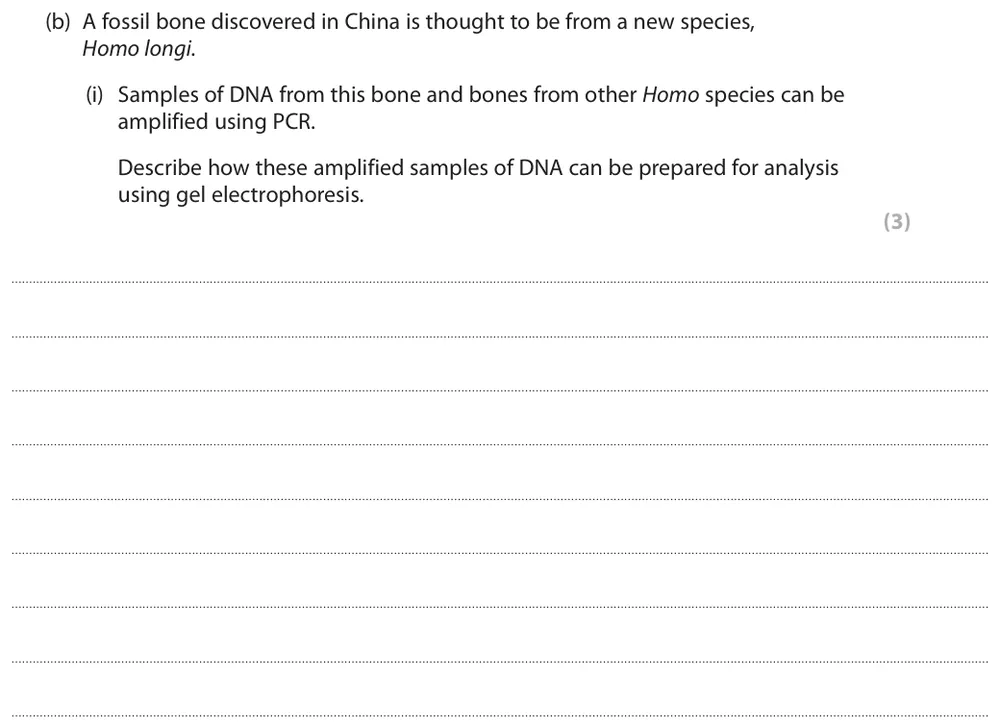
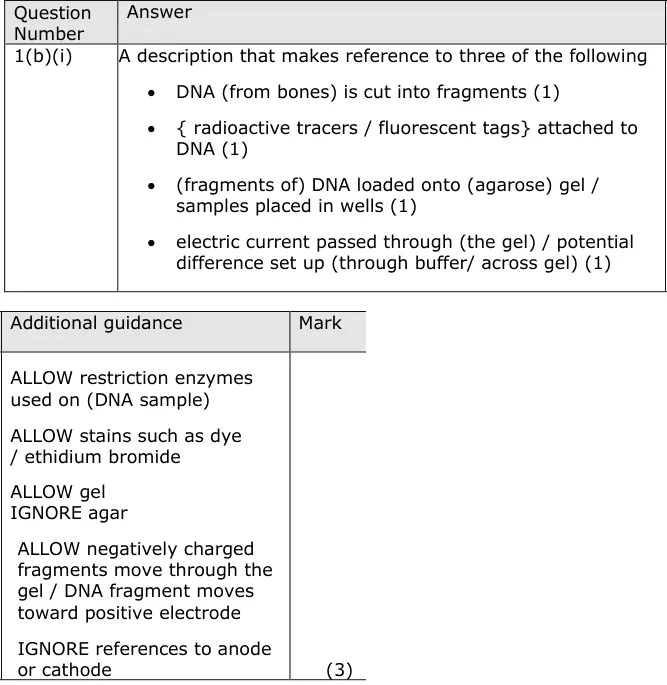
Describe how amplified DNA samples from fossil bones can be prepared for analysis using gel electrophoresis.
Show the mark scheme
Tap an image to open it full size.
From the examiners' report: Some started with a description of PCR, which did not answer the question, gained no marks and wasted time. Cut the DNA into fragments, add a stain or fluorescent tag, load the samples into wells in an agarose gel and pass an electric current through the gel.
Question 2
A level Paper 1 · November 2021 · Q2(b) · 4 marks
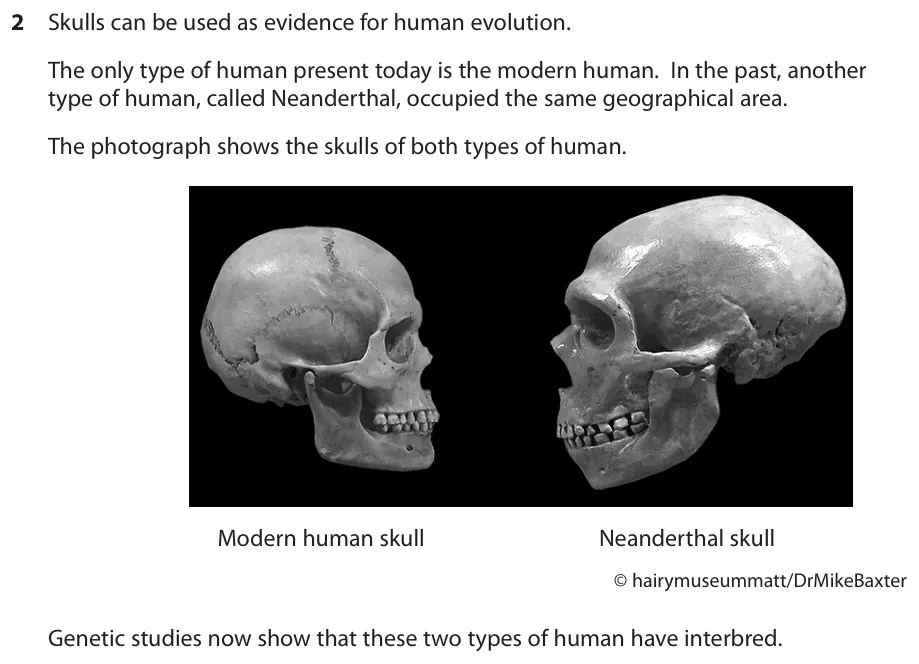
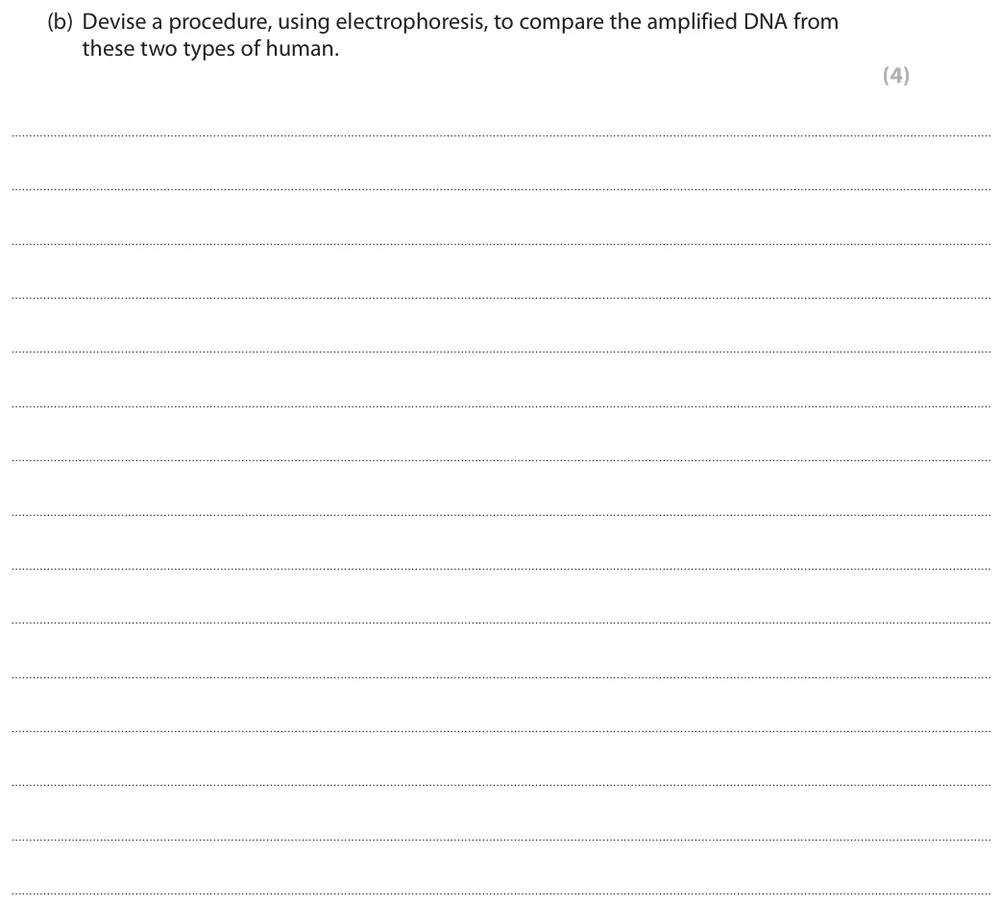
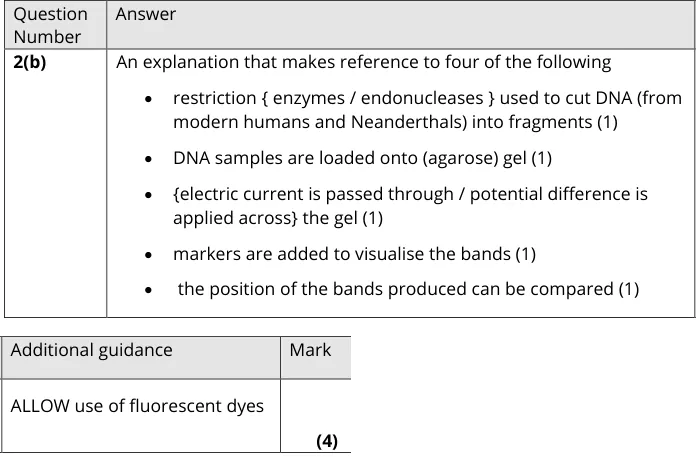
Devise a procedure using electrophoresis to compare the amplified DNA of modern humans and Neanderthals.
Information from earlier in this question:
Show the mark scheme
Tap an image to open it full size.
From the examiners' report: Many clearly described electrophoresis but lost marks by not explaining what was compared: the positions of the bands. Describing PCR at length was not required.
Question 3
A level Paper 1 · June 2025 · Q4(a)(ii) · 3 marks · Easy
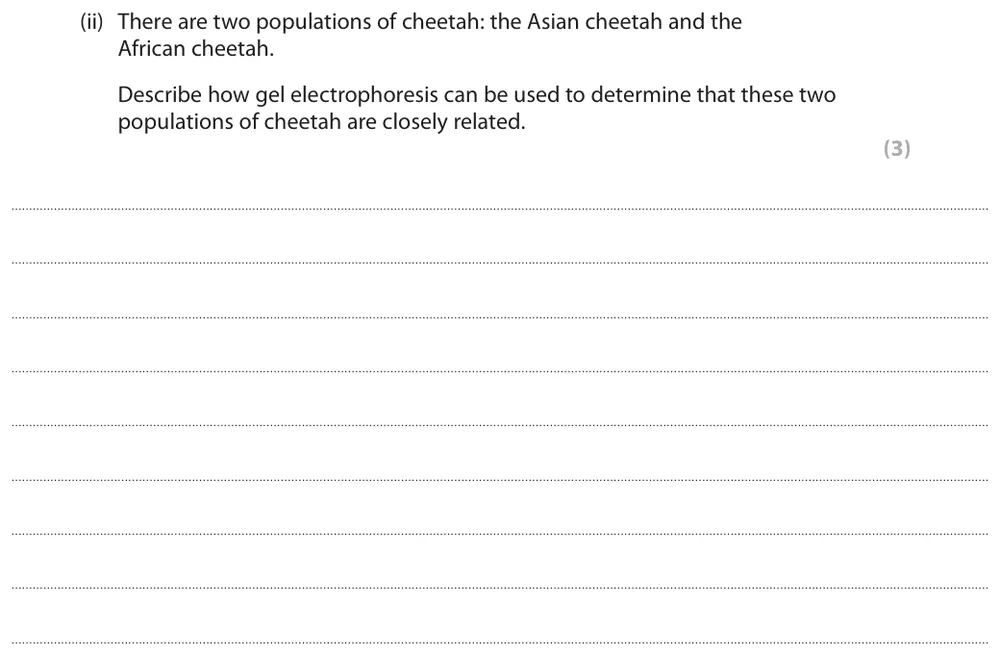
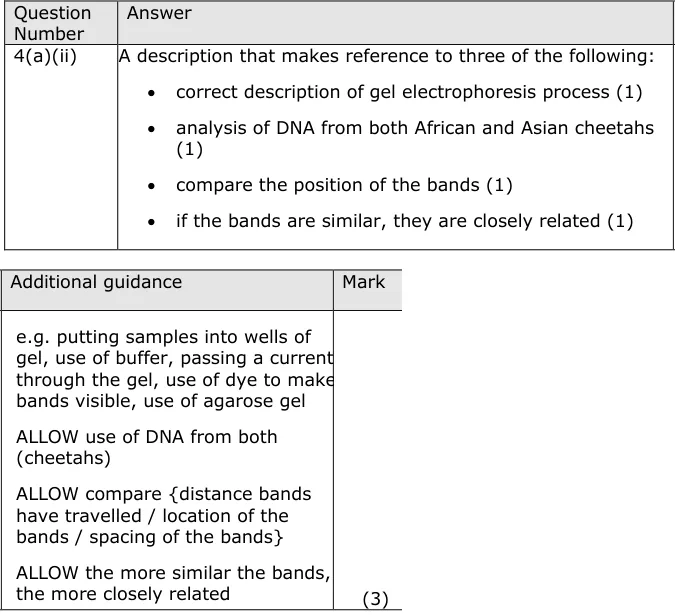
Describe how gel electrophoresis can show that Asian and African cheetahs are closely related.
Show the mark scheme
Tap an image to open it full size.
From the examiners' report: Well answered. Say agarose, not agar, and state that you are using DNA from both populations of cheetah. Compare the positions of the bands, not the fragments, which you cannot see; PCR was not required.
Core Practical 14: comparing DNA profiles
Question 4
A level Paper 1 · June 2019 · Q3(b) · 4 marks
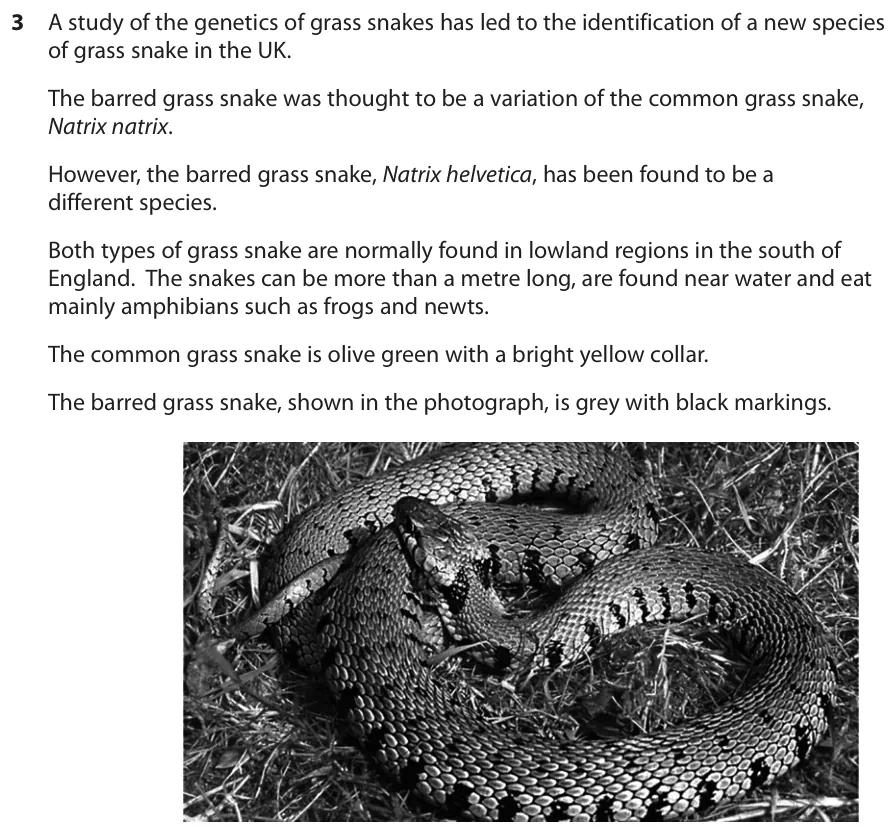
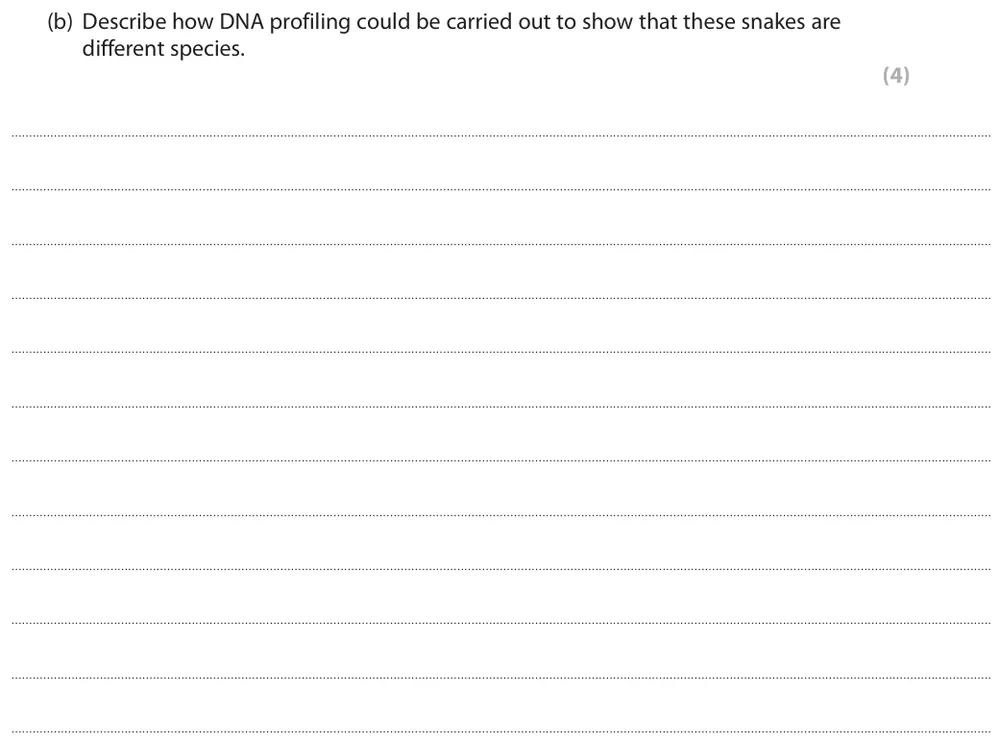
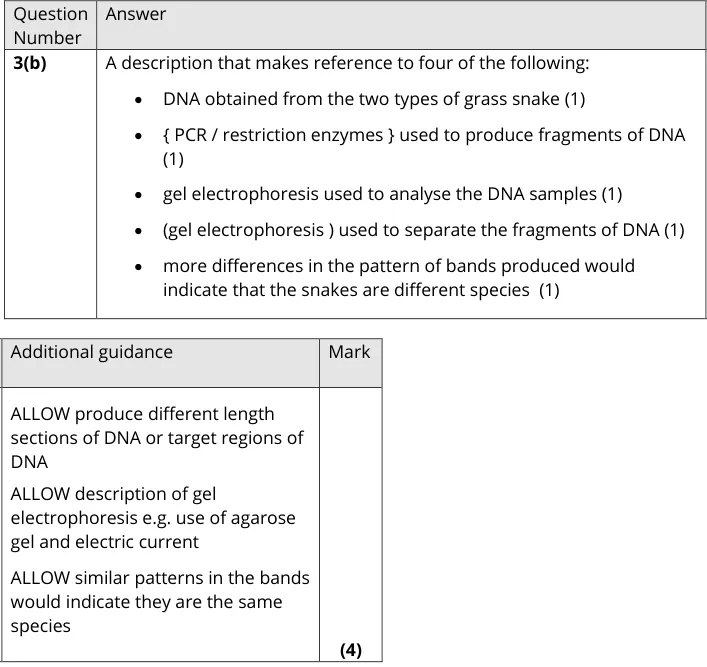
Describe how DNA profiling could show that two types of grass snake are different species.
Information from earlier in this question:
Show the mark scheme
Tap an image to open it full size.
From the examiners' report: Many gave a general description of DNA profiling, often with detailed PCR, without linking it to the snakes. STRs were not relevant here, and very few referred to fragments. More differences in the pattern of bands would show they are different species.
Question 5
A level Paper 3 · June 2018 · Q1(b) · 5 marks
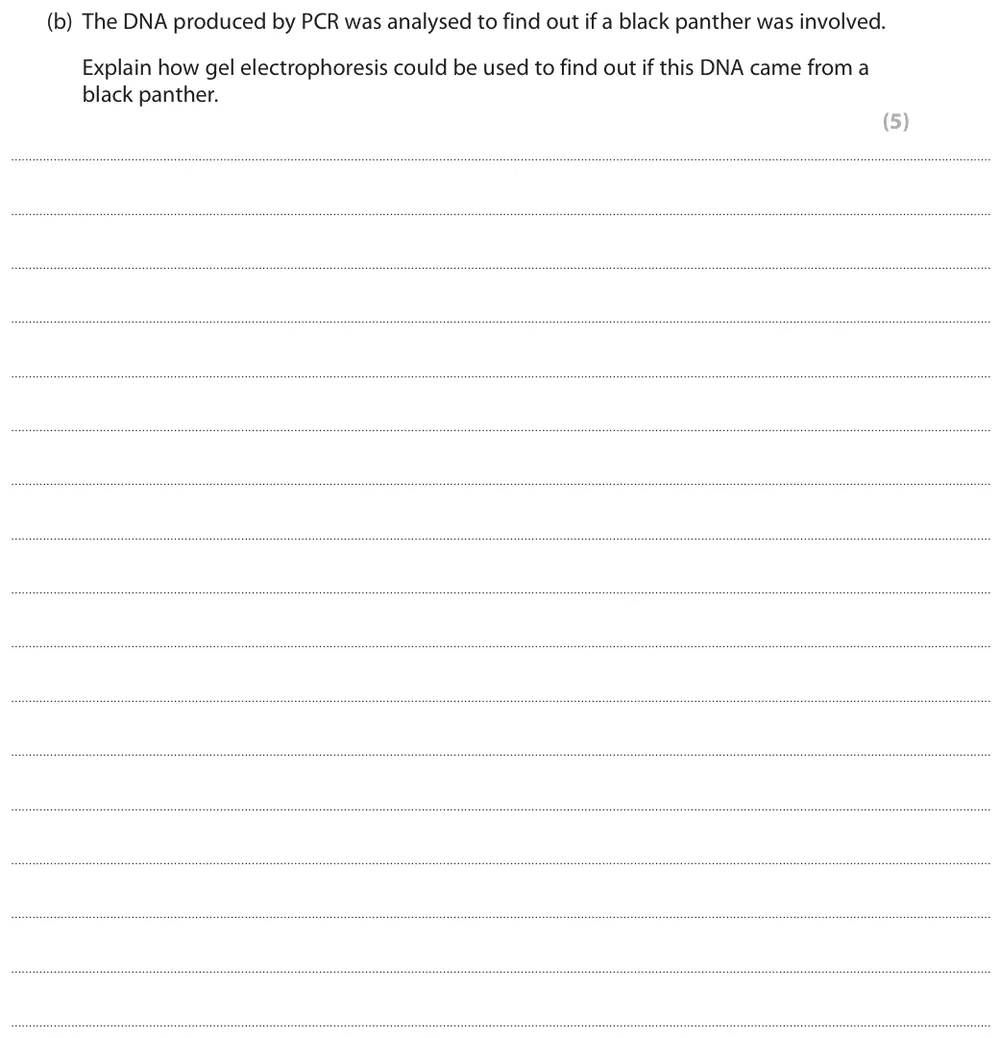
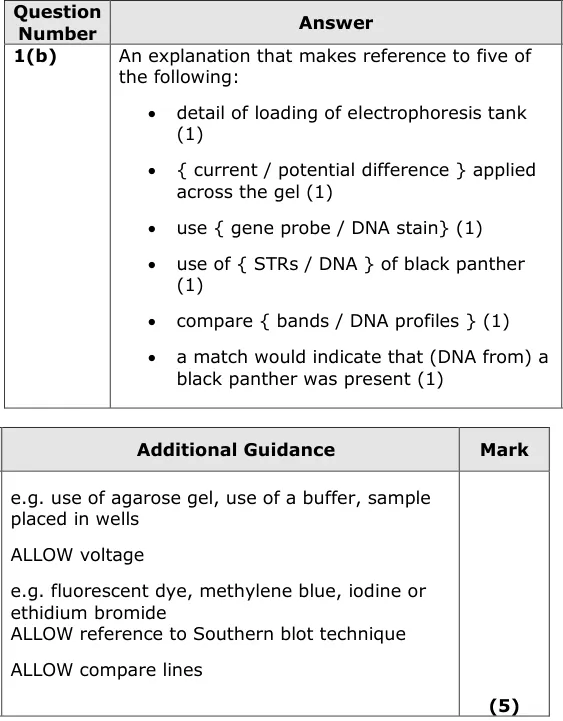
Explain how gel electrophoresis could find out whether DNA amplified by PCR came from a black panther.
Show the mark scheme
Tap an image to open it full size.
From the examiners' report: Link the process to the black panther. Common inaccuracies were agar instead of agarose, comparing 'results' rather than bands, and confusing the loading dye with a DNA stain. A match with black panther DNA would show a black panther was involved.
Core Practical 14: devising investigations with a gel
Question 6
A level Paper 3 · June 2025 · Q6(c) · 4 marks
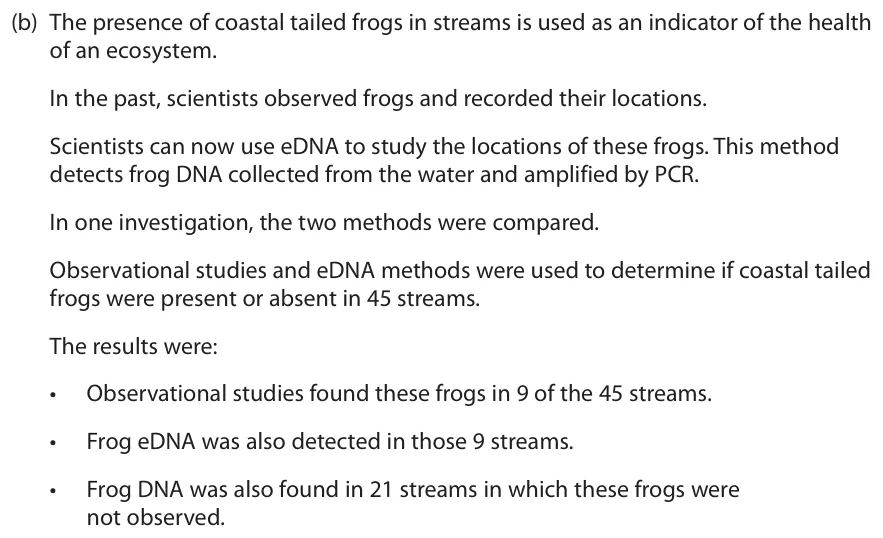
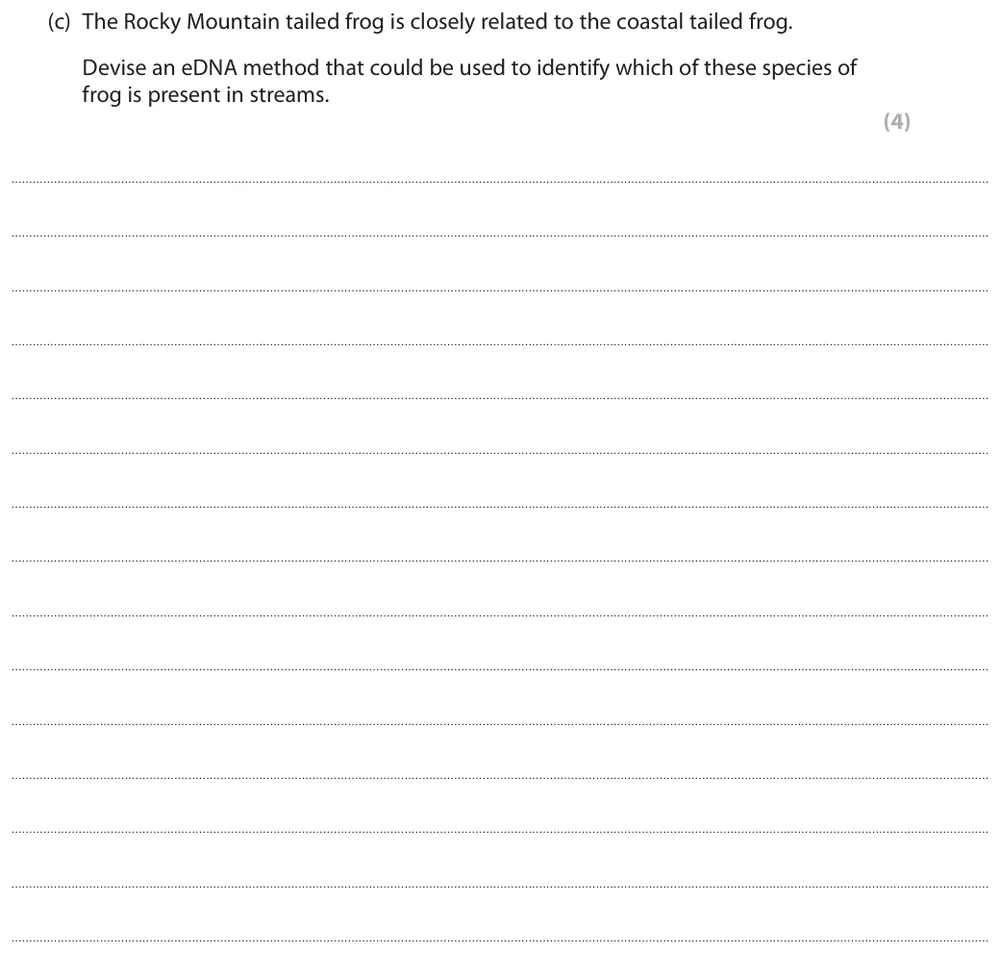
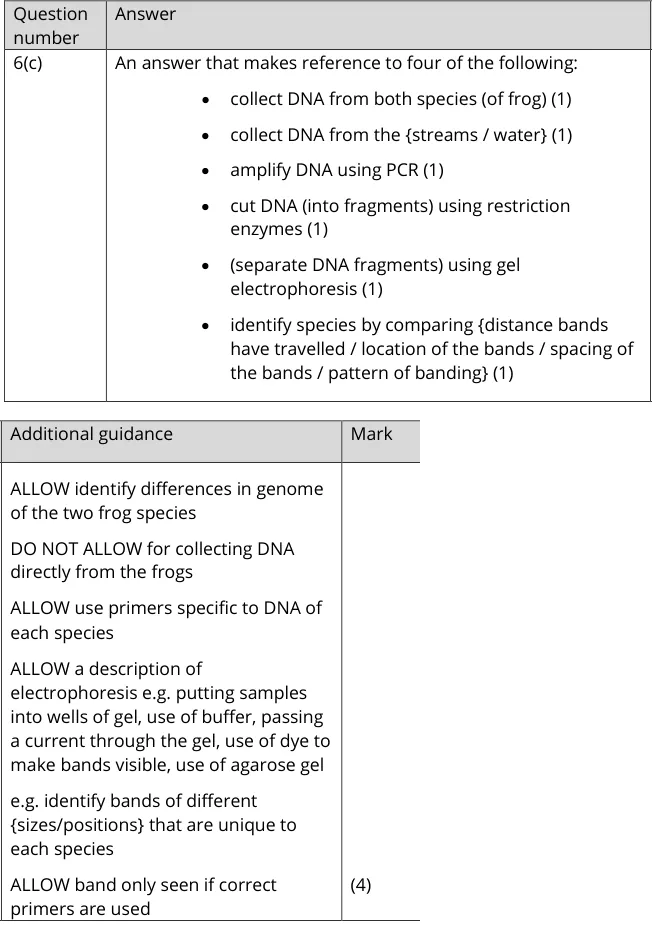
Devise an eDNA method to identify which of two closely related frog species is present in streams.
Information from earlier in this question:
Show the mark scheme
Tap an image to open it full size.
From the examiners' report: Many did not gain the first mark because they did not take DNA samples from both species of frog, as well as from the stream water. Many also did not refer to the position or location of the bands when identifying the species.
Question 7
A level Paper 3 · June 2022 · Q2(c) · 4 marks
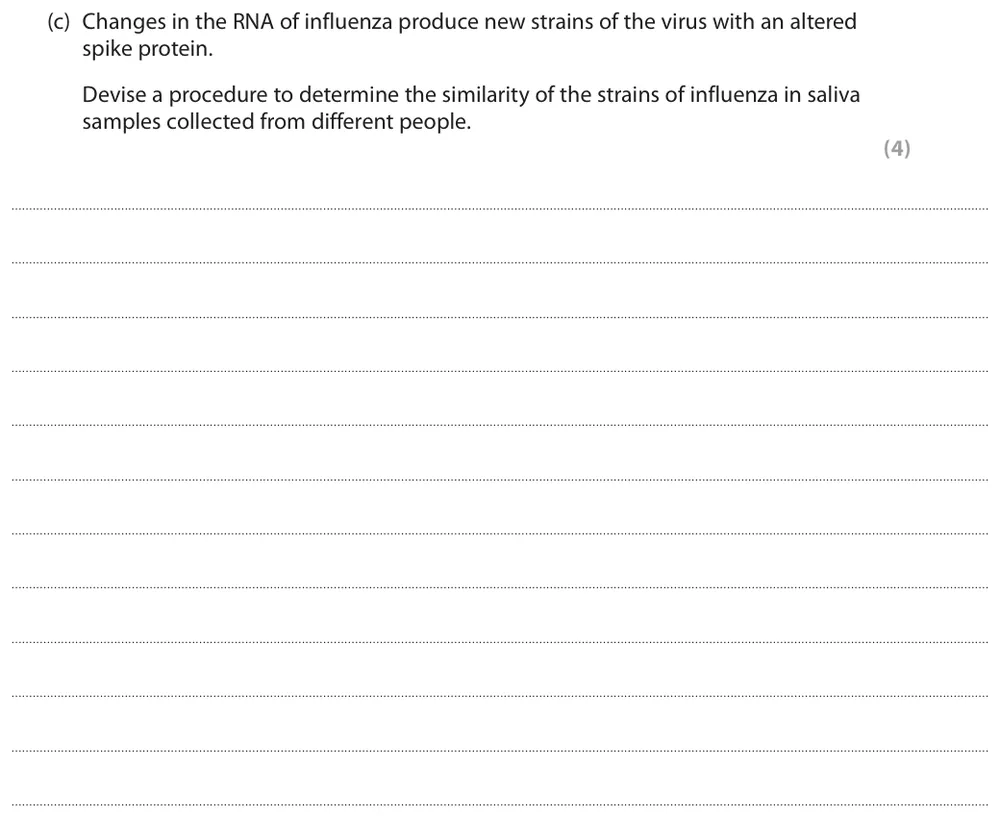
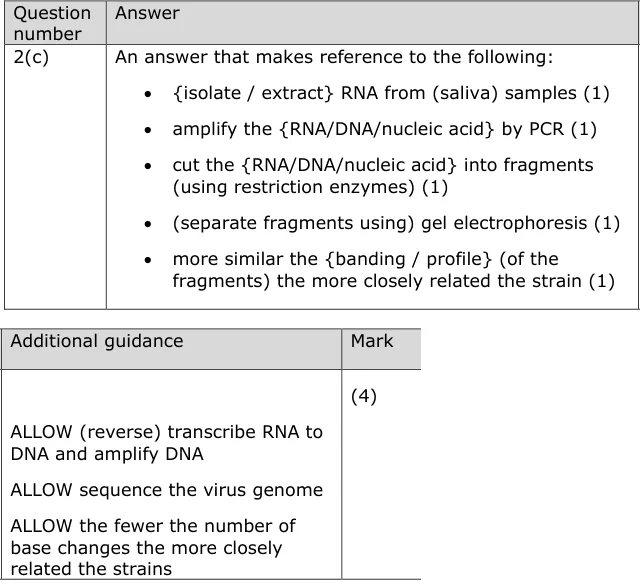
Devise a procedure to determine how similar the influenza strains in saliva samples from different people are.
Show the mark scheme
Tap an image to open it full size.
From the examiners' report: Collecting and amplifying 'saliva samples' without mentioning the viral RNA gained nothing. Few described producing fragments of the amplified material, and most struggled to explain the results: the more similar the banding pattern, the more closely related the strains.
Question 8
A level Paper 3 · October 2020 · Q5(b)(iii) · 4 marks
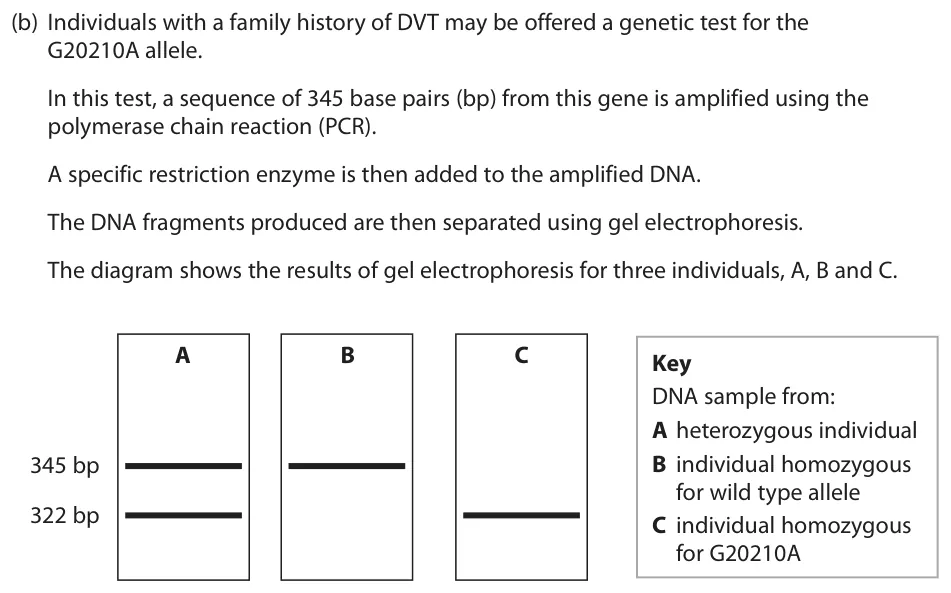
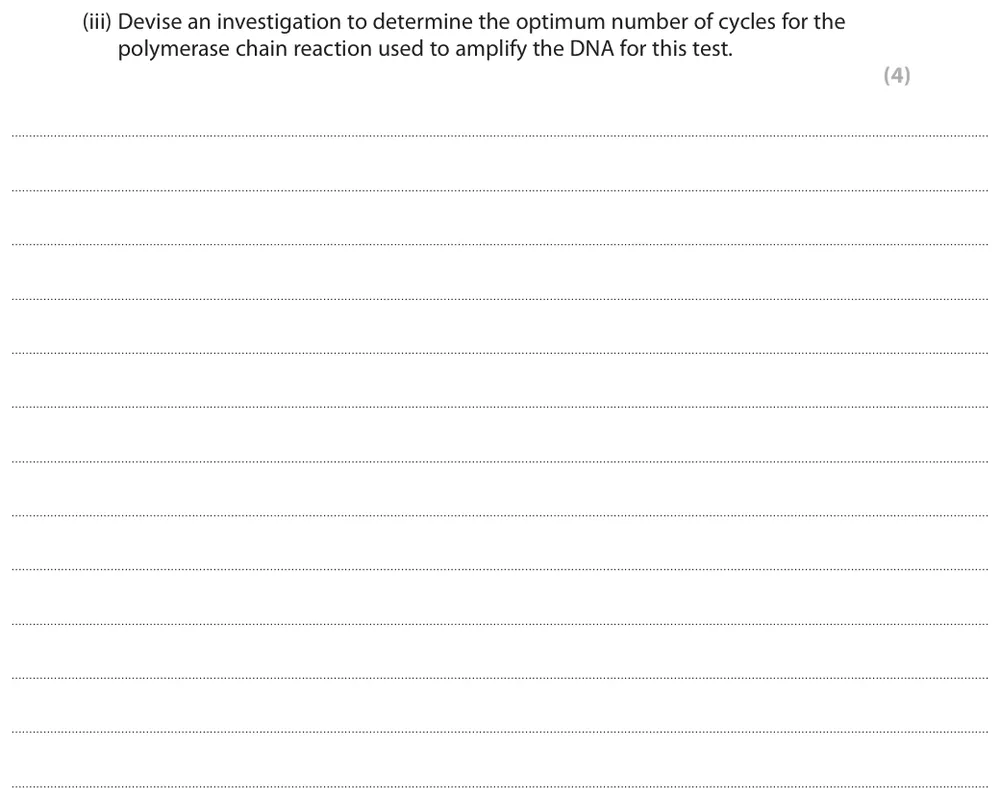
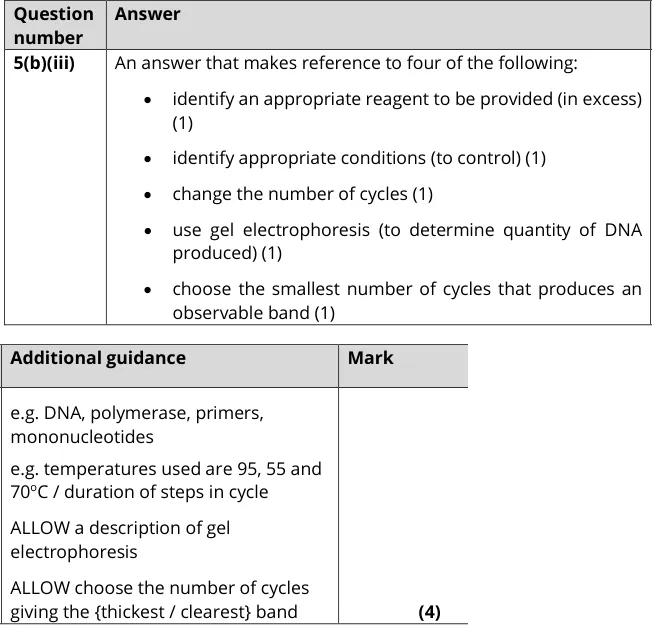
Devise an investigation to find the optimum number of PCR cycles, using gel electrophoresis.
Information from earlier in this question:
Show the mark scheme
Tap an image to open it full size.
From the examiners' report: Name a key reagent to provide in excess, such as primers or DNA polymerase. Make it clear that each temperature or step length in the cycle is kept the same: 'temperature should be kept constant' was not enough.
Core Practical 15: antibiotics and zones of inhibition
Question 9
A level Paper 1 · June 2025 · Q6(c)(i) · 4 marks
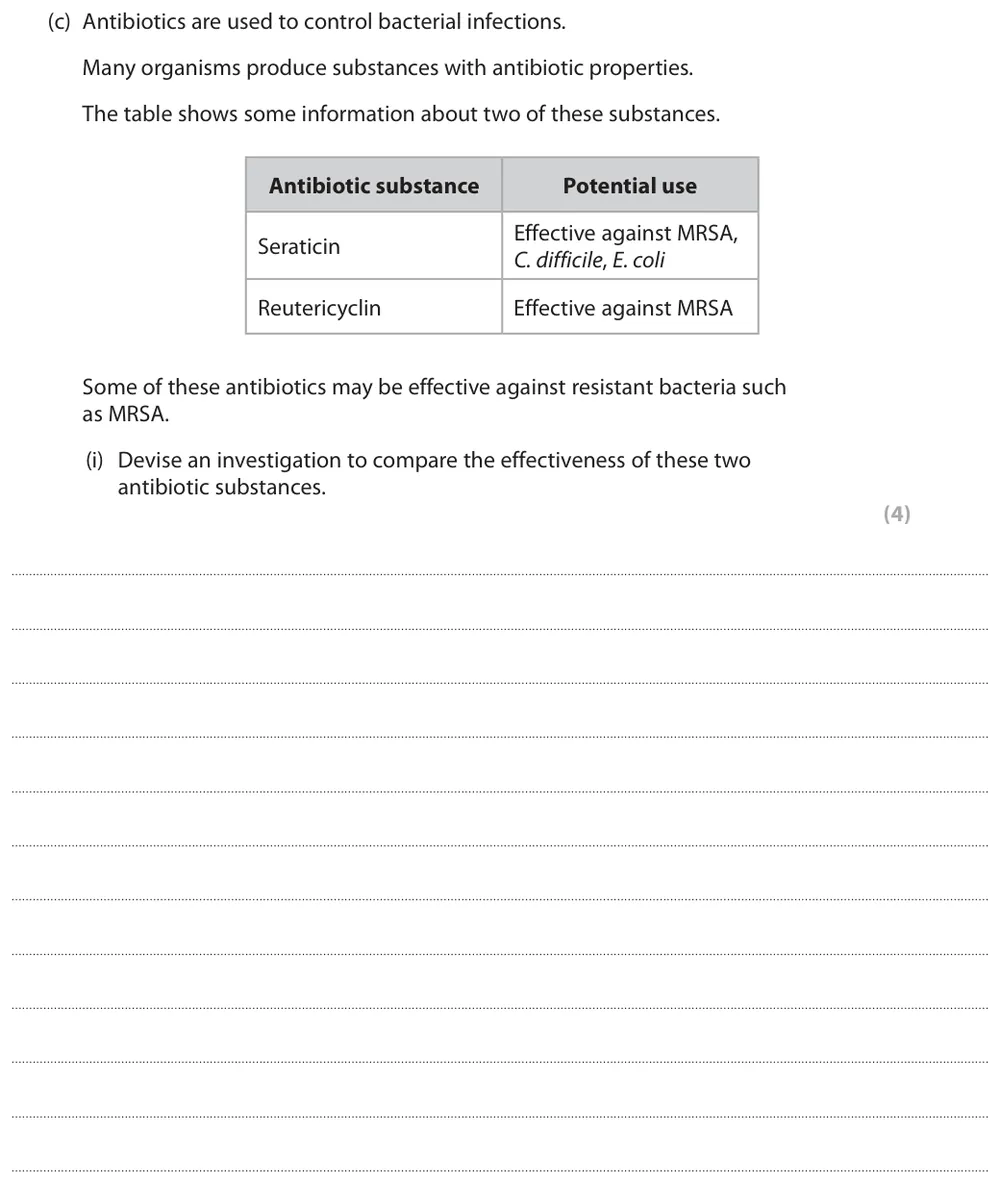
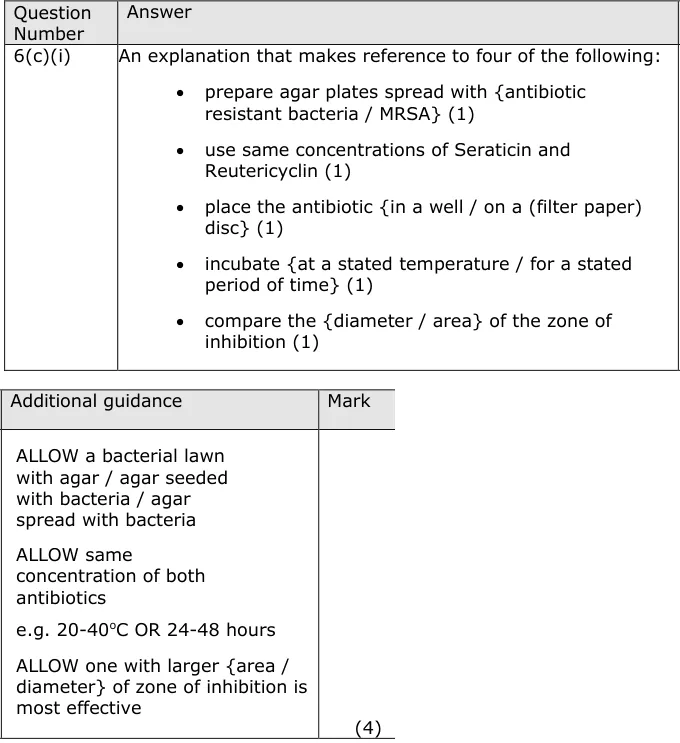
Devise an investigation to compare the effectiveness of two antibiotic substances against MRSA.
Show the mark scheme
Tap an image to open it full size.
From the examiners' report: Some missed a mark by adding bacteria to a Petri dish with no mention of agar, or by using agarose. Say which dimension of the zone of inhibition you would measure and compare, such as its diameter or area: 'measure the zone of inhibition' was not enough.
Question 10
A level Paper 3 · June 2025 · Q5(b)(ii) · 4 marks · Easy
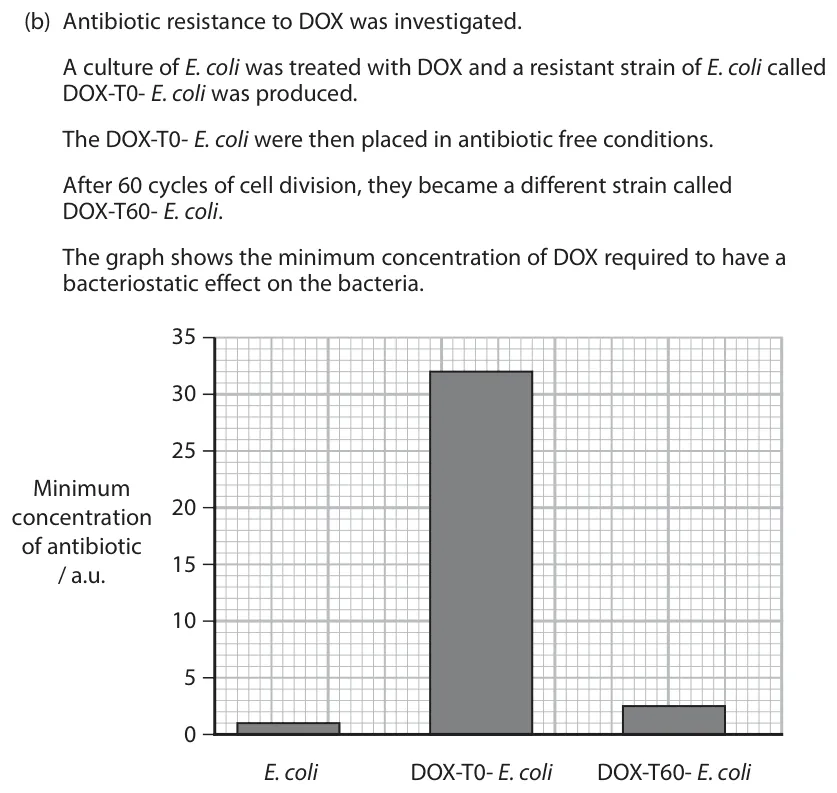
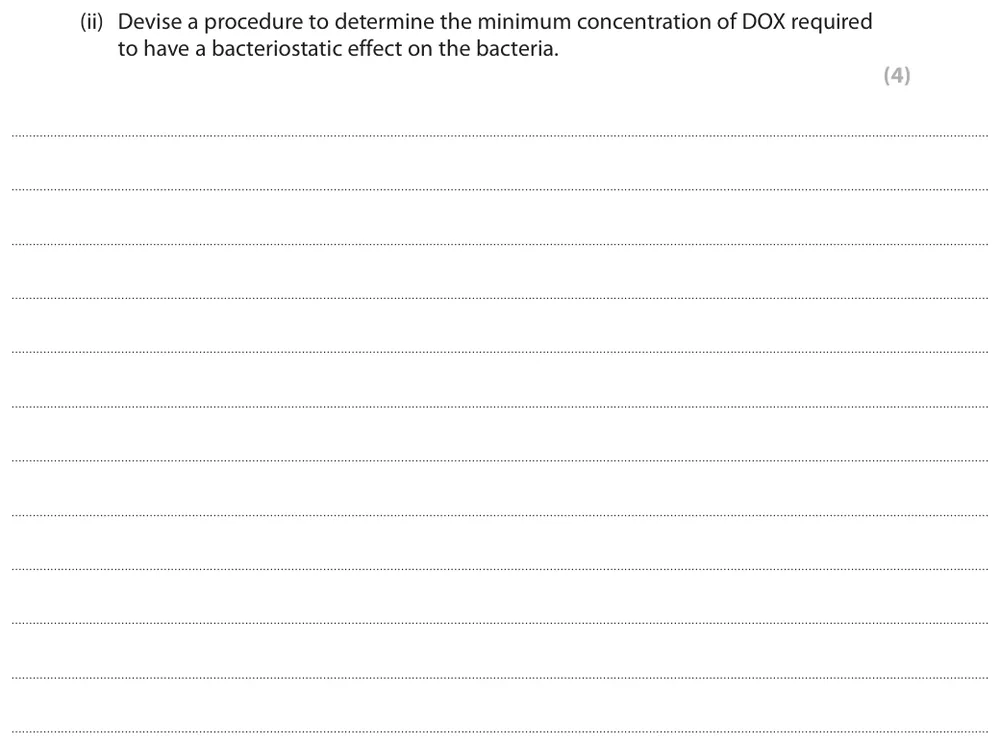
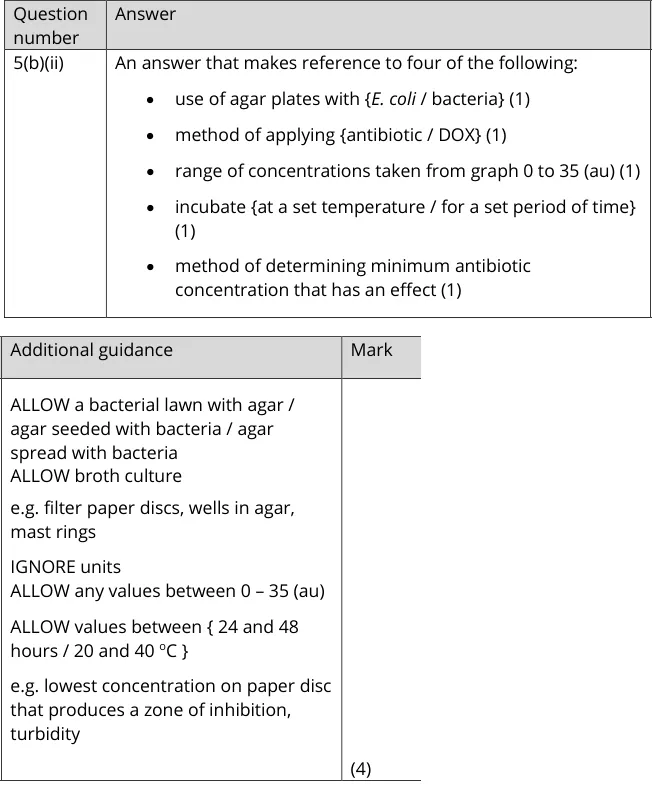
Devise a procedure to find the minimum concentration of DOX that has a bacteriostatic effect.
Information from earlier in this question:
Show the mark scheme
Tap an image to open it full size.
From the examiners' report: Specify agar plates, not just a Petri dish, and use a range of DOX concentrations taken from the graph. Few explained how they would use the zones of inhibition: find the lowest concentration disc that produces one.
Where students lose marks (from Pearson examiners' reports and mark schemes)
Each point below comes from the examiners' reports and mark schemes, and is followed by wording that gained marks.
Start with the gel, not with PCR. Some started with a description of PCR, which did not answer the question and gained no marks.
✔ Gains credit: 'Fragments of DNA are loaded into wells in an agarose gel and an electric current is passed through the gel.'
Say what is being compared on the gel. Marks were lost by not explaining what was compared.
✔ Gains credit: 'The position of the bands produced can be compared.'
You see bands, not fragments. Comparison of fragments was seen, which is not acceptable because the fragments cannot be seen.
✔ Gains credit: 'Compare the position of the bands; if the bands are similar, the cheetahs are closely related.'
Profile the snakes, and leave out STRs. Many gave a generalised account of DNA profiling and PCR, or referred to STRs, which were not relevant.
✔ Gains credit: 'Restriction enzymes are used to produce fragments of DNA; more differences in the pattern of bands would indicate they are different species.'
A loading dye is not a DNA stain. Candidates confused the loading dye with a DNA stain, and compared 'results' rather than bands.
✔ Gains credit: 'Use a gene probe or DNA stain, e.g. a fluorescent dye, methylene blue or ethidium bromide, then compare the bands with the DNA of a black panther.'
Take DNA from both frog species. Many did not state that DNA samples should be taken from both species of frog.
✔ Gains credit: 'Collect DNA from both species of frog, and collect DNA from the streams.'
Amplify the viral RNA, not the saliva. Several described collecting and amplifying saliva samples without mentioning the viral RNA.
✔ Gains credit: 'Extract RNA from the saliva samples and amplify it by PCR.'
Give the zone of inhibition a dimension. A number simply stated they would measure or compare the zone of inhibition.
✔ Gains credit: 'Compare the diameter or area of the zone of inhibition; the one with the larger zone is the more effective.'
Download the questions
Download the PDF pack (10 questions, mark schemes at the end)
Keep practising
- Forensics, DNA Profiling and PCR (Topic 6): Edexcel SNAB exam questions by topic
- Pathogens, Immunity and Antibiotics (Topic 6): Edexcel SNAB exam questions by topic
- Edexcel SNAB A level Biology revision resources by topic (every topic and core practical page)
- Edexcel SNAB Topic 6 Multiple-Choice Quiz: Immunity, Infection and Forensics
- Edexcel SNAB A level Biology past papers, mark schemes and examiners' reports
- Edexcel SNAB A level Biology grade boundaries
- Message Tom on WhatsApp about one-to-one Edexcel SNAB tutoring or an Edexcel group class
Questions, mark schemes and examiners' report extracts © Pearson Education Ltd.