

Senses, Plant Responses, the Brain and Learning covers the detection of stimuli, plant responses and brain development in Topic 8, Grey Matter, of the Edexcel A level Biology A (Salters-Nuffield) specification. You need to understand how rod cells detect light using rhodopsin, sodium ions and hyperpolarisation, how phytochrome and IAA bring about plant responses, where the main brain regions are and what they do, and how MRI, fMRI, PET and CT scans are used. You also need to know what happens during the critical period for vision, how animal models are used in brain research, and how animals learn by habituation. These questions come from A level Papers 2 and 3. All questions are from the A level papers (9BN0).
The examiners' reports keep warning about answering the question set. Students writing a textbook account of phototropism, normal synaptic transmission or how a scan is carried out lost marks when the question asked about data, habituation or the advantages of a scan. Put rod cell answers in the context of light or dark, write retinal rather than retinol, and say that cells elongate, not the plant. For fMRI, link more brain activity to more blood flow and oxyhaemoglobin.
Studying Edexcel SNAB and want more help? If you'd like to arrange one-to-one Edexcel tutoring, or to register your interest in an Edexcel group class, message Tom on WhatsApp using the link at the bottom of this page.
What you need from GCSE
Each question on this page assumes you're secure on these ideas. If any of them feels shaky, look it up before you start.
- The eye has a retina containing light-sensitive cells, an iris that controls the size of the pupil, and an optic nerve.
- Plant shoots grow towards light and roots grow in the direction of gravity; these responses are controlled by auxin.
- The brain has regions with different functions, such as the cerebral cortex and the cerebellum.
- Neurones pass impulses to each other across synapses using chemical neurotransmitters.
Key terms
These words come up in the questions and mark schemes. Examiners expect you to use them exactly.
- Rhodopsin: the light-sensitive pigment in rod cells, made of opsin and retinal; light breaks it down.
- Hyperpolarisation: the inside of a cell becomes more negative than the resting potential; rod cells hyperpolarise in the light.
- Phytochrome: a photosensitive plant pigment with an inactive form (PR) and an active form (PFR), interconverted by red and far-red light.
- IAA (auxin): a plant hormone made in shoot tips that stimulates cell elongation.
- Ocular dominance columns: columns of cells in the visual cortex that receive impulses from one eye.
- Critical period: a time early in life when visual stimulation is needed for connections in the visual cortex to develop.
- fMRI: functional MRI: shows active brain areas by detecting oxyhaemoglobin in increased blood flow.
- Habituation: learning to ignore a repeated, non-threatening stimulus.
What these questions cover (Edexcel SNAB Topic 8: Grey Matter)
The questions test these statements from Topic 8 of the Pearson Edexcel A level Biology A (Salters-Nuffield) specification (9BN0).
- 8.5 Understand how the nervous systems of organisms can detect stimuli with reference to rods in the retina of mammals, the roles of rhodopsin, opsin, retinal, sodium ions, c
- 8.6 Understand how phytochrome and IAA bring about responses in plants to environmental cues, including their effects on transcription.
- 8.8 Know the location and functions of the cerebral hemispheres, hypothalamus, cerebellum and medulla oblongata in the human brain.
- 8.9 Understand how magnetic resonance imaging (MRI), functional magnetic resonance imaging (fMRI), positron emission tomography (PET) and computed tomography (CT) scans are u
- 8.10 Understand what happens during the critical period so that mammals can develop their visual capacities to the full.
- 8.11 Understand the role animal models have played in the research into human brain development and function, including Hubel and Wiesel’s experiments with monkeys and kittens
- 8.13 Understand how animals, including humans, can learn by habituation.
How to use this page
Write your answer on paper before you open the mark scheme. Allow about 1.2 minutes per mark: the 20 questions are worth 60 marks, so about 72 minutes in total. Then mark your answer strictly against the mark scheme and read the examiners' tip underneath it. If you'd rather print the questions, download the PDF pack.
Rod cells and the detection of light (8.5)
Question 1
A level Paper 2 · June 2019 · Q9(c) · 3 marks
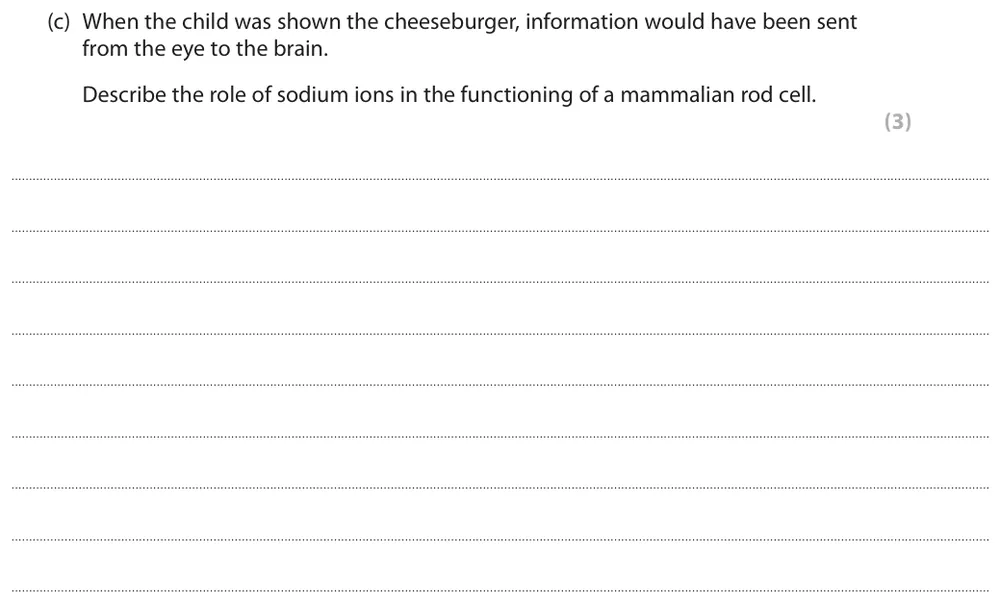
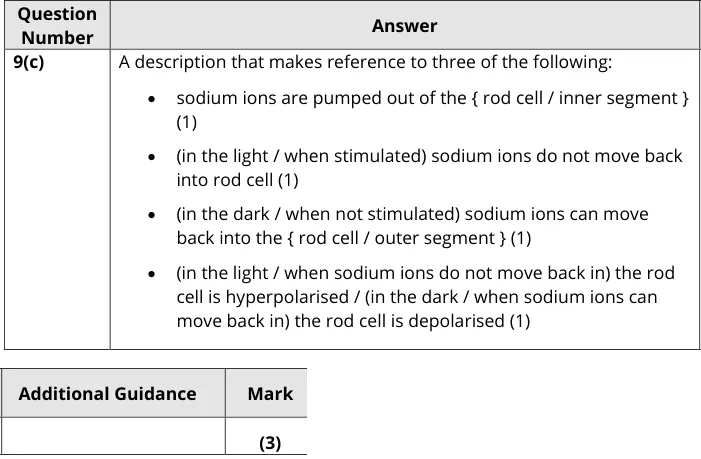
Describe the role of sodium ions in the functioning of a mammalian rod cell.
Show the mark scheme
Tap an image to open it full size.
From the examiners' report: Put each point in context. Sodium ions are pumped out of the rod cell; in the dark they move back in and the cell is depolarised, but in the light they do not, so it is hyperpolarised. 'Sodium ions move back in' without 'in the dark' was not credited.
Question 2
A level Paper 2 · November 2021 · Q10(a) · 5 marks
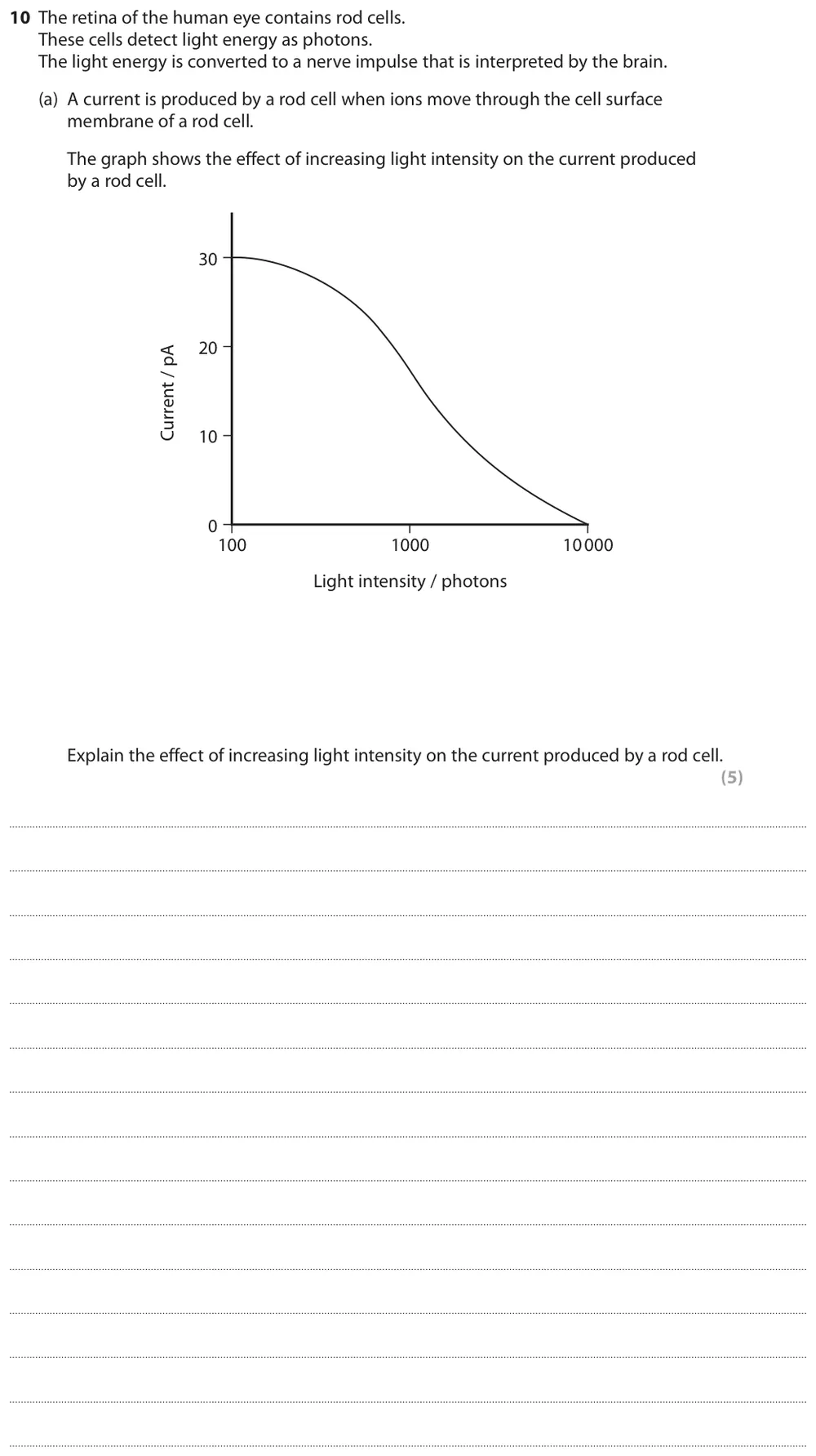
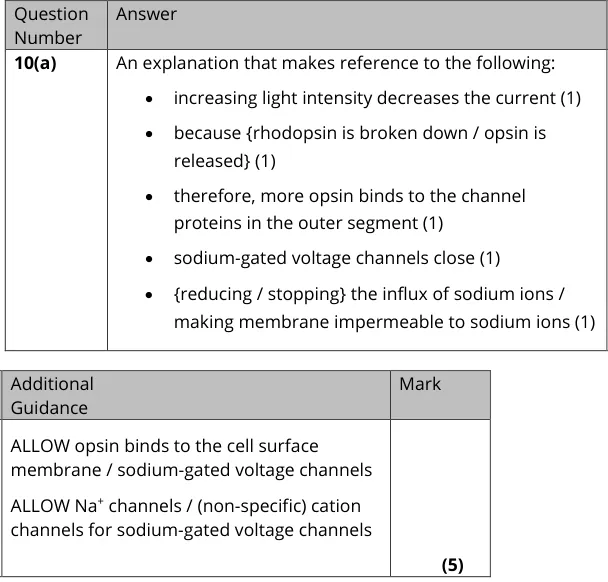
Explain the effect of increasing light intensity on the current produced by a rod cell.
Show the mark scheme
Tap an image to open it full size.
From the examiners' report: A typical answer gained only one mark. State the trend (current decreases as light intensity increases), then explain it: rhodopsin is broken down, opsin binds to the channel proteins, sodium ion channels close and the influx of sodium ions stops.
Question 3
A level Paper 2 · June 2023 · Q9(b) · 4 marks
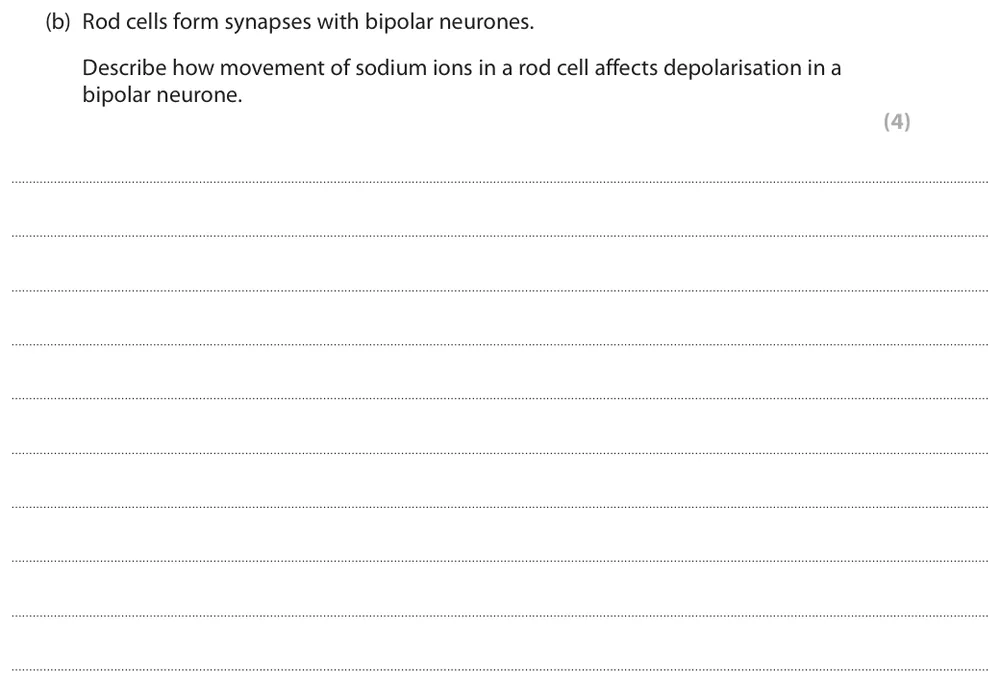
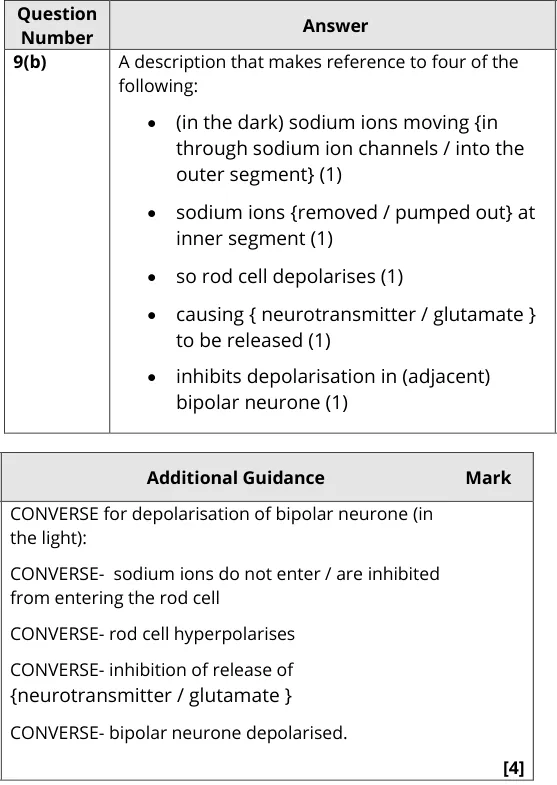
Describe how the movement of sodium ions in a rod cell affects depolarisation in a bipolar neurone.
Show the mark scheme
Tap an image to open it full size.
From the examiners' report: A minority did not notice the question names two cells. Follow the chain: in the dark sodium ions enter the rod cell, it depolarises and releases glutamate, which inhibits depolarisation of the bipolar neurone; the converse happens in the light.
Question 4
A level Paper 2 · June 2024 · Q7(b)(i) · 2 marks
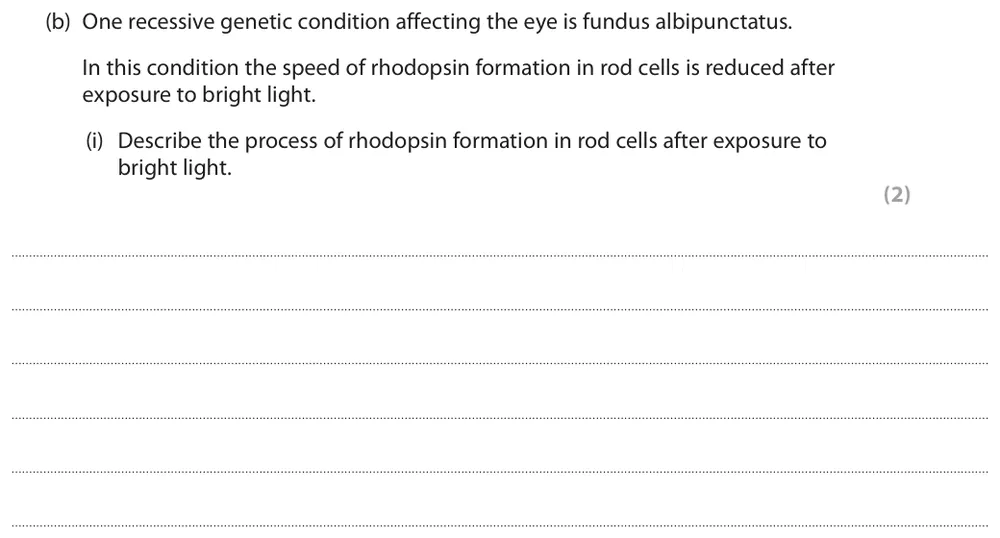
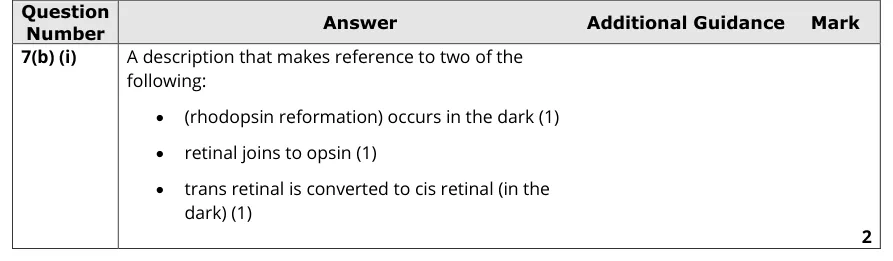
Describe how rhodopsin forms again in rod cells after exposure to bright light.
Show the mark scheme
Tap an image to open it full size.
From the examiners' report: Some confused retinal with retinol, and some described the breakdown of rhodopsin instead of its formation. In the dark, trans retinal is converted to cis retinal and joins to opsin.
Phytochrome, IAA and plant responses (8.6)
Question 5
A level Paper 2 · October 2020 · Q3(a) · 4 marks
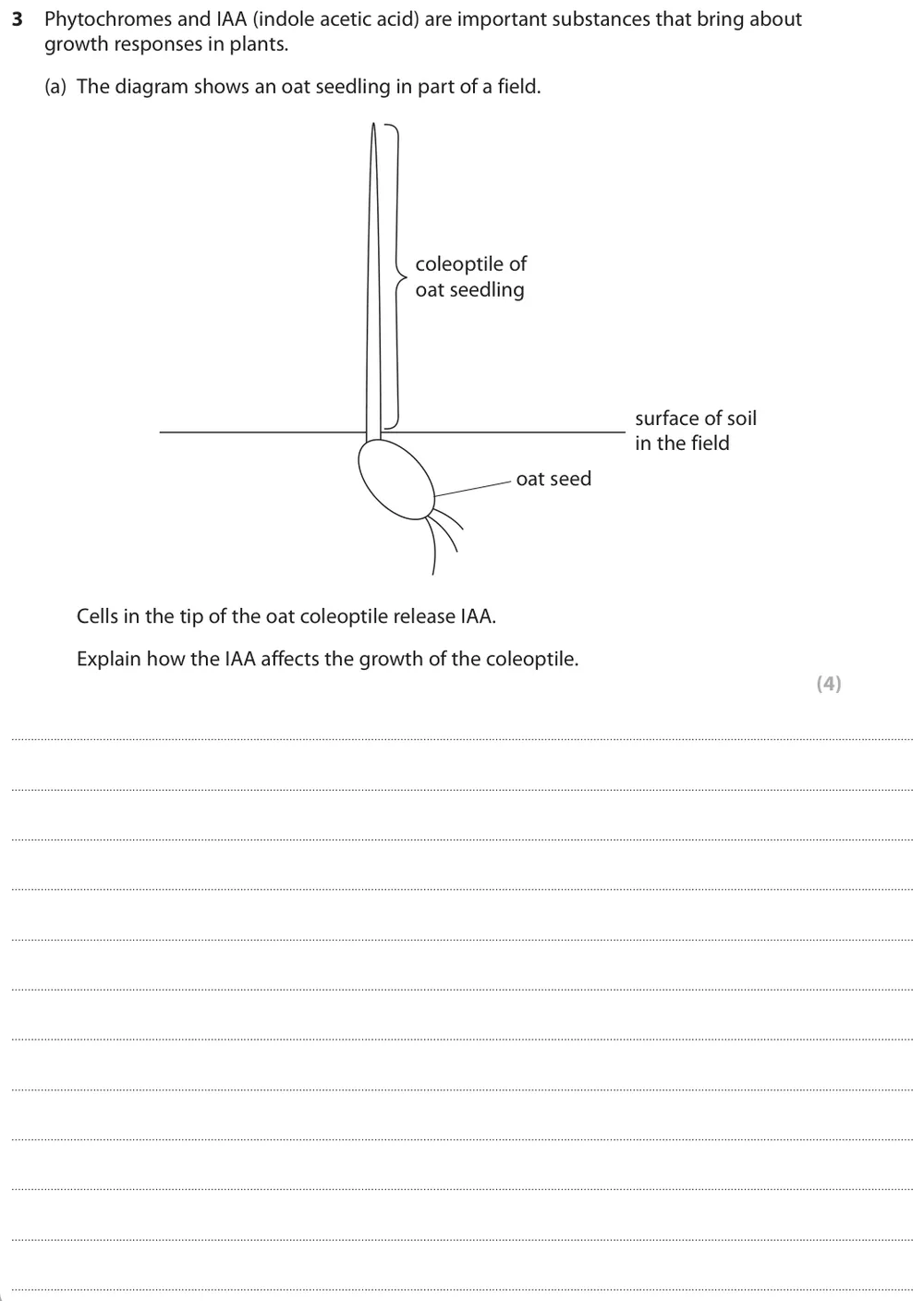
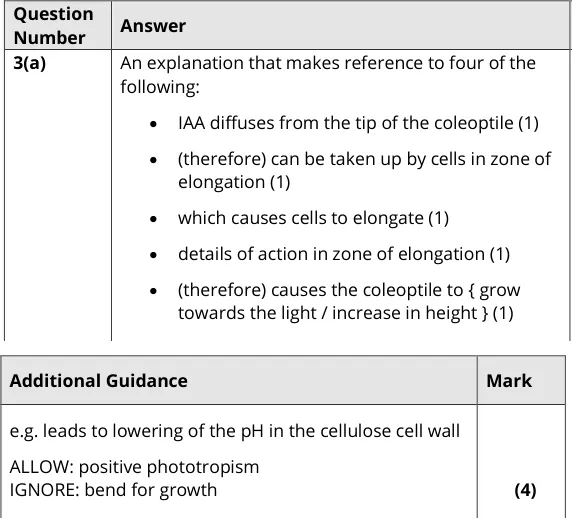
Explain how IAA released from the coleoptile tip affects the growth of an oat coleoptile.
Show the mark scheme
Tap an image to open it full size.
From the examiners' report: Many answered as if light came from one side, which the question did not say. IAA diffuses from the tip to the zone of elongation, where it causes cells to elongate, so the coleoptile increases in height.
Question 6
A level Paper 3 · June 2019 · Q5(b)(i) · 3 marks · Hard
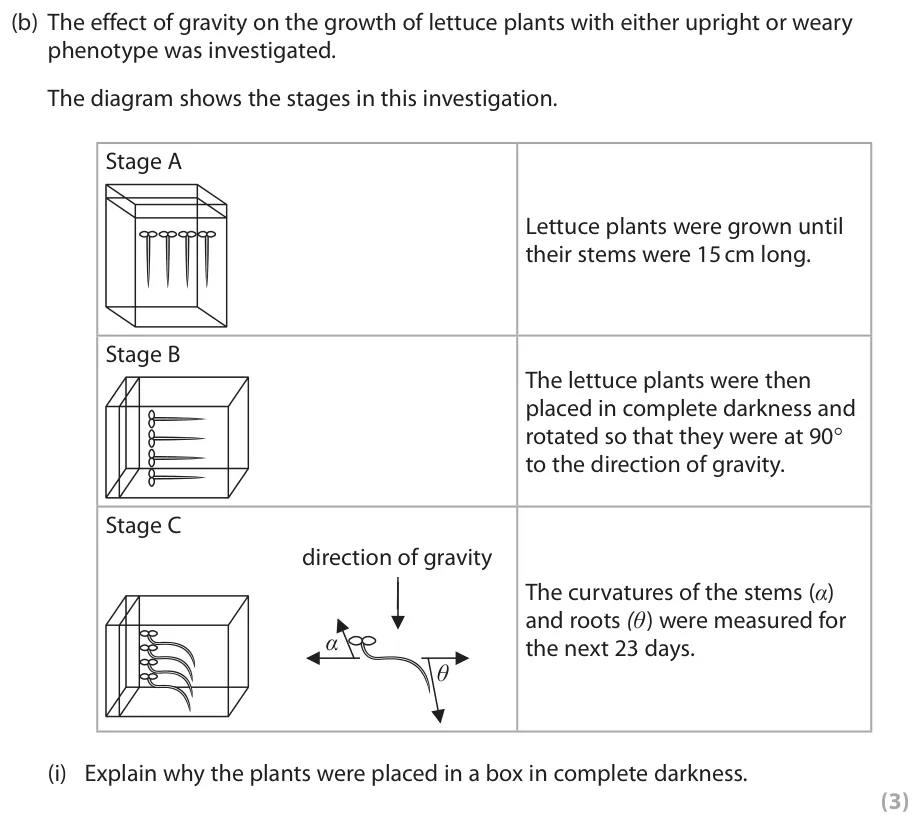
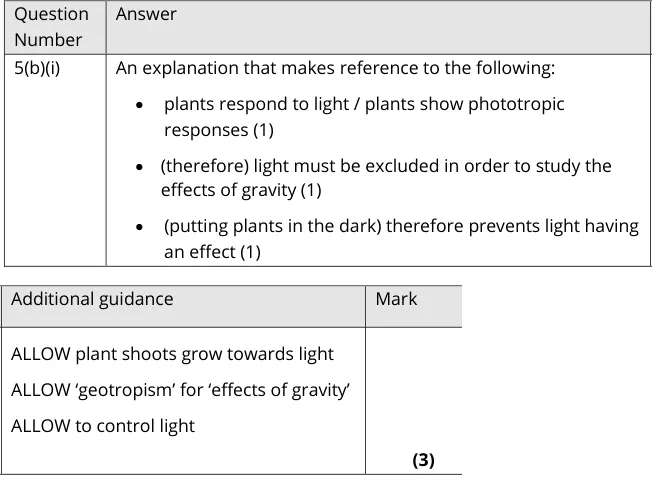
Explain why lettuce plants in a gravity investigation were kept in complete darkness.
Show the mark scheme
Tap an image to open it full size.
From the examiners' report: Most said plants respond to light but stopped there. Light must be excluded to study the effect of gravity, because light would otherwise affect the direction of growth.
Question 7
A level Paper 3 · November 2021 · Q1(b) · 4 marks
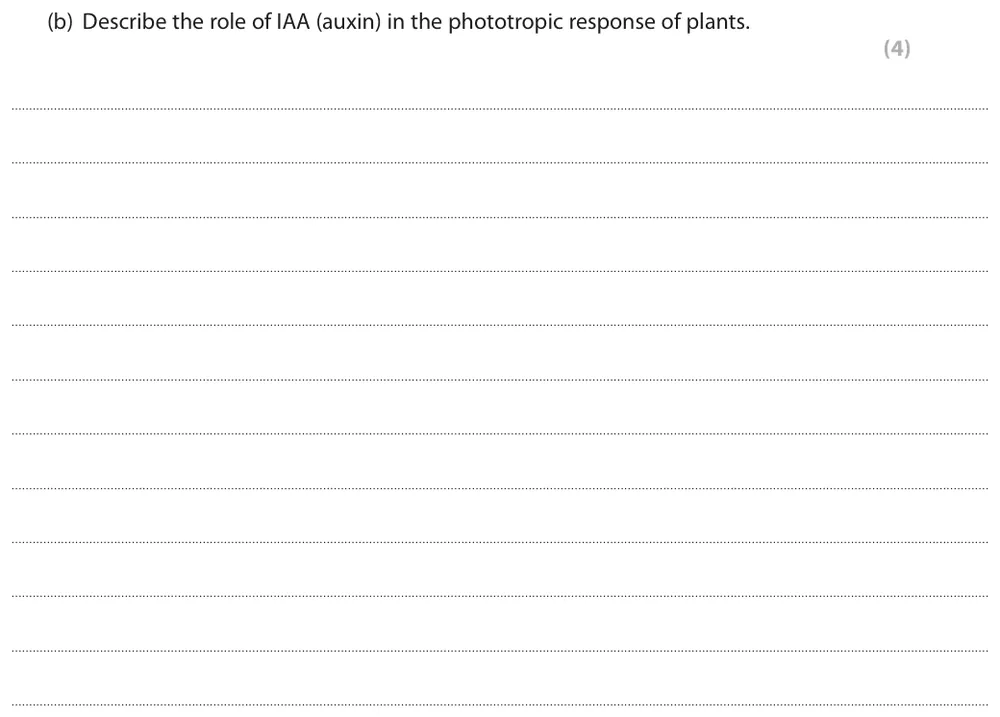
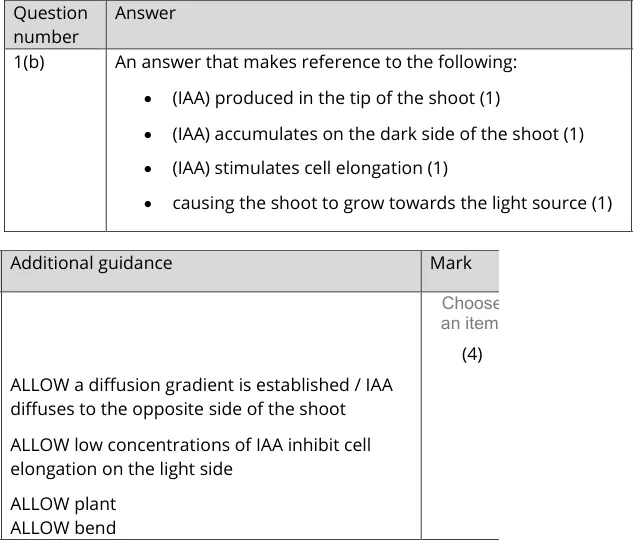
Describe the role of IAA in the phototropic response of plants.
Show the mark scheme
Tap an image to open it full size.
From the examiners' report: Few said IAA is produced in the shoot tip. Refer to cells elongating: 'the side of the plant elongates' was not credited.
Question 8
A level Paper 3 · June 2022 · Q1(c) · 3 marks · Hard
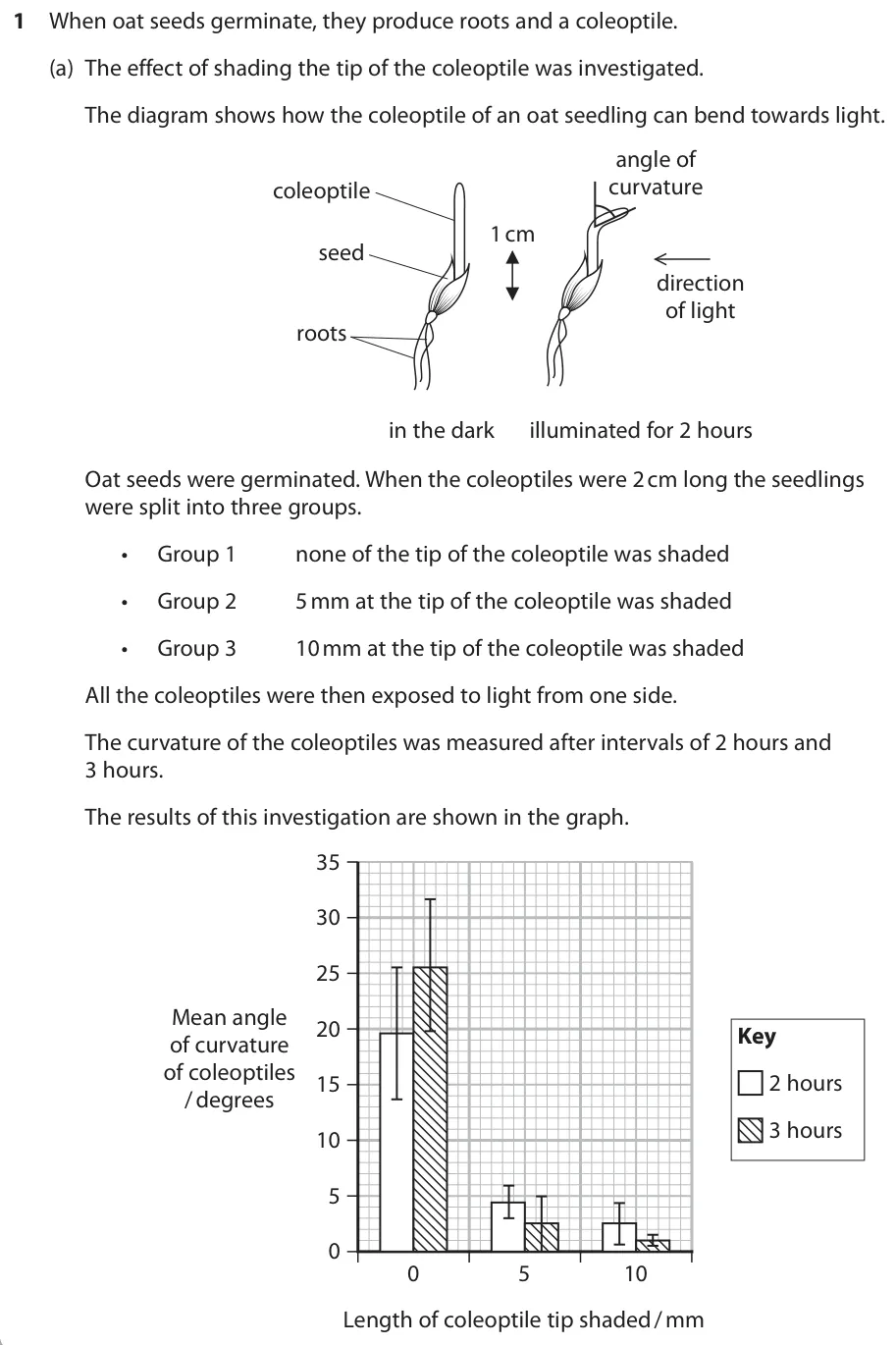
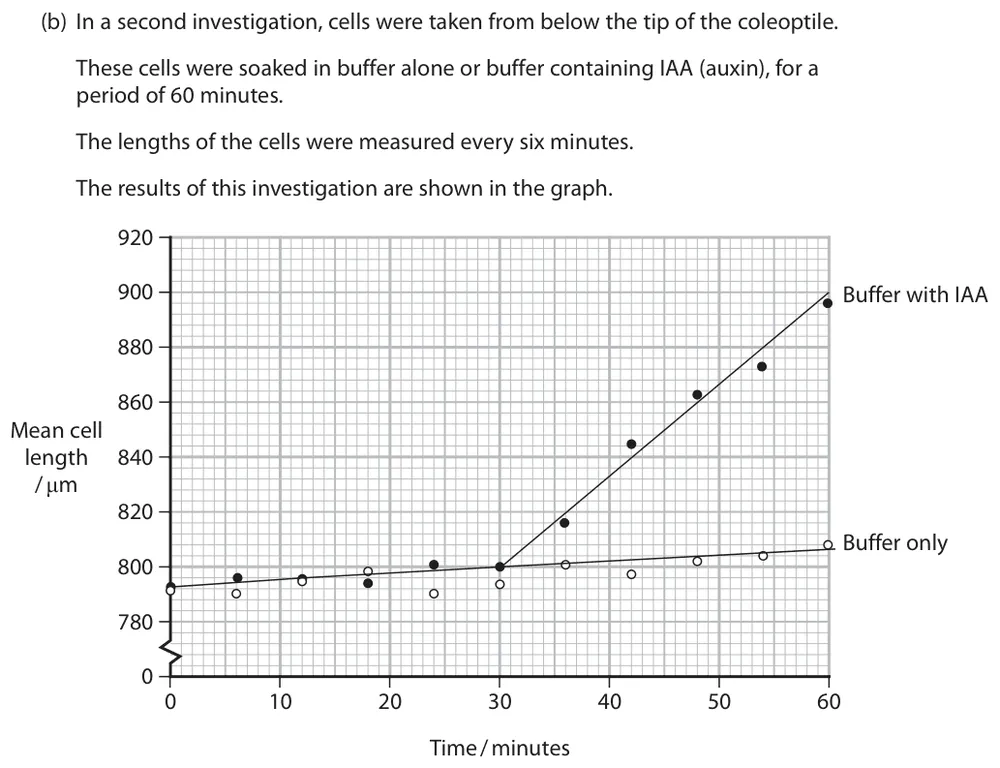
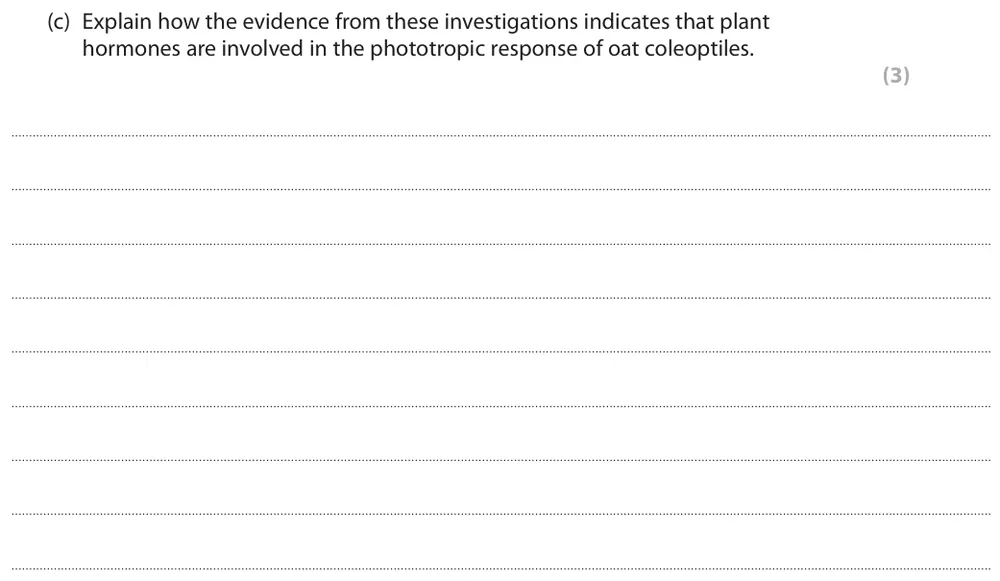
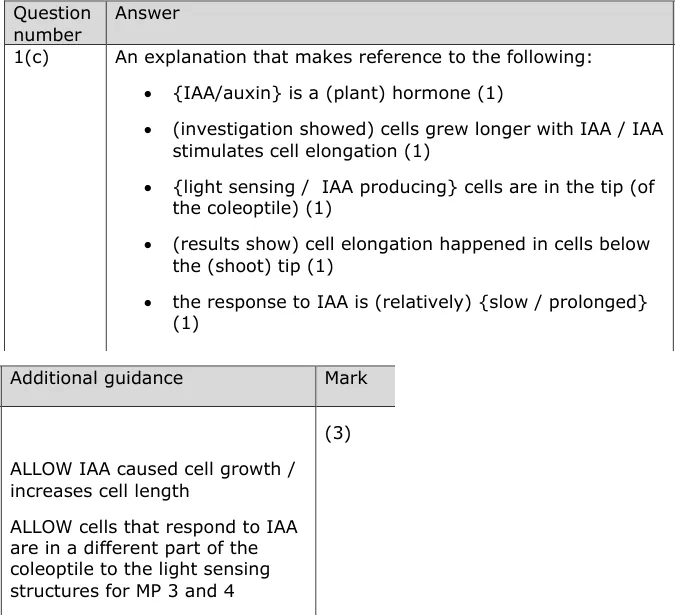
Explain how evidence from coleoptile investigations shows that plant hormones are involved in phototropism.
Information from earlier in this question:
Show the mark scheme
Tap an image to open it full size.
From the examiners' report: Challenging: many ignored the investigations and wrote a textbook account of IAA in phototropism. Use the evidence, for example that cells grew longer with IAA and that elongation happened below the tip, where light is sensed.
Question 9
A level Paper 2 · June 2024 · Q8(b)(ii) · 3 marks
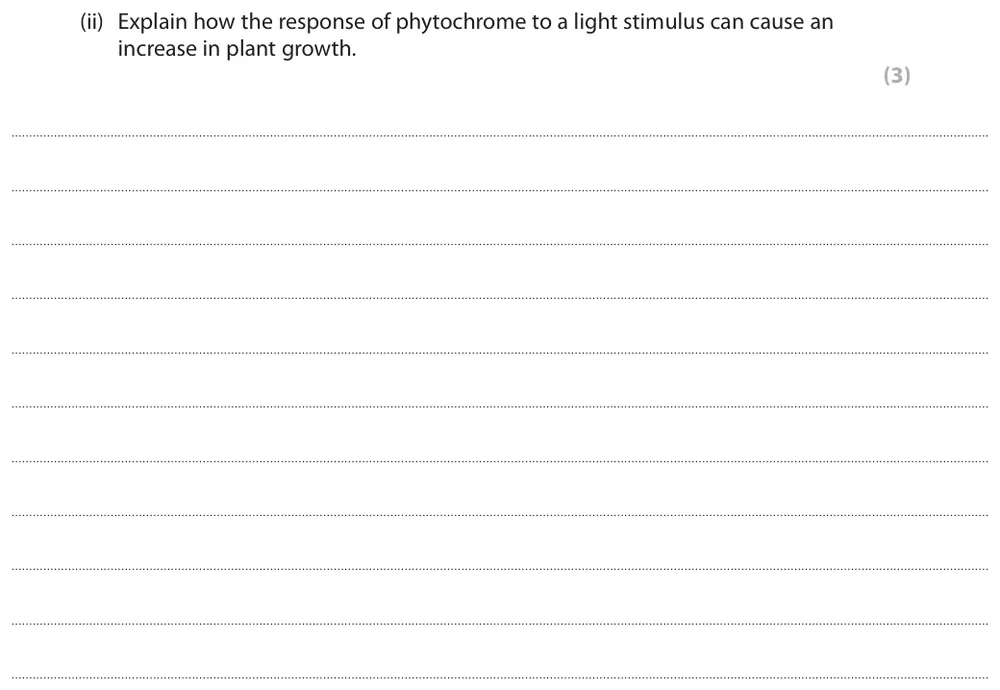
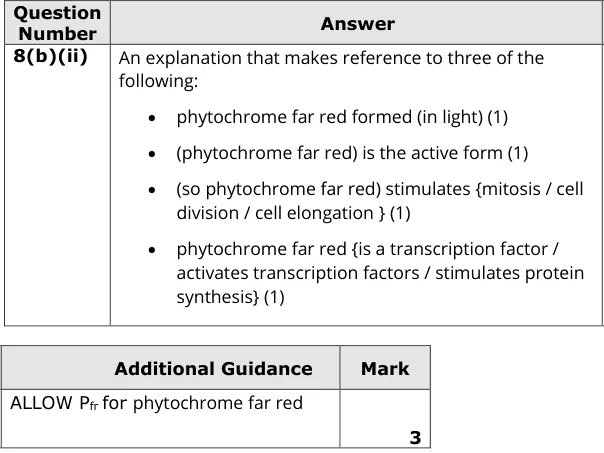
Explain how the response of phytochrome to light can increase plant growth.
Show the mark scheme
Tap an image to open it full size.
From the examiners' report: Many described the effect of light on phytochrome but not how it increases growth. Phytochrome far-red is the active form; it activates transcription factors and stimulates cell division or elongation.
Question 10
A level Paper 2 · June 2025 · Q8(a)(ii) · 3 marks
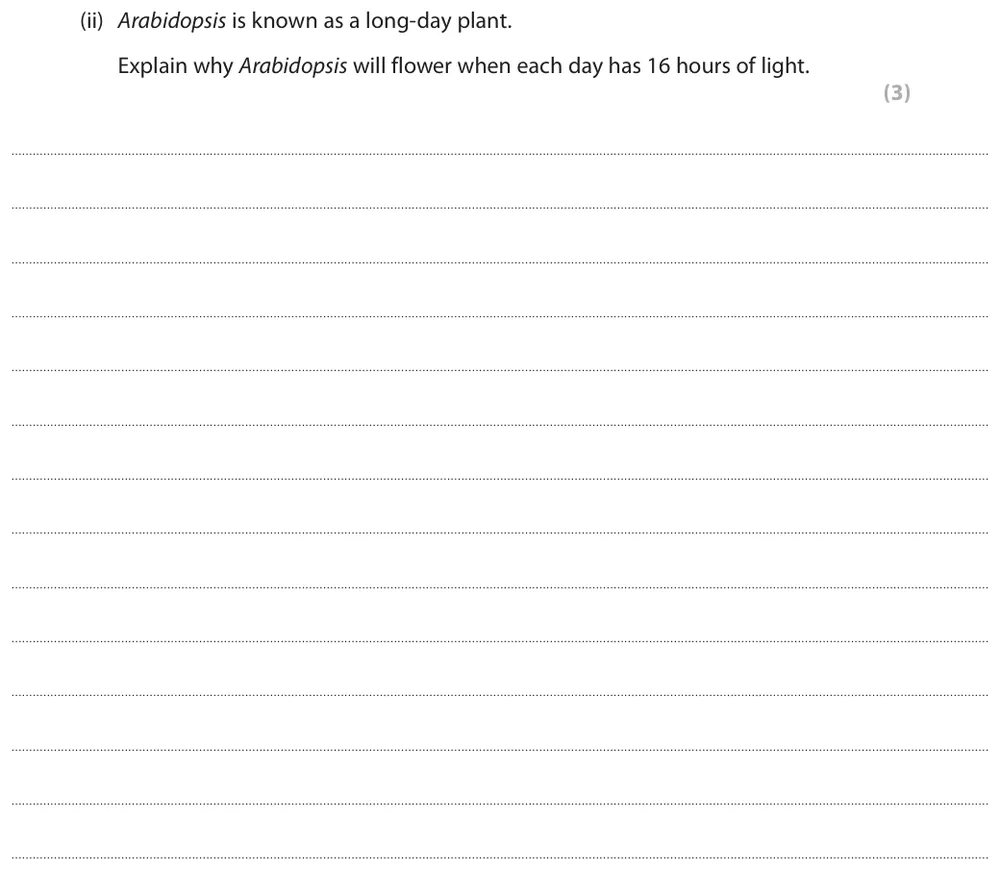
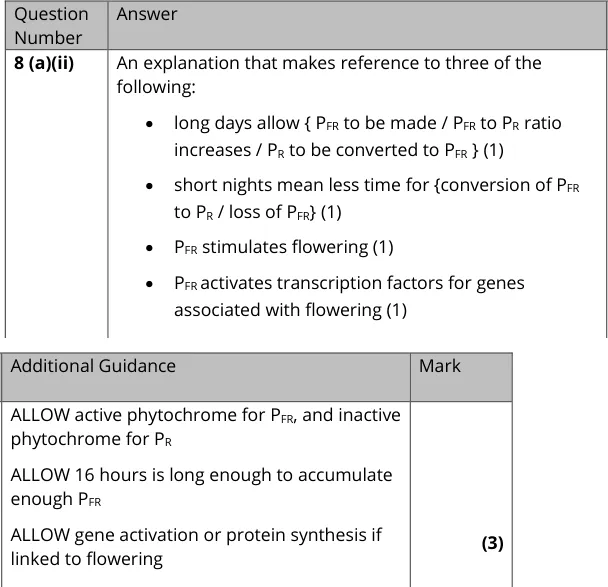
Explain why a long-day plant flowers when each day has 16 hours of light.
Show the mark scheme
Tap an image to open it full size.
From the examiners' report: Some wrote about having enough light for photosynthesis, which gained nothing. Long days let PFR accumulate, short nights leave less time for PFR to convert to PR, and PFR stimulates flowering.
Regions of the human brain (8.8)
Question 11
A level Paper 2 · June 2024 · Q1(c) · 2 marks
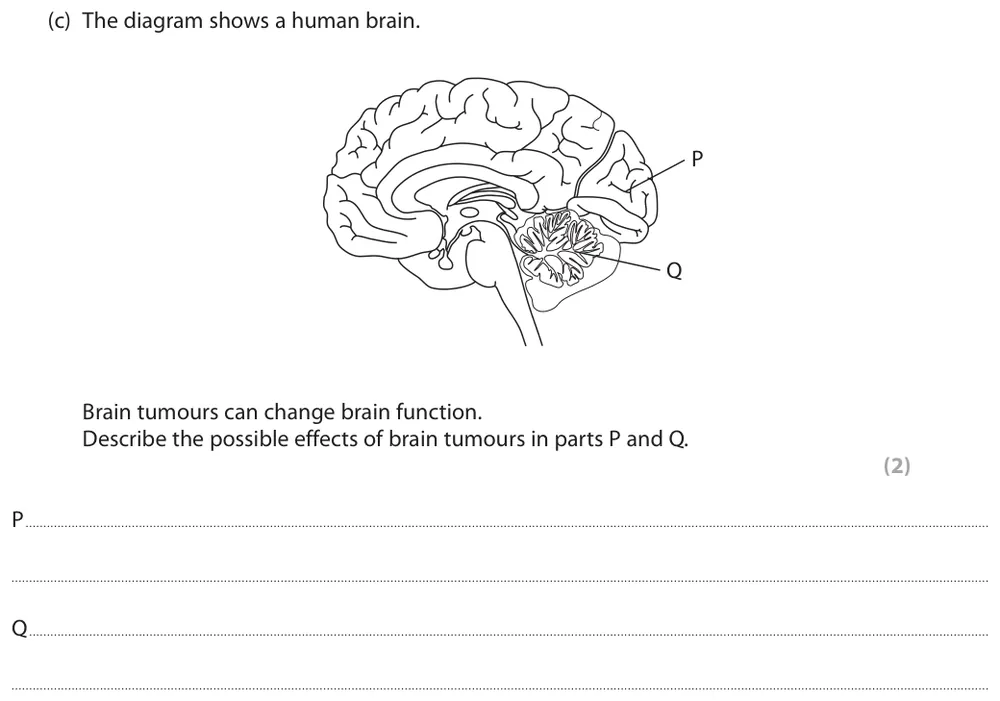
Describe the possible effects of brain tumours in two labelled regions of the brain.
Show the mark scheme
Tap an image to open it full size.
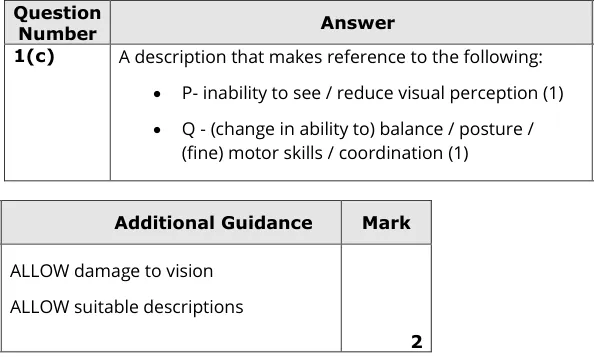
From the examiners' report: Most got at least one region; the cerebellum (Q) was more often right than the visual cortex (P). Identify each region and give its function: vision for P, balance and coordination for Q.
Brain scans: MRI, fMRI, PET and CT (8.9)
Question 12
A level Paper 2 · June 2018 · Q4(a)(iii) · 3 marks
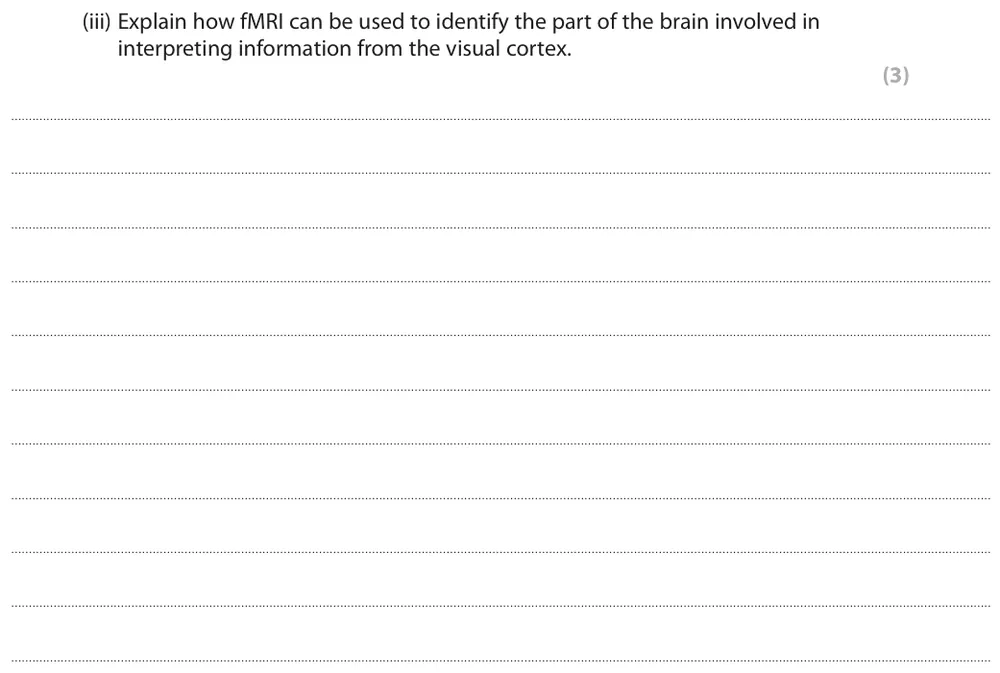
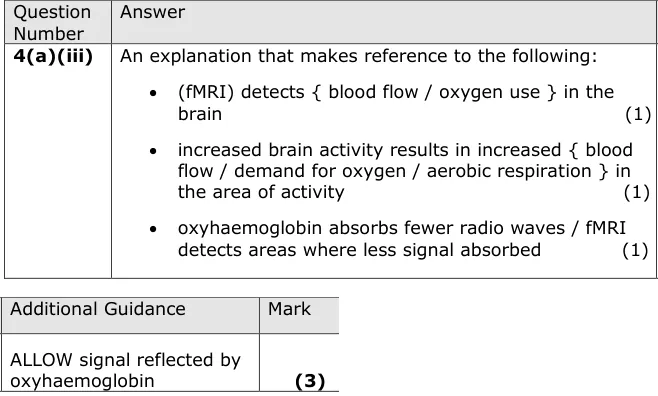
Explain how fMRI can identify the part of the brain that interprets information from the visual cortex.
Show the mark scheme
Tap an image to open it full size.
From the examiners' report: Many described how the scan is done. Say that more active areas need more oxygen, so blood flow increases, and that oxyhaemoglobin absorbs fewer radio waves. Write 'active', not 'used', and oxyhaemoglobin, not oxygenated blood.
Question 13
A level Paper 2 · June 2022 · Q2(b)(i) · 3 marks
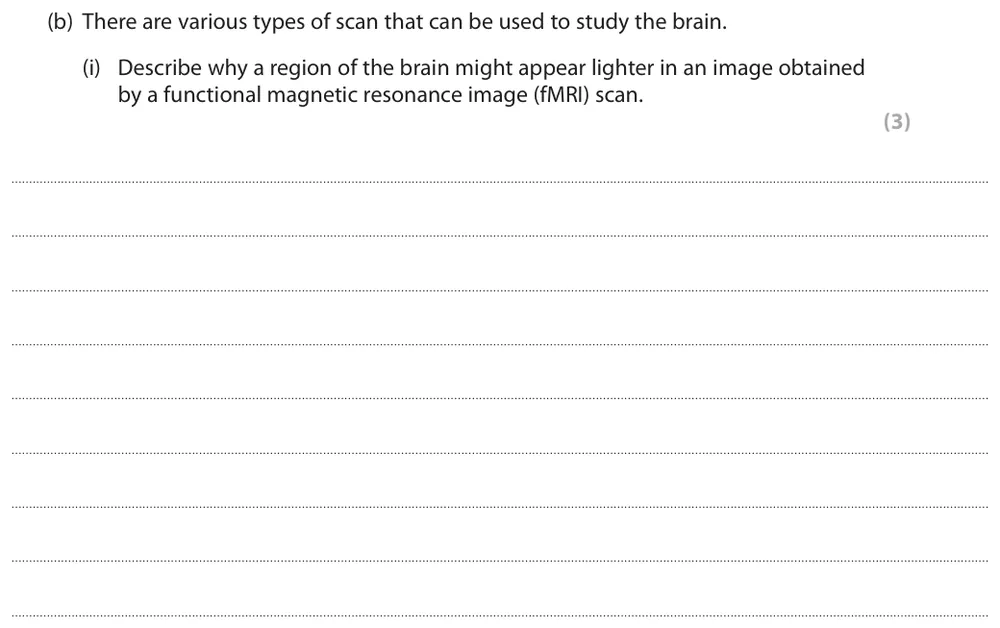
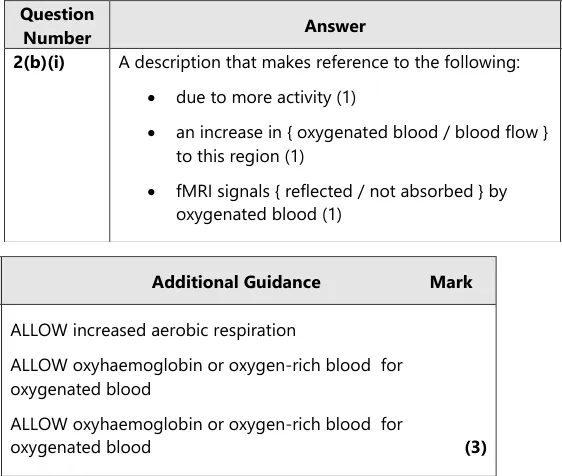
Describe why a region of the brain might appear lighter on an fMRI scan.
Show the mark scheme
Tap an image to open it full size.
From the examiners' report: Some were unsure whether the signal is absorbed or reflected: it is reflected (not absorbed) by oxygenated blood. All brain tissue respires, so say the region is more active, with more blood flow.
Question 14
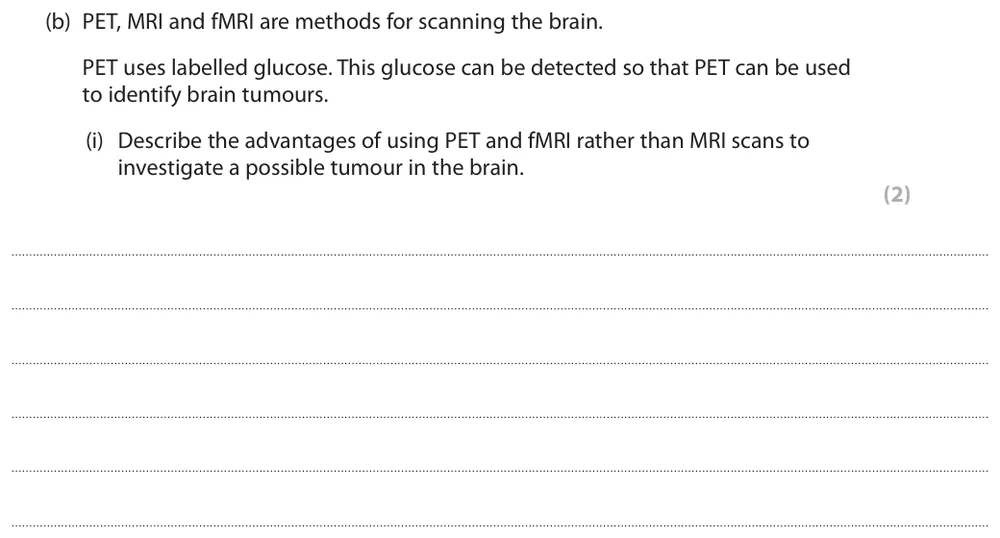
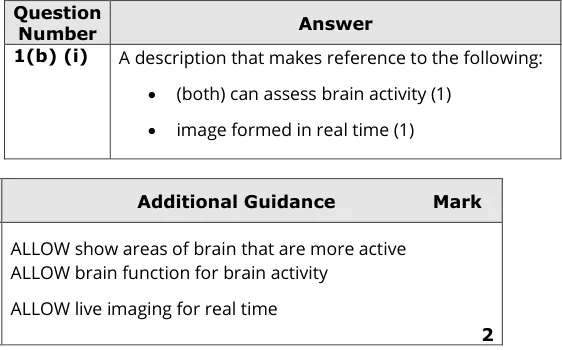
A level Paper 2 · June 2024 · Q1(b)(i) · 2 marks
Describe the advantages of PET and fMRI over MRI for investigating a possible brain tumour.
Show the mark scheme
Tap an image to open it full size.
From the examiners' report: Some described how each scan works instead. Give advantages that apply to both PET and fMRI: they assess brain activity and give images in real time.
The critical period and visual development (8.10)
Question 15
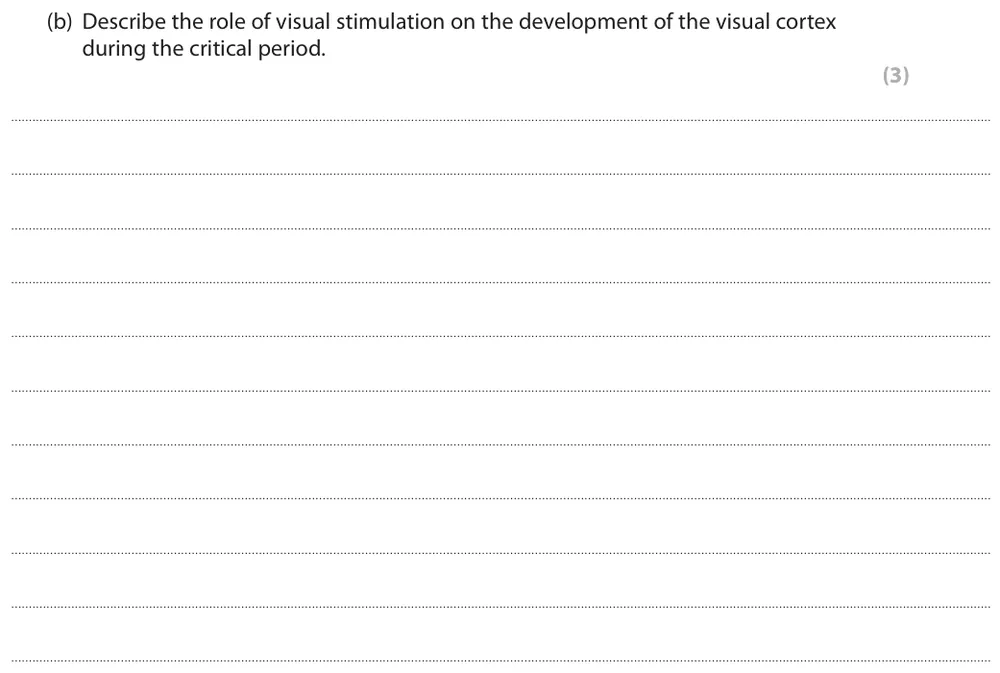
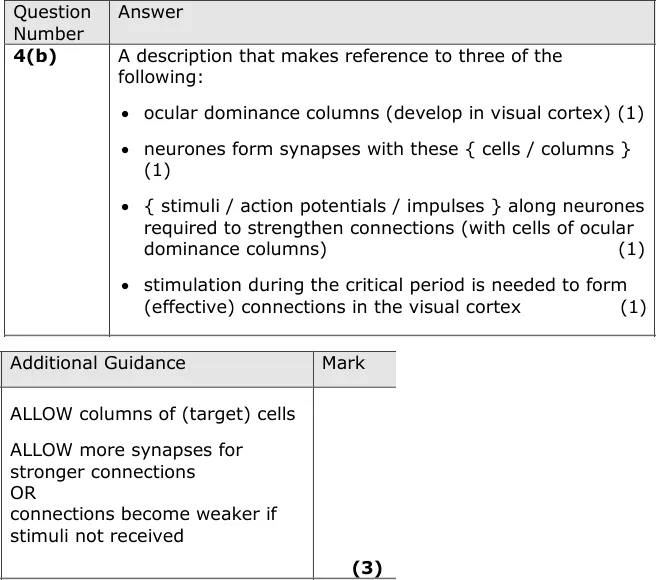
A level Paper 2 · June 2018 · Q4(b) · 3 marks
Describe the role of visual stimulation in the development of the visual cortex during the critical period.
Show the mark scheme
Tap an image to open it full size.
From the examiners' report: Many gave very general accounts and missed the importance of synapses and connections. Mention ocular dominance columns, neurones forming synapses with them, and impulses strengthening these connections.
Question 16
A level Paper 2 · November 2021 · Q10(c) · 2 marks
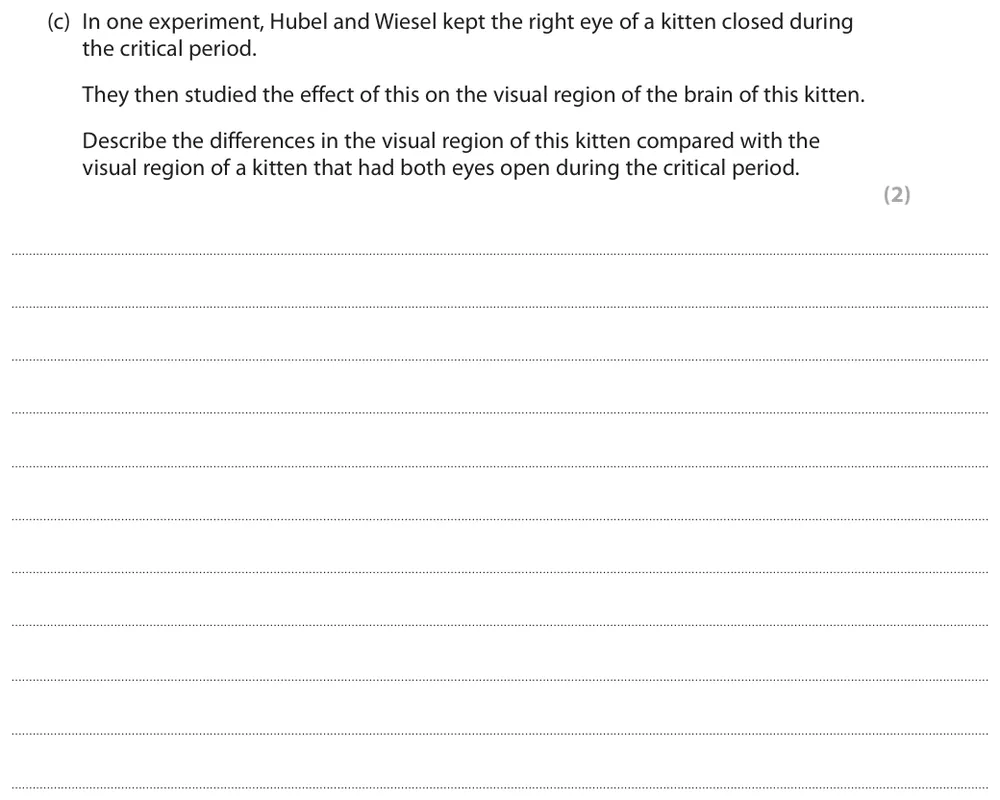
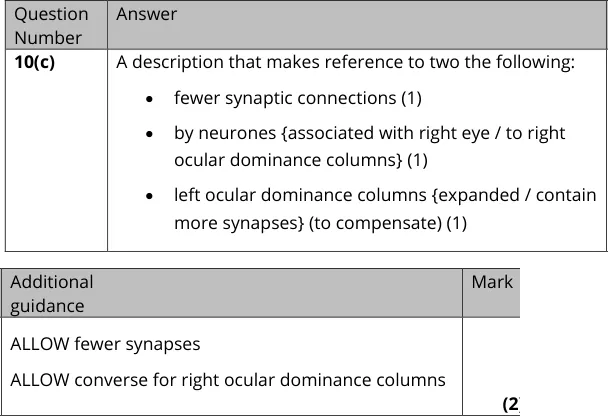
Describe the visual region of a kitten whose right eye was kept closed during the critical period.
Show the mark scheme
Tap an image to open it full size.
From the examiners' report: Many said there would be fewer synapses linked to the right eye, or that its ocular dominance columns would be smaller. The left eye's columns expand to compensate.
Animal models in brain research (8.11)
Question 17
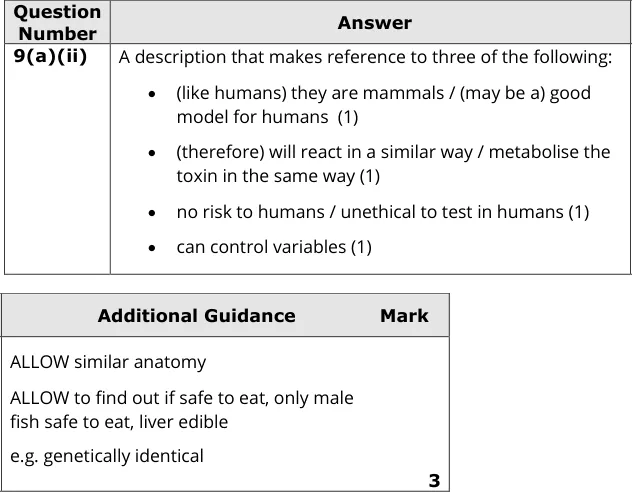
A level Paper 2 · June 2024 · Q9(a)(ii) · 3 marks
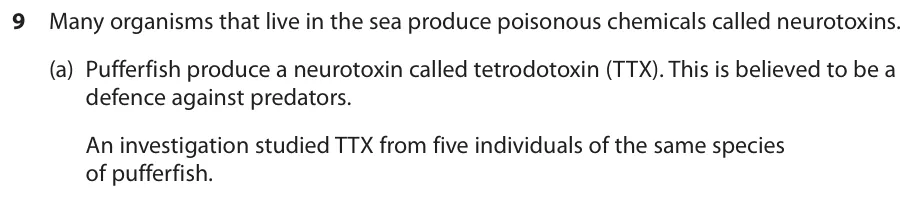
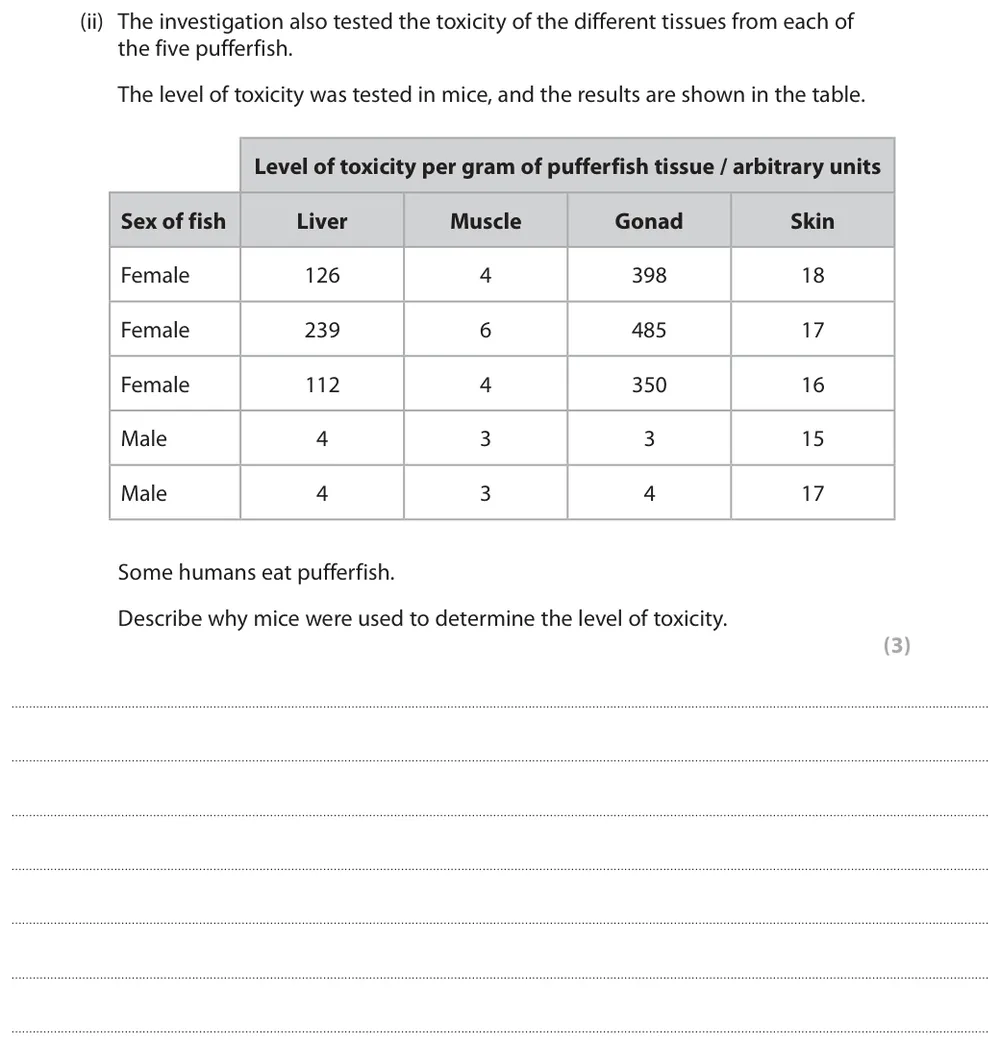
Describe why mice were used to find the toxicity of pufferfish tissue.
Information from earlier in this question:
Show the mark scheme
Tap an image to open it full size.
From the examiners' report: Focus on toxicity testing rather than general reasons. Mice are mammals, so they metabolise the toxin in a similar way to humans, and it would be unethical to test on humans.
Learning by habituation (8.13)
Question 18
A level Paper 3 · June 2022 · Q5(a) · 2 marks · Easy
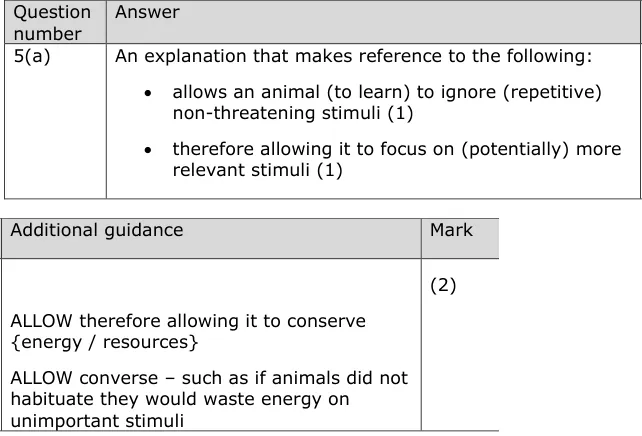
Explain the importance of the habituation response in an animal.
Show the mark scheme
Tap an image to open it full size.
From the examiners' report: Most gained both marks. Some missed that the animal learns to ignore repeated, non-threatening stimuli, so it can focus on more relevant ones.
Question 19
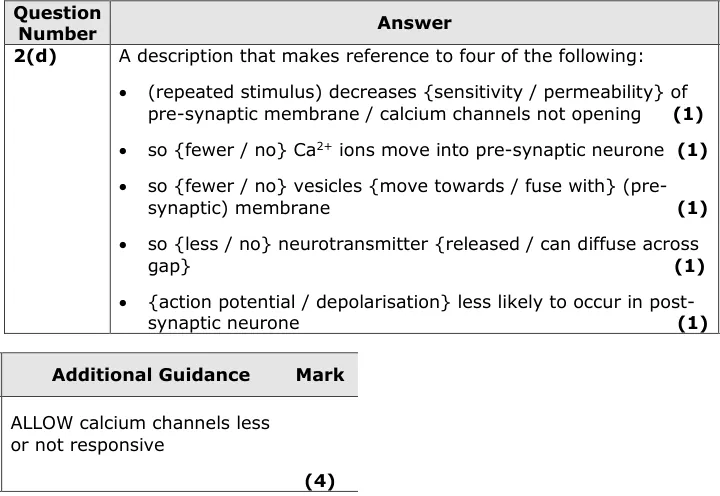
A level Paper 3 · June 2017 · Q2(d) · 4 marks
Describe the process at a synapse that leads to habituation.
Show the mark scheme
Tap an image to open it full size.
From the examiners' report: Many wasted time describing normal transmission. The most commonly missed point: calcium ion channels in the pre-synaptic membrane become less responsive. Calcium ions move into the pre-synaptic neurone, not into the membrane or the cleft.
Question 20
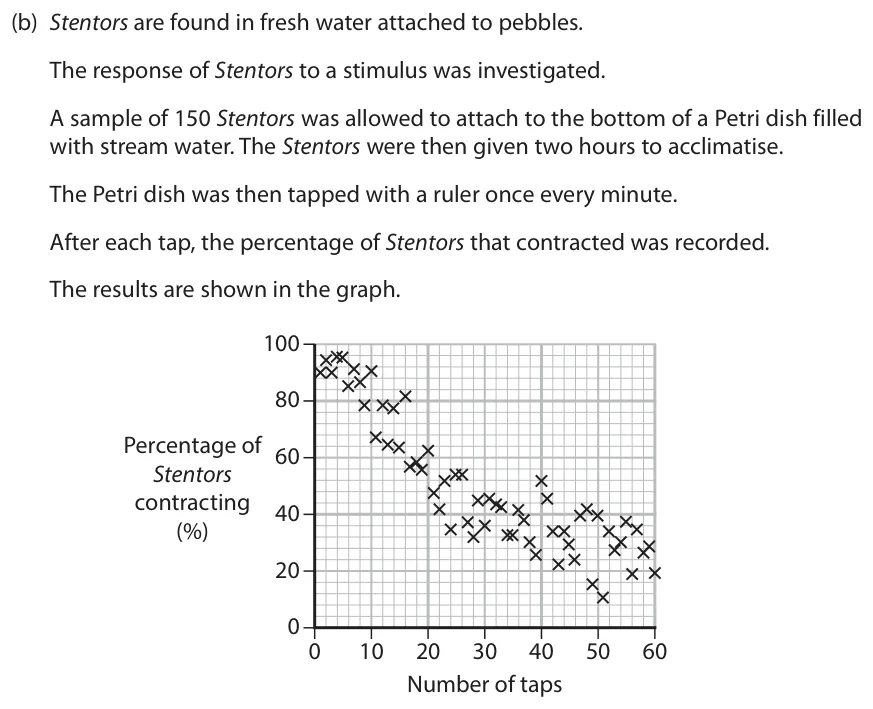
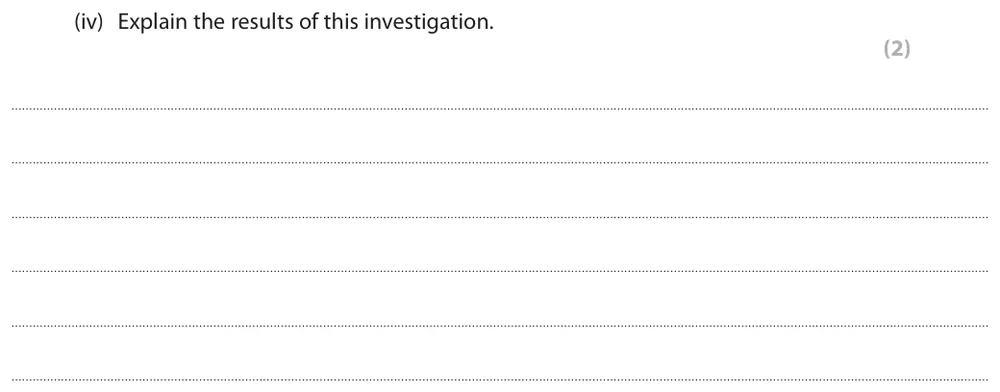
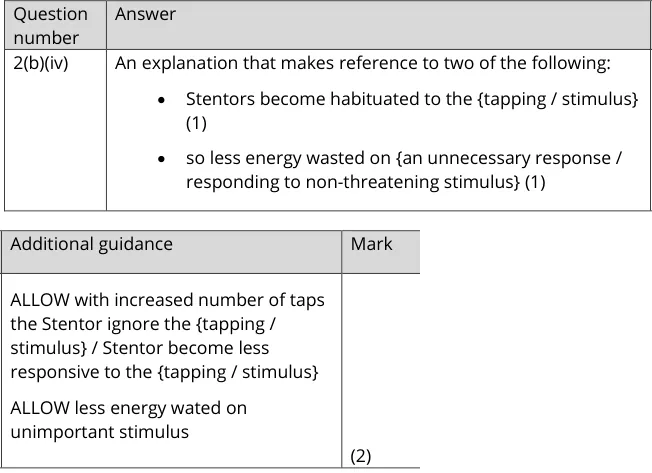
A level Paper 3 · June 2025 · Q2(b)(iv) · 2 marks · Easy
Explain why Stentors contract less as the number of taps increases.
Information from earlier in this question:
Show the mark scheme
Tap an image to open it full size.
From the examiners' report: Many said the stimulus is non-threatening but did not finish the point. Stentors habituate to the tapping, so less energy is wasted on responding to an unimportant stimulus.
Where students lose marks (from Pearson examiners' reports and mark schemes)
Each point below comes from the examiners' reports and mark schemes, and is followed by wording that gained marks.
Rod cell points need light or dark. Sodium ions moving back into the rod cell was not credited unless it was linked to the dark or no stimulation.
✔ Gains credit: 'In the dark, sodium ions move back into the rod cell and it is depolarised; in the light they do not, and the rod cell is hyperpolarised.'
Retinal, not retinol. A number confused retinal and retinol, or described rhodopsin breaking down instead of forming.
✔ Gains credit: 'In the dark, trans retinal is converted to cis retinal and joins to opsin.'
Shoot cells elongate, not the plant. Comments such as 'the side of the plant elongates' did not gain the cell elongation mark.
✔ Gains credit: 'IAA is produced in the shoot tip, accumulates on the dark side and stimulates cell elongation, causing the shoot to grow towards the light.'
Coleoptile evidence, not a textbook account. Many ignored the investigations and wrote a general account of IAA in phototropism.
✔ Gains credit: 'IAA is a plant hormone; cells grew longer with IAA, and cell elongation happened in cells below the tip.'
Long-day flowering is not about photosynthesis. Some said the plant needs enough hours of light for photosynthesis before it can flower.
✔ Gains credit: 'Long days allow enough PFR to accumulate; short nights mean less time for conversion of PFR to PR; PFR stimulates flowering.'
fMRI picks up oxyhaemoglobin. Some wrote 'oxygenated blood' or said a part of the brain was 'used' rather than active.
✔ Gains credit: 'Increased brain activity increases blood flow to that area; oxyhaemoglobin absorbs fewer radio waves, so fMRI detects where less signal is absorbed.'
Visual stimulation strengthens synapses. Many gave a general account and missed the synapses and connections made during the critical period.
✔ Gains credit: 'Neurones form synapses with cells of the ocular dominance columns; impulses are needed to strengthen these connections during the critical period.'
Habituation starts at the calcium ion channels. Many described normal transmission, or said calcium ions are released into the cleft or diffuse into the membrane.
✔ Gains credit: 'The repeated stimulus makes the pre-synaptic membrane less permeable to calcium ions, so fewer Ca2+ ions move into the pre-synaptic neurone and fewer vesicles fuse with the membrane.'
Download the questions
Download the PDF pack (20 questions, mark schemes at the end)
Keep practising
- Nerves, Synapses, Drugs and Genomes (Topic 8): Edexcel SNAB exam questions by topic
- Respiration, Spirometer Traces and Habituation (Core Practicals 16 to 18): Edexcel SNAB core practical questions
- Topic 8 multiple-choice quiz (18 questions, marked as you tap)
- Edexcel SNAB A level Biology resources hub (every topic, practical and paper)
- Extended Response Questions (Topics 5 to 8): Edexcel SNAB A Level Biology Exam Questions
- Edexcel SNAB A level Biology past papers, mark schemes and examiners' reports
- Edexcel SNAB A level Biology grade boundaries
- Message Tom on WhatsApp about one-to-one Edexcel SNAB tutoring or an Edexcel group class
Questions, mark schemes and examiners' report extracts © Pearson Education Ltd.