

Pathogens, Immunity and Antibiotics is the second part of Topic 6, Immunity, Infection and Forensics, of the Edexcel A level Biology A (Salters-Nuffield) specification. You need to compare the structure of bacteria and viruses, explain how Mycobacterium tuberculosis and HIV infect human cells, and describe the non-specific responses to infection (inflammation, lysozyme, interferon and phagocytosis) and the specific immune response, with its antigen-presenting cells, B cells and T cells. The topic also covers barriers to infection, natural and artificial immunity, the evolutionary race between pathogens and their hosts, bacteriostatic and bactericidal antibiotics, and hospital acquired infections. This topic is examined on A level Papers 1 and 3. All questions are from the A level papers (9BN0).
The examiners' reports keep asking for the exact cell, molecule or vessel. Say that glycoproteins (gp120) bind to CD4 receptors on T helper cells and that the viral envelope fuses with the cell membrane; that histamine makes arterioles dilate and capillaries more permeable; that macrophages present antigens to T cells; and that B effector cells differentiate into plasma cells, which make the antibodies. Only the stomach is acidic, not the whole gut, and a bacteriostatic antibiotic stops the number of bacteria increasing. When you are given data, link it to the immune system instead of repeating the numbers.
Studying Edexcel SNAB and want more help? If you'd like to arrange one-to-one Edexcel tutoring, or to register your interest in an Edexcel group class, message Tom on WhatsApp using the link at the bottom of this page.
What you need from GCSE
Each question on this page assumes you're secure on these ideas. If any of them feels shaky, look it up before you start.
- Pathogens are microorganisms, such as bacteria and viruses, that cause infectious disease.
- White blood cells defend the body by phagocytosis and by producing antibodies and antitoxins.
- Vaccination uses dead or inactive pathogens so that antibodies are made quickly if the real pathogen enters the body.
- Antibiotics are used against bacteria, not viruses, and bacteria can become resistant to them.
Key terms
These words come up in the questions and mark schemes. Examiners expect you to use them exactly.
- Antigen: a molecule, often a protein or glycoprotein on a pathogen's surface, that triggers a specific immune response.
- Antigen-presenting cell: a cell, such as a macrophage, that displays antigens from a pathogen on its surface so T helper cells can bind to them.
- T helper cell: a T cell with CD4 receptors that releases cytokines to activate B cells and T killer cells.
- Plasma cell: the cell that B effector cells differentiate into; it makes and releases antibodies.
- Memory cell: a long-lived B or T cell that allows a faster, larger secondary response on re-infection.
- Interferon: a protein released by virus-infected cells that inhibits viral replication in nearby cells.
- Bacteriostatic: an antibiotic that inhibits the increase in number of bacteria without killing them.
- Bactericidal: an antibiotic that kills bacteria.
What these questions cover (Edexcel SNAB Topic 6: Immunity, Infection and Forensics)
The questions test these statements from Topic 6 of the Pearson Edexcel A level Biology A (Salters-Nuffield) specification (9BN0).
- 6.5 Be able to compare the structure of bacteria and viruses.
- 6.6 Understand how Mycobacterium tuberculosis (TB) and Human Immunodeficiency Virus (HIV) infect human cells, causing a sequence of symptoms that may result in death.
- 6.7 Understand the non-specific responses of the body to infection, including inflammation, lysozyme action, interferon, and phagocytosis.
- 6.8 Understand the roles of antigens and antibodies in the body’s immune response including the involvement of plasma cells, macrophages and antigen-presenting cells.
- 6.9 Understand the differences between the roles of B cells (B memory and B effector cells) and T cells (T helper, T killer and T memory cells) in the body’s immune response.
- 6.11 ii Understand the role of barriers in protecting the body from infection, including skin, stomach acid, and gut and skin flora.
- 6.12 Understand how individuals may develop immunity (natural, artificial, active, passive).
- 6.13 Understand how the theory of an ‘evolutionary race’ between pathogens and their hosts is supported by the evasion mechanisms shown by pathogens.
- 6.14 Understand the difference between bacteriostatic and bactericidal antibiotics.
- 6.15 Know how an understanding of the contributory causes of hospital acquired infections have led to codes of practice regarding antibiotic prescription and hospital practice
How to use this page
Write your answer on paper before you open the mark scheme. Allow about 1.2 minutes per mark: the 20 questions are worth 50 marks, so about 60 minutes in total. Then mark your answer strictly against the mark scheme and read the examiners' tip underneath it. If you'd rather print the questions, download the PDF pack.
Comparing bacteria and viruses (6.5)
Question 1
A level Paper 1 · October 2020 · Q9(a) · 3 marks
Compare and contrast the structure of the Ebola virus with that of HIV.
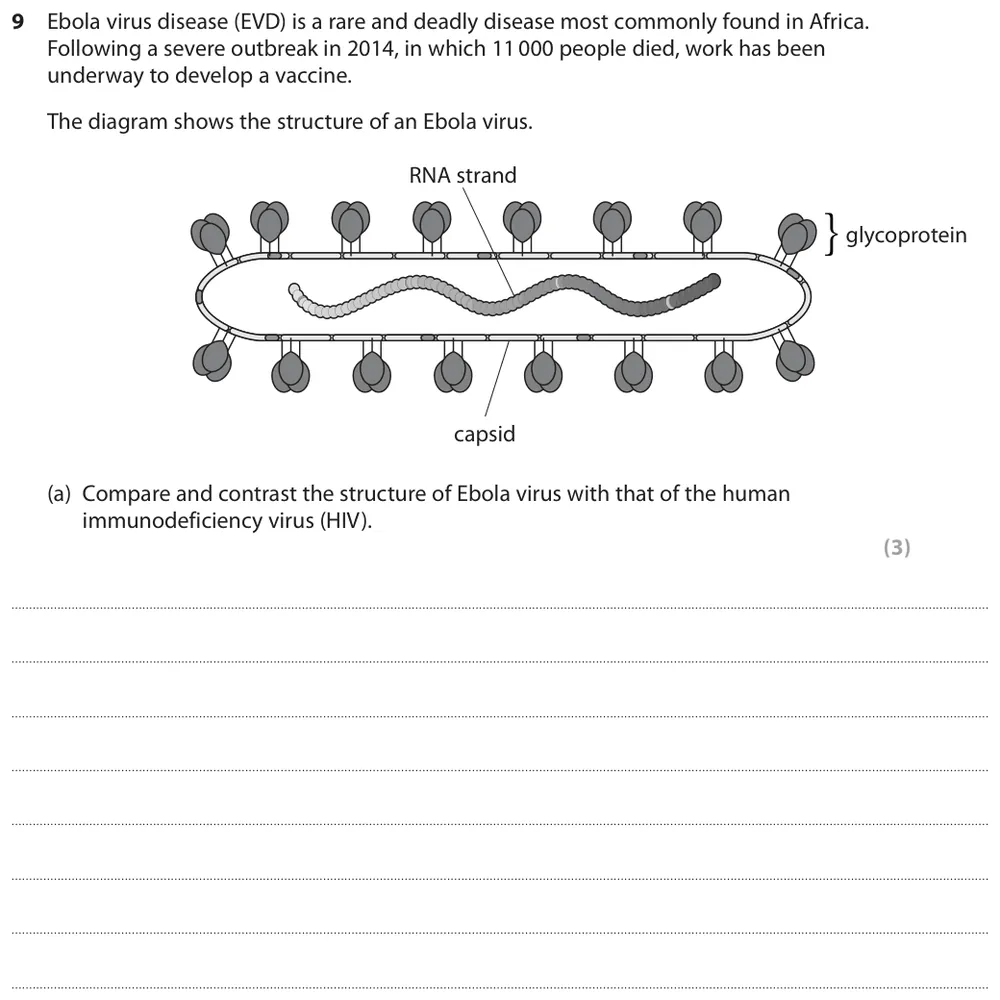
Show the mark scheme
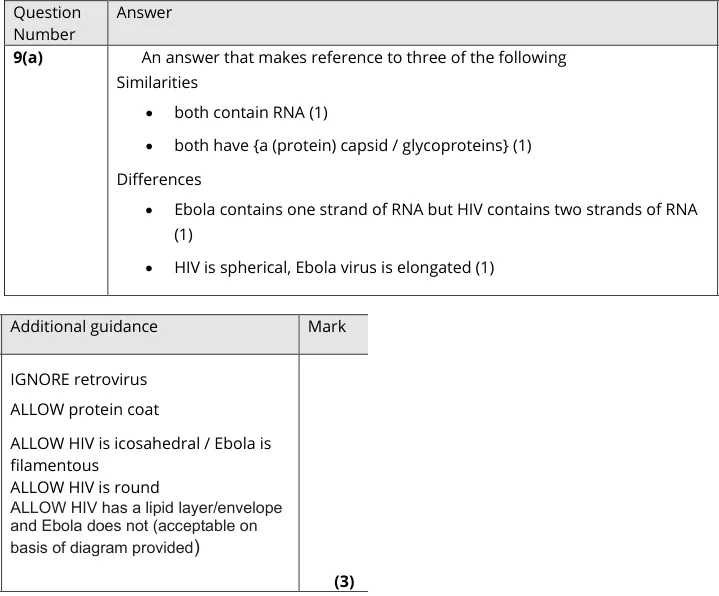
Tap an image to open it full size.
From the examiners' report: Some answers gave only similarities, so could not get full marks: a 'compare and contrast' question needs at least one similarity and one difference. Both contain RNA and a protein capsid; HIV has two RNA strands, Ebola one.
Question 2
A level Paper 3 · June 2022 · Q2(a) · 2 marks · Easy
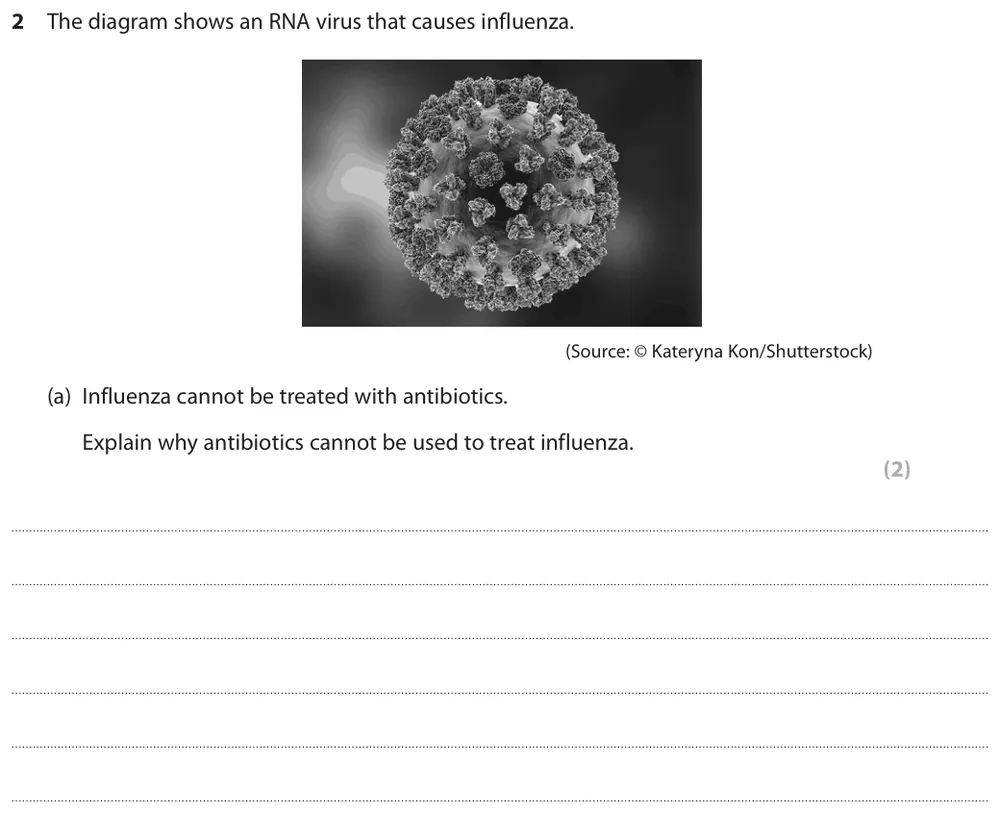
Explain why antibiotics cannot be used to treat influenza.
Show the mark scheme
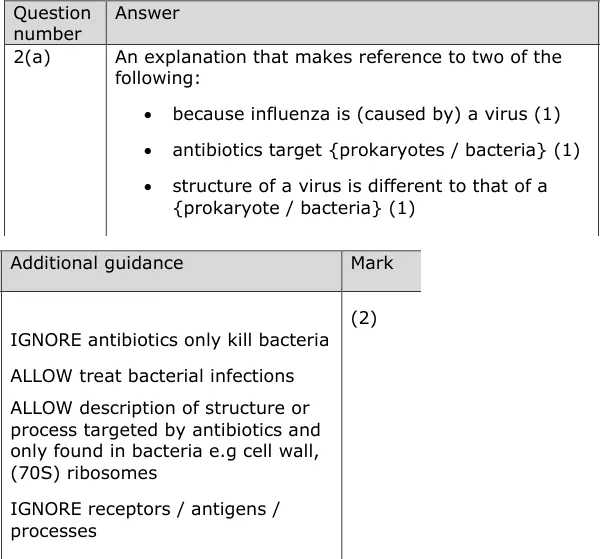
Tap an image to open it full size.
From the examiners' report: Most scored both marks: influenza is caused by a virus, and antibiotics target bacteria (prokaryotes). Extra detail was often muddled; if you add it, name a bacterial target such as the cell wall or 70S ribosomes.
How TB and HIV infect human cells (6.6)
Question 3
A level Paper 1 · November 2021 · Q9(b)(i) · 3 marks
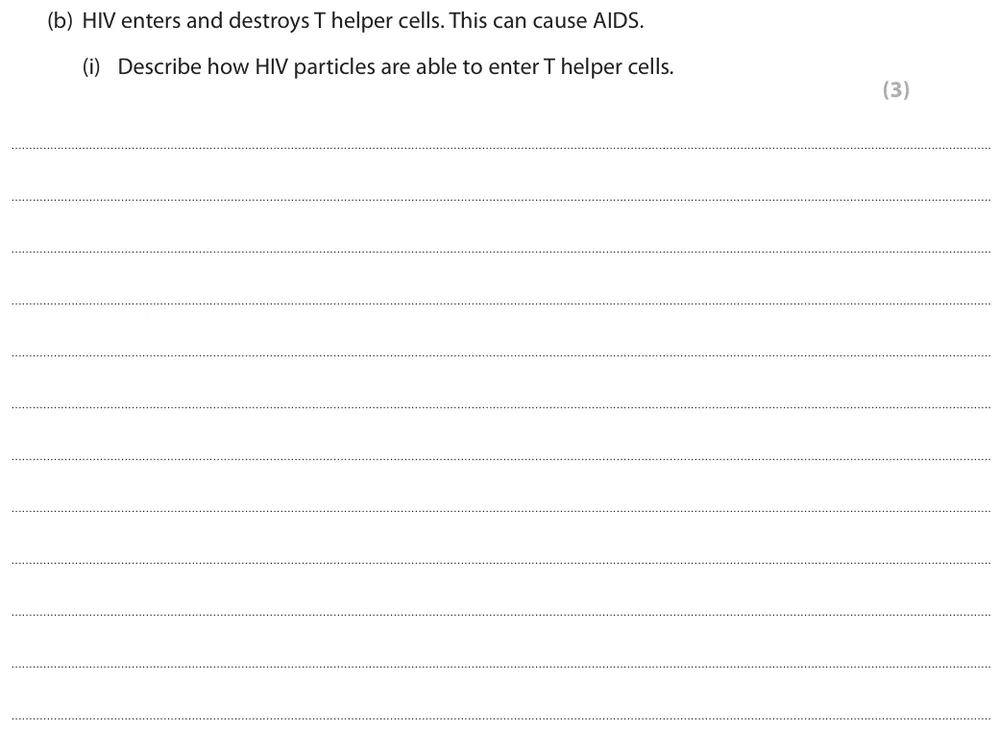
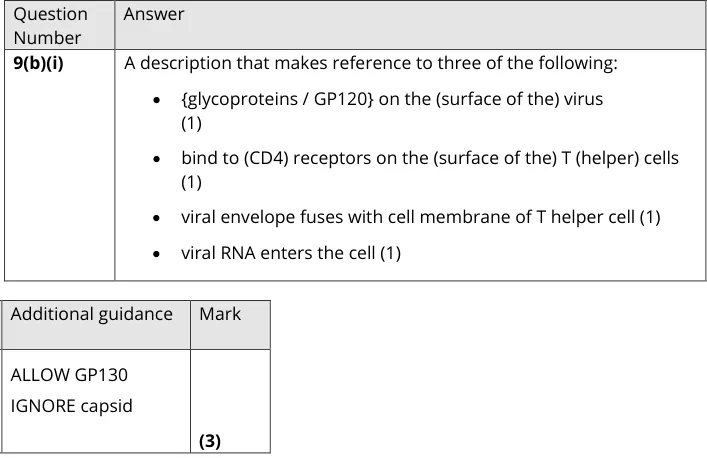
Describe how HIV particles enter T helper cells.
Show the mark scheme
Tap an image to open it full size.
From the examiners' report: Many answers lacked detail. Name the attachment proteins as glycoproteins (gp120) binding to CD4 receptors, and say it is the viral envelope that fuses with the cell membrane before the RNA enters.
Question 4
A level Paper 3 · June 2024 · Q5(a)(i) · 1 mark
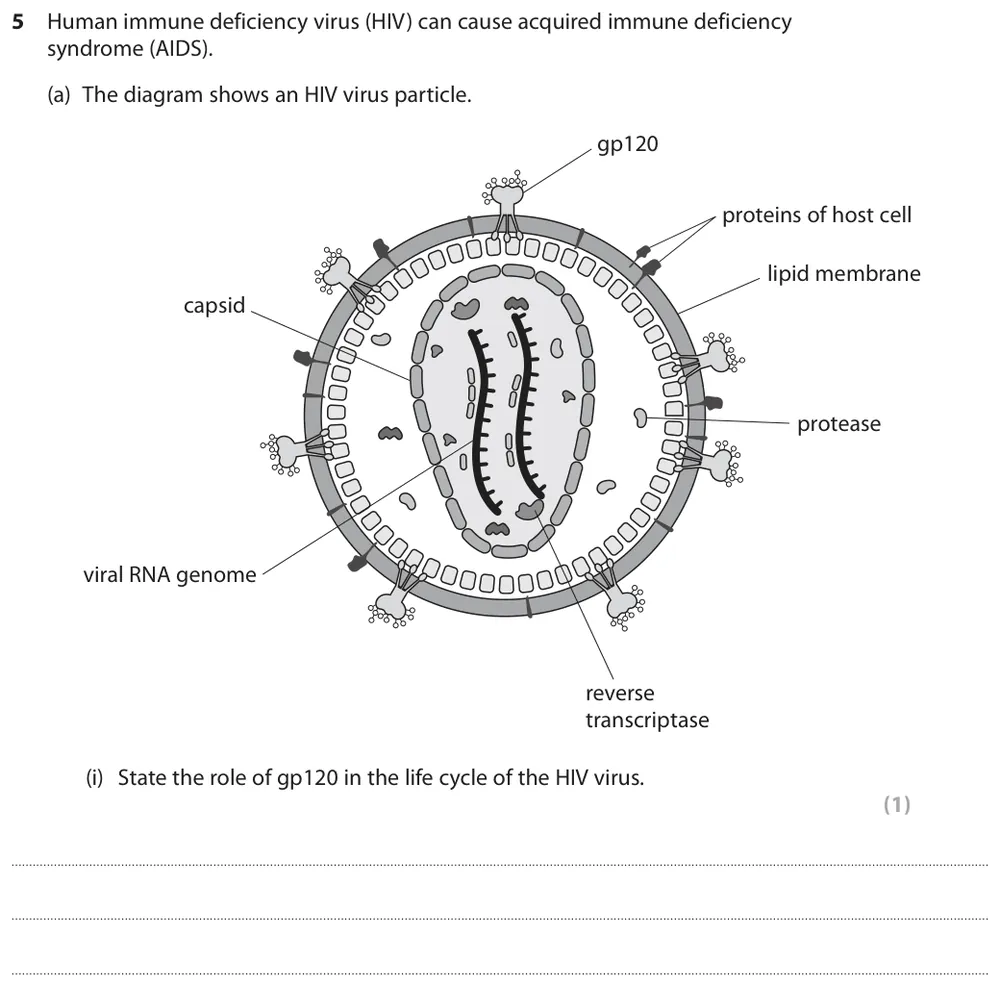
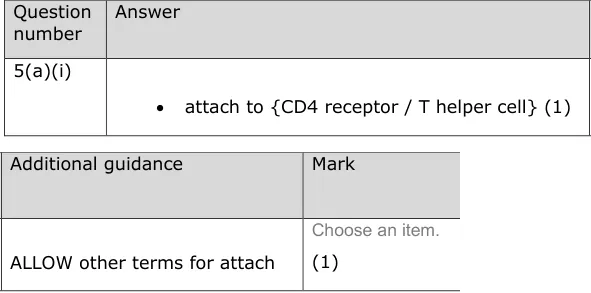
State the role of gp120 in the life cycle of HIV.
Show the mark scheme
Tap an image to open it full size.
From the examiners' report: Most knew gp120 binds to host cells, but to gain the mark you must say it attaches to CD4 receptors or to T helper cells.
Question 5
A level Paper 3 · June 2024 · Q5(a)(ii) · 1 mark
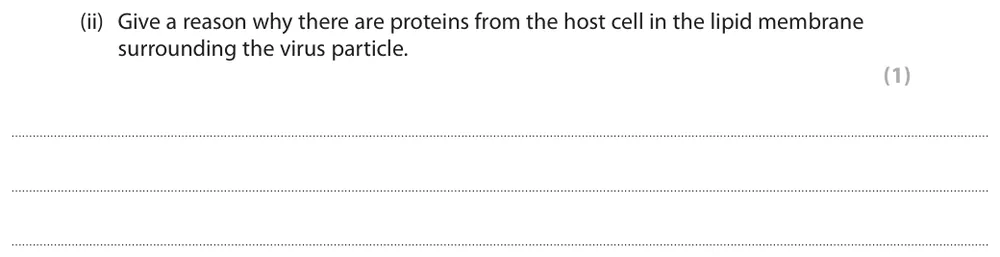
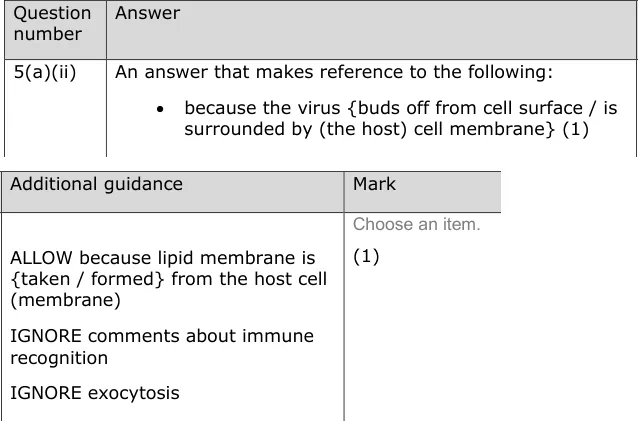
Give a reason why the membrane around HIV contains proteins from the host cell.
Show the mark scheme
Tap an image to open it full size.
From the examiners' report: Most students did not gain this mark. The proteins are there because the virus buds off from the host cell surface, taking some of its membrane; they are not there to avoid immune recognition or for antigen presentation.
Non-specific responses to infection (6.7)
Question 6
A level Paper 1 · June 2018 · Q3(b) · 4 marks · Easy
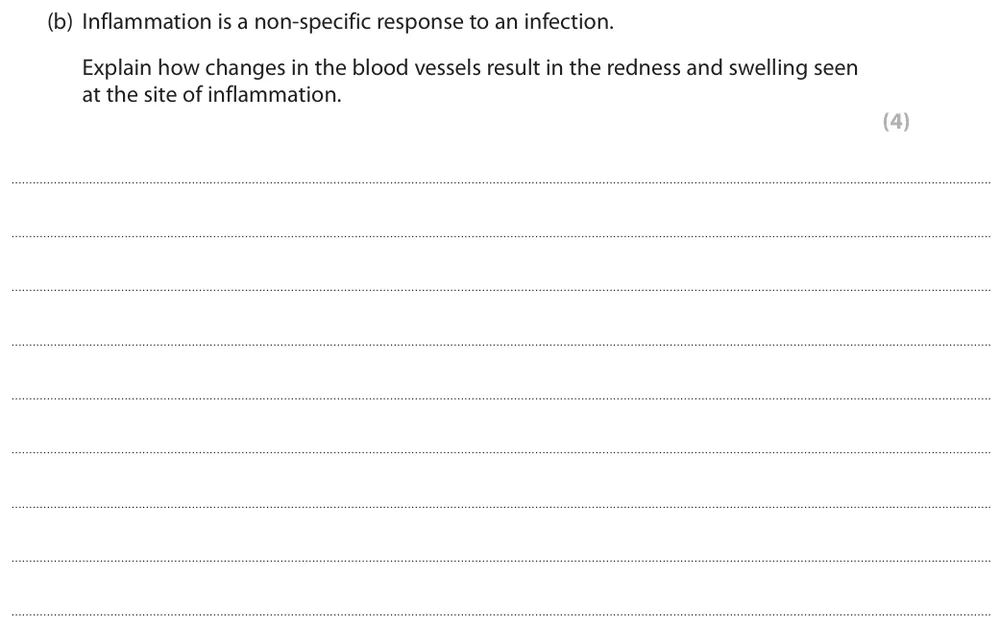
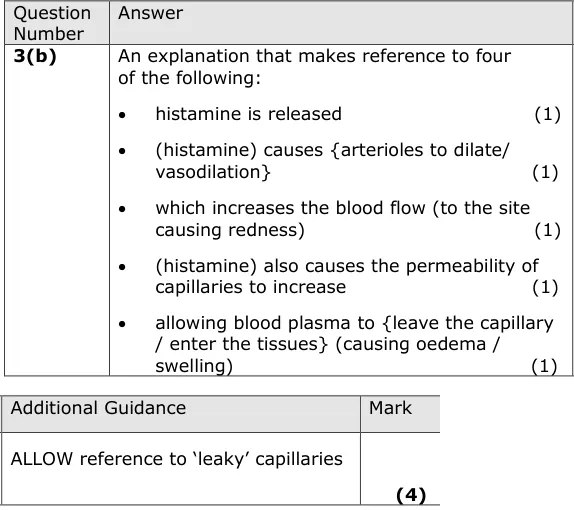
Explain how changes in the blood vessels cause redness and swelling at the site of inflammation.
Show the mark scheme
Tap an image to open it full size.
From the examiners' report: Be precise: histamine makes arterioles dilate (not arteries, capillaries or 'blood vessels'), capillaries become more permeable, and plasma, not cells, leaves the capillaries.
Question 7
A level Paper 1 · June 2018 · Q3(c)(i) · 3 marks
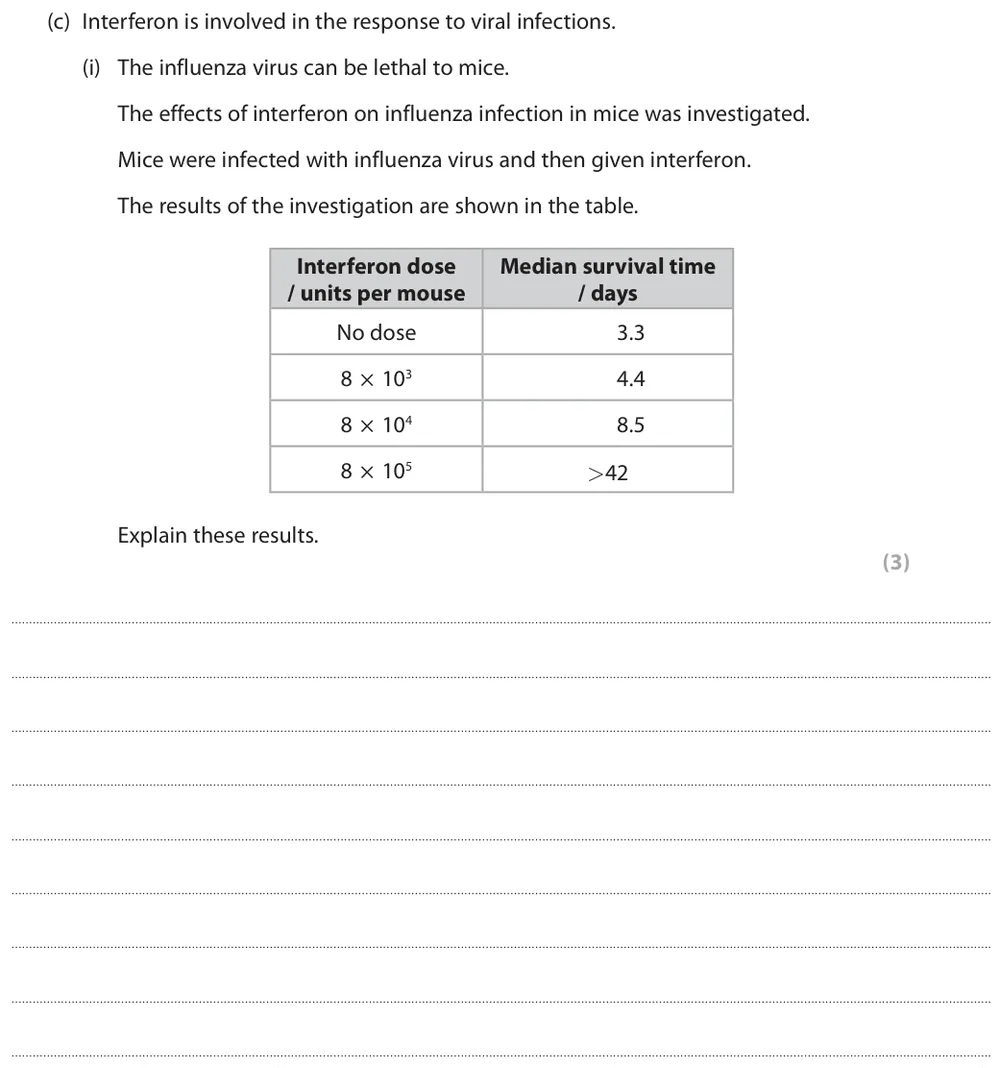
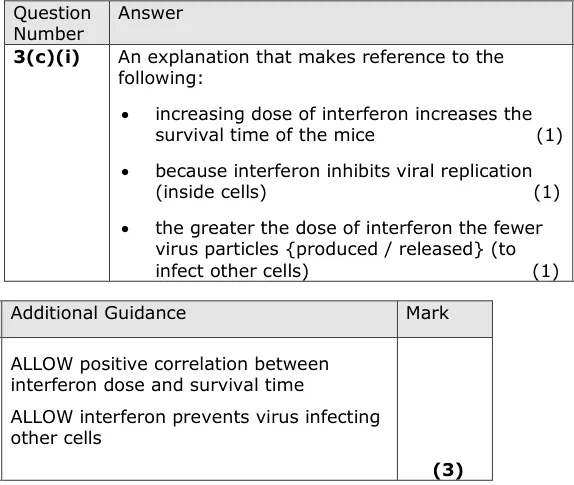
Explain the effect of interferon dose on the survival time of mice infected with influenza.
Show the mark scheme
Tap an image to open it full size.
From the examiners' report: Most gave the correlation and said interferon inhibits viral replication; few added that fewer virus particles are released to infect other cells. Avoid 'viral cells' and 'interferon binding to viruses'.
Question 8
A level Paper 3 · June 2023 · Q2(b)(i) · 1 mark
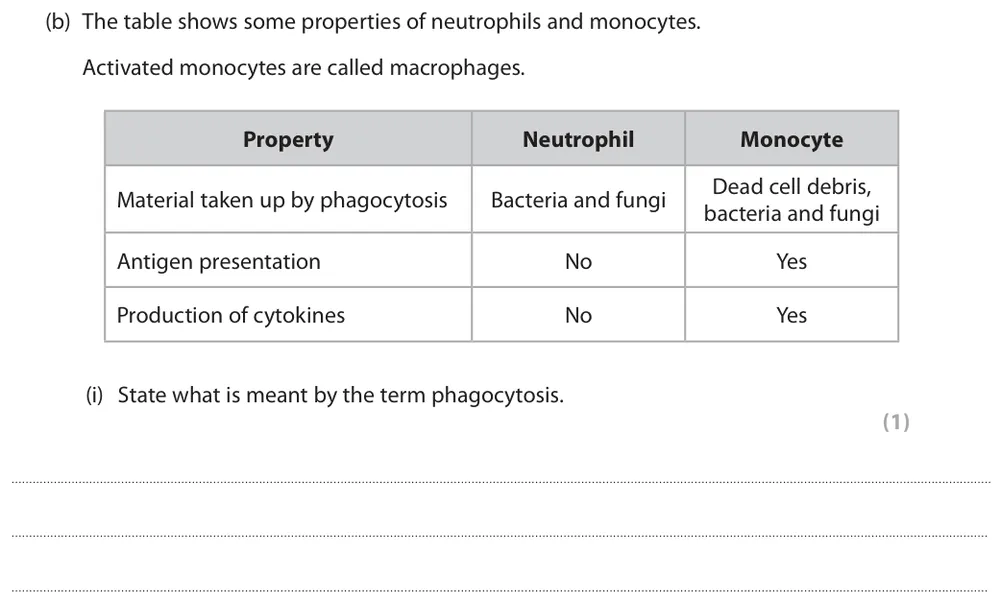
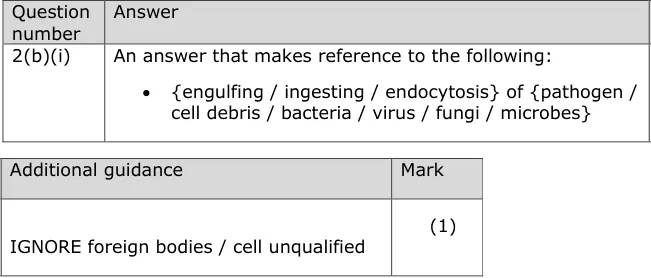
State what is meant by the term phagocytosis.
Show the mark scheme
Tap an image to open it full size.
From the examiners' report: Say what is engulfed: a pathogen, bacterium, virus or microbe. 'Engulfing material' or 'engulfing cells' did not gain the mark.
Antigens, antibodies and antigen-presenting cells (6.8)
Question 9
A level Paper 3 · June 2023 · Q2(b)(ii) · 3 marks
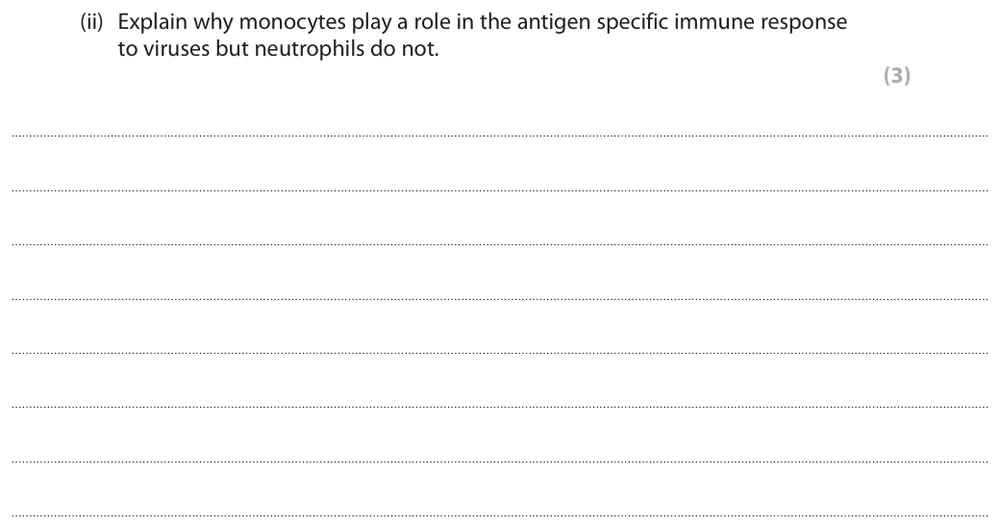
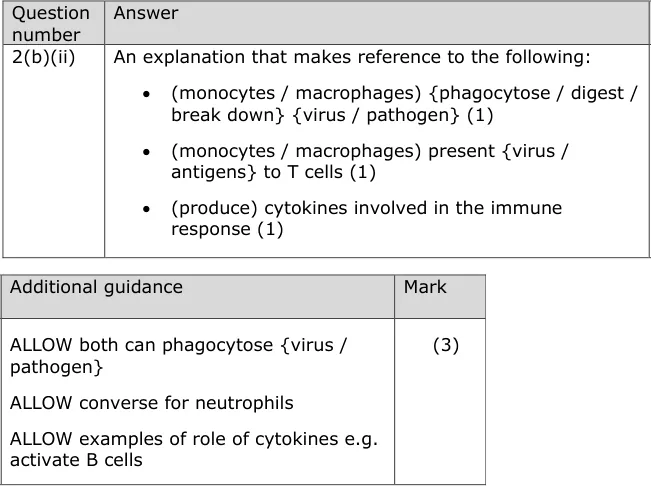
Explain why monocytes take part in the antigen-specific response to viruses but neutrophils do not.
Show the mark scheme
Tap an image to open it full size.
From the examiners' report: Many lost a mark by writing only 'antigen presentation': say monocytes (macrophages) present virus antigens to T cells. They also phagocytose the virus and produce cytokines.
Roles of B cells and T cells (6.9)
Question 10
A level Paper 1 · June 2024 · Q9(a)(ii) · 4 marks
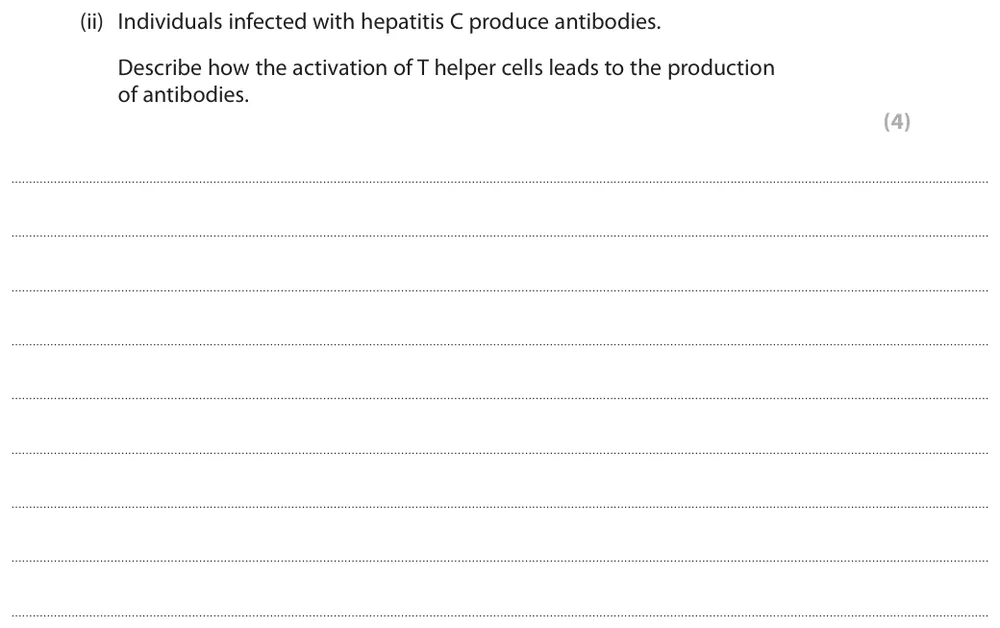
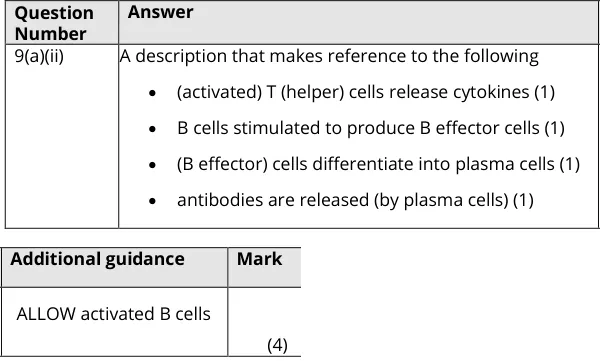
Describe how the activation of T helper cells leads to the production of antibodies.
Show the mark scheme
Tap an image to open it full size.
From the examiners' report: Don't spend time on how the T helper cells are activated. T helper cells release cytokines, B cells produce B effector cells, these differentiate into plasma cells, and the plasma cells release antibodies, not the B effector cells.
Question 11
A level Paper 1 · November 2021 · Q9(b)(ii) · 4 marks
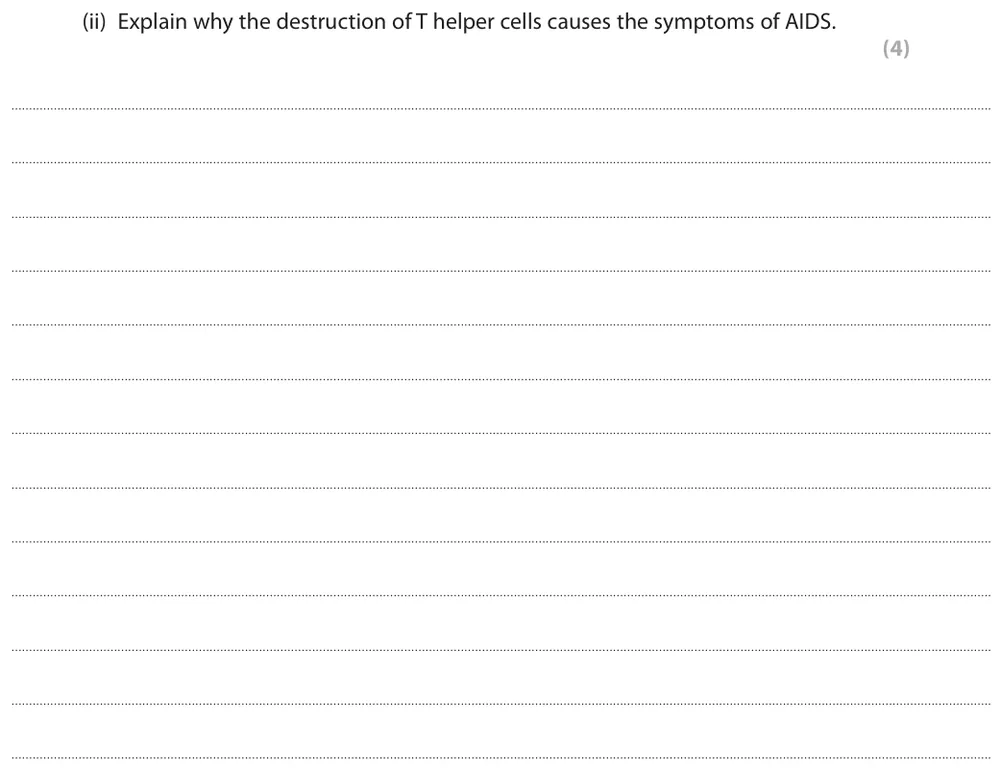
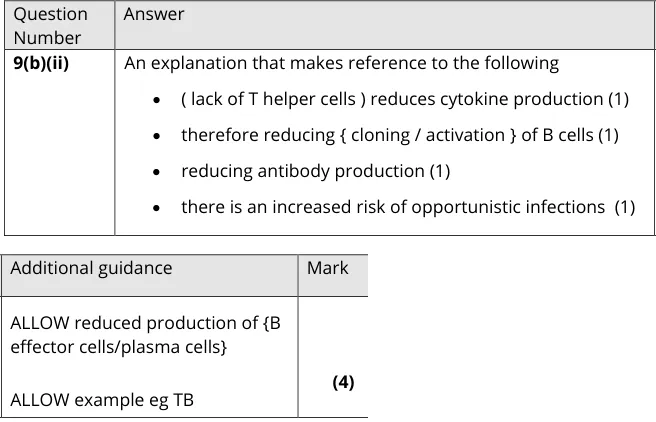
Explain why the destruction of T helper cells causes the symptoms of AIDS.
Show the mark scheme
Tap an image to open it full size.
From the examiners' report: 'A weakened immune system' is too vague, and describing what T helper cells do is not enough. Explain the effect of losing them: fewer cytokines, less B cell activation, fewer antibodies and more opportunistic infections such as TB.
Question 12
A level Paper 1 · October 2020 · Q9(b)(ii) · 3 marks · Hard
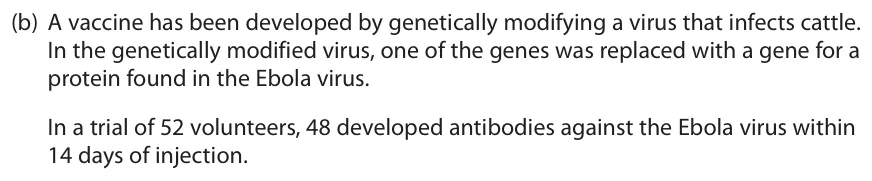
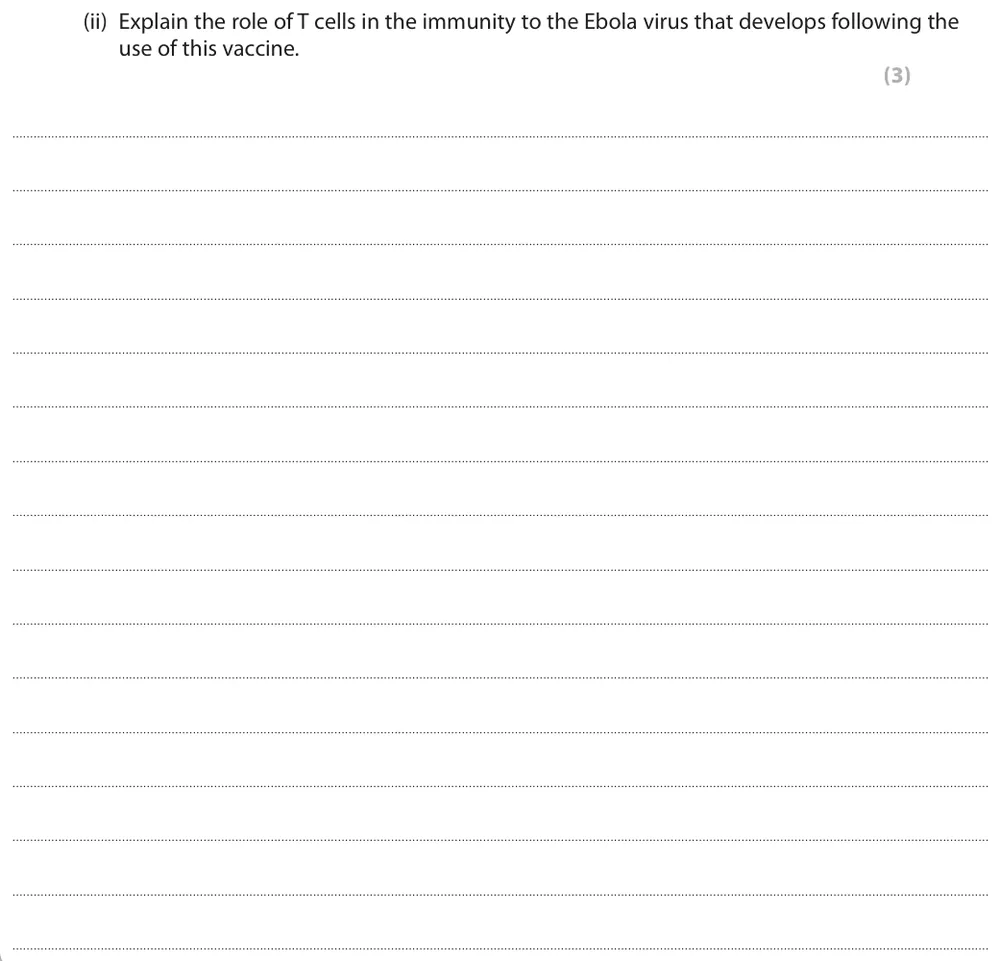
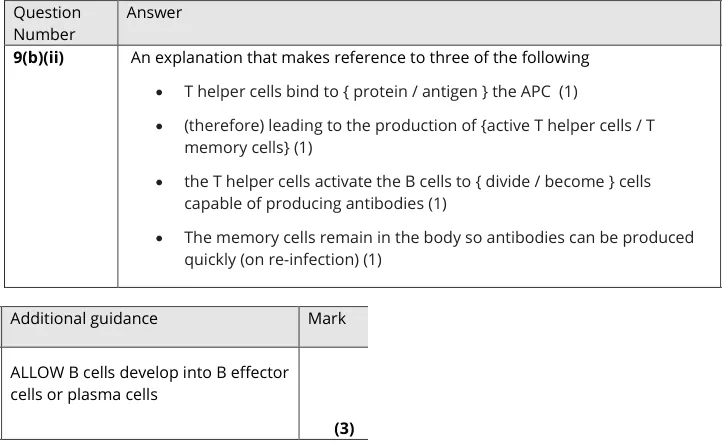
Explain the role of T cells in the immunity to Ebola that develops after vaccination.
Information from earlier in this question:
Show the mark scheme
Tap an image to open it full size.
From the examiners' report: Write about T helper cells, not just 'T cells'. B cells become plasma cells, which make the antibodies; and if you say the secondary response is faster, say antibodies are produced more quickly.
Barriers to infection (6.11 ii)
Question 13
A level Paper 1 · June 2023 · Q5(c) · 2 marks
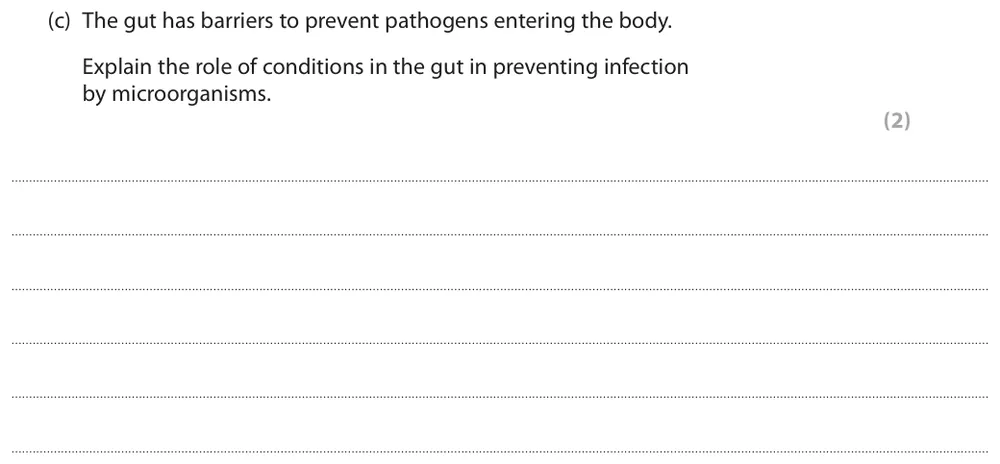
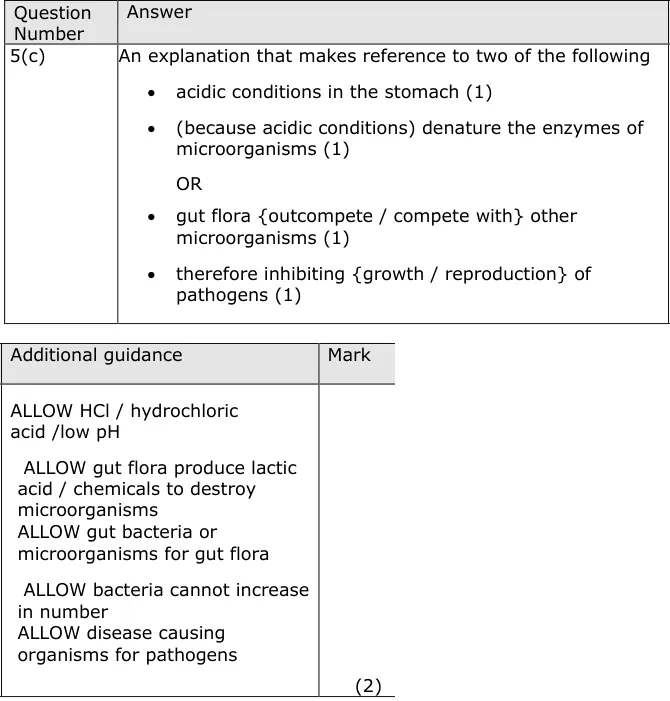
Explain the role of conditions in the gut in preventing infection by microorganisms.
Show the mark scheme
Tap an image to open it full size.
From the examiners' report: Describe a condition and then explain it. It is the stomach that is acidic, not the whole gut: the acid denatures the microorganisms' enzymes. Gut flora outcompete pathogens, inhibiting their growth.
Question 14
A level Paper 1 · October 2020 · Q3(b) · 3 marks
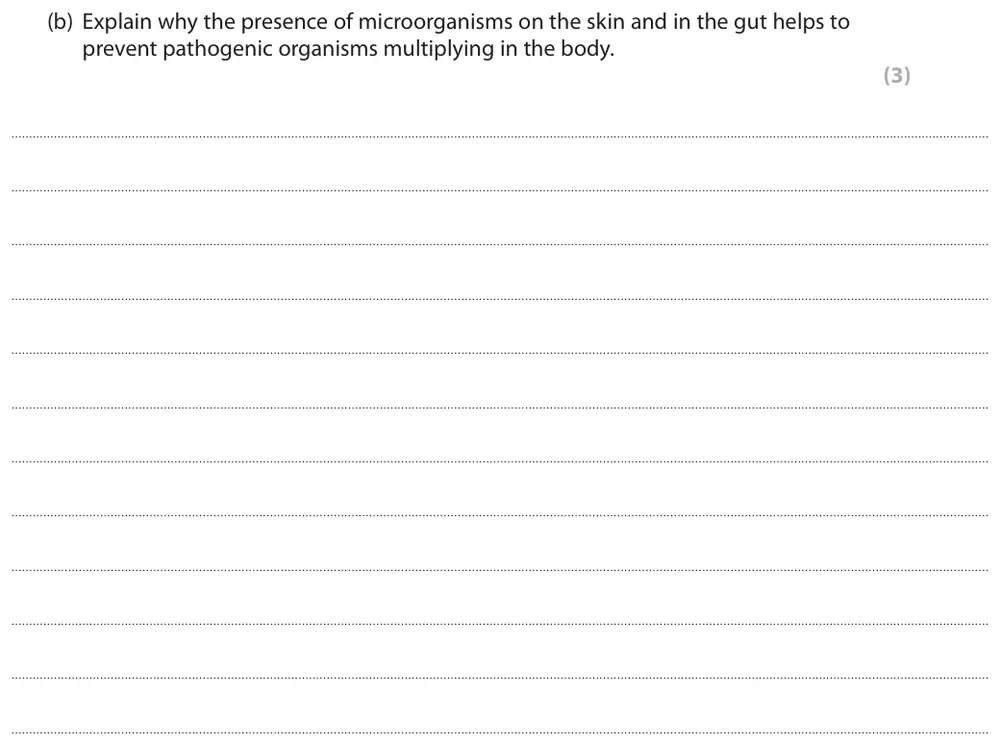
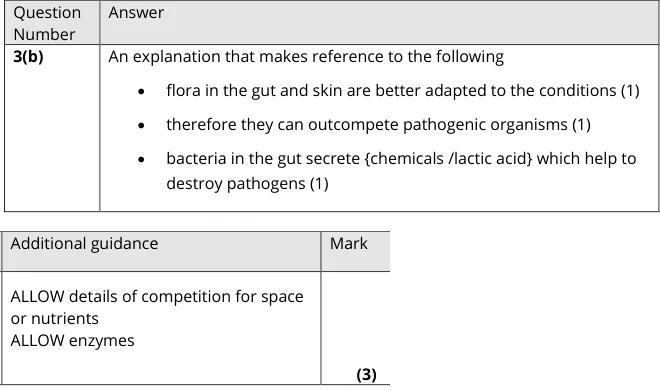
Explain why microorganisms on the skin and in the gut help stop pathogens multiplying.
Show the mark scheme
Tap an image to open it full size.
From the examiners' report: Most mentioned competition but did not say the pathogens are outcompeted because the flora are better adapted to the conditions. Stomach acid does not answer this question.
Developing immunity (6.12)
Question 15
A level Paper 1 · June 2022 · Q7(a)(ii) · 4 marks
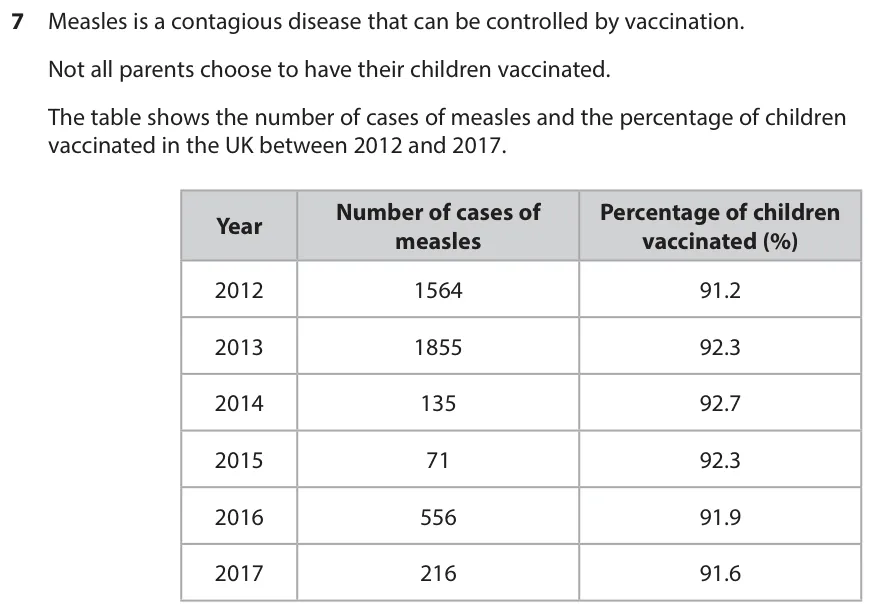
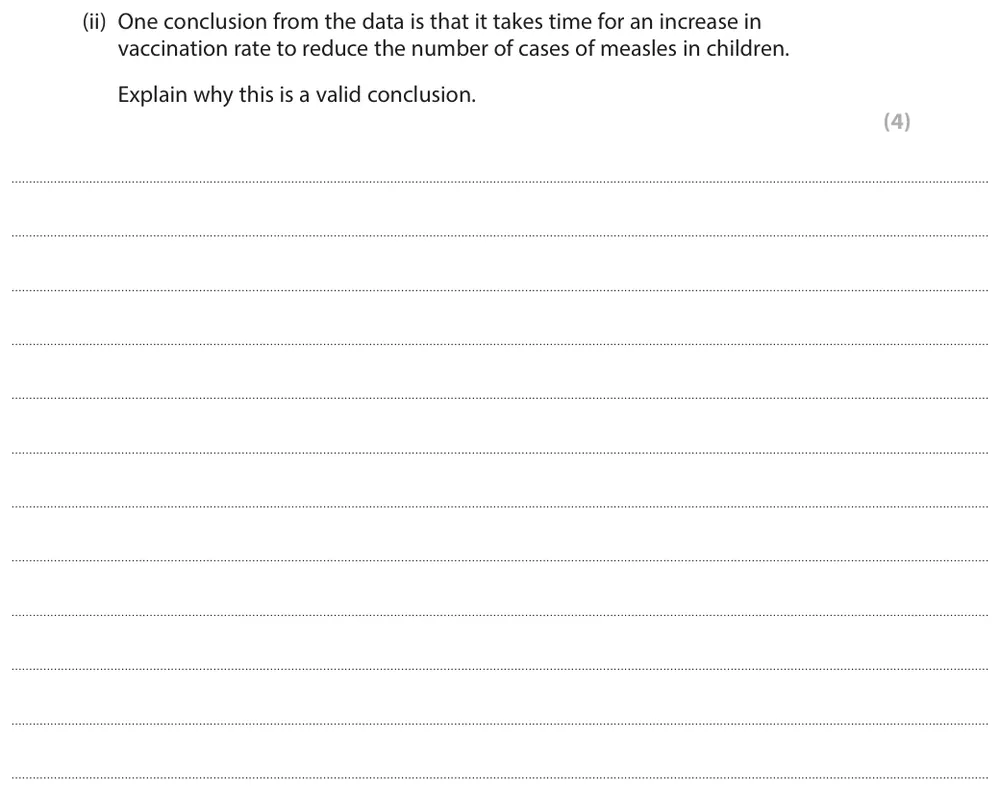
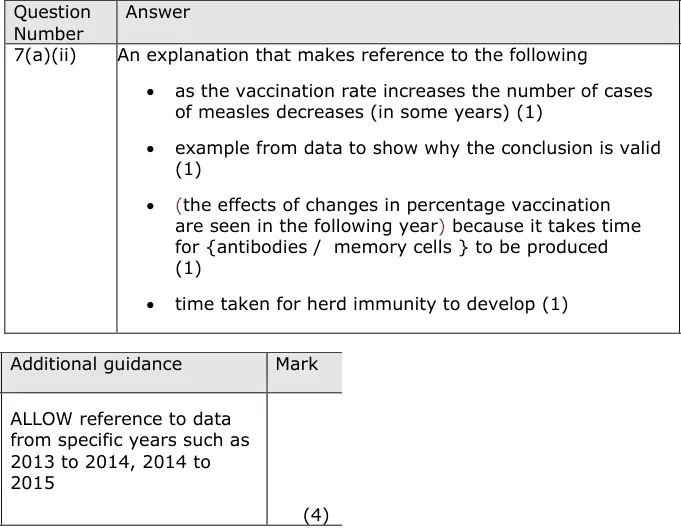
Explain why the measles data support the conclusion that a rise in vaccination rate takes time to reduce cases.
Information from earlier in this question:
Show the mark scheme
Tap an image to open it full size.
From the examiners' report: Many just repeated the data. Quote a suitable example from the data, then link it to the immune system: it takes time for antibodies and memory cells to be produced, and for herd immunity to develop.
The evolutionary race between pathogens and hosts (6.13)
Question 16
A level Paper 3 · June 2023 · Q7(a) · 2 marks
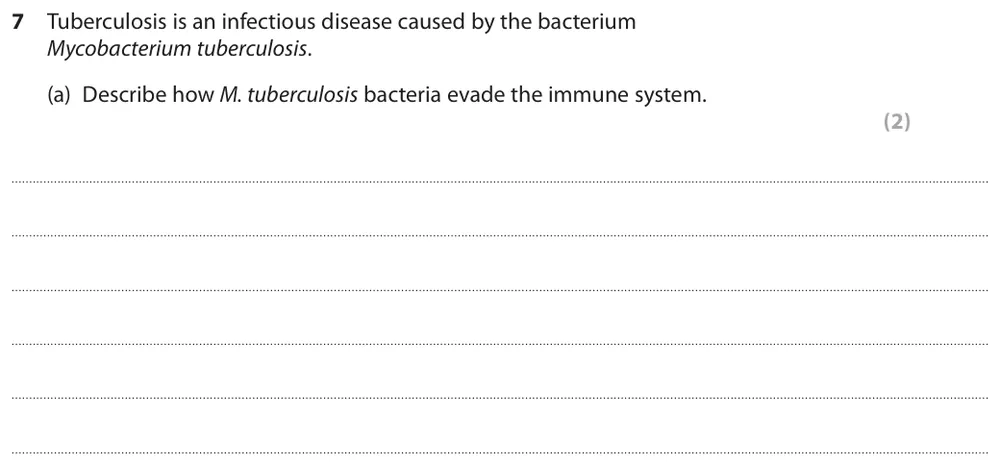
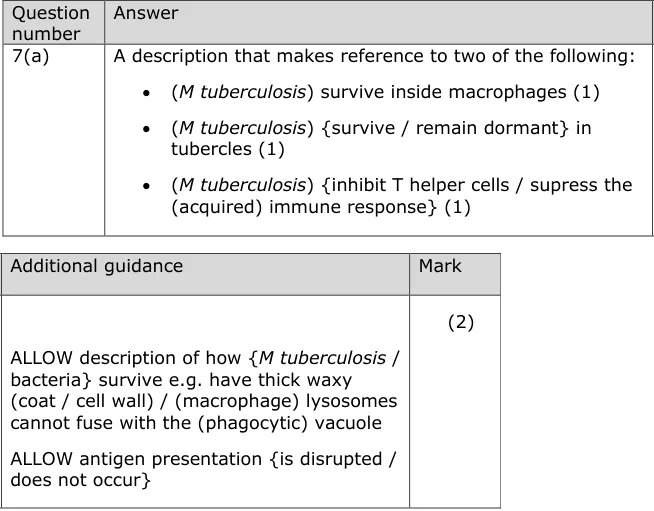
Describe how M. tuberculosis bacteria evade the immune system.
Show the mark scheme
Tap an image to open it full size.
From the examiners' report: Say the bacteria survive inside macrophages and remain dormant in tubercles. 'Avoids the immune response' needs detail, such as suppressing T helper cells. Some described how TB is spread, which does not answer the question.
Bacteriostatic and bactericidal antibiotics (6.14)
Question 17
A level Paper 1 · June 2023 · Q7(b)(i) · 1 mark
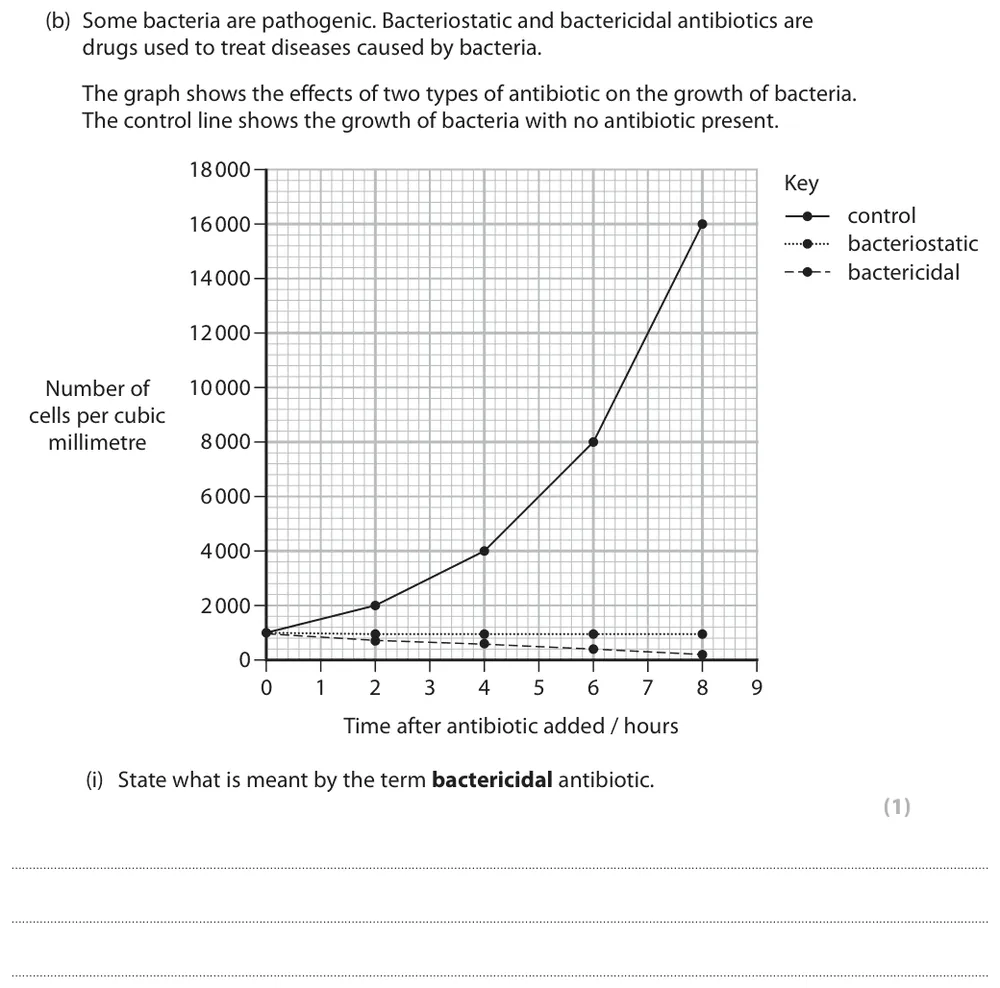
State what is meant by the term bactericidal antibiotic.
Show the mark scheme

Tap an image to open it full size.
From the examiners' report: Say that it kills bacteria. Describing effects on the cell wall or cell lysis was not enough.
Question 18
A level Paper 3 · June 2025 · Q5(a) · 1 mark
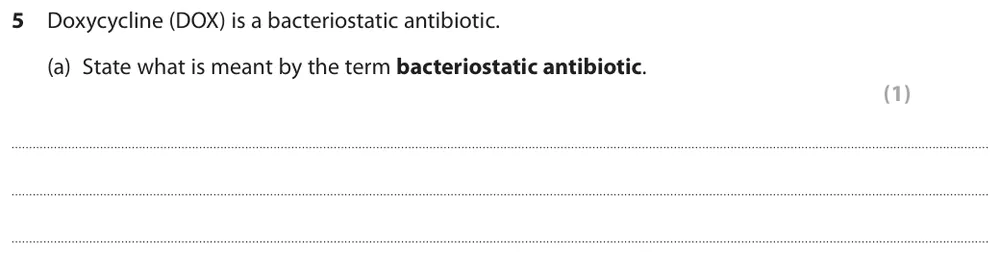
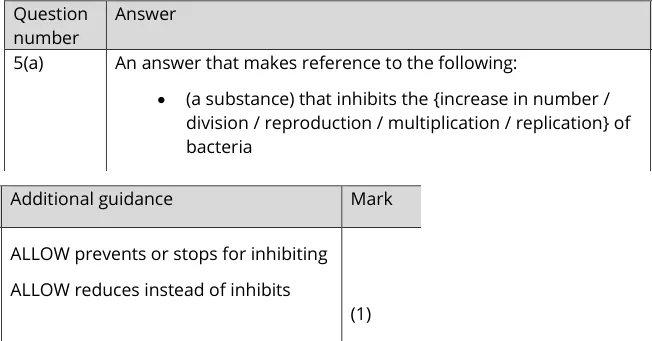
State what is meant by the term bacteriostatic antibiotic.
Show the mark scheme
Tap an image to open it full size.
From the examiners' report: Say it inhibits the increase in number (division or replication) of bacteria. 'Does not kill bacteria' or 'stops the growth of bacteria' did not gain the mark.
Question 19
A level Paper 3 · June 2025 · Q5(c)(ii) · 2 marks
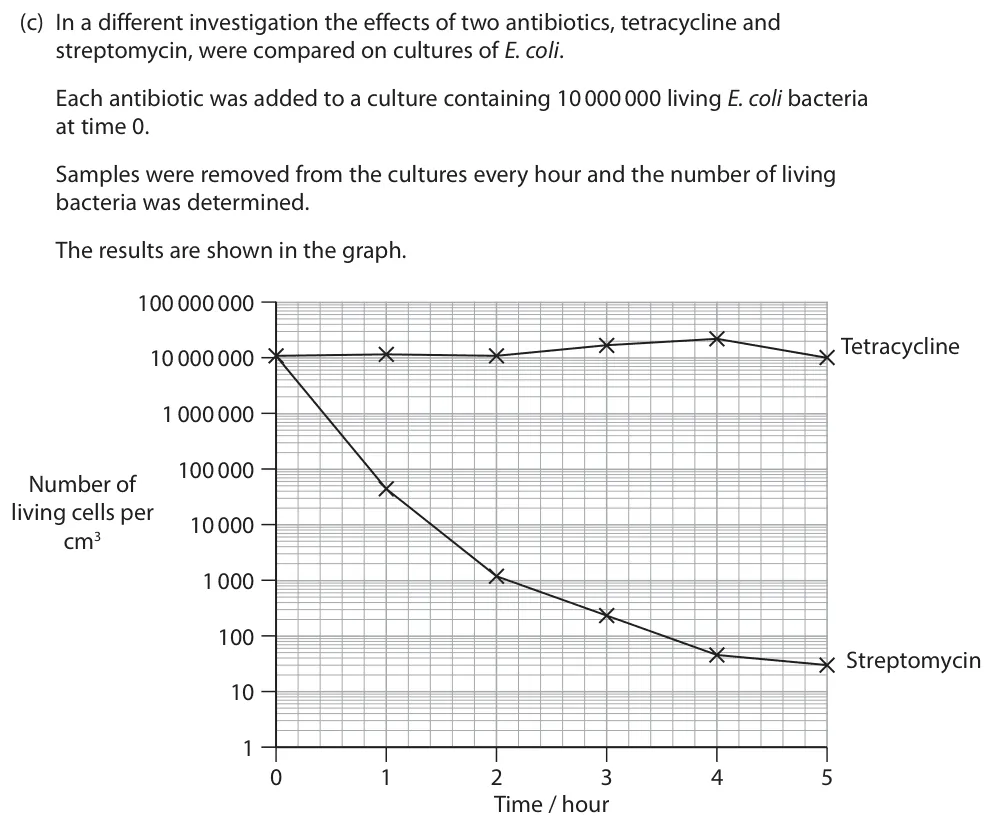
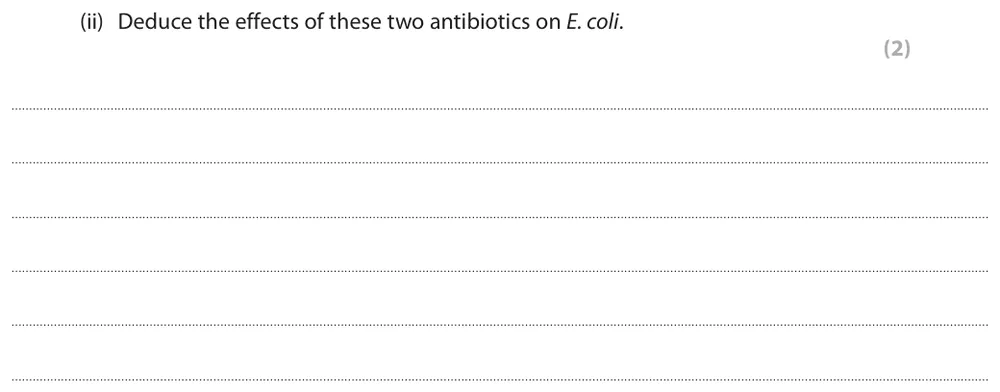
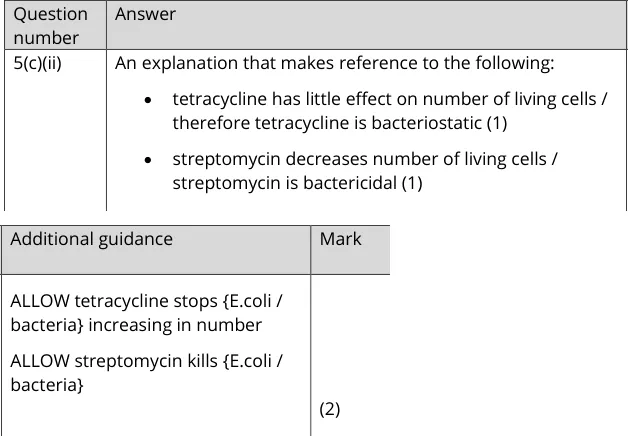
Deduce the effects of tetracycline and streptomycin on E. coli.
Information from earlier in this question:
Show the mark scheme
Tap an image to open it full size.
From the examiners' report: Don't just quote values. Say tetracycline has little effect on the number of living cells (bacteriostatic) and streptomycin decreases the number of living cells (bactericidal).
Hospital acquired infections (6.15)
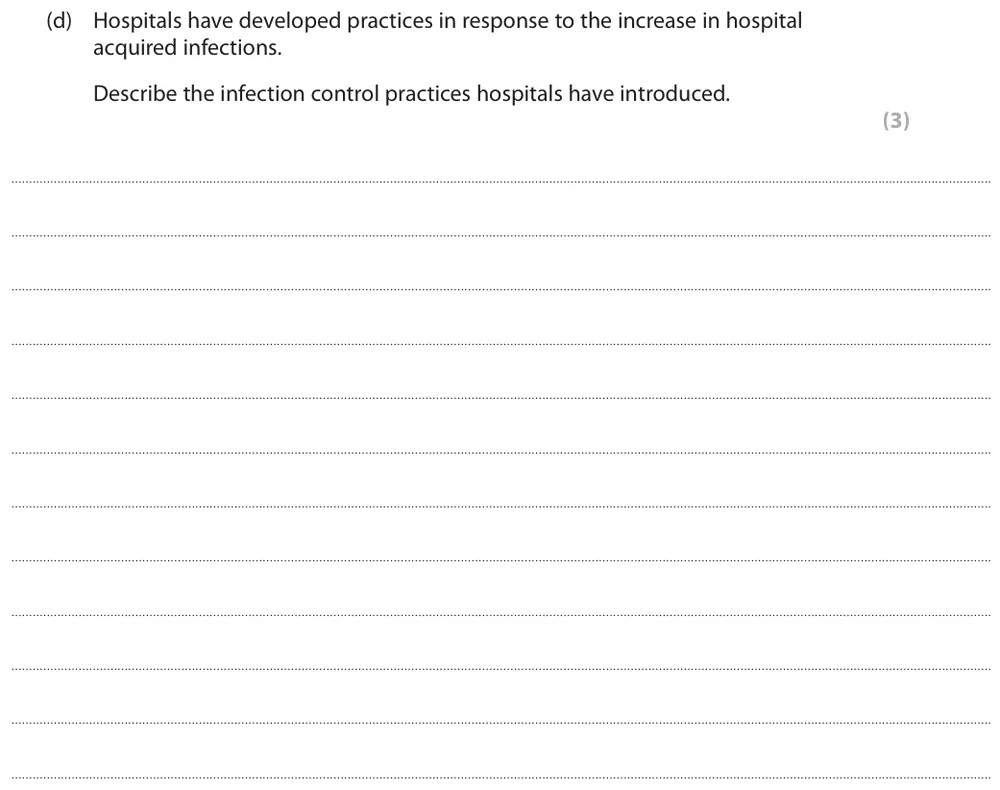
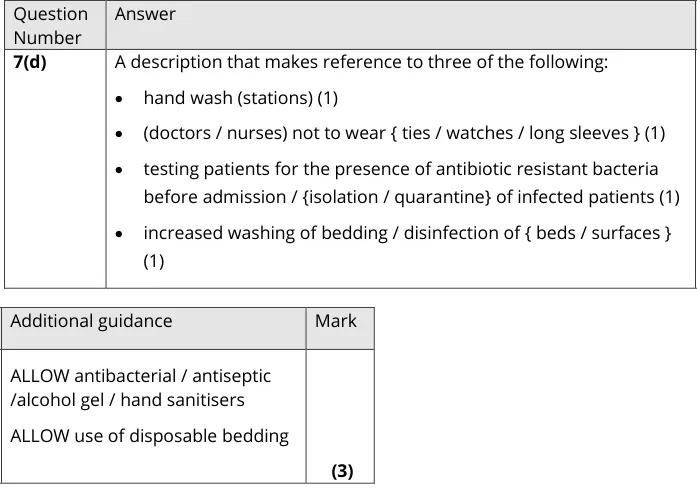
Question 20
A level Paper 1 · June 2019 · Q7(d) · 3 marks
Describe the infection control practices hospitals have introduced.
Show the mark scheme
Tap an image to open it full size.
From the examiners' report: Hand washing and isolating patients were the most common marks. Only recently introduced practices counted, so sterilising equipment was not credited, and antibiotic prescribing was not relevant here.
Where students lose marks (from Pearson examiners' reports and mark schemes)
Each point below comes from the examiners' reports and mark schemes, and is followed by wording that gained marks.
Ebola versus HIV needs a difference too. Some answers gave only similarities, which cannot gain full marks in a compare and contrast question.
✔ Gains credit: 'Both contain RNA and a protein capsid, but Ebola contains one strand of RNA and HIV contains two.'
Glycoproteins bind, the envelope fuses. Many answers on HIV entry lacked the detail needed to score.
✔ Gains credit: 'Glycoproteins (gp120) on the virus bind to CD4 receptors on T helper cells; the viral envelope fuses with the cell membrane and the viral RNA enters the cell.'
Arterioles dilate, plasma leaks out. Answers said arteries, capillaries or 'blood vessels' dilate, or that cells leave the capillaries.
✔ Gains credit: 'Histamine causes arterioles to dilate, increasing blood flow; it also increases the permeability of capillaries, allowing plasma to enter the tissues.'
Present antigens to T cells. Many wrote 'antigen presentation' without saying what the antigens are presented to.
✔ Gains credit: 'Monocytes (macrophages) present virus antigens to T cells and produce cytokines.'
Plasma cells release the antibodies. Some thought B effector cells produced the antibodies, or were unclear which cells the B cells were producing.
✔ Gains credit: 'T helper cells release cytokines; B cells are stimulated to produce B effector cells, which differentiate into plasma cells that release antibodies.'
No T helper cells, no antibodies. Many referred vaguely to a weakened immune system instead of explaining the effect of losing T helper cells.
✔ Gains credit: 'Lack of T helper cells reduces cytokine production, reducing activation of B cells and antibody production, so there is an increased risk of opportunistic infections.'
Only the stomach is acidic. Some said the whole gut is acidic, or named a condition without explaining how it prevents infection.
✔ Gains credit: 'Acidic conditions in the stomach denature the enzymes of microorganisms.'
Bacteriostatic stops numbers rising. Some said bacteriostatic antibiotics 'stop the growth of bacteria' or 'do not kill bacteria'.
✔ Gains credit: 'A substance that inhibits the increase in number of bacteria.'
Download the questions
Download the PDF pack (20 questions, mark schemes at the end)
Keep practising
- Forensics, DNA Profiling and PCR (Topic 6): Edexcel SNAB exam questions by topic
- Gel Electrophoresis and Antibiotics (Core Practicals 14 and 15): Edexcel SNAB core practical questions
- Topic 6 multiple-choice quiz (13 questions, marked as you tap)
- Edexcel SNAB A level Biology resources hub (every topic, practical and paper)
- Extended Response Questions (Topics 5 to 8): Edexcel SNAB A Level Biology Exam Questions
- Edexcel SNAB A level Biology past papers, mark schemes and examiners' reports
- Edexcel SNAB A level Biology grade boundaries
- Message Tom on WhatsApp about one-to-one Edexcel SNAB tutoring or an Edexcel group class
Questions, mark schemes and examiners' report extracts © Pearson Education Ltd.