

Climate Change and Evolution completes Topic 5, On the Wild Side, of the Edexcel A level Biology A (Salters-Nuffield) specification. You need to understand the evidence for climate change, including pollen in peat bogs and temperature records, how greenhouse gases cause it, how data are extrapolated in climate models, its effects on the distribution and life cycles of organisms, and the effect of temperature on enzymes. You also need evolution by mutation and natural selection, speciation, and how the carbon cycle, reforestation and sustainable resources can reduce carbon dioxide. These questions come from A level Papers 1 and 3. All questions are from the A level papers (9BN0).
The examiners' reports keep criticising generic answers. Use the data and the organism in the question: say how the trend supports a conclusion, and write natural selection in the context given. Mutations are random; the selection pressure does not cause them, and the result is a change in allele frequency. For temperature, give the enzymes more kinetic energy and make collisions more frequent. For greenhouse gases, it is the increase that traps more infrared radiation, not damage to the ozone layer, and reforestation works because of a net uptake of carbon dioxide.
Studying Edexcel SNAB and want more help? If you'd like to arrange one-to-one Edexcel tutoring, or to register your interest in an Edexcel group class, message Tom on WhatsApp using the link at the bottom of this page.
What you need from GCSE
Each question on this page assumes you're secure on these ideas. If any of them feels shaky, look it up before you start.
- Carbon dioxide and methane are greenhouse gases that trap heat in the atmosphere.
- Burning fossil fuels and deforestation increase the carbon dioxide concentration of the atmosphere.
- Variation and natural selection lead to evolution: better-adapted individuals survive and pass on their genes.
- Enzyme activity increases with temperature up to an optimum, above which enzymes denature.
Key terms
These words come up in the questions and mark schemes. Examiners expect you to use them exactly.
- Greenhouse effect: greenhouse gases absorb infrared radiation emitted from the Earth's surface, trapping heat in the atmosphere.
- Anthropogenic: caused by human activity, such as burning fossil fuels or deforestation.
- Extrapolation: extending a trend line beyond the data collected to make a prediction.
- Selection pressure: an environmental factor that gives some individuals a better chance of surviving and reproducing.
- Allele frequency: how common an allele is in a population; evolution is a change in allele frequency.
- Gene flow: the transfer of alleles between populations by interbreeding.
- Allopatric speciation: new species forming from populations that are geographically isolated.
- Carbon sink: something that takes in and stores more carbon than it releases, such as a growing forest.
What these questions cover (Edexcel SNAB Topic 5: On the Wild Side)
The questions test these statements from Topic 5 of the Pearson Edexcel A level Biology A (Salters-Nuffield) specification (9BN0).
- 5.12 Understand the different types of evidence for climate change and its causes (including records of carbon dioxide levels, temperature records, pollen in peat bogs and den
- 5.13 Understand the causes of anthropogenic climate change, including the role of greenhouse gases (carbon dioxide and methane) in the greenhouse effect.
- 5.14 i Understand that data can be extrapolated to make predictions and that these are used in models of future climate change.
- 5.15 Understand the effects of climate change (changing rainfall patterns and changes in seasonal cycles) on plants and animals (distribution of species, development and life
- 5.16 Understand the effect of temperature on the rate of enzyme activity and its impact on plants, animals and microorganisms.
- 5.17 Understand how evolution (a change in the allele frequency) can come about through gene mutation and natural selection.
- 5.19 Understand how isolation reduces gene flow between populations, leading to allopatric or sympatric speciation.
- 5.21 Understand how knowledge of the carbon cycle can be applied to methods to reduce atmospheric levels of carbon dioxide.
- 5.22 Understand how reforestation and the use of sustainable resources, including biofuels, are examples of the effective management of the conflict between human needs and co
How to use this page
Write your answer on paper before you open the mark scheme. Allow about 1.2 minutes per mark: the 20 questions are worth 61 marks, so about 73 minutes in total. Then mark your answer strictly against the mark scheme and read the examiners' tip underneath it. If you'd rather print the questions, download the PDF pack.
Evidence for climate change (5.12)
Question 1
A level Paper 1 · June 2017 · Q5(a) · 4 marks · Hard
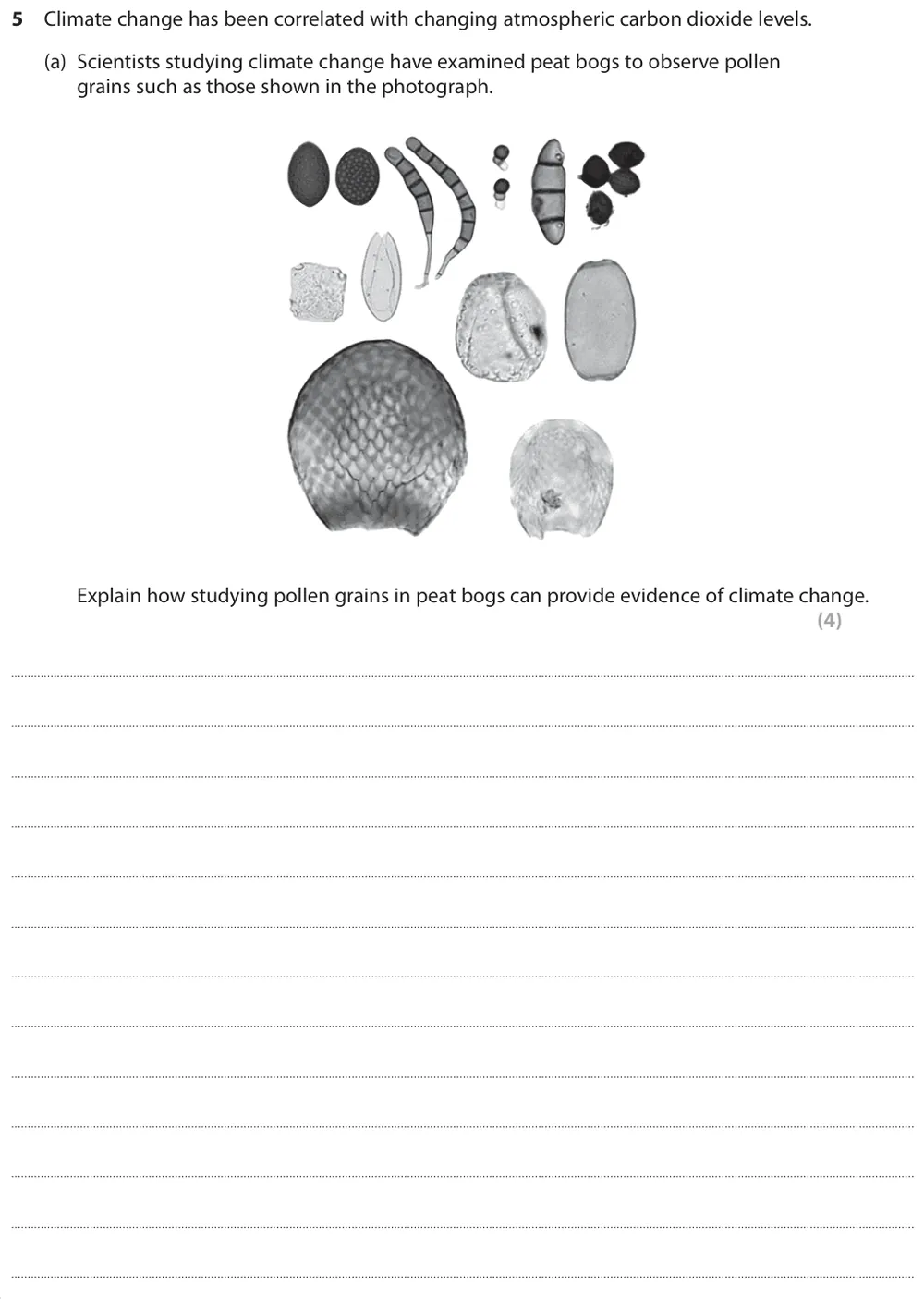
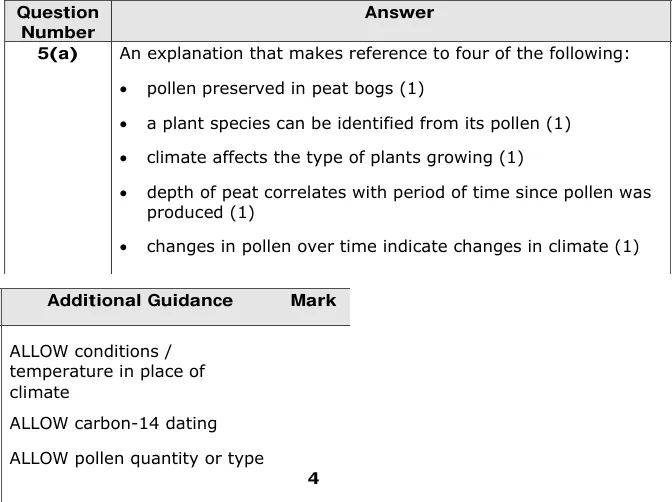
Explain how studying pollen grains in peat bogs can provide evidence of climate change.
Show the mark scheme
Tap an image to open it full size.
From the examiners' report: Be precise: pollen identifies the plant species, climate determines which species grow, and the depth of the peat correlates with the time since the pollen was deposited. Many described layers of peat without linking depth to time.
Question 2
A level Paper 3 · June 2018 · Q2(a)(i) · 2 marks
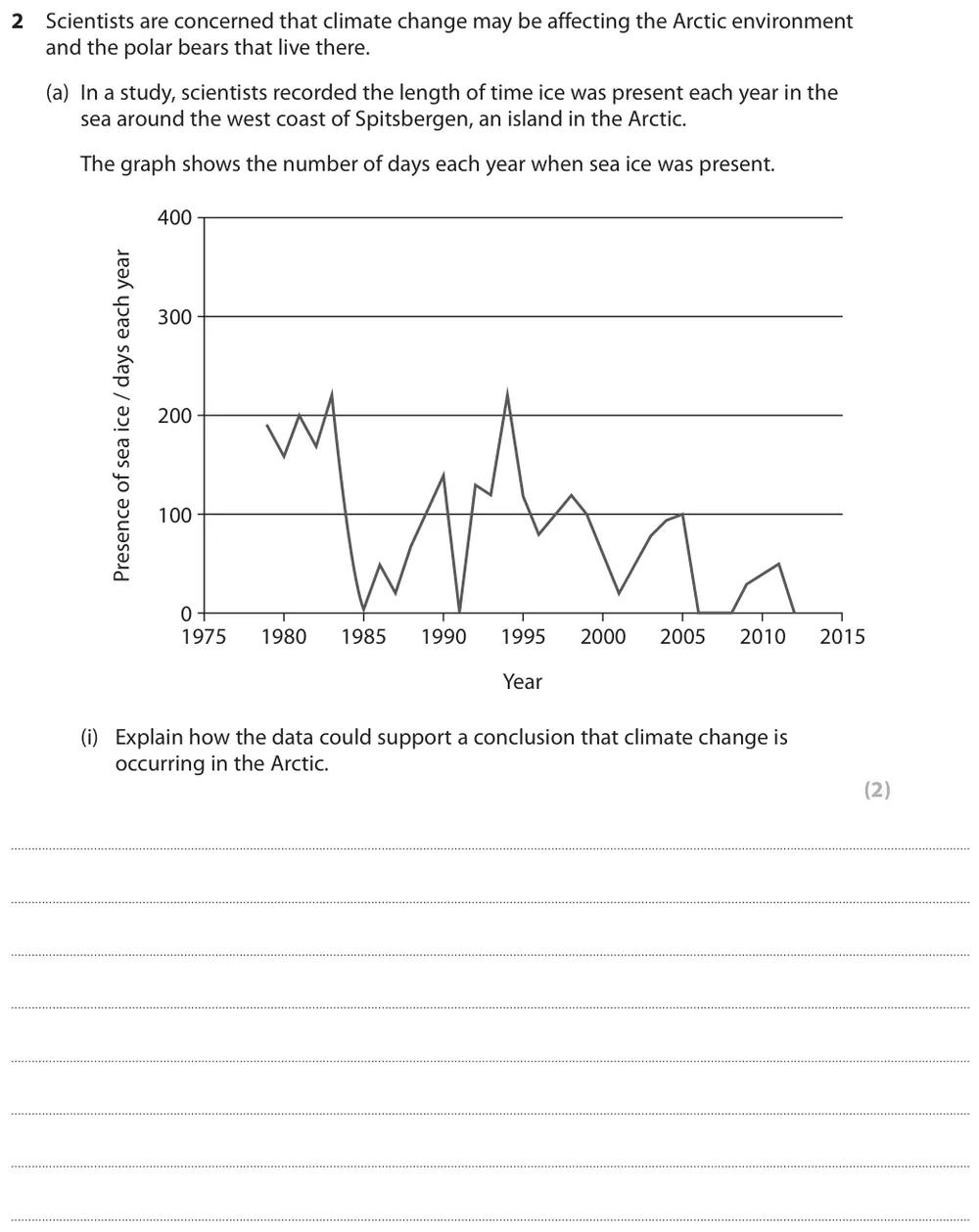
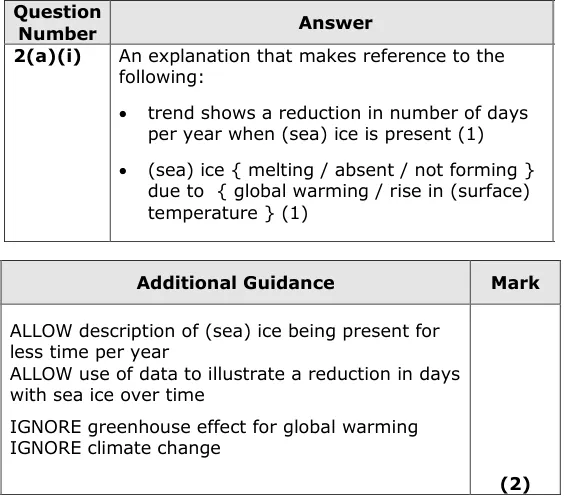
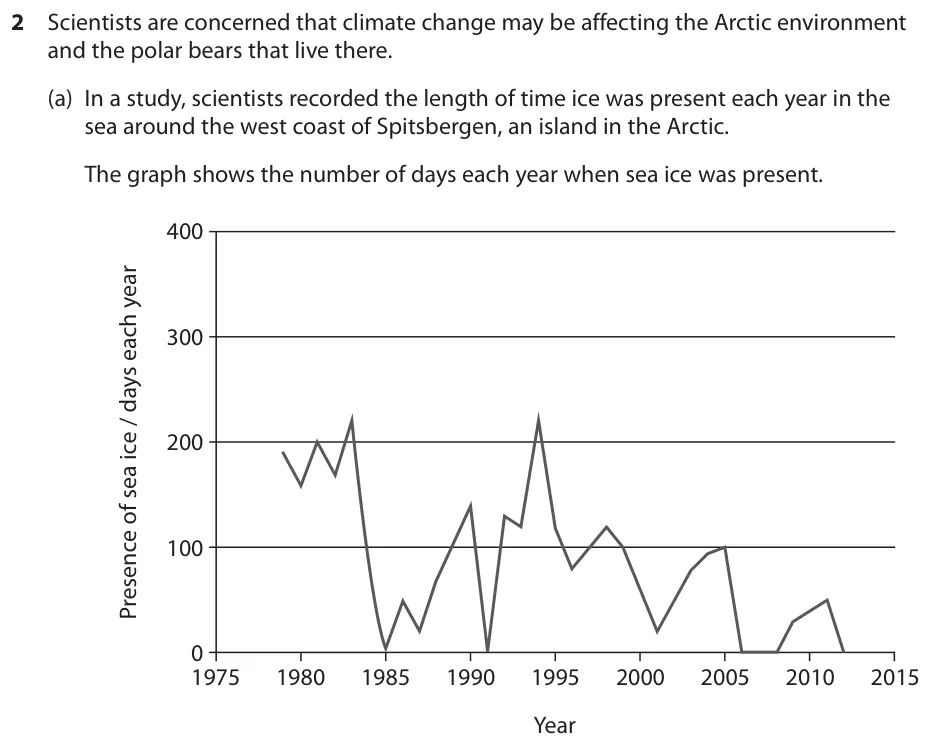
Explain how a graph of days with sea ice each year could support the conclusion that climate change is occurring in the Arctic.
Show the mark scheme
Tap an image to open it full size.
From the examiners' report: Describe the trend (fewer days with sea ice each year), not the fluctuations, then link it to global warming. Don't just repeat 'climate change' from the question.
Causes of climate change and the greenhouse effect (5.13)
Question 3
A level Paper 1 · June 2019 · Q10(a) · 3 marks
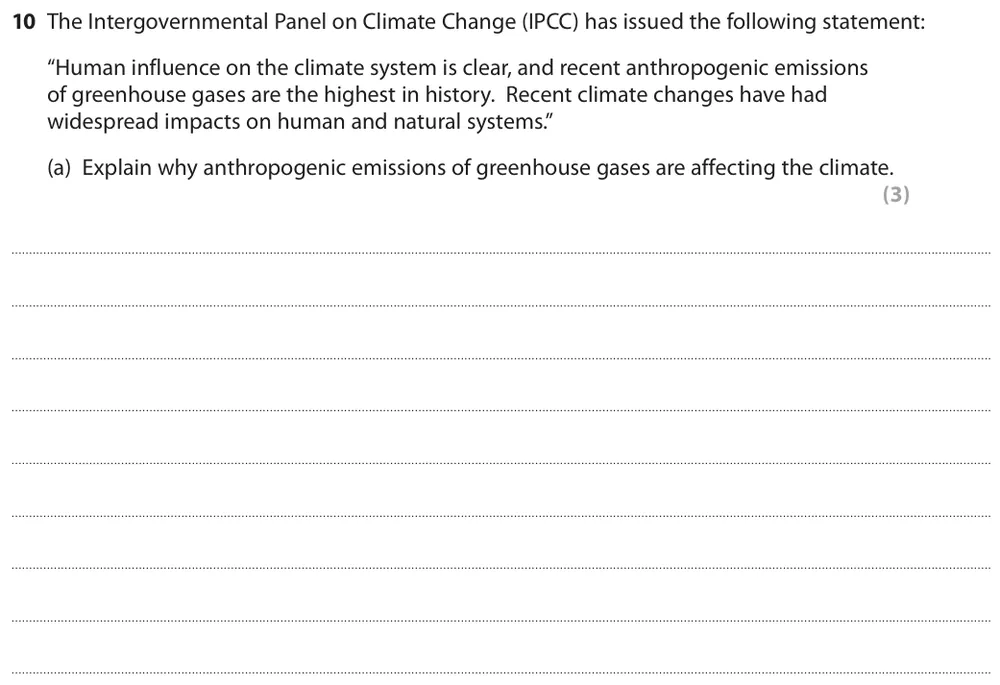
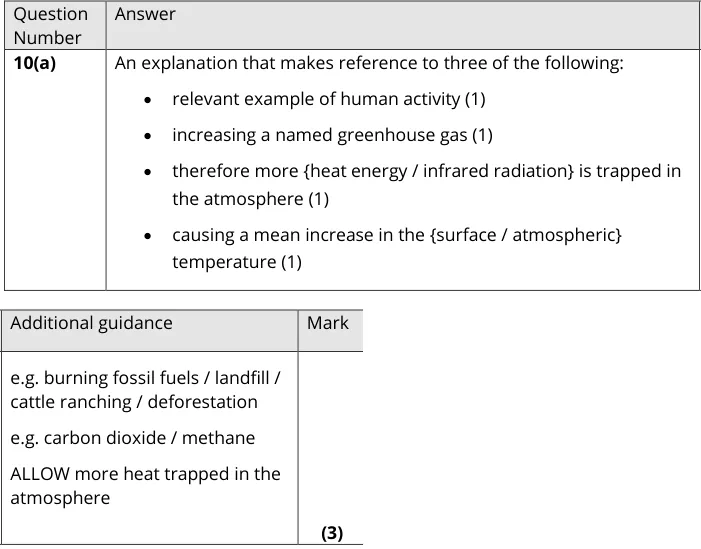
Explain why anthropogenic emissions of greenhouse gases are affecting the climate.
Show the mark scheme
Tap an image to open it full size.
From the examiners' report: It is the increase in emissions that traps more infrared radiation in the atmosphere, raising the mean surface temperature. Damage to the ozone layer is not relevant.
Question 4
A level Paper 1 · June 2023 · Q8(c)(i) · 3 marks
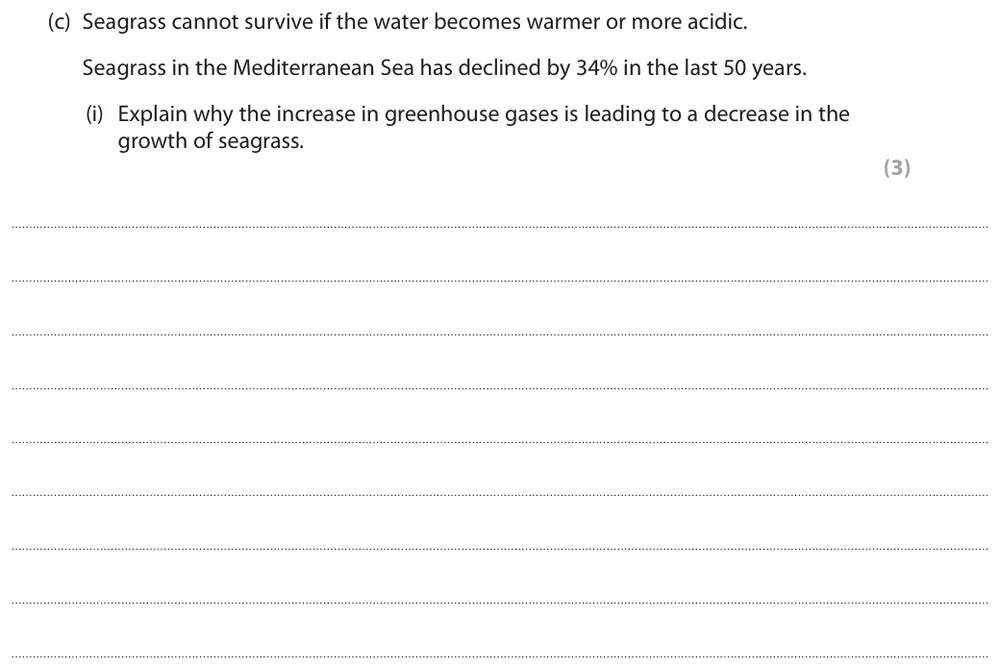
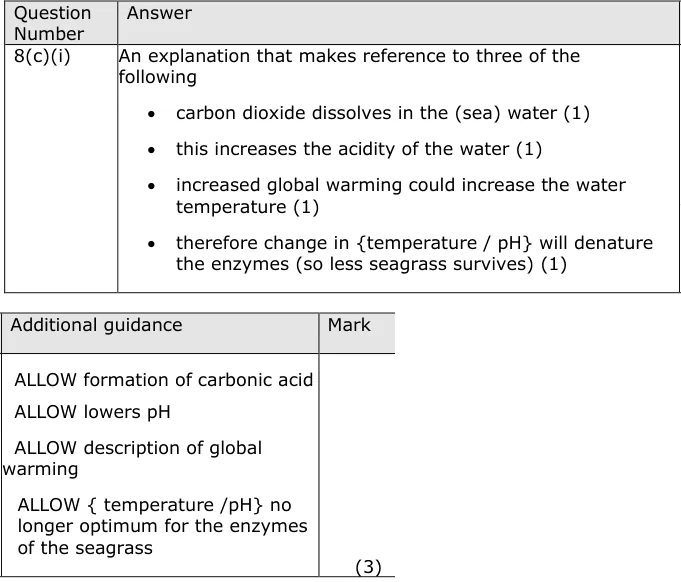
Explain why the increase in greenhouse gases is leading to a decrease in the growth of seagrass.
Show the mark scheme
Tap an image to open it full size.
From the examiners' report: Skip the description of the greenhouse effect. Say the water temperature rises, not just 'temperature', and explain the acidity: carbon dioxide dissolves in sea water and lowers the pH, so the seagrass enzymes are no longer at their optimum.
Question 5
A level Paper 3 · November 2021 · Q5(b)(ii) · 4 marks
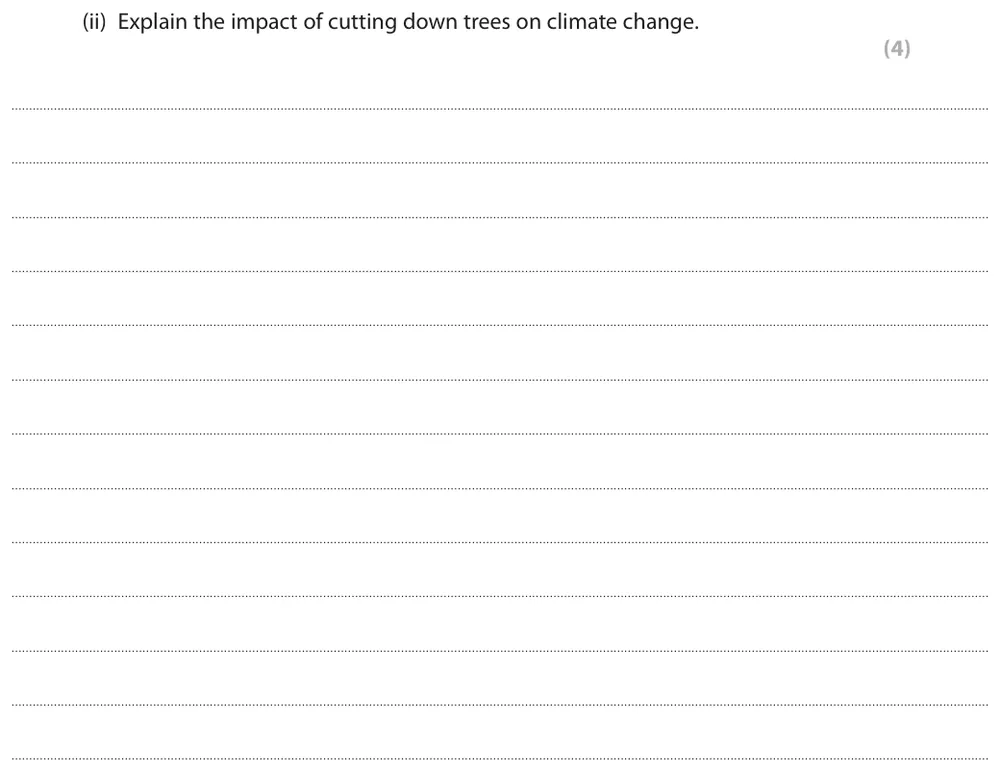
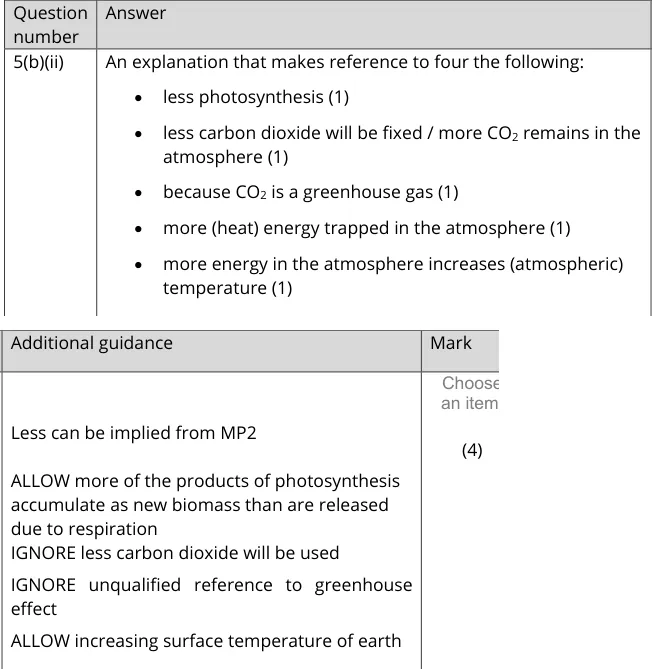
Explain the impact of cutting down trees on climate change.
Show the mark scheme
Tap an image to open it full size.
From the examiners' report: Start from less photosynthesis, so less carbon dioxide is fixed and more stays in the atmosphere as a greenhouse gas. Some wrote only about burning or decomposition of the felled trees.
Extrapolating data and climate models (5.14 i)
Question 6
A level Paper 1 · June 2023 · Q10(a) · 2 marks
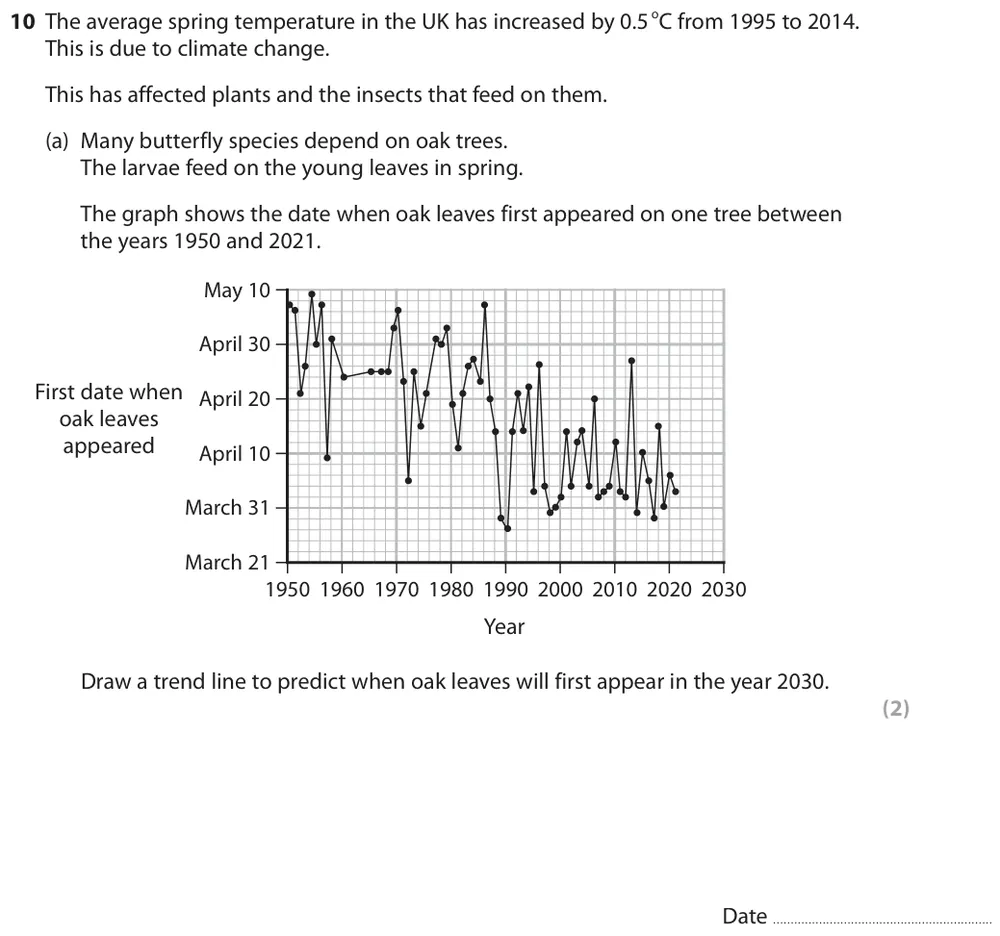
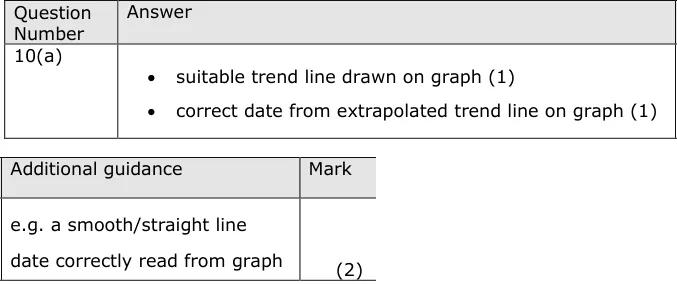
Draw a trend line on a graph of oak leaf dates and extrapolate it to predict the date in 2030.
Show the mark scheme
Tap an image to open it full size.
From the examiners' report: Most drew a trend line and read the date correctly. Use a smooth or straight line, extend it to 2030, and read the date from your own line.
Question 7
A level Paper 3 · June 2018 · Q2(a)(ii) · 4 marks
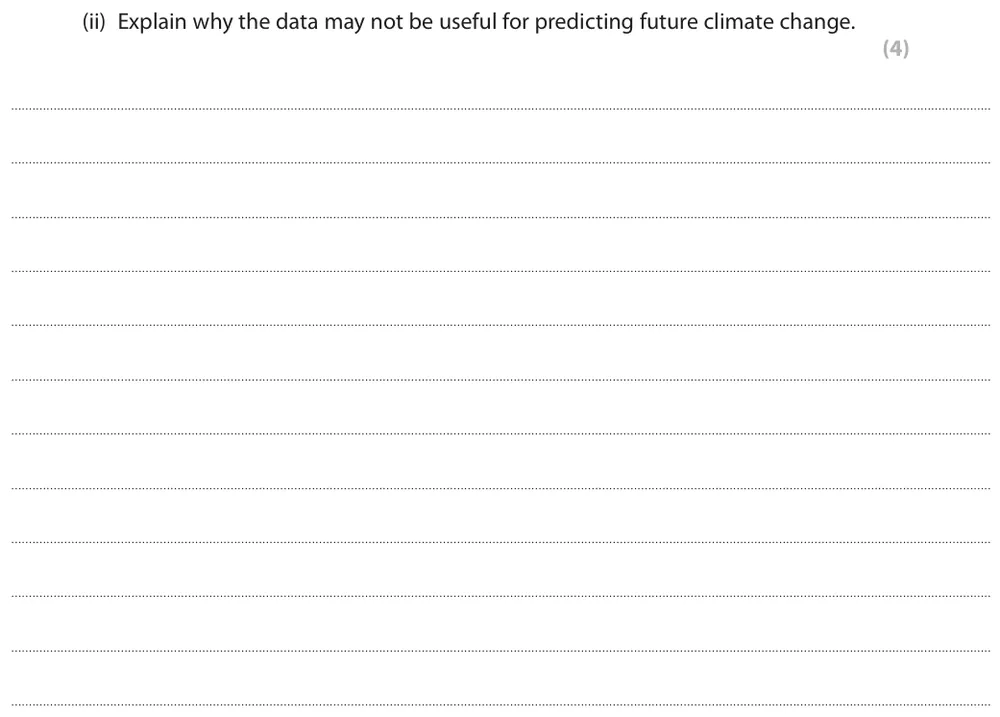
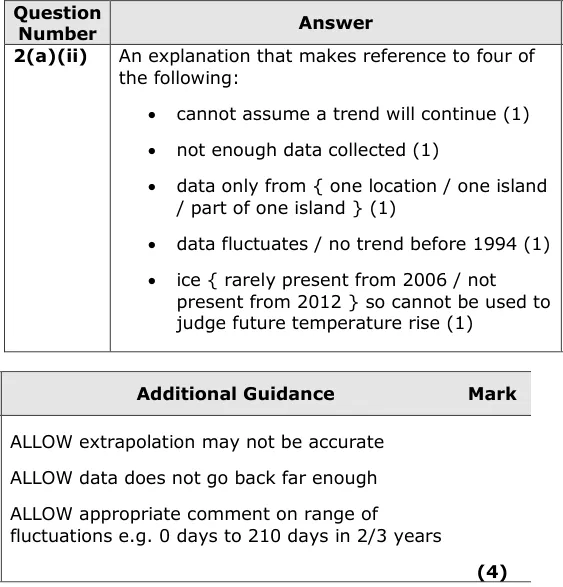
Explain why the sea ice data may not be useful for predicting future climate change.
Information from earlier in this question:
Show the mark scheme
Tap an image to open it full size.
From the examiners' report: Use the graph: a significant minority ignored it and wrote generally. Credit came for the fluctuations in the data, data from only one location, too few years and not assuming the trend will continue.
Effects of climate change on plants and animals (5.15)
Question 8
A level Paper 1 · June 2018 · Q7(b)(iii) · 5 marks · Easy
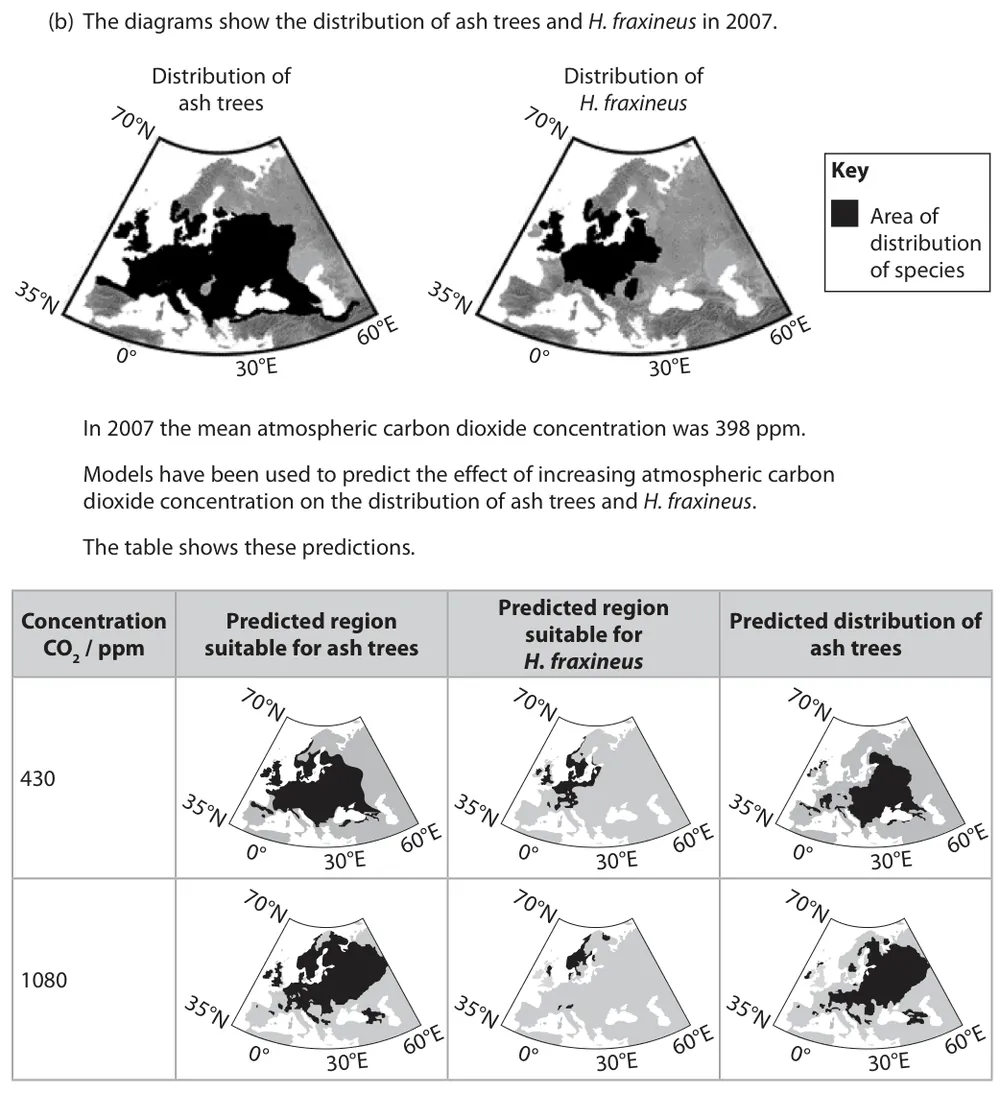
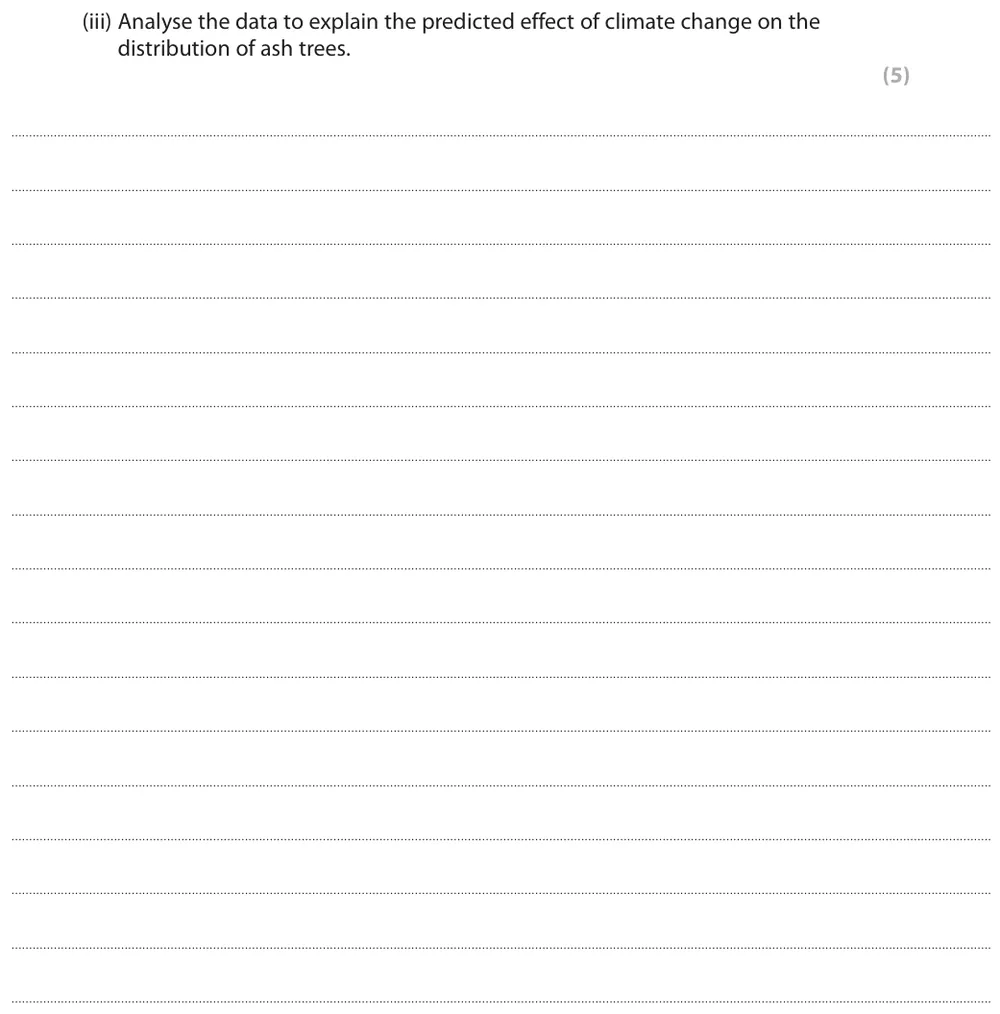
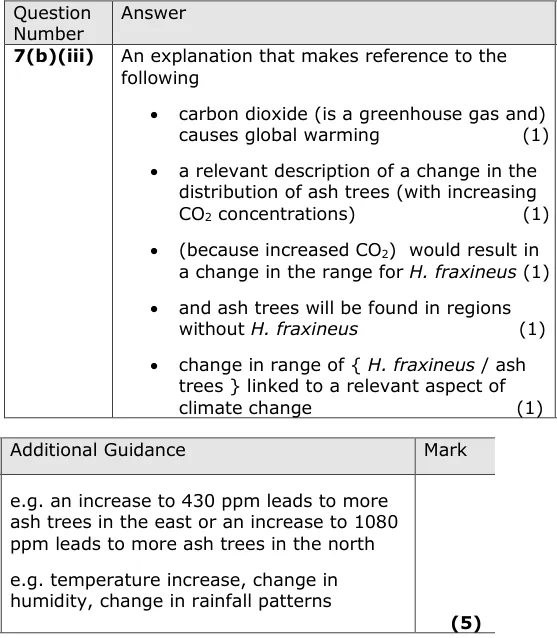
Analyse maps to explain the predicted effect of climate change on the distribution of ash trees.
Information from earlier in this question:
Show the mark scheme
Tap an image to open it full size.
From the examiners' report: Use the data on both the ash trees and the fungus H. fraxineus: many ignored the fungus. Very few said ash trees will be found where H. fraxineus is absent, or that carbon dioxide causes global warming.
Question 9
A level Paper 1 · October 2020 · Q2(c) · 4 marks
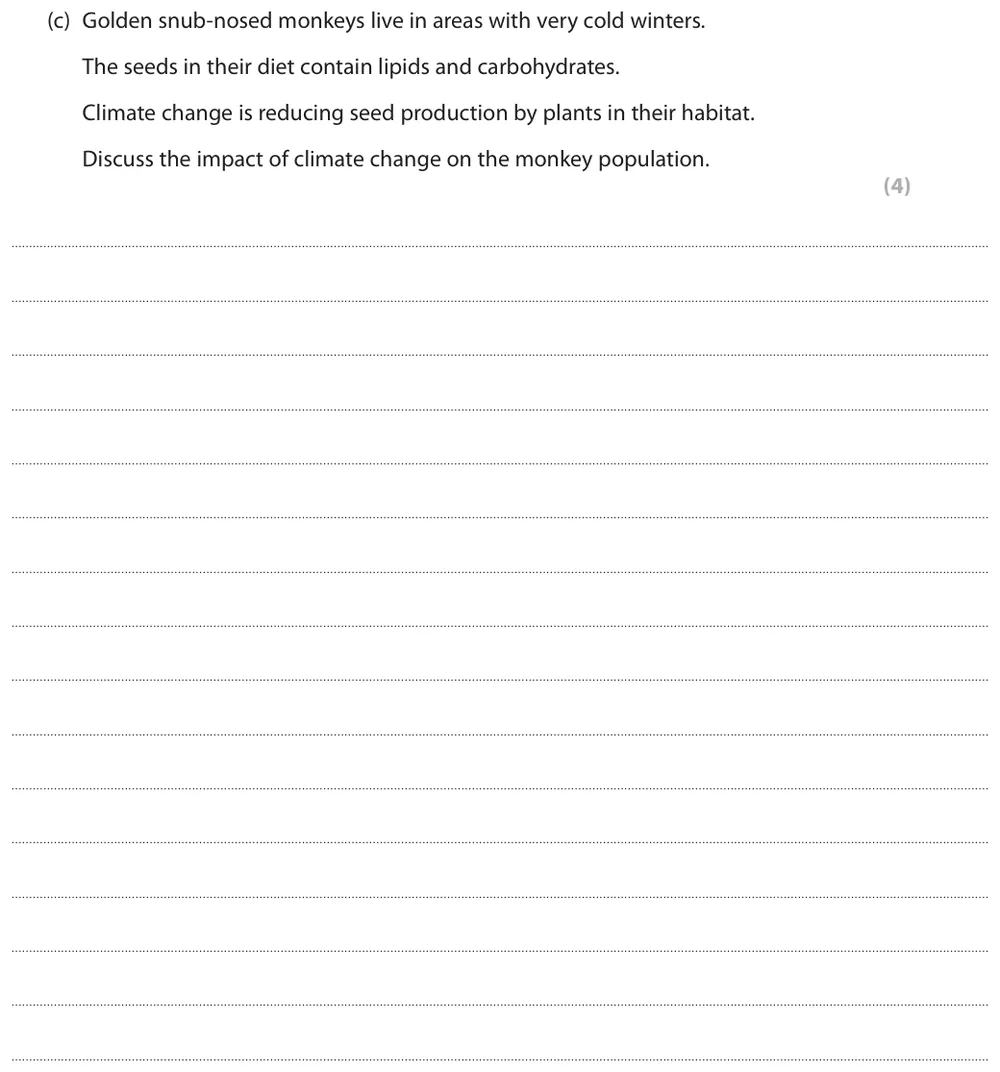
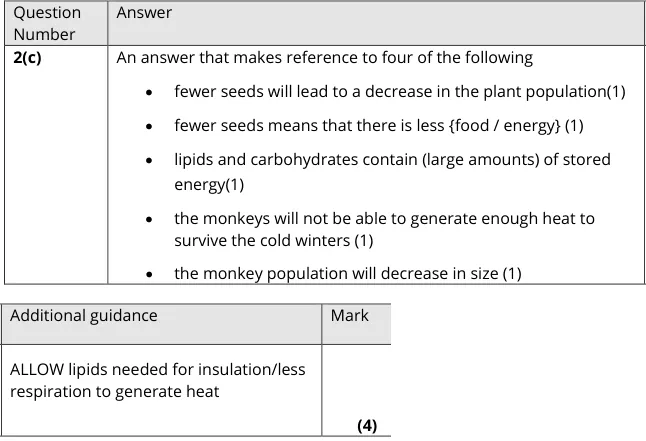
Discuss the impact of climate change on a population of golden snub-nosed monkeys.
Show the mark scheme
Tap an image to open it full size.
From the examiners' report: Most said less food means a smaller population. Few linked the lipids and carbohydrates in seeds to the energy the monkeys need to generate heat or keep warm in very cold winters.
Question 10
A level Paper 1 · June 2024 · Q6(b)(ii) · 2 marks · Hard
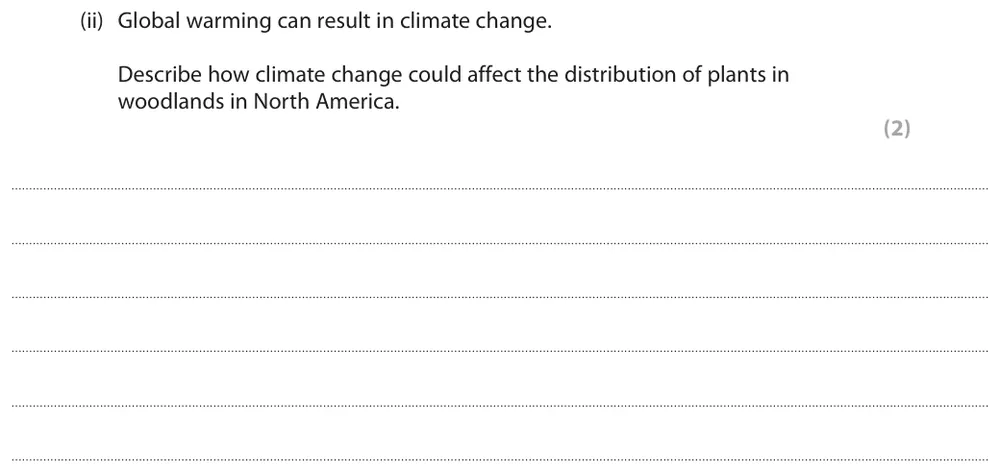
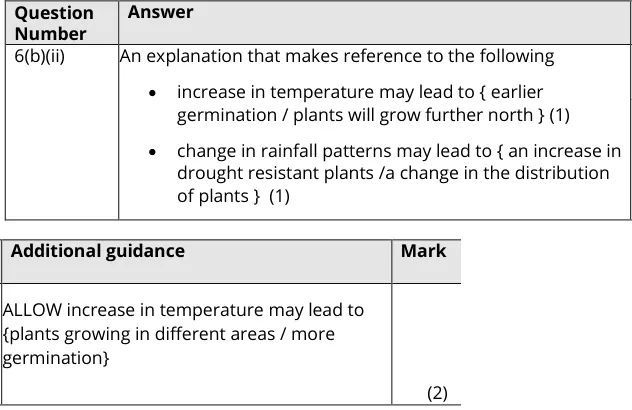
Describe how climate change could affect the distribution of woodland plants in North America.
Show the mark scheme
Tap an image to open it full size.
From the examiners' report: The question is about distribution, not abundance. Changing rainfall patterns were rarely mentioned: drought could change which plants grow where.
Temperature, enzymes and organisms (5.16)
Question 11
A level Paper 1 · June 2023 · Q10(c)(i) · 2 marks
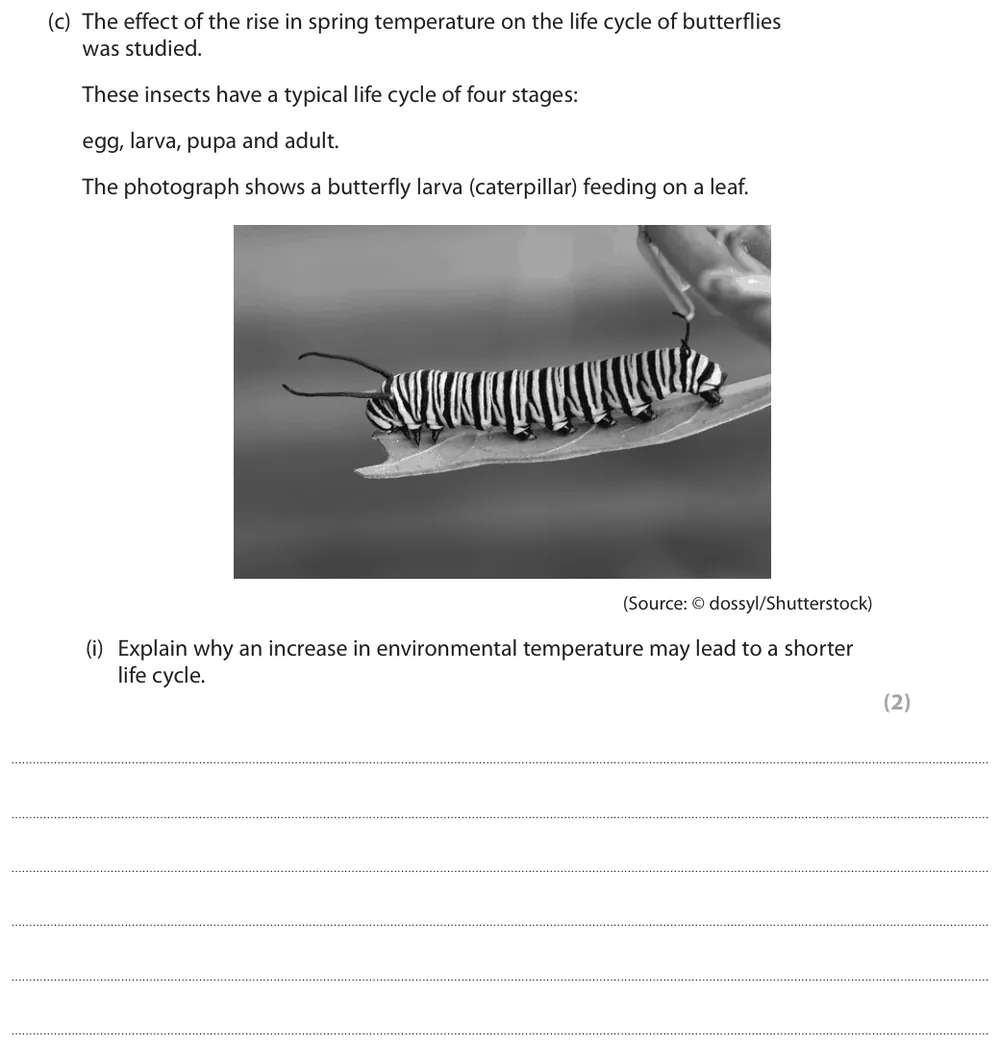
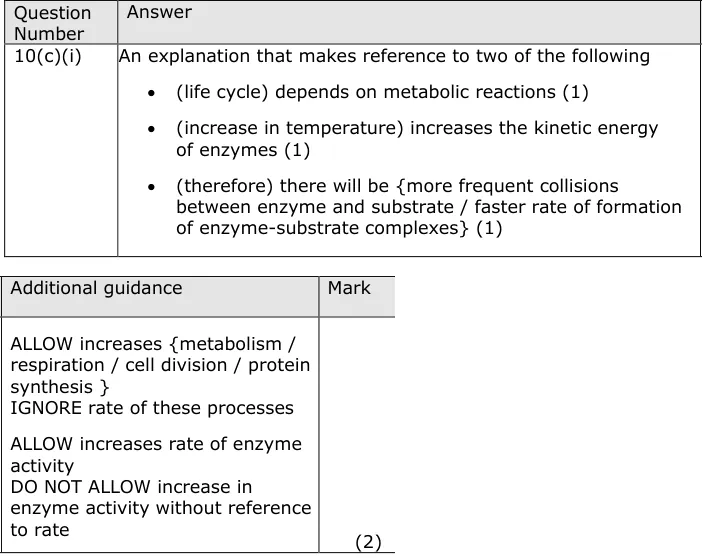
Explain why an increase in environmental temperature may lead to a shorter butterfly life cycle.
Show the mark scheme
Tap an image to open it full size.
From the examiners' report: Link the increase in kinetic energy to the enzymes, and say enzyme-substrate collisions become more frequent, not just 'more'.
Question 12
A level Paper 1 · June 2024 · Q6(b)(i) · 3 marks · Hard
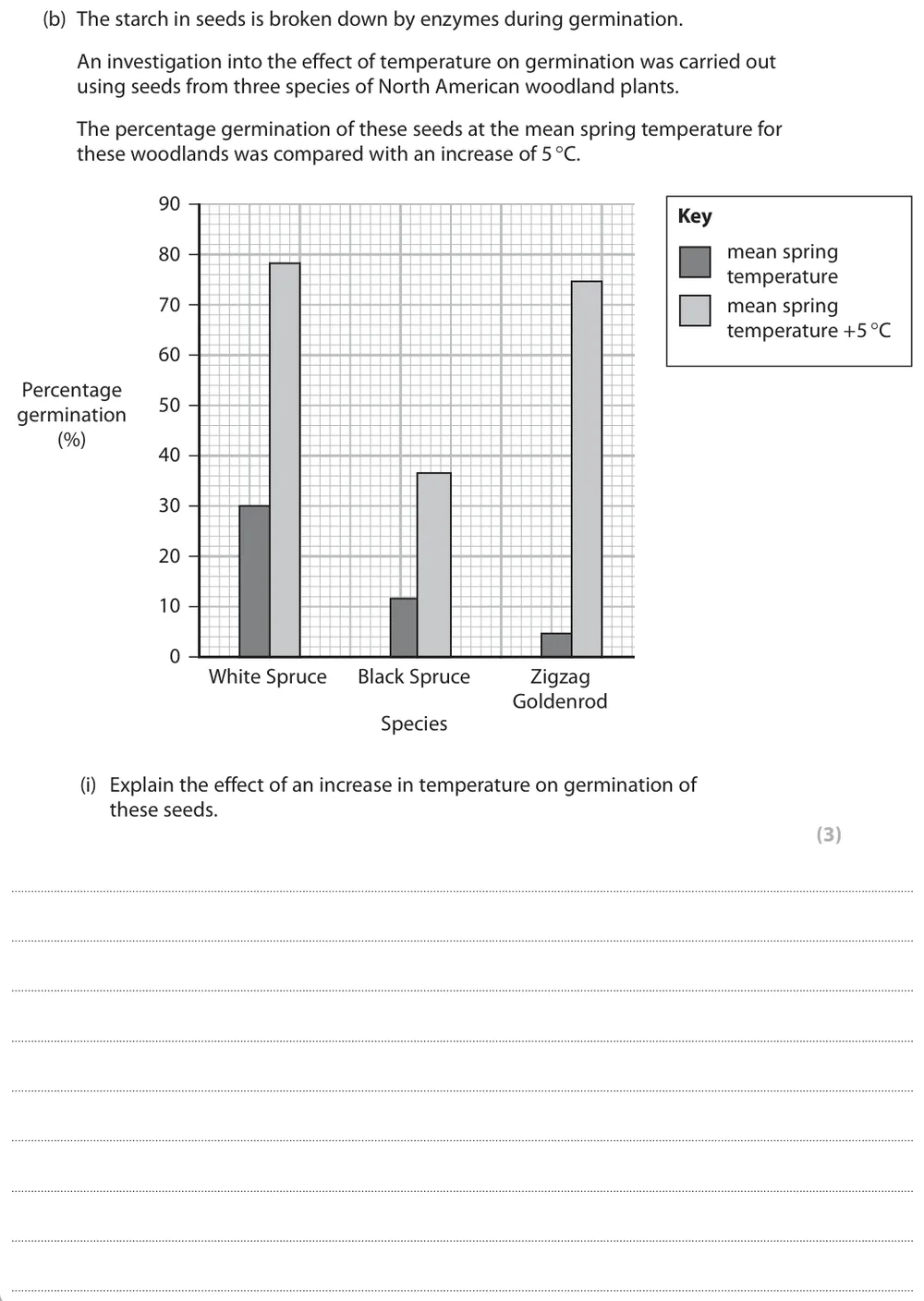
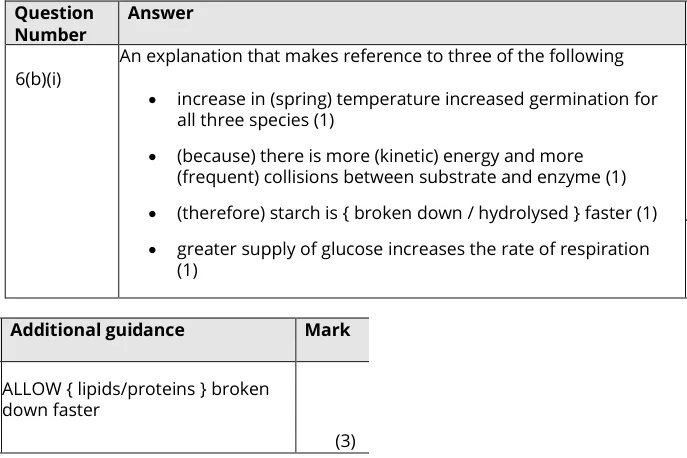
Explain the effect of a 5 °C increase in temperature on germination of three species of seed.
Show the mark scheme
Tap an image to open it full size.
From the examiners' report: Explain, don't just describe: germination increased for all three species because enzymes and substrates collide more often, so starch is broken down faster (faster, not more).
Question 13
A level Paper 1 · November 2021 · Q10(b) · 2 marks · Hard
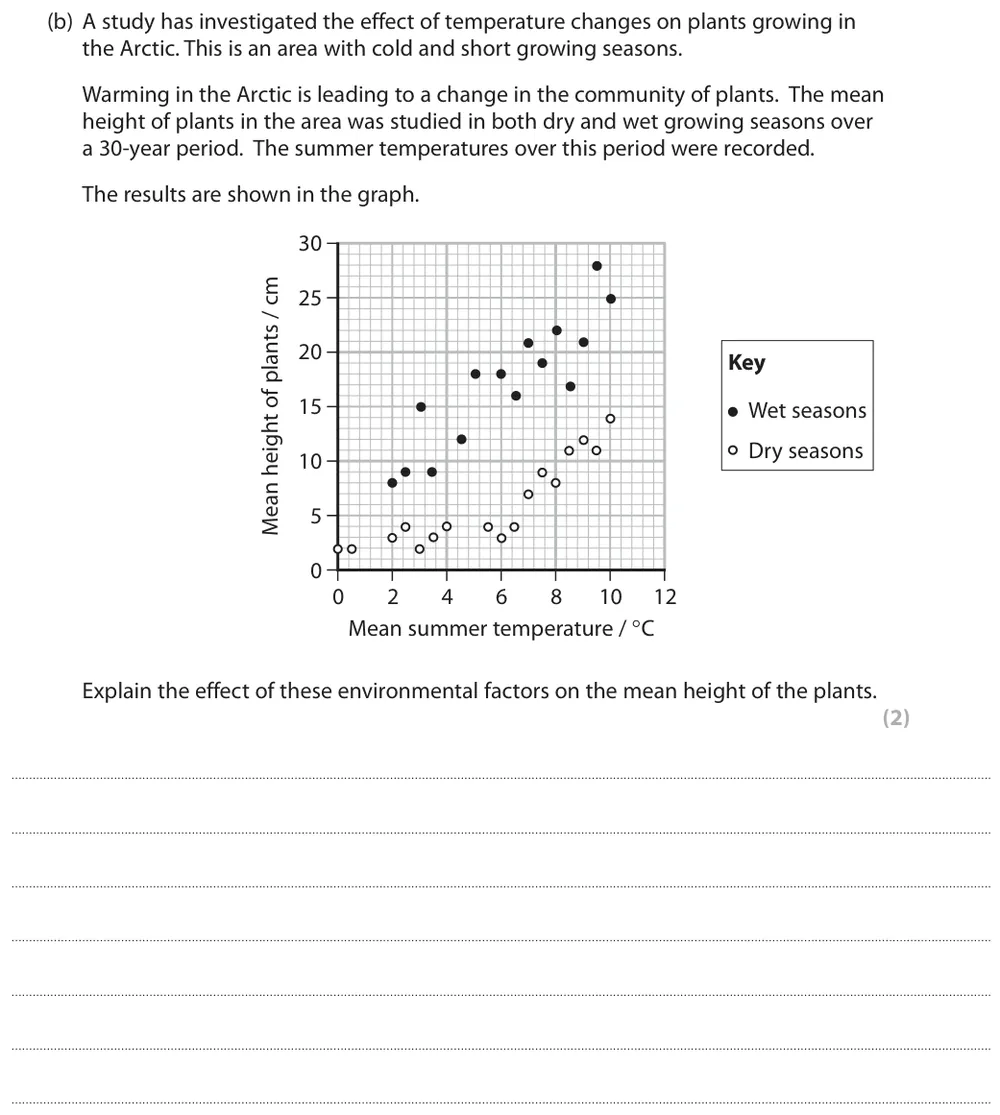
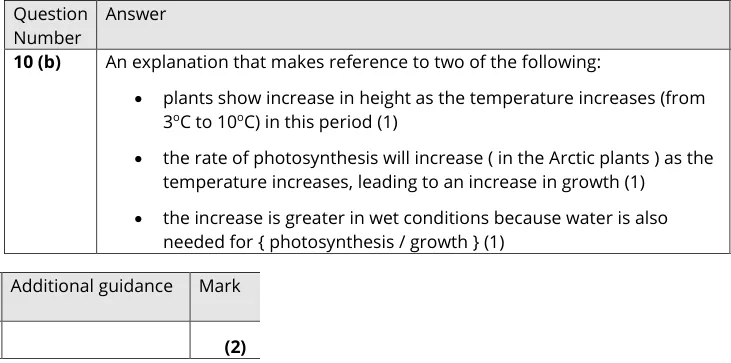
Explain the effect of summer temperature and wet or dry seasons on the mean height of Arctic plants.
Show the mark scheme
Tap an image to open it full size.
From the examiners' report: Give a reason, not just a description of the trends. Surprisingly few linked the increase in height to a faster rate of photosynthesis.
Evolution by mutation and natural selection (5.17)
Question 14
A level Paper 1 · June 2024 · Q8(b)(ii) · 4 marks
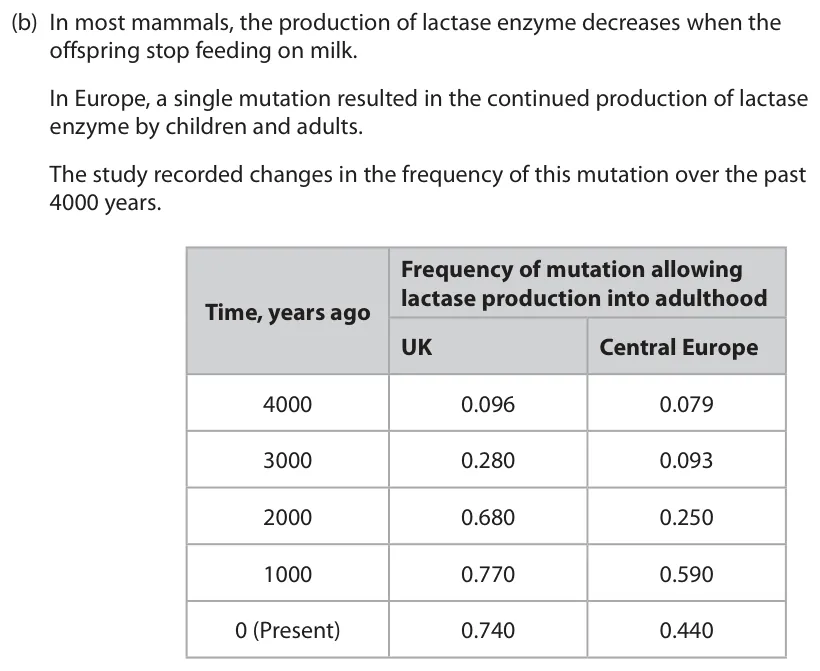
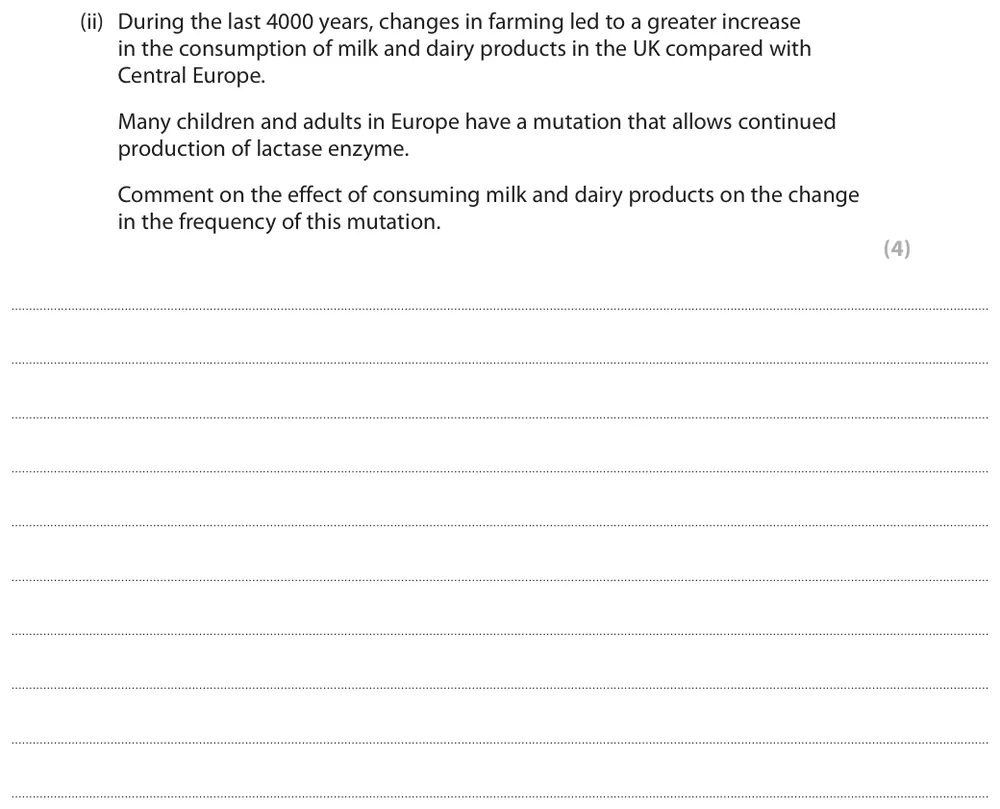
Comment on how consuming milk and dairy products affected the frequency of the lactase mutation.
Information from earlier in this question:
Show the mark scheme
Tap an image to open it full size.
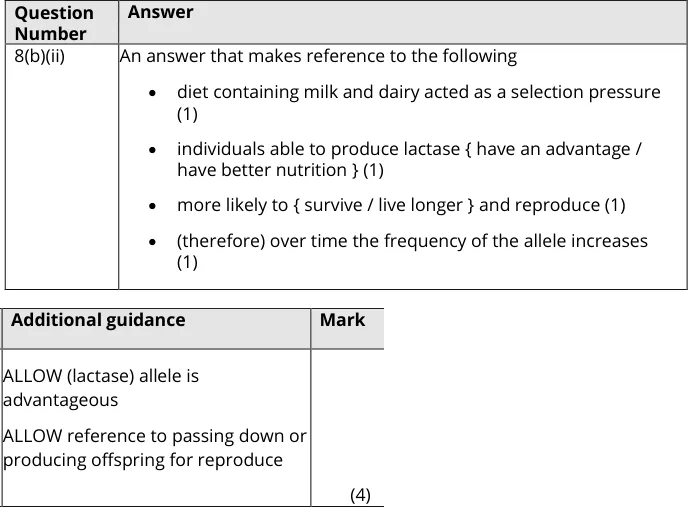
From the examiners' report: Recognise this as natural selection. The diet is the selection pressure; it does not cause the mutation. Some just described the data for the UK and Central Europe.
Question 15
A level Paper 1 · June 2025 · Q7(b)(ii) · 4 marks
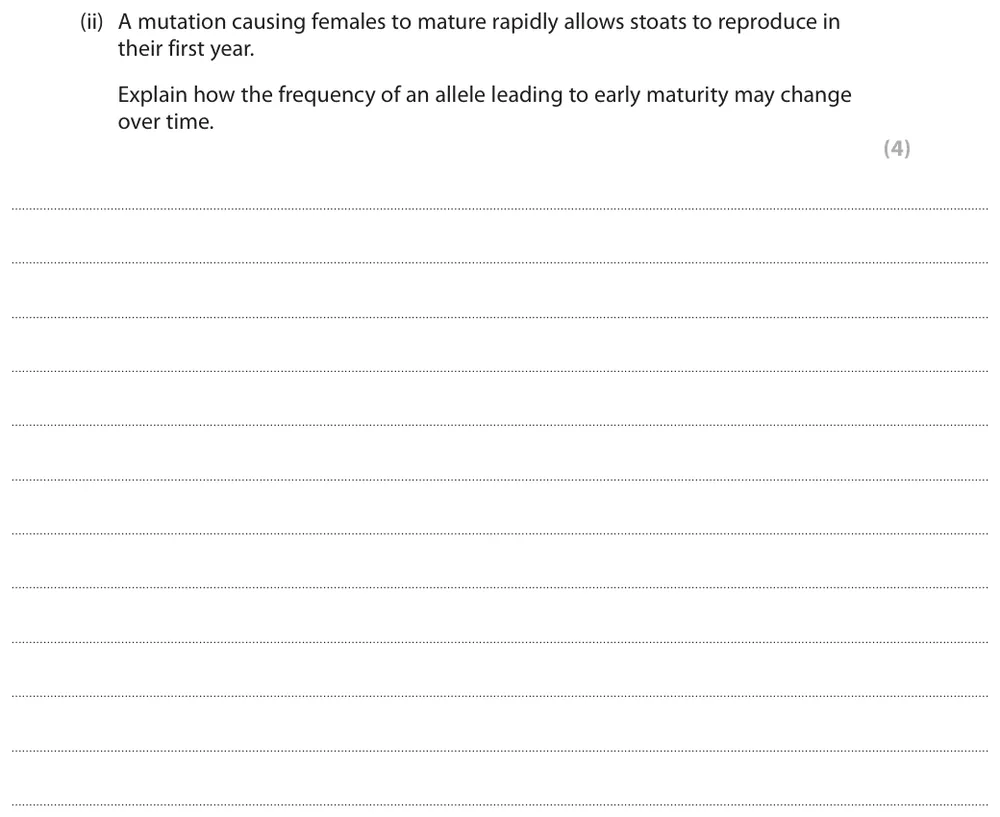
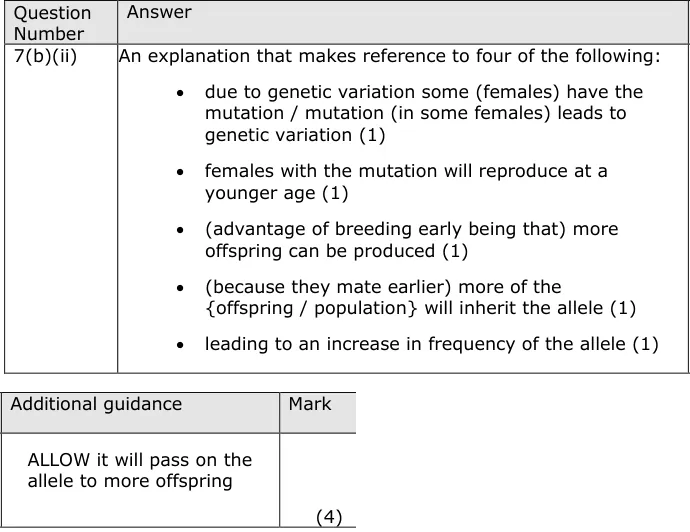
Explain how the frequency of an allele for early maturity in stoats may change over time.
Show the mark scheme
Tap an image to open it full size.
From the examiners' report: Generic natural selection answers usually scored only one mark. Use the context and qualify it: females with the mutation reproduce at a younger age (not just 'earlier'), so produce more offspring that inherit the allele.
Question 16
A level Paper 3 · June 2025 · Q5(b)(i) · 2 marks · Hard
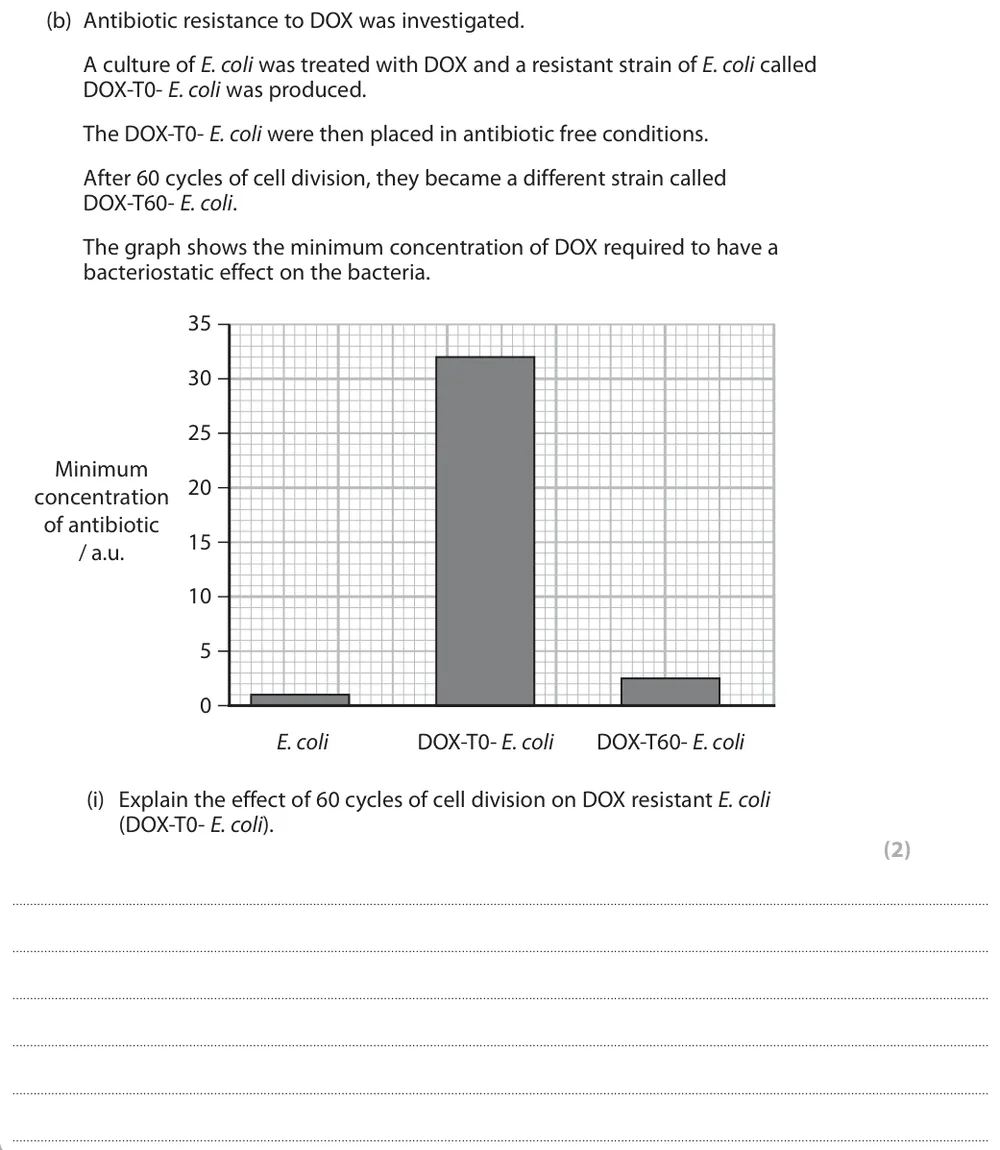
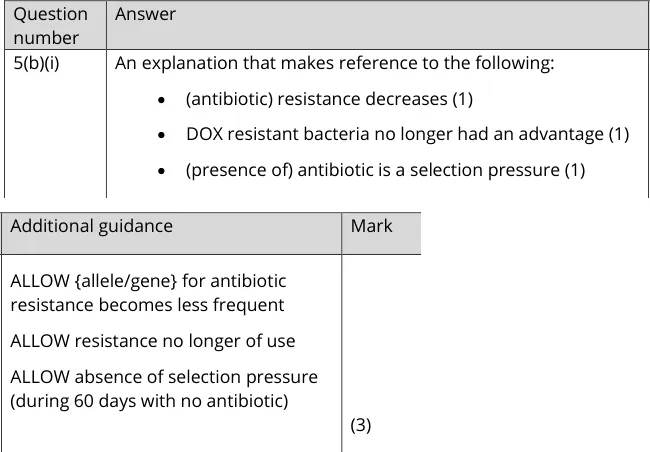
Explain the effect of 60 cycles of cell division without antibiotic on DOX-resistant E. coli.
Show the mark scheme
Tap an image to open it full size.
From the examiners' report: Explain rather than describe, and write about the DOX-resistant strain, not E. coli in general. Without the antibiotic there is no selection pressure, so resistance no longer gives an advantage.
Isolation and speciation (5.19)
Question 17
A level Paper 1 · June 2017 · Q10(b)(ii) · 3 marks
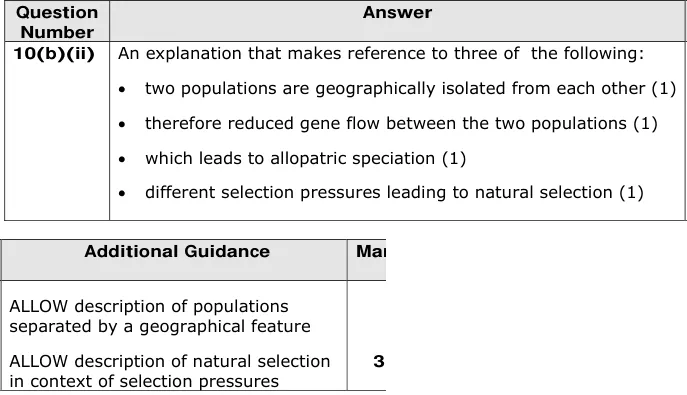
Explain how two species of African elephant could evolve from a common ancestor.
Show the mark scheme
Tap an image to open it full size.
From the examiners' report: Most gave geographical isolation and different selection pressures. Few said this reduces gene flow between the two populations.
Using the carbon cycle to reduce carbon dioxide (5.21)
Question 18
A level Paper 1 · June 2018 · Q9(b) · 3 marks
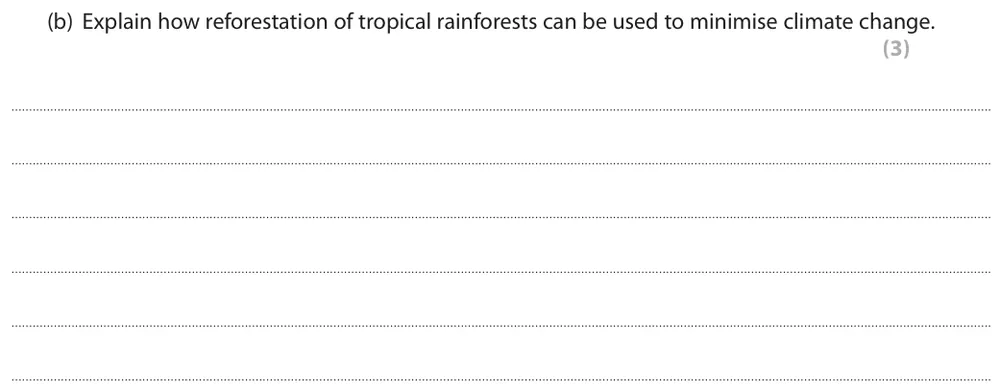
Explain how reforestation of tropical rainforests can be used to minimise climate change.
Show the mark scheme
Tap an image to open it full size.
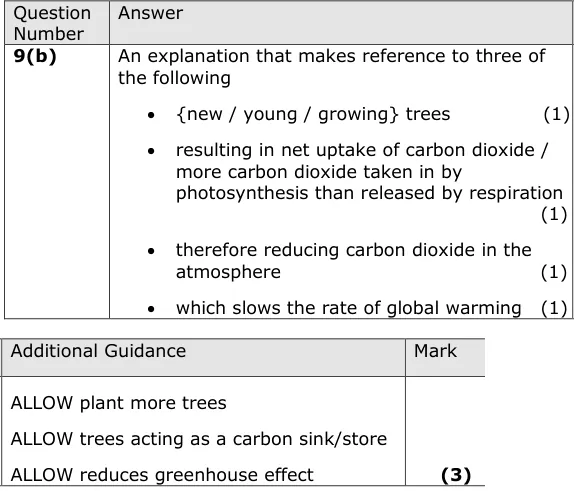
From the examiners' report: Express the net uptake: growing trees take in more carbon dioxide by photosynthesis than they release by respiration. 'Carbon dioxide is taken up in photosynthesis' alone did not gain the mark.
Question 19
A level Paper 1 · June 2022 · Q2(b)(ii) · 3 marks
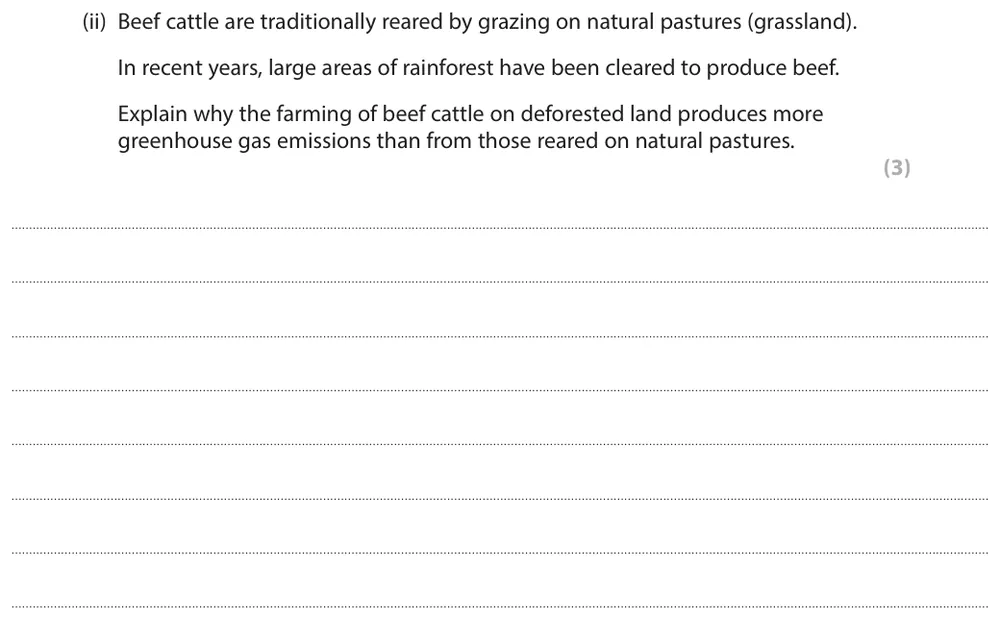
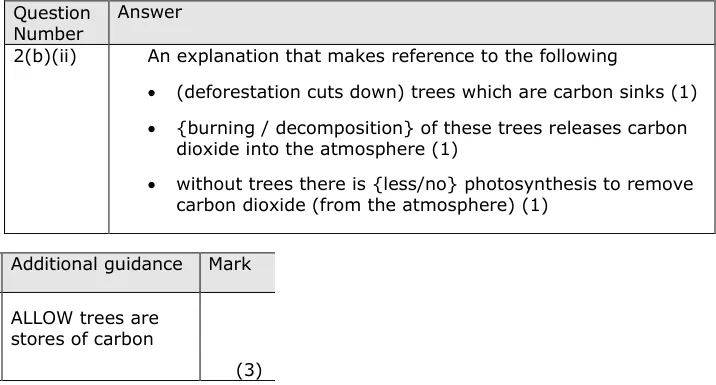
Explain why farming beef cattle on deforested land produces more greenhouse gas emissions than on natural pasture.
Show the mark scheme
Tap an image to open it full size.
From the examiners' report: Compare deforested land with natural pasture, not cattle farming in general: trees are carbon sinks, burning or decomposing them releases carbon dioxide, and fewer trees means less photosynthesis. Farm machinery is not relevant.
Reforestation and sustainable resources (5.22)
Question 20
A level Paper 3 · November 2021 · Q5(b)(i) · 2 marks
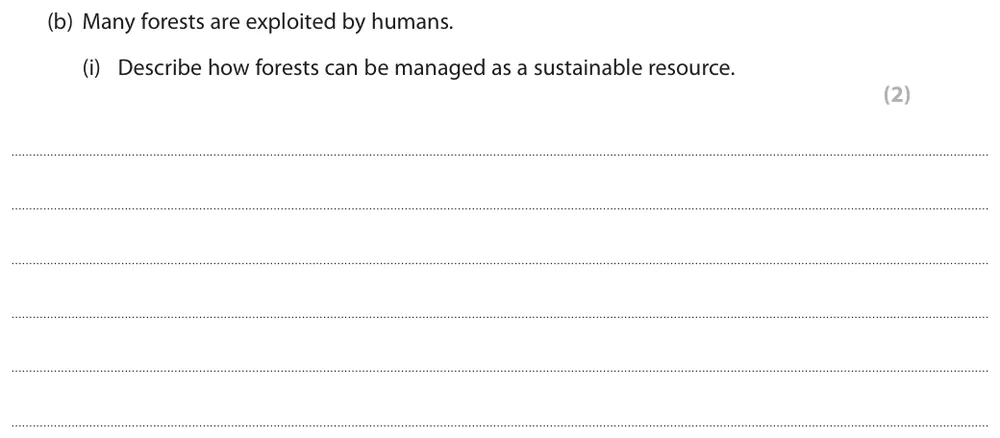
Describe how forests can be managed as a sustainable resource.
Show the mark scheme
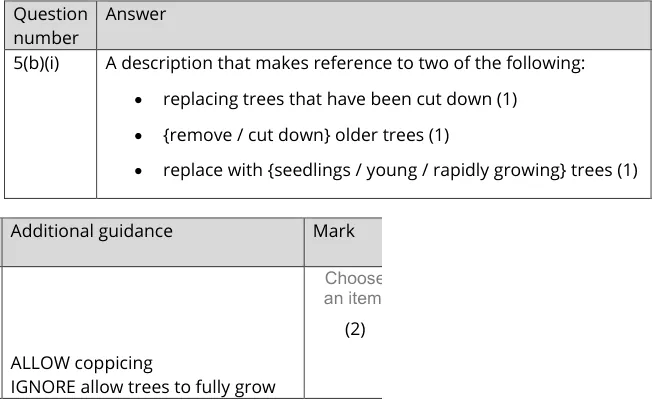
Tap an image to open it full size.
Where students lose marks (from Pearson examiners' reports and mark schemes)
Each point below comes from the examiners' reports and mark schemes, and is followed by wording that gained marks.
Peat depth tells you the age of the pollen. Many described pollen in layers of peat without linking the depth to the time since the pollen was deposited.
✔ Gains credit: 'The depth of peat correlates with the period of time since the pollen was produced; changes in pollen over time indicate changes in climate.'
Sea-ice days: describe the trend, not the wobbles. Some focused on the fluctuations rather than the trend, or simply repeated 'climate change' from the question.
✔ Gains credit: 'The trend shows a reduction in the number of days per year when sea ice is present; sea ice is not forming due to global warming.'
Greenhouse gases, not the ozone layer. Many referred to damage to the ozone layer, which is not relevant.
✔ Gains credit: 'Burning fossil fuels increases carbon dioxide, so more infrared radiation is trapped in the atmosphere, causing a mean increase in surface temperature.'
Warmer caterpillars: the enzymes gain kinetic energy. Marks were lost because the increase in kinetic energy was not linked to the enzymes, and collisions were not described as more frequent.
✔ Gains credit: 'An increase in temperature increases the kinetic energy of enzymes, so there are more frequent collisions between enzyme and substrate.'
Warmer seeds break starch down faster. Many described the germination data without explaining it, or said more starch is broken down rather than faster.
✔ Gains credit: 'More frequent collisions between substrate and enzyme, so starch is hydrolysed faster, giving a greater supply of glucose for respiration.'
A dairy diet selects the lactase allele; it doesn't cause it. Some still thought the selection pressure causes the mutation.
✔ Gains credit: 'A diet containing milk and dairy acted as a selection pressure; individuals able to produce lactase have an advantage, are more likely to survive and reproduce, so over time the frequency of the allele increases.'
Isolated elephants: reduced gene flow. Relatively few described reduced gene flow between the two populations.
✔ Gains credit: 'Two populations are geographically isolated, therefore reduced gene flow between the two populations, which leads to allopatric speciation.'
Reforestation needs a net uptake of carbon dioxide. Many simply said carbon dioxide is taken up during photosynthesis.
✔ Gains credit: 'Growing trees result in a net uptake of carbon dioxide: more is taken in by photosynthesis than released by respiration, reducing carbon dioxide in the atmosphere.'
Download the questions
Download the PDF pack (20 questions, mark schemes at the end)
Keep practising
- Ecosystems, Succession and Productivity (Topic 5): Edexcel SNAB exam questions by topic
- Photosynthesis (Topic 5): Edexcel SNAB exam questions by topic
- Ecology, the Hill Reaction and Q10 (Core Practicals 10 to 12): Edexcel SNAB core practical questions
- Topic 5 multiple-choice quiz (23 questions, marked as you tap)
- Edexcel SNAB A level Biology resources hub (every topic, practical and paper)
- Extended Response Questions (Topics 5 to 8): Edexcel SNAB A Level Biology Exam Questions
- Edexcel SNAB A level Biology past papers, mark schemes and examiners' reports
- Edexcel SNAB A level Biology grade boundaries
- Message Tom on WhatsApp about one-to-one Edexcel SNAB tutoring or an Edexcel group class
Questions, mark schemes and examiners' report extracts © Pearson Education Ltd.