

Photosynthesis is part of Topic 5, On the Wild Side, of the Edexcel A level Biology A (Salters-Nuffield) specification. You need to understand how phosphorylation of ADP needs energy and hydrolysis of ATP releases it, the light-dependent reactions (excitation of electrons in chlorophyll, photophosphorylation, reduction of NADP and photolysis of water), the light-independent reactions of the Calvin cycle with RuBP, RUBISCO, GP and GALP, and how the structure of the chloroplast relates to its role. These questions come from A level Papers 1 and 3. All questions are from the A level papers (9BN0).
The examiners' reports keep asking for exact biochemistry. Say ATP is hydrolysed, not split or broken. Photolysis releases hydrogen ions, not hydrogen atoms, and the carrier is reduced NADP, not reduced NAD. Carbon dioxide is used only in the light-independent reactions: call RUBISCO an enzyme and say it catalyses the combination of carbon dioxide with RuBP, and don't swap GP and GALP. Chlorophyll is in the thylakoid membrane, and when a question asks about structure and function, link every feature to what it does.
Studying Edexcel SNAB and want more help? If you'd like to arrange one-to-one Edexcel tutoring, or to register your interest in an Edexcel group class, message Tom on WhatsApp using the link at the bottom of this page.
What you need from GCSE
Each question on this page assumes you're secure on these ideas. If any of them feels shaky, look it up before you start.
- Photosynthesis uses light energy to make glucose from carbon dioxide and water, releasing oxygen.
- Photosynthesis takes place in chloroplasts, which contain the green pigment chlorophyll.
- Light intensity, carbon dioxide concentration and temperature can limit the rate of photosynthesis.
- Enzymes are proteins that catalyse reactions, and their activity depends on temperature.
Key terms
These words come up in the questions and mark schemes. Examiners expect you to use them exactly.
- ATP hydrolysis: the breakdown of ATP to ADP and inorganic phosphate, releasing energy for reactions.
- Photophosphorylation: making ATP from ADP and phosphate using energy from light-excited electrons.
- Photolysis: the splitting of water by light energy into hydrogen ions, electrons and oxygen.
- Reduced NADP: the hydrogen carrier made in the light-dependent reactions and used to reduce GP to GALP.
- RUBISCO: the enzyme that catalyses the fixation of carbon dioxide with RuBP.
- RuBP: ribulose bisphosphate, the five-carbon compound that accepts carbon dioxide in the Calvin cycle.
- GP and GALP: glycerate 3-phosphate, formed by carbon fixation, and glyceraldehyde 3-phosphate, formed when GP is reduced.
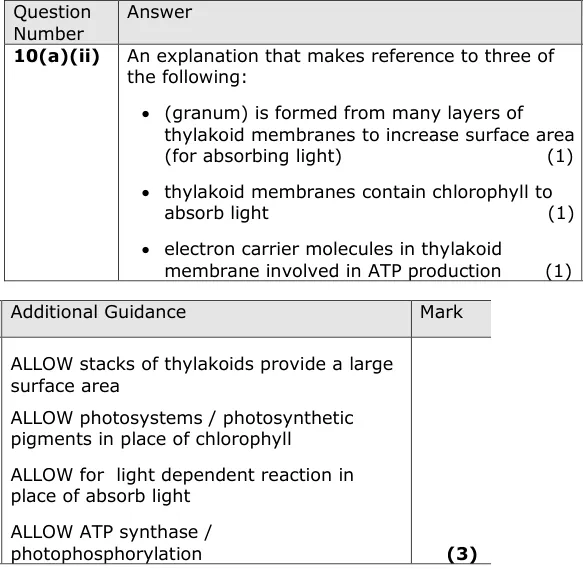
- Granum: a stack of thylakoid membranes containing chlorophyll; the site of the light-dependent reactions.
What these questions cover (Edexcel SNAB Topic 5: On the Wild Side)
The questions test these statements from Topic 5 of the Pearson Edexcel A level Biology A (Salters-Nuffield) specification (9BN0).
- 5.6 Understand how phosphorylation of ADP requires energy and that hydrolysis of ATP provides an immediate supply of energy for biological processes.
- 5.7 Understand the light-dependent reactions of photosynthesis including how light energy is trapped by exciting electrons in chlorophyll and the role of these electrons in g
- 5.8 i Understand the light-independent reactions as reduction of carbon dioxide using the products of the light-dependent reactions (carbon fixation in the Calvin cycle, the ro
- 5.9 Understand the structure of chloroplasts in relation to their role in photosynthesis.
How to use this page
Write your answer on paper before you open the mark scheme. Allow about 1.2 minutes per mark: the 20 questions are worth 51 marks, so about 61 minutes in total. Then mark your answer strictly against the mark scheme and read the examiners' tip underneath it. If you'd rather print the questions, download the PDF pack.
ATP and phosphorylation (5.6)
Question 1
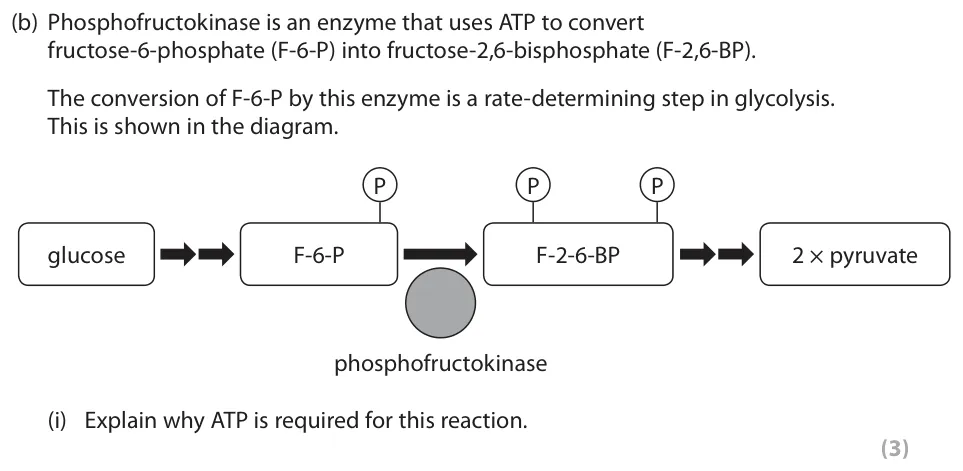
A level Paper 3 · June 2019 · Q6(b)(i) · 3 marks
Explain why ATP is needed to convert F-6-P into F-2,6-BP.
Show the mark scheme
Tap an image to open it full size.
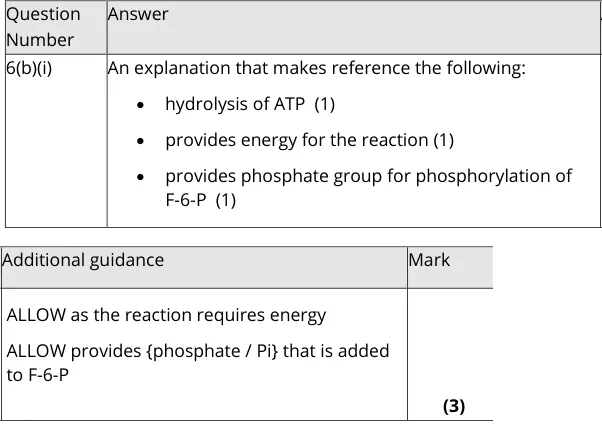
From the examiners' report: Say ATP is hydrolysed: 'splitting' or 'breaking' ATP was not accepted. Hydrolysis releases the energy for the reaction and provides the phosphate that phosphorylates F-6-P.
The light-dependent reactions (5.7)
Question 2
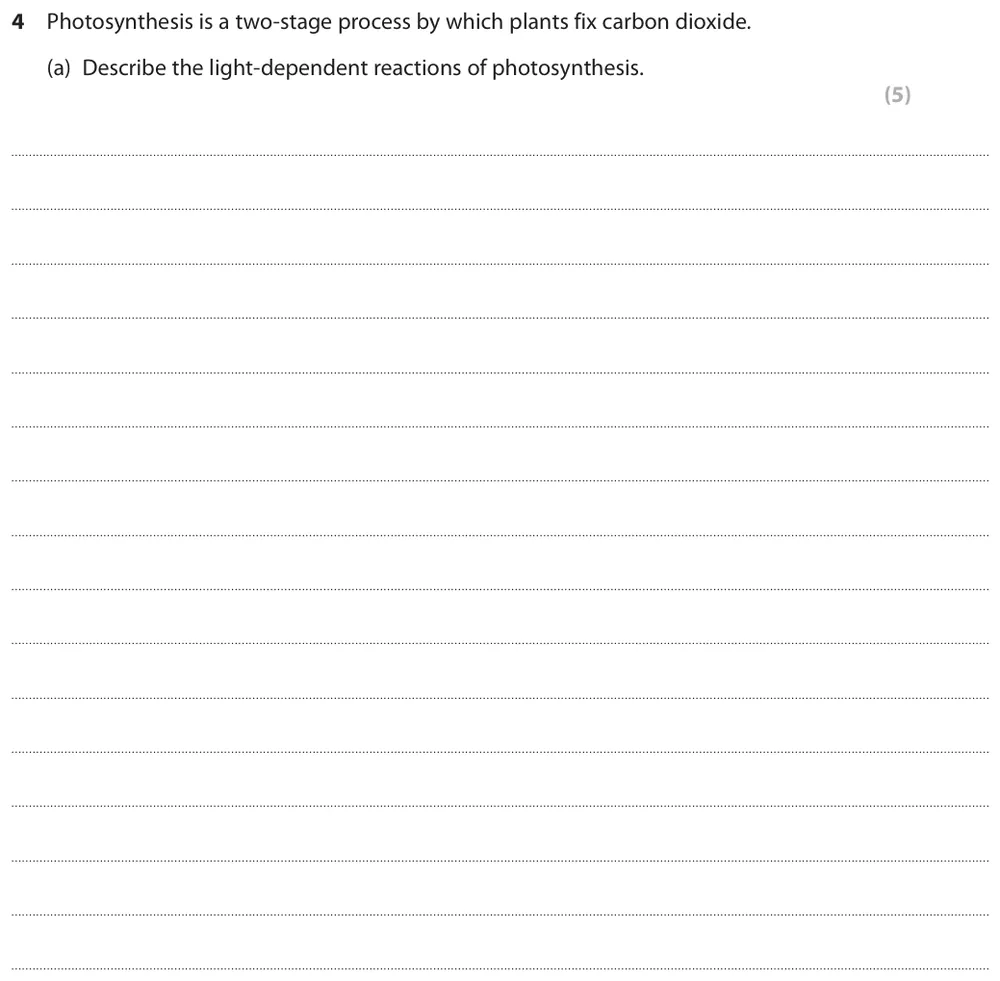
A level Paper 1 · June 2017 · Q4(a) · 5 marks
Describe the light-dependent reactions of photosynthesis.
Show the mark scheme
Tap an image to open it full size.
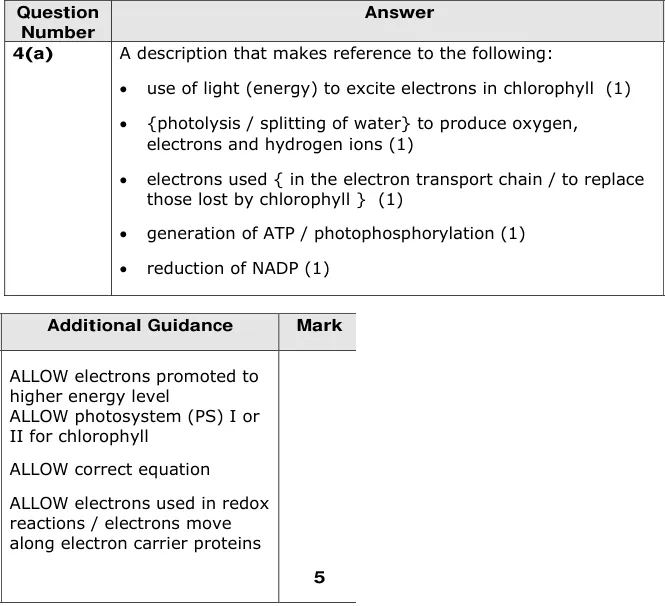
From the examiners' report: Most scored 4 or 5. Photolysis produces hydrogen ions (not hydrogen atoms), electrons and oxygen, so keep the roles of electrons and hydrogen ions separate. A detailed account of chemiosmosis was not needed.
Question 3
A level Paper 1 · June 2024 · Q5(b)(i) · 1 mark · Easy
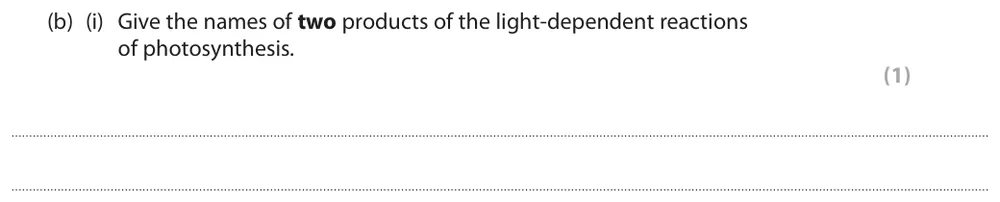
Name two products of the light-dependent reactions.
Show the mark scheme

Tap an image to open it full size.
From the examiners' report: Write reduced NADP, not reduced NAD: NADP is the photosynthesis carrier. Carbon dioxide is not a product.
Question 4
A level Paper 3 · June 2024 · Q3(a)(iii) · 2 marks
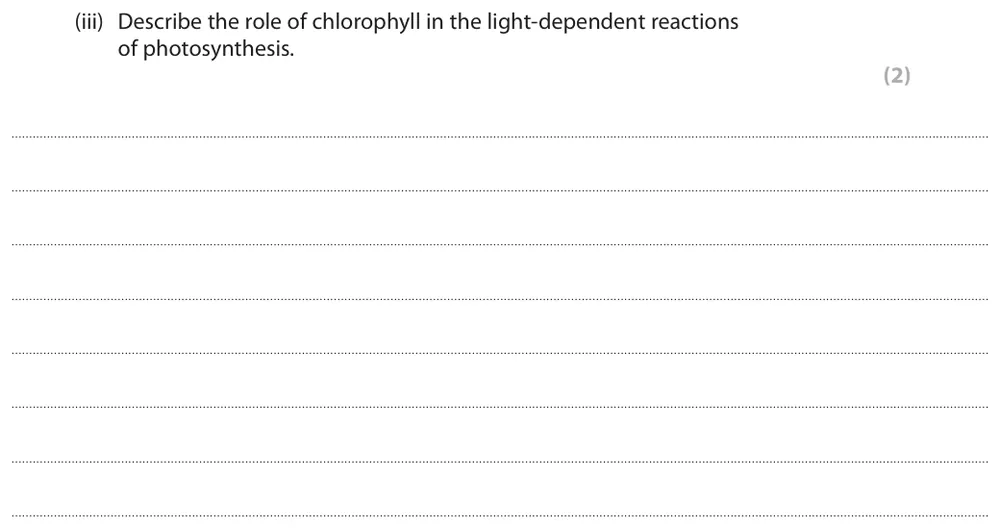
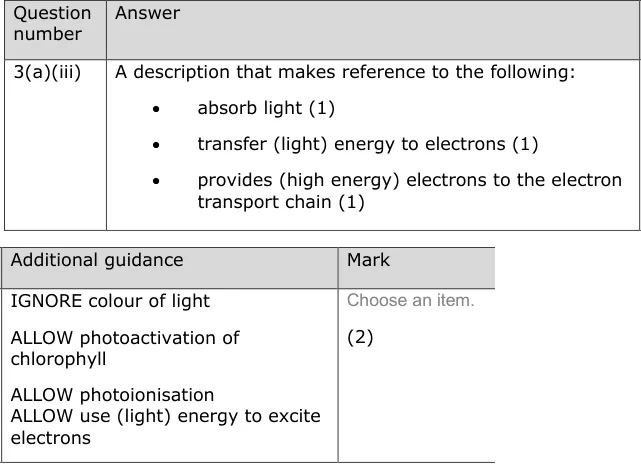
Describe the role of chlorophyll in the light-dependent reactions.
Show the mark scheme
Tap an image to open it full size.
From the examiners' report: Most said chlorophyll absorbs light and the energy excites electrons; fewer said these high-energy electrons are passed to the electron transport chain. Don't confuse chlorophyll with the chloroplast.
Question 5
A level Paper 1 · June 2022 · Q10(a)(ii) · 4 marks · Hard
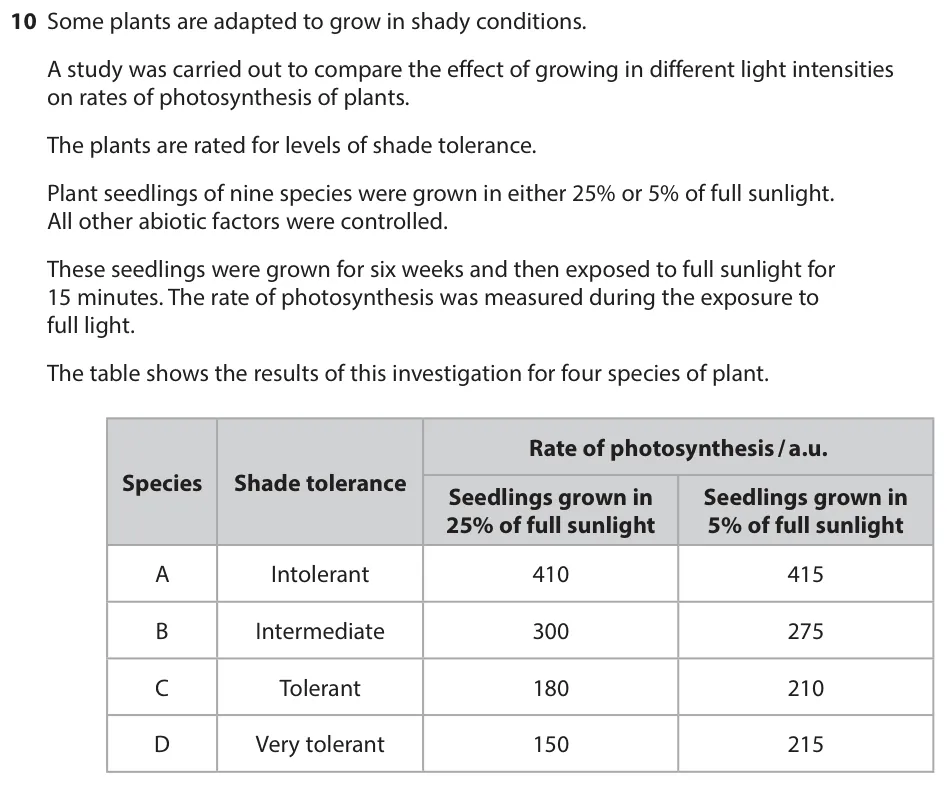
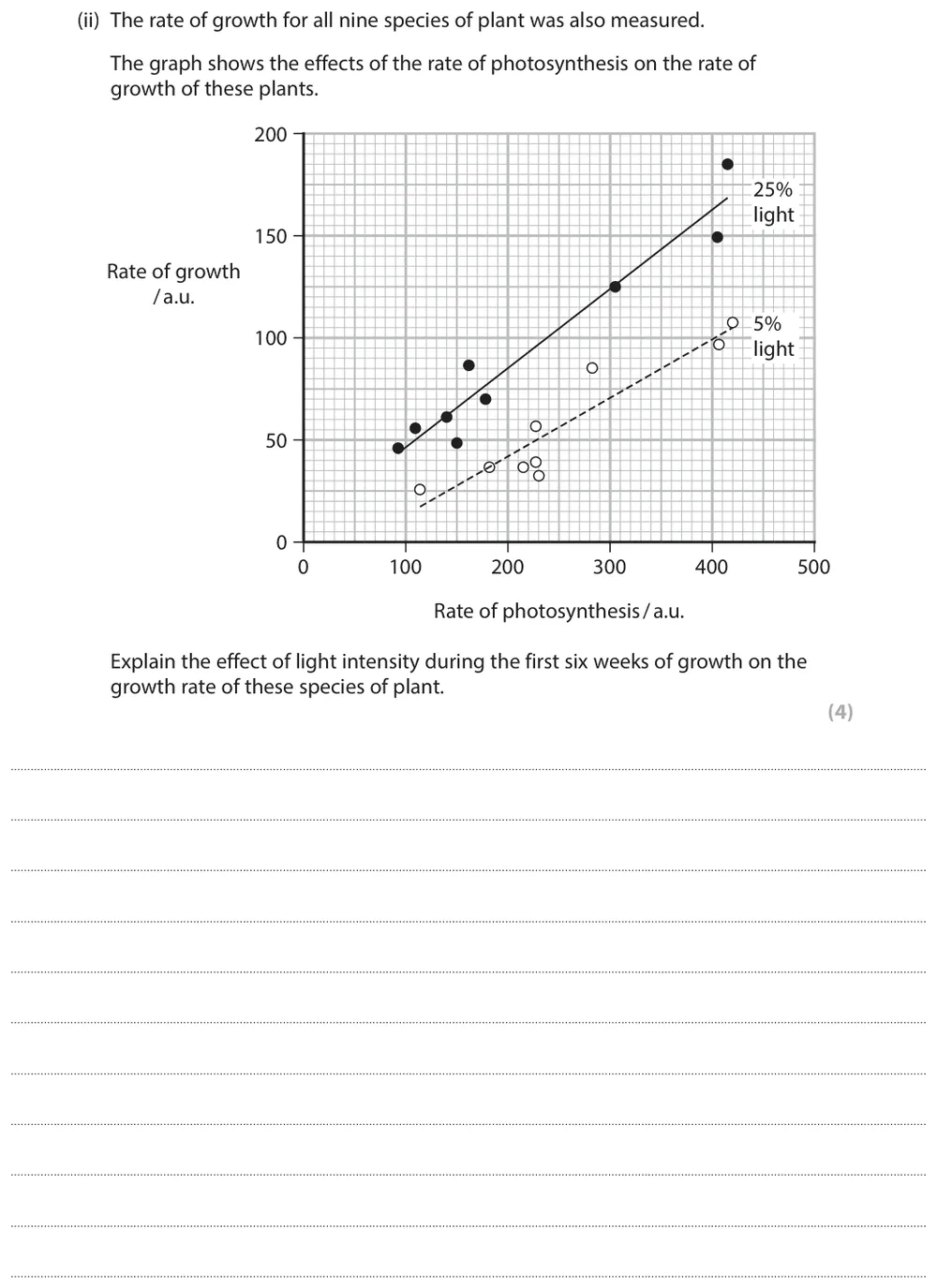
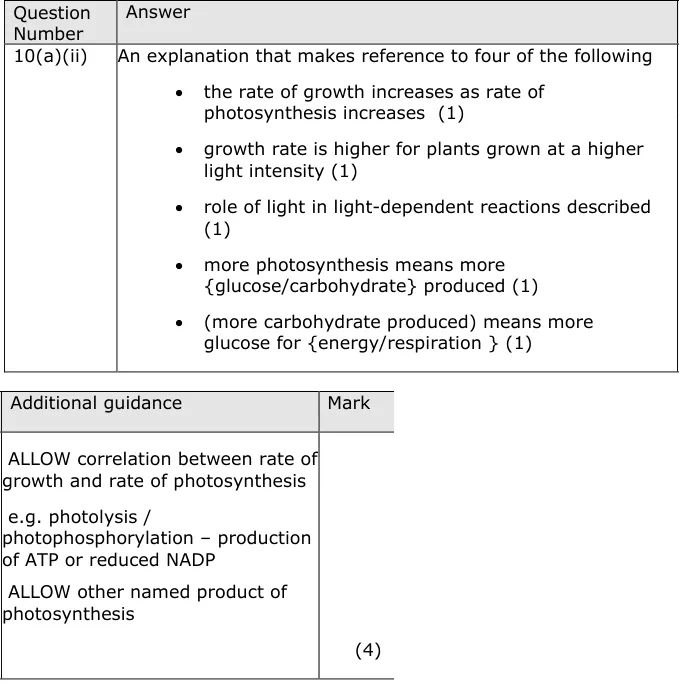
Use a graph to explain the effect of light intensity on the growth rate of nine plant species.
Information from earlier in this question:
Show the mark scheme
Tap an image to open it full size.
From the examiners' report: Link growth rate to the rate of photosynthesis as well as to light intensity, explain the role of light, and say that more glucose is available for respiration: very few made that last link.
The light-independent reactions (5.8 i)
Question 6
A level Paper 1 · June 2024 · Q2(a) · 4 marks · Easy
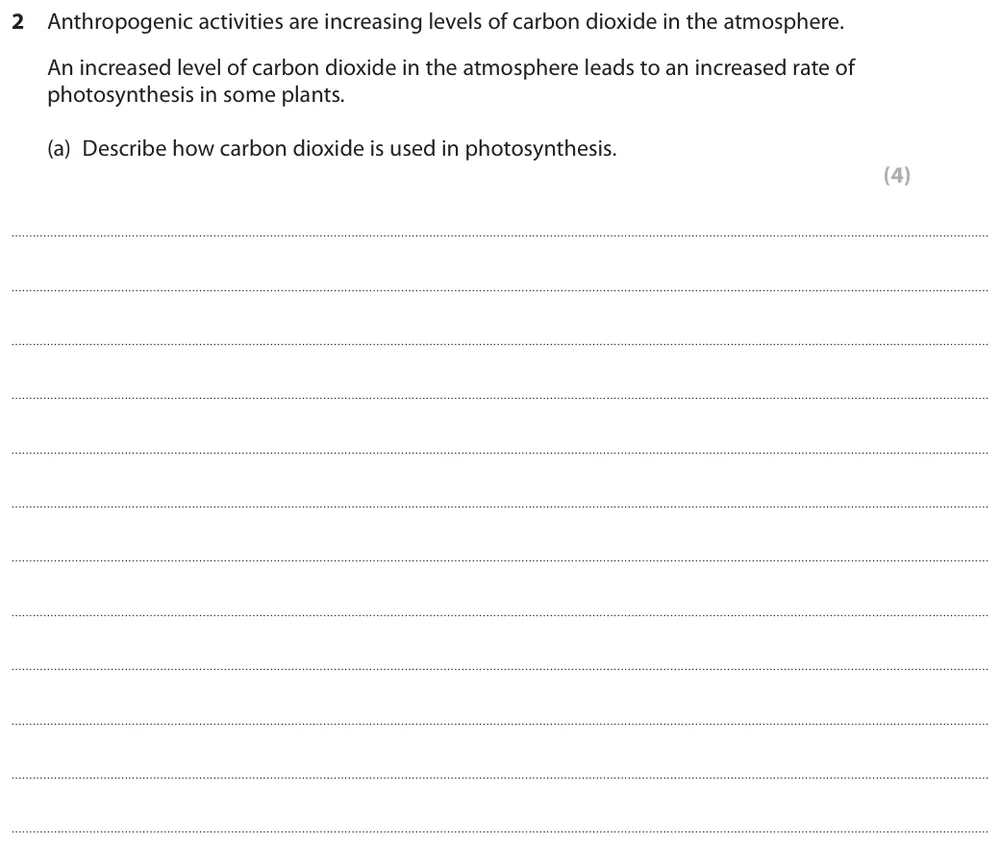
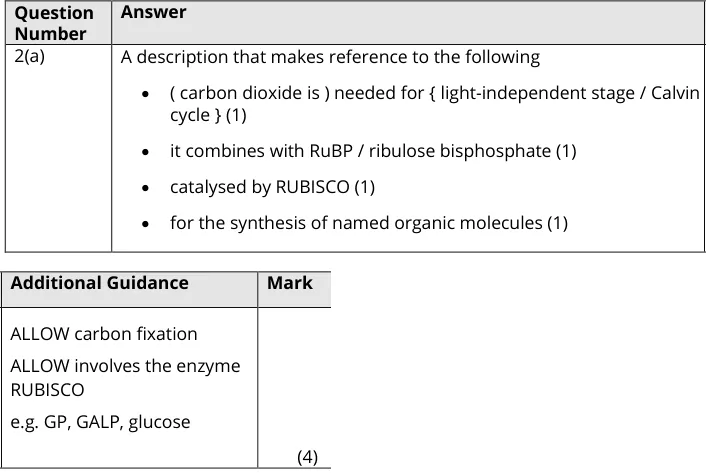
Describe how carbon dioxide is used in photosynthesis.
Show the mark scheme
Tap an image to open it full size.
From the examiners' report: Keep to the light-independent reactions: carbon dioxide combines with RuBP in a reaction catalysed by the enzyme RUBISCO. If you name RUBISCO, say it is an enzyme; carbon dioxide is not used in the electron transport chain.
Question 7
A level Paper 1 · June 2025 · Q9(a) · 4 marks · Easy
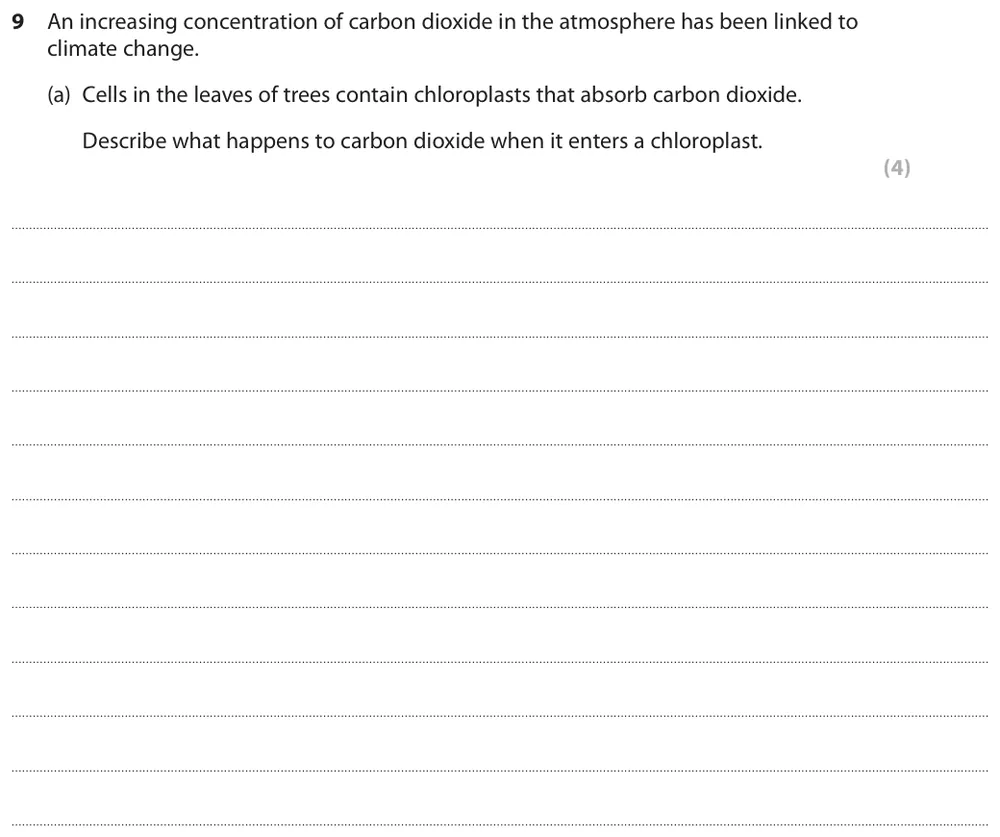
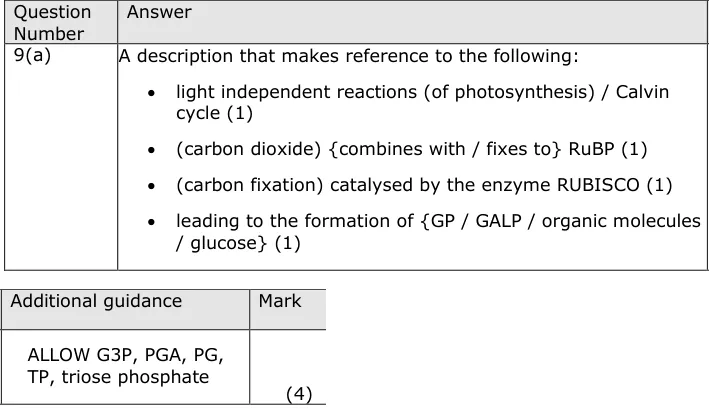
Describe what happens to carbon dioxide when it enters a chloroplast.
Show the mark scheme
Tap an image to open it full size.
From the examiners' report: A frequently asked question. Refer to RUBISCO as the enzyme catalysing the reaction between carbon dioxide and RuBP, and don't say carbon dioxide is needed for both the light-dependent and light-independent reactions: that contradiction scored nothing.
Question 8
A level Paper 1 · June 2019 · Q1(b) · 3 marks
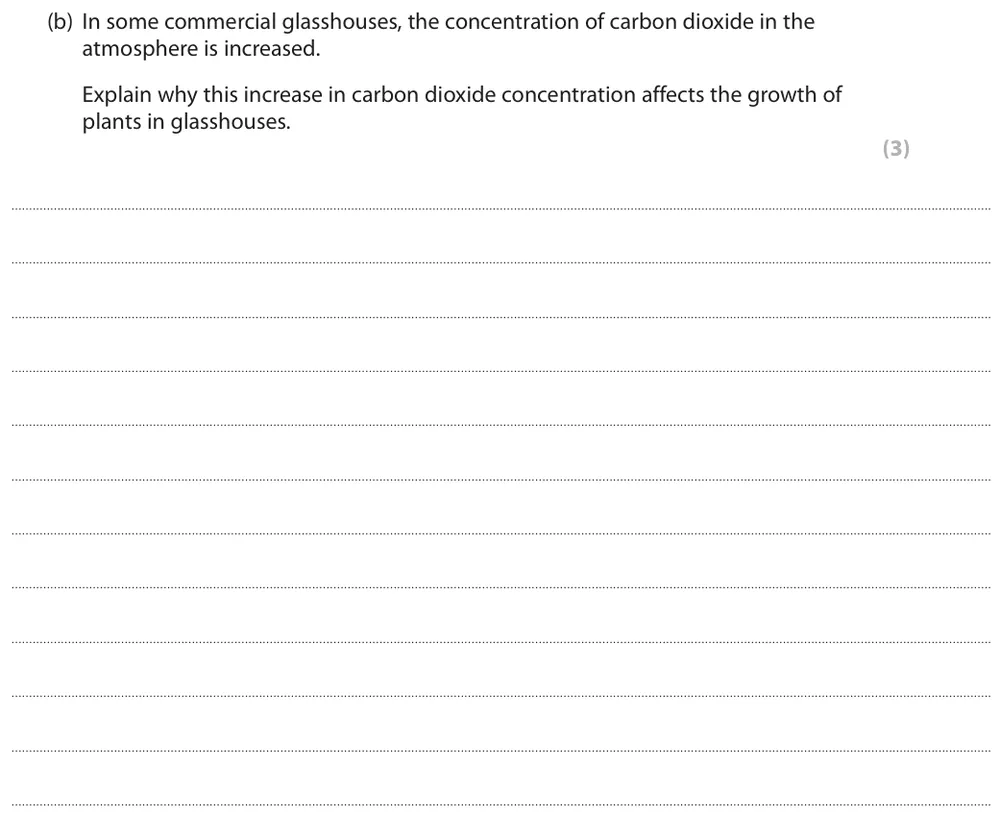
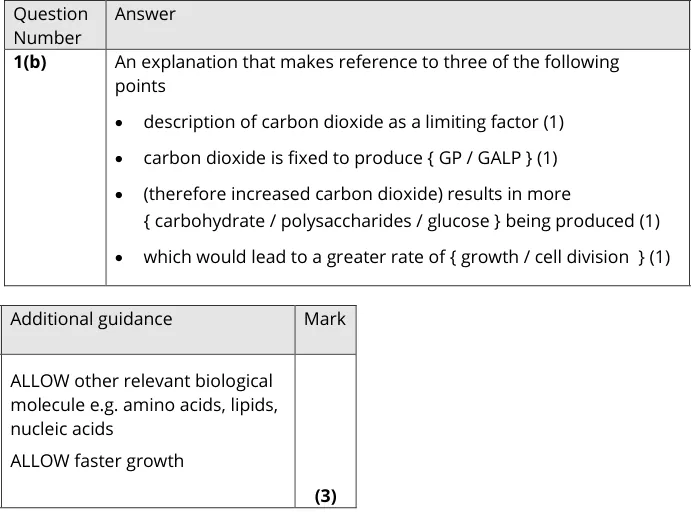
Explain why raising the carbon dioxide concentration in a glasshouse affects plant growth.
Show the mark scheme
Tap an image to open it full size.
From the examiners' report: Explain, using comparatives: carbon dioxide is a limiting factor, so more is fixed into GP and GALP, giving more glucose and a faster rate of growth. Few mentioned the increased rate of growth.
Question 9
A level Paper 1 · November 2021 · Q10(c) · 4 marks
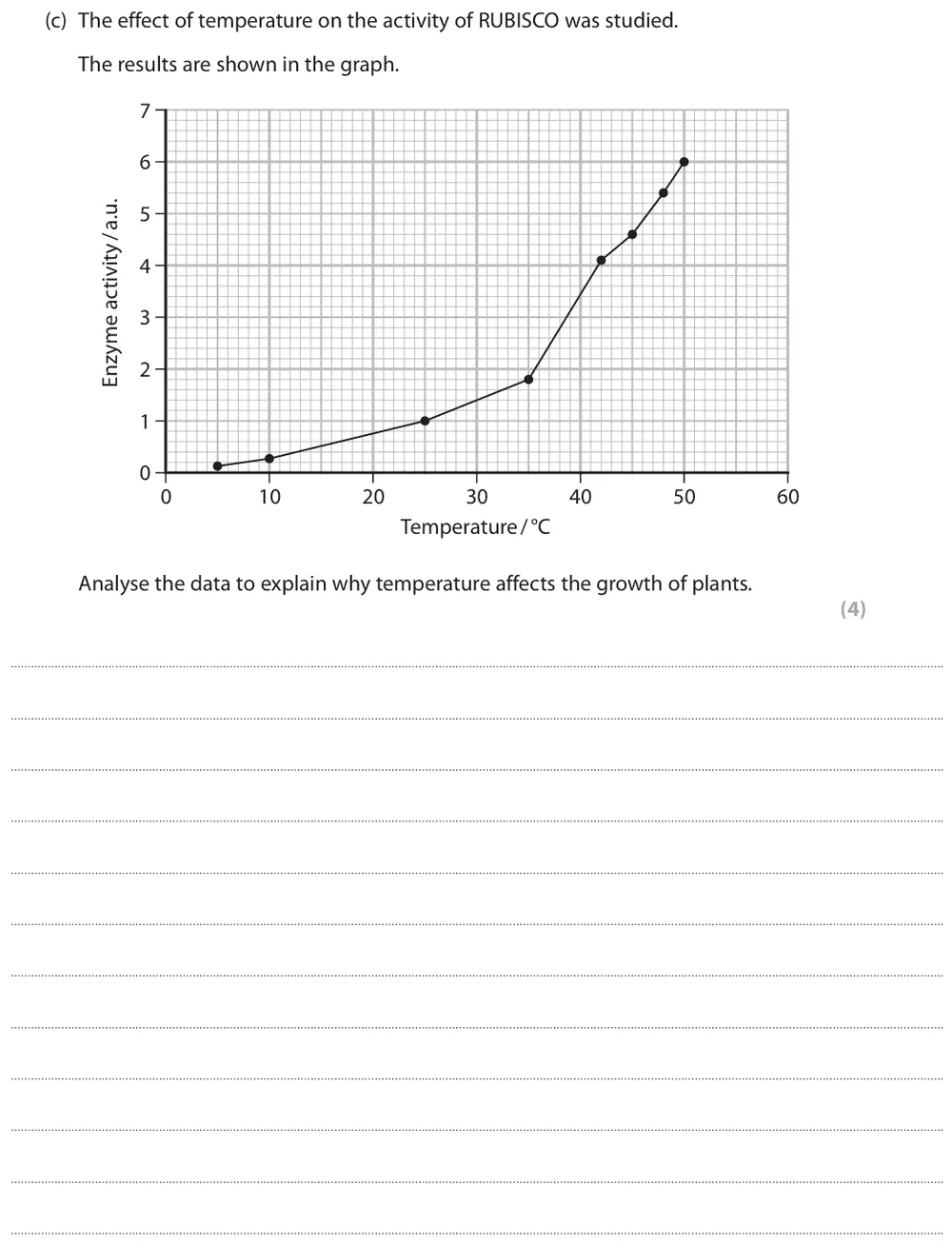
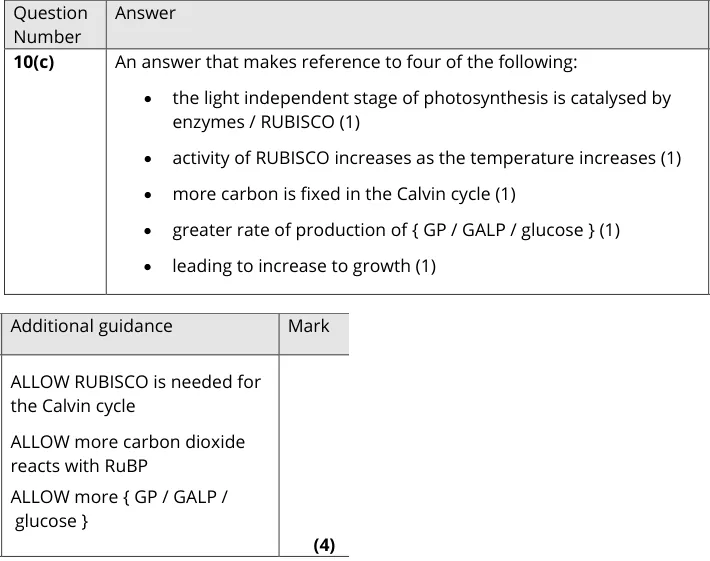
Analyse a graph of RUBISCO activity against temperature to explain how temperature affects plant growth.
Show the mark scheme
Tap an image to open it full size.
From the examiners' report: Link RUBISCO to the light-independent stage of photosynthesis: without that link it was hard to score more than one mark. Then say more carbon is fixed, so more GP, GALP or glucose is made for growth.
Question 10
A level Paper 3 · June 2024 · Q3(b) · 3 marks
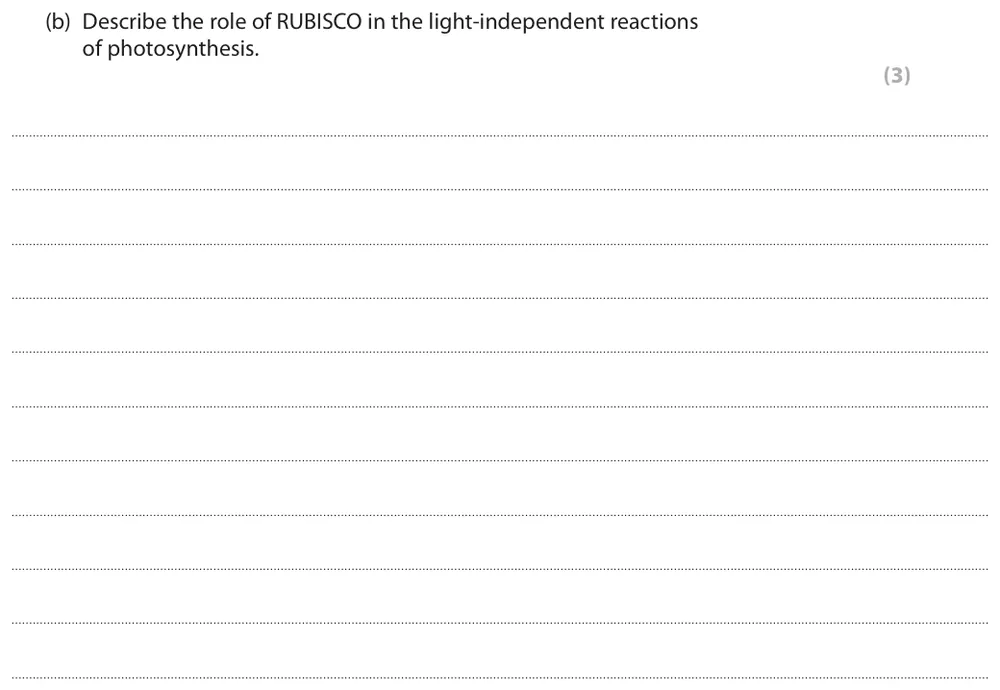
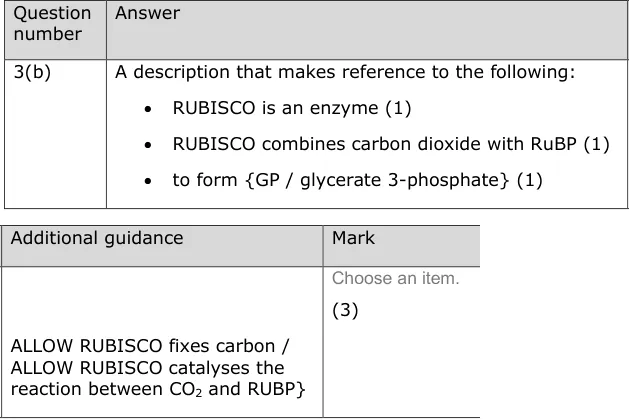
Describe the role of RUBISCO in the light-independent reactions.
Show the mark scheme
Tap an image to open it full size.
From the examiners' report: Describe RUBISCO's role, not the whole Calvin cycle. RUBISCO is an enzyme that combines carbon dioxide with RuBP to form GP; some wrongly combined carbon dioxide with a six-carbon molecule to make RuBP.
Question 11
A level Paper 3 · October 2020 · Q3(a)(ii) · 3 marks
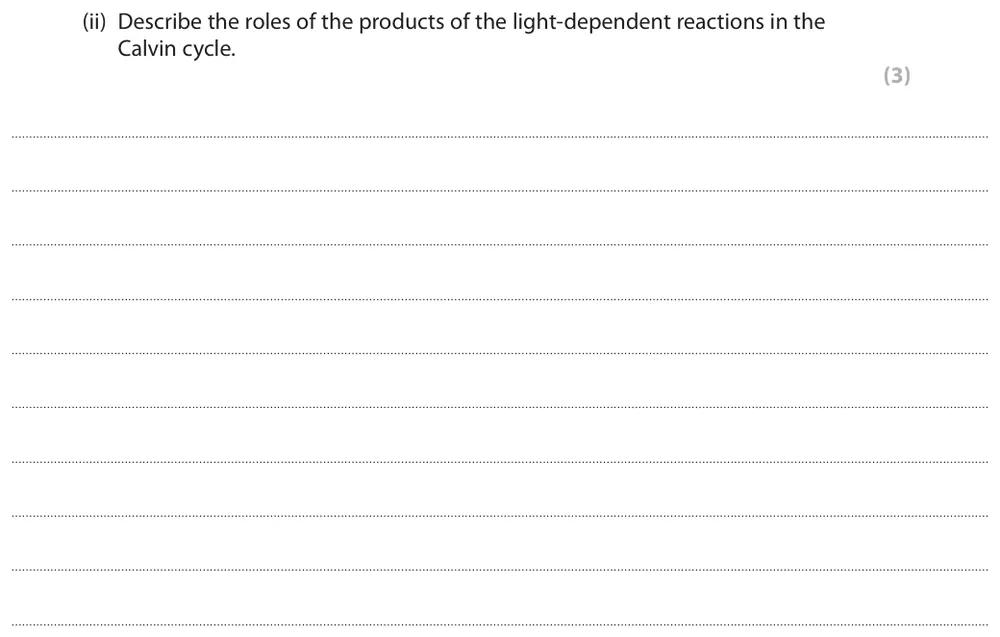
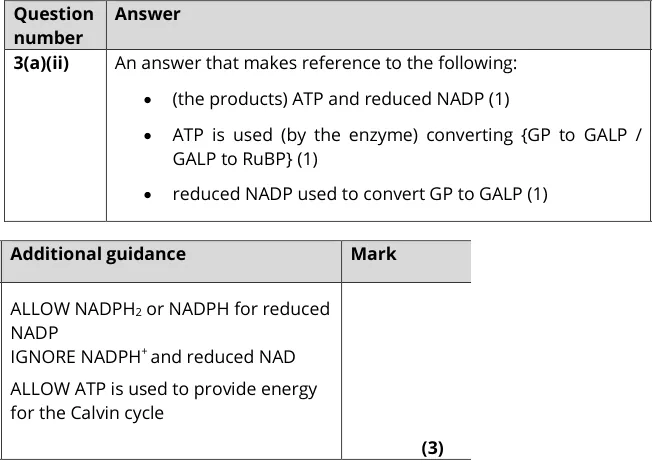
Describe the roles of the products of the light-dependent reactions in the Calvin cycle.
Show the mark scheme
Tap an image to open it full size.
From the examiners' report: Don't mix up GP and GALP: ATP and reduced NADP convert GP to GALP, not GALP to GP. The product is reduced NADP, not reduced NAD.
Question 12
A level Paper 3 · October 2020 · Q3(c) · 2 marks
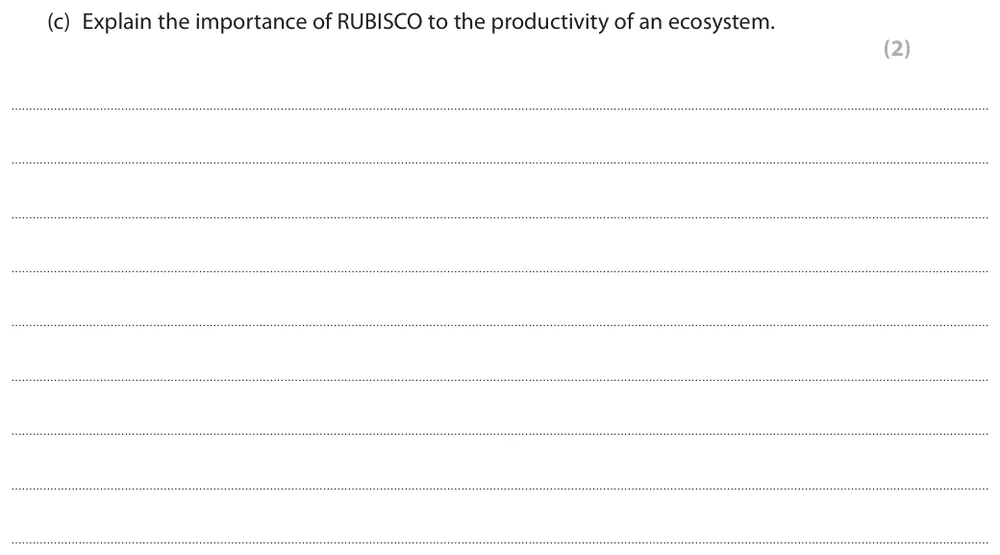
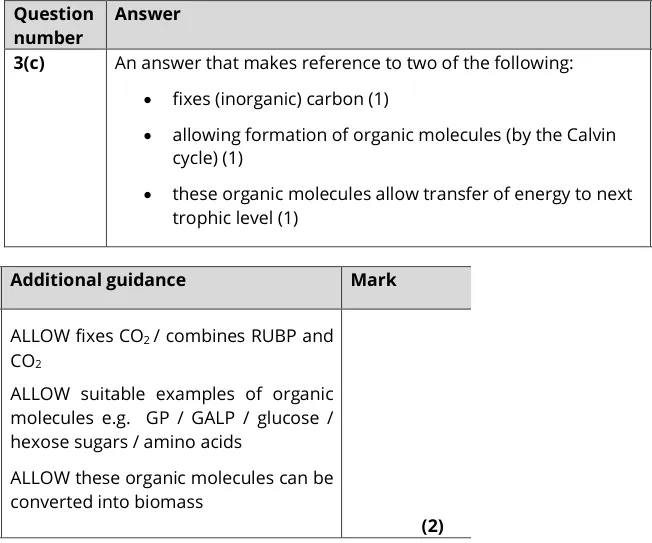
Explain the importance of RUBISCO to the productivity of an ecosystem.
Show the mark scheme
Tap an image to open it full size.
From the examiners' report: Most said RUBISCO fixes carbon. Few explained productivity: the organic molecules made are converted into biomass and transfer energy to the next trophic level.
Chloroplast structure (5.9)
Question 13
A level Paper 1 · June 2018 · Q10(a)(ii) · 3 marks · Hard
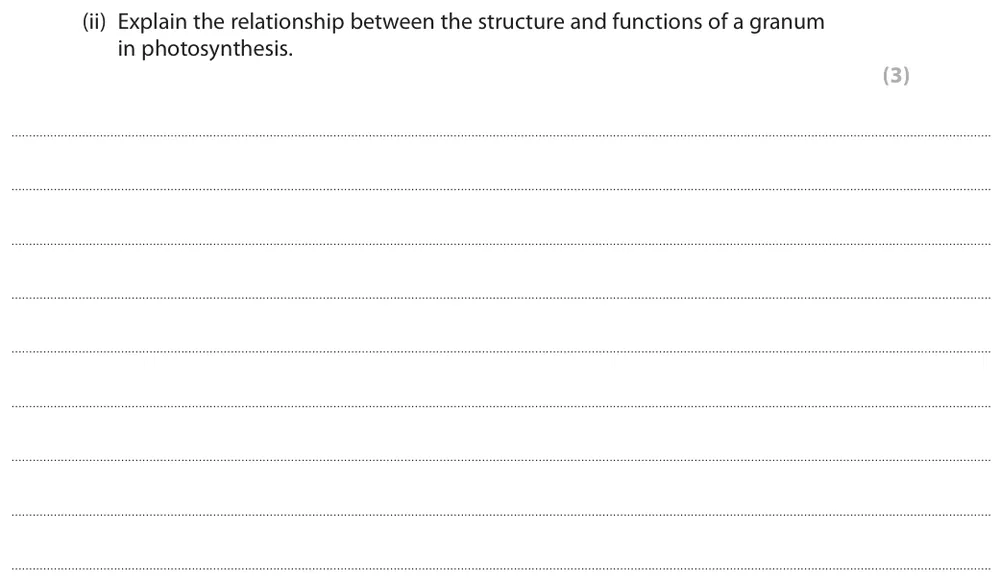
Explain the relationship between the structure and functions of a granum.
Show the mark scheme
Tap an image to open it full size.
From the examiners' report: Link each feature to its function. Many layers of thylakoid membrane give a large surface area for absorbing light (surface area, not surface area to volume ratio); say what the chlorophyll does, not just that it is there.
Question 14
A level Paper 3 · June 2017 · Q5(a) · 1 mark
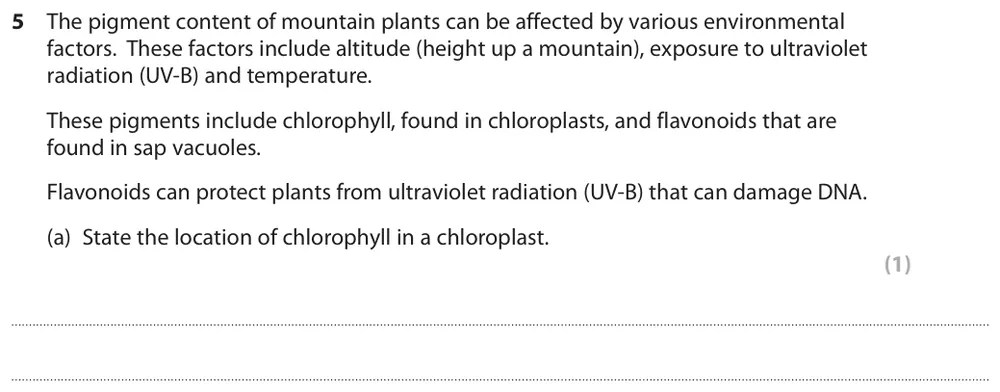
State the location of chlorophyll in a chloroplast.
Show the mark scheme

Tap an image to open it full size.
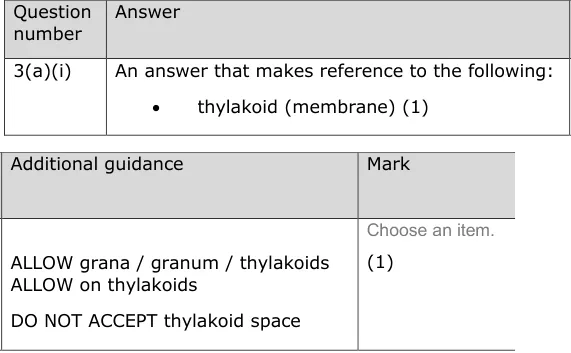
From the examiners' report: Write thylakoid membrane: 'thylakoid' on its own was the most common wrong answer, and adding the stroma lost the mark. The photosystems are embedded in the membrane.
Question 15
A level Paper 3 · June 2024 · Q3(a)(i) · 1 mark
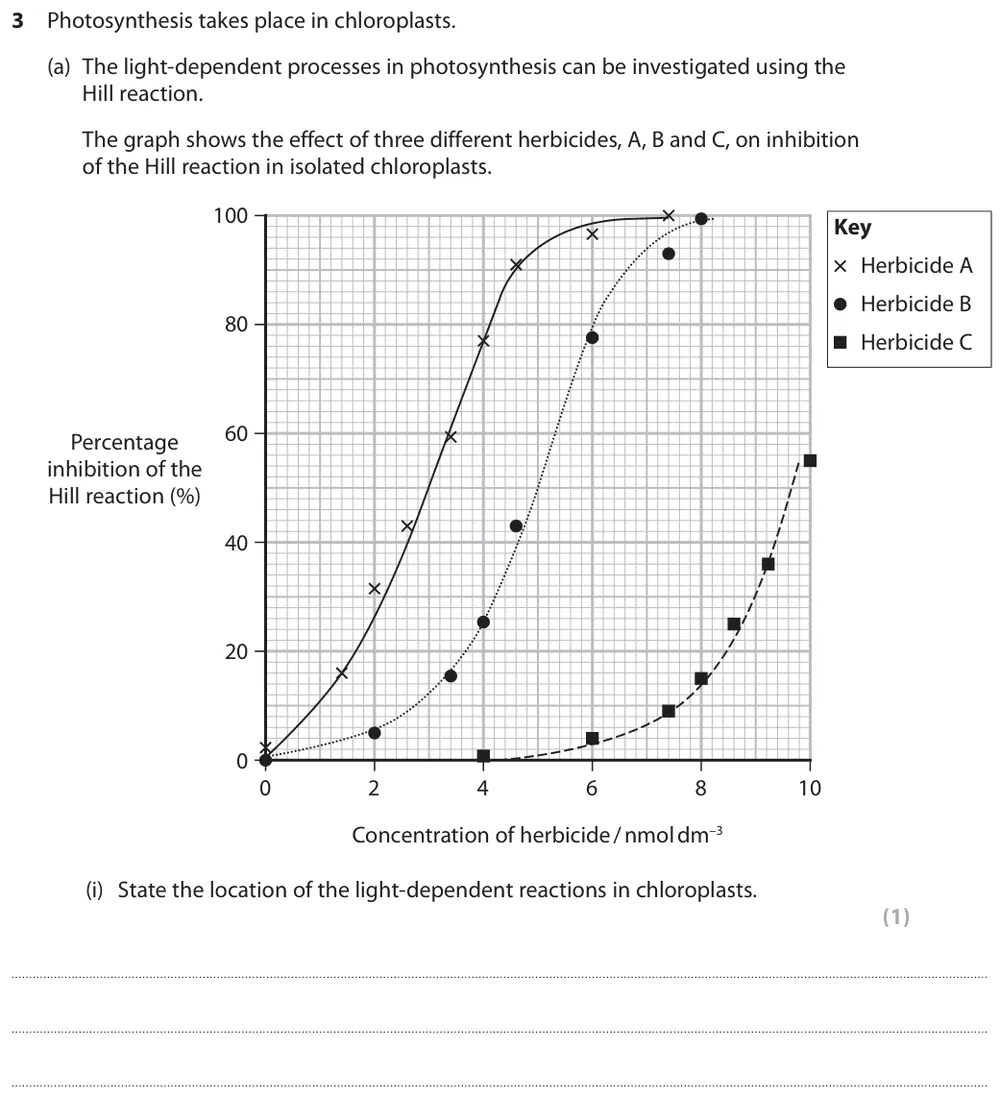
State where the light-dependent reactions take place in chloroplasts.
Show the mark scheme
Tap an image to open it full size.
From the examiners' report: Thylakoid membrane or grana. A few wrote 'thylakoid space', which was not accepted.
Question 16
A level Paper 3 · October 2020 · Q3(a)(i) · 1 mark
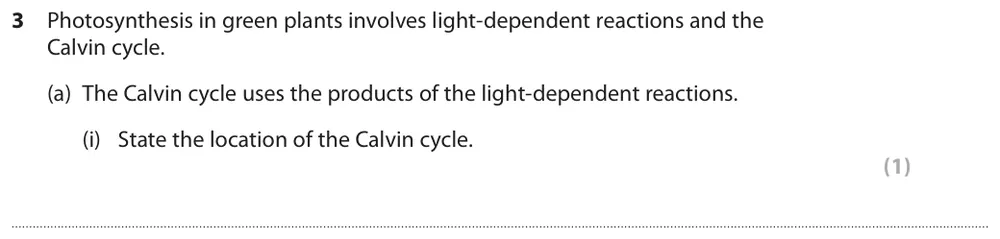
State the location of the Calvin cycle.
Show the mark scheme

Tap an image to open it full size.
From the examiners' report: The stroma of the chloroplast. 'Chloroplast' alone was not precise enough.
Question 17
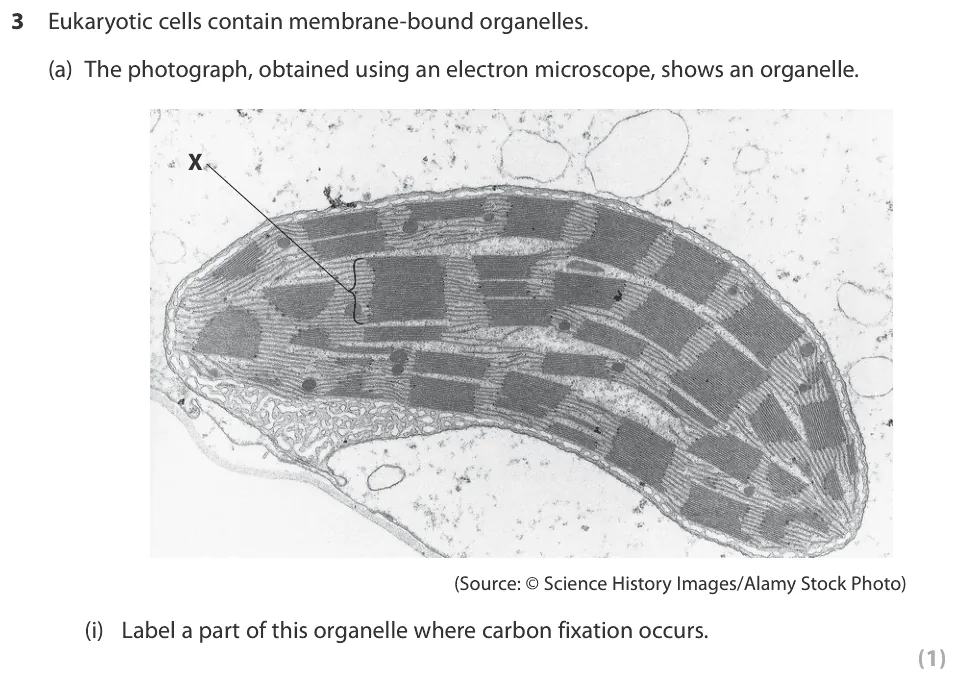
A level Paper 3 · June 2022 · Q3(a)(i) · 1 mark
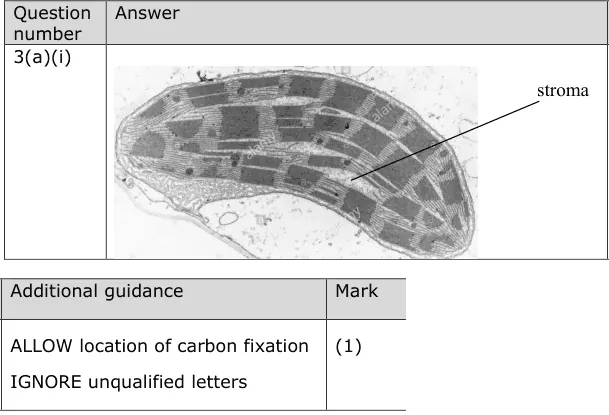
Label the part of the chloroplast in the electron micrograph where carbon fixation occurs.
Show the mark scheme
Tap an image to open it full size.
From the examiners' report: Many did not label the stroma. Draw a clear label line to it and write the label: a circle is not enough, and don't cross label lines over each other.
Question 18
A level Paper 3 · June 2022 · Q3(a)(ii) · 1 mark
Name the component labelled X.

Show the mark scheme

Tap an image to open it full size.
From the examiners' report: Strictly it is a granum (a stack of thylakoids). Thylakoid was accepted on this occasion.
Question 19
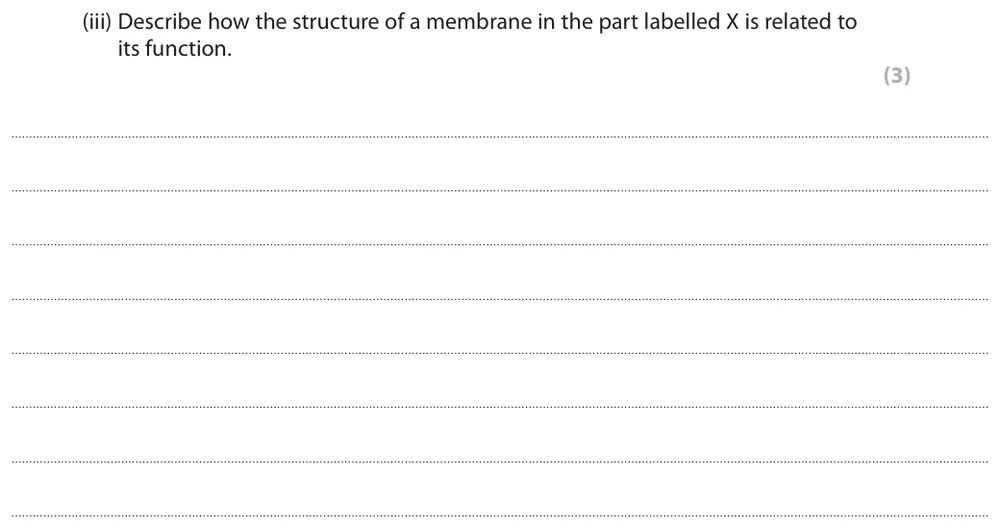
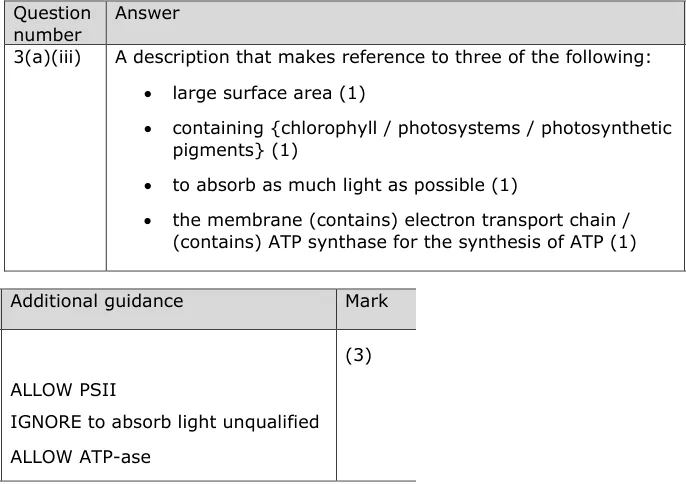
A level Paper 3 · June 2022 · Q3(a)(iii) · 3 marks
Describe how the structure of a membrane in X is related to its function.
Show the mark scheme
Tap an image to open it full size.
From the examiners' report: 'Absorbs light' on its own was not enough: the large surface area containing chlorophyll absorbs as much light as possible. The membrane also holds the electron transport chain and ATP synthase.
Question 20
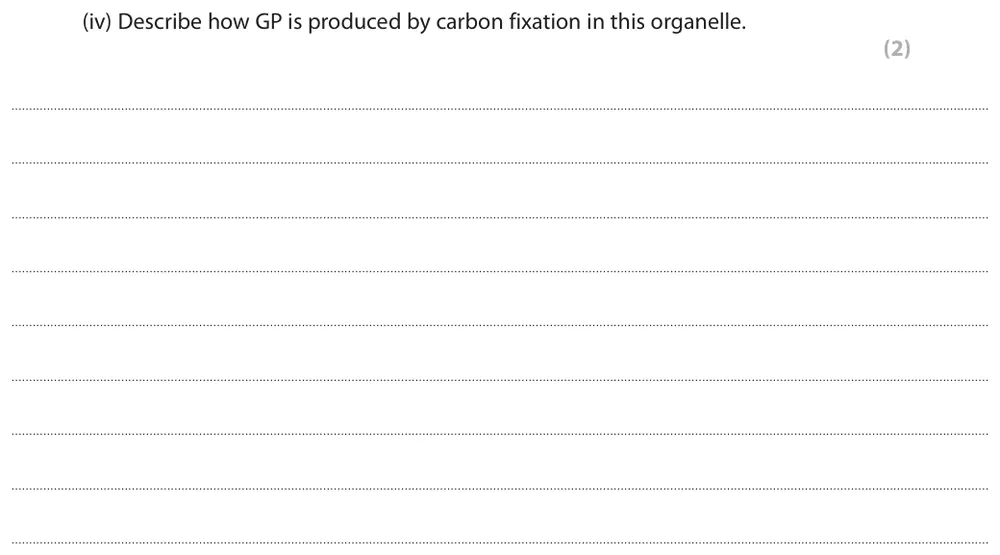
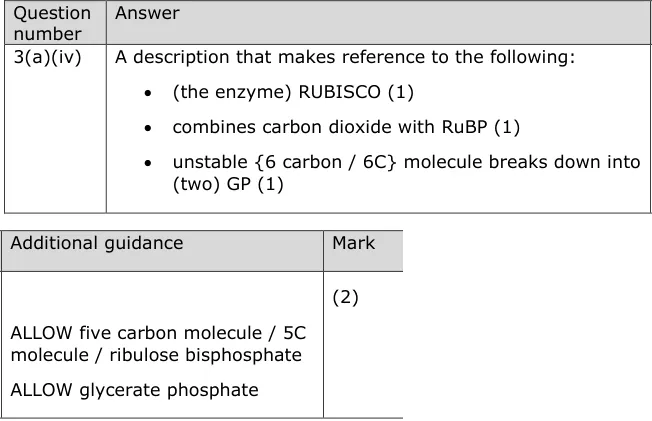
A level Paper 3 · June 2022 · Q3(a)(iv) · 2 marks
Describe how GP is produced by carbon fixation in this organelle.
Show the mark scheme
Tap an image to open it full size.
From the examiners' report: A few confused RuBP with RUBISCO or gave wrong carbon numbers. It must be carbon dioxide, not just 'carbon', that RUBISCO combines with RuBP; the unstable 6C molecule breaks down into two GP.
Where students lose marks (from Pearson examiners' reports and mark schemes)
Each point below comes from the examiners' reports and mark schemes, and is followed by wording that gained marks.
Hydrolyse ATP, don't split it. Many wrote 'splitting' or 'breaking' ATP and never said it is hydrolysed.
✔ Gains credit: 'Hydrolysis of ATP provides energy for the reaction and a phosphate group for the phosphorylation of F-6-P.'
Photolysis releases hydrogen ions. A number described hydrogen or hydrogen atoms as a product of photolysis.
✔ Gains credit: 'Photolysis (splitting of water) produces oxygen, electrons and hydrogen ions.'
Light-dependent products: reduced NADP, not NAD. Some wrote reduced NAD rather than reduced NADP; others gave carbon dioxide.
✔ Gains credit: 'Oxygen, ATP, reduced NADP.'
Carbon dioxide only enters the Calvin cycle. Some said carbon dioxide is needed for both the light-dependent and the light-independent reactions.
✔ Gains credit: 'In the light-independent reactions carbon dioxide combines with RuBP, catalysed by the enzyme RUBISCO, leading to the formation of GP.'
RUBISCO joins carbon dioxide to RuBP. Some said carbon dioxide is combined with a six-carbon molecule to form RuBP.
✔ Gains credit: 'RUBISCO is an enzyme that combines carbon dioxide with RuBP to form GP.'
GP is reduced to GALP, not the reverse. Some said ATP is used to produce GP from GALP.
✔ Gains credit: 'ATP and reduced NADP are used to convert GP to GALP.'
Stacked thylakoids give surface area, not SA:V. Many described stacks of membrane without saying they increase surface area, or called it surface area to volume ratio.
✔ Gains credit: 'The granum is formed from many layers of thylakoid membranes to increase the surface area for absorbing light.'
Chlorophyll sits in the thylakoid membrane. 'Thylakoid' without 'membrane' was the most common wrong answer; some also mentioned the stroma.
✔ Gains credit: 'Thylakoid membrane / grana.'
Download the questions
Download the PDF pack (20 questions, mark schemes at the end)
Keep practising
- Ecosystems, Succession and Productivity (Topic 5): Edexcel SNAB exam questions by topic
- Climate Change and Evolution (Topic 5): Edexcel SNAB exam questions by topic
- Ecology, the Hill Reaction and Q10 (Core Practicals 10 to 12): Edexcel SNAB core practical questions
- Topic 5 multiple-choice quiz (23 questions, marked as you tap)
- Edexcel SNAB A level Biology resources hub (every topic, practical and paper)
- Extended Response Questions (Topics 5 to 8): Edexcel SNAB A Level Biology Exam Questions
- Edexcel SNAB A level Biology past papers, mark schemes and examiners' reports
- Edexcel SNAB A level Biology grade boundaries
- Message Tom on WhatsApp about one-to-one Edexcel SNAB tutoring or an Edexcel group class
Questions, mark schemes and examiners' report extracts © Pearson Education Ltd.