

Geometry in AQA A Level Biology is one skill, MS 4.1: calculating the circumferences, surface areas and volumes of regular shapes. On the papers that means the area of a circular field of view when you work out stomatal density, the volume of water moving along a potometer or respirometer tube (πr²l), the surface area of a microvillus, and the volume of a cell, nucleus or tumour treated as a sphere. The formula is usually given; the marks are for using it properly.
The examiners' reports show the same slips again and again. Students use the diameter instead of the radius, convert an area into micrometres as if it were a length, forget to turn a 15-minute reading into a rate per hour, skip subtracting the volume of the nucleus, scale a percentage change the wrong way, and ignore the decimal places or significant figures the question asks for.
Write down the formula, halve the diameter before you do anything else, and show every step: most of these questions give a mark for a correct intermediate value. If you'd like help with this topic, my AQA masterclasses run online on Tuesdays at 5.15pm for Year 12 and on Wednesdays or Thursdays at 6.30pm for Year 13.
What you need from GCSE
Each question on this page assumes you're secure on these GCSE ideas. If any of them feels shaky, look it up before you start.
- GCSE: the radius is half the diameter; the circumference of a circle is 2πr (or πd) and its area is πr².
- GCSE: the volume of a cuboid is length × width × height, and the volume of a cylinder (a prism) is the area of its circular end × its length, πr²l.
- GCSE: the volume of a sphere is 4/3πr³ and its surface area is 4πr²; you'll be given these formulae.
- GCSE: area units are squared and volume units are cubed, so 1 mm² = 10⁶ µm² and 1 mm³ = 10⁹ µm³.
- GCSE: rounding to a given number of decimal places or significant figures, and finding a percentage of an amount.
Key terms
These words come up in the questions and mark schemes. Examiners expect you to use them exactly.
- Radius: half the diameter; πr², πr²l and 4/3πr³ all use the radius, and using the diameter is the commonest error.
- Diameter: the distance across a circle through its centre, such as line PQ across a cell or the bore of a capillary tube.
- Circumference: the distance round a circle, 2πr or πd.
- Area of a circle: πr², used for a circular field of view or the cross-section of a tube or channel.
- Volume of a cylinder: πr²l (or πr²d), where l is the length; used for the volume of liquid that moves along a potometer or respirometer tube.
- Surface area of a cylinder: 2πrl for the curved side, plus πr² for each end included, as in the microvillus equation 2πrl + πr².
- Volume of a sphere: 4/3πr³; used when a cell, nucleus, polar body or tumour is assumed to be spherical.
- Rectangular prism (cuboid): a box shape whose volume is length × width × depth, such as the DNA cages.
- Field of view: the circular area seen down a microscope; its area is πr² of the field's diameter halved.
- Stomatal density: the number of stomata per unit area, in stomata mm⁻² (stomata per mm²).
What these questions cover (AQA maths skills MS 4: geometry and trigonometry)
The questions test this mathematical skill from the AQA AS and A-level Biology specification (7401/7402):
- MS 4.1 Calculate the circumferences, surface areas and volumes of regular shapes (every question on this page; no available part asks you to calculate a circumference, so the questions cover areas and volumes of circles, squares, cuboids, cylinders and spheres)
How to use this page
Write your answer on paper before you open the mark scheme. Allow about 1.3 minutes per mark: the 14 questions are worth 31 marks, so about 40 minutes in total. Then mark your answer strictly against the mark scheme and read the examiners' tip underneath it. If you'd rather print the questions, download the PDF pack.
Area of a circle (MS 4.1)
Question 1
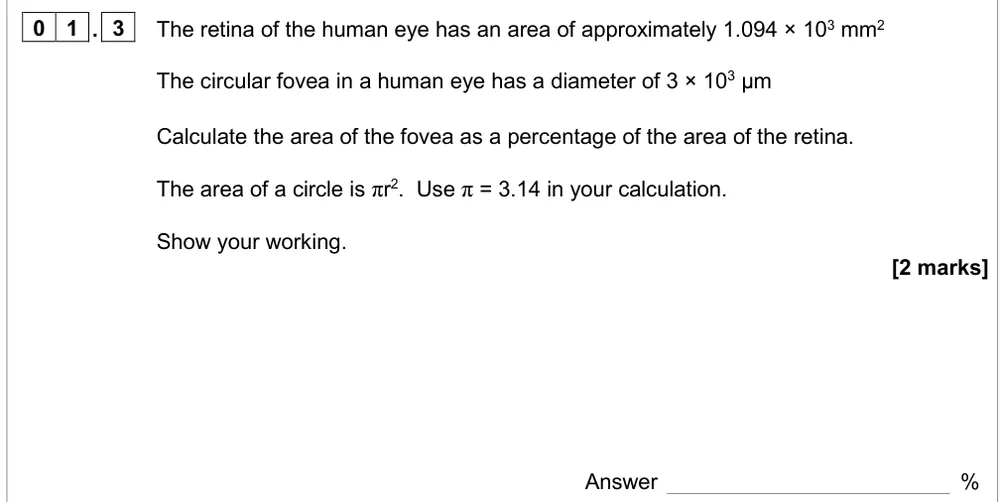
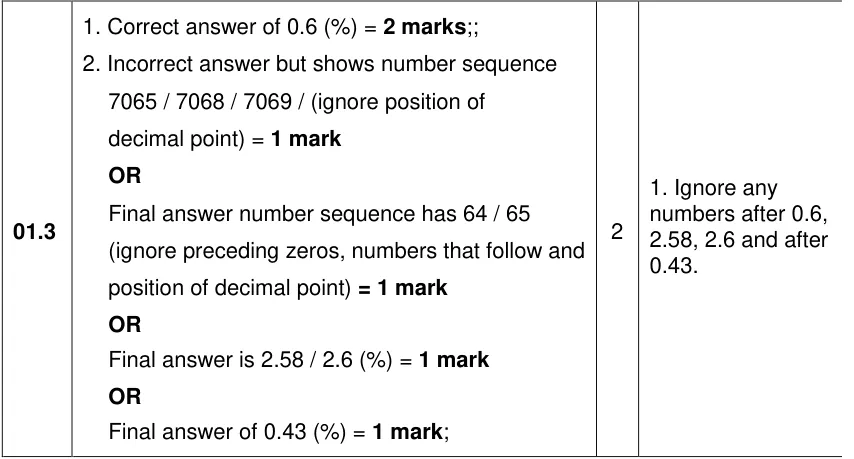
A level Paper 2 · November 2020 · Q01.3 · 2 marks · Easy
Calculate the area of the fovea as a percentage of the area of the retina.
Show the mark scheme
Tap an image to open it full size.
From the examiners' report: About 45% got both marks and 37% got one. Convert 3 × 10³ µm to 3 mm first, halve it for the radius, then divide the fovea area by the retina area and multiply by 100.
Question 2
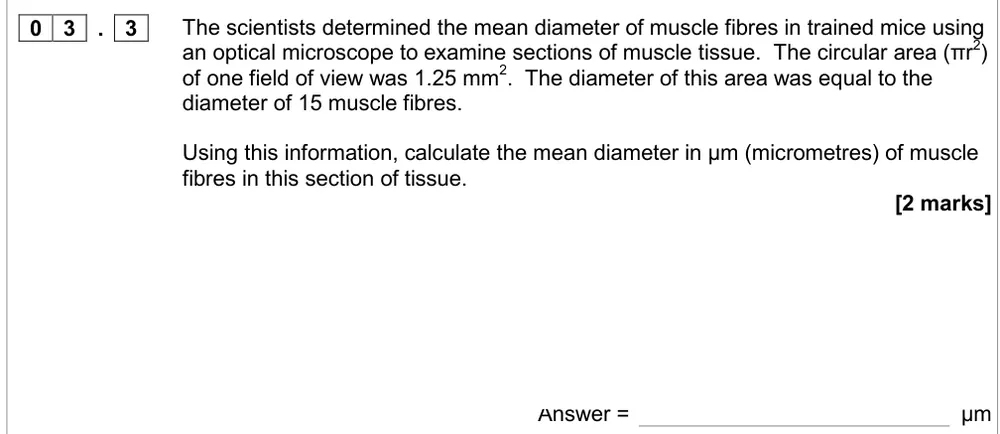
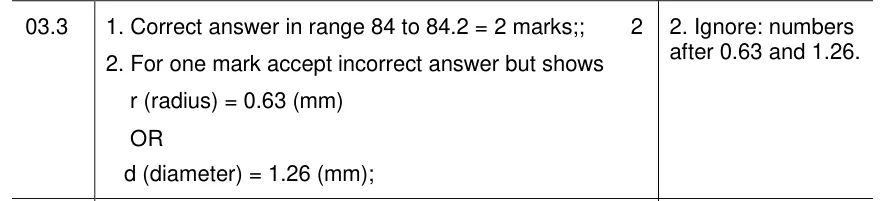
A level Paper 2 · June 2017 · Q03.3 · 2 marks · Medium
Use the area of a circular field of view to find the mean diameter of muscle fibres in µm.
Show the mark scheme
Tap an image to open it full size.
From the examiners' report: Only three in ten got both marks and over half scored zero. Don't convert the area to µm and divide by 15: find r = √(1.25 ÷ π), double it, convert to µm, then divide by 15.
Question 3
A level Paper 1 · June 2022 · Q03.4 · 2 marks
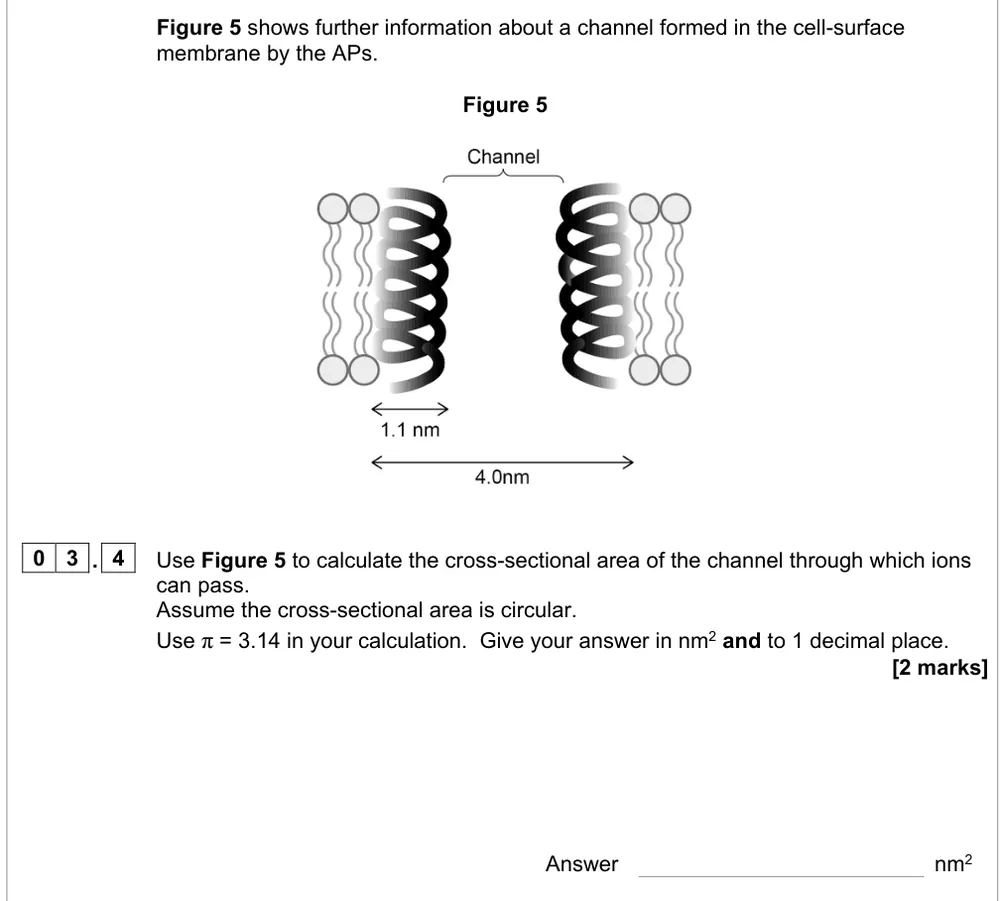
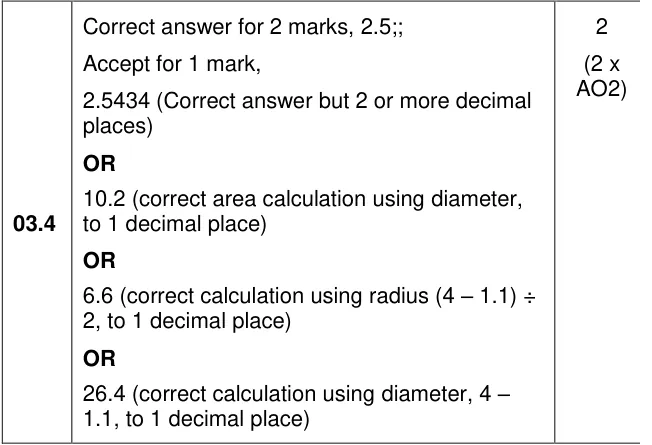
Calculate the cross-sectional area of a membrane channel in nm² to 1 decimal place.
Show the mark scheme
Tap an image to open it full size.
From the examiners' report: Half the answers were right. Others recalled πr² but used the wrong dimension from the figure or rounded wrongly. The channel is the 1.1 nm gap, so r = 0.55 nm.
Question 4
AS Paper 2 · June 2025 · Q04.1 · 3 marks · Medium
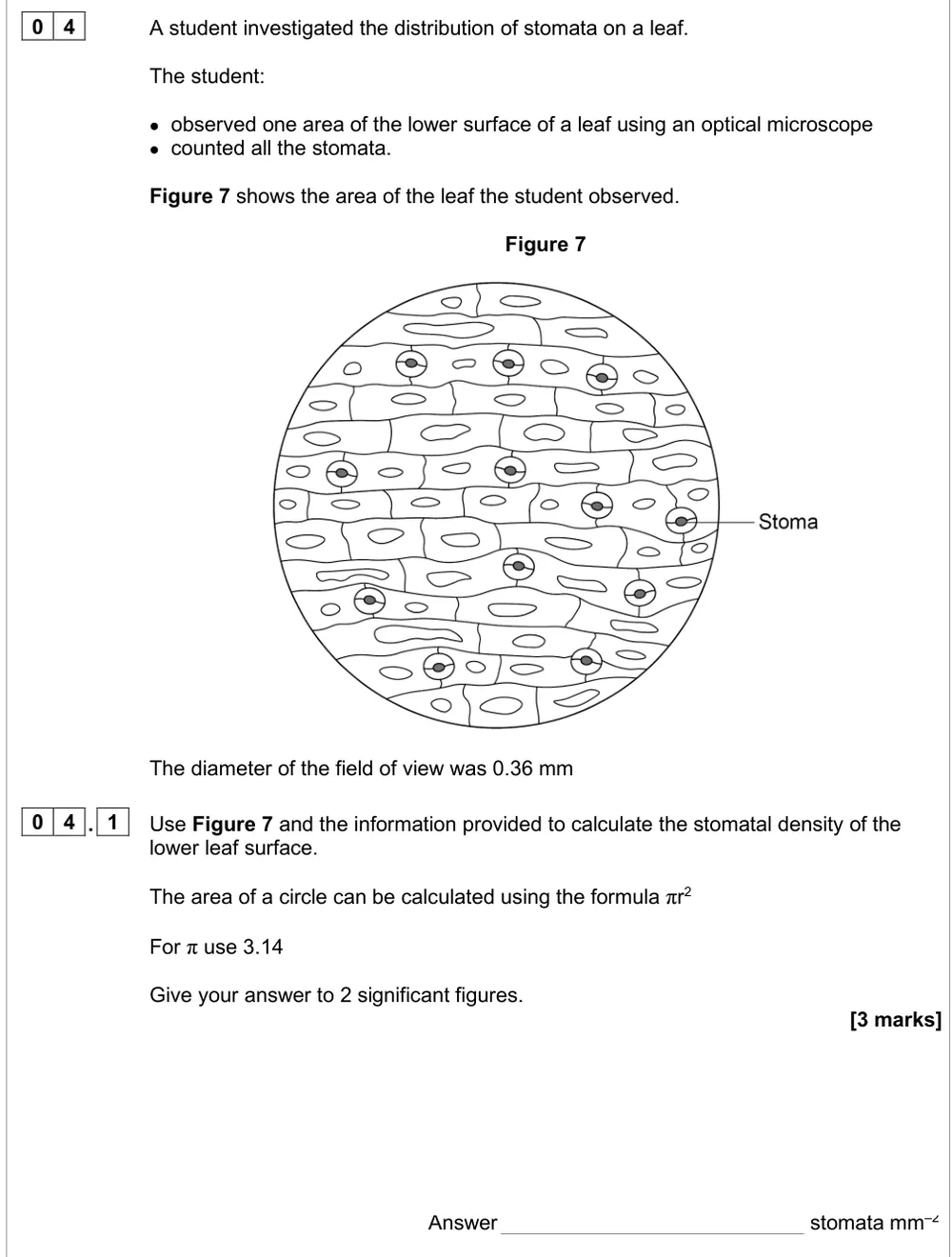
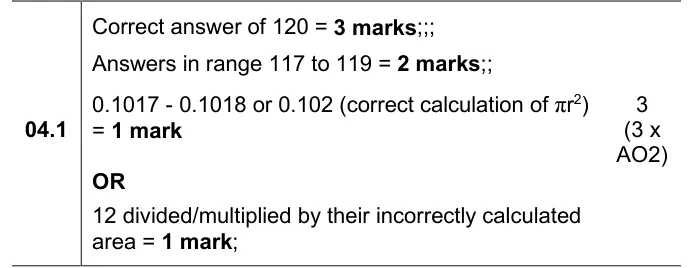
Calculate stomatal density from a count in a circular field of view of diameter 0.36 mm.
Show the mark scheme
Tap an image to open it full size.
From the examiners' report: About 80% got at least 1 mark and a third got all 3. Halve 0.36 mm before squaring, divide the 12 stomata by the area, and round to 2 significant figures: 118 only scored 2.
Squares and rectangular prisms (MS 4.1)
Question 5
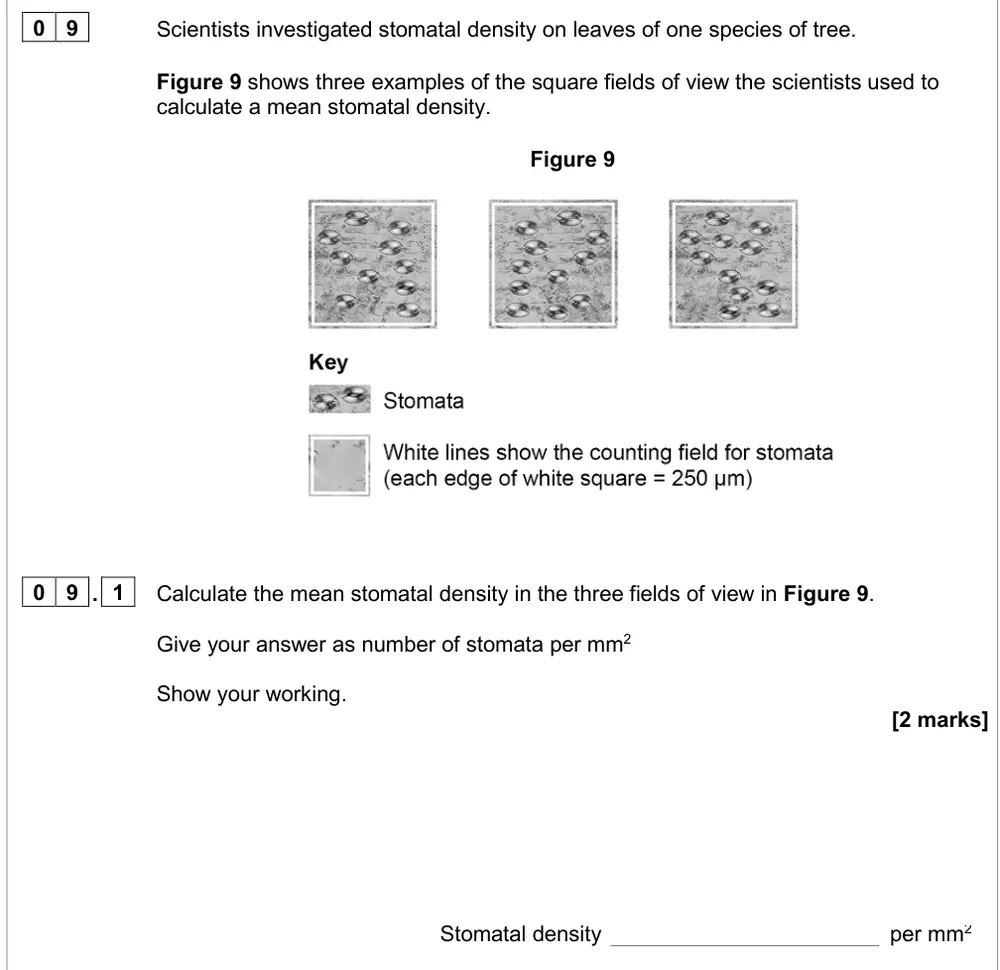
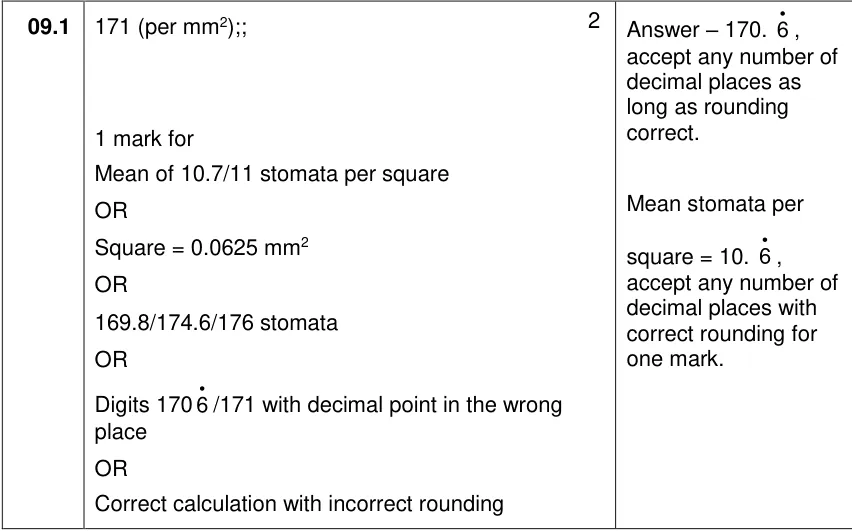
A level Paper 1 · November 2020 · Q09.1 · 2 marks
Calculate a mean stomatal density per mm² from three square fields of view.
Show the mark scheme
Tap an image to open it full size.
From the examiners' report: Many intermediate marks were available, so show each stage. Convert 250 µm to 0.25 mm before squaring (0.0625 mm²), and round to a whole number of stomata.
Question 6
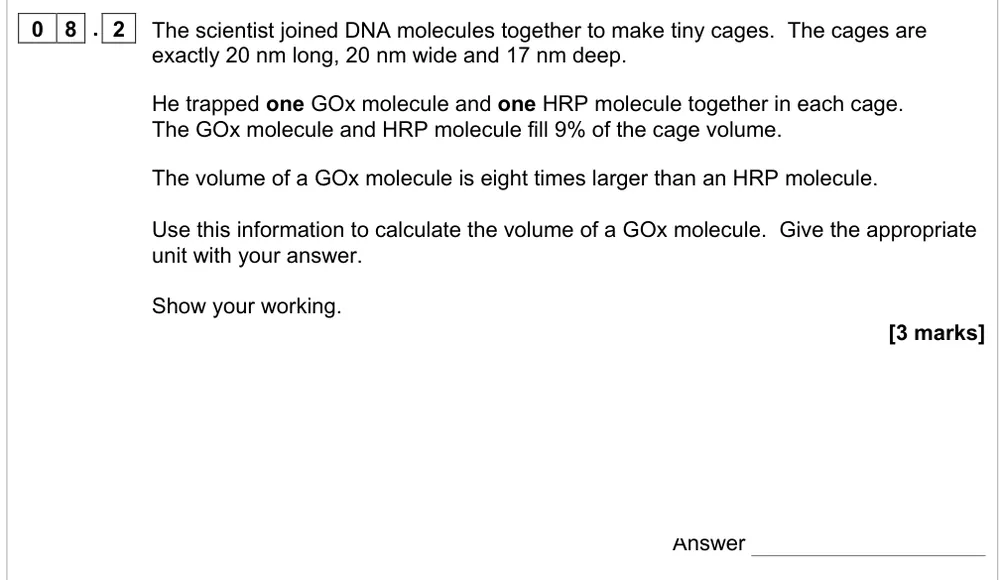
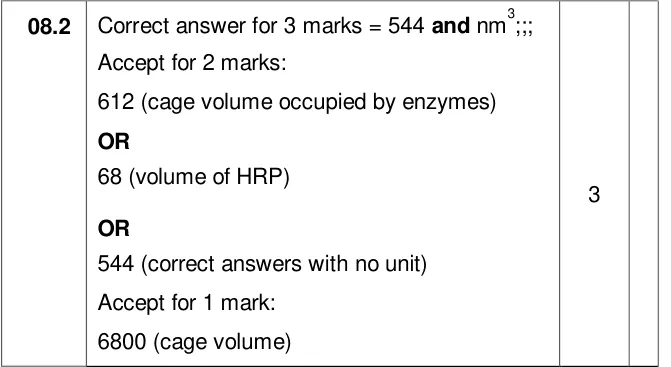
AS Paper 2 · November 2021 · Q08.2 · 3 marks
Use the volume of a DNA cage to calculate the volume of a GOx molecule, with units.
Show the mark scheme
Tap an image to open it full size.
From the examiners' report: There's no examiners' comment on this part, so this tip comes from the mark scheme. Volume of a cuboid = 20 × 20 × 17 = 6800 nm³; take 9%, then split it in the ratio 8 : 1, and remember the unit is nm³.
Cylinders (MS 4.1)
Question 7
A level Paper 2 · June 2022 · Q04.3 · 2 marks · Medium
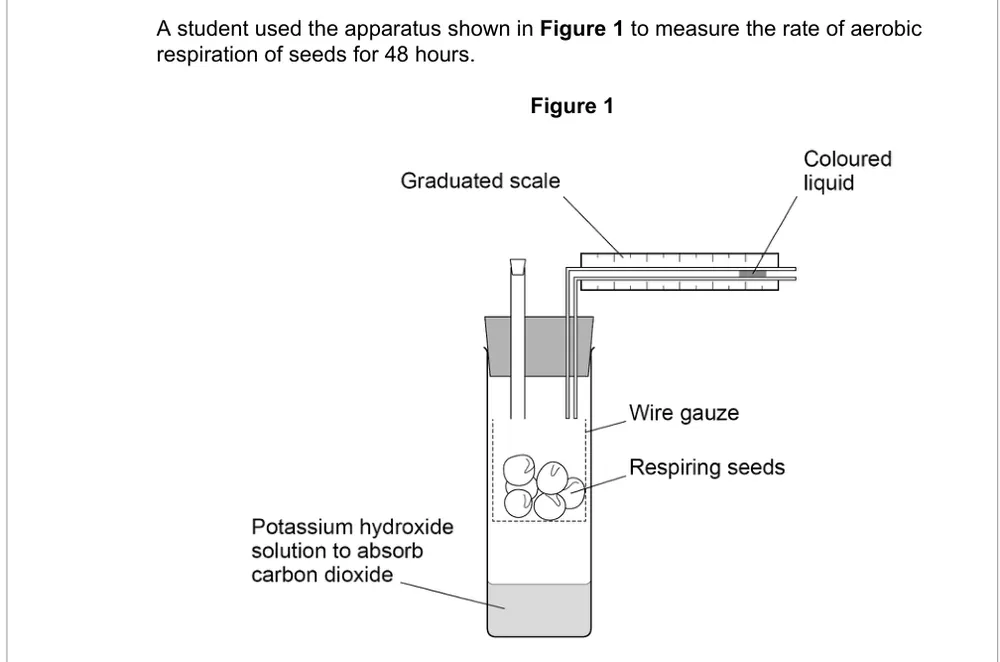
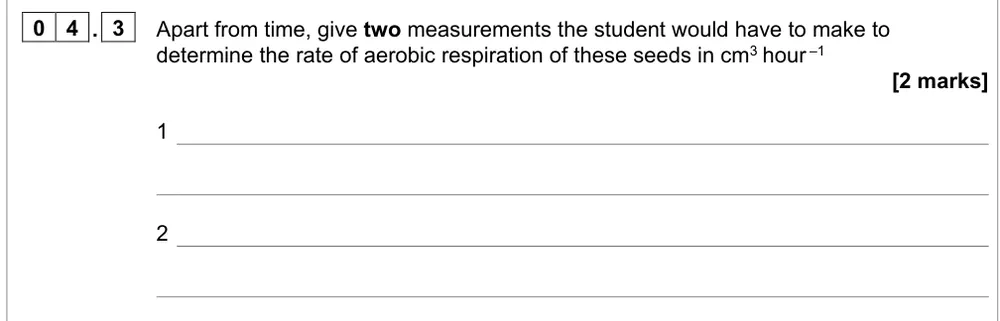
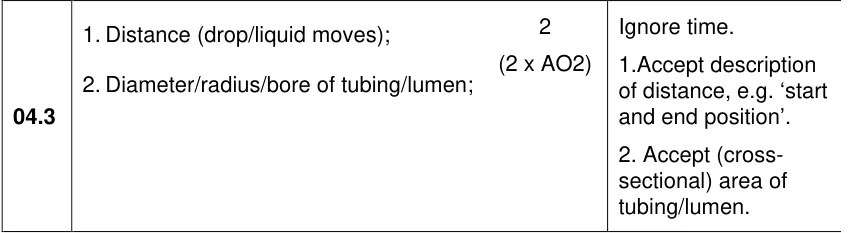
Give two measurements, apart from time, needed to find the rate of respiration of seeds in cm³ hour⁻¹.
Information from earlier in this question:
Show the mark scheme
Tap an image to open it full size.
From the examiners' report: Only 22% got both marks. A volume in cm³ comes from πr²l, so you need the distance moved and the radius of the tube. 'Volume of the tubing', mass of seeds and temperature didn't score.
Question 8
AS Paper 2 · June 2024 · Q01.3 · 1 mark
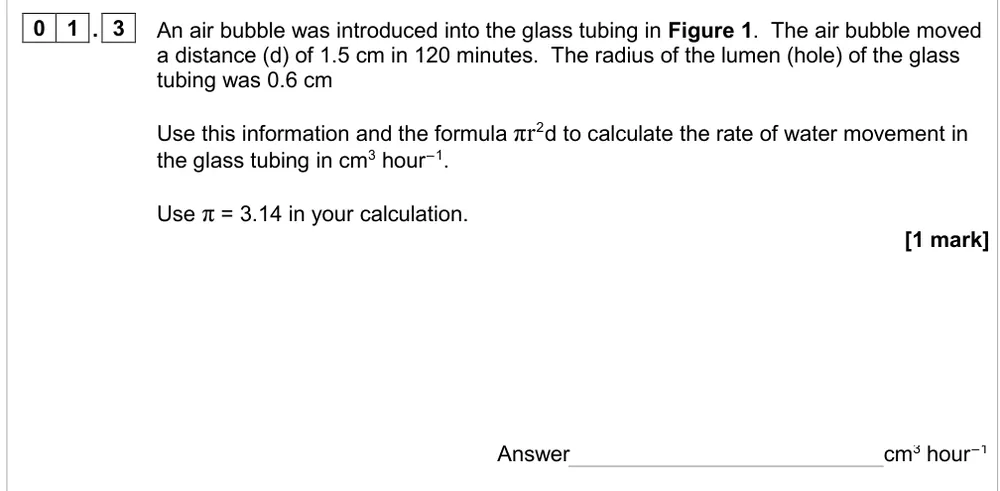
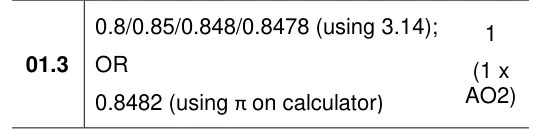
Use πr²d to calculate the rate of water movement in glass tubing in cm³ hour⁻¹.
Show the mark scheme
Tap an image to open it full size.
From the examiners' report: This caused few problems. Here you're given the radius, so use it as it is, then divide by 2 because 120 minutes is 2 hours.
Question 9
A level Paper 3 · June 2017 · Q06.1 · 2 marks · Easy
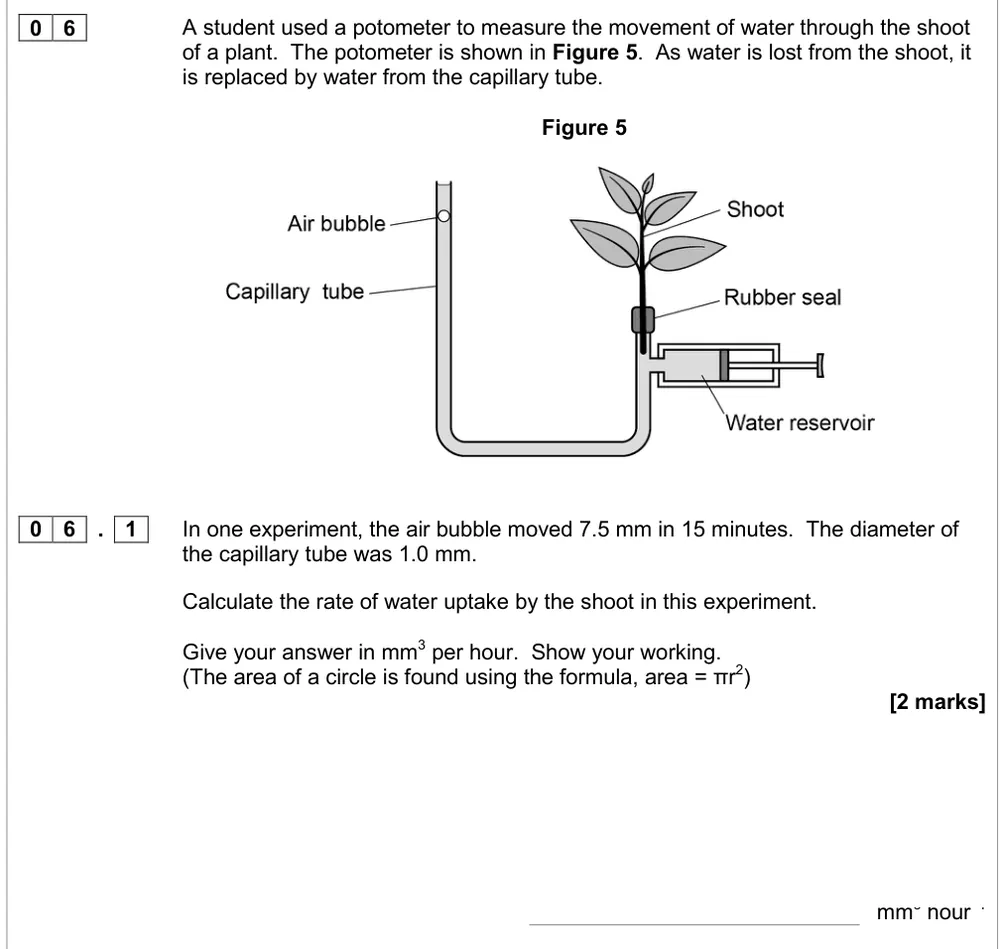
Calculate the rate of water uptake by a shoot in mm³ per hour from potometer readings.
Show the mark scheme
Tap an image to open it full size.
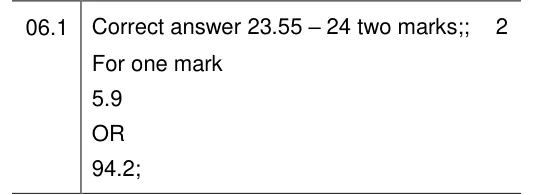
From the examiners' report: 57% got both marks. Use the radius (0.5 mm), not the diameter, and multiply by 4 to turn 15 minutes into an hour.
Question 10
A level Paper 3 · June 2024 · Q02.4 · 3 marks · Medium
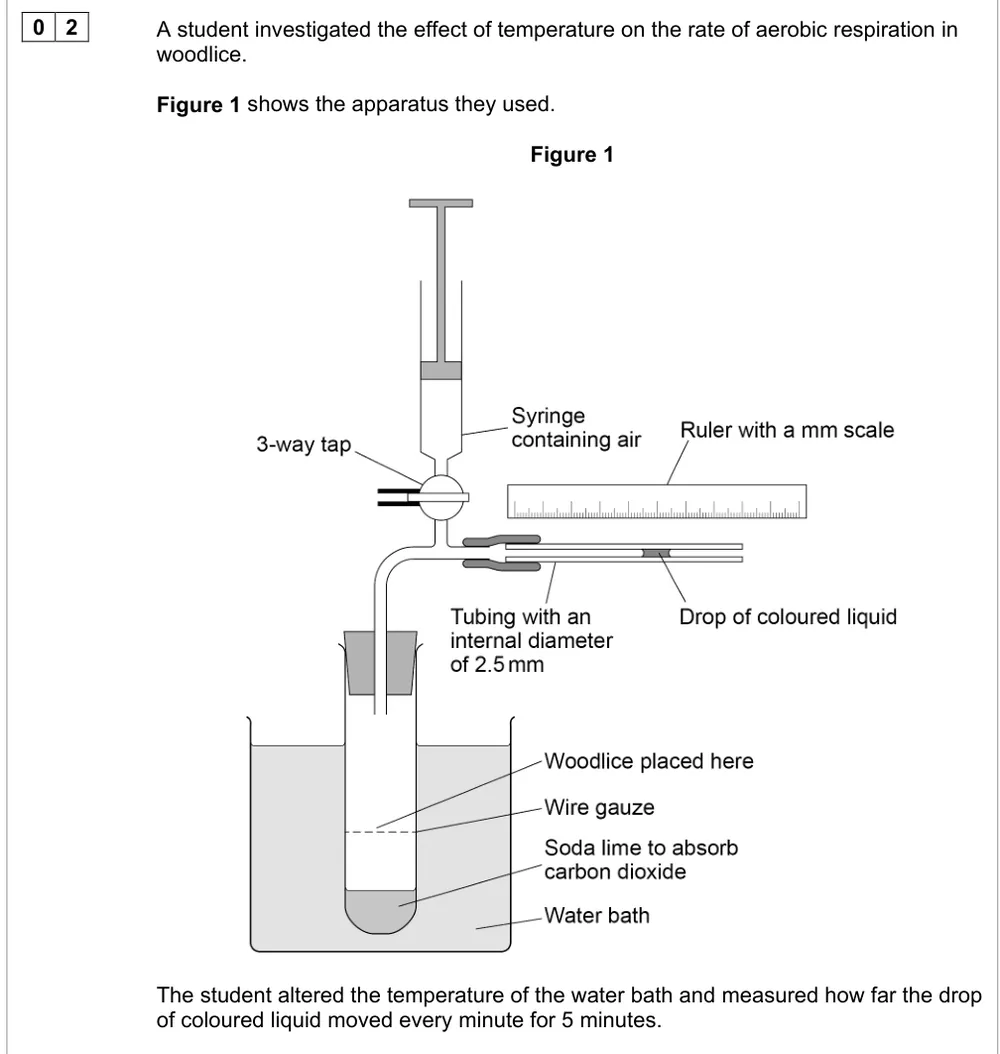
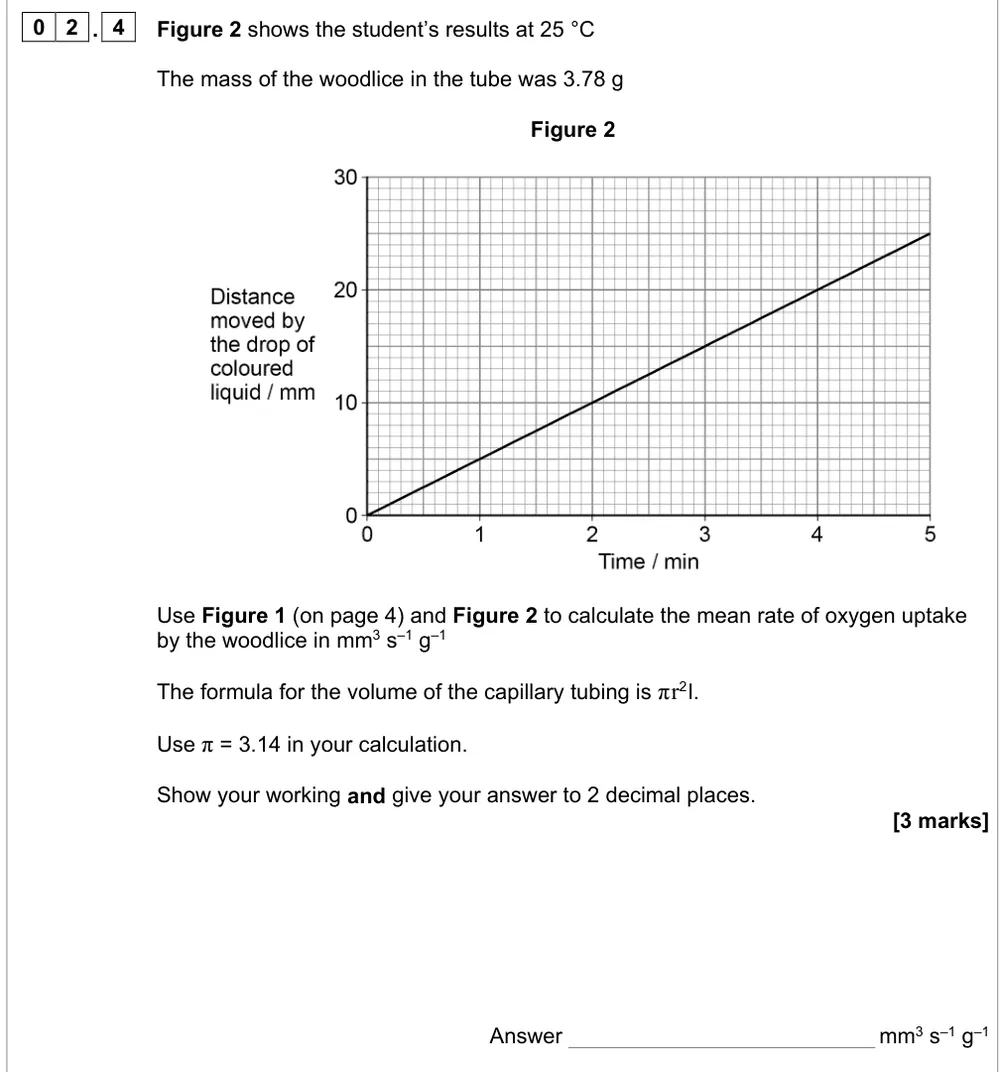
Use the distance a drop moved and πr²l to find the mean rate of oxygen uptake by woodlice in mm³ s⁻¹ g⁻¹.
Information from earlier in this question:
Show the mark scheme
Tap an image to open it full size.
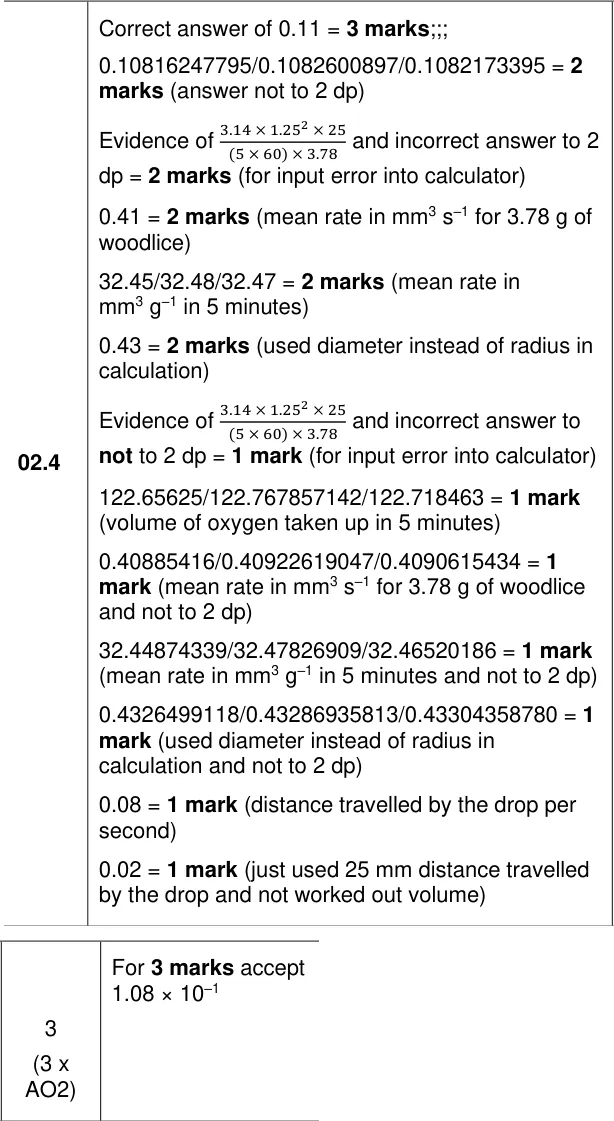
From the examiners' report: A third got all 3 marks. Use r = 1.25 mm, divide by 300 s and by 3.78 g, and round 0.108 to 0.11, not 0.12. Give exactly 2 decimal places.
Question 11
AS Paper 2 · June 2022 · Q03.2 · 2 marks · Medium
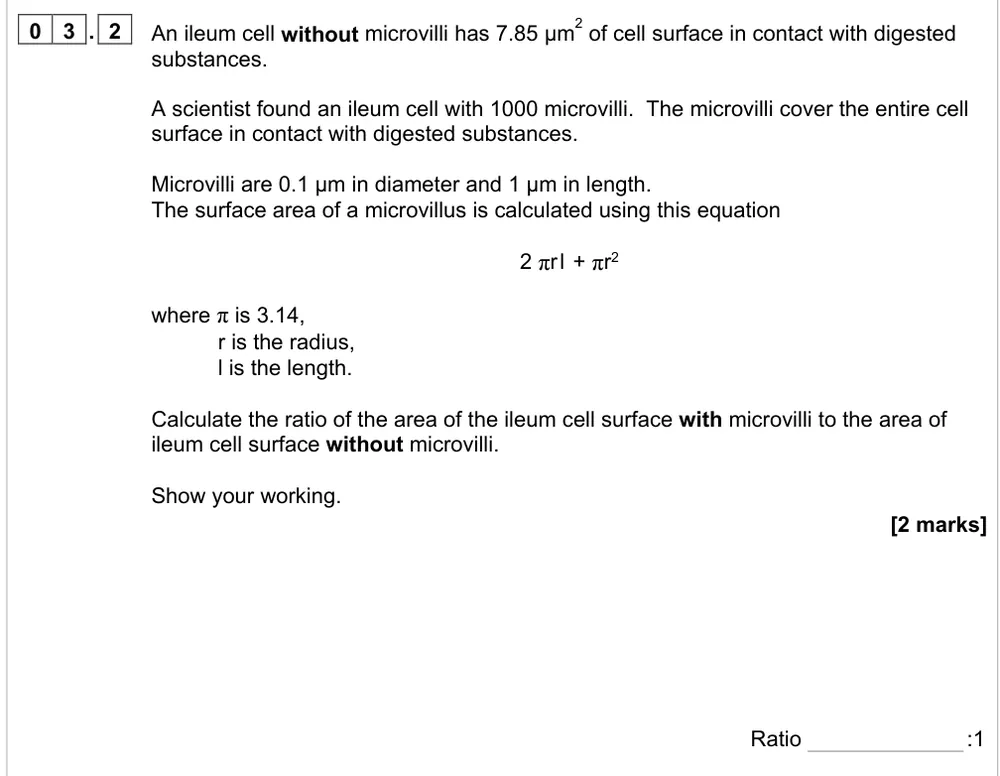
Use 2πrl + πr² to find the ratio of an ileum cell's surface area with and without microvilli.
Show the mark scheme
Tap an image to open it full size.
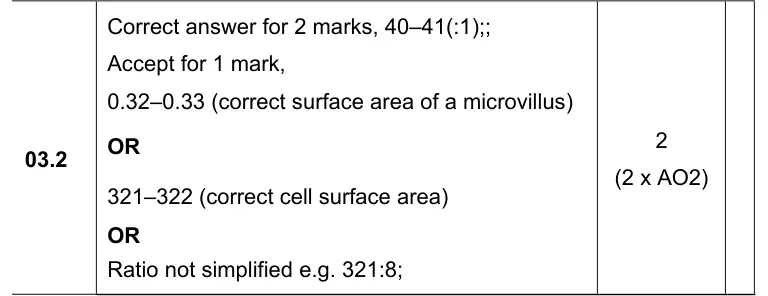
From the examiners' report: Almost 60% scored at least 1 mark, but many with a wrong answer showed no working and lost marks they could have had. Use r = 0.05 µm and π = 3.14, then divide by 7.85.
Spheres (MS 4.1)
Question 12
AS Paper 1 · June 2023 · Q04.1 · 3 marks · Medium
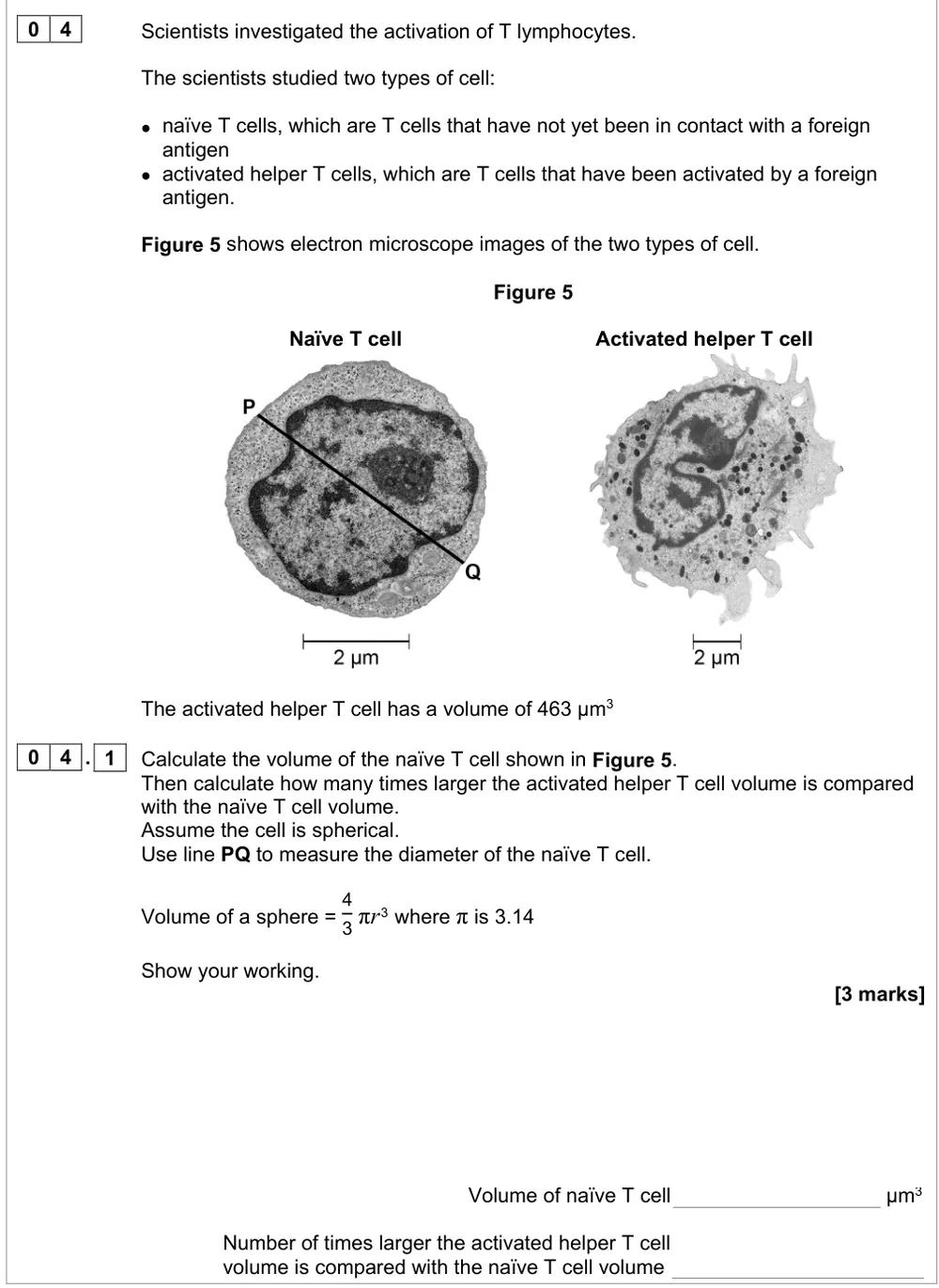
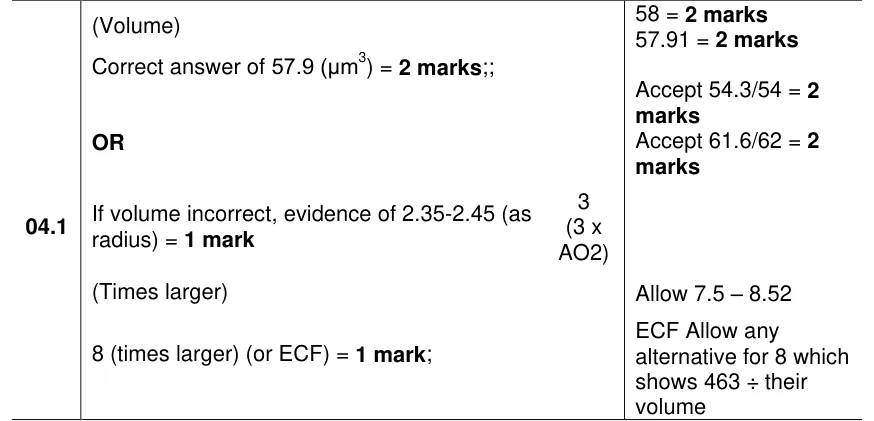
Measure line PQ to find the volume of a naïve T cell, then compare it with an activated helper T cell.
Show the mark scheme
Tap an image to open it full size.
From the examiners' report: About half scored at least 2 marks. Use the scale bar to turn PQ into µm, halve it for the radius, and give 'times larger' as a single number, not a fraction or ratio.
Question 13
A level Paper 3 · June 2018 · Q03.3 · 2 marks · Hard
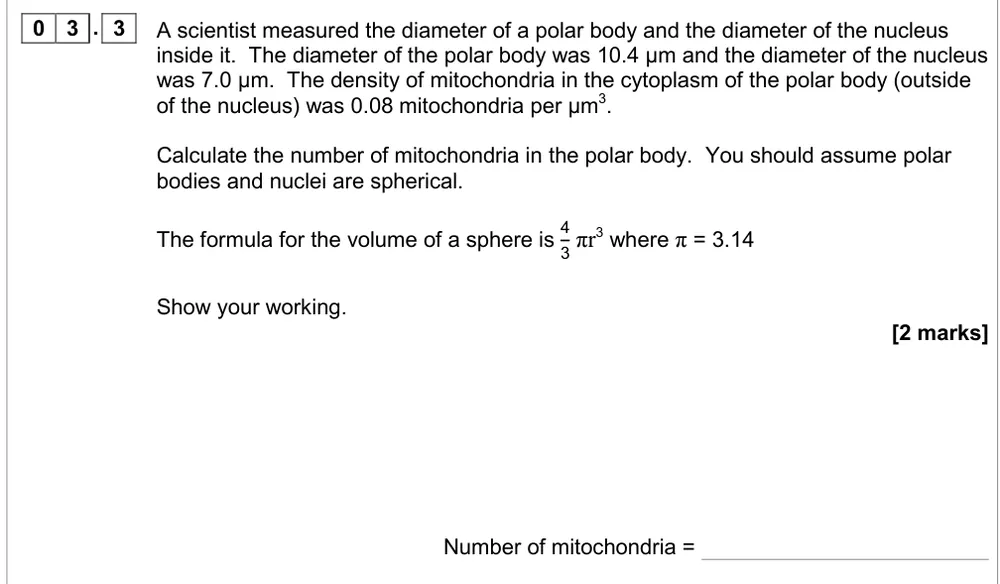
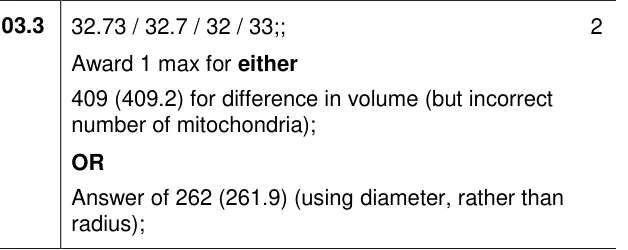
Use the volumes of two spheres to calculate the number of mitochondria in a polar body.
Show the mark scheme
Tap an image to open it full size.
From the examiners' report: 30% got both marks and 17% got one. Halve both diameters, subtract the volume of the nucleus from the polar body, then multiply by 0.08.
Question 14
A level Paper 3 · June 2019 · Q06.5 · 2 marks · Medium
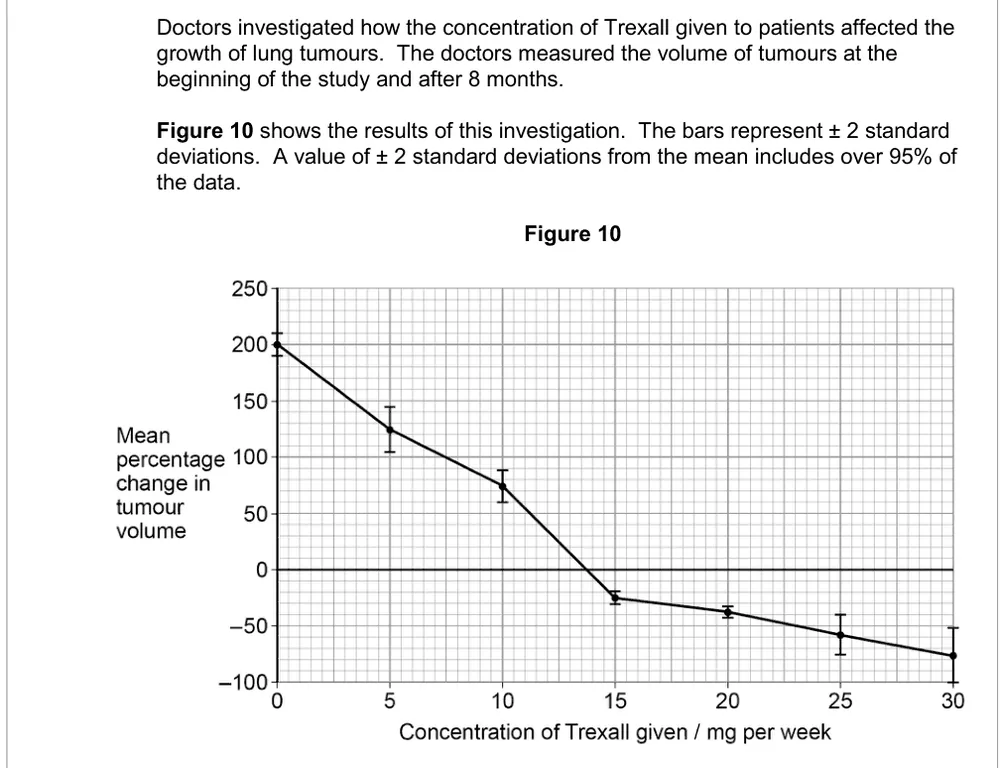
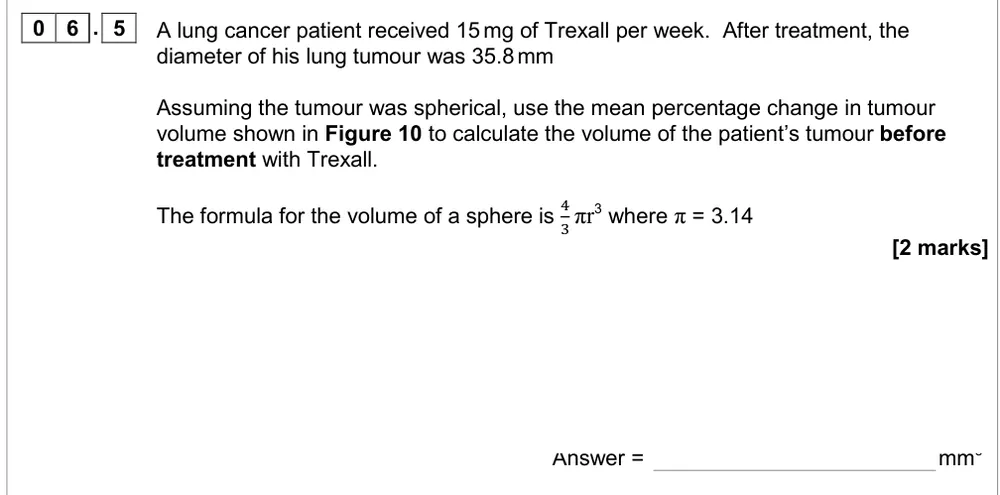
Use a graph of percentage change and 4/3πr³ to find a tumour's volume before treatment.
Information from earlier in this question:
Show the mark scheme
Tap an image to open it full size.
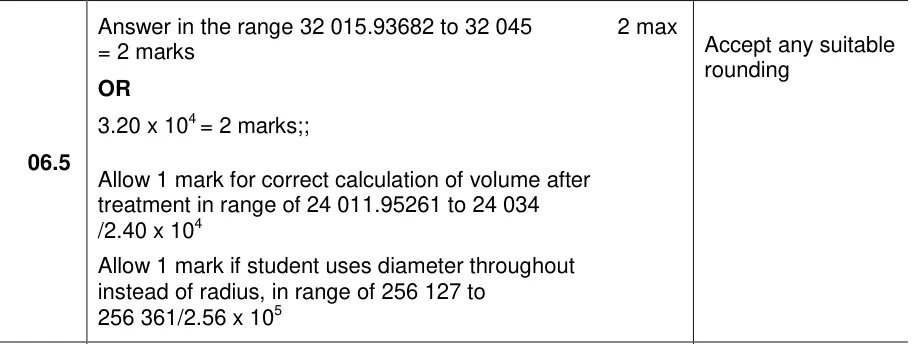
From the examiners' report: Only about 15% got both marks. Most found the volume after treatment but scaled it wrongly. A 25% fall means this volume is 75% of the original, so divide by 0.75.
Where students lose marks (from AQA examiners' reports and mark schemes)
Each point below is followed by wording that gained marks.
Find the diameter before dividing by 15: Three in ten students got both marks for the muscle fibre diameter, but over 50% scored zero. The most common wrong answer, 83.3, came from converting the area of the field of view into micrometres and then dividing by fifteen.
✔ Gains credit: "r (radius) = 0.63 (mm) OR d (diameter) = 1.26 (mm)"; correct answer 84 to 84.2 µm.
Multiply by 4 for a rate per hour: 57% got both marks for the potometer rate. Some used the diameter of the capillary tube rather than the radius; others didn't multiply by 4 to get the rate per hour. Either way they could get one mark.
✔ Gains credit: "For one mark 5.9 OR 94.2"; correct answer 23.55 to 24 mm³ hour⁻¹.
Take the nucleus away before counting mitochondria: 30% got both marks for the polar body and a further 17% got one. Some found the difference in volume between the nucleus and the polar body but couldn't then find the number of mitochondria; others used diameters instead of radii.
✔ Gains credit: "409 (409.2) for difference in volume"; 32.7 mitochondria (accept 32 or 33). Using diameters gives 262.
After treatment is 75% of before: Only about 15% got both marks for the tumour volume. Most found the volume after treatment but scaled it wrongly, multiplying by 25%, 125% or 225%, or misread the change as 15% or 35%.
✔ Gains credit: Volume after = 24 012 mm³ (1 mark); volume before = 24 012 ÷ 0.75 = 32 016 mm³, or 3.20 × 10⁴ mm³.
Same units before you take a percentage: About 45% got both marks for the fovea and 37% got one: they found the area of the fovea but not as a percentage of the retina. Errors converting µm to mm were common.
✔ Gains credit: "Number sequence 7065 / 7068 / 7069" for the fovea area (1 mark); correct answer 0.6%.
PQ is a diameter, measured in mm: About half scored at least 2 of the 3 marks for the T cell volume. Problems were realising that the radius is half the diameter and converting millimetres into micrometres; some gave 'times larger' as a fraction or ratio.
✔ Gains credit: "Evidence of 2.35-2.45 (as radius)"; volume 57.9 µm³; "8 (times larger)".
Two decimal places means 0.11: A third of students got all three marks for the woodlice. Many rounded 0.108 to 0.12, ignored the command to give 2 decimal places, or used the diameter instead of the radius.
✔ Gains credit: "Correct answer of 0.11"; 0.43 (using the diameter) scored 2 marks at most.
Measure the bore of the tube, not its volume: Only 22% got both marks and 67% at least one for the respirometer measurements. Students gave the 'volume of the tubing', time (which the question excluded), the mass of seeds, temperature or the volume of potassium hydroxide.
✔ Gains credit: "Distance (drop/liquid moves)"; "Diameter/radius/bore of tubing/lumen".
Download the questions
Download the PDF pack (14 questions, mark schemes at the end)
Keep practising
- Surface area to volume ratio: AQA A Level Biology exam questions by topic
- Arithmetic and numerical skills (MS 0): AQA A Level Biology exam questions
- Algebra (MS 2): AQA A Level Biology exam questions
- Graph skills (MS 3): AQA A Level Biology exam questions
- Mass transport in plants: AQA A Level Biology exam questions by topic
- AQA A Level Biology masterclasses
Questions, mark schemes and examiners' report extracts © AQA.