

Algebra in AQA A Level Biology means using equations you are given, or ones you are expected to know, in a biological context. The MS 2 skills in the specification cover the symbols =, <, >, ∝ and ~, changing the subject of an equation, substituting values with the right units, solving equations such as cardiac output = stroke volume × heart rate and the Hardy–Weinberg equation, and using logarithms for numbers that range over several orders of magnitude, such as the growth of a yeast population.
The examiners' reports show that students rarely lose these marks because the maths is hard. They lose them by dividing before they subtract, stopping at r² instead of r, using the diameter instead of the radius, taking N as the number of species, treating 10% affected as q rather than q², ignoring the significant figures asked for, and saying a log scale is used 'to fit on the graph'.
Write out the equation, rearrange it before you put any numbers in, and show every step: method marks are common. If you'd like help with maths skills, my AQA masterclasses run online on Tuesdays at 5.15pm for Year 12 and on Wednesdays or Thursdays at 6.30pm for Year 13.
What you need from GCSE
Each question on this page assumes you're secure on these GCSE ideas. If any of them feels shaky, look it up before you start.
- GCSE: substituting numbers into a formula, and rearranging a formula by doing the same operation to both sides.
- GCSE: the order of operations: brackets, then powers, then multiplying and dividing, then adding and subtracting.
- GCSE: the area of a circle is πr², and the radius is half the diameter.
- GCSE: the symbols <, > and ∝ (directly proportional to), and rounding to a given number of significant figures.
- GCSE: standard form, and converting between units such as mm and µm, or cm³ and dm³.
Key terms
These words come up in the questions and mark schemes. Examiners expect you to use them exactly.
- Subject of an equation: the quantity on its own on one side of the equation, such as heart rate in heart rate = cardiac output ÷ stroke volume.
- Changing the subject: rearranging an equation so the quantity you want is on its own, by doing the inverse operation to both sides in the reverse order.
- Substitution: putting numerical values, in the units the equation needs, in place of the letters.
- Solving an equation: working out the value of the unknown quantity, for example q from q² in the Hardy–Weinberg equation.
- ∝, << and >>: ∝ means directly proportional to; << means much less than and >> means much greater than; ~ means approximately.
- Radius: half the diameter; formulae such as πr², 4πr² and 4/3πr³ use the radius.
- Index of diversity: a measure of diversity that uses the number of species and the number of individuals of each; N is the total number of organisms of all species.
- Hardy–Weinberg equation: p + q = 1 and p² + 2pq + q² = 1, where q² is the frequency of the homozygous recessive genotype and 2pq the heterozygotes.
- Logarithm (log₁₀): the power to which 10 is raised to give a number; each whole number up a log₁₀ scale is ten times larger.
- Log scale: a scale used when values range over several orders of magnitude, such as numbers of bacteria or yeast cells.
What these questions cover (AQA maths skills MS 2: algebra)
The questions test these mathematical skills from the AQA AS and A-level Biology specification (7401/7402):
- MS 2.1 Understand and use the symbols: =, <, <<, >>, >, ∝, ~ (the only MS 2.1 part available; it asks you to write an equation for percentage loss)
- MS 2.2 Change the subject of an equation
- MS 2.3 Substitute numerical values into algebraic equations using appropriate units for physical quantities
- MS 2.4 Solve algebraic equations
- MS 2.5 Use logarithms in relation to quantities that range over several orders of magnitude (both questions ask why a log scale is used; no available part asks you to calculate a log)
How to use this page
Write your answer on paper before you open the mark scheme. Allow about 1.3 minutes per mark: the 17 questions are worth 31 marks, so about 40 minutes in total. Then mark your answer strictly against the mark scheme and read the examiners' tip underneath it. If you'd rather print the questions, download the PDF pack.
Symbols and writing equations (MS 2.1)
Question 1
AS Paper 2 · June 2018 · Q07.5 · 1 mark · Hard
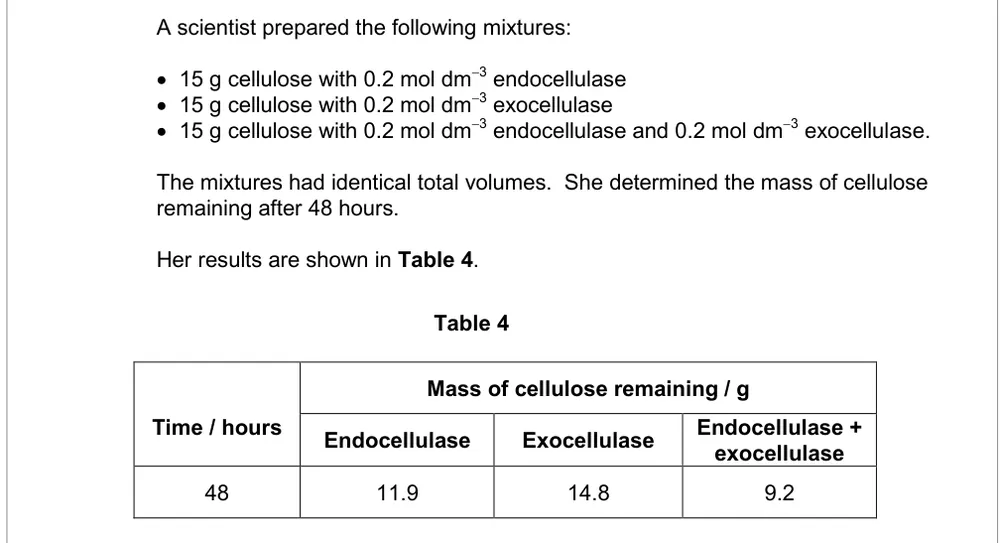
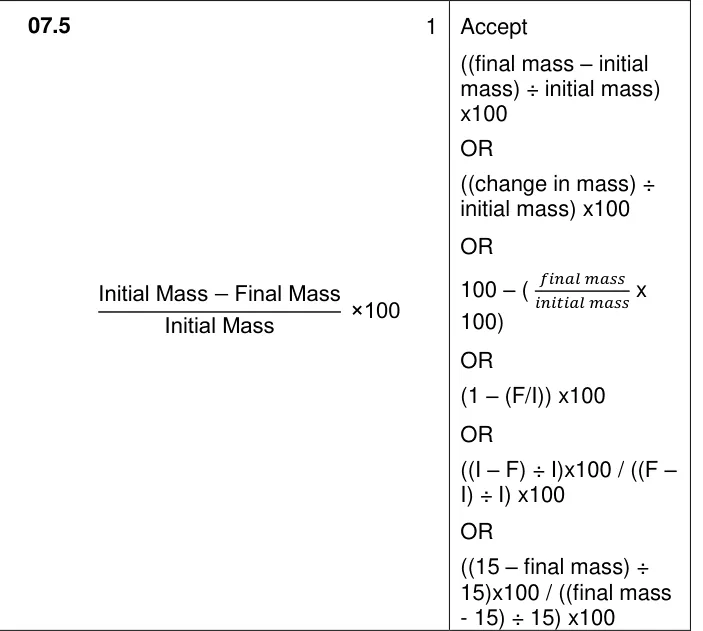
Write the equation for calculating the percentage loss in mass of cellulose.
Information from earlier in this question:


Show the mark scheme
Tap an image to open it full size.
From the examiners' report: Many knew this, but marks went on leaving out × 100, subtracting the mass lost instead of the final mass, or working out the percentage remaining. Use the words initial and final, not 'new' and 'old'.
Changing the subject (MS 2.2)
Question 2
A level Paper 3 · June 2019 · Q01.3 · 1 mark · Easy
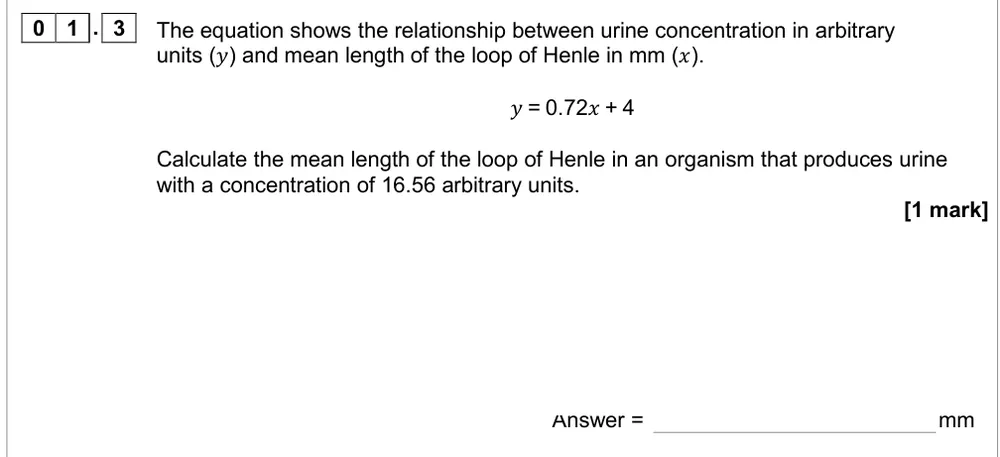
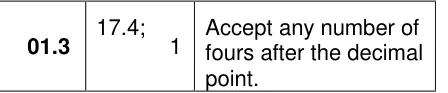
Rearrange y = 0.72x + 4 to find the loop of Henle length for a given urine concentration.
Show the mark scheme
Tap an image to open it full size.
From the examiners' report: About 80% scored. Undo the + 4 first, then divide by 0.72. Dividing first gives 19, which is wrong.
Question 3
A level Paper 2 · June 2022 · Q05.4 · 1 mark · Medium
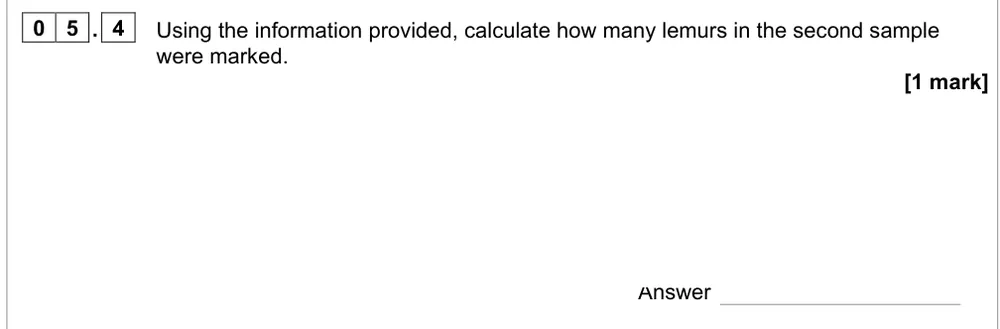
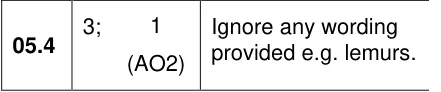
Rearrange the mark-release-recapture equation to find how many lemurs in the second sample were marked.
Information from earlier in this question:

Show the mark scheme
Tap an image to open it full size.
From the examiners' report: Only 45% got this: recalling and rearranging the equation caused more problems than expected. Number marked in the second sample = first sample × second sample ÷ population.
Question 4
AS Paper 2 · November 2020 · Q03.4 · 2 marks · Medium
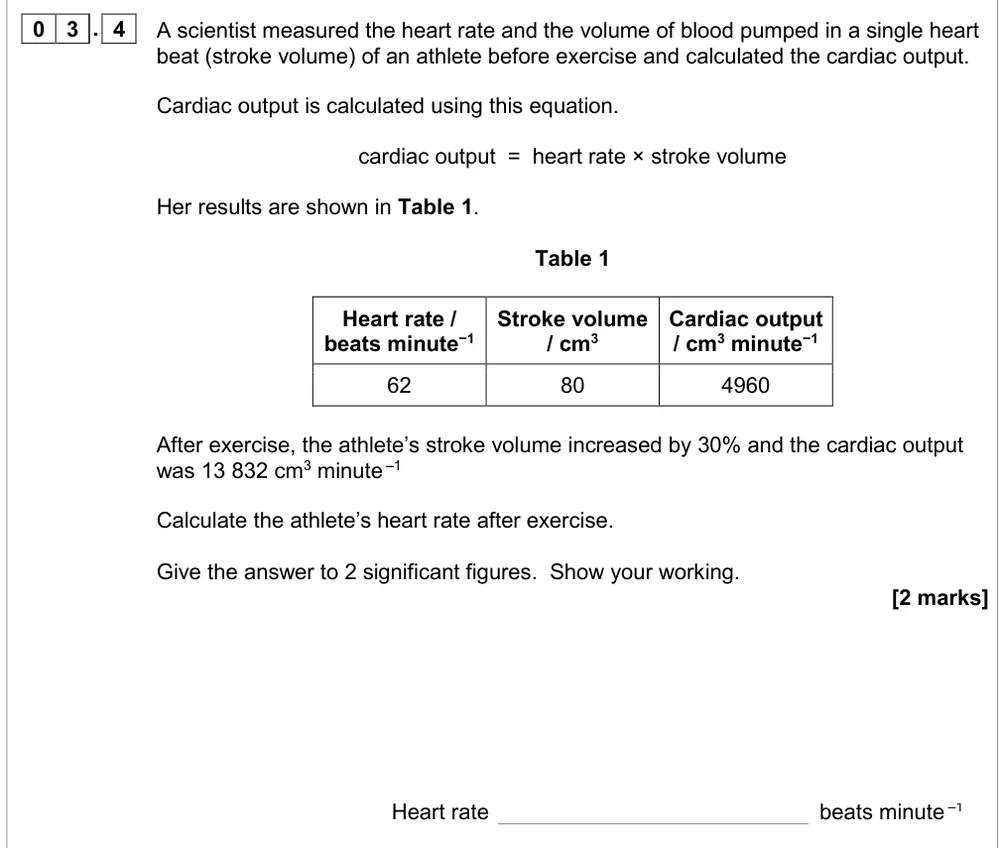
Use cardiac output = heart rate × stroke volume to find an athlete's heart rate after exercise.
Show the mark scheme
Tap an image to open it full size.
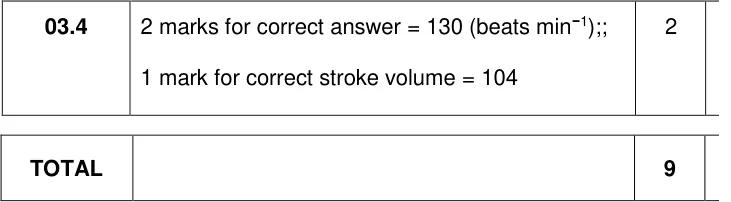
From the examiners' report: Over 90% could do the maths, but only 25% got both marks because over half didn't give 2 significant figures: 133 becomes 130.
Question 5
AS Paper 2 · June 2018 · Q03.2 · 2 marks
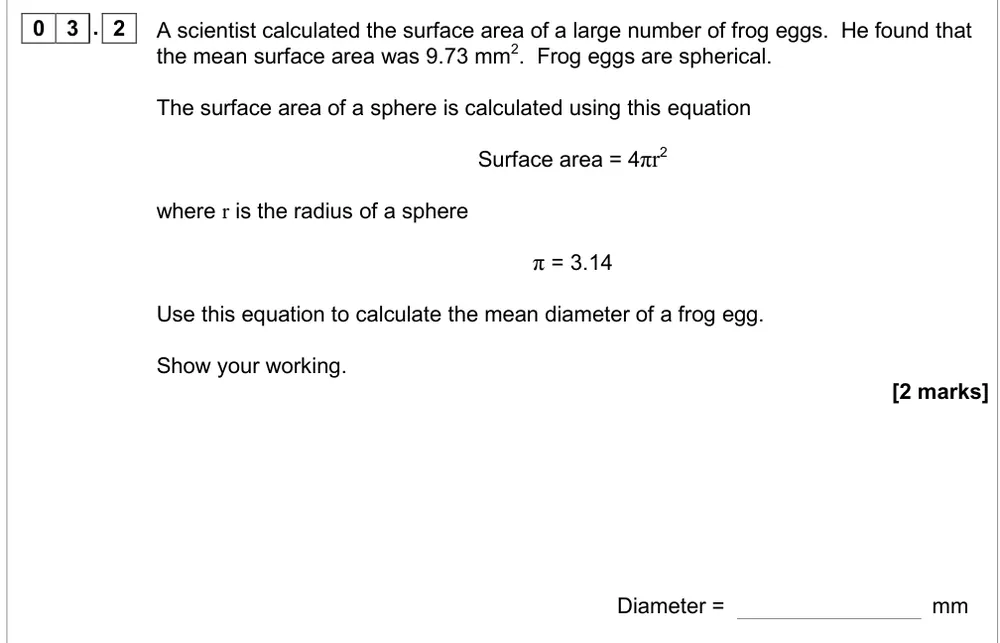
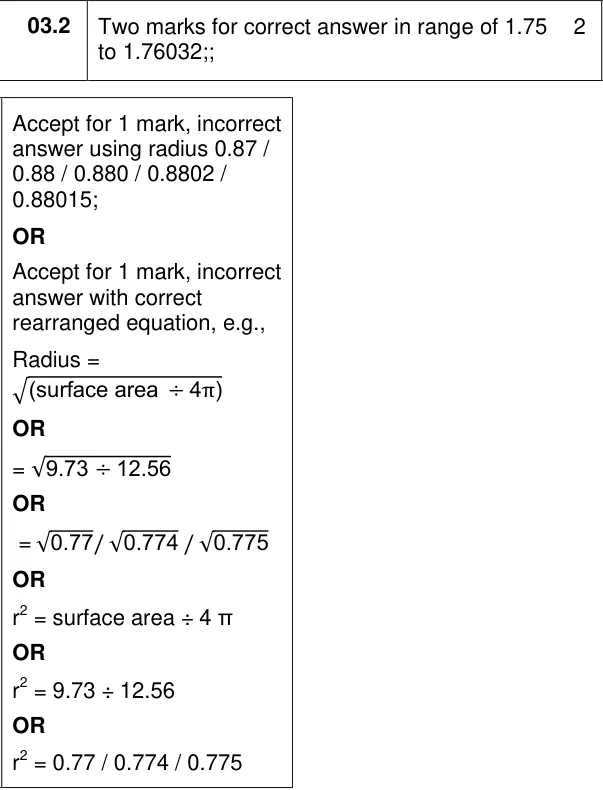
Rearrange surface area = 4πr² to find the mean diameter of a frog egg.
Show the mark scheme
Tap an image to open it full size.
From the examiners' report: Most rearranged the equation correctly. Marks were lost by stopping at r², or by forgetting to double the radius to get the diameter.
Question 6
A level Paper 1 · June 2024 · Q03.4 · 2 marks
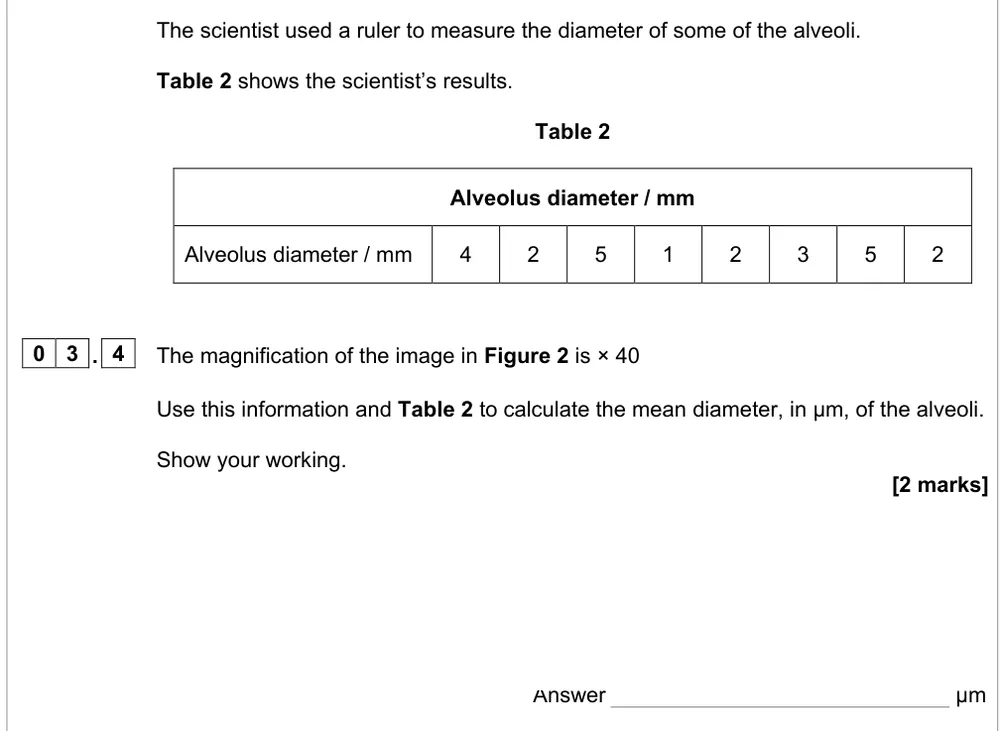
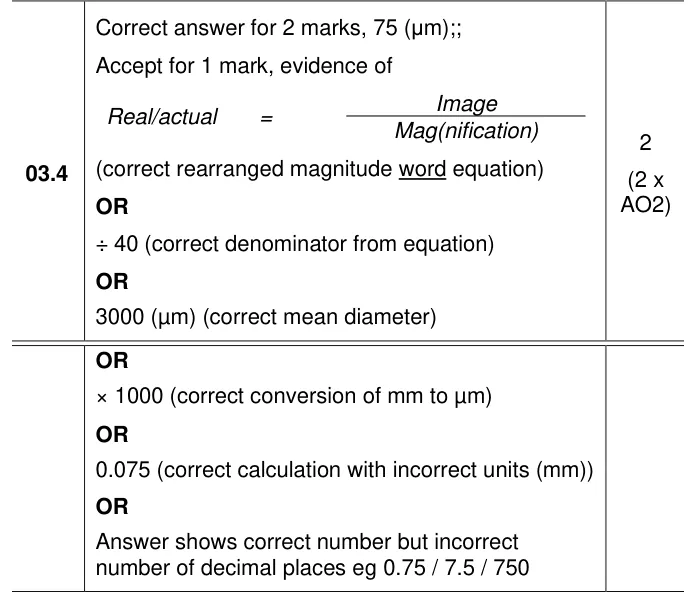
Use magnification to calculate the mean diameter of alveoli in micrometres.
Show the mark scheme
Tap an image to open it full size.
From the examiners' report: This discriminated well and many got both marks. Rearrange to actual size = image size ÷ magnification, and convert mm to µm by multiplying by 1000.
Substituting into equations (MS 2.3)
Question 7
A level Paper 1 · June 2022 · Q01.4 · 2 marks · Easy
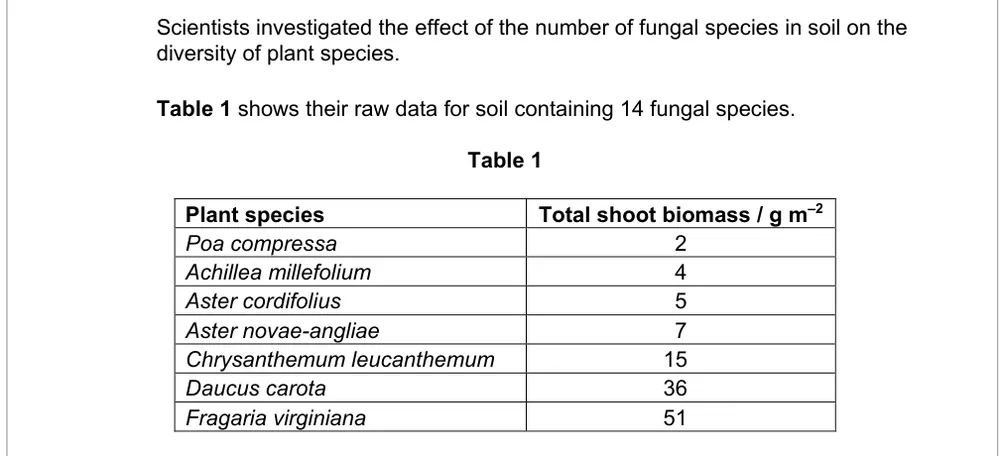
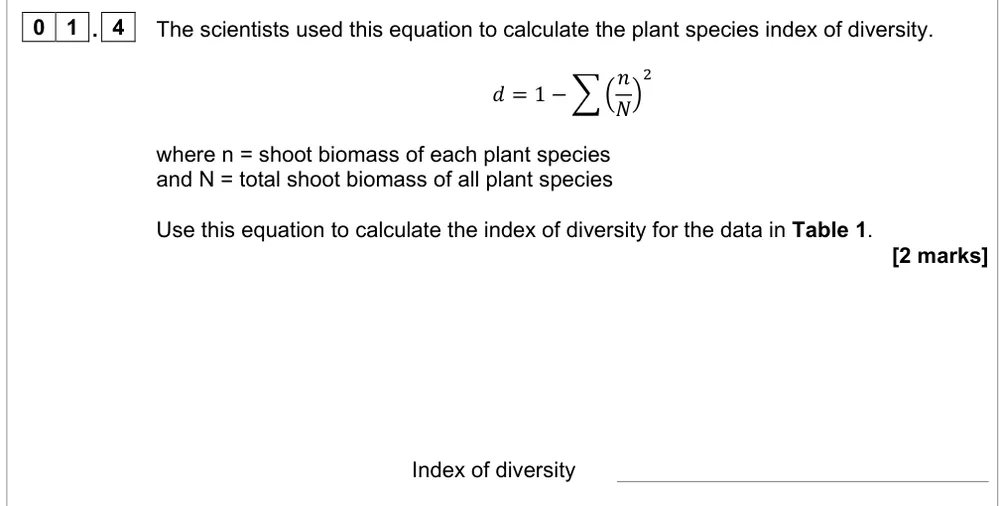
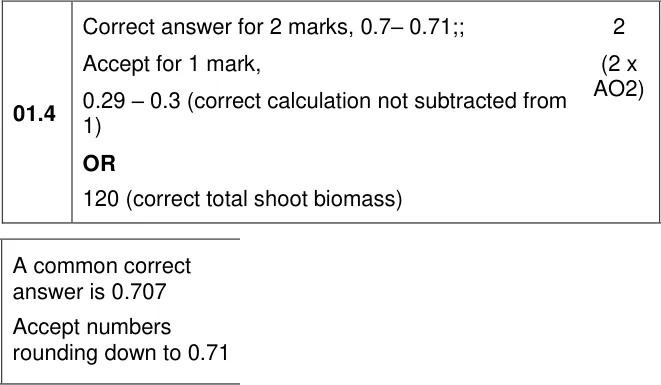
Substitute shoot biomass data into d = 1 − Σ(n/N)² to find an index of diversity.
Information from earlier in this question:
Show the mark scheme
Tap an image to open it full size.
From the examiners' report: Over 90% got at least 1 mark. Use the equation the question gives you, not the one you learned for the specification, and remember to subtract from 1.
Question 8
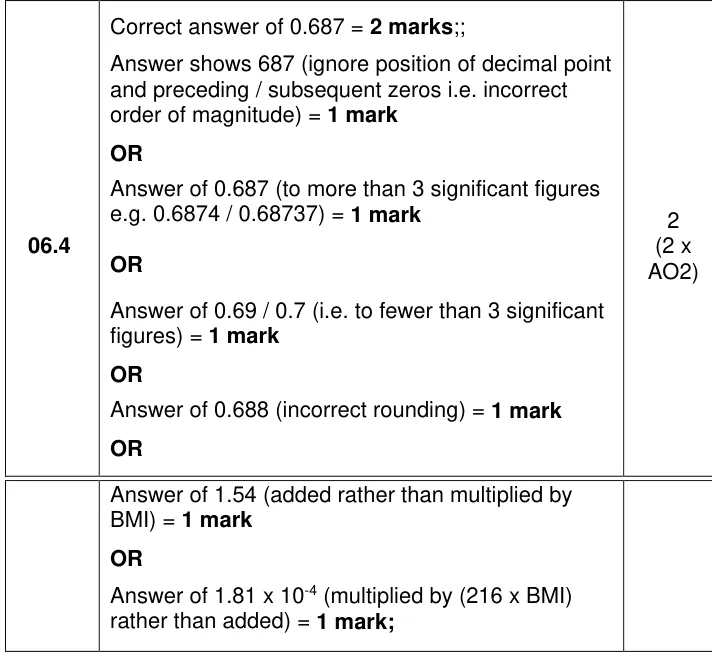
A level Paper 2 · June 2025 · Q06.4 · 2 marks · Easy
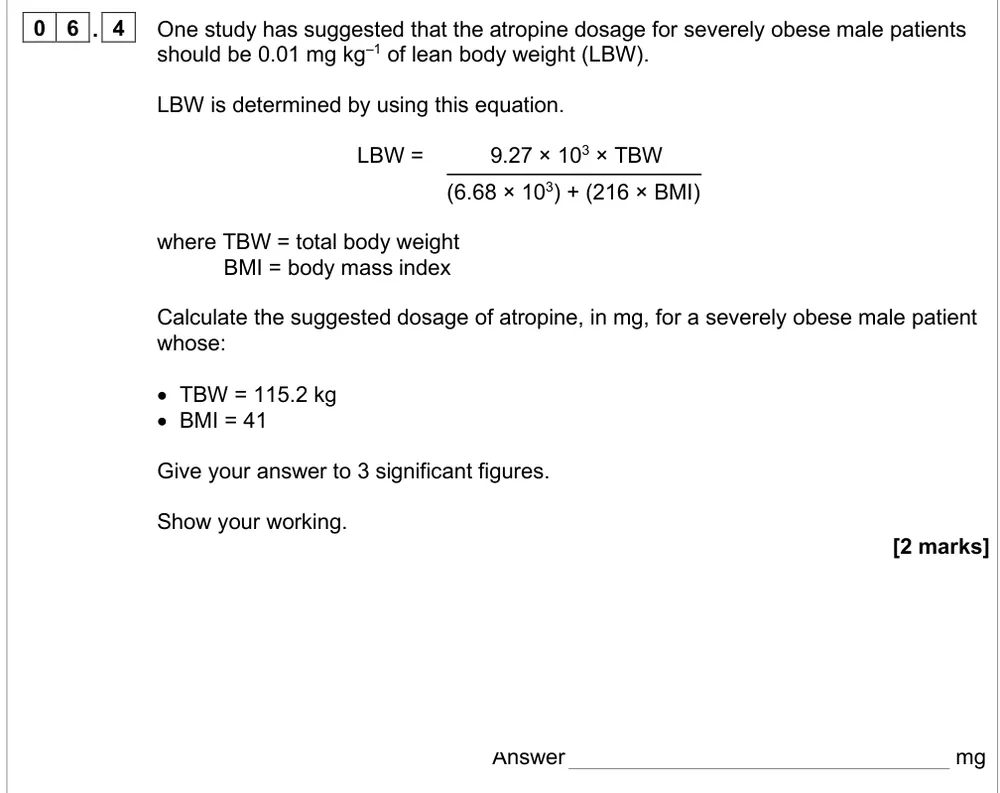
Substitute into an equation for lean body weight to calculate a drug dose to 3 significant figures.
Show the mark scheme
Tap an image to open it full size.
From the examiners' report: About 55% got both marks. The usual single error was an answer ten or a hundred times out, or not giving 3 significant figures. Work out the bottom line first, then multiply by 0.01.
Question 9
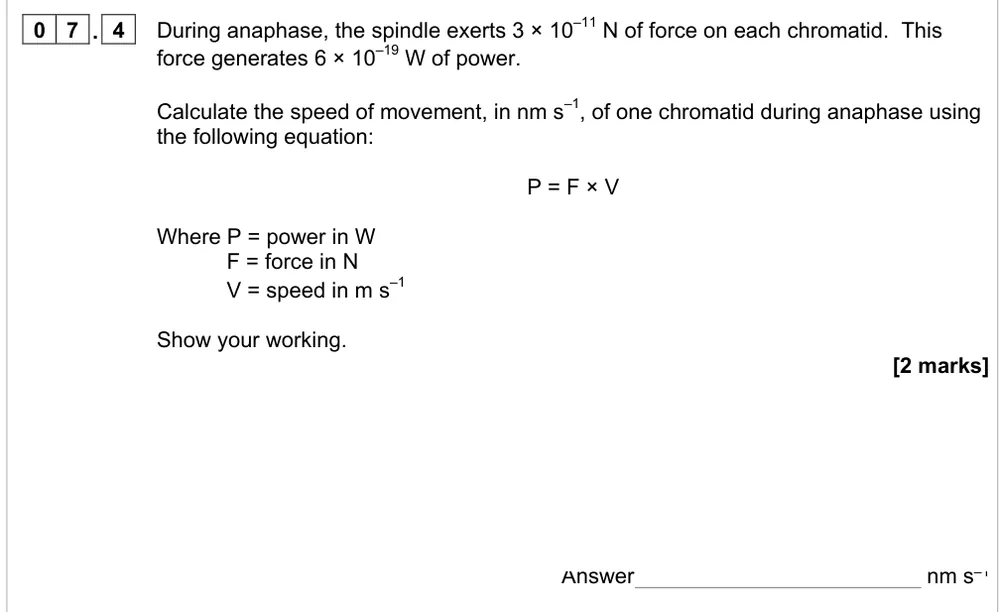
AS Paper 2 · June 2023 · Q07.4 · 2 marks · Medium
Use P = F × V to calculate the speed of a chromatid in nm s⁻¹.
Show the mark scheme

Tap an image to open it full size.
From the examiners' report: Almost three-quarters scored at least 1 mark. Rearrange to V = P ÷ F, then convert m s⁻¹ to nm s⁻¹ by multiplying by 10⁹.
Question 10
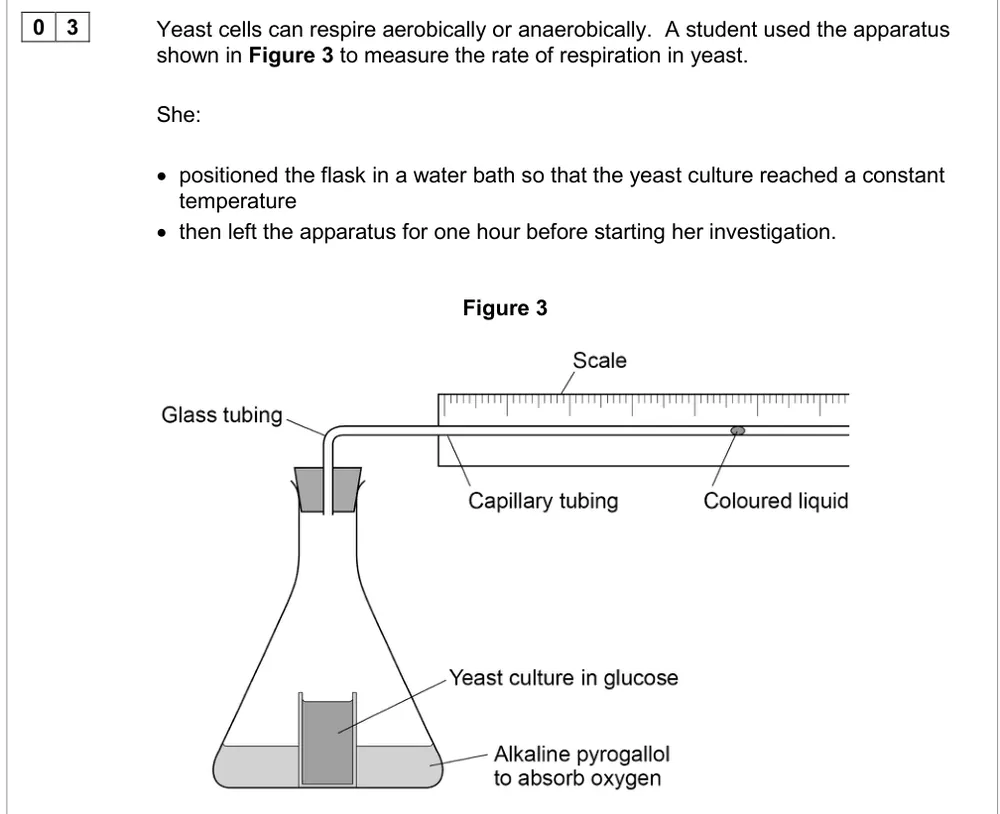
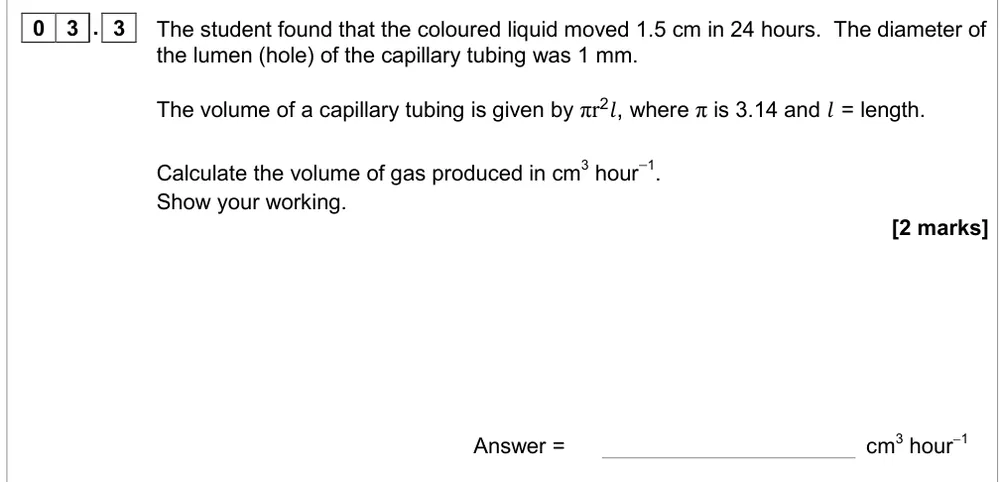
A level Paper 2 · June 2018 · Q03.3 · 2 marks · Medium
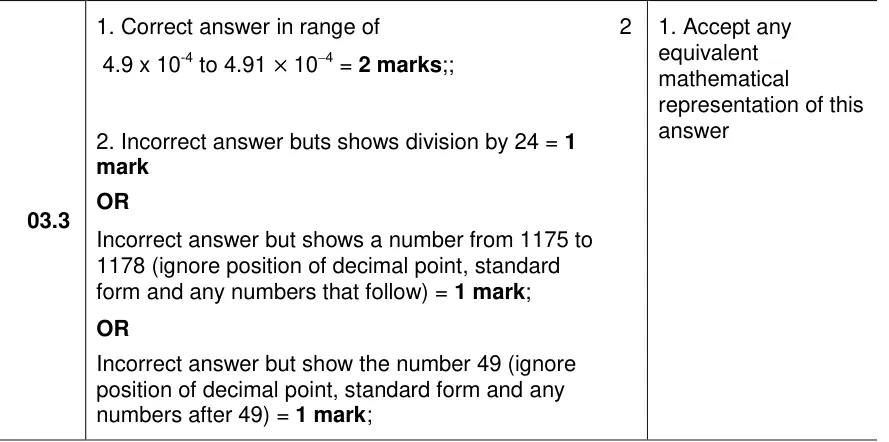
Use πr²l to calculate the volume of gas produced by yeast in cm³ per hour.
Information from earlier in this question:
Show the mark scheme
Tap an image to open it full size.
From the examiners' report: Fewer than a third got both marks, but over 52% got 1 mark for valid working, often for dividing by 24. Show your working, and use the radius, not the diameter.
Question 11
A level Paper 1 · June 2023 · Q05.2 · 2 marks · Medium
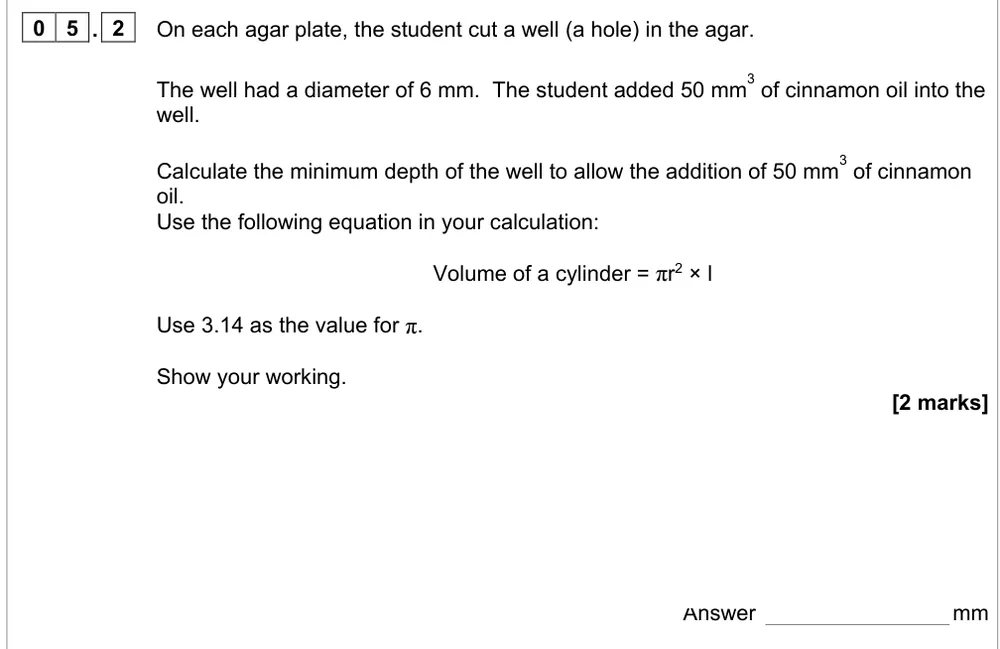
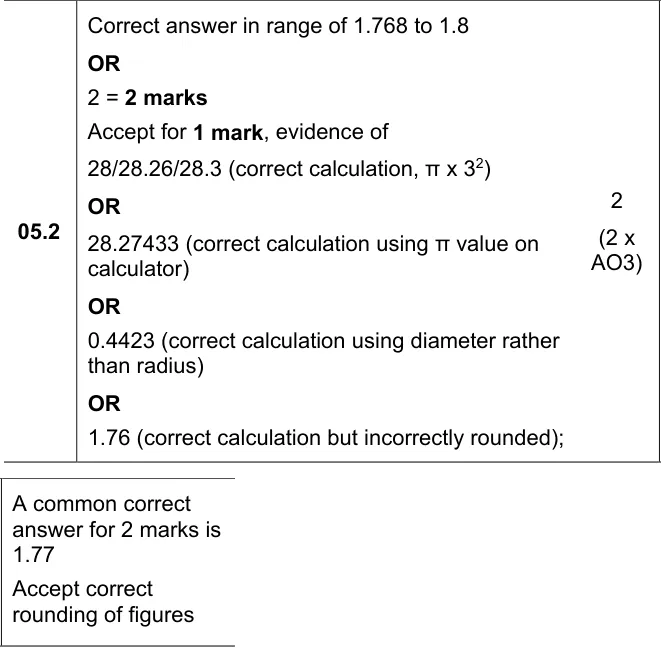
Use the volume of a cylinder to calculate the minimum depth of a well cut in agar.
Show the mark scheme
Tap an image to open it full size.
From the examiners' report: 60% got both marks. Use the radius (3 mm), not the diameter, work out πr² first, then rearrange to l = volume ÷ πr².
Question 12
A level Paper 3 · June 2017 · Q04.1 · 2 marks · Hard
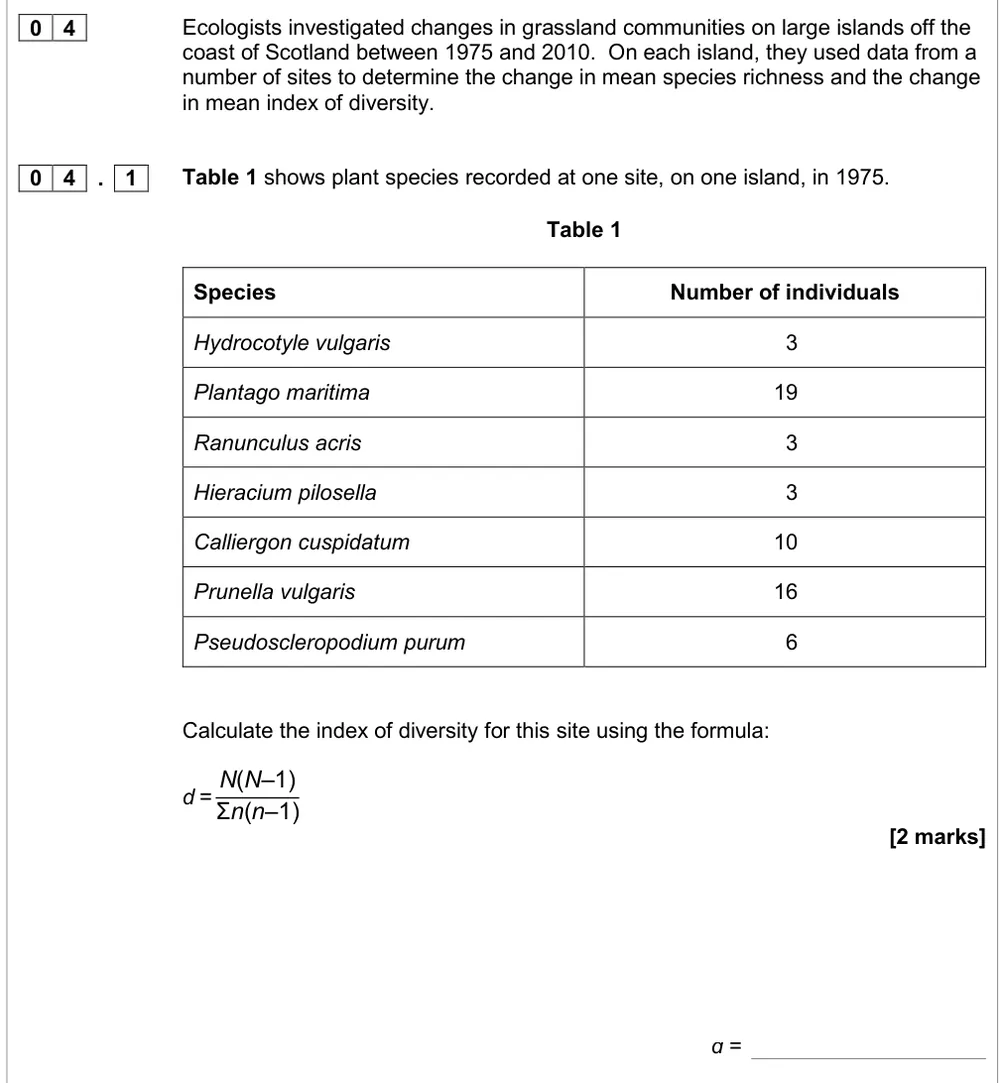
Calculate the index of diversity for a grassland site using d = N(N − 1) ÷ Σn(n − 1).
Show the mark scheme

Tap an image to open it full size.
From the examiners' report: 58% got it right. N is the total number of individuals of all species (60), not the number of species, and n(n − 1) is worked out for each species before you add them.
Solving equations (MS 2.4)
Question 13
A level Paper 2 · June 2018 · Q10.2 · 2 marks · Medium
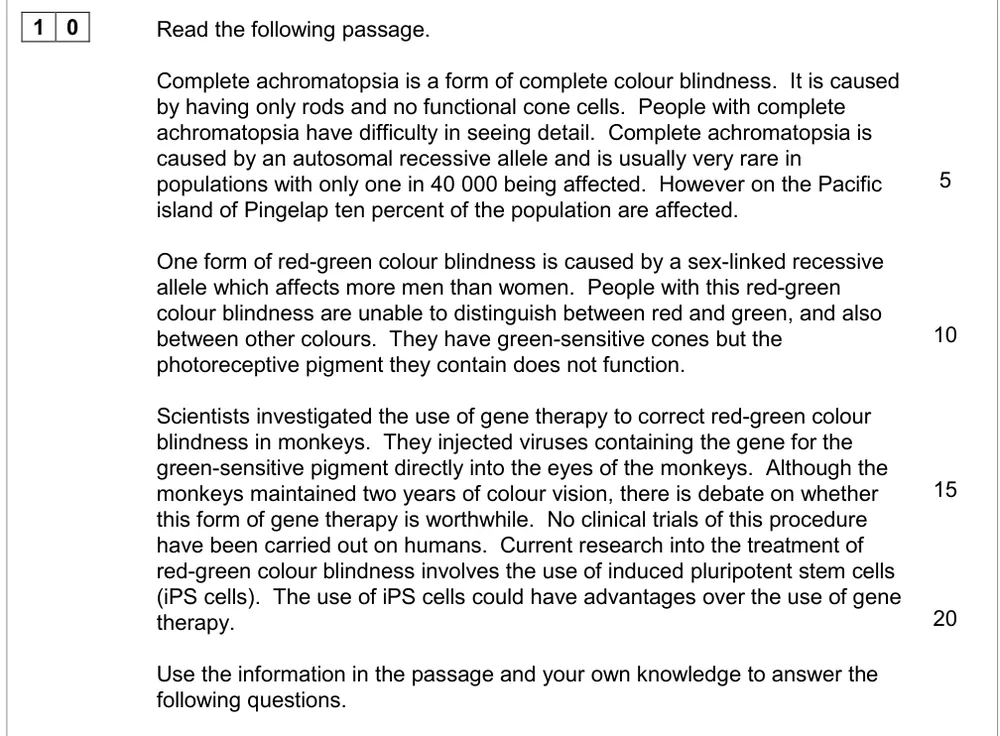
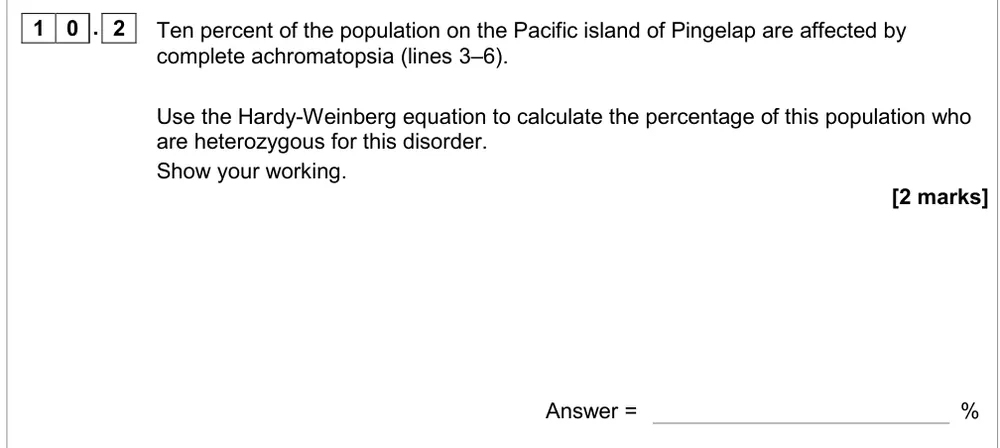
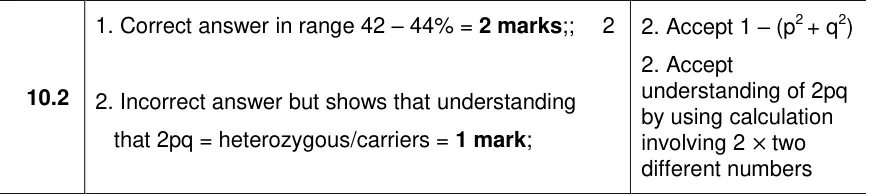
Use the Hardy–Weinberg equation to find the percentage of heterozygotes on an island where 10% are affected.
Information from earlier in this question:
Show the mark scheme
Tap an image to open it full size.
From the examiners' report: 70% got at least 1 mark but only 39% got both. The affected people are q² = 0.1, so q = 0.32. Annotate your working; the bare equation scores nothing.
Question 14
A level Paper 3 · June 2025 · Q06.3 · 2 marks
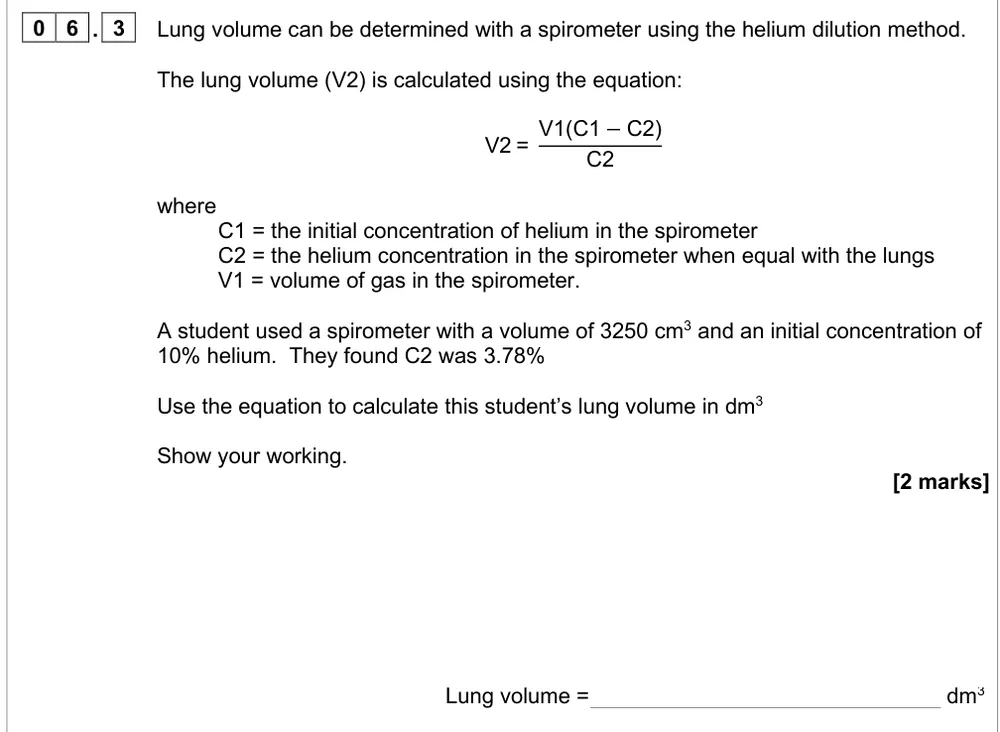
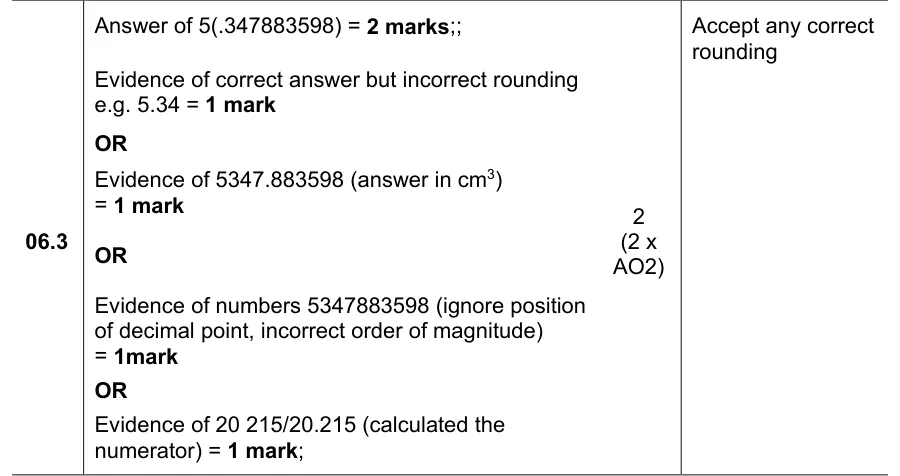
Use the helium dilution equation to calculate lung volume in dm³.
Show the mark scheme
Tap an image to open it full size.
From the examiners' report: About 60% could substitute and convert units. The usual lost mark was rounding: divide cm³ by 1000 for dm³ and round correctly.
Question 15
AS Paper 1 · June 2022 · Q04.2 · 3 marks · Medium
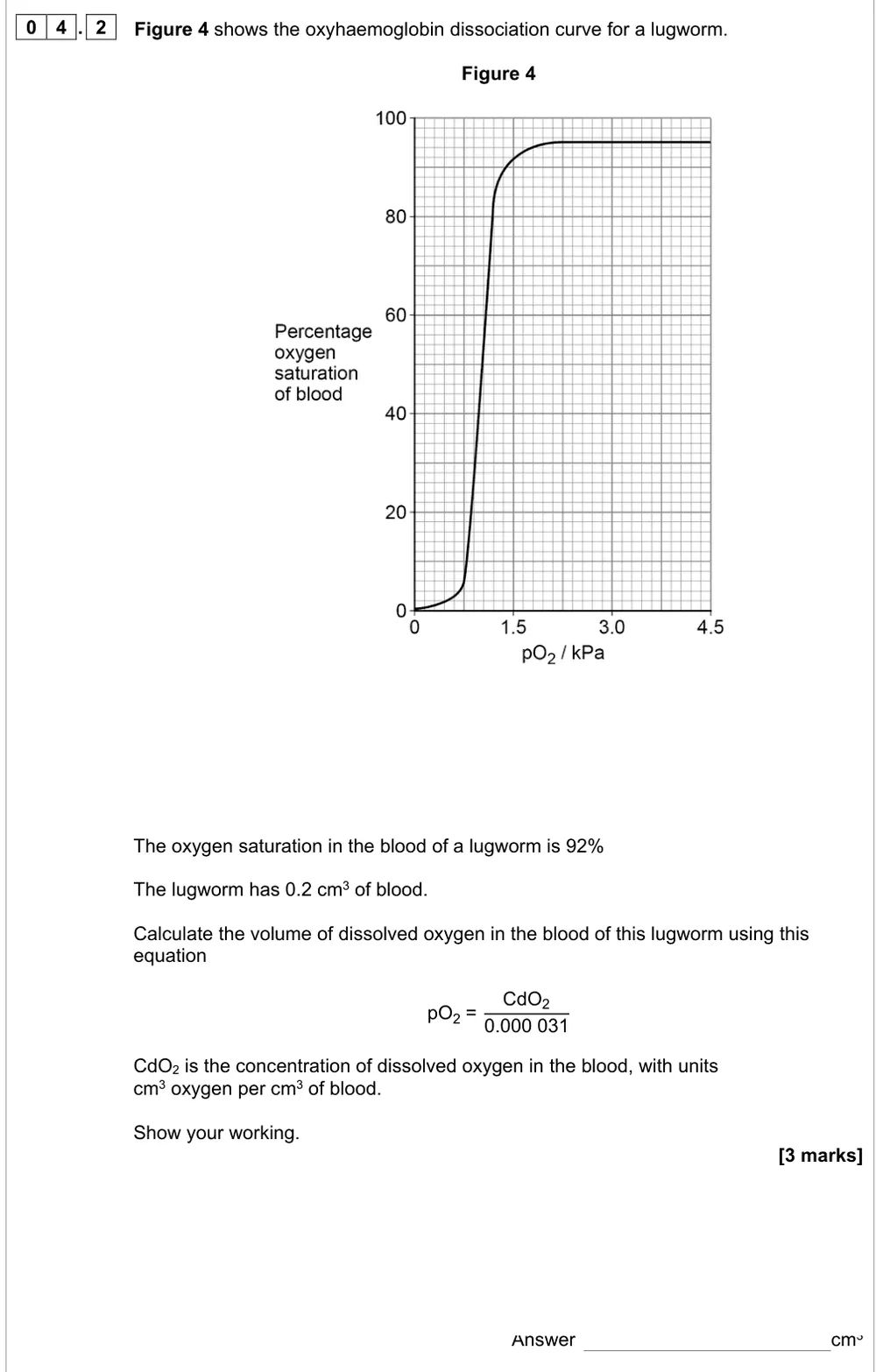
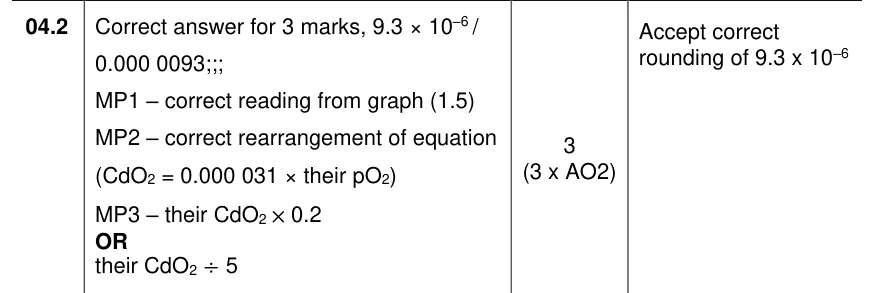
Read a dissociation curve, rearrange an equation and calculate the volume of dissolved oxygen in lugworm blood.
Show the mark scheme
Tap an image to open it full size.
From the examiners' report: Many read 1.5 kPa from the graph and rearranged the equation, but only 13% got all 3. Finish by multiplying the concentration per cm³ by the 0.2 cm³ of blood.
Logarithms (MS 2.5)
Question 16
A level Paper 2 · June 2018 · Q03.4 · 1 mark · Hard
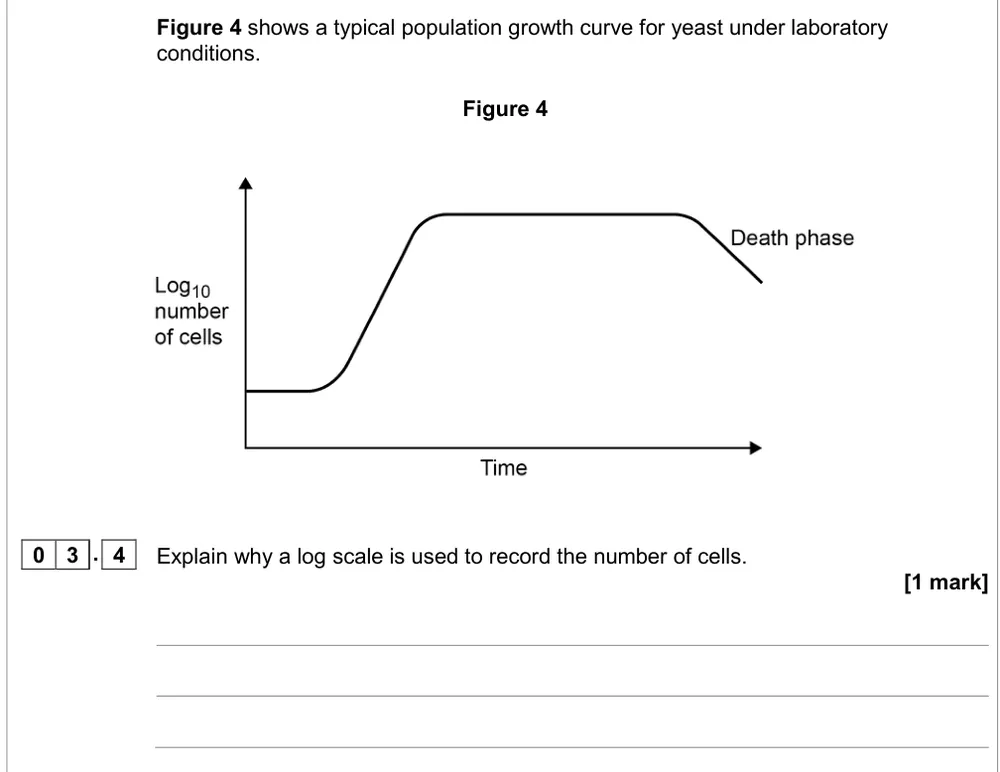
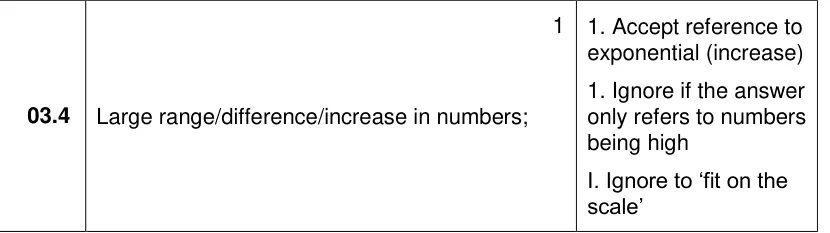
Explain why a log scale is used for the number of yeast cells in a population growth curve.
Show the mark scheme
Tap an image to open it full size.
From the examiners' report: Only about 31% scored. Say the numbers cover a large range or increase exponentially; 'to fit on the scale', 'numbers are large' and 'more accurate' don't score.
Question 17
A level Paper 3 · June 2017 · Q02.4 · 2 marks · Hard
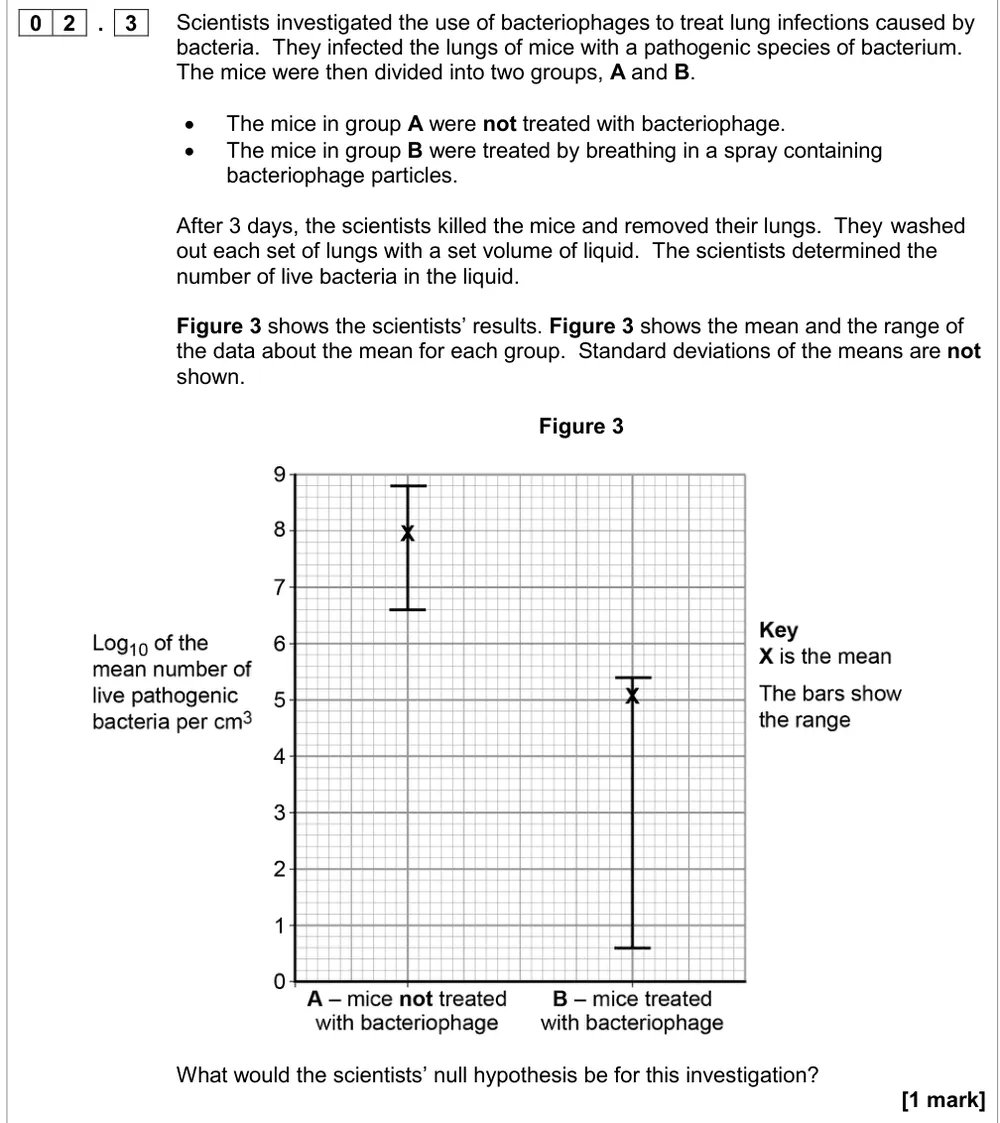
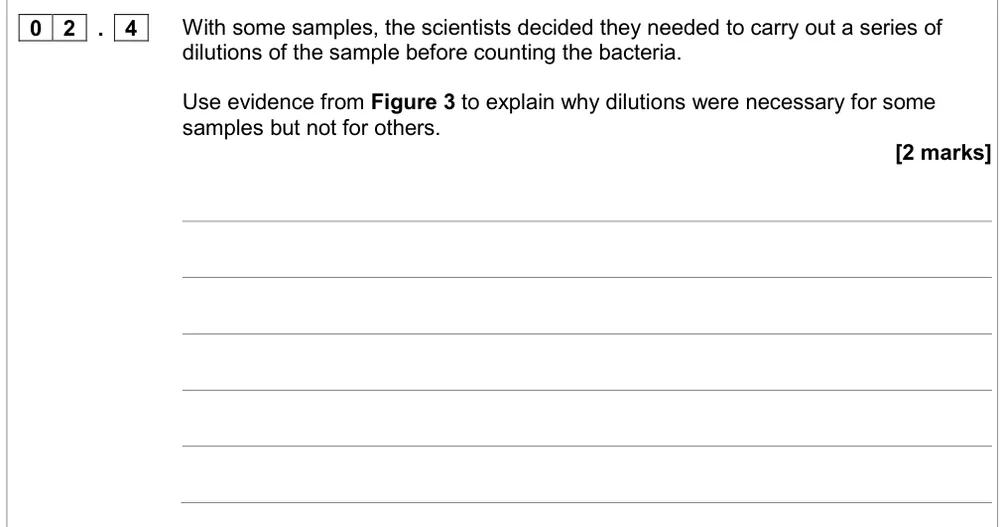
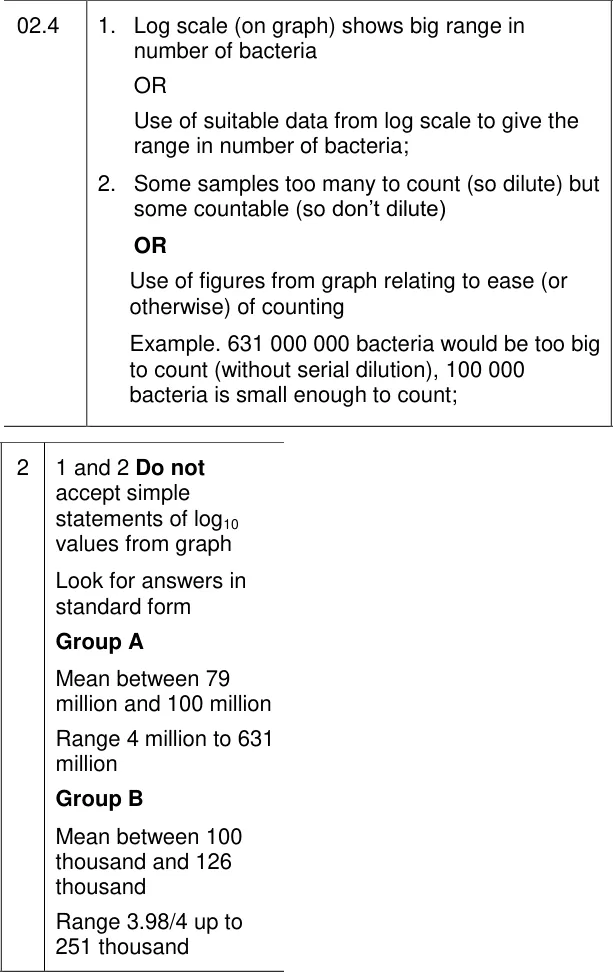
Use a log scale graph to explain why only some bacterial samples needed diluting before counting.
Information from earlier in this question:
Show the mark scheme
Tap an image to open it full size.
From the examiners' report: Few students understood log scales. Answer from the graph: the numbers differ by orders of magnitude, so some samples had too many bacteria to count and some few enough. About 20% made this point.
Where students lose marks (from AQA examiners' reports and mark schemes)
Each point below is followed by wording that gained marks.
Subtract before you divide: About 80% got the loop of Henle length from y = 0.72x + 4. Those who didn't rounded wrongly or divided first and then subtracted, giving 19.
✔ Gains credit: "x = (16.56 − 4) ÷ 0.72 = 17.4 mm."
Keep going until the subject is r: On the frog egg question some students left the subject of the equation as r², or found the radius and forgot to double it for the diameter.
✔ Gains credit: "r = √(9.73 ÷ 12.56) = 0.88 mm, so the diameter is 1.76 mm."
Halve the diameter first: Only 30% got both marks for the mitochondria in a polar body; some used diameters instead of radii. In the agar well question, using the 6 mm diameter instead of the radius also cost a mark.
✔ Gains credit: "r = 3 mm, so πr² = 28.26 mm²; depth = 50 ÷ 28.26 = 1.77 mm."
N counts individuals, not species: 58% got the index of diversity right and 20% scored 1. The commonest error was taking N as the number of species.
✔ Gains credit: "N(N − 1) = 3540, Σn(n − 1) = 720, so d = 4.92."
Ten per cent affected is q², not q: Only 39% got both marks for the achromatopsia carriers. Many used 0.1 as q, giving 2 × 0.9 × 0.1; others wrote the Hardy–Weinberg equation with no annotation, or used pq for heterozygotes.
✔ Gains credit: "q² = 0.1, so q = 0.32 and p = 0.68; 2pq = 0.43, so 43% are heterozygous."
Round to the figures the question sets: Over 90% could do the heart rate calculation, but only 25% got full marks: in over half the answers students didn't give 2 significant figures.
✔ Gains credit: "Stroke volume = 80 × 1.3 = 104; 13 832 ÷ 104 = 133, so 130 beats minute⁻¹."
Start from the initial mass: Students left out the × 100, subtracted the mass lost instead of the final mass, or calculated the percentage of cellulose remaining; 10.7% didn't attempt it.
✔ Gains credit: "(Initial mass − final mass) ÷ initial mass × 100."
A log scale covers a large range: Only about 31% explained why a log scale is used for yeast numbers. 'To fit on the scale', 'the numbers are large', 'more accurate' and 'more comparable' didn't score.
✔ Gains credit: "There is a large range (increase) in the number of cells", or "an exponential increase".
Download the questions
Download the PDF pack (17 questions, mark schemes at the end)
Keep practising
- Arithmetic and numerical skills (MS 0): AQA A Level Biology exam questions
- Handling data (MS 1): AQA A Level Biology exam questions
- Graph skills (MS 3): AQA A Level Biology exam questions
- Calculations and mathematical content in A level Biology, from AQA papers
- AQA A Level Biology masterclasses
Questions, mark schemes and examiners' report extracts © AQA.