

Surface area to volume ratio (AQA 3.3.1) is the short section that opens 'Organisms exchange substances with their environment', and the idea runs through everything after it: gas exchange, digestion, mass transport and even why a mouse eats so much for its size. You need to know that as an organism or structure gets bigger its surface area to volume ratio gets smaller, how larger organisms make up for this with flattened or long, thin shapes and specialised exchange and transport systems, how the ratio links to metabolic rate through heat loss, and how to calculate a ratio from dimensions or a formula.
The examiners' reports show where the marks go. Students give one example instead of describing the relationship, name a body feature without saying how it helps diffusion, say respiration 'produces energy', divide volume by surface area, round 23.75 to 24 and call it three significant figures, and forget to count every face when a cube is cut into smaller cubes.
Start with the questions on size and diffusion, then larger organisms, then metabolic rate, and finish with the calculations. Answer each on paper before you open the mark scheme. If you'd like help with this topic, my AQA masterclasses run online on Tuesdays at 5.15pm for Year 12 and on Wednesdays or Thursdays at 6.30pm for Year 13.
What you need from GCSE and Year 12
Each question on this page assumes you're secure on these GCSE and Year 12 ideas. If any of them feels shaky, revise it before you start.
- GCSE: surface area of a cube or cuboid is the total area of all six faces, and volume = length × width × height.
- GCSE: single-celled organisms exchange substances by diffusion across their surface; larger organisms need exchange surfaces and transport systems.
- GCSE: the rate of diffusion is faster with a larger surface area, a steeper concentration gradient and a shorter diffusion distance.
- GCSE: mammals keep a constant body temperature, and respiration releases energy, some of it as heat.
- Year 12 (AQA 3.1.6): ATP is made in respiration and releases energy for the cell when it is hydrolysed. See the ATP page.
Key terms
These words come up in the questions and mark schemes. Examiners expect you to use them exactly.
- Surface area to volume ratio: surface area divided by volume, written as x : 1. It gets smaller as an organism or structure gets bigger.
- Surface area: the total area of an object's outer surface; for a cube of side l it is 6l².
- Volume: the space an object takes up; for a cube of side l it is l³.
- Diffusion pathway: the distance a substance has to diffuse; a short (thin) pathway gives faster diffusion.
- Exchange surface: a specialised surface, such as gills, alveoli or villi, that is large and thin so substances are exchanged quickly.
- Mass transport system: a system, such as the blood circulation, that carries substances in bulk between exchange surfaces and the rest of the body.
- Metabolic rate: the rate of the chemical reactions in an organism, often measured as the rate of oxygen uptake because oxygen is used in respiration.
- Heat loss: heat lost across the body surface; an animal with a larger surface area to volume ratio loses heat faster.
- Significant figures: the digits that carry meaning, counted from the first non-zero digit; 23.8 has three, 24 has two.
What these questions cover (AQA 3.3.1)
The questions test these statements from the AQA AS and A-level Biology specification (7401/7402):
- Size and ratio: The relationship between the size of an organism or structure and its surface area to volume ratio.
- Larger organisms: Changes to body shape and the development of systems in larger organisms as adaptations that facilitate exchange as this ratio reduces.
- Students should be able to appreciate the relationship between surface area to volume ratio and metabolic rate.
How to use this page
Write your answer on paper before you open the mark scheme. Allow about 1.3 minutes per mark: the 14 questions are worth 30 marks, so about 39 minutes in total. Then mark your answer strictly against the mark scheme and read the examiners' tip underneath it. If you'd rather print the questions, download the PDF pack.
Size and surface area to volume ratio (3.3.1)
Question 1
AS Paper 2 · June 2018 · Q03.1 · 1 mark · Easy
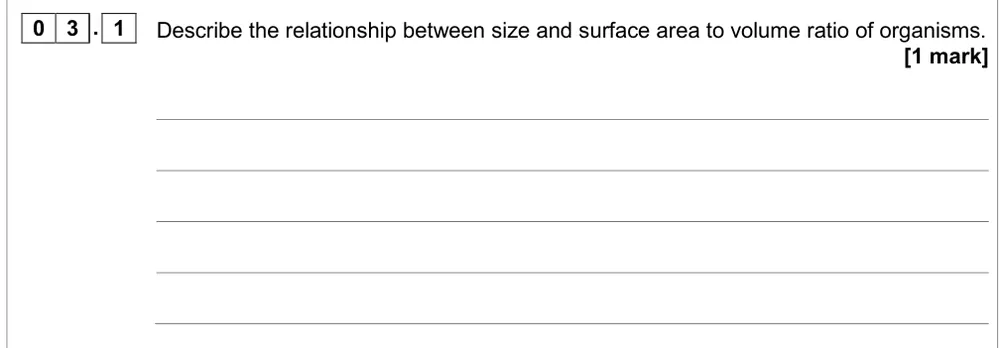
Describe the relationship between the size of an organism and its surface area to volume ratio.
Show the mark scheme

Tap an image to open it full size.
From the examiners' report: 70.3% got this. Describe the trend across all sizes ('as size increases, the ratio decreases'), not one example such as 'large organisms have small ratios', and don't drift into diffusion or gas exchange.
Question 2
AS Paper 2 · June 2016 · Q03.2 · 2 marks · Medium
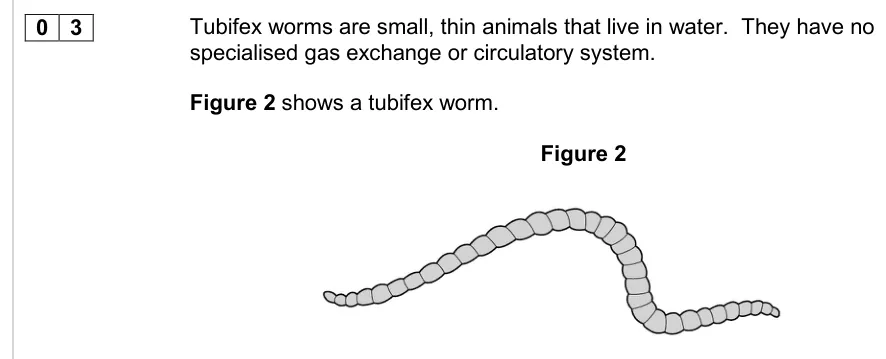
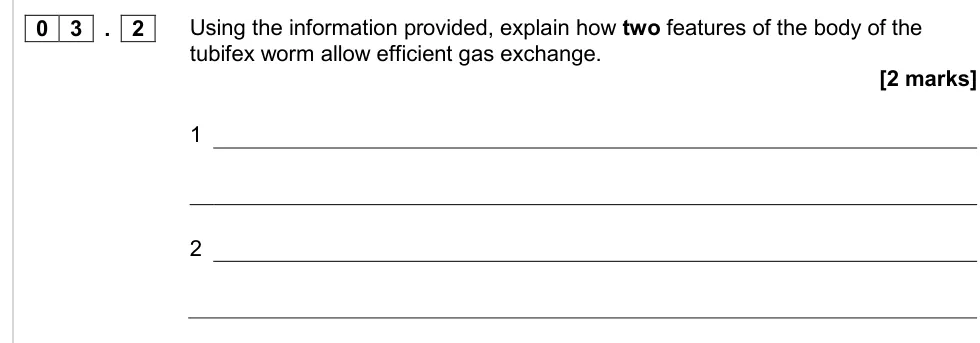
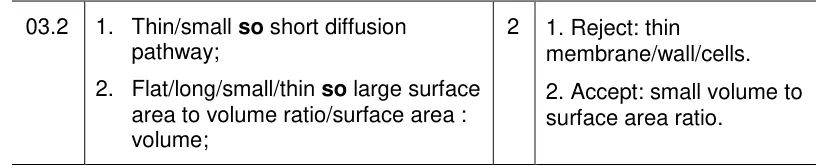
Explain how two features of a tubifex worm's body allow efficient gas exchange.
Information from earlier in this question:
Show the mark scheme
Tap an image to open it full size.
From the examiners' report: Almost two thirds scored at least one mark. Name a body feature and then say what it does: thin body so a short diffusion pathway, long and thin so a large surface area to volume ratio. A 'thin membrane' doesn't count.
Question 3
A level Paper 1 · June 2019 · Q07.1 · 1 mark
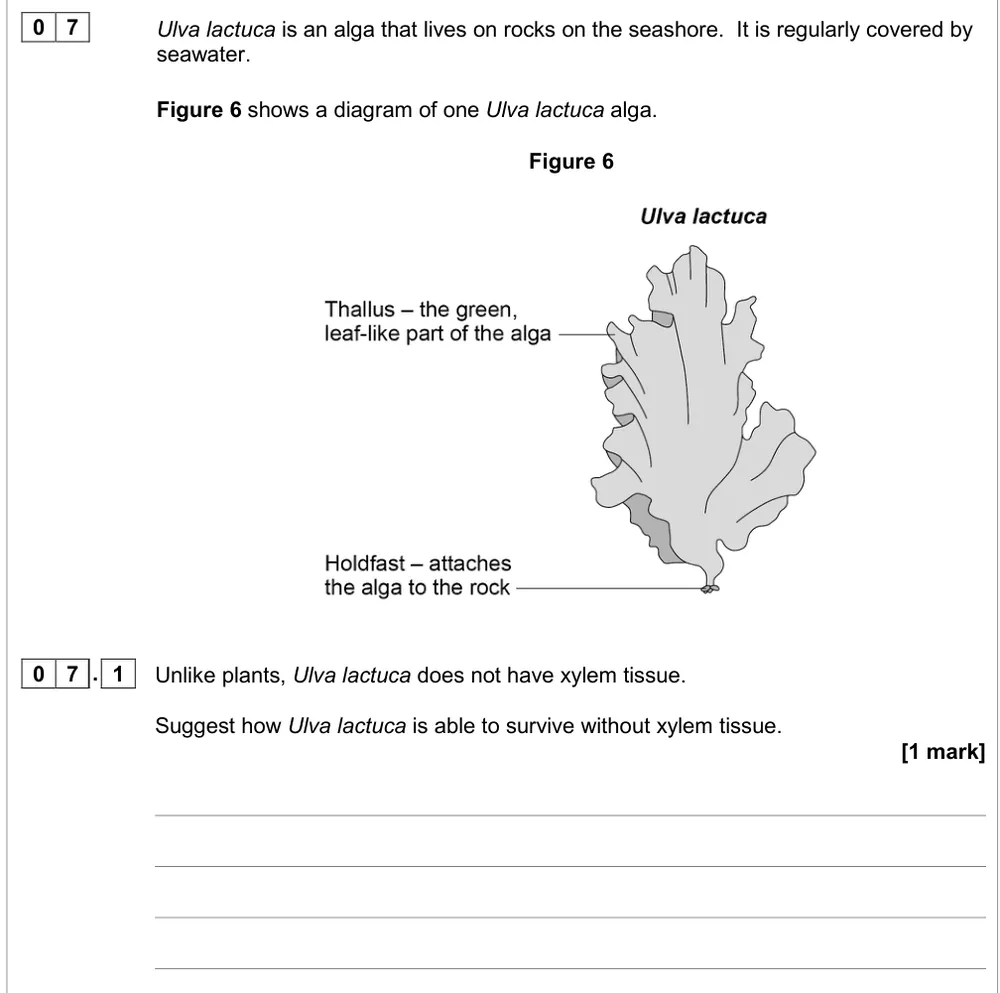
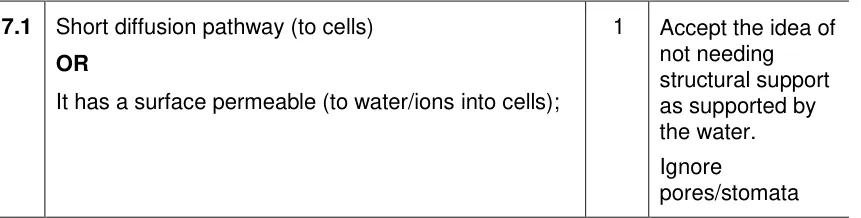
Suggest how the alga Ulva lactuca survives without xylem tissue.
Show the mark scheme
Tap an image to open it full size.
From the examiners' report: There's no examiners' report for this paper, so this tip comes from the mark scheme. A thin, flat alga has a short diffusion pathway, so water and ions reach every cell by diffusion across its surface.
Question 4
AS Paper 1 · November 2021 · Q03.4 · 2 marks
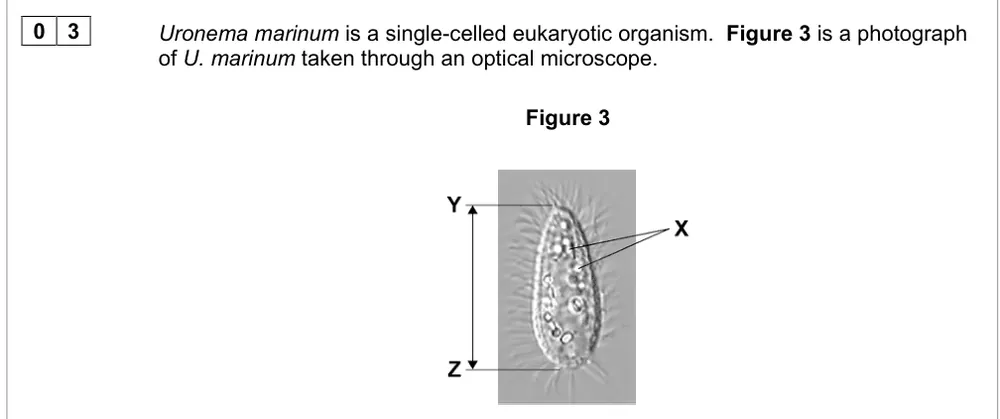
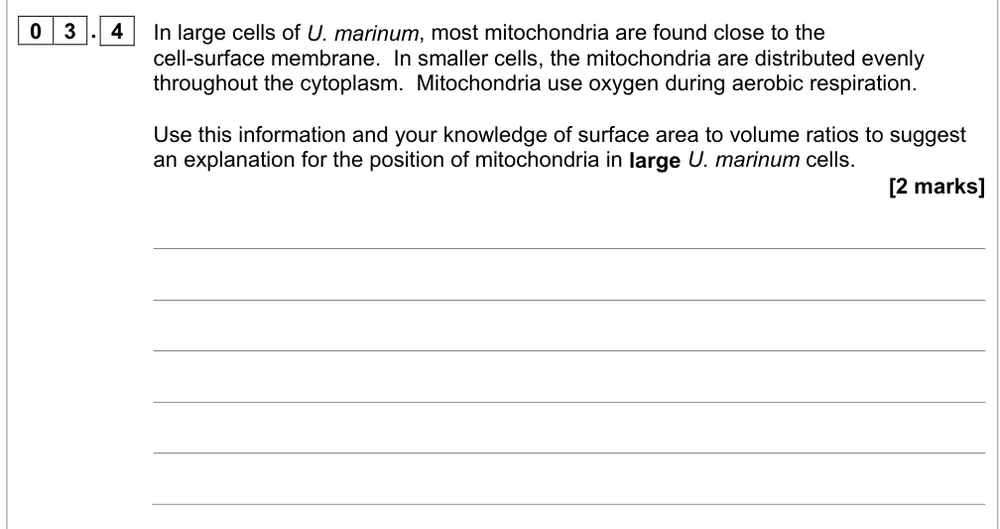
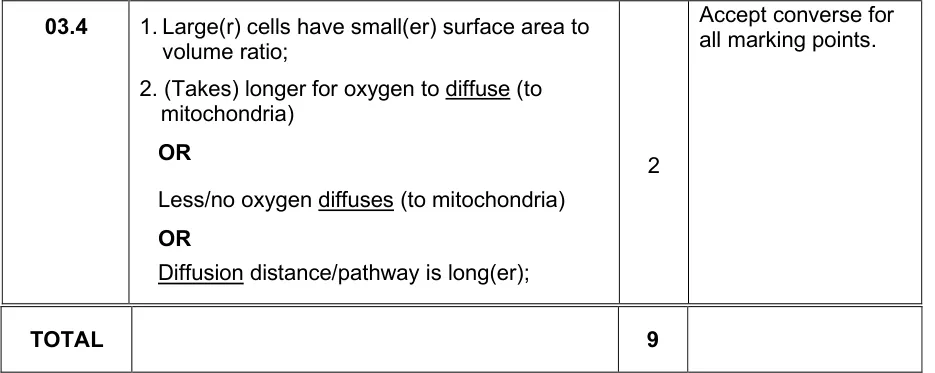
Use surface area to volume ratio to explain why mitochondria sit near the membrane in large cells.
Information from earlier in this question:
Show the mark scheme
Tap an image to open it full size.
From the examiners' report: There's no examiners' report for this paper, so this tip comes from the mark scheme. Link the two ideas: a larger cell has a smaller ratio, so oxygen has further to diffuse to mitochondria in the middle.
Body shape and exchange systems in larger organisms (3.3.1)
Question 5
A level Paper 1 · November 2021 · Q02.1 · 2 marks
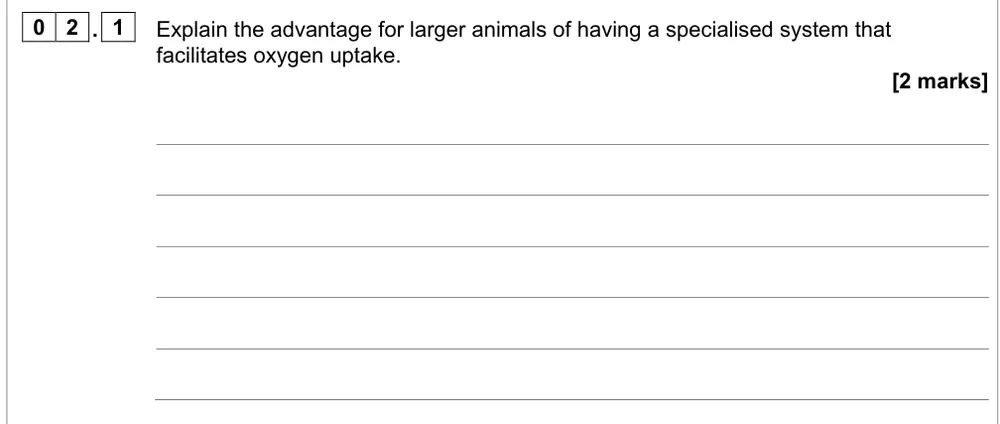
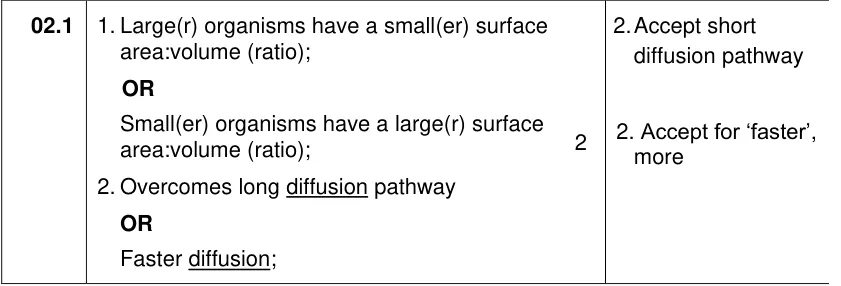
Explain the advantage for larger animals of a specialised system for oxygen uptake.
Show the mark scheme
Tap an image to open it full size.
From the examiners' report: Most answers stated the size and ratio relationship, but few gave the reason for the second mark. Finish the argument: the specialised system overcomes the long diffusion pathway.
Question 6
AS Paper 1 · June 2019 · Q06.4 · 2 marks
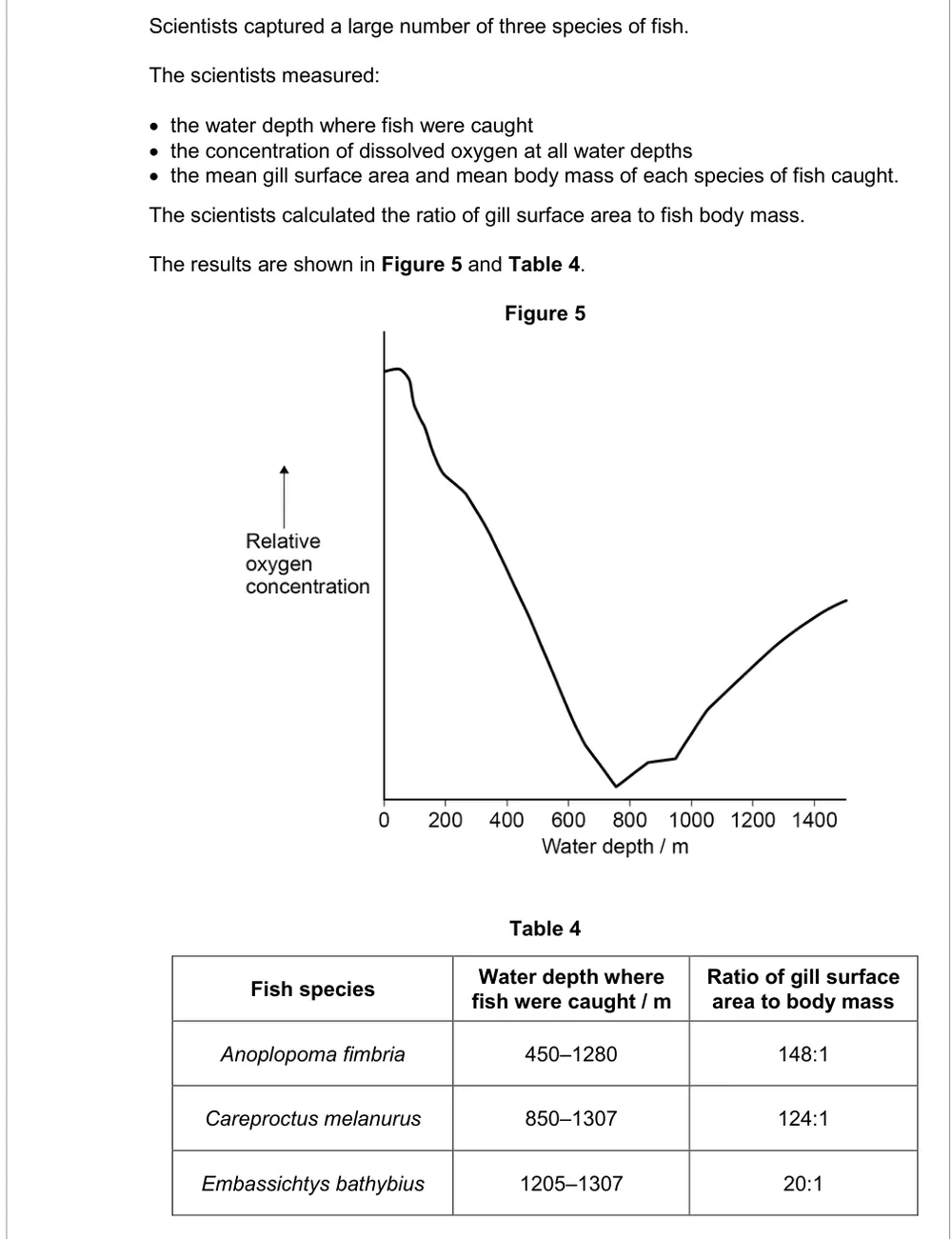
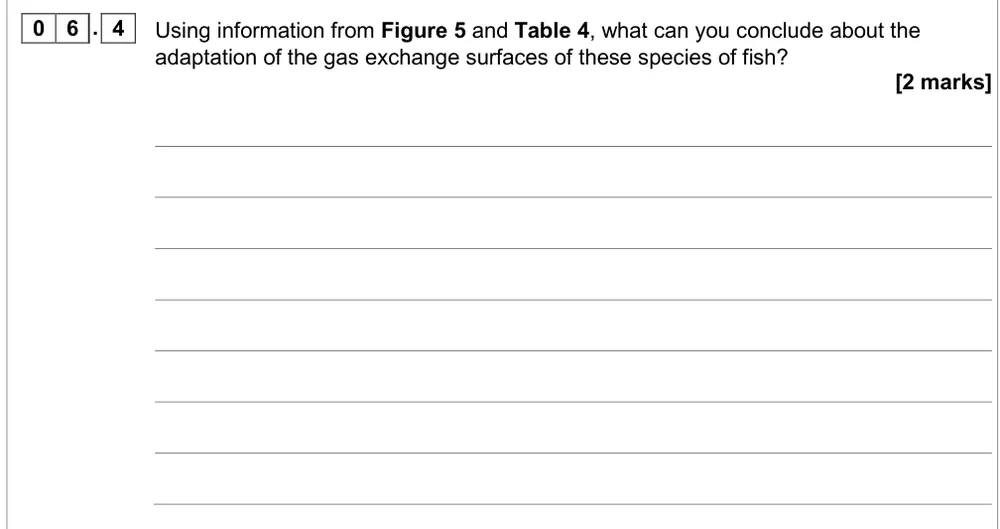
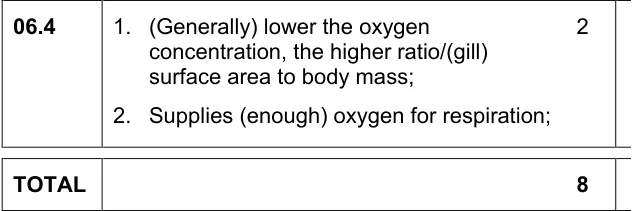
Conclude how the gills of three deep-sea fish species are adapted to oxygen concentration.
Information from earlier in this question:
Show the mark scheme
Tap an image to open it full size.
From the examiners' report: There's no examiners' report for this paper, so this tip comes from the mark scheme. Link the two data sets: species living where oxygen is scarcest have the largest gill surface area per gram, which gets enough oxygen for respiration.
Surface area to volume ratio and metabolic rate (3.3.1)
Question 7
A level Paper 3 · June 2024 · Q03.1 · 3 marks · Medium
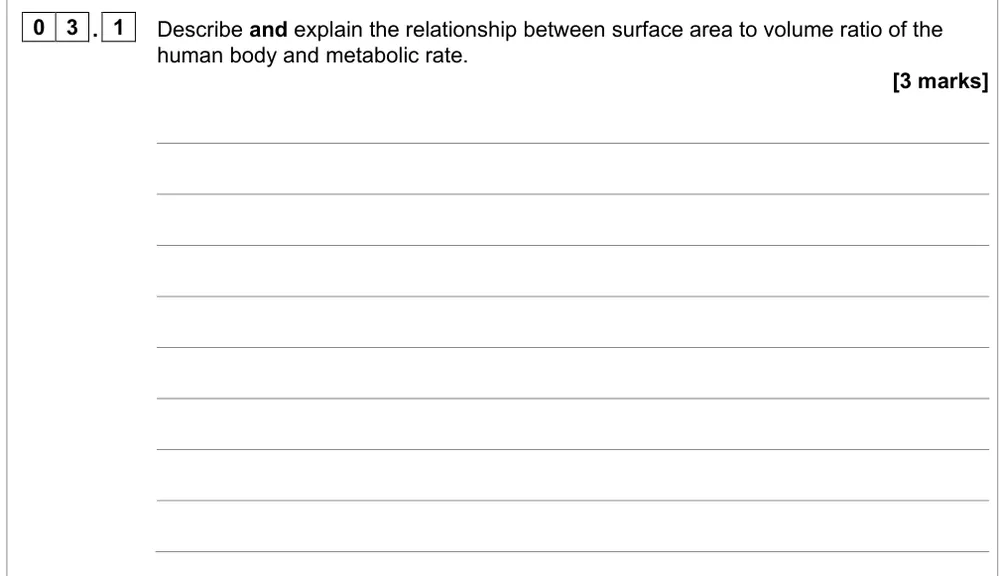
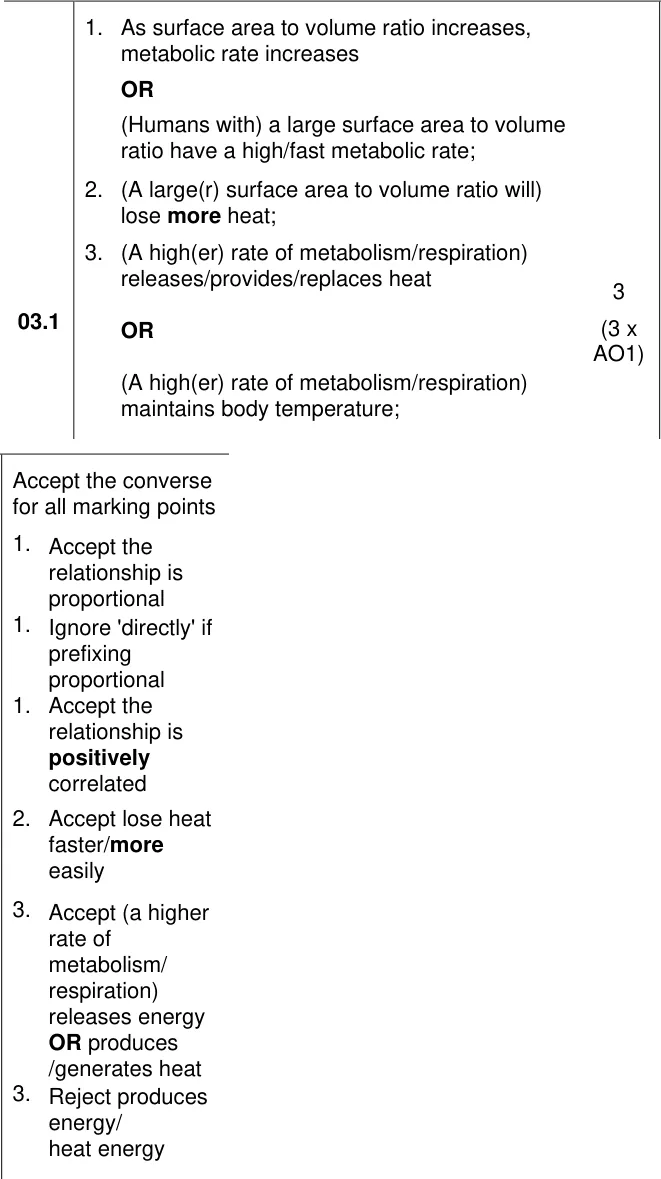
Describe and explain the relationship between surface area to volume ratio and metabolic rate in humans.
Show the mark scheme
Tap an image to open it full size.
From the examiners' report: Only about 15% scored all three and over a third scored nothing. Answer about the human body, not mice and elephants, state the relationship, then link it to heat loss and respiration releasing heat. Energy is never 'produced'.
Question 8
AS Paper 2 · June 2018 · Q03.5 · 1 mark
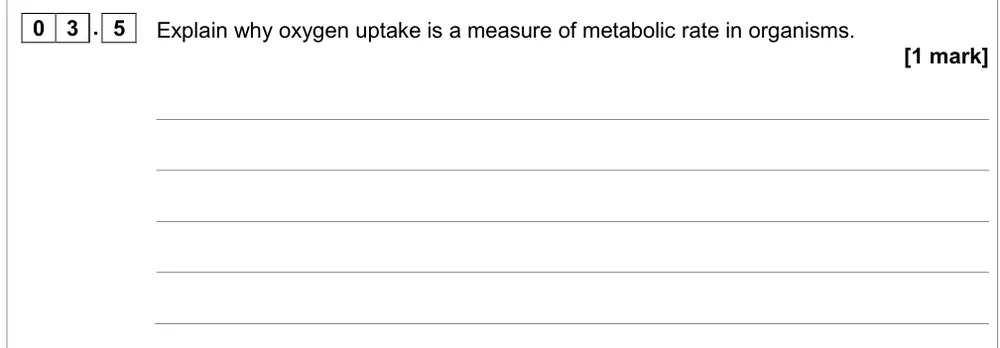
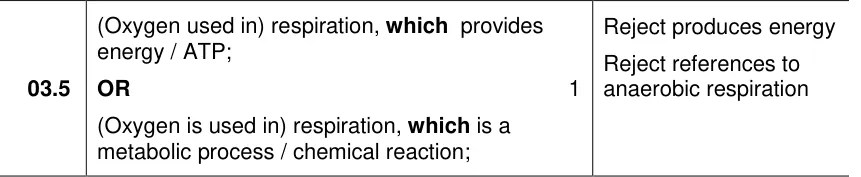
Explain why oxygen uptake is a measure of metabolic rate.
Show the mark scheme
Tap an image to open it full size.
From the examiners' report: Only 25.1% got this. Name respiration and then say why it matters: it provides the ATP for metabolism. Don't confuse respiration with breathing, or say energy is 'produced'.
Question 9
A level Paper 1 · June 2019 · Q09.4 · 3 marks
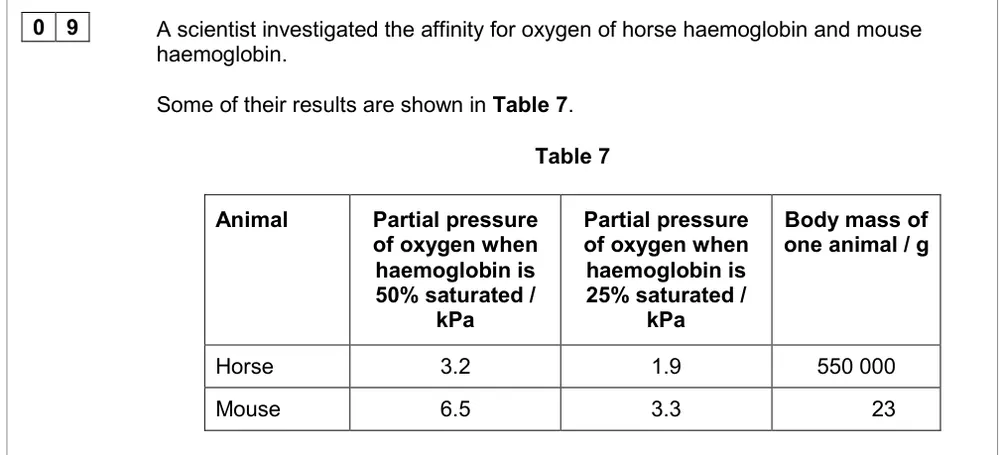
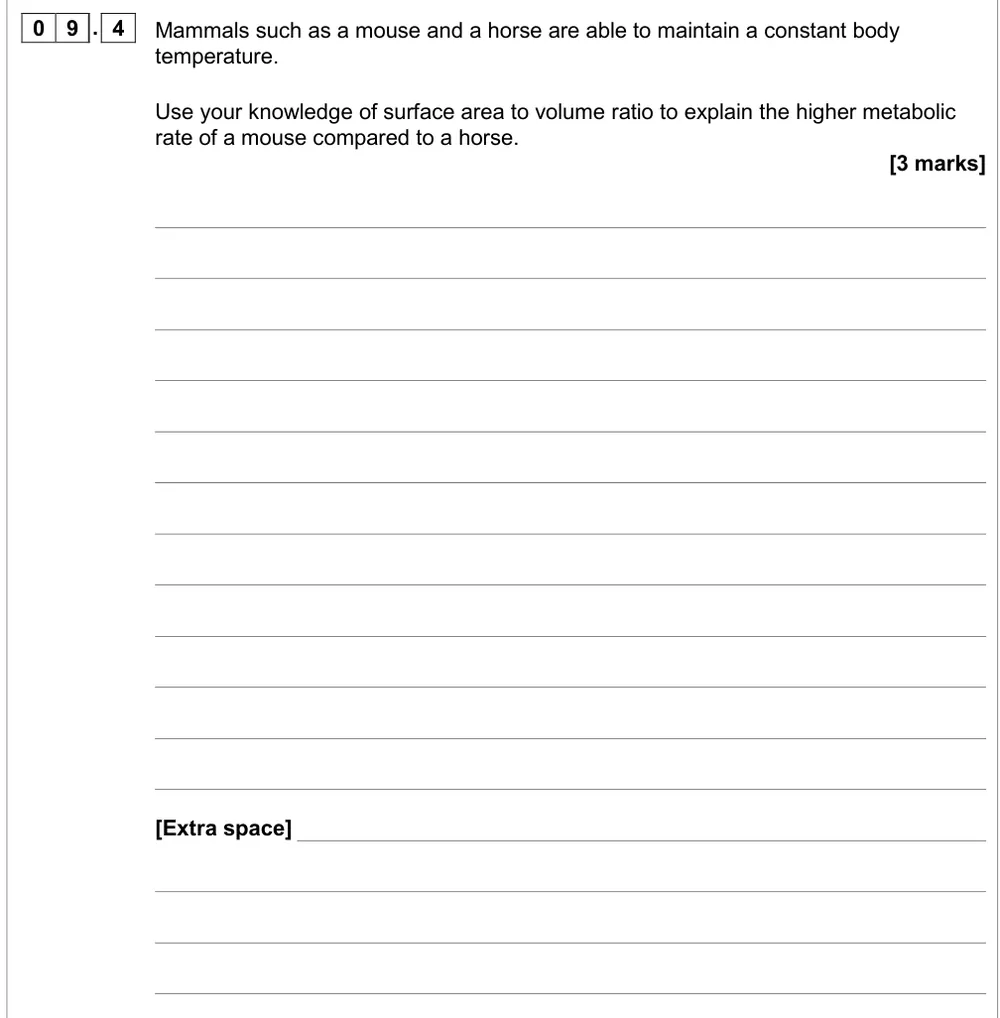
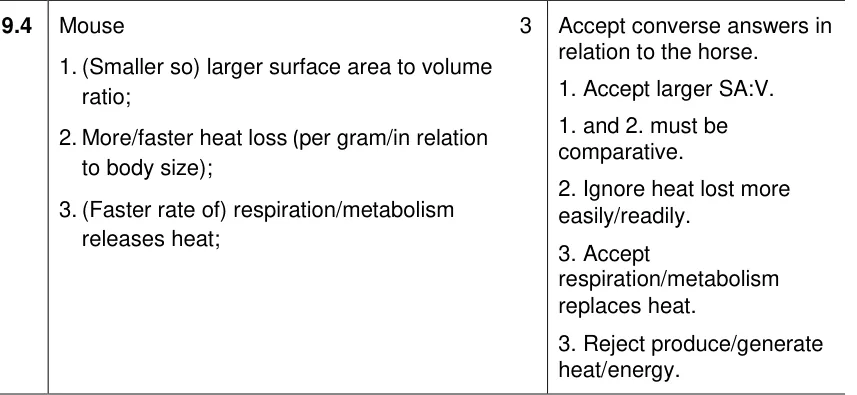
Use surface area to volume ratio to explain why a mouse has a higher metabolic rate than a horse.
Information from earlier in this question:
Show the mark scheme
Tap an image to open it full size.
From the examiners' report: There's no examiners' report for this paper, so this tip comes from the mark scheme. Keep every point comparative (larger ratio, more heat lost) and say respiration releases or replaces heat, not 'produces' it.
Question 10
AS Paper 2 · June 2018 · Q03.6 · 3 marks · Hard
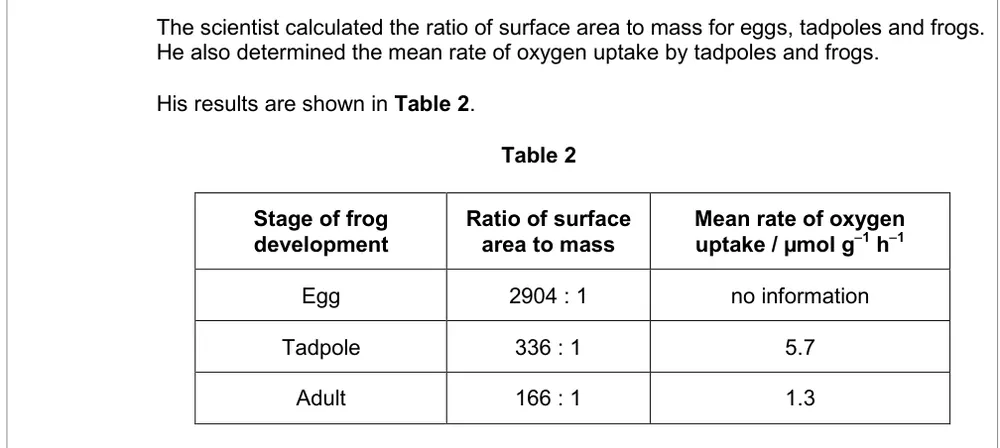
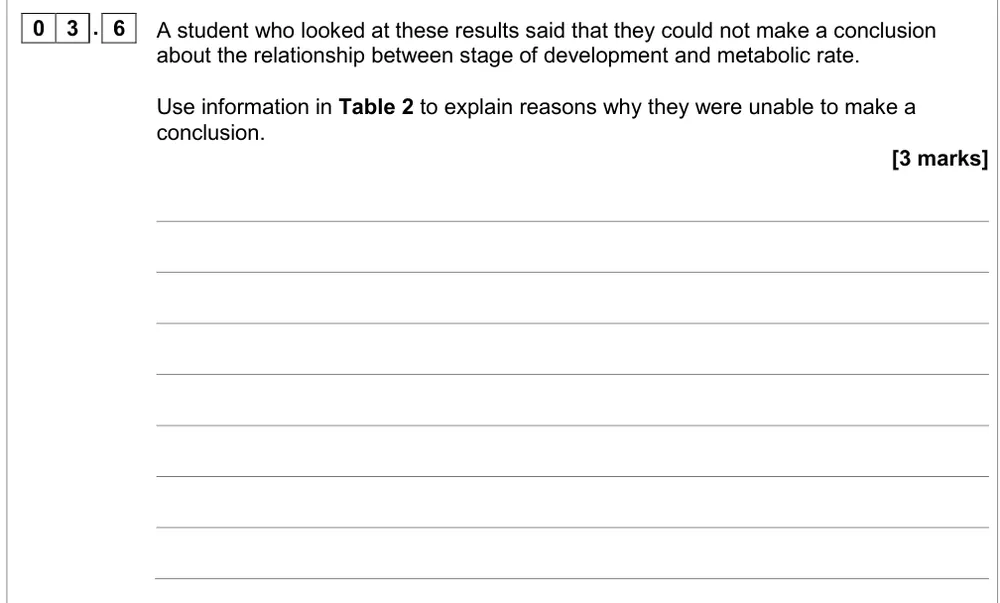
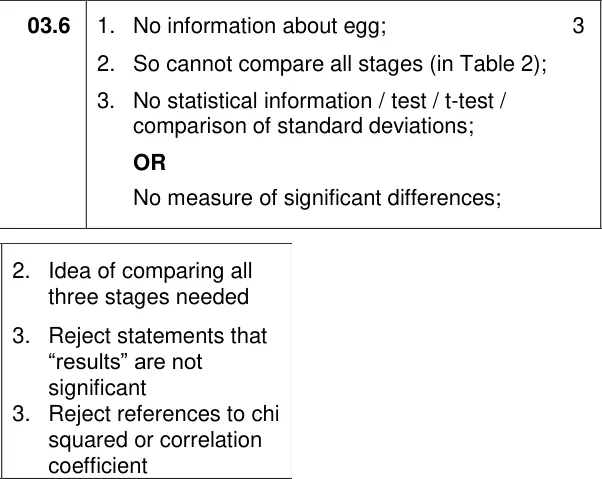
Explain why Table 2 doesn't allow a conclusion about stage of development and metabolic rate.
Information from earlier in this question:
Show the mark scheme
Tap an image to open it full size.
From the examiners' report: Most spotted the missing egg data, but a dash means no information, not a dead egg, and 'mean' means many tadpoles and frogs were measured. Explain why two stages aren't enough and mention the lack of a statistical test.
Calculating surface area to volume ratios (3.3.1)
Question 11
AS Paper 1 · June 2023 · Q05.1 · 2 marks · Hard
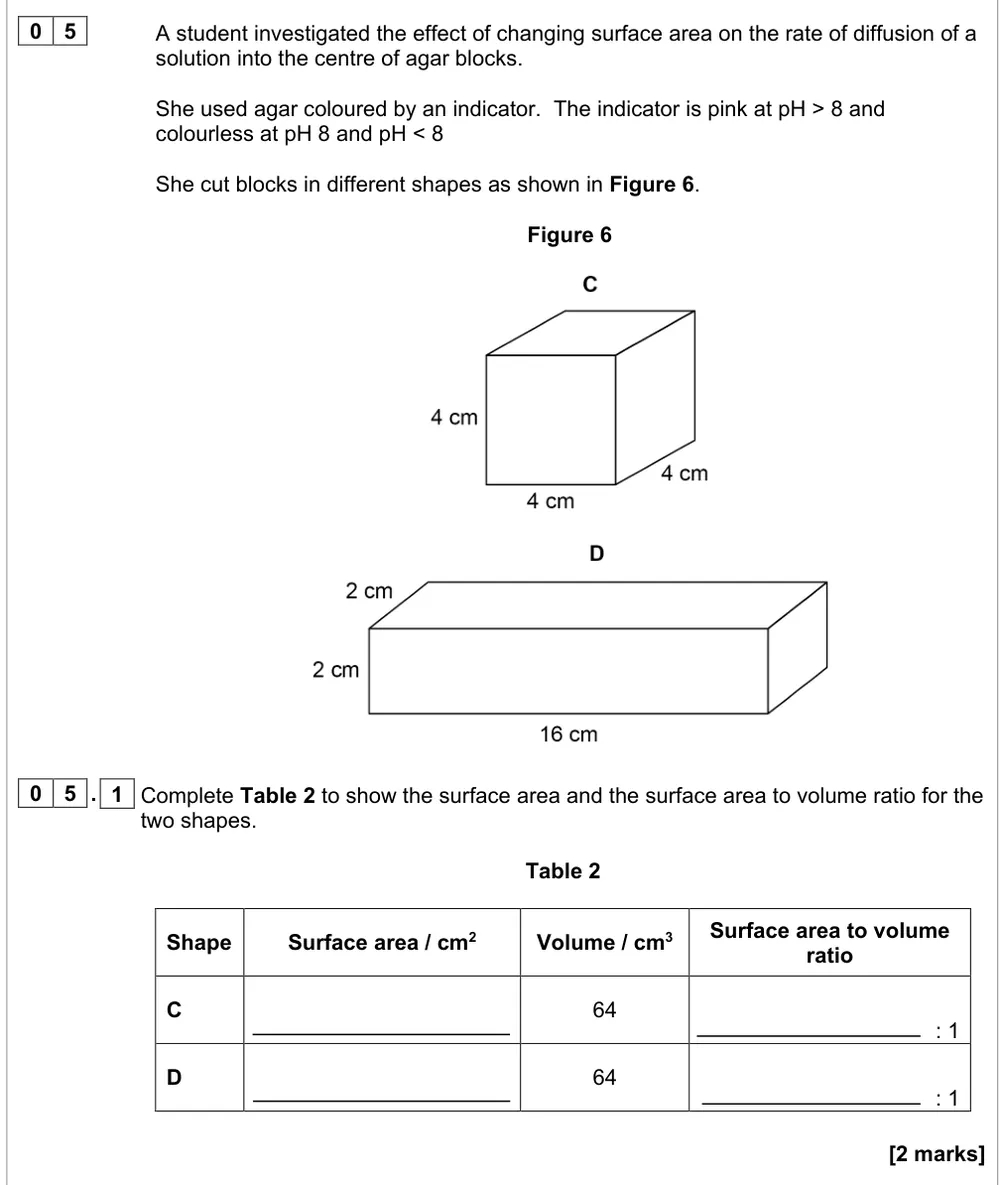
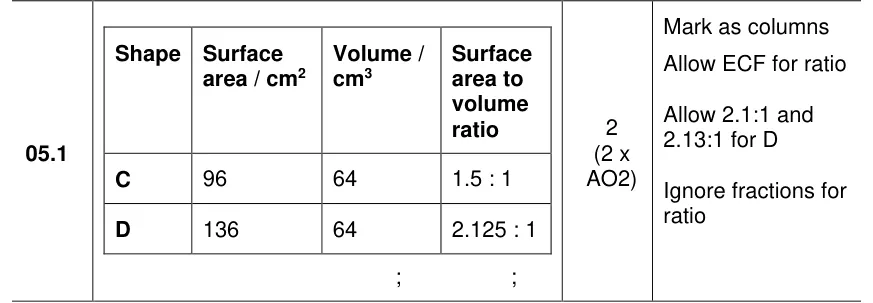
Calculate the surface area and surface area to volume ratio of two agar blocks.
Show the mark scheme
Tap an image to open it full size.
From the examiners' report: Many could find the surface areas, though the cuboid D caused more errors. Divide surface area by volume, not the other way round, and give the ratio as x : 1.
Question 12
A level Paper 1 · June 2022 · Q08.2 · 2 marks · Medium
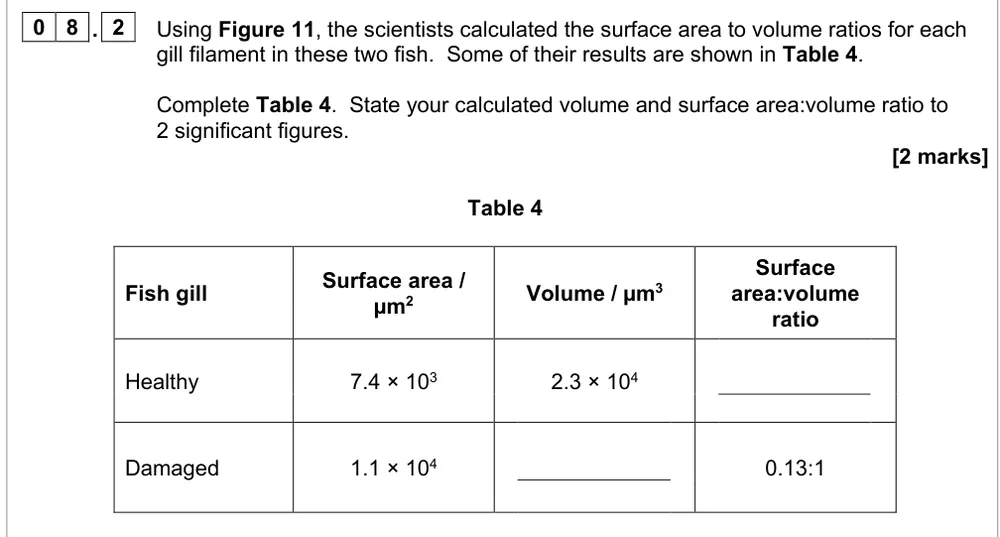
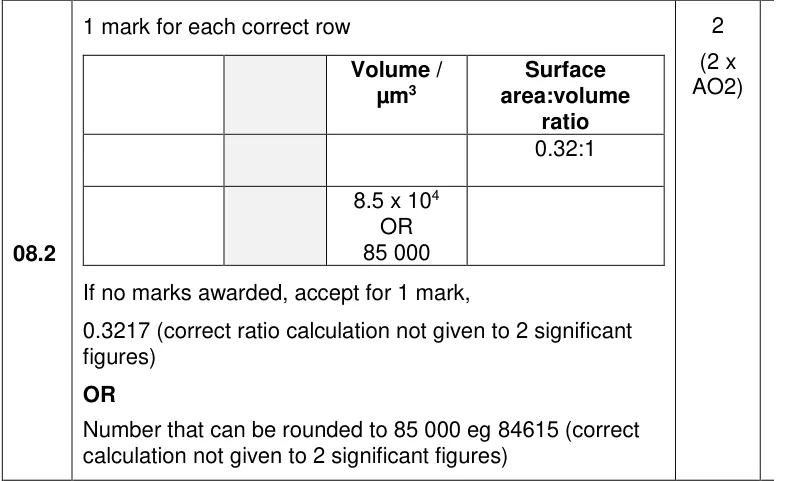
Complete a table of surface area to volume ratios for healthy and damaged gill filaments.
Show the mark scheme
Tap an image to open it full size.
From the examiners' report: Three-quarters scored at least 1 mark. The common errors were dividing volume by surface area and rounding wrongly: 84 615 to 2 significant figures is 85 000, not 84 000.
Question 13
A level Paper 3 · June 2024 · Q03.2 · 3 marks · Easy
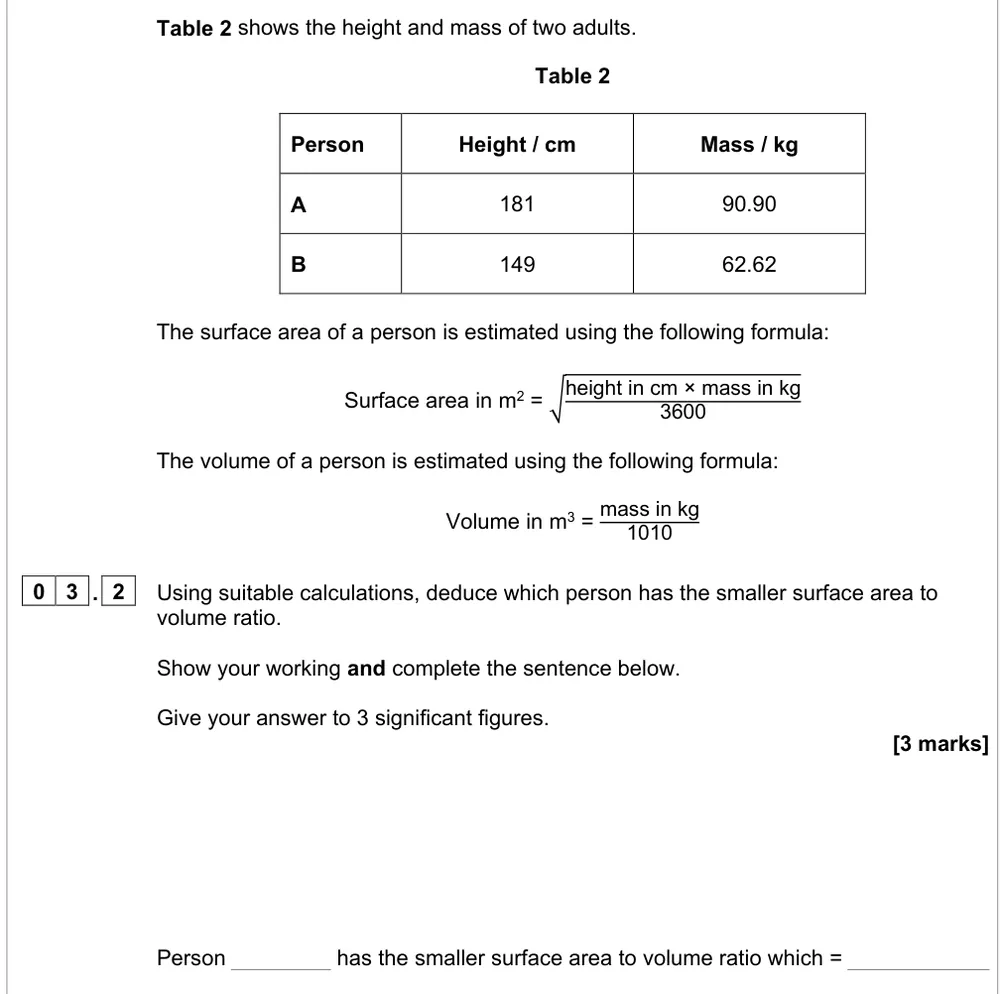
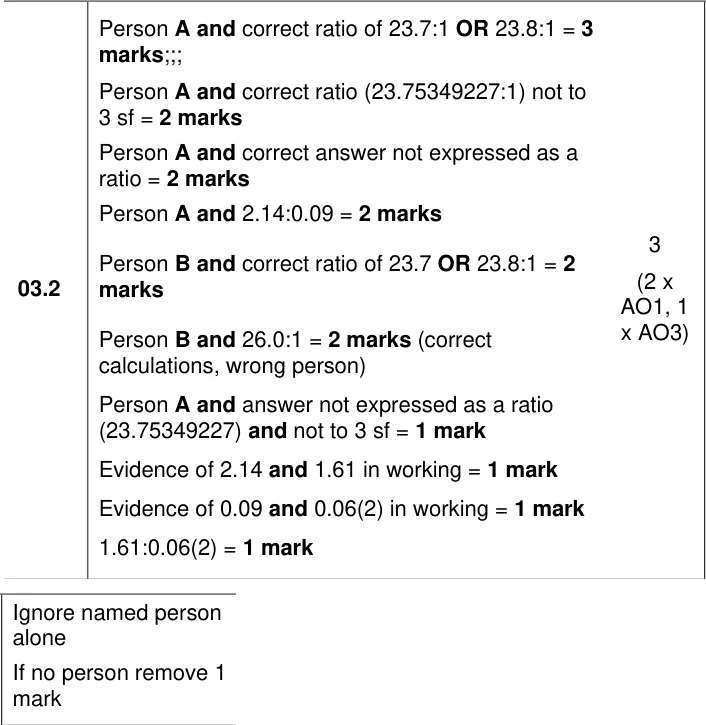
Use formulae to find which of two adults has the smaller surface area to volume ratio.
Show the mark scheme
Tap an image to open it full size.
From the examiners' report: Well answered: a third got all three. Many thought 24 : 1 was three significant figures; it's two, so write 23.8 : 1. Show the surface areas (2.14 and 1.61 m²) and volumes (0.09 and 0.062 m³).
Question 14
A level Paper 1 · June 2018 · Q02.2 · 3 marks · Hard
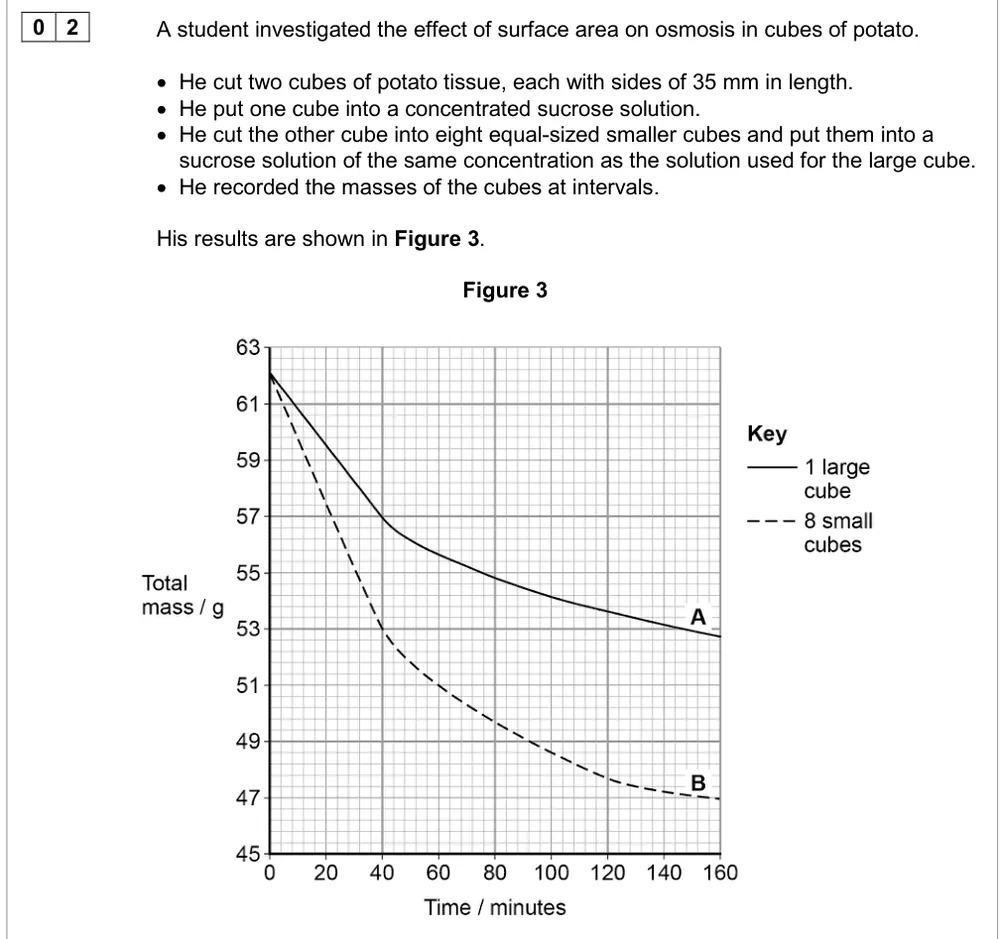
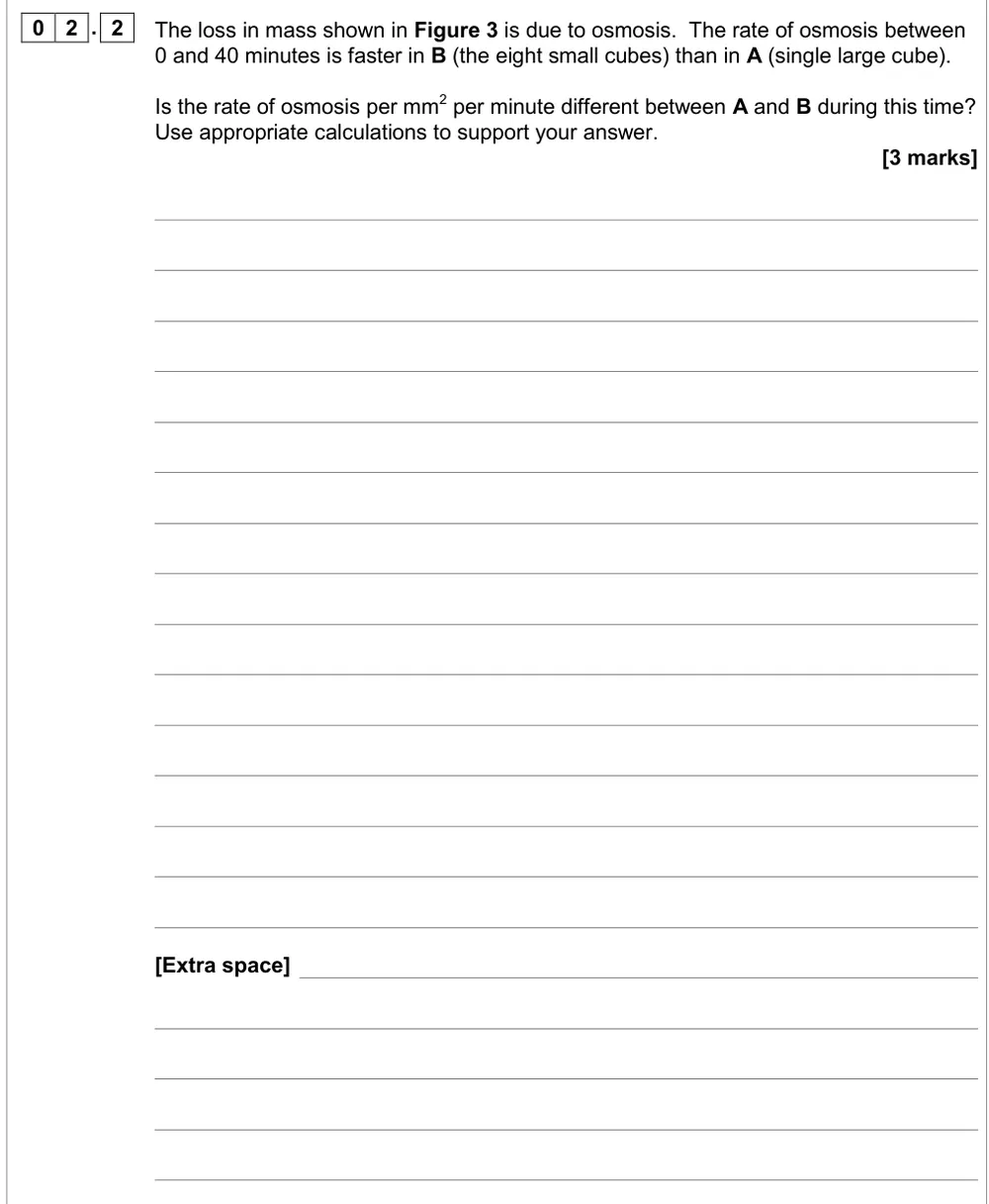
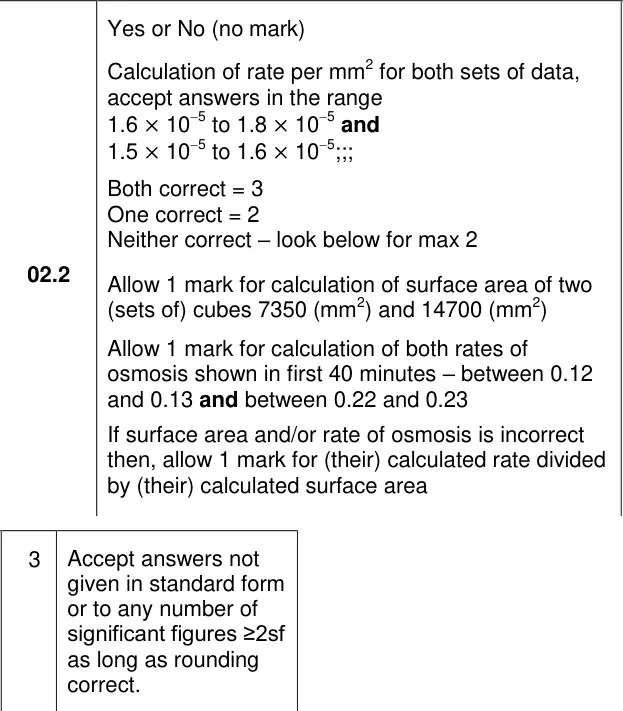
Calculate whether the rate of osmosis per mm² per minute differs between one large and eight small potato cubes.
Information from earlier in this question:
Show the mark scheme
Tap an image to open it full size.
From the examiners' report: Only 5% got both rates and 56.4% scored nothing. Find each rate from the graph, work out the total surface area of all the cubes (6 × 35² = 7350 mm²; 8 × 6 × 17.5² = 14 700 mm²), then divide, showing every step.
Where students lose marks (from AQA examiners' reports and mark schemes)
Each point below is followed by wording that gained marks.
Describe the trend, not one organism: 70.3% got the relationship, but others wrote about diffusion or gave a single example such as 'large organisms have small ratios' instead of a comparison.
✔ Gains credit: "As size increases, the ratio (of surface area to volume) decreases."
Link each body feature to diffusion: Almost two thirds scored on the tubifex worm, but many named body features without explaining how they help gas exchange, or quoted a large ratio without linking it to a feature. A 'thin membrane' was rejected.
✔ Gains credit: "Thin, so short diffusion pathway; flat/long, so large surface area to volume ratio."
Name respiration to link oxygen and metabolism: Only 25.1% explained why oxygen uptake measures metabolic rate. Many avoided the word respiration, confused it with breathing, or said energy was 'produced'.
✔ Gains credit: "(Oxygen used in) respiration, which provides energy/ATP."
More heat lost, so faster respiration to replace it: Only about 15% scored all three marks on the human body question and over a third scored nothing. Many wrote about mice and elephants instead of humans, or about diffusion distances, and 'produces energy' was rejected.
✔ Gains credit: "A larger surface area to volume ratio loses more heat; a higher rate of respiration releases/replaces heat to maintain body temperature."
Surface area divided by volume: In both the agar block and gill filament questions a common error was dividing volume by surface area.
✔ Gains credit: "C: 96 cm², 1.5 : 1; D: 136 cm², 2.125 : 1" and "0.32 : 1" for the healthy gill.
24 : 1 is only two significant figures: A third got all three marks for comparing two adults, but many gave 24 : 1 when the question asked for three significant figures. Rounding 84 615 to 84 000 lost marks in the gill question too.
✔ Gains credit: "Person A, 23.8 : 1 (or 23.7 : 1)" and "8.5 × 10⁴ µm³".
Count every face of every cube: Only 5% found both rates of osmosis per mm² and 56.4% scored nothing. Few could find the surface area of the eight small cubes, and answers with no working couldn't earn method marks.
✔ Gains credit: "7350 mm² and 14 700 mm²"; rates of about 1.7 × 10⁻⁵ (A) and 1.5 × 10⁻⁵ (B) g per mm² per minute.
A dash means no data, not a dead egg: Most noticed there was no oxygen uptake data for the egg, but some said the dash meant the eggs were dead or didn't respire, and some thought 'mean' meant only one tadpole was measured.
✔ Gains credit: "No information about egg, so cannot compare all three stages; no statistical test."
Download the questions
Download the PDF pack (14 questions, mark schemes at the end)
Keep practising
- Arithmetic and numerical skills: AQA A Level Biology exam questions by topic
- Graph skills: AQA A Level Biology exam questions by topic
- ATP: AQA A Level Biology exam questions by topic
- Calculations and mathematical content in A level Biology, from AQA papers
- AQA A Level Biology masterclasses
Questions, mark schemes and examiners' report extracts © AQA.