

Mass transport in plants (AQA 3.3.4.2) is a short section of the specification, but it produces some long answers on both Year 12 and A-level papers. You need to know xylem as the tissue that carries water and explain the cohesion-tension theory, know phloem as the tissue that carries organic substances and explain the mass flow hypothesis, and interpret tracer and ringing experiments, saying whether the evidence supports mass flow or not.
The examiners' reports keep finding the same gaps. Students name glucose instead of sucrose, say water moves up the xylem by osmosis, describe a water column without saying how the tension is created, write that sugars diffuse along the phloem instead of moving by mass flow, and describe tracer data without linking the radioactive carbon to sugars made in photosynthesis. In the evaluation questions, very few students name the source and the sink in the experiment in front of them.
Start with the xylem, then the phloem and mass flow, then the tracer and ringing experiments, and finish with the practical and data questions. Answer each question on paper before you open the mark scheme. If you'd like help with this topic, my AQA masterclasses run online on Tuesdays at 5.15pm for Year 12 and on Wednesdays or Thursdays at 6.30pm for Year 13.
What you need from GCSE and Year 12
Each question on this page assumes you're secure on these GCSE and Year 12 ideas. If any of them feels shaky, revise it before you start.
- GCSE: xylem carries water and mineral ions from the roots to the leaves in the transpiration stream; phloem carries dissolved sugars around the plant (translocation).
- GCSE: transpiration is faster at higher temperature, higher light intensity, lower humidity and more air movement, and can be measured with a potometer.
- Year 12 (AQA 3.1.7): hydrogen bonds between water molecules make them cohesive.
- Year 12 (AQA 3.1.2): sucrose is a disaccharide made from glucose and fructose.
- Year 12 (AQA 3.2.3): water moves by osmosis to a lower water potential; active transport and co-transport move substances against a concentration gradient using carrier proteins.
Key terms
These words come up in the questions and mark schemes. Examiners expect you to use them exactly.
- Xylem: the tissue that transports water (and mineral ions) in the stem and leaves; its vessels form continuous tubes.
- Transpiration: evaporation of water from leaf cells and its loss as water vapour, mainly through the stomata.
- Cohesion: water molecules sticking together by hydrogen bonds, so they form a continuous column in the xylem.
- Tension: the pull, or negative pressure, on the water column created as water evaporates from the leaves.
- Adhesion: attraction between water molecules and the walls of the xylem vessels.
- Phloem: the tissue that transports organic substances such as sucrose; sieve tube elements are supported by companion cells.
- Source and sink: the source is where sucrose is loaded into the phloem (such as a photosynthesising leaf); the sink is where it is unloaded and used or stored (such as roots).
- Mass flow: movement of the whole solution along the phloem from high hydrostatic pressure at the source to lower pressure at the sink.
- Translocation: the movement of organic substances through the phloem.
- Ringing experiment: removing a ring of bark, and with it the phloem, from a stem to see whether substances still move past that point.
- Tracer: a labelled substance, such as carbon dioxide containing radioactive 14C, that is followed through the plant to show where products of photosynthesis go.
What these questions cover (AQA 3.3.4.2)
The questions test these statements from the AQA AS and A-level Biology specification (7401/7402):
- Xylem: Xylem as the tissue that transports water in the stem and leaves of plants. The cohesion-tension theory of water transport in the xylem. (the potometer and celery questions come from the AT b practical skill listed beside this section)
- Phloem: Phloem as the tissue that transports organic substances in plants. The mass flow hypothesis for the mechanism of translocation in plants. The use of tracers and ringing experiments to investigate transport in plants.
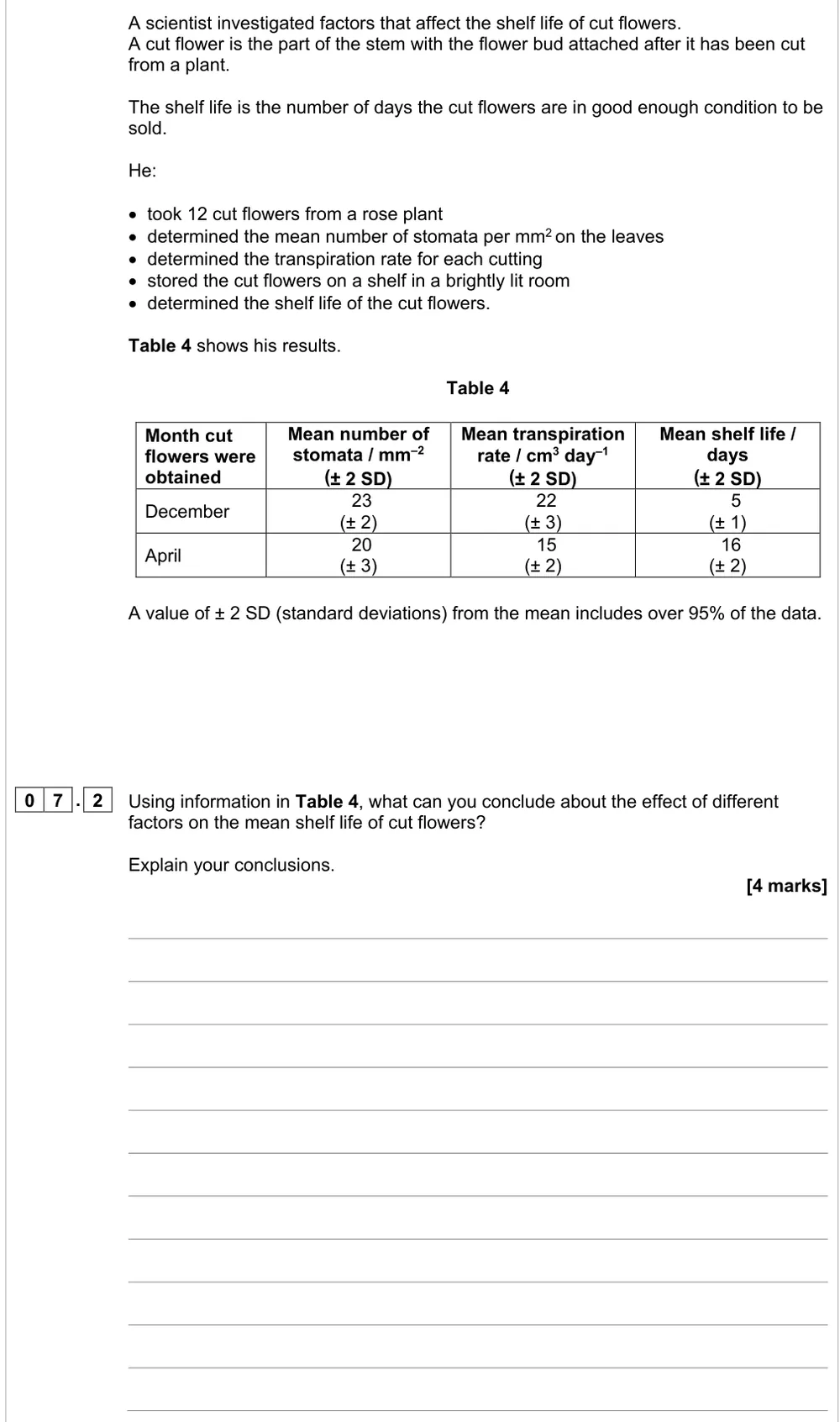
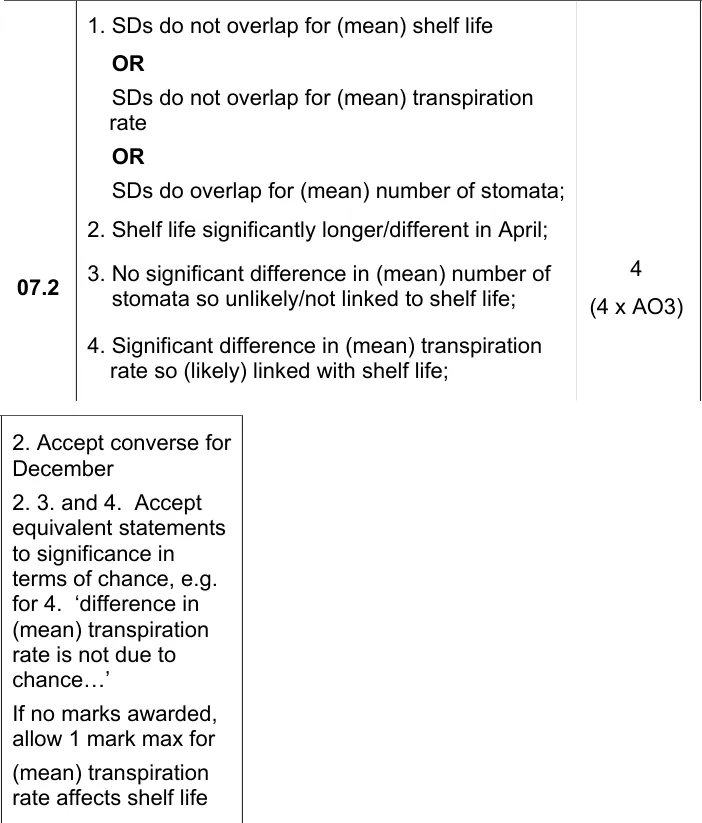
- Students should be able to recognise correlations and causal relationships (the cut flower question asks which factors are linked with shelf life, using standard deviations)
- Students should be able to interpret evidence from tracer and ringing experiments and to evaluate the evidence for and against the mass flow hypothesis. (two evaluation questions ask whether ringing (2018) and tracer (2025) evidence supports the mass flow hypothesis)
How to use this page
Write your answer on paper before you open the mark scheme. Allow about 1.3 minutes per mark: the 18 questions are worth 53 marks, so about 69 minutes in total. Then mark your answer strictly against the mark scheme and read the examiners' tip underneath it. If you'd rather print the questions, download the PDF pack.
Xylem and cohesion-tension (3.3.4.2)
Question 1
AS Paper 2 · June 2017 · Q09.1 · 5 marks
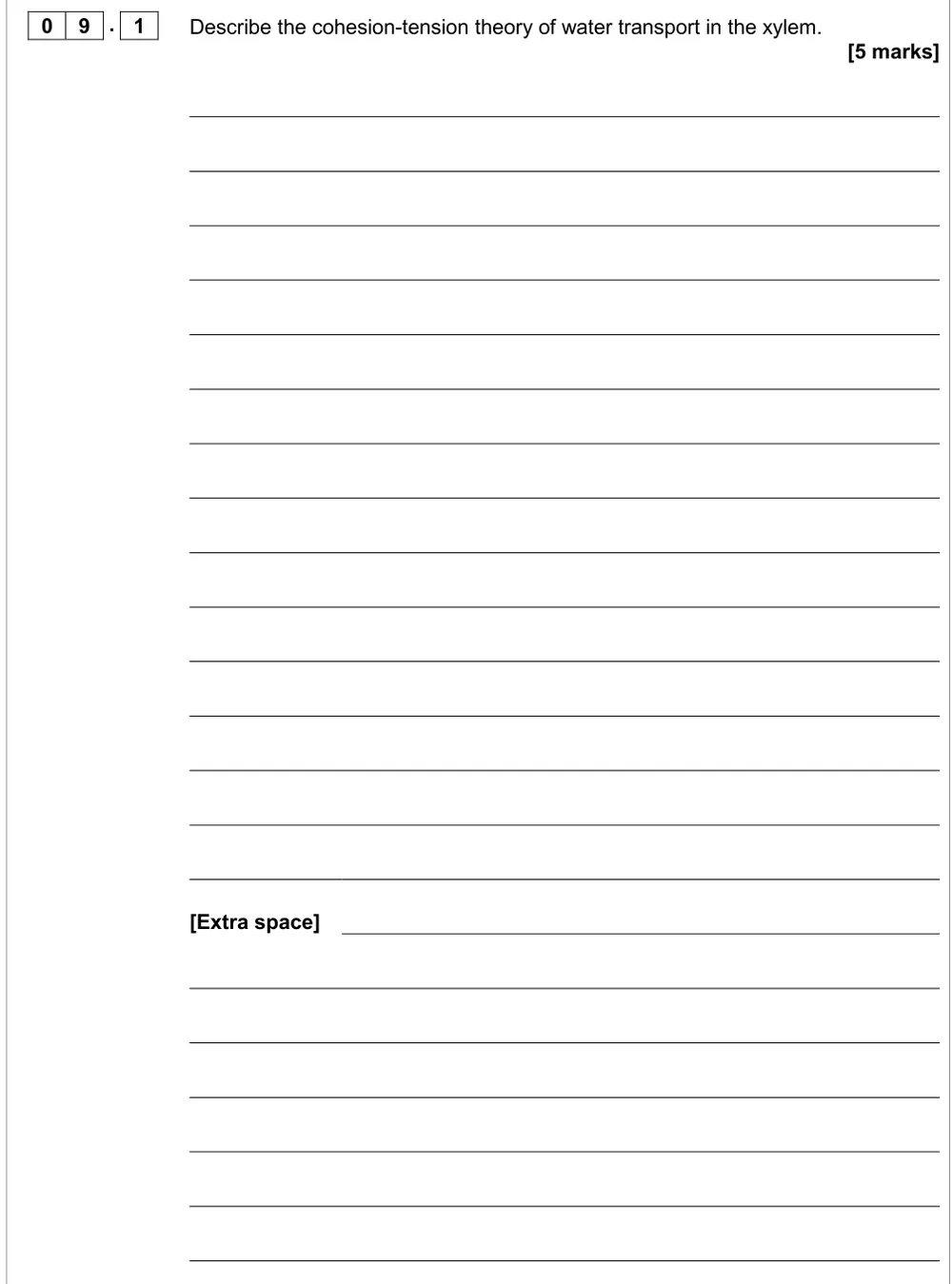
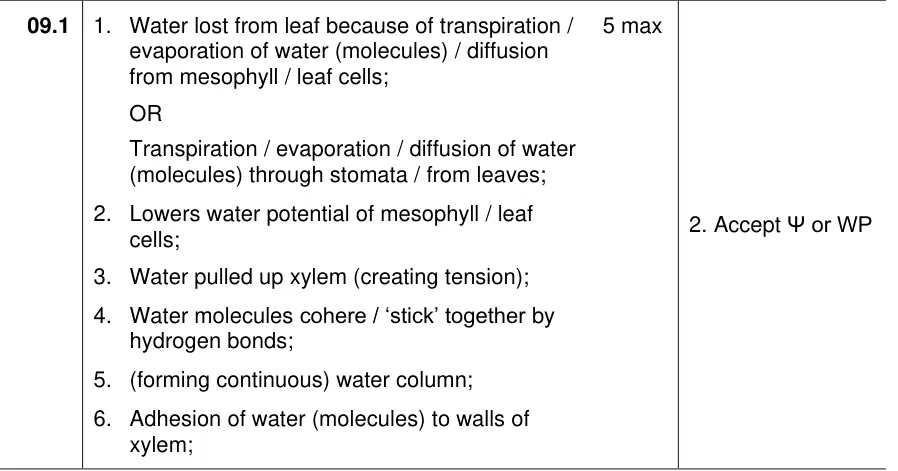
Describe the cohesion-tension theory of water transport in the xylem.
Show the mark scheme
Tap an image to open it full size.
From the examiners' report: No examiners' report for this part. Start at the leaf: evaporation creates the tension, then cohesion by hydrogen bonds keeps the column unbroken. Adhesion to the xylem walls is a separate mark.
Question 2
A level Paper 1 · June 2023 · Q02.3 · 3 marks · Medium
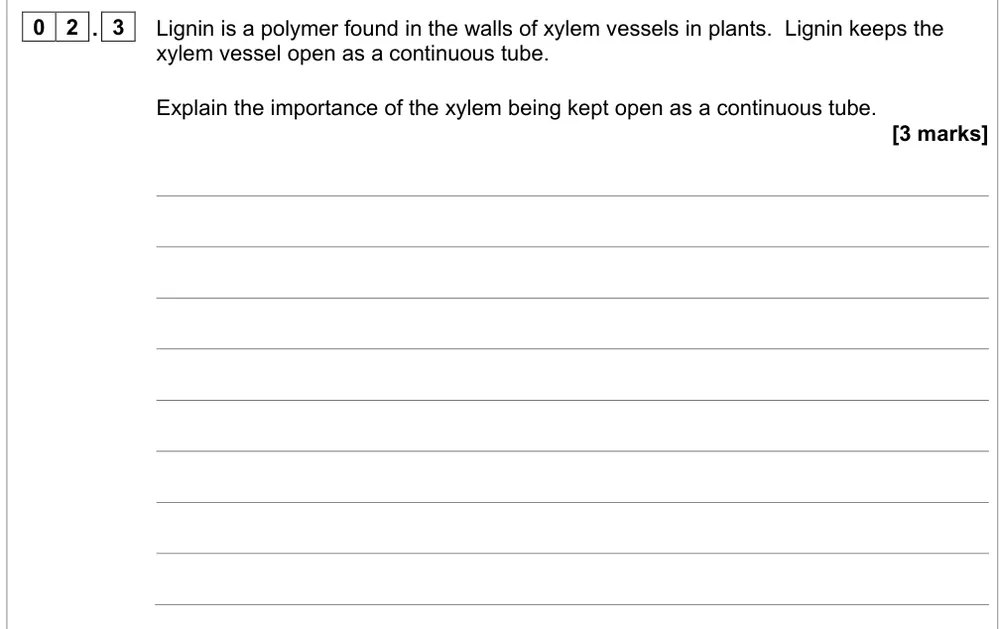
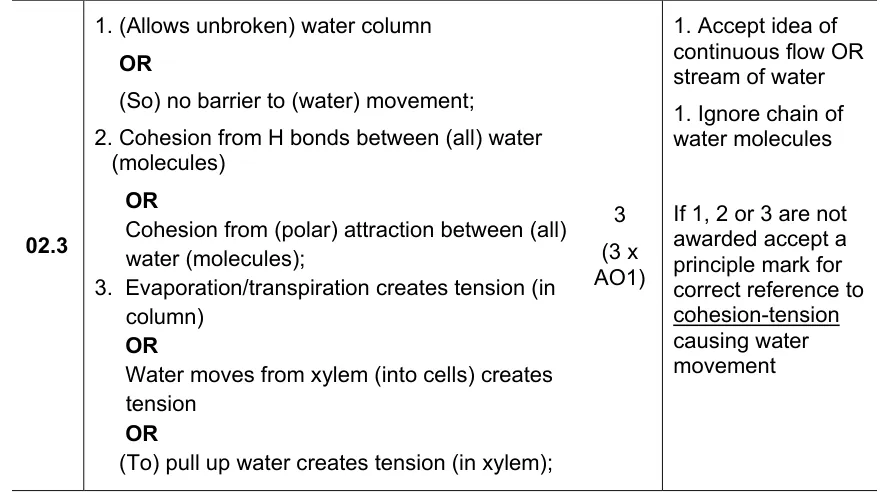
Explain why it matters that lignin keeps the xylem open as a continuous tube.
Show the mark scheme
Tap an image to open it full size.
From the examiners' report: Fewer than 5% got all 3. About half mentioned a water column; very few said how the tension is created. Source, sink and sugar don't belong in the xylem.
Question 3
AS Paper 2 · June 2024 · Q01.2 · 3 marks · Hard
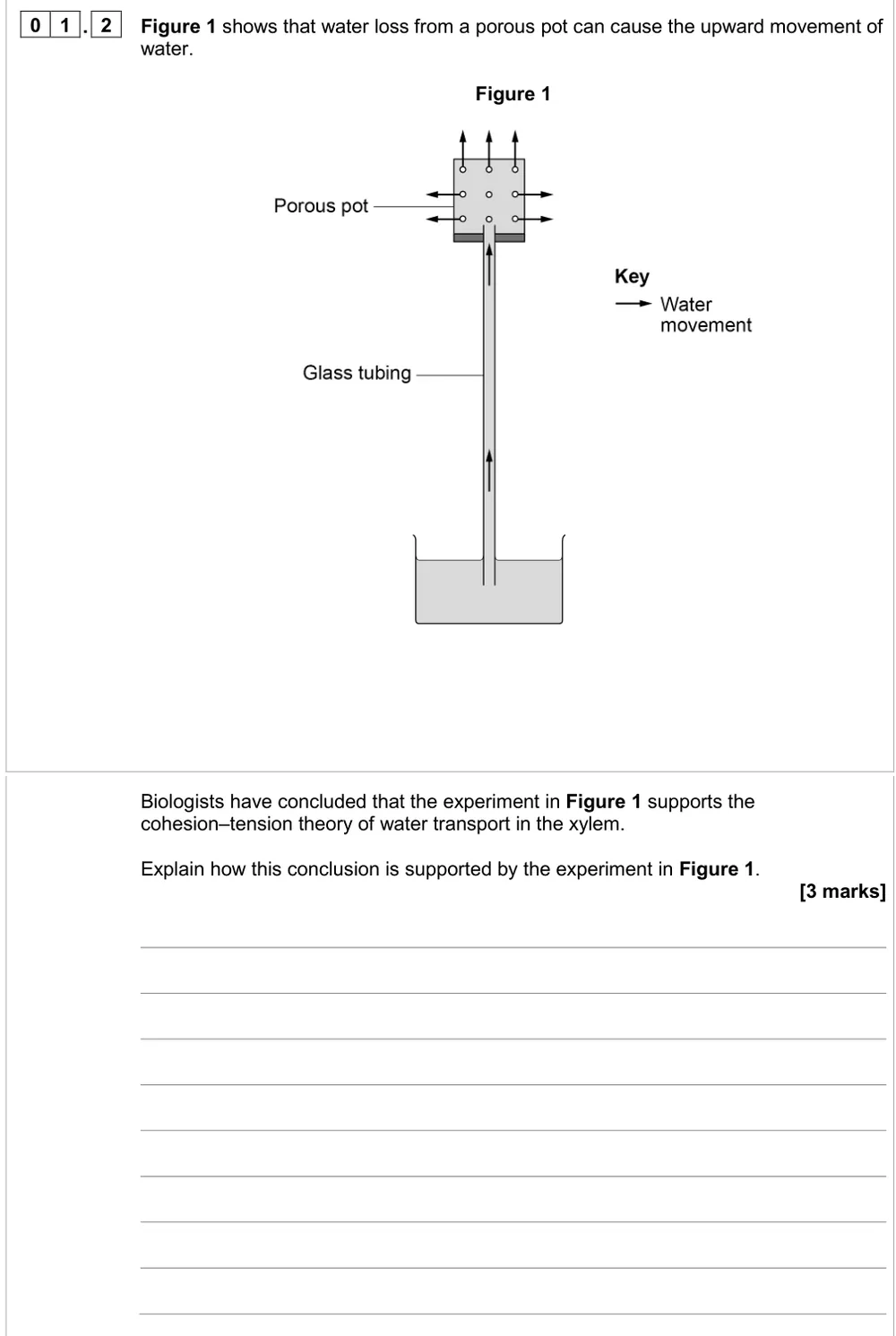
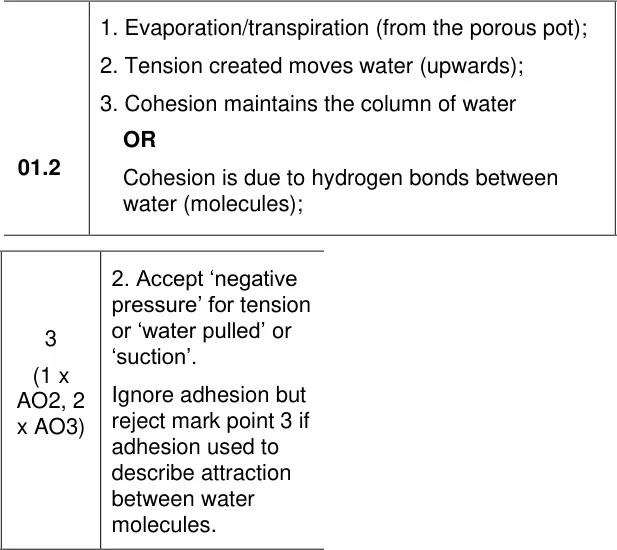
Explain how a porous pot model supports the cohesion-tension theory.
Show the mark scheme
Tap an image to open it full size.
From the examiners' report: Only a small minority said that evaporation creates tension. Explain the model in front of you; some just described what happens in a plant.
Question 4
AS Paper 2 · June 2019 · Q05.3 · 3 marks · Medium
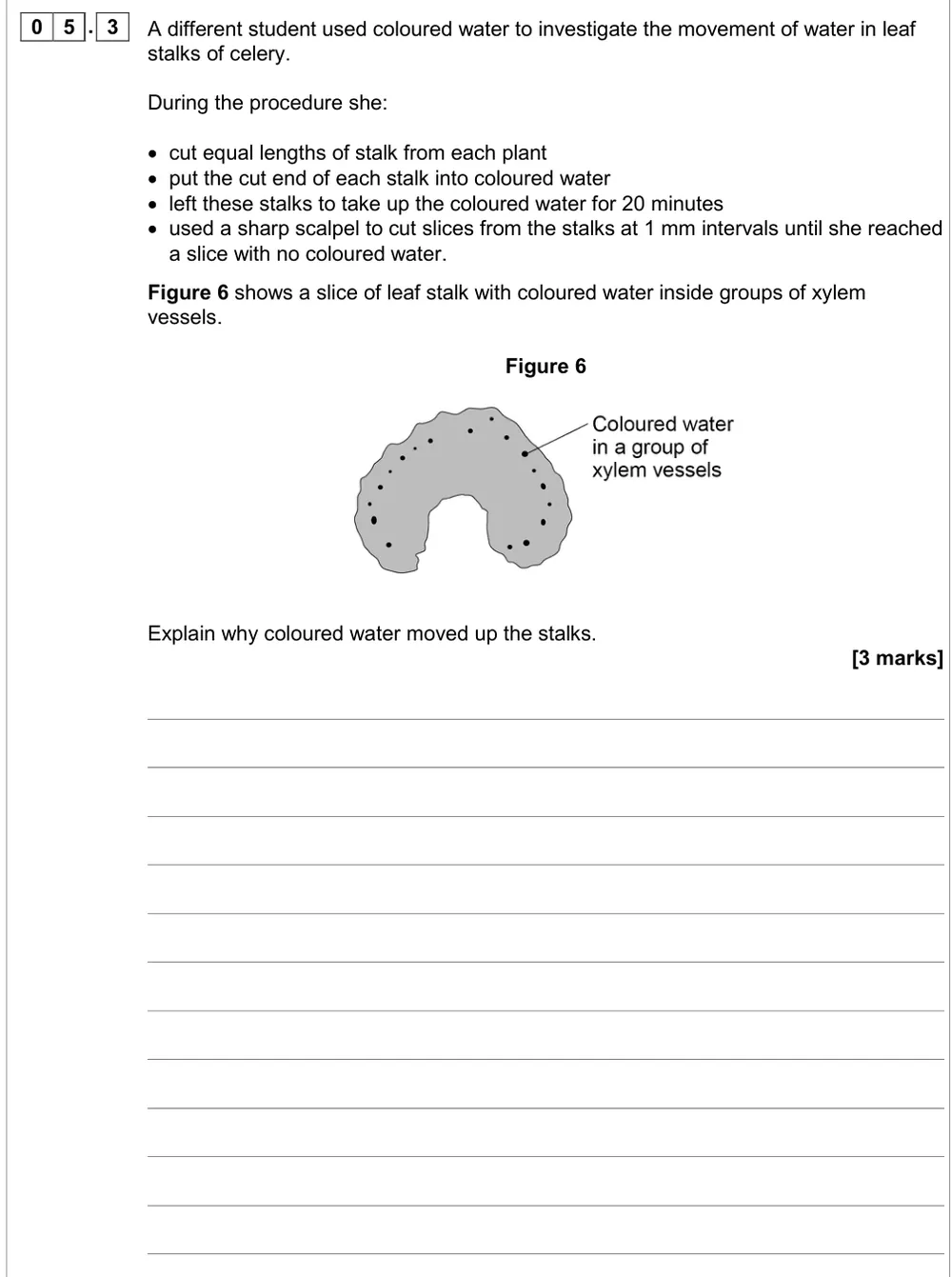
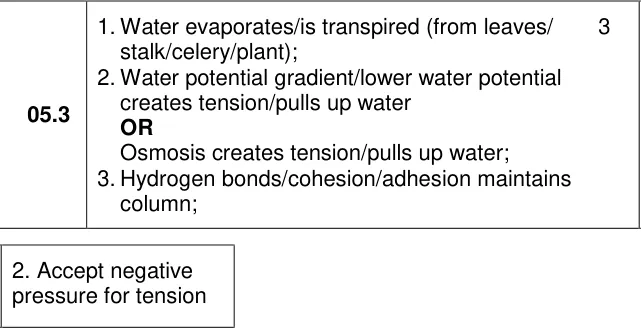
Explain why coloured water moved up celery stalks.
Show the mark scheme
Tap an image to open it full size.
From the examiners' report: About a third scored zero. Start with evaporation; tension pulls the column up and cohesion holds it together. Water doesn't move up the xylem by osmosis.
Question 5
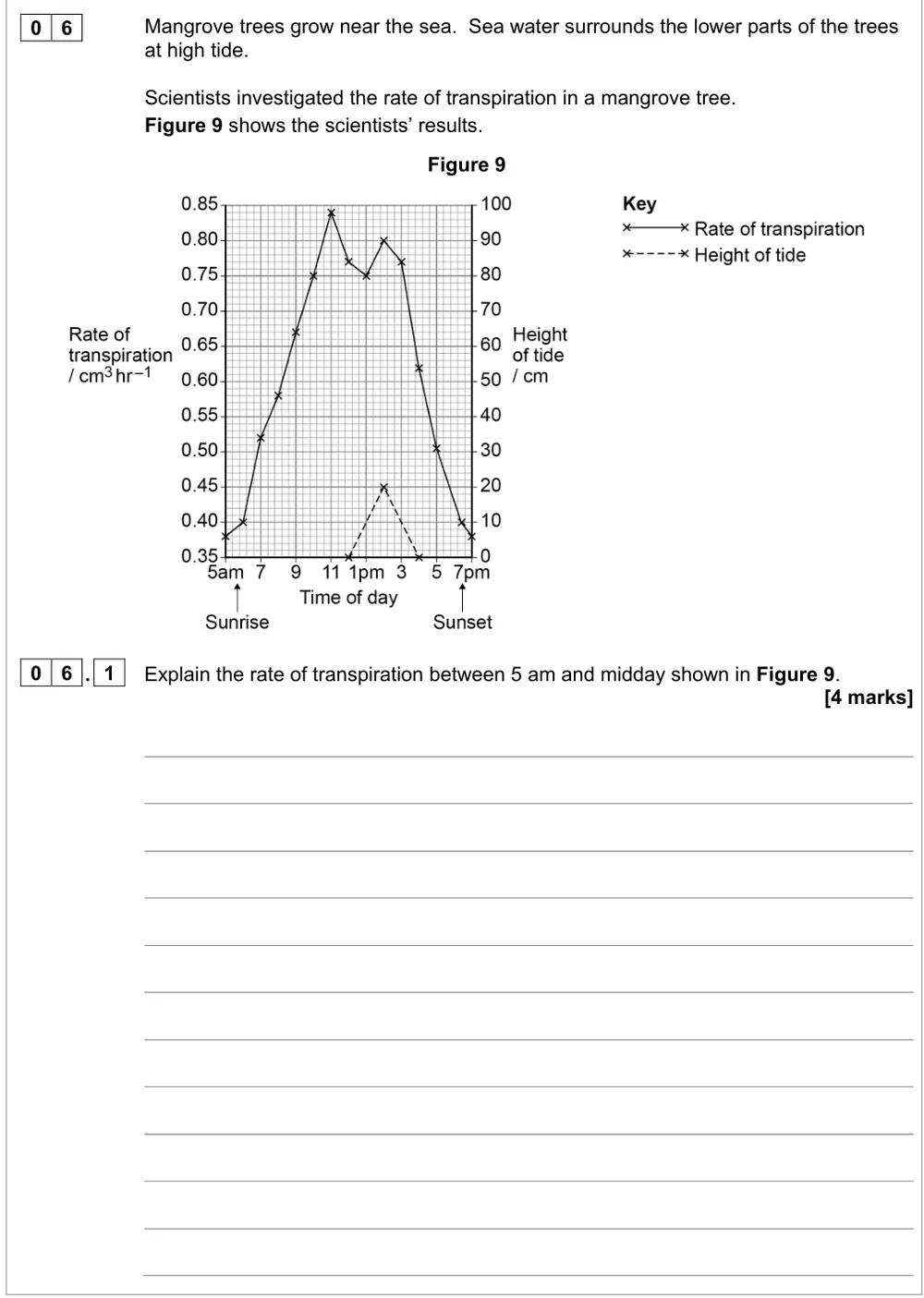
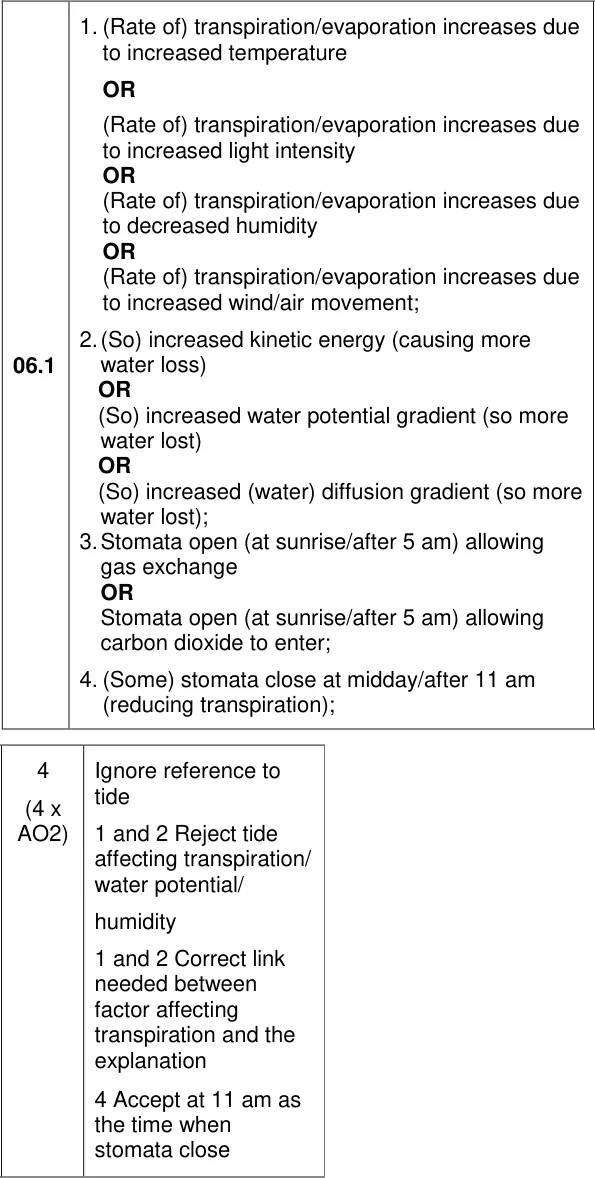
A level Paper 1 · June 2022 · Q06.1 · 4 marks · Medium
Explain the rise in transpiration rate of a mangrove tree from 5 am to midday.
Show the mark scheme
Tap an image to open it full size.
From the examiners' report: Only two-thirds scored. Explain, don't describe: link each factor to its effect, say 'light intensity' not 'the sun', and remember stomata open for gas exchange, not to let water out.
Phloem and mass flow (3.3.4.2)
Question 6
AS Paper 1 · June 2025 · Q07.1 · 1 mark · Easy
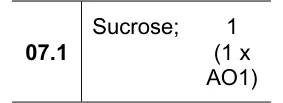
Name the main carbohydrate transported in the phloem.

Show the mark scheme
Tap an image to open it full size.
From the examiners' report: About 60% got it. Glucose was the common wrong answer.
Question 7
A level Paper 1 · June 2022 · Q09.1 · 5 marks · Medium
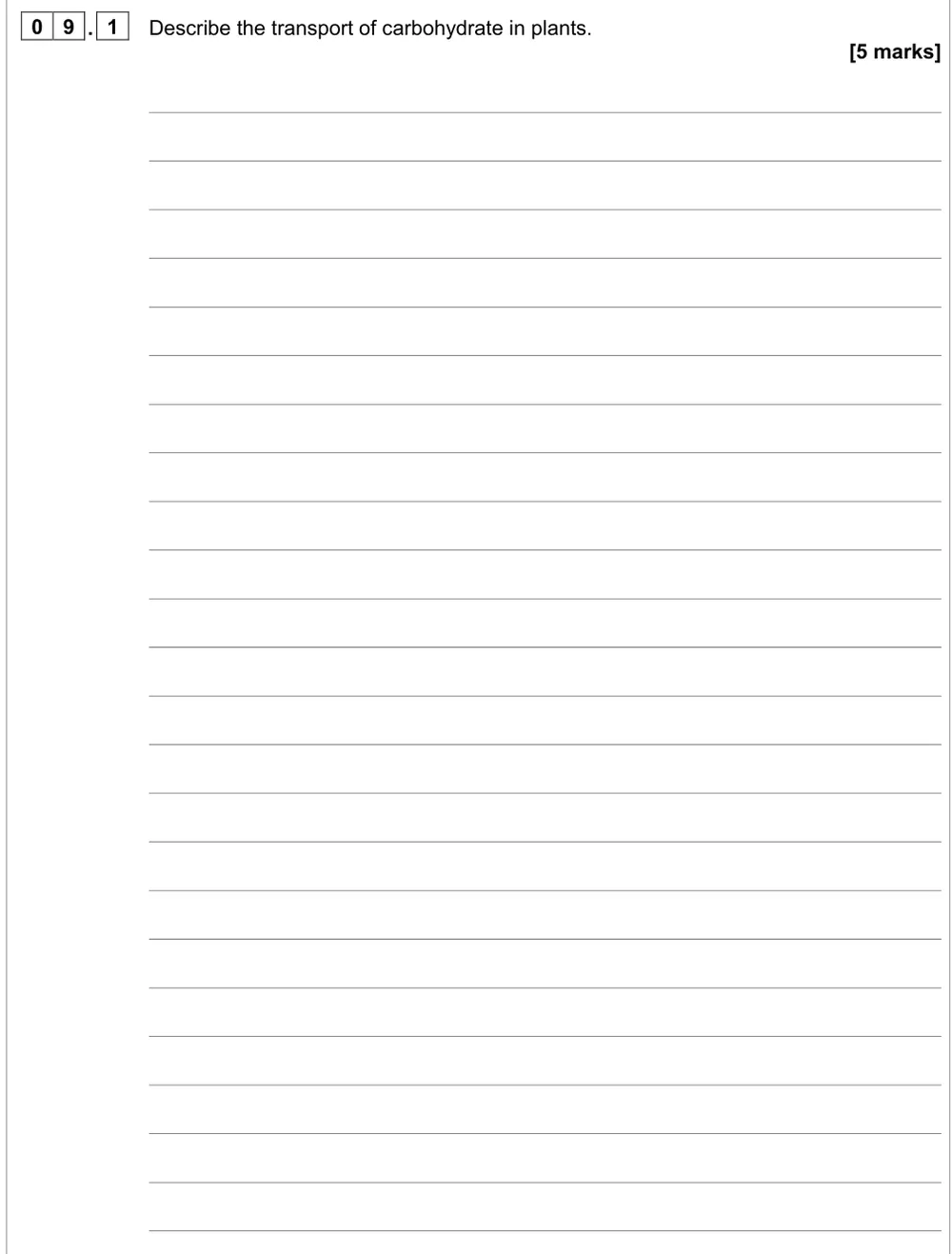
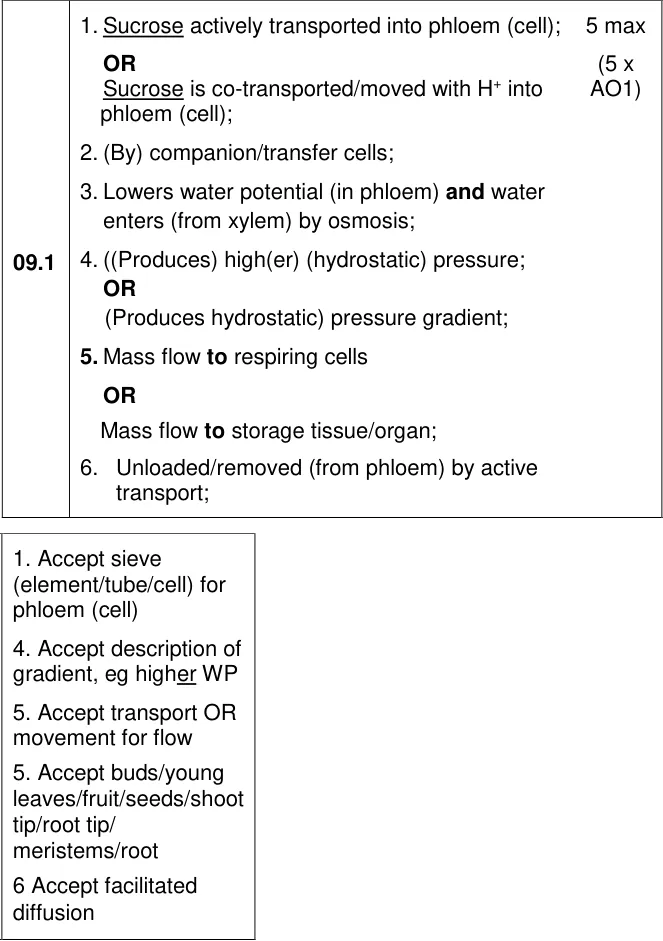
Describe the transport of carbohydrate in plants.
Show the mark scheme
Tap an image to open it full size.
From the examiners' report: A third got 4 or 5. Name sucrose, use the words mass flow, and say where it goes: respiring cells or storage tissue. Sugars don't diffuse along the phloem or out of it.
Question 8
AS Paper 2 · November 2020 · Q08.2 · 3 marks · Hard
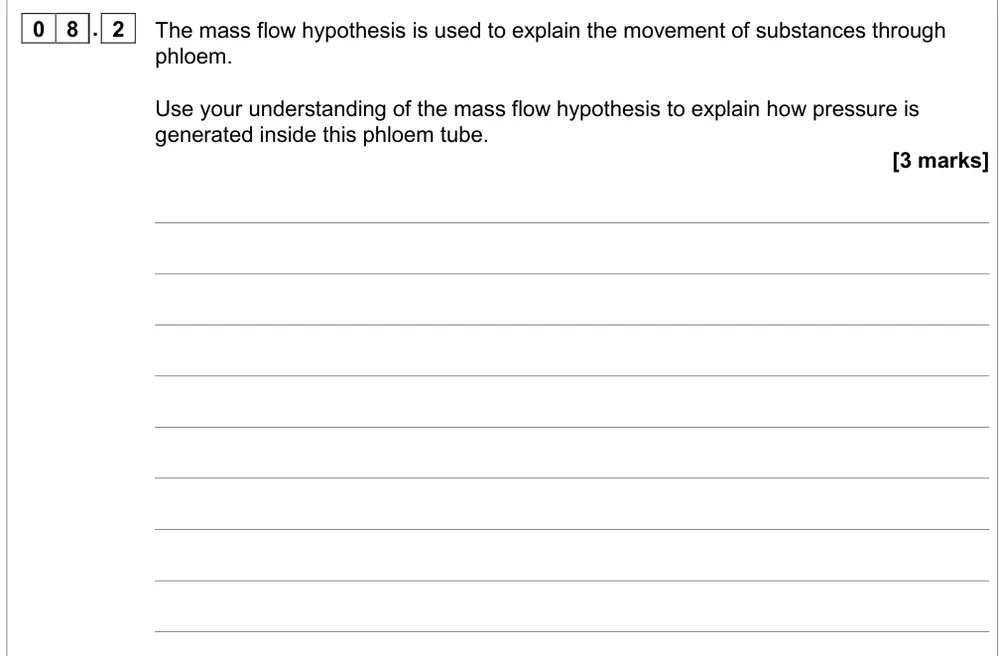
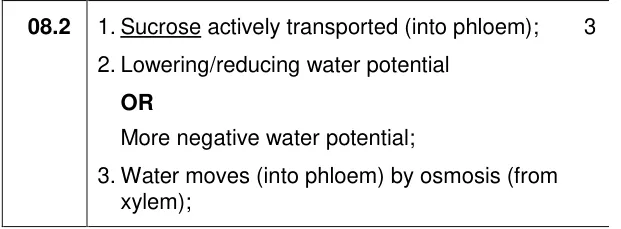
Use the mass flow hypothesis to explain how pressure builds up in a phloem tube.
Show the mark scheme
Tap an image to open it full size.
From the examiners' report: Only 25% got a mark. Name sucrose and active transport; adding a solute lowers the water potential, it doesn't raise it. Leave cohesion-tension out.
Question 9
AS Paper 1 · June 2023 · Q09.2 · 2 marks · Hard
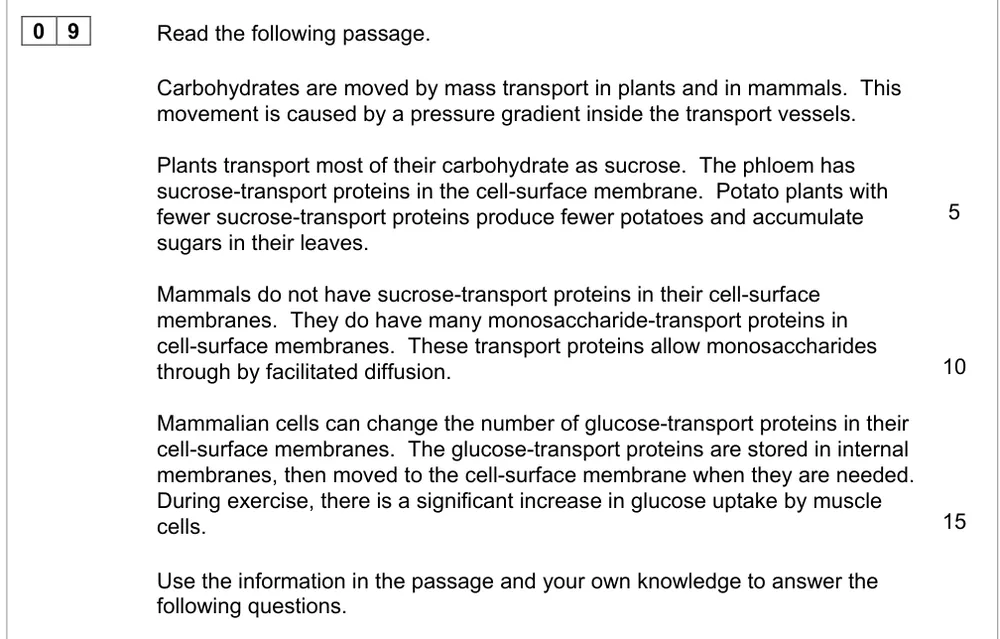
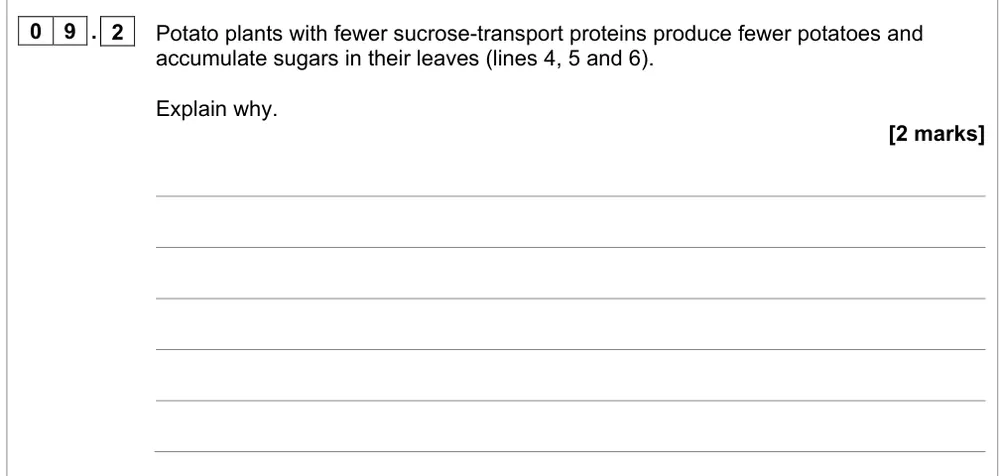
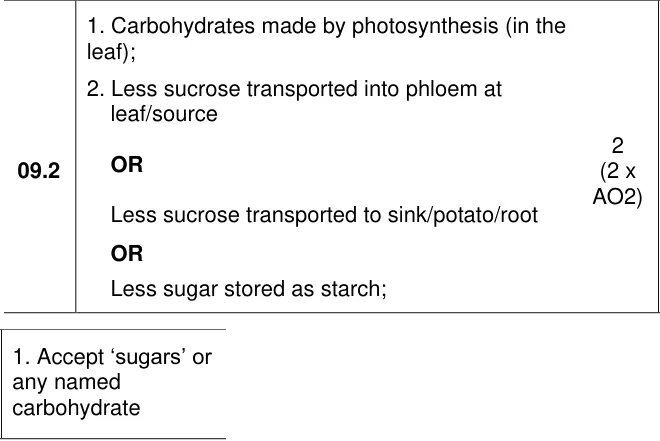
Explain why potato plants with fewer sucrose-transport proteins make fewer potatoes and keep sugar in their leaves.
Information from earlier in this question:
Show the mark scheme
Tap an image to open it full size.
From the examiners' report: This was poorly answered. Be precise about places: sugar is made in the leaf by photosynthesis, less is loaded into the phloem at the source, so less reaches the potato.
Question 10
AS Paper 2 · November 2020 · Q08.4 · 3 marks · Medium
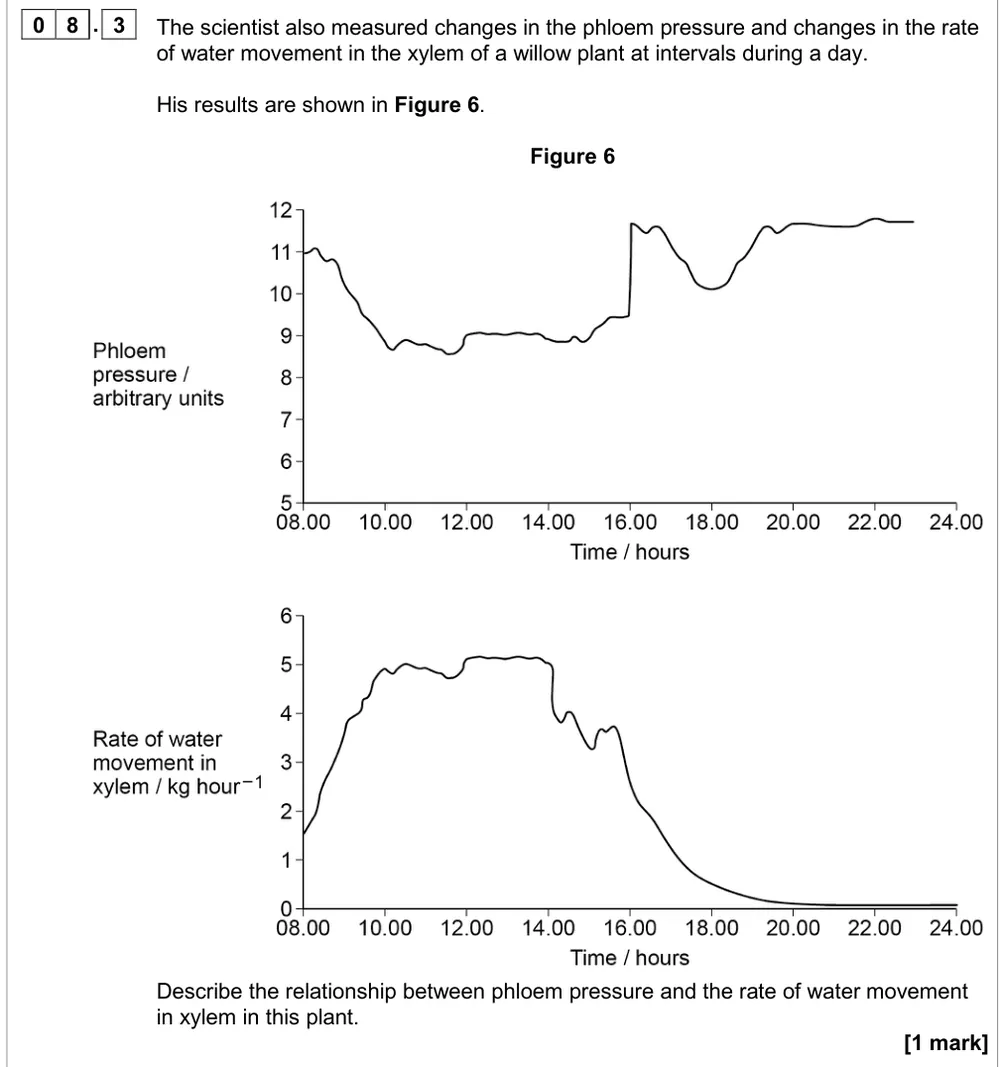
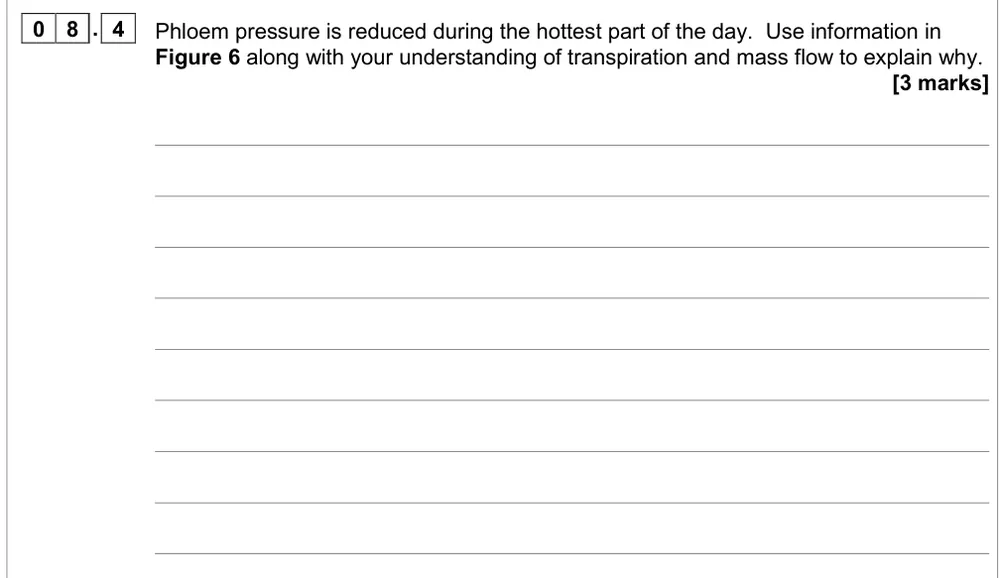
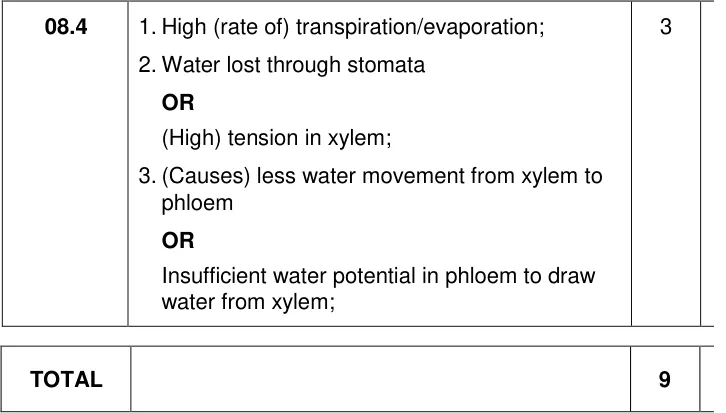
Use graphs of phloem pressure and xylem flow to explain why phloem pressure falls in the hottest part of the day.
Information from earlier in this question:
Show the mark scheme
Tap an image to open it full size.
From the examiners' report: Over 60% got a mark, but very few got all 3. Go one step further: high tension in the xylem means less water moves into the phloem, so phloem pressure falls.
Tracer and ringing experiments (3.3.4.2)
Question 11
AS Paper 2 · June 2018 · Q06.2 · 3 marks · Easy
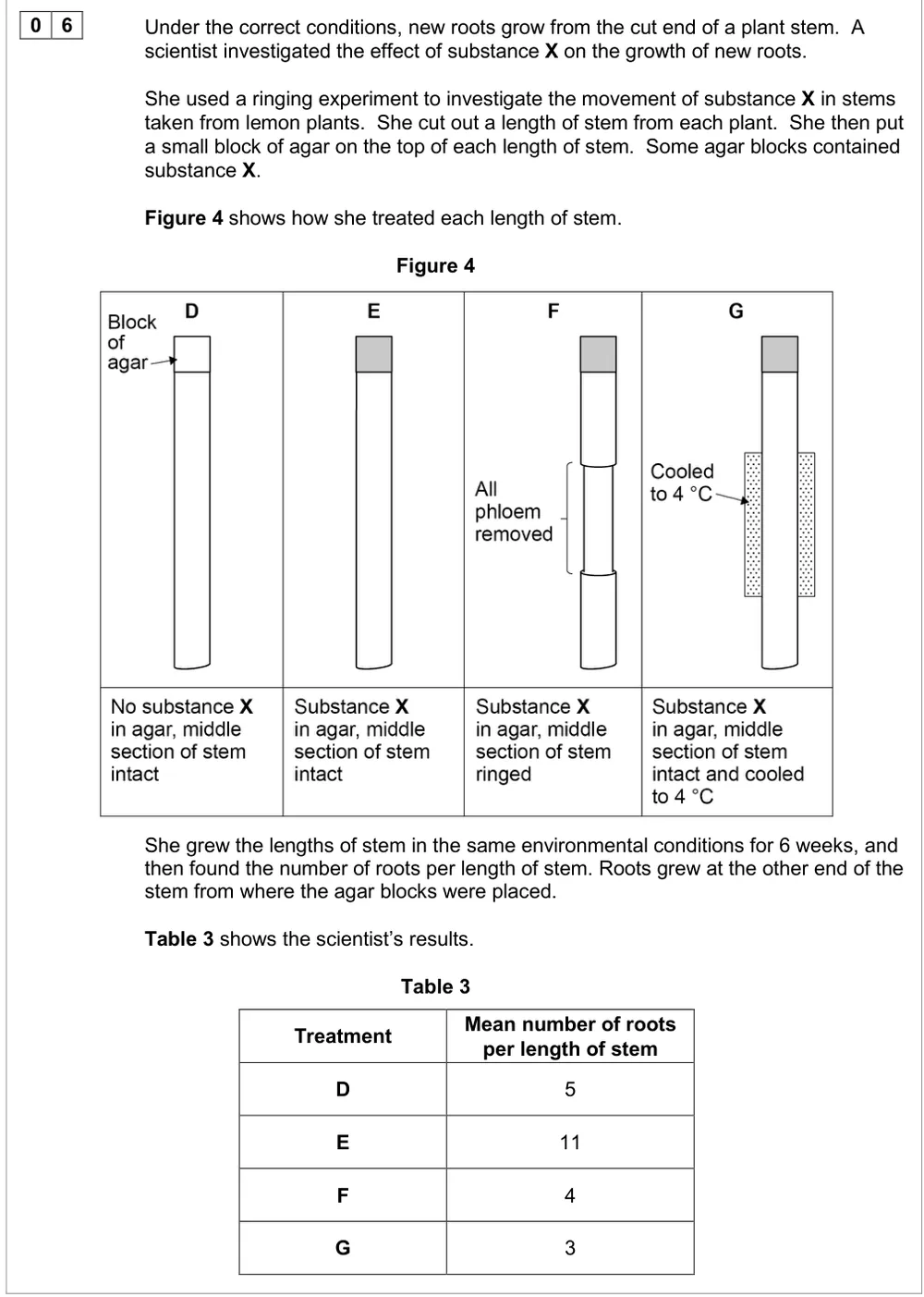
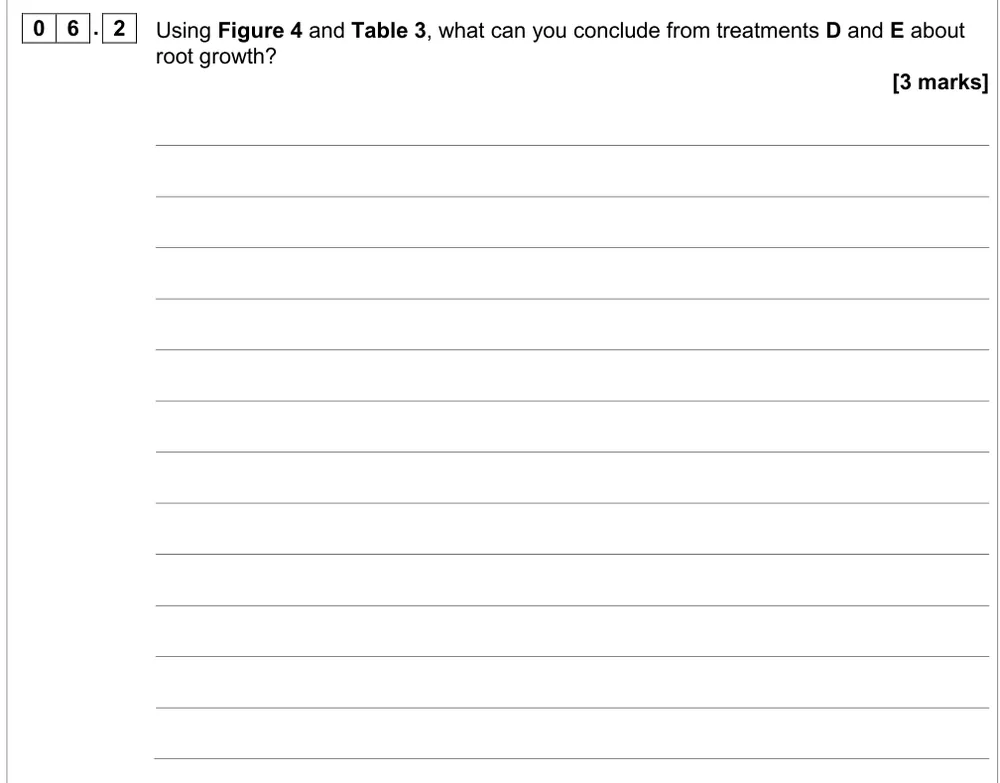
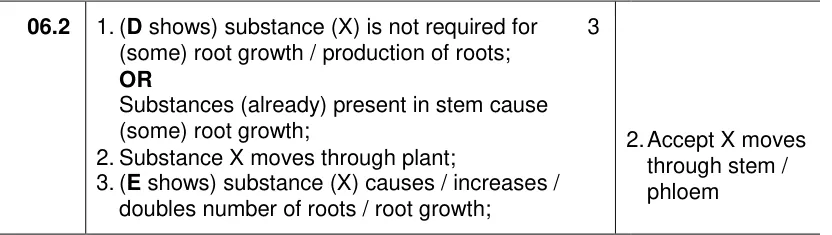
Use a ringing experiment to draw conclusions about substance X and root growth.
Information from earlier in this question:
Show the mark scheme
Tap an image to open it full size.
From the examiners' report: Most got the mark for X increasing root growth. Say what the control shows (roots still grow without X), and state that X moves through the stem.
Question 12
AS Paper 2 · June 2018 · Q06.3 · 4 marks · Medium
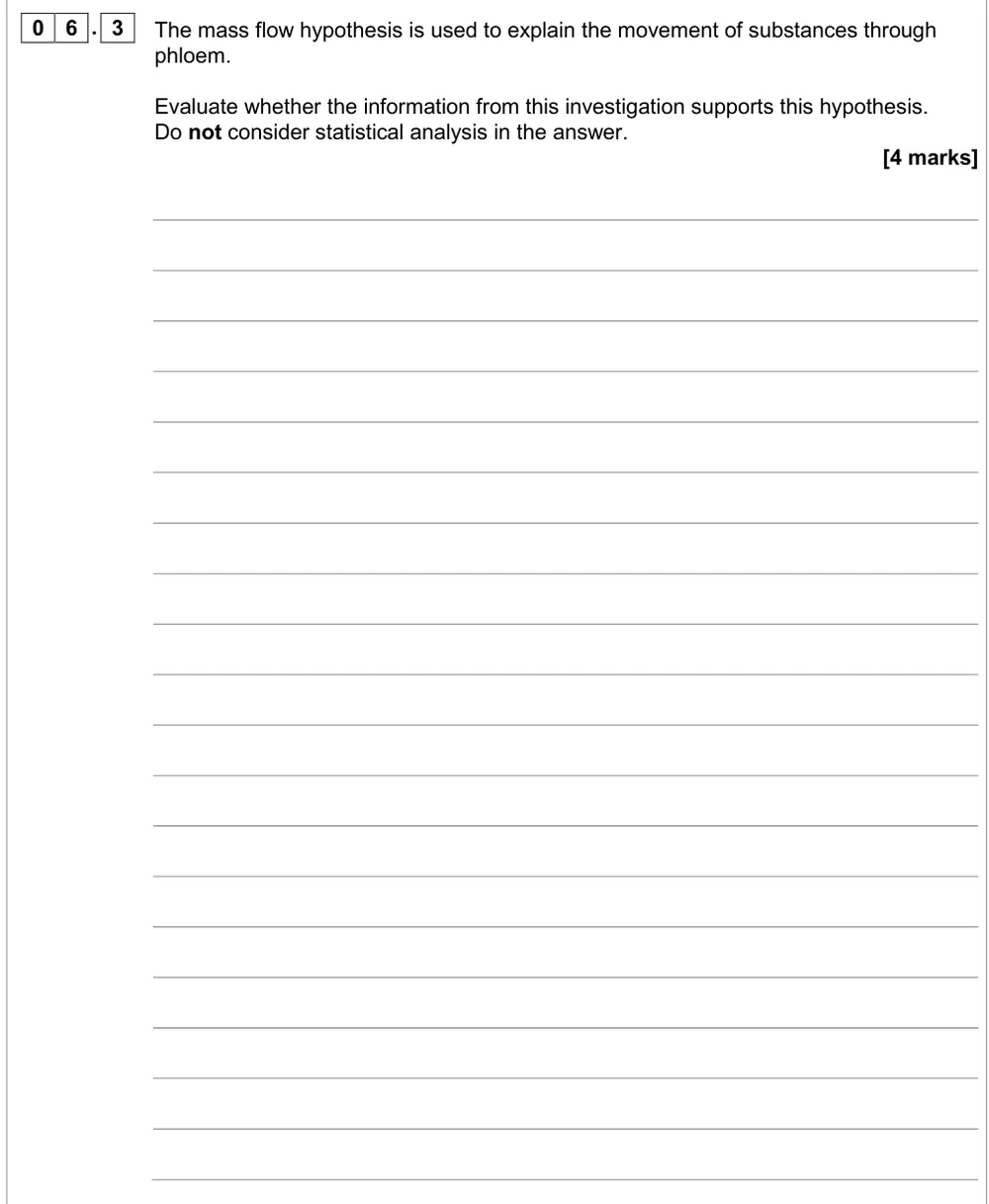
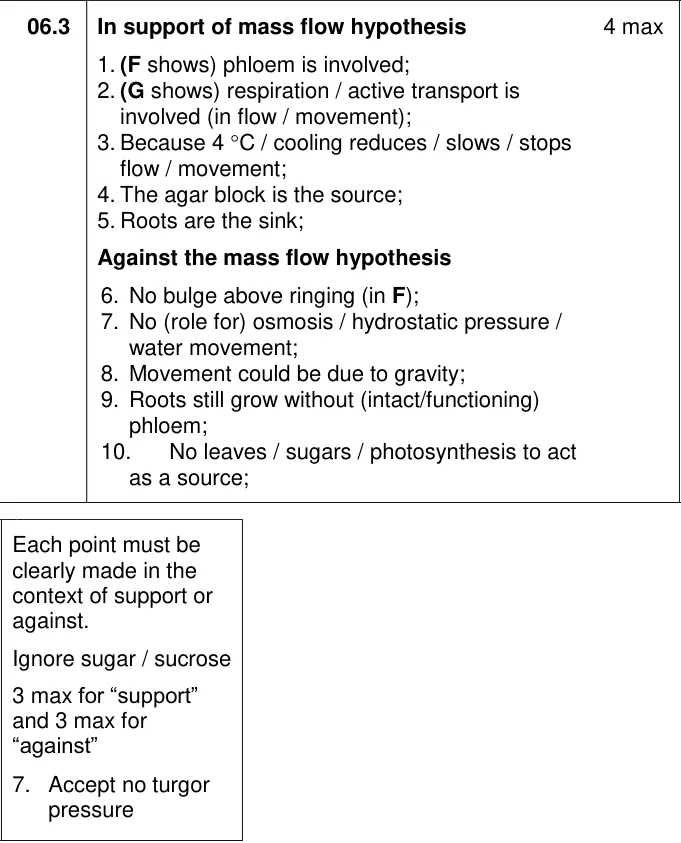
Evaluate whether the ringing experiment supports the mass flow hypothesis.
Show the mark scheme
Tap an image to open it full size.
From the examiners' report: Only 0.6% got all 4. Link each result to for or against: there was no bulge in F, the agar is the source and the roots the sink, and G points to respiration.
Question 13
A level Paper 1 · June 2018 · Q08.1 · 2 marks
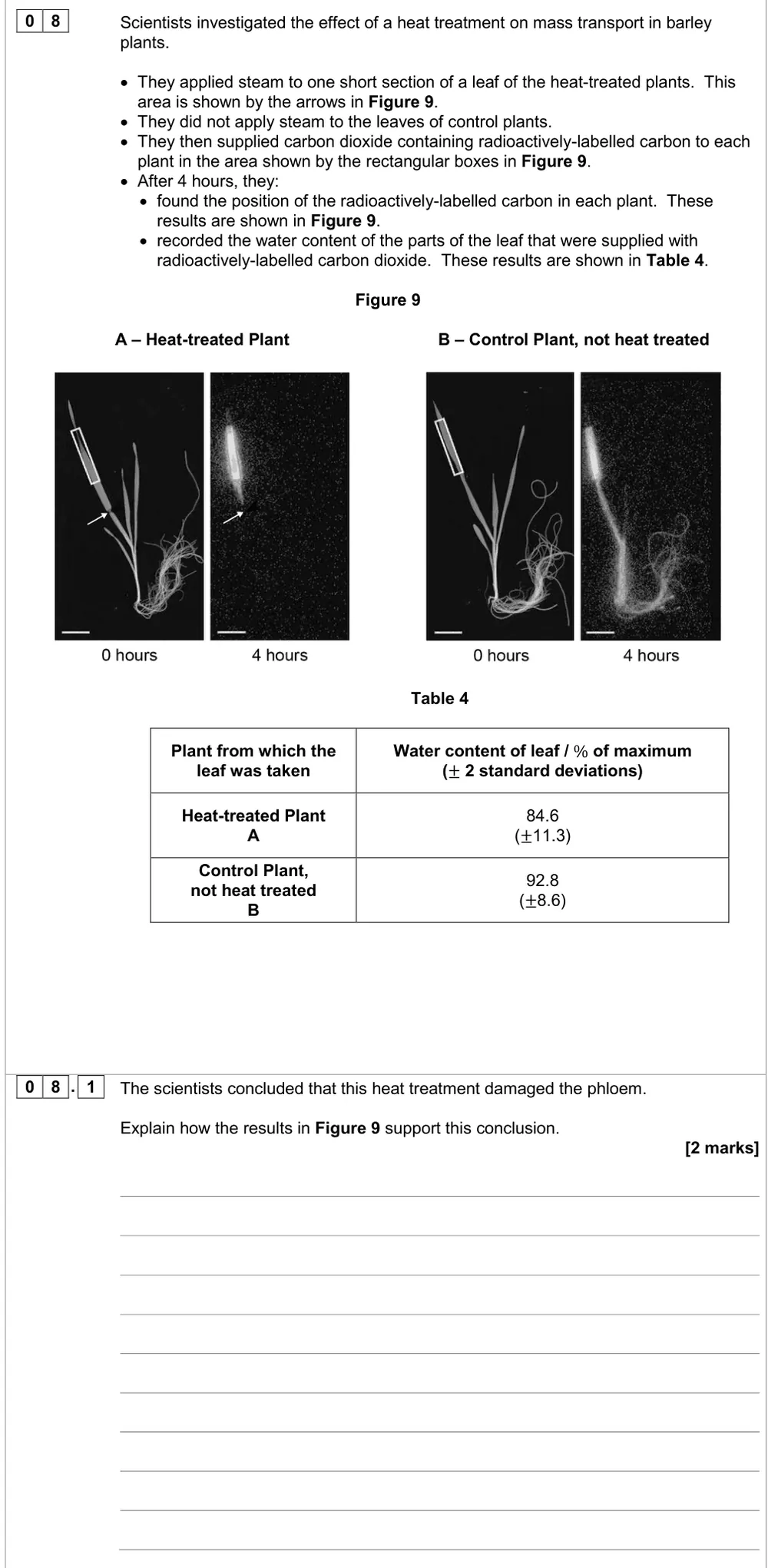
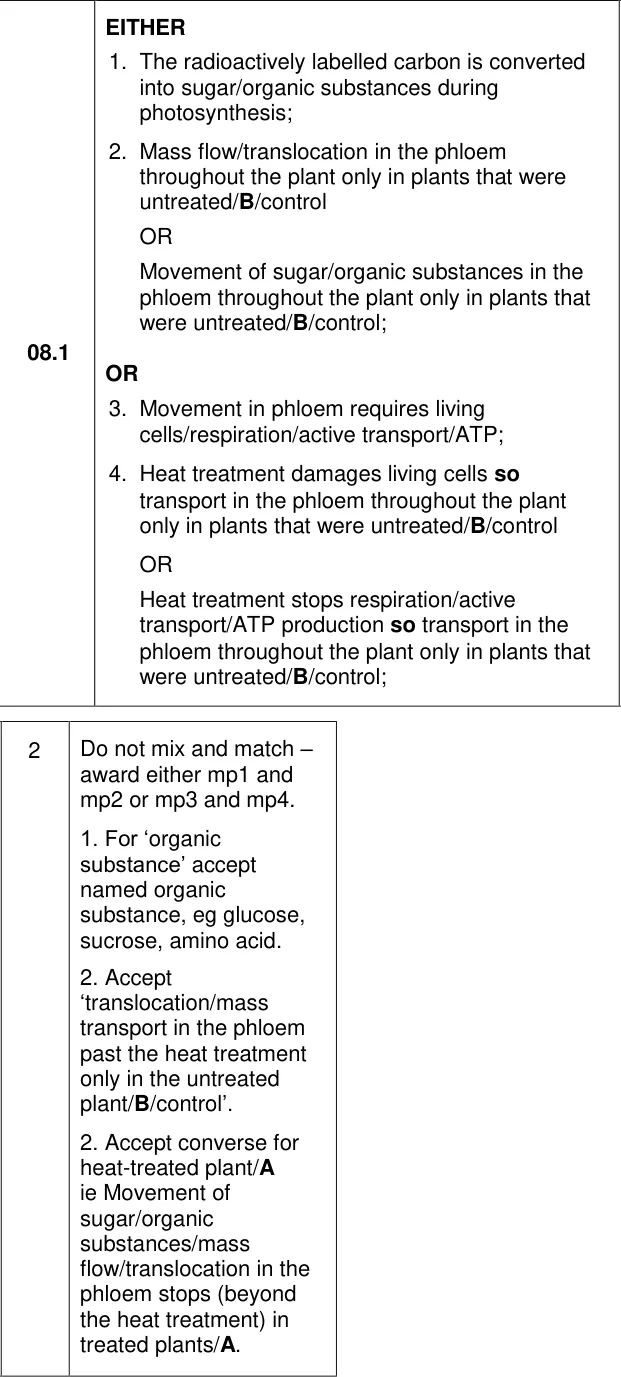
Explain how autoradiographs of barley plants show that heat treatment damaged the phloem.
Show the mark scheme
Tap an image to open it full size.
From the examiners' report: Nearly 60% made no headway, mostly by describing the images. Explain: the 14C goes into sugar by photosynthesis, and the sugar moves in the phloem, which stopped at the heat-treated section.
Question 14
AS Paper 1 · June 2025 · Q07.3 · 1 mark · Hard
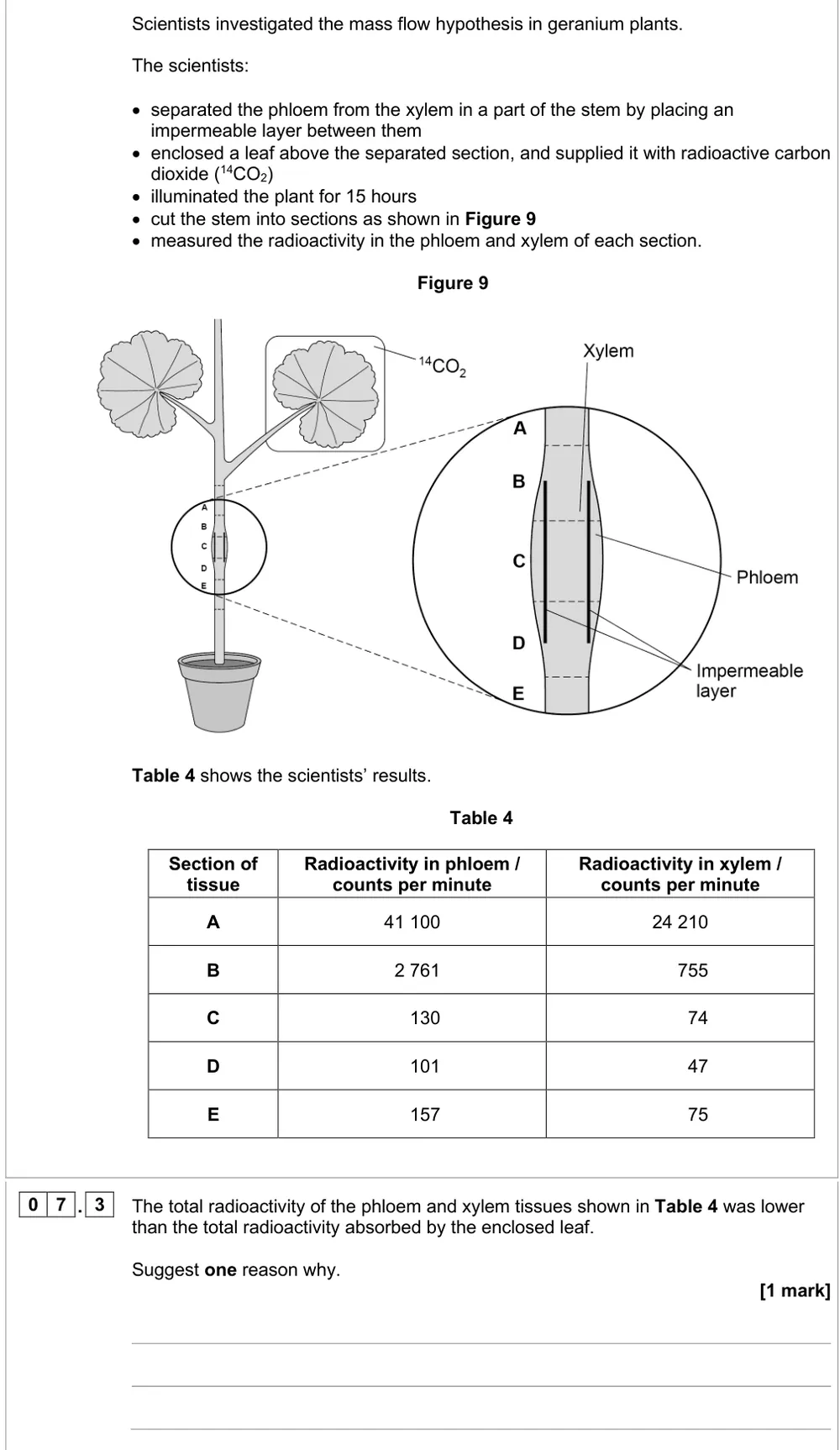
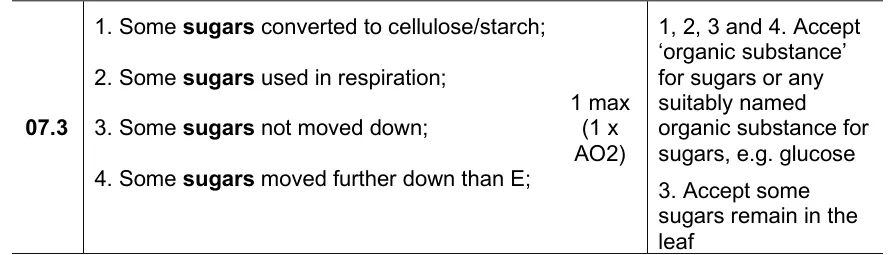
Suggest why less radioactivity was found in the stem than the leaf absorbed.
Show the mark scheme
Tap an image to open it full size.
From the examiners' report: Under 10% scored. The 14C ends up in sugars, so your answer must be about sugars, not 'radioactive material' or 'they were respired'.
Question 15
AS Paper 1 · June 2025 · Q07.4 · 4 marks · Hard
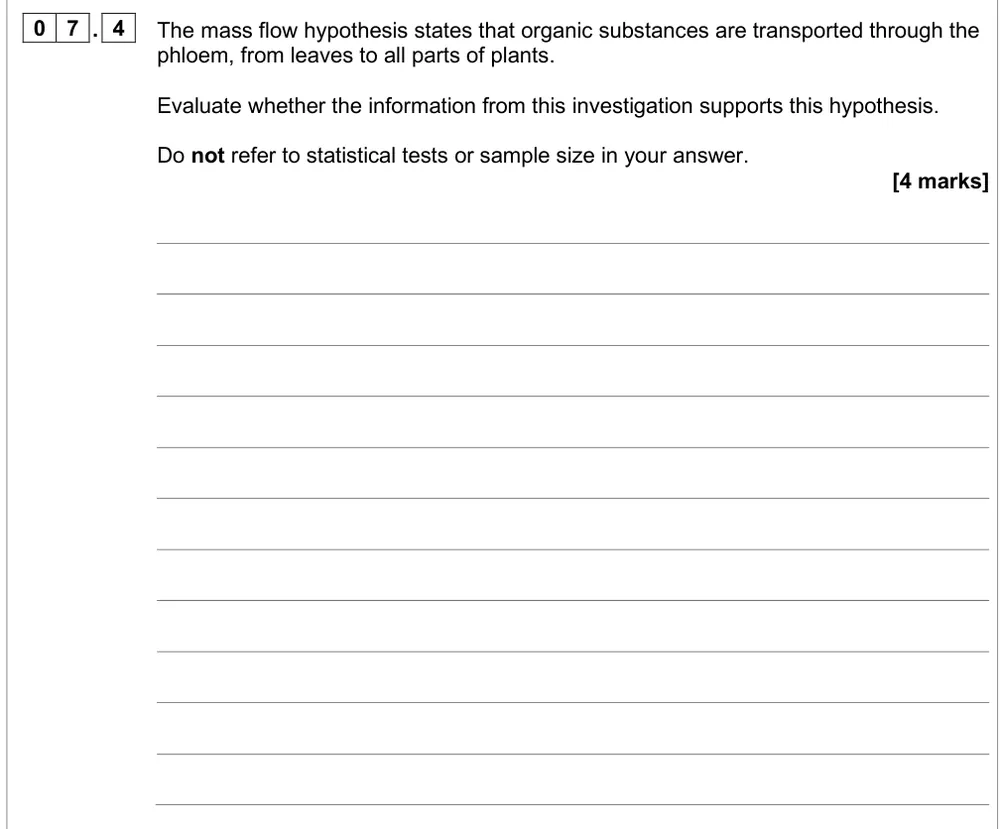
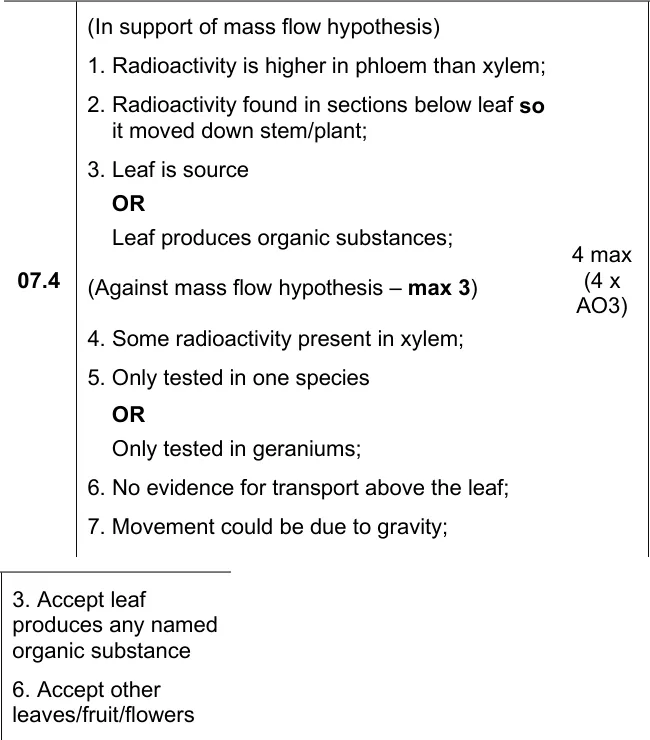
Evaluate whether the geranium tracer data support the mass flow hypothesis.
Show the mark scheme
Tap an image to open it full size.
From the examiners' report: Under 1% got all 4 and just over half scored zero. More in the phloem than the xylem supports it; some in the xylem counts against. Then look for what the data don't show, such as movement upwards.
Practical skills and data (3.3.4.2)
Question 16
AS Paper 2 · June 2019 · Q05.1 · 2 marks · Hard
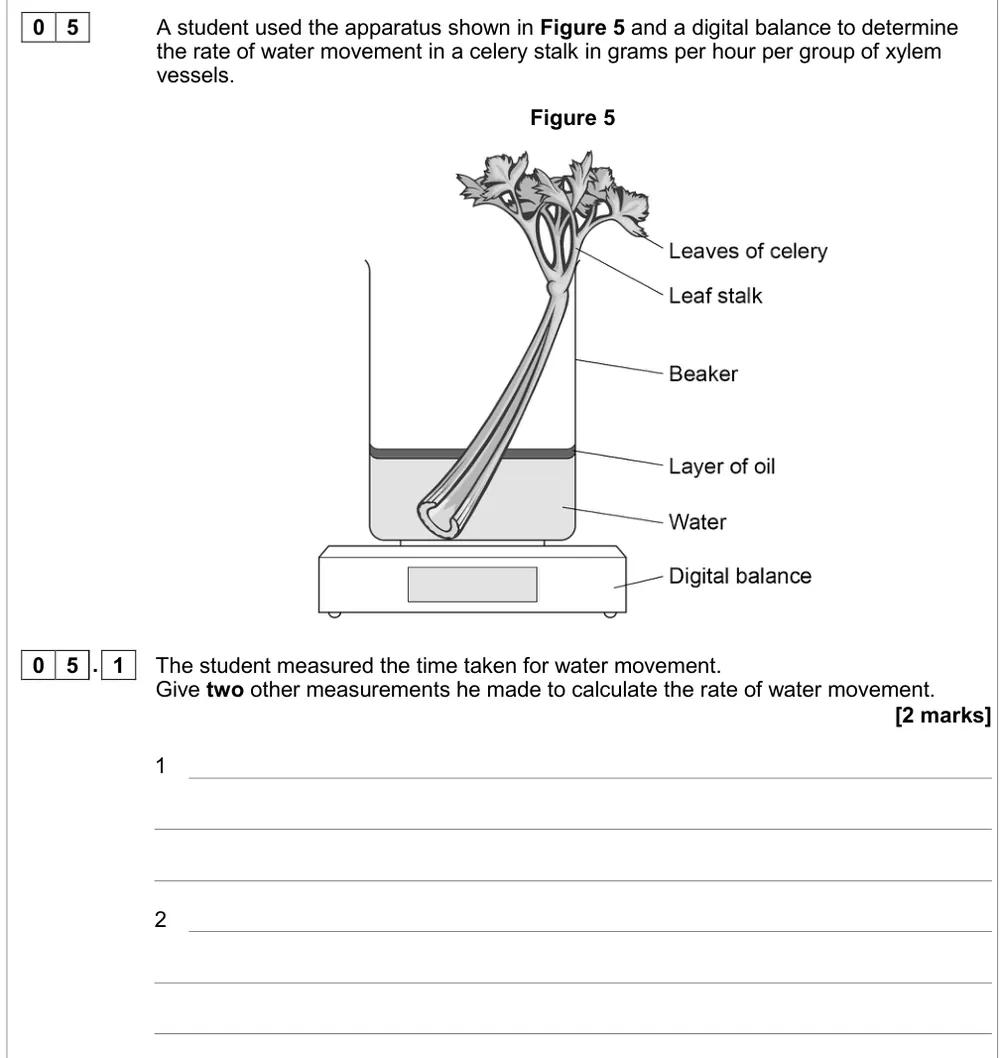
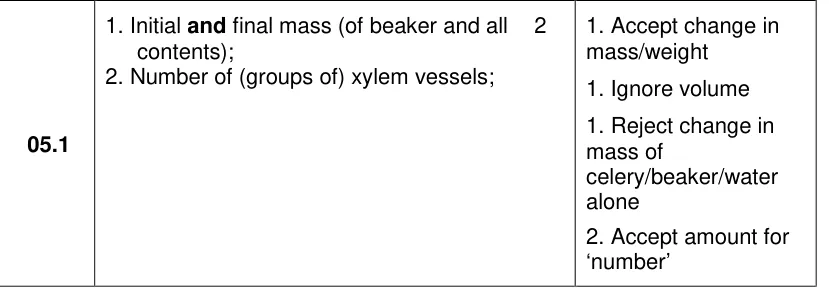
Give two measurements needed to find the rate of water movement in a celery stalk.
Show the mark scheme
Tap an image to open it full size.
From the examiners' report: Only about 2% got both marks. Use the apparatus and the units: the balance gives mass, and 'per group of xylem vessels' means count them.
Question 17
A level Paper 3 · June 2017 · Q06.3 · 1 mark
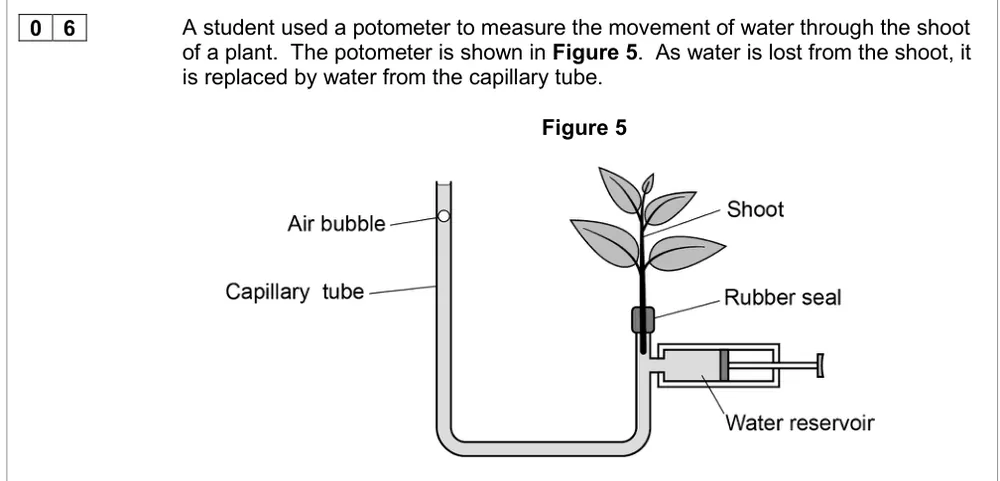
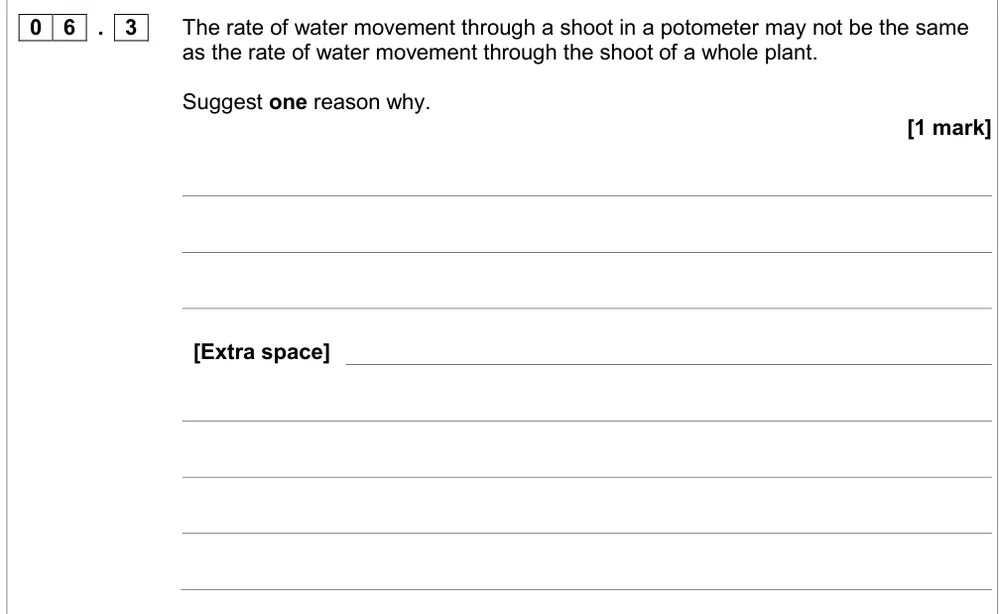
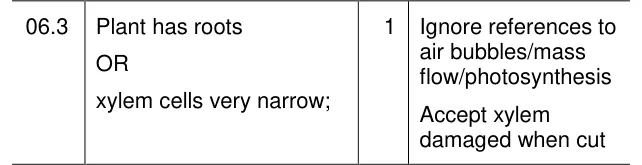
Suggest why water uptake by a cut shoot in a potometer may differ from a whole plant.
Information from earlier in this question:
Show the mark scheme
Tap an image to open it full size.
From the examiners' report: Only 17% noted that the shoot in the potometer has no roots, which is where water normally enters a plant.
Question 18
AS Paper 2 · June 2022 · Q07.2 · 4 marks · Hard
Use means and standard deviations to conclude which factors affect the shelf life of cut flowers.
Show the mark scheme
Tap an image to open it full size.
From the examiners' report: Less than 2% got all 4, though most spotted the SD overlap. Say whether each difference is significant and so whether that factor is linked with shelf life; don't bring in temperature or daylight.
Where students lose marks (from AQA examiners' reports and mark schemes)
Each point below is followed by wording that gained marks.
Say what creates the tension: Fewer than 5% got all 3 marks on why xylem must be a continuous tube: about half mentioned a water column, but very few said how tension is created. On the porous pot, only a small minority linked tension to evaporation.
✔ Gains credit: "Evaporation / transpiration creates tension (in column)"; "cohesion from H bonds between (all) water (molecules)".
No osmosis, source or sink in the xylem: About a third scored nothing on why coloured water moved up celery stalks. Many said water moved along the xylem down an osmotic gradient, or mixed in source and sink from translocation.
✔ Gains credit: "Water evaporates / is transpired; water potential gradient creates tension / pulls up water; hydrogen bonds / cohesion / adhesion maintains column."
Sucrose, not glucose: About 60% named the main carbohydrate carried in the phloem. Glucose was the common wrong answer, and weaker answers to the 5-mark sugar transport question had glucose, dead phloem cells or sugar moving in the xylem.
✔ Gains credit: "Sucrose"; "sucrose actively transported into phloem (cell) by companion / transfer cells".
Adding sucrose lowers the water potential: Only 25% got a mark for how pressure is generated in a phloem tube. Few said sucrose, some thought adding a solute raises the water potential, and many used cohesion-tension words.
✔ Gains credit: "Sucrose actively transported (into phloem); lowering / reducing water potential; water moves (into phloem) by osmosis (from xylem)."
Mass flow along the phloem, not diffusion: Many answers on carbohydrate transport described sugars diffusing along the phloem 'along a pressure gradient', said vaguely that sugar is 'respired at the sink', or had it diffuse out of the phloem.
✔ Gains credit: "Mass flow to respiring cells / storage tissue"; "unloaded / removed (from phloem) by active transport".
Turn the labelled carbon into sugar first: Under 10% scored on why the radioactivity in the stem was lower than the leaf took in, and nearly 60% made no headway on the heat-treated barley. Students didn't say the 14C ends up in sugars made in photosynthesis.
✔ Gains credit: "The radioactively labelled carbon is converted into sugar / organic substances during photosynthesis"; "some sugars used in respiration".
Name the source and sink in the experiment: Only 0.6% got all 4 marks evaluating the ringing experiment. Many described the hypothesis without using the results, mentioned a bulge that wasn't in the figure, or called leaves the source when there were none.
✔ Gains credit: "The agar block is the source"; "roots are the sink"; "(G shows) respiration / active transport is involved"; "no bulge above ringing (in F)".
Let the units tell you what to measure: Only about 2% got both marks for the measurements needed for a rate in grams per hour per group of xylem vessels. 'Measure volume' and 'change in mass of the beaker' didn't score, and few counted the xylem vessels.
✔ Gains credit: "Initial and final mass (of beaker and all contents)"; "number of (groups of) xylem vessels".
Download the questions
Download the PDF pack (18 questions, mark schemes at the end)
Keep practising
- Transport across cell membranes: AQA A Level Biology exam questions by topic
- Monomers, water and inorganic ions: AQA A Level Biology exam questions by topic
- Gas exchange: AQA A Level Biology exam questions by topic
- Blood vessels and tissue fluid: AQA A Level Biology exam questions by topic
- AQA A Level Biology masterclasses
Questions, mark schemes and examiners' report extracts © AQA.