

OCR A 4.2.2 · 5 exam questions worked through · about 15 minutes
Studying A-level Biology? I'm Tom, an A-level Biology teacher with 30 years' experience. I offer one-to-one lessons and weekly group classes for AQA and OCR A, with every lesson recorded.
This post covers OCR A specification 4.2.2, classification and evolution: the five kingdoms and three domains, the evidence used to classify organisms, and the evidence for evolution by natural selection. Work through five real OCR questions and you'll see exactly what the mark schemes credit and where the examiners say marks were lost.
What you need to know first
- The taxonomic hierarchy: domain, kingdom, phylum, class, order, family, genus, species
- The five kingdoms (Prokaryotae, Protoctista, Fungi, Plantae, Animalia) and the three domains (Archaea, Bacteria, Eukarya)
- That similarities in biological molecules are used as evidence of how closely organisms are related
- The outline of natural selection: variation, a selection pressure, survival and reproduction, alleles passed on
Question 1: Five kingdoms and three domains (2 marks)
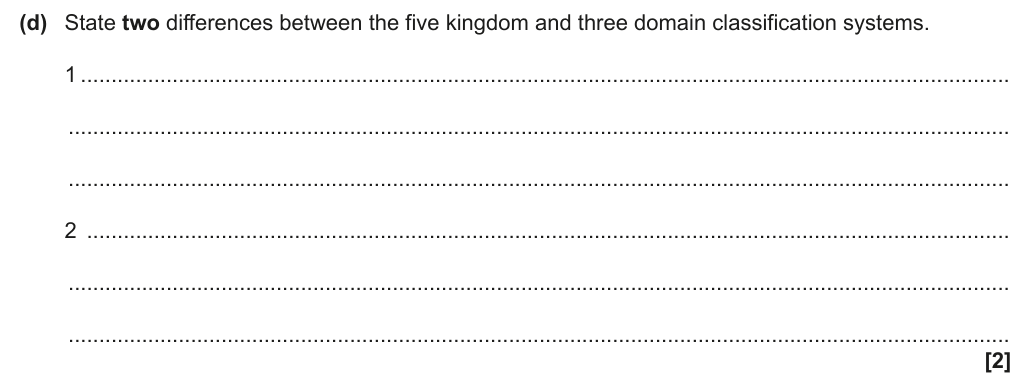
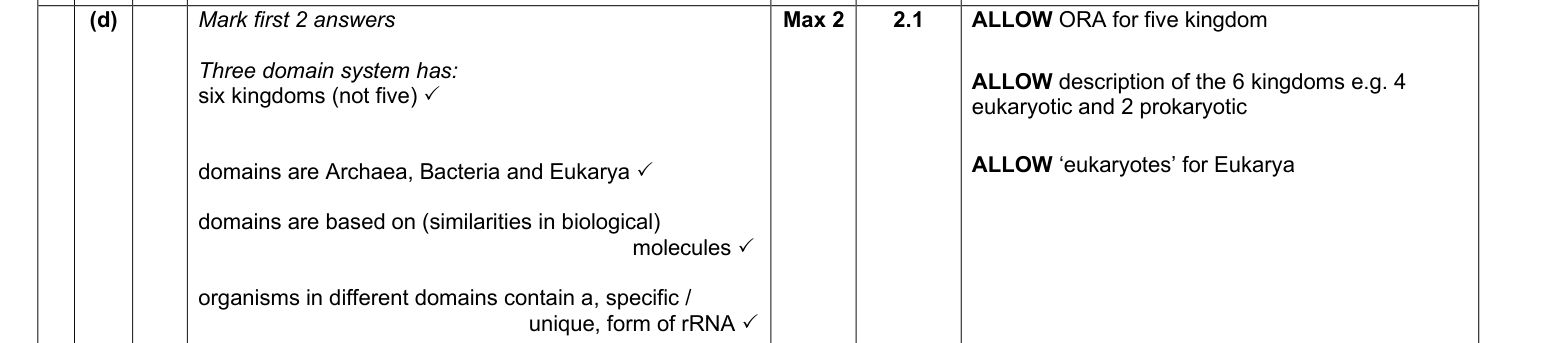
How to approach it. Give two differences in the systems themselves. The three domain system has six kingdoms, not five. Its domains are Archaea, Bacteria and Eukarya. It is based on similarities in biological molecules, and organisms in different domains have their own form of rRNA. Any two of these, written clearly, get both marks.
Mark scheme
Common mistakes (from OCR's examiners' reports and mark schemes)
- Writing about when each system was proposed. The examiners' report says many candidates said the three domain system is more recent, which was not credited because it is not a feature of the classification system. Gains credit: "the three domain system has six kingdoms, not five".
- Giving a weak point first. The mark scheme says only the first two answers are marked. Gains credit: leading with your two strongest points, for example the six kingdoms and "the domains are Archaea, Bacteria and Eukarya".
Question 2: Same domain, different kingdoms (2 marks)
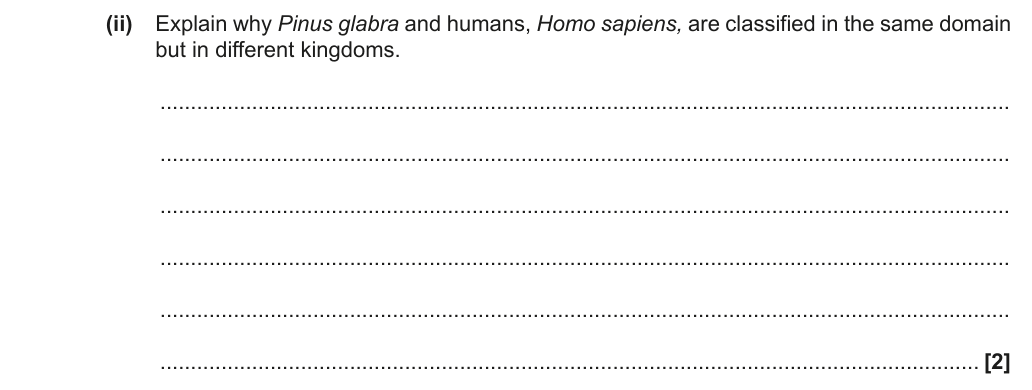
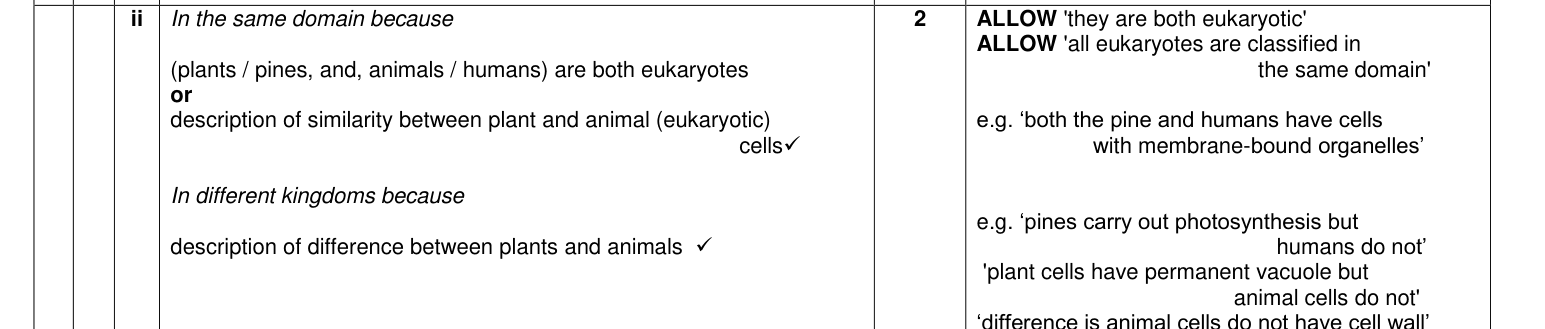
How to approach it. The question has two halves and there is one mark for each. Same domain: both are eukaryotes, or give a similarity such as both having cells with membrane-bound organelles. Different kingdoms: give a difference between plants and animals, written as a comparison, for example pines photosynthesise but humans do not.
Mark scheme
Common mistakes (from OCR's examiners' reports and mark schemes)
- Saying one is a plant and the other an animal, with no reason. The examiners' report says many candidates recognised this but did not explain why they are classified that way. Gains credit: a difference between them, for example "pine cells have a cell wall but human cells do not".
- Describing only one of the two organisms. The report says many attempts at a difference were not comparative and did not gain the mark. Gains credit: both sides in one sentence: "pines carry out photosynthesis but humans do not".
Question 3: Using molecular evidence to compare domains (3 marks)
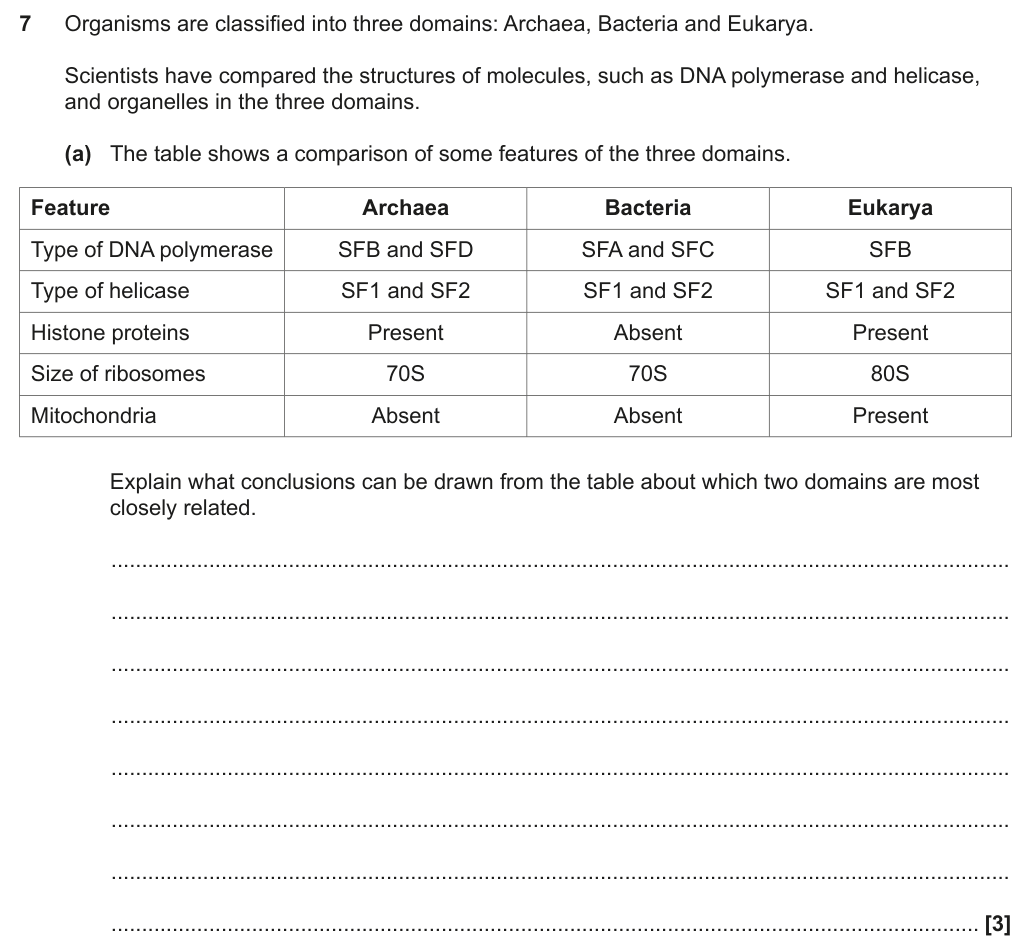
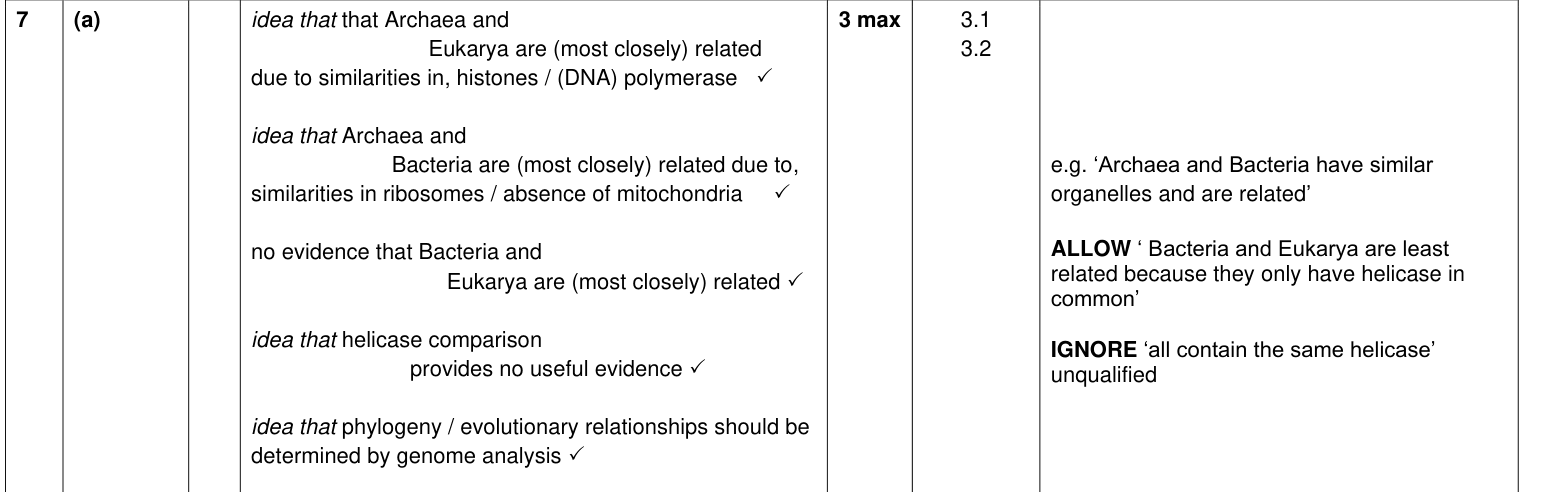
How to approach it. Each mark needs a conclusion about which domains are related, backed by a row of the table. Archaea and Eukarya look closely related because both have histone proteins and share a type of DNA polymerase. Archaea and Bacteria also look related because both have 70S ribosomes and no mitochondria. Bacteria and Eukarya have only helicase in common, so they are the least related. The helicase is the same in all three domains, so it gives no useful evidence.
Mark scheme
Common mistakes (from OCR's examiners' reports and mark schemes)
- Listing similarities from the table without saying what they show. The examiners' report says less successful responses stated the similarities but did not relate them to the question. Gains credit: "Archaea and Eukarya are closely related because both have histone proteins".
- Stopping after two conclusions. The report says few candidates went on to say that Bacteria and Eukarya are the least related, or that the helicase comparison gives no useful evidence. Gains credit: "Bacteria and Eukarya are the least related because they only have helicase in common".
- Writing "all contain the same helicase" and leaving it there. The mark scheme ignores this unless it is qualified. Gains credit: "all three have the same helicase, so helicase gives no useful evidence".
Question 4: Antibiotic resistance as evidence for evolution (2 marks)
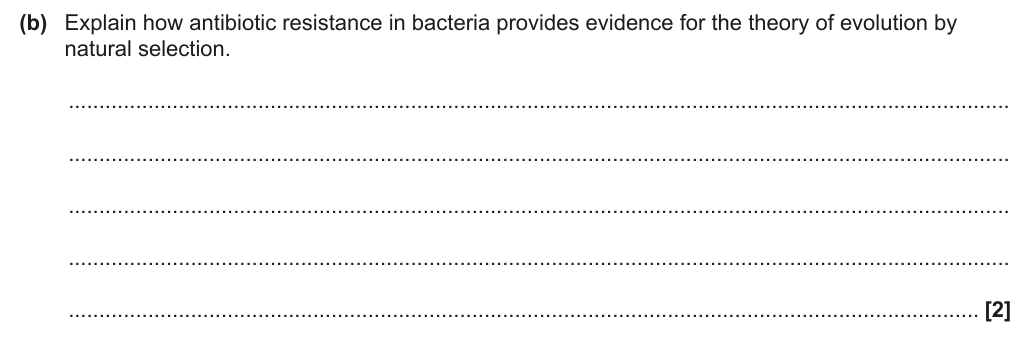
How to approach it. Read the command carefully: you are asked why resistance counts as evidence, not how resistance arises. The antibiotic acts as a selection pressure. The change in the population can actually be observed, and it happens in a short time because bacteria reproduce quickly.
Mark scheme

Common mistakes (from OCR's examiners' reports and mark schemes)
- Explaining how bacteria evolve resistance. The examiners' report says most responses did this thoroughly, but almost all missed the part of the question about evidence. Gains credit: "evolution can be observed happening".
- Stopping at the selection pressure. The report says many responses gained that mark, but the other two marking points were very rarely given. Gains credit: "the change is seen in a short period of time", or "within a human lifetime because bacteria reproduce quickly".
Question 5: Fossils as evidence for evolution (3 marks)
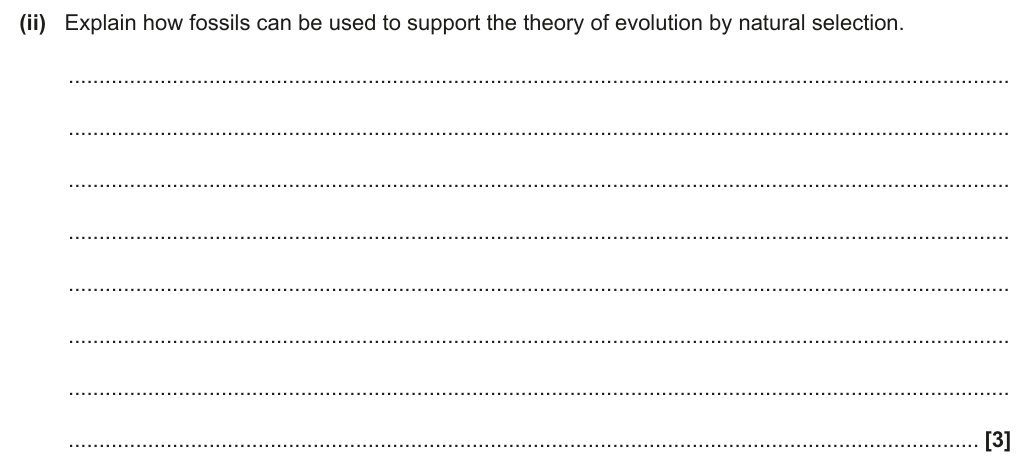
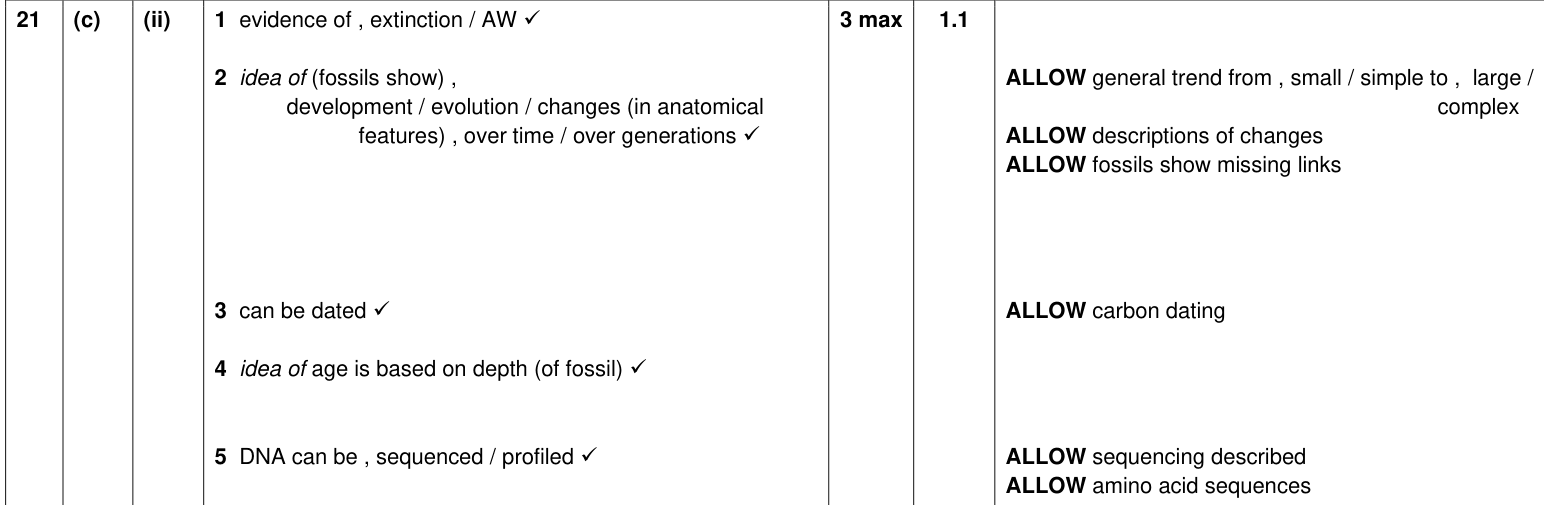
How to approach it. There are three marks, so make three different points. Fossils show changes in anatomical features over time. They can be dated, and the deeper a fossil is, the older it is. They are evidence that species have become extinct. DNA from fossils can also be sequenced and compared.
Mark scheme
Common mistakes (from OCR's examiners' reports and mark schemes)
- Making one point only. The examiners' report says candidates generally did not get all the marks, and the mark most often given was for features changing over time. Gains credit: adding a second and third idea, such as "fossils can be dated" and "deeper fossils are older".
- Leaving out extinction and molecular evidence. The report says only a few candidates used these. Gains credit: "fossils are evidence of extinction" or "DNA from fossils can be sequenced".
Key points to remember
- Three domains: Archaea, Bacteria and Eukarya, with six kingdoms. The system is based on similarities in molecules such as rRNA.
- When you are asked for a difference, write about both things in the same sentence.
- In data questions, give the conclusion and the evidence together: which groups are related, and which row shows it.
- "Evidence for evolution" questions want the evidence, not a description of natural selection.
- Fossils: change over time, dating and depth, extinction, and DNA that can be sequenced.
Practise next
- OCR A classification and evolution exam questions by topic
- Classification and evolution written quiz
- All OCR A Level Biology revision resources
Studying this for OCR A? My weekly OCR A Year 12 masterclass works through topics like this with real exam questions. See the timetable or book a first one-to-one lesson.
Questions, mark schemes and examiners' report comments © OCR.