

Classification and evolution sits next to biodiversity in Module 4, and it's one of those topics that looks like easy recall until you see the mark scheme. Spec point 4.2.2 asks you to know the taxonomic hierarchy and the binomial system, the five kingdoms and the three domains, how classification links to phylogeny, and the evidence for evolution. It then covers the types of variation and adaptation, how natural selection changes a population, and why the evolution of pesticide and antibiotic resistance matters to us.
Most of the lost marks here come down to precision. Students write that the binomial system is "universal" without saying why that helps, give a cell wall as a plant feature without saying it's made of cellulose, define classification and phylogeny separately instead of linking them, and explain how resistance evolves when the question asked why it is evidence for evolution.
Work through the seventeen questions below in order. They start with classification, move on to variation and adaptation, and finish with natural selection and the evidence for it. If you'd like to go through questions like these with me each week, my OCR A masterclasses run on Wednesdays at 5.15pm for Year 12 and on Tuesdays at 6.30pm or Thursdays at 5.15pm for Year 13.
Want help with this topic? It comes up in my weekly OCR A masterclasses. See the timetable →
What you need from GCSE
Each question on this page assumes you're secure on these GCSE ideas. If any of them feels shaky, look it up before you start.
- Living things are classified into groups: kingdom, phylum, class, order, family, genus and species.
- Each species has a two-part scientific name, the genus followed by the species, e.g. Homo sapiens.
- Variation between individuals can be caused by their genes, their environment or both.
- Darwin's theory: individuals vary, the best suited survive and breed, and pass their alleles on, so a species changes over many generations.
- Fossils and antibiotic-resistant bacteria are evidence for evolution.
Key terms
These words come up in the questions and mark schemes. Examiners expect you to use them exactly.
- Taxonomic hierarchy: domain, kingdom, phylum, class, order, family, genus, species: each group sits inside the one above it.
- Binomial system: naming a species by its genus (capital letter) and species (lower case), so every species has one unique, internationally used name.
- Domain: the highest taxonomic rank: Archaea, Bacteria and Eukarya, based on differences in biological molecules such as rRNA.
- Phylogeny: the evolutionary history and relationships of organisms; classification is based on it.
- Intraspecific and interspecific variation: differences between individuals of the same species; differences between different species.
- Continuous and discontinuous variation: a characteristic with a range of values, usually polygenic and affected by the environment (e.g. length); one with distinct categories, usually controlled by one or a few genes (e.g. blood group).
- Anatomical, physiological and behavioural adaptations: body structures; body processes and biochemistry; the way an organism acts.
- Convergent evolution: unrelated organisms evolve similar features because they adapt to similar environments or ways of life.
- Selection pressure: an environmental factor, such as a predator or an antibiotic, that makes some phenotypes more likely to survive and reproduce than others.
What these questions cover (OCR 4.2.2)
The questions test these learning outcomes from the OCR A Level Biology A specification (H420):
- (a) the biological classification of species
- (b) the binomial system of naming species and the advantage of such a system
- (c)(i) the features used to classify organisms into the five kingdoms: Prokaryotae, Protoctista, Fungi, Plantae, Animalia
- (c)(ii) the evidence that has led to new classification systems, such as the three domains of life, which clarifies relationships (including a comparison of the five kingdom and three domain systems)
- (d) the relationship between classification and phylogeny
- (e) the evidence for the theory of evolution by natural selection (including Darwin and Wallace, fossil, DNA and molecular evidence)
- (f) the different types of variation
- (g) the different types of adaptations of organisms to their environment
- (h) the mechanism by which natural selection can affect the characteristics of a population over time
- (i) how evolution in some species has implications for human populations (pesticide resistance in insects and drug resistance in microorganisms)
How to use this page
Write your answer on paper before you open the mark scheme. Allow about 1.2 minutes per mark: the 17 questions are worth 38 marks, so about 46 minutes in total. Then mark your answer strictly against the mark scheme and read the examiners' tip underneath it. If you'd rather print the questions, download the PDF pack.
Classification
Question 1
A level Paper 3 · June 2018 · Q5(a)(ii) · 2 marks · Easy
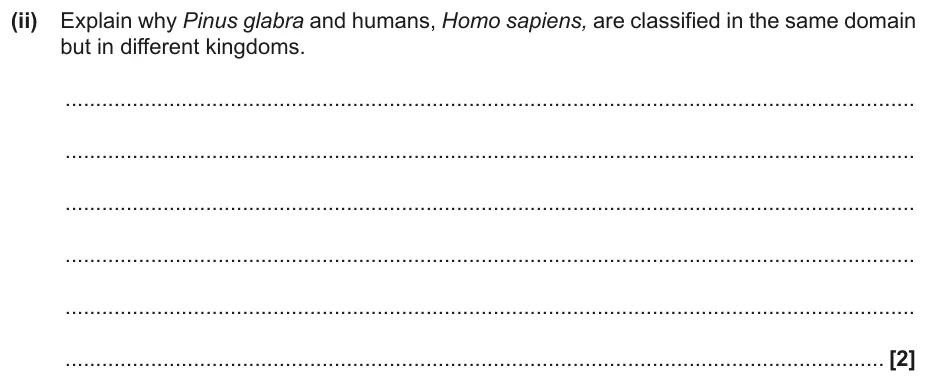
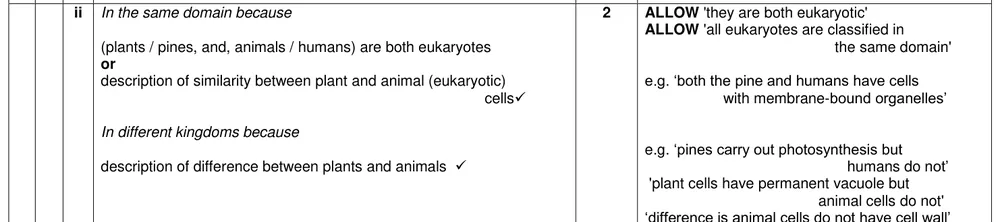
Explain why a pine tree and humans are in the same domain but different kingdoms.
Show the mark scheme
Tap an image to open it full size.
From the examiners' report: Saying "one is a plant and one is an animal" doesn't explain anything. Give a comparative difference, such as plant cells have a cellulose cell wall but animal cells do not.
Question 2
AS Paper 1 · June 2023 · Q24(c) · 3 marks · Medium
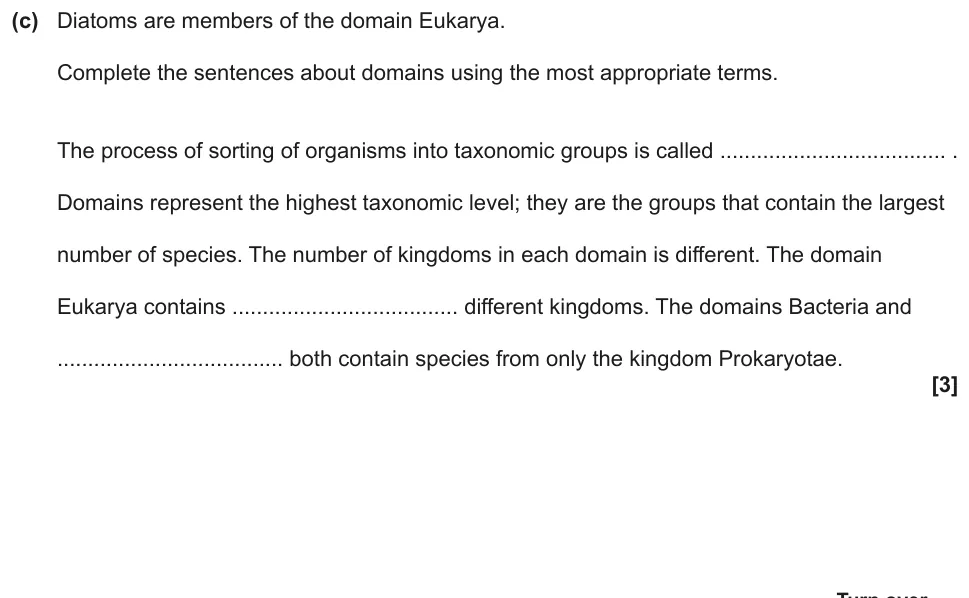
Complete sentences about classification and the three domains.
Show the mark scheme

Tap an image to open it full size.
From the examiners' report: Read the whole paragraph before you fill in any gaps, so you know what each sentence is building towards. Eukarya contains four kingdoms; Bacteria and Archaea contain only prokaryotes.
Question 3
AS Paper 2 · June 2025 · Q4(a)(i) · 1 mark · Hard
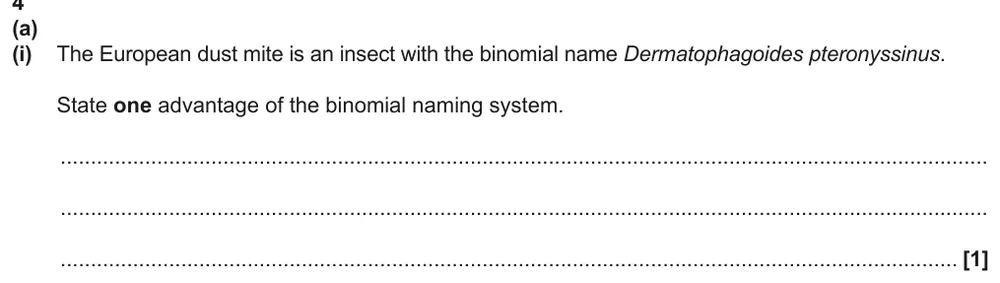
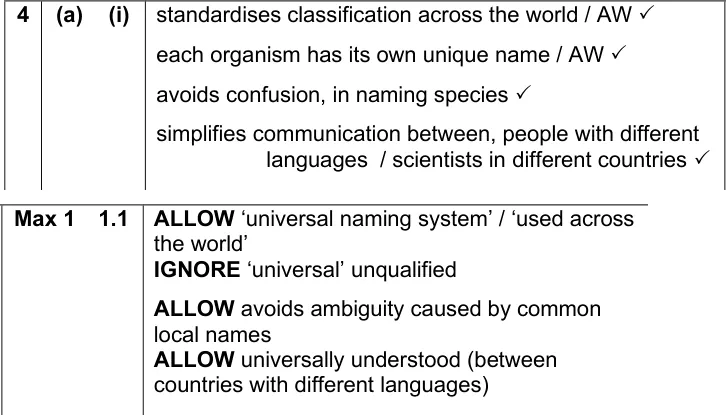
State one advantage of the binomial naming system.
Show the mark scheme
Tap an image to open it full size.
From the examiners' report: "It's universal" isn't enough. Say what that achieves: each species has one unique name, so scientists in different countries know exactly which organism is meant.
Question 4
AS Paper 2 · June 2025 · Q4(b) · 2 marks · Medium
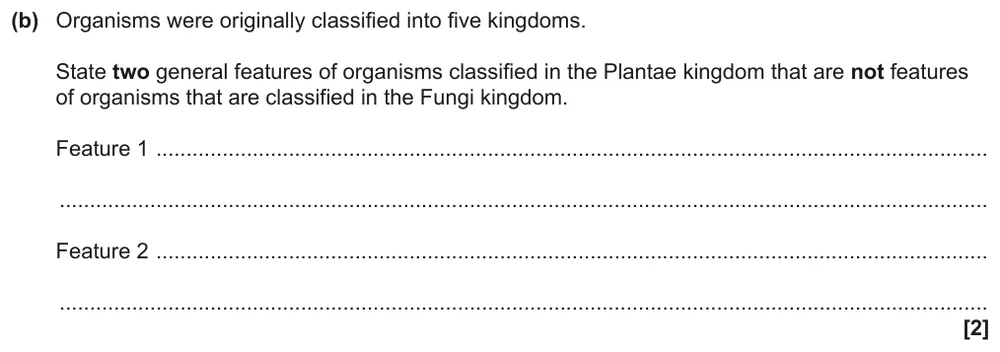
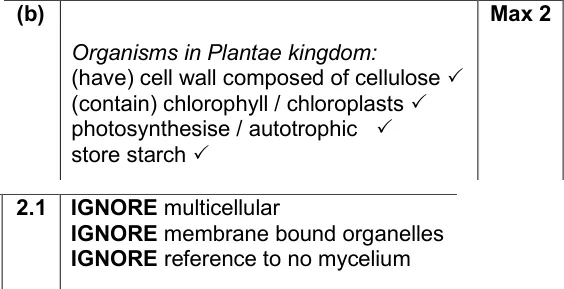
State two features of the Plantae kingdom that fungi don't have.
Show the mark scheme
Tap an image to open it full size.
From the examiners' report: Fungi have cell walls too, so say the plant cell wall is made of cellulose. Chloroplasts, photosynthesis and starch storage all score; vacuoles don't.
Question 5
AS Paper 2 · June 2025 · Q4(c) · 1 mark · Medium
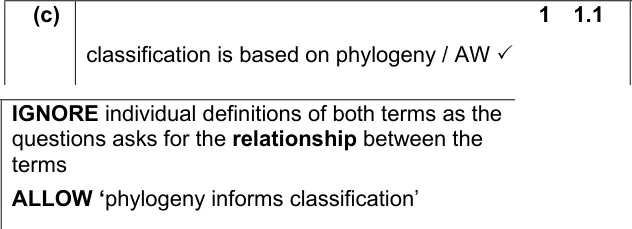
State the relationship between classification and phylogeny.

Show the mark scheme
Tap an image to open it full size.
From the examiners' report: Don't define the two words separately: the question asks how they're linked. Classification is based on phylogeny, not the other way round.
Question 6
AS Paper 2 · June 2025 · Q4(d) · 2 marks · Hard
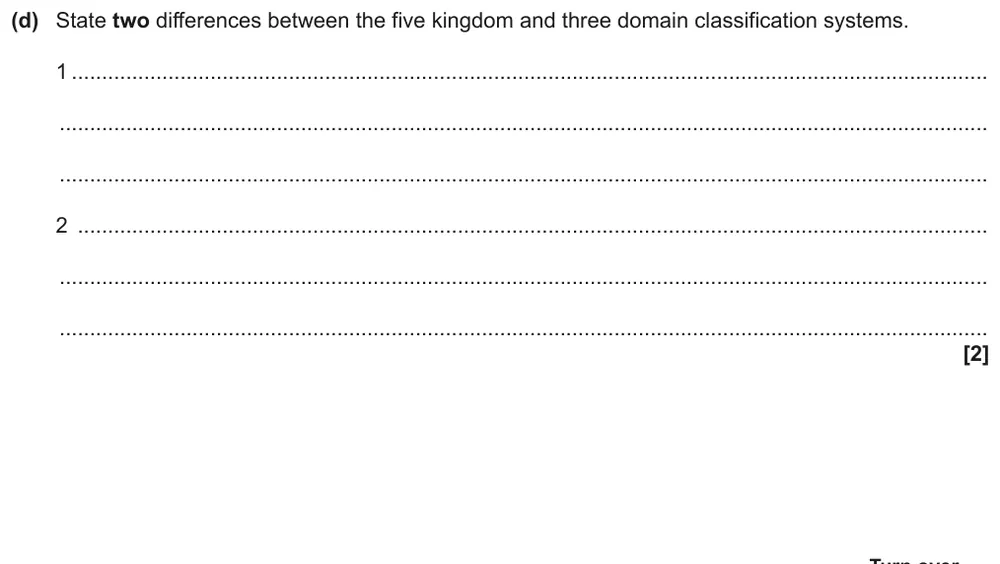
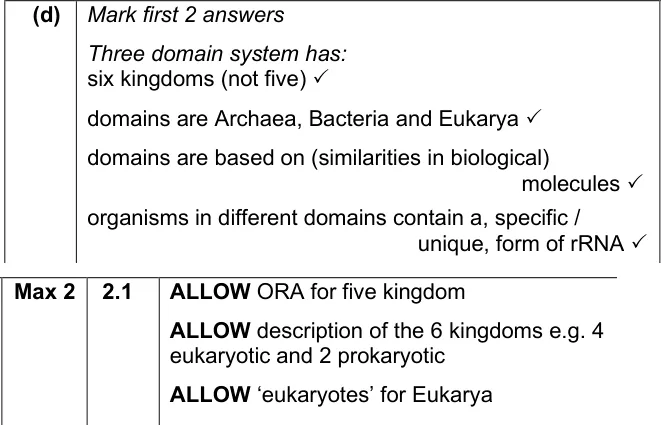
State two differences between the five kingdom and three domain systems.
Show the mark scheme
Tap an image to open it full size.
From the examiners' report: Give differences in the systems themselves: six kingdoms instead of five, the names of the three domains, and grouping by biological molecules such as rRNA. When each system was proposed doesn't count.
Variation and adaptation
Question 7
AS Paper 2 · June 2019 · Q3(a)(ii) · 2 marks · Medium
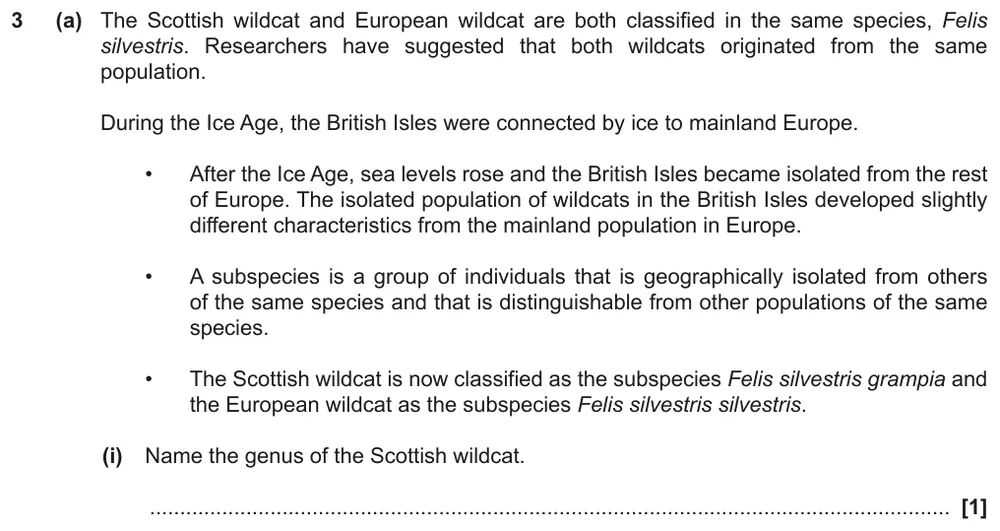
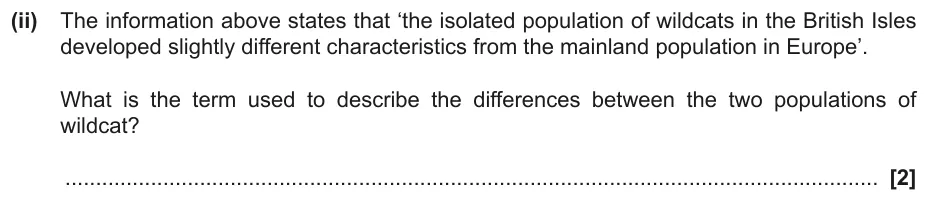
Name the type of variation between two populations of wildcat.
Information from earlier in this question:
Show the mark scheme

Tap an image to open it full size.
From the examiners' report: Both wildcats are the same species, so the term is intraspecific variation. "Genetic variation" only earned one of the two marks.
Question 8
A level Paper 2 · June 2018 · Q20(a)(iv) · 2 marks · Medium
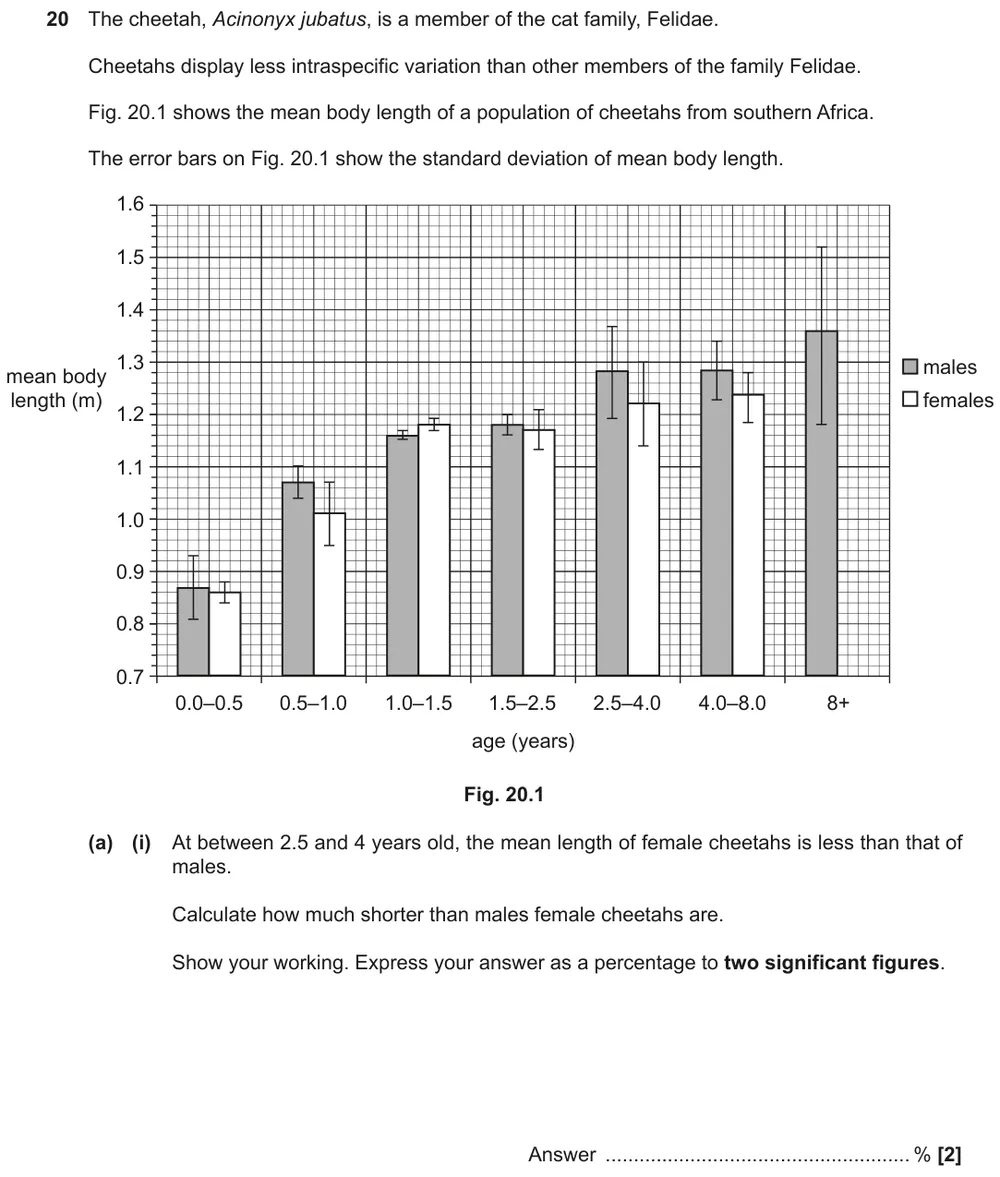
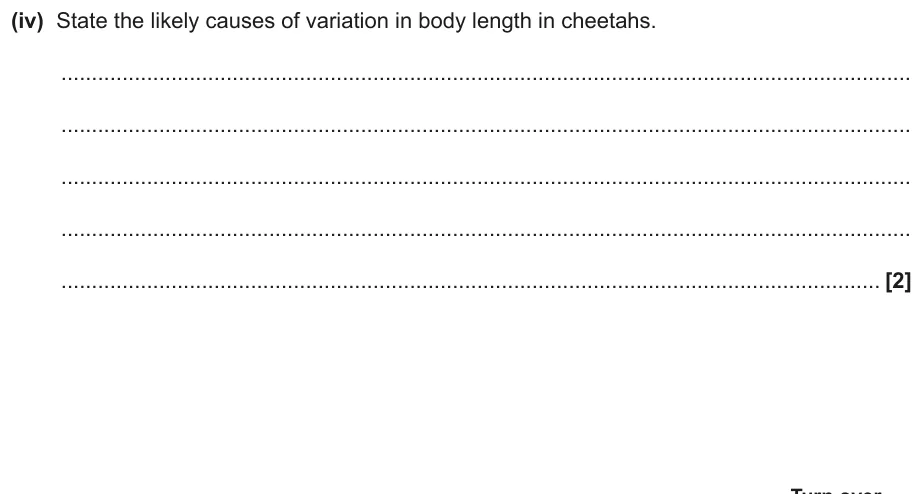
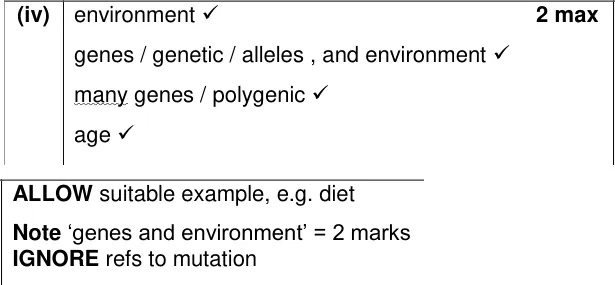
State the likely causes of variation in body length in cheetahs.
Information from earlier in this question:
Show the mark scheme
Tap an image to open it full size.
From the examiners' report: "State" means short, direct points: "genes and environment" was enough for both marks. Body length is continuous, so don't put it down to genes alone.
Question 9
A level Paper 3 · June 2023 · Q4(b)(ii) · 2 marks · Easy
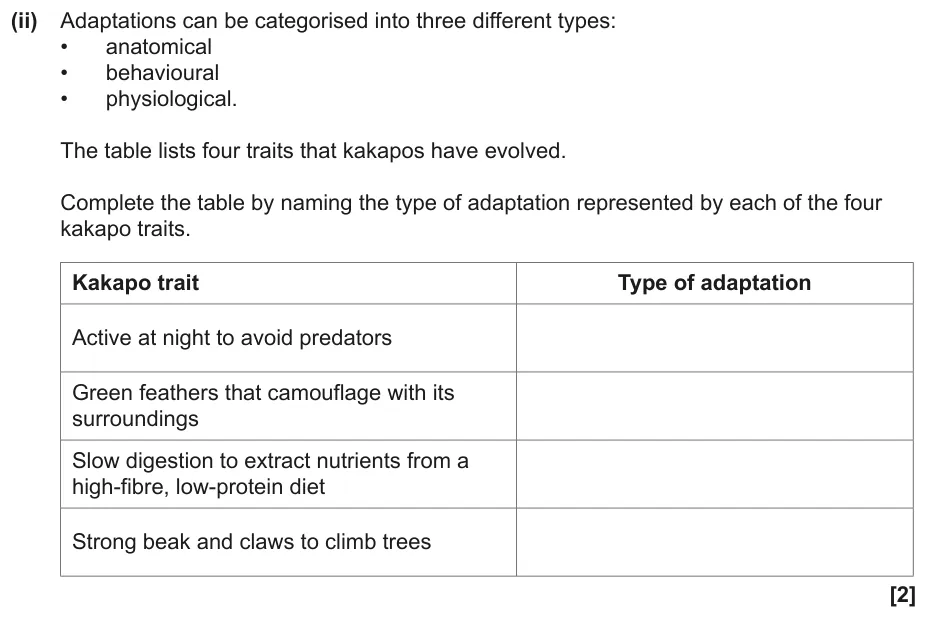
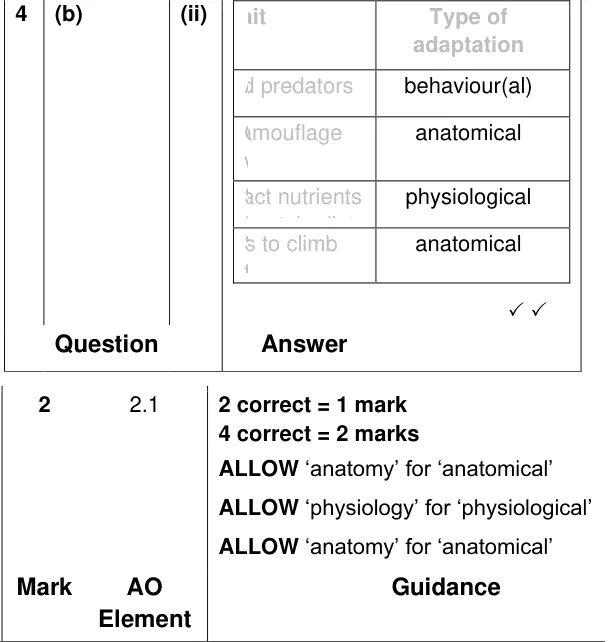
Classify four kakapo traits as anatomical, behavioural or physiological adaptations.
Show the mark scheme
Tap an image to open it full size.
From the examiners' report: Anatomical means a body structure, like feathers, beaks and claws; physiological means a body process, like digestion. Don't mix them up.
Natural selection and the evidence for it
Question 10
AS Paper 2 · June 2022 · Q6(b) · 4 marks · Medium
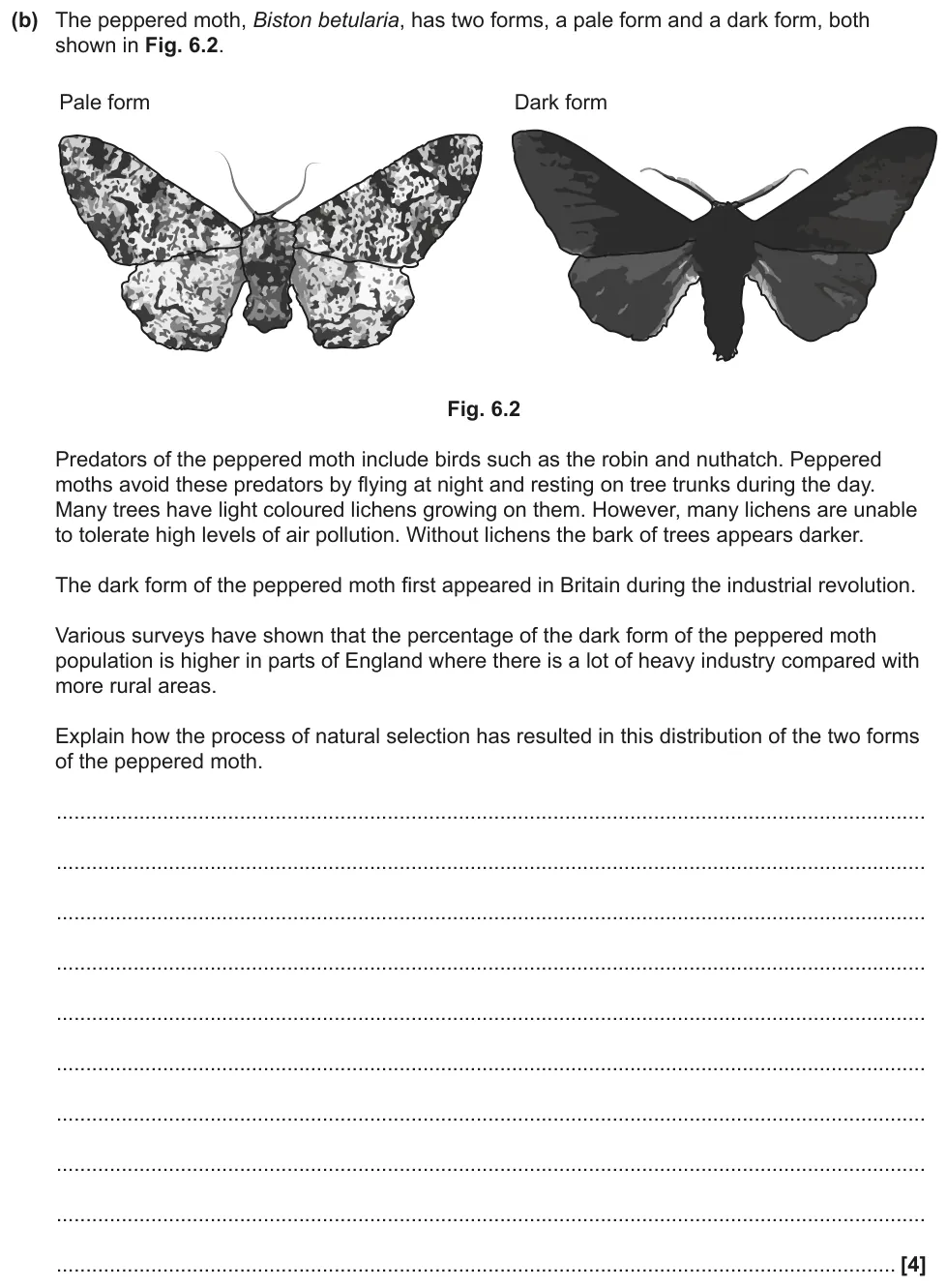
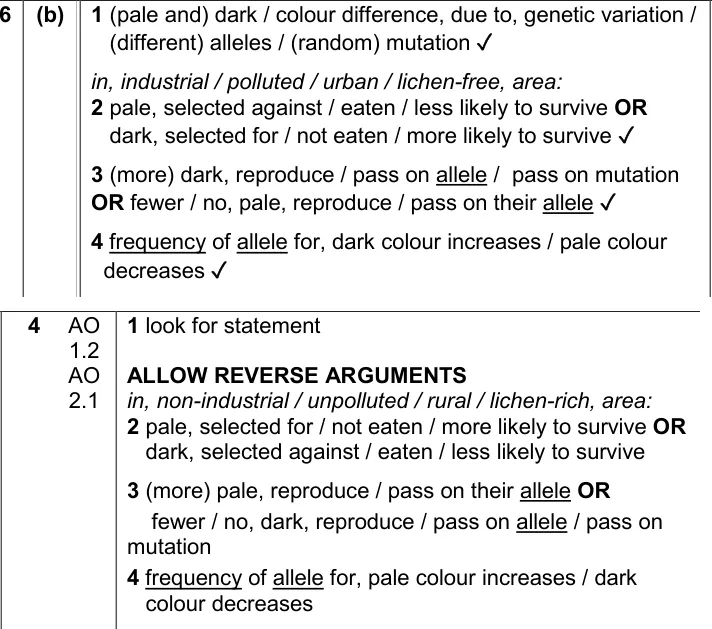
Explain how natural selection produced the distribution of pale and dark peppered moths.
Show the mark scheme
Tap an image to open it full size.
From the examiners' report: Don't copy the passage back. Pull out the steps: variation from different alleles, the pale form is eaten in polluted areas, dark moths survive and pass on their allele, so its frequency rises.
Question 11
AS Paper 2 · June 2022 · Q6(c) · 2 marks · Hard
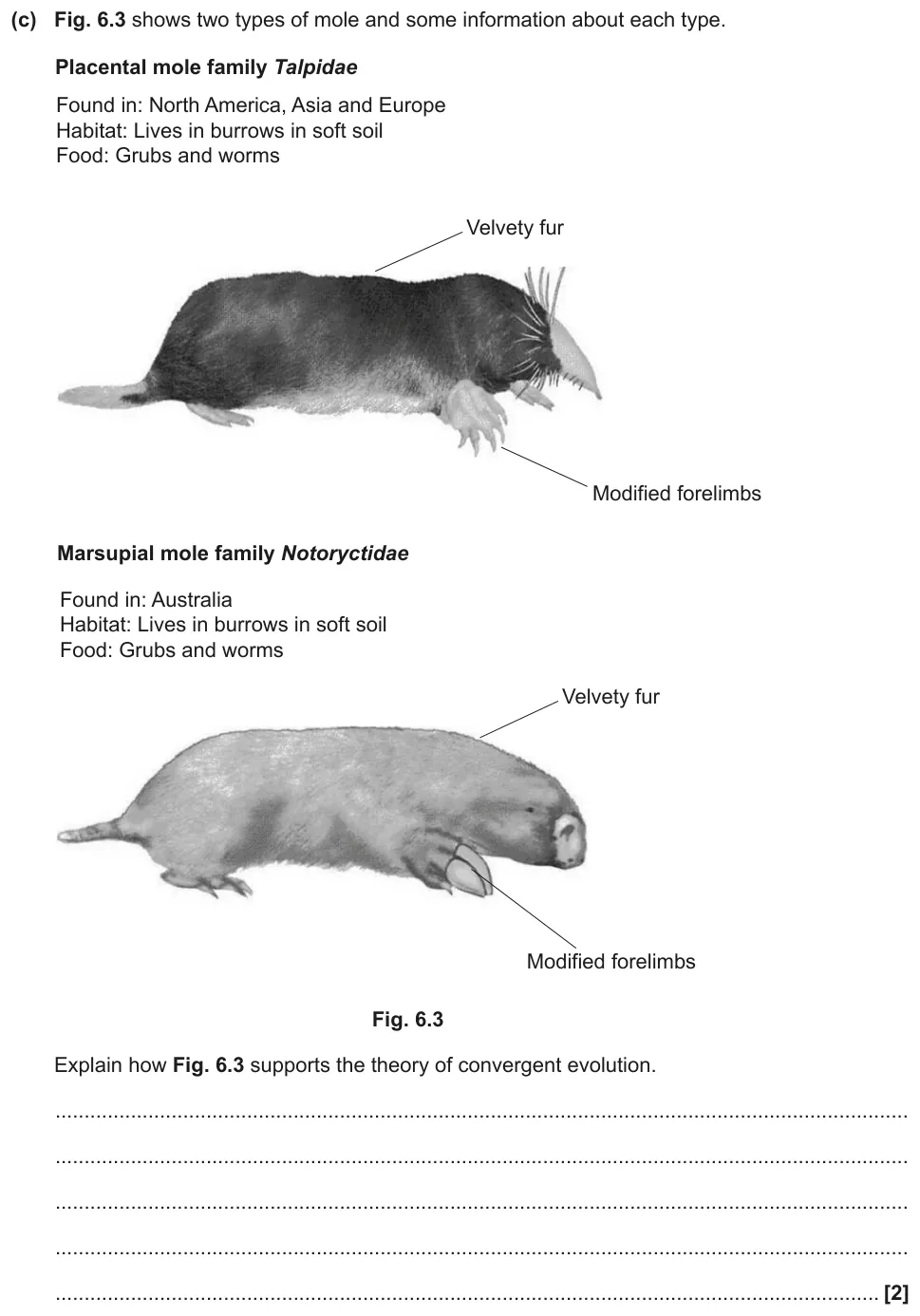
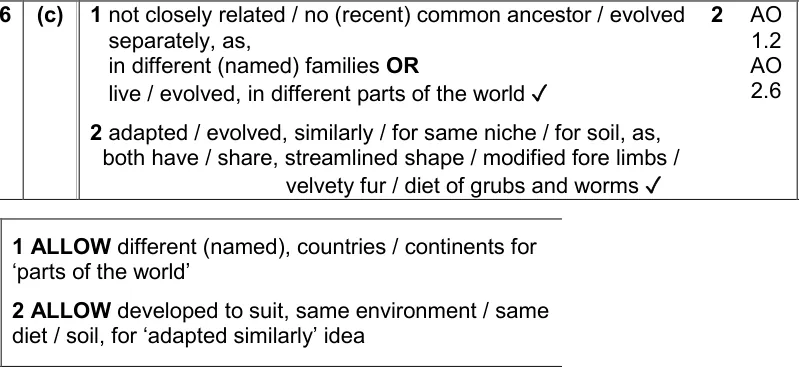
Explain how two types of mole support the theory of convergent evolution.
Show the mark scheme
Tap an image to open it full size.
From the examiners' report: Make both points of convergent evolution: the moles are not closely related (different families, different continents), and they share features because they evolved to fit the same burrowing way of life. Back each one with evidence from the figure.
Question 12
A level Paper 3 · November 2021 · Q3(e) · 1 mark · Medium
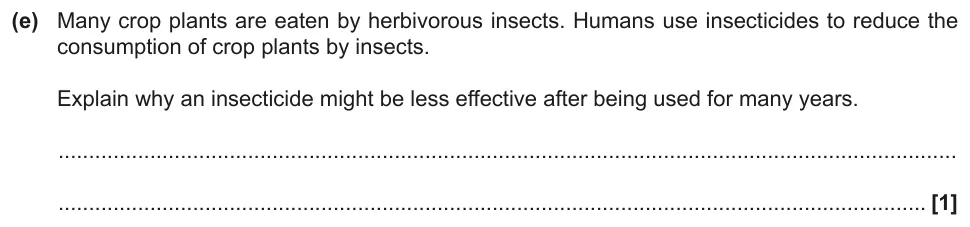
Explain why an insecticide might be less effective after many years of use.
Show the mark scheme

Tap an image to open it full size.
From the examiners' report: Insects become resistant, not immune: immunity is about the immune system. And the insecticide doesn't cause the mutation, it selects for resistant insects that already exist.
Question 13
A level Paper 2 · June 2025 · Q21(a) · 2 marks · Medium
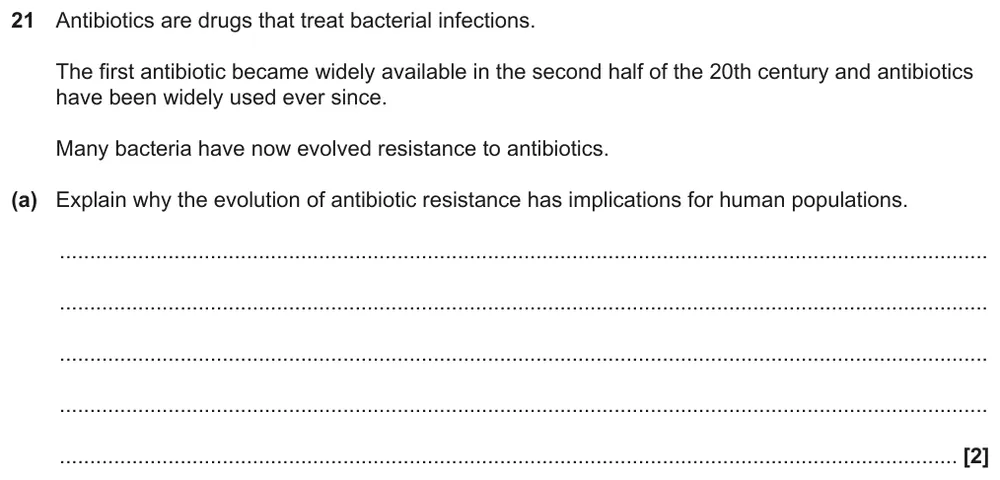
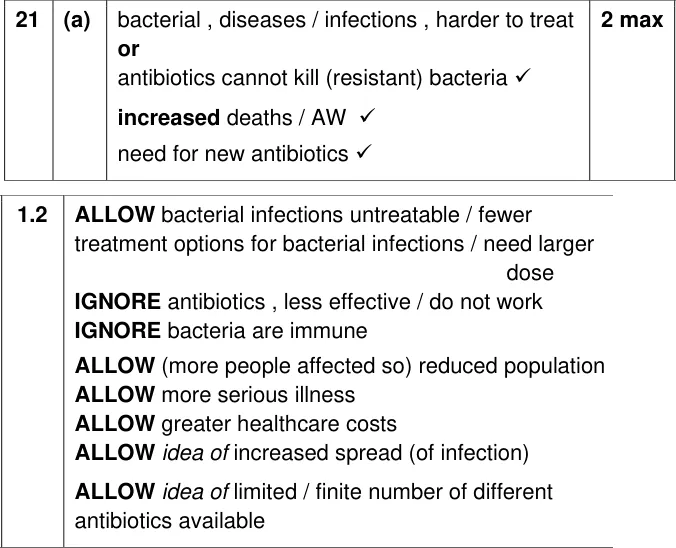
Explain why the evolution of antibiotic resistance matters to human populations.
Show the mark scheme
Tap an image to open it full size.
From the examiners' report: "Antibiotics don't work" is too vague. Say the antibiotic can no longer kill the resistant bacteria, so infections are harder to treat, more people die and new antibiotics are needed.
Question 14
A level Paper 2 · June 2025 · Q21(b) · 2 marks · Medium
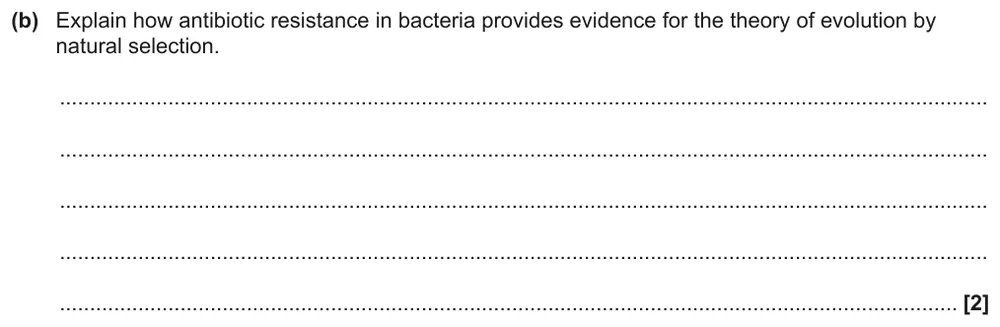
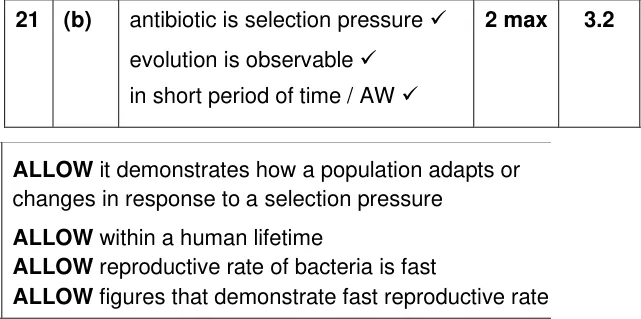
Explain how antibiotic resistance provides evidence for evolution by natural selection.
Show the mark scheme
Tap an image to open it full size.
From the examiners' report: Don't just describe how resistance evolves. Say why it's evidence: the antibiotic is a selection pressure and, because bacteria reproduce so fast, we can watch evolution happen within a human lifetime.
Question 15
A level Paper 2 · June 2025 · Q21(c)(i) · 5 marks · Easy
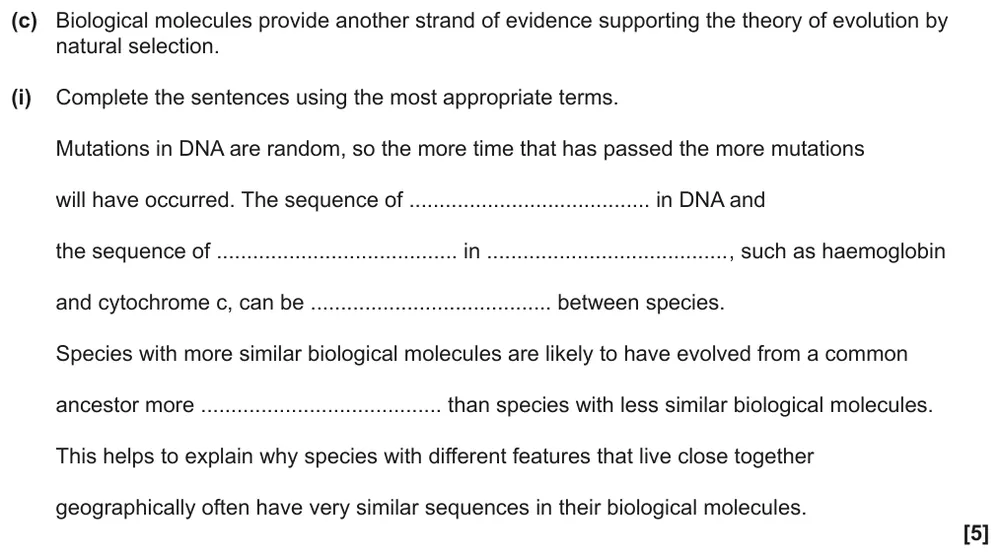
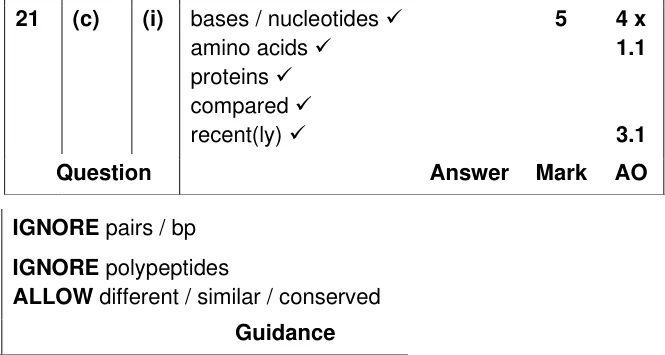
Complete a passage on molecular evidence for evolution.
Show the mark scheme
Tap an image to open it full size.
From the examiners' report: DNA is made of bases (nucleotides), proteins of amino acids. The last gap is about time, so the word is "recently", not "closely".
Question 16
A level Paper 2 · June 2025 · Q21(c)(ii) · 3 marks · Medium
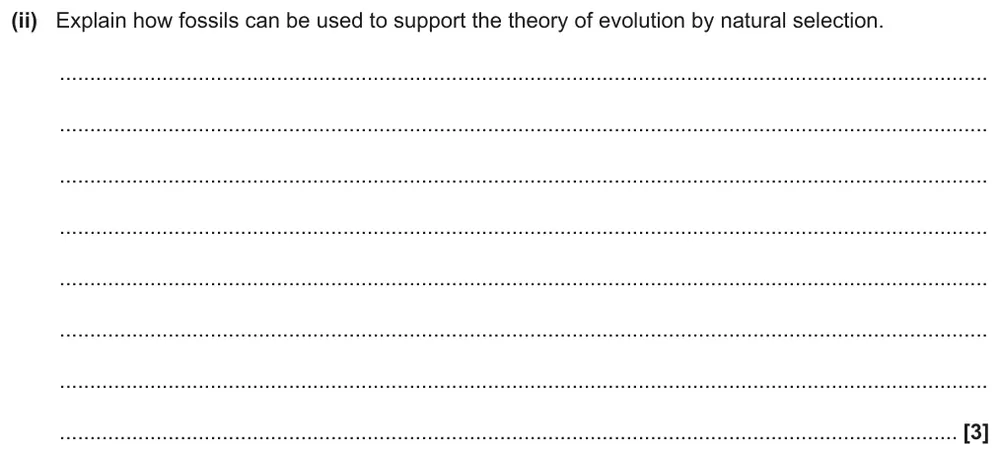
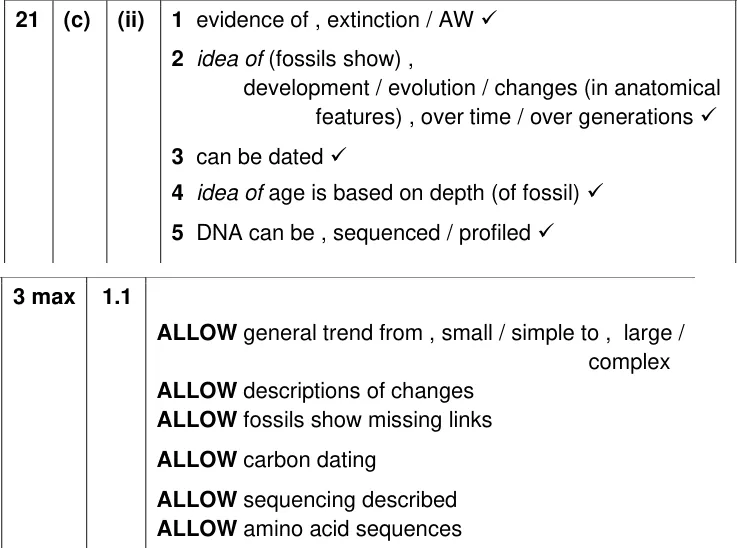
Explain how fossils can be used to support the theory of evolution by natural selection.
Show the mark scheme
Tap an image to open it full size.
From the examiners' report: Go beyond "features change over time". Add that fossils can be dated, that deeper rock layers hold older fossils, and that they show extinctions.
Question 17
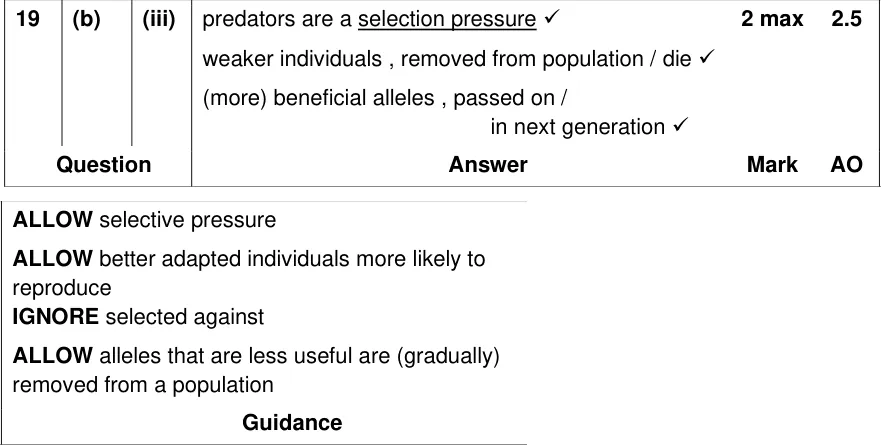
A level Paper 2 · June 2025 · Q19(b)(iii) · 2 marks · Hard
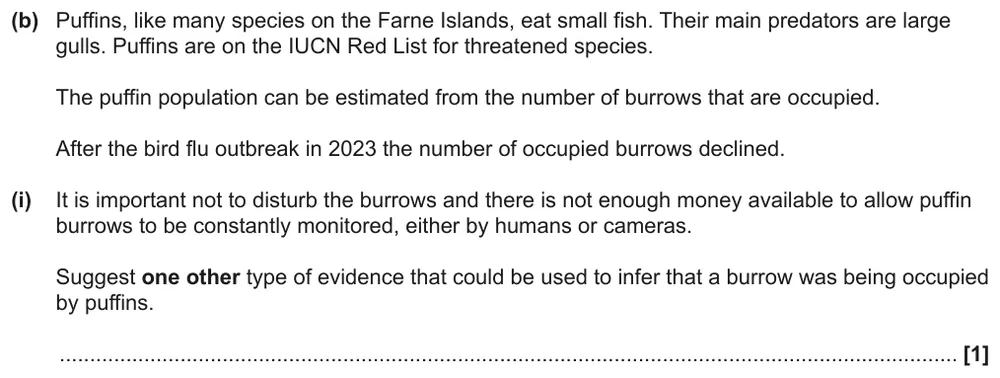
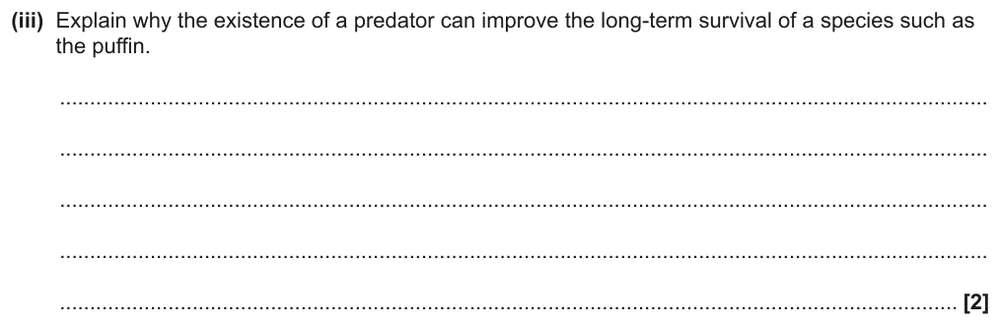
Explain why a predator can improve the long-term survival of a species such as the puffin.
Information from earlier in this question:
Show the mark scheme
Tap an image to open it full size.
From the examiners' report: "Long-term" points to natural selection, not predator-prey cycles or food supply. The predator is a selection pressure, so better-adapted puffins survive and pass on their advantageous alleles.
Where students lose marks (from OCR examiners' reports and mark schemes)
Each point below is followed by wording that gained marks.
Universal naming needs a reason: Many students wrote that the binomial system "is universal" without saying how that helps, or said it is used to identify the organism.
✔ Gains credit: "Each organism has its own unique name, which avoids confusion between scientists in different countries".
Fungi have walls too, so say cellulose: Students gave a cell wall as a feature of plants but not fungi without saying what it is made of, or wrote about vacuoles.
✔ Gains credit: "Cell wall composed of cellulose", "contain chloroplasts", "photosynthesise" or "store starch".
Classification follows phylogeny: Many defined classification and phylogeny separately, and some reversed them, saying phylogeny depends on classification.
✔ Gains credit: "Classification is based on phylogeny".
Six kingdoms, three domains, no dates: Many students said the three domain system is more recent, which is not a feature of the system.
✔ Gains credit: "The three domain system has six kingdoms" and "the domains are Archaea, Bacteria and Eukarya".
Same species, so intraspecific: Many students named the differences between the two wildcat populations as "genetic variation".
✔ Gains credit: "Intraspecific variation".
Different families, same burrowing lifestyle: Few students could give both principles of convergent evolution and back them with evidence from the two moles.
✔ Gains credit: "Not closely related as in different families" and "adapted for the same niche, as both have modified forelimbs".
Resistant insects, never immune ones: Some students said insects develop immunity to the insecticide, or that the insecticide causes mutations.
✔ Gains credit: "Insects develop resistance".
Resistance is evidence because we can watch it: Almost all students described how resistance evolves but missed why that is evidence for natural selection.
✔ Gains credit: "The antibiotic is a selection pressure" and "evolution is observable in a short period of time".
Download the questions
Download the PDF pack (17 questions, mark schemes at the end)
Keep practising
- Classification and Evolution quiz
- Classification and evolution: interactive written questions (22)
- Biodiversity (4.2.1): OCR A Level Biology exam questions by topic
- Patterns of Inheritance (6.1.2): OCR A Level Biology exam questions by topic
- OCR A Level Biology masterclasses
Questions, mark schemes and examiners' report extracts © OCR.