

AQA 3.1.3 · 5 exam questions worked through · about 15 minutes
Studying A-level Biology? I'm Tom, an A-level Biology teacher with 30 years' experience. I offer one-to-one lessons and weekly group classes for AQA and OCR A, with every lesson recorded.
This post covers AQA specification 3.1.3, lipids: how triglycerides and phospholipids are built, how their structures relate to their properties, and the emulsion test. Work through five real AQA questions and you'll see exactly what the mark schemes credit and where the examiners say marks were lost.
What you need to know first
- A triglyceride is made from one glycerol molecule and three fatty acids
- A phospholipid has one fatty acid replaced by a phosphate group
- A condensation reaction joins two molecules and removes a molecule of water
- Hydrophilic means attracted to water; hydrophobic means repelled by water
Question 1: How a triglyceride is formed (3 marks)
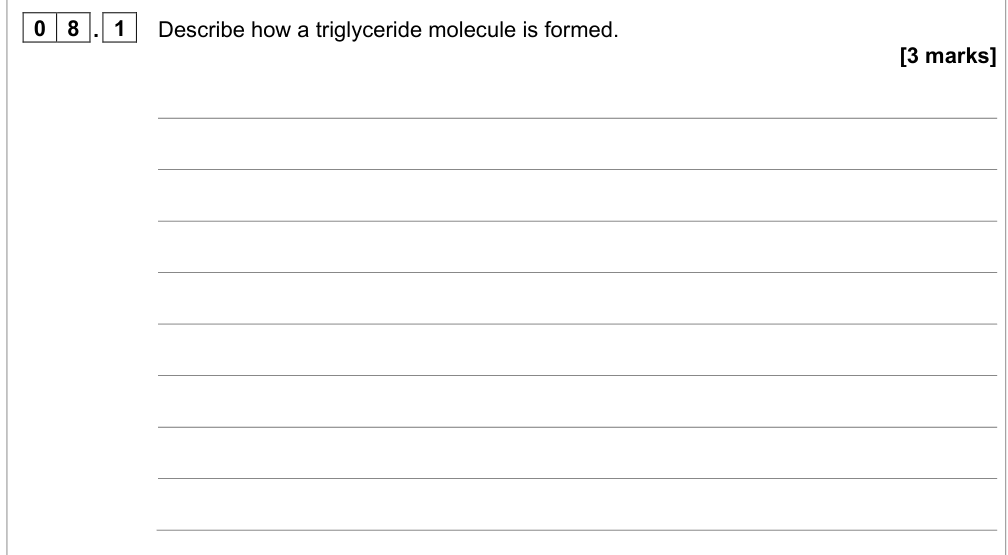
How to approach it. Three marks, three ideas, and the numbers matter. One glycerol joins to three fatty acids. This happens in condensation reactions that remove three molecules of water. The bonds formed are ester bonds. A labelled diagram or balanced equation showing all of this is also accepted.
Mark scheme

Common mistakes (from AQA's examiners' reports and mark schemes)
- Describing the condensation without the water. The examiners' report says some students missed the second mark by not stating that three water molecules are lost. Gains credit: "three condensation reactions, removing three molecules of water".
- Leaving out the numbers of each molecule. The mark scheme asks for one glycerol and three fatty acids. Gains credit: "one glycerol and three fatty acids".
Question 2: Triglyceride and phospholipid: two differences (2 marks)
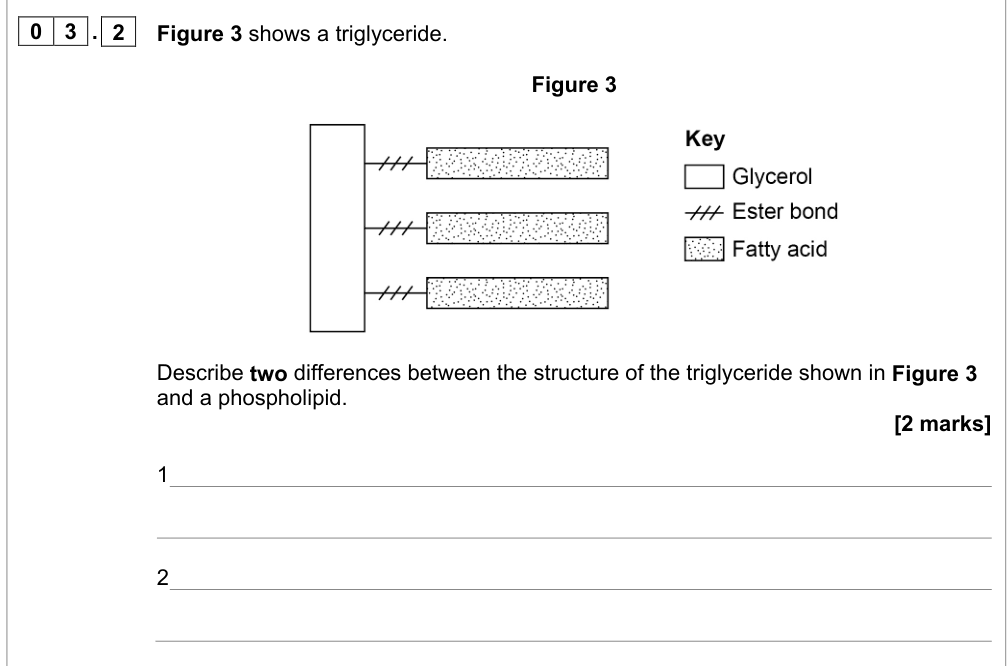
How to approach it. Use the key in the figure and compare the two molecules in each answer. The triglyceride has three fatty acids, a phospholipid has two. The triglyceride has three ester bonds, a phospholipid has two. The triglyceride has no phosphate group, a phospholipid has one. Any two.
Mark scheme

Common mistakes (from AQA's examiners' reports and mark schemes)
- Saying phospholipids contain phosphodiester bonds. The examiners' report calls this a common misconception. Gains credit: "three ester bonds rather than two".
- Calling it a "phosphorus group". The report says some students did. Gains credit: "phosphate group".
- Describing only one molecule. The report reminds students to use comparative answers to explain differences. Gains credit: "the triglyceride has three fatty acids but a phospholipid has only two".
Question 3: Why phospholipids form a bilayer (3 marks)
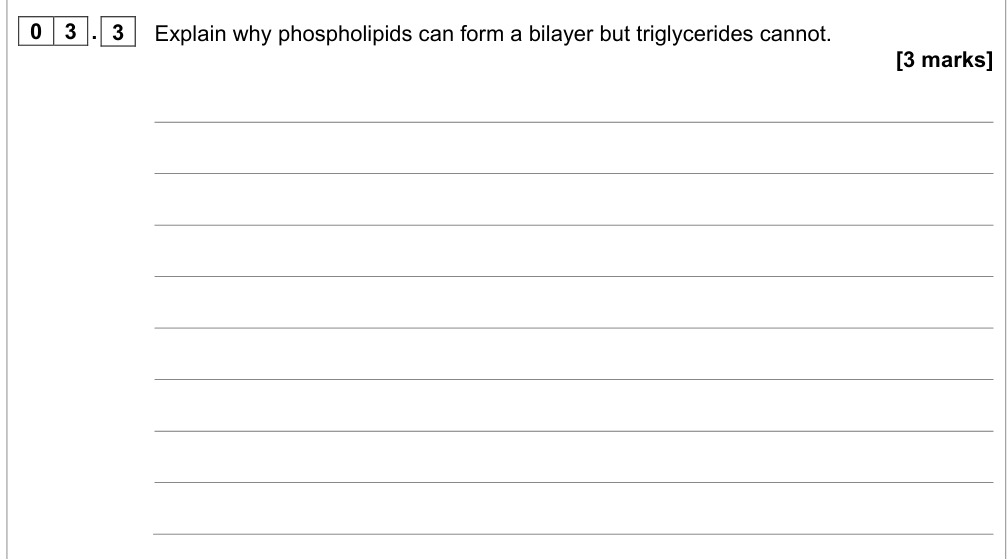
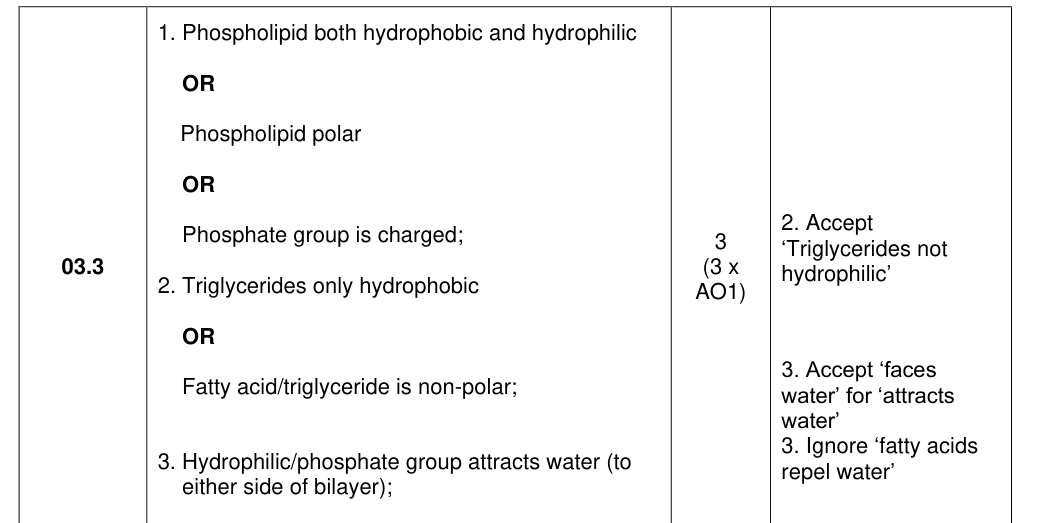
How to approach it. Cover both molecules, then the link to water. A phospholipid has a hydrophilic part (the charged phosphate group) and a hydrophobic part. A triglyceride is only hydrophobic, or non-polar. In a bilayer the hydrophilic phosphate groups are attracted to the water on either side.
Mark scheme
Common mistakes (from AQA's examiners' reports and mark schemes)
- Writing only about the phospholipid. The examiners' report says many students knew it has a hydrophobic and a hydrophilic region, but fewer said that a triglyceride has only a hydrophobic region. Gains credit: "triglycerides are only hydrophobic" or "triglycerides are non-polar".
- Calling the phosphate group hydrophobic. The report says some students did. Gains credit: "the phosphate group is hydrophilic" or "the phosphate group is charged".
- Not linking the hydrophilic group to water. The report says this stopped students reaching full marks, and the mark scheme ignores "fatty acids repel water". Gains credit: "the hydrophilic phosphate groups are attracted to water on either side of the bilayer".
Question 4: The emulsion test for lipids (2 marks)
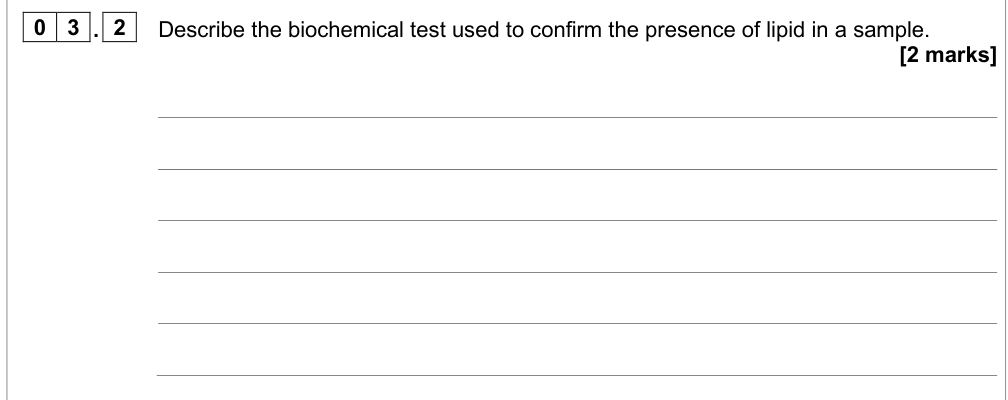
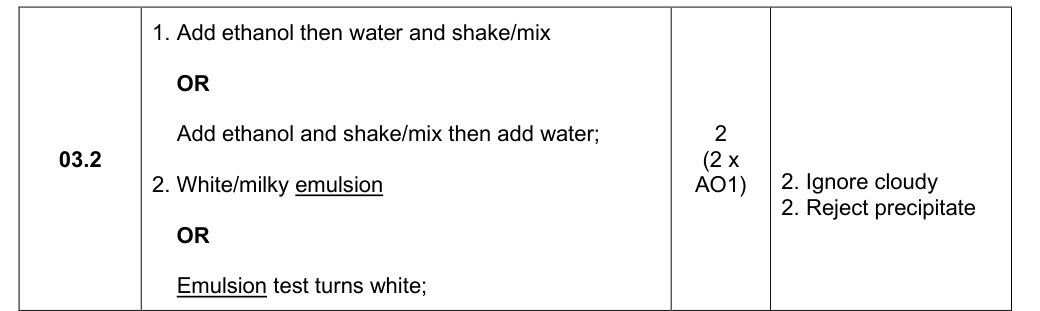
How to approach it. One mark for the method and one for the result. Add ethanol to the sample and shake, then add water (or add ethanol then water and shake). A white or milky emulsion shows that lipid is present.
Mark scheme
Common mistakes (from AQA's examiners' reports and mark schemes)
- Leaving out the water. The examiners' report says some students could not gain the first mark because they did not add water. Gains credit: "add ethanol and shake, then add water".
- Describing the result as cloudy or as a precipitate. The mark scheme ignores "cloudy" and rejects "precipitate". Gains credit: "a white emulsion" or "a milky emulsion".
Question 5: Compare and contrast triglycerides and phospholipids (5 marks)
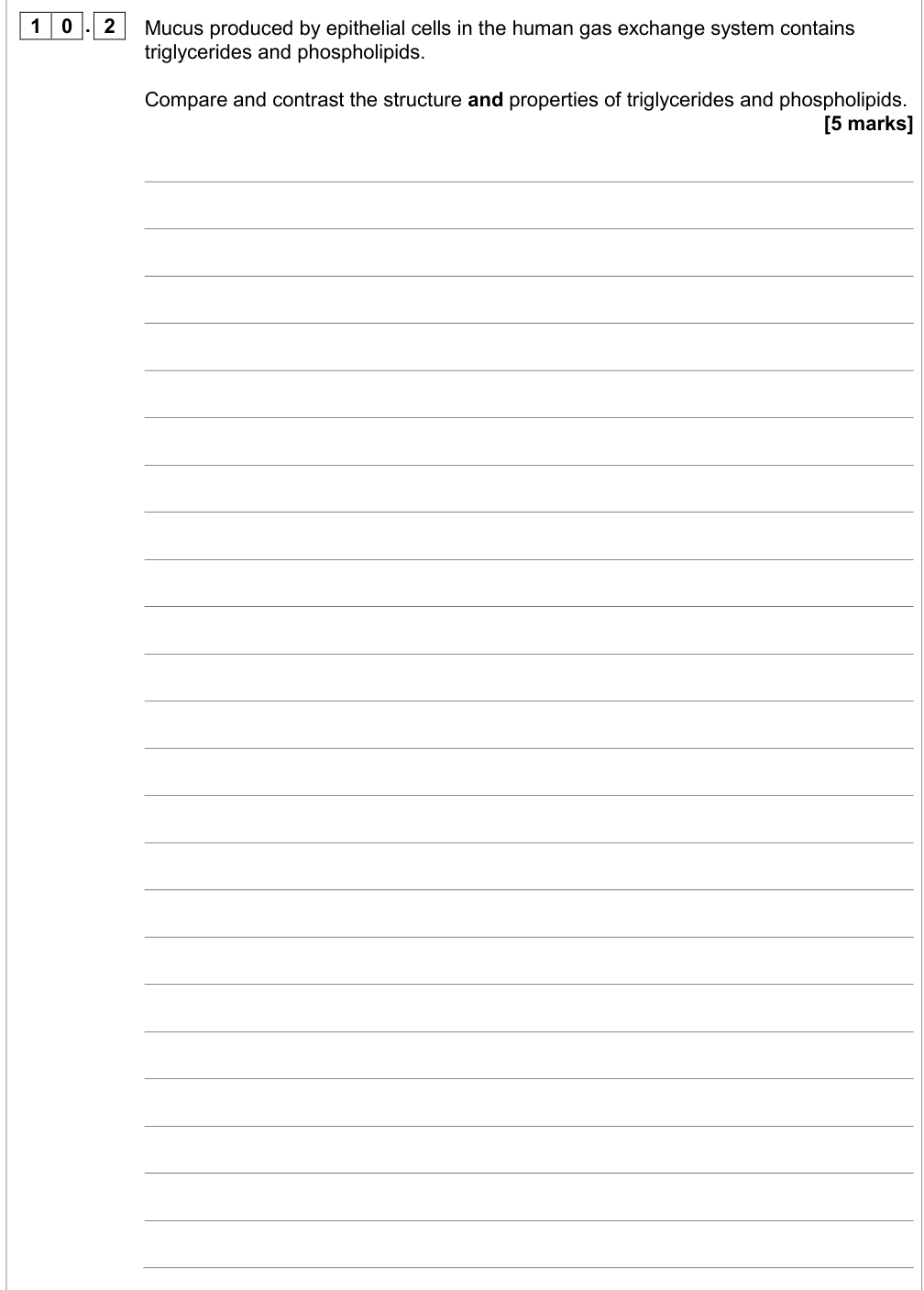
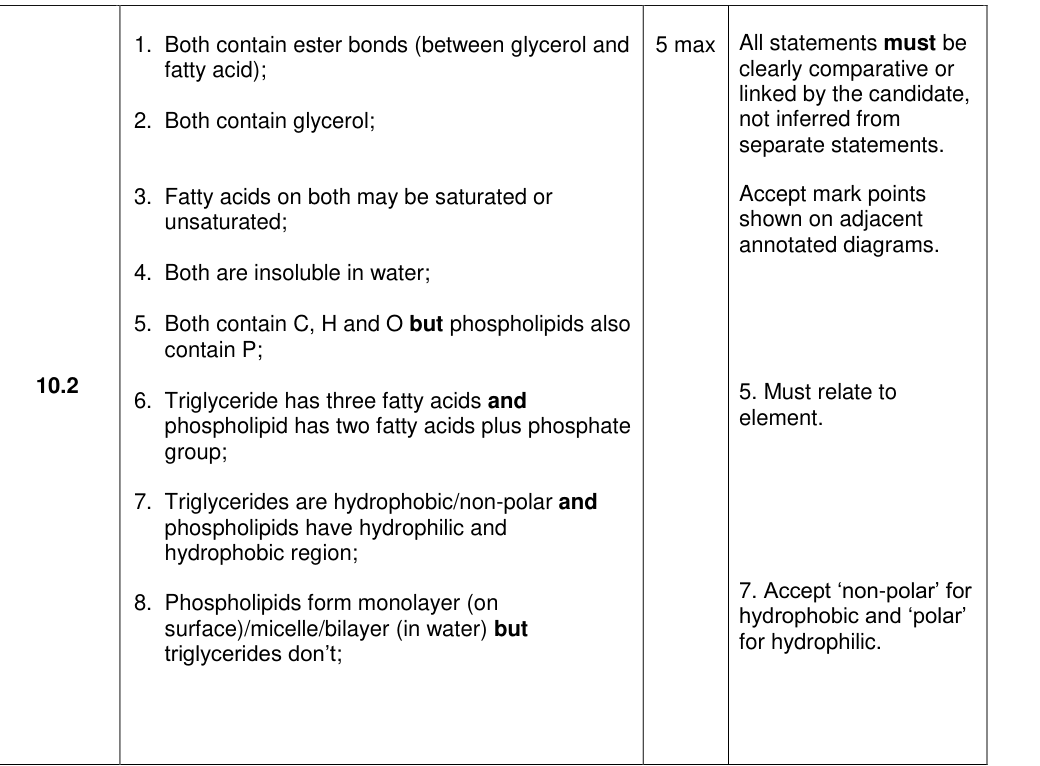
How to approach it. "Compare and contrast" means similarities and differences, and every point has to mention both molecules. Similarities: both contain glycerol, both contain ester bonds, both are insoluble in water, and the fatty acids in both may be saturated or unsaturated. Differences: a triglyceride has three fatty acids, a phospholipid has two fatty acids and a phosphate group; triglycerides are hydrophobic, phospholipids have a hydrophilic and a hydrophobic region; phospholipids form bilayers in water, triglycerides do not. Start sentences with "Both..." or use "but" and "whereas".
Mark scheme
Common mistakes (from AQA's examiners' reports and mark schemes)
- Describing each molecule separately. The examiners' report says many students knew both molecules but did not complete the command, and that examiners will not infer links between separate statements. Gains credit: a comparison in every sentence: "a triglyceride has three fatty acids but a phospholipid has two fatty acids and a phosphate group".
- Leaving glycerol out of the phospholipid. The report says many students did not include it. Gains credit: "both contain glycerol".
- Writing about uses of the molecules or their energy values. The report says some students were distracted into this. Gains credit: points about structure and properties only, such as "both are insoluble in water".
Key points to remember
- Triglyceride: one glycerol, three fatty acids, three ester bonds, formed by condensation with the loss of three molecules of water.
- Phospholipid: glycerol, two fatty acids and a phosphate group. The bonds are still ester bonds.
- The phosphate group is hydrophilic; the fatty acid tails are hydrophobic. Triglycerides are only hydrophobic.
- Emulsion test: ethanol, shake, then water; a white emulsion is the positive result.
- For "differences" and "compare and contrast", put both molecules in every sentence.
Practise next
- AQA lipids exam questions by topic
- Lipids self-marking quiz
- All AQA A-level Biology revision resources
Studying this for AQA? My weekly AQA Year 12 masterclass works through topics like this with real exam questions. See the timetable or book a first one-to-one lesson.
Questions, mark schemes and examiners' report comments © AQA.