OCR A - A Level Biology Resources
Explore a large collection of self-marking quizzes, exam tips, practice questions, background concepts and other resources to support your revision.
Want more? Search or explore the full range of free revision resources here. There is a lot of overlap between the boards and so it is useful to look at AQA and other resources too.
I also offer Weekly Masterclasses specifically for A Level Biology students studying OCR A. There are two separate groups: one for YR12 and one for YR13. As well as overviewing the content, we go through past paper exam questions in every session thinking about how to approach different types of questions to get top marks, with tips focused on OCR A question styles and markschemes.
OCR A Revision Resources:
OCR A - Biological Diversity:
Self marking quiz for revision of OCR A Level Biology A Biological Diversity H420/02 - June 2024
Self marking quiz for revision of OCR A Level Biology A Biological Diversity H420/02 - June 2023
Self marking quiz for revision of OCR A Level Biology A Biological Diversity H420/02 - June 2022
Self marking quiz for revision of OCR A Level Biology A Biological Diversity H420/02 - Nov 2021
OCR A Biological diversity (H420/02) June 2018 - Multiple Choice Questions as self marking quiz
OCR A - Biological Processes:
Self marking quiz for revision of OCR A Level Biology A Biological Processes H420 01 - June 2024
Self marking quiz for revision of OCR A Level Biology A Biological Processes H420 01 - June 2023
Self marking quiz for revision of OCR A Level Biology A Biological Processes H420 01 - June 2022
OCR A Level Biology A H420/01 Biological processes Practice paper – Set 1 (Apr 16) - MCQ - as an Online quiz - give it a go !
Self marking quiz for revision of OCR A Level Biology A Biological Processes H420 01 - Nov 2021
Self marking quiz for the OCR A Biological processes June 2018 paper
OCR released the OCR A June 2017 H420 papers. I combined the Biological Processes 420/01 paper with the markscheme to make it easier to follow and interpret.
OCR A Level Biology A H420/01 Biological processes Sample Question Paper - as an online quiz
- if you use then like and share
OCR A - Breadth in Biology:
Self marking quiz for revision of OCR A Breadth in Biology - June 2024
Self marking quiz for revision of OCR A Breadth in Biology - June 2023
Self marking quiz for revision of OCR A Breadth in Biology - June 2022
Self marking quiz for revision of OCR A Breadth in Biology - Nov 2021
Self marking quiz for the OCR AS Biology A H020/01 Breadth in biology paper
The new style linear A level Biology exams have a very different approach to assessment so I made recorded lessons of guides to the new specification sample and 2017 A level papers and to the 2016 AS Papers.
AS OCR Breadth in biology H020/01 June 2017 Multiple Choice Questions as an auto-marking online quiz
OCR AS Level Biology A H020/01 Breadth in biology Sample Question Paper - MCQ as Online Quiz
OCR AS Level Biology A H020/01 Breadth in biology May 2016 - MCQ as an online quiz
if you use then like and share
OCR AS Biology A Breadth in Biology H020/01 Practice Paper - MCQ - as Online Quiz - give it a go
if you use then like and share
OCR A - self marking quizzes
Browse all recent OCR resources by date:

You need to know some maths for A level Biology. This includes knowing how to interpret averages (mean, median and mode), ranges, and standard deviations to work out whether an experiment can be said to have shown an effect or not. Master this early on and it will not help you with exam questions, but also make it easier for you to learn the bits of the course that are explained using these statistical methods.
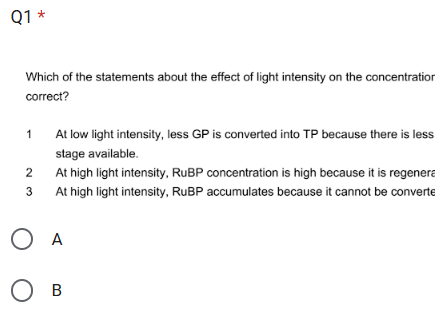
Self-marking multiple choice quiz for Photosynthesis. Using OCR A past paper exam questions.
Self-marking multiple choice quiz for Proteins. Using OCR A past paper exam questions.
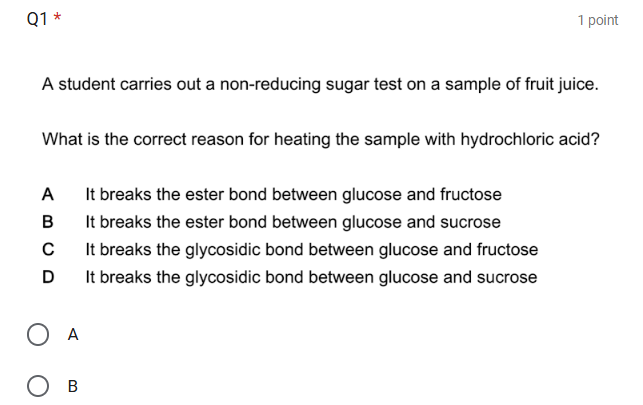
Self-marking multiple choice quiz for Food Tests and Chromatography. Using OCR A past paper exam questions.
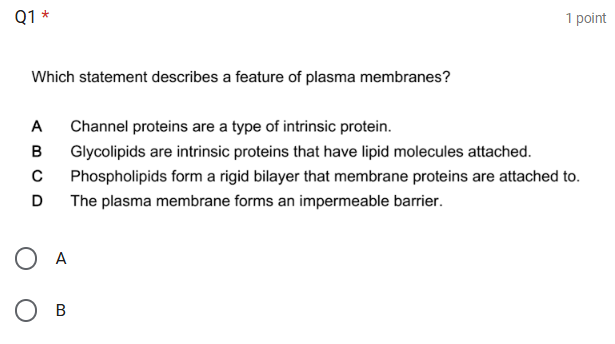
Self-marking multiple choice quiz for Phospholipids, Lipids, and Cholesterol. Using OCR A past paper exam questions.
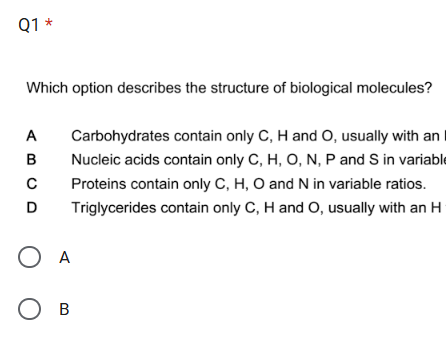
Self-marking multiple choice quiz for Carbohydrates, Ions and Elements. Using OCR A past paper exam questions.
Weekly Group Masterclasses for OCR A Y13
Raise your exam grade with question focused masterclasses from a highly experienced A level Biology teacher.
Every week we go through a different topic from the specification and look at how to apply the content to OCR A exam questions. I show how to understand commonly occurring questions and how to answer them.
Self-marking multiple choice quiz for Cell Ultrastructure, Ions, and Elements. Using OCR A past paper exam questions.
Weekly Group classes - for OCR A Y12
Raise your exam grade with question focused masterclasses from a highly experienced A level Biology teacher.
Every week we go through a different topic from the specification and look at how to apply the content to exam questions. I show how to understand commonly occurring questions and how to answer them.
Monoclonal antibodies are a relatively new treatment type, with huge importance for treating migraine, cancer, autoimmune diseases, and many other conditions.
So how do they work?
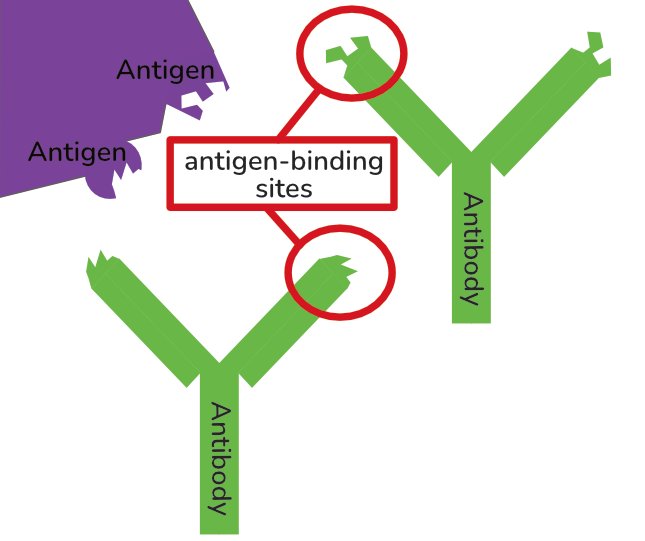
What is an Antibody? What is an Antigen?
Self marking quiz for revision of OCR A Breadth in Biology - June 2024
Self marking quiz for revision of OCR A Level Biology A Biological Diversity H420/02 - June 2024
Self marking quiz for revision of OCR A Level Biology A Biological Processes H420 01 - June 2024
Mastering Carbohydrates: Your Complete Guide to OCR A Level Biology Specification 2.1.2 (d-g)
Essential Prior Knowledge to Recap
Before diving into these commonly tested topics, ensure you're confident with:
• Basic carbohydrate classification – understanding the terms monosaccharide, disaccharide and polysaccharide, and being able to distinguish between them • Condensation and hydrolysis reactions – knowing that condensation joins molecules together by removing water, whilst hydrolysis breaks bonds by adding water • The concept of monomers and polymers – recognising that large biological molecules are built from smaller repeating units • Chemical bonding basics – understanding covalent bonds and how atoms share electrons to form stable molecules • The relationship between structure and function – appreciating that the shape and properties of molecules determine their biological roles
Mastering Resting Potential, Action Potential and Propagation: Common OCR A Level Biology Questions Answered
OCR A Level Biology: Mastering Biodiversity and Simpson's Index (Section 4.2.1 a-d)
Prior Knowledge to Recap
Before diving into biodiversity questions, ensure you understand these foundational concepts:
The three levels of biodiversity: genetic diversity (variation within species), species diversity (number and abundance of species), and habitat/ecosystem diversity (range of different habitats)
Species richness vs species evenness: richness is the total number of different species present, whilst evenness refers to how similar the abundance of each species is
Mastering Neuronal Communication: Common OCR A Level Biology Questions Answered
Prior Knowledge to Recap
Before diving into neuronal communication, make sure you're confident with these key concepts:
Mastering Microscopy and Cell Structure: Common OCR A Level Biology Questions Answered
Prior Knowledge to Recap
Before diving into microscopy and cell structure, make sure you're confident with these key concepts:
• Basic cell structure – understanding the difference between prokaryotic and eukaryotic cells, and being able to identify major organelles like the nucleus, mitochondria, and chloroplasts
• Units of measurement – being confident with converting between millimetres (mm), micrometres (μm), and nanometres (nm) is essential for magnification calculations (1mm = 1000μm, 1μm = 1000nm)
OCR A Level Biology: Mastering Photosynthesis - The Calvin Cycle and Limiting Factors (Section 5.2.1 e, f, g)
Prior Knowledge to Recap
Before diving into these photosynthesis questions, ensure you understand these foundational concepts:
The two stages of photosynthesis: the light-dependent stage (in thylakoid membranes) produces ATP and reduced NADP, whilst the light-independent stage (Calvin cycle in the stroma) uses these products to fix CO₂
The Calvin cycle pathway: CO₂ combines with RuBP (catalysed by RuBisCO) to form GP, which is reduced to TP using ATP and reduced NADP, with most TP recycled to regenerate RuBP
Mastering OCR A Level Biology Section 5.2.1: Photosynthesis - Common Questions & Mark Scheme Insights
After analysing extensive OCR past papers for specification section 5.2.1 a-d (Photosynthesis), I've identified the question patterns that consistently challenge students. Understanding how mark schemes assess pigment knowledge, chloroplast structure, chromatography calculations, and the relationship between photosynthesis and respiration is crucial for exam success. Let me guide you through five of the most frequently tested question types with real OCR examples.
Mastering OCR A Level Biology Section 2.1.1: Cell Structure and Organelles (g-h) - Common Questions & Mark Scheme Insights
After extensive analysis of OCR past papers for specification section 2.1.1 (Cell Structure - g-h), I've identified the question patterns that consistently challenge students. Understanding how mark schemes assess organelle functions, protein synthesis pathways, and cytoskeleton roles is crucial for exam success. Let me guide you through five of the most frequently tested question types with real OCR examples.
Mastering OCR A Level Biology Section 5.1.1: Communication, Homeostasis and Thermoregulation - Common Questions & Mark Scheme Insights
Having analyzed extensive OCR past papers for specification section 5.1.1 (Communication and Homeostasis), I've identified the question patterns that consistently challenge students. Understanding how mark schemes assess terminology, comparative statements, and explanation depth is essential for maximizing marks. Let me guide you through five of the most frequently tested question types with real OCR examples.
Many topics in A level biology relate to how the human body gains and loses atoms. But have you ever stepped back and thought of how these processes all fit together? Having a wide overview can help make sense of individual topics.
Immunity is a complex topic. This article overviews the basic concepts and vocabulary to give you a foundation before you start looking at the details. When you are studying, break this topic up into chunks so that you’re not overwhelmed by the amount of information.
A variable is any value that does/might change during an experiment. Variables can include things like pH, temperature, colour, or the concentration of substances. The amount of time that has passed is a variable, as are rates of reaction.
Self marking quiz for revision of OCR A Level Biology A Biological Diversity H420/02 - June 2023
Self marking quiz for revision of OCR A Level Biology A Biological Processes H420 01 - June 2023
Self marking quiz for revision of OCR A Breadth in Biology - June 2023
Can you spot the problems with these A level Biology exam question answers? These bloopers come up a lot - check you’re not going to make the same mistakes.
Full list of OCR blog posts, including earlier dates
Looking for a particular topic? Go to the main Free A level Biology Resources page and use the category search or search box.