

This free quiz has 20 multiple choice questions on protein structure, all taken from Cambridge International (CIE) A Level Biology exam papers. It marks itself, so you get your score as soon as you finish.
What the quiz covers (Cambridge 9700 topic 2: Biological molecules – proteins)
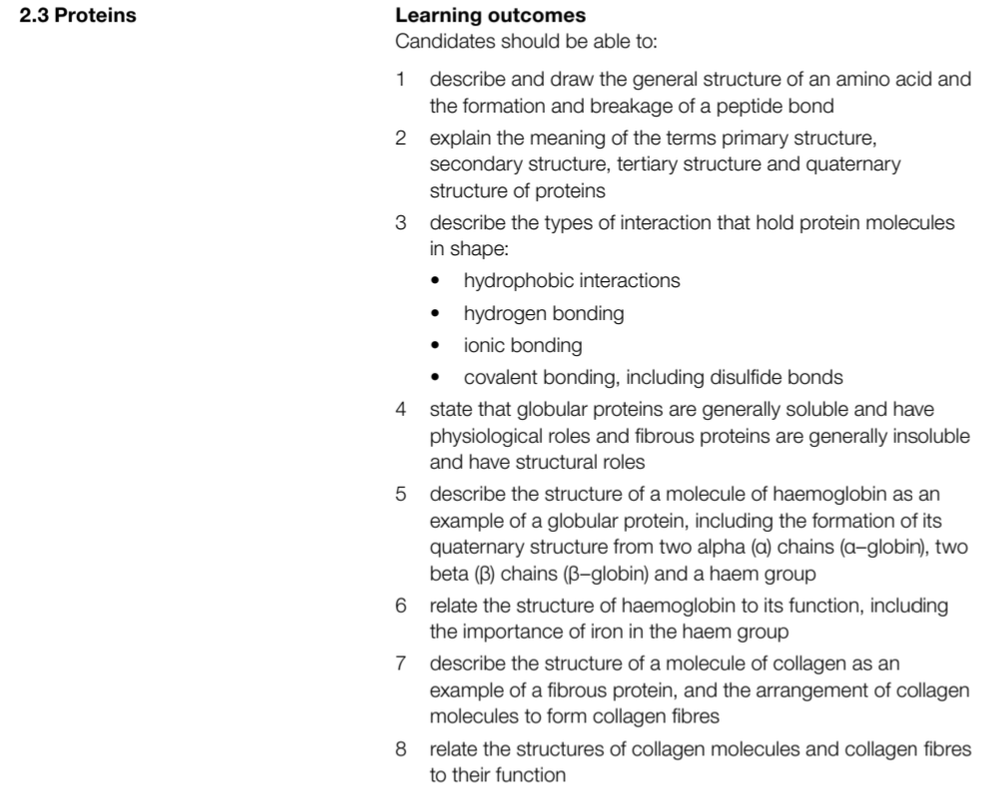
The general structure of an amino acid and the variable R group
Forming peptide bonds by condensation and breaking them by hydrolysis
Primary, secondary, tertiary and quaternary structure
Hydrogen bonds, ionic bonds, disulfide bonds and hydrophobic interactions, and how strong each one is
Globular and fibrous proteins
Haemoglobin and collagen: how their structures relate to their functions
Calculations, such as working out the mass of a protein from its polypeptides
How to use it
For each bond question, decide which level of structure it belongs to and whether it forms between R groups or along the backbone before you look at the options. For haemoglobin and collagen, sketch the arrangement of the polypeptides first.
Where students lose marks (from Cambridge examiners' reports and mark schemes)
Each point below is followed by wording that gained marks.
Naming secondary structures precisely: Writing 'a helix', 'pleated sheet' or 'B pleated sheet' without alpha or beta in full, or saying that the hydrogen bonds in secondary structure form between different polypeptides, gained no credit.
✔ Gains credit: an alpha helix or a beta-pleated sheet, held by hydrogen bonds between the N–H and C=O groups of the backbone, a few amino acids apart in the same polypeptide.
Peptide bonds aren't tertiary bonds: Listing peptide bonds among the bonds that hold a protein's 3D shape or quaternary structure. Peptide bonds only join amino acids in the primary structure, and mark schemes rejected lists that included them.
✔ Gains credit: tertiary structure is held by bonds between R groups: hydrogen bonds, ionic bonds, disulfide bonds and hydrophobic interactions between non-polar R groups.
Hydrogen bonds are individually weak: Describing individual hydrogen bonds as strong, for example in collagen, or thinking that the peptide bond is weaker than the bonds that hold the tertiary structure.
✔ Gains credit: each hydrogen bond is weak, but many hydrogen bonds together give stability and strength. The covalent peptide bond is stronger than hydrogen bonds, ionic bonds or hydrophobic interactions.
Tertiary versus quaternary structure: Giving quaternary structure to a protein made of a single polypeptide, or mixing up tertiary folding with quaternary structure. A compact folded shape does not by itself mean quaternary structure.
✔ Gains credit: a single polypeptide has tertiary structure, with bonds between R groups on the same chain. Quaternary structure needs more than one polypeptide, with bonds between R groups on different polypeptides.
Globular means R groups, not heads: Explaining solubility with 'hydrophilic heads and hydrophobic tails', which is phospholipid language, or vague 'hydrophilic regions', or calling a protein globular just because it is three-dimensional.
✔ Gains credit: amino acids with hydrophilic R groups are on the outside and those with hydrophobic R groups are towards the centre, so the protein is soluble in water.
Collagen molecule versus collagen fibre: Describing a collagen molecule when the question asked about fibres (or the reverse), calling each polypeptide an alpha helix, or saying that covalent bonds hold the three polypeptides together.
✔ Gains credit: a collagen molecule is three polypeptides wound into a triple helix, held by hydrogen bonds. In a fibre, many molecules lie side by side, staggered, and are joined by covalent cross-links.
Biuret test starting colour: Leaving out the starting colour of biuret solution, saying it is colourless, or naming Benedict's or iodine solution as the test for protein. Many candidates also misspelled 'biuret'.
✔ Gains credit: add biuret solution (copper sulfate and sodium or potassium hydroxide). It starts blue and turns lilac or purple when protein is present.
Keep practising
Go on to the CIE Enzymes quiz, the CIE Carbohydrates quiz or the CIE Lipids and Phospholipids quiz, or browse all our CIE A Level Biology quizzes. If proteins still feel shaky, book a one-to-one lesson and we can work through Cambridge exam questions together.