

This free quiz has 19 multiple choice questions on carbohydrates, all taken from Cambridge International (CIE) A Level Biology exam papers. It marks itself, so you get your score as soon as you finish.
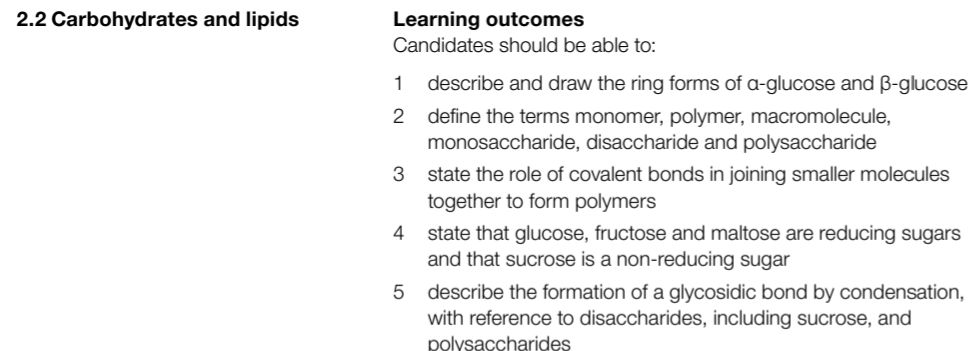
What the quiz covers (Cambridge 9700 topic 2: Biological molecules – carbohydrates)
The ring structures of alpha and beta glucose, and recognising them in diagrams
Monosaccharides, disaccharides and polysaccharides, including sucrose and maltose
Forming glycosidic bonds by condensation and breaking them by hydrolysis
Starch (amylose and amylopectin) and glycogen as stores of glucose
Cellulose: beta glucose chains, hydrogen bonds between chains and microfibrils
Reducing and non-reducing sugars
Matching the structure of each polysaccharide to its function
How to use it
Before you start, draw alpha and beta glucose from memory and check which way the –OH on carbon 1 points. For the polysaccharide questions, decide which bonds are present (1,4 or 1,6 glycosidic) and whether the chain is branched before you look at the options.
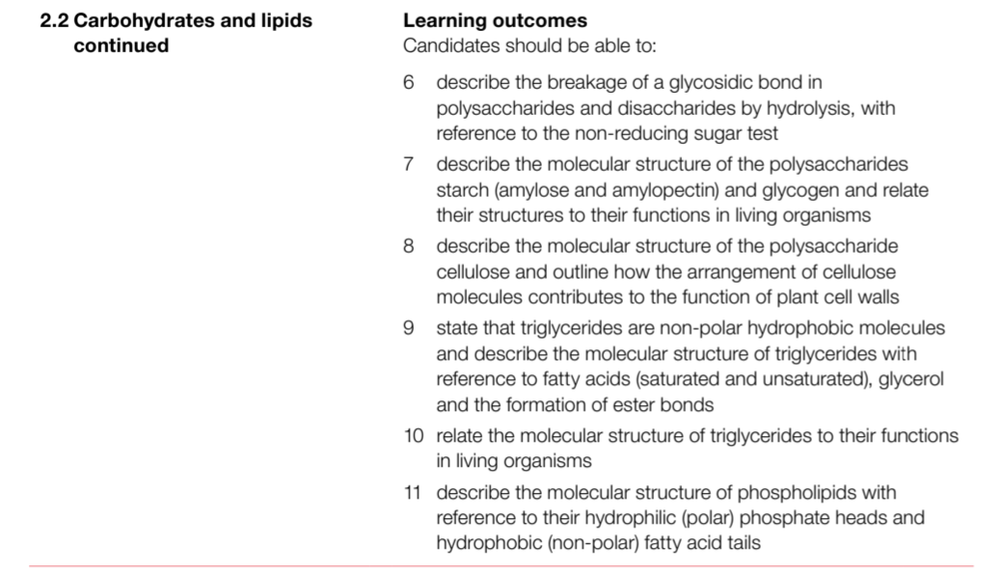
Where students lose marks (from Cambridge examiners' reports and mark schemes)
Each point below is followed by wording that gained marks.
Alpha or beta, written clearly: Writing just 'glucose', 'a-glucose' or 'B-glucose' did not gain credit. When drawing alpha glucose, many candidates also left off the –H on carbon 5.
✔ Gains credit: 'alpha glucose' or 'beta glucose' written in words, or a clear α or β symbol. In alpha glucose, the –OH on carbon 1 points downwards, below the ring.
Defining disaccharides and polysaccharides: Candidates said a disaccharide is 'two sugars', said a polysaccharide has 'two or more' units, or wrote 'monomer' with no further detail. Some called a polysaccharide a sugar, or gave sucrose as an example of one.
✔ Gains credit: a disaccharide is two monosaccharides joined by a glycosidic bond. A polysaccharide is a polymer of many monosaccharides joined by glycosidic bonds.
Condensation, hydrolysis and naming bonds: Some candidates called the breakdown of sucrose a condensation reaction. Others wrote that glycogen has '1,4 and 1,6 bonds' without saying they are glycosidic bonds, and lost the mark.
✔ Gains credit: hydrolysis uses water to break a glycosidic bond and gives monosaccharides. Condensation forms a glycosidic bond and releases water. Always write '1,4 glycosidic' or '1,6 glycosidic'.
Reducing and non-reducing sugars: Weaker answers said the acid in the non-reducing sugar test is used to extract sucrose. Many also thought a positive Benedict's test shows which reducing sugar is present, such as glucose.
✔ Gains credit: sucrose is a non-reducing sugar, so acid hydrolyses its glycosidic bond to give the reducing sugars glucose and fructose. Benedict's solution then gives a positive result, but it only shows that reducing sugars are present.
Amylose versus amylopectin: Candidates mixed up the two starch molecules and described amylose as branched with 1,6 glycosidic bonds. Weaker answers described starch using protein ideas such as secondary and tertiary structure.
✔ Gains credit: both are polysaccharides of alpha glucose joined by 1,4 glycosidic bonds. Amylose is unbranched and helical. Amylopectin is branched because it also has 1,6 glycosidic bonds.
Branches release glucose, not energy: Many linked glycogen's branching to a greater release of energy. Others said 'compact' only meant it takes up less space, or claimed that glycogen contains amylose and amylopectin.
✔ Gains credit: glycogen is a store of glucose. Its many branches give many ends, where glucose can be added or removed quickly. It is compact and insoluble, so it has no osmotic effect.
Cellulose molecules and microfibrils: Candidates often gave cellulose 1,6 bonds, a mix of alpha and beta bonds, or a branched or helical shape. Many also thought glycosidic bonds hold neighbouring cellulose molecules together.
✔ Gains credit: beta glucose joined by 1,4 glycosidic bonds, with each monomer rotated 180° to the next, forming a straight, unbranched chain. Parallel chains are held together by many hydrogen bonds to form microfibrils.
Keep practising
Go on to the CIE Food Tests quiz, the CIE Lipids and Phospholipids quiz or the CIE Protein Structure quiz, or browse all our CIE A Level Biology quizzes. If biological molecules still feel shaky, book a one-to-one lesson and we can work through Cambridge exam questions together.