

This free quiz has 20 multiple choice questions on transport in mammals, all taken from Cambridge International (CIE) A Level Biology exam papers. It marks itself, so you get your score as soon as you finish.
What the quiz covers (Cambridge 9700 topic 8: Transport in mammals)
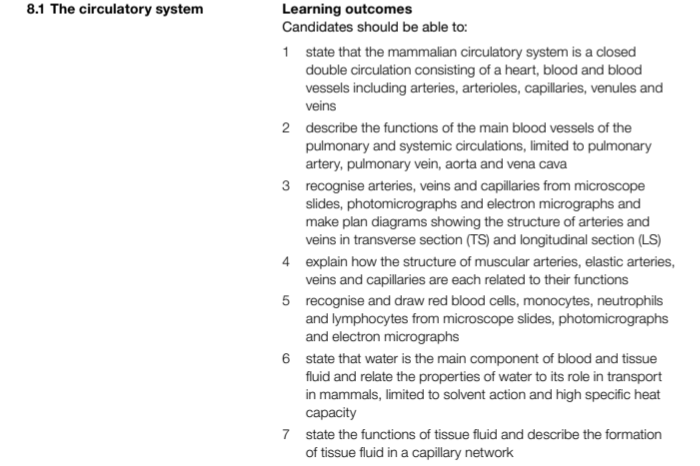
The structure of arteries, veins and capillaries, and identifying them in micrographs
How tissue fluid forms and returns to the blood
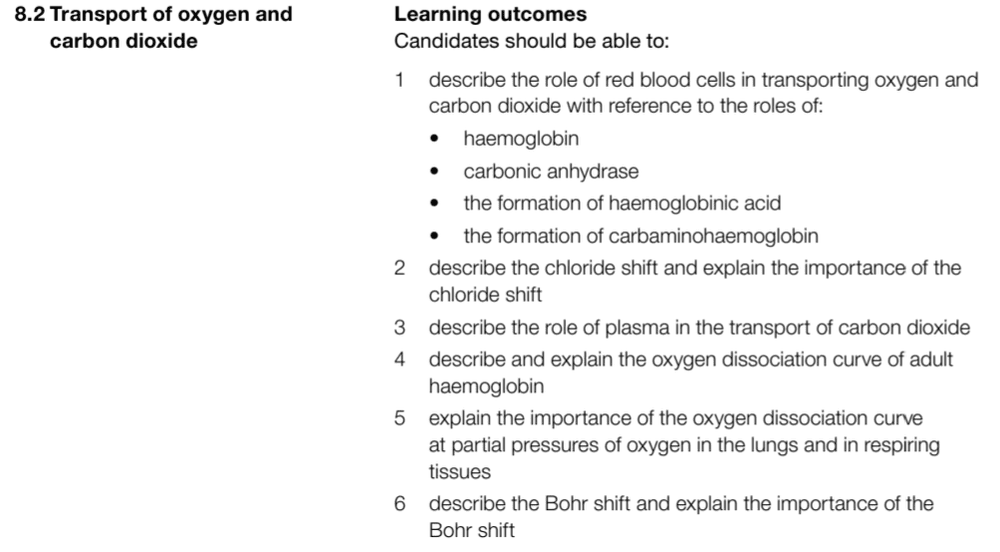
Red blood cells, haemoglobin and the transport of oxygen
The oxygen dissociation curve and the Bohr shift
Carbon dioxide transport: carbonic anhydrase, hydrogencarbonate ions and the chloride shift
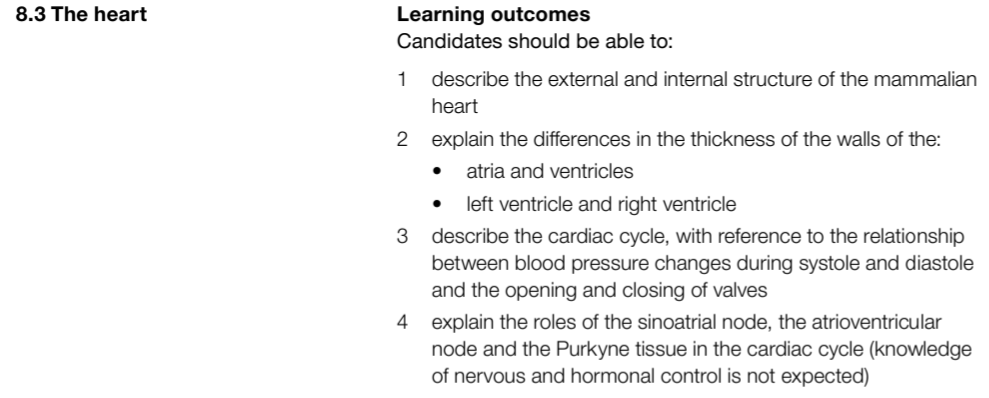
The structure of the heart and the pressure and volume changes in the cardiac cycle
How the SAN, AVN and Purkyne tissue control the heartbeat
How to use it
For cardiac cycle graphs, mark where each valve opens and closes before you read the options: a valve opens when the pressure behind it becomes higher than the pressure in front of it. For tissue fluid questions, compare hydrostatic pressure and water potential at each end of the capillary.
Where students lose marks (from Cambridge examiners' reports and mark schemes)
Each point below is followed by wording that gained marks.
Elastic fibres in artery walls: Describing the elastic tissue in the aorta wall as contracting and relaxing, or saying the smooth muscle in artery walls pumps blood along. Examiners pointed out that arteries do not pump blood.
✔ Gains credit: the wall of the aorta has many elastic fibres, so it stretches when the ventricle contracts, then recoils to maintain high pressure and even out the flow of blood.
Proteins in tissue fluid: Writing that tissue fluid contains no proteins at all, or just 'no cells'. Neither was credited, because some smaller proteins, such as protein hormones and antibodies, do leave the blood.
✔ Gains credit: tissue fluid has no large plasma proteins (such as albumin) and no red blood cells, because these are too large to pass through the gaps between the endothelial cells of the capillary wall.
Red blood cells versus haemoglobin: Treating red blood cells as if they were molecules. For example, saying oxygen or carbon monoxide binds to a red blood cell, or that a red blood cell carries only one haemoglobin molecule.
✔ Gains credit: each red blood cell contains many haemoglobin molecules. Carbon monoxide binds to haemoglobin to form carboxyhaemoglobin, so less haemoglobin is available to bind oxygen.
What causes the Bohr shift: Saying CO2 takes the place of oxygen on haemoglobin, that CO2 combining with haemoglobin is what lowers saturation, or that carbonic anhydrase directly releases oxygen from haemoglobin.
✔ Gains credit: more CO2 means more carbonic acid forms, releasing hydrogen ions. These bind to haemoglobin to form haemoglobinic acid, which lowers its affinity for oxygen, so more oxygen is released to the tissues.
Purpose of the chloride shift: Explaining the movement of chloride ions into red blood cells in terms of the loss of carbon dioxide, rather than the need to balance the electrical charge across the membrane.
✔ Gains credit: HCO3– ions diffuse out of the red blood cell into the plasma, and chloride ions move in through transport proteins to replace these negative ions, which maintains electrical neutrality.
Why the left ventricle is thicker: Stating that the left ventricle wall is thicker 'to withstand high pressure' or to stop it bursting. Examiners did not credit this as the reason for the thicker wall.
✔ Gains credit: the left ventricle has more cardiac muscle, so it contracts with more force. This generates the higher pressure needed to overcome the greater resistance of the systemic circulation.
SAN and AVN wording: Writing that nerve impulses start in the SAN, that the SAN sends 'signals', or that the AVN makes a new impulse or acts as the pacemaker. 'Nerve impulses' was rejected.
✔ Gains credit: the SAN, in the wall of the right atrium, sends waves of excitation across both atria. The AVN delays the same wave by about 0.1 s, then passes it down the Purkyne tissue to the ventricles.
Keep practising
Go on to the CIE Cardiac Cycle quiz, the CIE Carriage of Oxygen and Carbon Dioxide quiz or the CIE Tissue Fluid and Blood Vessels quiz, or browse all our CIE A Level Biology quizzes. If transport in mammals still feels shaky, book a one-to-one lesson and we can work through Cambridge exam questions together.