

This free quiz has 20 multiple choice questions on enzymes, all taken from Cambridge International (CIE) A Level Biology exam papers. It marks itself, so you get your score as soon as you finish.
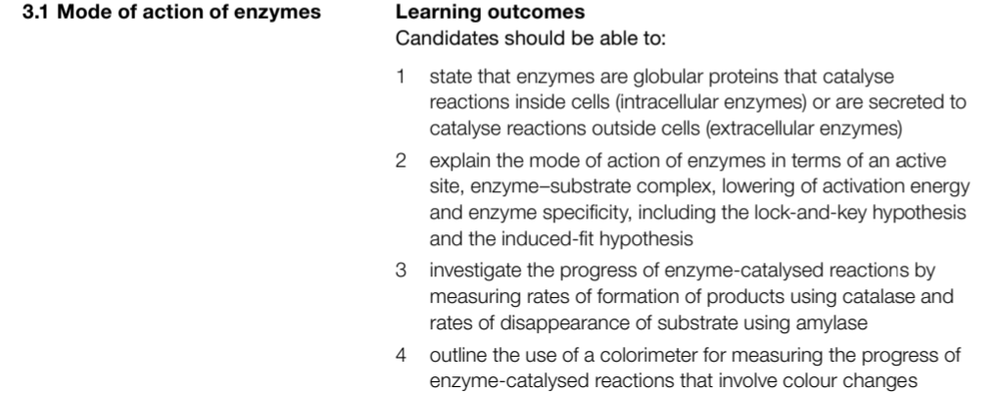
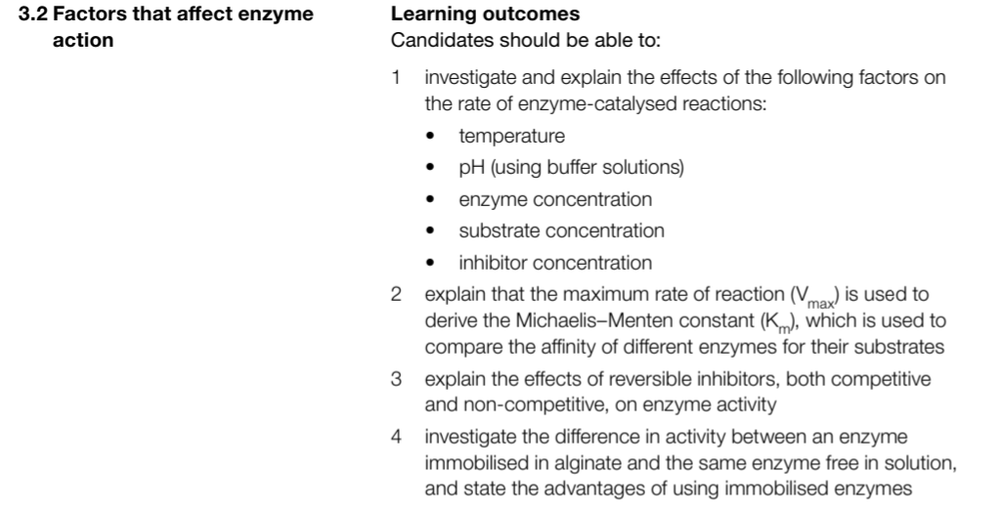
What the quiz covers (Cambridge 9700 topic 3: Enzymes)
How enzymes work: the active site, enzyme–substrate complexes, and the lock and key and induced fit models
How temperature and pH affect enzyme activity, including comparing the optimum curves of two enzymes
How substrate and enzyme concentration affect the rate of reaction, and the shapes of rate graphs
Competitive and non-competitive inhibition, including drugs that act as enzyme inhibitors
Vmax and the Michaelis–Menten constant (Km), and how each type of inhibitor changes them
Inhibition of enzymes in a metabolic pathway
Practical skills: measuring the initial rate of reaction and interpreting enzyme investigations
How to use it
For each graph question, decide what is limiting the rate on each part of the curve before you look at the options. For inhibitor questions, work out first what happens to Vmax and Km, then choose. Note down every question you get wrong and go back to that part of the syllabus.
Where students lose marks (from Cambridge examiners' reports and mark schemes)
Each point below is followed by wording that gained marks.
Induced fit described wrongly: When describing induced fit, many candidates said the substrate changes shape to fit, or that the whole enzyme changes shape. They also wrote 'similar' or 'matching' instead of complementary.
✔ Gains credit: the active site is not fully complementary to the substrate at first. As the substrate binds, the active site changes shape (moulds around it) to become complementary, forming an enzyme–substrate complex.
Time words on temperature graphs: On graphs of enzyme activity against temperature, candidates wrote that activity 'decreased faster' or that the enzyme was 'rapidly denatured', even though the axis shows temperature, not time.
✔ Gains credit: a steeper decrease in activity above the optimum, because bonds between R groups, such as hydrogen bonds, break. The active site loses its shape and the enzyme is denatured.
pH without enzyme structure: Many wrote about the optimum pH without explaining how a change in pH affects the enzyme molecule. Some mixed up hydrogen ions and hydroxide ions when the pH was rising.
✔ Gains credit: a change in pH disrupts ionic and hydrogen bonds between R groups. The tertiary structure and active site change shape, so the active site is less complementary and fewer enzyme–substrate complexes form.
Explaining the plateau: Candidates said the rate levels off because the enzyme is 'used up', is denatured or the substrate has run out. Others wrote 'enzyme is limiting' without mentioning concentration or active sites.
✔ Gains credit: at low substrate concentrations many active sites are free and substrate concentration is limiting. At the plateau all active sites are occupied (saturated) and enzyme concentration is the limiting factor.
Non-competitive inhibition muddled: Candidates gave features of both competitive and non-competitive inhibition, or stopped at 'binds somewhere else'. Many also predicted that Km would increase with a non-competitive inhibitor.
✔ Gains credit: the inhibitor binds to an allosteric site, which changes the shape of the active site so the substrate cannot bind and fewer enzyme–substrate complexes form. Vmax decreases and Km stays the same.
Getting Km and affinity backwards: Some confused Km with Vmax, or used Vmax to judge affinity. Others stated that a low Km means high affinity, then picked the wrong enzyme. Some wrongly defined Km as half of Vmax.
✔ Gains credit: Km is the substrate concentration at which the rate is half Vmax. A lower Km means a higher affinity, because half Vmax is reached at a lower substrate concentration.
Vague immobilised enzyme advantages: Candidates wrote that immobilised enzymes are simply 'cheaper', or that they work better because the enzyme 'cannot move', instead of giving specific advantages over enzymes free in solution.
✔ Gains credit: the enzyme can be recovered and reused, and the product is not contaminated with enzyme, so less purification is needed. The enzyme is also more stable and less likely to denature at higher temperatures.
Keep practising
Go on to the CIE Protein Structure quiz, the CIE Carbohydrates quiz or the CIE Nucleic Acids and Protein Synthesis quiz, or browse all our CIE A Level Biology quizzes. If enzymes still feel shaky, book a one-to-one lesson and we can work through Cambridge exam questions together.