

This free quiz has 20 multiple choice questions on lipids and phospholipids, all taken from Cambridge International (CIE) A Level Biology exam papers. It marks itself, so you get your score as soon as you finish.
What the quiz covers (Cambridge 9700 topic 2: Biological molecules – lipids)
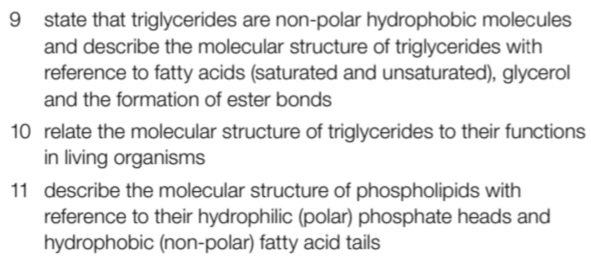
The structure of triglycerides: glycerol, three fatty acids and ester bonds
Forming triglycerides by condensation and breaking them down by hydrolysis
Saturated and unsaturated fatty acids
The structure of phospholipids and how they differ from triglycerides
How the structure of triglycerides relates to their role as an energy store
The emulsion test for lipids
Calculations, such as working out molecular mass from the parts of a lipid
How to use it
Draw a triglyceride and a phospholipid side by side before you start, labelling the glycerol, the fatty acids, the ester bonds and the phosphate group. For hydrolysis questions, count how many water molecules are needed: one for each ester bond.
Where students lose marks (from Cambridge examiners' reports and mark schemes)
Each point below is followed by wording that gained marks.
Naming the wrong bond: Calling the bond between glycerol and a fatty acid a glycosidic, peptide or hydrogen bond. Glycosidic bonds join sugars and peptide bonds join amino acids, so neither belongs in a lipid.
✔ Gains credit: an ester bond, formed between a hydroxyl group on glycerol and the carboxyl group of a fatty acid in a condensation reaction.
Water count in condensation: Mixing up condensation and hydrolysis when describing how a triglyceride forms, or forgetting that each ester bond releases its own water molecule and showing only one water.
✔ Gains credit: glycerol joins to three fatty acids by condensation, forming three ester bonds and releasing three molecules of water, one for each ester bond.
Phospholipid structure left vague: Describing a phospholipid only as 'a hydrophilic head and two hydrophobic tails', saying it has phosphate 'instead of glycerol', writing 'phosphorus' for phosphate, or giving triglycerides 'three glycerols'.
✔ Gains credit: one glycerol joined to two fatty acids by two ester bonds, plus a phosphate group in place of the third fatty acid.
Which double bond counts: Swapping saturated and unsaturated, or just saying an unsaturated fatty acid 'has a double bond'. Every fatty acid already has a C=O double bond in its carboxyl group, so that does not tell them apart.
✔ Gains credit: unsaturated fatty acids have one or more carbon–carbon (C=C) double bonds in the hydrocarbon chain. Saturated fatty acids have none.
Energy storage stated loosely: Writing that triglycerides 'store more energy' or 'produce more energy' than glycogen. This was not credited because it does not compare the same mass, and other explanations were too vague.
✔ Gains credit: triglycerides have a higher energy to mass ratio (a greater energy density), so less mass is needed to store the same amount of energy.
What hydrophobic actually means: Defining hydrophobic as 'hates water' or 'repels water', or saying triglycerides cannot form membranes simply 'because they are hydrophobic'. Neither of these answers was credited.
✔ Gains credit: hydrophobic molecules are non-polar and cannot form hydrogen bonds with water. Triglycerides have no hydrophilic phosphate head, so they cannot form a bilayer.
Why phospholipids form bilayers: Saying only that the tails 'face away from water', which would also describe a monolayer, drawing phospholipids with two heads or the wrong number of tails, or swapping hydrophilic and hydrophobic.
✔ Gains credit: the hydrophilic phosphate heads face the watery surroundings on both sides of the membrane, and the hydrophobic fatty acid tails face each other to form a hydrophobic core.
Keep practising
Go on to the CIE Carbohydrates quiz, the CIE Protein Structure quiz or the CIE Cell Membranes and Transport quiz, or browse all our CIE A Level Biology quizzes. If biological molecules still feel shaky, book a one-to-one lesson and we can work through Cambridge exam questions together.