

This free quiz has 20 multiple choice questions on transport in plants, all taken from Cambridge International (CIE) A Level Biology exam papers. It marks itself, so you get your score as soon as you finish.
What the quiz covers (Cambridge 9700 topic 7: Transport in plants)
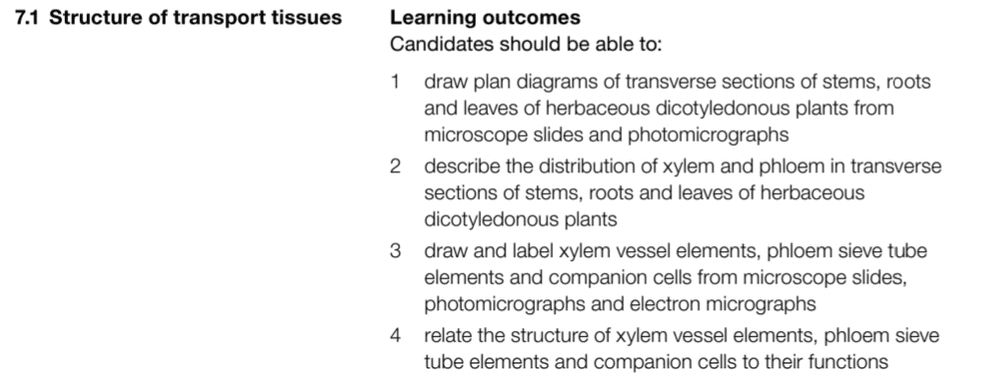
Where xylem and phloem are found in roots, stems and leaves, and identifying them in diagrams
The structure of xylem vessel elements, sieve tube elements and companion cells
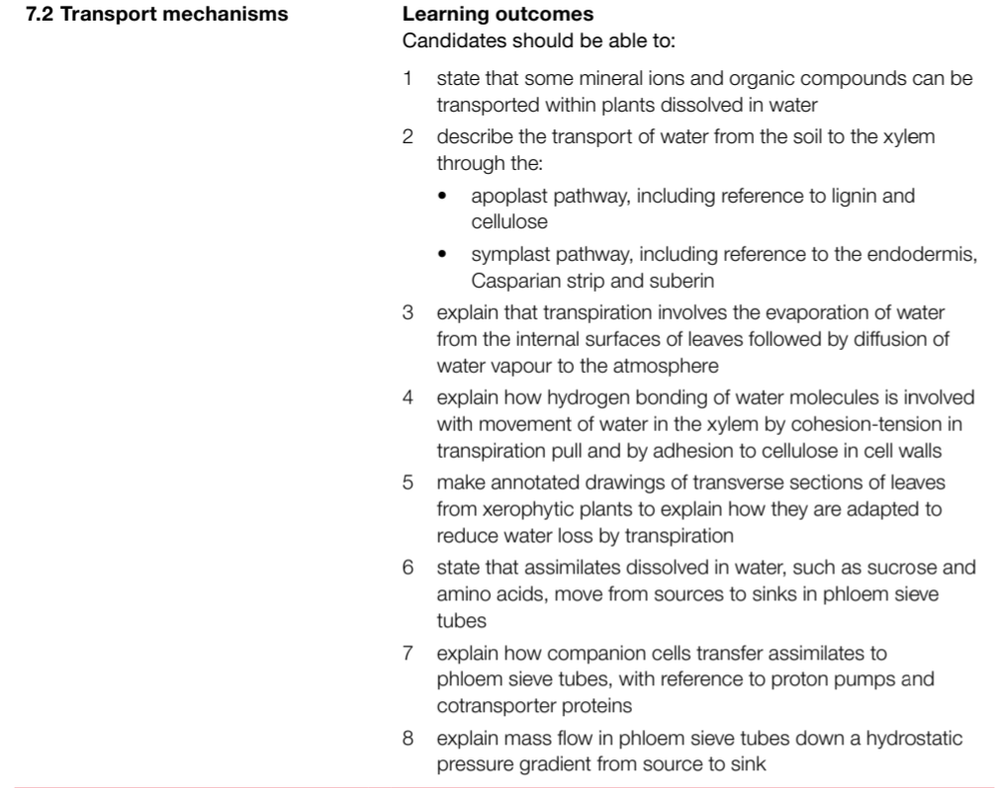
Transpiration and how water moves up the xylem by cohesion and tension
The apoplast and symplast pathways, the endodermis and the Casparian strip
Adaptations of xerophytic leaves that reduce water loss
Loading sucrose into phloem by proton–sucrose cotransport
Translocation by mass flow from source to sink
How to use it
Sketch a plan of a root and a stem before you start so you can place the xylem and phloem confidently. For translocation questions, track water potential and hydrostatic pressure separately at the source and at the sink.
Where students lose marks (from Cambridge examiners' reports and mark schemes)
Each point below is followed by wording that gained marks.
Sieve tubes are not empty: Candidates described phloem sieve tube elements as dead, empty or having no organelles. Some drew in a nucleus or a large vacuole, said they contain lignin, or left out the cell surface membrane.
✔ Gains credit: living cells with a thin layer of cytoplasm around the edge containing a few organelles such as mitochondria, a cell surface membrane, no nucleus, and sieve plates with pores.
Where evaporation happens: Candidates wrote that water evaporates from the leaf surface, from guard cells or out through the stomata. Others described transpiration simply as loss of water rather than loss of water vapour.
✔ Gains credit: water evaporates from the cell walls of spongy mesophyll cells into the air spaces. Water vapour then diffuses out through open stomata to the atmosphere, down a water potential gradient.
Cohesion versus adhesion: Candidates swapped cohesion and adhesion, wrote about water instead of water molecules, or said that lignin itself is hydrophilic. Some also brought in root pressure when it was not relevant.
✔ Gains credit: cohesion is hydrogen bonding between water molecules. Adhesion is hydrogen bonding between water molecules and cellulose or the hydrophilic parts of lignin. Transpiration pull draws up a continuous column of water.
Apoplast is not osmosis: Candidates said water moves through the apoplast pathway by osmosis. When naming the Casparian strip, some wrote only suberin, or did not realise that water cannot pass through the Casparian strip.
✔ Gains credit: apoplast movement is through cell walls and intercellular spaces without crossing membranes. The suberin in the Casparian strip blocks this route, so water must cross the cell surface membranes of endodermal cells into the symplast.
Water vapour, not water: In xerophyte questions, candidates said liquid water has to pass through the thick cuticle or multilayered epidermis, said stomatal crypts trap water, or claimed the stomata were closed.
✔ Gains credit: a thicker cuticle or multilayered epidermis increases the diffusion distance for water vapour. Sunken stomata, hairs and rolled leaves keep humid air near the stomata, which reduces the water potential gradient.
Cotransport is not active transport: Candidates called sucrose uptake into companion cells active transport, did not say that sucrose and H+ pass through the cotransporter together, or had H+ pumped into the sieve tube.
✔ Gains credit: H+ is actively pumped out of the companion cell into the cell wall using ATP. H+ diffuses back in through a cotransporter protein, carrying sucrose with it against its concentration gradient.
Mass flow needs pressure: Candidates said water enters sieve tubes down a concentration gradient, that sucrose moves by osmosis or diffuses along the sieve tube, or mixed up water potential and hydrostatic pressure gradients.
✔ Gains credit: sucrose lowers the water potential, so water enters by osmosis and raises the hydrostatic pressure at the source. Unloading at the sink lowers the pressure, so sap moves by mass flow down the hydrostatic pressure gradient.
Keep practising
Go on to the CIE Transport in Mammals quiz, the CIE Properties of Water quiz or the CIE Cell Membranes and Transport quiz, or browse all our CIE A Level Biology quizzes. If plant transport still feels shaky, book a one-to-one lesson and we can work through Cambridge exam questions together.