

In short: Genes on different chromosomes assort independently, so a cross between two double heterozygotes gives a 9:3:3:1 ratio of phenotypes. Autosomal linkage (two genes on the same autosome) and epistasis (one gene masking the expression of another) both change that ratio. The chi-squared test tells you whether the difference between your observed and expected numbers is significant, or small enough to be due to chance.
Studying A-level Biology? I'm Tom, an A-level Biology teacher with 30 years' experience. I offer one-to-one lessons and weekly group classes for AQA, OCR A and CIE, with every lesson recorded.
Dihybrid crosses, linkage, epistasis and chi-squared are often examined together in one long question. This guide builds the ideas one at a time with worked genetic diagrams and walks through a real OCR question from start to finish. Then there are six more real exam questions with the mark-scheme wording and what the examiners said. It matches OCR A 6.1.2(b) and (c) and AQA 3.7.1.
Independent assortment and the 9:3:3:1 ratio
A dihybrid cross follows two genes at once. If the two genes are on different (non-homologous) chromosomes, the pairs of chromosomes line up independently of each other at metaphase I of meiosis. This is independent assortment. Each allele of one gene is equally likely to end up in a gamete with either allele of the other gene.
Mendel used pea seeds. Allele Y (yellow) is dominant to y (green), and allele R (round) is dominant to r (wrinkled). A plant that is heterozygous for both genes, YyRr, makes four types of gamete in equal numbers: YR, Yr, yR and yr. Always write gametes with one allele of each gene, never two alleles of the same gene.
Crossing two YyRr plants gives 16 equally likely combinations. Grouping them by phenotype gives the 9:3:3:1 ratio.
Parents: YyRr (yellow, round) × YyRr (yellow, round)
Gametes (each parent): YR, Yr, yR, yr (¼ each)
Phenotype ratio 9 : 3 : 3 : 1
Two other ratios come up often. A test cross, YyRr × yyrr, gives four phenotypes in a 1:1:1:1 ratio, because the double recessive parent only makes yr gametes. A cross such as AaBb × aaBb gives 3:1:3:1. OCR's examiners noted in 2023 that many students were only prepared for the standard 9:3:3:1 cross, so practise working out the gametes from any pair of parental genotypes.
What autosomal linkage is and why it changes the ratio
Autosomal linkage means that two genes are on the same autosome (a chromosome that is not a sex chromosome). Their loci are on the same chromosome, so the genes do not assort independently. The alleles on one chromosome tend to be inherited together and end up in the same gamete.
Be precise: "the genes are on the same chromosome" earns credit, but "the alleles are on the same chromosome" does not. Two alleles of one gene sit on different chromosomes of a homologous pair.
Take an AQA example. In fruit flies, G (grey body) is dominant to g (black body) and L (long wings) is dominant to l (short wings). A fly heterozygous for both genes, with G and L on one chromosome and g and l on its homologue, is crossed with a black, short-winged fly. If the genes were on different chromosomes you would expect four phenotypes in a 1:1:1:1 ratio. In the AQA November 2021 paper the cross gave 223 grey, long-winged flies and 218 black, short-winged flies, and nothing else.
Gametes from GgLl: GL, Gl, gL, gl (¼ each)
Offspring: grey long, grey short, black long, black short
Ratio 1 : 1 : 1 : 1
Gametes from GgLl: GL and gl only (½ each)
Offspring: GgLl grey long and ggll black short
Ratio 1 : 1 AQA Nov 2021: 223 : 218
The mark scheme gave credit for three ideas. The genes are linked; no crossing over occurred (or the genes are close together); and only GL and gl gametes were made, so there were no Ggll or ggLl offspring. Only 1% of students scored all three marks.
If two linked heterozygotes are crossed (GL/gl × GL/gl) and there is no crossing over, the offspring are 3 dominant-dominant : 1 recessive-recessive, not 9:3:3:1. OCR used exactly this idea in June 2025 with sweet peas giving 3 blue, long : 1 red, round.
Crossing over and recombinant offspring
In prophase I of meiosis, homologous chromosomes pair up and non-sister chromatids can form a chiasma and swap sections. This is crossing over. If a chiasma forms between the two gene loci, it produces chromatids with new combinations of alleles. Gametes carrying them are recombinant gametes, and the offspring they produce are recombinant offspring.
Offspring with the same combinations of alleles as the original parents are parental types. Because crossing over between two particular loci happens in only some cells, recombinant offspring are always the smaller classes. The closer together the two loci are, the less likely a chiasma is to form between them, so the fewer recombinants there are.
Test cross: GgNn (G and N on one chromosome, g and n on the other) × ggnn
| Offspring phenotype | Genotype | Number | Type |
|---|---|---|---|
| Grey body, long wings | GgNn | 975 | Parental |
| Black body, short wings | ggnn | 963 | Parental |
| Grey body, short wings | Ggnn | 186 | Recombinant |
| Black body, long wings | ggNn | 194 | Recombinant |
| Total | 2318 | 380 recombinants (16.4%) | |
Data from an AQA specimen paper question on fruit flies (G grey body, g black body; N long wings, n short wings).
The heterozygous parent makes mostly GN and gn gametes, because those alleles are linked. Crossing over in some cells makes a few Gn and gN gametes, so there are a few Ggnn and ggNn offspring. If the genes were not linked, the expected ratio would be 1:1:1:1.
When you explain linkage data, describe the gametes as well as the offspring. In AQA's June 2025 paper, very few students gave the relative proportions of gamete genotypes.
Epistasis: when one gene masks another
Epistasis is an interaction between two genes at different loci, where one gene affects or masks the expression of the other. The phenotype depends on both genes. The gene doing the masking is epistatic; the gene being masked is hypostatic. OCR's examiners in 2025 said the most successful answers used these two words, and that few students linked the masking to a change in phenotype.
Epistasis is not codominance, and it is not epigenetics. Both were common wrong answers on AQA papers in 2017 and 2023. The genes also usually assort independently, so the 16 combinations from a dihybrid cross are still there. They are simply grouped into fewer phenotypes, which is why the ratio changes.
Recessive epistasis: 9:3:4
A common textbook example is coat colour in mice. Gene A controls the pigment pattern: A (agouti, banded hair) is dominant to a (black). Gene C controls whether any pigment is made: C allows pigment, and cc mice are albino whatever alleles of gene A they have. Two homozygous recessive alleles of one gene mask the other gene, so this is recessive epistasis.
Dominant epistasis: 12:3:1 and 13:3
In summer squash (an AQA June 2017 question), one dominant allele A gives white fruit whatever the B gene is. In aa plants, B gives yellow fruit and aabb gives green fruit. One dominant allele masks the other gene, so this is dominant epistasis.
OCR used onion bulbs in June 2018. A codes for a red pigment and aa bulbs are white. The dominant allele B inhibits the expression of A, so any bulb with B is white. Only A_bb bulbs are red, giving 13 white : 3 red. The mark scheme credited "dominant epistasis" and rejected "recessive epistasis".
Ratio 9 : 3 : 4
cc masks gene A.
Ratio 12 : 3 : 1
One A allele masks gene B.
Ratio 13 : 3
One B allele stops A being expressed.
A blank (_) means either allele. Each cross is between two double heterozygotes, so there are still 16 combinations.
If asked how allele B inhibits allele A, describe a gene product, such as a repressor protein or transcription factor that binds to the promoter of A and stops transcription.
Do not assume every epistasis cross is between two double heterozygotes. In the AQA squash question the cross was aabb × AaBb. That gives AaBb, Aabb, aaBb and aabb in equal numbers, so 2 white : 1 yellow : 1 green.
The chi-squared test: null hypothesis, calculation, degrees of freedom, critical value
The chi-squared (χ2) test compares observed numbers (O) with expected numbers (E) in categories. Use it for categorical data, such as numbers of offspring with each phenotype. It tells you whether the difference between O and E is significant.
Write the null hypothesis. "There is no significant difference between the observed and expected numbers." Any difference is due to chance.
Work out the expected numbers. Multiply the total number of offspring by the expected fraction for each class. For a 9:3:3:1 ratio, the fractions are 9/16, 3/16, 3/16 and 1/16. Use actual numbers, never the ratio itself, and never percentages.
Calculate (O − E)2/E for each class and add them up: χ2 = Σ(O − E)2/E.
Find the degrees of freedom: number of categories (classes) − 1. Four phenotypes give 3 degrees of freedom.
Look up the critical value at p = 0.05 for that number of degrees of freedom.
Compare and conclude. If χ2 is greater than the critical value, the difference is significant and you reject the null hypothesis. If it is smaller, the difference is not significant and you accept the null hypothesis.
Here is a full example based on an OCR specimen paper question. A farmer crossed pigs heterozygous for tail shape (T curly, t straight) and skin colour (D pink, d black) with pigs homozygous recessive for both. He expected equal numbers of the four phenotypes, but wondered whether the genes were linked. There were 104 piglets, so each expected number is 104 ÷ 4 = 26.
Null hypothesis: there is no significant difference between the observed and expected numbers of piglets.
| Phenotype | O | E | O−E | (O−E)2 | (O−E)2/E |
|---|---|---|---|---|---|
| Curly, pink | 20 | 26 | −6 | 36 | 1.38 |
| Curly, black | 30 | 26 | 4 | 16 | 0.62 |
| Straight, pink | 21 | 26 | −5 | 25 | 0.96 |
| Straight, black | 33 | 26 | 7 | 49 | 1.88 |
| χ2 = Σ | 4.85 | ||||
Degrees of freedom = 4 classes − 1 = 3
| Degrees of freedom | p = 0.05 | p = 0.01 |
|---|---|---|
| 1 | 3.841 | 6.635 |
| 2 | 5.991 | 9.210 |
| 3 | 7.815 | 11.345 |
Difference is significant. Less than 5% probability it is due to chance. Reject the null hypothesis.
Difference is not significant. More than 5% probability it is due to chance. Accept the null hypothesis.
Pigs: 4.85 < 7.815, so the difference is not significant. The farmer's conclusion that the genes are linked is not supported.
Notice how the conclusion is worded. Significance belongs to the difference between observed and expected results, not to "the results" or "the data". AQA examiners repeatedly report students writing that the results are due to chance, which loses the mark.
A full conclusion has four parts. State the comparison (4.85 is less than the critical value of 7.815 at 3 degrees of freedom). Say whether the difference is significant. Give the probability (more than 5% probability that the difference is due to chance). Then accept or reject the null hypothesis and say what that means in context.
The exact credit varies slightly. Some OCR mark schemes ignore "reject the null hypothesis" on its own and reward the probability statement instead, while AQA often credits it. Writing all four parts covers both. If the question gives a critical value, use it rather than looking one up.
A worked exam question from start to finish
This is OCR H420/02, June 2017, Question 17(b). It is worth 9 marks and covers all three ideas in this guide.
Mendel crossed two pea plants heterozygous for seed colour (Y yellow, y green) and seed shape (R round, r wrinkled). He got 9 yellow round : 3 green round : 3 yellow wrinkled : 1 green wrinkled. Students repeated the cross with a modern variety. They got 58 yellow round, 31 green round, 21 yellow wrinkled and 2 green wrinkled.
Part (i): calculate the χ2 value (3 marks)
Step 1: add up the total. 58 + 31 + 21 + 2 = 112 seeds.
Step 2: work out the expected numbers from the 9:3:3:1 ratio. 112 × 9/16 = 63. 112 × 3/16 = 21 (twice). 112 × 1/16 = 7.
Step 3: calculate (O − E)2/E for each class and add them.
| Phenotype | O | E | O−E | (O−E)2 | (O−E)2/E |
|---|---|---|---|---|---|
| Yellow, round | 58 | 63 | −5 | 25 | 0.40 |
| Green, round | 31 | 21 | 10 | 100 | 4.76 |
| Yellow, wrinkled | 21 | 21 | 0 | 0 | 0.00 |
| Green, wrinkled | 2 | 7 | −5 | 25 | 3.57 |
| χ2 = Σ | 8.73 | ||||
3 degrees of freedom. Critical value at p = 0.05 is 7.82. At p = 0.025 it is 9.35.
8.73 > 7.82, so the difference is significant at p = 0.05.
The mark scheme accepts 8.73 or 8.8. If your answer is wrong, it still gives 1 mark for the correct expected numbers (63, 21, 21, 7) and 1 mark for the correct (O − E)2/E values. It also allows 2 marks for about 637, the value you get by wrongly using 9, 3, 3 and 1 as the expected numbers.
Part (ii): do the results support the students' statement? (3 marks)
The students said inheritance in their plants was different from Mendel's. Four classes give 3 degrees of freedom, and the critical value at p = 0.05 is 7.82. The calculated value, 8.73, is higher than 7.82. So the difference between observed and expected numbers is significant. There is less than a 5% probability that the difference is due to chance. The statement is supported.
For a top answer, also look one column further. 8.73 is smaller than 9.35, the value at p = 0.025. So there is more than a 2.5% probability that the difference is due to chance. The result is close to the critical value, which makes the conclusion less secure. The mark scheme credits this. It ignores "reject the null hypothesis" here, so the marks come from the comparison and the probability.
Part (iii): suggest and explain one reason, other than epistasis, why the ratio might not be 9:3:3:1 (3 marks)
Suggest autosomal linkage. The two genes are on the same chromosome, so they do not assort independently. Alleles on the same chromosome are inherited together and end up in the same gamete, unless crossing over occurs (a chiasma forms between the loci). The mark scheme ignores sex linkage and mutation, but allows lethal genotypes, and genetic drift if numbers are small.
Six more real exam questions with the mark-scheme wording
These come from OCR A and AQA A-level papers. Try each one before reading the answer.
Question 1 (7402/2, June 2022, 2 marks)
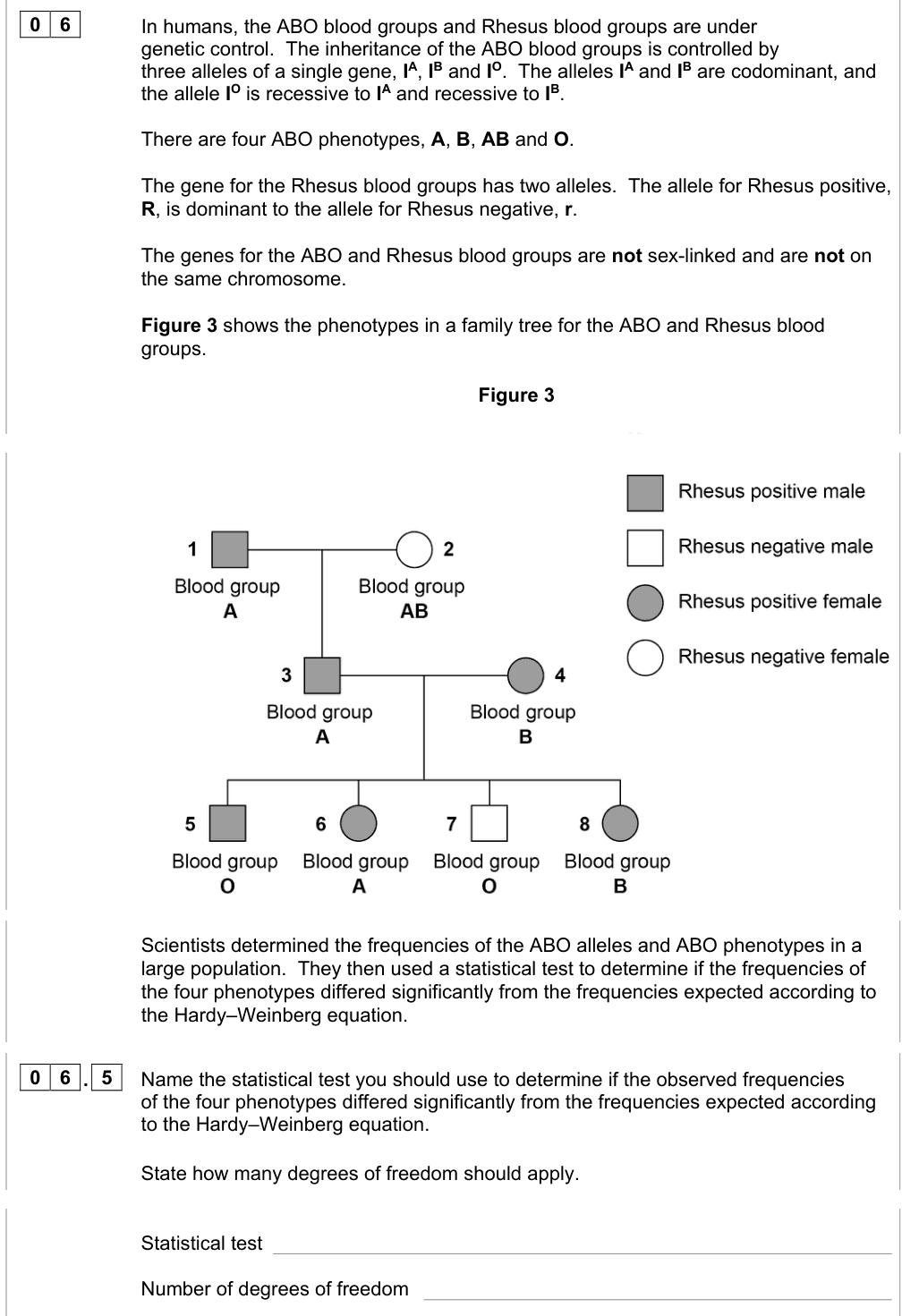
Mark scheme: chi-squared (χ2 accepted); 3 degrees of freedom.
Examiners said: about 88% named chi-squared, but only about 44% got both marks. Wrong tests included Student's t-test, Spearman's rank, Mann–Whitney and Wilcoxon. The most common wrong numbers of degrees of freedom were 2, 4, 5 and 0.05.
Question 2 (H420/03, June 2018, 4 marks)
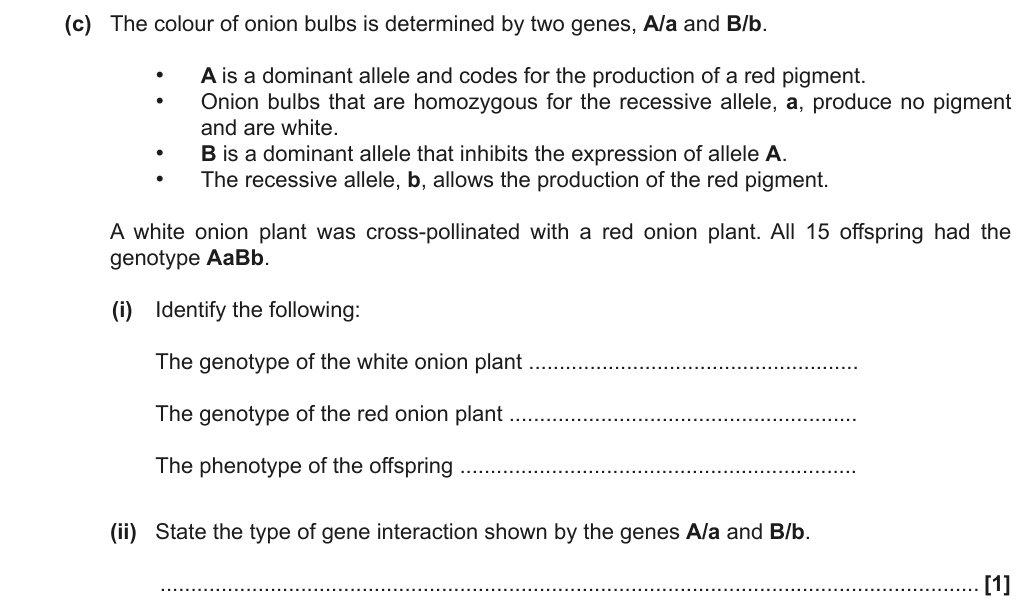
Mark scheme: (a) aaBB; AAbb; white or no pigment ("colourless" is not allowed). (b) (dominant) epistasis. Recessive epistasis and complementary epistasis are not allowed.
Examiners said: most students scored at least one mark in (a). Lost marks usually came from giving one copy of each allele (AB, ab) or giving heterozygous genotypes such as AaBb or Aabb. In (b), codominance was a common wrong answer, and a few wrote recessive epistasis.
Question 3 (7402/1, June 2018, 2 marks)
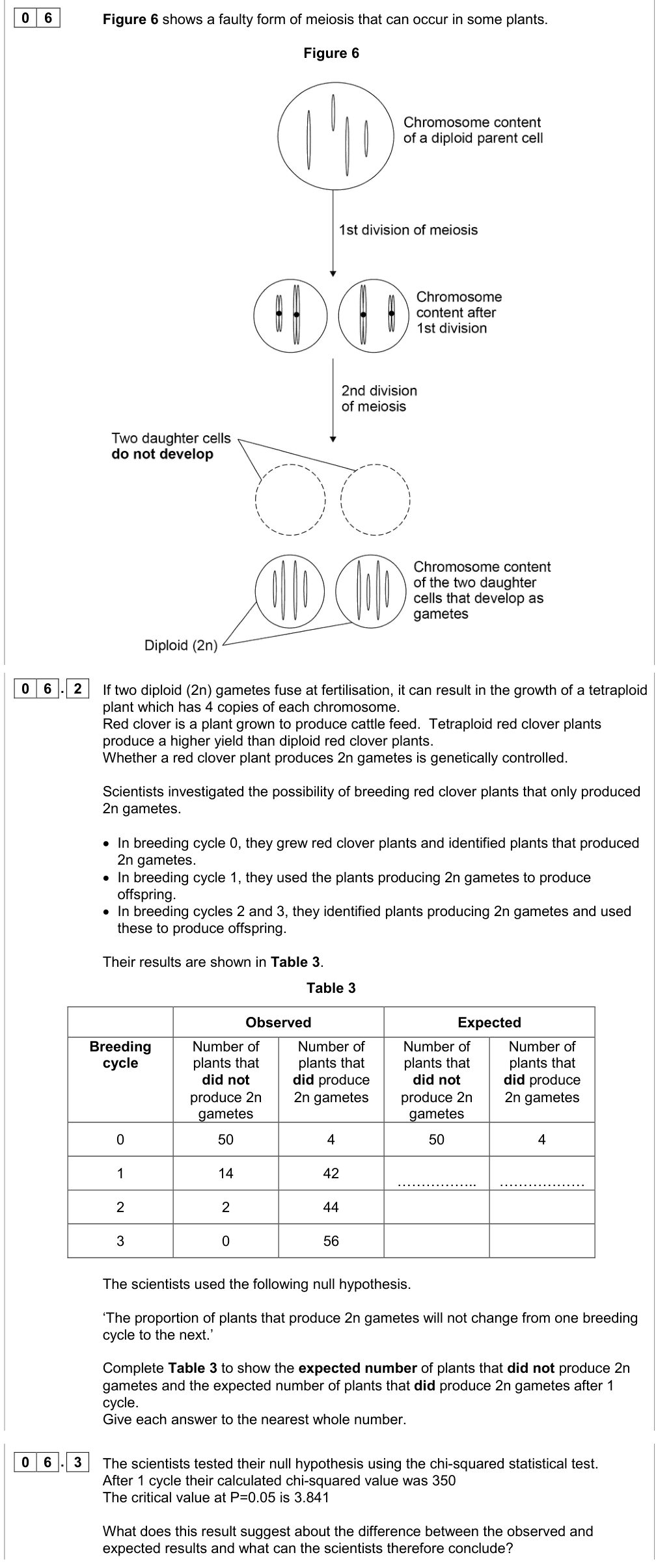
Mark scheme: there is less than a 0.05 (5%) probability that the difference between observed and expected occurred by chance; the calculated value is greater than the critical value, so the null hypothesis can be rejected; the proportion of plants producing 2n gametes does change from one cycle to the next (2 max). "Results" occurring by chance, with no reference to the difference, limits the answer to 1 mark. "P value" is not accepted in place of "critical value".
Examiners said: questions on P values are still not answered well. Too many students wrote that the "results" are due to chance, leaving out that it is the difference that is or is not due to chance. The examiners suggested students meet all three statistical tests in a range of contexts, not only genetic crosses.
Question 4 (7402/2, June 2017, 3 marks)
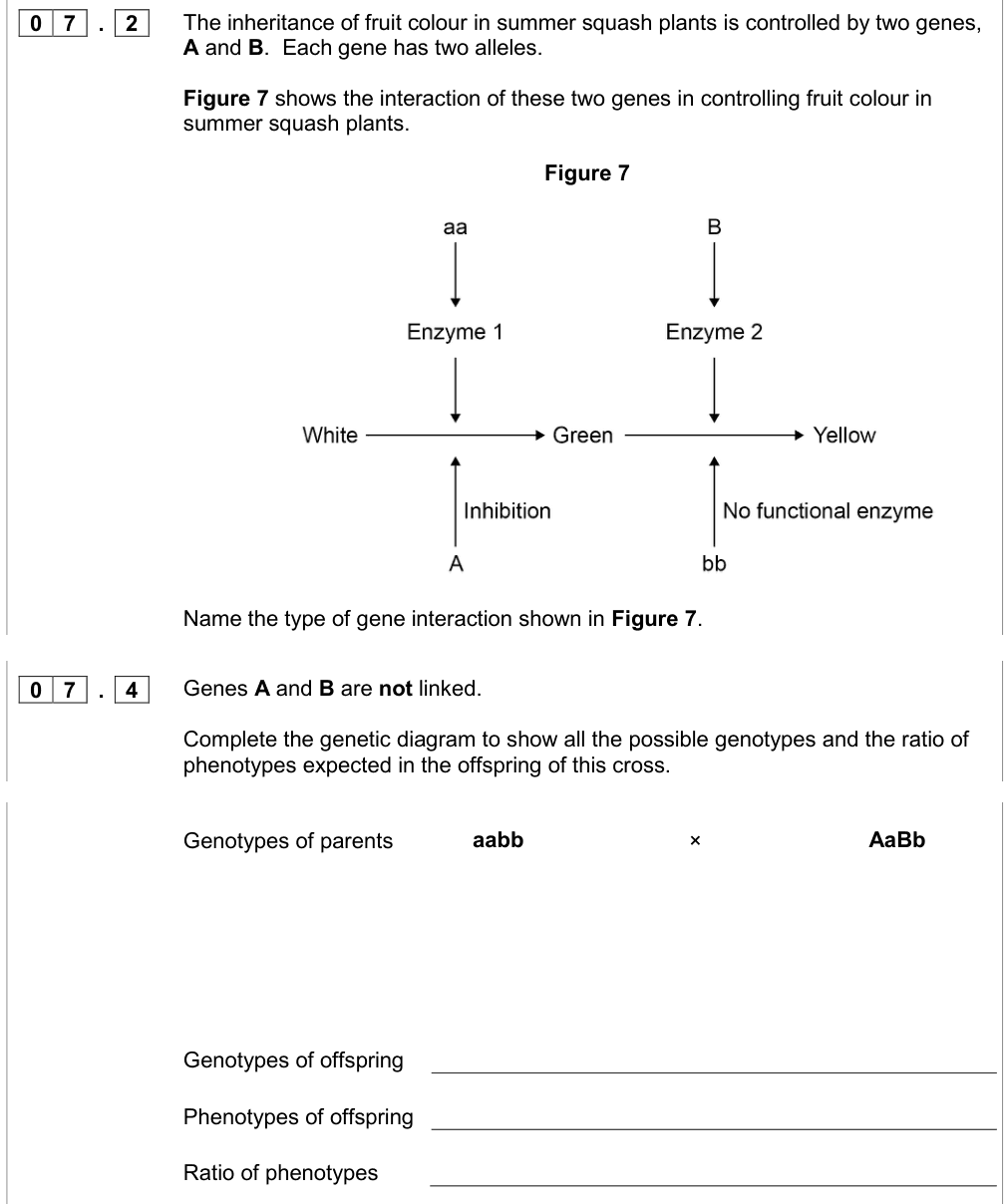
Mark scheme: genotypes AaBb, Aabb, aaBb, aabb; phenotypes white, white, yellow, green; ratio 2 white : 1 yellow : 1 green (equivalent ratios such as 4:2:2 accepted). If the genotypes are wrong, no marks are given.
Examiners said: over 55% got all three marks, but over 25% scored zero on what was considered a straightforward cross. Some students gave the correct genotypes and phenotypes and then wrote 1:1:1:1 or 9:3:3:1 as the ratio.
Question 5 (H420/02, June 2025, 3 marks)
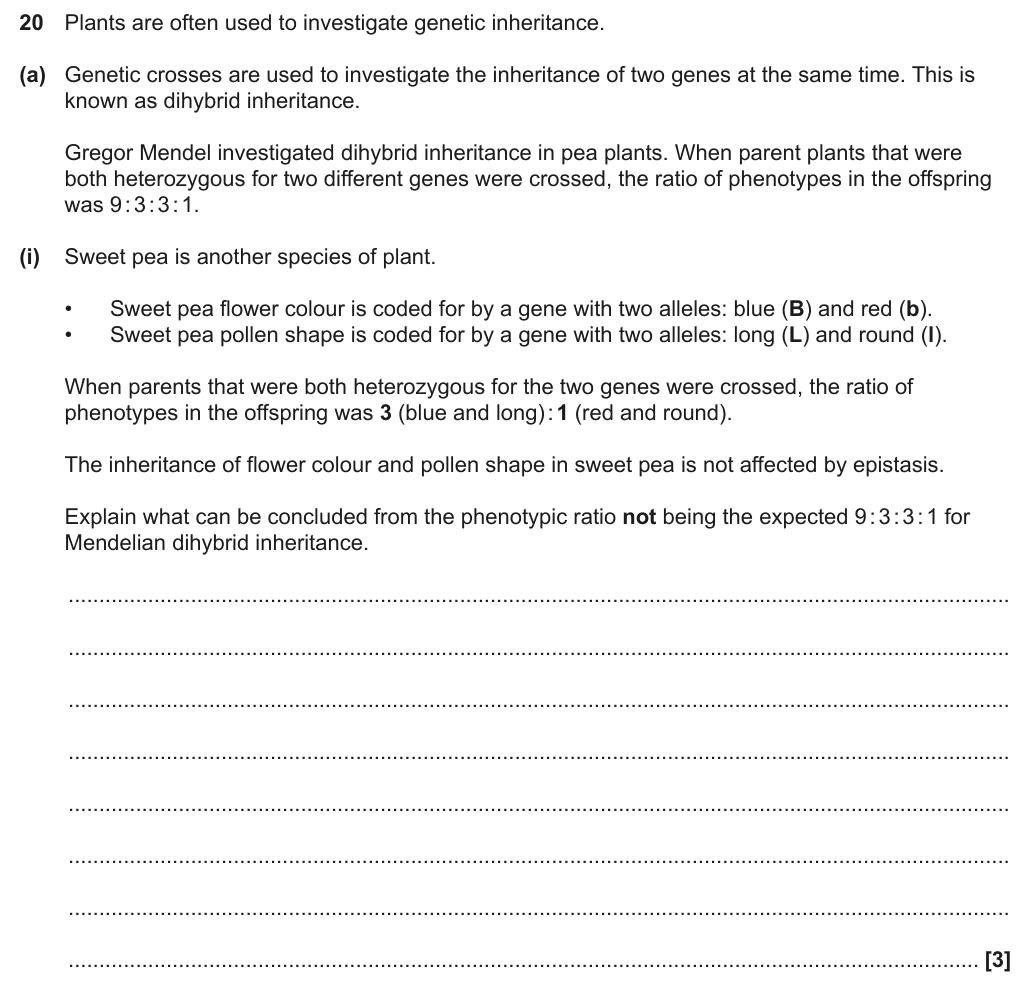
Mark scheme: autosomal linkage or both genes on the same chromosome; no independent assortment; short distance between the loci; no crossing over, so no recombinants; alleles BL and bl inherited together or end up in the same gamete (3 max). "Genes or loci linked" is allowed, but "alleles on the same chromosome" and "alleles linked" are ignored. "Crossing over rarely occurs" is not allowed.
Examiners said: just under half scored nothing. Some answered with sex linkage, codominance or epistasis, despite the question ruling epistasis out. Students who gave "no crossing over" and "no independent assortment" picked up marks. The examiners asked for clearer teaching of the differences between linkage, epistasis and independent assortment.
Question 6 (7402/2, June 2018, 3 marks)
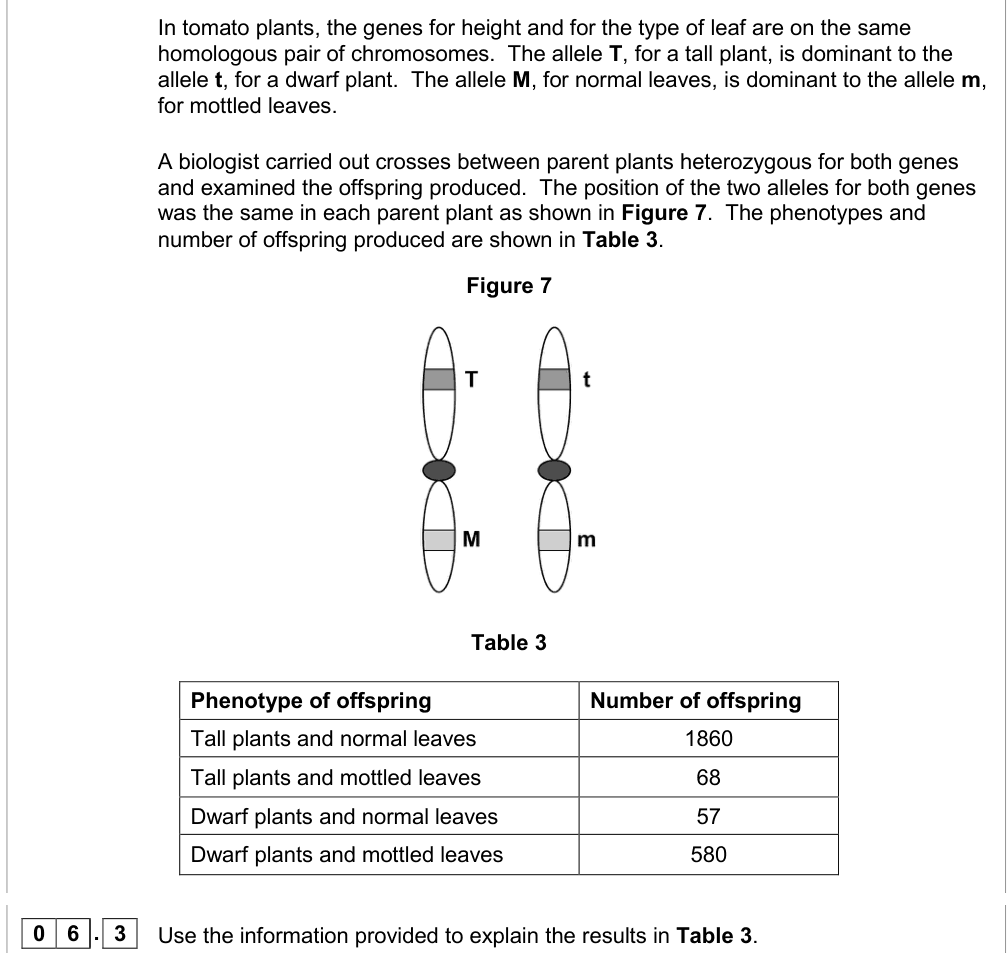
Mark scheme: the genes are linked; this produces few(er) tall mottled and dwarf normal offspring (accept few Tm and tM gametes, or fewer recombinants); crossing over has occurred. "Alleles are linked" is accepted, unless it suggests alleles of the same gene.
Examiners said: this was a new topic and 45% scored zero, even though the stem said the genes were on the same chromosome pair. The best answers said that if the linked alleles were always inherited together the offspring would be 3:1. They added that crossing over made a small number of Tm and tM gametes, giving the few recombinant plants. Weaker answers expected 9:3:3:1, blamed mutation, or said crossing over happens in mitosis.
Common mistakes (from the examiners’ reports and mark schemes)
Defining linkage using "alleles" or "traits". Gains credit: "the genes are on the same chromosome (autosome)", or "alleles of different genes are on the same chromosome".
Explaining a linkage result as if it were a normal dihybrid cross. Gains credit: "the genes are linked, so the alleles are inherited together; there is no independent assortment", and explain why there are only two (or mostly two) phenotype classes.
Describing the offspring when the question asks about gametes, or putting crossing over in mitosis. Gains credit: "crossing over in meiosis produces a few Fl and fL gametes, so there are more FL and fl gametes" and "fewer recombinant offspring".
Writing "allele B turns off allele A" for epistasis. Gains credit: "allele B codes for a repressor protein or transcription factor that binds to the promoter of A, so A is not transcribed".
Naming codominance, epigenetics or "dihybrid" when the question describes epistasis. Gains credit: "epistasis: the expression of one gene masks or affects the expression of another gene, so the phenotype is affected by more than one gene".
Giving gametes or parents with the wrong number of alleles, or a 1:1:1:1 ratio after correct genotypes. Gains credit: one allele of each gene in each gamete (AB, Ab, aB, ab), two of each gene in each parent, and phenotypes matched to genotypes in the ratio.
Saying "mutation" for why observed ratios differ from expected. Gains credit: "small sample size", "random fertilisation (fusion of gametes)", "crossing over", "epistasis" or "lethal genotypes". Mutation is too rare to change the ratio.
Miscalculating expected numbers or degrees of freedom. Gains credit: "E = total × expected fraction (112 × 9/16 = 63)" and "degrees of freedom = number of categories − 1".
Saying "the results are due to chance" or "the data are significant". Gains credit: "there is less than a 5% probability that the difference between observed and expected results is due to chance, so the difference is significant and the null hypothesis is rejected".
Try the challenge questions
Once you are confident with the examples above, try these harder problems from my blog.
Want help with topics like this every week?
My weekly group classes for AQA and OCR A work through exam questions topic by topic, and every class is recorded. Or book a first one-to-one lesson. For more past questions, see my OCR A-level Biology exam questions by topic.