

In short: Nitrogen cycles between the air, the soil and living organisms, and bacteria carry out almost every step. Nitrogen-fixing bacteria turn nitrogen gas into ammonium. Saprobionts turn proteins, nucleic acids and urea back into ammonium (ammonification). Nitrifying bacteria oxidise ammonium to nitrite and then nitrate, which plants absorb, and denitrifying bacteria in waterlogged soil turn nitrate back into nitrogen gas.
Studying A-level Biology? I'm Tom, an A-level Biology teacher with 30 years' experience. I offer one-to-one lessons and weekly group classes for AQA, OCR A and CIE, with every lesson recorded.
The nitrogen cycle looks simple, but exam answers lose marks on names, order and conditions. Typical slips are mixing up Nitrosomonas and Nitrobacter, putting nitrate before nitrite, or forgetting which steps need oxygen. This guide explains each stage with a labelled diagram, adds the AQA content on the phosphorus cycle and mycorrhizae, and covers fertilisers and eutrophication. It then gives seven real OCR and AQA exam questions with the mark-scheme wording and what the examiners said. It matches OCR A 6.3.1(c) and AQA 3.5.4.
Why organisms need nitrogen
Nitrogen is part of many biological molecules. Every amino acid has an amine group, so all proteins contain nitrogen, including enzymes, haemoglobin and antibodies. Nucleotides contain nitrogenous bases, so DNA and RNA need nitrogen too. So do ATP, NAD, NADP and chlorophyll.
About 78% of the air is nitrogen gas, N2. The two atoms are held by a strong triple bond, so N2 is very unreactive. Plants and animals cannot use it directly. Plants absorb nitrogen from the soil, mainly as nitrate ions (NO3−), and some ammonium ions (NH4+). Animals get their nitrogen by eating proteins and nucleic acids, which they digest and reassemble into their own molecules.
Because the supply of usable nitrogen in soil is limited, it has to be recycled. Microorganisms do the recycling. The diagram shows the whole cycle, with each arrow coloured by process.
Nitrification needs oxygen; denitrification happens when soil is waterlogged and anaerobic.
Nitrogen fixation (free-living bacteria and Rhizobium in root nodules)
Nitrogen fixation is the conversion of nitrogen gas into ammonia (NH3), which forms ammonium ions (NH4+) in water. Bacteria do this with the enzyme nitrogenase. The reaction reduces nitrogen and needs a lot of ATP. One AQA paper gave a figure of 16 ATP for each molecule of nitrogen reduced.
Nitrogenase is inhibited by oxygen, so nitrogen fixation must happen where the oxygen concentration is kept low. This is a favourite source of "suggest" questions.
Free-living nitrogen-fixing bacteria, such as Azotobacter, live in the soil. They use the ammonia to make their own amino acids. The nitrogen reaches the rest of the ecosystem when they die and are decomposed.
Mutualistic nitrogen-fixing bacteria, such as Rhizobium, live inside root nodules of legumes such as peas, beans and clover. The bacteria give the plant ammonium, which the plant uses to make amino acids. The plant gives the bacteria carbohydrates, which they respire to make ATP.
Leghaemoglobin in the nodules binds oxygen, like haemoglobin. It supplies oxygen for the bacteria's respiration while keeping the oxygen concentration around nitrogenase low.
Some nitrogen is also fixed by lightning, and a great deal is fixed industrially by the Haber process to make fertiliser. Farmers use legumes in crop rotation because the nodules add fixed nitrogen to the soil. Ploughing in the remains of the crop adds more.
Ammonification
Ammonification is the conversion of nitrogen-containing compounds in dead organisms and waste into ammonium ions. It is carried out by saprobionts, which are decomposer bacteria and fungi. OCR usually calls them decomposers; AQA uses the term saprobionts. Either way, be specific about what they break down.
Saprobionts secrete enzymes onto dead organisms, faeces and urine. This is extracellular digestion.
Proteins are hydrolysed to amino acids, and nucleic acids to nucleotides. Urea and uric acid are broken down too.
Saprobionts absorb the soluble products and respire some of them. Ammonia is released, and it forms ammonium ions in the soil water.
Ammonification is faster in warm, moist, well-aerated soil. If you explain why, link the factor to enzymes or respiration. An AQA report (June 2025) noted that many students linked temperature only to "faster decomposition", which was not enough.
Nitrification
Nitrification is the conversion of ammonium ions into nitrate ions. It happens in two steps, each carried out by a different genus of nitrifying bacteria:
Nitrosomonas oxidises ammonium ions (NH4+) to nitrite ions (NO2−).
Nitrobacter oxidises nitrite ions (NO2−) to nitrate ions (NO3−).
Both steps are oxidation reactions, and both need oxygen. The bacteria are chemoautotrophs: they use the energy released by these oxidations to make organic compounds. Nitrification is fastest in well-aerated soil, which is one reason farmers plough and drain fields.
Plants absorb nitrate ions into their root hair cells by active transport. They use the nitrogen to make amino acids, proteins, nucleotides and chlorophyll. Note that plants do not turn nitrate into ammonia or nitrogen gas, a mistake OCR examiners reported in June 2023.
Denitrification
Denitrification is the conversion of nitrate ions back into nitrogen gas. It is carried out by denitrifying bacteria, which are anaerobic. In the absence of oxygen they use nitrate in their respiration and reduce it to N2, which escapes to the air.
Denitrification happens in waterlogged or compacted soil, where water fills the air spaces and oxygen is scarce. Two things happen together in these soils:
Nitrifying bacteria are less active, because they need oxygen. Less ammonium is oxidised to nitrite and nitrate, so ammonium builds up.
Denitrifying bacteria are more active, so more nitrate is converted to nitrogen gas.
The result is soil that is low in nitrate, so plants grow poorly. Draining and ploughing add oxygen, which favours nitrification and reduces denitrification. The cards below summarise the five conversions.
Bacteria: Rhizobium (root nodules of legumes); free-living Azotobacter
Reduction. Nitrogenase works only when oxygen is kept low.
Bacteria: Saprobionts (decomposer bacteria and fungi)
Extracellular digestion of dead matter and waste.
Bacteria: Nitrosomonas
Oxidation. Aerobic.
Bacteria: Nitrobacter
Oxidation. Aerobic.
Bacteria: Denitrifying bacteria
Reduction. Anaerobic, e.g. waterlogged soil.
The phosphorus cycle and mycorrhizae (AQA)
AQA 3.5.4 also covers the phosphorus cycle and mycorrhizae. OCR 6.3.1(c) focuses on nitrogen, so OCR students can treat this section as background.
Phosphorus is used to make ATP, ADP, DNA, RNA, phospholipids, RuBP, GP, triose phosphate and NADP. In a June 2017 AQA question, a common error was to say that plants use phosphate to make proteins. Most proteins contain no phosphorus, so name one of the compounds above.
Most phosphorus is held in rocks as phosphate ions (PO43−). Weathering and erosion release them into soil and water.
Plants absorb phosphate ions by active transport. Animals get phosphorus by eating plants or other animals.
Saprobionts decompose dead organisms and waste, releasing phosphate ions back into the soil.
Some phosphate ends up in sediments, which form new rock over very long periods. Bird and bat droppings (guano) and bones are other stores.
Unlike nitrogen and carbon, phosphorus has no significant gas phase. It does not cycle through the air.
Mycorrhizae are associations between fungi and plant roots. The fungal hyphae grow over and into the roots and spread far into the soil. They act like an extension of the root system. They greatly increase the surface area for absorbing water and mineral ions, especially phosphate, which moves slowly in soil. The hyphae also hold water near the roots, which helps plants survive drought.
The relationship is mutualistic. The plant gains water and ions. The fungus gains organic compounds from the plant, such as sugars and other carbohydrates made in photosynthesis. In a June 2017 AQA question, many students wrongly said the fungus gains "nutrients", water or oxygen.
Fertilisers, leaching and eutrophication
When a crop is harvested, the nitrogen and phosphorus in its proteins and nucleic acids leave the field. They are not returned by decomposition. Farmers replace these mineral ions with fertilisers. Nitrate and phosphate are often limiting factors, so fertilisers increase yield. More nitrate means more protein and chlorophyll, and more phosphate means more ATP and nucleic acids, so growth and photosynthesis increase.
Natural (organic) fertilisers are manure, slurry, compost and crop residues. Saprobionts must decompose them first, so the ions are released slowly.
Artificial (inorganic) fertilisers contain soluble ions such as ammonium nitrate and phosphates. They act quickly and the amounts can be controlled.
Adding more fertiliser gives smaller and smaller increases in yield. Too much fertiliser can lower the water potential of the soil, so roots take up less water.
Leaching is the washing of soluble ions out of the soil by rain. Nitrate is very soluble, so it leaches easily, especially after heavy rain on bare soil. Leached nitrate and phosphate run into rivers and lakes, and this can cause eutrophication.
Extra nitrate and phosphate allow algae and surface plants to grow rapidly, forming an algal bloom.
The bloom blocks light, so plants under the surface cannot photosynthesise. They die.
Saprobionts decompose the dead plants and algae. They use oxygen in aerobic respiration, so the oxygen concentration of the water falls.
Fish and other aerobic organisms have less oxygen for respiration, so they die.
The fish die from lack of oxygen for respiration. They are not poisoned by the nutrients. Farmers can reduce leaching by applying the right amount of fertiliser at the right time. Avoiding heavy rain and leaving strips of vegetation beside rivers also help.
Seven real exam questions with the mark-scheme wording
These are from OCR A Level Biology A and AQA A-level Biology papers. Try each one before reading the answer.
Question 1 (H420/02, November 2020, 1 mark)
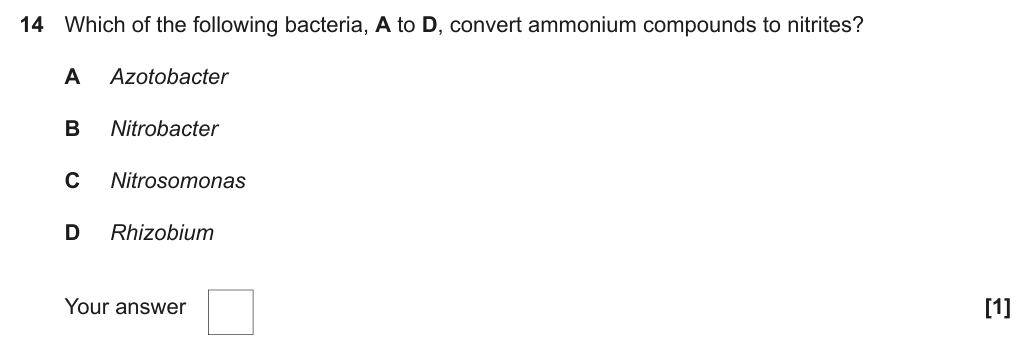
Mark scheme: C, Nitrosomonas.
Question 2 (7402/3, June 2019, 2 marks)

Mark scheme: (they use enzymes to) decompose proteins, DNA, RNA or urea; producing or releasing ammonia, ammonium compounds or ammonium ions. Any named nitrogen-containing molecule is accepted, and "digest", "break down" or "hydrolyse" are accepted for decompose. "Nitrogen-containing compounds" on its own is ignored. "They perform ammonification" is accepted for the second point.
Examiners said: many students described the whole cycle, as if expecting the examiner to pick out the right part. Very few named a nitrogen-containing compound, and some confused ammonification with nitrogen fixation. The second mark was gained more often. About two-thirds of students scored at least one mark.
Question 3 (H420/02, June 2023, 6 marks)
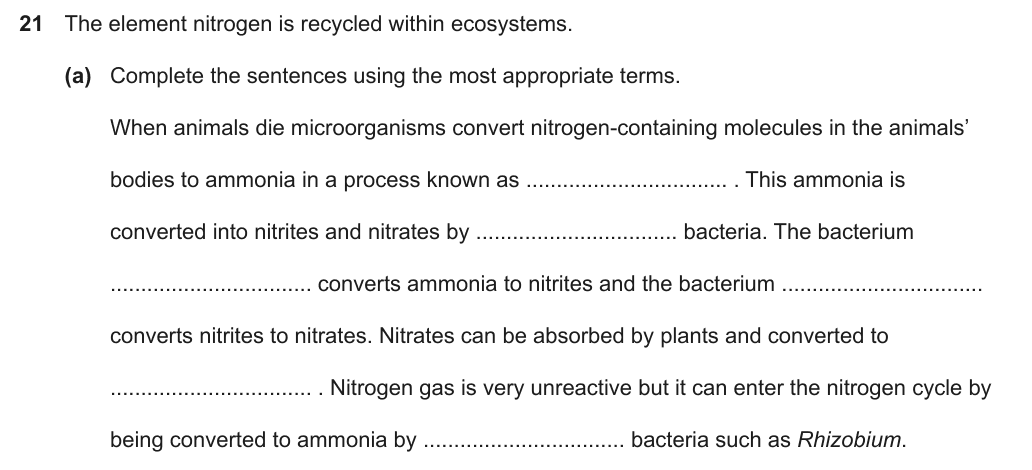
Mark scheme: (1) ammonification; (2) nitrifying; (3) Nitrosomonas; (4) Nitrobacter; (5) amino acids (protein or nucleic acids allowed); (6) nitrogen-fixing. Lower-case generic names and phonetic spellings were accepted.
Examiners said: fewer than 1 in 10 candidates scored full marks, and slightly more scored zero. Many could not recall the right genus, and wrote names such as Azotobacter instead. Spellings that were not phonetic equivalents, such as "nitrogen-fixating", were not credited. Some wrote that plants convert nitrates to ammonia or nitrogen rather than proteins.
Question 4 (H420/02, June 2023, 2 marks)
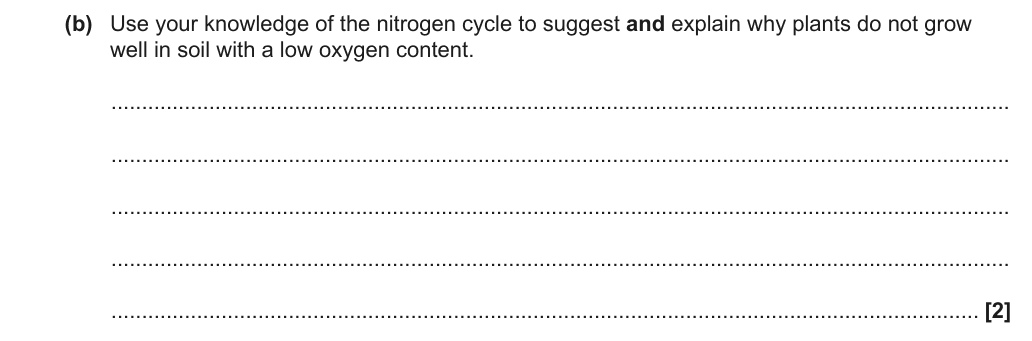
Mark scheme: increased denitrification or decreased nitrification; conditions favour (named) denitrifying bacteria; (more) nitrate converted to nitrogen gas. Descriptions of either process are allowed, and so is "reduces the availability of nitrate to plants".
Examiners said: almost half of candidates scored one mark, usually for reduced nitrification or nitrate availability. Only about 1 in 10 realised that denitrification was the key, but they usually scored both marks. Many ignored the reference to the nitrogen cycle and wrote about respiration. A significant number said oxygen was needed for photosynthesis.
Question 5 (7402/3, November 2021, 2 marks)
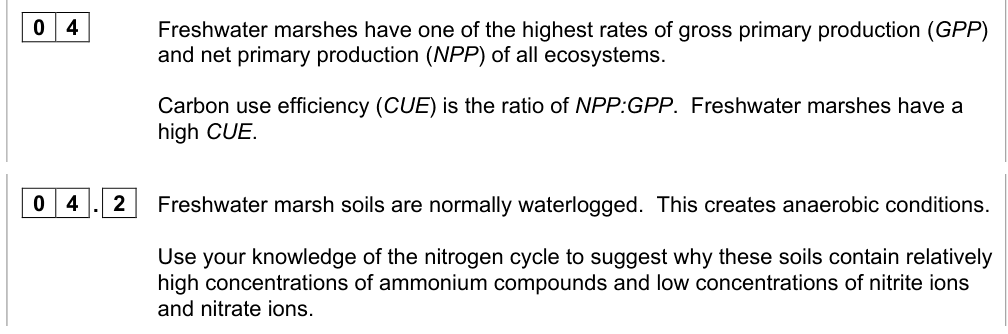
Mark scheme: any two from: less nitrification, or nitrifying bacteria need oxygen; (less) oxidation of ammonium to nitrite and to nitrate; more denitrification, or denitrifying bacteria need anaerobic conditions; (so more) nitrate reduced to nitrogen gas. The order must be nitrite then nitrate. "Breakdown" is ignored in place of oxidation or conversion.
Examiners said: students tried to make incorrect knowledge fit the question, for example saying that saprobionts are anaerobic or that nitrates are denitrified into ammonia. About a quarter of students scored both marks.
Question 6 (7402/2, June 2025, 4 marks)
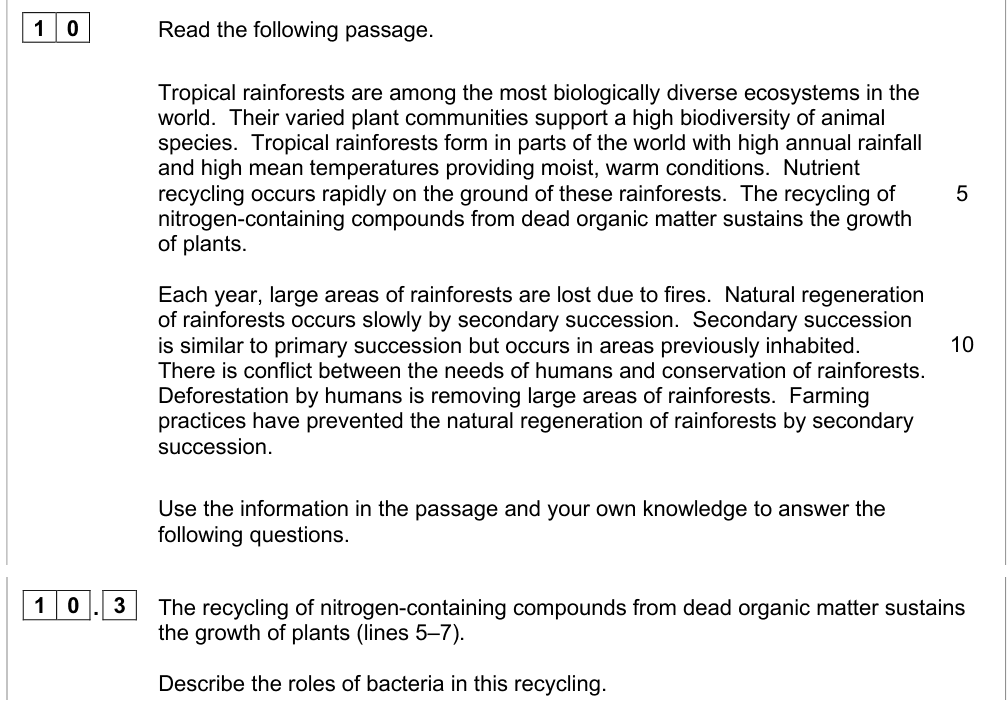
Mark scheme: protein, amino acids or DNA into ammonium or ammonia; (by) saprobionts; ammonium or ammonia into nitrite and (then) into nitrate; (by) nitrifying bacteria. Any named nitrogen-containing compound, such as urea, is accepted. A type of bacteria linked to the wrong process is rejected, for example "nitrite converted to nitrate by saprobionts". Nitrogen fixation and denitrification are ignored.
Examiners said: fewer than 20% scored all four marks. Most did not name a nitrogen-containing compound in the dead matter. A significant number said ammonia was converted to nitrate and then nitrite, and some described nitrification as reduction. Weaker answers confused nitrifying bacteria with nitrogen-fixing bacteria, and many added irrelevant detail about fixation and denitrification.
Question 7 (7402/2, November 2021, 4 marks)
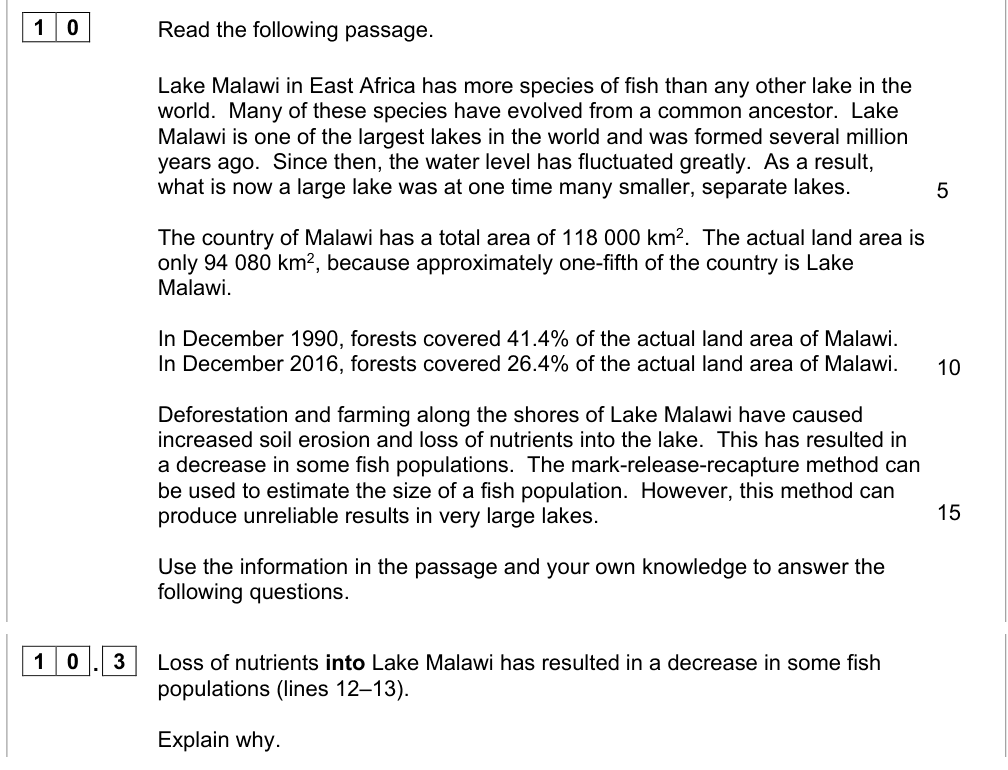
Mark scheme: (growth of) algae or surface plants, or an algal bloom, blocks light; reduced or no photosynthesis, so (submerged) plants die; saprobiotic microorganisms aerobically respire, or use oxygen in respiration; less oxygen for fish to respire. "Decomposer" is neutral: the mark needs saprobionts (or saprophytes or saprotrophs).
Examiners said: half of students misread the question as a loss of nutrients from the lake and scored nothing. Only 17% scored three or more marks, and 6% scored full marks by linking saprobionts to oxygen use in respiration. Some referred only to "bacteria" or "decomposers". Others thought decomposition released toxins, or that the nutrients themselves were toxic.
For a harder, synoptic question, try my nitrogen cycle challenge question.
Common mistakes (from the examiners’ reports and mark schemes)
Naming the wrong genus for nitrification. Gains credit: "Nitrosomonas converts ammonium to nitrite; Nitrobacter converts nitrite to nitrate". Azotobacter is a nitrogen fixer.
Putting nitrate before nitrite. Gains credit: "ammonium is oxidised to nitrite and then to nitrate". AQA mark schemes say the order must be nitrite then nitrate.
Calling nitrification a reduction, or mixing up the two. Gains credit: "nitrification is oxidation; nitrogen fixation and denitrification are reductions".
Confusing nitrifying bacteria with nitrogen-fixing bacteria. Gains credit: "nitrifying bacteria convert ammonia to nitrite and then nitrate"; "nitrogen-fixing bacteria convert nitrogen gas to ammonia".
Writing that saprobionts break down "nitrogen-containing compounds". Gains credit: "saprobionts decompose proteins, DNA or urea, releasing ammonium" (ammonification). The unqualified phrase is ignored.
Giving nitrate or ammonium when asked for nitrogen-containing biological molecules. Gains credit: "amino acids, proteins, DNA, RNA, ATP, NAD or chlorophyll". AQA rejects nitrates, nitrites, ammonia and urea here.
Answering a low-oxygen soil question in terms of respiration or photosynthesis. Gains credit: "more denitrification: denitrifying bacteria convert nitrate to nitrogen gas in anaerobic conditions", and "less nitrification".
Saying Rhizobium lives in "the roots", or writing ions without charges. Gains credit: "in root nodules (of legumes)", and correct formulae such as NH4+, NO2− and NO3−.
In eutrophication, writing "bacteria" or "decomposers", or blaming toxins. Gains credit: "saprobionts use oxygen in aerobic respiration, so there is less oxygen for fish to respire".
Want help with topics like this every week?
My weekly group classes for AQA and OCR A work through exam questions topic by topic, and every class is recorded. Or book a first one-to-one lesson. For more OCR practice sorted by topic, see my OCR A-level Biology exam questions by topic.