

In short: Plants respond to light, gravity, water stress and herbivores using plant hormones, not nerves. Auxin (IAA) causes cell elongation and controls phototropism, geotropism and apical dominance. Gibberellins cause stem elongation and switch on seed germination. Abscisic acid (ABA) closes stomata when water is short, and ethene triggers leaf fall and fruit ripening.
Studying A-level Biology? I'm Tom, an A-level Biology teacher with 30 years' experience. I offer one-to-one lessons and weekly group classes for AQA, OCR A and CIE, with every lesson recorded.
Plant responses is a short topic, but it turns up regularly on H420/01 and H420/03, often as a practical or data question. This guide covers tropisms, how auxin, gibberellins, abscisic acid and ethene act, the classic experiments and the commercial uses. Then there are seven real OCR exam questions with the mark-scheme wording and what the examiners said. It matches OCR A 5.1.5(a) to (f), the plant half of 5.1.5. The animal half (the brain, reflexes and muscle contraction) is coming in a later post.
Why plants need to respond
Plants cannot move away from a problem, so they must respond where they are. They respond to abiotic stimuli such as light, gravity, water availability, temperature and day length. They also respond to biotic stresses such as herbivores and pathogens.
Most plant responses are growth responses, and they are slower than animal responses. They are coordinated by plant hormones. A plant hormone is a chemical messenger. It is made in one part of the plant and changes the activity of target cells in another part.
The mark schemes credit these responses to abiotic stress:
Drought: closing stomata, leaf drop or wilting.
Freezing: production of antifreeze chemicals, closing stomata or leaf drop.
Short day length or low light: abscission (leaf fall).
Defences against herbivory can be chemical or physical. Chemical defences include toxic compounds such as tannins and alkaloids, and pheromones. Some damaged plants release volatile chemicals that attract predators or parasites of the herbivore. A physical response is folding of leaves when touched, as in Mimosa pudica.
Tropisms: phototropism and geotropism
A tropism is a directional growth response to a directional stimulus. Growth towards the stimulus is positive. Growth away from it is negative.
Phototropism is growth in response to light. Shoots are positively phototropic, so leaves are held where they can photosynthesise. Roots are usually negatively phototropic.
Geotropism (gravitropism) is growth in response to gravity. Roots are positively geotropic, which anchors the plant and reaches water and mineral ions. Shoots are negatively geotropic.
Other tropisms you can quote include hydrotropism (water), thigmotropism (touch) and chemotropism (chemicals).
Spell it "tropism". The mark schemes do not allow "trophism".
For the practical part of 5.1.5(a), you grow seedlings with light from one side and record the direction or angle of bending. Good method points from the mark schemes include controlling light intensity and selecting seedlings at random. Measure the angle of bend with a protractor, and repeat the investigation. If you want to see geotropism alone, keep the seedlings in the dark. Placing Petri dishes vertically lets roots grow down and shoots grow up, so they are easy to measure.
Auxin and cell elongation
The main auxin is indoleacetic acid (IAA). It is made in the meristems at shoot tips and moves back down the shoot to the zone of elongation. In shoots, auxin stimulates cell elongation. In the exam, "auxin causes growth" on its own is ignored.
Auxin makes cell walls stretch. It stimulates proton pumps, so hydrogen ions are pumped into the cell wall and the pH falls. The low pH activates proteins called expansins. These loosen the bonds between cellulose microfibrils. The cell takes up water by osmosis, and the more plastic wall stretches, so the cell elongates.
How auxin causes phototropism
Light from one side is detected at the shoot tip.
Auxin moves across to the shaded side of the shoot.
Cells on the shaded side elongate more than cells on the lit side.
The shoot bends towards the light.
Light does not destroy auxin. Plants grown in the dark and in light from one side have similar total auxin levels. The auxin is redistributed, not broken down.
How auxin causes geotropism
When a shoot or root is horizontal, auxin collects on the lower side. Shoot cells elongate more on the lower side, so the shoot bends upwards. Root cells are more sensitive to auxin, and higher concentrations inhibit their elongation. The lower side of the root elongates less, so the root bends downwards.
One OCR question gave real data for mustard seedlings. Roots grew 55 to 70% more than the water control at very low IAA concentrations (10−5 to 10−3 ppm). They were inhibited by 45% or more at 0.1 ppm and above. Shoots showed their largest increase, +200%, at 10 ppm. One hypothesis for root geotropism involves cells called statocytes. Dense amyloplasts settle on the lower side of the cell, contact the endoplasmic reticulum and trigger release of calcium ions.
The four hormones at a glance
Gibberellins: stem elongation and seed germination
Gibberellins cause stem elongation by stimulating cell elongation and cell division in the internodes, the lengths of stem between leaves. Dwarf varieties of plants such as peas make little active gibberellin. Applying gibberellin makes them grow tall.
Gibberellins also control germination. Learn the sequence in order, because examiners reward a clear chronological answer:
The seed absorbs water, which activates the embryo.
The embryo releases gibberellin.
Gibberellin switches on genes (gene expression) for digestive enzymes such as amylase and protease, in the aleurone layer of cereal seeds.
Amylase hydrolyses starch in the food store to maltose and glucose.
Glucose is used in respiration to produce ATP for growth of the embryo.
Abscisic acid inhibits germination and keeps seeds dormant. It is antagonistic to gibberellin. The mark scheme does not allow answers that say ABA causes germination.
Other roles of gibberellin credited by OCR include flowering in long-day plants, fruit development and preventing leaf abscission.
Abscisic acid and stomatal closure
When a plant is short of water, abscisic acid is made in the roots and leaves. It travels to the guard cells and causes the stomata to close. This reduces water loss by transpiration. The sequence is:
ABA binds to receptors on the guard cell plasma membranes.
Calcium ions enter the cytoplasm of the guard cells.
Potassium ions leave the guard cells.
The water potential of the guard cells rises.
Water leaves the guard cells by osmosis.
The guard cells become flaccid and the stoma closes.
A multiple-choice question asked why a water-stressed plant had high ABA levels. The answer was that ABA stimulates stomatal closing, not that it prevents leaf drop or causes fruit ripening.
Leaf loss and apical dominance
Leaf loss in deciduous plants
Deciduous trees drop their leaves when days shorten in autumn. With less light, leaves photosynthesise less, and keeping them is not worth the cost. The leaves also make less auxin. The cells of the abscission zone, at the base of the leaf stalk, become more sensitive to ethene. Ethene switches on genes for cellulase, which digests the cell walls in the abscission zone, and the leaf falls. A layer of cells containing suberin seals the scar.
OCR has asked which hormones are involved in leaf drop. The answer was auxin and ethene. Auxin inhibits abscission by preventing a rise in ethene production.
Apical dominance
Apical dominance means the growing apical bud at the shoot tip inhibits the growth of lateral (side) buds. Auxin made in the apical bud keeps the lateral buds dormant. Remove the tip and the lateral buds grow, so the plant becomes bushier. Gardeners and bonsai growers use this when they prune.
OCR data on auxin concentration showed both sides of the story. Apical shoot growth was stimulated from about 10−9 to 10−4 mol dm−3 of auxin, peaking at 10−5 mol dm−3. Lateral shoot growth was stimulated at low concentrations but inhibited above about 3 × 10⁻⁷ mol dm−3. So the high auxin concentrations that favour the apical shoot inhibit the lateral shoots.
Experimental evidence for plant hormones
Phototropism experiments
Tip covered with a lightproof cap: the shoot does not bend. The photoreceptors are in the tip.
Tip removed: no bending. The tip produces the growth factor.
Tip replaced on a permeable agar block: the shoot still bends. The factor is a chemical that diffuses through agar.
Mica or an impermeable sheet inserted on the shaded side: no bending. Mica blocks soluble molecules but lets electrical impulses through. So the factor is a chemical, not an electrical signal, and it moves down the shaded side, away from the light.
Apical dominance experiments
A standard design uses four groups. The apical bud is left on (control), removed, replaced by a plain agar block, or replaced by agar containing auxin. Lateral buds grow only in the second and third groups. The plain agar block shows that the agar itself has no effect.
Gibberellin experiments
In one OCR study, 8 soybean plants were given gibberellin and 8 were controls. The mean internode distance was 6.33 cm (SD 1.44) for treated plants and 3.58 cm (SD 1.27) for controls. An unpaired t-test gave t = 4.05. With 8 + 8 − 2 = 14 degrees of freedom, the critical value at p = 0.01 is 2.98. So the difference is significant and the null hypothesis is rejected.
The examiners wanted more than the statistics. The control plants should have been sprayed with the same solution minus the gibberellin. The samples were small, the standard deviations were large, and one internode may not represent the whole stem.
Designing your own hormone investigation (5.1.5(e))
Make a range of concentrations by serial dilution. For example, 1 cm3 of stock plus 9 cm3 of water gives a 1 in 10 dilution. Repeat with each new solution. This gives a logarithmic range, where each step is a factor of 10.
Use a clean pipette or syringe for each transfer and mix well at every step.
Include a control with distilled water instead of hormone, so you can calculate percentage change in growth.
Measure stem length precisely and give rates in sensible units, such as mm day−1.
Choose the statistical test to fit the design: a t-test for two groups, or a correlation test for a range of concentrations.
Commercial uses of plant hormones
Auxins: rooting powders for cuttings, micropropagation (tissue culture), selective weedkillers and seedless fruit. Synthetic auxins in weedkillers make broad-leaved weeds grow too fast, and they die. Auxins can also prevent leaf and fruit drop.
Gibberellins: used in brewing to speed up the release of amylase in germinating barley. They also elongate grape stalks, so the grapes are larger and less crowded. Inhibiting gibberellin production keeps crop stems short.
Ethene: fruit such as bananas is picked unripe, transported, then ripened with ethene in controlled, closed conditions.
OCR has examined the reverse use too. Farmers grow soybeans close together, the stems grow too long and the plants fall over. Spraying with a chemical that inhibits gibberellin production lowers gibberellin concentration, so the stems stay short and the plants stay upright. Fewer plants are damaged and more can be harvested.
Seven real exam questions with the mark-scheme wording
These are from OCR A Level Biology A papers. Try each one before reading the answer.
Question 19(a) (H420/01, June 2024, 2 marks)
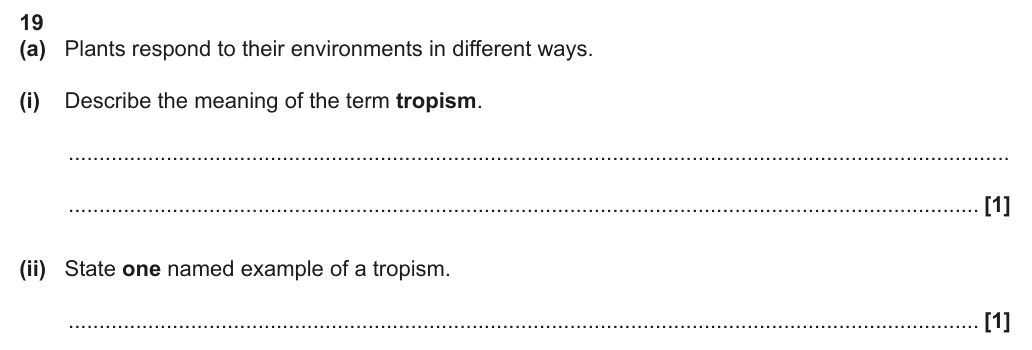
Mark scheme: directional growth in response to a stimulus (allow "grows towards or away from a stimulus"); "growth" unqualified is not allowed, as it must have the sense of being directional. Example: phototropism, geotropism (allow gravitropism), hydrotropism, thigmotropism or chemotropism. "Trophism" is not allowed.
Question 11 (H420/01, June 2025, 1 mark)
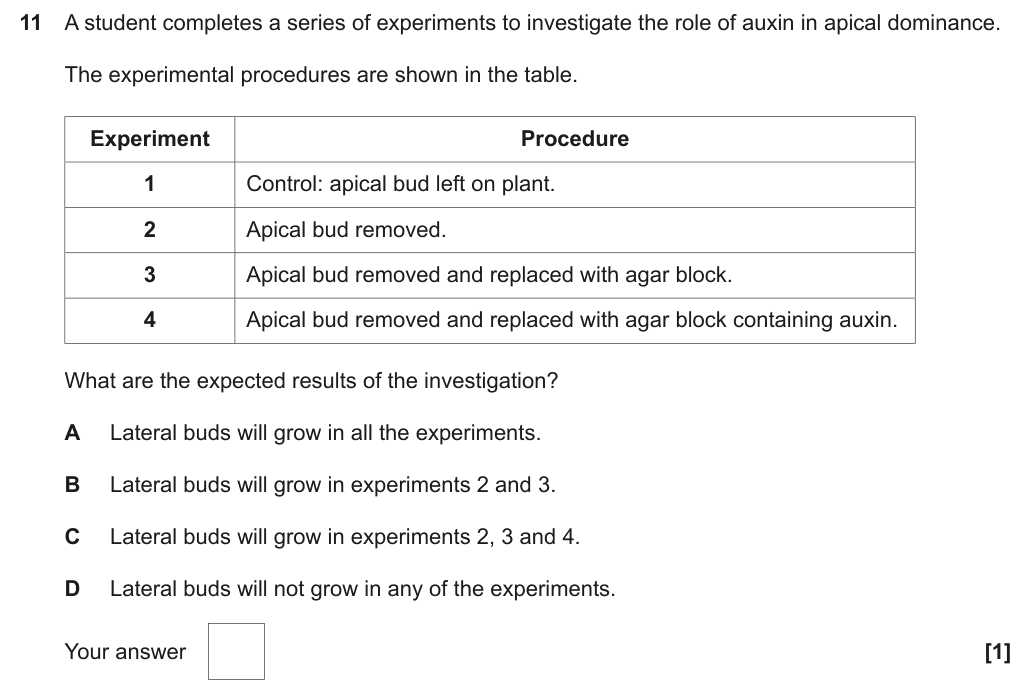
Mark scheme: B.
Examiners said: this was generally well answered, and many candidates appreciated that apical and lateral bud growth oppose each other.
Question 17(a)(i) (H420/01, June 2023, 2 marks)
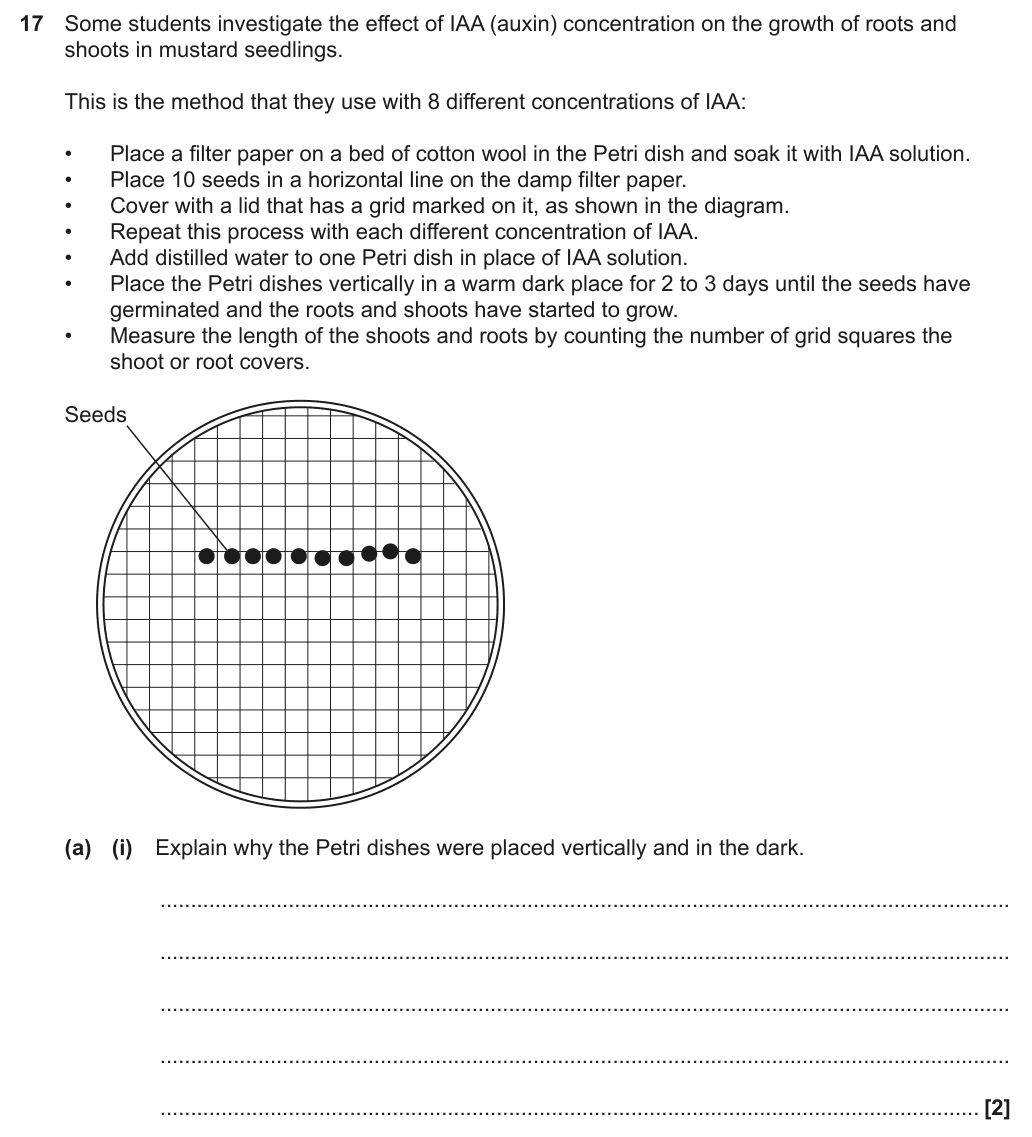
Mark scheme: placed vertically so that roots grow downwards and shoots grow upwards (allow roots are positively geotropic and shoots negatively geotropic); in the dark so that light does not affect growth, or to prevent phototropism (allow darkness is a control variable). "Trophism" or "trophic" is not allowed.
Examiners said: most linked the dark to avoiding phototropism, but fewer explained the vertical dishes. Some recognised geotropism but did not say what the root or shoot does. With two conditions in a question, make clear which one you are discussing.
Question 17(b) (H420/01, June 2023, 2 marks)
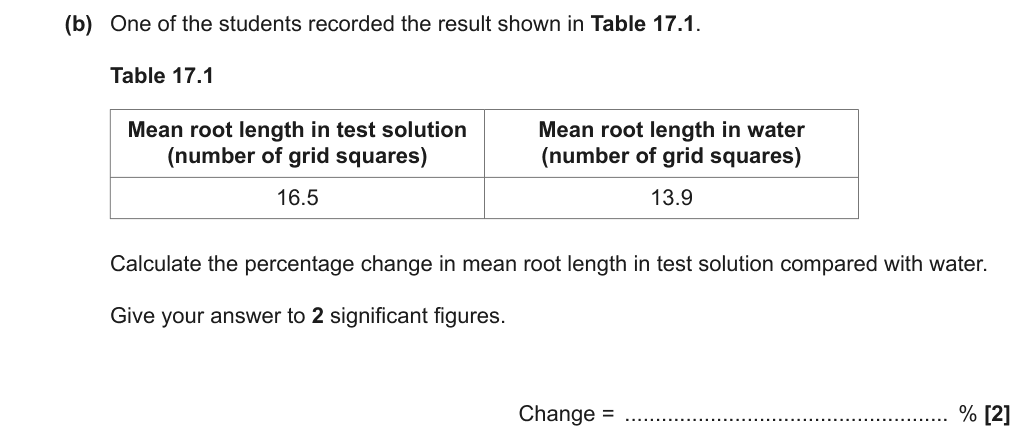
Mark scheme: change = 16.5 − 13.9 = 2.6; percentage change = 2.6 ÷ 13.9 × 100 = 18.7, so 19% to 2 significant figures. Maximum 1 mark if the answer is not given to 2 significant figures (for example 18.7 or 19.0).
Examiners said: a common error was dividing by the final length, giving 16%. Some did the right calculation but lost a mark for ignoring the 2 significant figures instruction. Show your working so you can earn a mark if the final answer is wrong.
Question 18(a) (H420/01, June 2025, 4 marks)
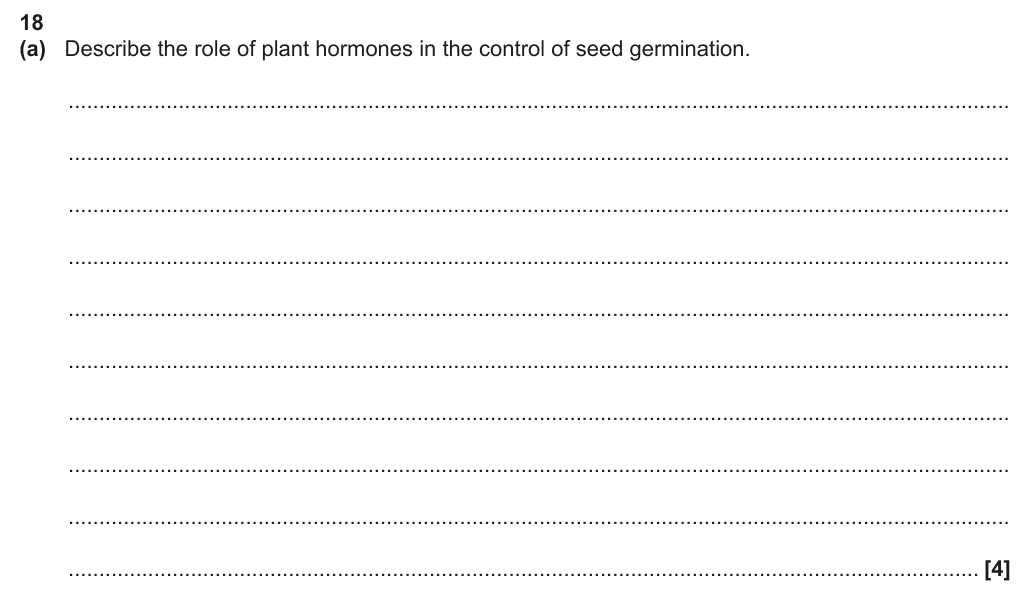
Mark scheme (any 4): water is absorbed by the seed and activates the embryo; the embryo releases gibberellin; gibberellin causes gene expression of digestive enzymes (named enzymes such as amylase, protease or lipase allowed); the enzymes break down food stores; the product, such as glucose, is used in respiration to produce ATP; abscisic acid inhibits germination or causes dormancy (allow "ABA is antagonistic to gibberellins"). Saying that gibberellin and ABA both cause germination is not allowed, and "gibberellin causes water uptake" is ignored.
Examiners said: most named gibberellin, and many gave ABA as its antagonist. Candidates who knew the structure of a seed wrote a clear chronological answer. Weaker answers listed every function of gibberellin, including stem elongation, or wrote about "the plant" instead of the seed.
Question 18(c) (H420/01, June 2025, 3 marks)
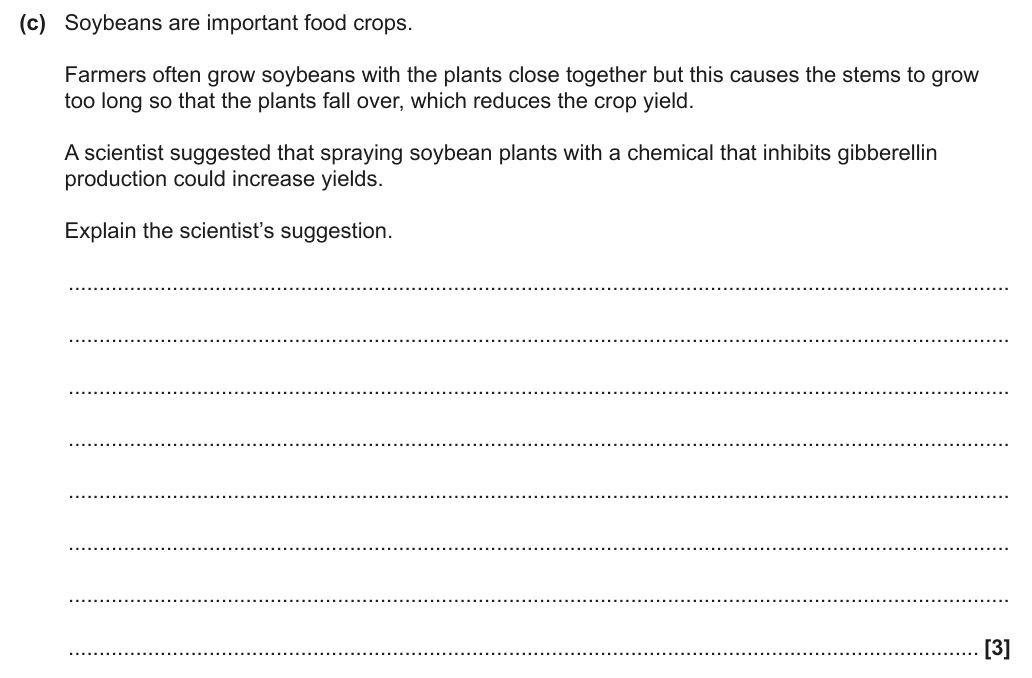
Mark scheme (any 3): the chemical reduces gibberellin concentration; the plants are shorter (allow "stems are not elongated"), so they do not fall over; plants are less damaged, or more can be harvested; plants use fewer resources for stem growth, so yield can increase. "Smaller" is ignored for "shorter".
Examiners said: most knew that less gibberellin means shorter stems that do not fall over. Few explained why this raises yield, which the question already implied. Very few used the idea that production is inhibited, so the gibberellin concentration falls.
Question 3(d) (H420/03, June 2022, 3 marks)
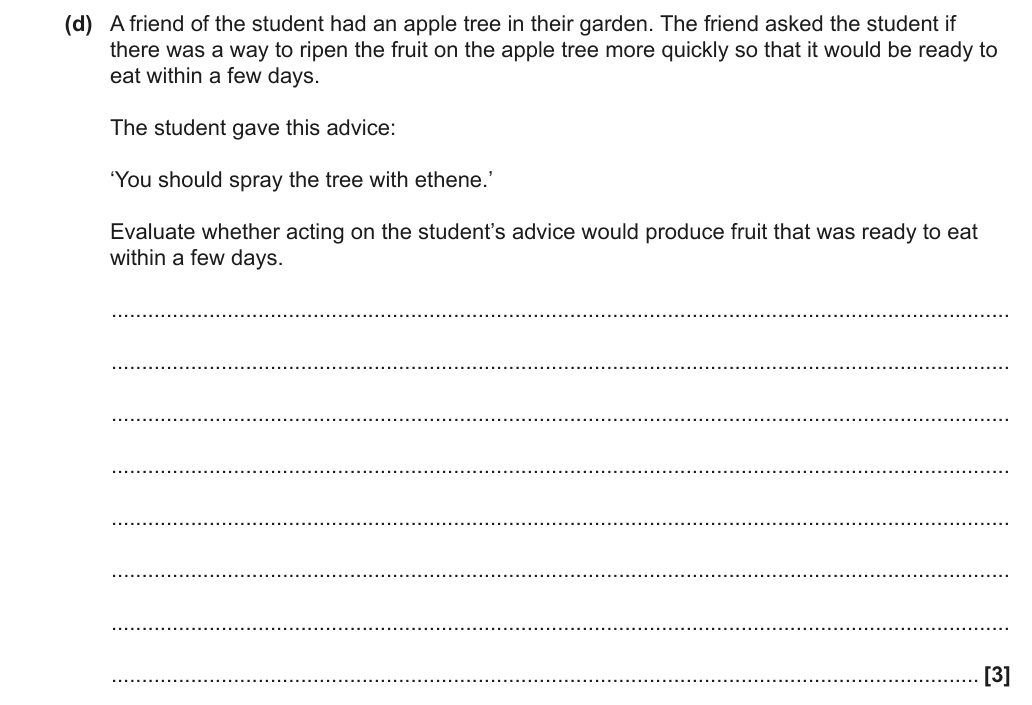
Mark scheme (any 3): ethene promotes fruit ripening; the concentration of ethene or the stage of apple development needs to be known; using ethene to ripen fruit normally needs controlled conditions, such as a closed space or a set temperature; ethene is a gas, so it will not be effective outside, as it diffuses away; ethene promotes fruit drop (abscission), so apples may fall and be damaged. "Spraying a gas would be ineffective" on its own is ignored.
Examiners said: most gained a mark for fruit ripening, and many knew ethene also causes fruit drop. The best answers saw that there were 3 marks and added points about concentration or stage of maturity. Few said that ethene is a gas, so few scored the point about outdoor use.
Common mistakes (from the examiners’ reports and mark schemes)
Writing "trophism" or "trophic". Gains credit: "phototropism", "geotropism" (or "gravitropism"), and "roots are positively geotropic".
Defining a tropism as just "growth". Gains credit: "directional growth in response to a stimulus".
Saying auxin "causes growth". Gains credit: "auxin stimulates cell elongation".
Calling a distilled water dish a "control variable". Gains credit: "it acts as a control: it shows growth without auxin, so results with and without IAA can be compared".
Dividing by the final value in a percentage change. Gains credit: "(16.5 − 13.9) ÷ 13.9 × 100 = 19%", given to the significant figures asked for.
Answering a germination question about "the plant" or stem elongation. Gains credit: "the embryo releases gibberellin, which switches on genes for amylase to break down the food store".
Writing "repeat the experiment" for a possible anomaly. Gains credit: "repeat the measurements at that auxin concentration".
Giving units of length, or seconds, for a rate of stem elongation. Gains credit: "mm day−1" or "cm h−1".
Using n − 1 degrees of freedom for an unpaired t-test. Gains credit: "degrees of freedom = 8 + 8 − 2 = 14; t is greater than the critical value, so reject the null hypothesis".
Test yourself with my OCR plant and animal responses quiz, and for the practical, see PAG 11 plant and animal responses questions.
Want help with topics like this every week?
My weekly group classes for AQA and OCR A work through exam questions topic by topic, and every class is recorded. Or book a first one-to-one lesson. For more practice, see my OCR A-level Biology exam questions by topic.