

AQA 3.1.5 · 5 exam questions worked through · about 15 minutes
Studying A-level Biology? I'm Tom, an A-level Biology teacher with 30 years' experience. I offer one-to-one lessons and weekly group classes for AQA and OCR A, with every lesson recorded.
This post covers AQA specification 3.1.5, nucleic acids: the structure of DNA and RNA (3.1.5.1) and the semi-conservative replication of DNA (3.1.5.2). Work through five real AQA questions and you'll see exactly what the mark schemes credit and where the examiners say marks were lost.
What you need to know first
- A DNA nucleotide is made of deoxyribose, a phosphate group and one of four bases
- Nucleotides in a strand are joined by phosphodiester bonds; the two strands are held together by hydrogen bonds between complementary bases
- Adenine pairs with thymine and cytosine pairs with guanine
- Semi-conservative means each new DNA molecule has one original strand and one new strand
Question 1: How a phosphodiester bond forms (2 marks)
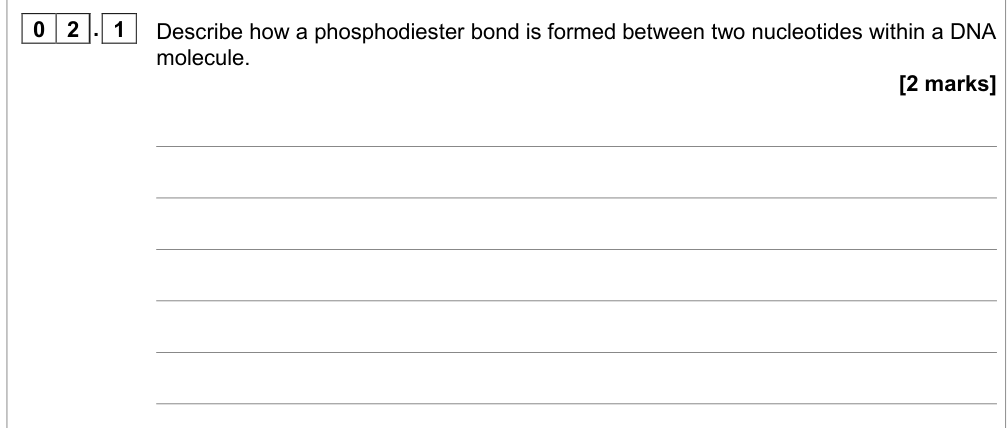
How to approach it. Say what type of reaction it is and which two parts of the nucleotides are joined. It is a condensation reaction (water is lost) between the phosphate of one nucleotide and the deoxyribose of the next. You can add that it is catalysed by DNA polymerase.
Mark scheme

Common mistakes (from AQA's examiners' reports and mark schemes)
- Bringing in DNA polymerase but giving it the wrong job. The examiners' report says a small number of students described it forming hydrogen bonds or joining complementary bases, and the mark scheme rejects this. Gains credit: "DNA polymerase catalyses the condensation reaction".
- Naming only one of the two groups. The mark scheme needs both. Gains credit: "between the phosphate of one nucleotide and the deoxyribose of the next".
Question 2: DNA and mRNA: four structural differences (4 marks)
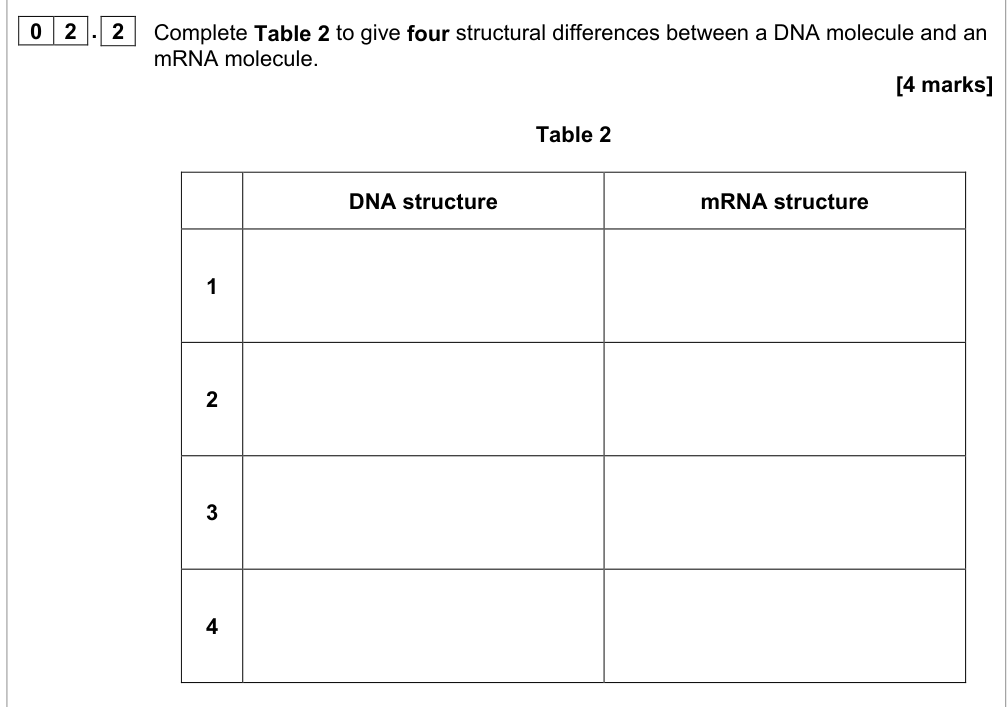
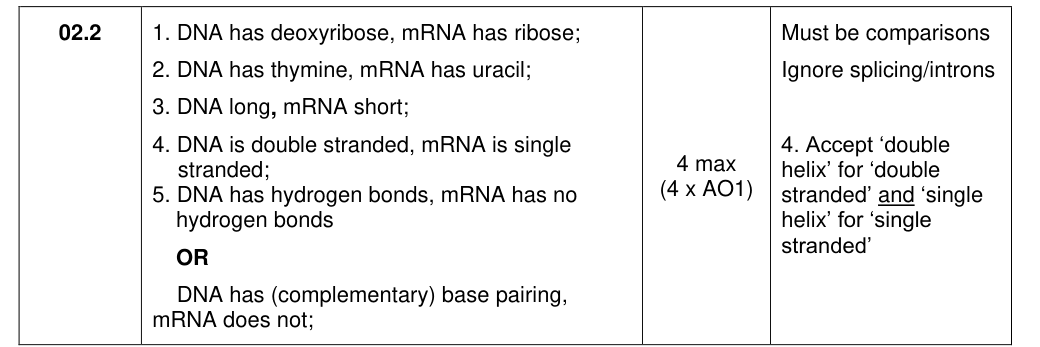
How to approach it. Fill each row so that the two boxes match each other. DNA has deoxyribose, mRNA has ribose. DNA has thymine, mRNA has uracil. DNA is double stranded, mRNA is single stranded. DNA is long, mRNA is short. DNA has hydrogen bonds between base pairs, mRNA has none.
Mark scheme
Common mistakes (from AQA's examiners' reports and mark schemes)
- Writing two boxes that do not pair up. The examiners' report says marks were only given for correct comparisons, and that students need to state correct pairs of statements. Gains credit: matching statements in the same row: "double stranded" with "single stranded", "deoxyribose" with "ribose".
- Using letters for the bases. The report says abbreviations such as A and U should not be used. Gains credit: "DNA has thymine" and "mRNA has uracil", written in full.
- Writing about splicing or introns. The mark scheme ignores these. Gains credit: differences in structure only.
Question 3: Features of DNA that matter in replication (2 marks)
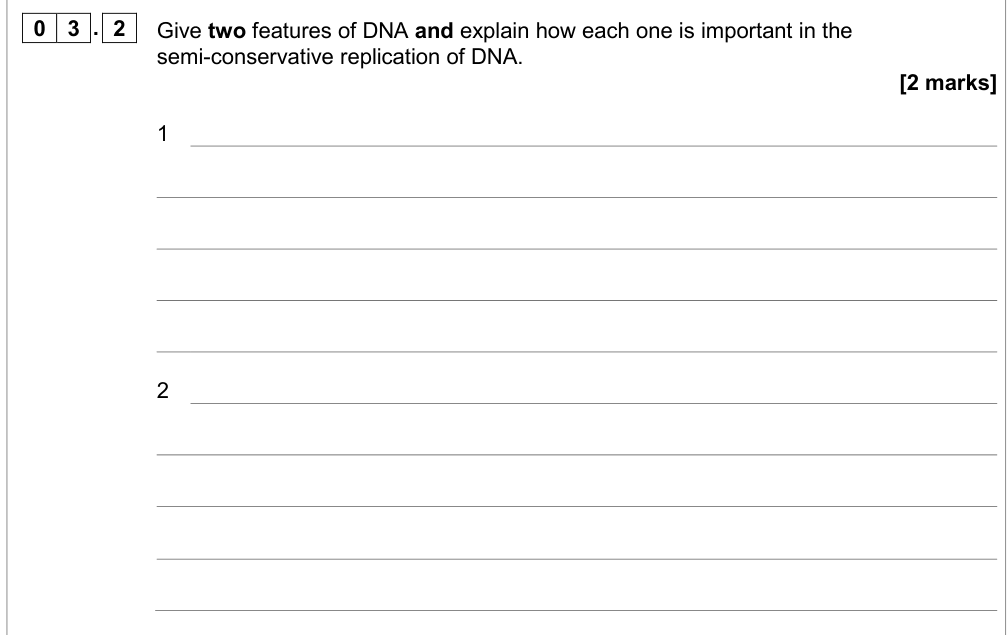
How to approach it. Each mark needs a feature and what it allows. Weak hydrogen bonds between the bases allow the two strands to separate. There are two strands, so both can act as templates. Complementary base pairing allows accurate replication.
Mark scheme

Common mistakes (from AQA's examiners' reports and mark schemes)
- Naming features without explaining them. The examiners' report says features were simply described and not explained, and that only 9.2% of students scored both marks. Gains credit: feature plus consequence: "weak hydrogen bonds between bases, so the two strands can be separated" and "two strands, so both can act as templates".
Question 4: The role of DNA polymerase (2 marks)
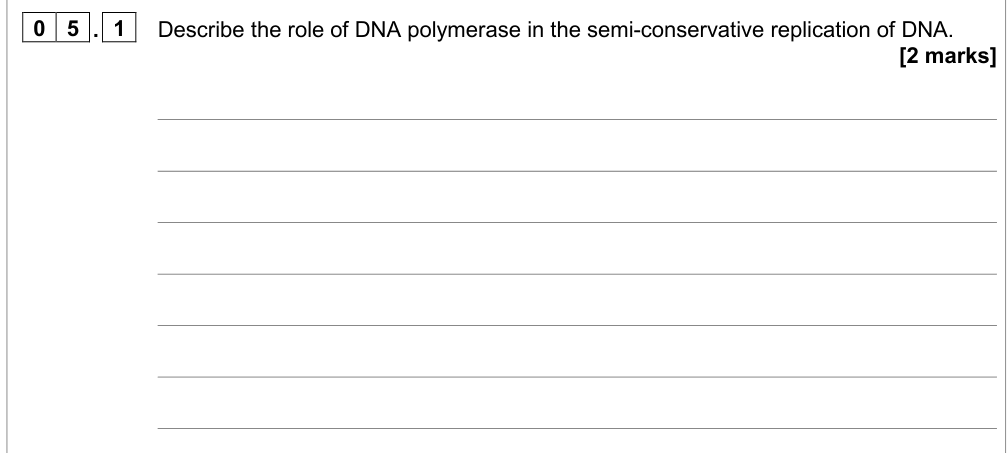
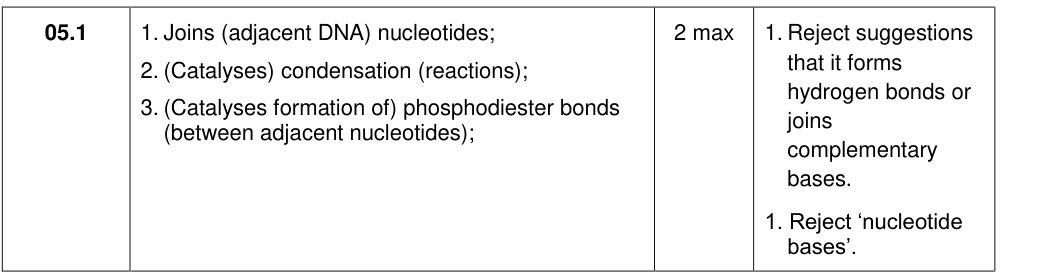
How to approach it. DNA polymerase joins adjacent DNA nucleotides together. It does this by catalysing condensation reactions that form phosphodiester bonds between the nucleotides. It works along the new strand; it has nothing to do with the hydrogen bonds between the two strands.
Mark scheme
Common mistakes (from AQA's examiners' reports and mark schemes)
- Saying it forms hydrogen bonds or complementary base pairs. The examiners' report says many students still did this, and the mark scheme rejects it. Gains credit: "catalyses the formation of phosphodiester bonds between adjacent nucleotides".
- Confusing bases with nucleotides. The report says many students did, including writing that phosphodiester bonds form between bases, and the mark scheme rejects "nucleotide bases". Gains credit: "joins adjacent DNA nucleotides".
Question 5: Describe semi-conservative replication (5 marks)
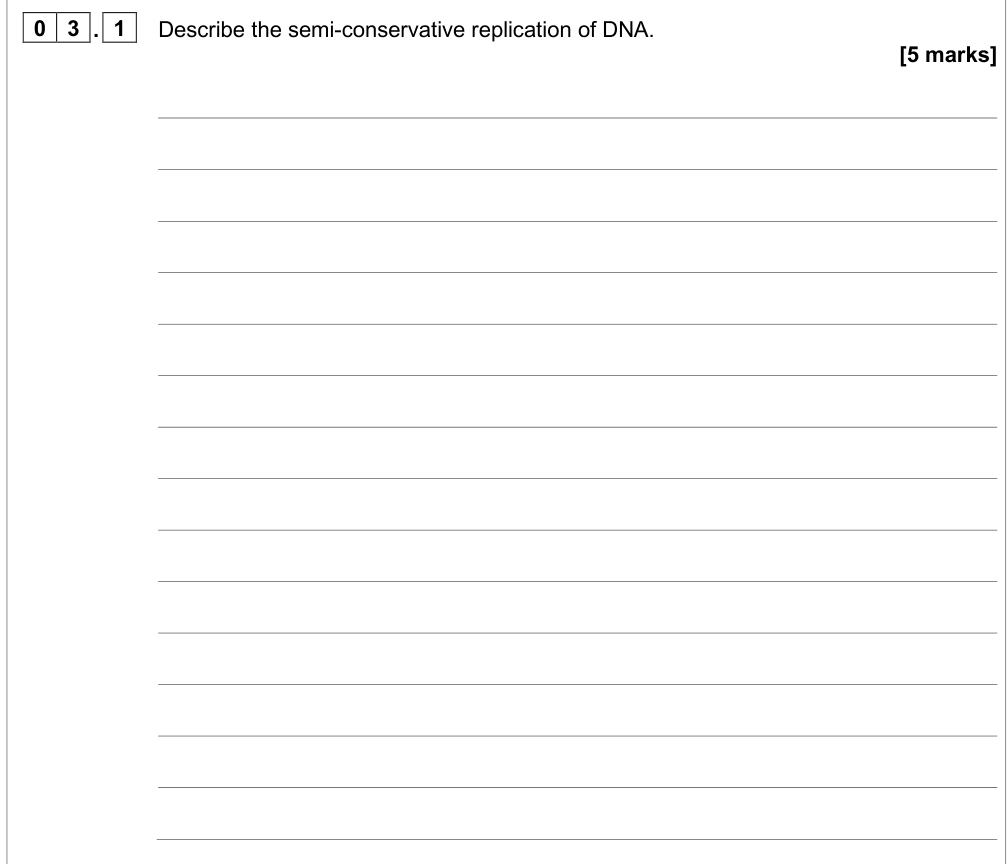
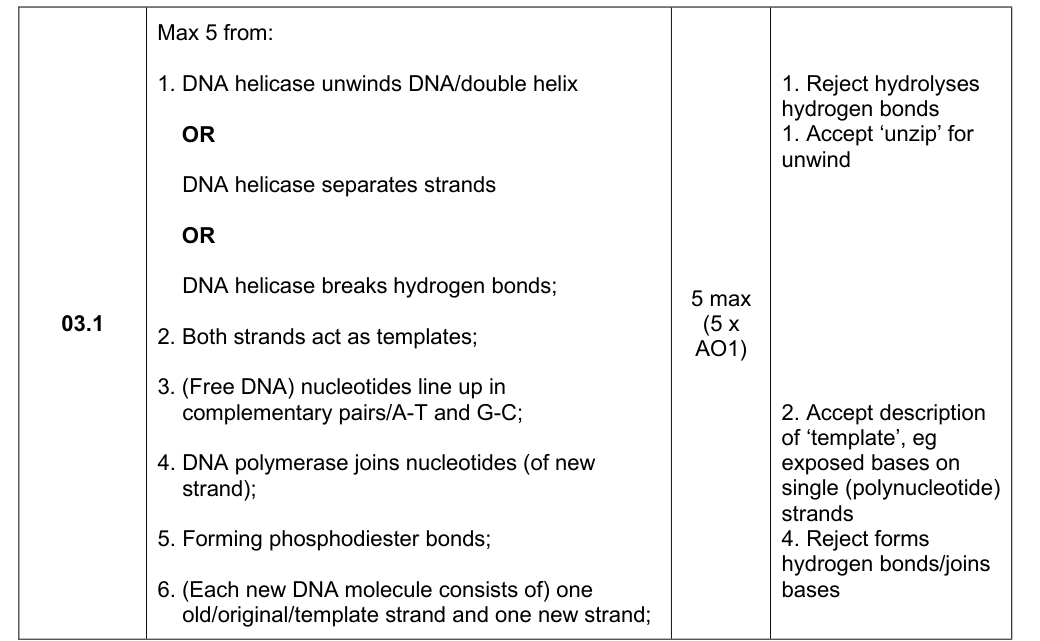
How to approach it. Write it as a sequence. DNA helicase breaks the hydrogen bonds and separates the two strands. Both strands act as templates. Free DNA nucleotides line up by complementary base pairing, adenine with thymine and cytosine with guanine. DNA polymerase joins the adjacent nucleotides of the new strand, forming phosphodiester bonds. Each new DNA molecule has one original strand and one new strand. That is six points for five marks.
Mark scheme
Common mistakes (from AQA's examiners' reports and mark schemes)
- Saying helicase "hydrolyses" the hydrogen bonds. The examiners' report lists this as a common error and the mark scheme rejects it. Gains credit: "DNA helicase breaks the hydrogen bonds between the bases".
- Saying DNA polymerase forms hydrogen bonds between complementary bases. The report lists this as a common error too. Gains credit: "DNA polymerase joins adjacent nucleotides, forming phosphodiester bonds".
- Drifting into RNA, transcription or translation. The report says a few students did. Gains credit: DNA replication only, ending with "each new molecule has one original strand and one new strand".
Key points to remember
- Helicase breaks hydrogen bonds (never "hydrolyses" them). DNA polymerase forms phosphodiester bonds.
- DNA polymerase joins nucleotides, not bases, and does not make base pairs.
- A phosphodiester bond forms by condensation between a phosphate group and deoxyribose.
- When you give a feature of DNA, add what it allows: "so that..."
- In comparison tables, each row must be a matching pair, with base names written in full.
Practise next
- AQA DNA replication exam questions by topic
- AQA structure of DNA and RNA exam questions
- DNA, RNA and DNA replication self-marking quiz
Studying this for AQA? My weekly AQA Year 12 masterclass works through topics like this with real exam questions. See the timetable or book a first one-to-one lesson.
Questions, mark schemes and examiners' report comments © AQA.