

The structure of DNA and RNA (AQA 3.1.5.1) is short in the specification but turns up on AS and A-level papers year after year. You need the three parts of a nucleotide, how DNA and RNA nucleotides differ, how a condensation reaction makes a phosphodiester bond, how hydrogen bonds between complementary base pairs hold the double helix together, and what ribosomes are made of. It's examined as one-mark recall, 6-mark 'describe' and 'compare' questions, and calculations from base counts or helix lengths.
The examiners' reports show the marks go on detail. Students write 'pentose' instead of deoxyribose, use the letters A, T, G, C and U instead of the full base names, say 'helix' without 'double', put mRNA or tRNA into ribosomes, and forget that only one DNA strand codes for amino acids when they do the maths.
Start with nucleotides and the double helix, then compare DNA with RNA, then try the ribosome and calculation questions. Answer each on paper before you open the mark scheme. If you'd like help with this topic, my AQA masterclasses run online on Tuesdays at 5.15pm for Year 12 and on Wednesdays or Thursdays at 6.30pm for Year 13.
What you need from GCSE and Year 12
Each question on this page assumes you're secure on these GCSE and Year 12 ideas. If any of them feels shaky, revise it before you start.
- GCSE: DNA is a polymer made of two strands coiled into a double helix, found in the nucleus as chromosomes.
- GCSE: DNA is made of repeating nucleotides, each with a sugar, a phosphate group and one of four bases.
- GCSE: the bases pair up, A with T and C with G, and the order of bases codes for the order of amino acids in a protein.
- Year 12 (AQA 3.1.2): condensation reactions join monomers and release water; hydrolysis breaks the bond using water. See the Carbohydrates page.
- Year 12 (AQA 3.1.4.1): hydrogen bonds are weak individually but strong in large numbers. See the Proteins page.
Key terms
These words come up in the questions and mark schemes. Examiners expect you to use them exactly.
- Nucleotide: the monomer of DNA and RNA: a pentose sugar, a phosphate group and a nitrogen-containing organic base.
- Deoxyribose: the pentose sugar in DNA nucleotides. Name it: 'pentose' alone doesn't score when deoxyribose is asked for.
- Ribose: the pentose sugar in RNA nucleotides (and in ATP).
- Organic bases: adenine, cytosine and guanine in both; thymine in DNA only and uracil in RNA only. Write the names in full, not just the letters.
- Phosphodiester bond: the bond formed by condensation between the phosphate group of one nucleotide and the deoxyribose (or ribose) of the next.
- Polynucleotide: a chain of nucleotides joined by phosphodiester bonds, with a sugar-phosphate backbone.
- Complementary base pairing: adenine pairs with thymine (or uracil in RNA) and cytosine pairs with guanine, held by hydrogen bonds.
- Double helix: the shape of a DNA molecule: two polynucleotide strands held together by hydrogen bonds and twisted round each other.
- mRNA and tRNA: single-stranded RNA molecules: mRNA is a copy of a gene; tRNA has a clover-leaf shape, an anticodon and carries an amino acid.
- Ribosome: the organelle where proteins are made, formed from ribosomal RNA (rRNA) and protein, not mRNA or tRNA.
What these questions cover (AQA 3.1.5.1)
The questions test these statements from the AQA AS and A-level Biology specification (7401/7402):
- Information-carrying molecules: Deoxyribonucleic acid (DNA) and ribonucleic acid (RNA) are important information-carrying molecules. In all living cells, DNA holds genetic information and RNA transfers genetic information from DNA to the ribosomes. (no current-spec written question tests this on its own; mRNA carrying the code to ribosomes is on the Mastering 3.4.2 post)
- Ribosomes: Ribosomes are formed from RNA and proteins.
- Nucleotides: Both DNA and RNA are polymers of nucleotides. Each nucleotide is formed from a pentose, a nitrogen-containing organic base and a phosphate group.
- DNA nucleotides: The components of a DNA nucleotide are deoxyribose, a phosphate group and one of the organic bases adenine, cytosine, guanine or thymine.
- RNA nucleotides: The components of an RNA nucleotide are ribose, a phosphate group and one of the organic bases adenine, cytosine, guanine or uracil.
- Phosphodiester bonds: A condensation reaction between two nucleotides forms a phosphodiester bond.
- The double helix: A DNA molecule is a double helix with two polynucleotide chains held together by hydrogen bonds between specific complementary base pairs.
- RNA molecules: An RNA molecule is a relatively short polynucleotide chain.
- Students should be able to appreciate that the relative simplicity of DNA led many scientists to doubt that it carried the genetic code. (not yet examined in a written part on the current papers)
How to use this page
Write your answer on paper before you open the mark scheme. Allow about 1.3 minutes per mark: the 15 questions are worth 36 marks, so about 47 minutes in total. Then mark your answer strictly against the mark scheme and read the examiners' tip underneath it. If you'd rather print the questions, download the PDF pack.
Nucleotides and phosphodiester bonds (3.1.5.1)
Question 1
AS Paper 1 · June 2017 · Q01.1 · 1 mark · Easy
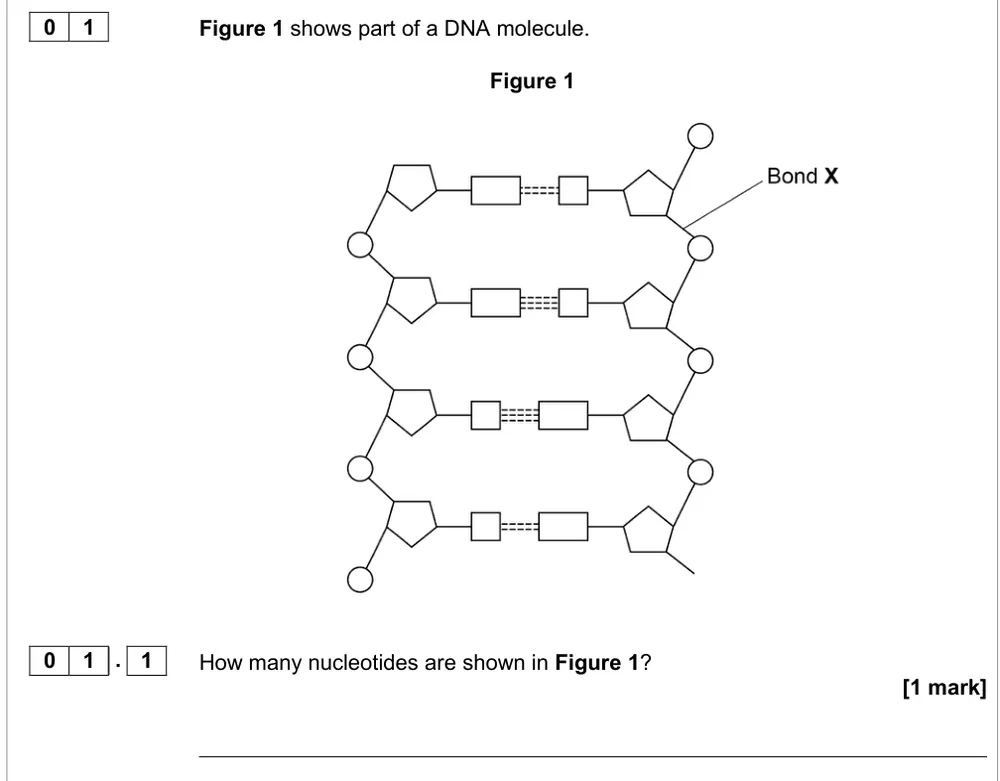
Count the nucleotides in a diagram of part of a DNA molecule.
Show the mark scheme

Tap an image to open it full size.
From the examiners' report: Most students scored. Each nucleotide is one phosphate, one sugar and one base, so count the bases on both strands.
Question 2
AS Paper 1 · June 2017 · Q01.2 · 1 mark · Easy
Name the bond labelled X between two nucleotides.

Show the mark scheme

Tap an image to open it full size.
From the examiners' report: Most students scored. X joins two nucleotides in the same strand, so it's a phosphodiester bond, not a hydrogen bond.
Question 3
AS Paper 1 · June 2018 · Q03.1 · 2 marks
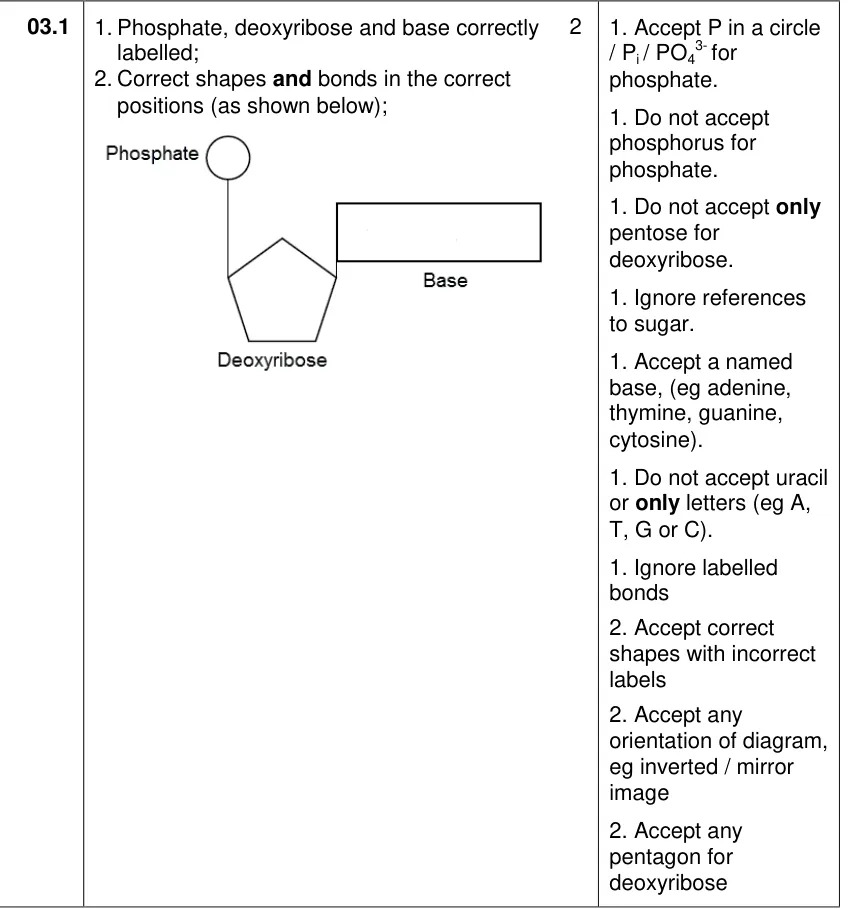
Draw and label a single DNA nucleotide.

Show the mark scheme
Tap an image to open it full size.
From the examiners' report: Just under half (46.3%) got this. Label the sugar deoxyribose, not pentose, and join the phosphate and the base to the sugar, not to each other.
Question 4
AS Paper 2 · November 2020 · Q02.1 · 2 marks
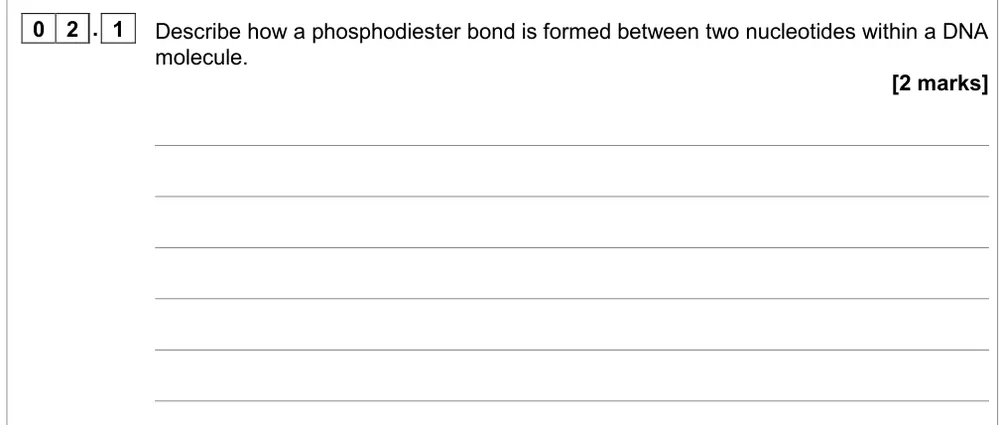
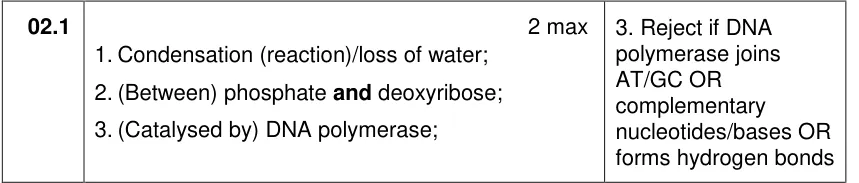
Describe how a phosphodiester bond forms between two DNA nucleotides.
Show the mark scheme
Tap an image to open it full size.
From the examiners' report: Most described a condensation reaction between a phosphate and deoxyribose. If you mention DNA polymerase, don't say it forms hydrogen bonds or joins complementary bases.
The DNA double helix (3.1.5.1)
Question 5
AS Paper 1 · November 2021 · Q01.1 · 2 marks
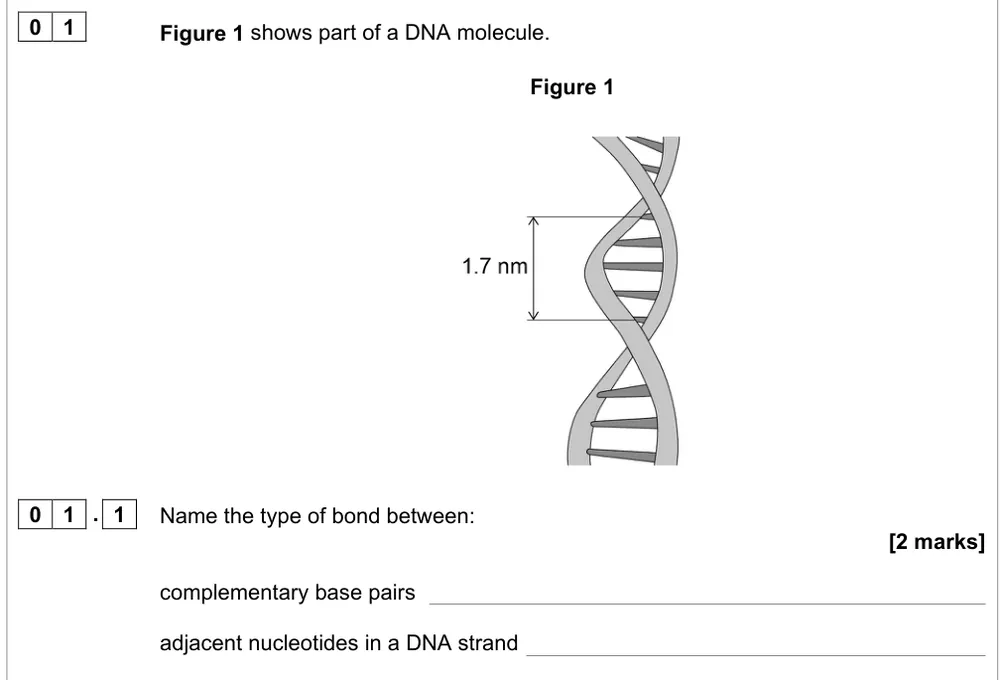
Name the bonds between complementary base pairs and between adjacent nucleotides.
Show the mark scheme

Tap an image to open it full size.
From the examiners' report: There's no examiners' report for this paper, so this tip comes from the mark scheme. Keep the two straight: hydrogen bonds go across between the strands, phosphodiester bonds run along each strand.
Question 6
A level Paper 1 · June 2023 · Q10.2 · 6 marks · Medium
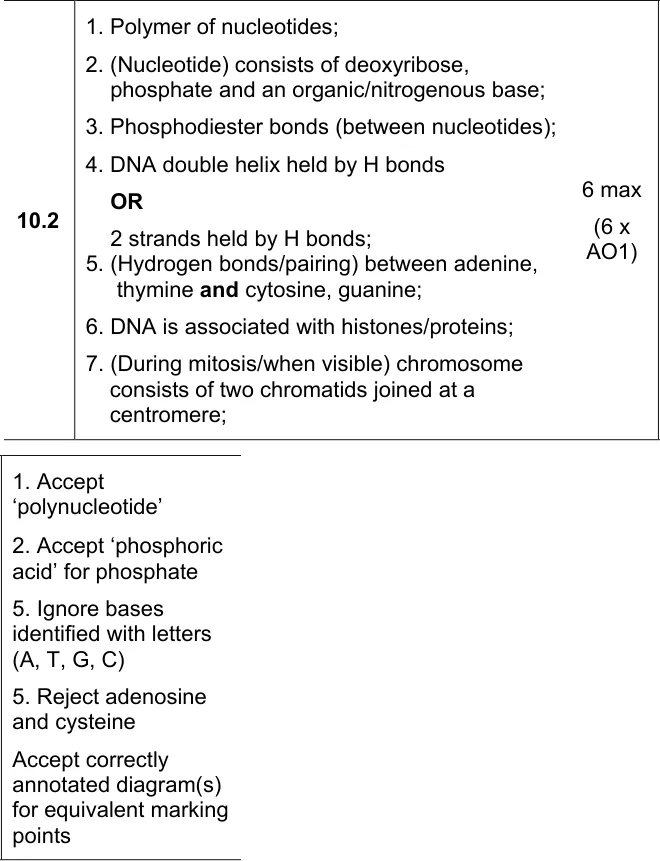
Describe the structure of DNA and the structure of a chromosome.
Show the mark scheme
Tap an image to open it full size.
From the examiners' report: Over half got 4 marks and 15% full marks. 'Polymer of nucleotides' was often missed, phosphodiester bonds were named without saying where, and base letters alone weren't credited. Numbers of hydrogen bonds and 5' to 3' aren't needed.
Question 7
AS Paper 1 · June 2024 · Q09.1 · 1 mark
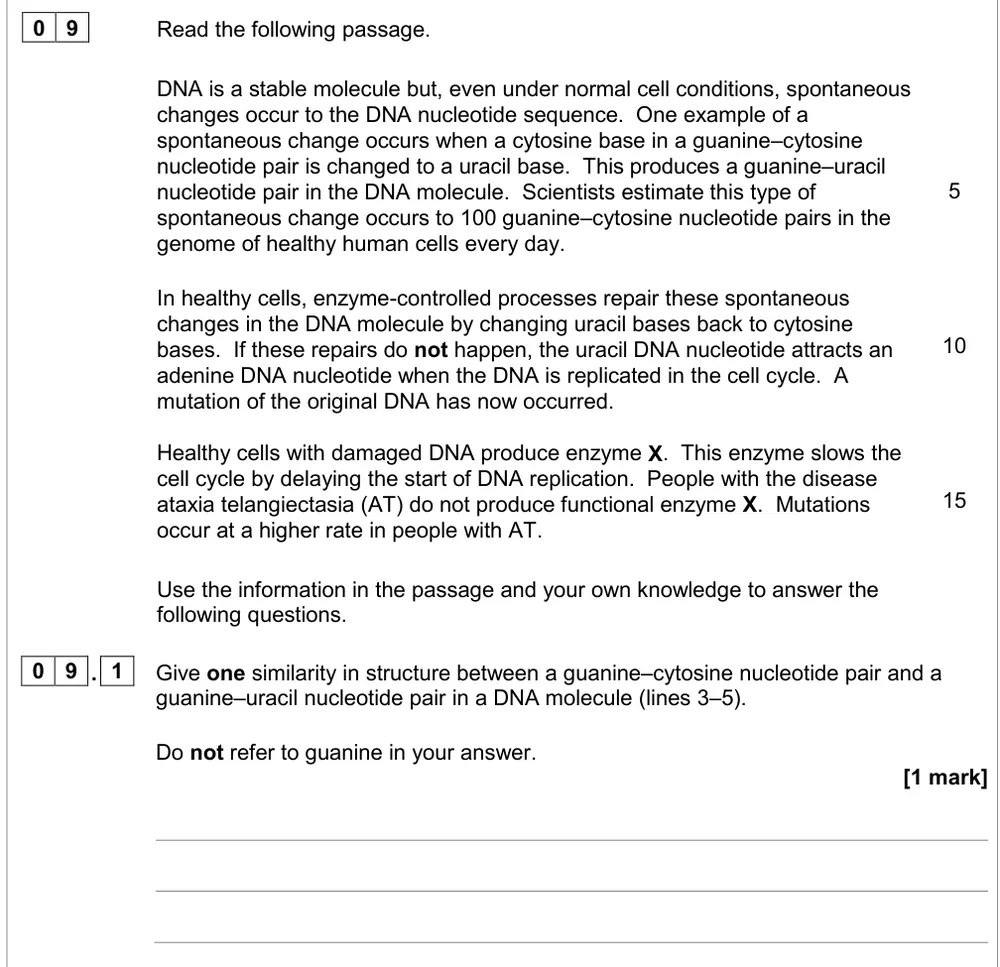
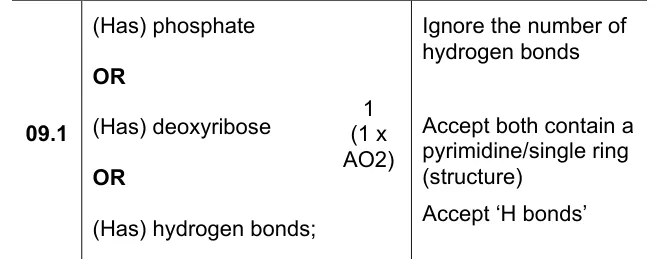
Give a structural similarity between a G–C pair and a G–U pair in DNA.
Show the mark scheme
Tap an image to open it full size.
From the examiners' report: The question said 'do not refer to guanine', yet some did. Most scored by saying both pairs are held by hydrogen bonds; the strongest knew cytosine and uracil are both single-ringed bases.
Question 8
AS Paper 2 · June 2016 · Q05.2 · 2 marks · Medium
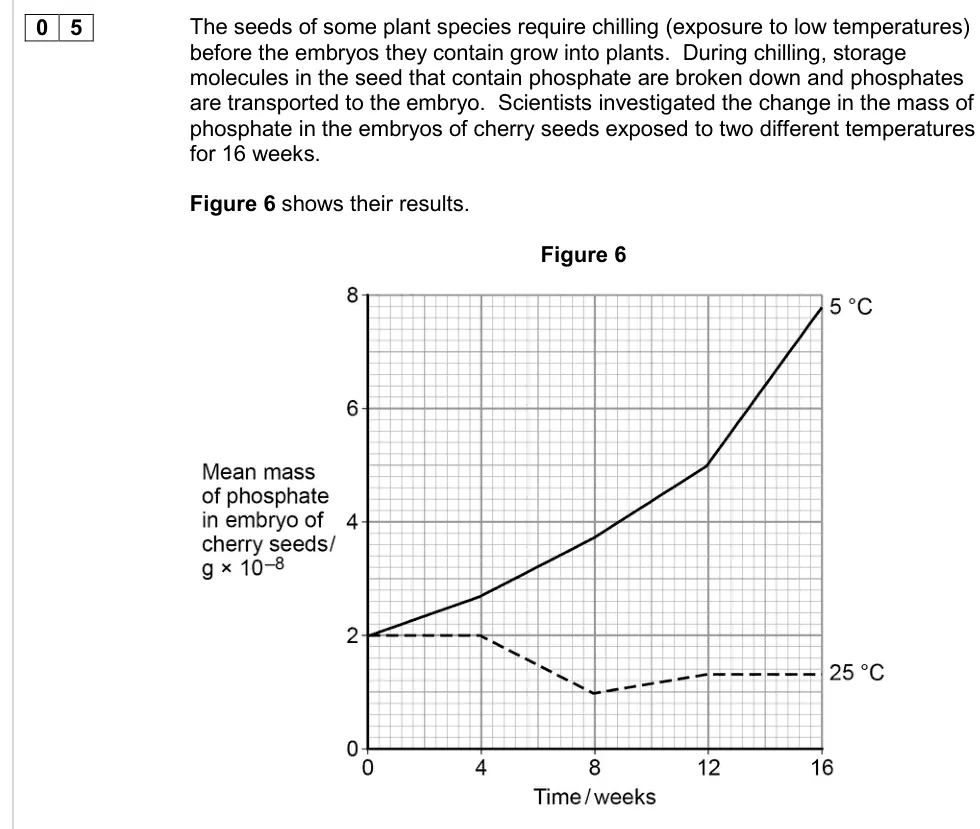
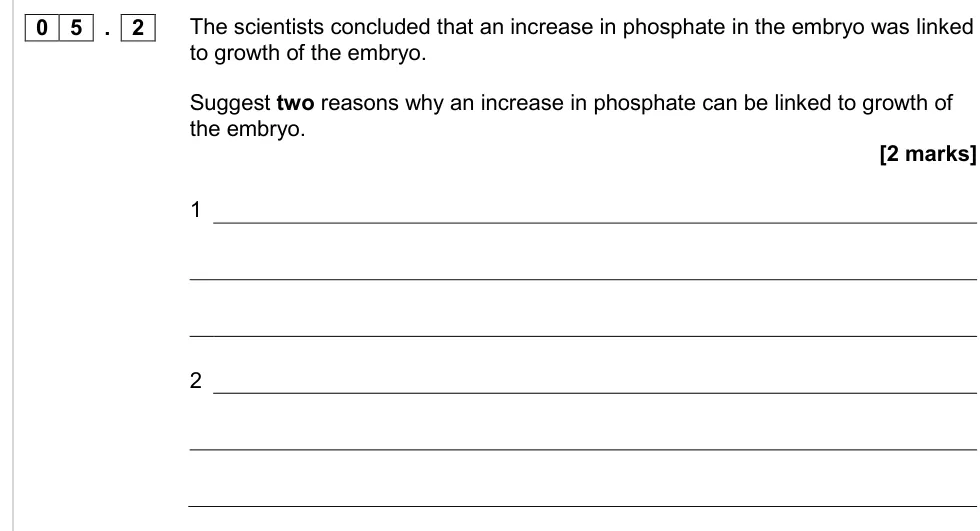
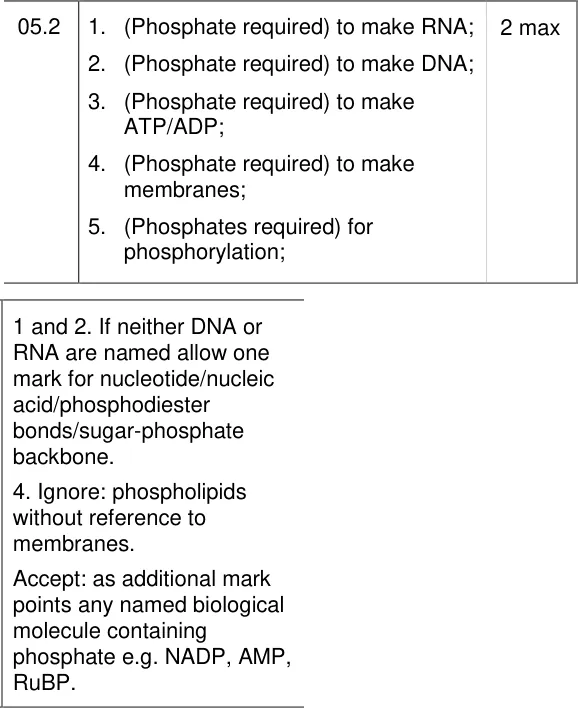
Suggest two reasons why more phosphate is linked to growth of an embryo.
Information from earlier in this question:
Show the mark scheme
Tap an image to open it full size.
From the examiners' report: About 50% scored. Name the molecule the phosphate goes into, such as DNA, RNA or ATP; 'a nutrient', 'for energy' or 'to form protein' got nothing.
DNA and RNA compared (3.1.5.1)
Question 9
AS Paper 2 · June 2023 · Q10.1 · 6 marks · Medium
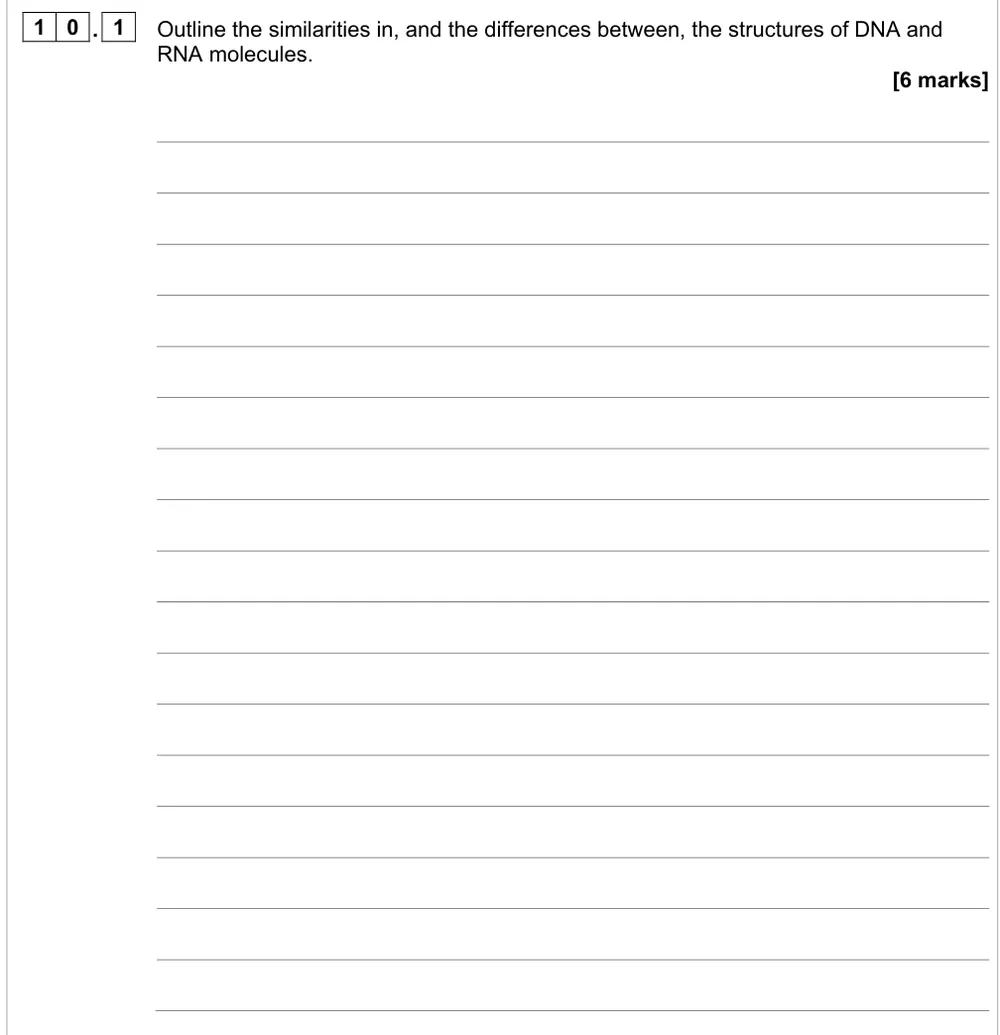
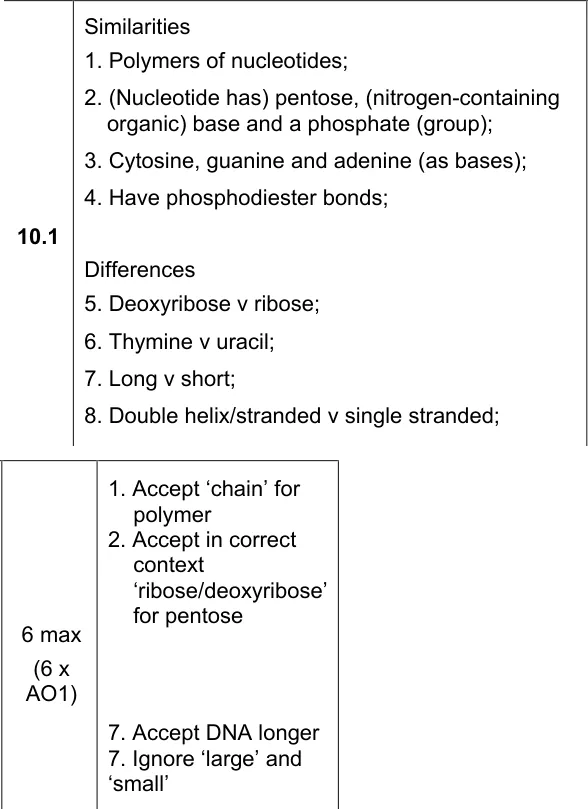
Outline the similarities and differences between the structures of DNA and RNA.
Show the mark scheme
Tap an image to open it full size.
From the examiners' report: Over 20% got all 6. Write the base names in full, not letters, and set out the differences as clear paired statements.
Question 10
AS Paper 1 · June 2016 · Q01.3 · 3 marks
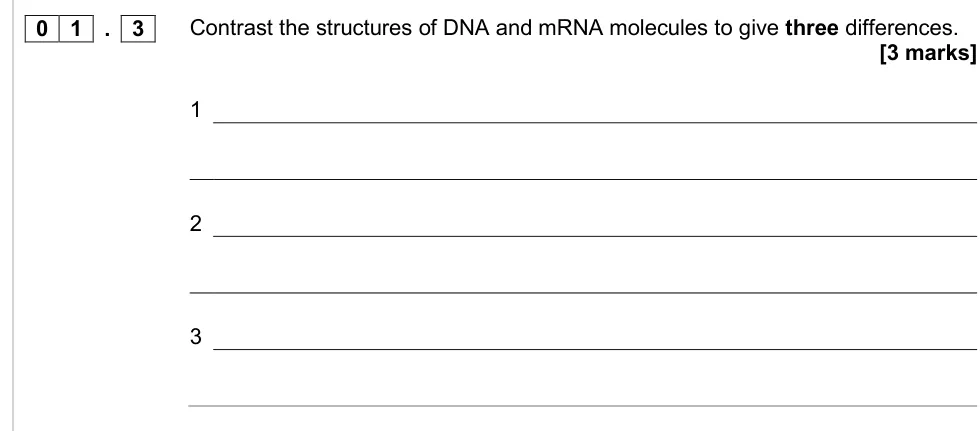
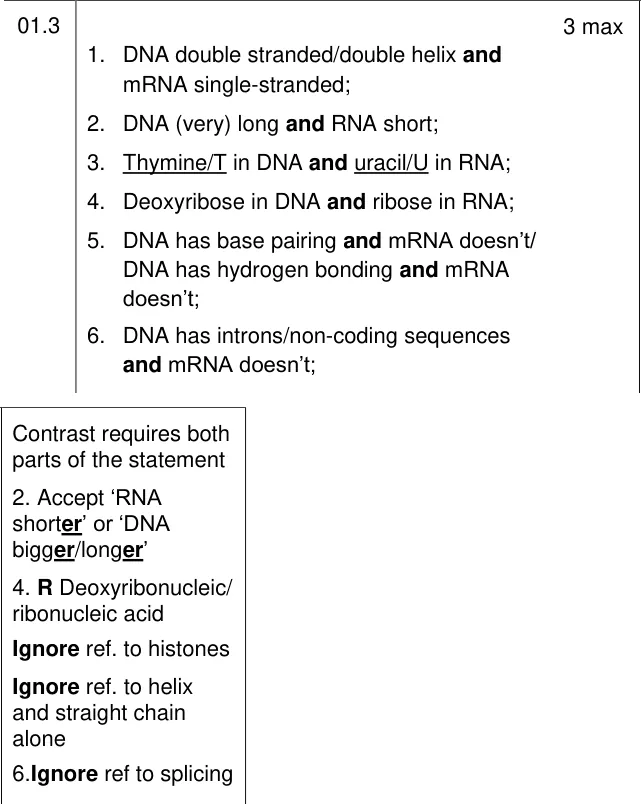
Give three differences between the structures of DNA and mRNA.
Show the mark scheme
Tap an image to open it full size.
From the examiners' report: There's no examiners' report for this paper, so this tip comes from the mark scheme. A contrast needs both sides of every point, such as 'DNA is double-stranded but mRNA is single-stranded'.
Question 11
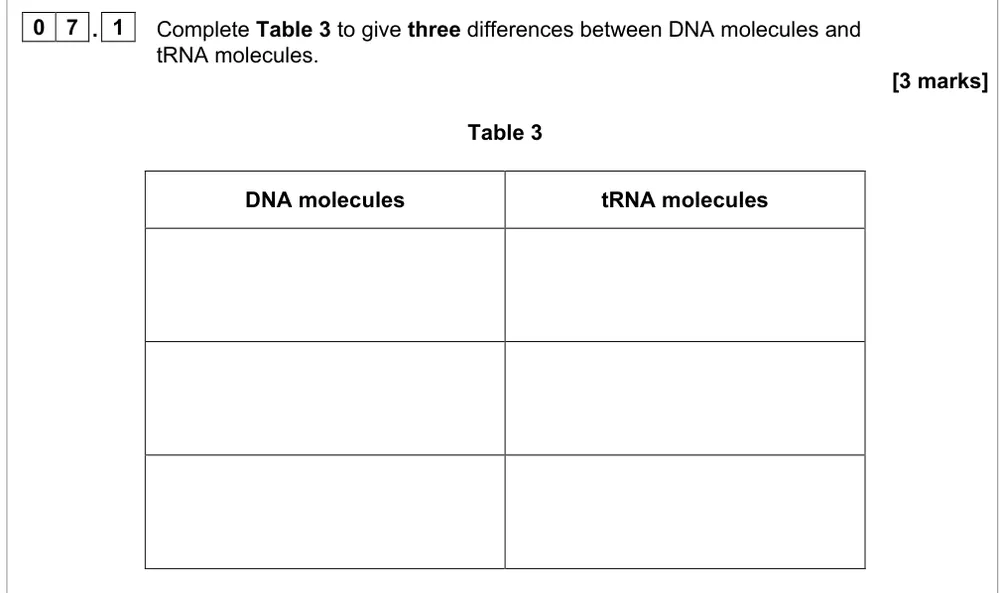
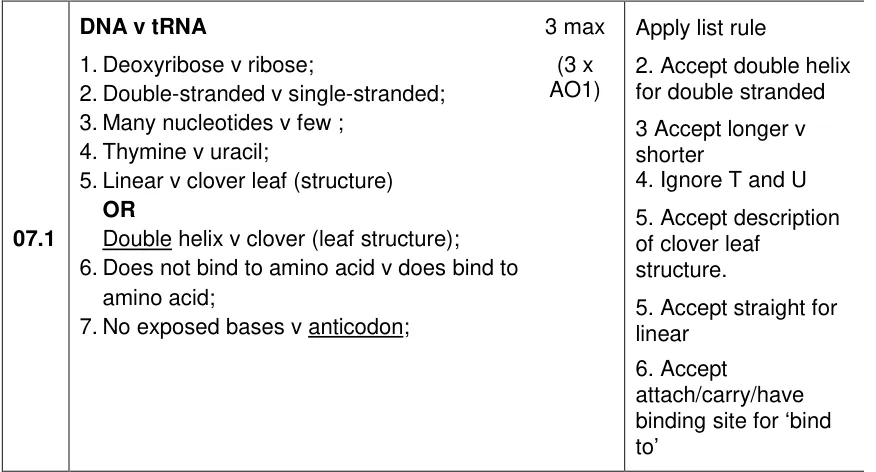
A level Paper 1 · June 2022 · Q07.1 · 3 marks · Easy
Complete a table of three differences between DNA and tRNA.
Show the mark scheme
Tap an image to open it full size.
From the examiners' report: 90% got at least 1 mark. 'Helix' needs to be double helix, T and U need naming, and if you give the anticodon say DNA has no exposed bases.
Ribosomes (3.1.5.1)
Question 12
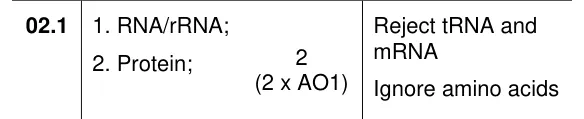
AS Paper 1 · June 2022 · Q02.1 · 2 marks · Medium
Give the two types of molecule a ribosome is made from.

Show the mark scheme
Tap an image to open it full size.
From the examiners' report: Only 18% got both marks. Ribosomes are made of ribosomal RNA and protein; tRNA and mRNA are wrong.
Question 13
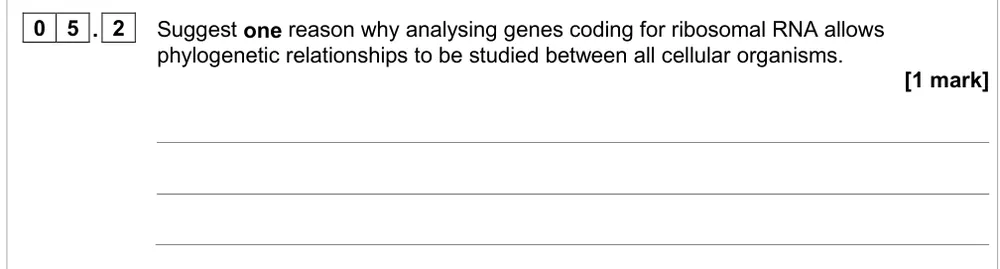
AS Paper 2 · June 2024 · Q05.2 · 1 mark
Suggest why rRNA genes let scientists compare all cellular organisms.
Show the mark scheme

Tap an image to open it full size.
From the examiners' report: A surprising number missed that all cellular organisms, prokaryotes and eukaryotes, have ribosomes, so they all have rRNA genes.
DNA calculations (3.1.5.1)
Question 14
AS Paper 2 · November 2020 · Q02.2 · 2 marks
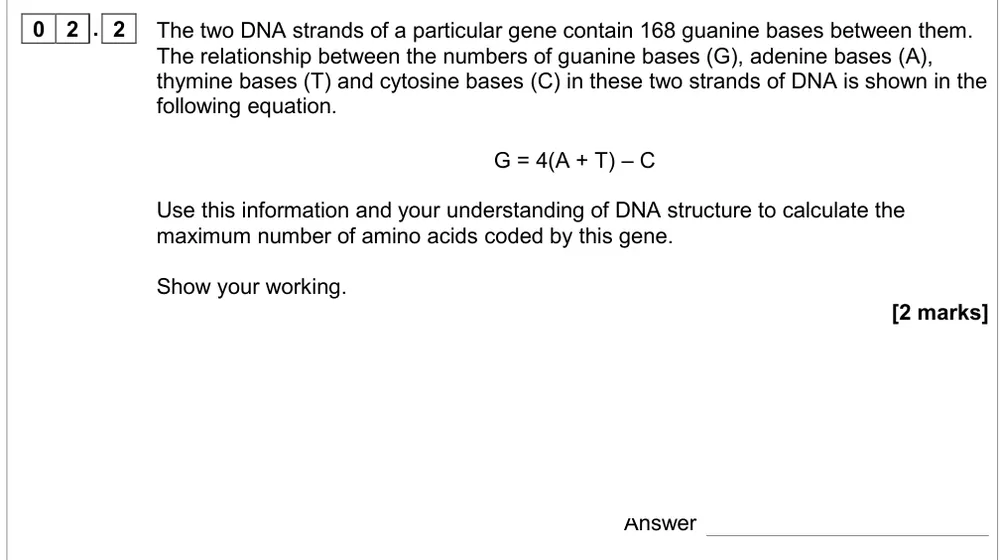
Use G = 4(A + T) – C to find how many amino acids a gene codes for.
Show the mark scheme
Tap an image to open it full size.
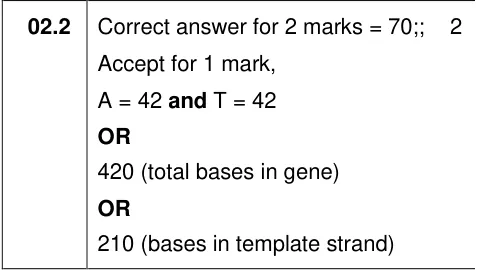
From the examiners' report: About half rearranged the equation, but many gave 140 because they forgot only one strand codes, or found 420 bases and didn't divide by 3.
Question 15
A level Paper 2 · June 2019 · Q05.2 · 2 marks · Easy
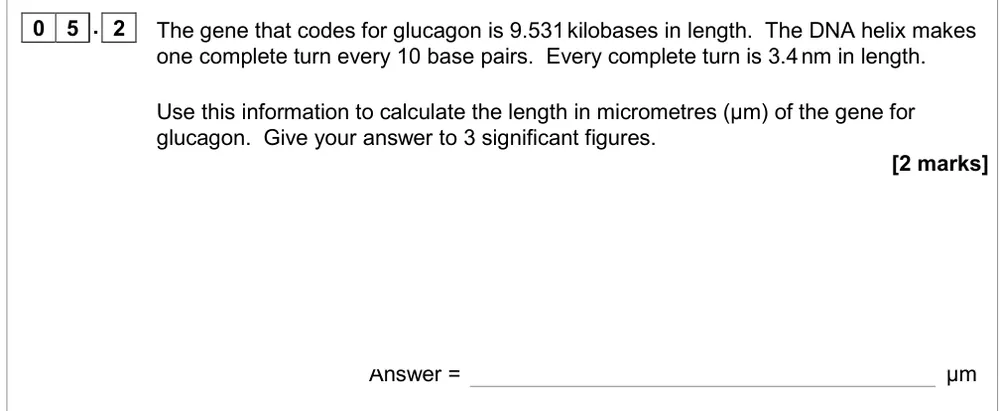
Calculate the length in µm of a 9.531 kilobase gene.
Show the mark scheme
Tap an image to open it full size.
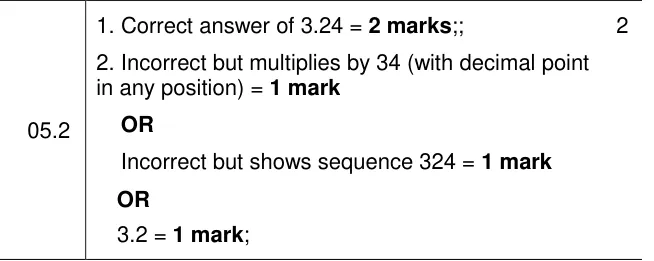
From the examiners' report: Almost 80% got at least 1 mark. Multiply, don't divide, by 3.4; divide nm by 1000 for µm; and three significant figures isn't three decimal places.
Where students lose marks (from AQA examiners' reports and mark schemes)
Each point below is followed by wording that gained marks.
Deoxyribose, not just pentose: Only 46.3% could draw and label a DNA nucleotide. The main errors were bonds drawn in the wrong place and labelling the sugar 'pentose' instead of deoxyribose.
✔ Gains credit: "Phosphate, deoxyribose and base correctly labelled", with the base and the phosphate both joined to the pentagon.
Full base names, not letters: In the 6-mark DNA and RNA questions, answers using only the letters A, C, T, G and U got no credit for the bases, as in previous years.
✔ Gains credit: "(Hydrogen bonds/pairing) between adenine, thymine and cytosine, guanine"; "thymine v uracil".
Say double helix, not just helix: When comparing DNA with tRNA, answers that said DNA is a 'helix' without saying double helix didn't score.
✔ Gains credit: "Double helix v clover leaf (structure)" or "Double-stranded v single-stranded".
Point to the anticodon's exposed bases: Many mentioned the anticodon on tRNA but didn't give the matching point for DNA, so it wasn't a difference.
✔ Gains credit: "No exposed bases v anticodon".
Say where each phosphodiester bond is: In 'describe the structure of DNA', many named phosphodiester bonds without saying where they are, and 'polymer of nucleotides' was the point most often missed.
✔ Gains credit: "Polymer of nucleotides"; "phosphodiester bonds (between nucleotides)", formed by condensation "between phosphate and deoxyribose".
Ribosomes contain rRNA, not mRNA or tRNA: Only 18% got both marks for what ribosomes are made of; some said tRNA or mRNA, which were rejected. On a later paper only about 45% scored.
✔ Gains credit: "RNA/rRNA" and "protein".
Only one strand codes, so divide by three: About half rearranged the equation correctly, but many gave 140 amino acids by forgetting that only one strand codes, or found 420 bases and didn't divide by 3 for the triplet code.
✔ Gains credit: "A = 42 and T = 42"; "420 (total bases in gene)"; "210 (bases in template strand)"; answer 70.
Multiply by 3.4, then convert nm to µm: Almost 80% got at least one mark, but many divided 9531 by 3.4 instead of multiplying, put the decimal point in the wrong place converting nanometres to micrometres, or gave three decimal places instead of three significant figures.
✔ Gains credit: "Correct answer of 3.24" µm (to 3 significant figures).
Download the questions
Download the PDF pack (15 questions, mark schemes at the end)
Keep practising
- DNA replication: AQA A Level Biology exam questions by topic
- ATP: AQA A Level Biology exam questions by topic
- Mastering AQA A Level Biology 3.4.1: DNA, genes and chromosomes
- Mastering AQA A Level Biology 3.4.2: DNA and protein synthesis
- Calculations and mathematical content in A level Biology, from AQA papers
- AQA A Level Biology masterclasses
Questions, mark schemes and examiners' report extracts © AQA.