

DNA replication (AQA 3.1.5.2) comes up year after year on AS and A-level papers, as recall of the process, as the roles of DNA helicase and DNA polymerase, or in an unfamiliar context such as a virus or a labelled nucleotide. You need to describe semi-conservative replication step by step and evaluate the heavy and light nitrogen experiment that supported the Watson–Crick model.
The examiners' reports show that this 'simple recall' is where many students drop marks. Only 28% could describe both enzymes' functions and 24.4% could describe two named enzymes. Students say helicase 'unzips' or 'hydrolyses' hydrogen bonds, say DNA polymerase forms hydrogen bonds or joins complementary bases, forget that both strands act as templates, and describe a band in a centrifuge tube without ever naming semi-conservative replication.
Start with the full process, then the two enzymes, then templates and base pairing, then the Meselson–Stahl style experiments. Answer each on paper before you open the mark scheme. If you'd like help with this topic, my AQA masterclasses run online on Tuesdays at 5.15pm for Year 12 and on Wednesdays or Thursdays at 6.30pm for Year 13.
What you need from GCSE and Year 12
Each question on this page assumes you're secure on these GCSE and Year 12 ideas. If any of them feels shaky, revise it before you start.
- GCSE: DNA is copied before a cell divides by mitosis, so each new cell gets identical genetic information.
- GCSE: enzymes are biological catalysts with an active site that fits a particular substrate.
- Year 12 (AQA 3.1.5.1): DNA is a double helix of two polynucleotide strands, held by hydrogen bonds between adenine and thymine and between cytosine and guanine. See the Structure of DNA and RNA page.
- Year 12 (AQA 3.1.5.1): a condensation reaction between two nucleotides forms a phosphodiester bond. See the Structure of DNA and RNA page.
- Year 12 (AQA 3.1.4.2): an enzyme's active site is complementary to its substrate. See the Enzymes page.
Key terms
These words come up in the questions and mark schemes. Examiners expect you to use them exactly.
- Semi-conservative replication: each new DNA molecule contains one original (template) strand and one newly made strand.
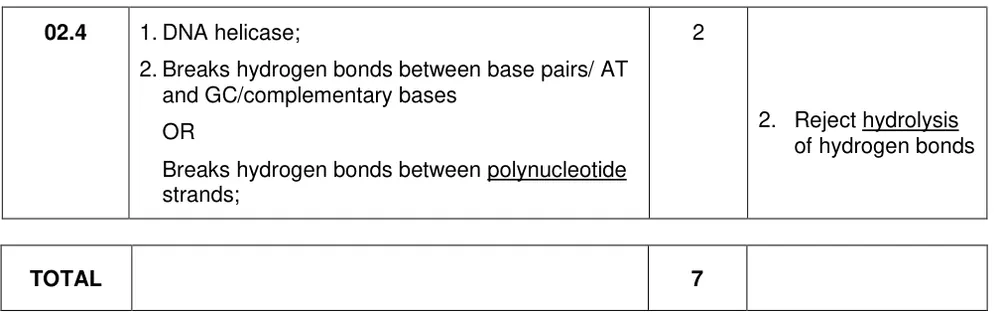
- DNA helicase: the enzyme that unwinds the double helix by breaking the hydrogen bonds between complementary bases. Say 'breaks', not 'hydrolyses'.
- Template strand: an original strand whose exposed bases decide the order of nucleotides in the new strand. Both strands act as templates.
- Free DNA nucleotides: nucleotides in the nucleus that are attracted to exposed bases and line up by complementary base pairing.
- Complementary base pairing: adenine pairs with thymine and cytosine with guanine, by hydrogen bonds, so the new strand is an accurate copy.
- DNA polymerase: the enzyme that joins adjacent nucleotides of the new strand by condensation reactions. It does not form the hydrogen bonds.
- Phosphodiester bond: the bond between the phosphate of one nucleotide and the deoxyribose of the next, made by DNA polymerase.
- Condensation reaction: a reaction that joins two molecules and releases water.
- Watson and Crick: the scientists who proposed the double-helix structure of DNA and the semi-conservative model of replication.
- Heavy and light nitrogen (15N and 14N): isotopes used to label DNA so that old and new strands can be told apart by density after centrifuging.
What these questions cover (AQA 3.1.5.2)
The questions test these statements from the AQA AS and A-level Biology specification (7401/7402):
- Semi-conservative replication: The semi-conservative replication of DNA ensures genetic continuity between generations of cells.
- Unwinding: unwinding of the double helix (no part asks about unwinding on its own; it's mark point 1 in the full descriptions of replication and in the helicase questions)
- Hydrogen bonds: breakage of hydrogen bonds between complementary bases in the polynucleotide strands
- DNA helicase: the role of DNA helicase in unwinding DNA and breaking its hydrogen bonds
- Base pairing: attraction of new DNA nucleotides to exposed bases on template strands and base pairing
- DNA polymerase: the role of DNA polymerase in the condensation reaction that joins adjacent nucleotides.
- Students should be able to evaluate the work of scientists in validating the Watson–Crick model of DNA replication.
How to use this page
Write your answer on paper before you open the mark scheme. Allow about 1.3 minutes per mark: the 16 questions are worth 39 marks, so about 51 minutes in total. Then mark your answer strictly against the mark scheme and read the examiners' tip underneath it. If you'd rather print the questions, download the PDF pack.
Semi-conservative replication (3.1.5.2)
Question 1
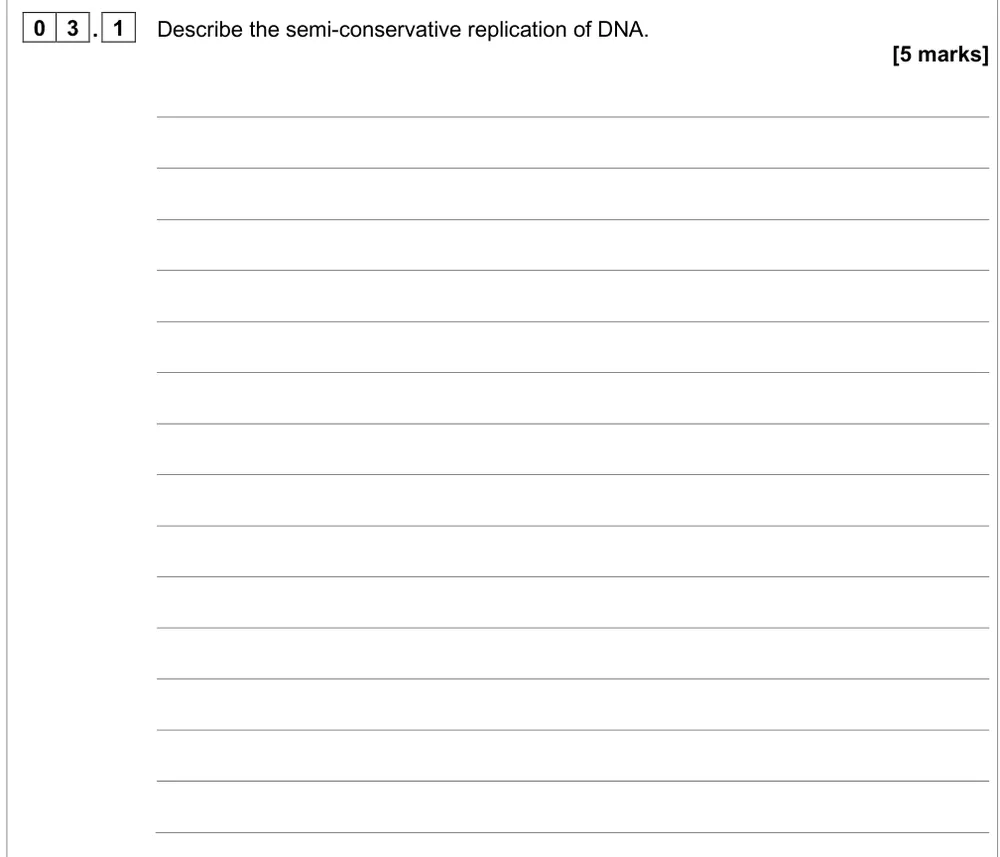
AS Paper 1 · June 2025 · Q03.1 · 5 marks · Easy
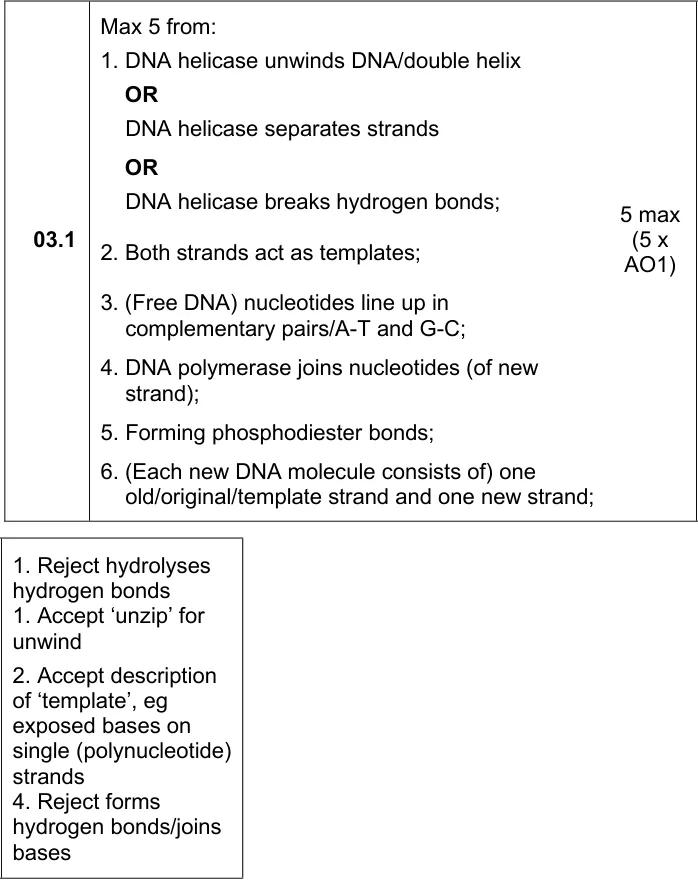
Describe the semi-conservative replication of DNA.
Show the mark scheme
Tap an image to open it full size.
From the examiners' report: About a third got full marks and almost 90% scored. Say helicase breaks (not hydrolyses) hydrogen bonds and that DNA polymerase joins adjacent nucleotides; don't drift into transcription.
Question 2
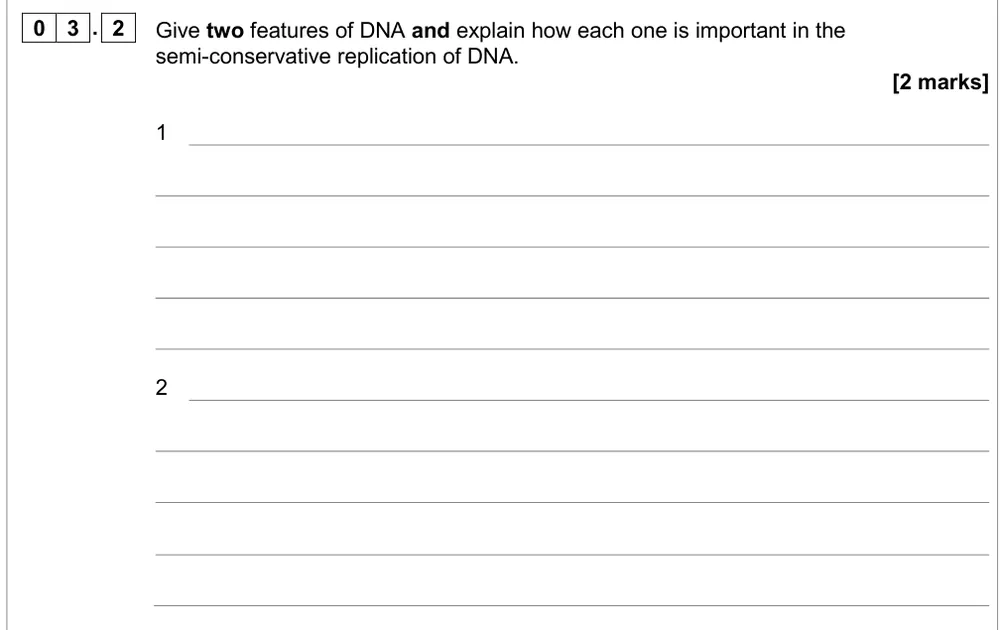
AS Paper 1 · June 2018 · Q03.2 · 2 marks · Hard
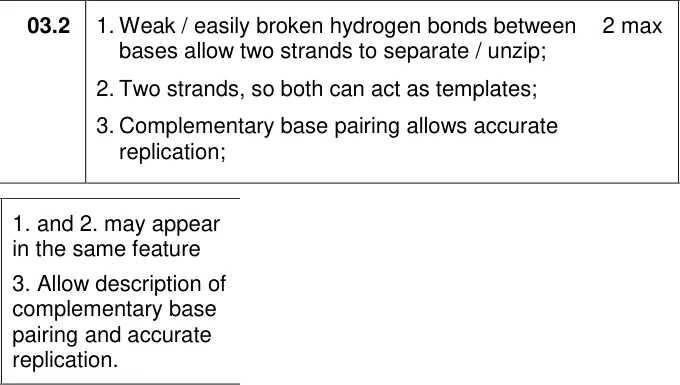
Give two features of DNA and explain why each matters in replication.
Show the mark scheme
Tap an image to open it full size.
From the examiners' report: Only 9.2% got both marks. Give the feature and then why it matters: hydrogen bonds are weak so the strands separate, and both strands act as templates.
DNA helicase and DNA polymerase (3.1.5.2)
Question 3
A level Paper 3 · June 2017 · Q05.1 · 2 marks · Easy
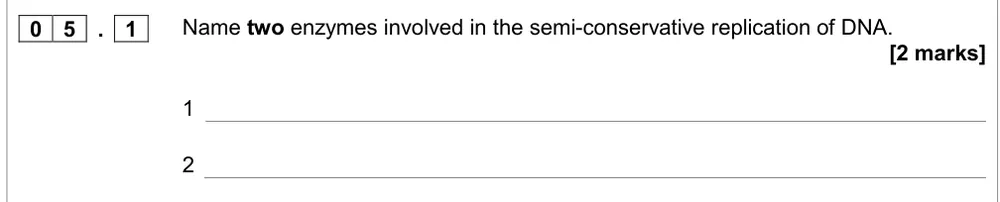
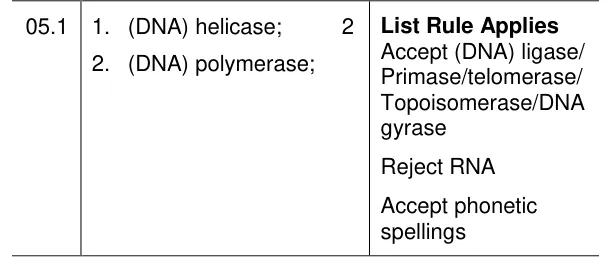
Name two enzymes involved in semi-conservative replication.
Show the mark scheme
Tap an image to open it full size.
From the examiners' report: 92% got both marks. Learn the names exactly: DNA helicase and DNA polymerase.
Question 4
AS Paper 1 · June 2017 · Q01.3 · 2 marks · Medium
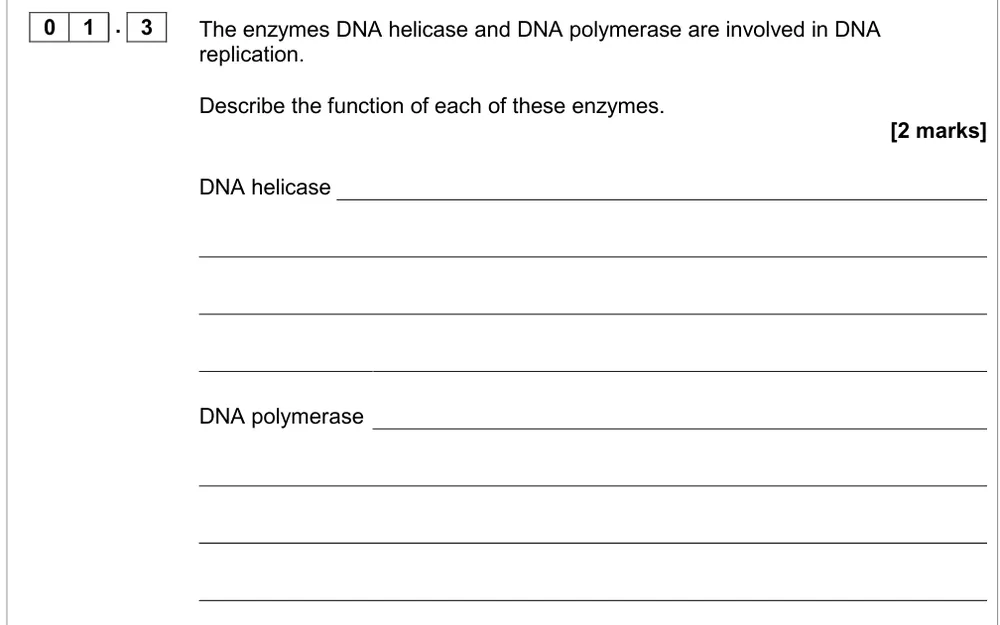
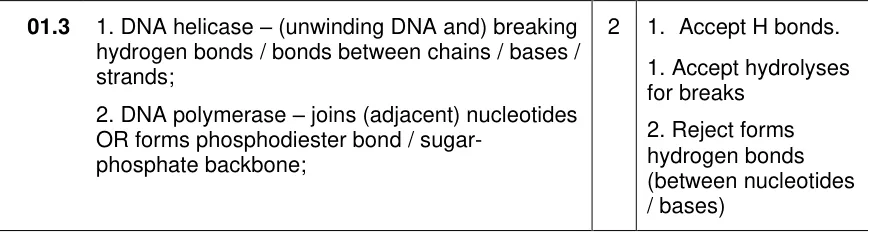
Describe the function of DNA helicase and of DNA polymerase.
Show the mark scheme
Tap an image to open it full size.
From the examiners' report: Only 28% got both. 'Unwinds' or 'unzips' alone didn't score, and DNA polymerase doesn't form hydrogen bonds or make pre-mRNA.
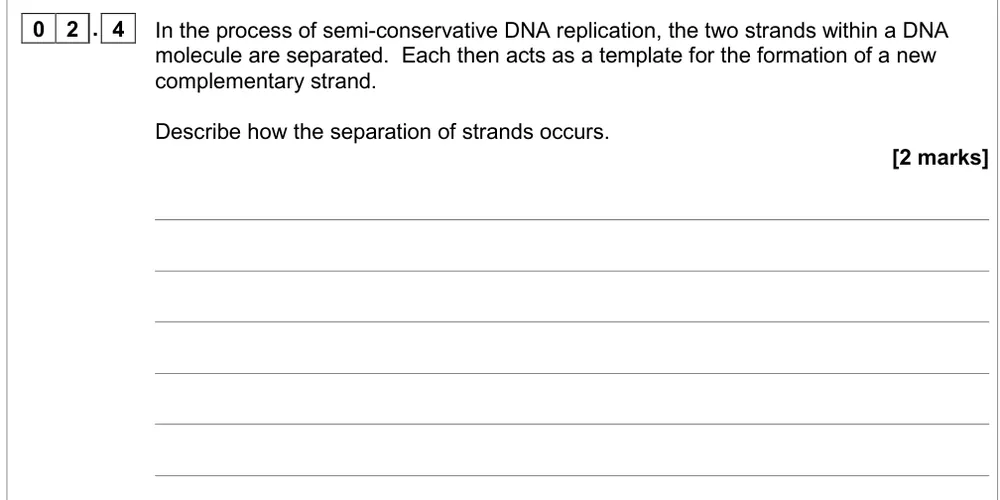
Question 5
AS Paper 2 · November 2020 · Q02.4 · 2 marks
Describe how the two DNA strands are separated.
Show the mark scheme
Tap an image to open it full size.
From the examiners' report: Most named DNA helicase and said it breaks hydrogen bonds between base pairs. Marks went for leaving 'DNA' out of the name or calling it hydrolysis.
Question 6
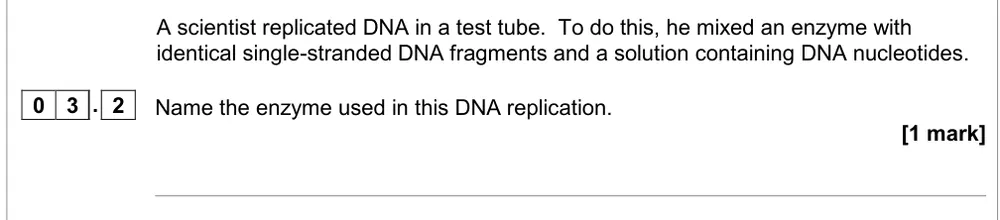
AS Paper 2 · June 2019 · Q03.2 · 1 mark · Easy
Name the enzyme that replicates DNA in a test tube.
Show the mark scheme

Tap an image to open it full size.
From the examiners' report: Three quarters scored. It's DNA polymerase, spelled correctly.
Question 7
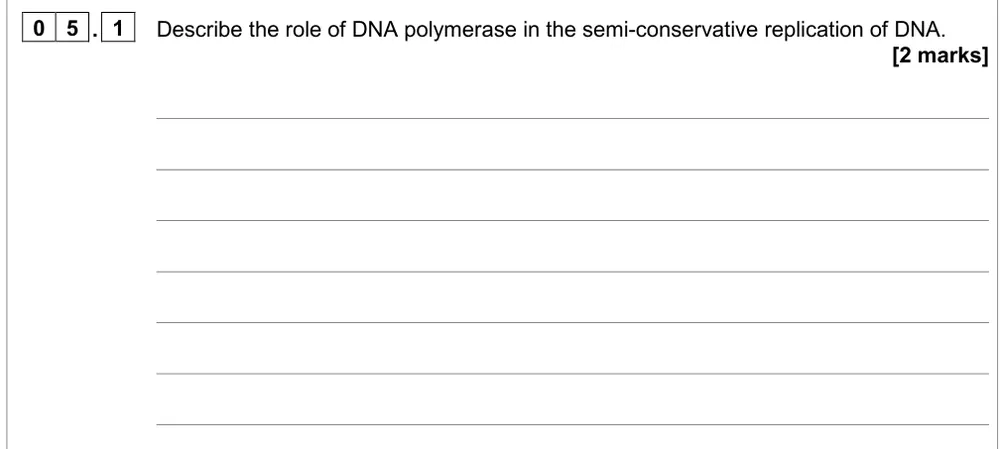
A level Paper 1 · November 2020 · Q05.1 · 2 marks
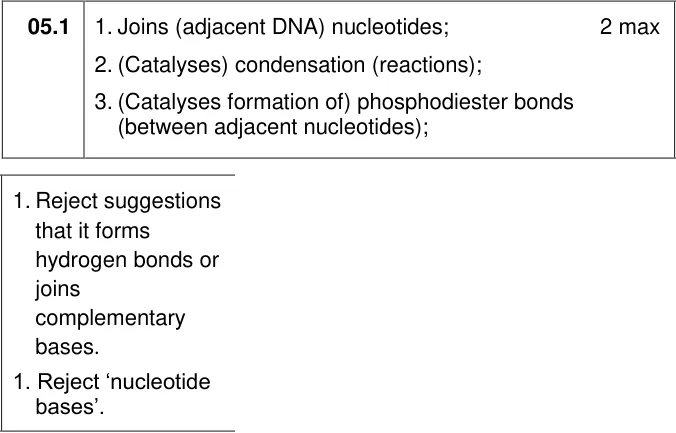
Describe the role of DNA polymerase in replication.
Show the mark scheme
Tap an image to open it full size.
From the examiners' report: Asked many times before, yet many still confused bases with nucleotides or said DNA polymerase forms hydrogen bonds or complementary base pairs.
Question 8
A level Paper 1 · June 2018 · Q09.1 · 3 marks · Medium
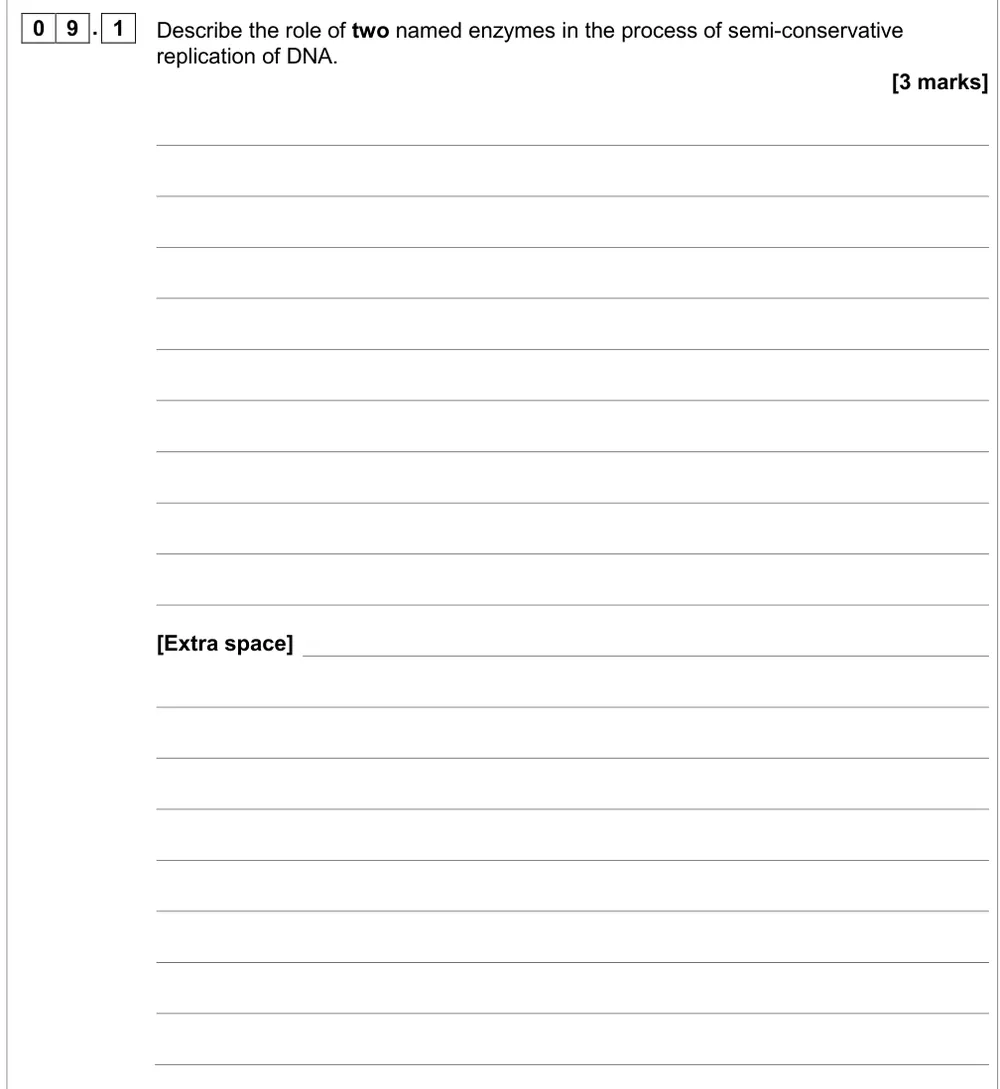
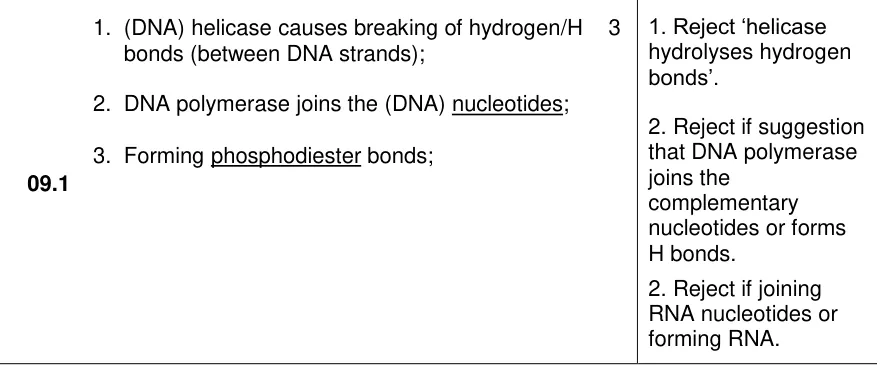
Describe the roles of two named enzymes in DNA replication.
Show the mark scheme
Tap an image to open it full size.
From the examiners' report: Only 24.4% got all three. 'Hydrolysing' hydrogen bonds wasn't credited, and saying polymerase forms base pairs cancelled the mark.
Templates and base pairing (3.1.5.2)
Question 9
AS Paper 2 · June 2019 · Q03.3 · 3 marks · Hard
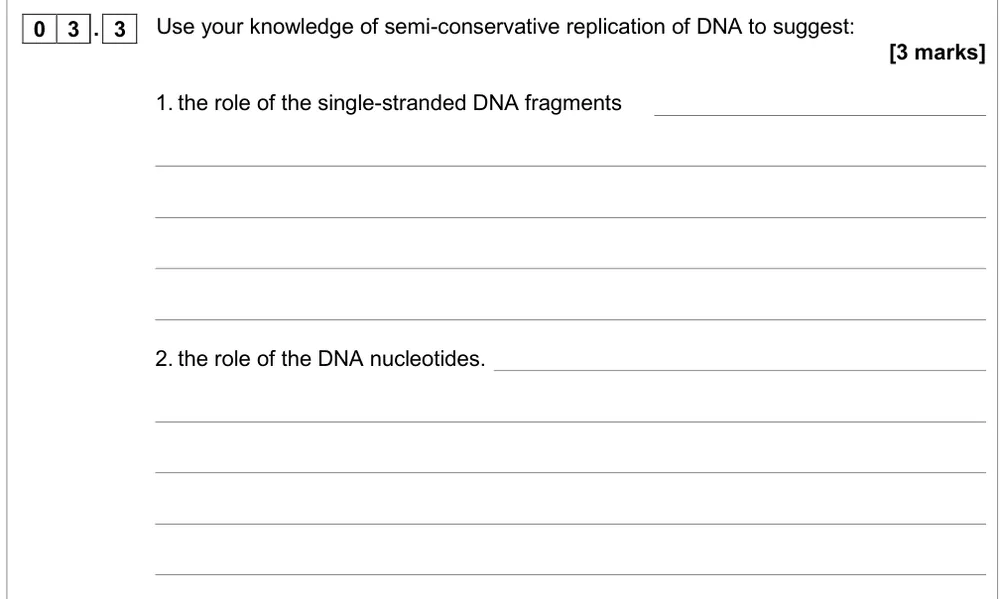
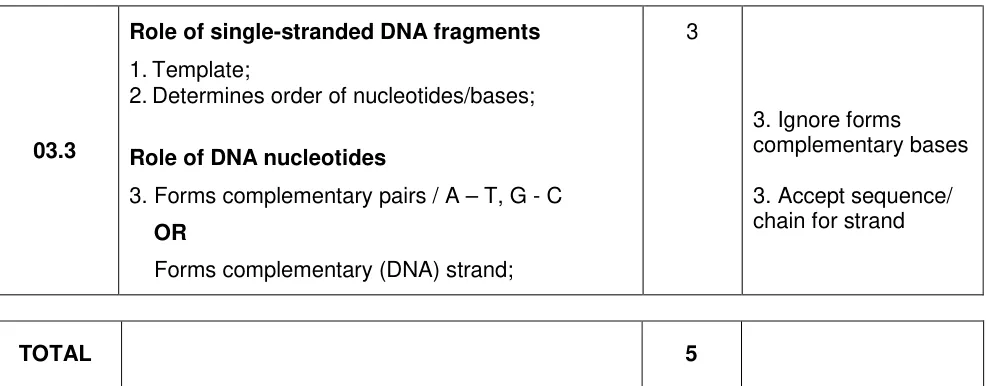
Suggest the roles of the single-stranded DNA fragments and the DNA nucleotides.
Information from earlier in this question:

Show the mark scheme
Tap an image to open it full size.
From the examiners' report: Most knew the fragment is a template and nucleotides pair with it, but very few said the template determines the order of nucleotides in the new strand.
Question 10
AS Paper 1 · June 2016 · Q01.2 · 3 marks
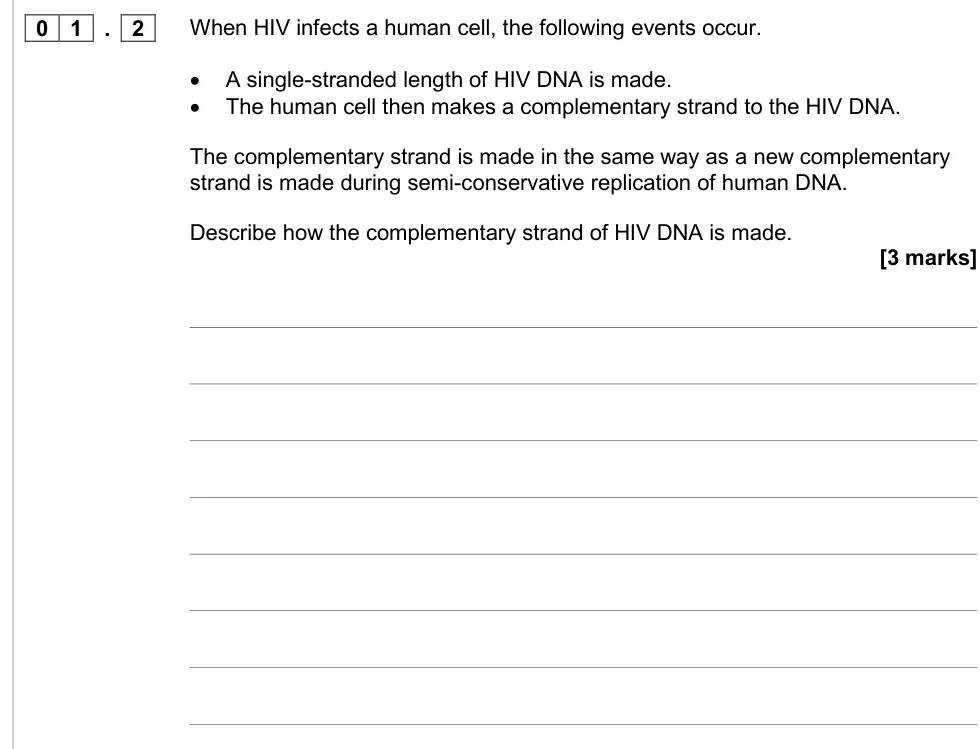
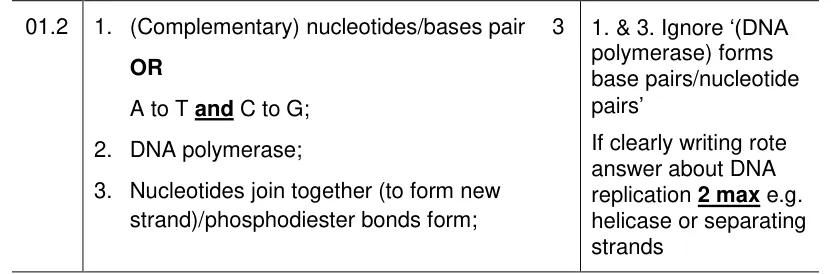
Describe how a cell makes the complementary strand to HIV DNA.
Show the mark scheme
Tap an image to open it full size.
From the examiners' report: There's no examiners' report for this paper, so this tip comes from the mark scheme. There's only one strand here, so don't write about helicase; describe base pairing, then DNA polymerase joining the nucleotides.
Question 11
A level Paper 1 · June 2019 · Q06.2 · 5 marks
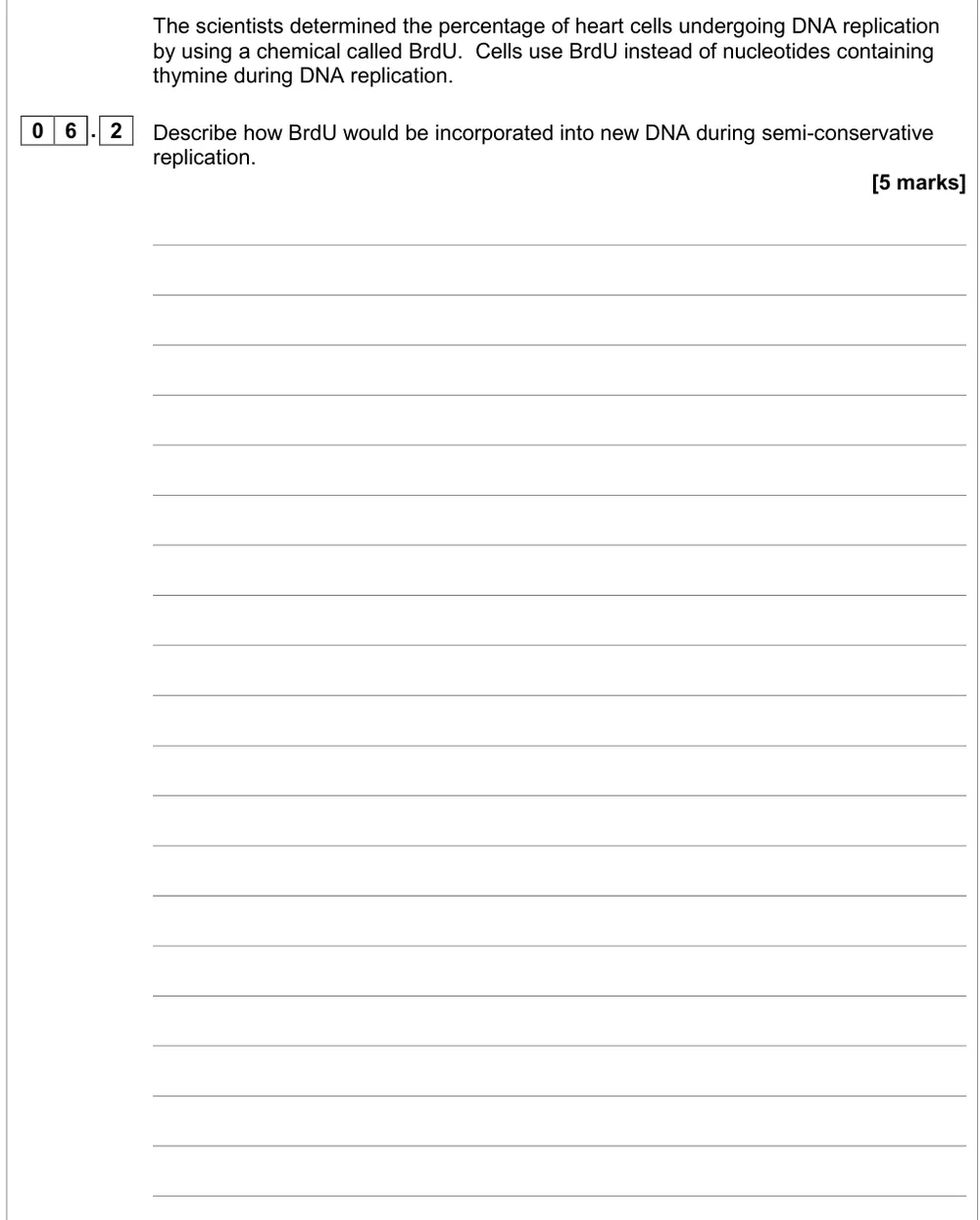
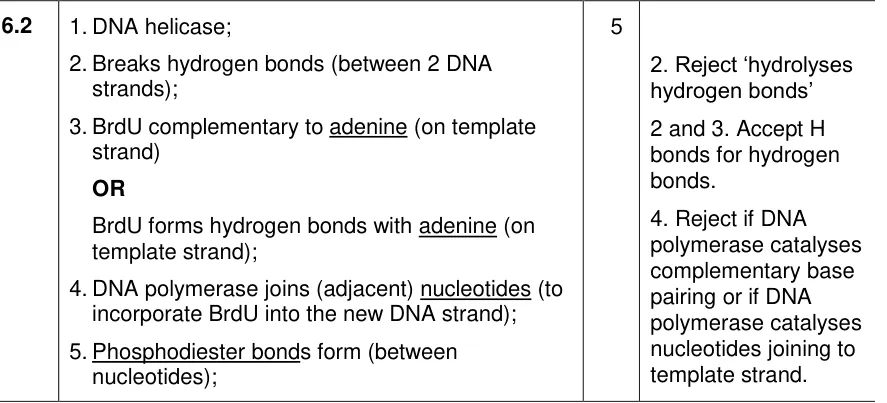
Describe how BrdU would be built into new DNA during replication.
Show the mark scheme
Tap an image to open it full size.
From the examiners' report: There's no examiners' report for this paper, so this tip comes from the mark scheme. Apply replication to BrdU: it takes thymine's place, so it pairs with adenine on the template strand.
Evaluating the Watson–Crick model (3.1.5.2)
Question 12
AS Paper 2 · June 2019 · Q03.1 · 1 mark · Hard
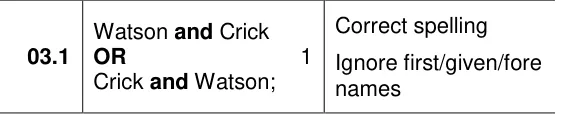
Name the two scientists who proposed models of DNA structure and replication.

Show the mark scheme
Tap an image to open it full size.
From the examiners' report: Only about a third named Watson and Crick; many left it blank or wrote Meselson and Stahl, who tested the model.
Question 13
AS Paper 1 · June 2025 · Q03.2 · 2 marks · Medium
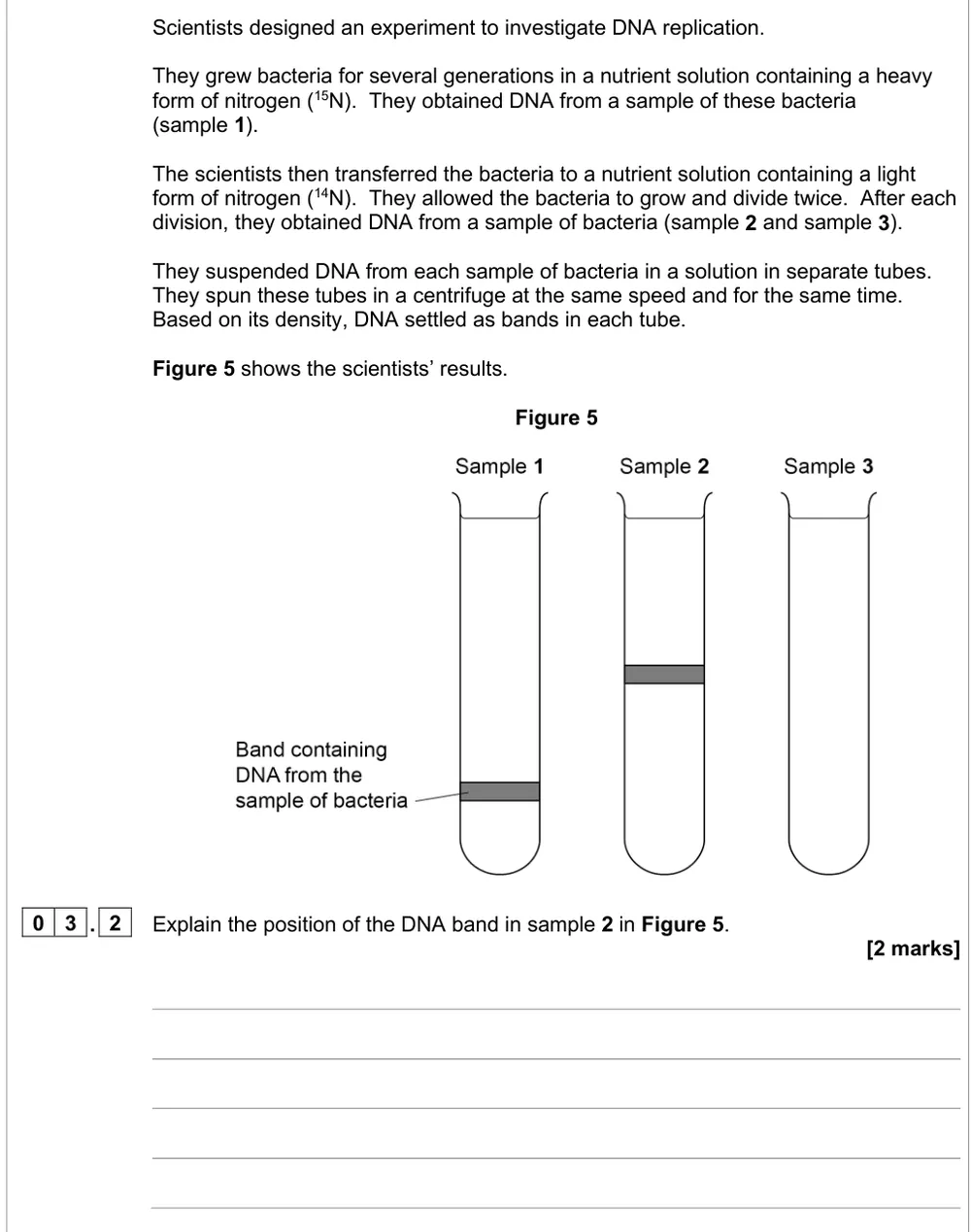
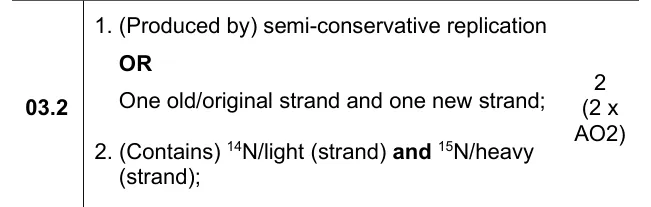
Explain the position of the DNA band after one division in 14N.
Show the mark scheme
Tap an image to open it full size.
From the examiners' report: About 50% scored, mostly for heavy and light nitrogen. Only the best answers named or described semi-conservative replication.
Question 14
AS Paper 1 · June 2025 · Q03.3 · 1 mark · Hard
Draw the bands you'd expect after two divisions in 14N.

Show the mark scheme

Tap an image to open it full size.
From the examiners' report: About 25% got this. Half the molecules are still hybrid (level with sample 2) and half are all light (higher up); some drew a band below sample 2.
Question 15
A level Paper 1 · November 2021 · Q09.2 · 2 marks · Hard
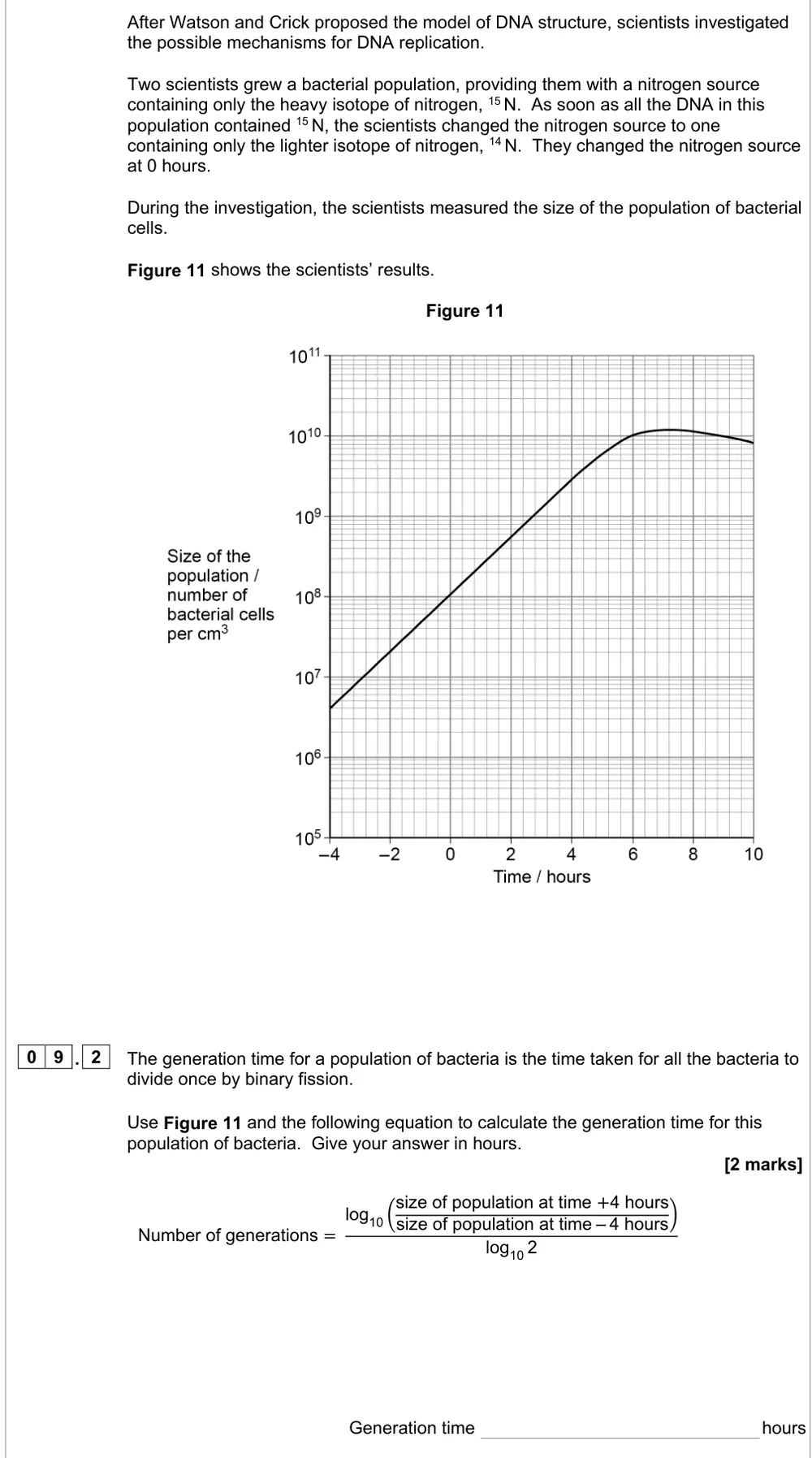
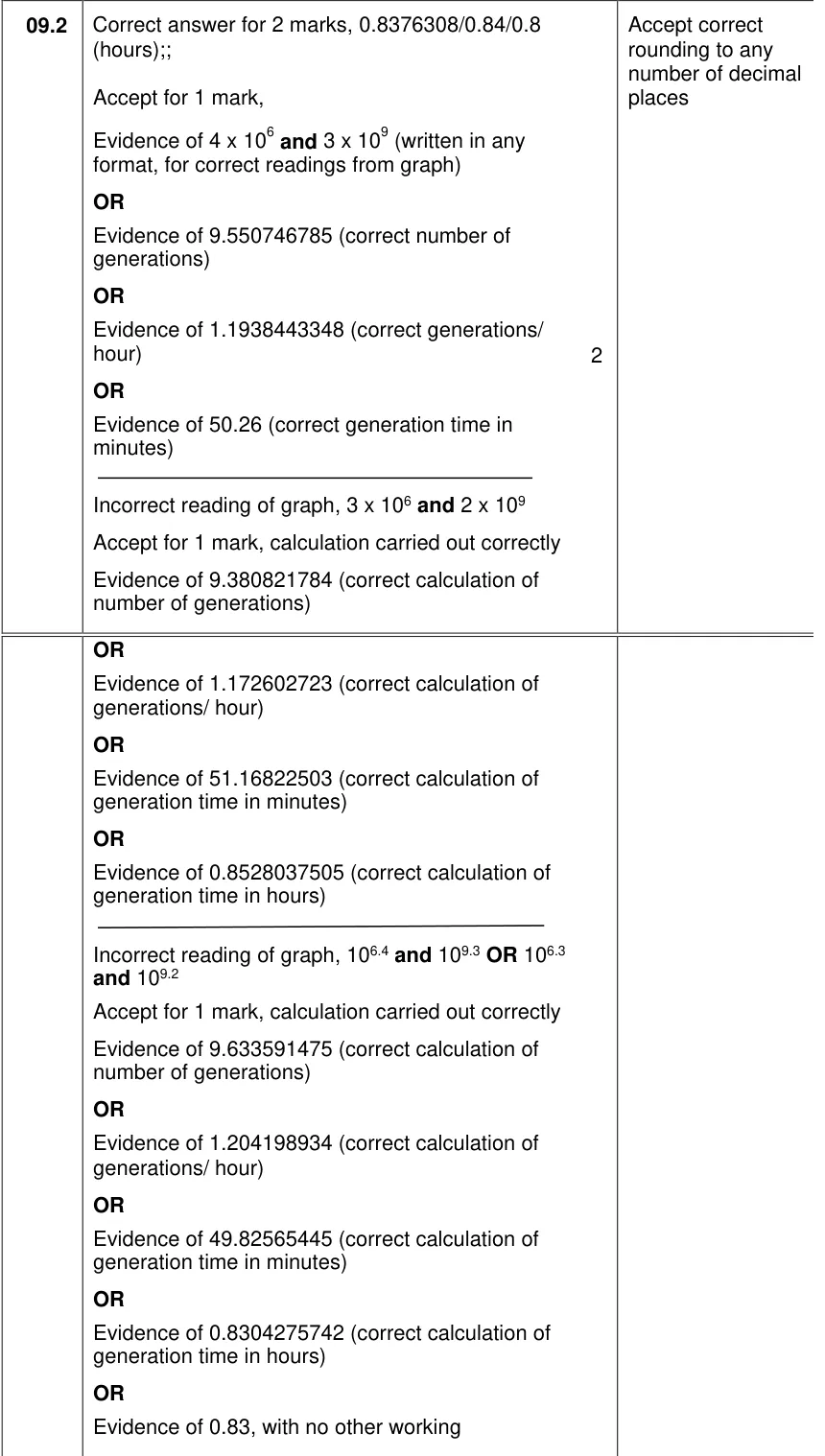
Use a log-scale growth curve to calculate the bacteria's generation time.
Show the mark scheme
Tap an image to open it full size.
From the examiners' report: Hardly anyone read the log scale correctly: each labelled line is ten times the one below, so read the minor lines carefully before using the equation.
Question 16
A level Paper 1 · November 2021 · Q09.3 · 3 marks
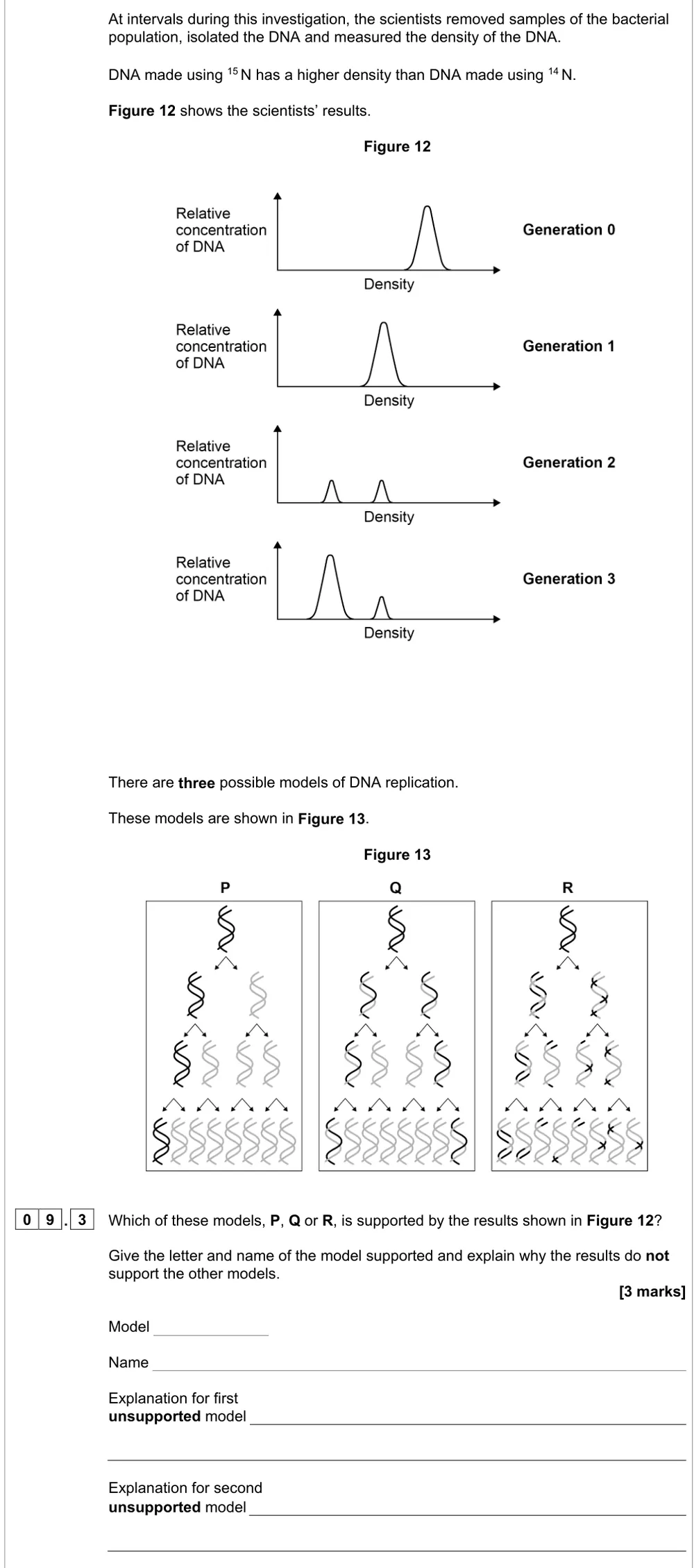
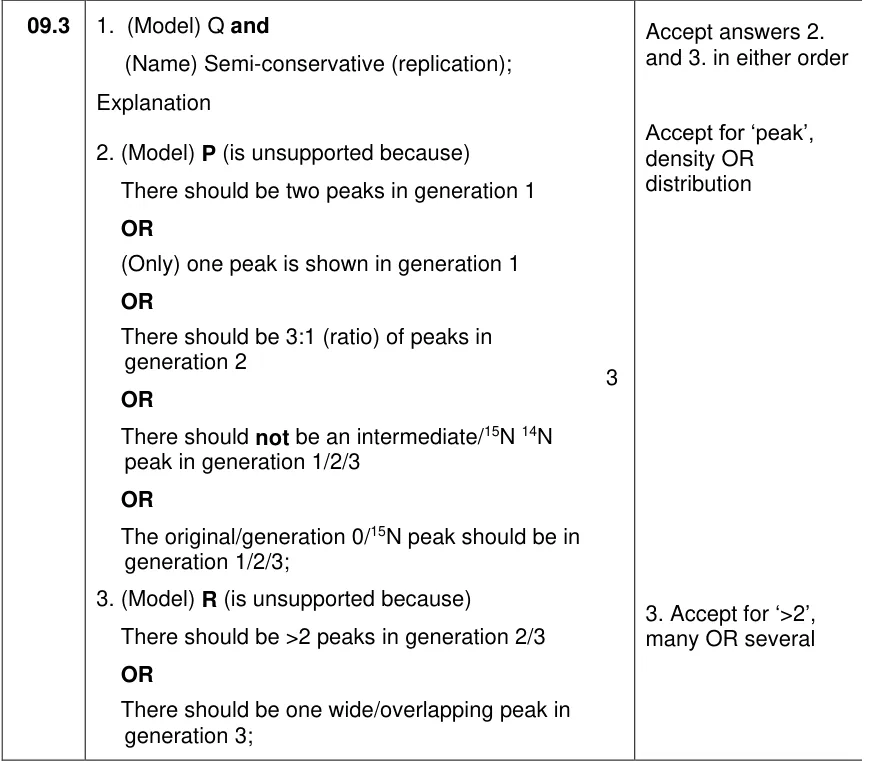
Decide which replication model the density results support, and rule out the others.
Show the mark scheme
Tap an image to open it full size.
From the examiners' report: The examiners' report has no comment on this part, so this tip comes from the mark scheme. For each rejected model, say what peaks it predicts and how that differs from Figure 12.
Where students lose marks (from AQA examiners' reports and mark schemes)
Each point below is followed by wording that gained marks.
Helicase breaks hydrogen bonds, not 'unzips': Only 28% described both enzymes' functions on the 2017 AS paper, where 'unwinds' or 'unzips' on its own wasn't accepted for DNA helicase. Say which bonds it breaks.
✔ Gains credit: "DNA helicase – (unwinding DNA and) breaking hydrogen bonds between strands / bases."
Break, don't hydrolyse, hydrogen bonds: On the 2018, 2020 and 2025 papers, answers saying helicase 'hydrolyses' hydrogen bonds were rejected. Helicase breaks hydrogen bonds; it doesn't hydrolyse them.
✔ Gains credit: "(DNA) helicase causes breaking of hydrogen bonds (between DNA strands)."
Polymerase joins nucleotides, not bases: The most common error is saying DNA polymerase forms hydrogen bonds, joins complementary bases or forms phosphodiester bonds between bases. It joins adjacent nucleotides in the new strand.
✔ Gains credit: "Joins (adjacent DNA) nucleotides; (catalyses) condensation (reactions); (forms) phosphodiester bonds."
Phosphodiester bonds, and the right polymerase: When asked for the enzymes copying a virus genome, some said DNA polymerase forms ester bonds, and others named RNA polymerase or reverse transcriptase.
✔ Gains credit: "(Polymerase) forms phosphodiester bonds between (adjacent) nucleotides."
Put DNA in the enzyme's name: Some lost marks by writing just 'helicase' where DNA helicase was needed, or confused replication with transcription and said DNA polymerase makes pre-mRNA.
✔ Gains credit: "DNA helicase" and "DNA polymerase" named in full.
Both strands are templates: Only 9.2% got both marks for two features of DNA: features were described but not explained, and most said one strand acts as a template rather than both.
✔ Gains credit: "Weak / easily broken hydrogen bonds between bases allow two strands to separate"; "two strands, so both can act as templates."
The template decides the order: Most knew the single strand is a template, but very few said the order of bases on the template determines the order of nucleotides in the new strand.
✔ Gains credit: "Template; determines order of nucleotides/bases."
Name semi-conservative replication for the band: About 50% scored on the sample 2 band, mostly for heavy and light nitrogen; only the best answers named semi-conservative replication. About a third could name Watson and Crick, with many writing Meselson and Stahl.
✔ Gains credit: "Semi-conservative replication OR one old strand and one new strand"; "contains 14N (light) and 15N (heavy) strands."
Download the questions
Download the PDF pack (16 questions, mark schemes at the end)
Keep practising
- Structure of DNA and RNA: AQA A Level Biology exam questions by topic
- Enzymes: AQA A Level Biology exam questions by topic
- Graph skills: AQA A Level Biology exam questions by topic
- Mastering AQA A Level Biology 3.4.2: DNA and protein synthesis
- AQA A Level Biology masterclasses
Questions, mark schemes and examiners' report extracts © AQA.