

AI for A-level Biology Students
“That’s a great question, let’s delve into this”
Most students use AI in some way. People online get excited about loving/hating it but the truth is that it can either help or make things worse, depending on how you use it.
(I’m not going to consider ethics in this article.)
This is part of a short series for people who are already planning to use AI to study:
AI for A-level Biology (overview/summary) «« you are here
AI for exam practice - coming soon
What are you trying to achieve
The most important thing is to remember that your objective is to get a good grade in the exam, NOT just to complete today’s task.
For this you need to learn the content (properly) and develop exam skills. Anything else is wasting your time.
How humans learn
It can be difficult to get your brain to construct understanding of new concepts, and difficult to convince it to let you remember them.
We know from previous research that you need to spend time understanding, processing, and thinking about the concepts. And then practice recalling and using them. This is very different from just trying to memorise things. If you don’t go through these steps, you’re not going to be ready for the exam.
Learning at this academic level should feel like an effort! Having moments of feeling confused, and struggling to work stuff out, are a valuable part of the process. If it feels like the information is just gliding into your head then you’re very probably not learning anything at all
Aim for the process of learning, not the ‘answer’. The objective is not to finish quickly, it’s to spend time thinking about the topic
Don’t try to ‘remember the answers’, instead strive to understand the topic and practice using the vocabulary
Proceed with Caution
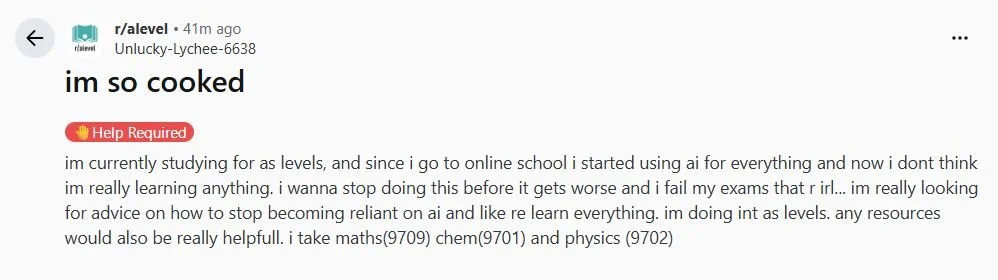
Genuine post. I’m actually really impressed by this student in that they realised their study methods weren’t working and want to change - good luck to them.
OK so obviously there are bad ways to use AI
Let’s get the obvious stuff out the way first.
If your teacher asks you to write an essay (or whatever), they’re doing that because they want you to think through the content, understand it, organise it in your mind, and practice writing using precise language and technical vocabulary. This process helps you gain understanding and skills which you can use to achieve a better A-level grade.
If you get an AI to write the essay, none of that happens. No learning occurs, you don’t gain anything. So the whole exercise is entirely pointless.
People do it because they are overwhelmed by the immediate objective of ‘submit an essay’ and they lose sight of the bigger picture. Humans have a tendency to focus on short-term goals. But what’s the point of going through the motions in college for two years if you don’t get a decent grade at the end of it? You’re just wasting your time.
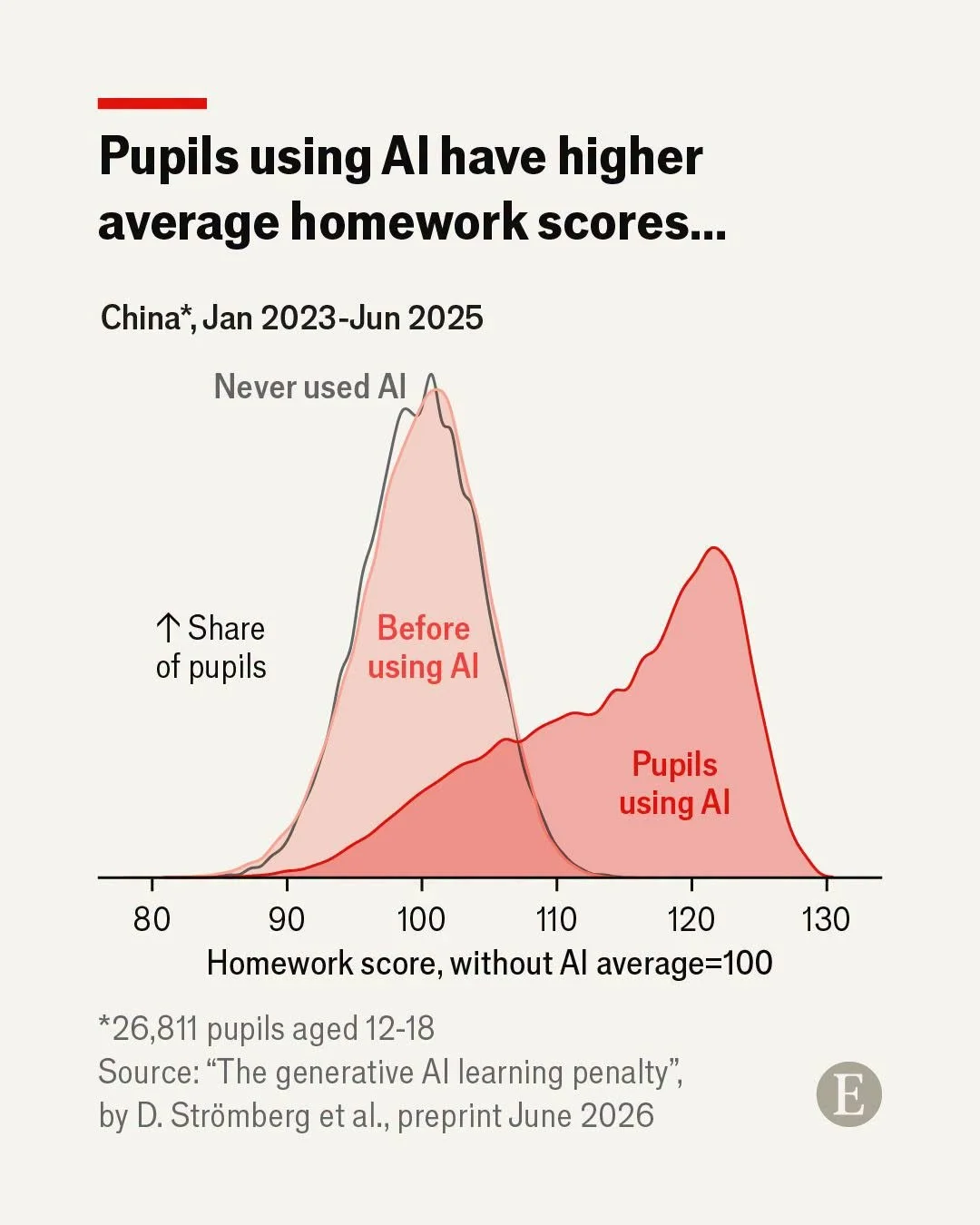
AI helps students get a better grade for their homework
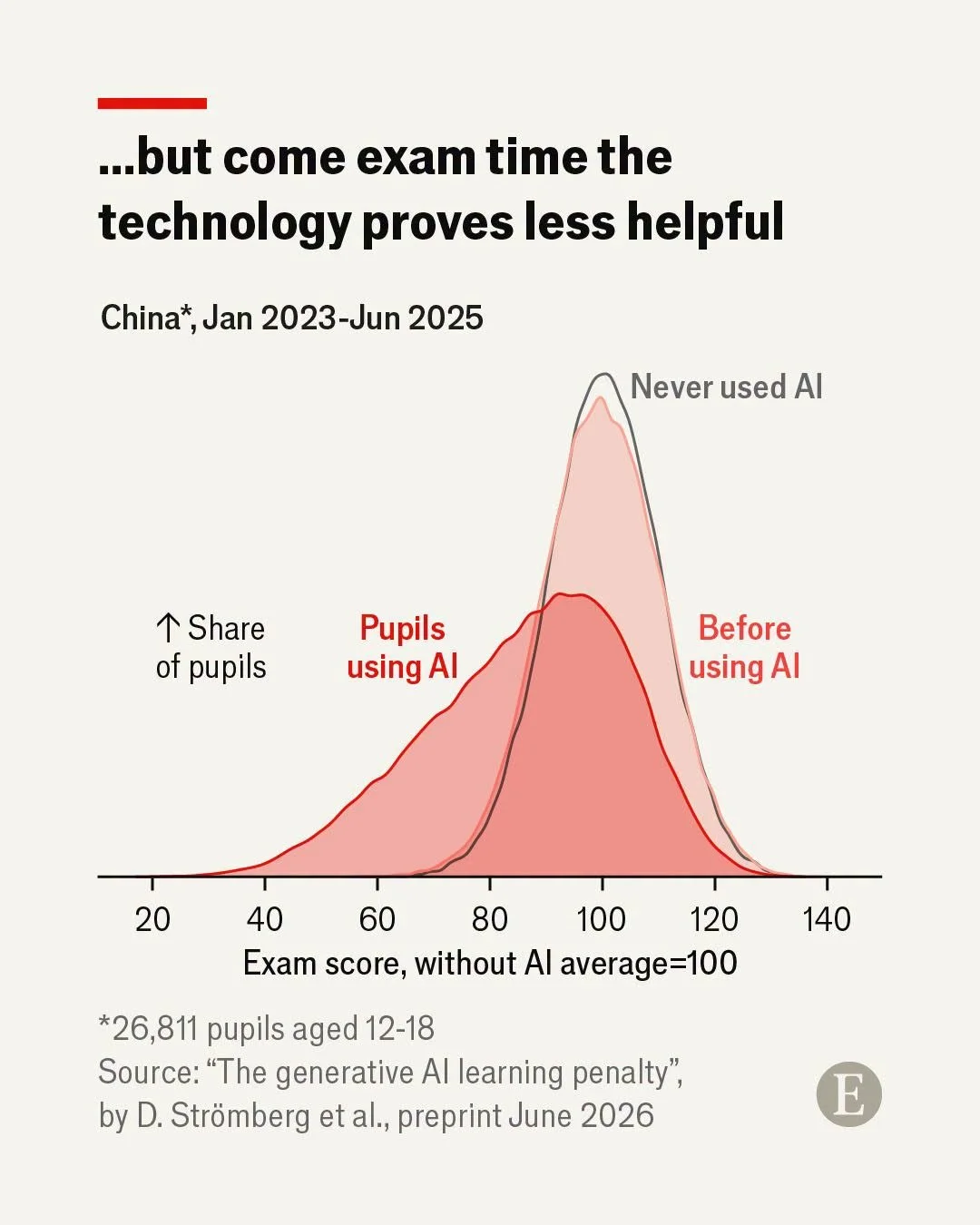
But those same students do WORSE in their exams
The above images are from The Economist magazine, 2026
Are there good ways to use AIs?
Well yes. (Maybe?). If the AI is carefully trained/prompted. Those things are desperate to just … tell you stuff. And that’s not going to help you.
Can the AI make studying easier?
“Trust me, this is for your own good”
Many people are drawn to using an AI because they think it will make studying easier.
However, if you are able to train your AI to be an effective study assistant, then it will challenge you. It’s not going to feel easy. It will push you to drag things out of your memory, and refuse to immediately give you the answers. It won’t let you get away with memorising content.
Do you want to use an AI like that?
If your AI is making everything super easy, I would bet good money that you’re learning very little with that time. And we only have so much time available.
Can the AI make studying more effective?
I reckon this is where AI could potentially help most - to help you make better use of your time.
If your studying is more effective then you can have shorter study periods, broken up with proper breaks. That’s a much better route to exam success than studying ineffectively for hours on end.
A well trained/prompted AI should be able to help ensure you are focused on your spec’s requirements, and help structure your work as you go through a topic. It can ask you questions to test your understanding, and provide near-instant feedback.
Are these things you need help with?
The huge challenge here is to stop it from just giving you ‘the answer’. Finding out the answer might feel helpful/good, but unless you are learning something for the first time, or have already struggled but failed to understand or recall a concept, it’s not going to be helpful. (Struggle is important for learning, and your goal is to get a good grade at the end of all this).
How do I get the AI to help me?
Never just open up the AI and ask it a question without any context. Remember that Reddit user I quoted above.
You need to be smarter about this.
I’ve had a go at developing some example Chat-GPT prompts, which are linked through the articles below. You can give them a go and see if they work for you, and/or adapt them to suit your needs.
Suggested Approaches and Prompts for A-level Biology study
I had a think about how you might approach prompt design for different contexts, and assessed how well the AI did.
“Would I lie to you?”
AI as a teacher (learning new content)
AI is good at breaking topics from the spec up into simple steps, but is not great at explaining them.
» See my suggested prompt
AI for homework
Danger: too much risk of offloading mental effort! Best avoid unless the homework falls into one of the other categories
AI for revision
Can an AI challenge you to recall the topic and structure your thinking, to discover what you need to re-learn?
» See my suggested prompt
AI for exam practice
You can’t take an AI into the exam, and you won’t be typing your answers on a keyboard. Can an AI help the process without making you reliant on its support? They are also not great at marking answers, and do badly at making up application-type exam quesions.
» Article coming soon
Is your AI use helping? A checklist for any time you’re using it:
Things to consider:
🧠 Are you still thinking?
Are you still making mental effort to understand the topics? If not, then it’s not likely to be effective learning.
The objective is not for it to feel easy, nor for you to be reading the ‘thoughts’ of the AI without having your own independent thoughts. Your understanding of the topic should be much richer and deeper than it’s possible to put into a few set phrases.
😱 Can you survive without it?
In some studies, the benefit students got from using AI vanished in the exams.
There’s a weird weird thing about humans. We have a quirk of storing information and memories in other people’s brains (a bit like organic cloud storage). This is one of the reasons people might feel that ‘part of themselves’ died when they lose loved ones. If you chat to the AI, there’s a risk your brain will think you have a close, accessible friend who you can ask for this information. So your brain considers the information as being ‘stored’ and doesn’t bother saving it locally. But of course the AI won’t be accessible during your exams.
We also have a habit of becoming ‘familiar’ with information without actually learning it in a way that allows for recall. Chatting to an AI risks this, in the same way that re-reading notes does.
Why not practice writing explanations of the topic without any help from the AI (or from your notes, textbook etc) after a revision period, to see how much has truly gone in. Even better, repeat that exercise a week or more later - tt’s easy to hold stuff in short term memory during a revision session then forget it afterwards.
🤔 Can you trust it?
Everyone knows AIs can get things wrong, and the worst time for this to happen is when you’re trying to learn. You don’t yet know the subject well enough to spot the errors.
If you 100% trust the AI, then you’re going to suck those errors straight into your brain, where they will get in the way of further learning.
An AI is most likely to get things wrong when it’s a complex topic and there is a lot of misinformation online. Which means it’s going to teach you the most popular misconceptions out there, which will be the hardest ones to lose. Do you trust that your AI is restricting its input to authoritative sources?
This article was written by Jenny Shipway