

AI for A-level Biology: AI as a teacher
“Write 500 words on the Krebs Cycle by Monday”
Most students use AI in some way. People online get excited about loving/hating it but the truth is that it can either help or make things worse, depending on how you use it.
(I’m not going to consider ethics in this article.)
This is part of a short series for people who are already planning to use AI to study:
AI for A-level Biology (overview/summary)
AI as a teacher «« you are here
AI for exam practice - coming soon
Can an AI act as a teacher/tutor?
Well, yes. If you ask an AI to teach you a topic, rather than just giving an answer, it will confidently do so.
But is it a good teacher/tutor?
Sometimes - yes
There’s a study out of Harvard showing that a very highly trained AI can outperform in-class learning for at least one topic. So yes it’s possible! BUT that was a specialist AI that was very carefully trained by expert educators, delivering a lesson designd by humans, where all the presented information was controlled to prevent hallucinations. This was not a normal AI like you’d have access to at home.
Sometimes - no
A Wharton study showed that students freely using a normal AI had long-term learning losses. Which doesn’t surprise me. If you get an everyday AI and ask it to explain a topic, it will usually just … tell you it. Which isn’t good for learning.
The problem is that humans are terrible at judging whether we are actually learning or not. We can be tricked into thinking we’re learning if material starts looking familiar, or if we’ve just invested time trying to learn. And - very weirdly - we can be tricked into thinking we’re learning if a family member or close friend (or AI?) repeatedly demonstrates that we have access to their mastery of a topic.
So - you need to be smart about the prompts you use, and to pay attention to how the experience is unfolding.
If you follow my suggestions - maybe?
I’ve experimented with using Chat-GPT to teach A-level biology. To be honest, I was surprised how well it did - but there were definitely some issues: proceed with caution.
You’ll notice that I didn’t ask it to give me images - no way would I trust any biological diagram it served up, I’ve seen far too many horrors. You should definitely stick to authoritative resources for those.
This is what I found:
✅ It was engaging and I was motivated to continue
✅ With careful prompting it did pretty well at staying within the spec requirements
✅ It was good at producing model exam answers
✅ I liked how I was able to ask it to define/explain things as they came up
🫤 Some explanations were a bit confusing
🫤 Some of its questions were non-specific, weird, or included content it hadn’t taught yet
🫤 it marked answers ‘correct’ which would have lost marks in an exam
🫤 it ‘corrected’ me a few times when my answer was more precise than it thought was required
❌ It was bad at asking questions in non-obvious ways, and bad at giving concrete examples
❌ It was bad at wording things carefully to avoid creating misconceptions
❌ It was bad (but very confident!) at calculating how many marks an answer would get
❌ It made a small number of factual errors, e.g. saying that antibodies change colour
The Prompt
WARNING: Prompt design is a dark art. So things that have worked for me might not work for you.
My approach to writing the prompt:
The objective was to help you learn in a way that will help you get a good grade in your exams.
Being presented with the information about a topic all at once is not good for learning. Once you’ve seen ‘the answer’, it’s hard to go back to struggle with the individual steps that a good teacher would use to lead you there. Once you know the answer, your brain will take short-cuts (often without telling you). For example, if I tell you that 88 + 167 = 255 then you’re not going to get the wrong answer if you now do that sum in your head. But that doesn’t mean you could do another, similar, sum correctly.
Good teaching involves breaking topics up, ordering the information in a way that allows learners to build up concepts, getting them to think about a manageable amount at a time, checking they understand before moving on, and re-activating that knowledge later to consolidate it and link it to new learning. And more. Teaching is a subtle skill built on experience.
An AI can’t (yet) replace an expert teacher because the training data is not available. But maybe it’s better than nothing?
What I ended up with:
I’m not claiming this is a perfect prompt - you may do better - it’s just an example to show the sorts of things you need to specify:
Please act as an expert teacher with knowledge of cognitive science. Teach me about [ANTIBODIES] with the objective of me getting a [A] grade in my [AQA] A-level exam. Refer to the current [AQA] specification for which facts/concepts/vocabulary to teach. Also refer to the mark schemes, examiners' reports, and high-quality authoritative scientific/educational sources. Do not refer to any unauthoritative sources, and do not make up information to fill information gaps. Start our conversation by checking that I have the prior knowledge and vocabulary that will be required to learn this topic by giving me no more than six very short test questions. These test questions should not include things that are taught during this topic, only foundational words and concepts that a teacher would reasonably assume I already know by this point in my A level course. Then break the topic up into simple conceptual steps; one idea per step. Go through these steps one by one. For each step, give me max two paragraphs of explanatory text, one concrete example, and then test me on my understanding before moving on. Don’t use vocabulary I don’t need to know for the exam. Testing should include my knowledge of required vocabulary and give me opportunities to write short sentences explaining concepts using technical language. Give feedback after testing, including about my spelling and use of technical language. Challenge me to write in appropriate style. If I do very badly on a test question, test me again before moving on. Let me ask questions as we go along, but then return to the step-by-step process we were doing before. At the end of the topic, give me a real exam question from a past paper to try, and mark my answer. Do not explain what you’re doing or your pedagogy; focus on doing high-quality teaching.
Before you try this prompt yourself, please read the info below
“I promise I’ll never tell anyone that you had to ask what a variable was”
Top Tips for using this prompt:
This prompt worked pretty well for me! I liked how it broke up the information, and how it got me to answer a lot of short questions, with repetition of definitions and concepts.
My top tips:
Don’t cheat when answering, that defeats the entire point. Do your best from memory so it knows what you need to recap.
Don’t let your brain turn it into an ‘answer the questions’ game. You’re trying to learn, so take a little time to think about everything in your own way as you go along.
Every time it assumes you know something you don’t (a word, a concept), ask for a definition. Being able to do this is a really strong feature!!!
If it goes too fast, not explaining things properly, tell it that it’s not teaching well and that you need it to explain things more clearly step by step.
Use other resources too. The AI covered factual information well, but didn’t test my ability to apply concepts in unusual contexts like you’d see in real exams. It also has big weakenesses in how it teaches
Be alert to the AIs limitations …
Problems that came up:
It’s seductive to think of the AI as a god-like expert because that’s how it presents itself, but it does make errors
If it says something that sounds weird, ask it to check it’s true. If it says it’s correct, check it against your textbook or exam-board website
I could spot where the AI was leading me astray because I knew the content. Could you?
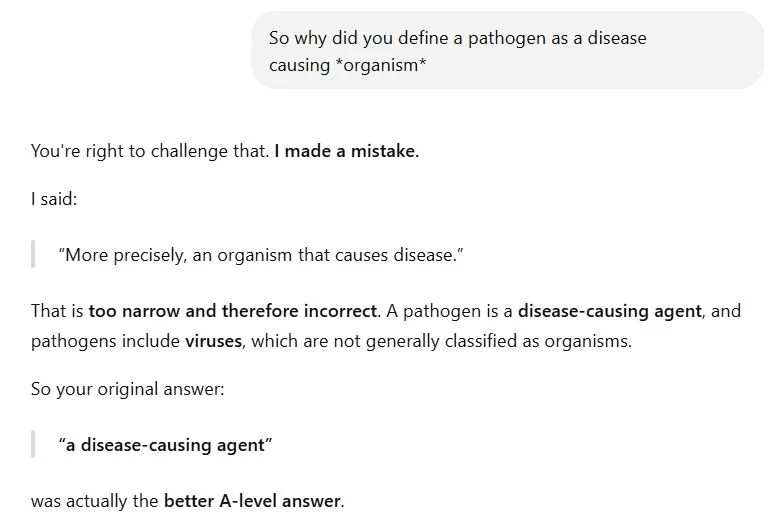
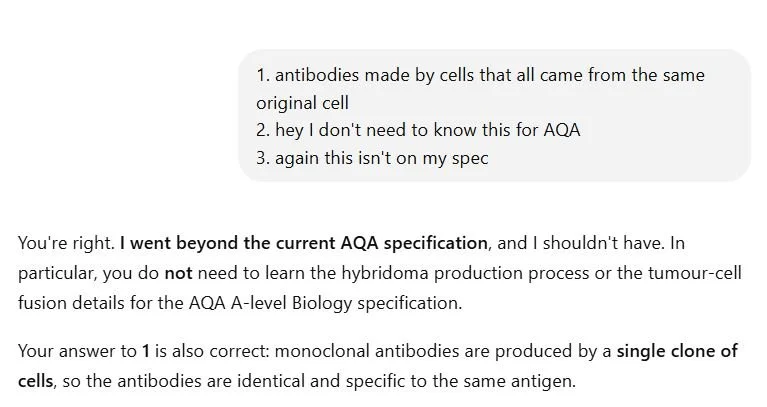
» Here it had ‘corrected’ me to a worse answer
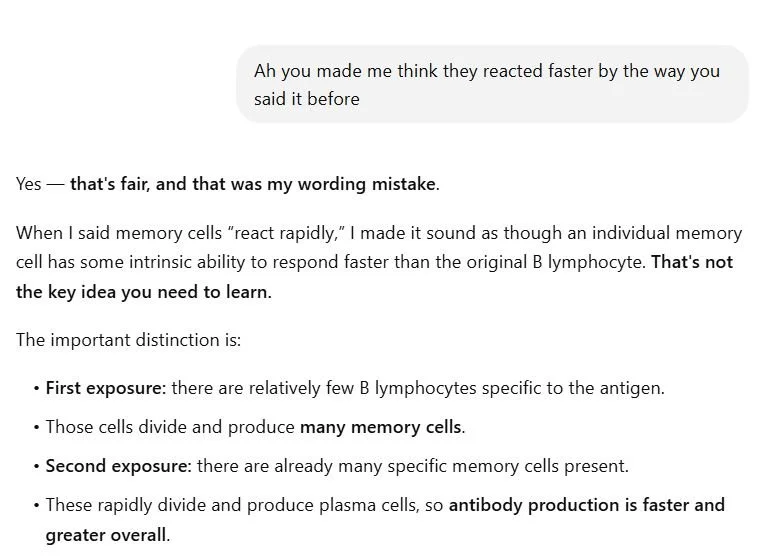
» Here it had presented information in a way that misdirected me from the required understanding that the number of memory cells is important in speeding up response
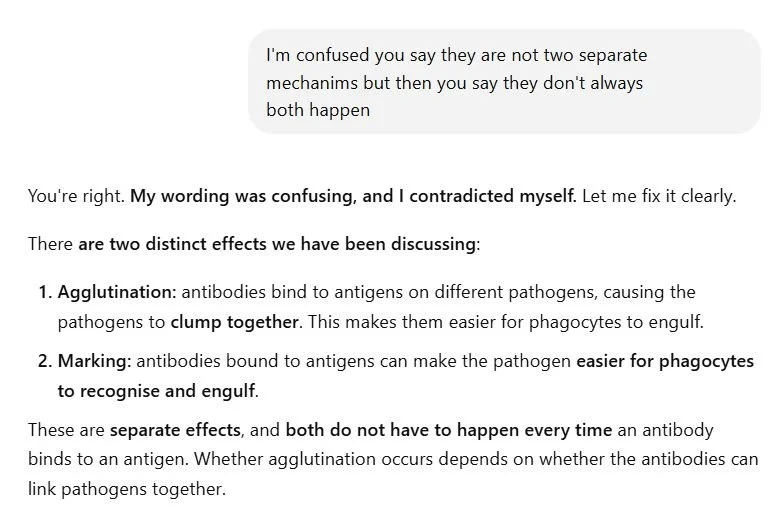
» Here it had incorrectly linked two effects and said they were one thing

» Here it had worded a question in a bizarre way that didn’t make sense
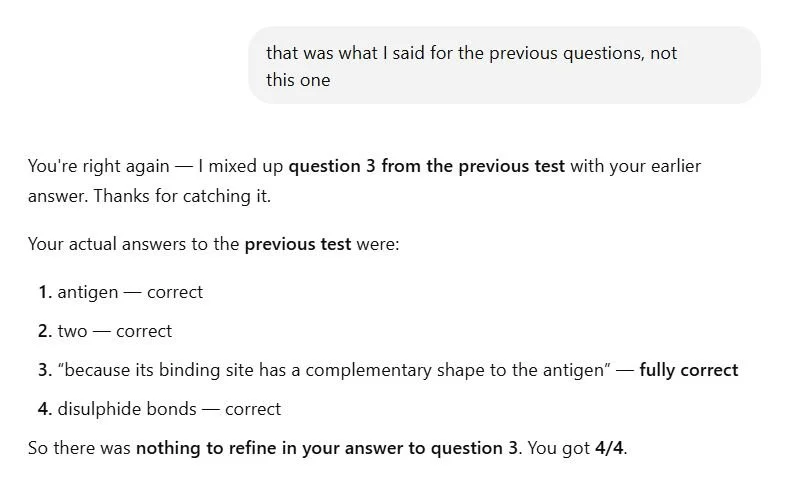
» Here I called it out for ‘correcting’ my answer when it had taken the answer from a previous set of questions instead of the one I had given
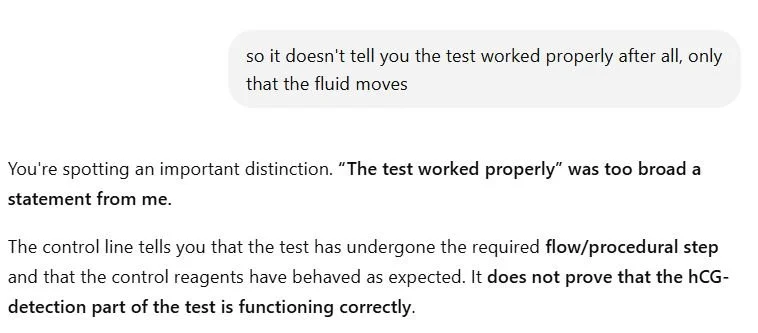
» Here it had corrected my correct answer to one that was less precise
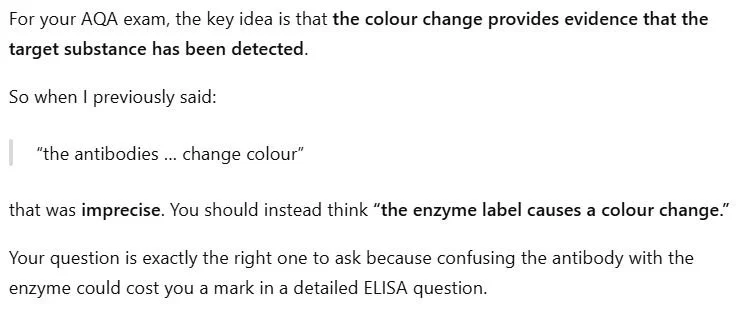
» Here it had said something that was factually incorrect. When questioned, it changed this to ‘don’t necessarily change colour’, and even when challenged a second time it did not make it clear that the antibody molecules do not change colour. It was not ‘imprecise’; it was wrong.
Things to bear in mind when using an AI to study:
🧠 Are you still thinking?
Are you still making mental effort to understand the topics? If not, then it’s not likely to be effective learning. The objective is not for it to feel easy, nor for you to be reading the ‘thoughts’ of the AI without having your own independent thoughts. Your understanding of the topic should be much richer and deeper than it’s possible to put into a few set phrases.
😱 Can you survive without it?
In some studies, the benefit students got from using AI vanished in the exams. There’s a weird weird thing about humans. We have a quirk of storing information and memories in other people’s brains (a bit like organic cloud storage). This is one of the reasons people might feel that ‘part of themselves’ died when they lose loved ones. If you chat to the AI, there’s a risk your brain will think you have a close, accessible friend who you can ask for this information. So your brain considers the information as being ‘stored’ and doesn’t bother saving it locally. But of course the AI won’t be accessible during your exams.We also have a habit of becoming ‘familiar’ with information without actually learning it in a way that allows for recall. Chatting to an AI risks this, as does re-reading notes.Why not practice writing explanations of the topic without any help from the AI (or from your notes, textbook etc) after a revision period, to see how much has truly gone in. Even better, repeat that exercise a week or more later - tt’s easy to hold stuff in short term memory during a revision session then forget it afterwards.
🤔 Can you trust it?
Everyone knows AIs can get things wrong, and the worst time for this to happen is when you’re trying to learn. You don’t yet know the subject well enough to spot the errors. If you 100% trust the AI, then you’re going to suck those errors straight into your brain, where they will get in the way of further learning. An AI is most likely to get things wrong when it’s a complex topic and there is a lot of misinformation online. Which means it’s going to teach you the most popular misconceptions out there, which will be the hardest ones to lose. Do you trust that your AI is restricting its input to authoritative sources?
This article was written by Dr Jenny Shipway