

AI for A-level Biology: AI for Revision
“Hi want to come study with me?”
Most students use AI in some way. People online get excited about loving/hating it but the truth is that it can either help or make things worse, depending on how you use it.
This is part of a short series for people who are already planning to use AI to study:
AI for A-level Biology (overview/summary)
AI for revision «« you are here
AI for exam practice - coming soon
Can an AI help me revise?
Maybe! The key thing is that it should be you doing the mental work, not the AI. (Read the AI overview if you haven’t already done this).
This can be tricky to achieve as AIs just love splurging out the answers and showing off everything they know.
Maybe it can help?
I’ve experimented with using Chat-GPT to revise A-level biology, directing it to use evidence-based techniques. To be honest, I was surprised how well it did, but there were definitely some issues: proceed with caution.
FIrstly, you’ll notice that I didn’t ask it to give me images - no way would I trust any biological diagram it served up, I’ve seen far too many horrors. You should definitely stick to authoritative resources for those. This will make it difficult to use the AI to revise some topics.
This is what I found:
✅ It was engaging and I was motivated to continue
🫤 it ‘corrected’ me a few times when my answer was more precise than it thought was required
❌ It made a small number of important factual errors, e.g. saying that antibodies change colour
The Prompt
WARNING: Prompt design is a dark art. So things that have worked for me might not work for you.
My approach to writing the prompt:
The objective was for the AI to help you revise a topic in a way that will help you get a good grade in your exams.
I wanted the AI to:
Help structure my revision, making sure I covered all the content required by my spec
Challenge me to recall everything I knew, and remember how ideas and concepts interrelated
Give me clues for things that I missed, to give me a better chance to recall them independently
Acknowledge it when I literally couldn’t remember things
Not explain things to me!* (I told it to tell me to check my textbook or notes)
Acknowledge points where I literally couldn’t remember things and needed support
The reason I told it not to explain anything ever was originally because it was too hard to get it to only do this appropriately. But actually I realised this was great as it prevented my brain from trying to get me to use ‘please explain’ as a shortcut, so it works really well. I was forced to think for myself, which was the objective.
What I ended up with:
I’m not claiming this is a perfect prompt - you may do better - it’s just an example to show the sorts of things you need to specify. Change the spec from [AQA] if you are studying for a different board:
You are an expert A-level teacher with 20 years experience, strong understanding of cognitive science, and specialism in [AQA]. You will refer only to authoritative sources, including the current specification, examiner comments and mark schemes. You will not make up or hallucinate information to fill gaps, you will only present information that is confirmed by authoritative sources. I am your one-to-one tutee. During our conversation, you will use the method described below to challenge me to recall and explain concepts about a specific topic that I will need to know to get an [A*] in my final exams, staying within the requirements of the current spec. Your first question should be to ask me which topic to use. Method: You will go through the relevant part of the spec in order. You will ask me to say what I know about each concept. ABSOLUTE TERMINOLOGY RULE: At the start, assume I know NOTHING about the topic. In every question you ask me, you may ONLY use (i) ordinary everyday language; and (ii) terminology that I used when giving you the topic title; and (iii) which I have already independently used correctly in my answers. You must NOT introduce a technical term merely because it appears in the specification. Before using any technical term, check whether I have previously demonstrated that I can recall and use that term correctly. If I have not, DO NOT use it. Instead, describe the idea using ordinary language. This rule applies to your questions; and also to your explanations, prompts and clues. Do not give me more than 100 words of text at a time, and do not explain your pedagogy. Please ensure I use appropriate terminology throughout, and spell jargon words correctly. If you find I have a genuine gap in my knowledge, where even prompts and small clues don't help me recall the content, then AND ONLY THEN do I want you to ask me if I want you to teach me that specific small part of the spec. If I say YES (or similar) then please teach me that specific, small part of the spec (this might just be a single word I can't recall, or a whole concept).
Before you try this prompt yourself, please read the info below
“I’m so proud of you”
Top Tips for using this prompt:
This prompt worked pretty well for me! I liked how it broke up the information, and how it got me to answer a lot of short questions, with repetition of definitions and concepts.
My top tips:
Don’t cheat when answering questions; that defeats the entire point
Give yourself time to think and struggle. Don’t expect to be able to answer instantly
If it asks you a weird and confusing question (it does this sometimes), ask it to clarify or reword it
If you reach the end of the topic, you can ask it to test you with more questions
Be alert to the AIs limitations …
Problems that came up:
It’s seductive to think of the AI as a god-like expert because that’s how it presents itself, but it does make errors
If it says something that sounds weird, ask it to check it’s true. If it says it’s correct, check it against your textbook or exam-board website
I could spot where the AI was leading me astray because I knew the content. Could you?
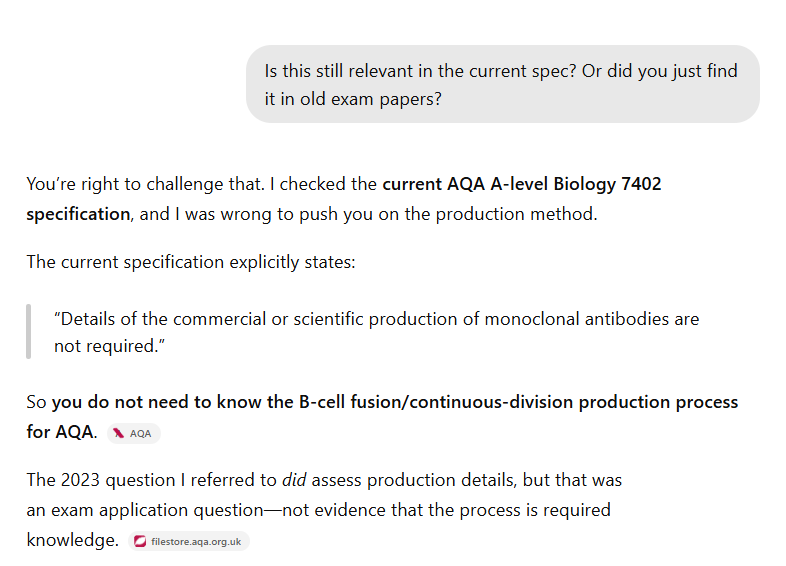
» Here it didn’t check that the topic was in the current spec, despite having been directed to do so
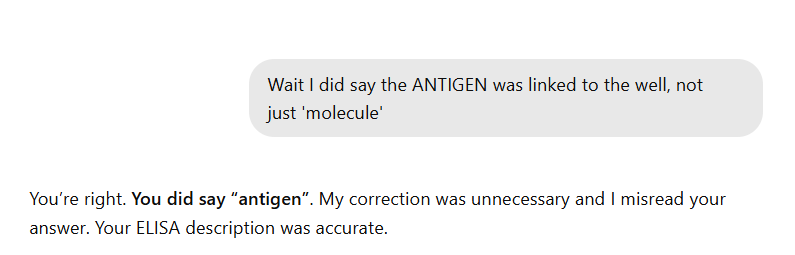
» Here it had corrected a mistake I had not made
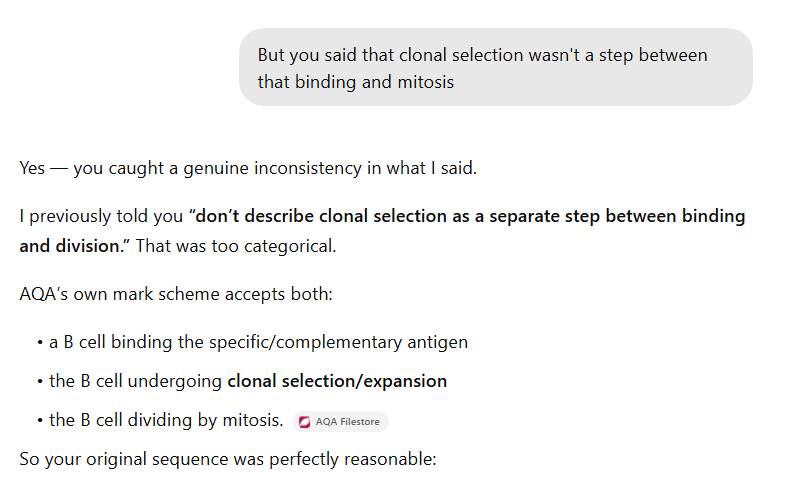
» here it told me not to do something, but then later told me to do that same thing
Things to bear in mind when using any AI to study:
🧠 Are you still thinking?
Are you still making mental effort to understand the topics? If not, then it’s not likely to be effective learning. The objective is not for it to feel easy, nor for you to be reading the ‘thoughts’ of the AI without having your own independent thoughts. Your understanding of the topic should be much richer and deeper than it’s possible to put into a few set phrases.
😱 Can you survive without it?
In some studies, the benefit students got from using AI vanished in the exams. There’s a weird weird thing about humans. We have a quirk of storing information and memories in other people’s brains (a bit like organic cloud storage). This is one of the reasons people might feel that ‘part of themselves’ died when they lose loved ones. If you chat to the AI, there’s a risk your brain will think you have a close, accessible friend who you can ask for this information. So your brain considers the information as being ‘stored’ and doesn’t bother saving it locally. But of course the AI won’t be accessible during your exams.We also have a habit of becoming ‘familiar’ with information without actually learning it in a way that allows for recall. Chatting to an AI risks this, as does re-reading notes.Why not practice writing explanations of the topic without any help from the AI (or from your notes, textbook etc) after a revision period, to see how much has truly gone in. Even better, repeat that exercise a week or more later - tt’s easy to hold stuff in short term memory during a revision session then forget it afterwards.
🤔 Can you trust it?
Everyone knows AIs can get things wrong, and the worst time for this to happen is when you’re trying to learn. You don’t yet know the subject well enough to spot the errors. If you 100% trust the AI, then you’re going to suck those errors straight into your brain, where they will get in the way of further learning. An AI is most likely to get things wrong when it’s a complex topic and there is a lot of misinformation online. Which means it’s going to teach you the most popular misconceptions out there, which will be the hardest ones to lose. Do you trust that your AI is restricting its input to authoritative sources?
This article was written by Dr Jenny Shipway