

Biological molecules is the longest spec point in Module 2, so it has two pages. My Carbohydrates page covers sugars, starch, glycogen, cellulose, the Benedict's and iodine tests and colorimetry. This page covers the rest of spec point 2.1.2: how hydrogen bonding gives water its properties, triglycerides and phospholipids, amino acids and peptide bonds, the four levels of protein structure, globular and fibrous proteins, the key inorganic ions, the biuret test and chromatography.
The examiners' reports show where the marks go. Students call the carboxyl group a hydroxyl group, forget that hydrolysing a triglyceride breaks three ester bonds, and say that hydrogen bonds explain the melting points of fats when the answer is kinked chains. They describe a membrane when the question asks them to explain how phospholipids form one, and they draw a general amino acid next to a figure instead of completing the R group they were given.
Work through the twenty questions below in order. They start with recall, move on to water, lipids and proteins in new contexts, and finish with practical questions on the biuret test, ions and chromatography. If you'd like to go through questions like these with me each week, my OCR A masterclasses run on Wednesdays at 5.15pm for Year 12 and on Tuesdays at 6.30pm or Thursdays at 5.15pm for Year 13.
What you need from GCSE
Each question on this page assumes you're secure on these GCSE ideas. If any of them feels shaky, look it up before you start.
- Proteins are made of amino acids, and lipids are made of fatty acids and glycerol.
- Digestive enzymes break large molecules into small ones: proteases make amino acids and lipases make fatty acids and glycerol.
- A protein's shape decides its function, and high temperature or extreme pH can denature it.
- The biuret test turns purple with protein, and the emulsion (ethanol) test goes cloudy white with lipid.
- Paper chromatography separates a mixture, and Rf = distance moved by the substance ÷ distance moved by the solvent.
Key terms
These words come up in the questions and mark schemes. Examiners expect you to use them exactly.
- Hydrogen bond: a weak attraction between the slightly positive hydrogen of one polar water molecule and the slightly negative oxygen of another.
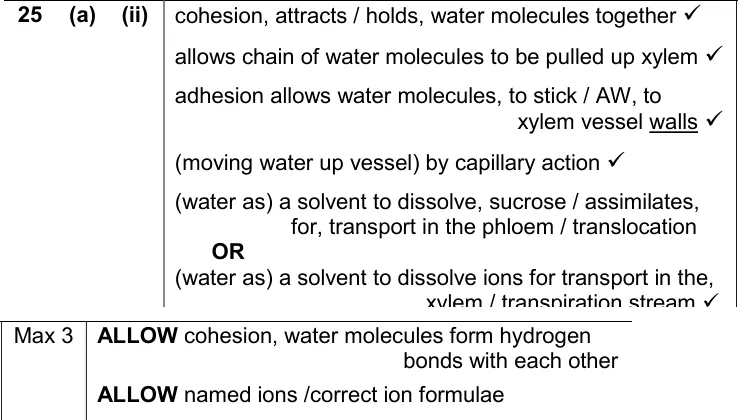
- Cohesion and adhesion: water molecules sticking to each other (cohesion) and to other surfaces such as xylem walls (adhesion).
- Triglyceride: one glycerol joined to three fatty acids by three ester bonds, made by three condensation reactions.
- Saturated and unsaturated: a saturated fatty acid has no C=C double bonds; an unsaturated one has at least one, which puts a kink in the chain (polyunsaturated means more than one).
- Phospholipid: glycerol joined to two fatty acids and a phosphate group: a hydrophilic head and two hydrophobic tails, which arrange themselves into a bilayer in water.
- Amino acid: a central carbon carrying an amine group (NH₂), a carboxyl group (COOH), a hydrogen atom and a variable R group.
- Peptide bond: the bond between two amino acids, formed by condensation and broken by hydrolysis.
- Levels of protein structure: primary (sequence of amino acids), secondary (α-helix and β-pleated sheet, held by hydrogen bonds), tertiary (3D folding, held by hydrogen, ionic and disulfide bonds and hydrophobic interactions), quaternary (more than one polypeptide).
- Conjugated protein: a protein with a non-protein prosthetic group, such as the haem groups in haemoglobin.
- Rf value: distance moved by the solute ÷ distance moved by the solvent front, measured from the origin.
What these questions cover (OCR 2.1.2, water, lipids, proteins and ions)
The questions test these learning outcomes from the OCR A Level Biology A specification (H420):
- (a) how hydrogen bonding occurs between water molecules (hydrogen bonding, and water as solvent, transport medium, coolant and habitat)
- (c) the chemical elements that make up biological molecules
- (h) the structure of a triglyceride and a phospholipid as examples of macromolecules (including saturated and unsaturated fatty acids)
- (i) the synthesis and breakdown of triglycerides by the formation and breakage of ester bonds between fatty acids and glycerol
- (j) how the properties of triglyceride, phospholipid and cholesterol molecules relate to their functions in living organisms
- (k) the general structure of an amino acid
- (l) the synthesis and breakdown of dipeptides and polypeptides, by the formation and breakage of peptide bonds
- (m) the levels of protein structure
- (n) the structure and function of globular proteins including a conjugated protein (haemoglobin as a conjugated protein, a named enzyme and insulin)
- (o) the properties and functions of fibrous proteins (collagen, keratin and elastin)
- (p) the key inorganic ions that are involved in biological processes (recognise the symbols of the key ions)
- (q) how to carry out and interpret the results of the following chemical tests (the biuret test is here; Benedict's and iodine tests are on the Carbohydrates page)
- (s)(i) the principles and uses of paper and thin layer chromatography to separate biological molecules / compounds (including calculating Rf values)
- (s)(ii) practical investigations to analyse biological solutions using paper or thin layer chromatography
How to use this page
Write your answer on paper before you open the mark scheme. Allow about 1.2 minutes per mark: the 20 questions are worth 41 marks, so about 49 minutes in total. Then mark your answer strictly against the mark scheme and read the examiners' tip underneath it. If you'd rather print the questions, download the PDF pack.
Recall
Question 1
AS Paper 2 · June 2024 · Q6(a)(i) · 2 marks · Easy
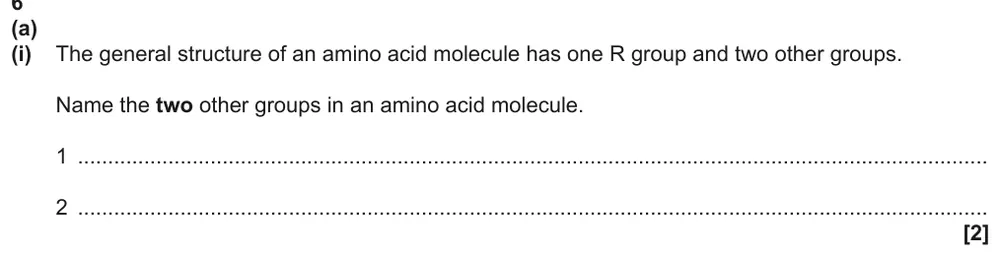
Name the two groups in an amino acid apart from the R group.
Show the mark scheme

Tap an image to open it full size.
From the examiners' report: Most scored both marks. The group at the end is the whole COOH, so call it carboxyl, not hydroxyl.
Question 2
AS Paper 2 · June 2024 · Q6(a)(iii) · 1 mark · Easy
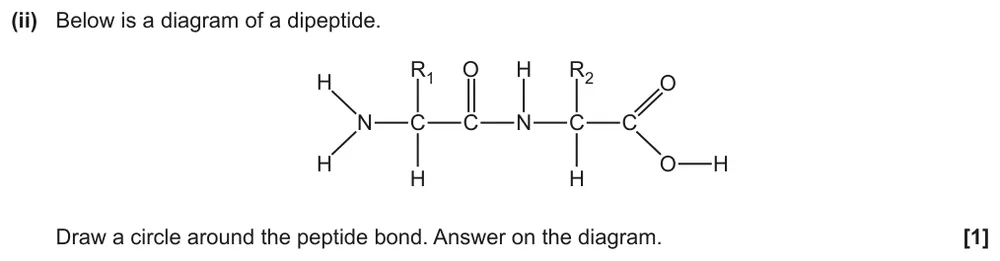
Name the type of reaction that breaks a peptide bond.
Information from earlier in this question:

Show the mark scheme

Tap an image to open it full size.
From the examiners' report: Most got this. Bonds are broken by hydrolysis and made by condensation, so don't swap them.
Question 3
A level Paper 2 · June 2018 · Q22(a) · 1 mark · Easy
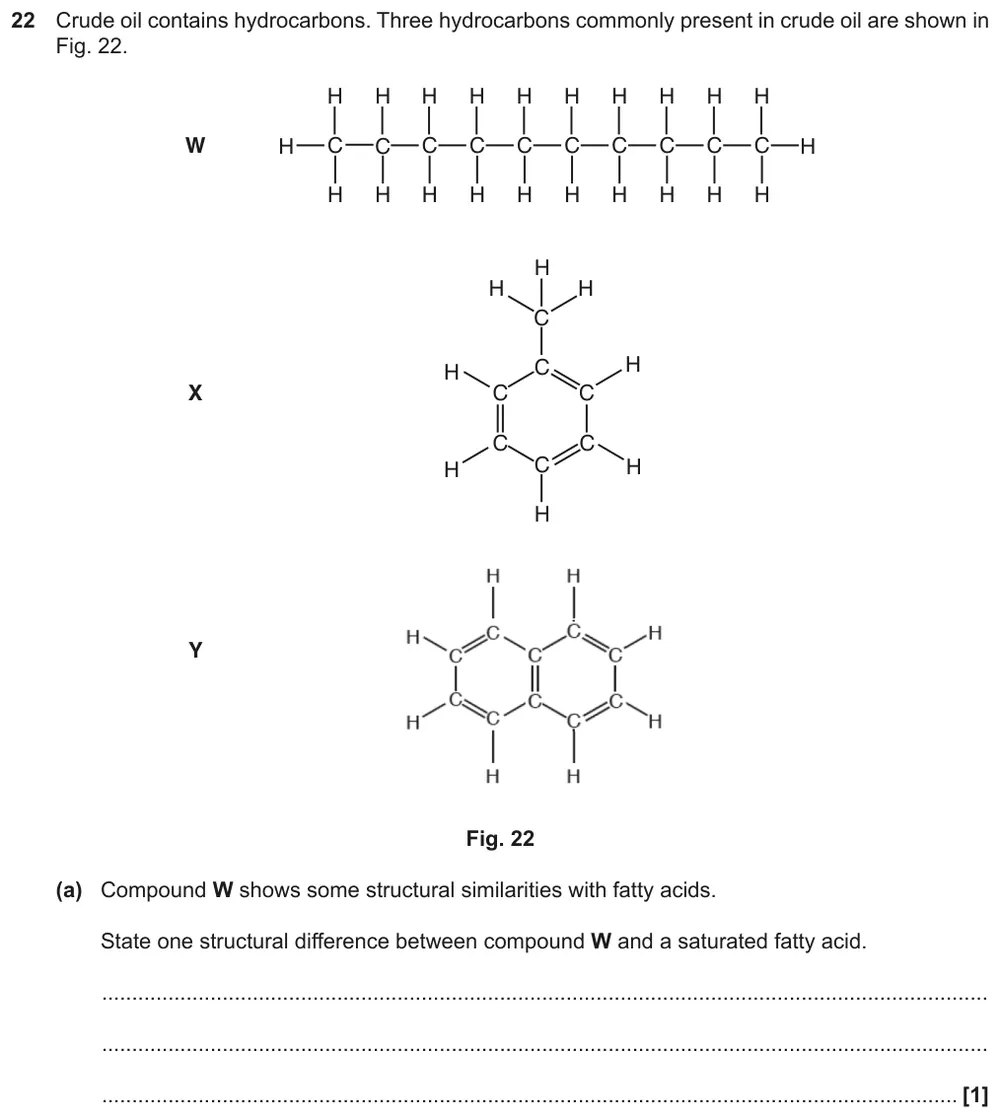
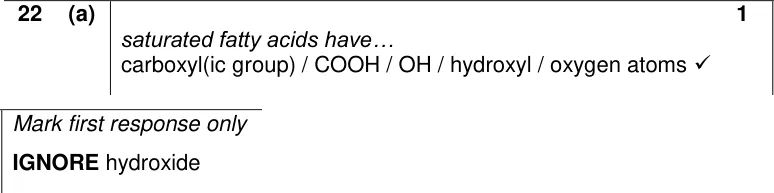
State one structural difference between a hydrocarbon and a saturated fatty acid.
Show the mark scheme
Tap an image to open it full size.
From the examiners' report: Fewer than half scored this easy mark. A fatty acid has a carboxyl group at one end; it has no double bonds if saturated, and no ester bond or glycerol on its own.
Question 4
AS Paper 2 · June 2018 · Q4(a)(i) · 2 marks · Medium
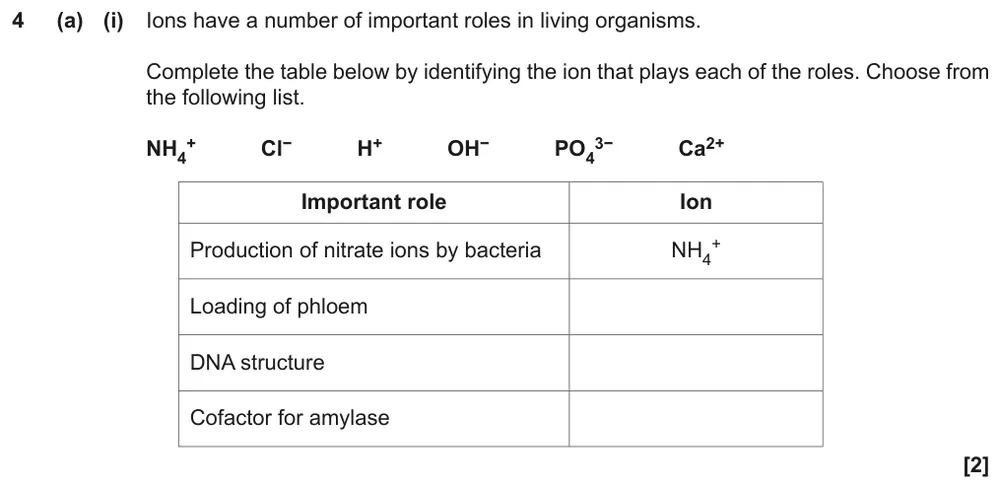
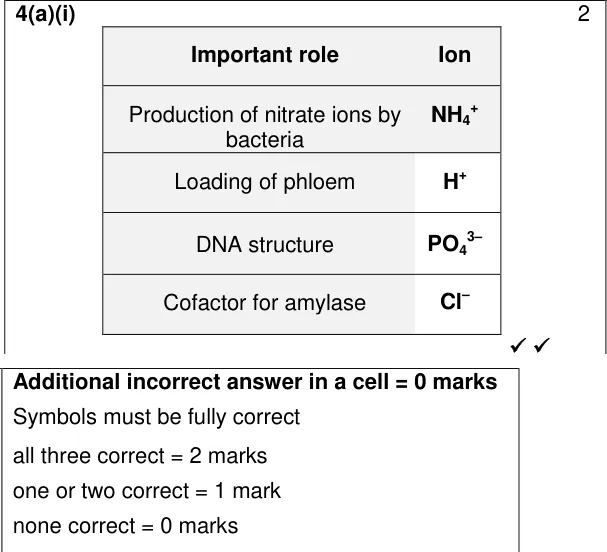
Match ions to their roles in organisms.
Show the mark scheme
Tap an image to open it full size.
From the examiners' report: Most got one or two. The least known was the chloride ion as the cofactor for amylase, and the symbols must be written exactly, charges included.
Applying what you know
Question 5
AS Paper 1 · June 2022 · Q25(a)(i) · 3 marks · Medium
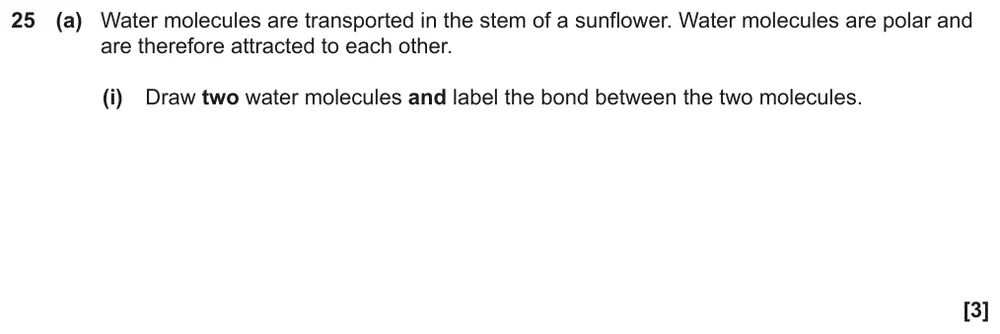
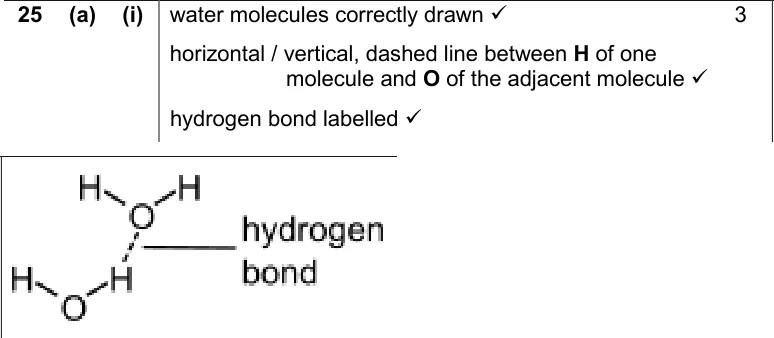
Draw two water molecules and label the bond between them.
Show the mark scheme
Tap an image to open it full size.
From the examiners' report: Most drew this well. Each water molecule is one oxygen and two hydrogens, and the hydrogen bond goes from H on one molecule to O on the other, never H to H.
Question 6
AS Paper 1 · June 2022 · Q25(a)(ii) · 3 marks · Hard
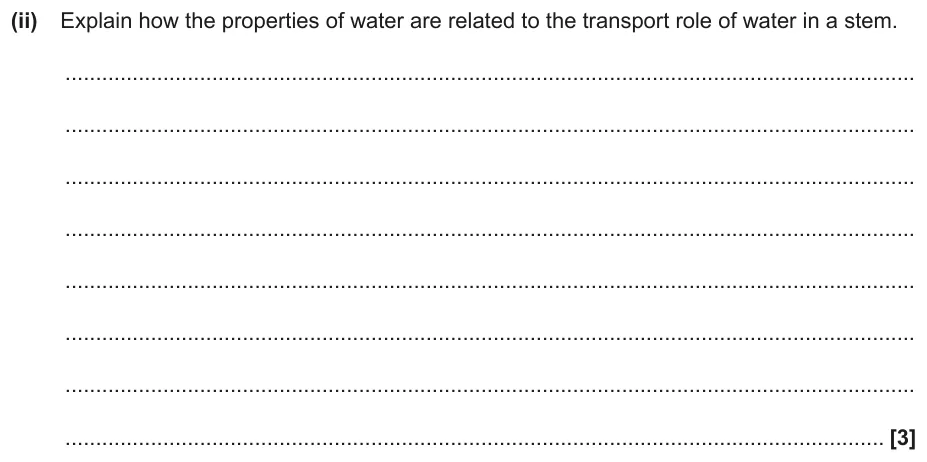
Explain how the properties of water relate to its transport role in a stem.
Show the mark scheme
Tap an image to open it full size.
From the examiners' report: Students knew cohesion and adhesion but used them loosely. Say water molecules stick to each other and to the xylem walls, and link each property to transport, not to heat capacity.
Question 7
AS Paper 1 · June 2018 · Q22(c)(i) · 3 marks · Medium
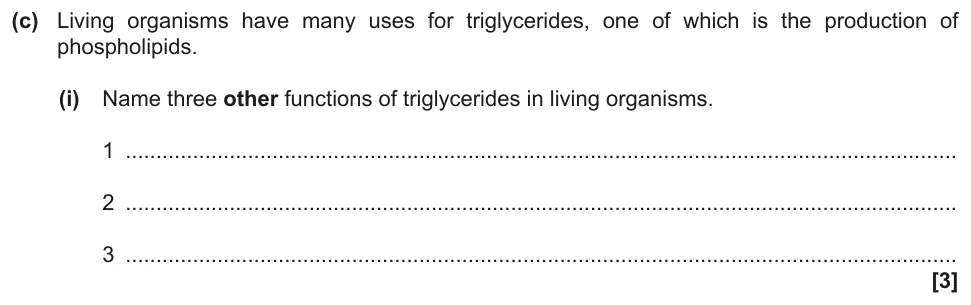
Name three functions of triglycerides other than making phospholipids.
Show the mark scheme
Tap an image to open it full size.
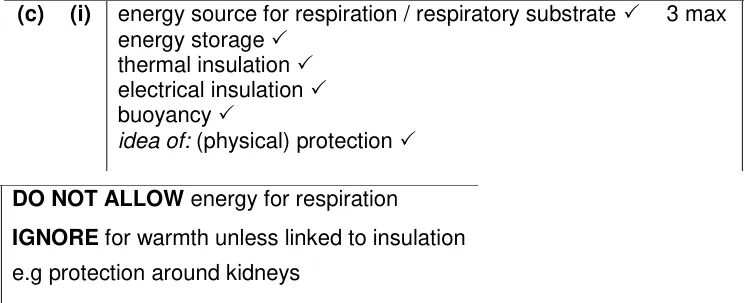
From the examiners' report: Most scored one or two. One-word answers rarely scored: say thermal or electrical insulation, and energy storage rather than just energy.
Question 8
AS Paper 1 · June 2018 · Q22(c)(ii) · 2 marks · Medium
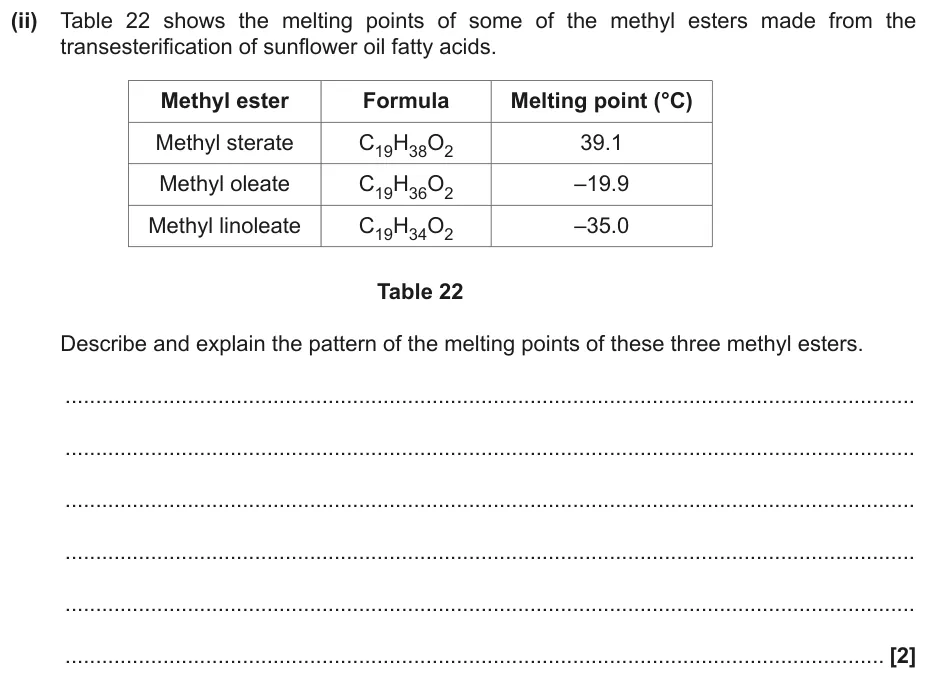
Describe and explain the pattern in the melting points of three methyl esters.
Show the mark scheme
Tap an image to open it full size.
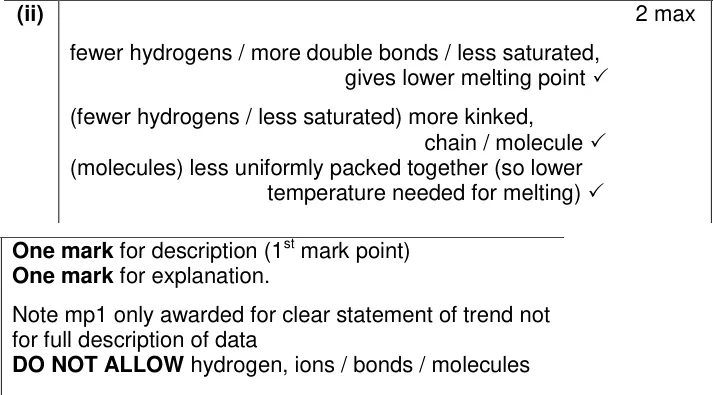
From the examiners' report: Spot the trend first: fewer hydrogens, lower melting point. Then explain it with double bonds that kink the chains so they pack loosely. Hydrogen bonds have nothing to do with it.
Question 9
AS Paper 2 · June 2022 · Q3(b)(i) · 1 mark · Medium
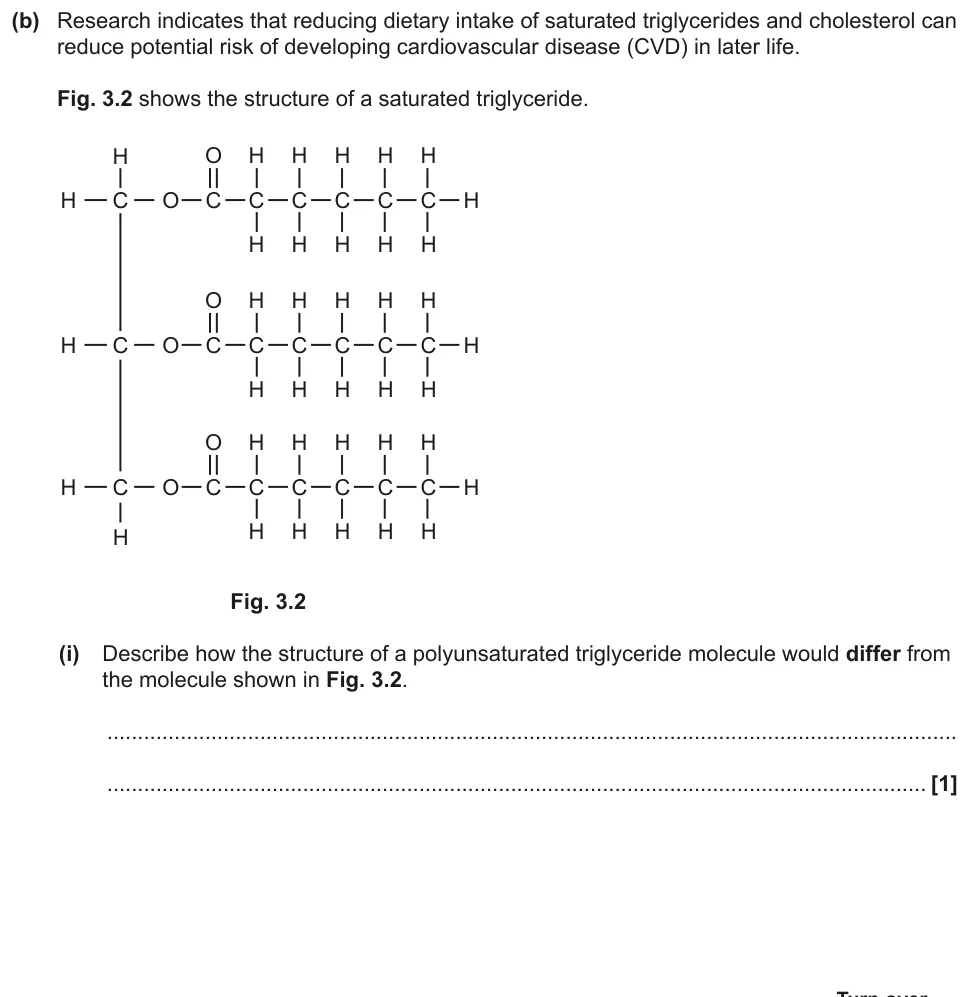
Describe how a polyunsaturated triglyceride differs from a saturated one.
Show the mark scheme
Tap an image to open it full size.
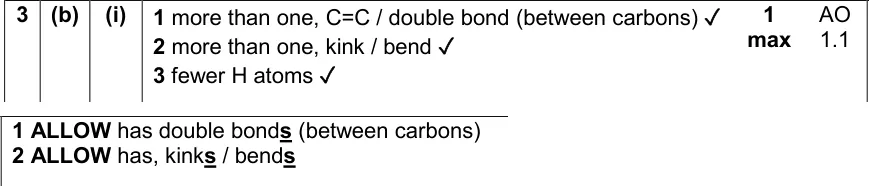
From the examiners' report: Most knew saturated versus unsaturated, but polyunsaturated means more than one C=C double bond. One double bond or one kink didn't score.
Question 10
A level Paper 2 · June 2019 · Q21(c) · 2 marks · Medium
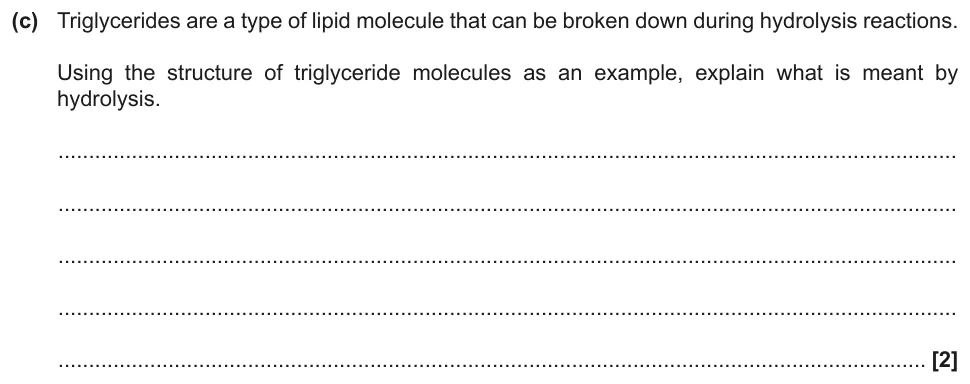
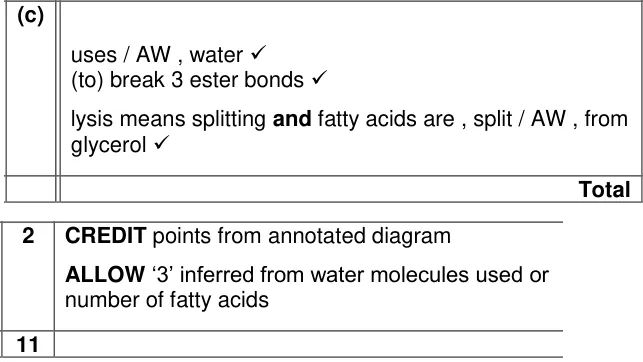
Use triglycerides to explain what hydrolysis means.
Show the mark scheme
Tap an image to open it full size.
From the examiners' report: Most got the water mark, but few said three ester bonds are broken. Name the bond correctly (not glycosidic or phosphodiester) and label any diagram you draw.
Question 11
A level Paper 2 · November 2021 · Q18(a) · 3 marks · Medium
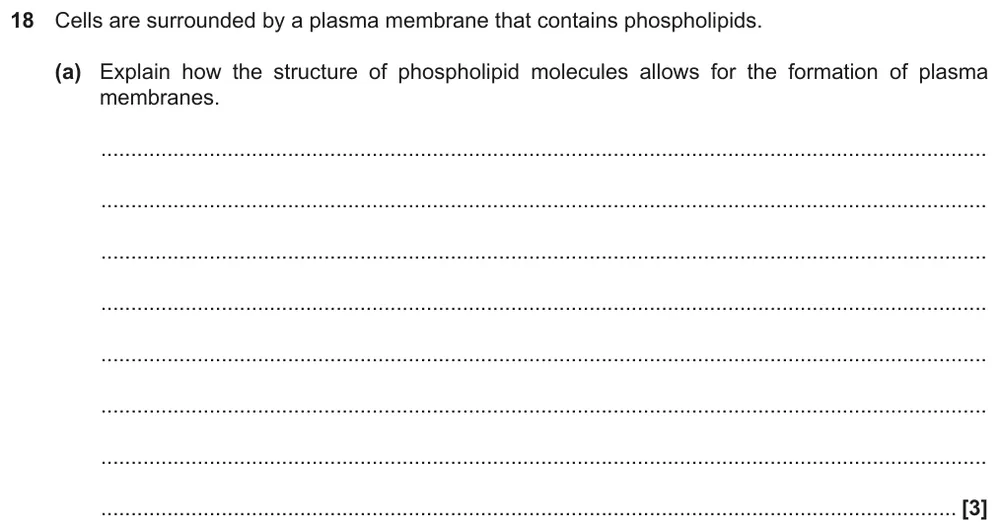
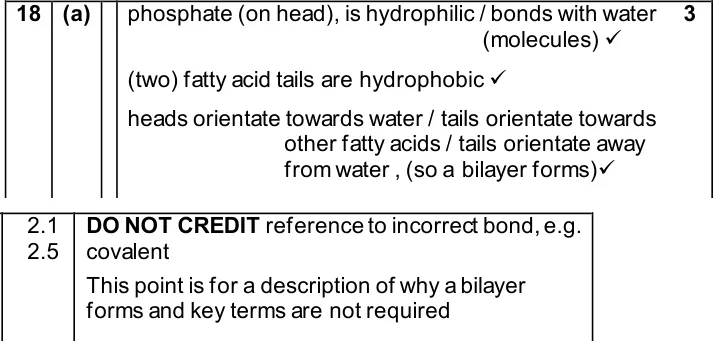
Explain how the structure of phospholipids lets them form plasma membranes.
Show the mark scheme
Tap an image to open it full size.
From the examiners' report: The command word is explain. Don't just describe the membrane; say which way the heads and tails face relative to the water inside and outside the cell.
Question 12
AS Paper 1 · June 2022 · Q21(a) · 3 marks · Hard
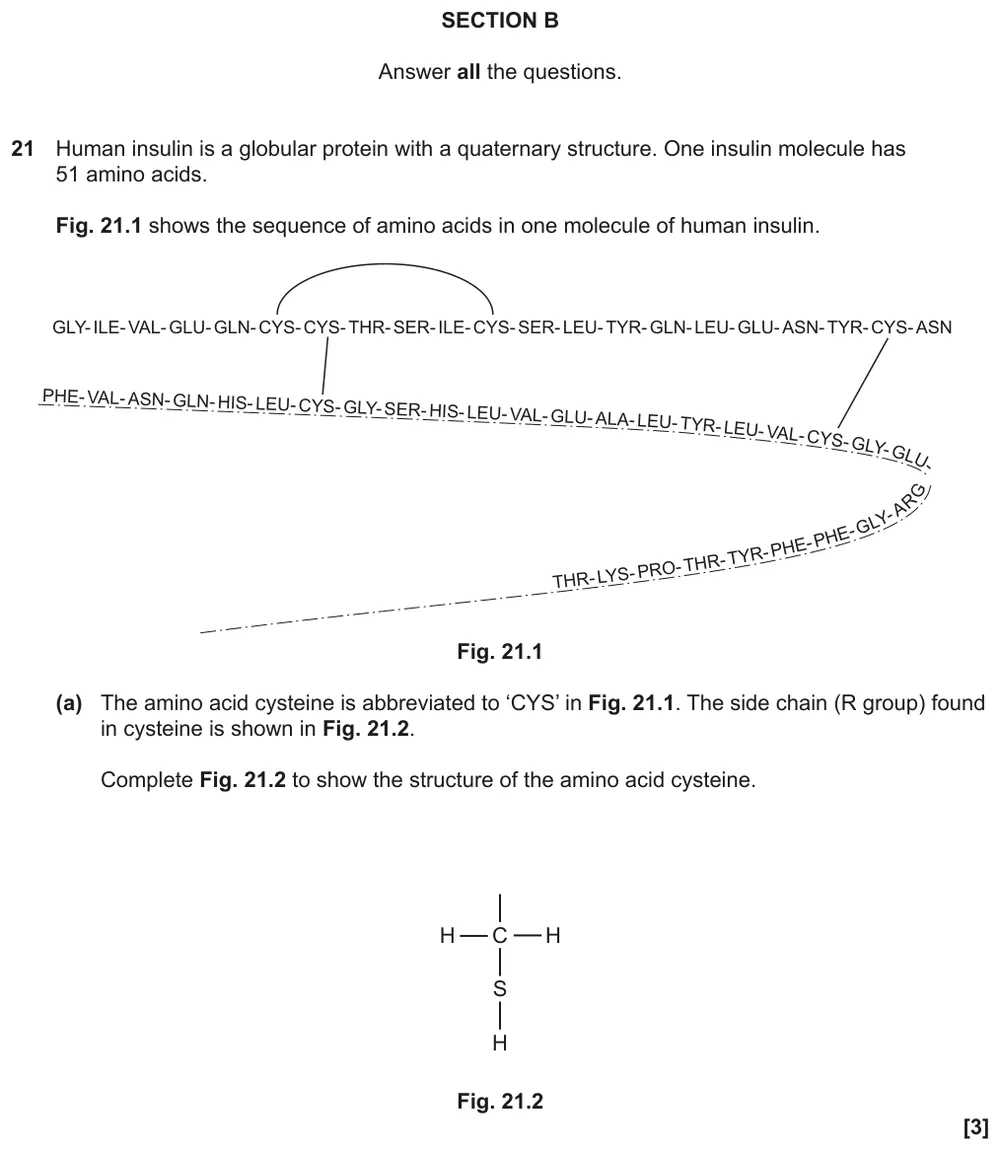
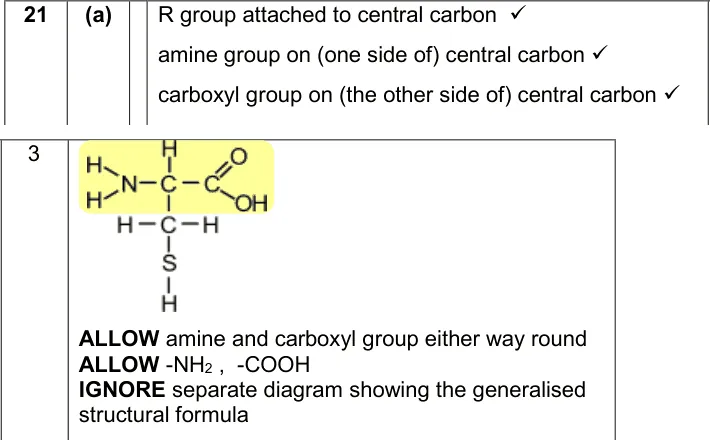
Complete the structure of cysteine from its R group.
Show the mark scheme
Tap an image to open it full size.
From the examiners' report: Many drew a general amino acid to the side and scored nothing. Complete the figure you are given: add a central carbon to the R group, then the amine and carboxyl groups.
Question 13
AS Paper 1 · June 2024 · Q24(a)(i) · 3 marks · Medium
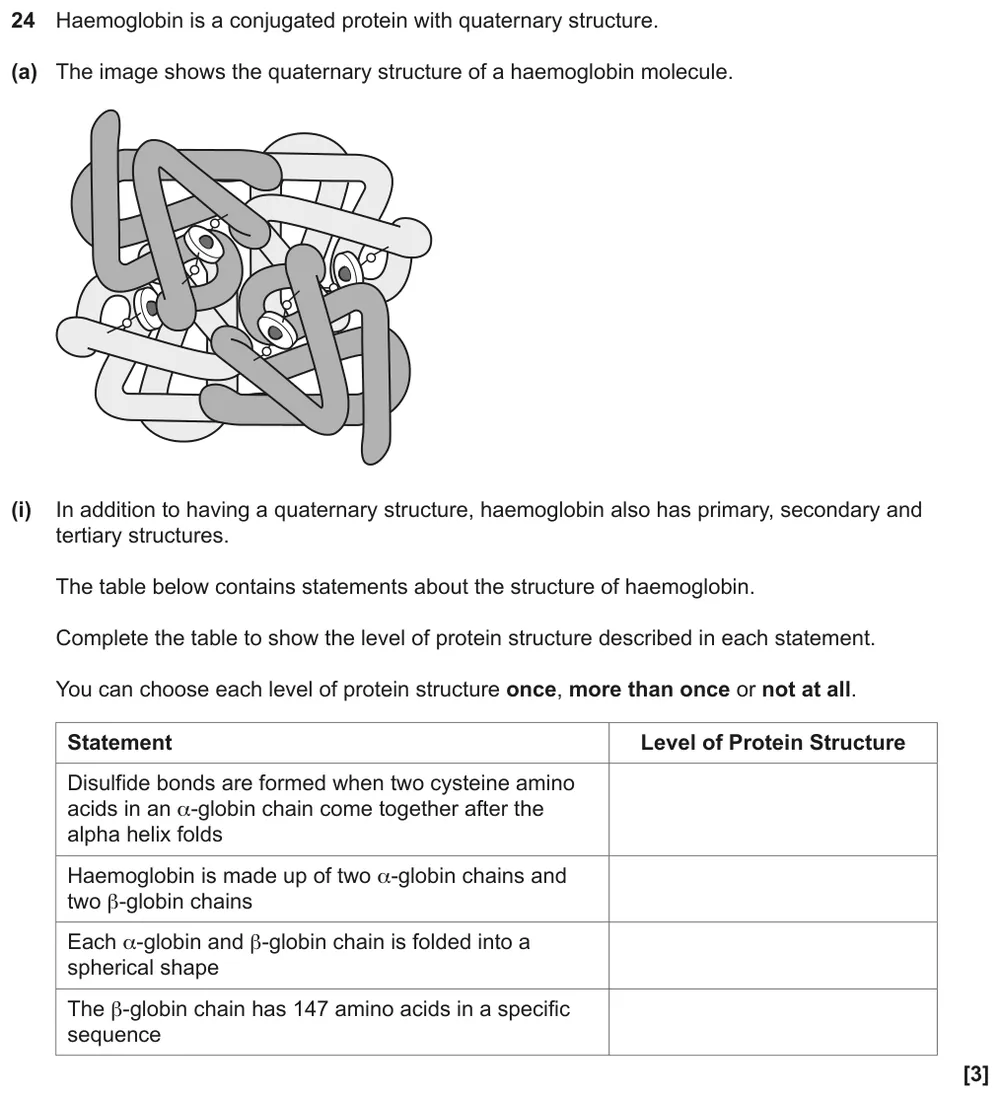
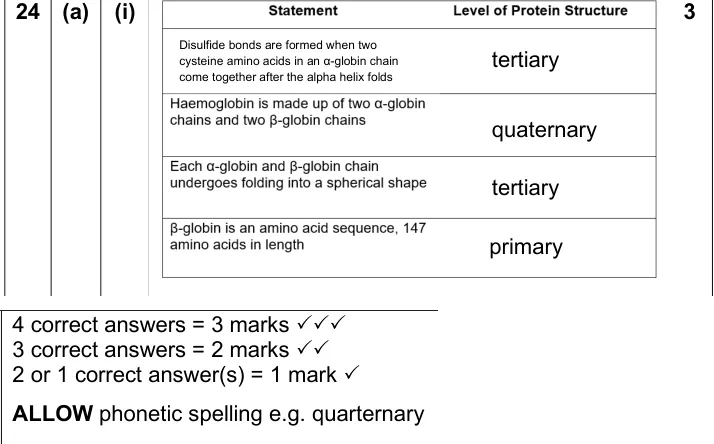
Match statements about haemoglobin to levels of protein structure.
Show the mark scheme
Tap an image to open it full size.
From the examiners' report: Write a level of structure in each box; you can use a level more than once, and you don't have to use them all. Disulfide bonds and folding are tertiary.
Question 14
A level Paper 2 · June 2022 · Q16(a)(iii) · 1 mark · Medium
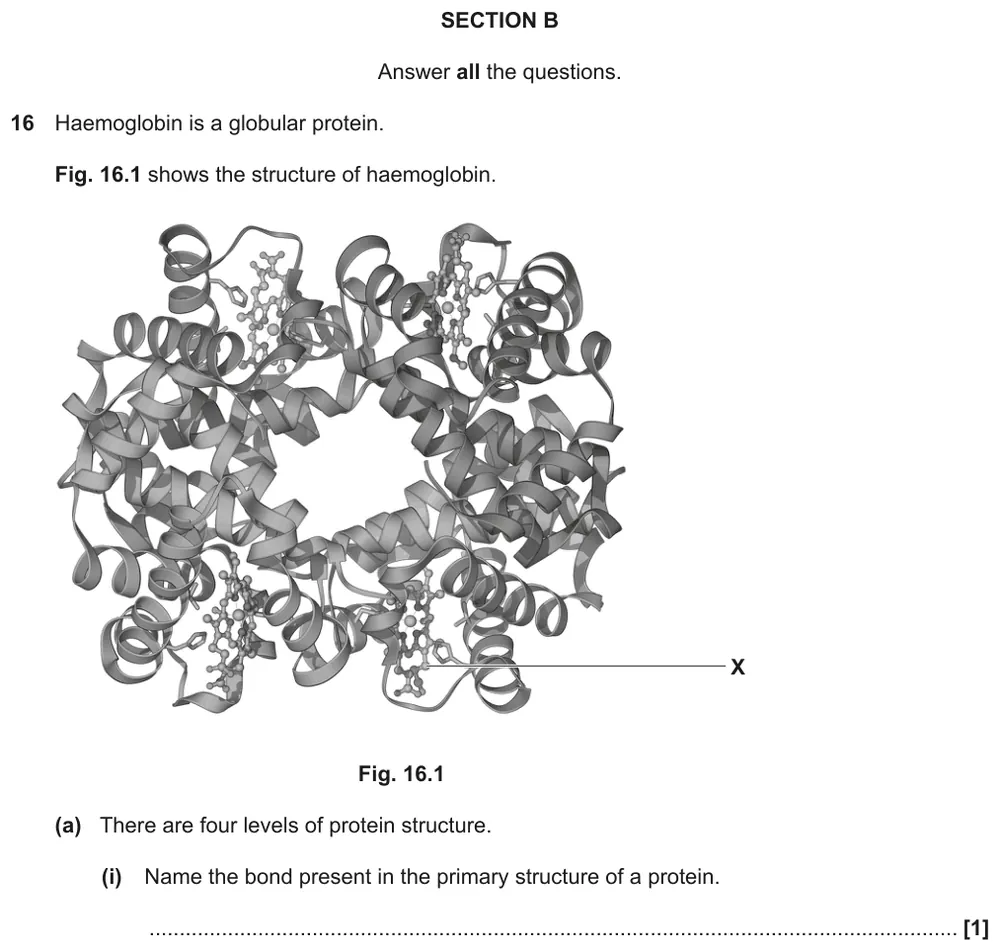
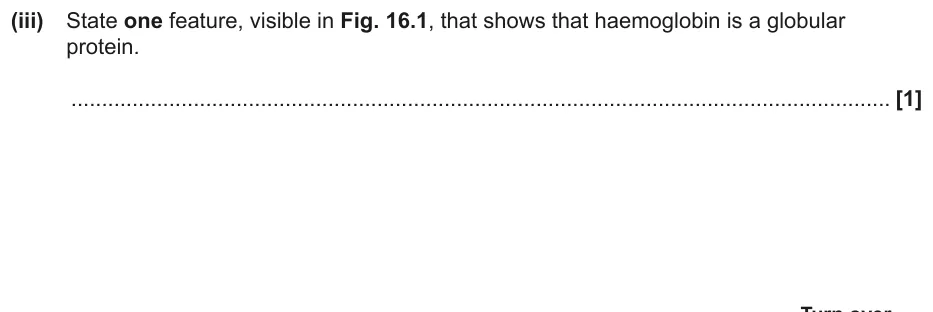
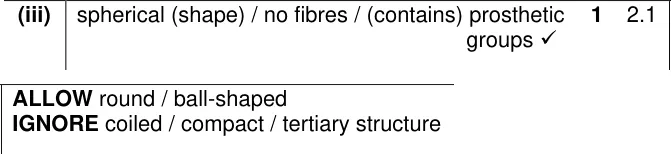
State a feature of a haemoglobin model that shows it is globular.
Information from earlier in this question:
Show the mark scheme
Tap an image to open it full size.
From the examiners' report: Over half scored, usually by describing the round shape. "Coiled" doesn't count, because fibrous proteins are coiled too.
Question 15
AS Paper 2 · June 2023 · Q5(b)(ii) · 2 marks · Medium
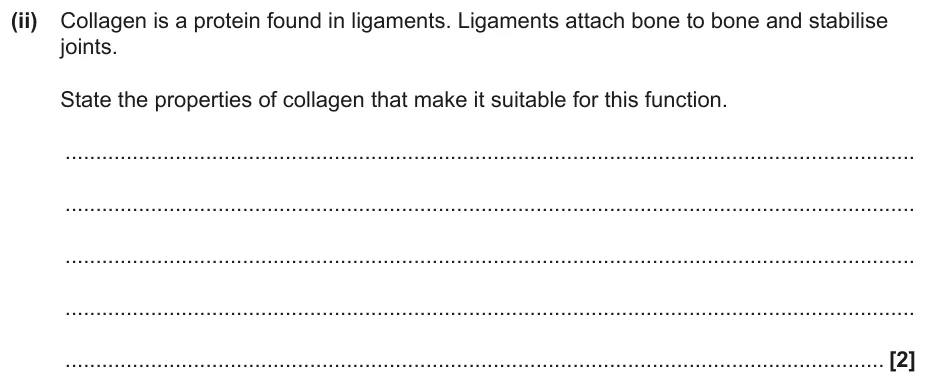
State the properties of collagen that suit it to ligaments.
Show the mark scheme

Tap an image to open it full size.
From the examiners' report: Say what kind of strength: high tensile strength, so it resists stretching. Collagen isn't elastic; that's elastin.
Question 16
A level Paper 2 · June 2022 · Q21(c)(iii) · 2 marks · Medium
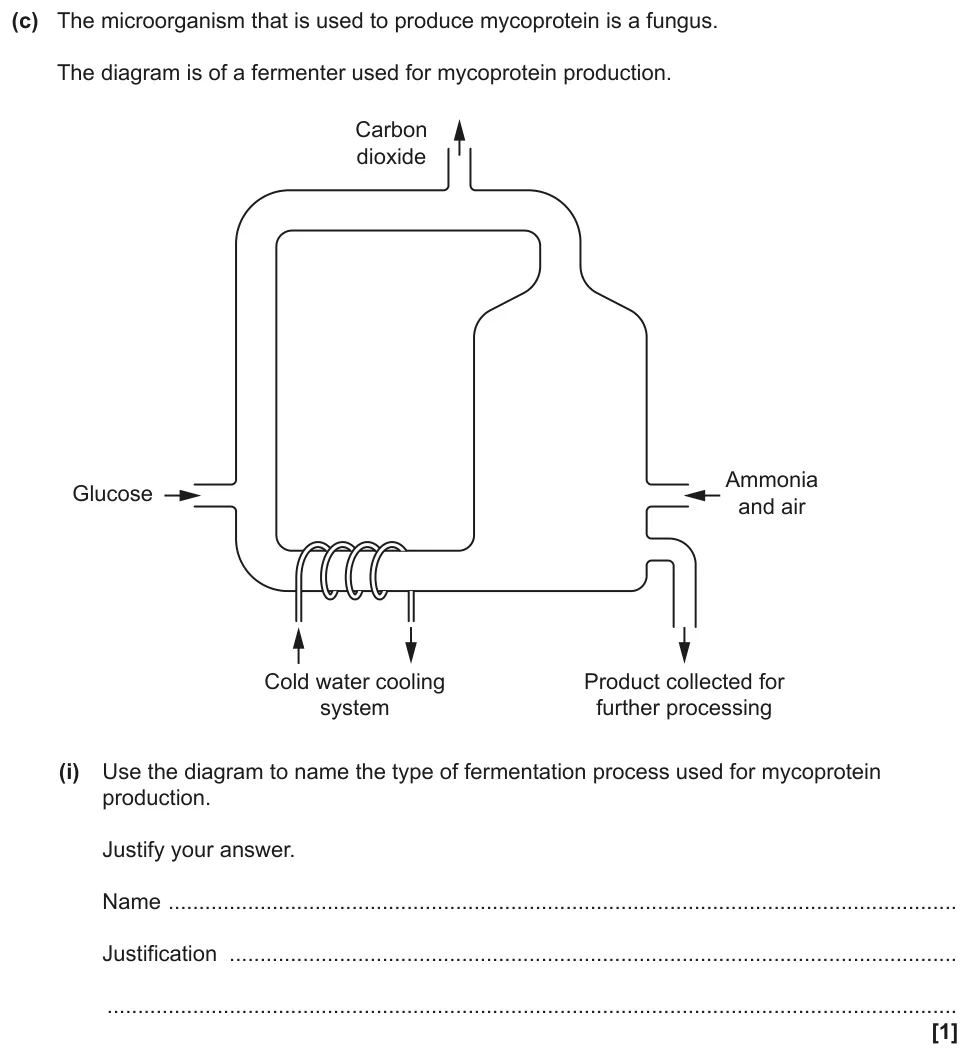
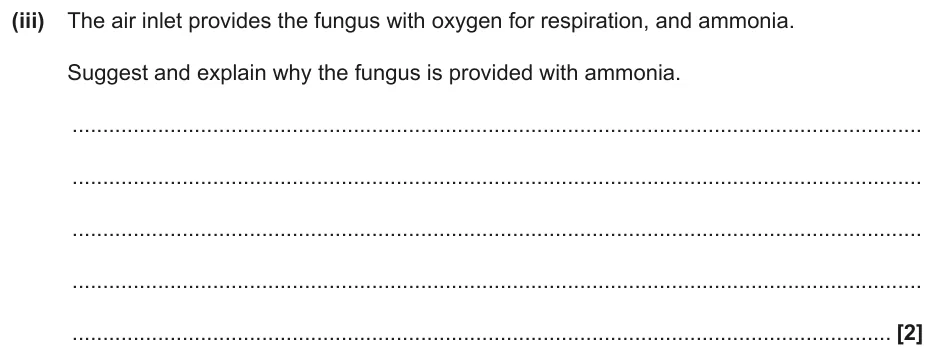
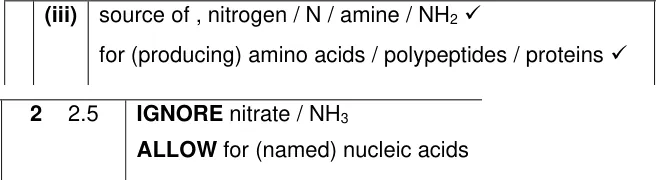
Explain why a fungus grown in a fermenter is supplied with ammonia.
Information from earlier in this question:
Show the mark scheme
Tap an image to open it full size.
From the examiners' report: Only those who saw ammonia as a nitrogen source scored, but they usually got both marks. Link the nitrogen to making amino acids and proteins, not to the nitrogen cycle or respiration.
Practical and maths
Question 17
AS Paper 2 · June 2023 · Q3(a)(i) · 1 mark · Medium
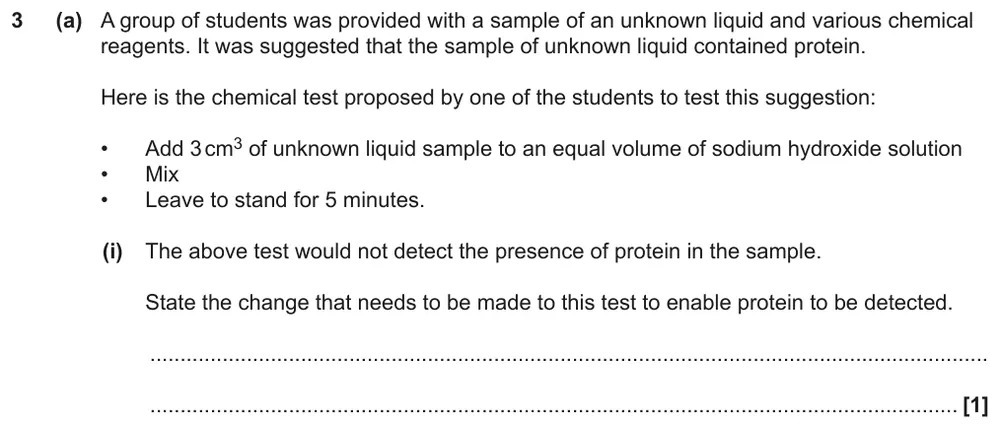
Correct a student's test for protein.
Show the mark scheme

Tap an image to open it full size.
From the examiners' report: Well answered, but spell biuret correctly so it can't be mistaken for burette, and don't use Benedict's reagent.
Question 18
AS Paper 2 · June 2023 · Q3(a)(ii) · 2 marks · Hard
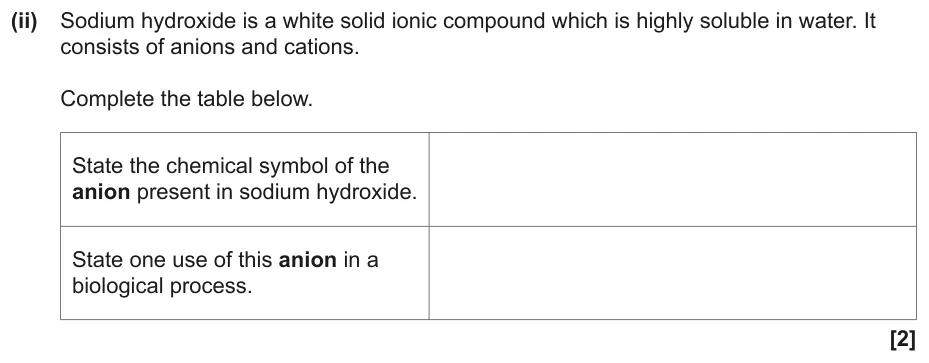
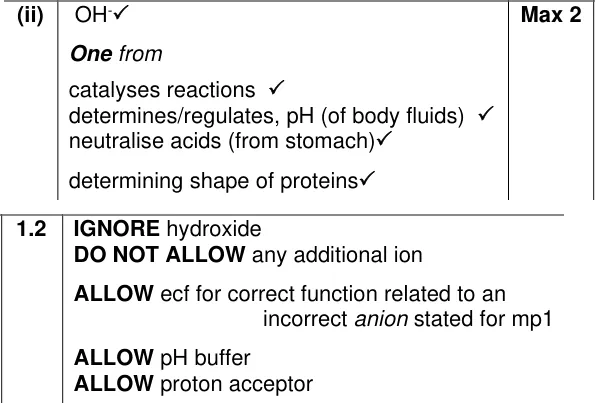
Give the symbol of the anion in sodium hydroxide and one biological use.
Show the mark scheme
Tap an image to open it full size.
From the examiners' report: Few named an anion. Write the symbol OH⁻, then a role linked to pH; it isn't the same as hydrolysis, which uses water.
Question 19
A level Paper 3 · June 2017 · Q1(a)(ii) · 1 mark · Medium
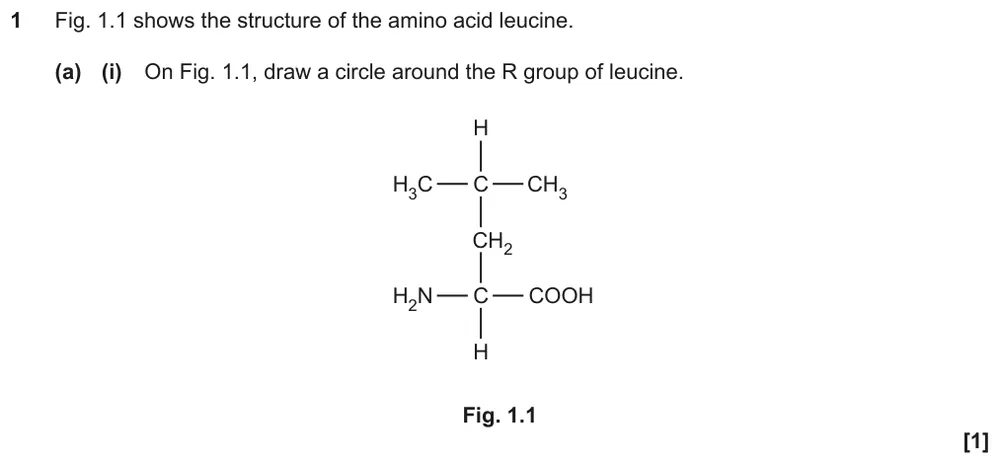
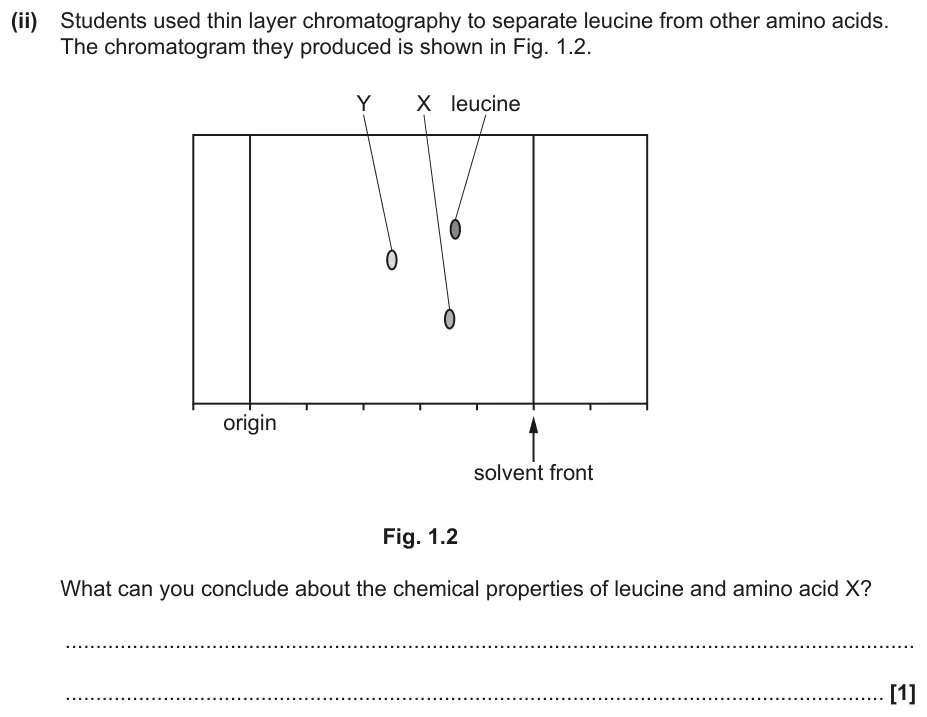
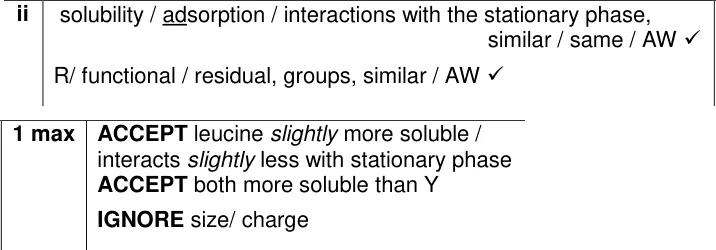
Conclude what a chromatogram shows about leucine and amino acid X.
Information from earlier in this question:
Show the mark scheme
Tap an image to open it full size.
From the examiners' report: "Similar chemical properties" or "similar Rf values" didn't score. Say they have similar solubility in the solvent, or similar R groups.
Question 20
A level Paper 3 · June 2017 · Q1(a)(iii) · 3 marks · Hard
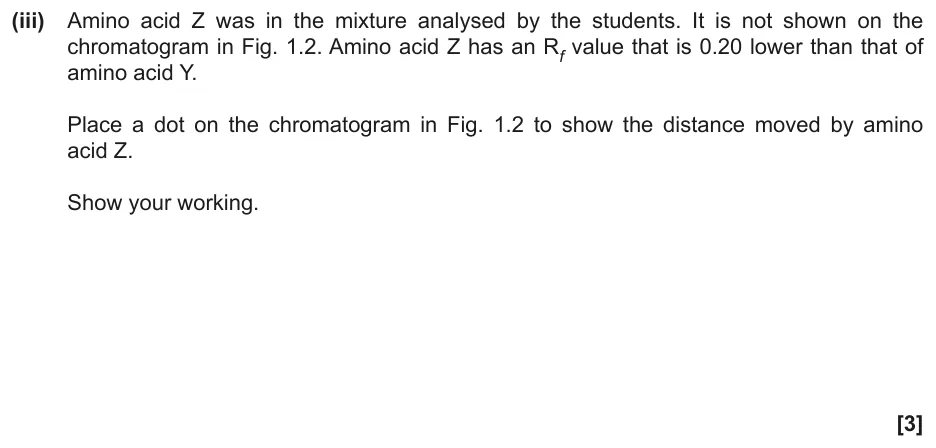
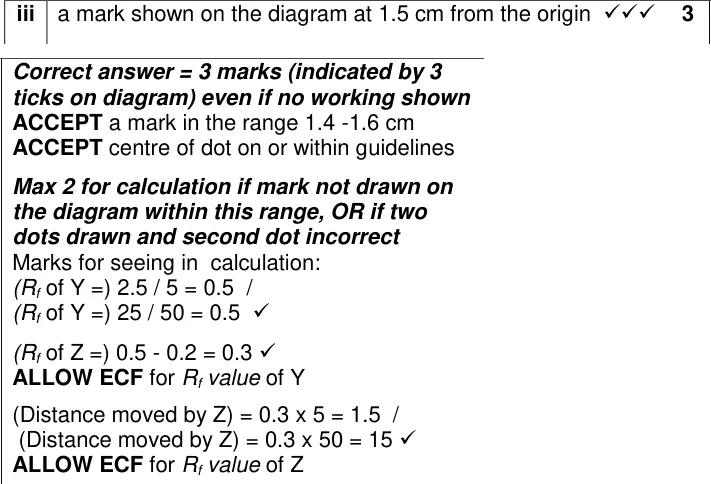
Plot where amino acid Z would be, from its Rf value.
Show the mark scheme
Tap an image to open it full size.
From the examiners' report: Measure Y and the solvent front carefully, subtract 0.2 from Y's Rf, then multiply by the solvent front distance to get the position. Don't just multiply 0.2 by 5.
Where students lose marks (from OCR examiners' reports and mark schemes)
Each point below is followed by wording that gained marks.
Call the COOH end carboxyl: Some students named the carboxyl group a hydroxyl group because of the OH in it.
✔ Gains credit: "amine; carboxyl" (carboxylic acid allowed).
Water molecules stick, to each other and to xylem: Answers mentioned cohesion and adhesion loosely, without saying water molecules, or wandered into heat capacity.
✔ Gains credit: "cohesion, holds water molecules together … adhesion allows water molecules to stick to xylem vessel walls".
One triglyceride, three ester bonds: Most students said water was used but very few said that three ester bonds are broken; some called them glycosidic.
✔ Gains credit: "uses water (to) break 3 ester bonds … fatty acids are split from glycerol".
Polyunsaturated means more than one C=C: Many students described a single double bond or a single kink.
✔ Gains credit: "more than one, kink / bend" or "fewer H atoms".
Kinked chains, not hydrogen bonds, lower the melting point: Many thought more hydrogen atoms meant more hydrogen bonds between the molecules.
✔ Gains credit: "more double bonds … more kinked chain … molecules less uniformly packed together".
Say thermal or electrical insulation: Single-word answers such as "insulation" or "energy" seldom scored.
✔ Gains credit: "energy storage; thermal insulation; electrical insulation; buoyancy".
Explain which way the heads face: Many described membrane structure instead of explaining why phospholipids form a bilayer.
✔ Gains credit: "phosphate head is hydrophilic … tails are hydrophobic … heads orientate towards water".
Build the amino acid onto the given R group: Many drew a general amino acid beside Fig. 21.2 instead of completing the cysteine side chain shown.
✔ Gains credit: "R group attached to central carbon; amine group … carboxyl group on central carbon".
Download the questions
Download the PDF pack (20 questions, mark schemes at the end)
Keep practising
- Biological Molecules quiz
- Amino Acids and Proteins quiz
- Lipids and Cholesterol quiz
- Water, Ions and Elements quiz
- Water, carbohydrates and lipids: interactive written questions (20)
- Proteins, ions, food tests and chromatography: interactive written questions (20)
- Carbohydrates (2.1.2): OCR A Level Biology exam questions by topic
- Biological Membranes (2.1.5): OCR A Level Biology exam questions by topic
- PAG 6 Chromatography and Electrophoresis: OCR A Level Biology exam questions by topic
- PAG 9 Qualitative Testing: OCR A Level Biology exam questions by topic
- OCR A Level Biology masterclasses
Questions, mark schemes and examiners' report extracts © OCR.