

Membranes hold every cell together, and spec point 2.1.5 asks a lot of them. You need to know the roles of membranes at the cell surface and inside cells, describe the fluid mosaic model and the job of each component, and explain how temperature and solvents change permeability. You also need diffusion, facilitated diffusion, active transport, endocytosis and exocytosis, and osmosis explained with water potential, plus the beetroot, model cell and plant tissue practicals.
The examiners' reports for these questions show the same slips again and again. Students write "water concentration" or "semi-permeable" in a definition of osmosis, say facilitated diffusion uses ATP, blame denatured proteins when the question asks about phospholipids, or describe a whole plant as turgid. Small changes in wording make the difference here.
Work through the eighteen questions below in order. They start with recall of membrane structure, move on to transport and osmosis in new contexts such as Paramecium and over-fertilised sunflowers, and finish with the practical and maths questions. If you'd like to practise questions like these with me each week, my OCR A masterclasses run on Wednesdays at 5.15pm for Year 12 and on Tuesdays at 6.30pm or Thursdays at 5.15pm for Year 13.
What you need from GCSE
Each question on this page assumes you're secure on these GCSE ideas. If any of them feels shaky, look it up before you start.
- The cell membrane controls what enters and leaves a cell.
- Diffusion is the net movement of particles from a higher to a lower concentration; it is faster with a bigger surface area, a steeper gradient, a shorter distance and a higher temperature.
- Osmosis is the movement of water across a partially permeable membrane; plant cells become turgid or plasmolysed and animal cells can burst or shrink.
- Active transport moves substances against a concentration gradient using energy from respiration.
- Percentage change in mass = change in mass ÷ starting mass × 100.
Key terms
These words come up in the questions and mark schemes. Examiners expect you to use them exactly.
- Phospholipid bilayer: two layers of phospholipids with hydrophilic phosphate heads facing the water on each side and hydrophobic fatty acid tails pointing inwards.
- Fluid mosaic model: phospholipids and proteins can move within the membrane (fluid), and proteins are scattered through the bilayer (mosaic).
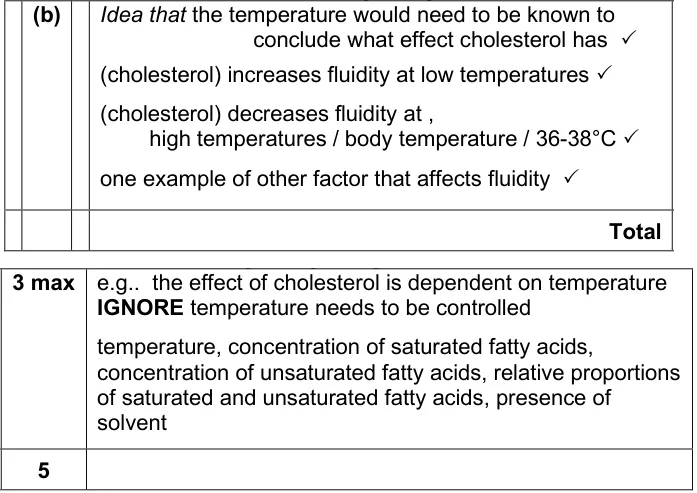
- Cholesterol: a lipid between the phospholipid tails that regulates fluidity: it makes the membrane less fluid at high temperatures and stops it becoming too rigid at low ones.
- Cell signalling: communication between cells, for example a hormone or drug binding to a complementary receptor on the cell surface membrane.
- Facilitated diffusion: passive movement of molecules down a concentration gradient through channel or carrier proteins.
- Active transport: movement of molecules or ions against a concentration gradient by carrier proteins, using ATP.
- Endocytosis and exocytosis: bulk transport into or out of a cell in vesicles; both need ATP.
- Water potential (ψ): the tendency of water to move; pure water has the highest value (0 kPa) and adding solutes makes it more negative.
- Osmosis: the net movement of water across a partially permeable membrane from a higher to a lower water potential.
- Turgor pressure: the pressure of the vacuole and cytoplasm pushing against the cell wall when a plant cell takes in water.
What these questions cover (OCR 2.1.5)
The questions test these learning outcomes from the OCR A Level Biology A specification (H420):
- (a) the roles of membranes within cells and at the surface of cells (barriers, sites of reactions and cell signalling)
- (b) the fluid mosaic model of membrane structure and the roles of its components (phospholipids, cholesterol, glycolipids, proteins and glycoproteins)
- (c)(i) factors affecting membrane structure and permeability (including temperature and solvents)
- (c)(ii) practical investigations into factors affecting membrane structure and permeability (PAG 5 and PAG 8 beetroot practicals)
- (d)(i) the movement of molecules across membranes (diffusion, facilitated diffusion, active transport, endocytosis and exocytosis)
- (d)(ii) practical investigations into the factors affecting diffusion rates in model cells (model cells such as dialysis tubing)
- (e)(i) the movement of water across membranes by osmosis and the effects that solutions of different water potential can have on plant and animal cells
- (e)(ii) practical investigations into the effects of solutions of different water potential on plant and animal cells (PAG 8 plant tissue in sucrose solutions)
How to use this page
Write your answer on paper before you open the mark scheme. Allow about 1.2 minutes per mark: the 18 questions are worth 42 marks, so about 50 minutes in total. Then mark your answer strictly against the mark scheme and read the examiners' tip underneath it. If you'd rather print the questions, download the PDF pack.
Membrane roles and structure
Question 1
AS Paper 1 · June 2023 · Q25(b) · 3 marks · Hard
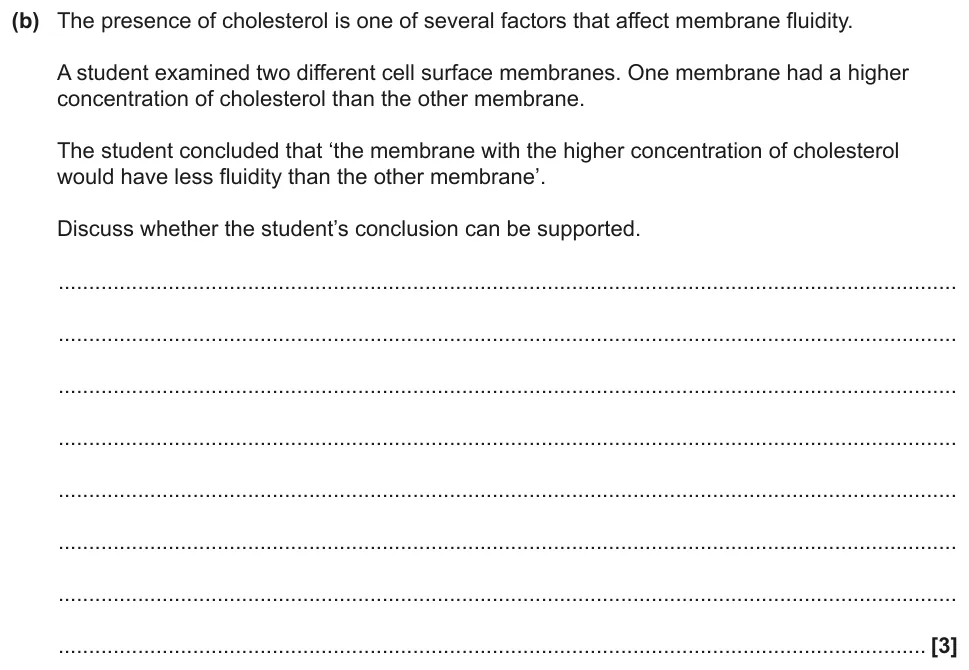
Discuss whether a membrane with more cholesterol is always less fluid.
Show the mark scheme
Tap an image to open it full size.
From the examiners' report: Very few students realised that cholesterol's effect depends on temperature. Don't just describe where cholesterol sits: say what it does to fluidity at low and at high temperatures.
Question 2
A level Paper 1 · June 2018 · Q17(c)(i) · 2 marks · Medium
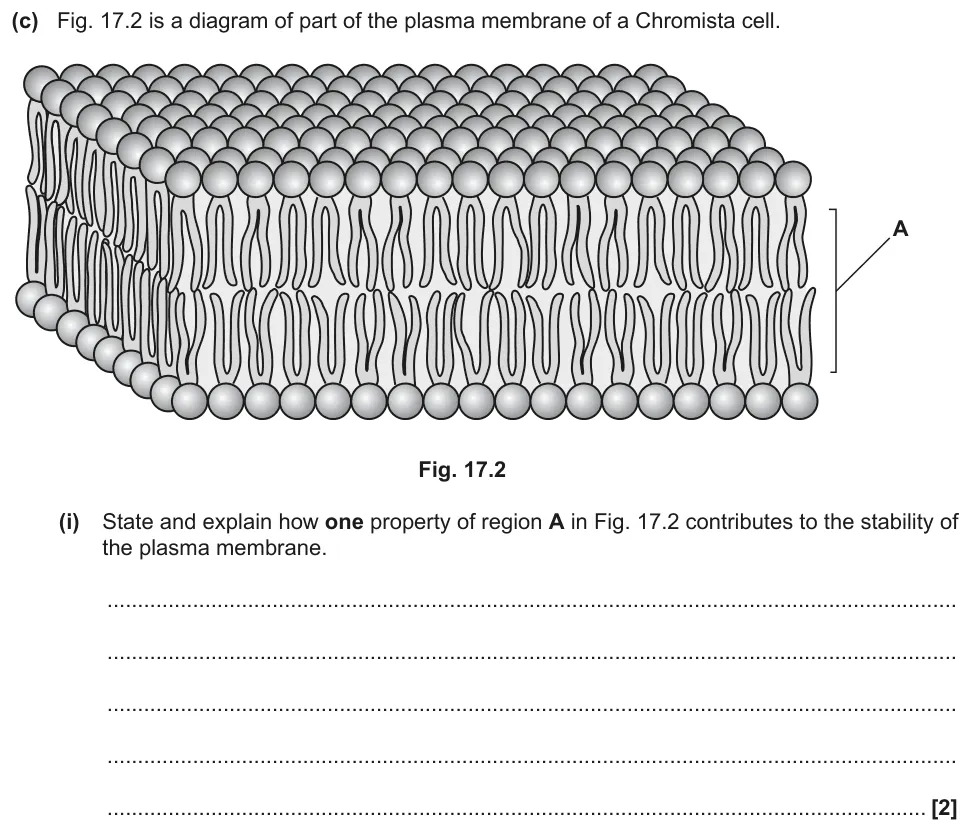
State and explain how one property of region A of a membrane helps keep it stable.
Show the mark scheme
Tap an image to open it full size.
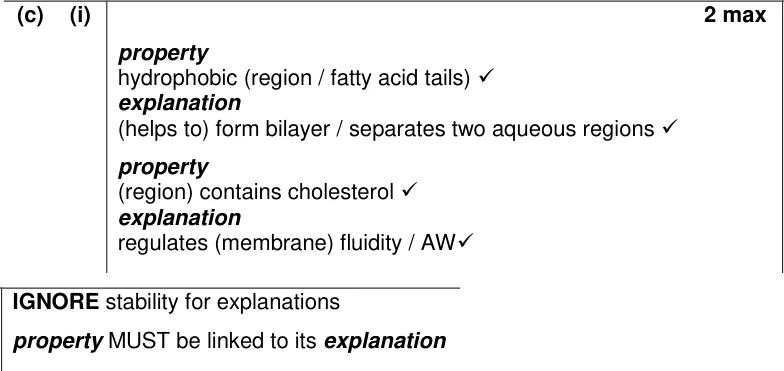
From the examiners' report: Look closely at the diagram: region A is the tail region, not the whole bilayer. State its property (hydrophobic) and then link it to how the bilayer forms.
Question 3
A level Paper 1 · June 2018 · Q17(c)(ii) · 2 marks · Medium
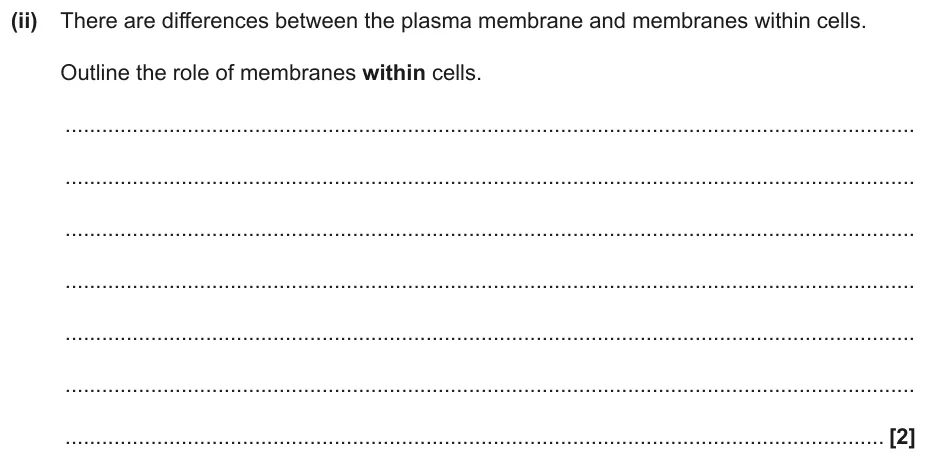
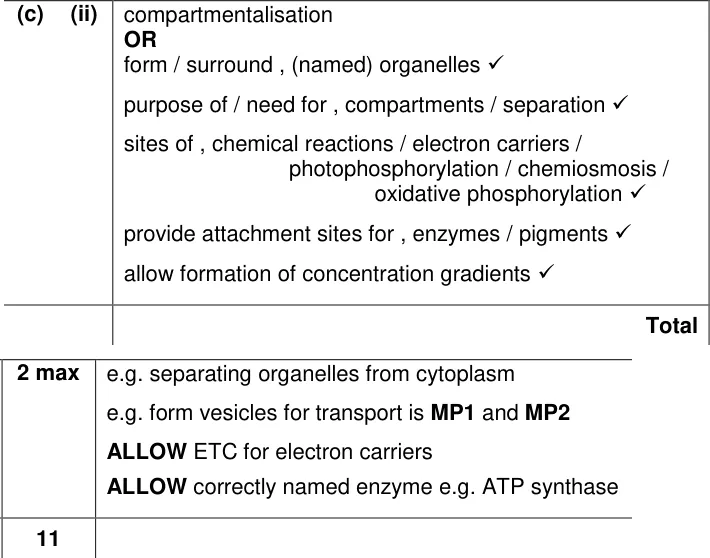
Outline the role of membranes within cells.
Show the mark scheme
Tap an image to open it full size.
From the examiners' report: Keep to membranes inside the cell. Compartmentalisation scored well; answers about the cell surface membrane didn't.
Question 4
A level Paper 1 · June 2023 · Q20(c)(ii) · 2 marks · Medium
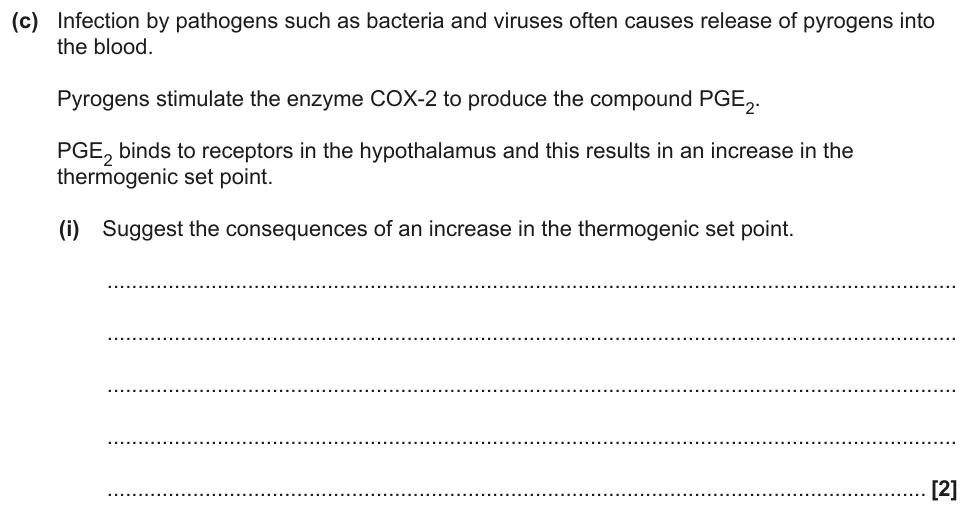
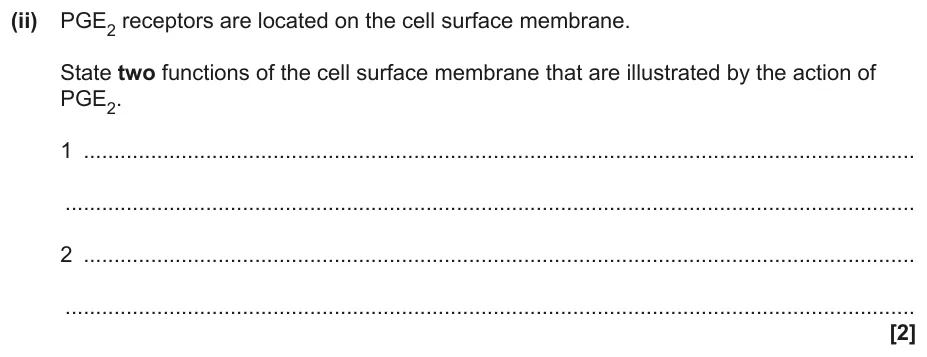
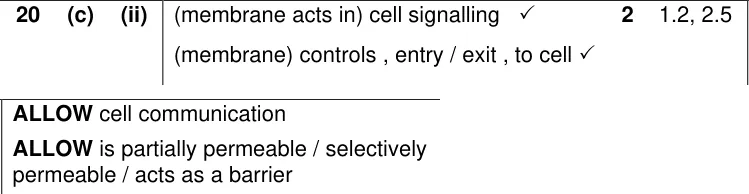
State two functions of the cell surface membrane shown by the action of PGE2 on its receptors.
Information from earlier in this question:
Show the mark scheme
Tap an image to open it full size.
From the examiners' report: Good answers spotted both functions in the stem: cell signalling and controlling what enters and leaves the cell.
Moving substances across membranes
Question 5
AS Paper 2 · June 2025 · Q2(b) · 2 marks · Easy
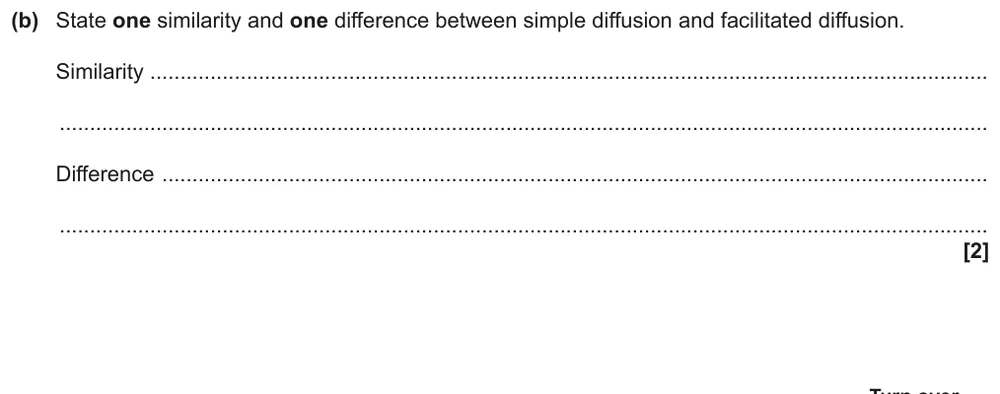
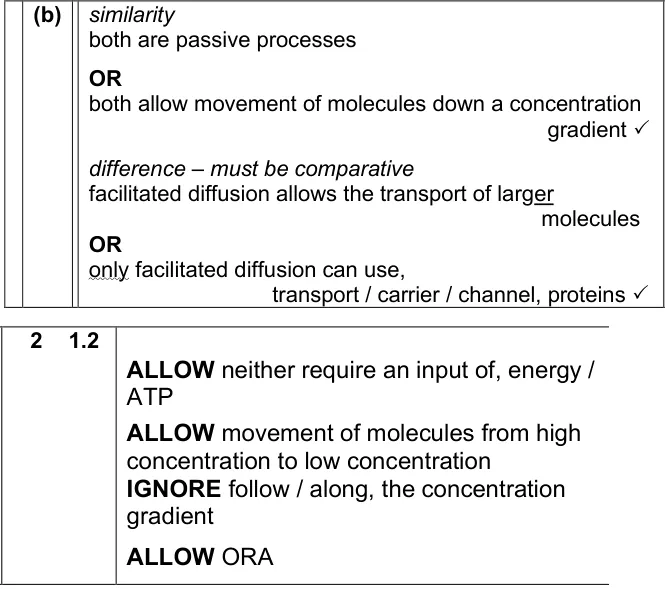
State one similarity and one difference between simple and facilitated diffusion.
Show the mark scheme
Tap an image to open it full size.
From the examiners' report: Say that molecules move down the concentration gradient, not just "both go down a gradient". Make the difference comparative, for example "only facilitated diffusion uses channel proteins"; neither uses ATP.
Question 6
AS Paper 2 · June 2025 · Q2(c) · 3 marks · Medium
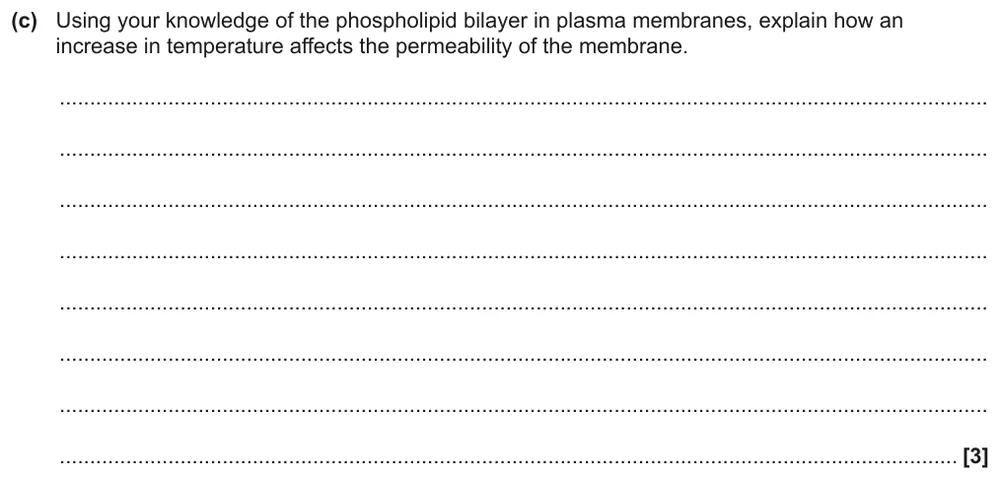
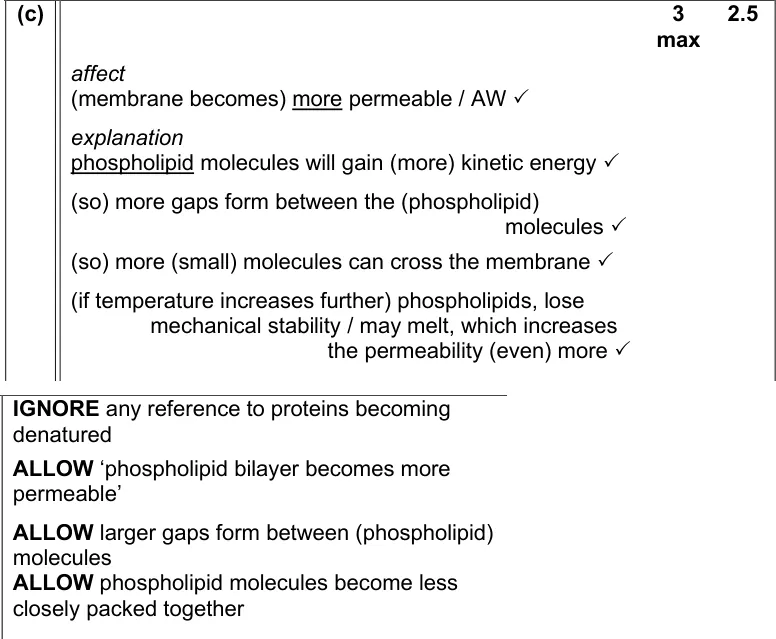
Explain how a rise in temperature changes membrane permeability, using the phospholipid bilayer.
Show the mark scheme
Tap an image to open it full size.
From the examiners' report: The question asks about phospholipids, so talk about kinetic energy and gaps between phospholipid molecules. Many students wrote about denatured proteins or enzymes, which earned nothing.
Question 7
AS Paper 2 · June 2025 · Q2(d) · 2 marks · Medium
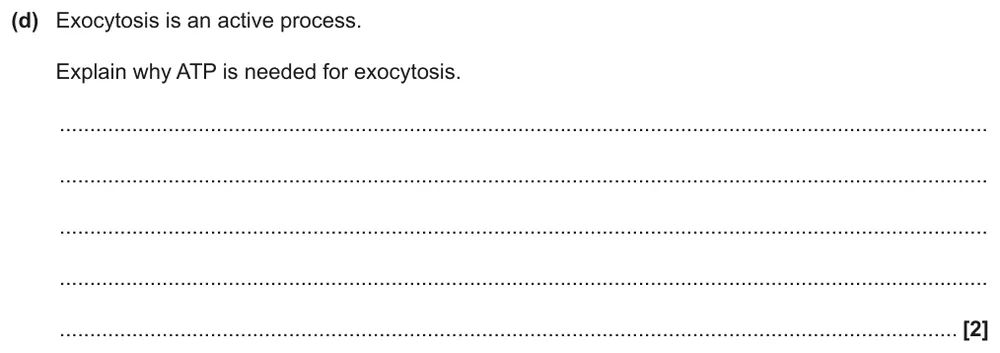
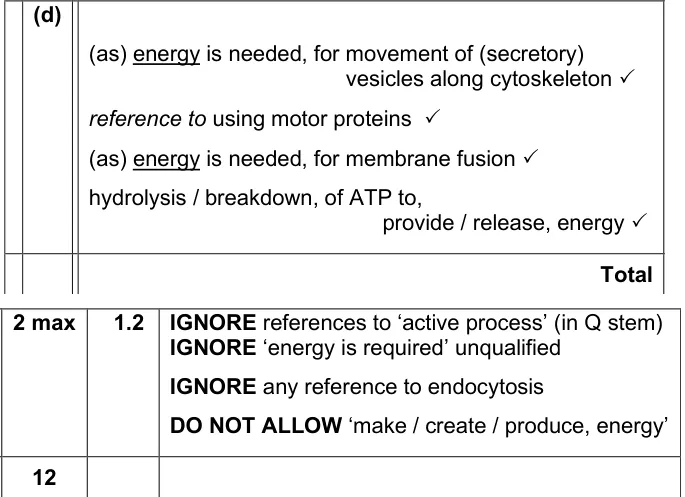
Explain why ATP is needed for exocytosis.
Show the mark scheme
Tap an image to open it full size.
From the examiners' report: Say what the energy is used for: moving the vesicle along the cytoskeleton with motor proteins and fusing it with the membrane. Energy is released by hydrolysing ATP, never "made".
Osmosis and water potential
Question 8
A level Paper 2 · June 2019 · Q16(a)(i) · 2 marks · Hard
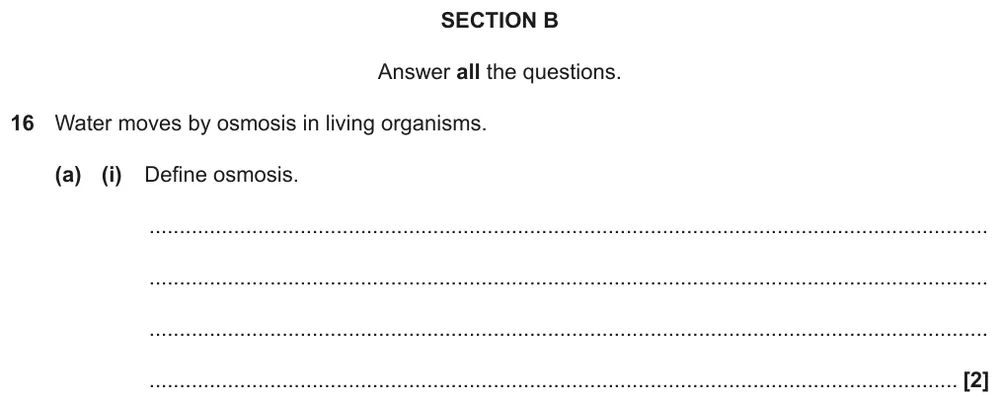
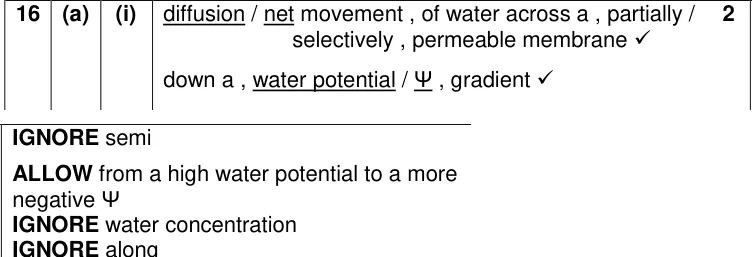
Define osmosis.
Show the mark scheme
Tap an image to open it full size.
From the examiners' report: Learn the full definition: net movement of water, across a partially permeable membrane, down a water potential gradient. "Water concentration" and "semi-permeable" don't score at A level.
Question 9
A level Paper 2 · June 2019 · Q16(a)(ii) · 3 marks · Medium
Explain the importance of osmosis in plant support.
Show the mark scheme

Tap an image to open it full size.
From the examiners' report: "Support" means holding the plant up, so focus on cells: water enters the vacuole, presses on the cell wall and the turgid cells support the plant. Use the word pressure, and don't call the whole plant or the xylem turgid.
Question 10
AS Paper 2 · June 2019 · Q5(a) · 2 marks · Medium
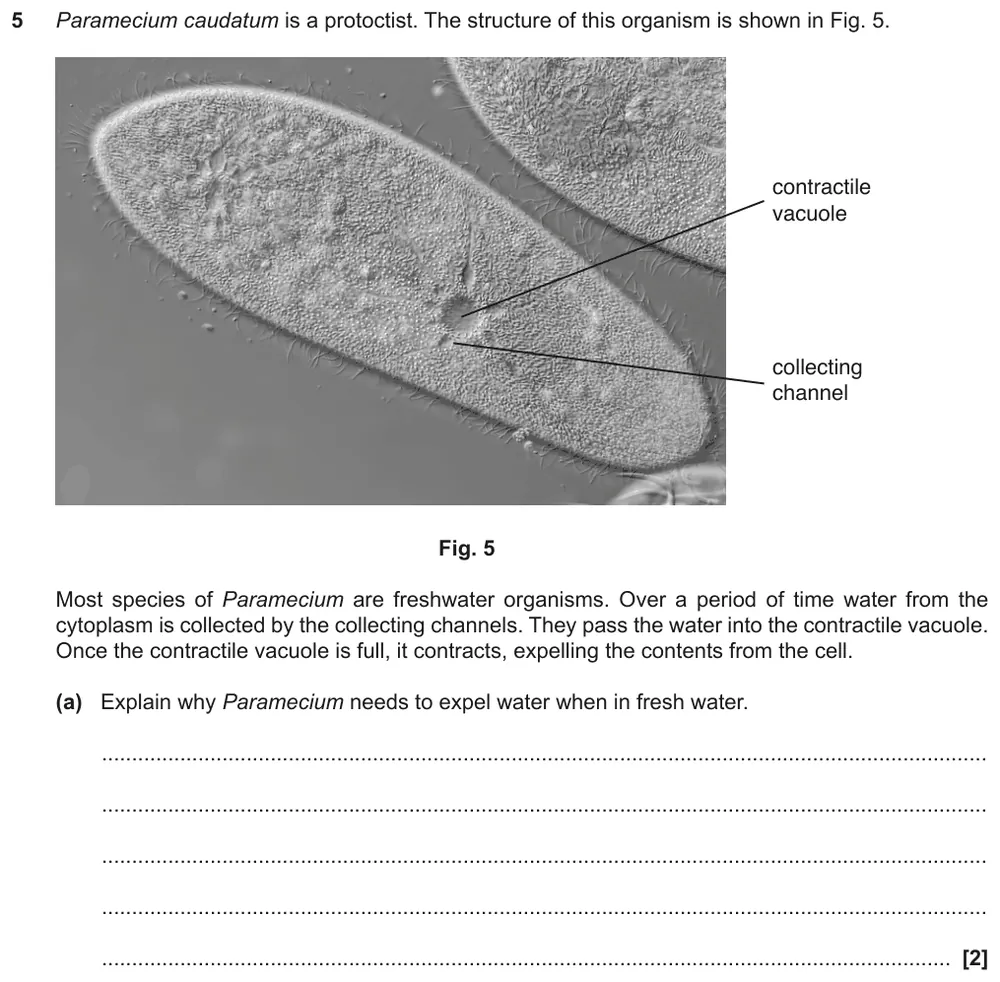
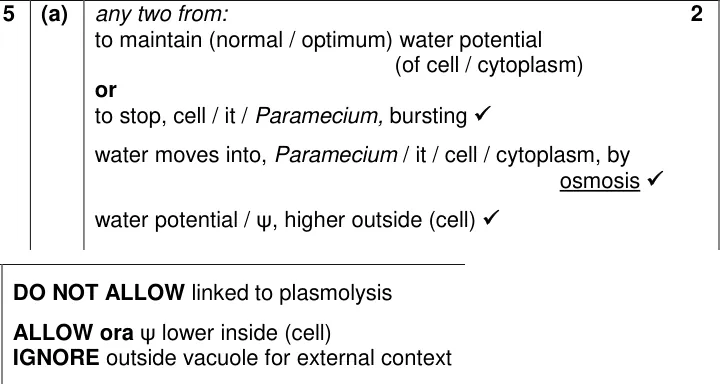
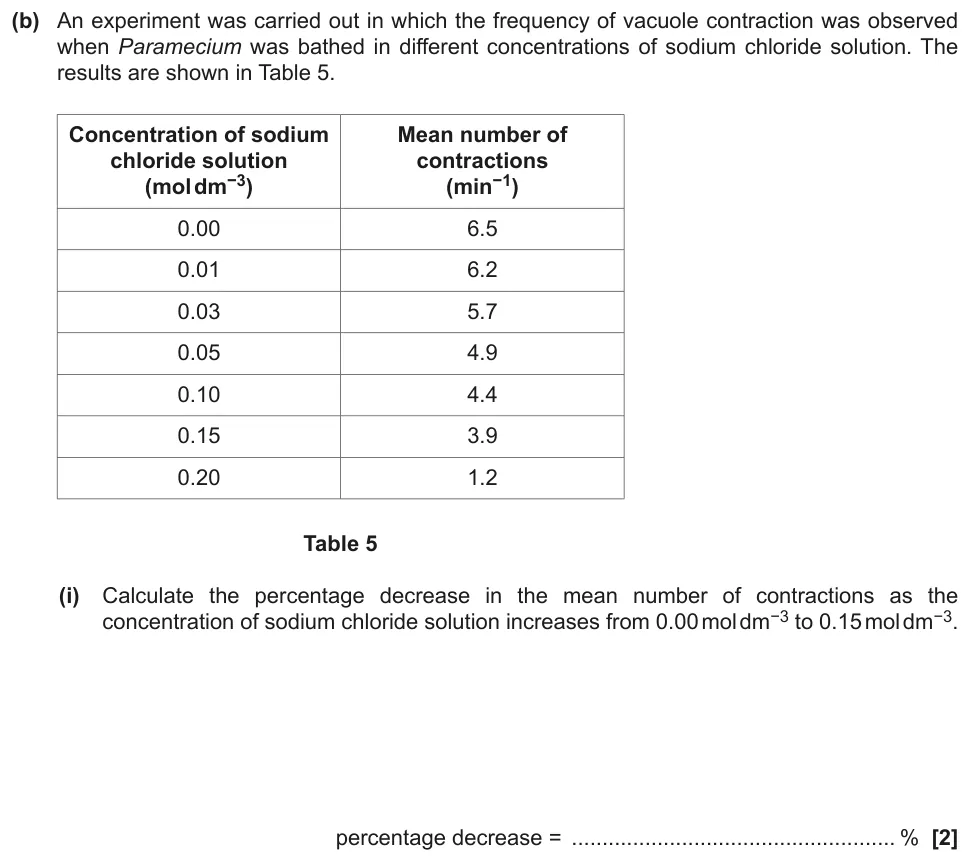
Explain why Paramecium must expel water when it lives in fresh water.
Show the mark scheme
Tap an image to open it full size.
From the examiners' report: Water enters because the water potential outside is higher; the vacuole is the solution to that problem, not the reason water comes in. Plasmolysis is the wrong word here.
Question 11
AS Paper 2 · June 2019 · Q5(b)(iv) · 2 marks · Hard
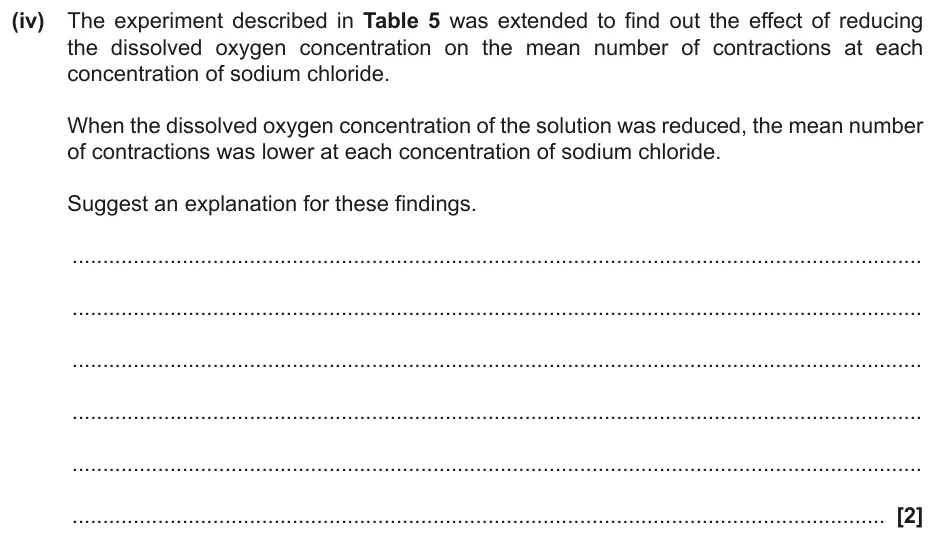
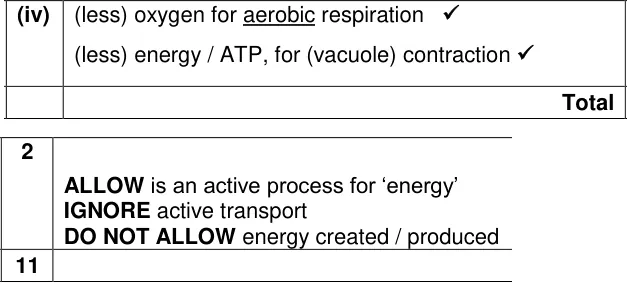
Suggest why the contractile vacuole contracts less often when dissolved oxygen is reduced.
Information from earlier in this question:
Show the mark scheme
Tap an image to open it full size.
From the examiners' report: This isn't an osmosis question any more. Say aerobic respiration, and link the lower ATP supply to the active, energy-using contraction of the vacuole.
Question 12
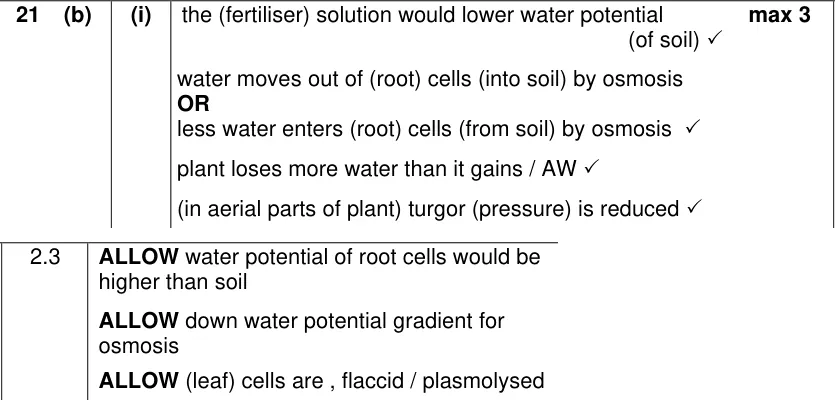
A level Paper 1 · June 2023 · Q21(b)(i) · 3 marks · Medium
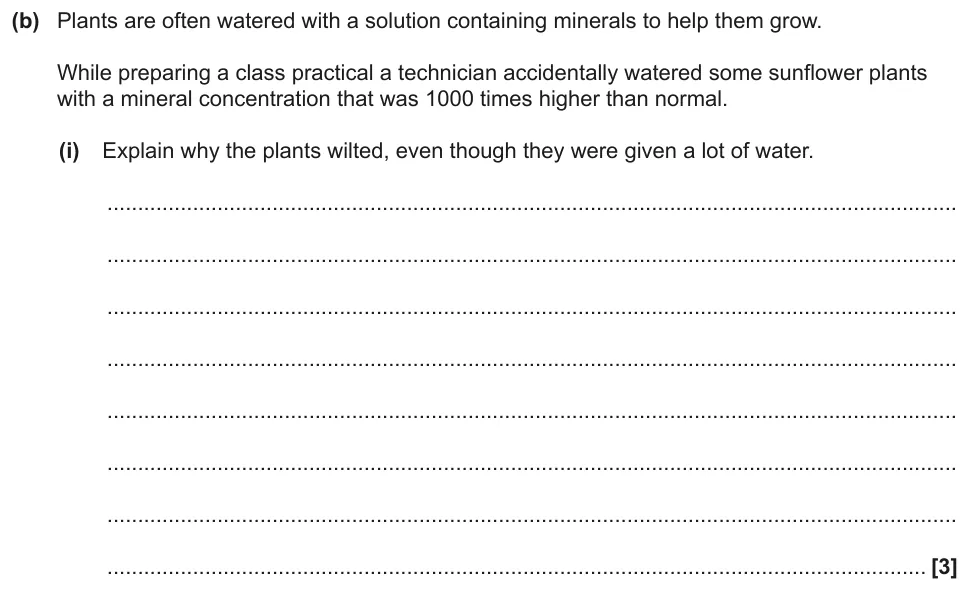
Explain why sunflowers wilted after being watered with a very concentrated mineral solution.
Show the mark scheme
Tap an image to open it full size.
From the examiners' report: Don't just repeat that the plant wilted: explain it as loss of turgor pressure in leaf cells, after the low soil water potential stops water entering root hair cells by osmosis.
Question 13
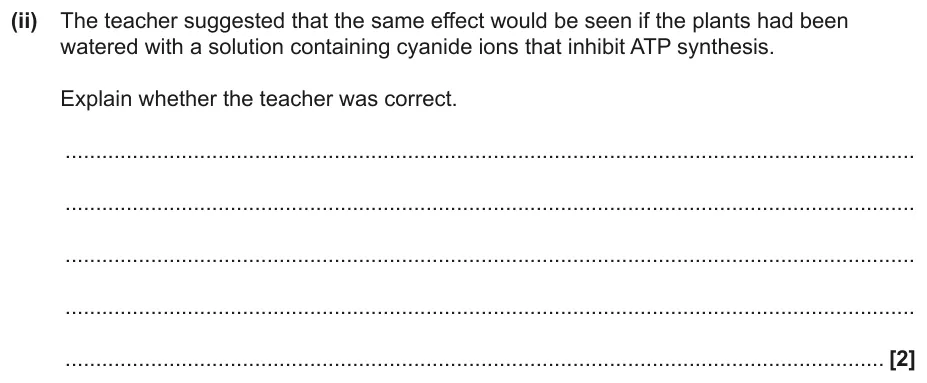
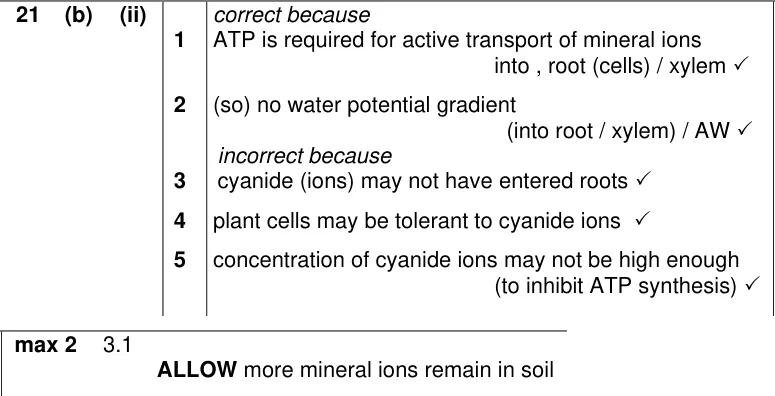
A level Paper 1 · June 2023 · Q21(b)(ii) · 2 marks · Medium
Explain whether cyanide, which stops ATP synthesis, would have the same effect.
Show the mark scheme
Tap an image to open it full size.
From the examiners' report: Link ATP to active transport of mineral ions into root hair cells, which sets up the water potential gradient. General answers about growth or photosynthesis weren't credited.
Practical and maths
Question 14
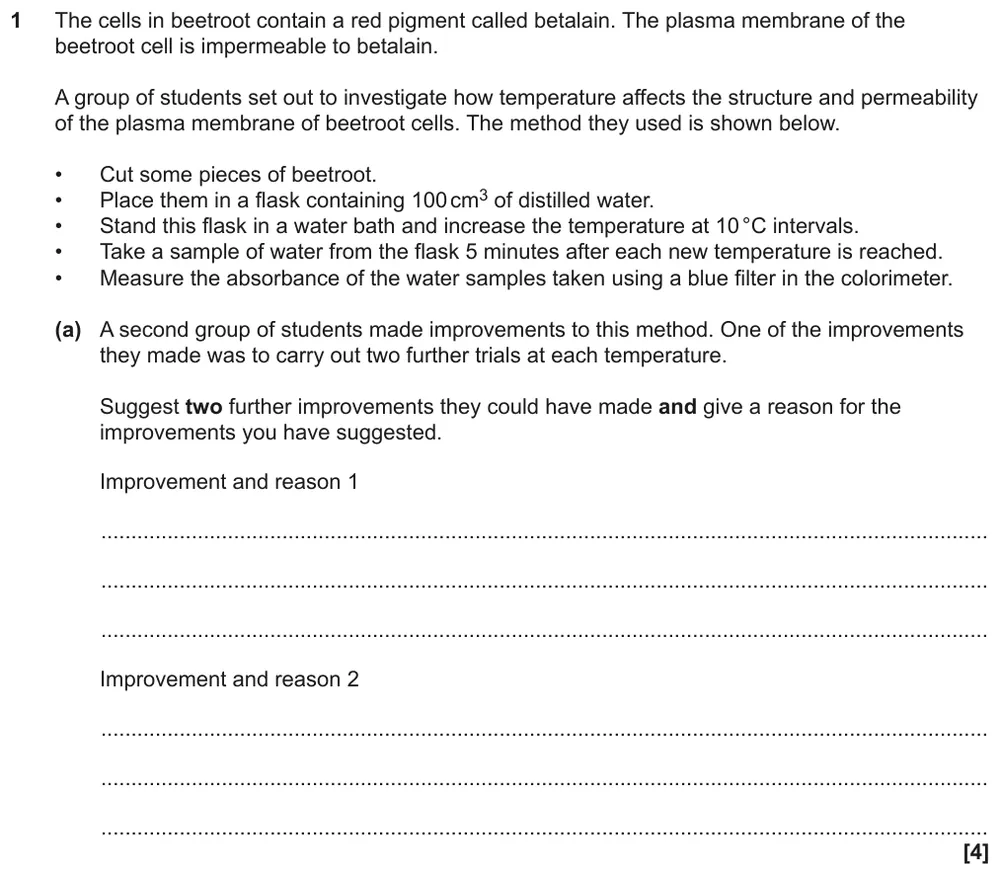
AS Paper 2 · June 2022 · Q1(d) · 2 marks · Hard
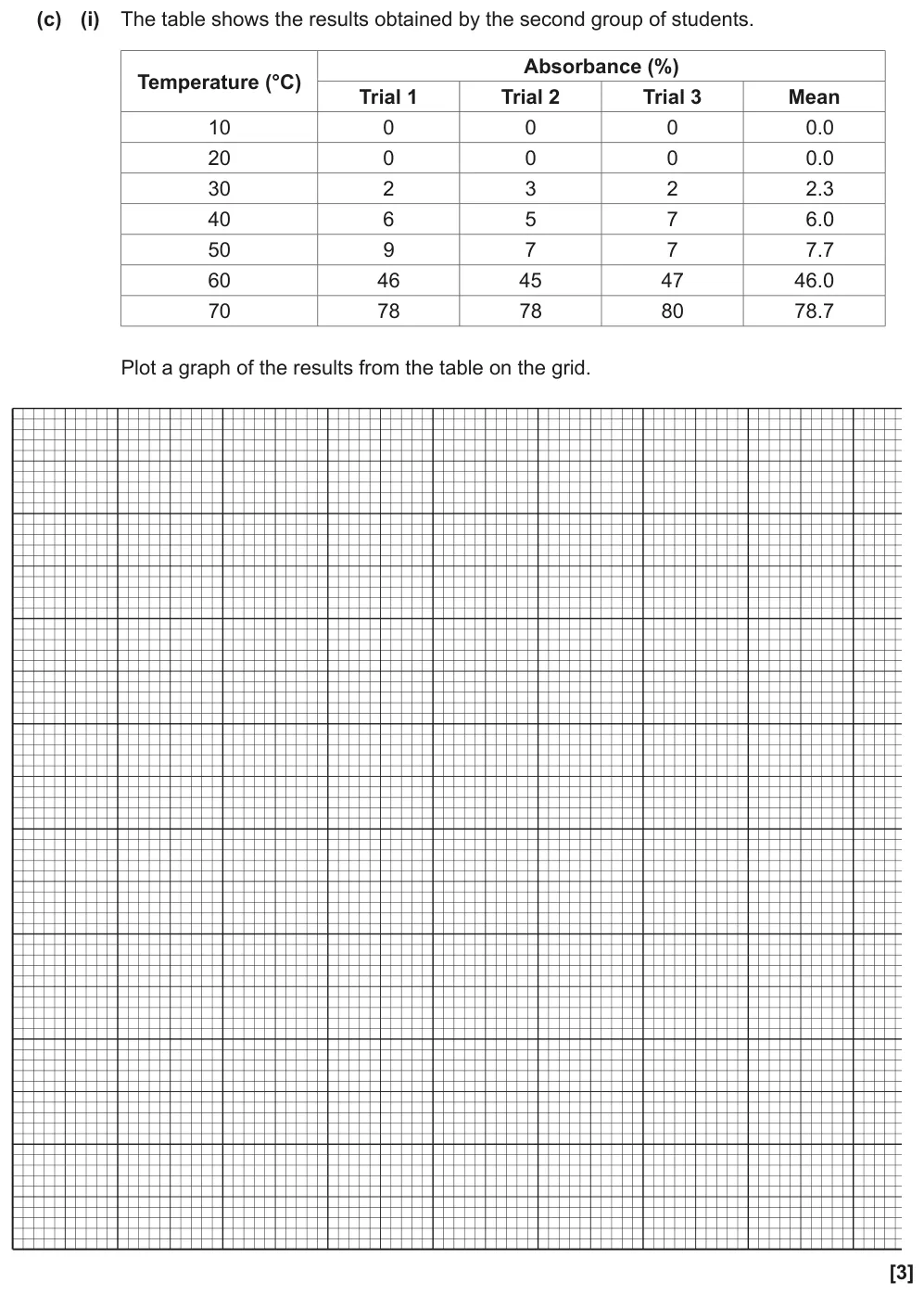
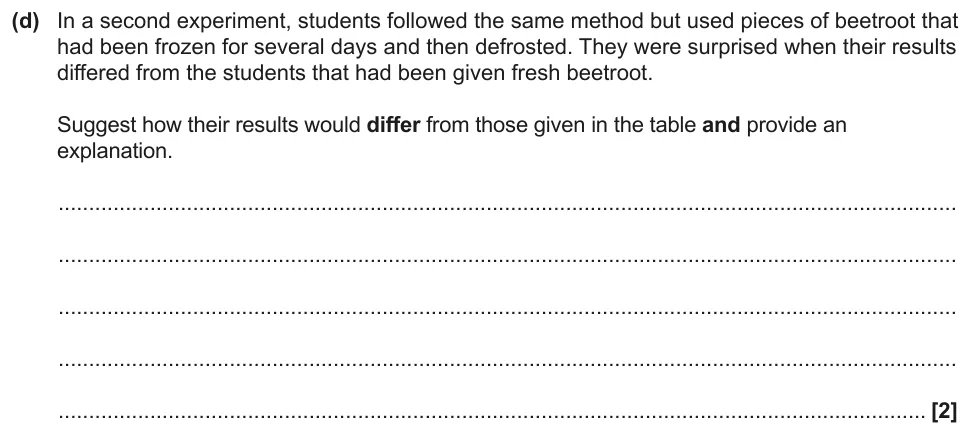
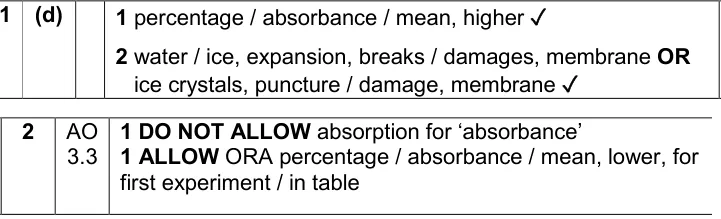
Suggest how results would differ for beetroot that had been frozen and defrosted, and explain why.
Information from earlier in this question:
Show the mark scheme
Tap an image to open it full size.
From the examiners' report: Read the stem: the beetroot was defrosted, so it isn't rigid. Comment on the absorbance results, and explain that expanding ice and sharp ice crystals damage the membrane.
Question 15
AS Paper 2 · June 2024 · Q3(b) · 1 mark · Easy
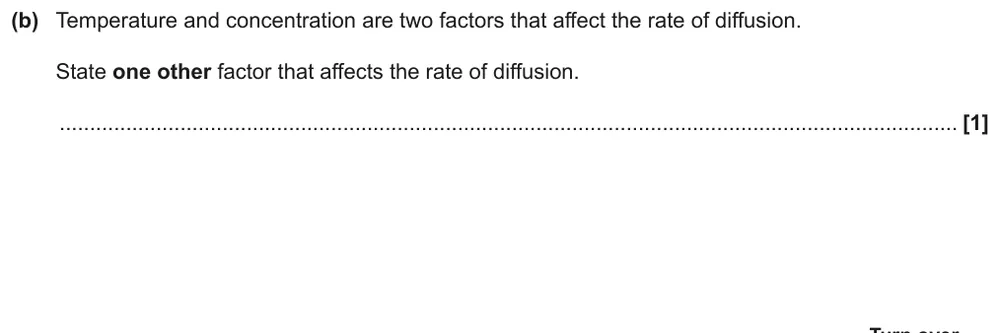
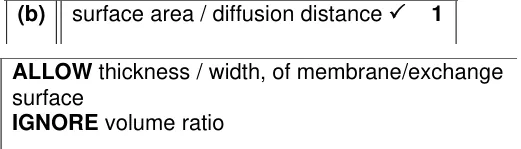
State one factor other than temperature and concentration that affects the rate of diffusion.
Show the mark scheme
Tap an image to open it full size.
From the examiners' report: Most students said surface area. Humidity and pH affect transpiration and enzymes, not the rate of diffusion across a membrane.
Question 16
AS Paper 2 · June 2024 · Q3(c)(ii) · 4 marks · Medium
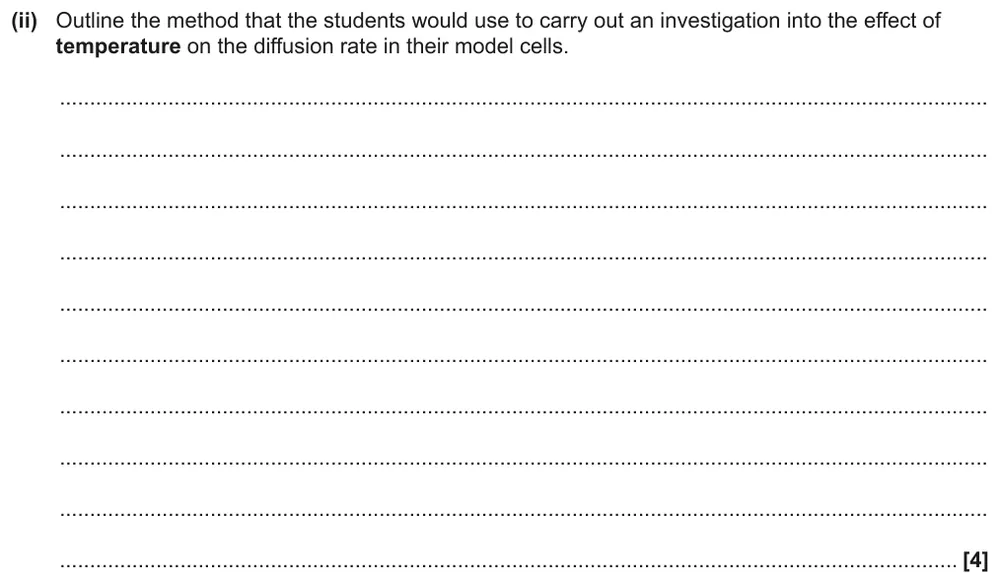
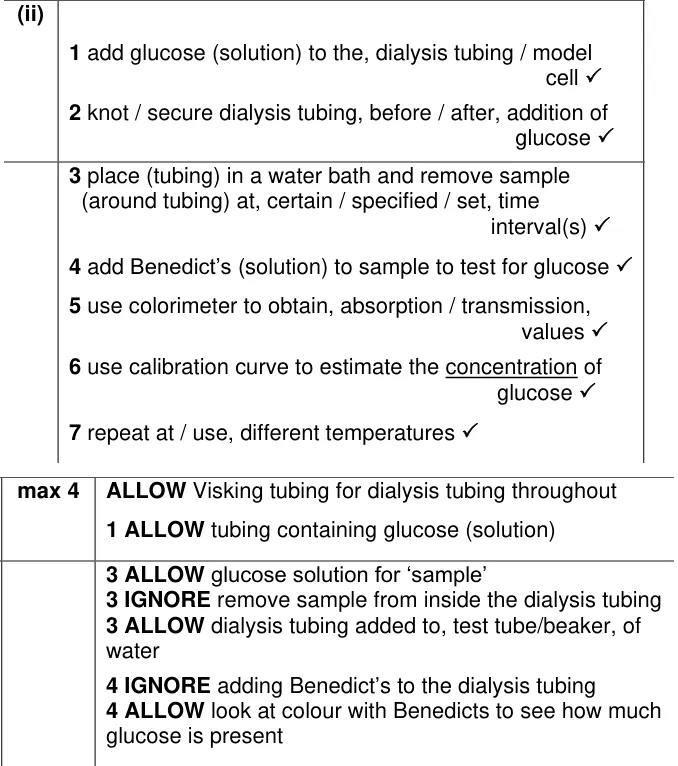
Outline a method for investigating the effect of temperature on diffusion in model cells.
Show the mark scheme
Tap an image to open it full size.
From the examiners' report: The model cell is dialysis (Visking) tubing filled with glucose solution, not a potato or beetroot cylinder. Sample the water outside it at set times and measure the glucose with Benedict's and a colorimeter.
Question 17
AS Paper 2 · June 2024 · Q3(d) · 3 marks · Hard
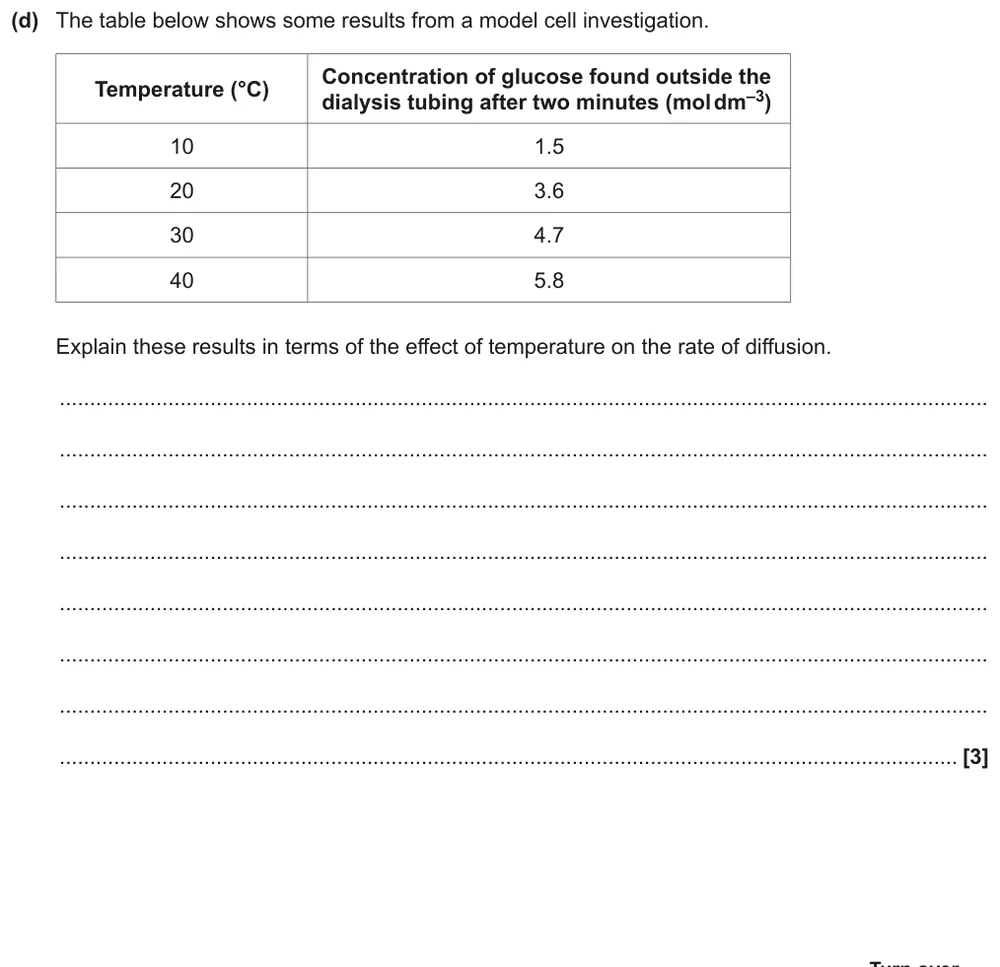
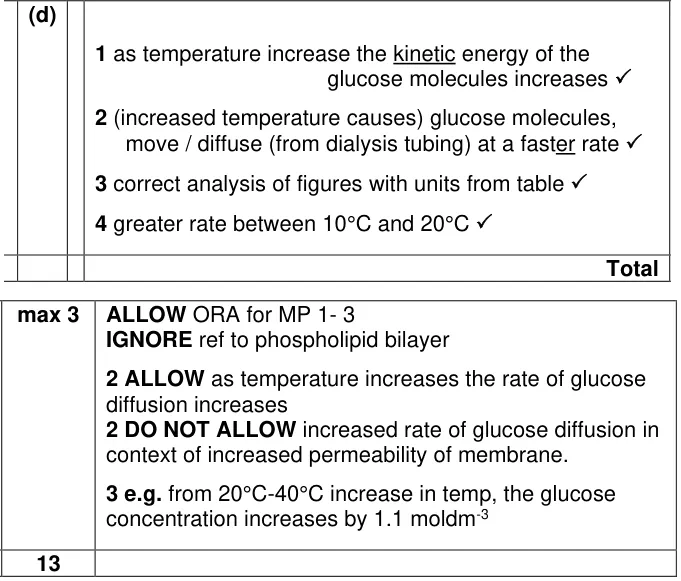
Explain the effect of temperature on diffusion of glucose out of dialysis tubing, using a table of results.
Show the mark scheme
Tap an image to open it full size.
From the examiners' report: This is a model cell, so explain with kinetic energy, not with the membrane becoming more permeable. Quote figures with units and point out where the increase is greatest.
Question 18
A level Paper 3 · June 2025 · Q5(d) · 2 marks · Easy
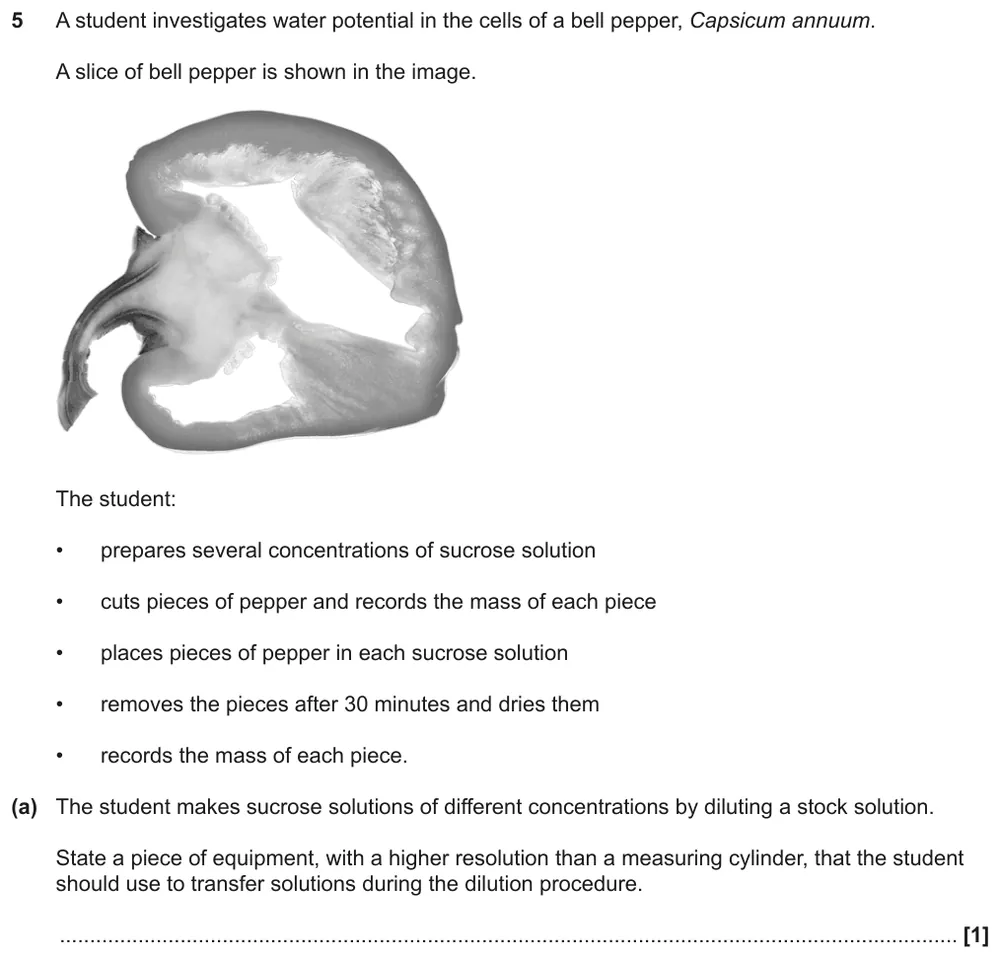
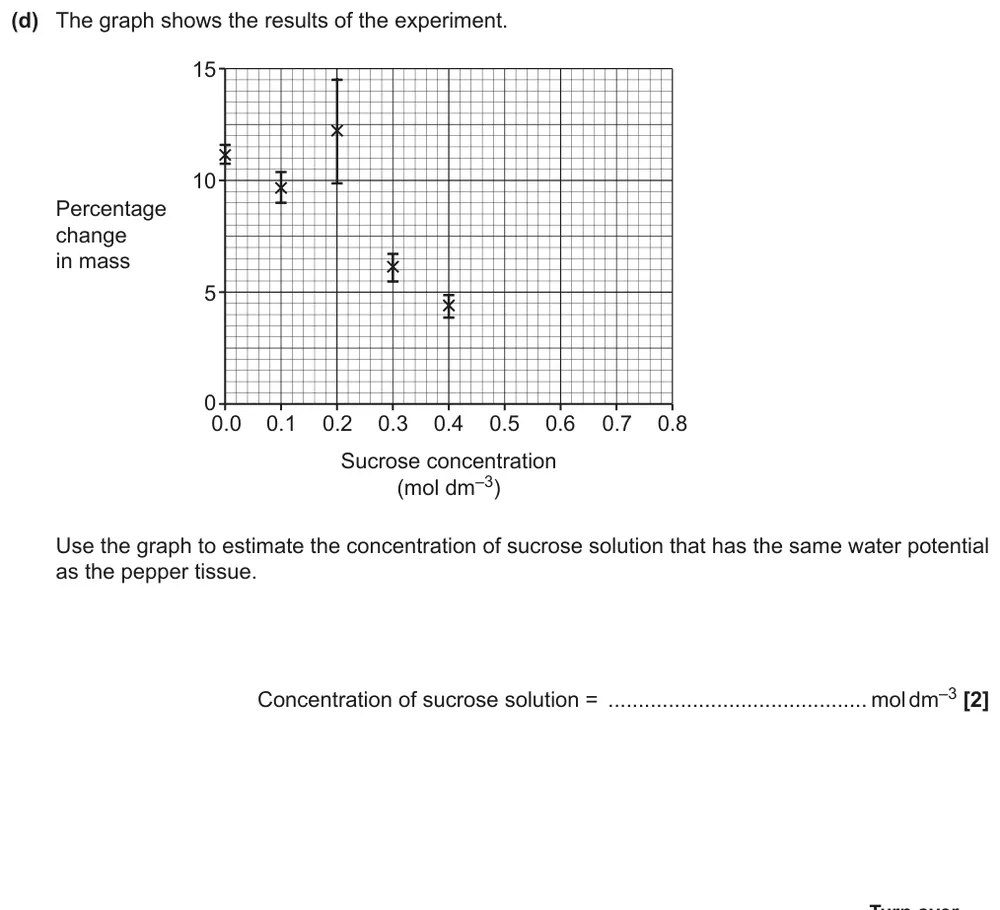
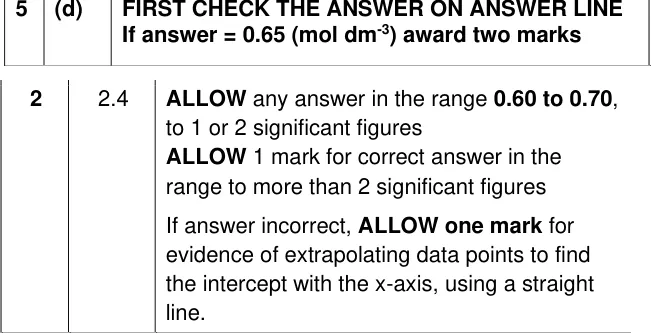
Use a graph of percentage change in mass of pepper tissue to estimate the sucrose concentration with the same water potential.
Information from earlier in this question:
Show the mark scheme
Tap an image to open it full size.
From the examiners' report: Most students did well. Draw a straight line through the points, ignore the anomaly, and read off where it crosses zero change in mass.
Where students lose marks (from OCR examiners' reports and mark schemes)
Each point below is followed by wording that gained marks.
Region A means the tails, not the whole bilayer: Asked about region A of a membrane diagram, a number of students described the whole phospholipid bilayer, which could not be credited.
✔ Gains credit: "Region A is hydrophobic (the fatty acid tails), so it helps form the bilayer and separates the two aqueous regions", or "it contains cholesterol, which regulates fluidity".
Cholesterol cuts both ways with temperature: Very few students saw that cholesterol's effect on fluidity depends on temperature; many just described where cholesterol sits among the phospholipid tails.
✔ Gains credit: "Cholesterol increases fluidity at low temperatures and decreases fluidity at high (body) temperatures, so the temperature would need to be known."
Facilitated diffusion is still free: A very common misconception was that facilitated diffusion uses energy or ATP, and differences such as "facilitated diffusion uses transport proteins" weren't comparative.
✔ Gains credit: "Both are passive and move molecules down a concentration gradient; only facilitated diffusion uses carrier or channel proteins."
Heat the phospholipids, not the proteins: Explaining how temperature changes permeability using the phospholipid bilayer, many students wrote about denatured proteins or enzymes, which the mark scheme ignores.
✔ Gains credit: "Phospholipid molecules gain kinetic energy, so more gaps form between them and more molecules can cross the membrane."
No 'water concentration', no 'semi-permeable': In the definition of osmosis, "water concentration", "semi-permeable" and "from a high water potential gradient to a low one" were not credited, and few mentioned net movement.
✔ Gains credit: "The net movement of water across a partially permeable membrane down a water potential gradient."
Turgid cells hold the plant up: Asked about osmosis and plant support, many students called the whole plant or the xylem turgid, or wrote about photosynthesis and transport.
✔ Gains credit: "Water enters the vacuole, creating turgor pressure against the cell wall; the turgid cells support the plant."
Defrosted beetroot leaks more: Many students said freezing would make the membrane rigid and impermeable, missing that the beetroot had been defrosted, and didn't comment on the absorbance results.
✔ Gains credit: "Absorbance would be higher because expanding ice and ice crystals puncture the membranes, so more pigment leaks out."
Less oxygen, less ATP for the vacuole: Explaining fewer vacuole contractions at low oxygen, some students kept writing about osmosis, and others mentioned respiration without saying aerobic or wrote that energy is "produced".
✔ Gains credit: "Less oxygen for aerobic respiration, so less ATP for contraction of the contractile vacuole."
Download the questions
Download the PDF pack (18 questions, mark schemes at the end)
Keep practising
- Biological Membranes quiz
- PAG 8 Transport in and out of Cells: OCR A Level Biology exam questions by topic
- Cell Division, Cell Diversity and Cellular Organisation (2.1.6): OCR A Level Biology exam questions by topic
- Biological membranes: interactive written questions (20)
- OCR A Level Biology masterclasses
Questions, mark schemes and examiners' report extracts © OCR.