

OCR A 2.1.2 · 17 questions · mark schemes and examiners’ tips included
Carbohydrates are one of the first topics you meet in OCR A Level Biology, and they come back again and again: in respiration, in photosynthesis, in plant transport and in the practical endorsement. Spec point 2.1.2 asks you to know the ring structures of α- and β-glucose, how glycosidic bonds are made and broken, and how the structures of starch, glycogen and cellulose suit them to their jobs. You also need to be able to carry out and interpret the Benedict's and iodine tests, and to use a colorimeter to find a glucose concentration.
Students rarely lose marks here because they don't know the facts. They lose them because the facts aren't linked to the question: a property is given without the structure that causes it, "glycosidic bond" is written without saying which carbons it joins, or a comparison doesn't say which molecule is which. The examiners' reports for these questions say exactly that.
Work through the seventeen questions below in order. They start with recall, move on to applying what you know to unfamiliar molecules such as chitin and callose, and finish with the practical and maths questions. If you'd like to go through questions like these with me each week, my OCR A masterclasses run on Wednesdays at 5.15pm for Year 12 and on Tuesdays at 6.30pm or Thursdays at 5.15pm for Year 13.
Want help with this topic? It comes up in my weekly OCR A masterclasses. See the timetable →
What you need from GCSE
Each question on this page assumes you're secure on these GCSE ideas. If any of them feels shaky, look it up before you start.
- Carbohydrates are made from sugars. Glucose is made in photosynthesis and used in respiration.
- Plants store glucose as starch and animals store it as glycogen. Plant cell walls are made of cellulose.
- Enzymes break large molecules into small ones in digestion: amylase breaks starch down into sugars.
- Food tests: Benedict's solution turns from blue to green, yellow, orange or brick red when heated with a reducing sugar; iodine solution turns from orange-brown to blue-black with starch.
Key terms
These words come up in the questions and mark schemes. Examiners expect you to use them exactly.
- Monomer: a small molecule that joins with others like it to make a polymer (for example glucose).
- Polymer: a large molecule made of many monomers joined together (for example starch).
- Monosaccharide, disaccharide, polysaccharide: one sugar unit; two sugar units joined together; many sugar units joined together.
- Condensation reaction: a reaction that joins two molecules with a chemical bond and removes a molecule of water.
- Hydrolysis reaction: a reaction that breaks a chemical bond between two molecules using a molecule of water.
- Glycosidic bond: the bond formed between two monosaccharides by a condensation reaction, named after the carbons it joins (for example 1,4 or 1,6).
- Isomers: molecules with the same formula but a different arrangement of atoms, such as α-glucose and β-glucose.
- Reducing sugar: a sugar that gives a positive Benedict's test when heated (all monosaccharides, maltose and lactose). Sucrose is a non-reducing sugar.
- Calibration curve: a graph made from solutions of known concentration, used to read off the concentration of an unknown solution.
- Absorbance: how much light a solution absorbs in a colorimeter; a deeper colour gives a higher absorbance (and a lower transmission).
What these questions cover (OCR 2.1.2)
The questions test these learning outcomes from the OCR A Level Biology A specification (H420):
- (b) the concept of monomers and polymers and the importance of condensation and hydrolysis reactions in a range of biological molecules (carbohydrate examples)
- (c) the chemical elements that make up biological molecules (for carbohydrates: C, H and O)
- (d) the ring structure and properties of glucose as an example of a hexose monosaccharide and the structure of ribose as an example of a pentose monosaccharide
- (e) the synthesis and breakdown of a disaccharide and polysaccharide by the formation and breakage of glycosidic bonds
- (f) the structure of starch (amylose and amylopectin), glycogen and cellulose molecules
- (g) how the structures and properties of glucose, starch, glycogen and cellulose molecules relate to their functions in living organisms
- (q) how to carry out and interpret the results of the following chemical tests: Benedict’s test for reducing and non-reducing sugars; iodine test for starch (the carbohydrate tests only)
- (r) quantitative methods to determine the concentration of a chemical substance in a solution (colorimetry to find a glucose concentration)
How to use this page
Write your answer on paper before you open the mark scheme. Allow about 1.2 minutes per mark: the 17 questions are worth 43 marks, so about 52 minutes in total. Then mark your answer strictly against the mark scheme and read the examiners' tip underneath it. If you'd rather print the questions, download the PDF pack.
Recall
Question 1
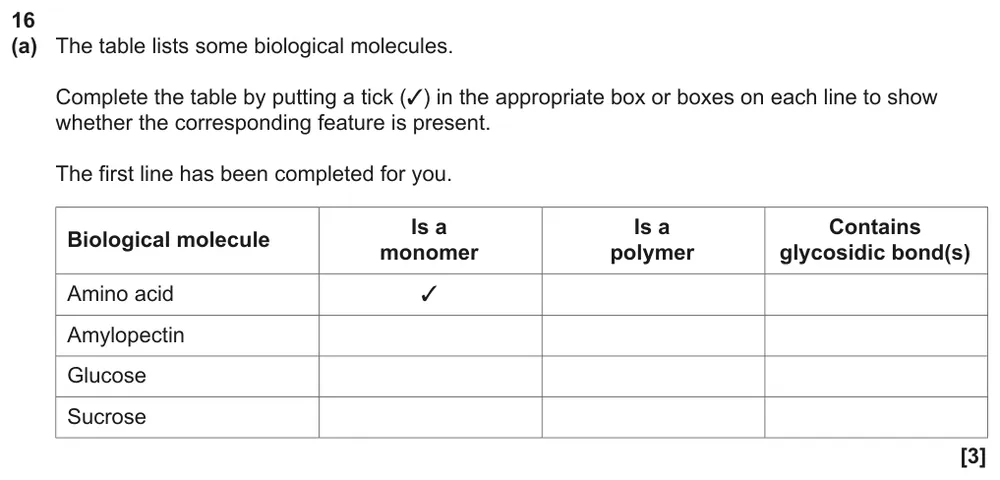
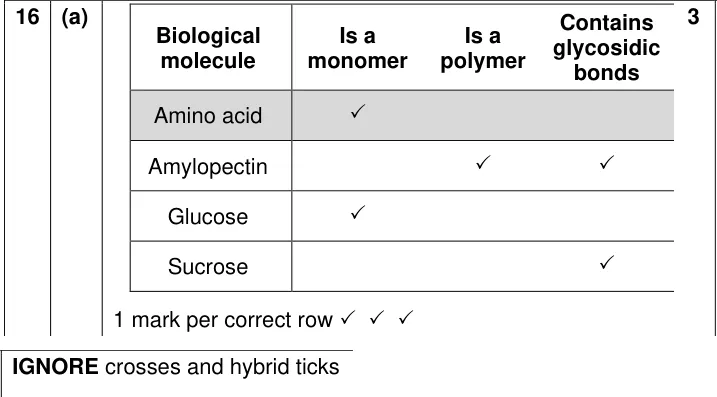
A level Paper 1 · June 2024 · Q16(a) · 3 marks · Medium
Tick whether amylopectin, glucose and sucrose are monomers, polymers or contain glycosidic bonds.
Show the mark scheme
Tap an image to open it full size.
Question 2
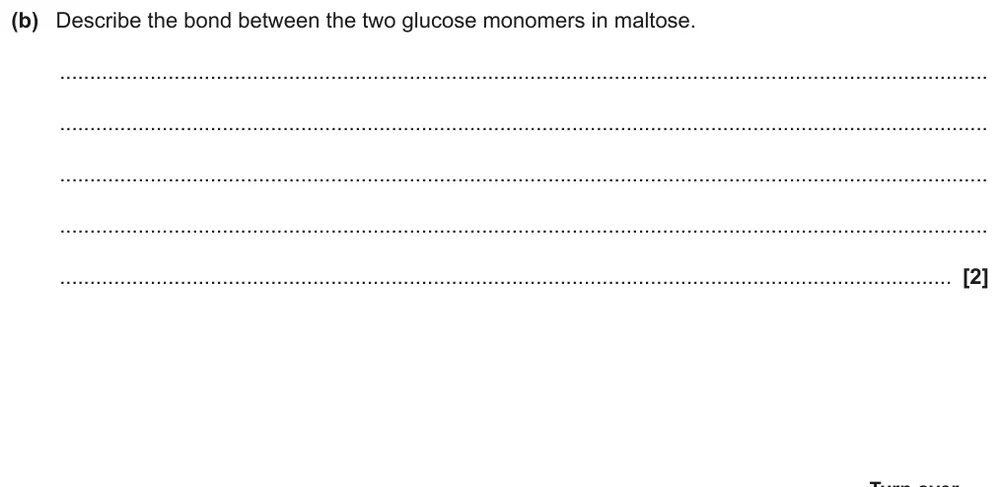
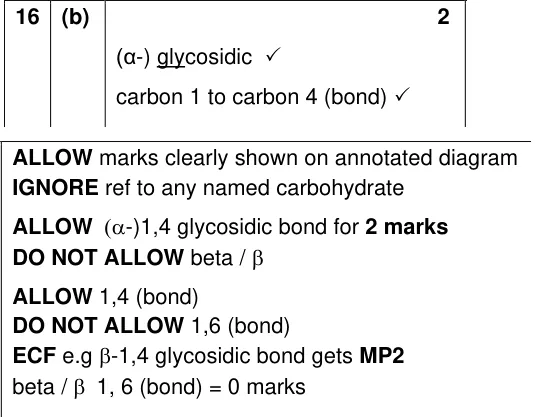
A level Paper 1 · June 2024 · Q16(b) · 2 marks · Medium
Describe the bond that joins the two glucose monomers in maltose.
Show the mark scheme
Tap an image to open it full size.
Question 3
AS Paper 2 · June 2022 · Q3(a)(i) · 2 marks · Easy
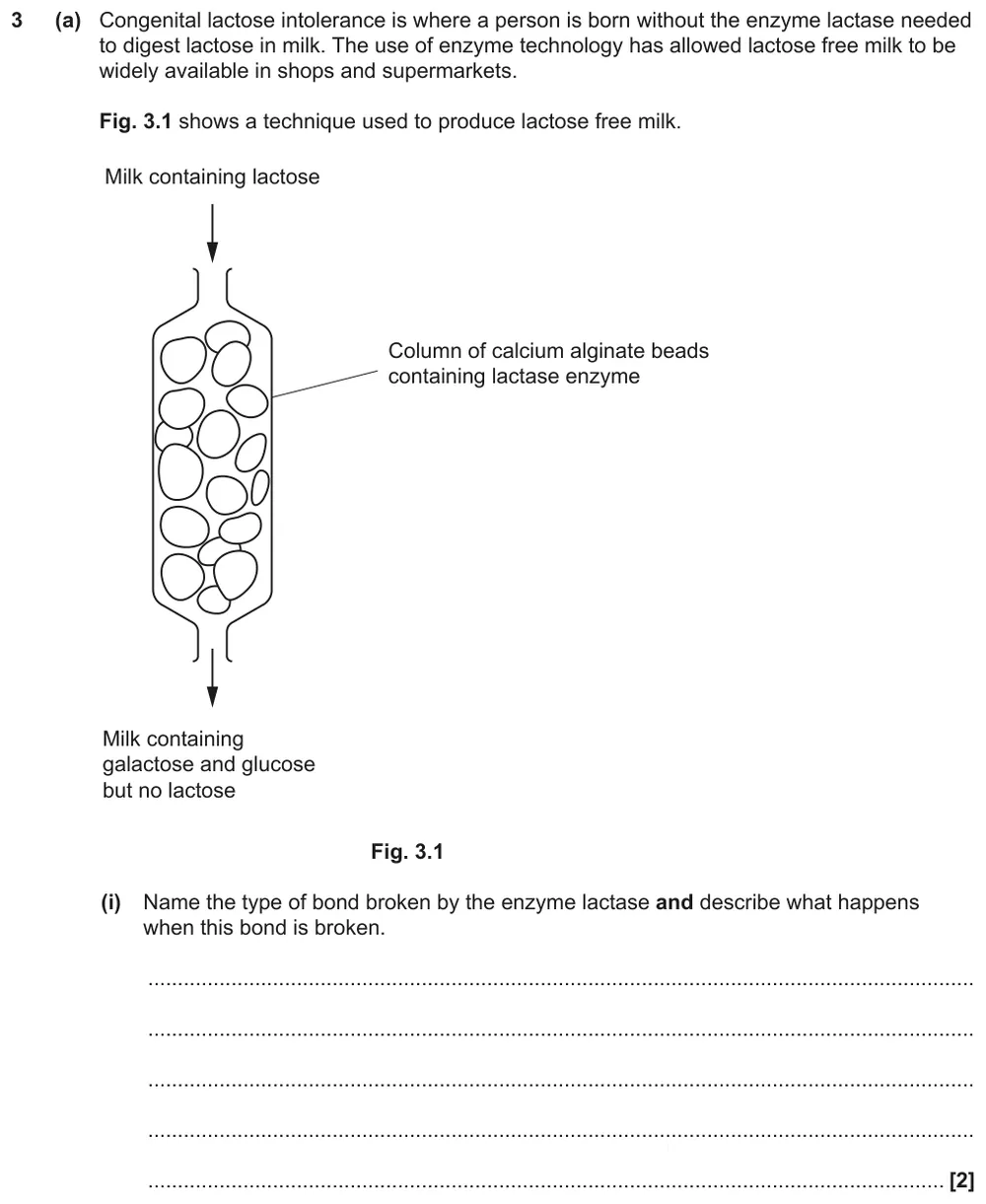
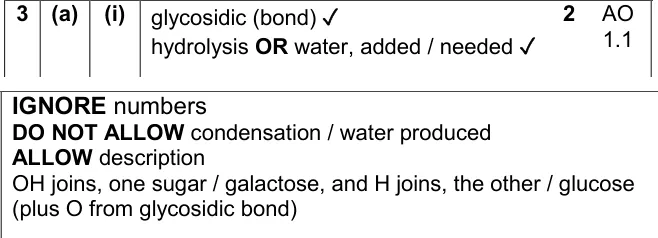
Name the bond lactase breaks in lactose-free milk production and say what happens when it breaks.
Show the mark scheme
Tap an image to open it full size.
From the examiners' report: Most students named the glycosidic bond, but some wrote peptide, disulfide or hydrogen bond, and some said condensation. Breaking a glycosidic bond is hydrolysis: water is used, not produced.
Question 4
AS Paper 2 · June 2025 · Q1(a) · 3 marks · Easy
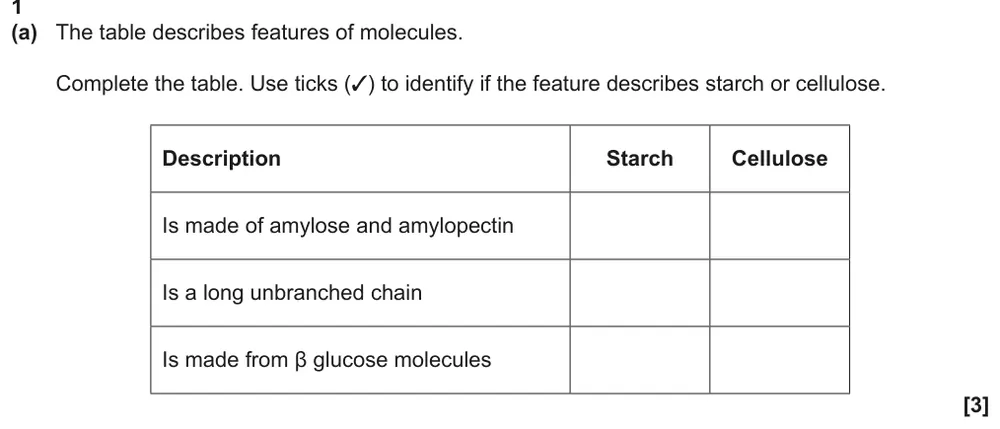
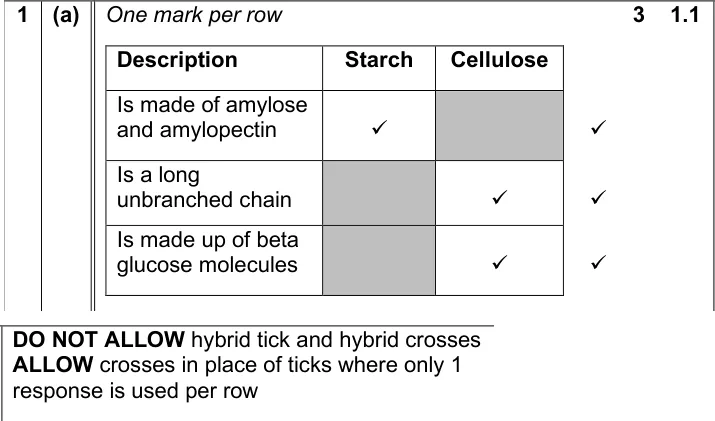
Tick whether each feature describes starch, cellulose or both.
Show the mark scheme
Tap an image to open it full size.
From the examiners' report: Most students knew these features, but some swapped starch and cellulose and got every row the wrong way round. Read each row twice and only put ticks in the boxes, as the question asks.
Question 5
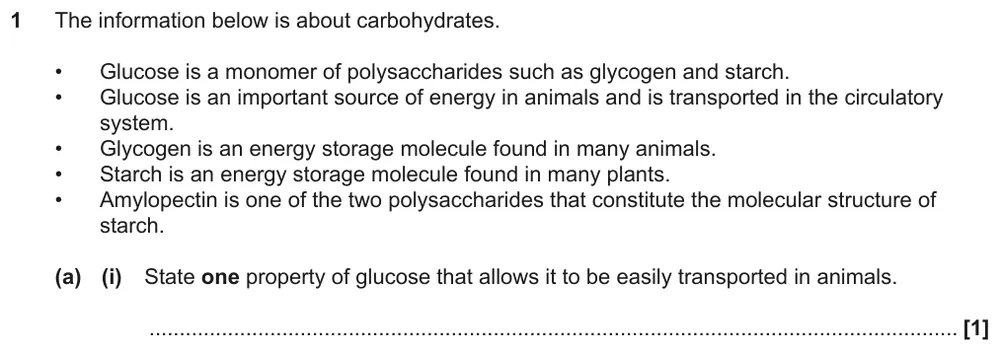
AS Paper 2 · November 2021 · Q1(a)(i) · 1 mark · Medium
State one property of glucose that lets it be transported easily in animals.
Show the mark scheme

Tap an image to open it full size.
Question 6
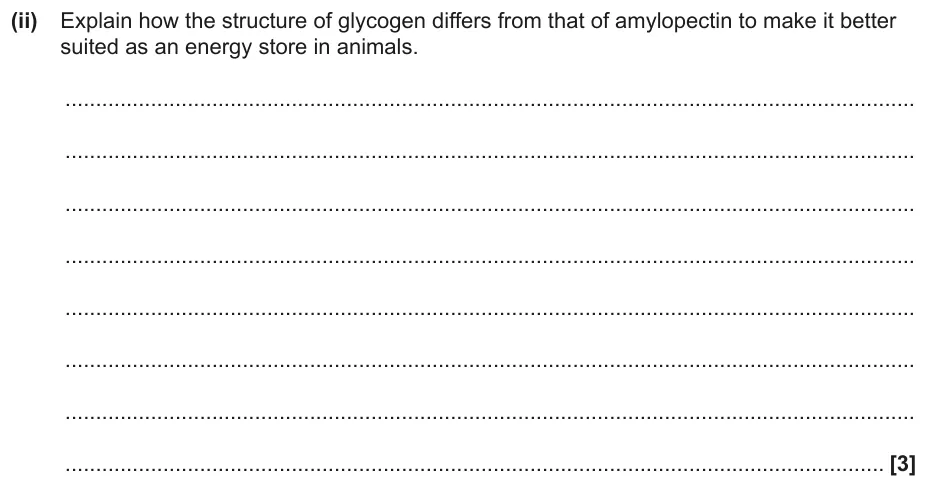
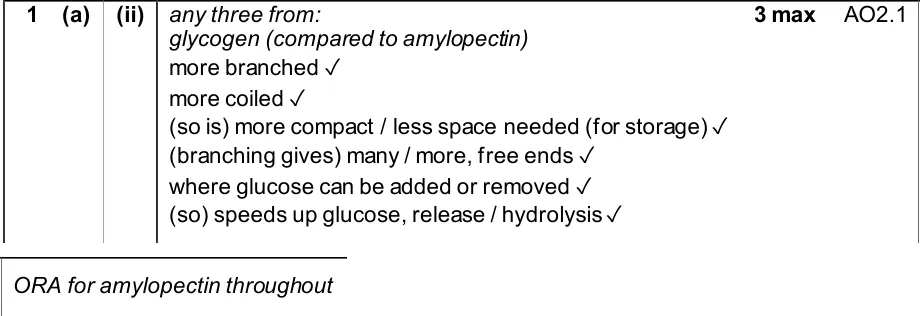
AS Paper 2 · November 2021 · Q1(a)(ii) · 3 marks · Medium
Explain how glycogen's structure differs from amylopectin's to make it a better energy store in animals.
Show the mark scheme
Tap an image to open it full size.
Question 7
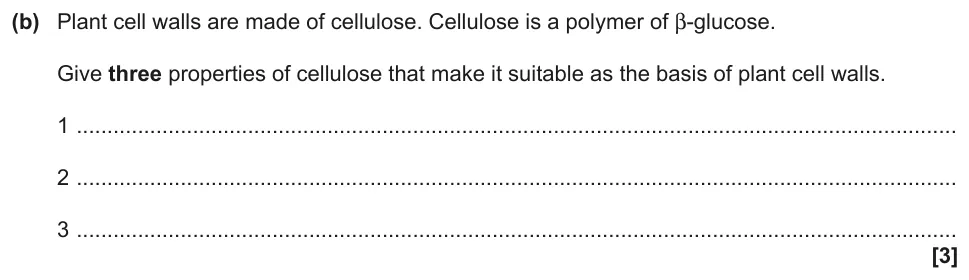
A level Paper 1 · June 2018 · Q18(b) · 3 marks · Hard
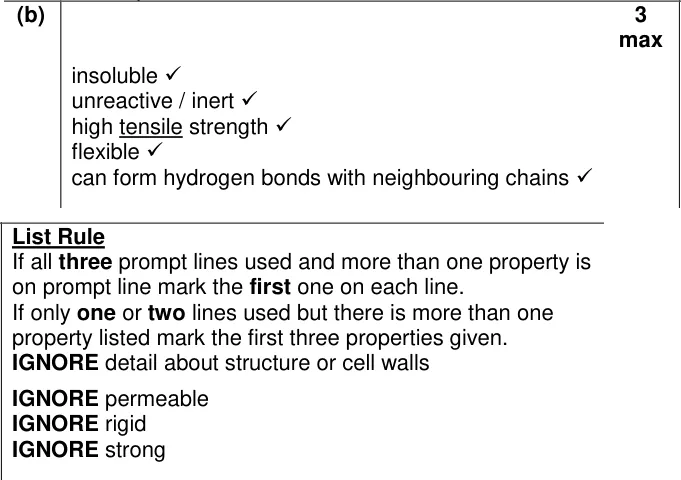
Give three properties of cellulose that suit it to plant cell walls.
Show the mark scheme
Tap an image to open it full size.
From the examiners' report: Most students got "insoluble" but few got all three marks. Answers that described the structure, or the cell wall rather than the cellulose molecule, didn't score. "Strong" on its own isn't enough: say high tensile strength.
Question 8
AS Paper 1 · June 2023 · Q28(b) · 4 marks · Medium
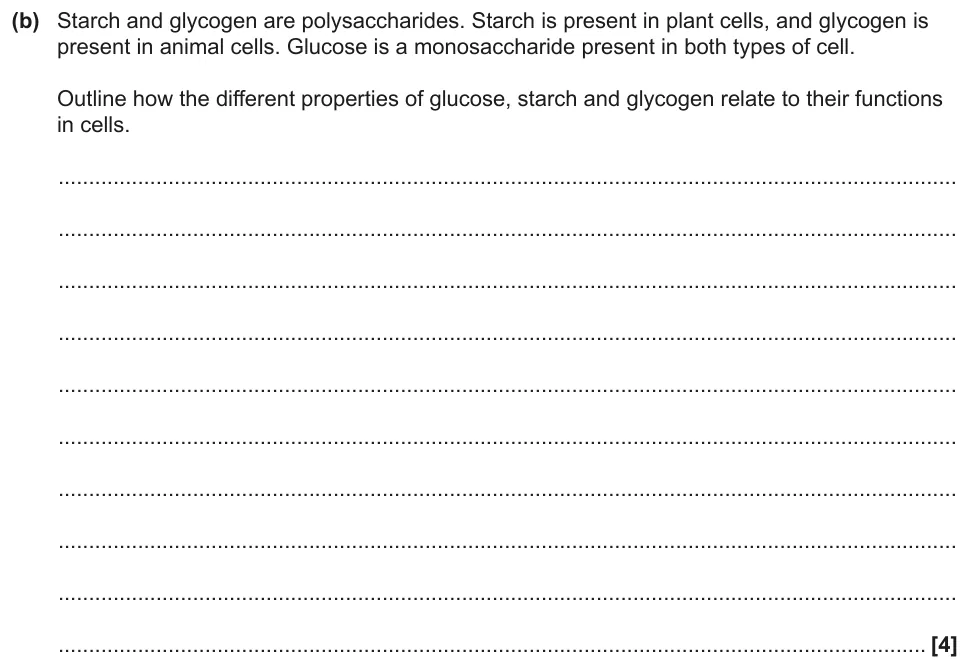
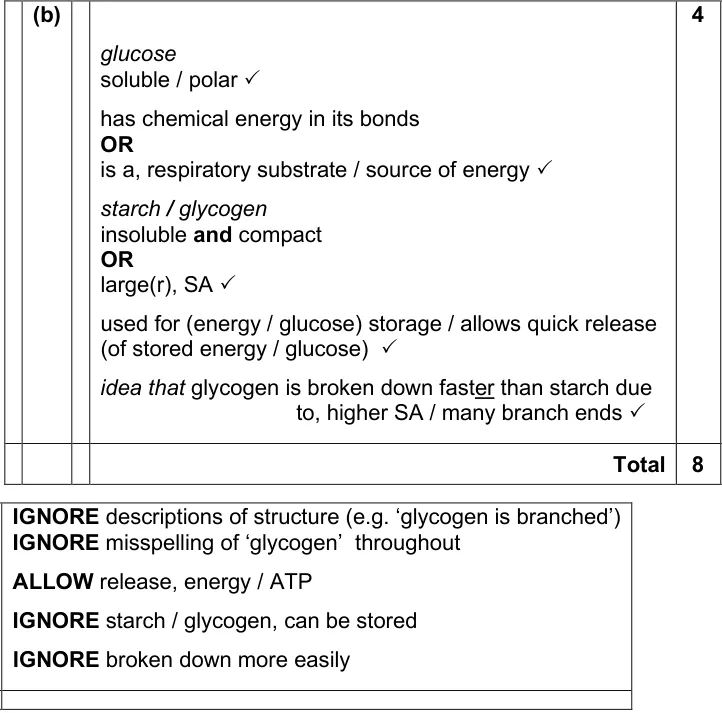
Outline how the properties of glucose, starch and glycogen relate to their functions in cells.
Show the mark scheme
Tap an image to open it full size.
From the examiners' report: Only the strongest answers got all 4 marks. Deal with each molecule in turn and give a property, not a structure. Say glycogen releases glucose more rapidly than starch because it has more branch ends; "easily" did not score.
Question 9
A level Paper 2 · June 2023 · Q21(c)(i) · 3 marks · Medium
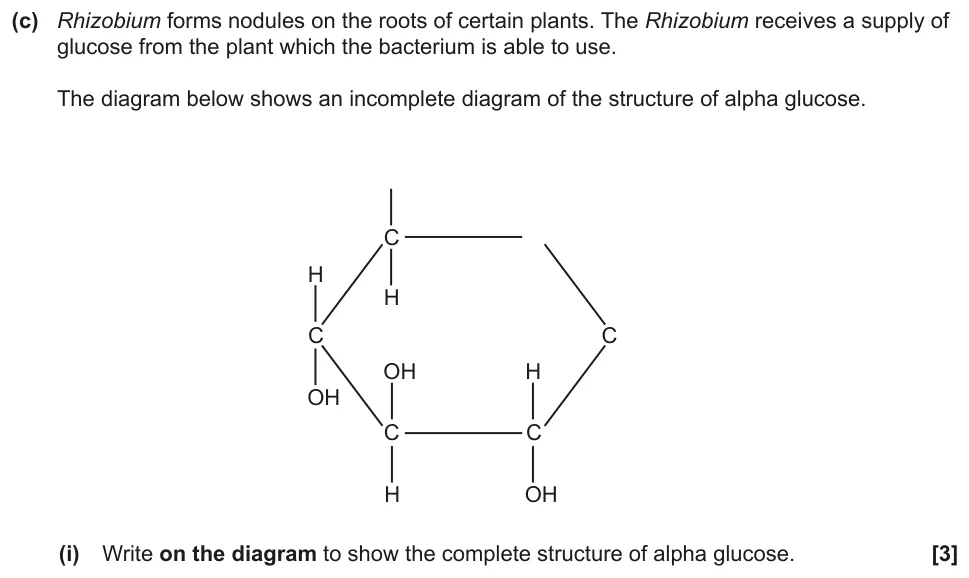
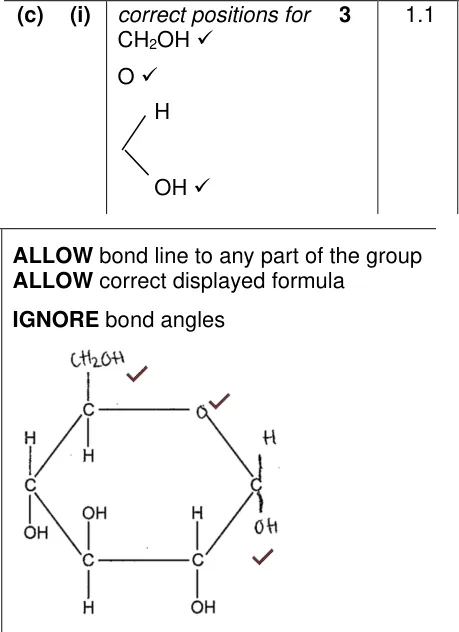
Complete the ring structure of α-glucose on a partly drawn diagram.
Show the mark scheme
Tap an image to open it full size.
From the examiners' report: Most students placed the ring oxygen or got carbon 1 right, but far fewer remembered the CH2OH group on carbon 5. Check all three before you move on: ring O, CH2OH, and OH below the ring on carbon 1.
Applying what you know
Question 10
A level Paper 2 · June 2023 · Q21(c)(ii) · 2 marks · Medium
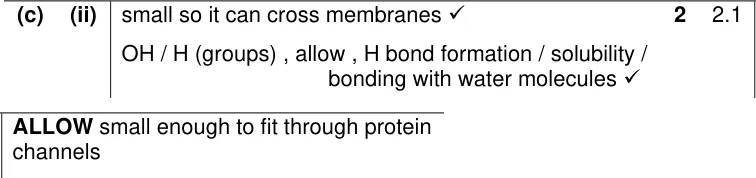
Explain how glucose's structure lets it move from a plant to a bacterium.
Show the mark scheme
Tap an image to open it full size.
From the examiners' report: Only half of students scored even one mark, and two marks were rare. Many described a property without linking it to the structure, or stopped after one point. Give two separate structure-to-property links.
Question 11
AS Paper 2 · June 2016 · Q3(a)(i) · 1 mark · Medium
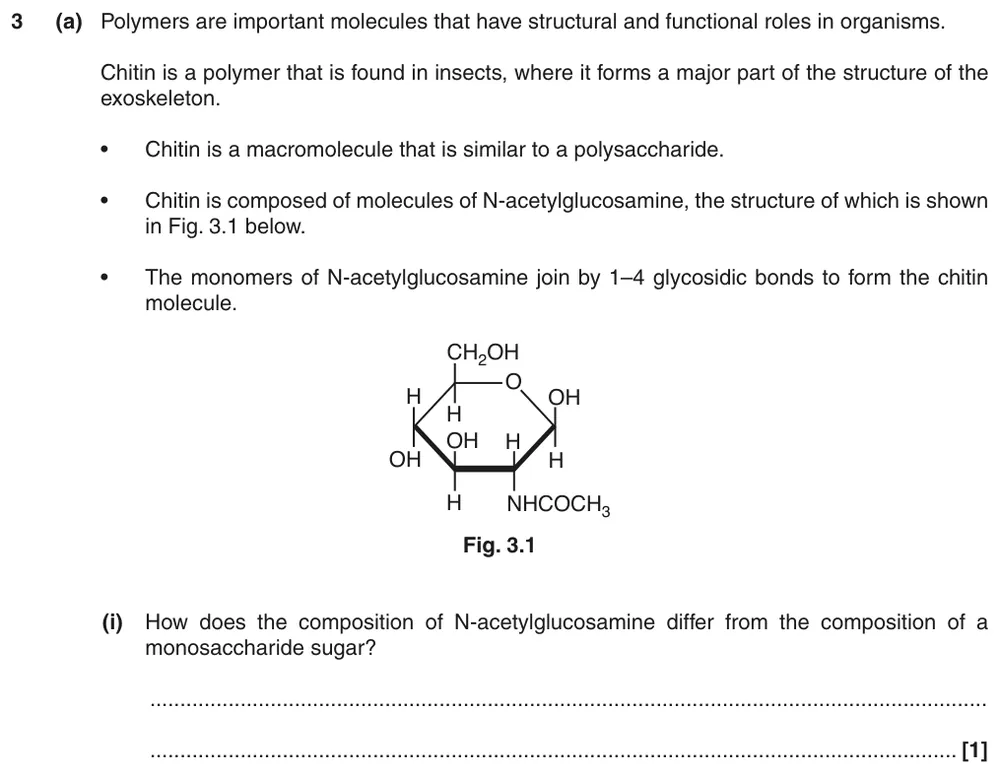
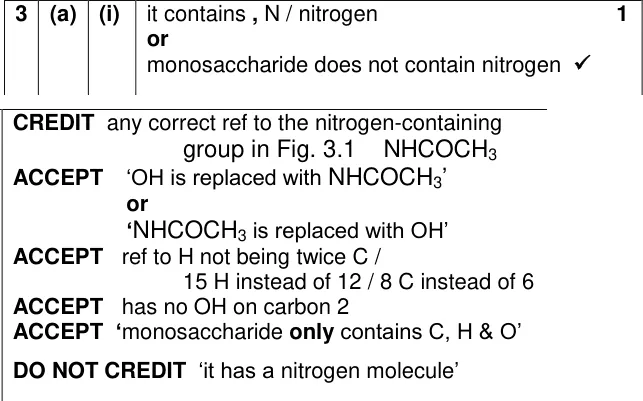
Use a diagram of N-acetylglucosamine, the chitin monomer, to say how its composition differs from a monosaccharide.
Show the mark scheme
Tap an image to open it full size.
Question 12
A level Paper 1 · June 2018 · Q19(b) · 4 marks · Medium
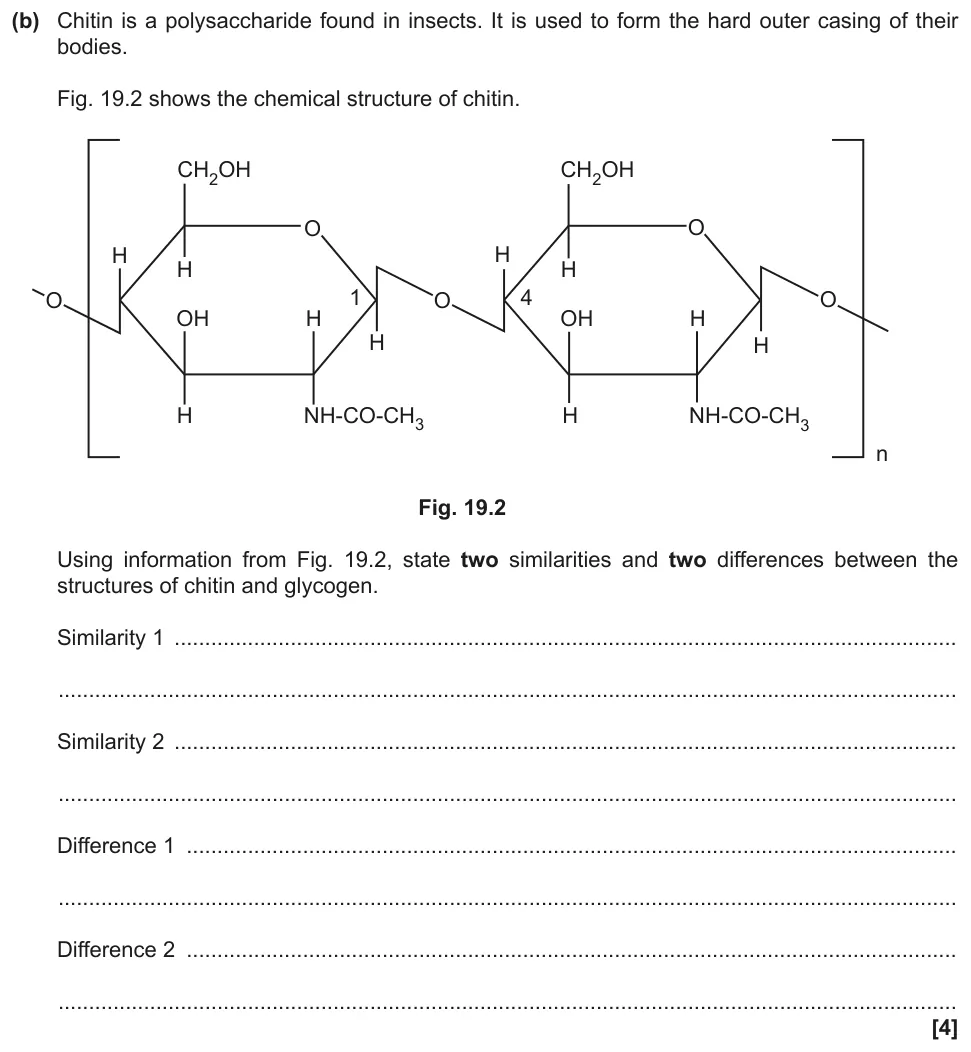
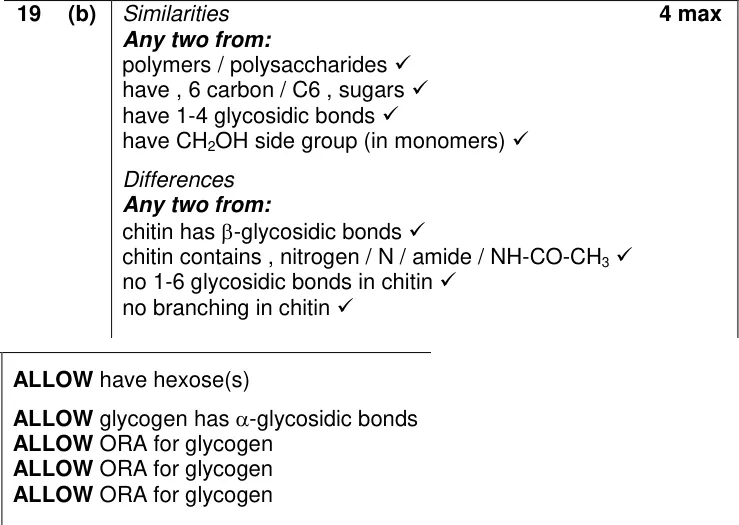
Use a diagram of chitin to give two similarities and two differences between chitin and glycogen.
Show the mark scheme
Tap an image to open it full size.
From the examiners' report: Saying both "contain glycosidic bonds" wasn't enough: name the 1-4 or 1-6 bonds. Say the polymers contain hexose sugars, not that they are hexose sugars. For each difference, say which polymer you mean.
Question 13
A level Paper 3 · November 2021 · Q3(a) · 2 marks · Medium
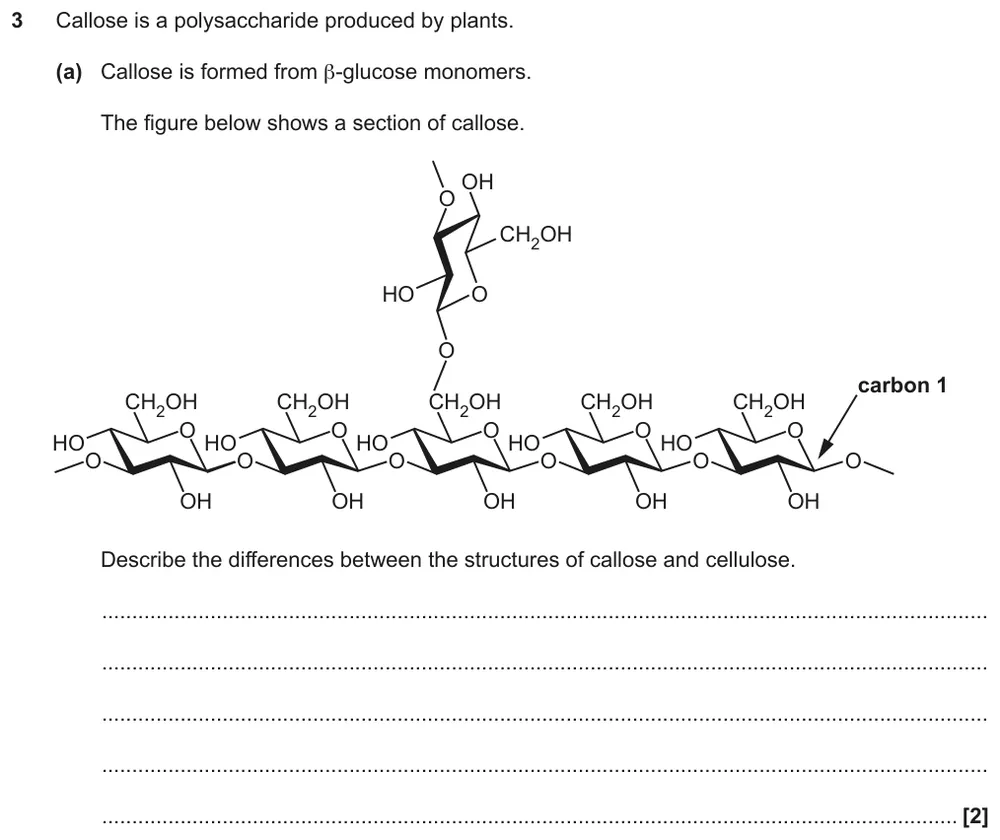
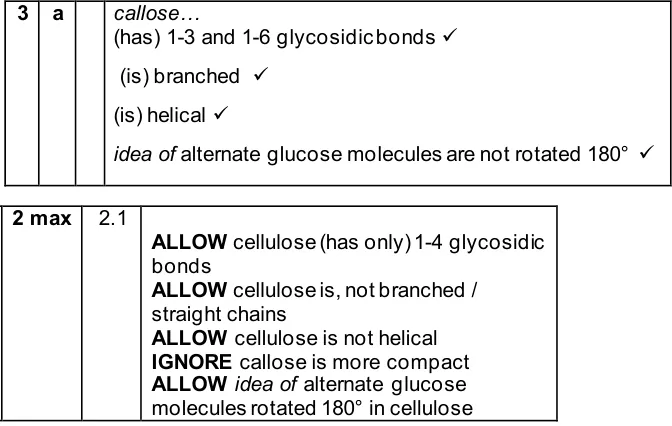
Use a diagram of callose to describe how its structure differs from cellulose.
Show the mark scheme
Tap an image to open it full size.
From the examiners' report: Many students spotted the branch and that alternate glucose units are not flipped. Others mixed up the bond numbers. Count the carbons on the diagram before you write 1-3, 1-4 or 1-6.
Practical and maths
Question 14
A level Paper 3 · June 2018 · Q2(b) · 3 marks · Easy
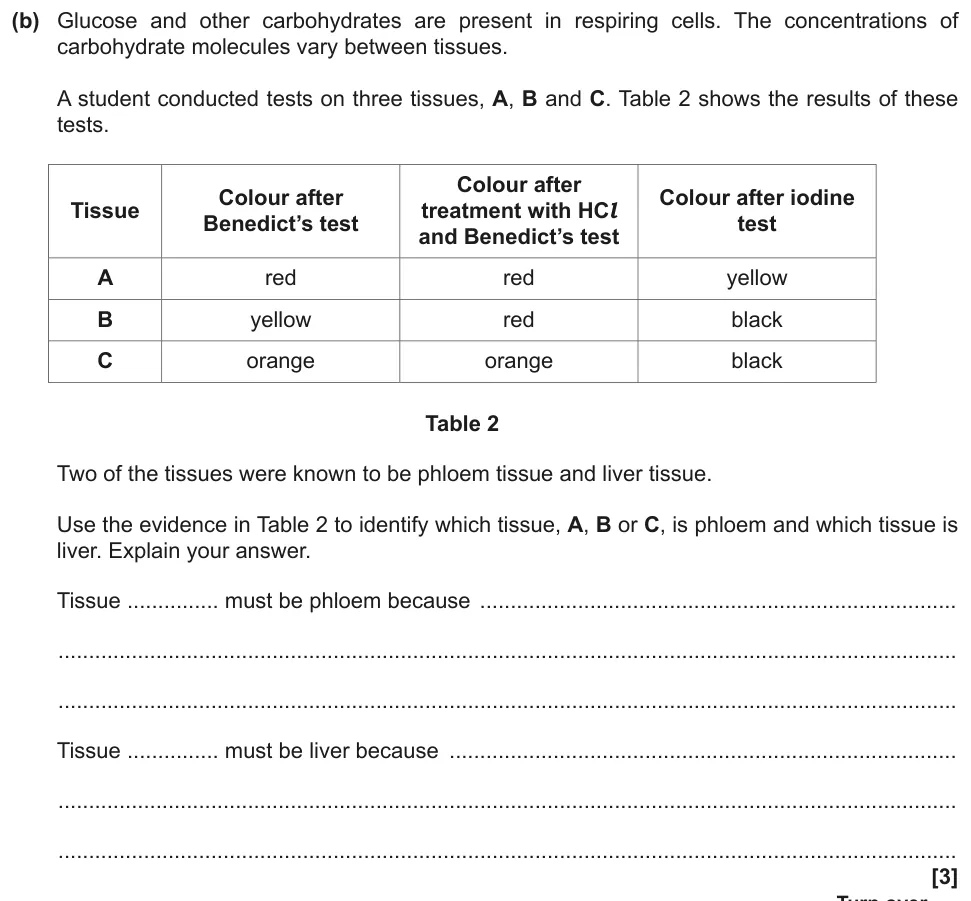
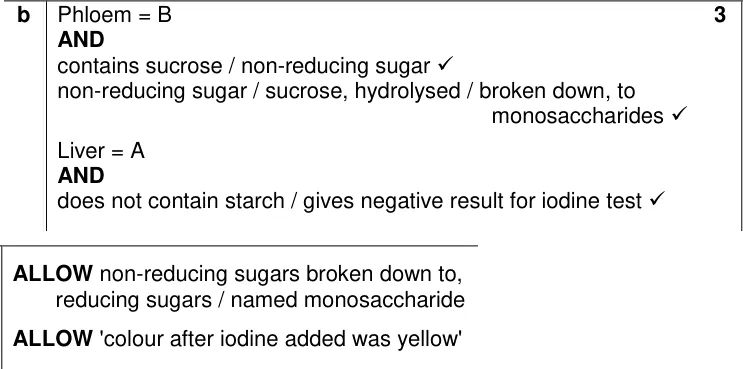
Use Benedict's, acid-hydrolysis and iodine results to identify phloem and liver tissue.
Show the mark scheme
Tap an image to open it full size.
From the examiners' report: Most students picked B as phloem, but fewer explained that boiling with acid hydrolyses sucrose into monosaccharides. Some lost a mark by calling sucrose a reducing sugar.
Question 15
A level Paper 3 · November 2021 · Q4(a) · 2 marks · Hard
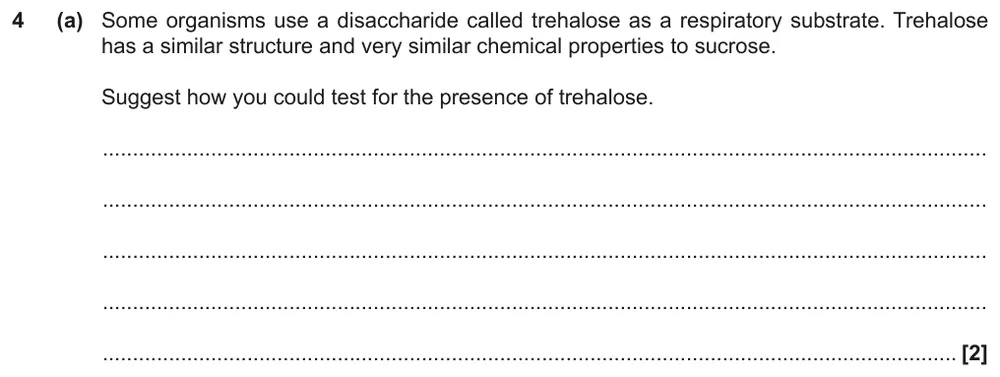
Suggest how to test for trehalose, a non-reducing sugar like sucrose.
Show the mark scheme

Tap an image to open it full size.
From the examiners' report: Very few students got both marks. The non-reducing sugar test only makes sense after a negative Benedict's test, so describe that first.
Question 16
AS Paper 2 · June 2023 · Q3(c)(i) · 3 marks · Medium
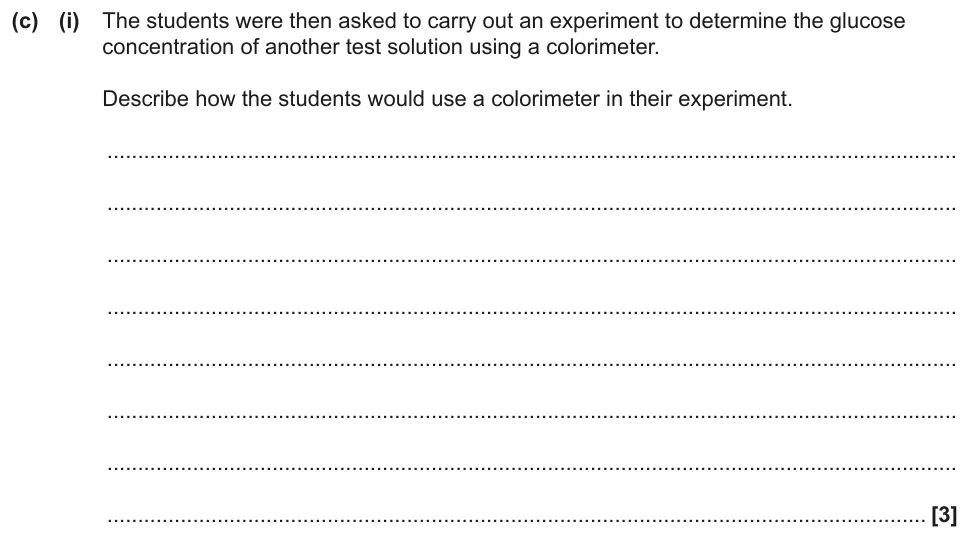
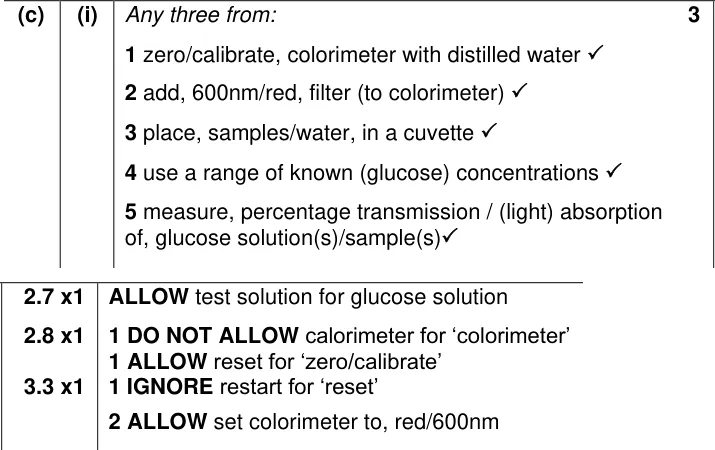
Describe how to use a colorimeter to find the glucose concentration of a solution.
Show the mark scheme
Tap an image to open it full size.
From the examiners' report: Many students knew to calibrate with distilled water. Learn the word cuvette rather than writing "special tubes", and keep to the colorimeter: this part didn't ask about the Benedict's test.
Question 17
AS Paper 2 · June 2023 · Q3(c)(ii) · 2 marks · Hard
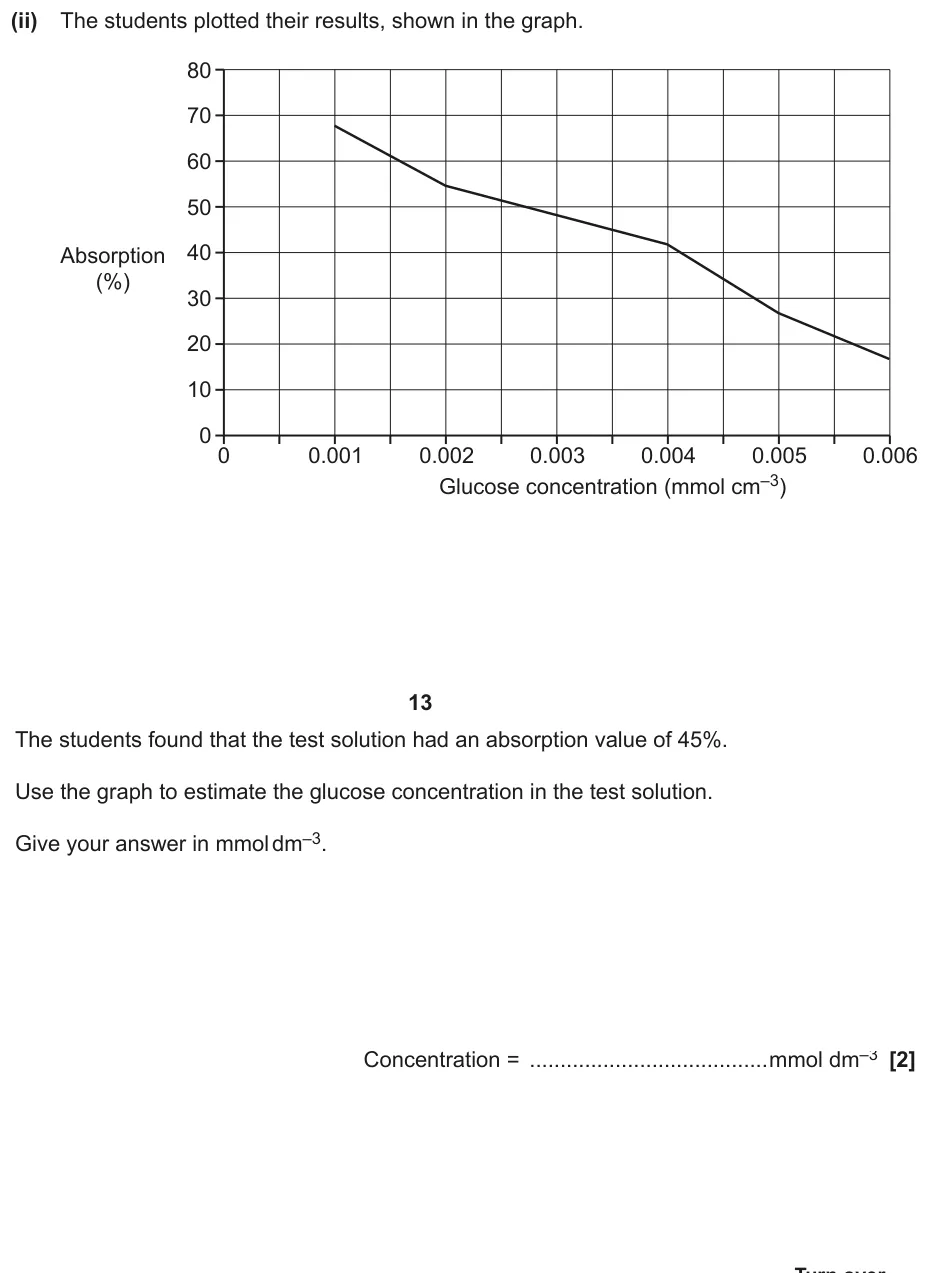
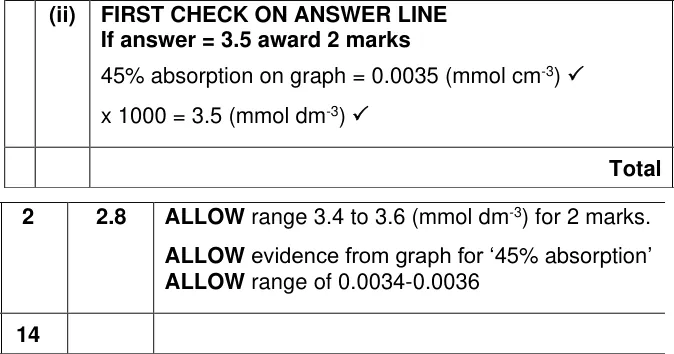
Read a glucose concentration off a calibration graph and convert it to mmol dm⁻³.
Show the mark scheme
Tap an image to open it full size.
From the examiners' report: Most students read the graph correctly but missed that the axis is in mmol cm⁻³. There are 1000 cm³ in a dm³, so multiply by 1000; don't divide.
Where students lose marks (from OCR examiners' reports and mark schemes)
Each point below is followed by wording that gained marks.
"Contains" hexose, not "is" hexose: When comparing chitin and glycogen, some students wrote that both polymers "are hexose sugars". A polymer is made of sugars; it isn't one, so this lost the mark.
✔ Gains credit: "Both have six-carbon (hexose) sugars" or "both are polysaccharides".
Say which polymer you mean: In "differences" answers, statements such as "it has β-glycosidic bonds" or "it is unbranched" scored nothing when the student didn't say which molecule "it" was.
✔ Gains credit: "Chitin has β-glycosidic bonds; glycogen has α-glycosidic bonds" and "there are no 1-6 glycosidic bonds in chitin, so it is not branched".
Don't forget carbon 6: When completing the α-glucose ring, most students placed the ring oxygen or the groups on carbon 1, but fewer added the CH2OH group, so full marks were less common.
✔ Gains credit: CH2OH drawn above carbon 5, an O in the ring between carbons 1 and 5, and on carbon 1 the H above the ring with the OH below it.
Two structural features, two marks: Asked how glucose's structure lets it move from plant to bacterium, many students described a property without linking it to the structure, or stopped after one point.
✔ Gains credit: "Glucose is small, so it can cross membranes through protein channels" and "its OH groups form hydrogen bonds with water, so it is soluble".
Rapid, and faster than starch: Writing that glucose is released "easily" from glycogen was ignored, and so was a claim that glycogen releases glucose quickly without comparing it with starch.
✔ Gains credit: "Glycogen is broken down faster than starch because it has more branch ends, so glucose can be released rapidly".
Count the carbons in a new polysaccharide: Comparing callose with cellulose, some students confused the types of glycosidic bond between the monomers.
✔ Gains credit: "Callose has 1-3 and 1-6 glycosidic bonds, but cellulose has only 1-4 bonds" and "in cellulose alternate glucose molecules are rotated 180°; in callose they are not".
Say what the acid does: In food test questions, students often linked a red result after boiling with acid to sucrose without explaining why, and some lost a mark by calling sucrose a reducing sugar.
✔ Gains credit: "Sucrose is a non-reducing sugar; boiling with HCl hydrolyses it into monosaccharides, which are reducing sugars and give a positive Benedict's test".
Name the colorimeter kit: Students who knew the method still lost precision by calling cuvettes "special tubes" or writing "calorimeter" (not allowed), and some described the Benedict's test when only the colorimeter was asked about.
✔ Gains credit: "Zero the colorimeter with distilled water, use a red (600 nm) filter, put each sample in a cuvette and measure the absorbance of known glucose concentrations".
Download the questions
Download the PDF pack (17 questions, mark schemes at the end)
Keep practising
- Carbohydrates quiz (27 multiple-choice questions)
- Carbohydrates, Ions and Elements quiz (29 questions)
- Carbohydrates: Glucose, Starch and Cellulose, with worked answers
- Cell Structure (2.1.1): OCR A Level Biology exam questions by topic
- Nucleotides and Nucleic Acids (2.1.3): OCR A Level Biology exam questions by topic
- Water, Lipids, Proteins and Ions (2.1.2): OCR A Level Biology exam questions by topic
- OCR A Level Biology masterclasses
Questions, mark schemes and examiners' report extracts © OCR.