

OCR A PAG 9 · 8 questions · mark schemes and examiners’ tips included
PAG 9 is the food tests practical: biuret for protein, Benedict's for reducing and non-reducing sugars, iodine for starch and the emulsion test for lipids. You will also have used glucose test strips, and the Benedict's test together with a colorimeter to put a number on how much reducing sugar is there.
These are marks you should never drop, but the examiners keep seeing the same slips. Students swap the tests round, spell biuret as 'burette', add a heating step to the emulsion test, forget the water, or say a reducing sugar is non-reducing. In method questions, the marks go on naming the reagent, the apparatus and the colour you would see, and on saying 'volume' or 'concentration' rather than 'amount'.
Work through the eight questions below in order. They start with the food tests themselves, then using a test to answer a question, and finish with methods that use Benedict's and a colorimeter. If you'd like to go through questions like these with me each week, my OCR A masterclasses run on Wednesdays at 5.15pm for Year 12 and on Tuesdays at 6.30pm or Thursdays at 5.15pm for Year 13.
Want help with this topic? It comes up in my weekly OCR A masterclasses. See the timetable →
What these questions cover (OCR PAG 9: qualitative testing)
PAG 9 is one of the twelve practical activity groups in the OCR A Level Biology A specification (H420). The questions test these parts of the specification:
- 1.2.2(f) use of qualitative reagents to identify biological molecules
- 2.1.2(q) how to carry out and interpret the results of the following chemical tests (biuret, Benedict's (reducing and non-reducing sugars), iodine and emulsion tests)
- 2.1.2(r) quantitative methods to determine the concentration of a chemical substance in a solution (to include colorimetry)
How to use this page
Write your answer on paper before you open the mark scheme. Allow about 1.2 minutes per mark: the 8 questions are worth 27 marks, so about 32 minutes in total. Then mark your answer strictly against the mark scheme and read the examiners' tip underneath it. If you'd rather print the questions, download the PDF pack.
The food tests
Question 1
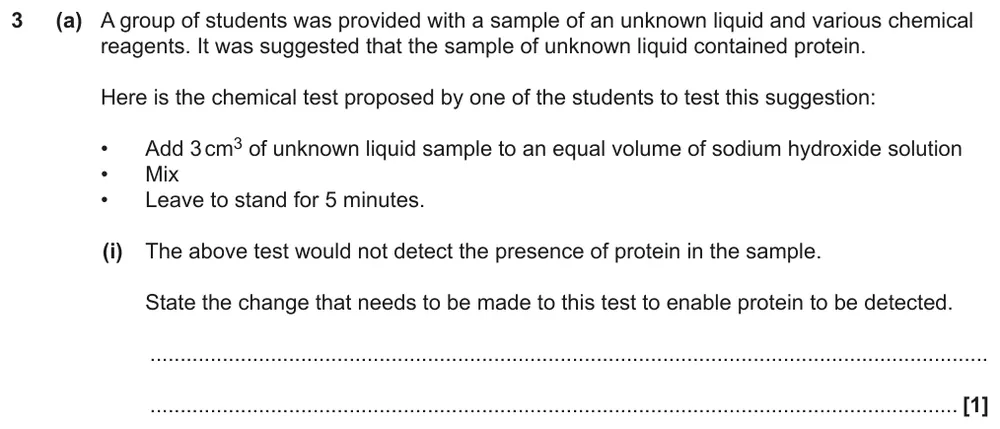
AS Paper 2 · June 2023 · Q3(a)(i) · 1 mark · Medium
State the change needed so that a proposed method detects protein.
Show the mark scheme

Tap an image to open it full size.
From the examiners' report: Well answered, though some students said Benedict's reagent. Learn to spell biuret: it is easily confused with burette.
Question 2
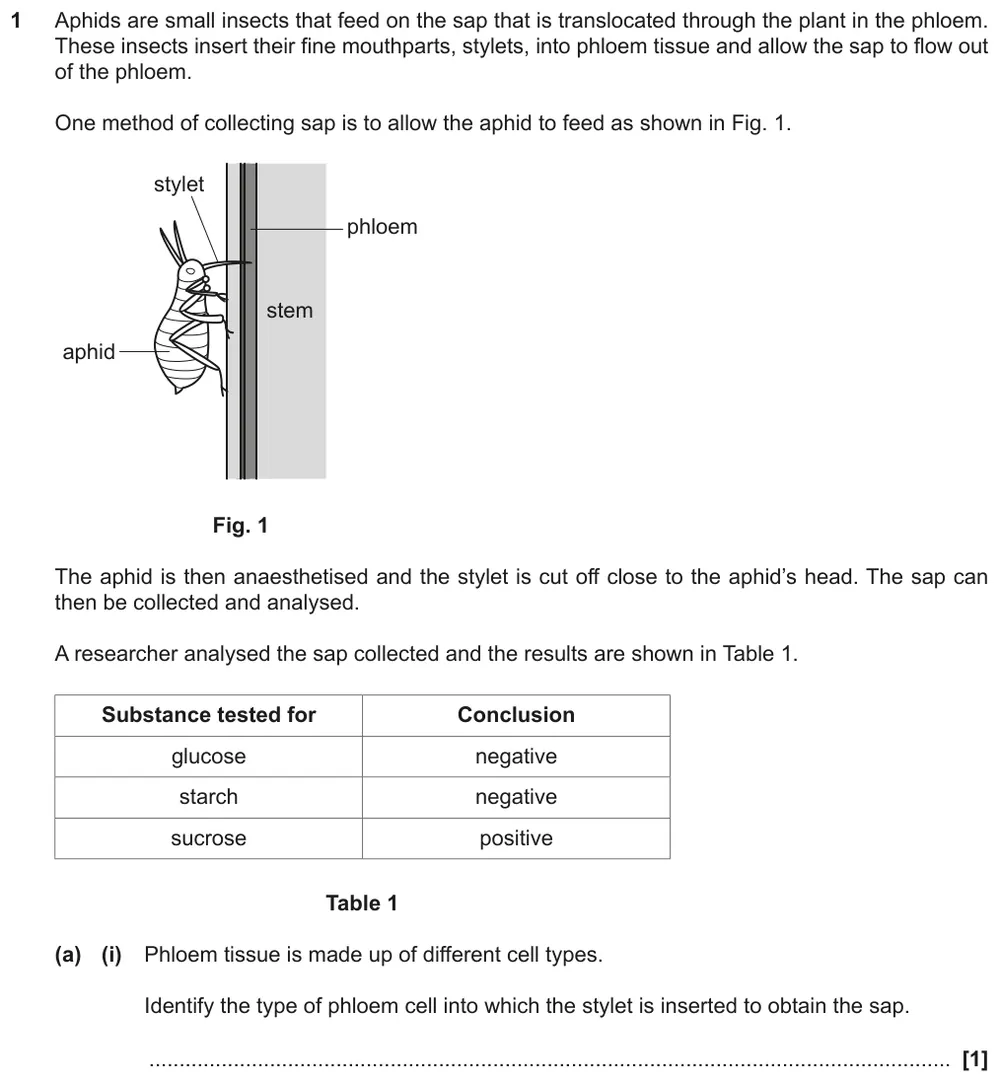
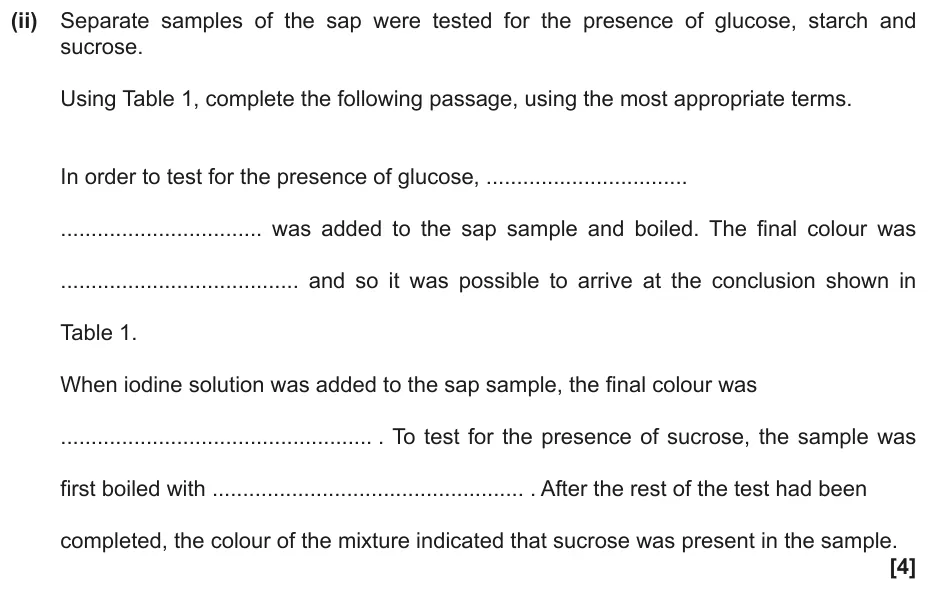
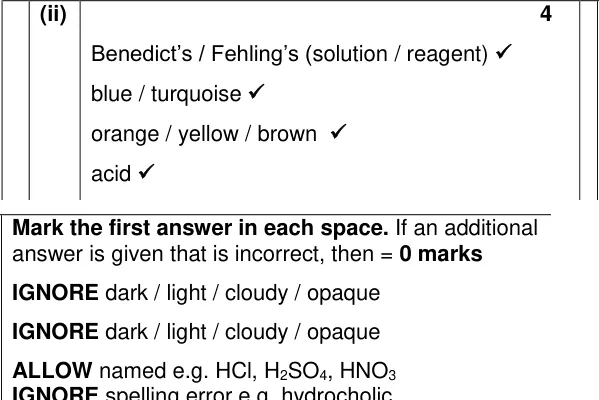
AS Paper 2 · June 2019 · Q1(a)(ii) · 4 marks · Medium
Complete a passage on the tests for glucose, starch and sucrose in plant sap.
Information from earlier in this question:
Show the mark scheme
Tap an image to open it full size.
From the examiners' report: Most students knew the reagents. Use the results table to work out each colour: no glucose means Benedict's stays blue, and no starch means iodine stays orange or brown. For sucrose, boil with acid first.
Question 3
AS Paper 2 · June 2023 · Q3(b) · 6 marks · Hard
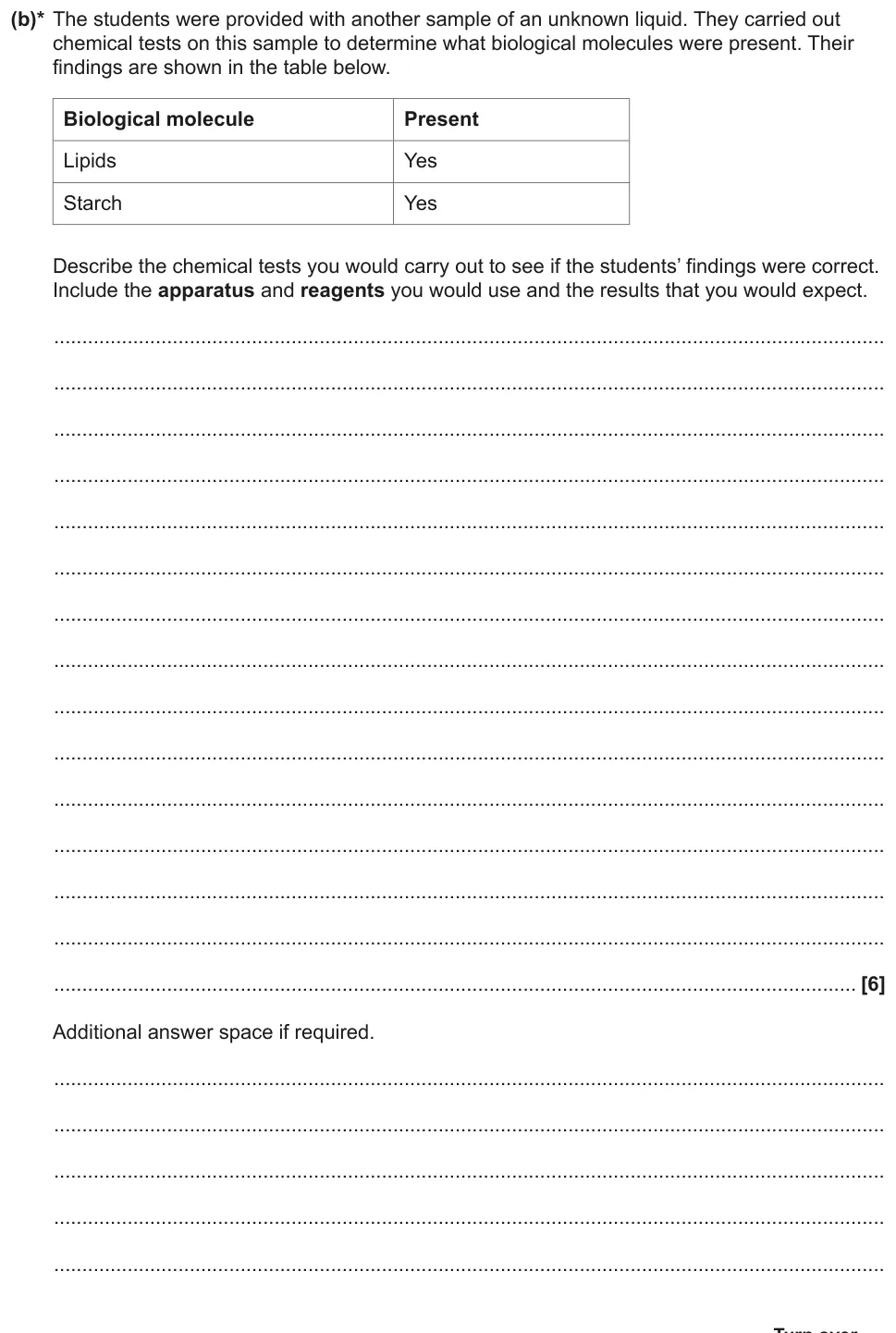
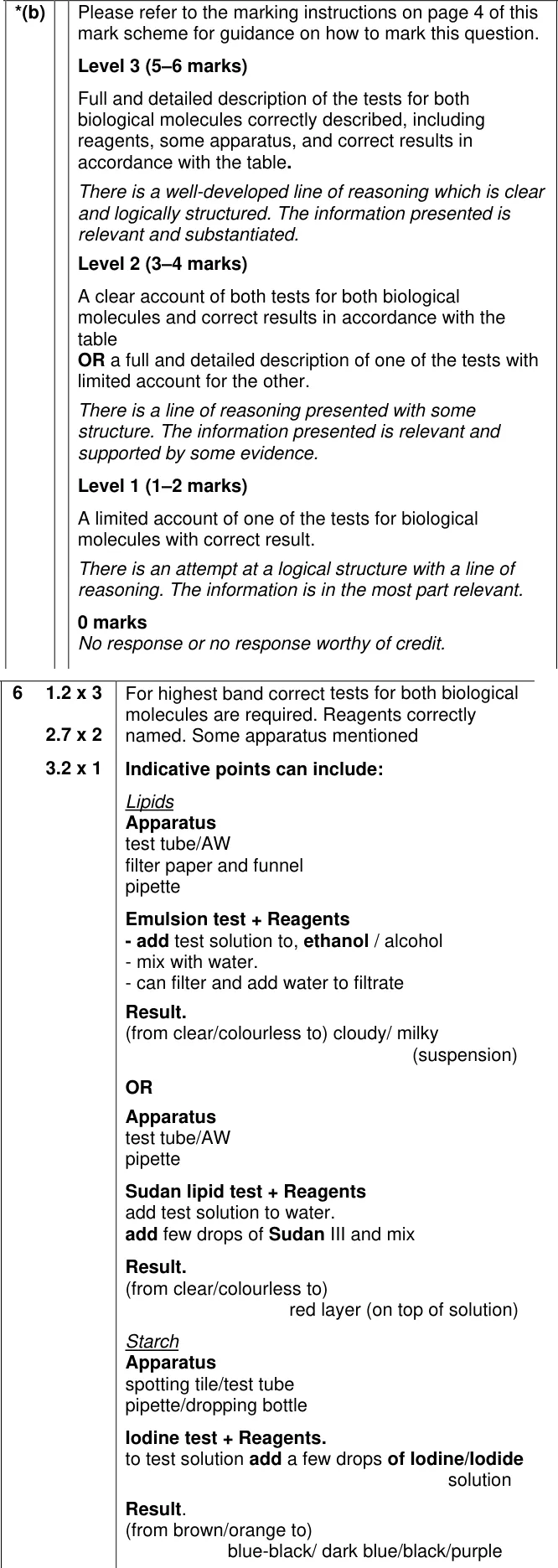
Describe the tests you would do to check that an unknown liquid contains lipid and starch, with apparatus, reagents and results.
Show the mark scheme
Tap an image to open it full size.
From the examiners' report: Many students reached Level 3. Marks were lost for leaving out the water in the emulsion test, adding a heating step, or confusing the starch test with Benedict's. Name the apparatus (a spotting tile, not a 'white tile'), and don't crush the sample: it is already a liquid.
Using a test to answer a question
Question 4
AS Paper 2 · June 2016 · Q4(a)(ii) · 1 mark · Medium
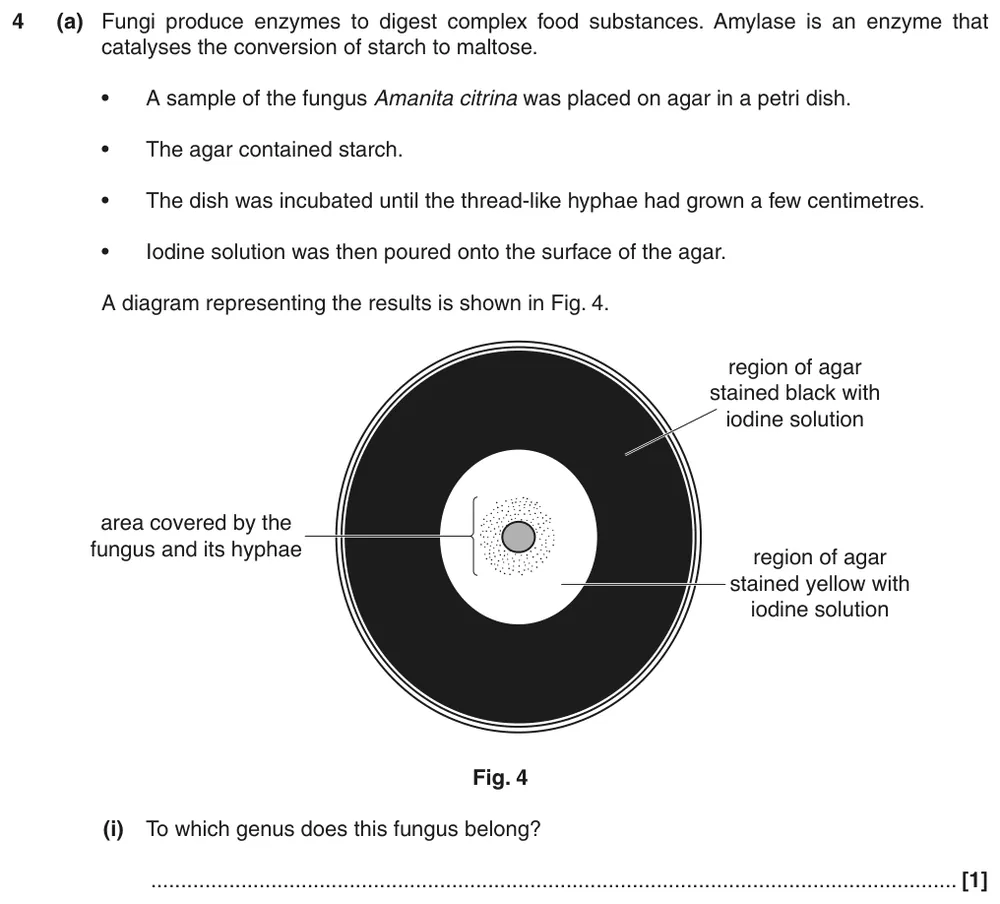
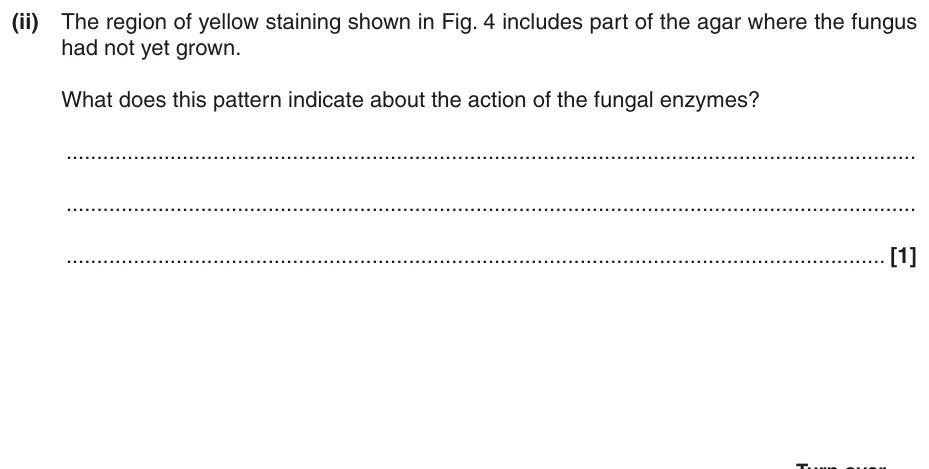
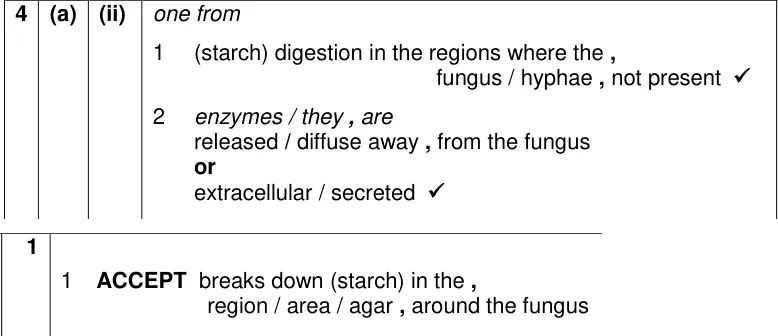
Explain what yellow staining beyond the fungus on starch agar shows about its enzymes.
Information from earlier in this question:
Show the mark scheme
Tap an image to open it full size.
From the examiners' report: There's no examiners' report for this paper. Yellow or brown iodine means the starch has gone, so the enzymes have digested it beyond the hyphae: say they are secreted, extracellular enzymes that diffuse away from the fungus.
Question 5
AS Paper 2 · June 2017 · Q6(b)(i) · 4 marks · Medium
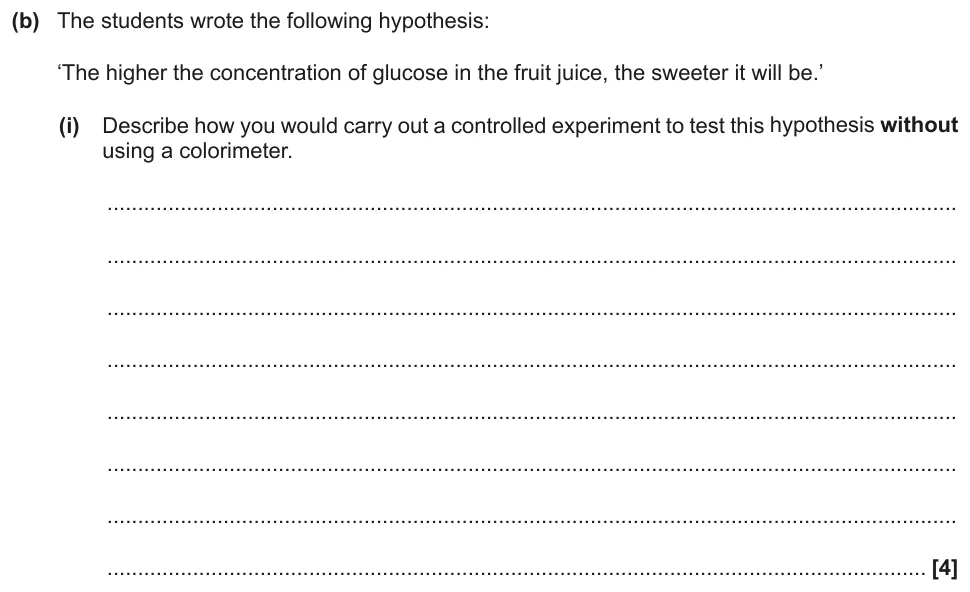
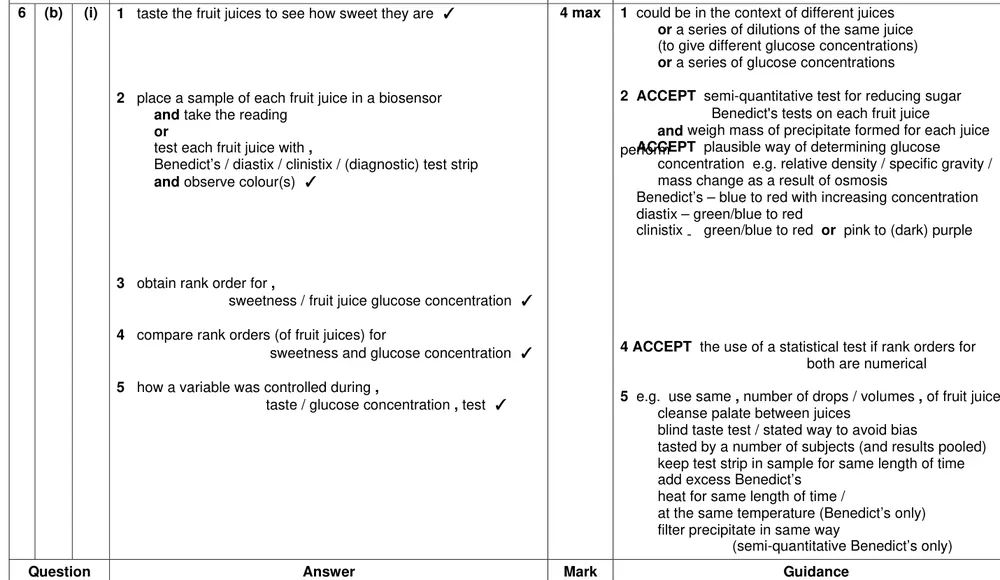
Describe a controlled experiment, without a colorimeter, to test whether juices with more glucose taste sweeter.
Show the mark scheme
Tap an image to open it full size.
From the examiners' report: There's no examiners' report for this paper. The mark scheme wants both measurements, sweetness by tasting and glucose by biosensor, test strip or Benedict's, then a rank order for each that you compare. Add one control, such as the same volume of juice or a blind taste test.
Question 6
AS Paper 2 · June 2017 · Q6(b)(ii) · 1 mark · Medium
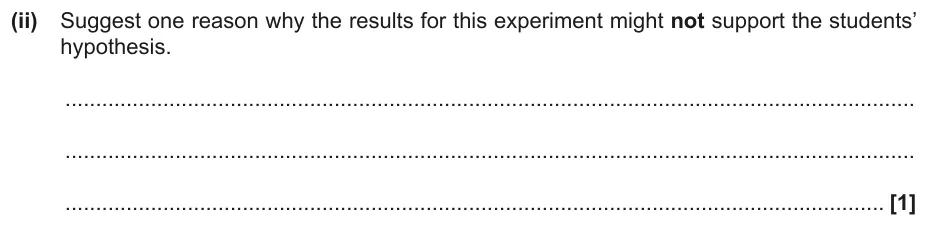
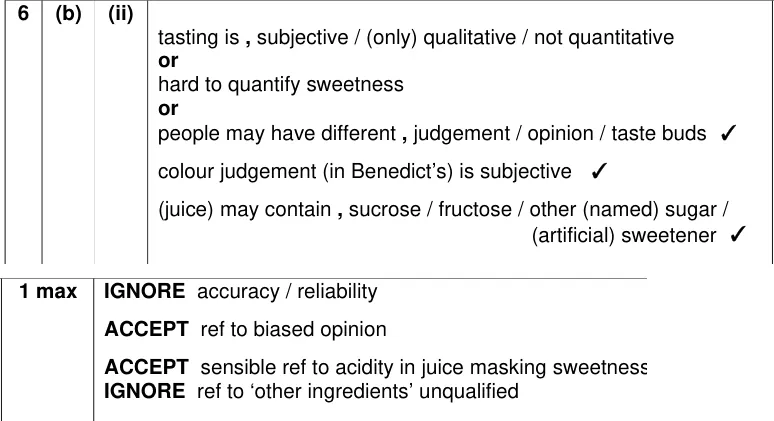
Suggest why the results might not support the glucose and sweetness hypothesis.
Show the mark scheme
Tap an image to open it full size.
From the examiners' report: There's no examiners' report for this paper. The mark scheme ignores 'accuracy' and 'reliability'. Give a specific reason: sweetness is judged subjectively, or the juice contains other sugars or sweeteners that taste sweet.
Benedict's and the colorimeter
Question 7
A level Paper 2 · June 2017 · Q20(c) · 4 marks · Medium
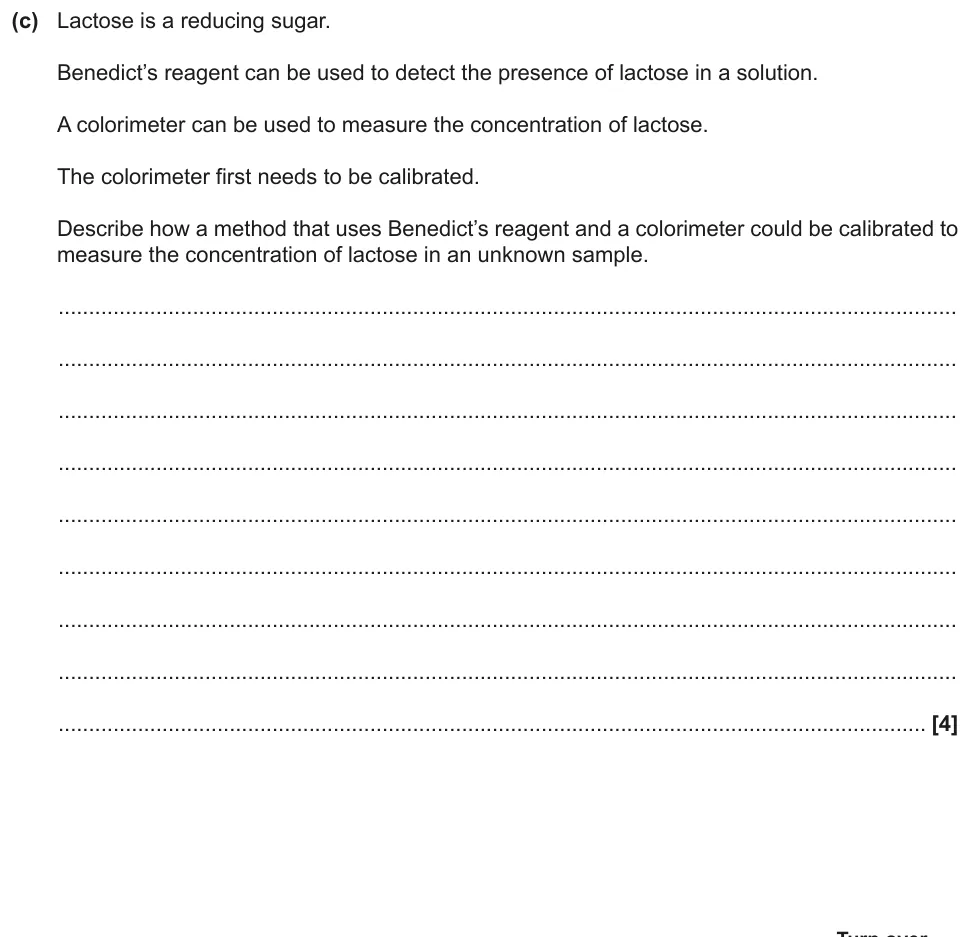
Describe how to calibrate a Benedict's and colorimeter method to find the lactose concentration of an unknown sample.
Show the mark scheme
Tap an image to open it full size.
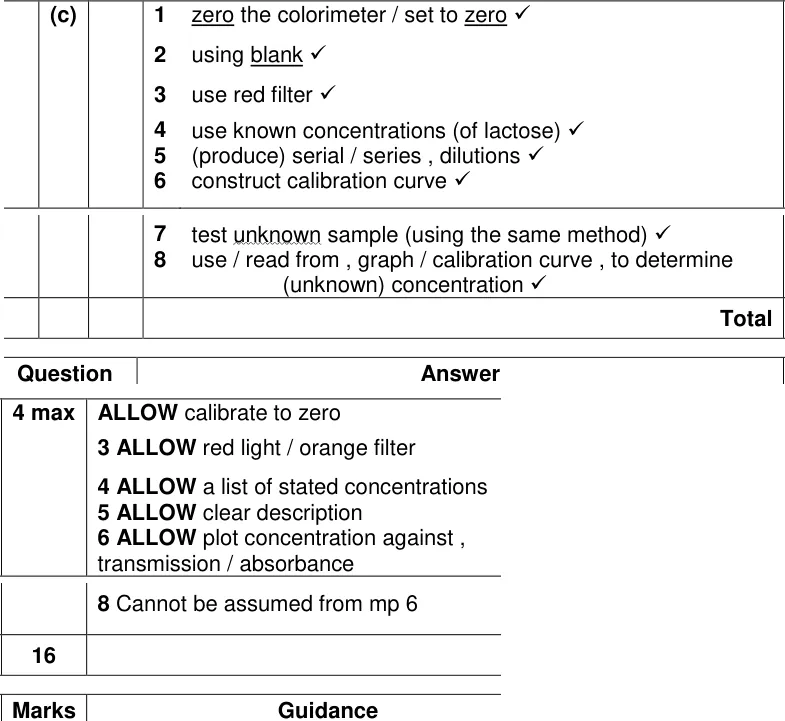
From the examiners' report: There's no examiners' report for this paper. The mark scheme wants the whole chain: zero with a blank, test known concentrations, plot a calibration curve, then test the unknown and read its concentration off the curve. Reading the unknown isn't assumed from drawing the curve, so say it.
Question 8
A level Paper 2 · June 2023 · Q18(c)(ii) · 6 marks · Medium
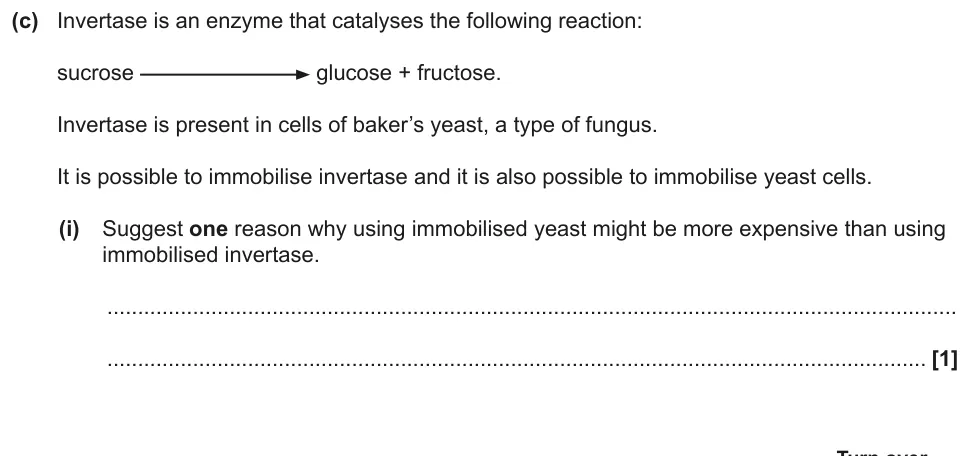
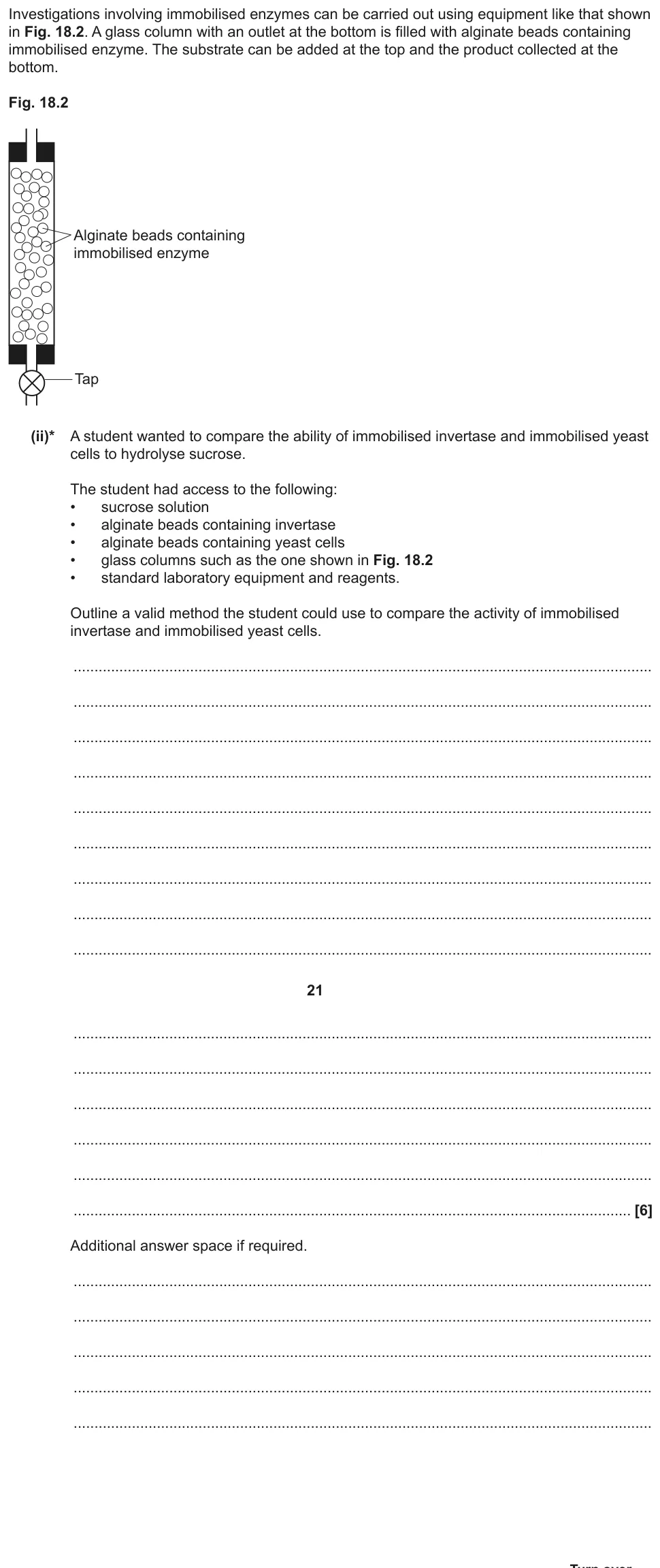
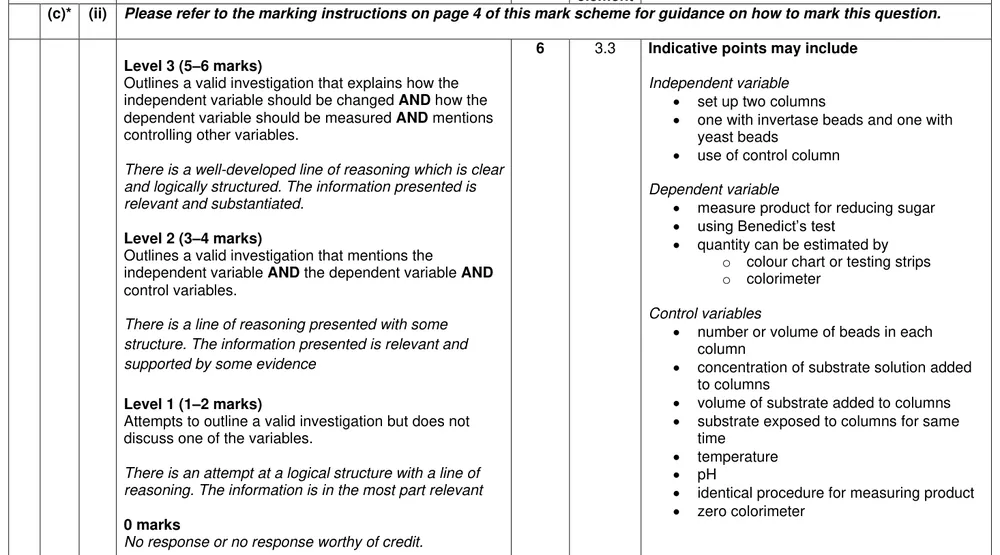
Outline a valid method to compare how well immobilised invertase and immobilised yeast hydrolyse sucrose.
Information from earlier in this question:
Show the mark scheme
Tap an image to open it full size.
From the examiners' report: Level 3 needed the independent variable, how to measure the dependent variable and control variables. 'Test the solution for sucrose' didn't score: test the product for reducing sugar with Benedict's. Glucose and fructose are reducing sugars. Say 'concentration' or 'volume', never 'amount', and keep to an outline.
Where students lose marks (from OCR examiners' reports and mark schemes)
Each point below is followed by wording that gained marks.
Biuret, not burette: Some students gave Benedict's reagent for protein, and the spelling of biuret varied a great deal.
✔ Gains credit: "Add biuret (instead of sodium hydroxide)"; copper sulfate solution is also allowed.
Ethanol, then water, no heat: In the emulsion test, students often left out the water or added a heating step.
✔ Gains credit: "Add test solution to ethanol, mix with water": the result is "cloudy / milky (suspension)".
Iodine is the starch test: Students who chose the wrong test often confused the test for starch with the test for reducing sugars, and some called a spotting tile a 'white tile'.
✔ Gains credit: "Spotting tile, to test solution add a few drops of iodine solution": the result is "(from brown / orange to) blue-black".
Glucose and fructose are reducing: Some students said Benedict's would test for a non-reducing sugar, or that glucose and fructose are non-reducing sugars.
✔ Gains credit: "Measure product for reducing sugar using Benedict's test"; the quantity "can be estimated by colour chart or testing strips or colorimeter".
Concentration or volume, never amount: Control variables written as 'the amount of sucrose' were ambiguous and lost credit.
✔ Gains credit: "Concentration of substrate solution added to columns" and "volume of substrate added to columns".
Sweetness is subjective: The mark scheme ignores vague answers about accuracy or reliability.
✔ Gains credit: "Tasting is subjective / (only) qualitative", or the juice "may contain sucrose / fructose / other (named) sugar / (artificial) sweetener".
Read the unknown off the curve: Drawing a calibration curve doesn't earn the final marks unless you also test the unknown and use the curve.
✔ Gains credit: "Use known concentrations", "construct calibration curve", "test unknown sample (using the same method)" and "read from graph / calibration curve, to determine (unknown) concentration".
Download the questions
Download the PDF pack (8 questions, mark schemes at the end)
Keep practising
- OCR A food tests and chromatography quiz
- OCR A Level Biology biological molecules quiz
- Carbohydrates: OCR A Level Biology exam questions by topic
- PAG 5 Colorimeter and Potometer: OCR A Level Biology exam questions by topic
- OCR A Level Biology masterclasses
Questions, mark schemes and examiners' report extracts © OCR.