

Arithmetic and numerical computation (MS0 in the mathematical requirements of the specification) covers using the right units in calculations, writing numbers in decimal and standard form, using ratios, fractions and percentages, estimating results, and using a calculator for powers and logarithms. Biology questions set these skills in context: the mass of a drug given during a trial, the energy red squirrels take from pine cones per hectare per day, the number of bacteria in the rumen of a cow, the percentage change in a bird population, a surface area to volume ratio, or the number of cell divisions needed to make a nematode worm. Calculations like these appear on every paper. Questions marked AS are from the AS papers (B400); the rest are from the A level papers (A400).
The examiners' reports keep making the same points. Read the instruction in the question: give the unit asked for (grams, not milligrams), use standard form when told to, and round to the nearest whole number if that is what is wanted. Percentage change is still a problem for a significant number of candidates, and some misread the graph the values come from. Round correctly, and keep the decimal point in the right place. Finish the calculation: a considerable number forgot to halve the number of kites to give breeding pairs. And check that the answer is sensible: thousands of squirrels in one hectare is not.
I don't teach the Eduqas specification myself, so for one-to-one help I recommend Sam. He teaches Eduqas A level Biology at a top-rated sixth form college and is very popular with his students. You can ask about lessons with Sam on WhatsApp using the link at the bottom of this page.
What you need first
Each question on this page assumes you're secure on these ideas. If any of them feels shaky, look it up before you start.
- Unit conversions: 1 g = 1000 mg, 1 dm³ = 1000 cm³, 1 mm = 1000 µm and 1 µm = 1000 nm.
- Percentage change = (change ÷ original value) × 100.
- A number in standard form is written as a × 10ⁿ, where a is at least 1 and less than 10.
- Each round of cell division doubles the number of cells, so n divisions of one cell give 2ⁿ cells.
Key terms
These words come up in the questions and mark schemes. Examiners expect you to use them exactly.
- Standard form: a number written as a × 10ⁿ, with one non-zero digit before the decimal point, for example 1.2 × 10⁵.
- Percentage change: the difference between the new and the original value, divided by the original value and multiplied by 100.
- Ratio: a comparison of two quantities; in the form n : 1 the first quantity is divided by the second.
- Rate: an amount per unit of something else, such as kJ per hectare per day or mm³ per hour.
- Estimate: an approximate answer found by rounding the values before you calculate.
- Logarithm (log₁₀): the power to which 10 must be raised to give a number; log₁₀ 100 = 2 because 10² = 100.
- Generation: one round of cell division; a bacterium that divides every 20 minutes goes through three generations an hour.
What these questions cover
Every question on this page uses one of these mathematical skills, listed in the mathematical requirements of the Eduqas A level Biology specification (A400).
- MS0.1: Recognise and make use of appropriate units in calculations
- MS0.2: Recognise and use expressions in decimal and standard form
- MS0.3: Use ratios, fractions and percentages
- MS0.4: Estimate results
- MS0.5: Use calculators to find and use power, exponential and logarithmic functions
How to use this page
Write your answer on paper before you open the mark scheme. Allow about 1.2 minutes per mark: the 20 questions are worth 41 marks, so about 49 minutes in total. Then mark your answer strictly against the mark scheme and read the examiners' tip underneath it. If you'd rather print the questions, download the PDF pack.
Units and rates (MS0.1)
Question 1
A level Component 2 · Autumn 2020 · Q5(c)(i) · 2 marks
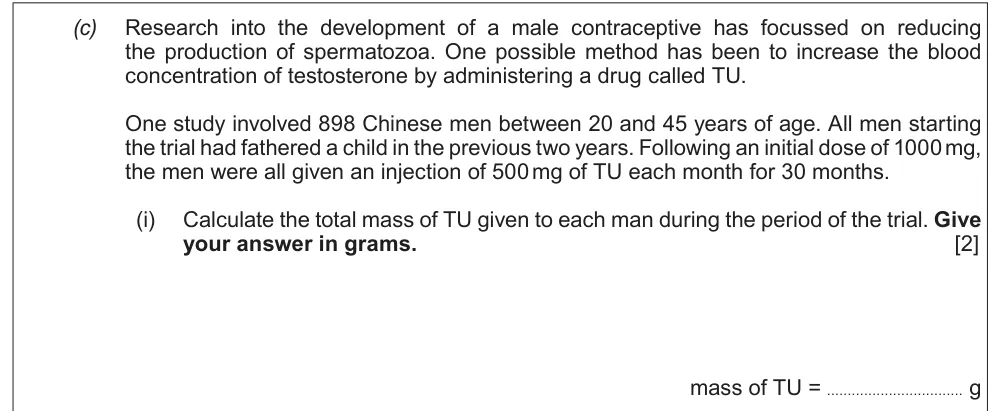
Calculate the total mass of a drug given over a 30-month trial, in grams.
Show the mark scheme
Tap an image to open it full size.
From the examiners' report: Converting units, here from milligrams to grams, was still a problem. Read the instruction on how the answer must be given.
Question 2
A level Component 1 · June 2017 · Q7(c)(i) · 2 marks
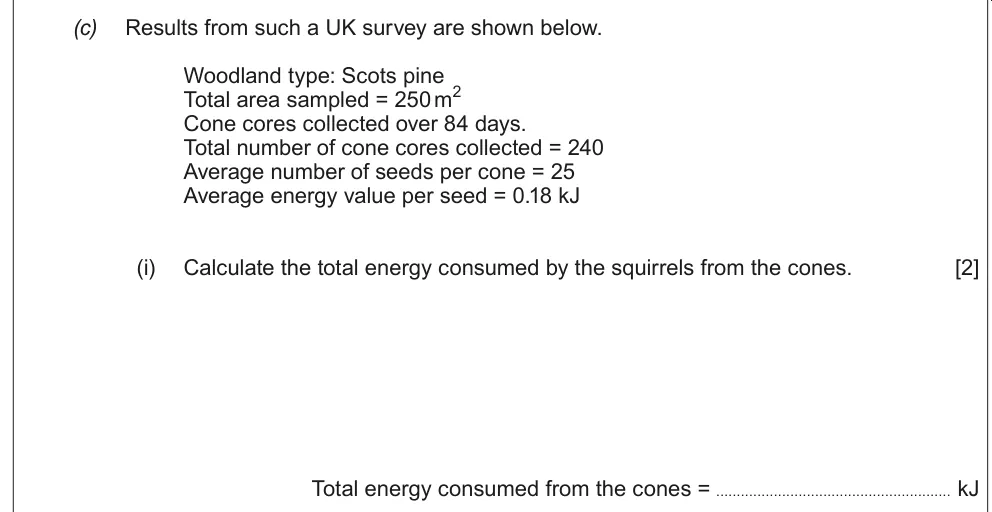
Calculate the total energy red squirrels took from pine cones, using the survey results.
Show the mark scheme

Tap an image to open it full size.
From the examiners' report: The maths in this part of the question was routinely good.
Question 3
A level Component 1 · June 2017 · Q7(c)(ii) · 2 marks
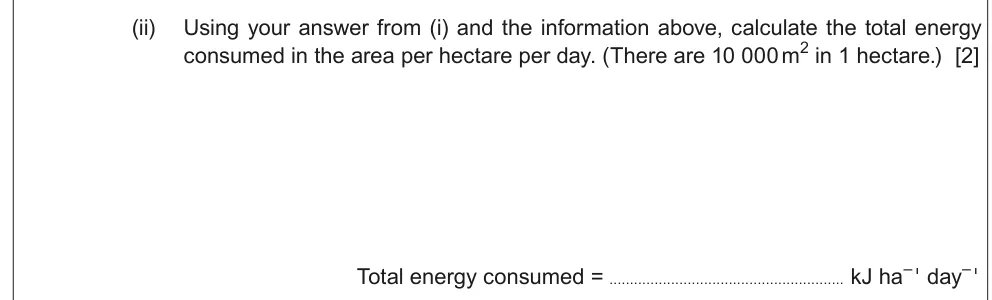
Convert the total energy to a rate per hectare per day.
Show the mark scheme

Tap an image to open it full size.
From the examiners' report: The maths in this part of the question was routinely good.
Question 4
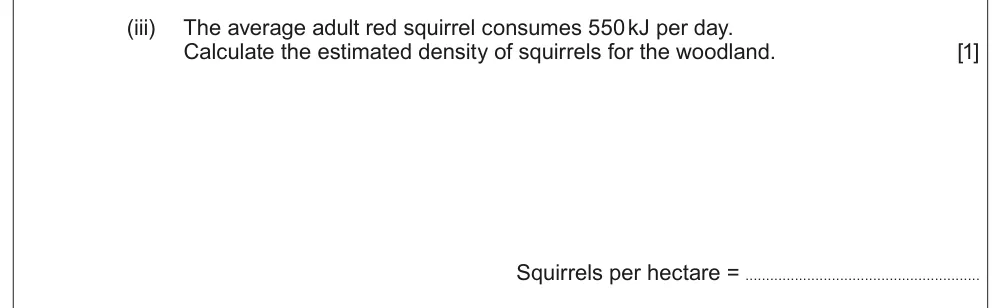
A level Component 1 · June 2017 · Q7(c)(iii) · 1 mark
Use the daily energy need of one squirrel to estimate the number of squirrels per hectare.
Show the mark scheme

Tap an image to open it full size.
From the examiners' report: A significant number of candidates calculated many thousands of squirrels in a hectare, which is more than the whole UK population. Ask yourself whether your answer is sensible.
Standard form (MS0.2)
Question 5
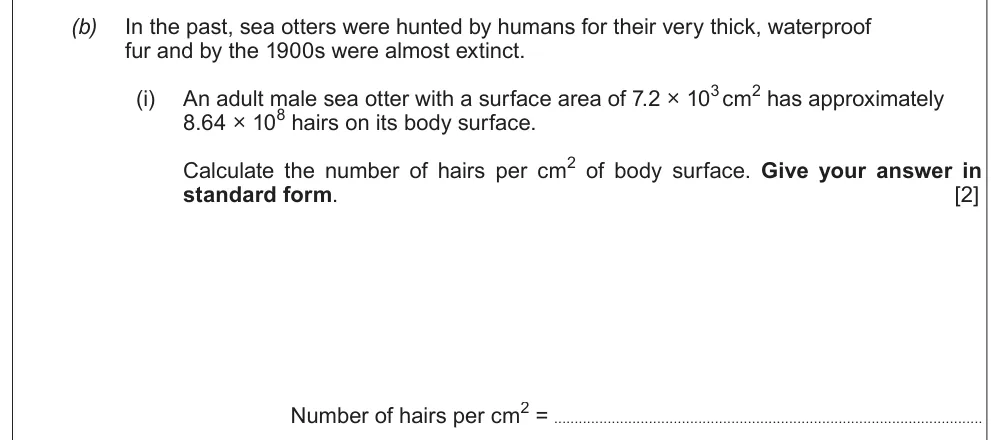
A level Component 1 · Autumn 2021 · Q7(b)(i) · 2 marks
Divide two numbers given in standard form to find the number of hairs per cm² of a sea otter.
Show the mark scheme

Tap an image to open it full size.
From the examiners' report: The calculation of the number of hairs per square centimetre was generally good.
Question 6
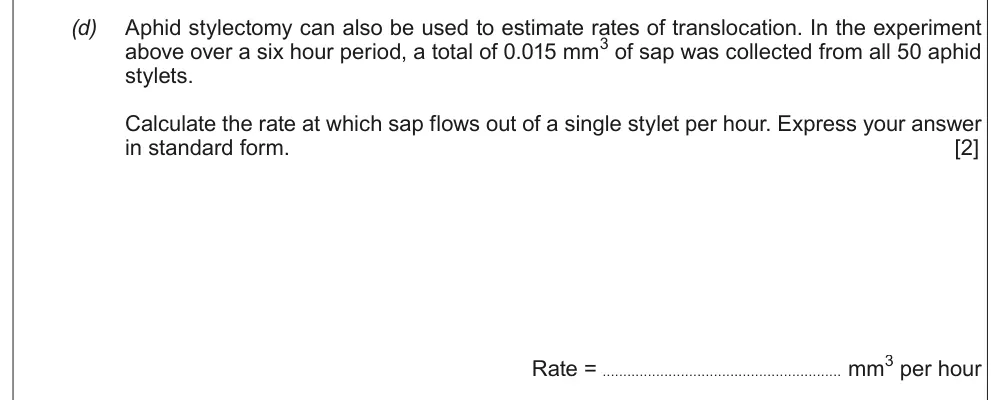
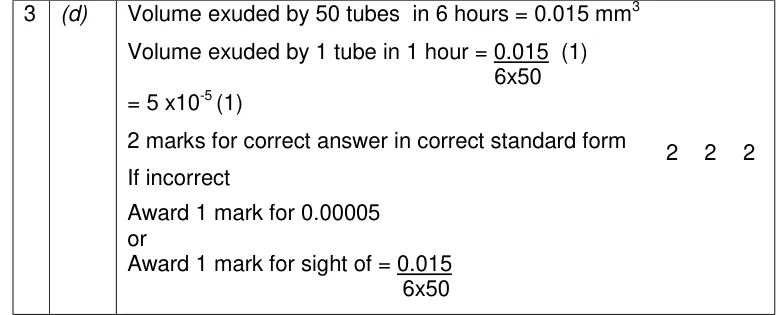
AS Component 2 · June 2016 · Q3(d) · 2 marks
Calculate the rate of sap flow from one aphid stylet per hour, in standard form.
Show the mark scheme
Tap an image to open it full size.
From the examiners' report: The calculations were generally well done, but some candidates did not understand what is meant by standard form.
Question 7
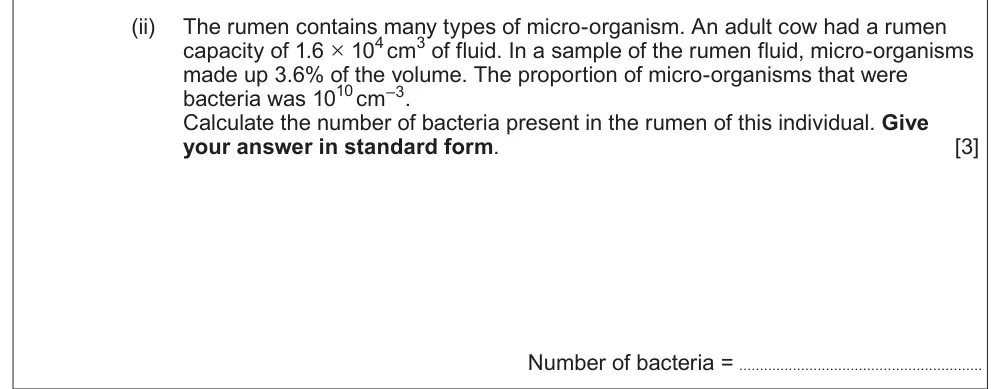
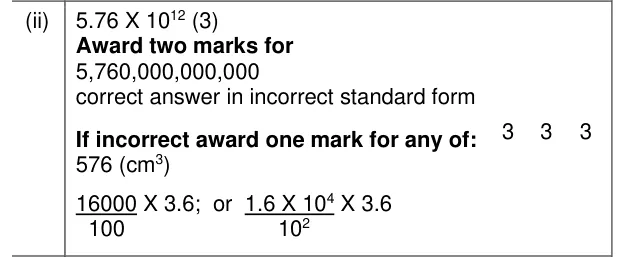
AS Component 2 · June 2024 · Q2(b)(ii) · 3 marks
Calculate the number of bacteria in the rumen of a cow from its volume and a percentage, in standard form.
Show the mark scheme
Tap an image to open it full size.
From the examiners' report: Most errors were decimal points in the wrong place. Some candidates lost a mark by working out the correct answer and then writing an incorrect one in the answer space.
Question 8
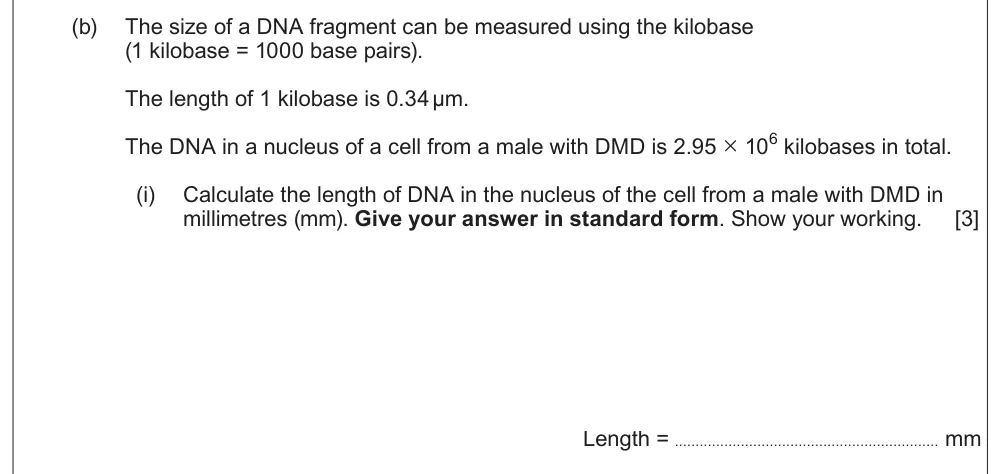
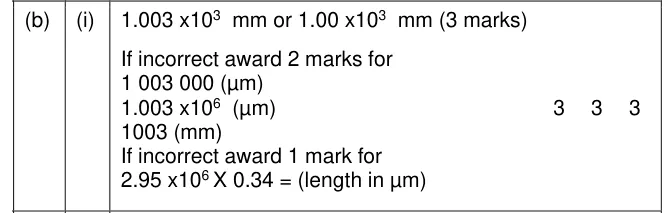
A level Component 2 · June 2023 · Q5(b)(i) · 3 marks
Calculate the length of the DNA in a nucleus in millimetres, in standard form.
Show the mark scheme
Tap an image to open it full size.
Percentages and percentage change (MS0.3)
Question 9
A level Component 1 · Autumn 2021 · Q5(a)(i) · 3 marks
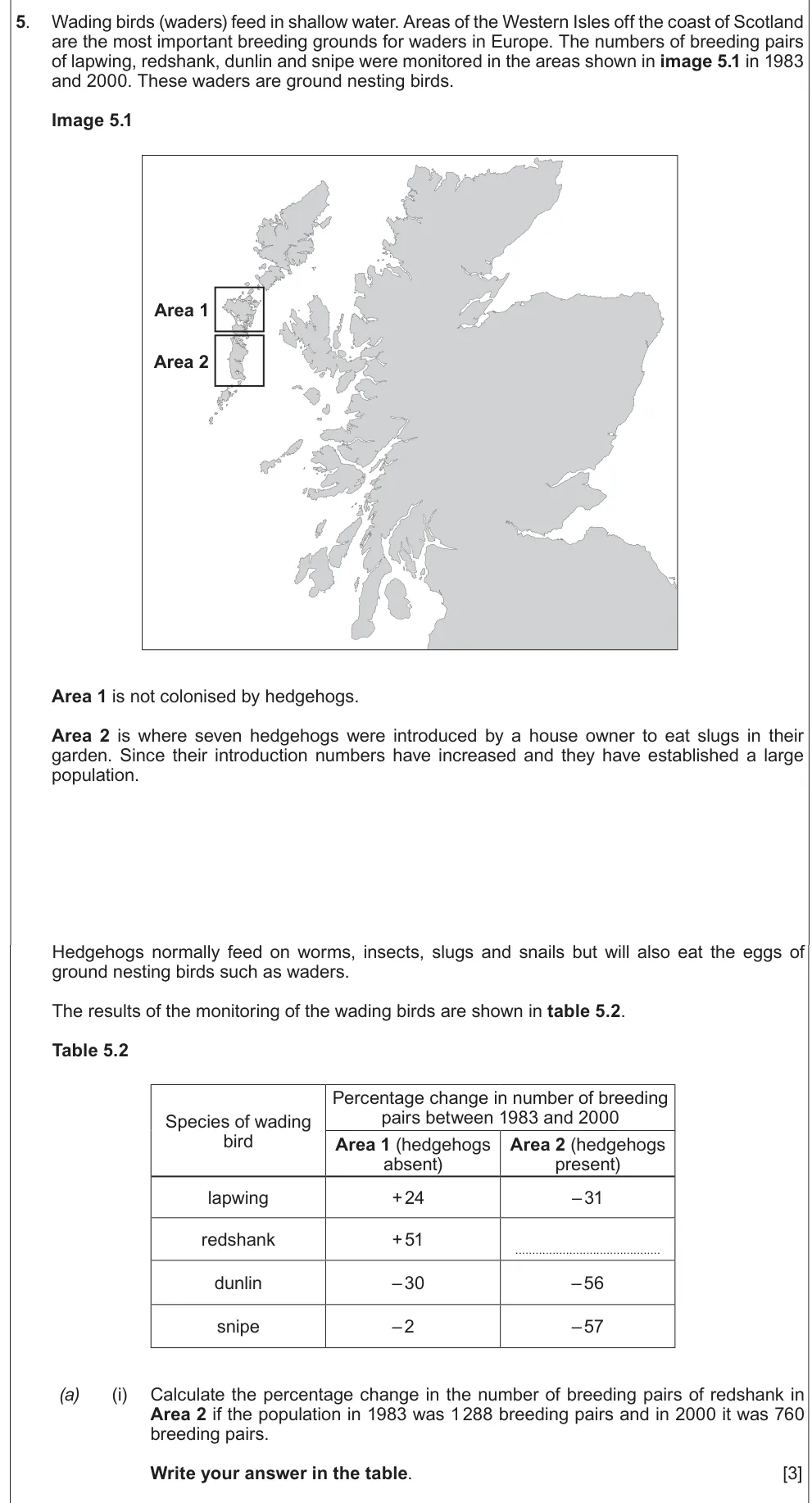
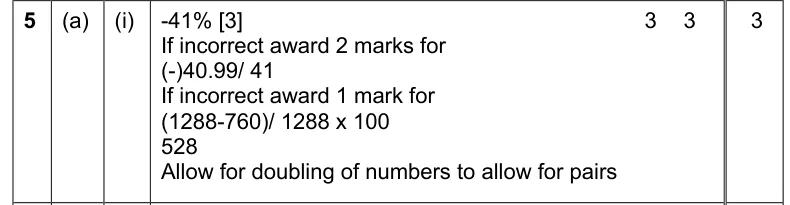
Calculate the percentage change in the number of breeding pairs of a wading bird.
Show the mark scheme
Tap an image to open it full size.
From the examiners' report: Answers to this percentage change calculation were excellent.
Question 10
A level Component 1 · June 2019 · Q6(a) · 3 marks
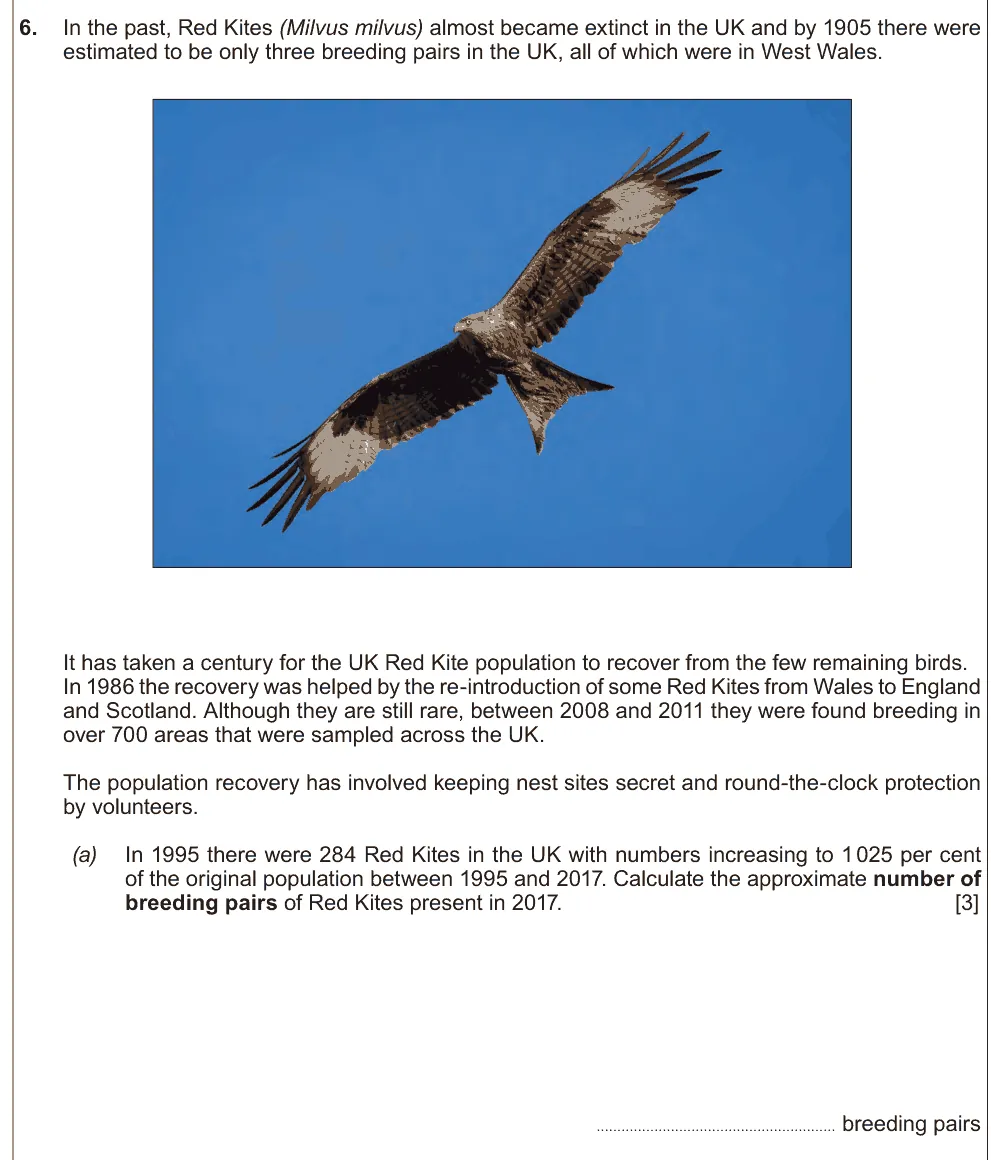
Use a percentage of the original population to calculate the number of breeding pairs of Red Kites.
Show the mark scheme

Tap an image to open it full size.
From the examiners' report: Largely well done, but a considerable number did not divide the number of kites by two to give breeding pairs.
Question 11
A level Component 3 · June 2018 · Q4(a)(i) · 2 marks
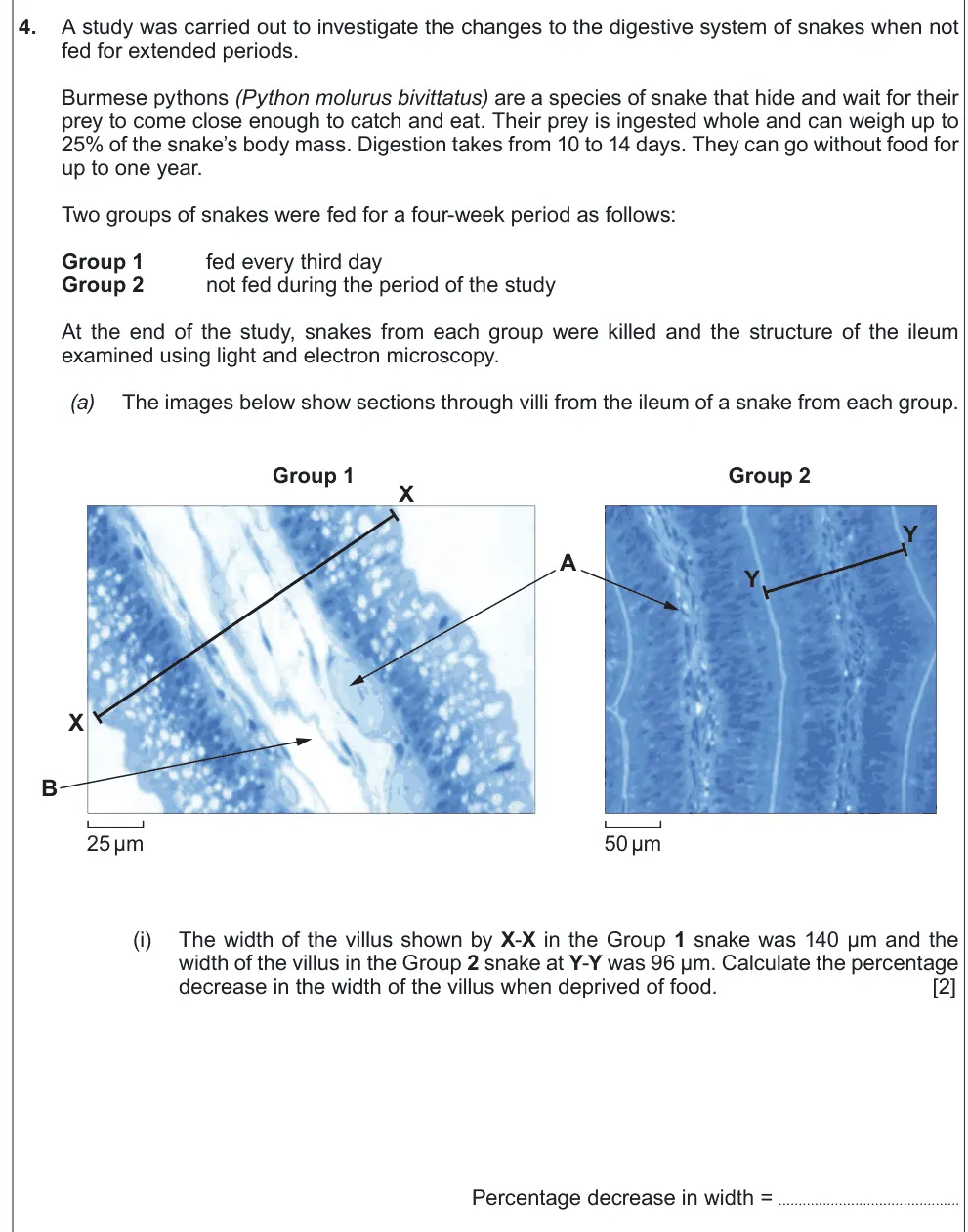
Calculate the percentage decrease in the width of a villus in a snake deprived of food.
Show the mark scheme

Tap an image to open it full size.
From the examiners' report: A significant number of candidates still cannot calculate a percentage change, which the examiners describe as a basic skill that A level students should have.
Question 12
A level Component 3 · June 2017 · Q9(c)(i) · 2 marks
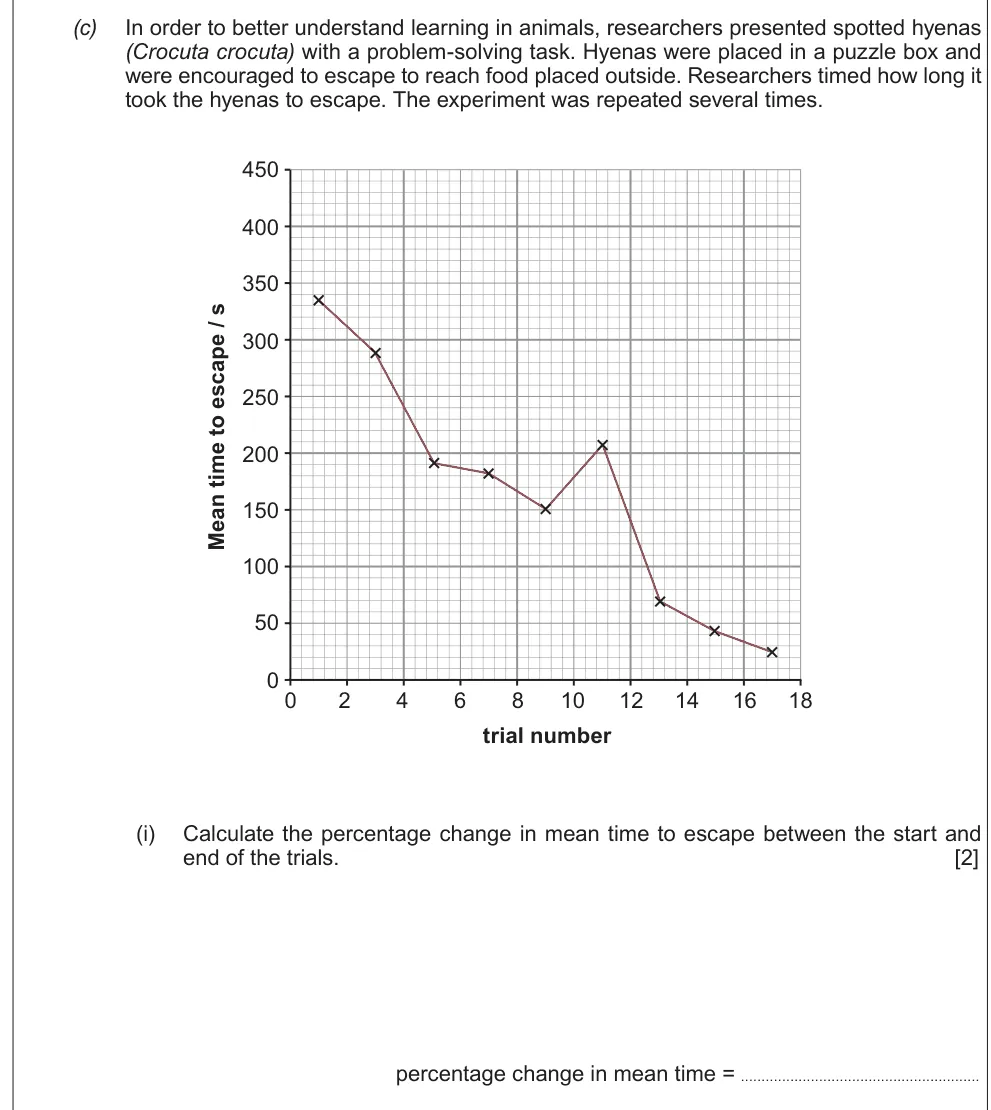
Read two values from a graph and calculate the percentage change in the time hyenas took to escape.
Show the mark scheme

Tap an image to open it full size.
From the examiners' report: A surprising number could not calculate a percentage change, and some completely misread the graph.
Question 13
AS Component 2 · June 2017 · Q4(a)(i) · 2 marks
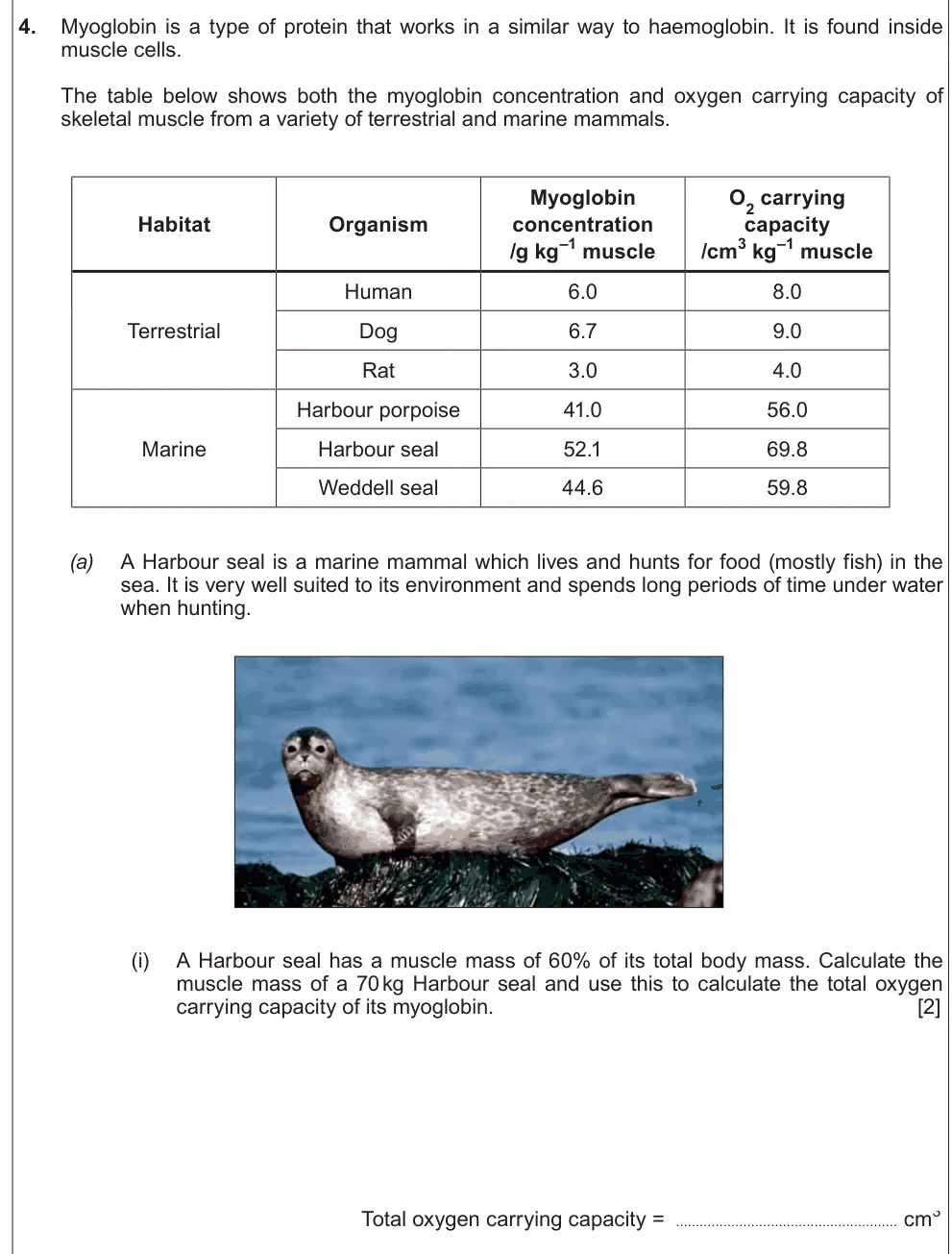
Use a percentage to find the muscle mass of a seal, then calculate the oxygen carrying capacity of its myoglobin.
Show the mark scheme

Tap an image to open it full size.
From the examiners' report: Generally well done. Some used the figure for myoglobin concentration instead of the oxygen carrying capacity.
Question 14
AS Component 2 · June 2024 · Q1(c)(i) · 1 mark
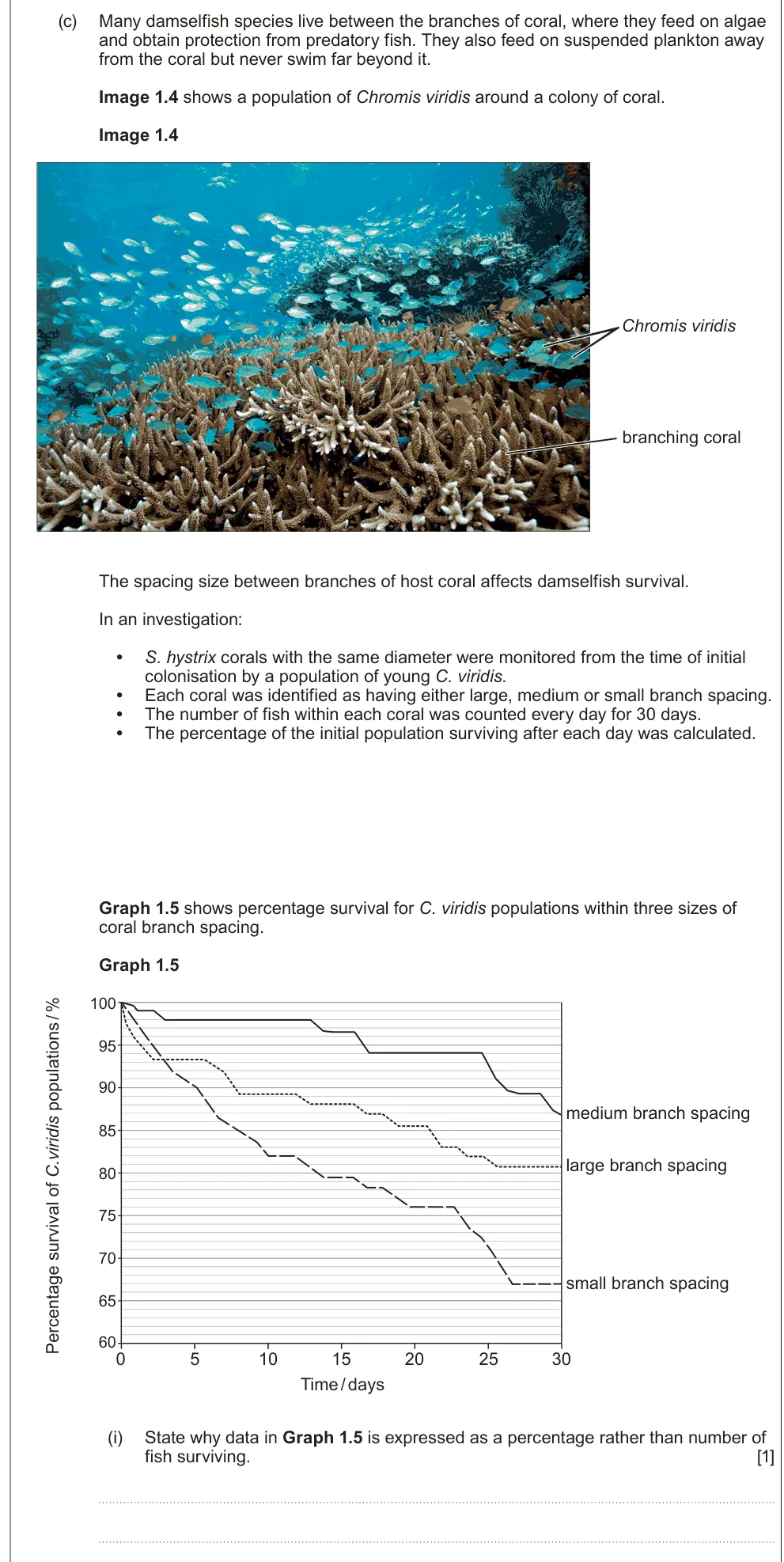
State why survival is plotted as a percentage and not as the number of fish.
Show the mark scheme

Tap an image to open it full size.
From the examiners' report: A considerable number did not recognise that a percentage allows comparison where numbers may not. Some answers did not make it clear that there were different populations of fish.
Ratios and proportions (MS0.3)
Question 15
A level Component 3 · June 2022 · Q2(a)(i) · 2 marks
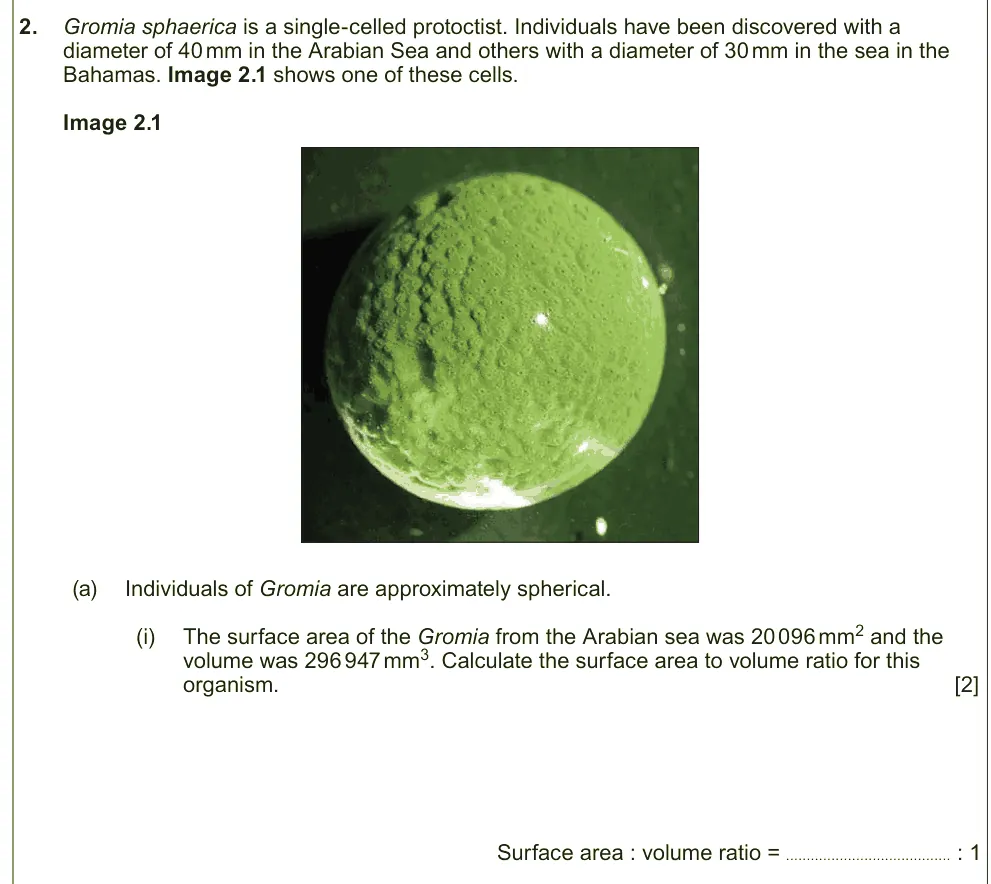
Calculate a surface area to volume ratio in the form n : 1.
Show the mark scheme

Tap an image to open it full size.
From the examiners' report: The most common mistake was to round the answer incorrectly, for example by cutting the number short without rounding the last digit up.
Question 16
A level Component 3 · June 2022 · Q7(d) · 2 marks
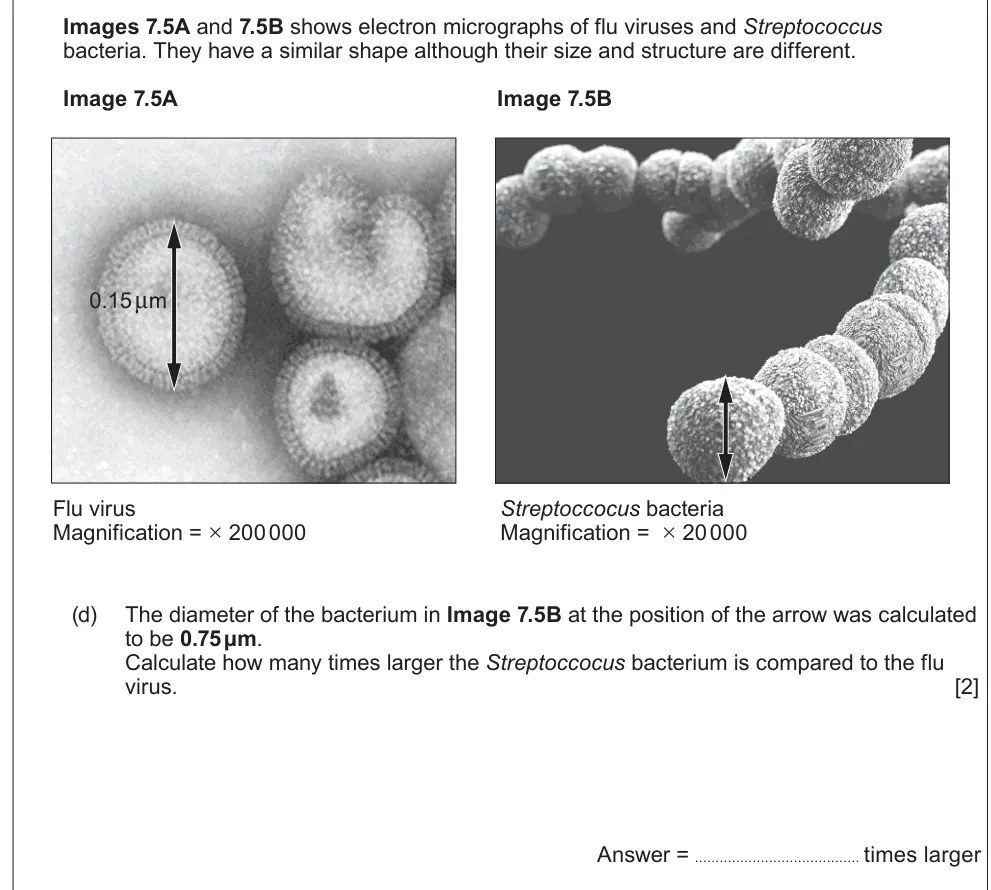
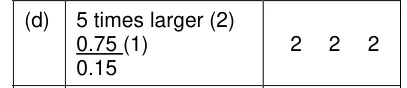
Calculate how many times larger a bacterium is than a flu virus.
Show the mark scheme
Tap an image to open it full size.
From the examiners' report: Most saw that only a simple calculation of proportion was needed, with no conversion of units. The magnifications only show why the smaller structure looks larger in the images.
Estimating a result (MS0.4)
Question 17
A level Component 2 · June 2018 · Q4(d) · 3 marks
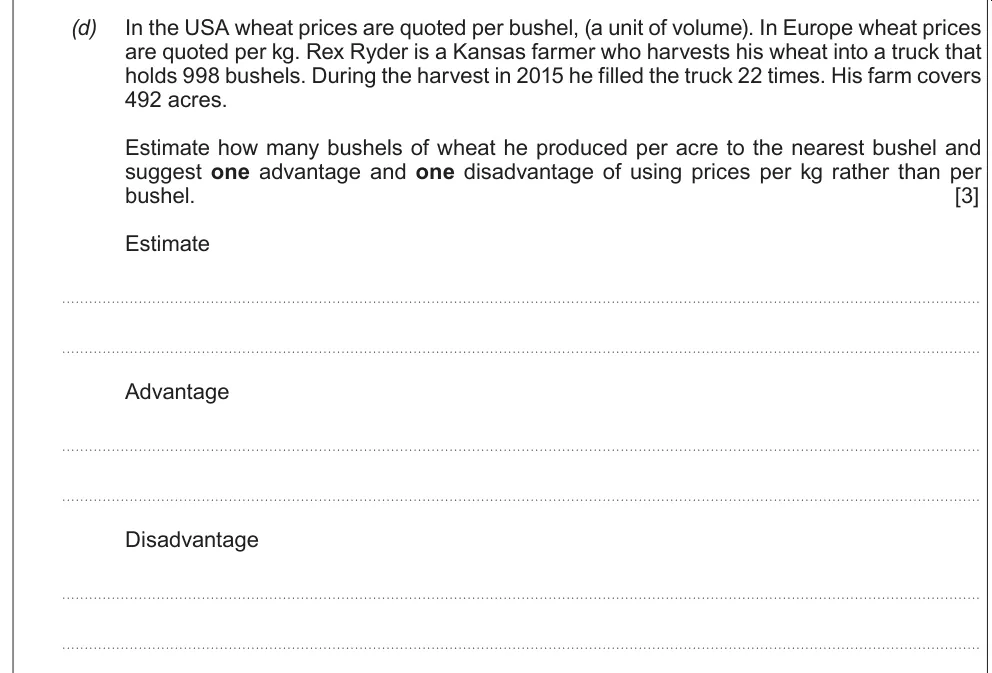
Estimate a wheat yield in bushels per acre and suggest one advantage and one disadvantage of pricing by mass.
Show the mark scheme

Tap an image to open it full size.
From the examiners' report: This tests estimating: the values can be rounded and the answer worked out in your head. Most used a calculator instead and still gained the mark, unless they did not round to the nearest bushel.
Powers and logarithms (MS0.5)
Question 18
A level Component 1 · June 2022 · Q1(b)(ii) · 2 marks · Hard
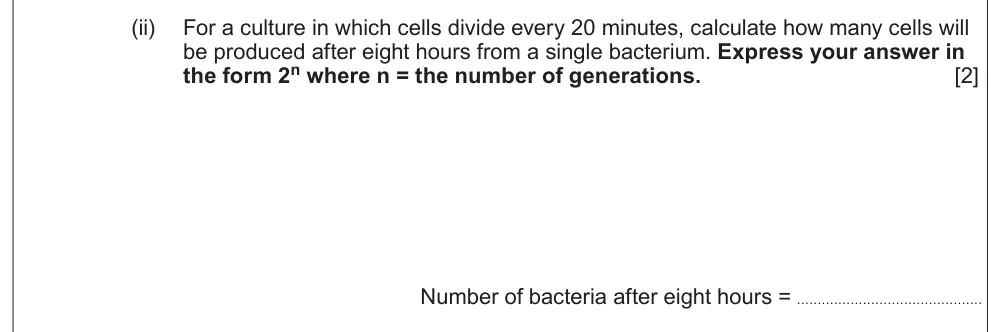
Calculate the number of bacteria produced from one cell after eight hours, as a power of 2.
Show the mark scheme

Tap an image to open it full size.
From the examiners' report: Candidates did not find any difficulty with this part.
Question 19
A level Component 2 · Autumn 2020 · Q2(b)(ii) · 1 mark
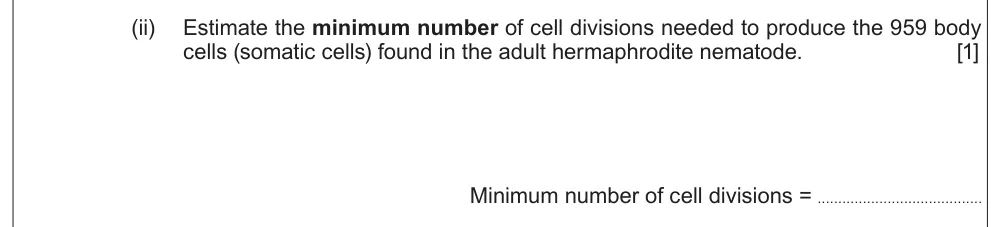
Estimate the smallest number of rounds of cell division needed to make 959 cells.
Show the mark scheme

Tap an image to open it full size.
From the examiners' report: There was much confusion here. Many just divided the total number of cells by two or took its square root.
Question 20
A level Component 2 · Autumn 2020 · Q6(b)(i) · 1 mark
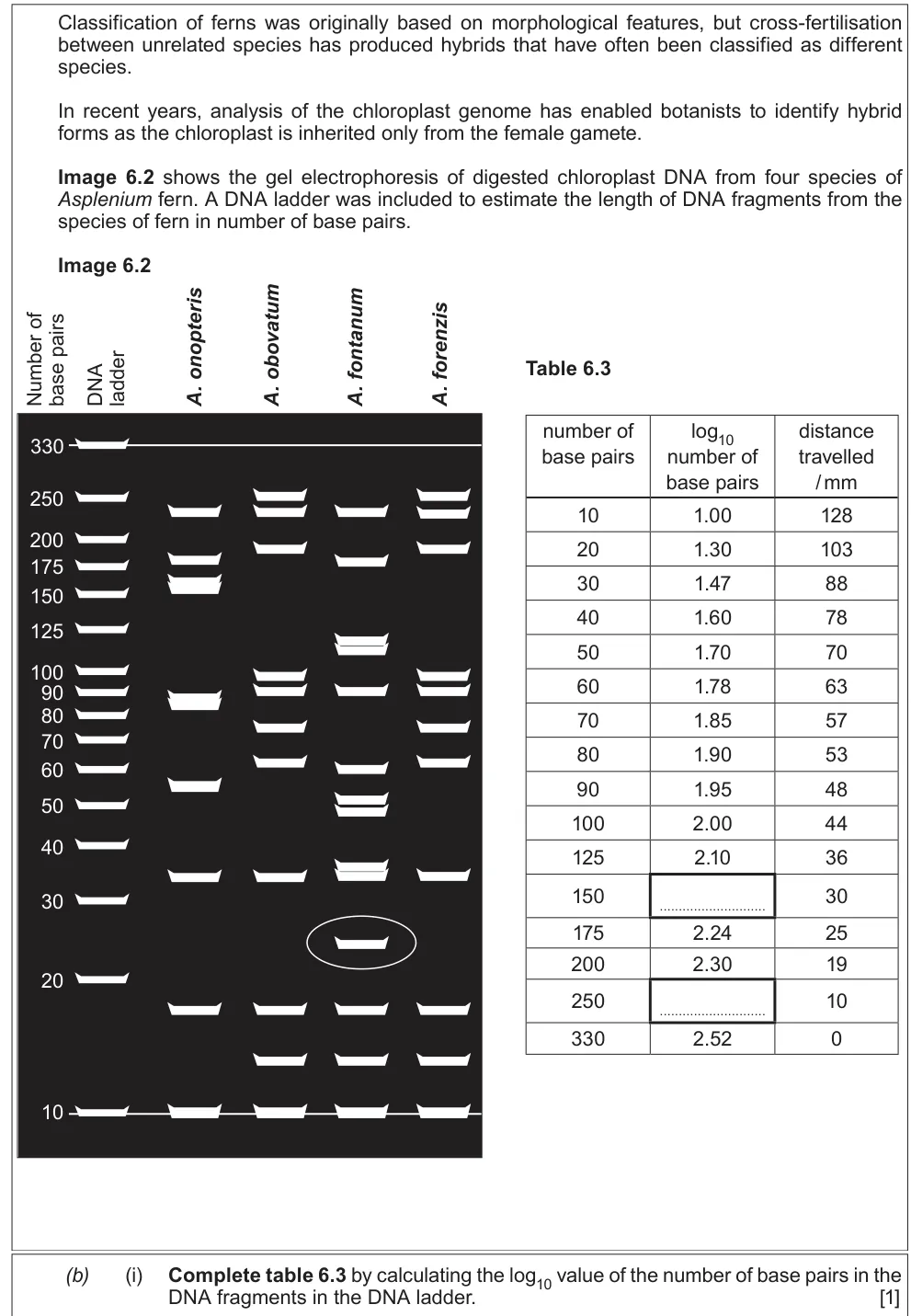
Complete a table by calculating log₁₀ of the number of base pairs in two DNA fragments.
Show the mark scheme

Tap an image to open it full size.
From the examiners' report: Using logarithms is a required maths skill, and candidates' ability to use log₁₀ was variable.
Where students lose marks (from Eduqas examiners' reports and mark schemes)
Each point below is followed by wording that gained marks.
Grams, not milligrams: Converting units, in this case from mg to g, was still a problem, and candidates did not read the instruction on how to give the answer.
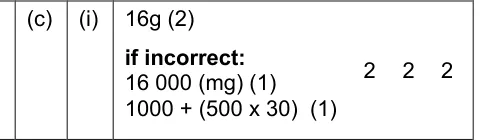
✔ Gains credit: "1000 + (500 × 30)" gives "16 000 (mg)", which is "16 g".
Kites come in pairs: A considerable number did not divide the number of kites by two to give breeding pairs.
✔ Gains credit: "Any number multiplied by 1 025/100 or 10.25", then "any number divided by 2 (to show breeding pairs)".
Round, don't cut short: The most common mistake was to round the ratio incorrectly, which gained only one of the two marks.
✔ Gains credit: "20096 ÷ 296947" with "correct rounding", for example "0.07".
Know what standard form means: Some candidates worked out the rate but did not understand what is meant by standard form.
✔ Gains credit: "0.015 ÷ (6 × 50)", then the "correct answer in correct standard form": "5 × 10⁻⁵".
Mind the decimal point: Most errors were decimal points in the wrong place, and some wrote an incorrect answer in the answer space after reaching the correct one.
✔ Gains credit: "1.6 × 10⁴ × 3.6 ÷ 100" gives "576 (cm³)"; the final answer is "5.76 × 10¹²".
Each division doubles the cells: Many just divided the total number of cells by two or took the square root of the total.
✔ Gains credit: "10 (mitotic) divisions".
Capacity, not concentration: Some used the figure for myoglobin concentration in the calculation instead of the oxygen carrying capacity.
✔ Gains credit: "Total muscle mass = 70 × 60/100 = 42 (kg)", then "O₂ capacity of muscle = 42 × 69.8".
Divide the change by the original: A significant number of candidates could not calculate a percentage change.
✔ Gains credit: "(140 µm – 96 µm) / 140 µm × 100".
Download the questions
Download the PDF pack (20 questions, mark schemes at the end)
Keep practising
- Handling Data (Maths Skills MS1): Eduqas A Level Biology Exam Questions
- Algebra (Maths Skills MS2): Eduqas A Level Biology Exam Questions
- Graphs and Geometry (Maths Skills MS3 and MS4): Eduqas A Level Biology Exam Questions
- Populations and Ecosystems (1.5): Eduqas A Level Biology exam questions by topic
- Microbiology (1.4): Eduqas A Level Biology exam questions by topic
- Cell Division (2.2): Eduqas A Level Biology exam questions by topic
- Transport in Animals (3.2): Eduqas A Level Biology exam questions by topic
- Eduqas A level Biology revision resources by topic
- Eduqas A level Biology past papers, mark schemes and examiners' reports
- Eduqas A level Biology grade boundaries
- Ask about Eduqas A level Biology lessons with Sam on WhatsApp
Questions, mark schemes and examiners' report extracts © WJEC CBAC Ltd (Eduqas).