

Arithmetic and numerical computation (MS 0) is the first group of mathematical skills in the Edexcel A level Biology A (Salters-Nuffield) specification: using units, standard form, ratios, fractions and percentages, estimating results, and using powers and logarithms. In biology questions these skills always come in context. You might convert micrograms to milligrams to work out a vitamin C intake, find the surface area to volume ratio of a lung, calculate the percentage change in a nutrient or a heart rate, give the mass of plastic bags in standard form, or show how many copies of DNA PCR makes in 40 minutes. Maths questions like these appear on every paper, AS and A level. Questions marked AS are from the AS papers (8BN0); the rest are from the A level papers (9BN0).
The examiners' reports keep returning to the same problems. Convert units before you calculate, and give the answer in the unit the question asks for: mg to µg, cm³ to dm³, g to kg, seconds to hours. For a percentage change, find the difference and divide by the starting value; a decrease of more than 100% tells you that you divided by the wrong number. Write a ratio in the order the question gives. Follow every instruction on decimal places, significant figures and standard form. Show your working, including intermediate values, because method marks are often given even when the final answer is wrong.
Studying Edexcel SNAB and want more help? If you'd like to arrange one-to-one Edexcel tutoring, or to register your interest in an Edexcel group class, message Tom on WhatsApp using the link at the bottom of this page.
What you need first
Each question on this page assumes you're secure on these ideas. If any of them feels shaky, look it up before you start.
- 1 g = 1000 mg, 1 mg = 1000 µg, 1 dm³ = 1000 cm³ and 1 m² = 10 000 cm².
- A percentage is a fraction of 100, so 30% of a value is 0.3 × the value.
- A number in standard form is a number between 1 and 10 multiplied by a power of 10.
- In PCR the quantity of DNA doubles with each cycle.
Key terms
These words come up in the questions and mark schemes. Examiners expect you to use them exactly.
- Ratio: a comparison of two quantities in a stated order, written as a : b and often given as x : 1.
- Simplest form: a ratio with both numbers divided by their highest common factor, for example 6 : 9 = 2 : 3.
- Percentage change: (final value − initial value) ÷ initial value × 100; positive for an increase and negative for a decrease.
- Percentage difference: the difference between two values as a percentage of the value it is being compared against.
- Standard form: a number written as A × 10ⁿ, where A is at least 1 and less than 10.
- Significant figures: the digits in a number that carry meaning, counted from the first non-zero digit.
- Decimal places: the number of digits after the decimal point.
- Exponential growth: growth by the same factor in each time period, such as doubling every cycle, so after n cycles the starting quantity is multiplied by 2ⁿ.
What these questions cover
Every question on this page tests one of these mathematical skills listed in the Pearson Edexcel A level Biology A (Salters-Nuffield) specification (9BN0).
- MS0.1: Recognise and make use of appropriate units in calculations
- MS0.2: Recognise and use expressions in decimal and standard form
- MS0.3: Use ratios, fractions and percentages
- MS0.5: Use calculators to find and use power, exponential and logarithmic functions (A level only)
How to use this page
Write your answer on paper before you open the mark scheme. Allow about 1.2 minutes per mark: the 20 questions are worth 41 marks, so about 49 minutes in total. Then mark your answer strictly against the mark scheme and read the examiners' tip underneath it. If you'd rather print the questions, download the PDF pack.
Units and unit conversions (MS 0.1)
Question 1
AS Paper 1 · June 2025 · Q4(a) · 3 marks
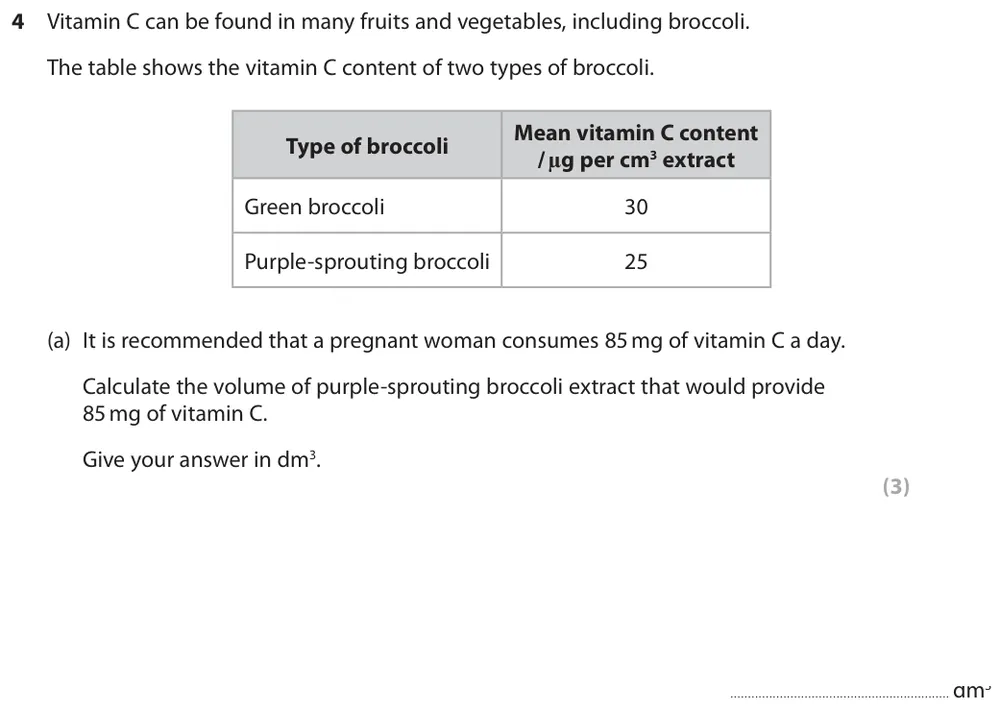
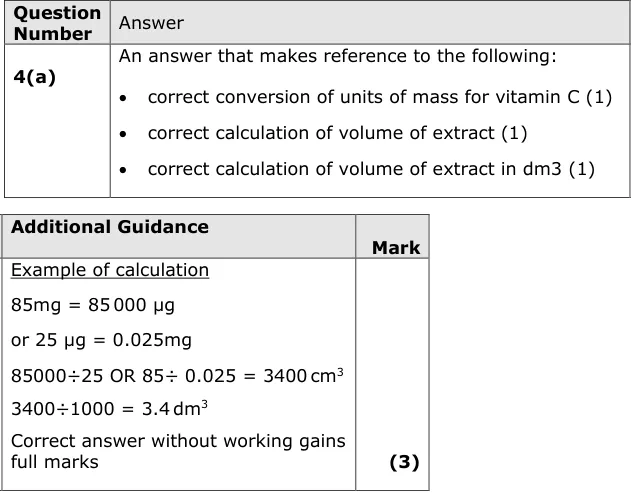
Calculate the volume of broccoli extract, in dm³, that would provide a pregnant woman's daily vitamin C.
Show the mark scheme
Tap an image to open it full size.
From the examiners' report: A significant number of candidates could not convert mg to µg or cm³ to dm³. Get the mass into the same unit as the table before dividing, then convert the volume to dm³ at the end.
Question 2
A level Paper 2 · June 2018 · Q7(b)(i) · 3 marks · Hard
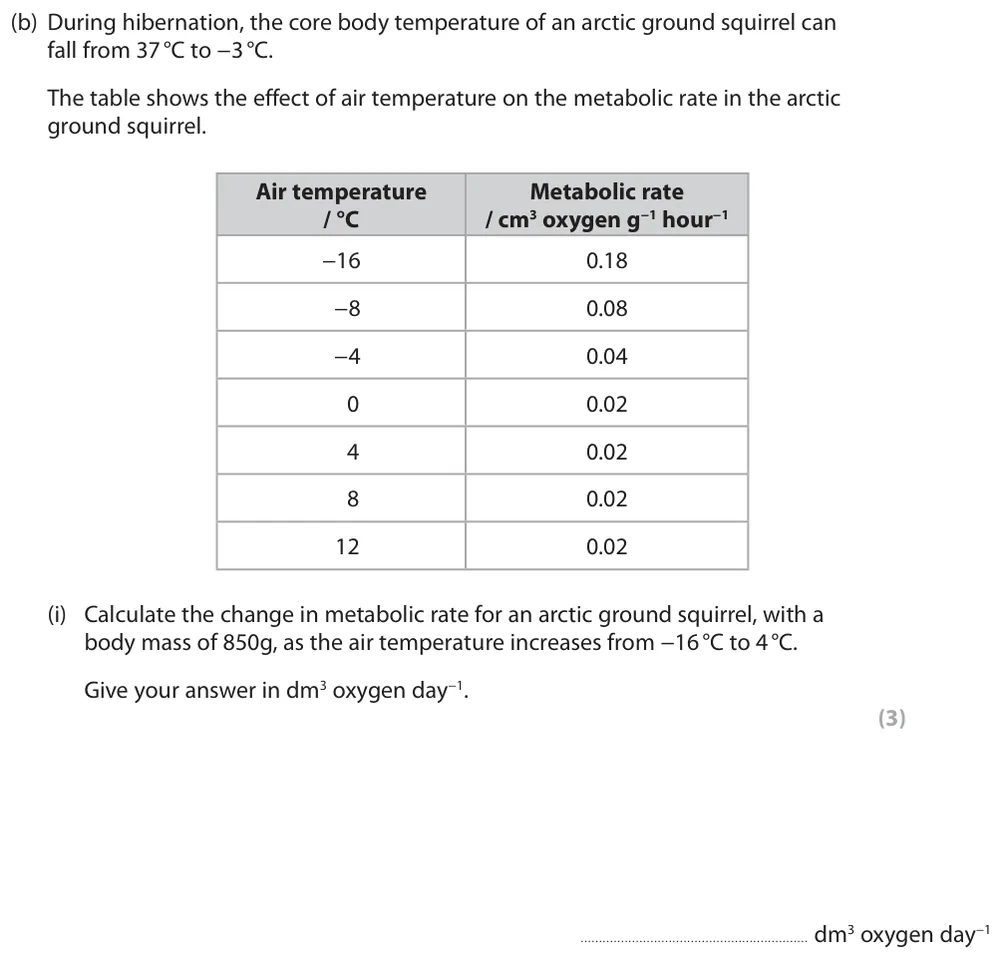
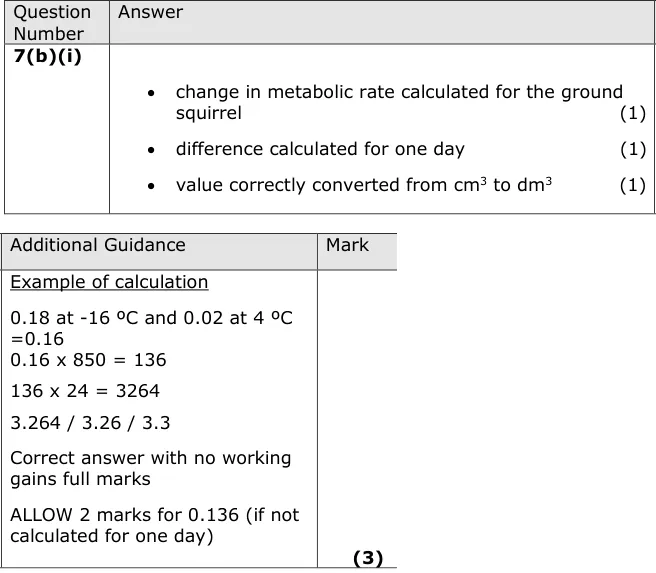
Use a table of metabolic rates per gram per hour to calculate the change in a squirrel's oxygen use, in dm³ per day.
Show the mark scheme
Tap an image to open it full size.
From the examiners' report: Few gained full marks. Errors included reading the wrong values from the table and confusion over whether to multiply or divide by the body mass. One answer worked out the difference correctly but did not convert it to the units asked for, so gained 2 of the 3 marks.
Question 3
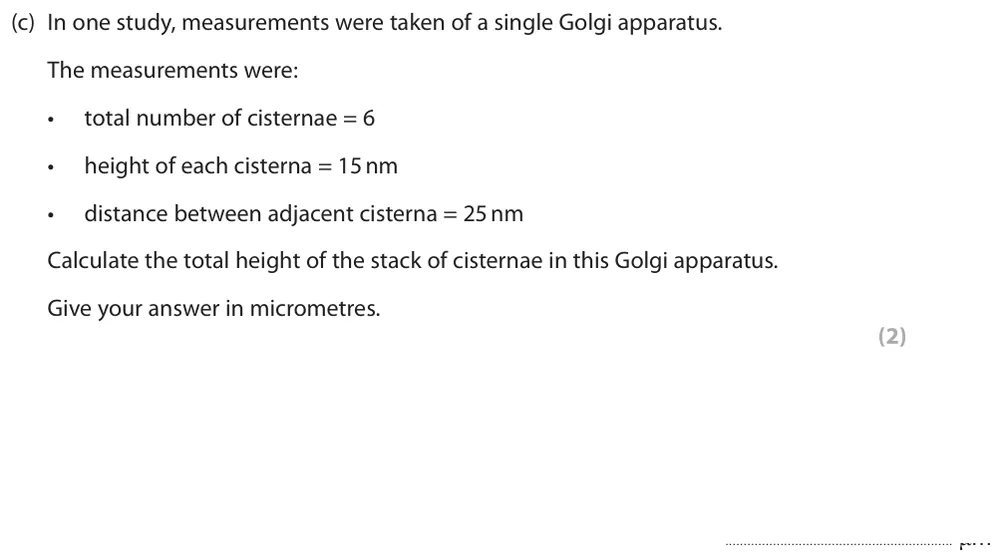
A level Paper 2 · June 2022 · Q8(c) · 2 marks
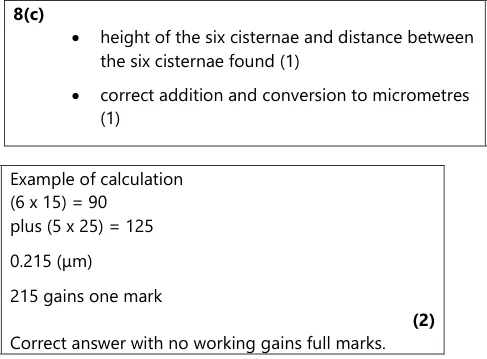
Calculate the total height of a stack of Golgi cisternae, in micrometres.
Show the mark scheme
Tap an image to open it full size.
From the examiners' report: Using a quick diagram is a good idea: it shows that six cisternae have only five gaps between them. The best answers worked out the height and then converted it to micrometres as the question asked.
Question 4
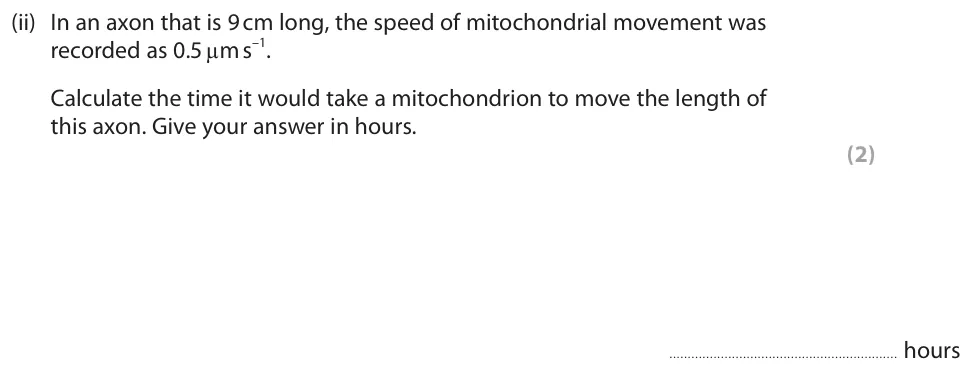
A level Paper 2 · June 2023 · Q8(b)(ii) · 2 marks
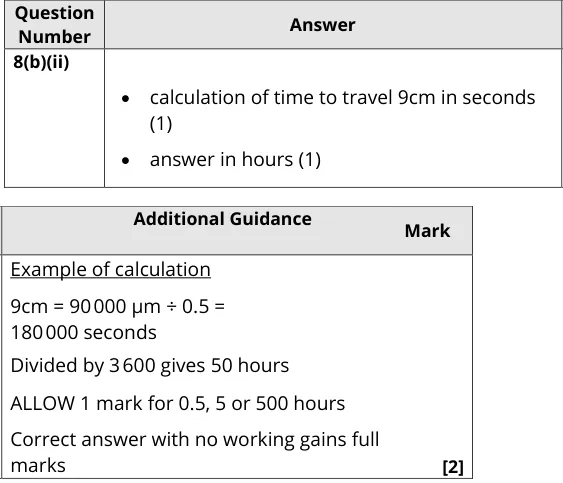
Calculate how long a mitochondrion takes to move the length of an axon, in hours.
Information from earlier in this question:

Show the mark scheme
Tap an image to open it full size.
From the examiners' report: You have to convert both the distance and the time. A number of candidates missed at least one of these conversions; an answer out by an order of magnitude gained only half the marks.
Question 5
A level Paper 2 · June 2024 · Q9(a)(i) · 2 marks
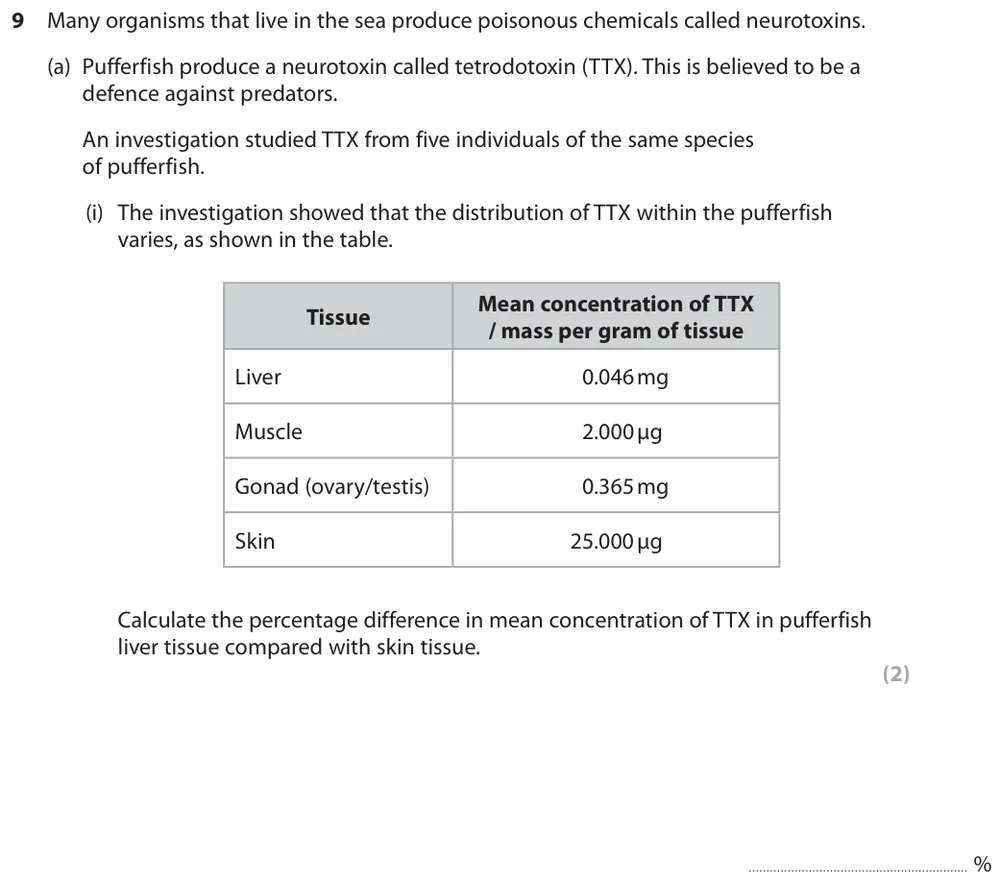
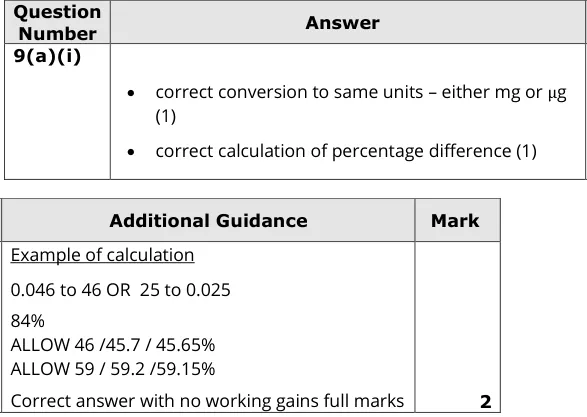
Calculate the percentage difference in toxin concentration between pufferfish liver and skin, when the two are given in different units.
Show the mark scheme
Tap an image to open it full size.
From the examiners' report: It was common for answers not to take account of the different units (mg and µg) for the two tissues. Convert to the same unit first, and show your working: a wrong answer with no working scored nothing, when half the marks were available for the method.
Standard form (MS 0.2)
Question 6
AS Paper 2 · November 2021 · Q2(a) · 2 marks
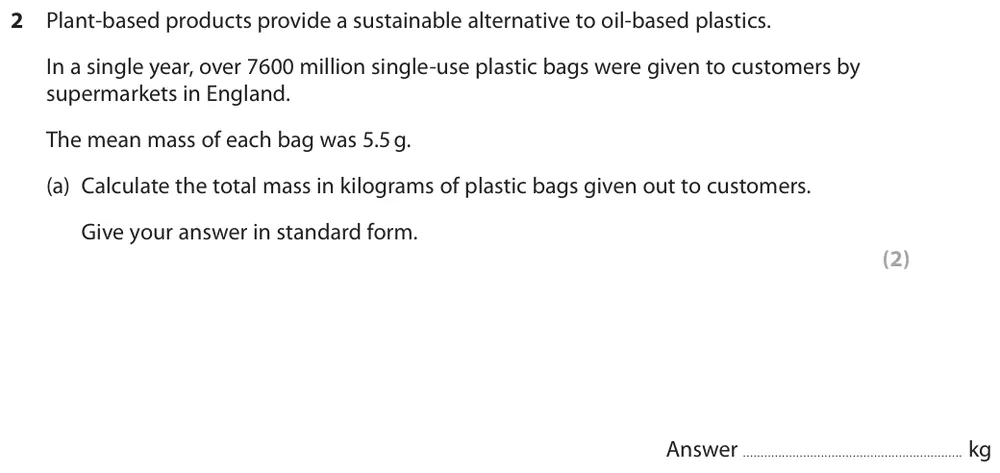
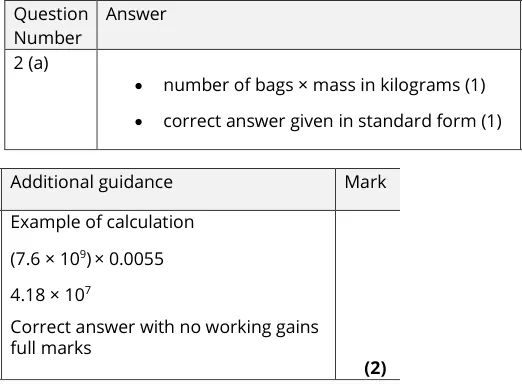
Calculate the total mass of plastic bags in kilograms and give it in standard form.
Show the mark scheme
Tap an image to open it full size.
From the examiners' report: Those who did not gain full marks had not converted the mass of each bag from grams to kilograms.
Question 7
A level Paper 2 · June 2024 · Q4(a) · 1 mark
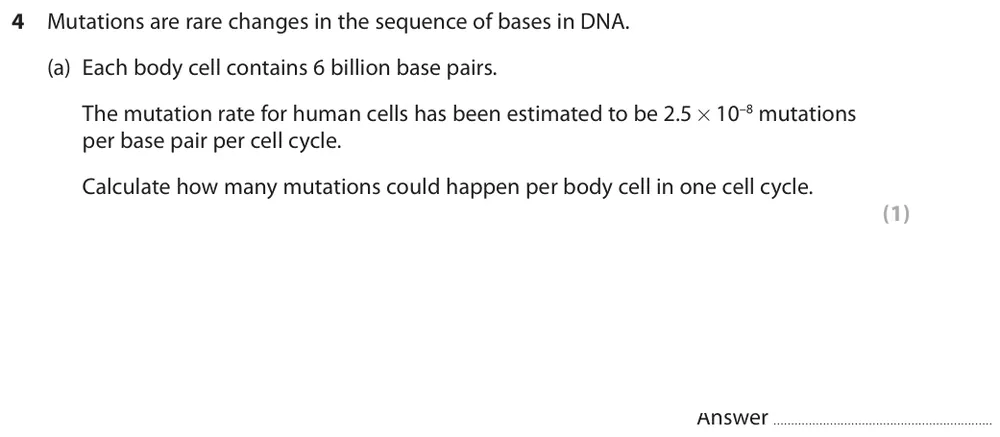
Calculate how many mutations could happen in one body cell in one cell cycle, from a mutation rate in standard form.
Show the mark scheme

Tap an image to open it full size.
From the examiners' report: One common wrong answer came from converting 2.5 × 10⁻⁸ out of standard form incorrectly. Always double check when converting between standard form and ordinary numbers.
Question 8
A level Paper 2 · June 2023 · Q10(a)(iii) · 2 marks
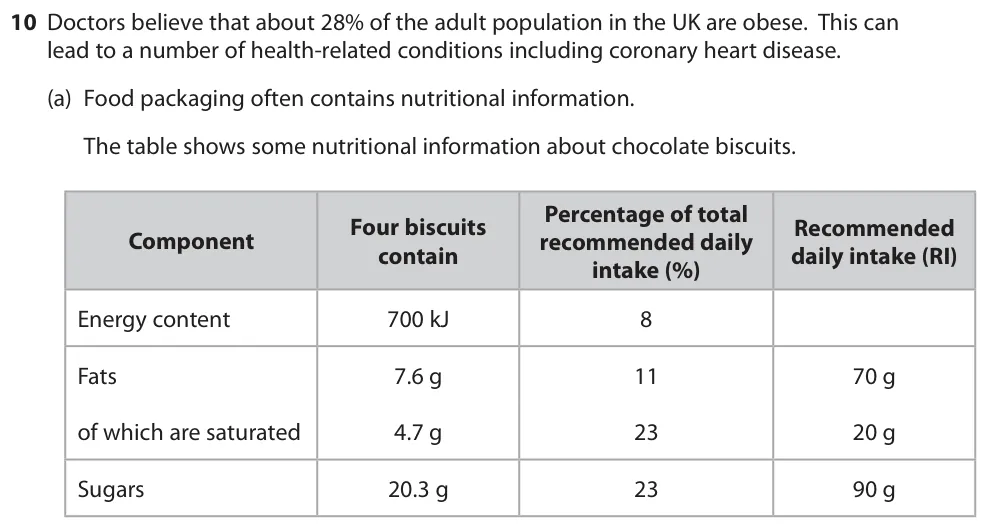
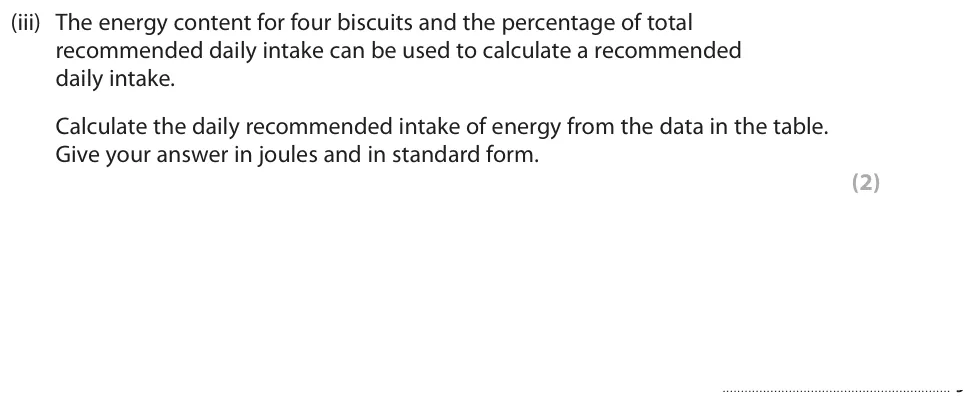
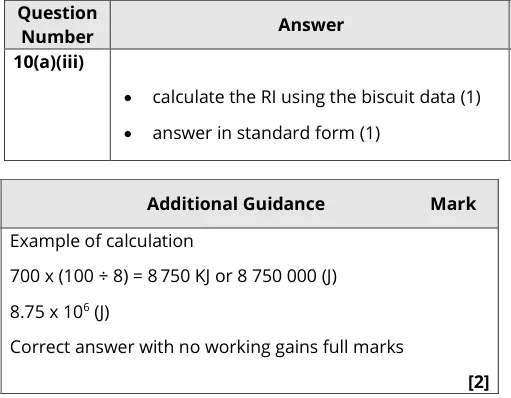
Use biscuit nutrition data to calculate the recommended daily energy intake, in joules and in standard form.
Information from earlier in this question:
Show the mark scheme
Tap an image to open it full size.
From the examiners' report: Some candidates did not give the value in standard form as requested. One answer had the right digits but treated them as joules when they were kilojoules, and gained nothing. Keep track of the units at every step.
Ratios (MS 0.3)
Question 9
AS Paper 1 · June 2016 · Q6(d)(i) · 1 mark
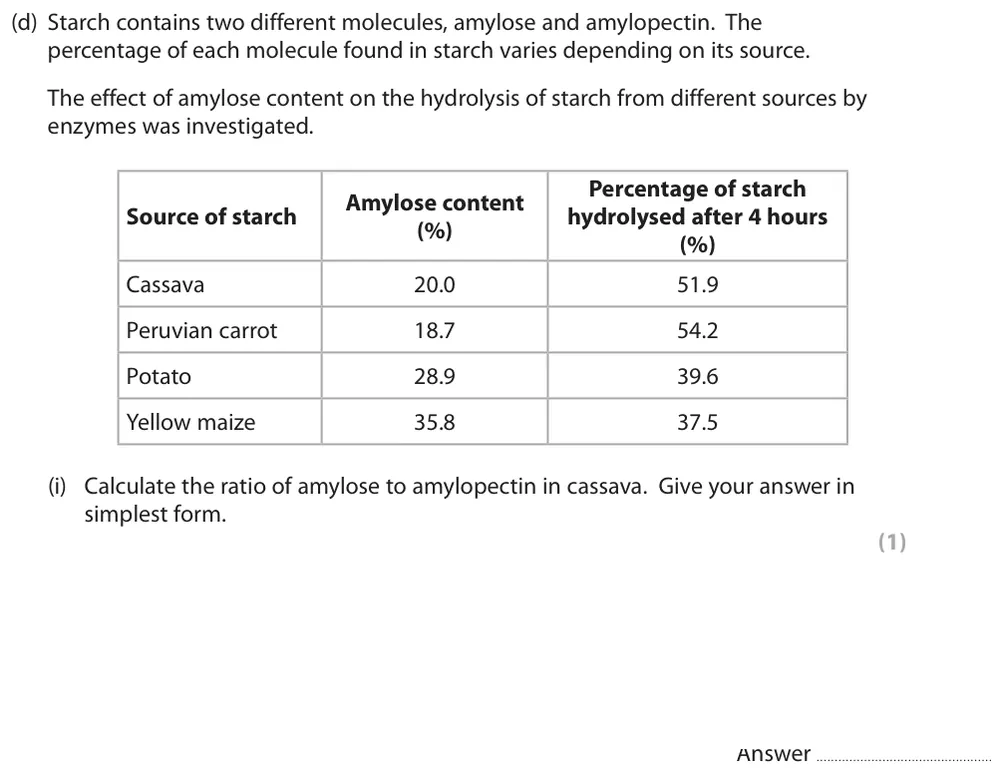
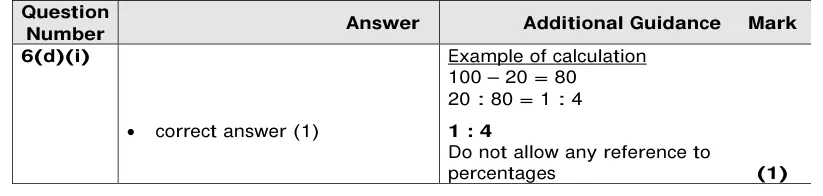
Calculate the ratio of amylose to amylopectin in cassava starch, in its simplest form.
Show the mark scheme
Tap an image to open it full size.
From the examiners' report: A significant number of candidates did not understand the terms 'ratio' or 'simplest form'. Some took the wrong column from the table instead of working out the percentage of amylopectin from the information above the table.
Question 10
AS Paper 1 · June 2019 · Q2(a)(i) · 2 marks
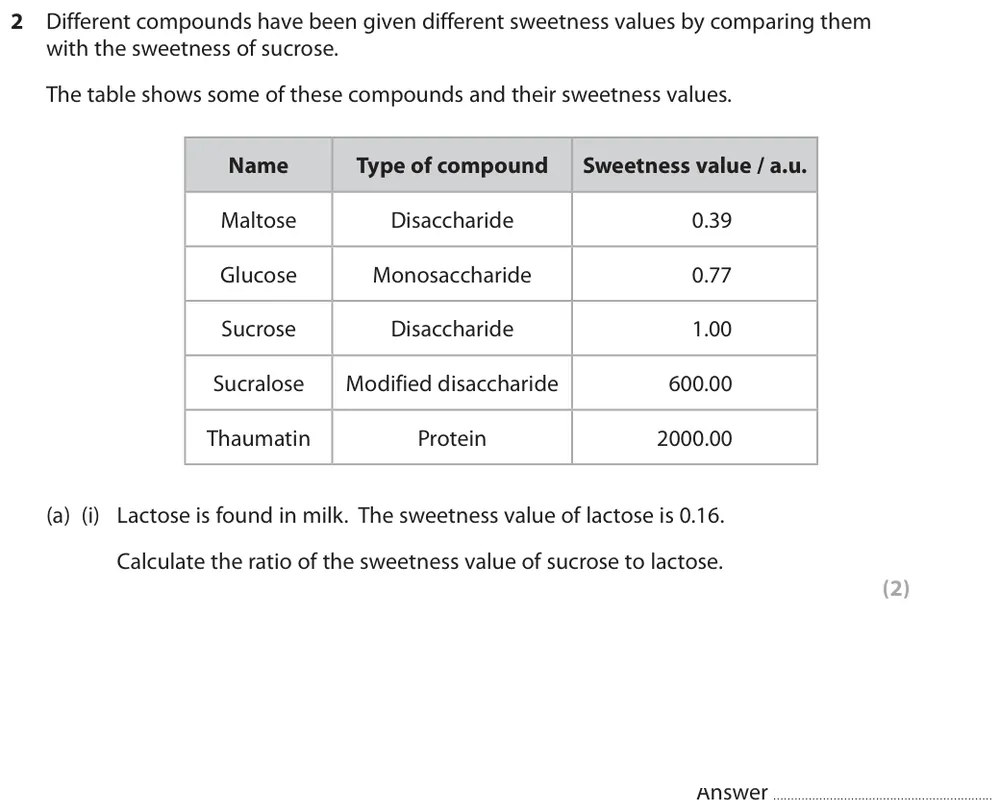
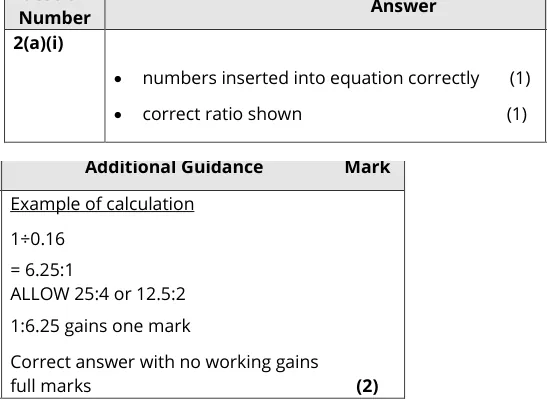
Calculate the ratio of the sweetness value of sucrose to that of lactose.
Show the mark scheme
Tap an image to open it full size.
From the examiners' report: A significant minority did not know how to work out a ratio. The most common reason for losing a mark was writing the ratio the wrong way round.
Question 11
A level Paper 2 · June 2017 · Q9(a)(i) · 2 marks
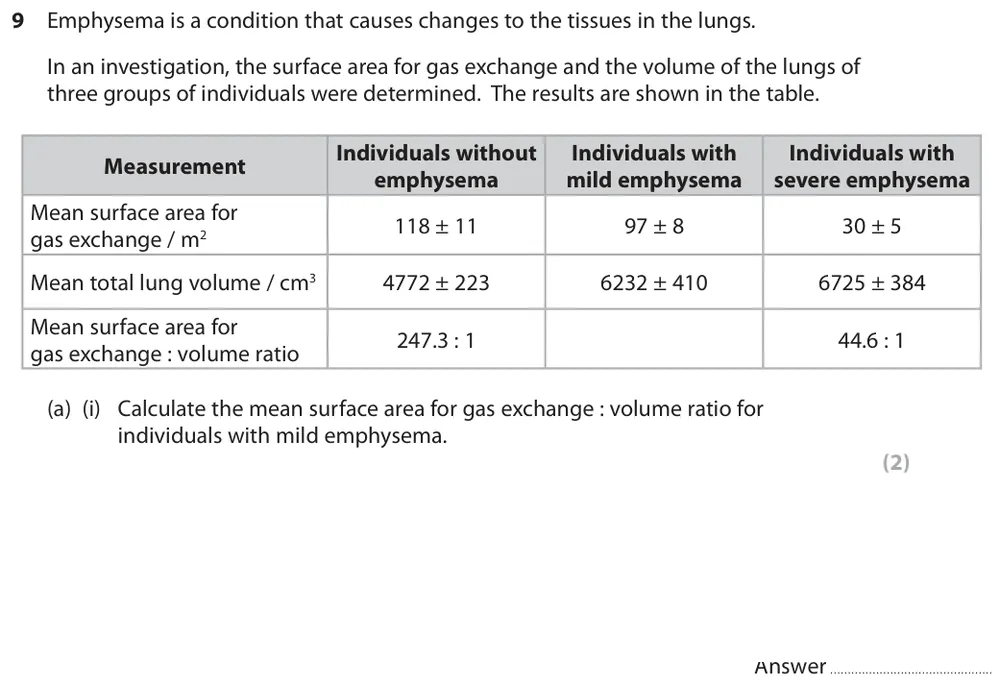
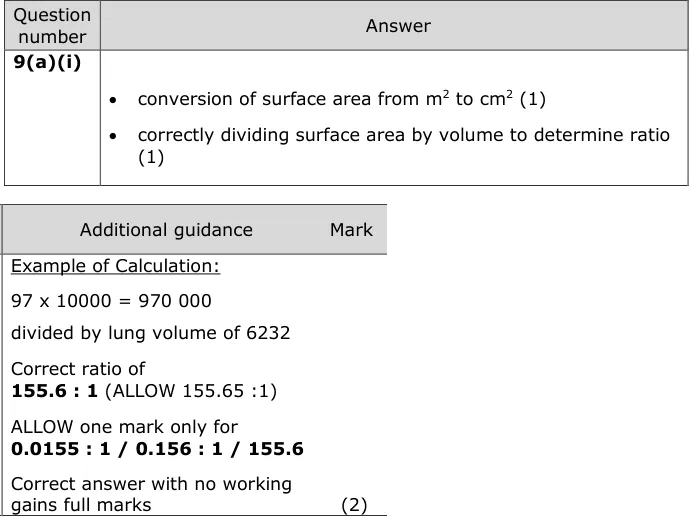
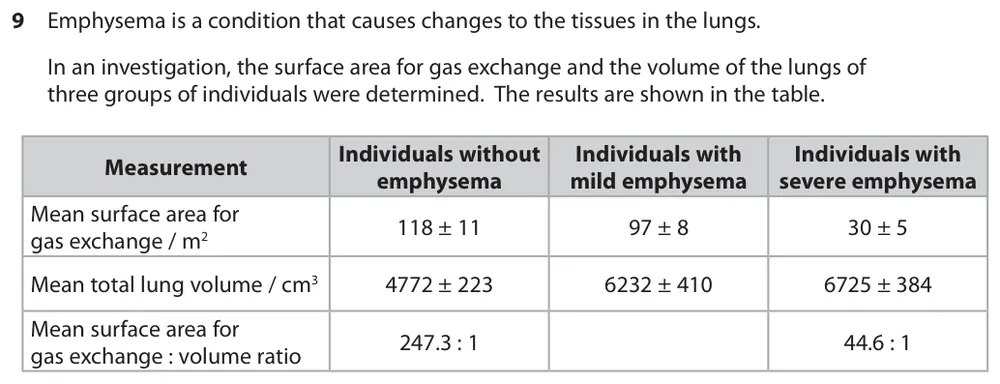
Calculate the surface area for gas exchange : volume ratio of the lungs in mild emphysema.
Show the mark scheme
Tap an image to open it full size.
From the examiners' report: Candidates tended to score full marks or none. Mistakes included not converting m² to cm² correctly, dividing the wrong way round, keying in the wrong calculation and not giving the answer as a ratio. Use the other ratios in the table as a guide to the format.
Percentages and percentage change (MS 0.3)
Question 12
AS Paper 2 · June 2016 · Q3(b)(i) · 2 marks · Easy
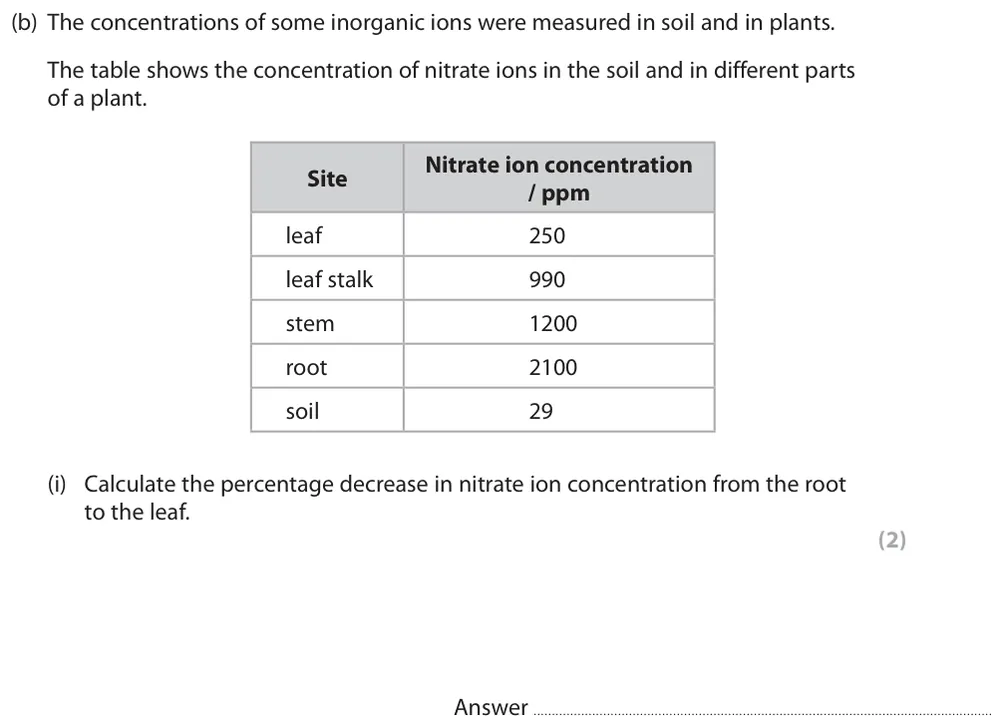
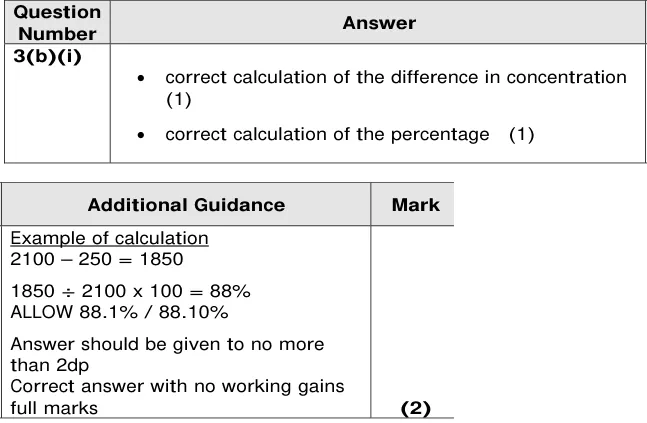
Calculate the percentage decrease in nitrate ion concentration from the root to the leaf.
Show the mark scheme
Tap an image to open it full size.
From the examiners' report: Some candidates did not subtract to find the difference; others divided by the leaf value instead of the root value. That gave a decrease of more than 100%, which makes no biological sense: check that your answer is sensible.
Question 13
AS Paper 1 · June 2019 · Q4(a) · 2 marks
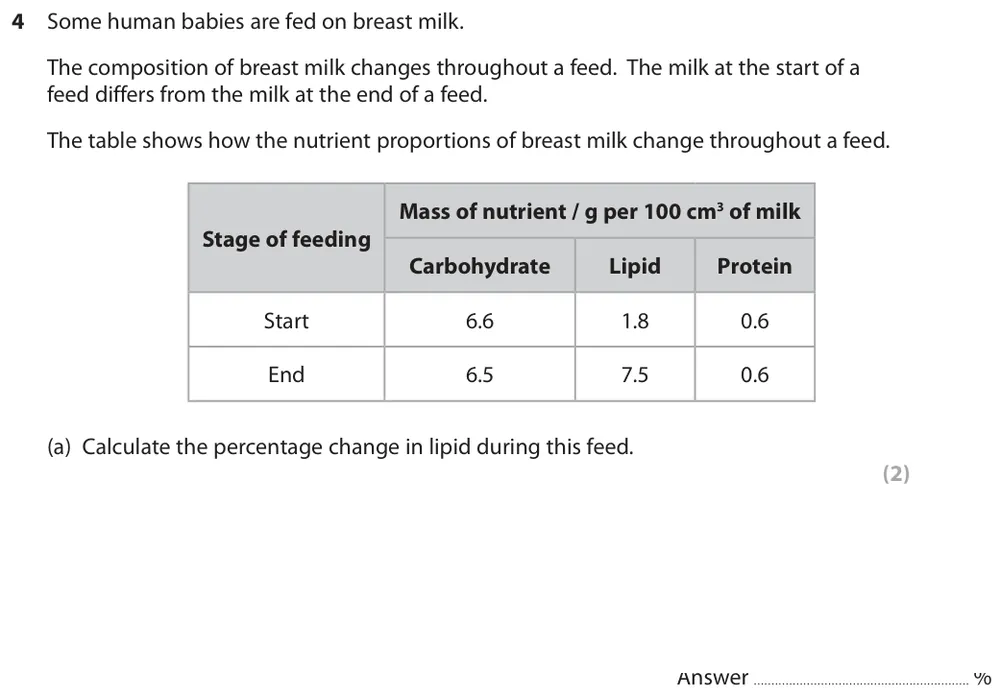
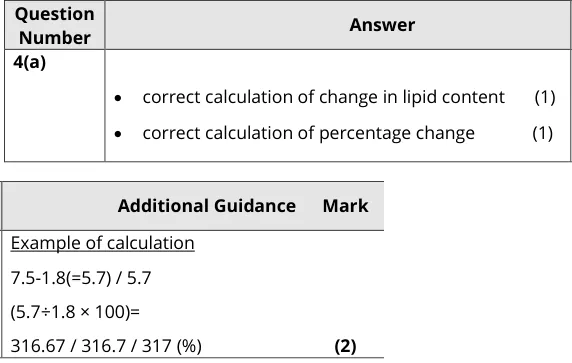
Calculate the percentage change in lipid in breast milk during a feed.
Show the mark scheme
Tap an image to open it full size.
From the examiners' report: Most got this right and rounded correctly. A significant number divided by the wrong number or rounded the answer down when it should have been rounded up.
Question 14
AS Paper 1 · November 2021 · Q8(b)(i) · 2 marks
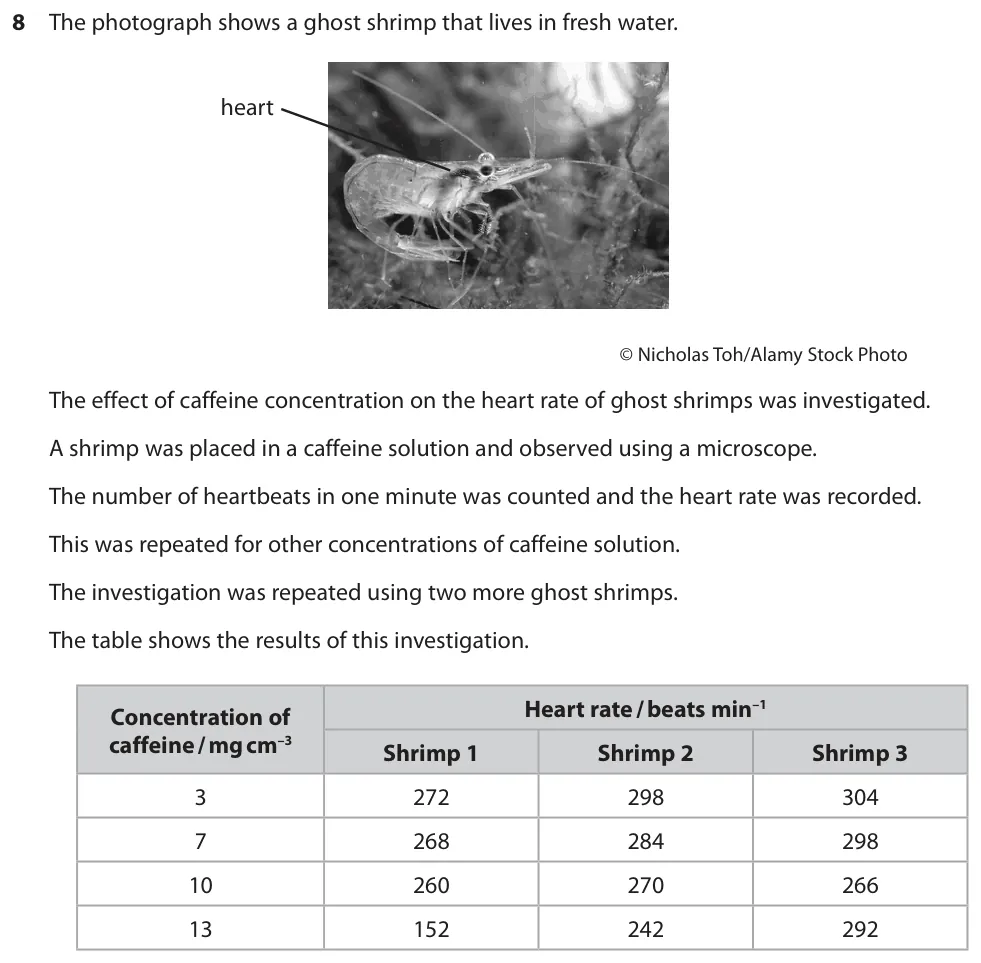
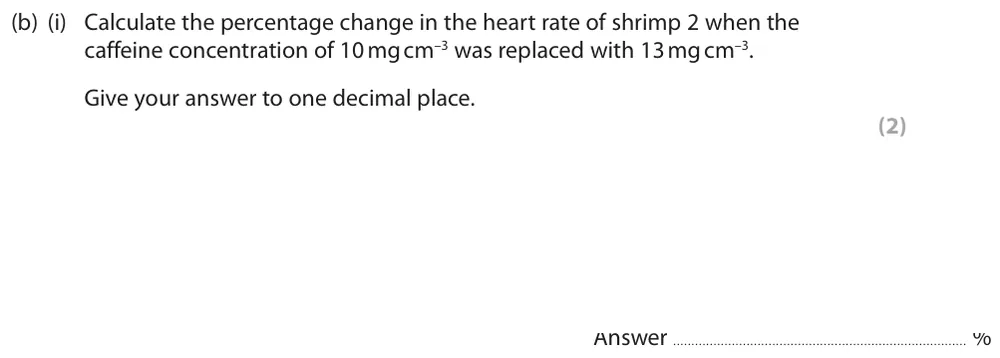
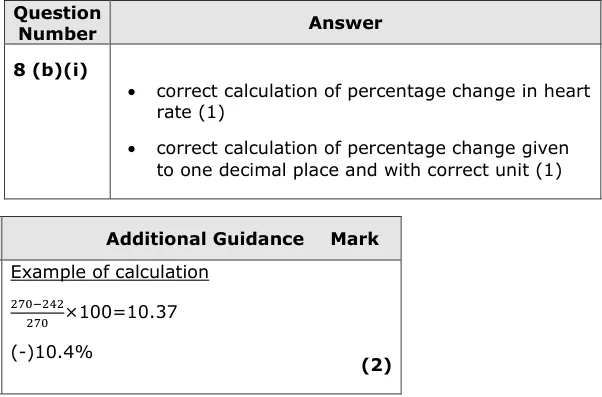
Calculate the percentage change in a shrimp's heart rate, to one decimal place.
Information from earlier in this question:
Show the mark scheme
Tap an image to open it full size.
From the examiners' report: Nearly all candidates could calculate the percentage change, but some did not give the answer to one decimal place as directed.
Question 15
A level Paper 1 · June 2024 · Q8(b)(i) · 2 marks · Easy
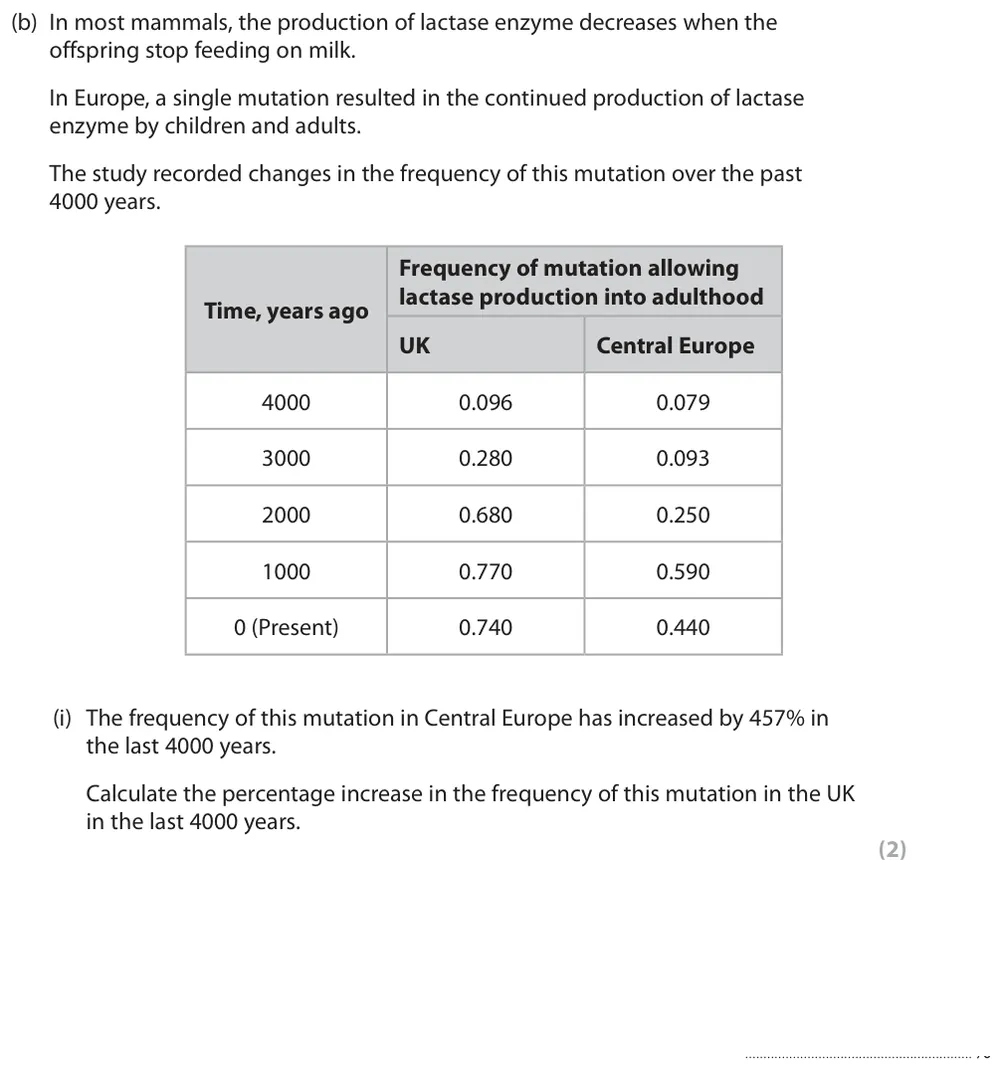
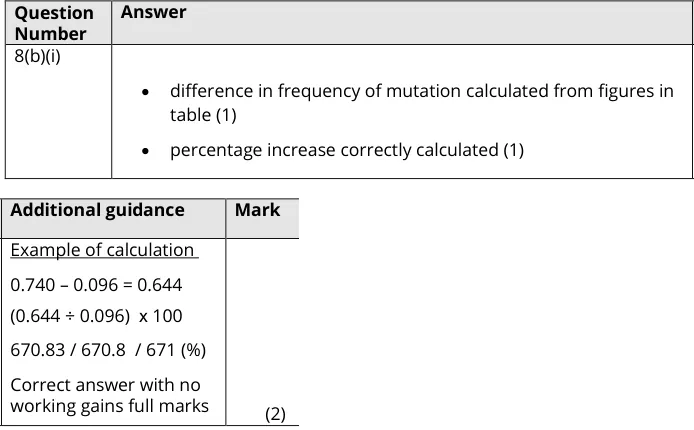
Calculate the percentage increase in the frequency of a lactase mutation in the UK over 4000 years.
Show the mark scheme
Tap an image to open it full size.
From the examiners' report: Those who lost marks usually divided by the wrong value. Write down the intermediate value (the difference) as well as the subtraction: the first mark needed that value to be seen if the final answer was wrong.
Question 16
A level Paper 1 · June 2022 · Q10(a)(i) · 2 marks
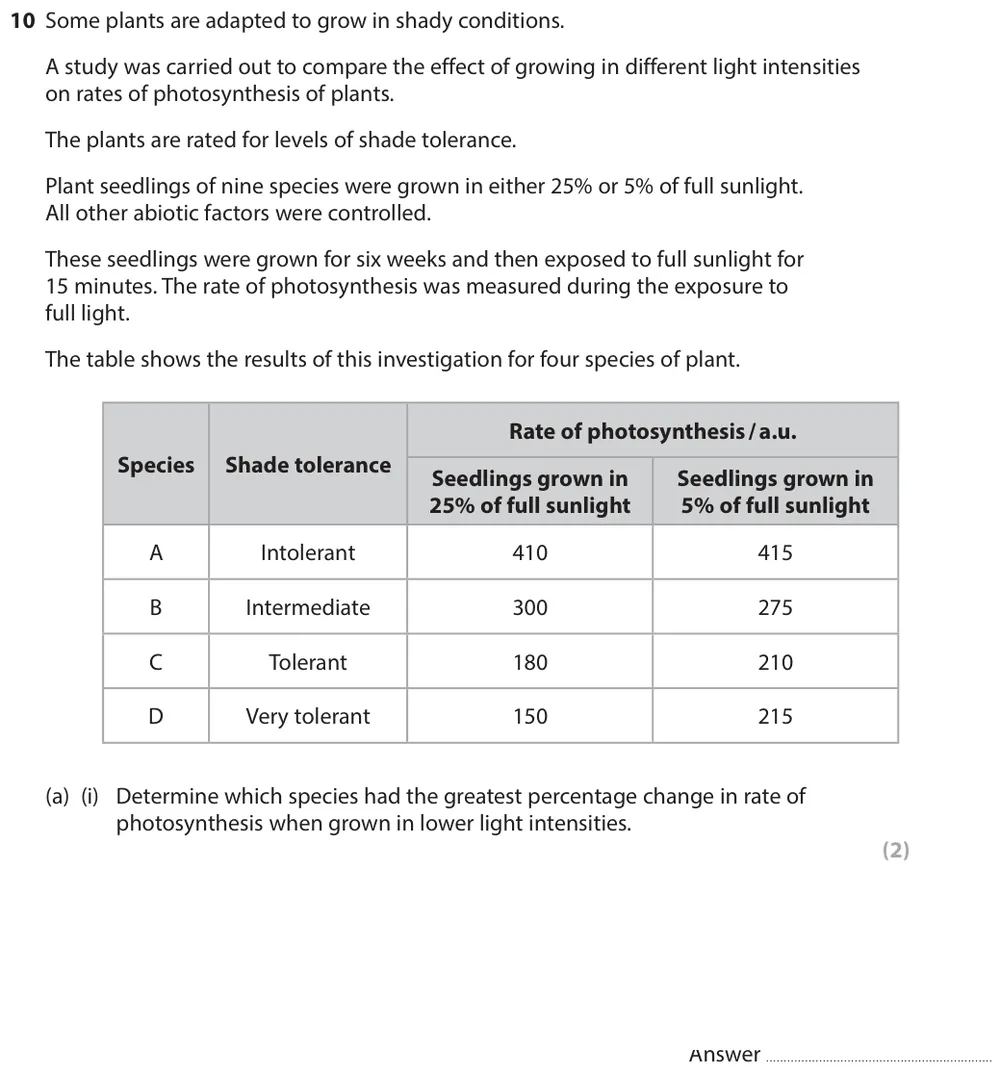
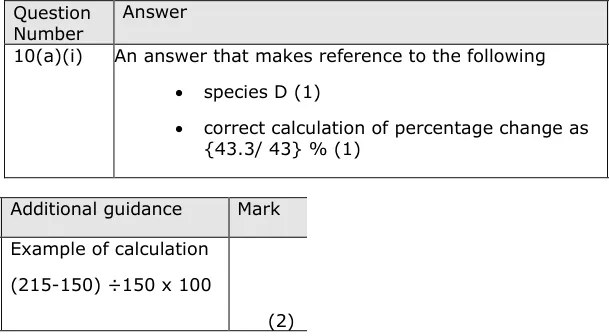
Determine which plant species had the greatest percentage change in photosynthesis rate in lower light.
Show the mark scheme
Tap an image to open it full size.
From the examiners' report: A question with the command word 'determine' always needs a calculation. Some gave only the species or only the percentage and gained one mark; give both.
Question 17
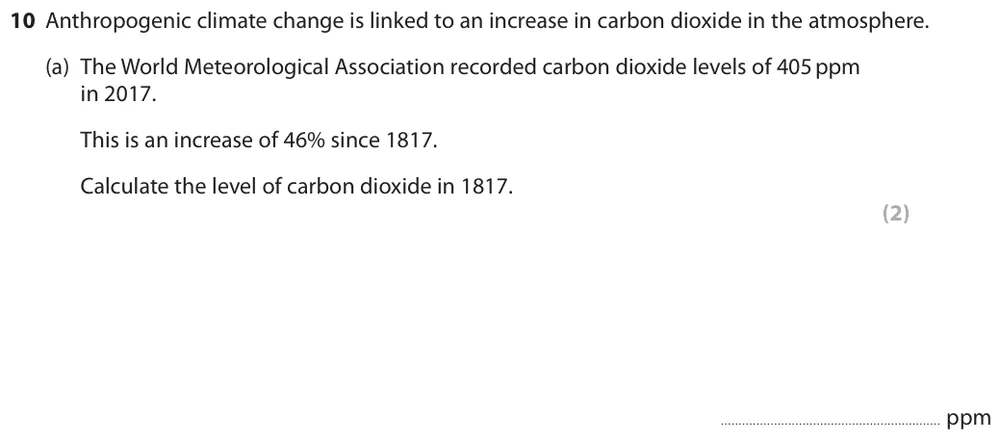
A level Paper 1 · November 2021 · Q10(a) · 2 marks
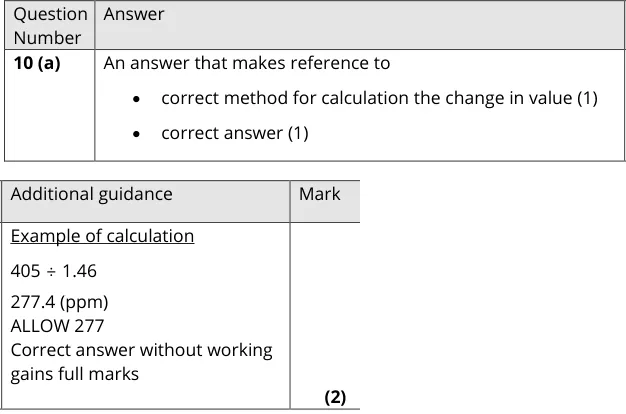
Calculate the carbon dioxide level in 1817 from the 2017 level and a 46% increase.
Show the mark scheme
Tap an image to open it full size.
Question 18
A level Paper 2 · June 2017 · Q9(b)(ii) · 2 marks
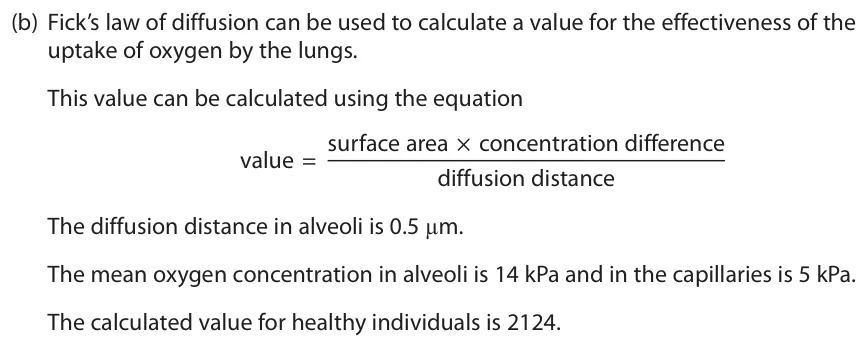
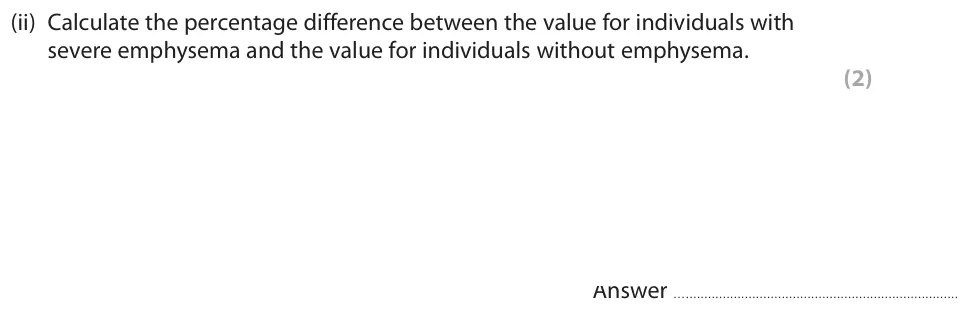
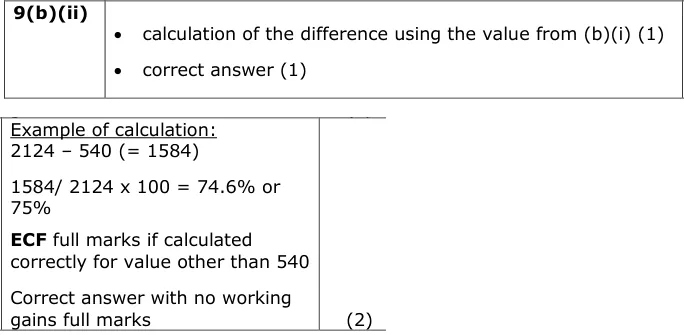
Use Fick's law to find the value for severe emphysema, then calculate its percentage difference from the value for healthy lungs.
Information from earlier in this question:
Show the mark scheme
Tap an image to open it full size.
From the examiners' report: Some divided the difference by the value for severe emphysema instead of the value for healthy individuals. Divide by the value you are comparing against, and show your working: it earned marks even when the value for severe emphysema had been calculated wrongly.
Question 19
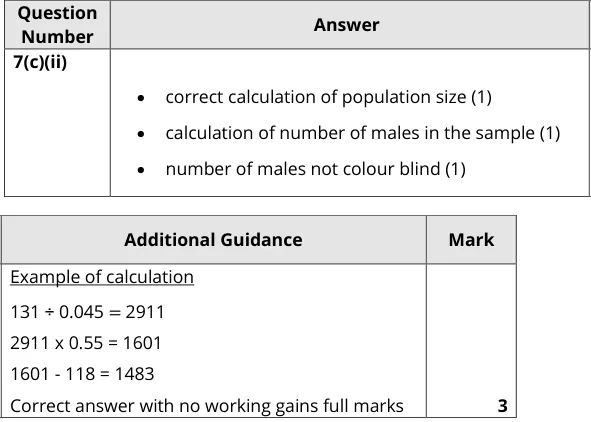
A level Paper 2 · June 2024 · Q7(c)(ii) · 3 marks · Easy
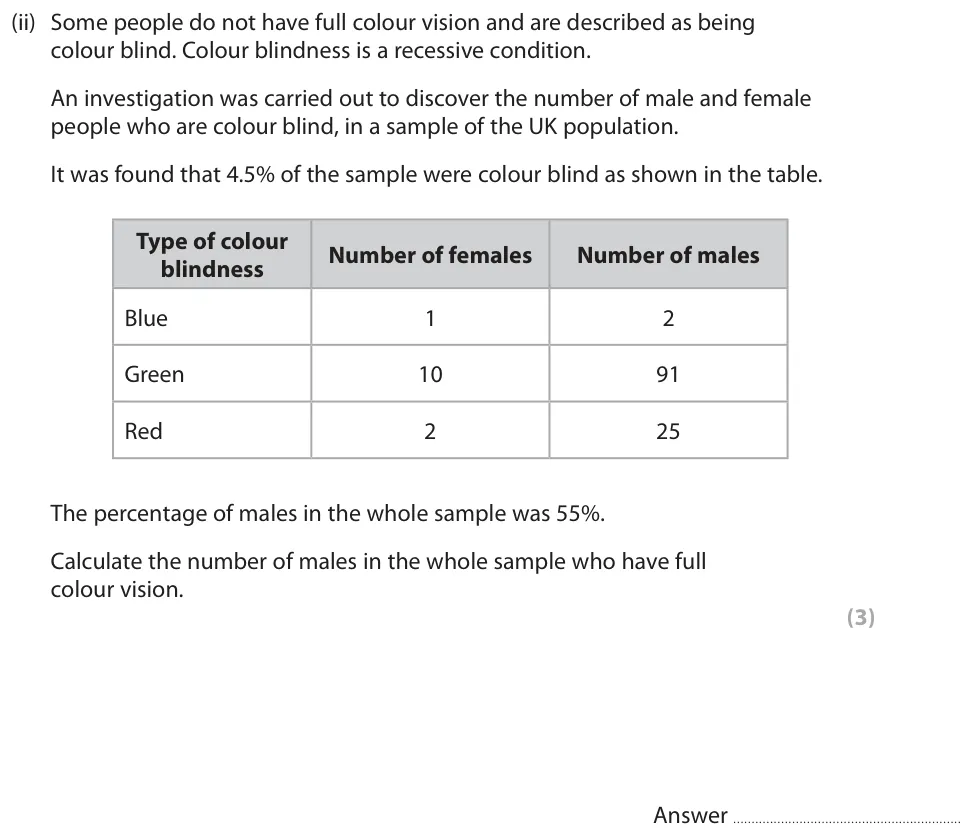
Calculate the number of males in a sample who have full colour vision.
Show the mark scheme
Tap an image to open it full size.
From the examiners' report: This calculation needed more than one step. Most candidates gained at least one mark.
Powers and exponential growth (MS 0.5)
Question 20
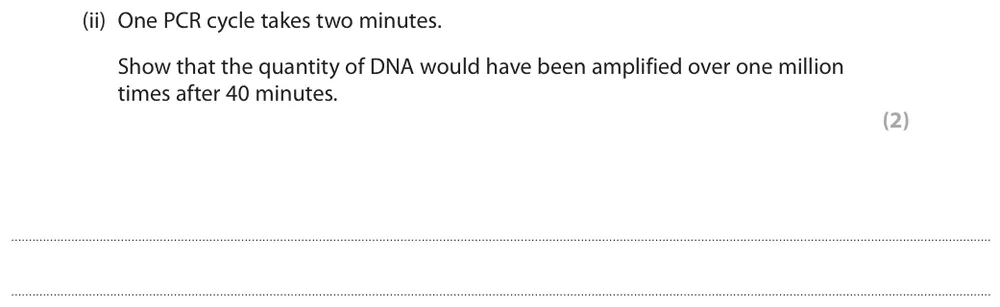
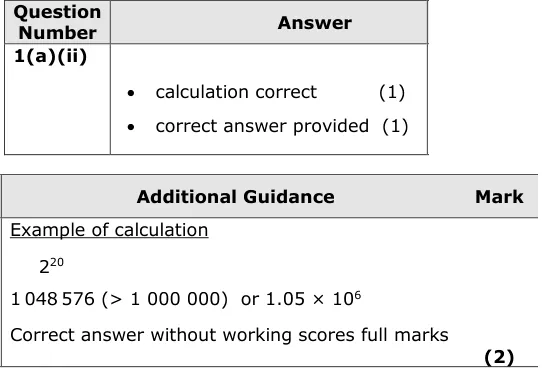
A level Paper 3 · June 2018 · Q1(a)(ii) · 2 marks
Show that PCR would amplify DNA over one million times in 40 minutes.
Show the mark scheme
Tap an image to open it full size.
From the examiners' report: The most common non-scoring answer stopped at '20 cycles'. Use the fact that the DNA doubles with every cycle to calculate the quantity after 20 cycles. Comparing your answer with one million was not required.
Where students lose marks (from Pearson examiners' reports and mark schemes)
Each point below comes from the examiners' reports and mark schemes, and is followed by wording that gained marks.
Convert mg to µg before you divide. A significant number could not convert mg to µg or cm³ to dm³.
✔ Gains credit: '85 mg = 85 000 µg; 85 000 ÷ 25 = 3400 cm³; 3400 ÷ 1000 = 3.4 dm³'
Finish in the unit the question asks for. Leaving the height of the Golgi stack in nanometres gained only one mark.
✔ Gains credit: '(6 × 15) + (5 × 25) = 215 nm = 0.215 µm'
Grams are not kilograms. Those who missed full marks did not convert the mass of each bag from grams to kilograms.
✔ Gains credit: '(7.6 × 10⁹) × 0.0055 = 4.18 × 10⁷ (kg)'
Check every standard form conversion. One common wrong answer converted 2.5 × 10⁻⁸ out of standard form incorrectly.
✔ Gains credit: '(2.5 × 10⁻⁸) × (6 × 10⁹) = 150 or 1.5 × 10²'
Keep the ratio in the order asked. The most common reason for losing a mark was writing the ratio the wrong way round; 1 : 6.25 gained only one mark.
✔ Gains credit: '1 ÷ 0.16 = 6.25 : 1'
A decrease cannot be more than 100%. Dividing by the leaf concentration instead of the root concentration gave a decrease of more than 100%.
✔ Gains credit: '2100 – 250 = 1850; 1850 ÷ 2100 × 100 = 88%'
Determine means name it and calculate it. Some gave only the species or only the percentage, which gained one mark.
✔ Gains credit: 'Species D; (215 – 150) ÷ 150 × 100 = 43.3%'
Doubling every cycle means powers of two. The most common non-scoring answer stopped at '20 cycles'.
✔ Gains credit: '2²⁰ = 1 048 576 (> 1 000 000) or 1.05 × 10⁶'
Download the questions
Download the PDF pack (20 questions, mark schemes at the end)
Keep practising
- Edexcel SNAB A level Biology revision resources by topic
- Handling Data and Statistics (Maths Skills MS1): Edexcel SNAB A Level Biology Exam Questions
- Algebra and Equations (Maths Skills MS2): Edexcel SNAB A Level Biology Exam Questions
- Graphs and Geometry (Maths Skills MS3 and MS4): Edexcel SNAB A Level Biology Exam Questions
- All Edexcel SNAB exam questions by topic
- Edexcel SNAB A level Biology past papers, mark schemes and examiners' reports
- Edexcel SNAB A level Biology grade boundaries
- Message Tom on WhatsApp about one-to-one Edexcel SNAB tutoring or an Edexcel group class
Questions, mark schemes and examiners' report extracts © Pearson Education Ltd.