

Algebra (MS 2 in the specification) covers changing the subject of an equation, substituting values into a formula using the right units, solving equations and using logarithms for quantities that range over several orders of magnitude. In biology papers the formula is usually given: body mass index, the volume of a cylinder, sphere or cone, the index of diversity, standard deviation, chi squared, Spearman's rank and the Hardy–Weinberg equation. Your job is to pick out the right values, convert units, work through the formula in the right order and present the answer as asked. Maths questions appear on every paper, at AS and A level. Questions marked AS are from the AS papers (8BN0); the rest are from the A level papers (9BN0).
The examiners' reports keep making the same points. Follow the instruction on rounding (one decimal place, three significant figures or a whole number), and round only the final answer. Give a unit when the answer line does not show one. Check units before you substitute: halve a diameter to get a radius and convert centimetres to metres. Lay out your working and label intermediate values such as p² so that working marks can be awarded. And finish the job: answers that stopped at a proportion, or never used the result, lost marks.
Studying Edexcel SNAB and want more help? If you'd like to arrange one-to-one Edexcel tutoring, or to register your interest in an Edexcel group class, message Tom on WhatsApp using the link at the bottom of this page.
What you need first
Each question on this page assumes you're secure on these ideas. If any of them feels shaky, look it up before you start.
- Work through a formula in order: brackets, then powers, then multiplication and division, then addition and subtraction.
- Unit conversions: 1 m = 100 cm = 1000 mm, and 1 mm = 1000 µm.
- The radius of a circle, sphere or cylinder is half its diameter.
- A recessive phenotype only shows in individuals that are homozygous recessive.
Key terms
These words come up in the questions and mark schemes. Examiners expect you to use them exactly.
- Subject of an equation: the quantity on its own on one side of the equals sign; rearranging an equation changes which quantity this is.
- Hardy–Weinberg equation: p² + 2pq + q² = 1, where p and q are the frequencies of the dominant and recessive alleles and p + q = 1.
- Allele frequency: the proportion of all copies of a gene in a population that are one particular allele.
- Index of diversity: D = N(N – 1) ÷ Σn(n – 1), where N is the total number of organisms of all species and n is the number of organisms of one species.
- Chi squared (χ²): Σ(O – E)² ÷ E; compares observed (O) and expected (E) numbers to see whether a difference is due to chance.
- Standard deviation: a measure of the spread of data around the mean.
- Logarithmic scale: a scale on which each equal step is a tenfold change; take the antilog of a reading to get the actual number.
- Significant figures: the digits that carry meaning in a number, counted from the first non-zero digit.
What these questions cover
Every question on this page tests one of these mathematical skills listed in the Pearson Edexcel A level Biology A (Salters-Nuffield) specification (9BN0).
- MS2.2: Change the subject of an equation
- MS2.3: Substitute numerical values into algebraic equations using appropriate units for physical quantities
- MS2.4: Solve algebraic equations
- MS2.5: Use logarithms in relation to quantities that range over several orders of magnitude (A level only)
How to use this page
Write your answer on paper before you open the mark scheme. Allow about 1.2 minutes per mark: the 20 questions are worth 49 marks, so about 59 minutes in total. Then mark your answer strictly against the mark scheme and read the examiners' tip underneath it. If you'd rather print the questions, download the PDF pack.
Changing the subject of an equation (MS 2.2)
Question 1
AS Paper 1 · June 2019 · Q4(c)(ii) · 2 marks
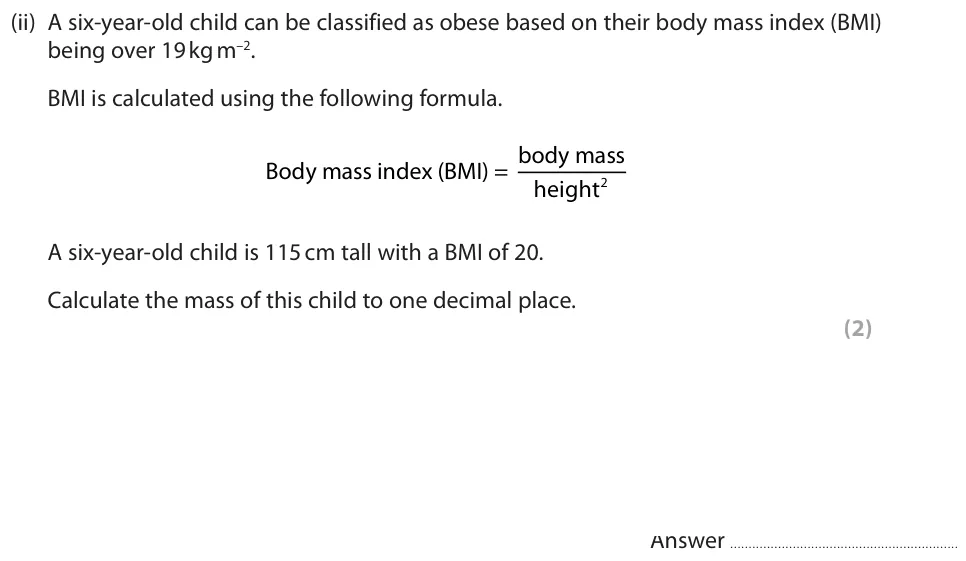
Rearrange the BMI formula to calculate the mass of a child, to one decimal place.
Show the mark scheme
Tap an image to open it full size.
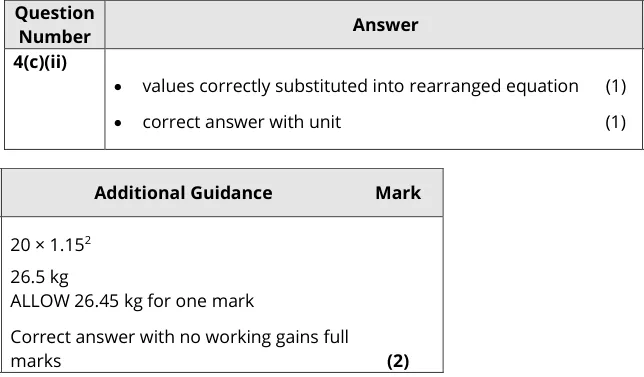
From the examiners' report: Rearrange the equation so that mass is the subject. Many answers were not given to one decimal place or had no unit, and another common mistake was not converting the height to metres and squaring it (1.15²).
Question 2
AS Paper 1 · June 2024 · Q7(a) · 2 marks
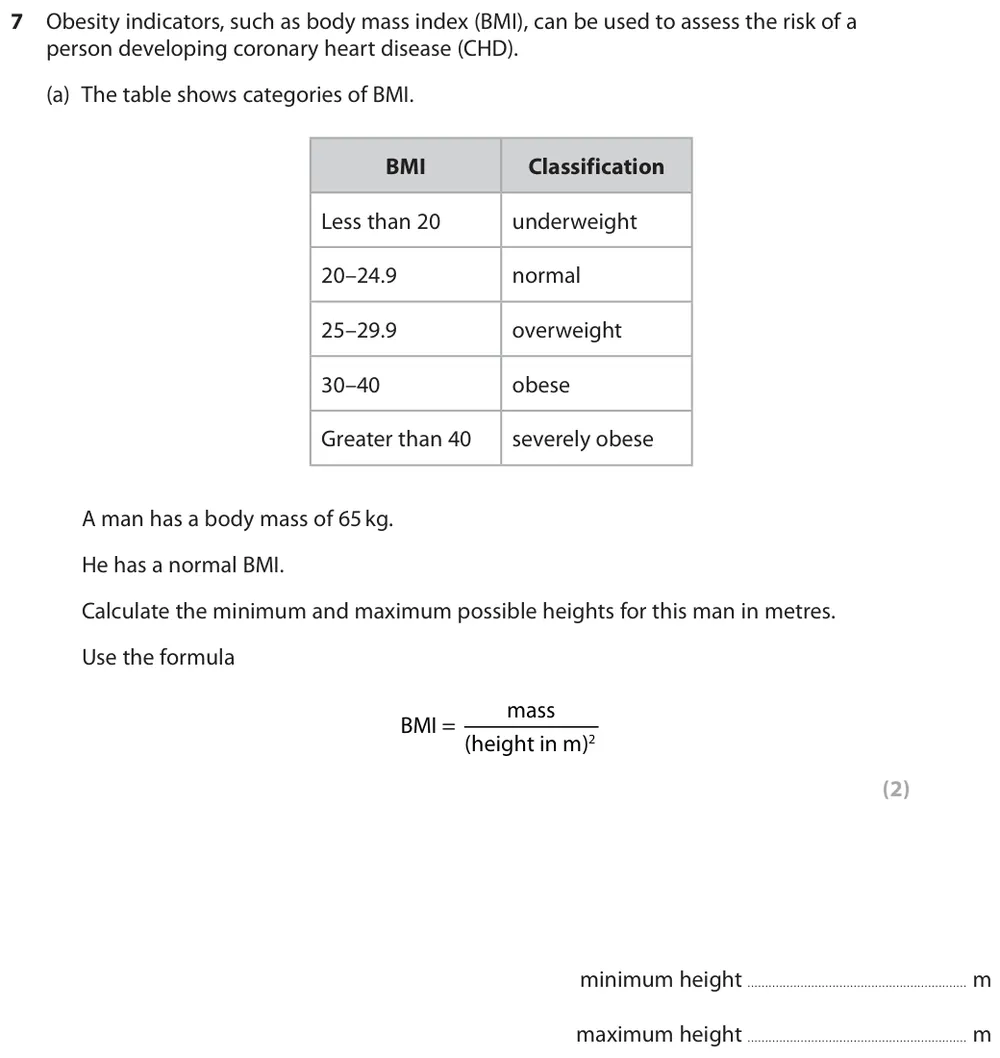
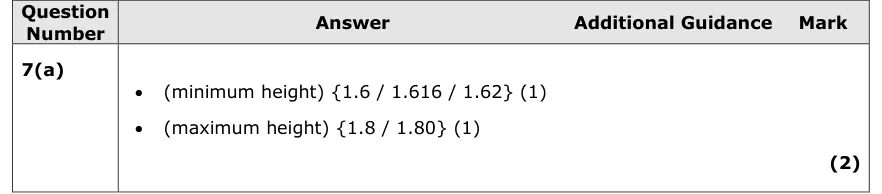
Use a table of BMI categories and the BMI formula to calculate the minimum and maximum heights of a man with a normal BMI.
Show the mark scheme
Tap an image to open it full size.
From the examiners' report: Most gave correct heights, but a significant minority wrote them in the wrong places, putting the minimum value next to 'maximum height'. Check that your answers are reasonable.
Substituting values into a given formula (MS 2.3)
Question 3
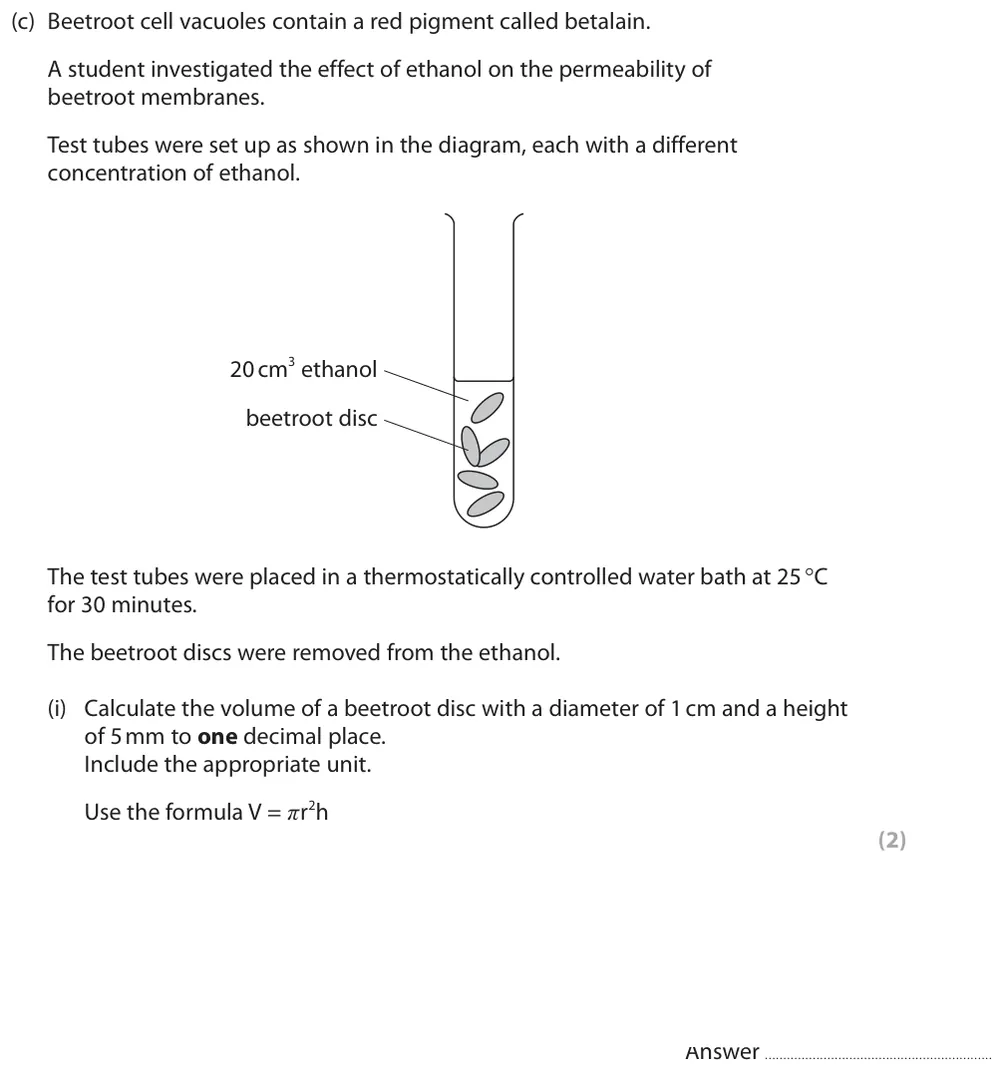
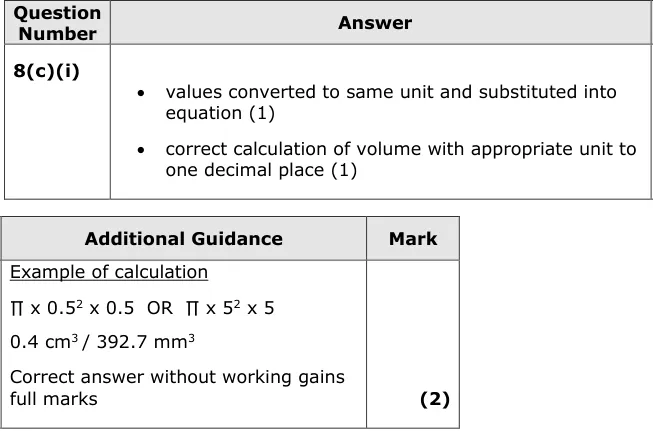
AS Paper 1 · June 2023 · Q8(c)(i) · 2 marks
Calculate the volume of a beetroot disc, to one decimal place and with the unit, using V = πr²h.
Show the mark scheme
Tap an image to open it full size.
From the examiners' report: The diameter and height were given in different units. A significant number did not convert one of them, made an incorrect conversion or left out the unit.
Question 4
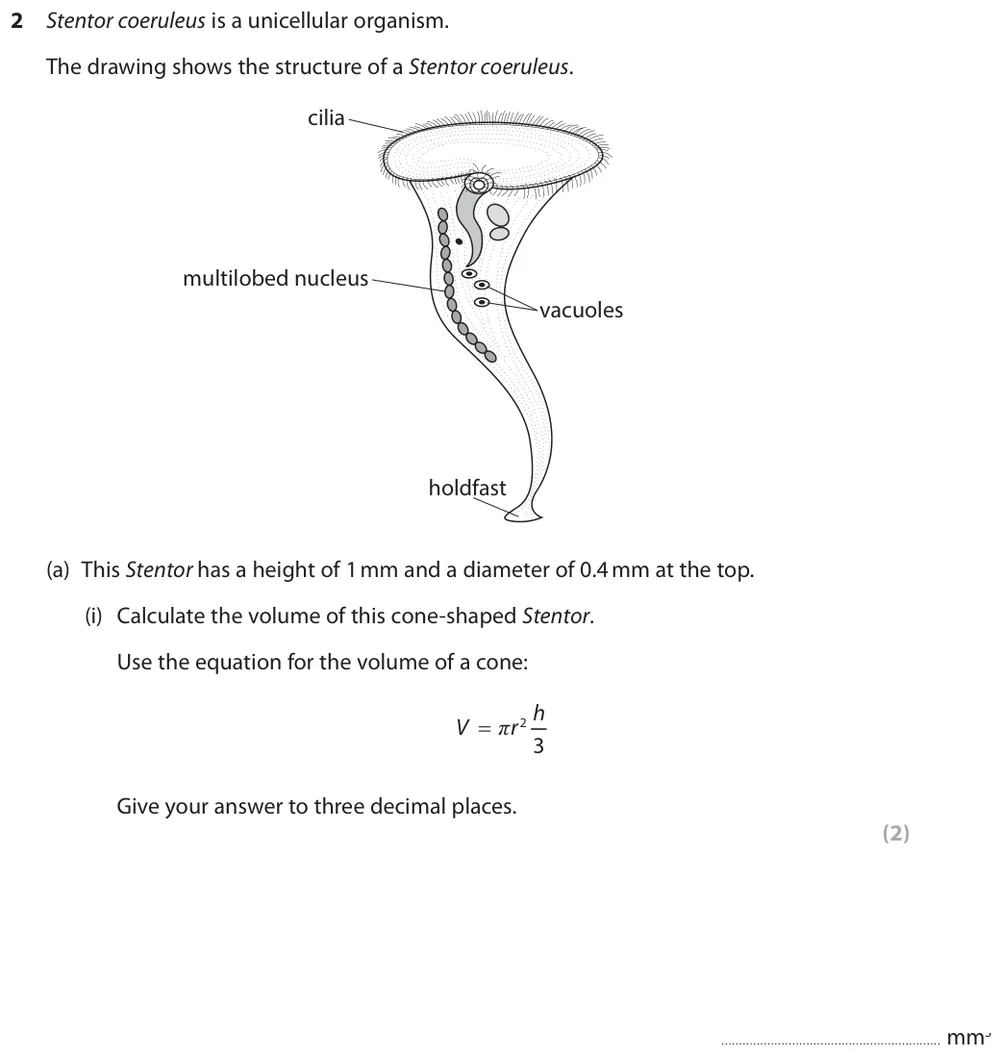
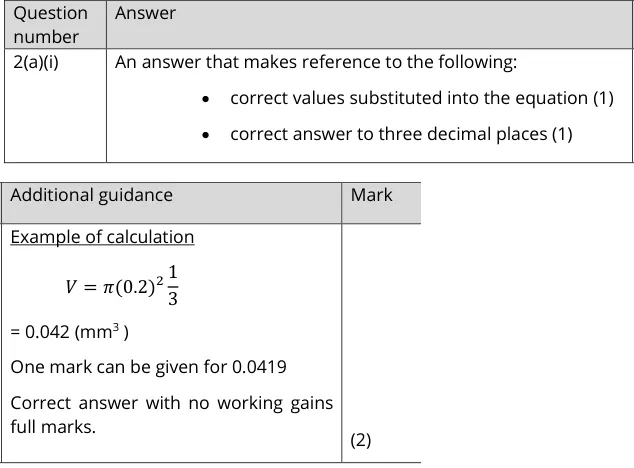
A level Paper 3 · June 2025 · Q2(a)(i) · 2 marks
Calculate the volume of a cone-shaped Stentor to three decimal places.
Show the mark scheme
Tap an image to open it full size.
From the examiners' report: Most scored both marks. Errors were not halving the 0.4 mm diameter to get the radius, not squaring the radius, and not giving the answer to three decimal places.
Question 5
A level Paper 1 · June 2025 · Q9(b) · 3 marks · Easy
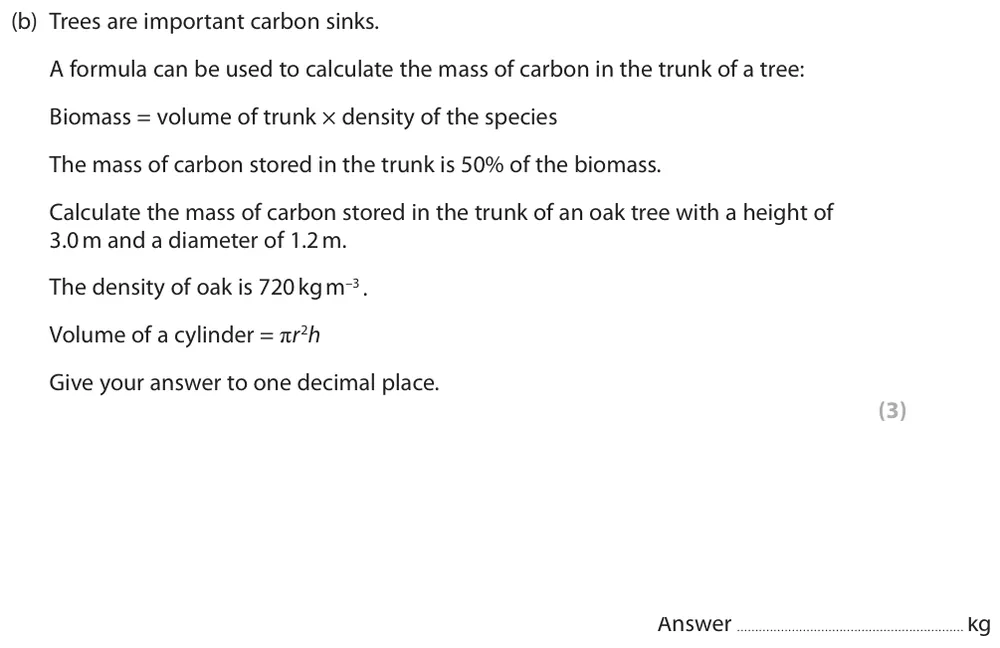
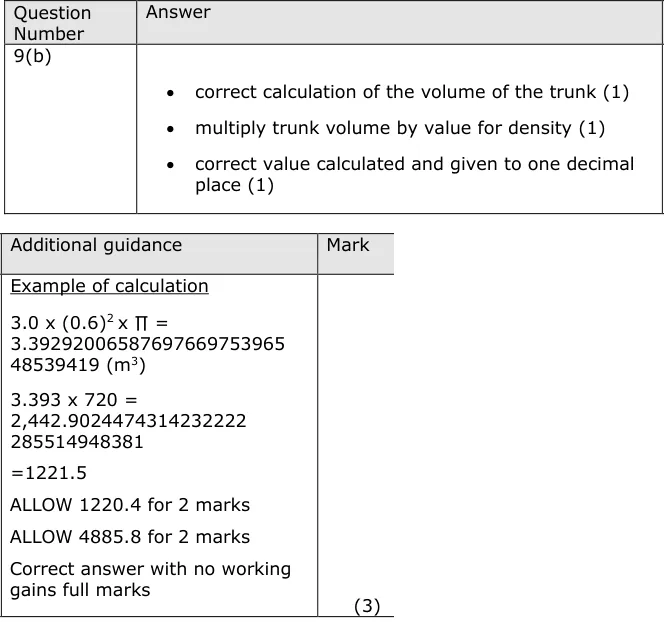
Calculate the mass of carbon stored in an oak tree trunk from its height, diameter and density.
Show the mark scheme
Tap an image to open it full size.
From the examiners' report: Common errors were not halving the diameter, forgetting that carbon is only 50% of the biomass and not giving one decimal place. Some rounded intermediate values: do no rounding until the final answer.
Question 6
A level Paper 3 · June 2022 · Q2(b) · 3 marks
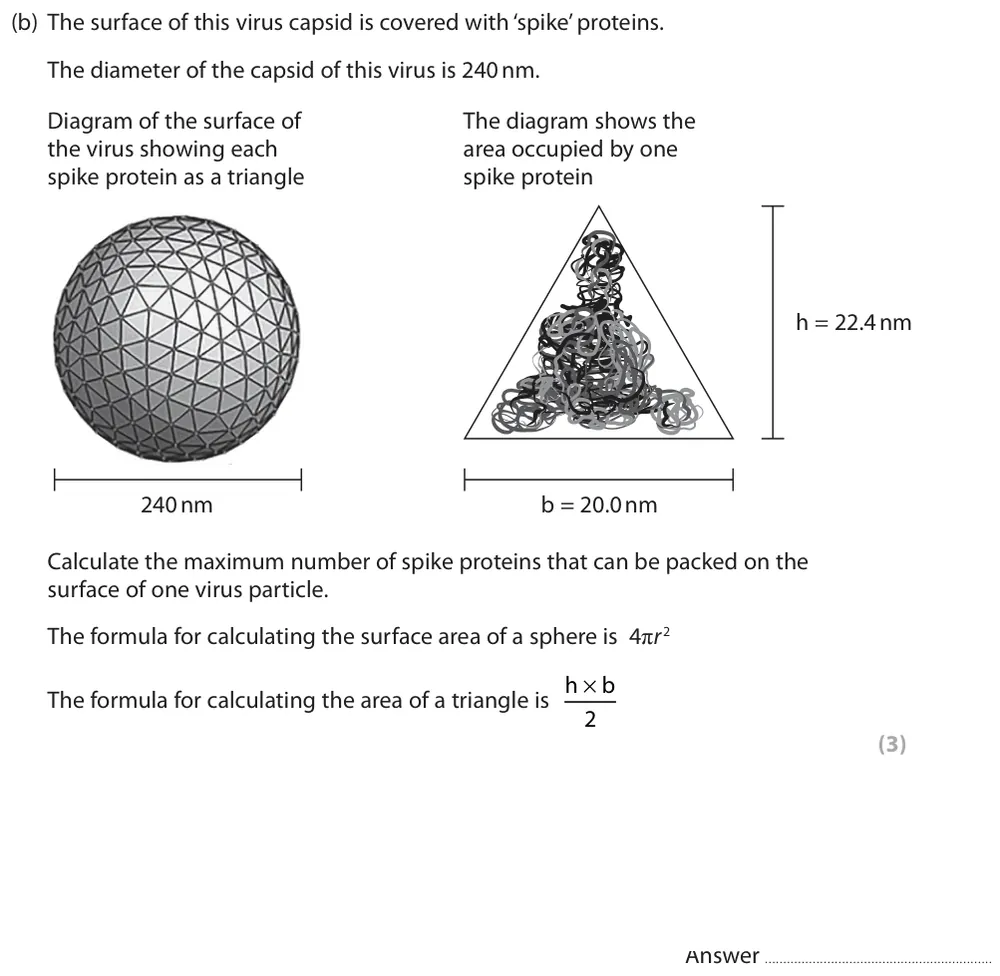
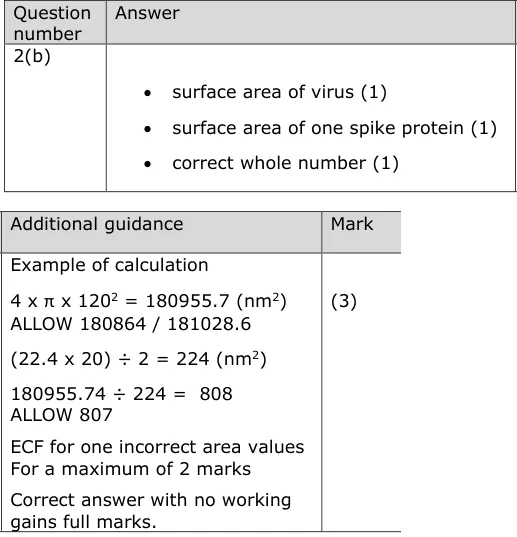
Use the surface area of a sphere and the area of a triangle to calculate how many spike proteins fit on one virus particle.
Show the mark scheme
Tap an image to open it full size.
From the examiners' report: The final answer had to be a whole number. Lay out your working clearly so that working marks can be awarded, and don't leave the π symbol in your working or final answer.
Question 7
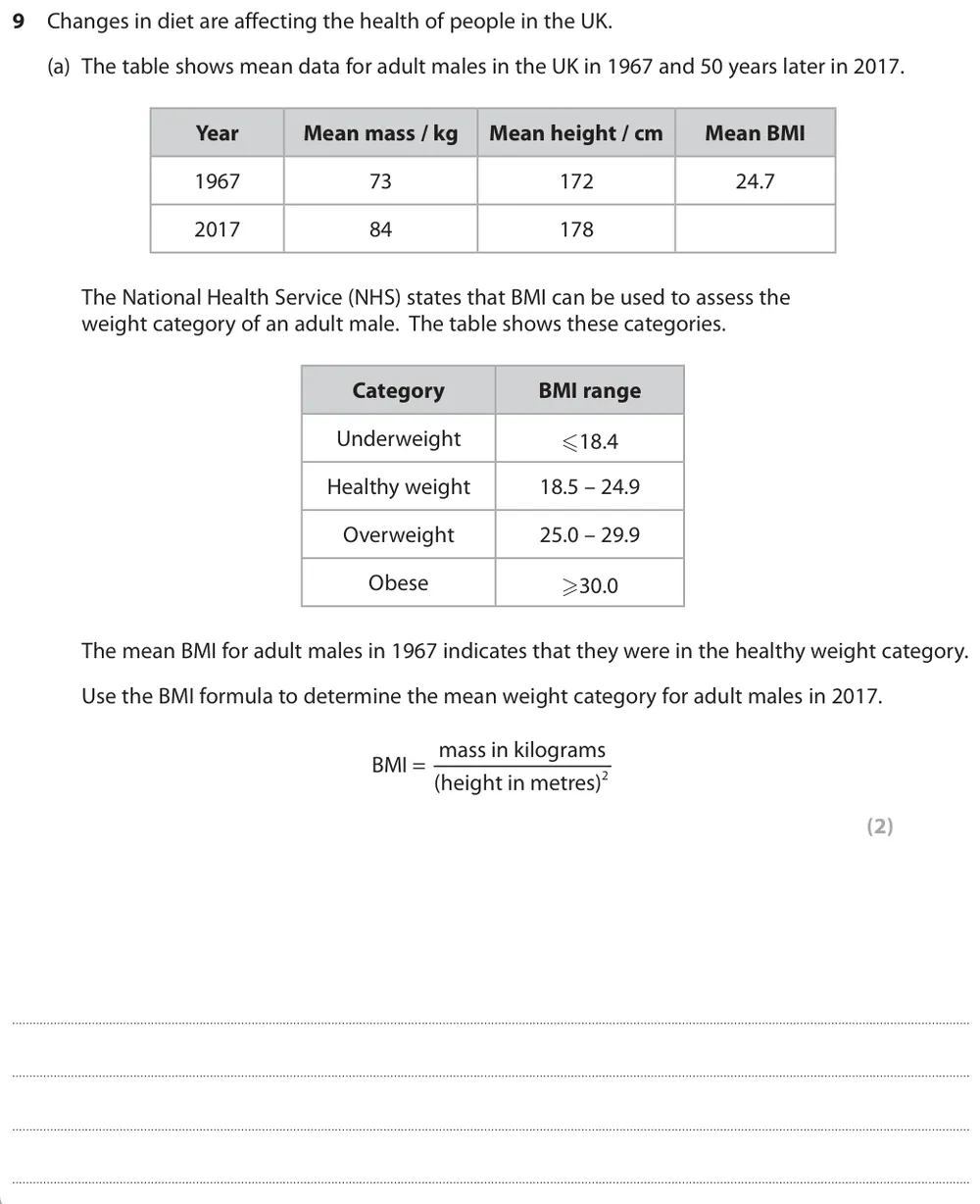
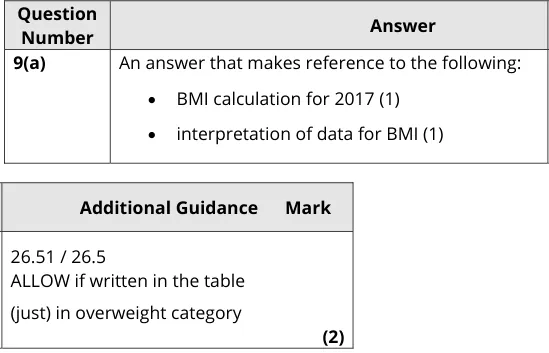
A level Paper 2 · June 2019 · Q9(a) · 2 marks
Use the BMI formula to work out the mean weight category for adult males in 2017.
Show the mark scheme
Tap an image to open it full size.
From the examiners' report: Most calculated the BMI correctly, but a number did not then use it to give the weight category, so gained only one mark.
Index of diversity (MS 2.3)
Question 8
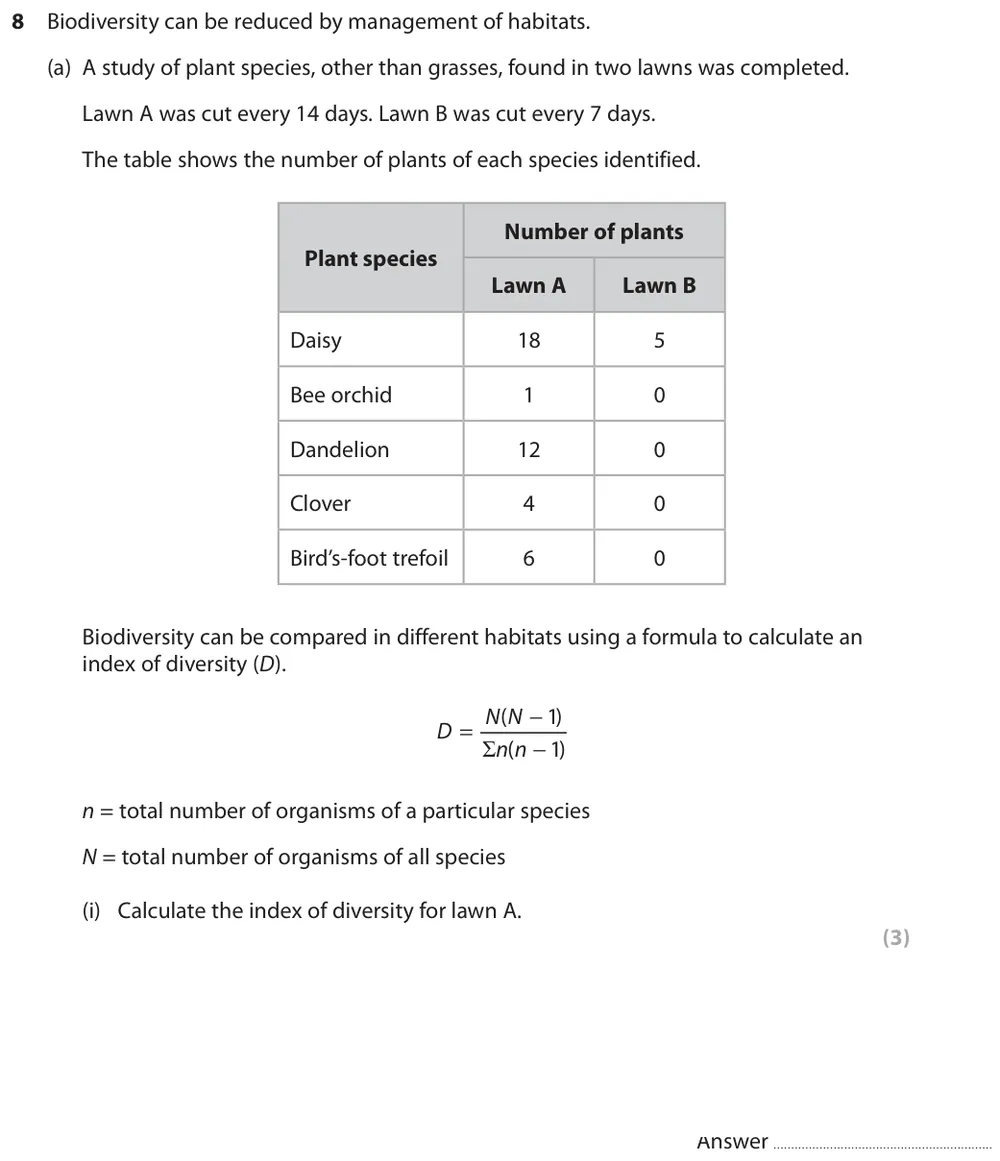
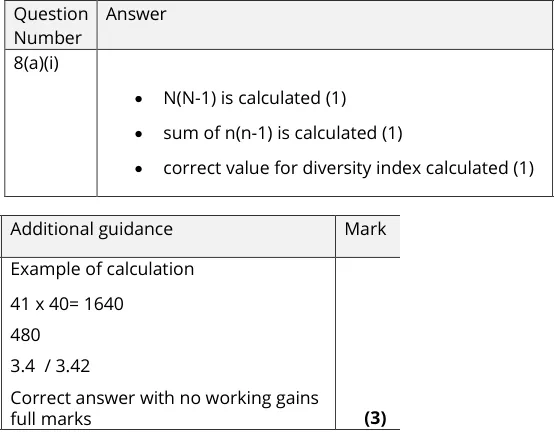
AS Paper 2 · November 2021 · Q8(a)(i) · 3 marks
Calculate the index of diversity for a lawn from a table of species numbers.
Show the mark scheme
Tap an image to open it full size.
From the examiners' report: The formula is given, but you need to know what N and n stand for, and some could not. Some stopped part way through the calculation; others added an extra step after reaching the index.
Question 9
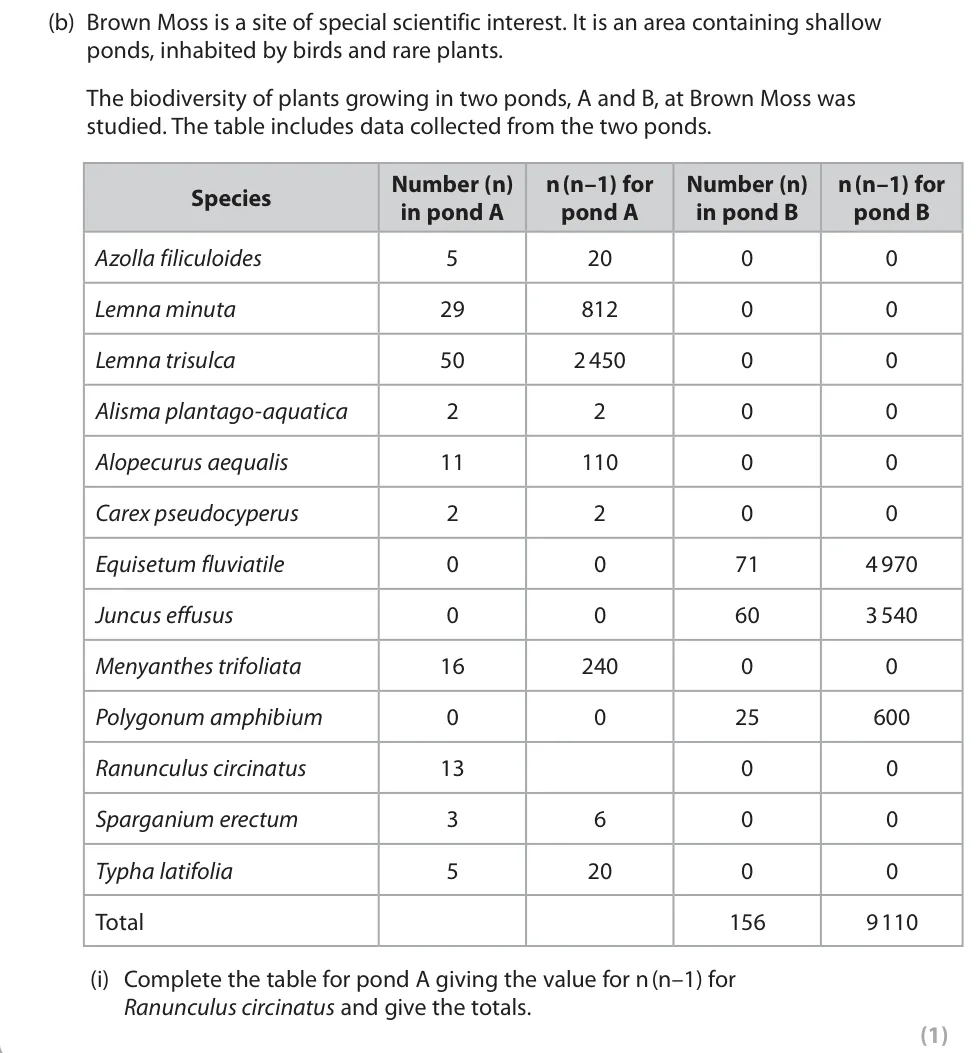
A level Paper 1 · June 2023 · Q2(b)(i) · 1 mark · Easy
Complete a table of n(n – 1) values and totals for a pond.
Show the mark scheme

Tap an image to open it full size.
From the examiners' report: Most candidates filled in the table correctly.
Question 10
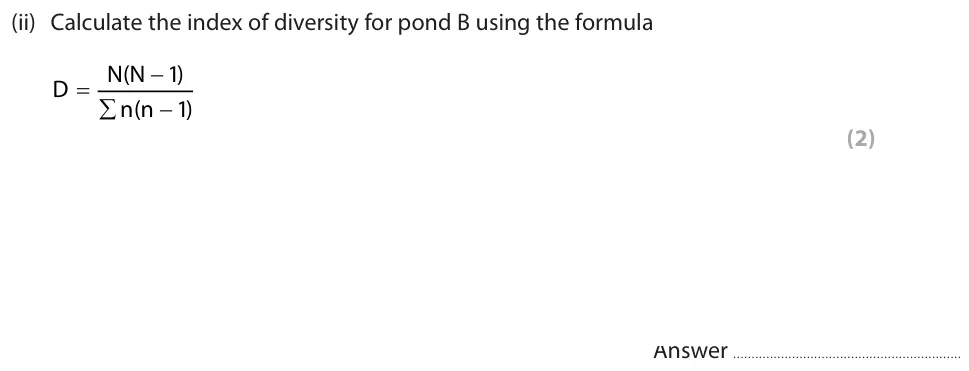
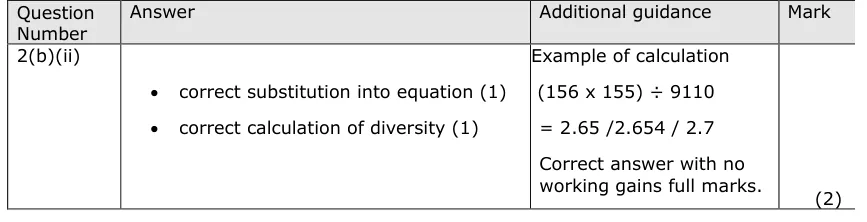
A level Paper 1 · June 2023 · Q2(b)(ii) · 2 marks
Calculate the index of diversity for a second pond using the formula.
Show the mark scheme
Tap an image to open it full size.
From the examiners' report: Marks were lost by using the wrong denominator. You will always be given the equation; make sure you put the correct numbers into it.
Statistical formulae: standard deviation, chi squared and Spearman's rank (MS 2.3)
Question 11
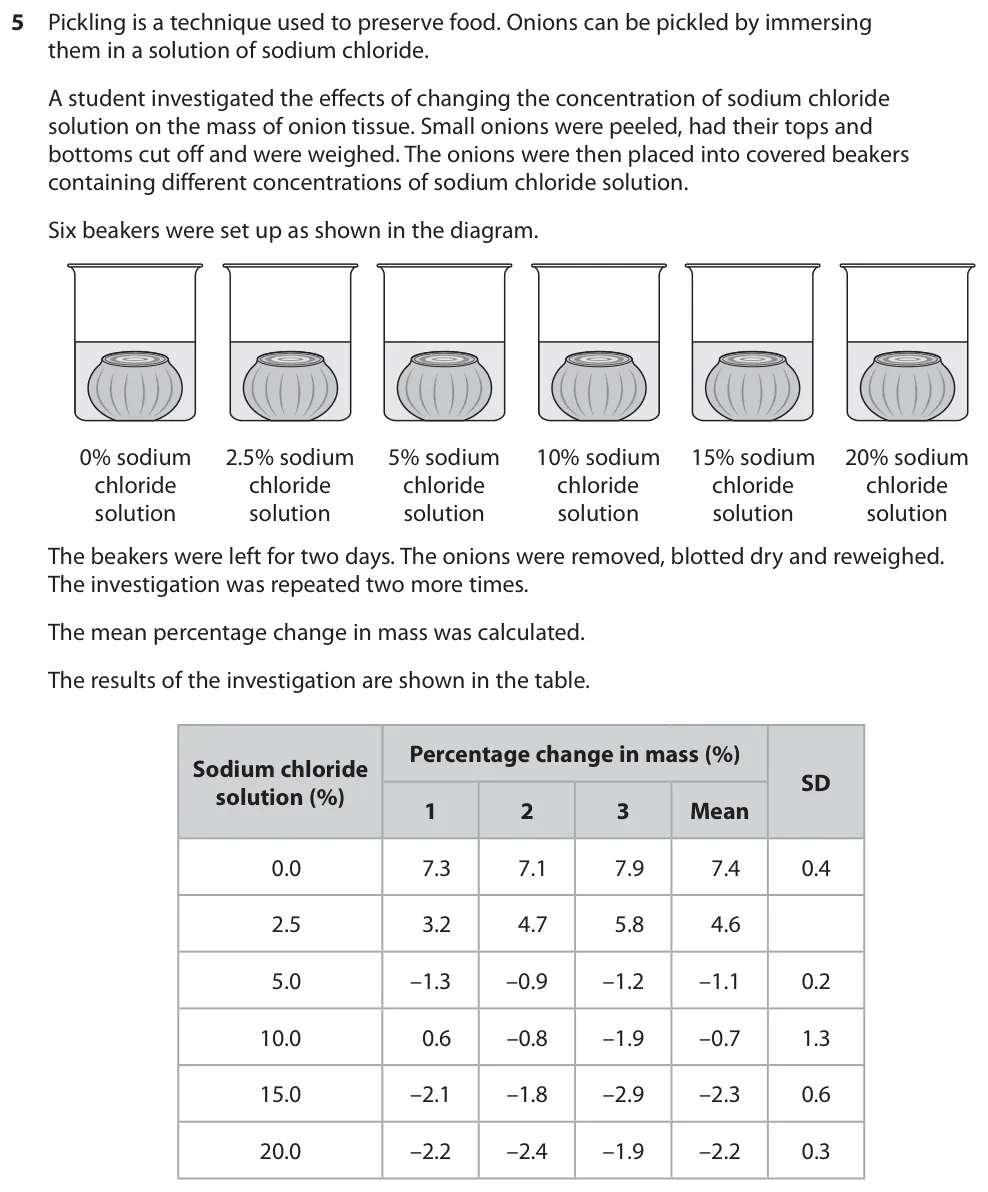
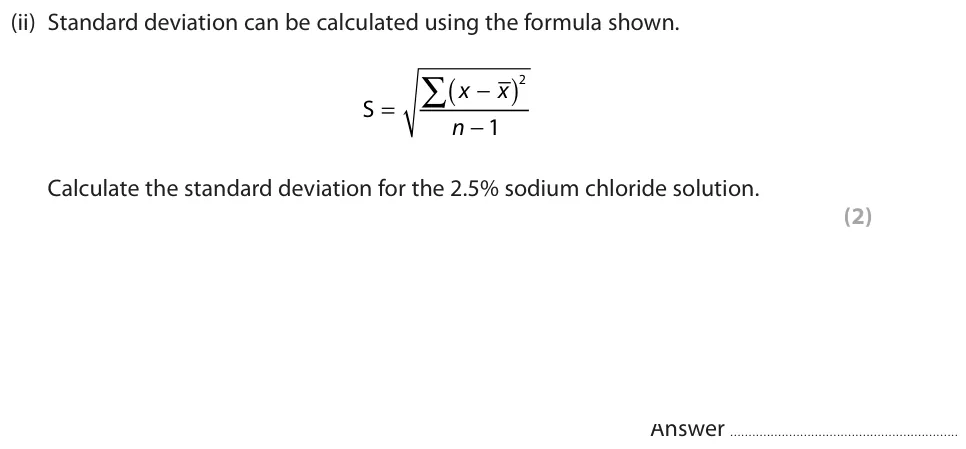
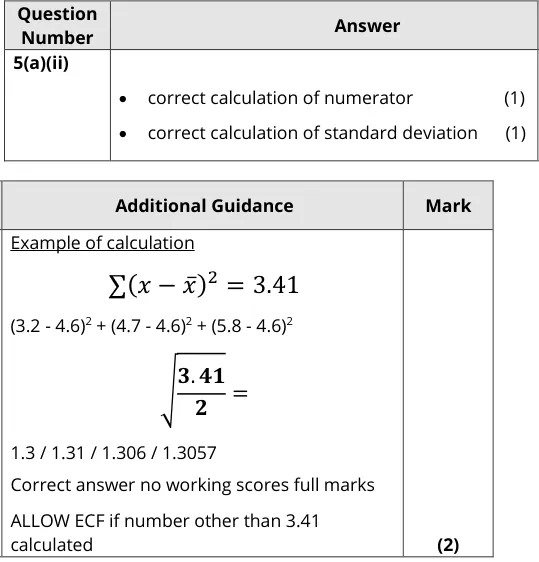
AS Paper 1 · June 2019 · Q5(a)(ii) · 2 marks
Calculate a standard deviation using the formula given.
Information from earlier in this question:
Show the mark scheme
Tap an image to open it full size.
From the examiners' report: This was the first time standard deviation was tested on this paper, and many left it blank. The most common error was not knowing what the symbol n referred to.
Question 12
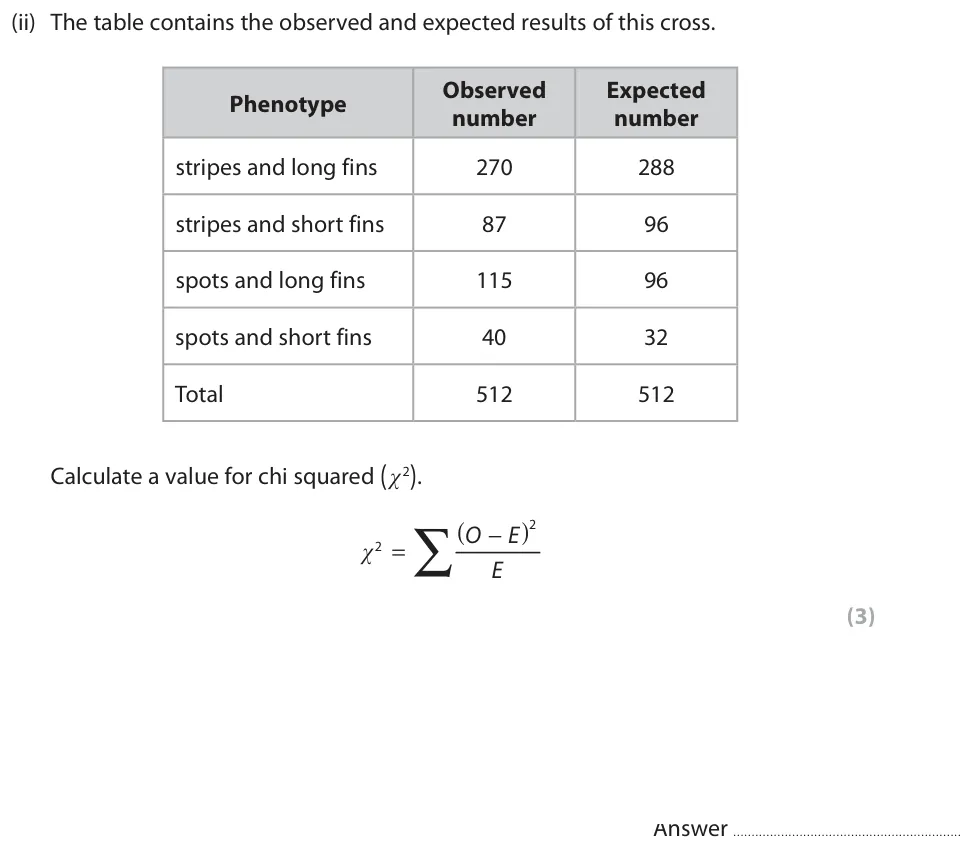
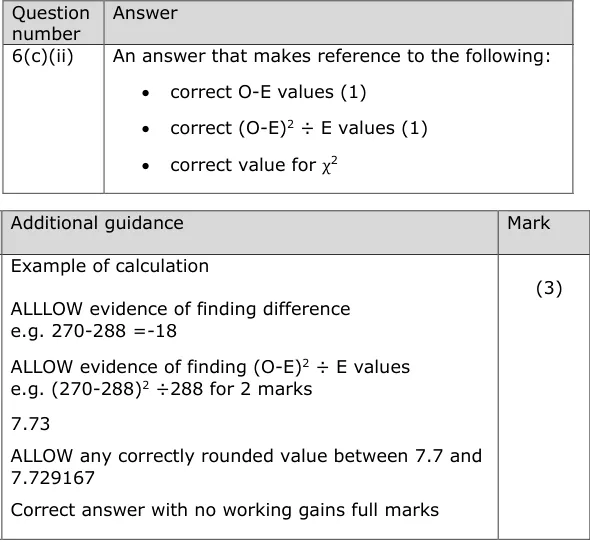
A level Paper 3 · June 2023 · Q6(c)(ii) · 3 marks
Calculate a chi squared value from observed and expected numbers of fish phenotypes.
Show the mark scheme
Tap an image to open it full size.
From the examiners' report: A frequent error was dividing the (O – E)² values by the total (512) instead of dividing each one by its own expected value.
Question 13
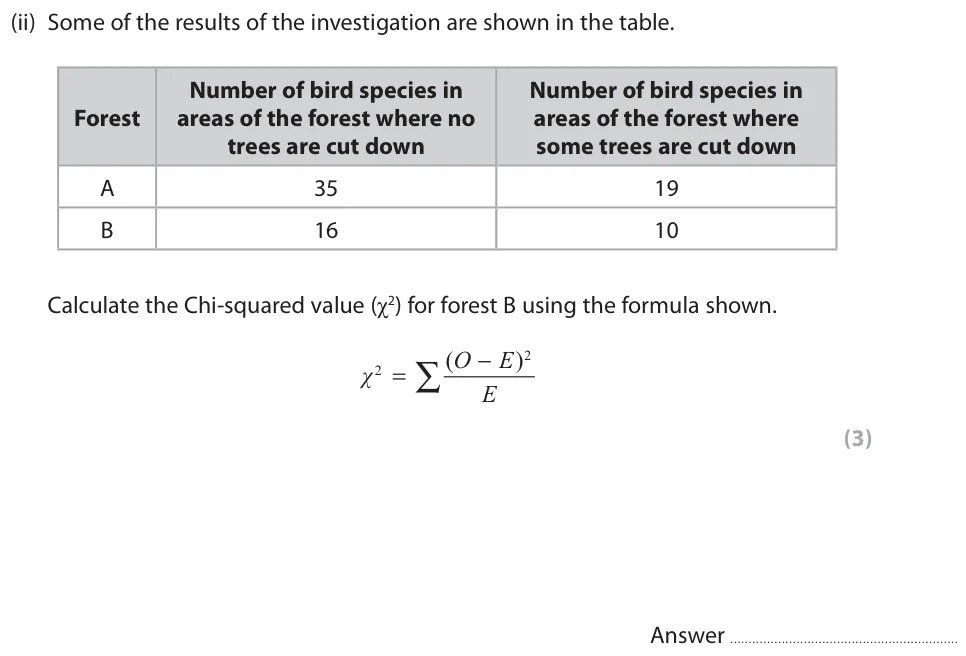
A level Paper 3 · November 2021 · Q5(a)(ii) · 3 marks
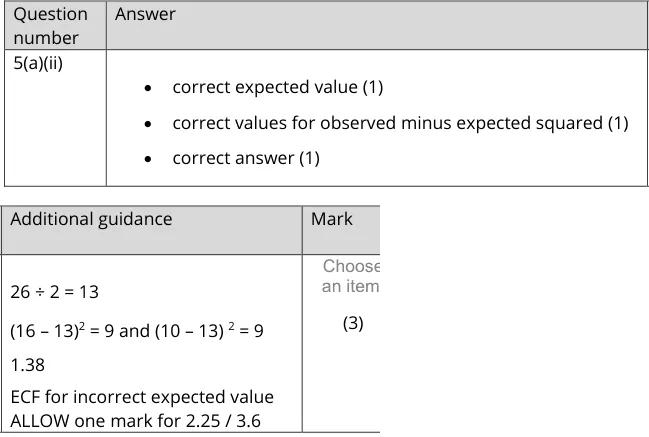
Calculate a chi squared value for the number of bird species in two areas of a forest.
Show the mark scheme
Tap an image to open it full size.
From the examiners' report: Only a very small number got this right. Start by finding the expected value: most used 16 or 10 instead of the mean of the two.
Question 14
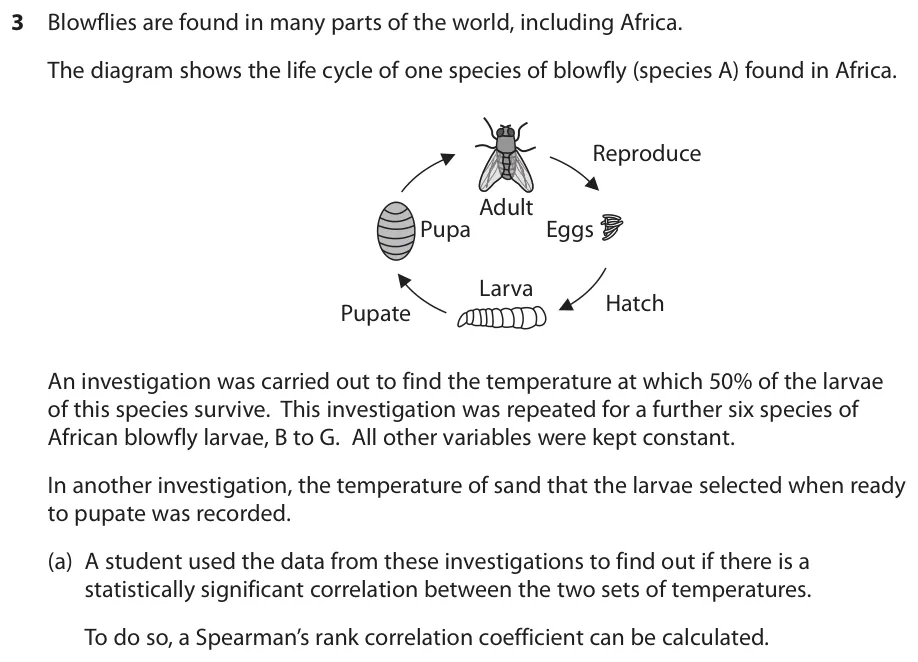
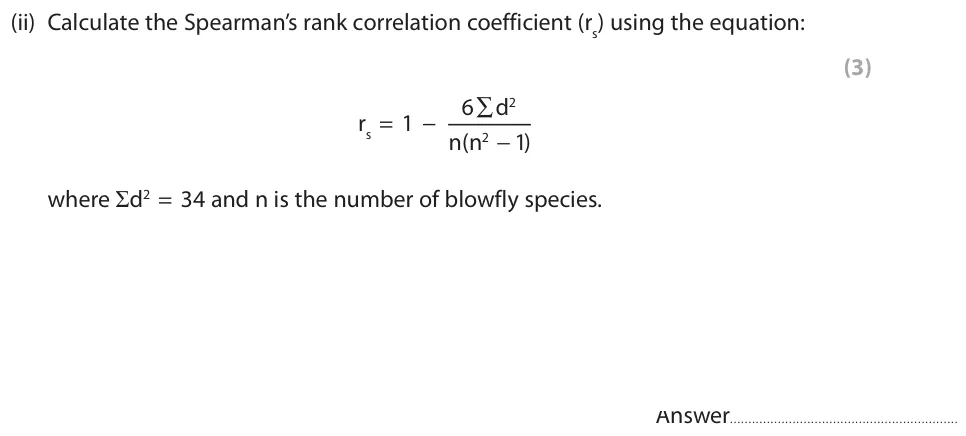
A level Paper 3 · June 2018 · Q3(a)(ii) · 3 marks
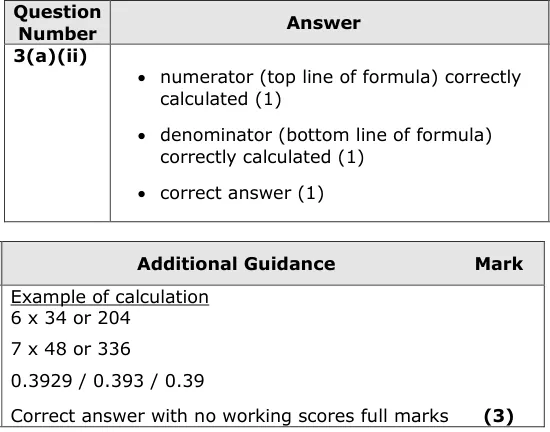
Calculate Spearman's rank correlation coefficient from the sum of d² and the number of species.
Information from earlier in this question:
Show the mark scheme
Tap an image to open it full size.
From the examiners' report: Most got the right value, but a significant minority forgot to subtract their calculated value from one.
Solving the Hardy–Weinberg equation (MS 2.4)
Question 15
AS Paper 2 · June 2017 · Q4(b)(ii) · 3 marks
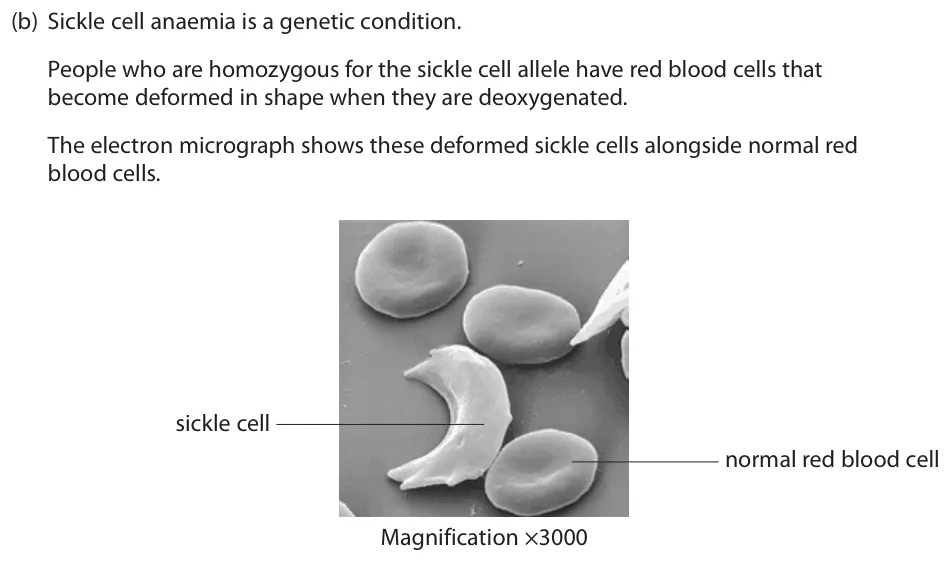
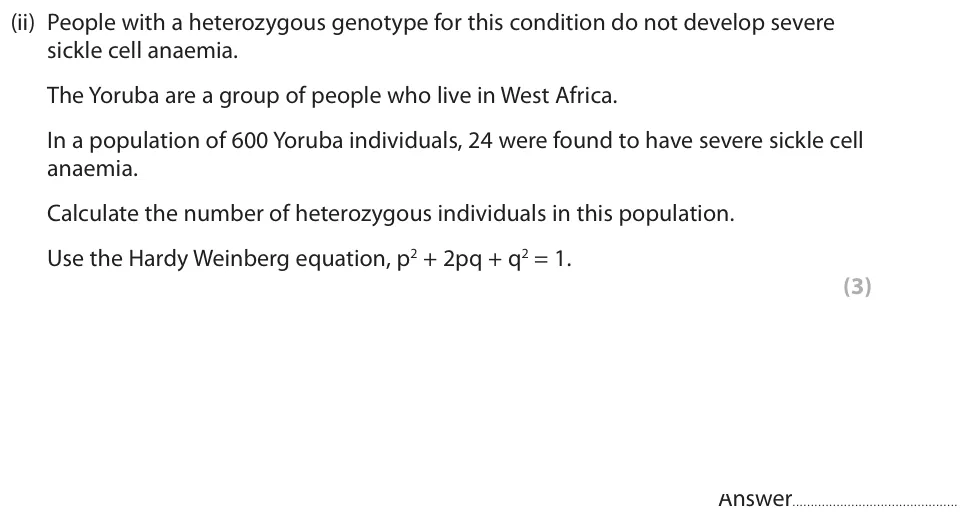
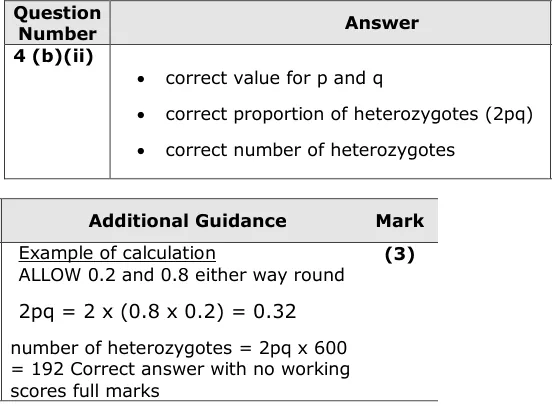
Use the Hardy–Weinberg equation to calculate the number of heterozygous individuals in a population.
Information from earlier in this question:
Show the mark scheme
Tap an image to open it full size.
From the examiners' report: Calculating a square root seemed beyond many candidates, and many seemed to be working without a calculator. Some stopped at the proportion of heterozygotes instead of going on to the number of individuals.
Question 16
AS Paper 2 · June 2024 · Q5(a)(i) · 3 marks
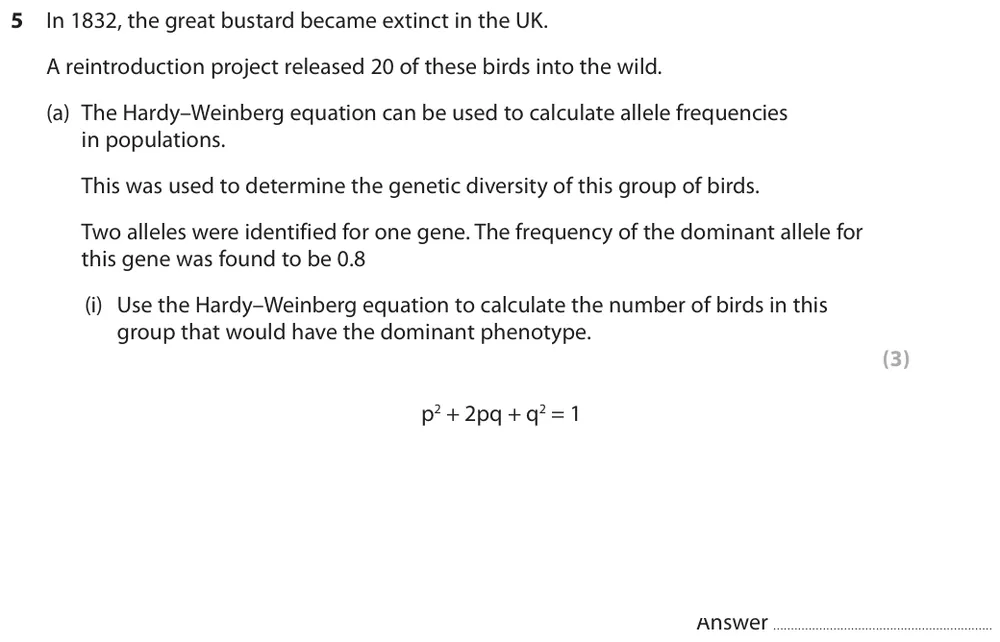
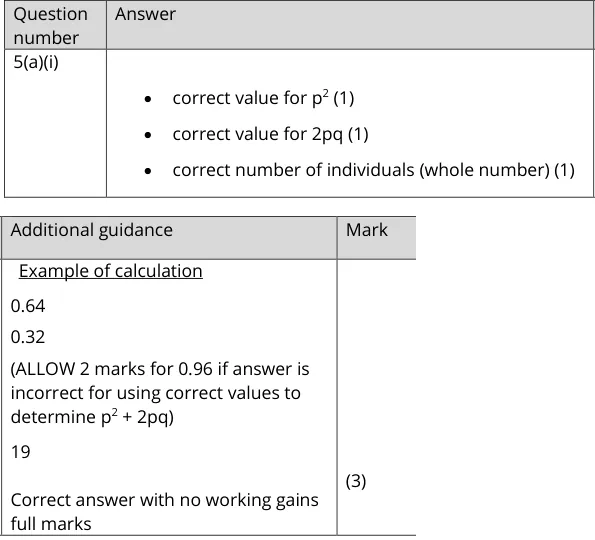
Use the Hardy–Weinberg equation to calculate the number of birds with the dominant phenotype.
Show the mark scheme
Tap an image to open it full size.
From the examiners' report: Both the homozygous dominant and the heterozygous birds have the dominant phenotype. Some found p² and 2pq but did not add them before multiplying by the number of birds; others did not round to a whole number.
Question 17
A level Paper 1 · November 2021 · Q3(a) · 3 marks
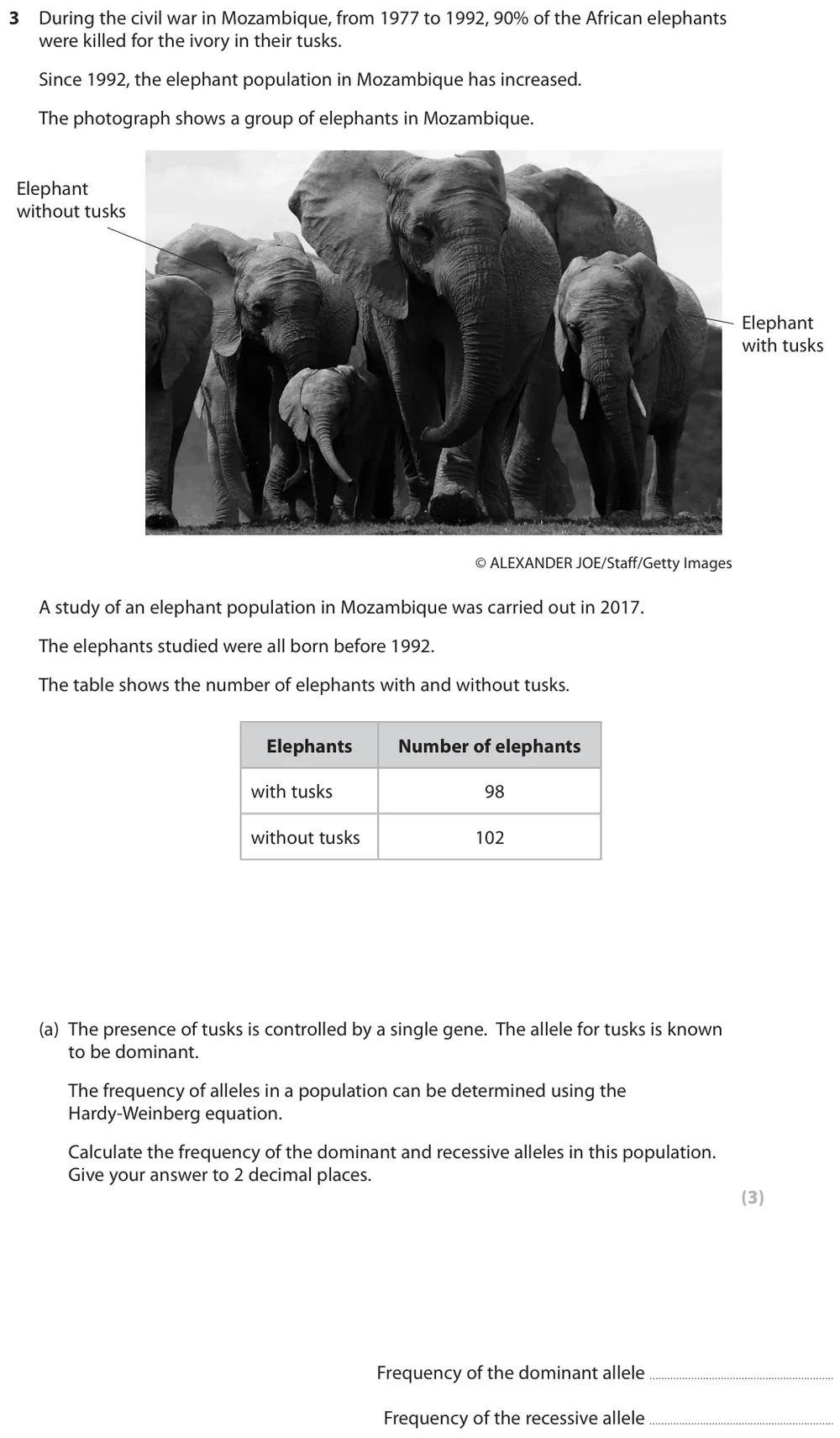
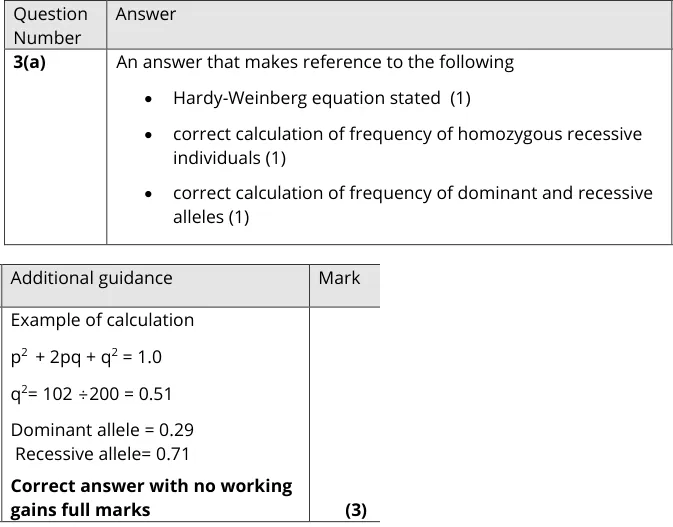
Calculate the frequencies of the dominant and recessive alleles to two decimal places.
Show the mark scheme
Tap an image to open it full size.
From the examiners' report: Many could state the Hardy–Weinberg equation, but only a few selected the correct numbers to put into it.
Question 18
A level Paper 3 · October 2020 · Q5(a)(ii) · 3 marks · Hard
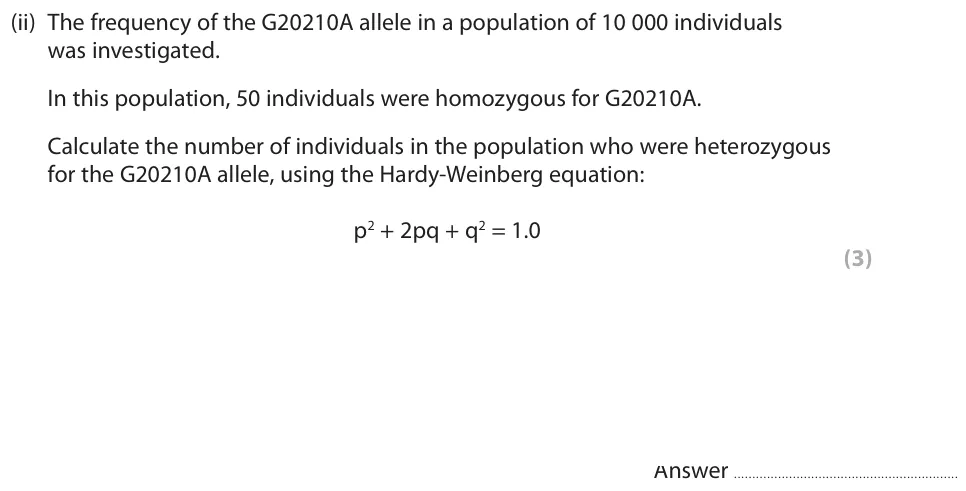
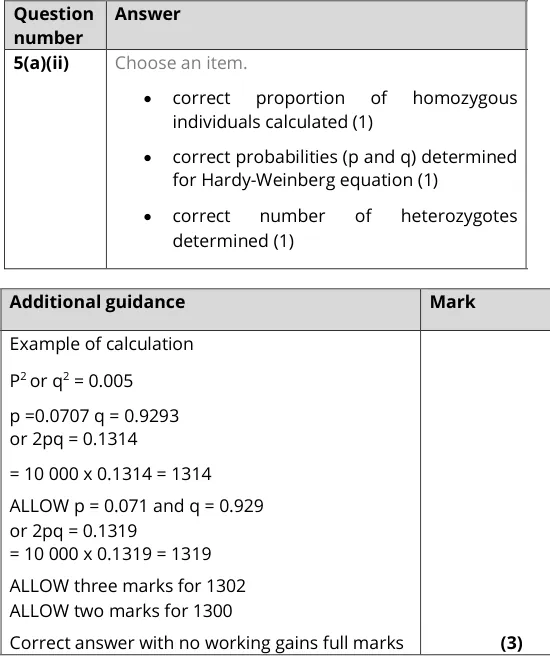
Use the Hardy–Weinberg equation to calculate the number of individuals heterozygous for an allele.
Show the mark scheme
Tap an image to open it full size.
From the examiners' report: Many struggled to find p² and then did not take its square root. Label intermediate values (for example p² = 0.005) so the examiner can award working marks, and use 2pq, not pq, for heterozygotes.
Logarithmic scales (MS 2.5)
Question 19
A level Paper 1 · June 2024 · Q10(b)(i) · 2 marks
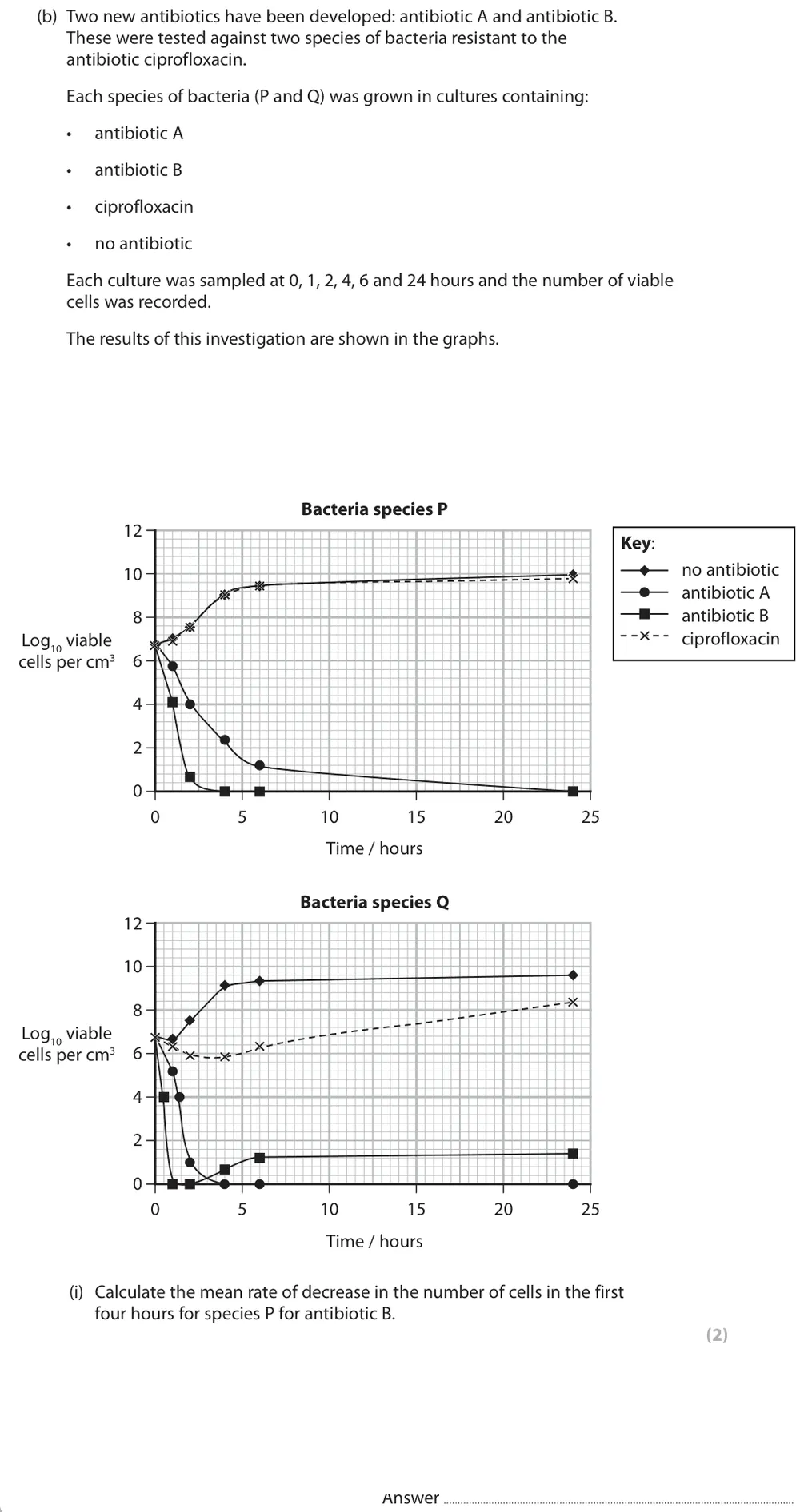
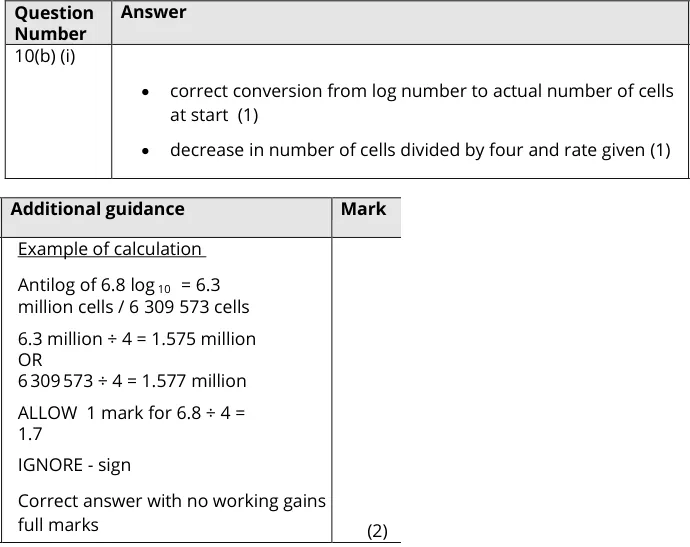
Read a value from a log scale and calculate the mean rate of decrease in the number of bacterial cells.
Show the mark scheme
Tap an image to open it full size.
From the examiners' report: Most read the value from the graph and did not take the antilog, so gained only one mark. Know how to take an antilog on your calculator before the exam.
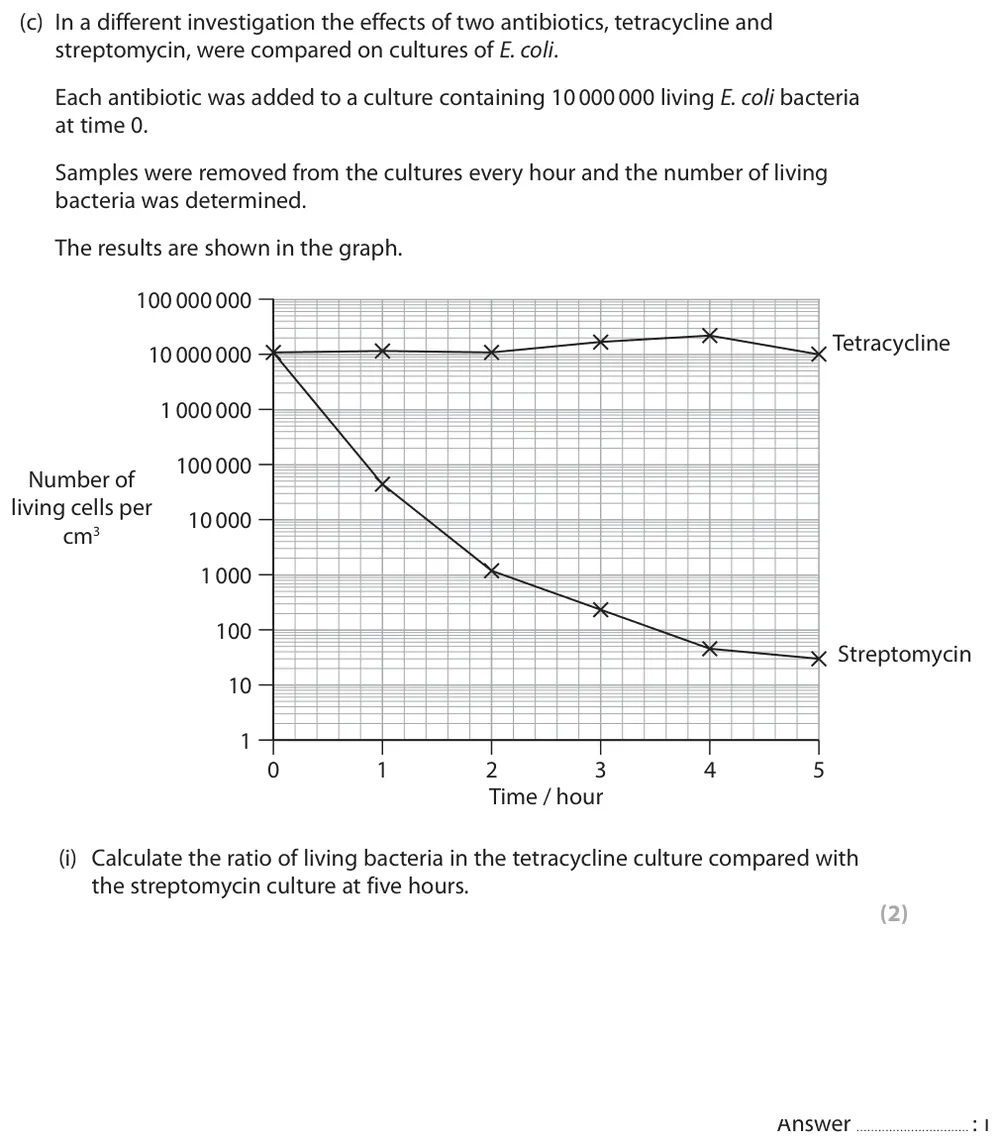
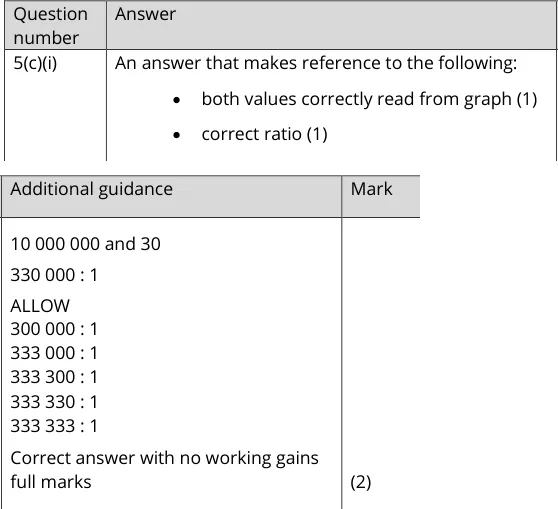
Question 20
A level Paper 3 · June 2025 · Q5(c)(i) · 2 marks
Read two values from a log scale and calculate the ratio of living bacteria in two cultures.
Show the mark scheme
Tap an image to open it full size.
From the examiners' report: Many scored nothing because they read the wrong value for streptomycin. Others lost a mark because they did not express their answer as a whole number.
Where students lose marks (from Pearson examiners' reports and mark schemes)
Each point below comes from the examiners' reports and mark schemes, and is followed by wording that gained marks.
Square the height in metres. Many did not give the unit or one decimal place, and a common mistake was not using 1.15², the height in metres squared.
✔ Gains credit: 'Values correctly substituted into rearranged equation: 20 × 1.15²; correct answer with unit: 26.5 kg.'
Halve the diameter, then halve the biomass. Common errors were not dividing the diameter by two and not recognising that carbon is only 50% of the biomass.
✔ Gains credit: '3.0 × (0.6)² × π = 3.393 m³; 3.393 × 720 = 2442.9; carbon is 50% of this = 1221.5.'
Leave no π in the answer. Some candidates left the π symbol in their working or final answer, or did not give a whole number.
✔ Gains credit: 'Surface area of virus 4 × π × 120² = 180 955.7 nm²; area of one spike protein (22.4 × 20) ÷ 2 = 224 nm²; 180 955.74 ÷ 224 = 808.'
Divide each square by its own expected value. A frequently seen error was dividing the (O – E)² values by the total (512).
✔ Gains credit: 'Correct O – E values, e.g. 270 – 288 = –18; correct (O – E)² ÷ E values, e.g. (270 – 288)² ÷ 288; χ² = 7.73.'
The expected value is the mean. Most students selected 16 or 10 as their expected value instead of finding the mean.
✔ Gains credit: 'Correct expected value 26 ÷ 2 = 13; (16 – 13)² = 9 and (10 – 13)² = 9; χ² = 1.38.'
Spearman's rank: take it away from one. A significant minority failed to subtract their calculated value from one.
✔ Gains credit: 'Numerator 6 × 34 = 204; denominator 7 × 48 = 336; rs = 0.393.'
Dominant phenotype means p² plus 2pq. Some worked out p² and 2pq but did not add them together before multiplying by the whole population.
✔ Gains credit: 'Correct value for p² 0.64; correct value for 2pq 0.32; correct number of individuals (whole number) 19.'
Antilog before you divide. Most read the value from the log graph and divided it by four without taking the antilog.
✔ Gains credit: 'Antilog of 6.8 = 6.3 million cells at the start; 6.3 million ÷ 4 = 1.575 million.'
Download the questions
Download the PDF pack (20 questions, mark schemes at the end)
Keep practising
- Edexcel SNAB A level Biology revision resources by topic
- Arithmetic and Numerical Computation (Maths Skills MS0): Edexcel SNAB A Level Biology Exam Questions
- Handling Data and Statistics (Maths Skills MS1): Edexcel SNAB A Level Biology Exam Questions
- Graphs and Geometry (Maths Skills MS3 and MS4): Edexcel SNAB A Level Biology Exam Questions
- All Edexcel SNAB exam questions by topic
- Edexcel SNAB A level Biology past papers, mark schemes and examiners' reports
- Edexcel SNAB A level Biology grade boundaries
- Message Tom on WhatsApp about one-to-one Edexcel SNAB tutoring or an Edexcel group class
Questions, mark schemes and examiners' report extracts © Pearson Education Ltd.