

Transport across cell membranes (AQA 3.2.3) is one of the most heavily examined Year 12 topics, and it comes back in Year 13 in questions on the ileum, the kidney, roots and nerves. You need the fluid-mosaic model (phospholipids, proteins, glycoproteins, glycolipids and cholesterol), the five ways substances cross a membrane (simple diffusion, facilitated diffusion, osmosis, active transport and co-transport of sodium ions and glucose in the ileum), and how surface area, the number of channel and carrier proteins and the size of the gradient change the rate.
The examiners' reports show where the marks go. Students describe movement 'along' a gradient, put channel proteins into active transport, say steroids are 'fat soluble', explain osmosis without the words water potential or without saying which way the water moves, define active transport when the question is about co-transport, and mix up microvilli with villi.
Start with membrane structure, then the transport processes one by one, then cells adapted for fast transport, and finish with the graphs and the osmosis calculation. Answer each on paper before you open the mark scheme. If you'd like help with this topic, my AQA masterclasses run online on Tuesdays at 5.15pm for Year 12 and on Wednesdays or Thursdays at 6.30pm for Year 13.
What you need from GCSE and Year 12
Each question on this page assumes you're secure on these GCSE and Year 12 ideas. If any of them feels shaky, revise it before you start.
- GCSE: diffusion is the net movement of particles from a higher to a lower concentration; a bigger gradient, higher temperature and larger surface area make it faster.
- GCSE: osmosis is the movement of water across a partially permeable membrane, and active transport moves substances against a concentration gradient using energy from respiration.
- Year 12 (AQA 3.1.3): phospholipids have a hydrophilic phosphate head and two hydrophobic fatty acid tails. See the Lipids page.
- Year 12 (AQA 3.1.6): ATP hydrolase hydrolyses ATP to ADP and Pi, releasing energy for active transport. See the ATP page.
- Year 12 (AQA 3.2.1.1): the structure of the cell-surface membrane and of mitochondria. See the Eukaryotic cell structure page.
Key terms
These words come up in the questions and mark schemes. Examiners expect you to use them exactly.
- Fluid-mosaic model: the model of membrane structure: a phospholipid bilayer in which proteins, glycoproteins, glycolipids and cholesterol are scattered (the mosaic) and can move (fluid).
- Cholesterol: a lipid in cell membranes that restricts the movement of the other molecules, making the membrane less fluid. It doesn't 'strengthen' the membrane.
- Simple diffusion: the net movement of small or lipid-soluble (non-polar) molecules down a concentration gradient through the phospholipid bilayer; passive.
- Facilitated diffusion: the passive movement of polar or charged substances, such as glucose or ions, down a concentration gradient through channel or carrier proteins.
- Channel protein: a protein forming a water-filled pore that lets particular ions or polar molecules diffuse through. Used only in facilitated diffusion.
- Carrier protein: a protein that binds a specific molecule and changes shape to move it across the membrane, in facilitated diffusion or active transport.
- Water potential (Ψ): the tendency of water to move out of a solution; pure water is 0 kPa, and adding solutes makes it lower (more negative).
- Osmosis: the net movement of water from a higher (less negative) to a lower (more negative) water potential across a partially permeable membrane.
- Active transport: the movement of substances against a concentration gradient by carrier proteins, using energy released by the hydrolysis of ATP.
- Co-transport: a carrier protein moving two substances together, such as sodium ions and glucose in the ileum, using the gradient of one (made by active transport) to move the other.
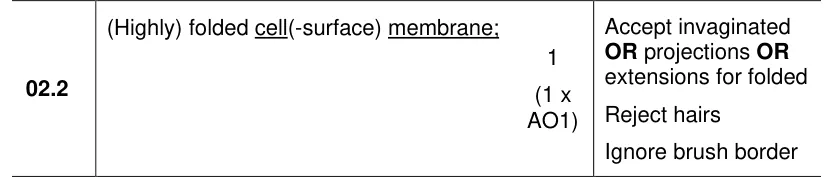
- Microvilli: folds of the cell-surface membrane of one cell, such as an ileum epithelial cell, that increase the surface area for carrier and channel proteins. Not villi.
What these questions cover (AQA 3.2.3)
The questions test these statements from the AQA AS and A-level Biology specification (7401/7402):
- Membranes: The basic structure of all cell membranes, including cell-surface membranes and the membranes around the cell organelles of eukaryotes, is the same.
- Fluid-mosaic model: The arrangement and any movement of phospholipids, proteins, glycoproteins and glycolipids in the fluid-mosaic model of membrane structure. Cholesterol may also be present in cell membranes where it restricts the movement of other molecules making up the membrane.
- Movement across membranes occurs by: simple diffusion (involving limitations imposed by the nature of the phospholipid bilayer)
- Movement across membranes occurs by: facilitated diffusion (involving the roles of carrier proteins and channel proteins)
- Movement across membranes occurs by: osmosis (explained in terms of water potential)
- Movement across membranes occurs by: active transport (involving the role of carrier proteins and the importance of the hydrolysis of ATP)
- Movement across membranes occurs by: co-transport (illustrated by the absorption of sodium ions and glucose by cells lining the mammalian ileum).
- Adaptations: Cells may be adapted for rapid transport across their internal or external membranes by an increase in surface area of, or by an increase in the number of protein channels and carrier molecules in, their membranes. (microvilli on cells lining the ileum are the usual example)
- Students should be able to explain the adaptations of specialised cells in relation to the rate of transport across their internal and external membranes
- Students should be able to explain how surface area, number of channel or carrier proteins and differences in gradients of concentration or water potential affect the rate of movement across cell membranes. (required practicals 3 and 4 have their own pages)
How to use this page
Write your answer on paper before you open the mark scheme. Allow about 1.3 minutes per mark: the 18 questions are worth 44 marks, so about 57 minutes in total. Then mark your answer strictly against the mark scheme and read the examiners' tip underneath it. If you'd rather print the questions, download the PDF pack.
Membrane structure (3.2.3)
Question 1
A level Paper 1 · June 2025 · Q01.2 · 2 marks · Easy
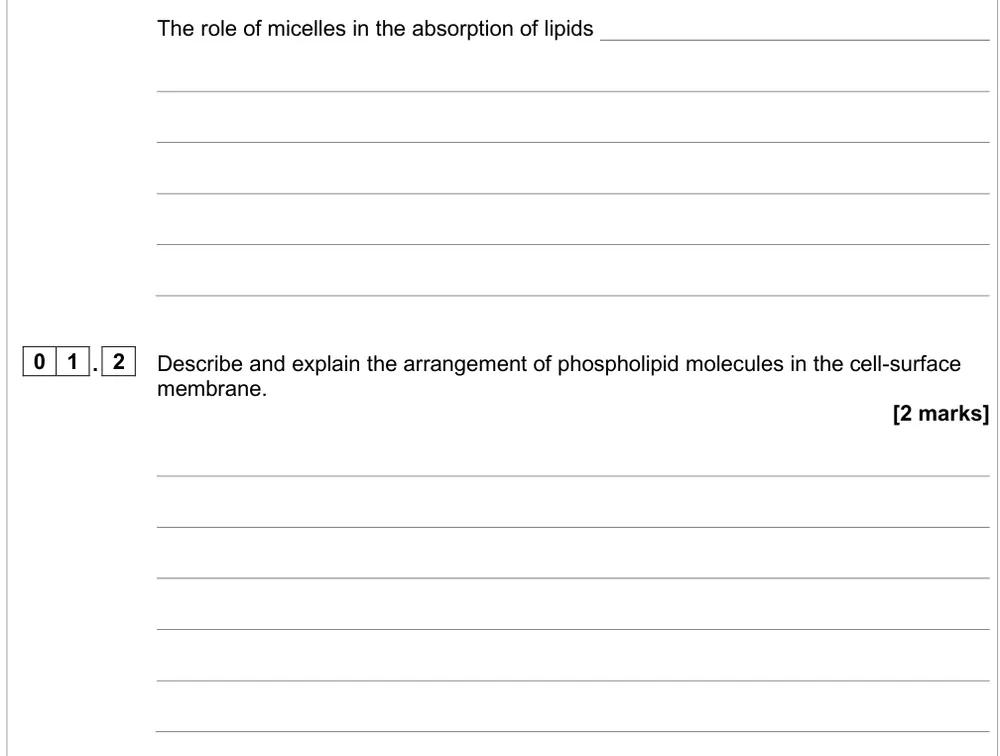
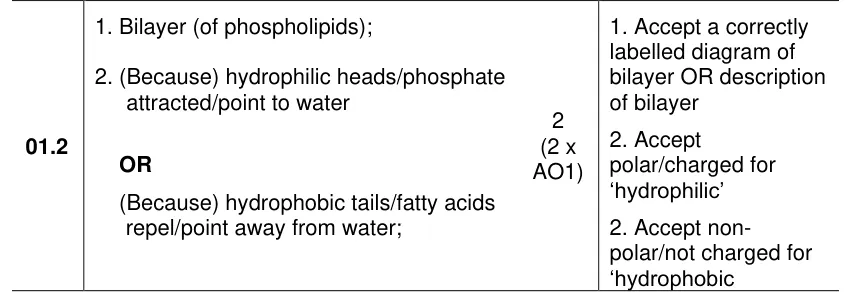
Describe and explain how phospholipids are arranged in the cell-surface membrane.
Show the mark scheme
Tap an image to open it full size.
From the examiners' report: About 80% scored, but only about 30% explained the bilayer. Say water is on both sides, and keep the heads hydrophilic and the tails hydrophobic.
Question 2
AS Paper 1 · June 2025 · Q08.1 · 2 marks · Medium
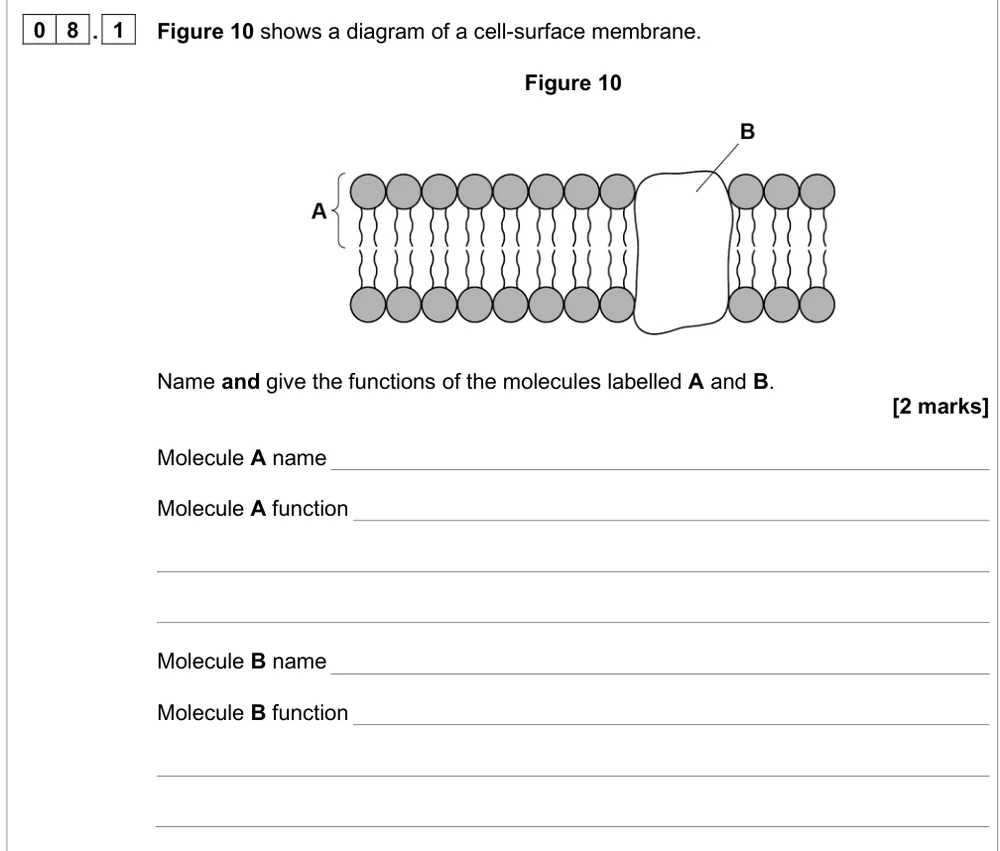
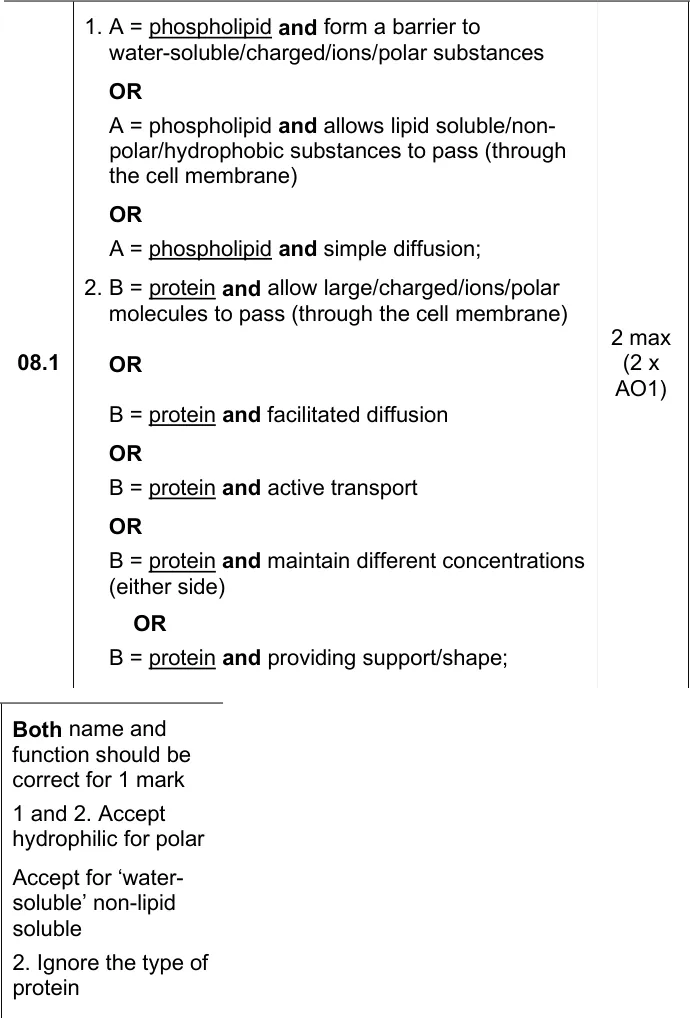
Name molecules A and B in a membrane diagram and give the function of each.
Show the mark scheme
Tap an image to open it full size.
From the examiners' report: About 20% got both marks. Give a function in the membrane, not just the hydrophobic and hydrophilic properties of the molecule.
Question 3
A level Paper 1 · November 2020 · Q01.4 · 2 marks · Medium
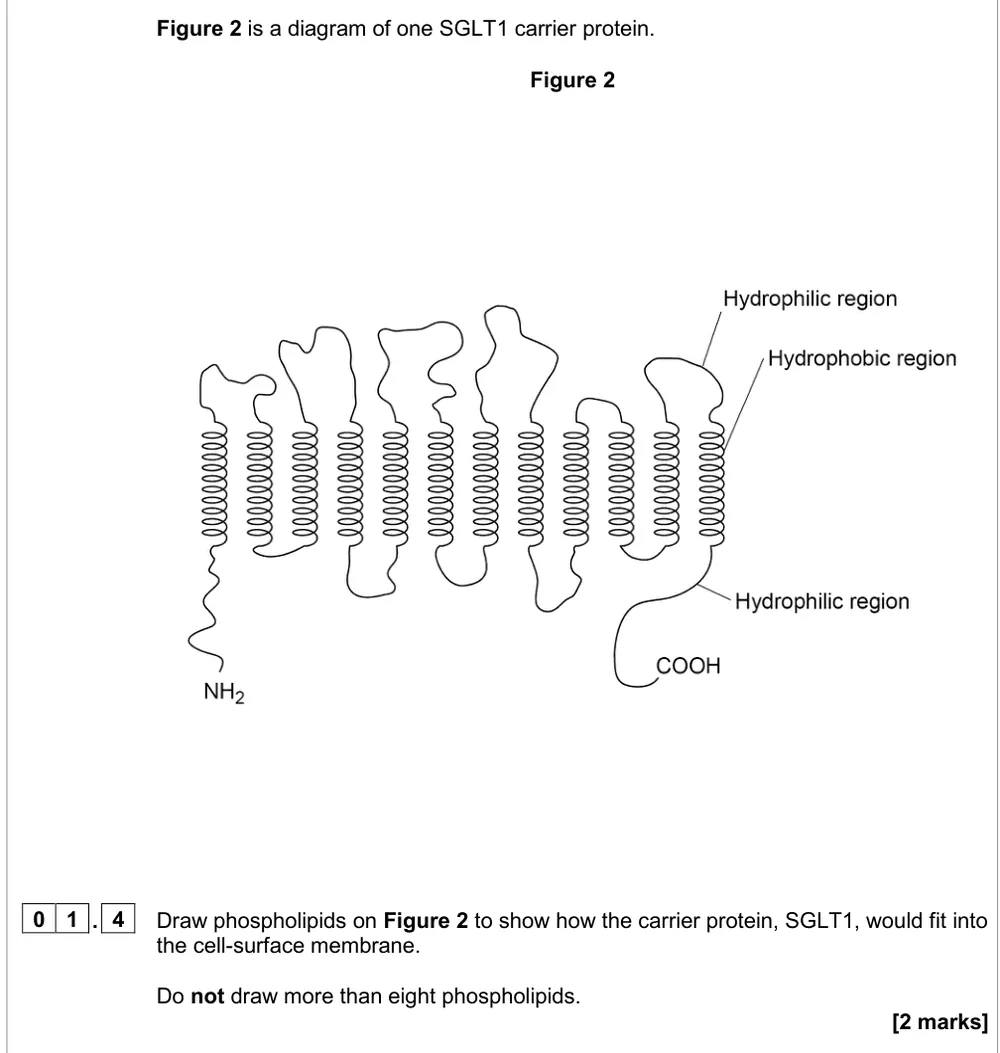
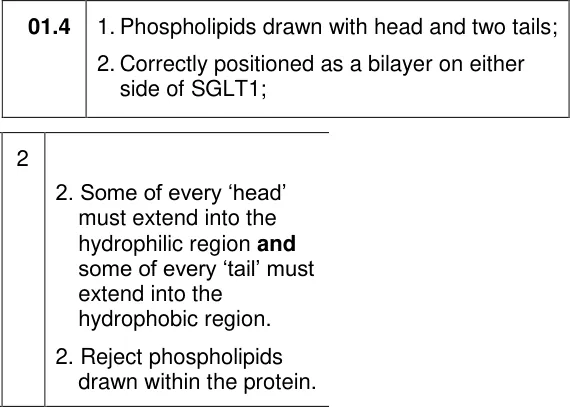
Draw phospholipids to show how the carrier protein SGLT1 fits into the membrane.
Show the mark scheme
Tap an image to open it full size.
From the examiners' report: Only 32% got 2 marks. Draw a bilayer beside the protein, with every head level with a hydrophilic region and every tail in the hydrophobic region.
Question 4
A level Paper 1 · June 2022 · Q03.5 · 2 marks · Medium
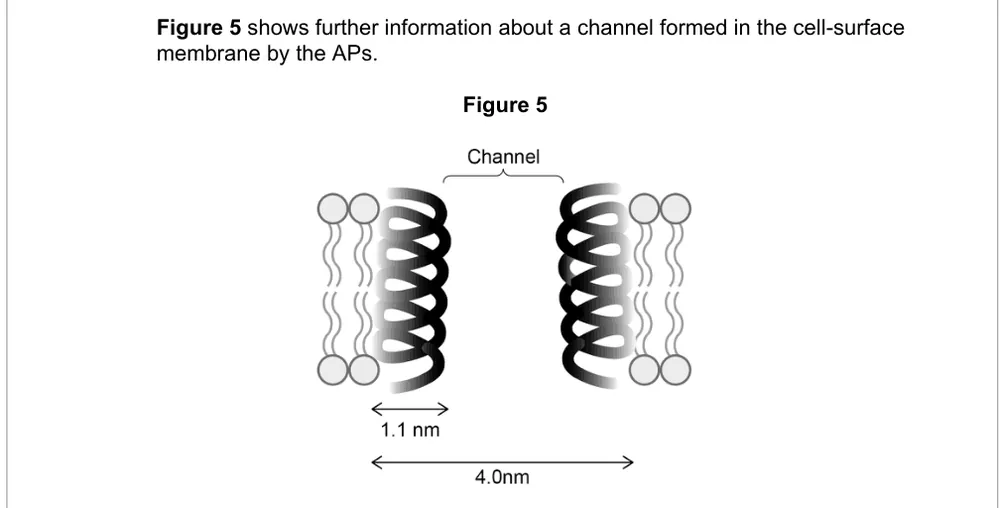
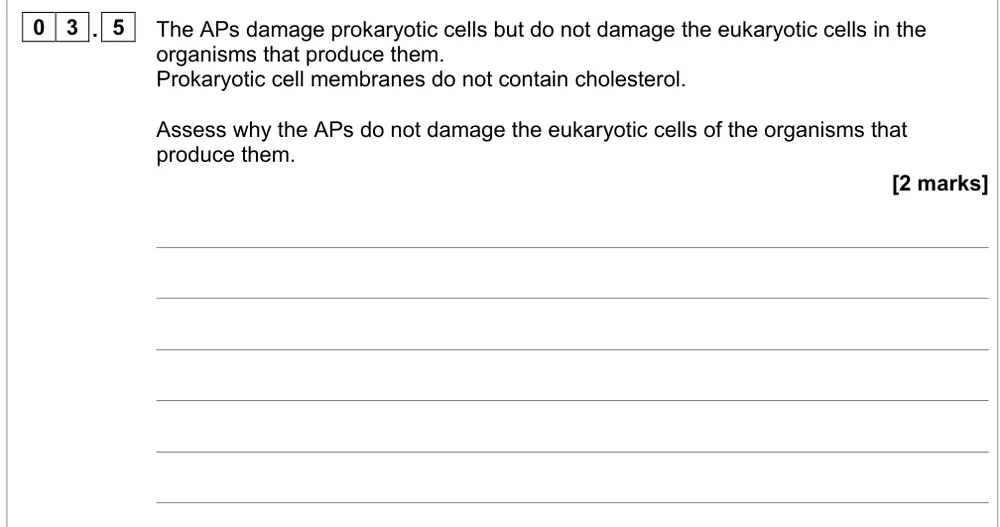
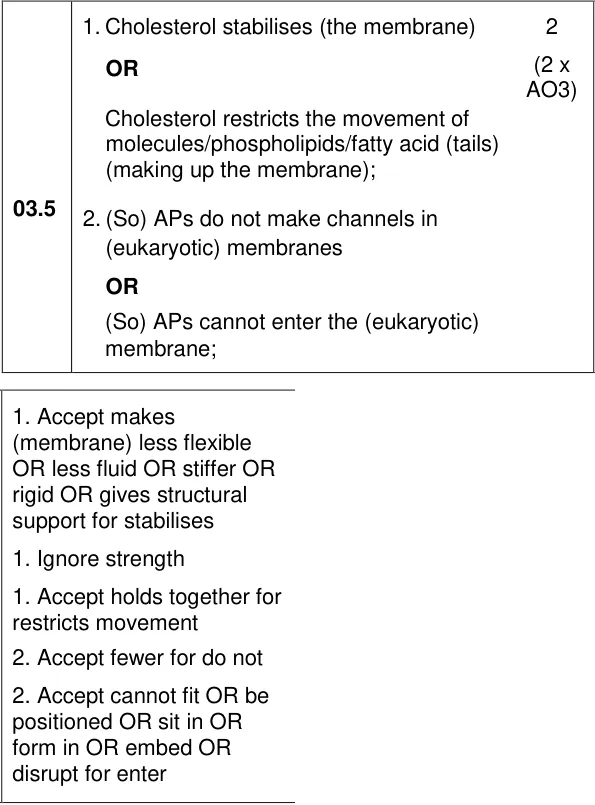
Use the role of cholesterol to explain why APs don't damage eukaryotic cells.
Information from earlier in this question:
Show the mark scheme
Tap an image to open it full size.
From the examiners' report: Over 60% scored at least 1. Cholesterol restricts movement of the other molecules; it doesn't 'strengthen' the membrane or resist turgor. Say exactly what the APs can't do.
Diffusion, facilitated diffusion and osmosis (3.2.3)
Question 5
A level Paper 2 · November 2020 · Q02.1 · 2 marks · Medium
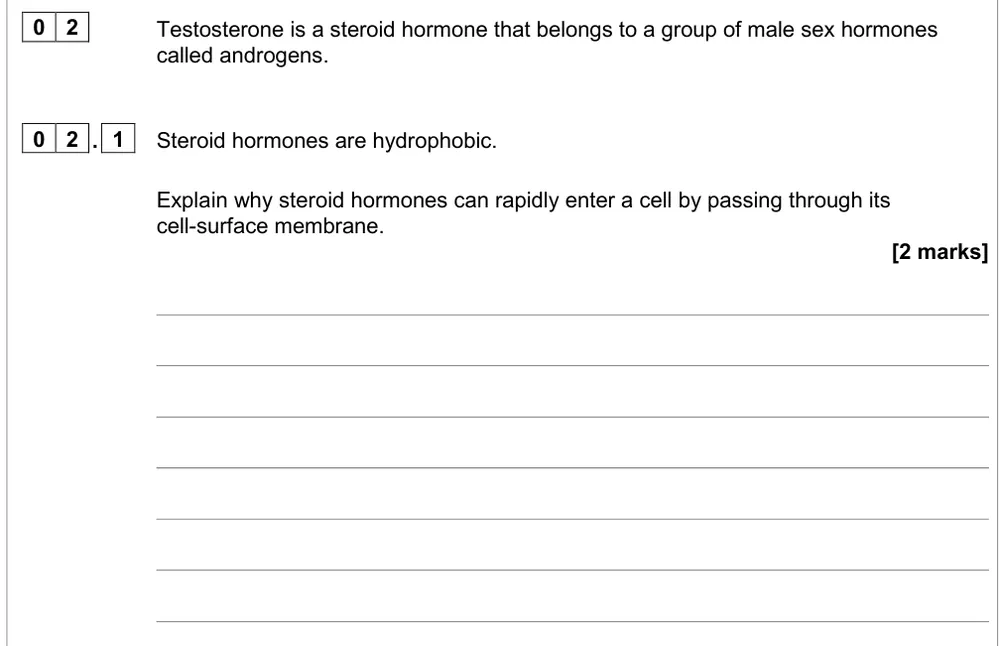
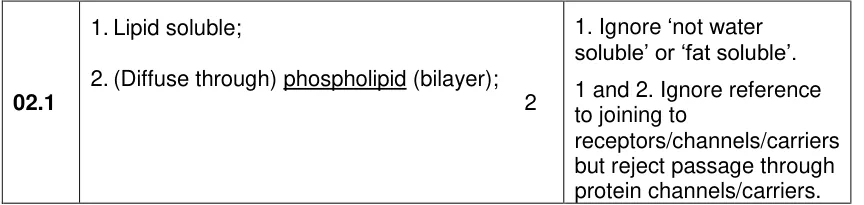
Explain why steroid hormones can enter a cell rapidly through the cell-surface membrane.
Show the mark scheme
Tap an image to open it full size.
From the examiners' report: About two-thirds scored, usually for the bilayer, but only one in four wrote lipid-soluble. 'Fat soluble' and 'non-polar' weren't credited.
Question 6
A level Paper 1 · June 2024 · Q02.1 · 3 marks · Medium
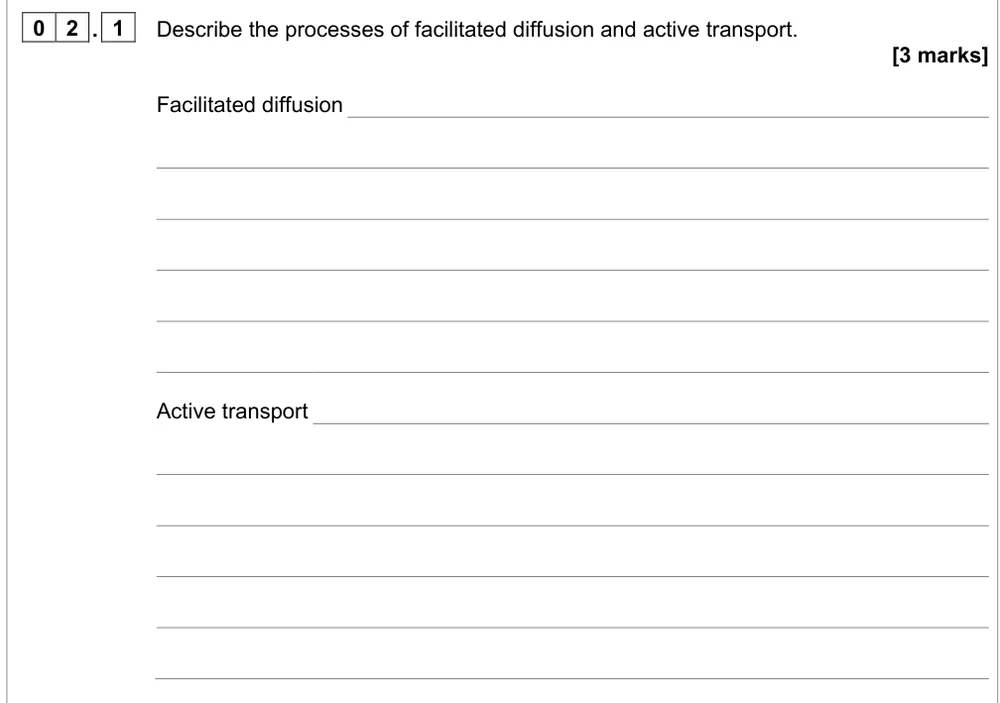
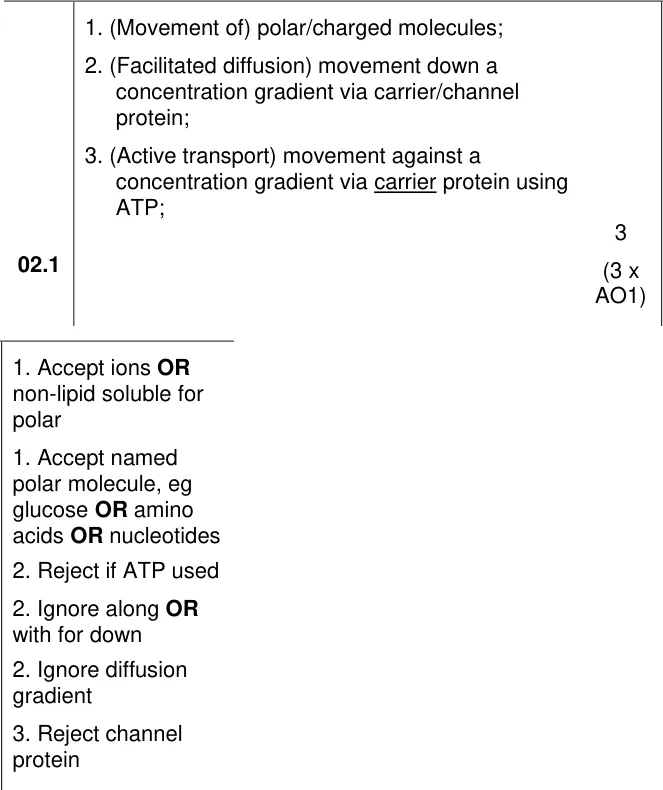
Describe the processes of facilitated diffusion and active transport.
Show the mark scheme
Tap an image to open it full size.
From the examiners' report: Only about a fifth got all three. Name the carrier protein in active transport (never a channel), keep ATP out of facilitated diffusion, and say the molecules are polar or charged.
Question 7
AS Paper 2 · June 2016 · Q03.4 · 2 marks · Hard
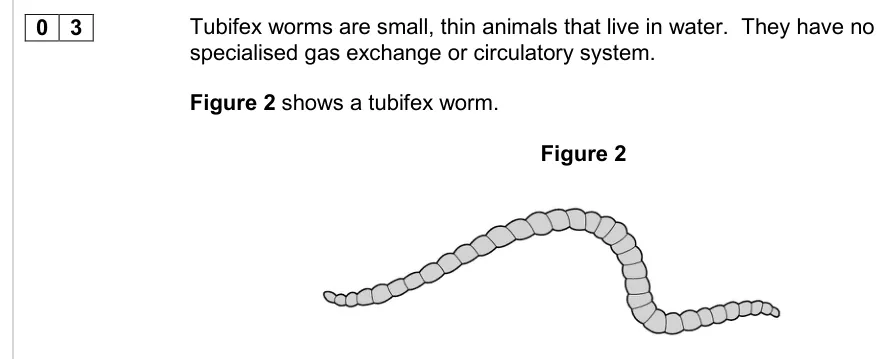
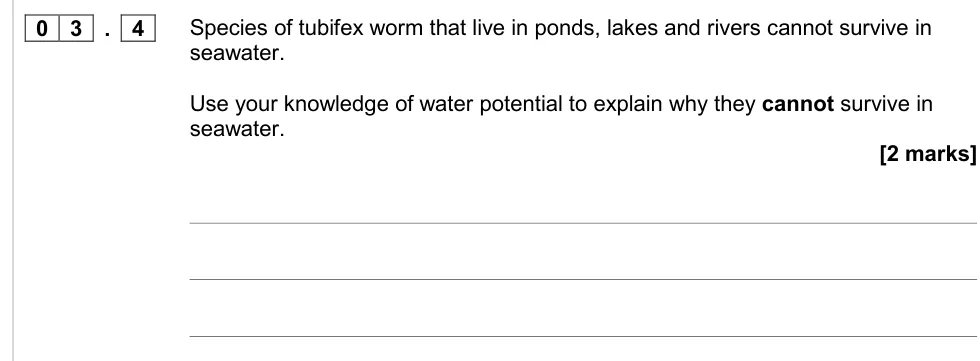
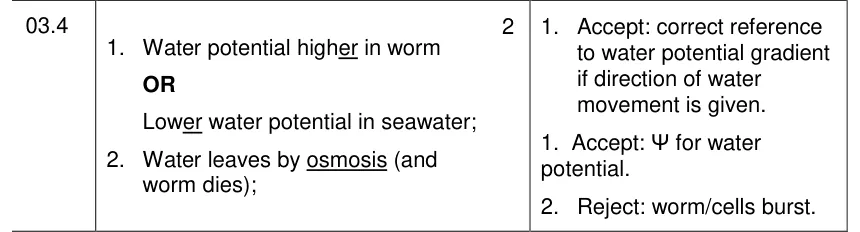
Use water potential to explain why freshwater tubifex worms can't survive in seawater.
Information from earlier in this question:
Show the mark scheme
Tap an image to open it full size.
From the examiners' report: Most got the first mark, but only about a third went on to say water leaves by osmosis. The worm loses water; it doesn't burst.
Question 8
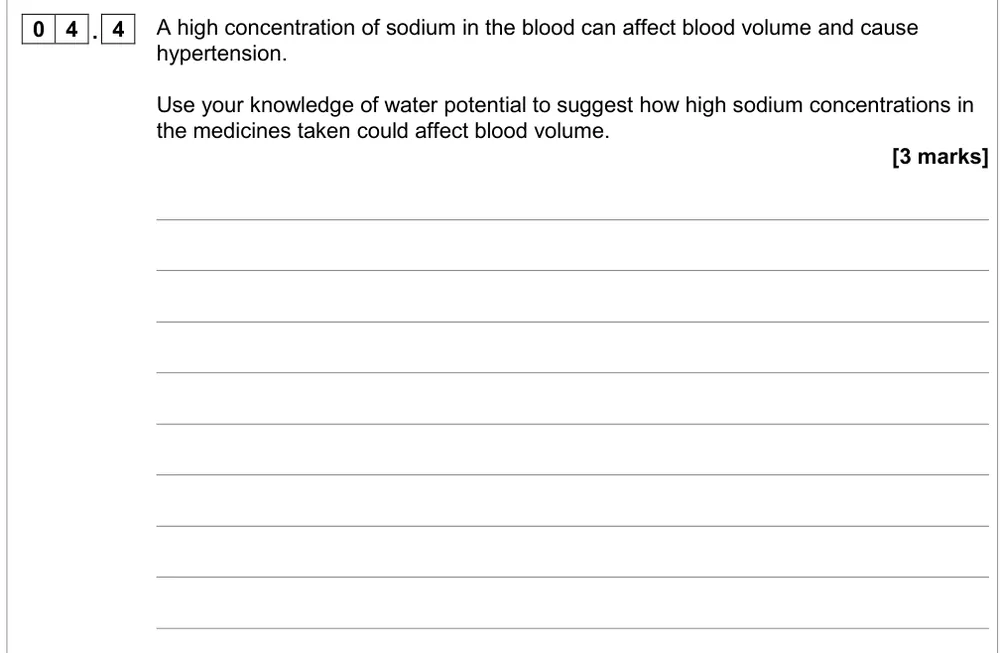
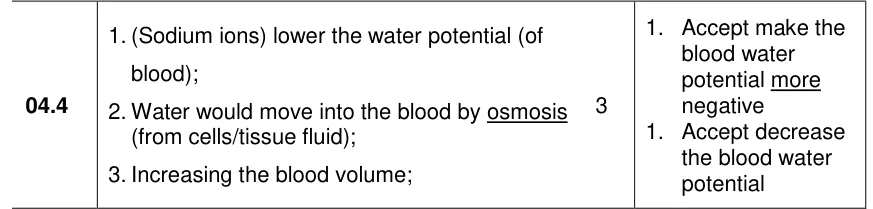
A level Paper 3 · November 2020 · Q04.4 · 3 marks · Easy
Use water potential to suggest how high sodium in medicines could affect blood volume.
Show the mark scheme
Tap an image to open it full size.
From the examiners' report: About 44% got all three. Keep to water potential and osmosis: bringing in the kidney or tissue fluid formation lost marks.
Active transport and co-transport (3.2.3)
Question 9
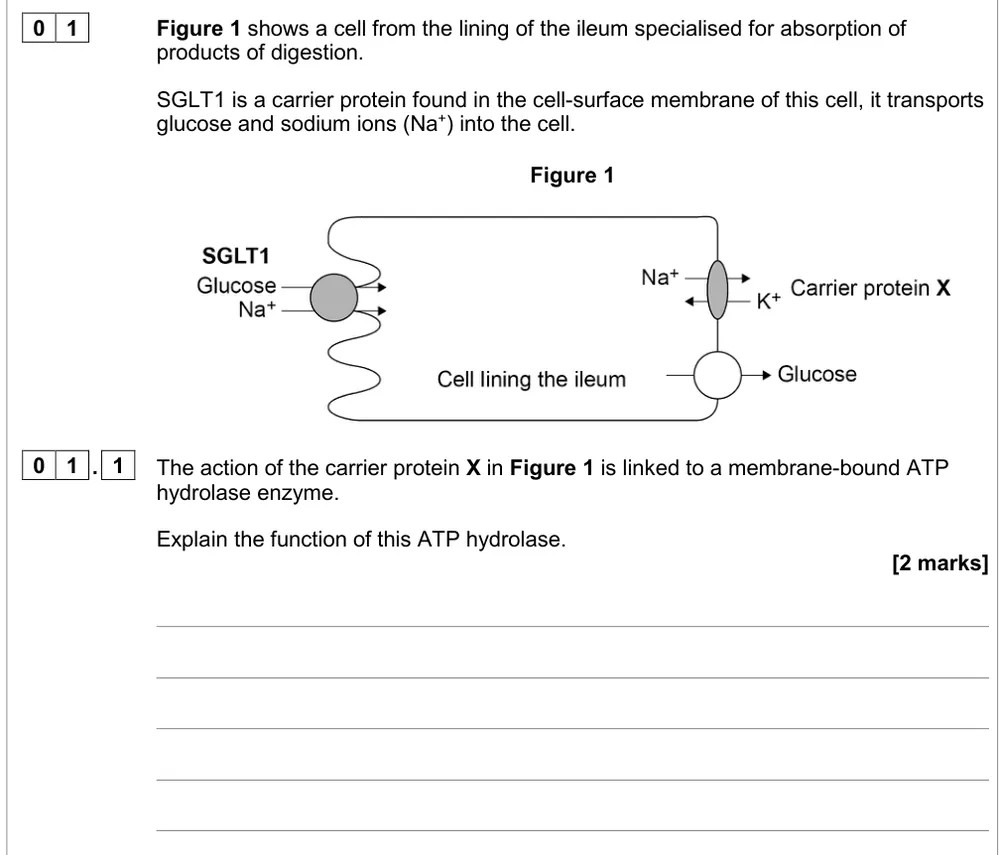
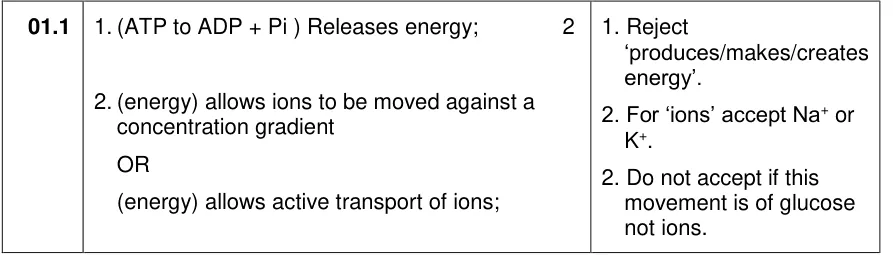
A level Paper 1 · November 2020 · Q01.1 · 2 marks
Explain the function of the ATP hydrolase linked to carrier protein X in an ileum cell.
Show the mark scheme
Tap an image to open it full size.
From the examiners' report: Many lost marks here. ATP hydrolysis releases energy (it doesn't make it), and that energy moves the ions, not glucose, against their gradient.
Question 10
AS Paper 1 · June 2025 · Q02.3 · 3 marks · Medium
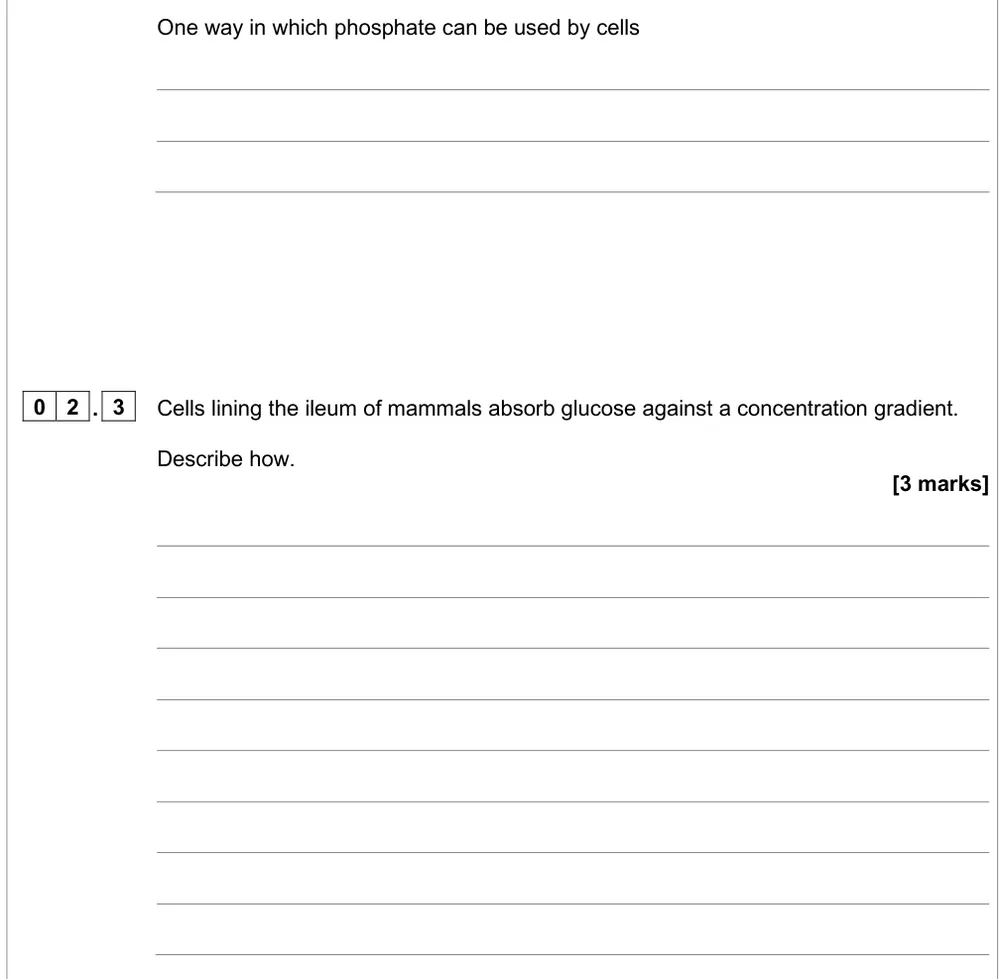
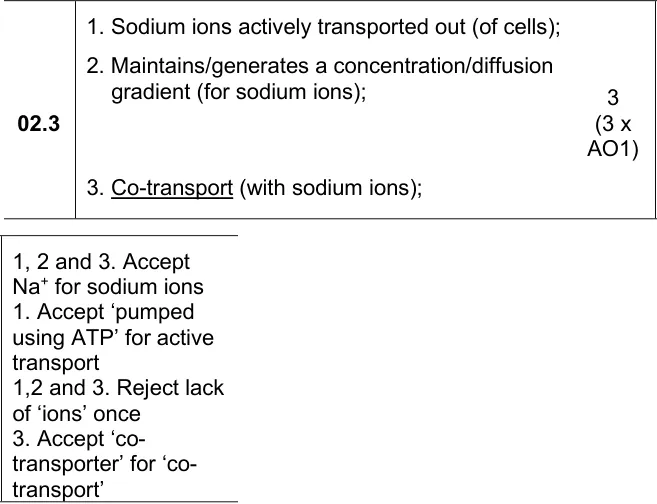
Describe how cells lining the ileum absorb glucose against a concentration gradient.
Show the mark scheme
Tap an image to open it full size.
From the examiners' report: About 25% got all three. Don't just say glucose is actively transported: start with sodium ions pumped out, then the gradient, then co-transport.
Question 11
A level Paper 1 · June 2025 · Q05.1 · 4 marks · Medium
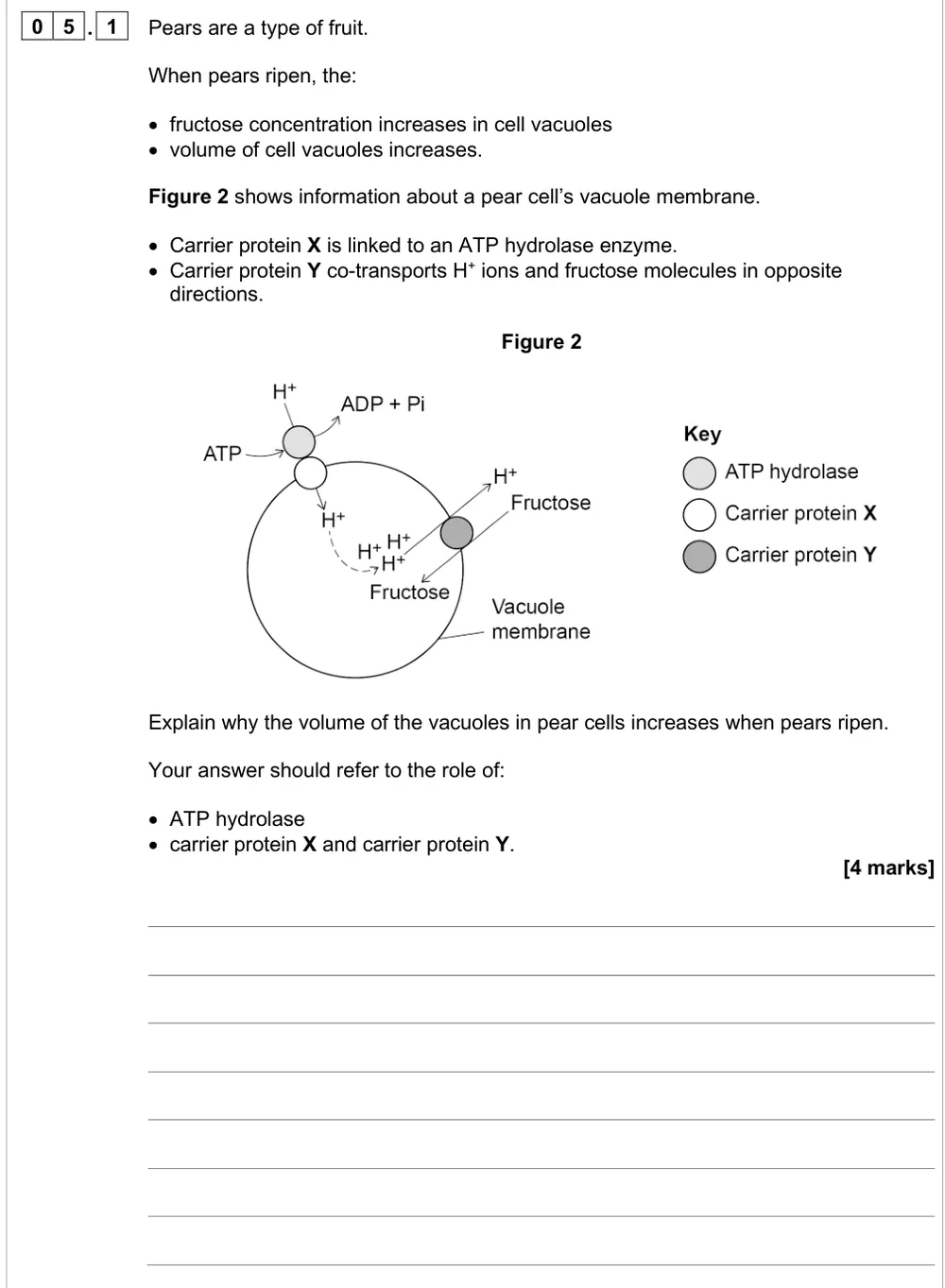
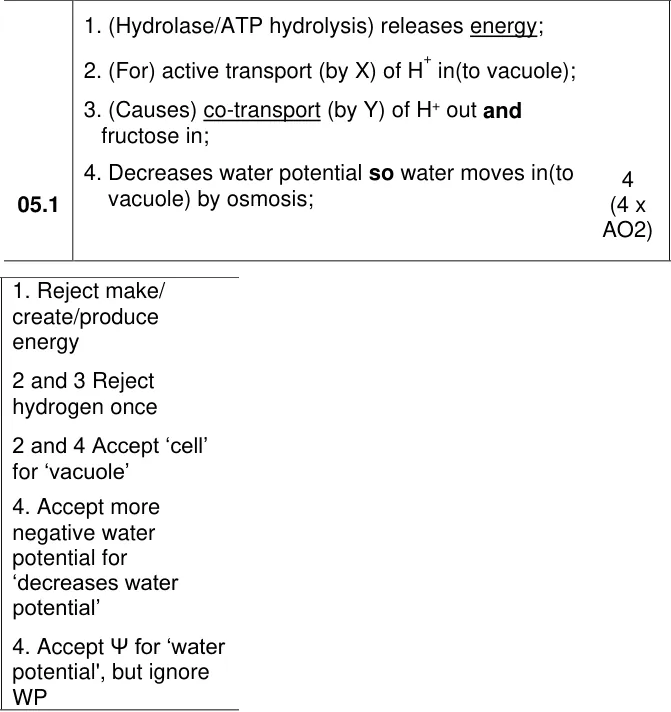
Explain why pear vacuoles get bigger as pears ripen, using ATP hydrolase and carriers X and Y.
Show the mark scheme
Tap an image to open it full size.
From the examiners' report: Under 10% got all four. Energy is released, not produced; H+ moves in by active transport and out down its gradient, bringing fructose in; then link fructose to water potential and osmosis.
Cells adapted for rapid transport (3.2.3)
Question 12
A level Paper 1 · June 2024 · Q02.2 · 1 mark · Hard
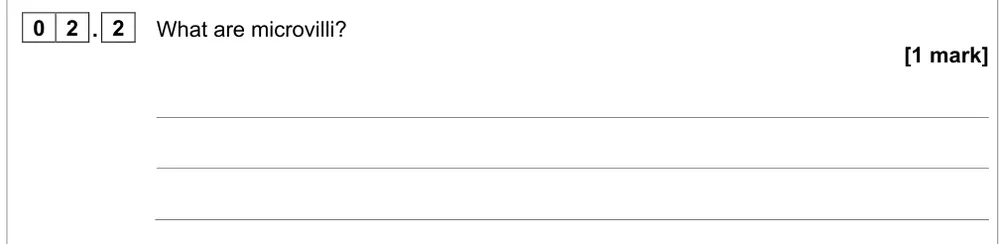
What are microvilli?
Show the mark scheme
Tap an image to open it full size.
From the examiners' report: Few got this. Microvilli are folds of one cell's surface membrane, not villi, cilia or hairs, and 'increased surface area' is a function, not a structure.
Question 13
AS Paper 2 · June 2022 · Q03.1 · 2 marks · Hard
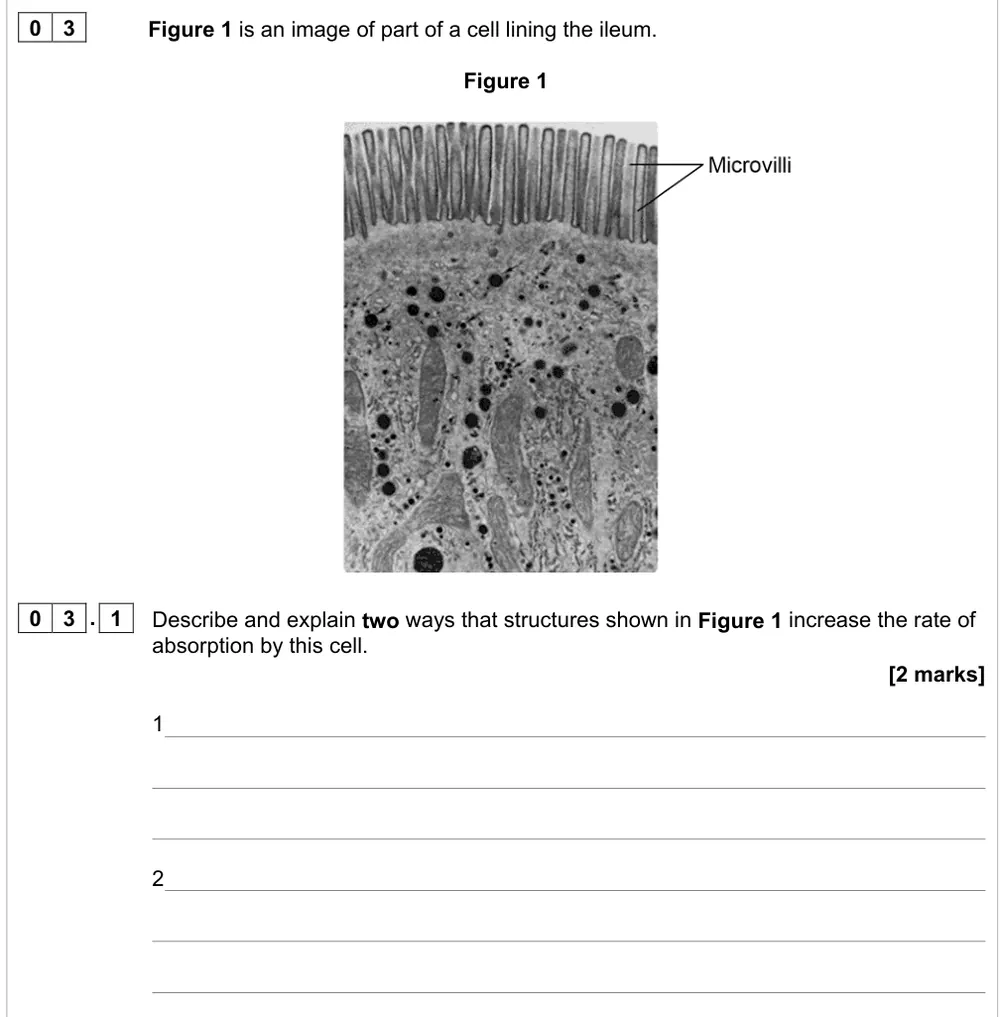
Describe and explain two ways structures in an ileum cell increase its rate of absorption.
Show the mark scheme
Tap an image to open it full size.
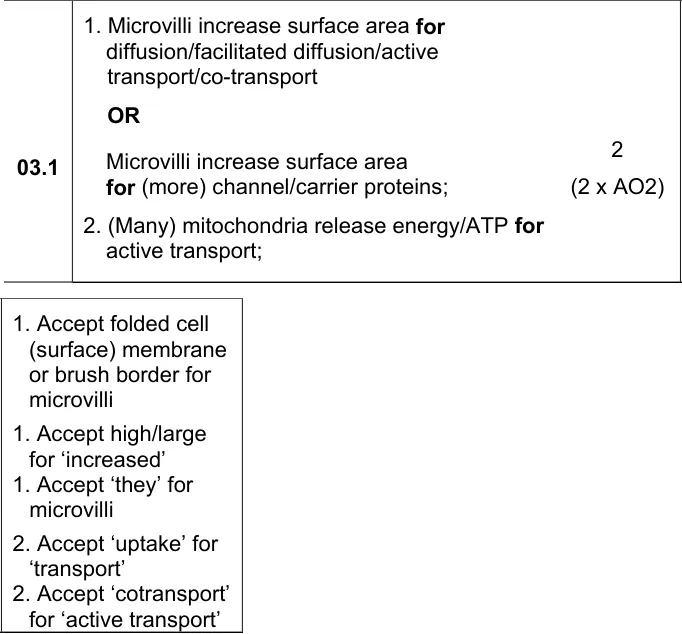
From the examiners' report: 72% scored nothing. Link each structure to transport: surface area for more carrier proteins, mitochondria for ATP. 'Thin walls' describes villi, not microvilli.
Question 14
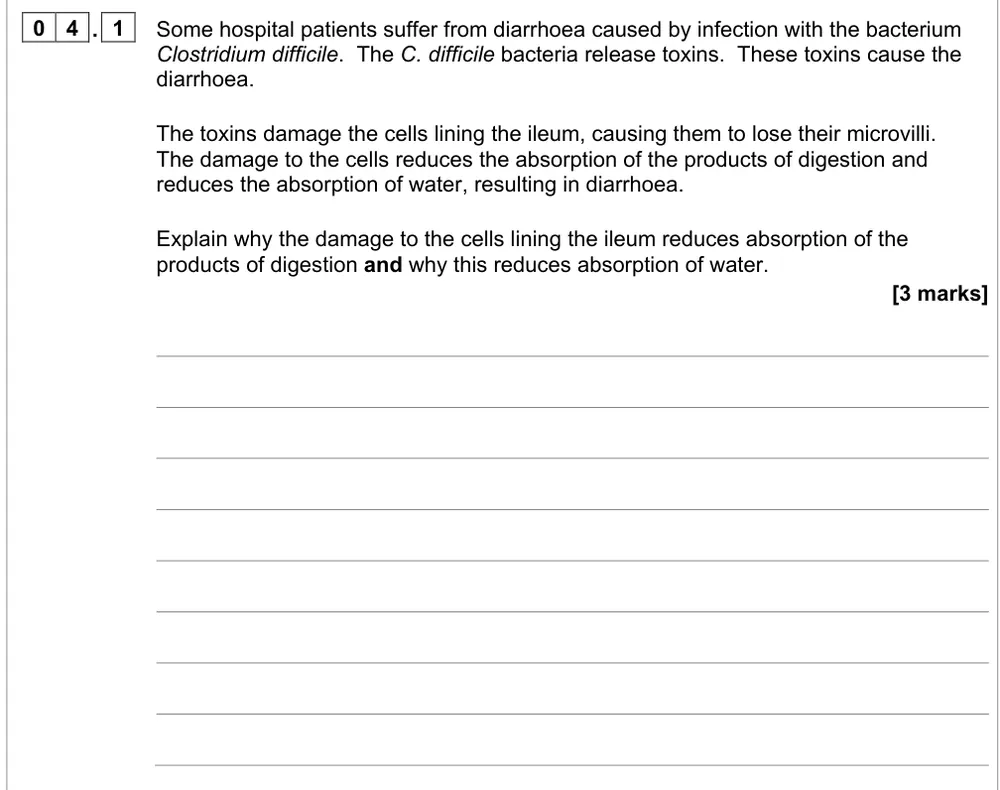
A level Paper 1 · June 2023 · Q04.1 · 3 marks · Hard
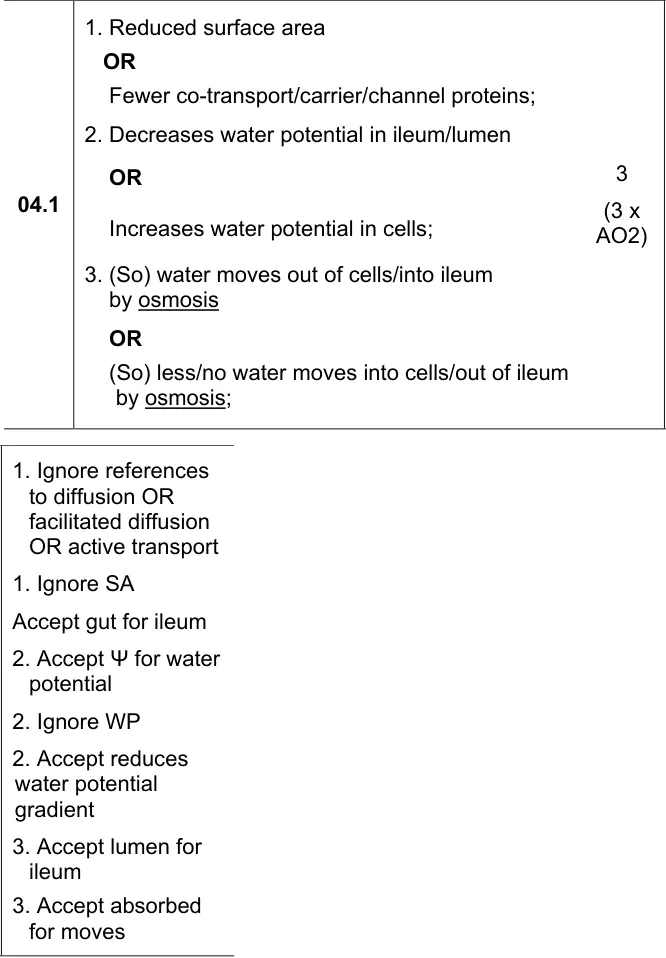
Explain why losing microvilli reduces absorption of digested food and of water.
Show the mark scheme
Tap an image to open it full size.
From the examiners' report: Many good answers never mentioned osmosis. Water moves by osmosis down a water potential gradient, so say which way the gradient runs and where the water goes.
Rates of transport: data and calculations (3.2.3)
Question 15
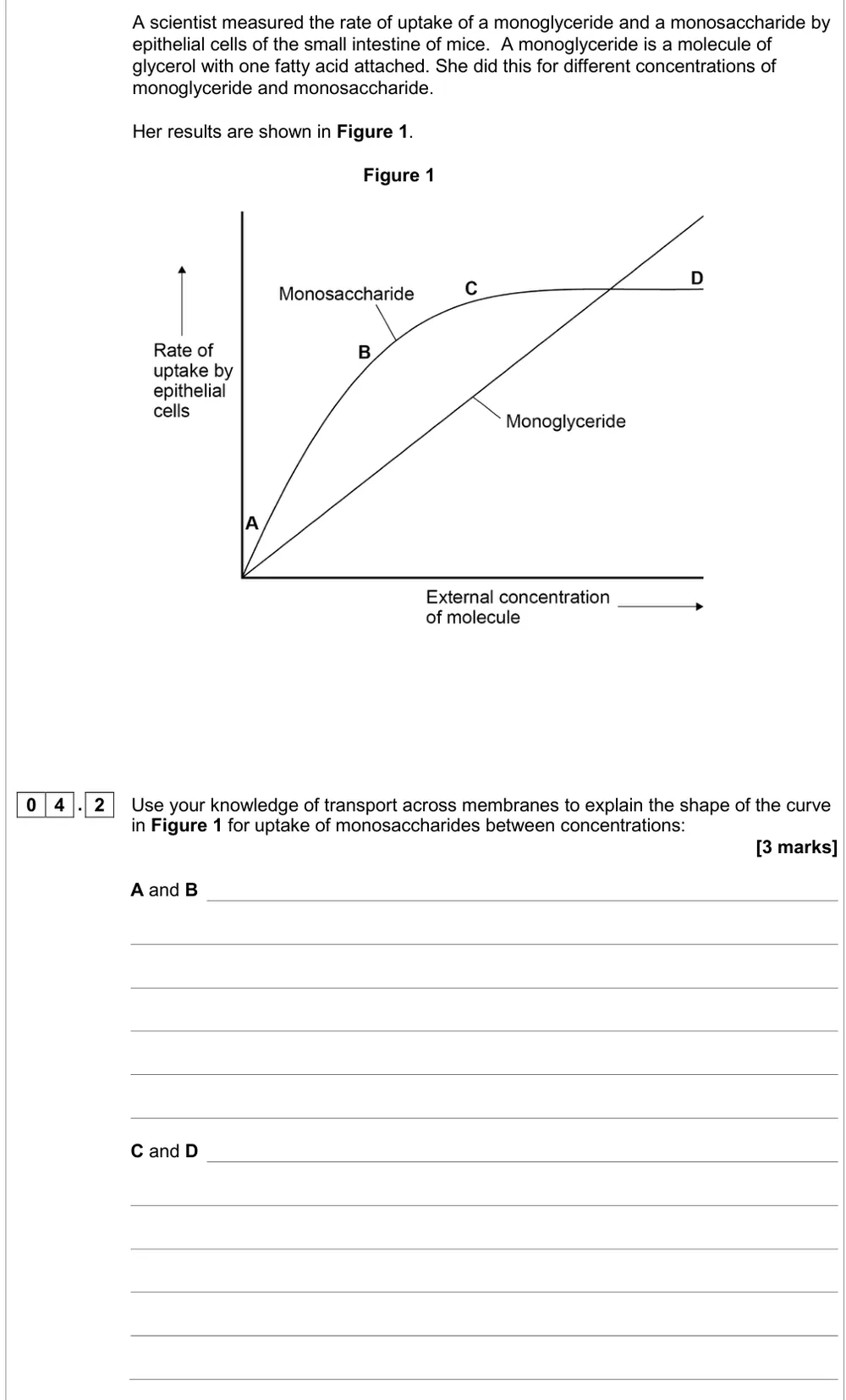
AS Paper 2 · June 2018 · Q04.2 · 3 marks · Medium
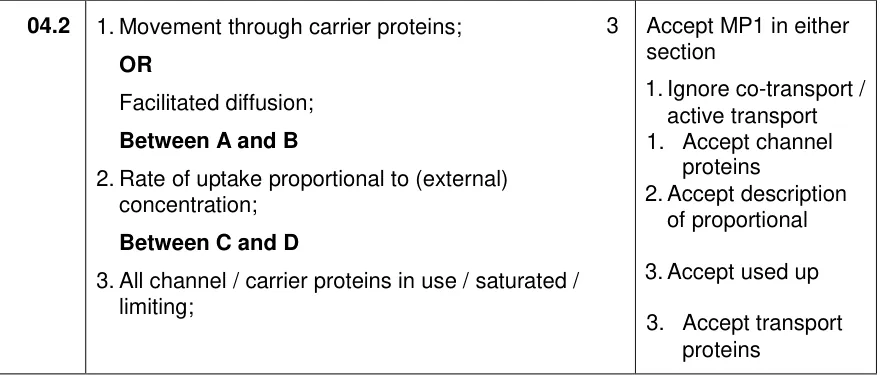
Explain the shape of the monosaccharide uptake curve between A and B and between C and D.
Show the mark scheme
Tap an image to open it full size.
From the examiners' report: Only 9.3% got all three. The levelling off is carrier proteins being saturated, not the gradient disappearing, and carrier proteins don't have active sites.
Question 16
AS Paper 2 · June 2025 · Q02.3 · 3 marks · Medium
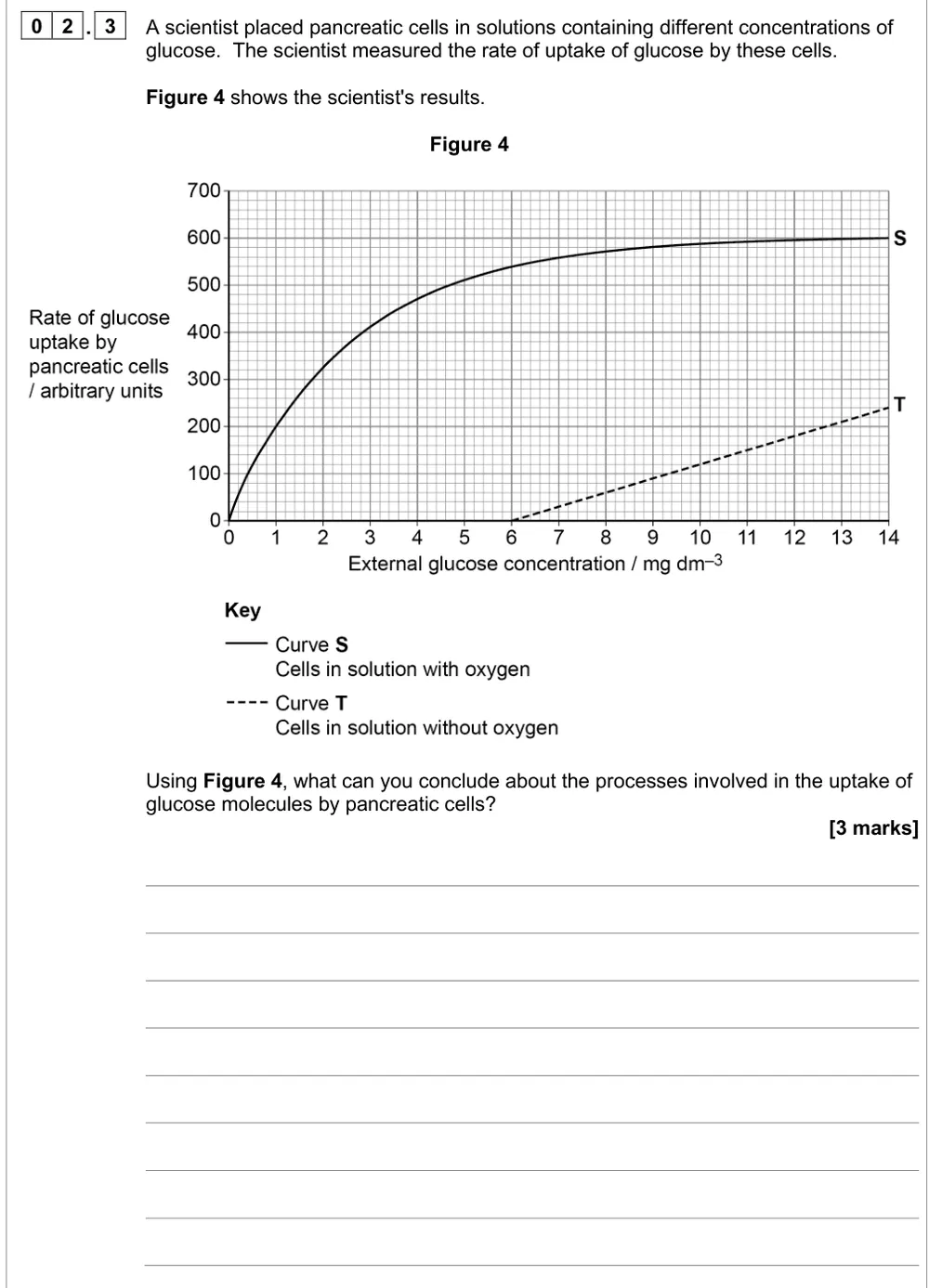
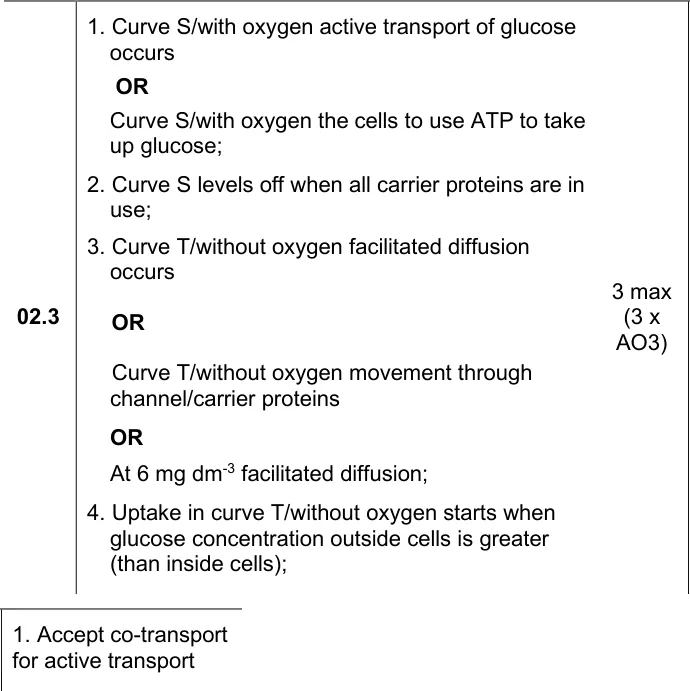
Use glucose uptake curves with and without oxygen to conclude how pancreatic cells take up glucose.
Show the mark scheme
Tap an image to open it full size.
From the examiners' report: Less than half scored, and only about 6% got all three. Don't just describe the curves: link oxygen to ATP and active transport, the plateau to saturated carriers, and 6 mg dm⁻³ to diffusion down a gradient.
Question 17
A level Paper 1 · June 2024 · Q04.4 · 3 marks · Medium
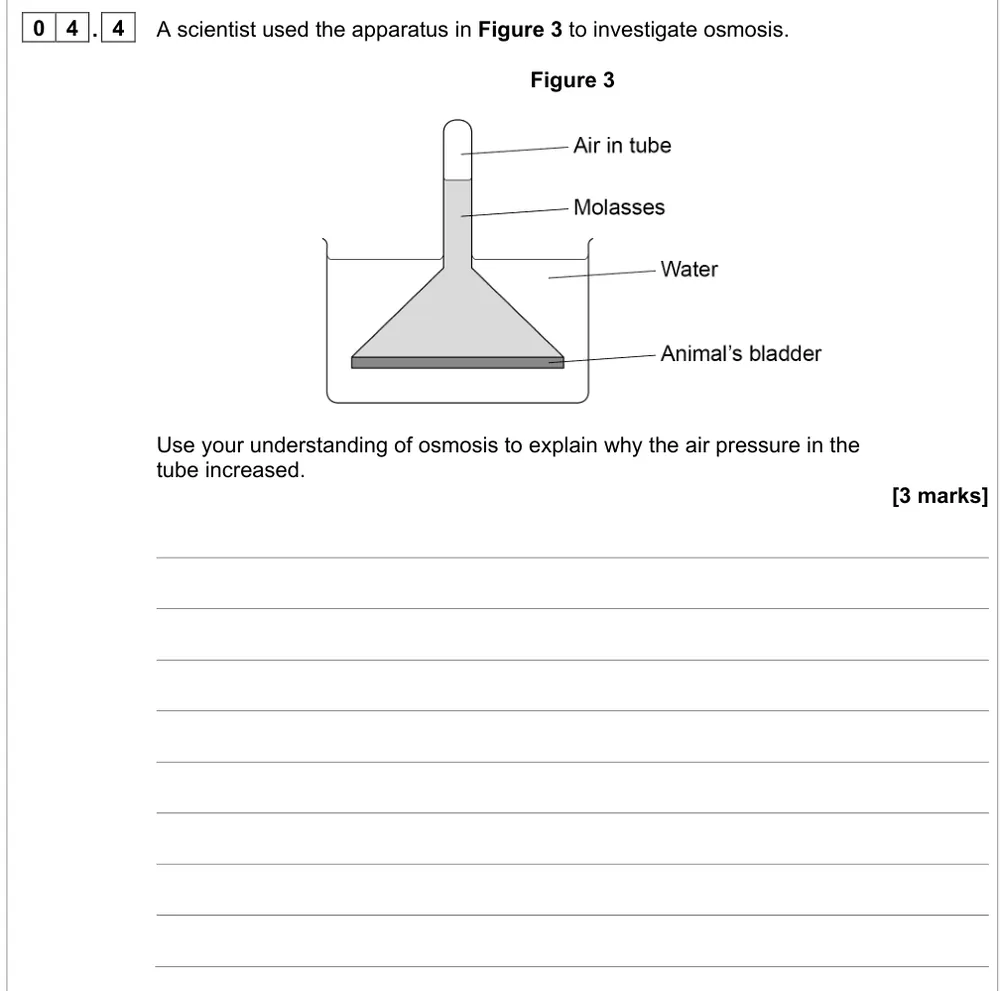
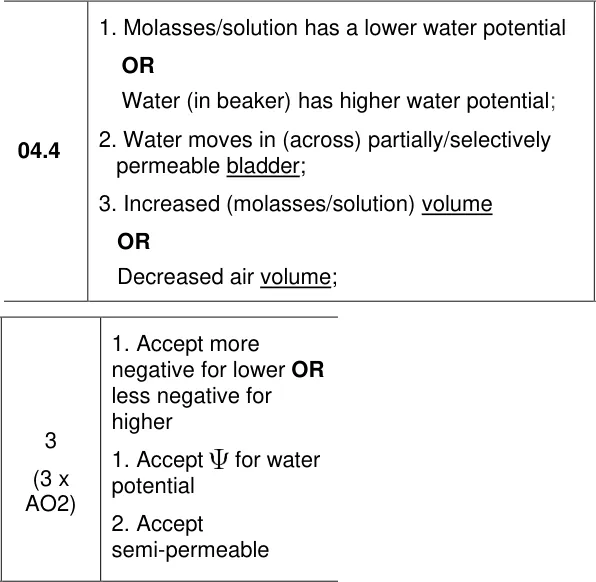
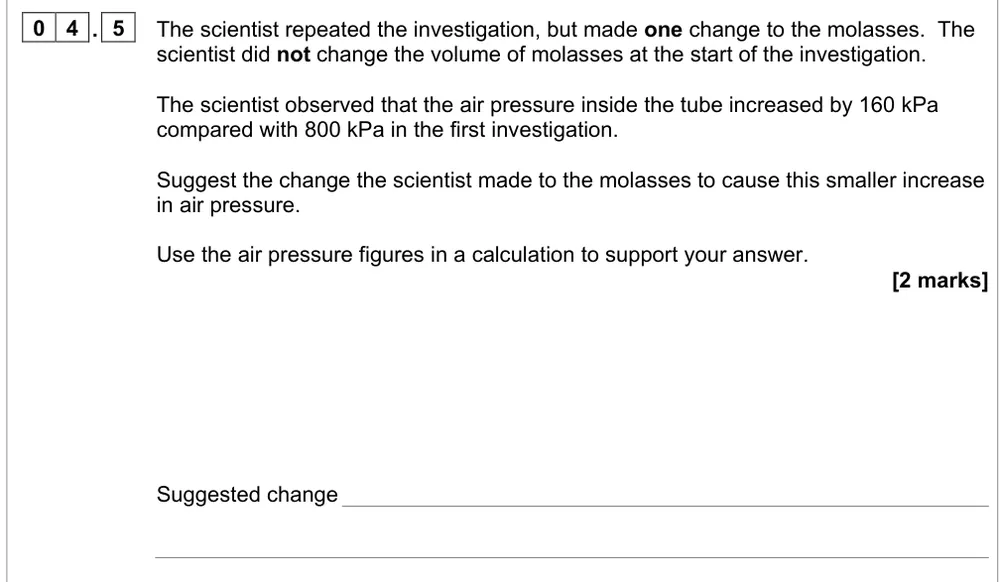
Use osmosis to explain why air pressure rose in a tube of molasses sealed with a bladder.
Show the mark scheme
Tap an image to open it full size.
From the examiners' report: About 12% got full marks. Use water potential, not water 'concentration', say water crosses the partially permeable bladder into the molasses, and say what happens to the air volume.
Question 18
A level Paper 1 · June 2024 · Q04.5 · 2 marks · Medium
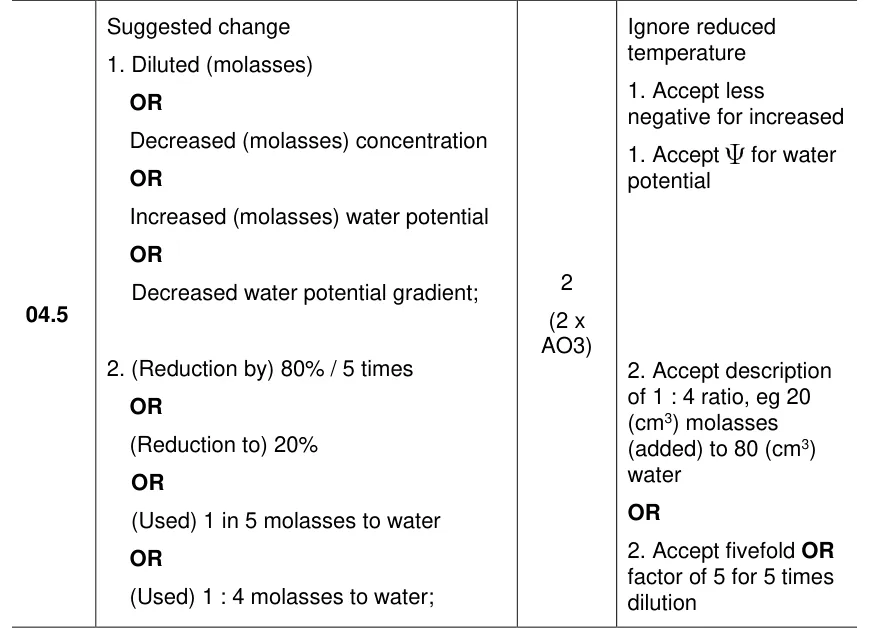
Use the air pressure figures to suggest what change was made to the molasses.
Show the mark scheme
Tap an image to open it full size.
From the examiners' report: Over half scored at least one. Change the molasses, not the water or the tube, and use the numbers: 800 ÷ 160 = 5, so a fivefold dilution.
Where students lose marks (from AQA examiners' reports and mark schemes)
Each point below is followed by wording that gained marks.
Explain the bilayer with water: About 80% got a mark for 'bilayer', but only about 30% explained it in terms of water on both sides. Some called the phosphate heads hydrophobic and the fatty acid tails hydrophilic, and unlabelled sketches rarely scored.
✔ Gains credit: "Bilayer (of phospholipids); because hydrophilic heads/phosphate are attracted to water OR hydrophobic tails/fatty acids point away from water."
Lipid-soluble, not 'fat-soluble': About two-thirds got a mark for the phospholipid bilayer, but only about one in four said steroid hormones are lipid-soluble. 'Fat soluble', 'non-polar' and 'not water soluble' weren't credited, and some sent steroids through channel proteins.
✔ Gains credit: "Lipid soluble; (diffuse through) phospholipid (bilayer)."
Carriers for active transport, never channels: Only about a fifth got all three marks for describing facilitated diffusion and active transport. Answers left out carrier proteins, put channel proteins into active transport, said facilitated diffusion needs ATP, or wrote 'along' or 'with' a gradient instead of down it.
✔ Gains credit: "Facilitated diffusion: down a concentration gradient via carrier/channel protein; active transport: against a concentration gradient via carrier protein using ATP."
Use water potential and give the direction: Only 41% got both marks for the potato chip in sucrose solution: most answers were at GCSE level and didn't use the term water potential. In other questions answers left out osmosis or just said 'water moves in'.
✔ Gains credit: "The solution has a lower (more negative) water potential than the potato; water moves out of the potato into the solution by osmosis."
Lower water potential pulls water in: In the lactulose question only 28.6% got both marks: many confused high and low water potential, and some had water moving out of the faeces into the lactulose.
✔ Gains credit: "(Lactulose) lowers the water potential of the faeces/intestine contents; water is retained/enters by osmosis and softens the faeces."
Sodium ions out first, then co-transport: About 25% got all three marks for glucose absorption in the ileum. Weaker answers said glucose is absorbed by active transport and defined active transport instead of explaining the role of sodium ions.
✔ Gains credit: "Sodium ions actively transported out (of cells); maintains a concentration gradient for sodium ions; co-transport (of glucose with sodium ions)."
Microvilli are folds of one cell's membrane: 72% scored nothing on the ileum cell image, mostly for stating 'large surface area' without linking it to transport, and for 'thin walls' or 'one cell thick', which belong to villi. Few could say what microvilli are.
✔ Gains credit: "(Highly) folded cell-surface membrane"; "microvilli increase surface area for (more) channel/carrier proteins; (many) mitochondria release ATP for active transport."
Download the questions
Download the PDF pack (18 questions, mark schemes at the end)
Keep practising
- Lipids: AQA A Level Biology exam questions by topic
- Eukaryotic cell structure: AQA A Level Biology exam questions by topic
- ATP: AQA A Level Biology exam questions by topic
- Water and inorganic ions: AQA A Level Biology exam questions by topic
- AQA A Level Biology masterclasses
Questions, mark schemes and examiners' report extracts © AQA.