

All cells arise from other cells (AQA 3.2.2) covers how new cells are made: the eukaryotic cell cycle, with DNA replication in interphase, the behaviour of chromosomes and spindle fibres in prophase, metaphase, anaphase and telophase, and cytokinesis; why uncontrolled division leads to tumours and cancer, and how cancer treatments target cell division; binary fission in prokaryotes; and how a host cell replicates virus particles. It comes up on every AS and A-level paper, often as a photo or drawing of a cell you have to explain.
The examiners' reports show the same slips each year. Students write 'fission' or 'binary fusion', lump the circular DNA and plasmids together as 'genetic material', forget that centromeres divide in anaphase, say cancer cells divide faster rather than uncontrollably, say the cell-surface membrane 'splits' in cytokinesis, and stop a description of viral replication before the virus is assembled.
Start with the cell cycle and the stages of mitosis, then cancer, then binary fission and viruses, and finish with a short calculation. Answer each on paper before you open the mark scheme. If you'd like help with this topic, my AQA masterclasses run online on Tuesdays at 5.15pm for Year 12 and on Wednesdays or Thursdays at 6.30pm for Year 13.
What you need from GCSE and Year 12
Each question on this page assumes you're secure on these GCSE and Year 12 ideas. If any of them feels shaky, revise it before you start.
- GCSE: chromosomes are made of DNA and found in the nucleus; body cells have pairs of chromosomes.
- GCSE: in the cell cycle, the DNA is copied, then mitosis produces two genetically identical cells for growth and repair.
- GCSE: cancer is the result of changes in cells that lead to uncontrolled growth and division.
- Year 12 (AQA 3.1.5.2): semi-conservative replication of DNA by DNA helicase and DNA polymerase. See the DNA replication page.
- Year 12 (AQA 3.2.1.2): prokaryotic cells have circular DNA and often plasmids; virus particles have genetic material, a capsid and attachment proteins. See the Prokaryotic cells and viruses page.
Key terms
These words come up in the questions and mark schemes. Examiners expect you to use them exactly.
- Cell cycle: the sequence of interphase, mitosis and usually cytokinesis in a eukaryotic cell that keeps the ability to divide.
- Interphase: the longest part of the cell cycle, when the cell grows, makes proteins and organelles and replicates its DNA.
- Chromatid: one of the two identical copies of a chromosome after DNA replication, joined to the other at the centromere.
- Centromere: the region that holds two sister chromatids together and attaches to the spindle fibres; it divides in anaphase.
- Spindle fibres: protein fibres that attach to the centromeres and shorten to pull the chromatids to opposite poles.
- Prophase, metaphase, anaphase, telophase: chromosomes condense; chromosomes line up on the equator; centromeres divide and chromatids are pulled to opposite poles; chromatids reach the poles and nuclear envelopes re-form.
- Cytokinesis: division of the cytoplasm: the cell-surface membrane pinches in to make two new cells.
- Tumour: a mass of abnormal cells produced by uncontrolled mitosis.
- Binary fission: how prokaryotes divide: the circular DNA and plasmids replicate, then the cytoplasm divides into two daughter cells.
- Viral replication: attachment proteins bind to receptors, viral nucleic acid enters the host cell, the cell copies it and makes viral proteins, and new particles are assembled and released.
What these questions cover (AQA 3.2.2)
The questions test these statements from the AQA AS and A-level Biology specification (7401/7402):
- The cell cycle: Within multicellular organisms, not all cells retain the ability to divide.
- The cell cycle: Eukaryotic cells that do retain the ability to divide show a cell cycle.
- The cell cycle: DNA replication occurs during the interphase of the cell cycle.
- The cell cycle: Mitosis is the part of the cell cycle in which a eukaryotic cell divides to produce two daughter cells, each with the identical copies of DNA produced by the parent cell during DNA replication.
- Mitosis: The behaviour of chromosomes during interphase, prophase, metaphase, anaphase and telophase of mitosis. The role of spindle fibres attached to centromeres in the separation of chromatids. (meiosis is in section 3.4.3)
- Mitosis: Division of the cytoplasm (cytokinesis) usually occurs, producing two new cells.
- Students should be able to: recognise the stages of the cell cycle: interphase, prophase, metaphase, anaphase and telophase (including cytokinesis)
- Students should be able to: explain the appearance of cells in each stage of mitosis. (root tip squashes, the mitotic index and measuring cells (required practical 2) have their own page)
- Cancer: Mitosis is a controlled process. Uncontrolled cell division can lead to the formation of tumours and of cancers. Many cancer treatments are directed at controlling the rate of cell division.
- Binary fission in prokaryotic cells involves: replication of the circular DNA and of plasmids
- Binary fission in prokaryotic cells involves: division of the cytoplasm to produce two daughter cells, each with a single copy of the circular DNA and a variable number of copies of plasmids.
- Viruses: Being non-living, viruses do not undergo cell division. Following injection of their nucleic acid, the infected host cell replicates the virus particles.
How to use this page
Write your answer on paper before you open the mark scheme. Allow about 1.3 minutes per mark: the 18 questions are worth 45 marks, so about 58 minutes in total. Then mark your answer strictly against the mark scheme and read the examiners' tip underneath it. If you'd rather print the questions, download the PDF pack.
The cell cycle (3.2.2)
Question 1
A level Paper 1 · June 2019 · Q06.1 · 2 marks
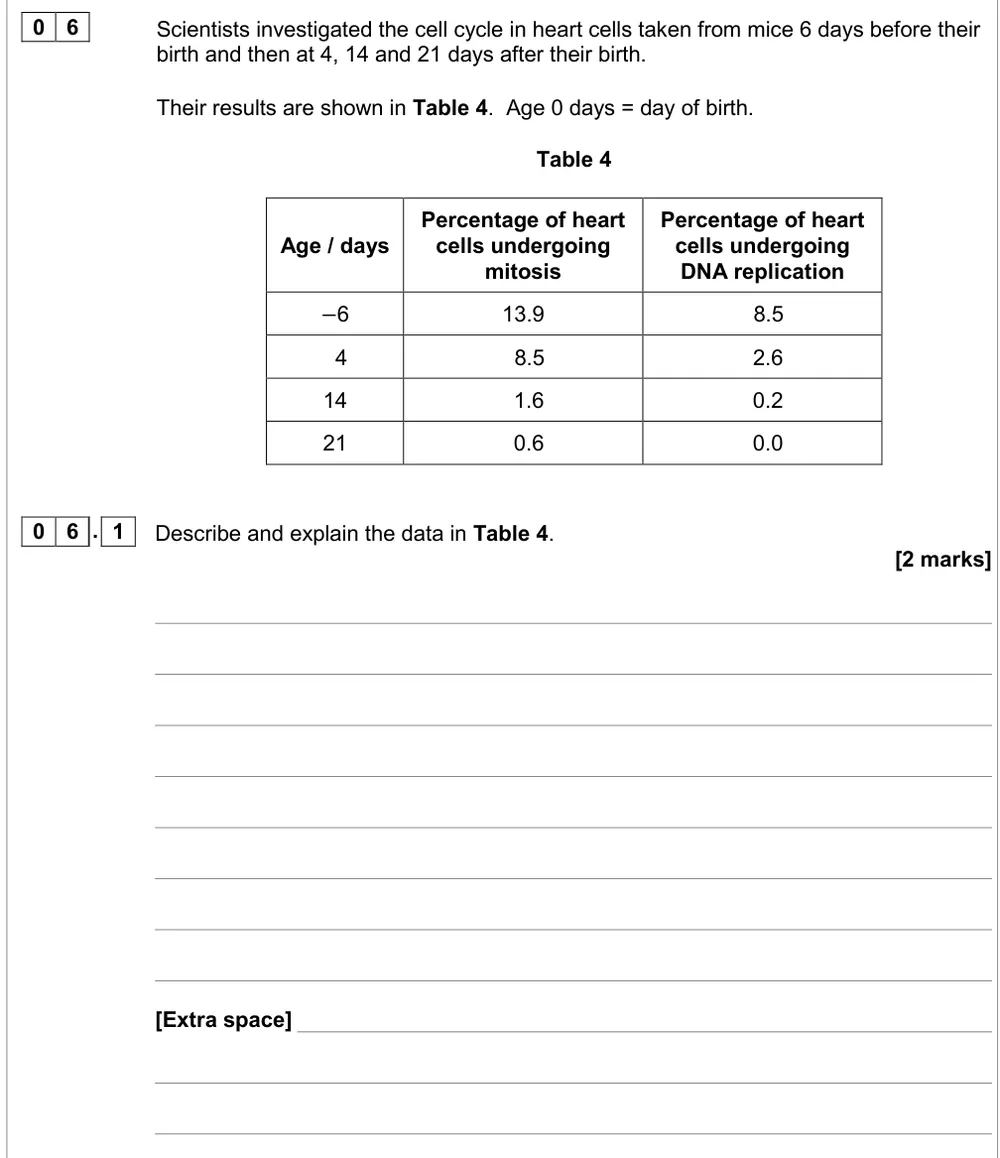
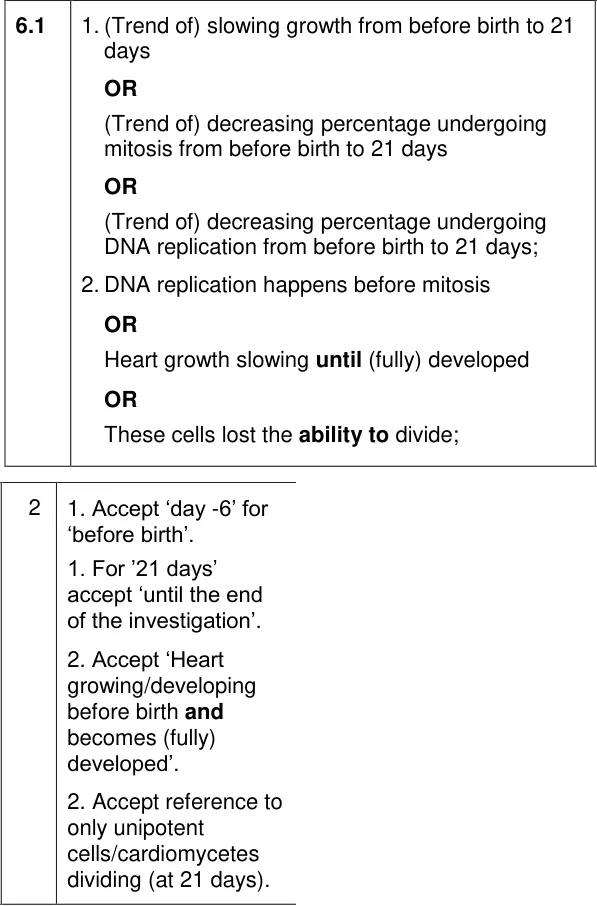
Describe and explain the falling percentage of mouse heart cells in mitosis and DNA replication.
Show the mark scheme
Tap an image to open it full size.
From the examiners' report: There's no examiners' report for this paper, so this tip comes from the mark scheme. Describe the trend with the ages, then explain it: heart cells lose the ability to divide once the heart is developed.
Question 2
AS Paper 2 · June 2023 · Q07.1 · 3 marks · Hard
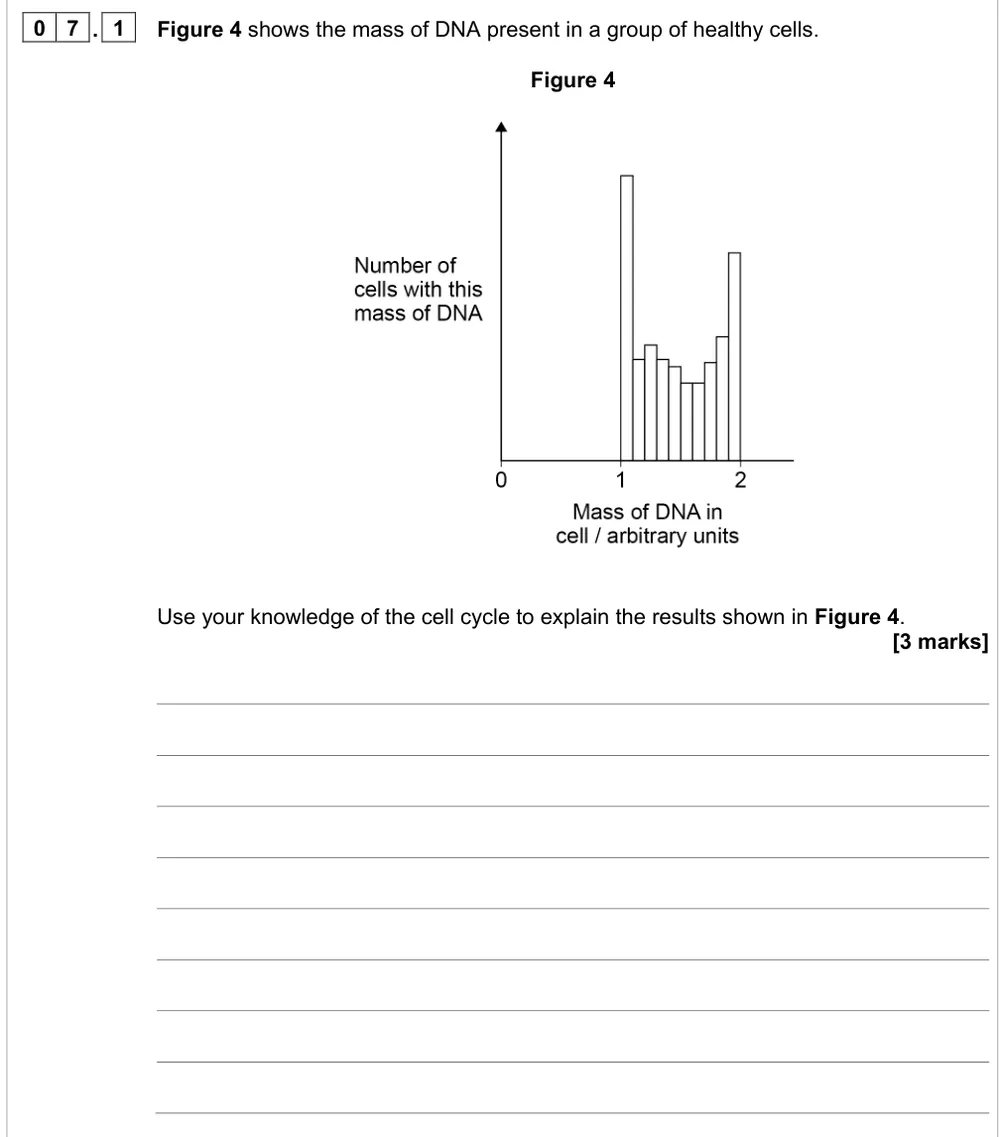
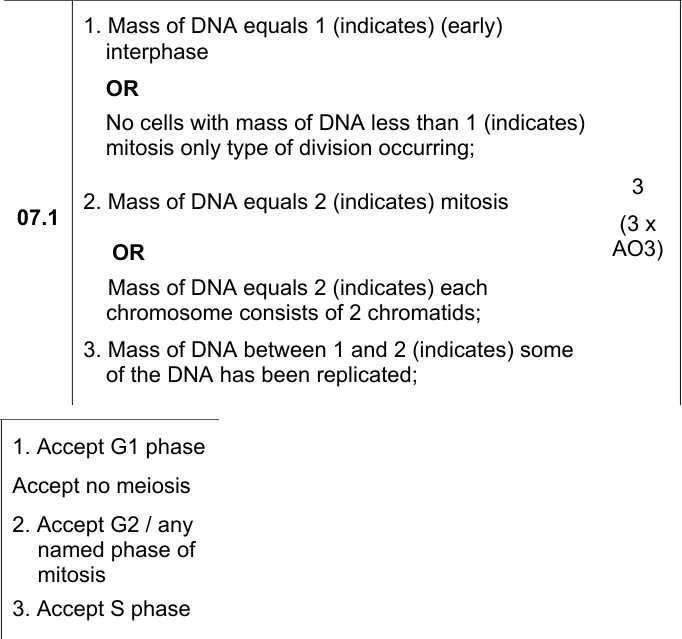
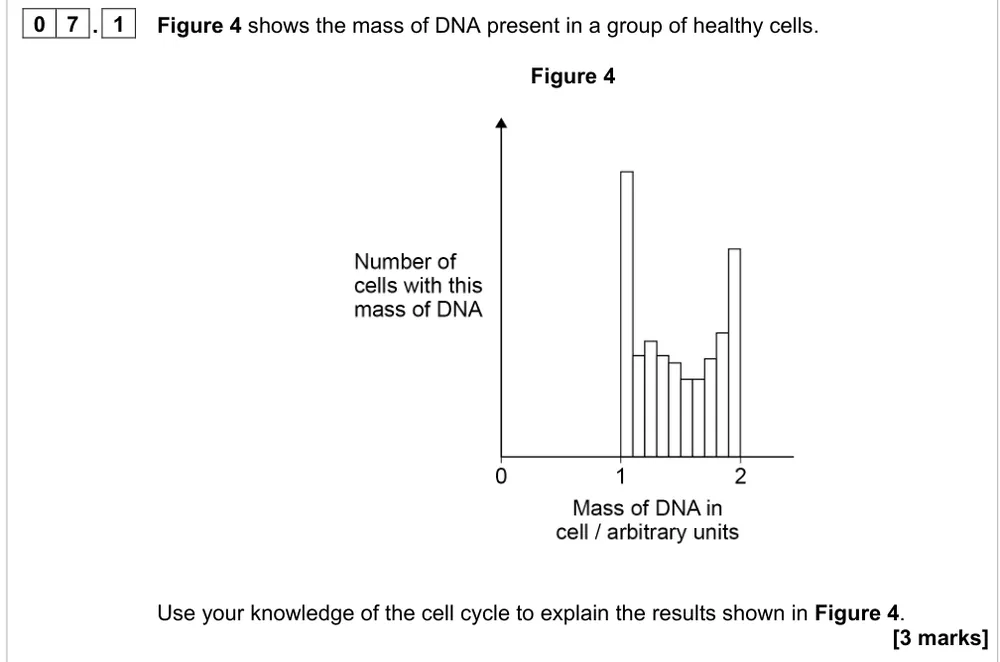
Use your knowledge of the cell cycle to explain a graph of the number of cells against DNA mass.
Show the mark scheme
Tap an image to open it full size.
From the examiners' report: Students struggled: the y-axis is the number of cells, not the DNA mass. Most cells have a mass of 1 because they're in interphase; between 1 and 2 they're replicating DNA.
Question 3
AS Paper 2 · June 2025 · Q05.2 · 4 marks · Medium
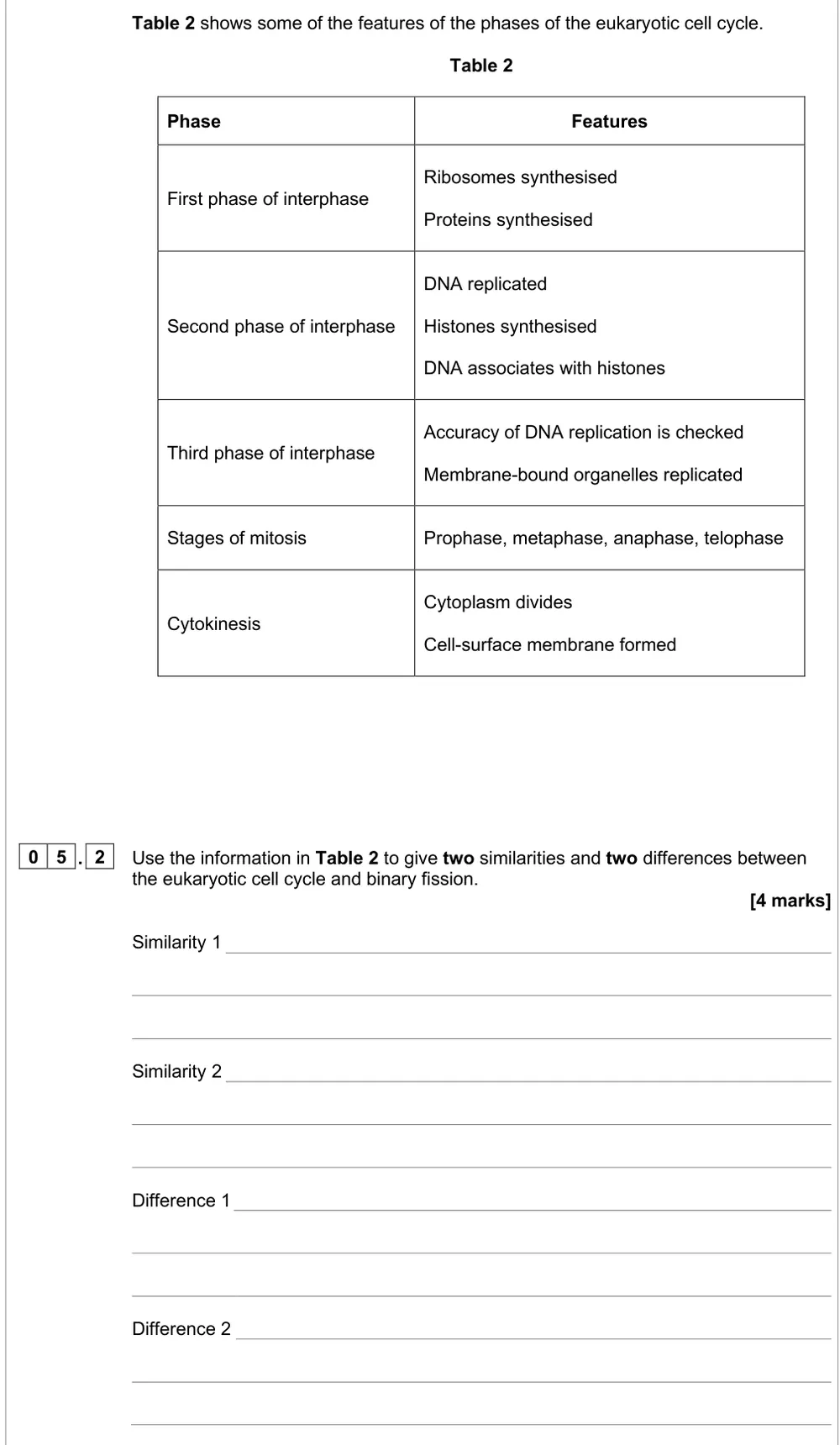
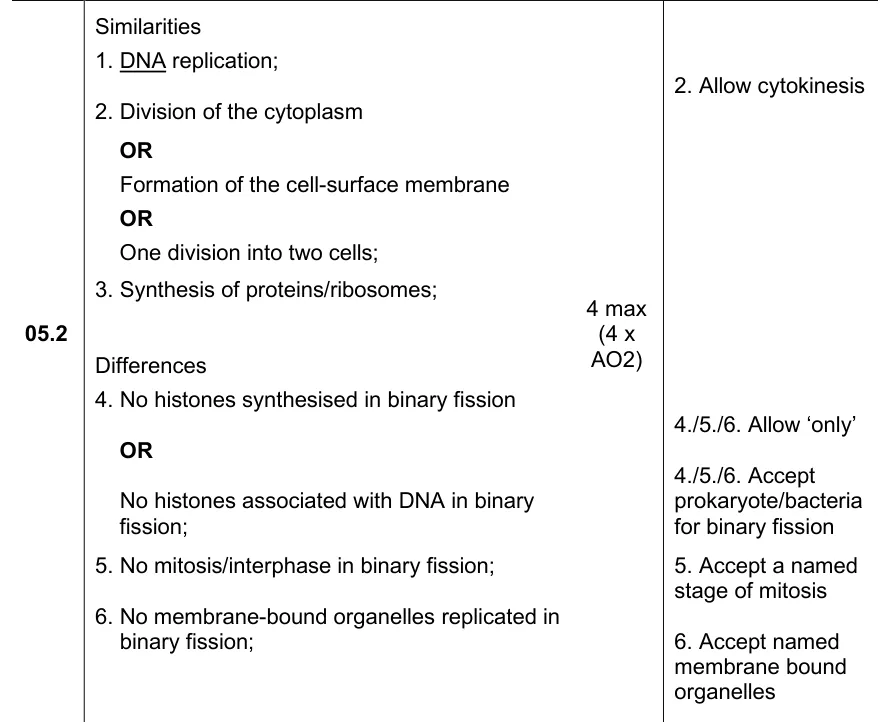
Use a table of cell cycle phases to give similarities and differences with binary fission.
Show the mark scheme
Tap an image to open it full size.
From the examiners' report: Almost a third got full marks. Use the table, not circular v linear DNA. 'No histones synthesised' and 'no histones with DNA' are one difference, so don't use both.
Mitosis and cytokinesis (3.2.2)
Question 4
A level Paper 1 · June 2024 · Q05.1 · 4 marks · Easy
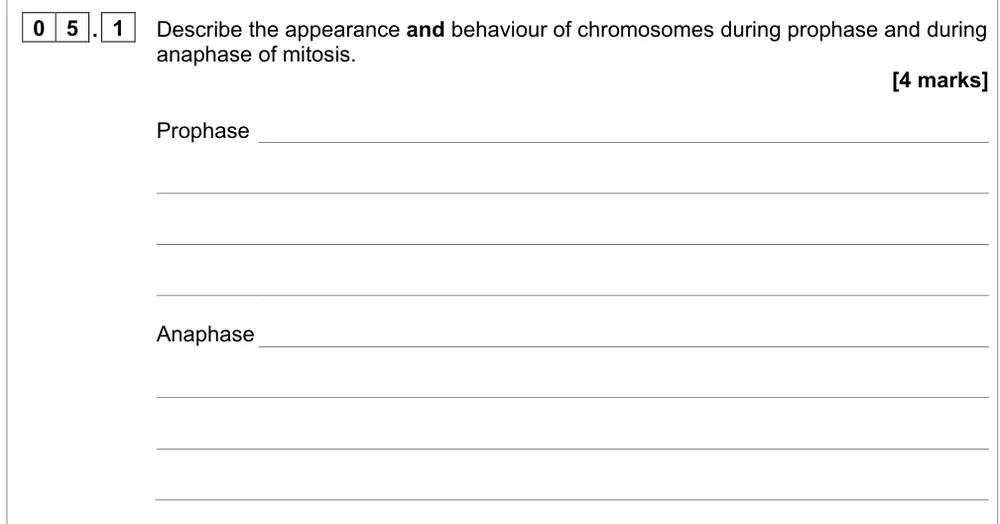
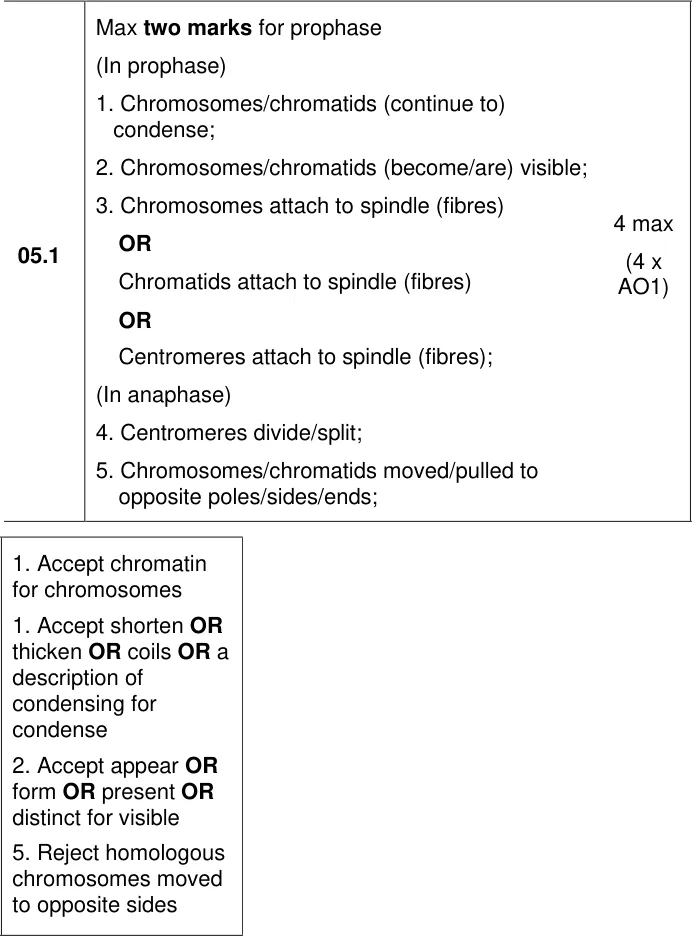
Describe the appearance and behaviour of chromosomes during prophase and anaphase.
Show the mark scheme
Tap an image to open it full size.
From the examiners' report: Generally well answered, but few said the centromere splits in anaphase, and spindle attachment was less well known. Homologous pairs and crossing over belong to meiosis.
Question 5
A level Paper 1 · November 2021 · Q06.2 · 5 marks
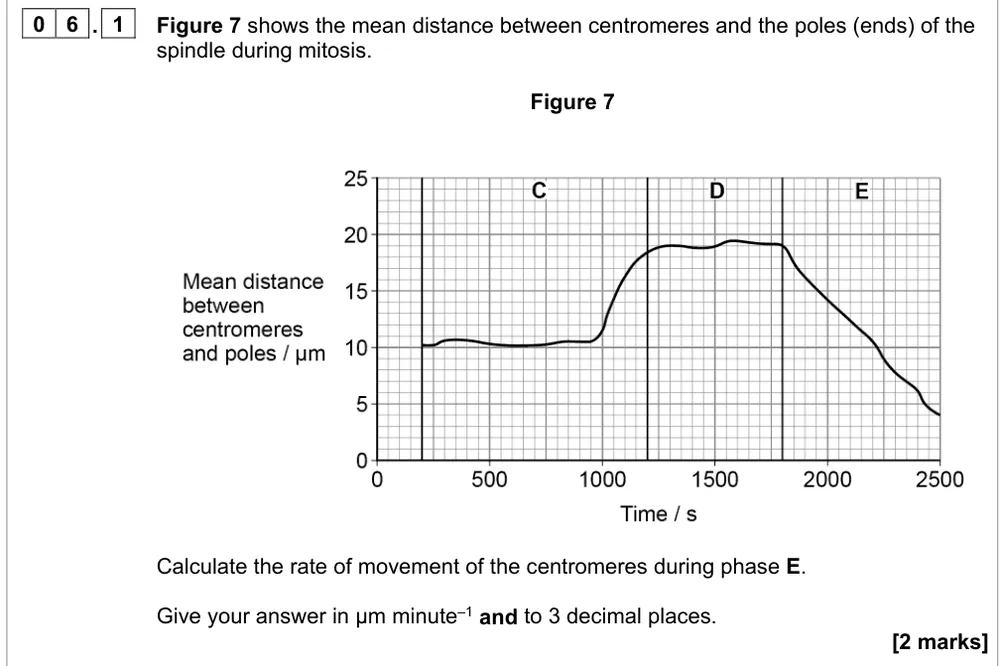
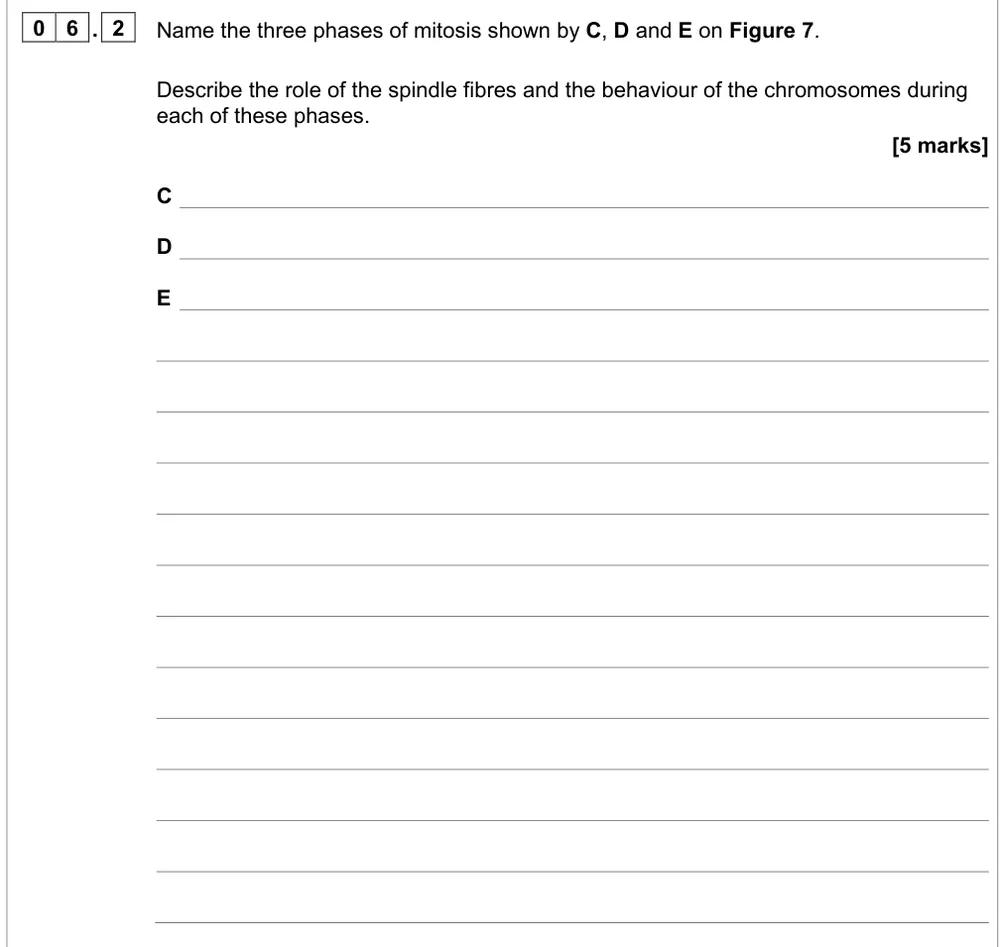
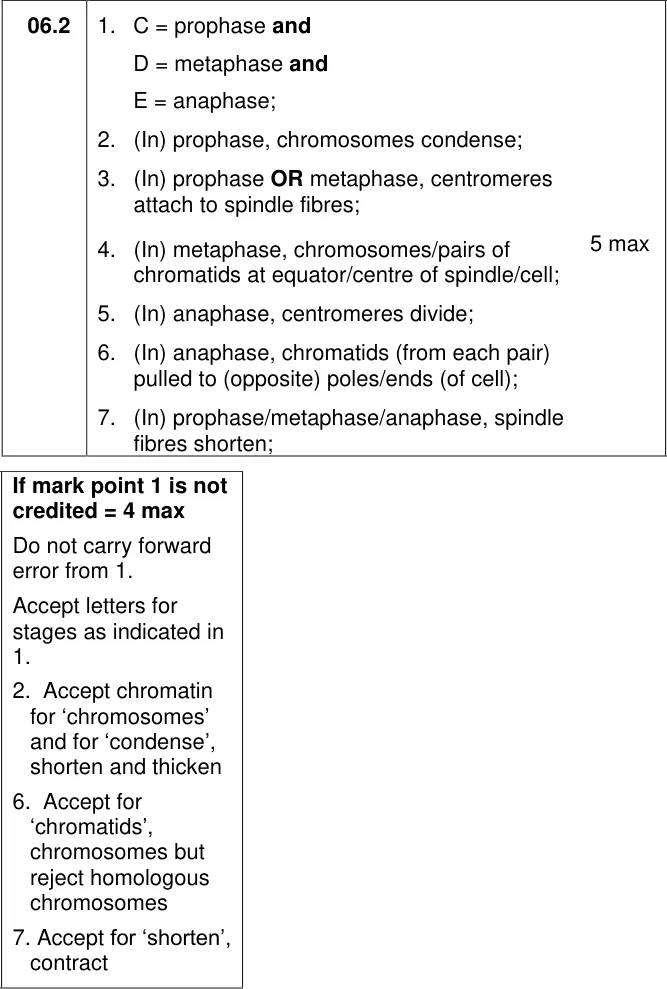
Name phases C, D and E on a graph and describe the spindle and chromosomes in each.
Information from earlier in this question:
Show the mark scheme
Tap an image to open it full size.
From the examiners' report: Many didn't match the stages to the graph. Distance to the poles stays the same while chromosomes sit on the equator (metaphase), then falls as chromatids are pulled apart (anaphase).
Question 6
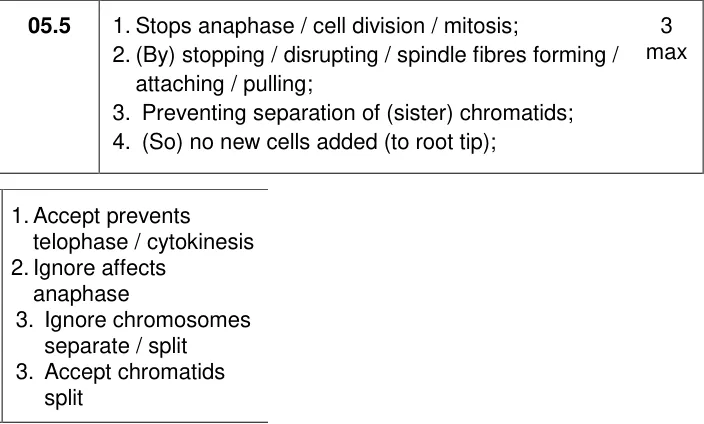
AS Paper 2 · June 2018 · Q05.5 · 3 marks
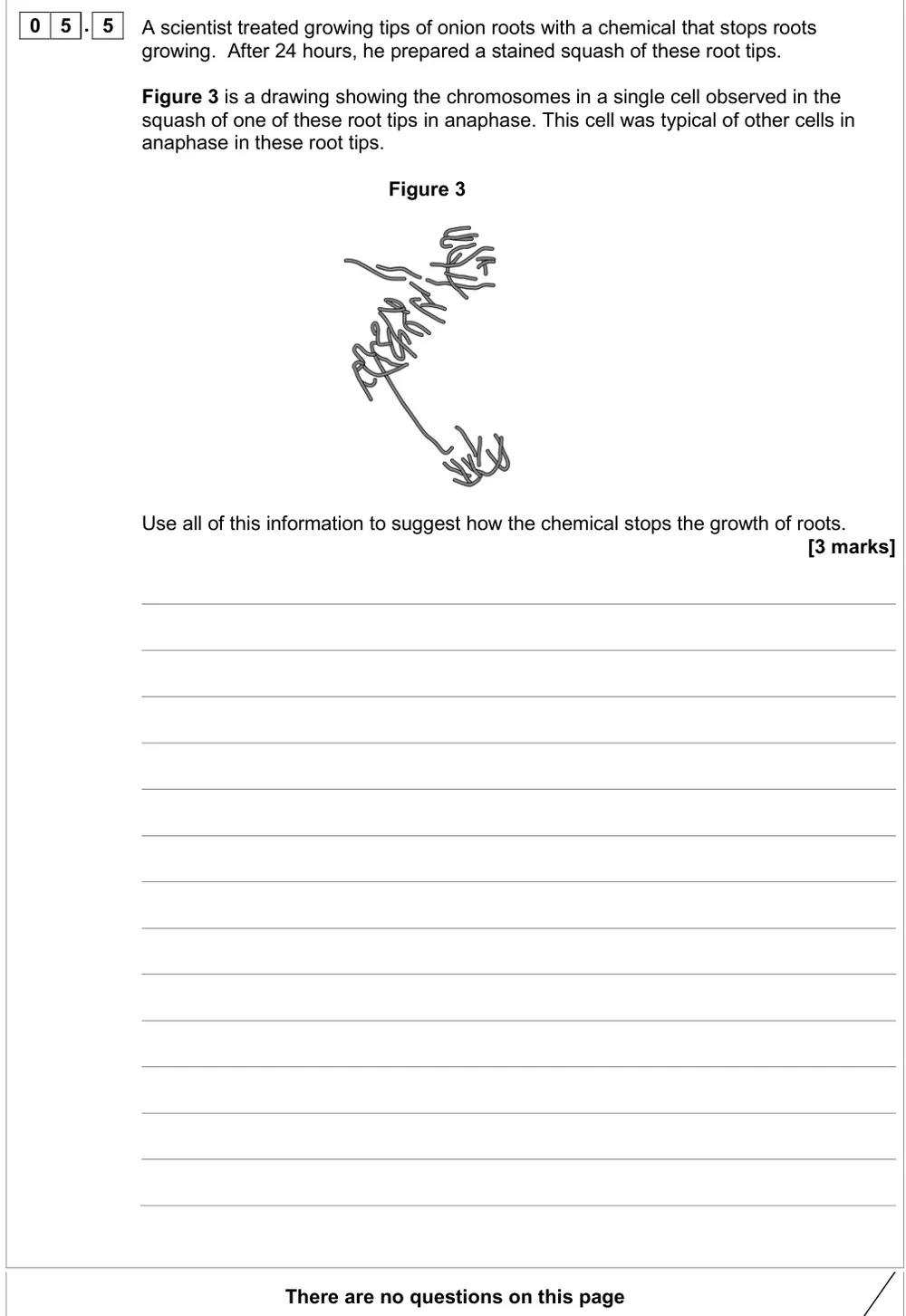
Suggest how a chemical stops root growth, using a drawing of an anaphase cell.
Show the mark scheme
Tap an image to open it full size.
From the examiners' report: Most linked the chemical to spindle fibres. Say chromatids, not homologous chromosomes, fail to separate, and finish with no new cells being made.
Question 7
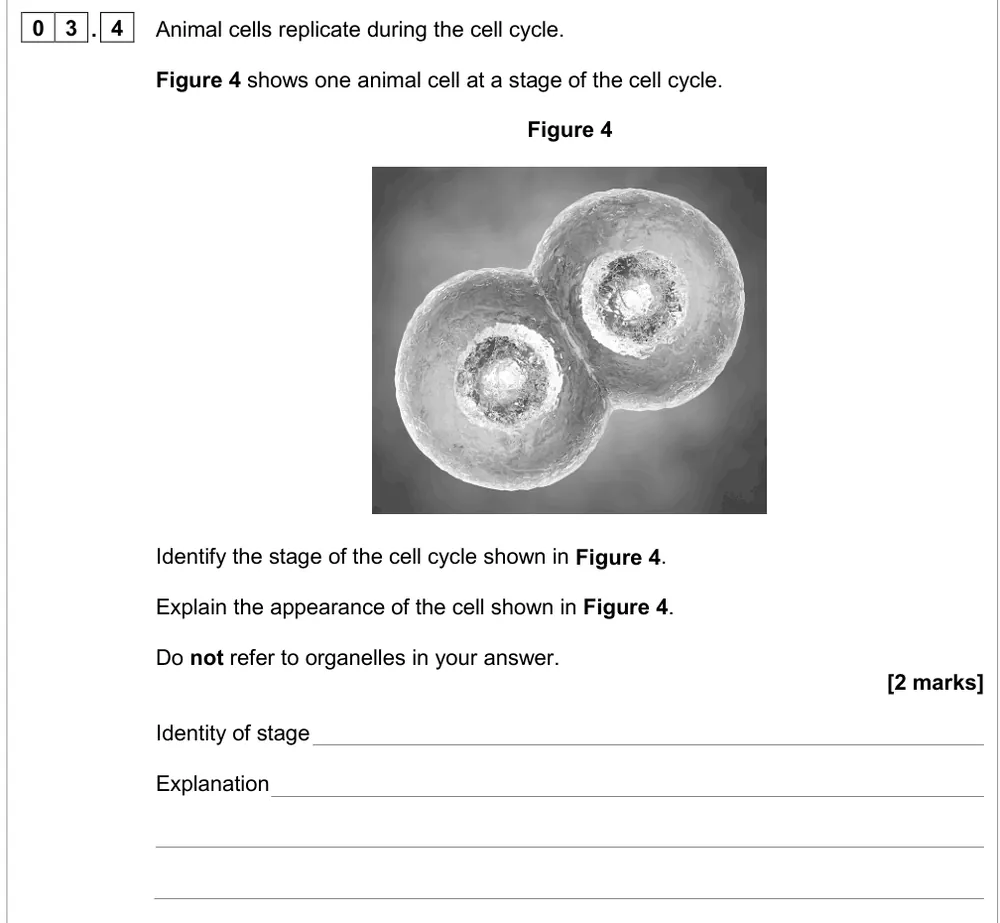
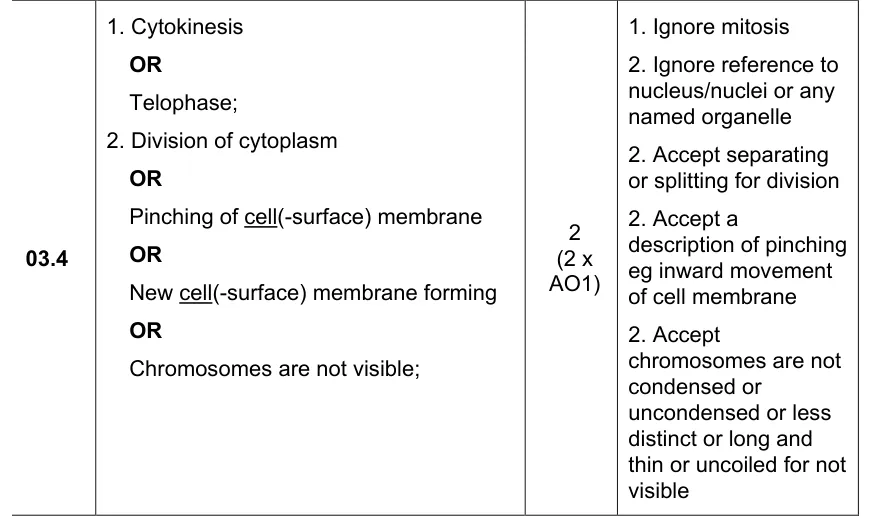
AS Paper 1 · June 2024 · Q03.4 · 2 marks · Hard
Identify the stage of the cell cycle in a photo of an animal cell and explain its appearance.
Show the mark scheme
Tap an image to open it full size.
From the examiners' report: Many identified cytokinesis or telophase. The membrane pinches in; it doesn't split down the middle. The question bans organelles, so don't mention nuclei.
Question 8
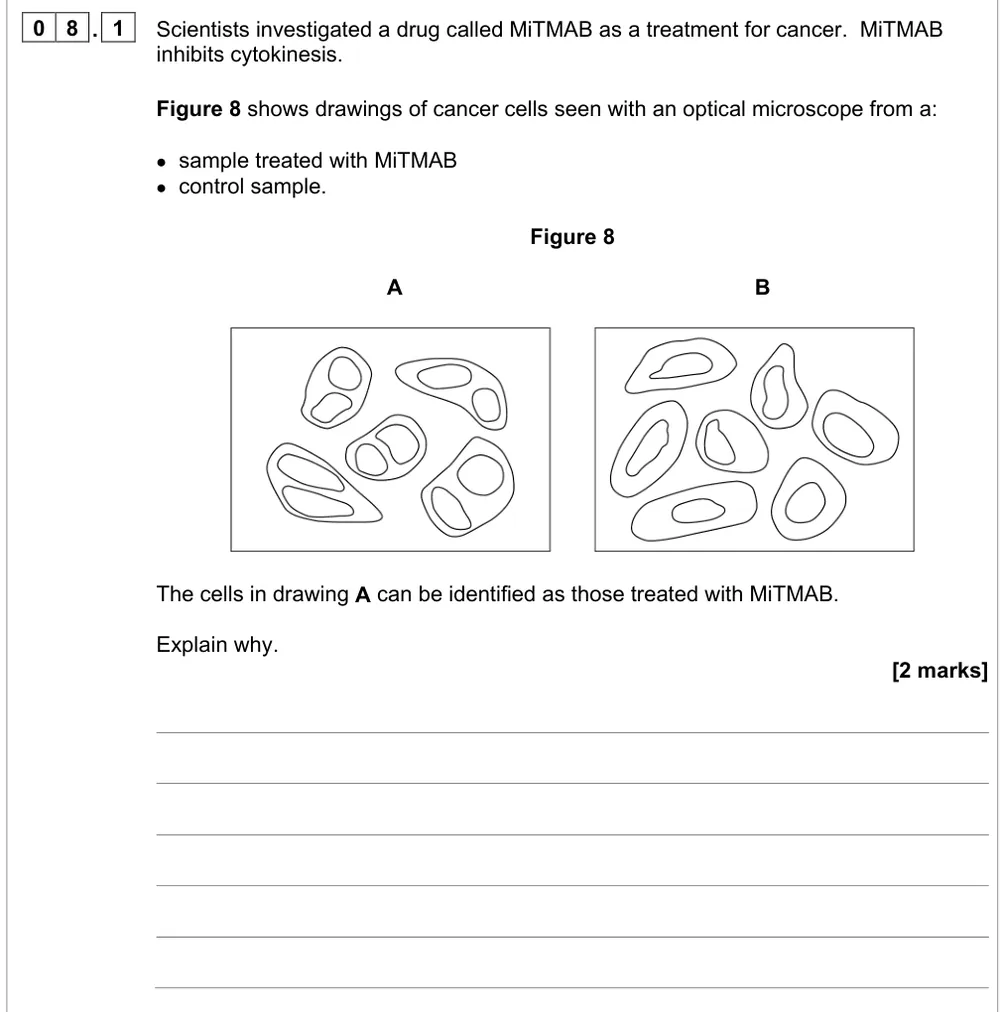
A level Paper 1 · June 2023 · Q08.1 · 2 marks · Easy
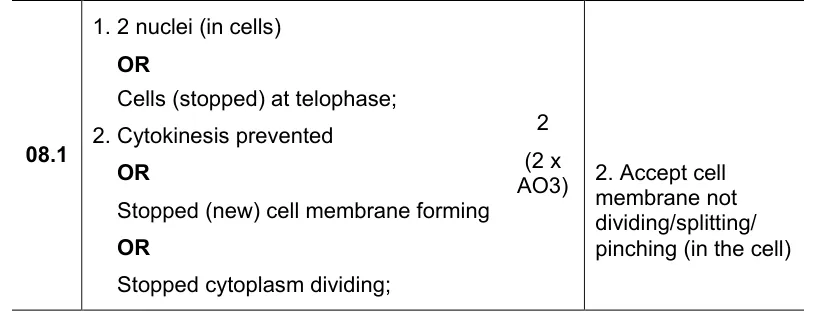
Explain why drawing A shows cancer cells treated with MiTMAB, which inhibits cytokinesis.
Show the mark scheme
Tap an image to open it full size.
From the examiners' report: 80% got at least one mark. Spot the two nuclei in each cell; they aren't separate cells inside one membrane.
Question 9
AS Paper 2 · June 2024 · Q07.3 · 1 mark · Hard
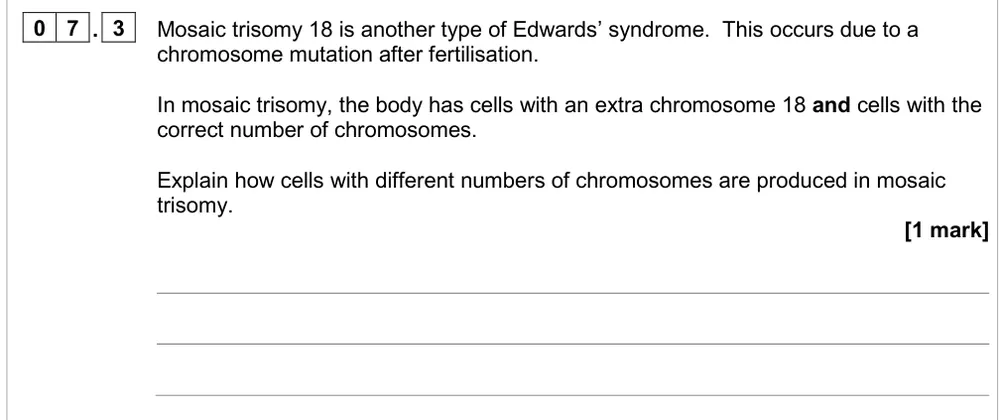
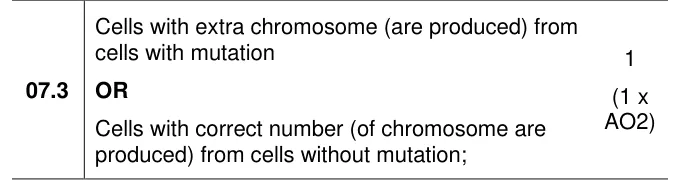
Explain how mosaic trisomy 18 produces body cells with different chromosome numbers.
Show the mark scheme
Tap an image to open it full size.
From the examiners' report: Many left this blank or blamed gametes, though the question says the mutation is after fertilisation. Mitosis copies a cell exactly, so every cell descended from the mutant cell has it.
Cancer and cell division (3.2.2)
Question 10
AS Paper 1 · June 2022 · Q07.1 · 2 marks
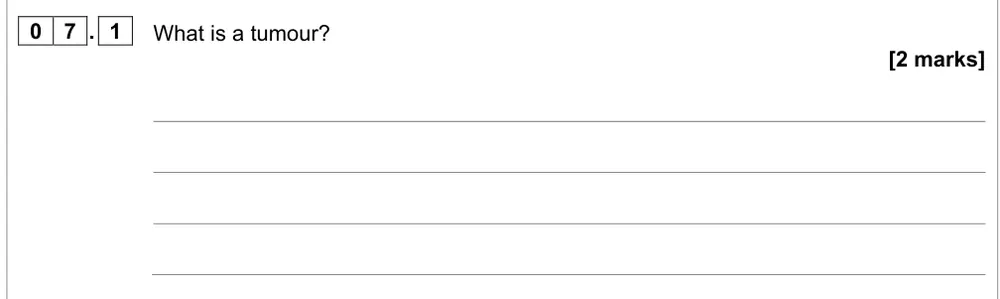
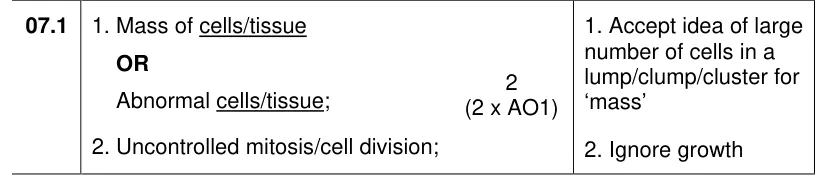
What is a tumour?
Show the mark scheme
Tap an image to open it full size.
From the examiners' report: Most knew a tumour comes from uncontrolled mitosis but didn't also say it's a mass (lump) of cells.
Question 11
AS Paper 2 · June 2023 · Q07.2 · 2 marks · Medium
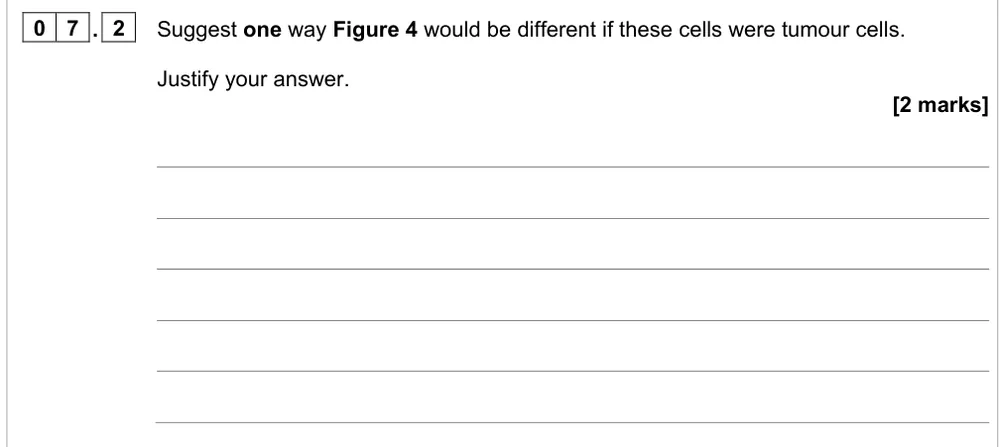
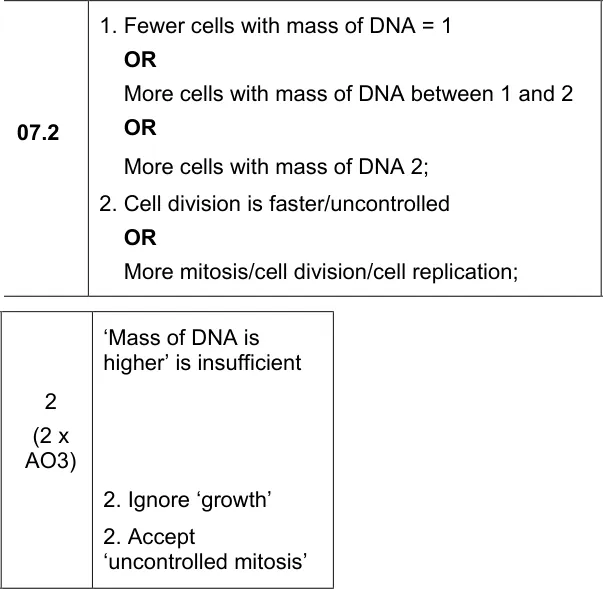
Suggest how the DNA mass graph would differ for tumour cells, and justify it.
Information from earlier in this question:
Show the mark scheme
Tap an image to open it full size.
From the examiners' report: Almost three-quarters got one mark, for uncontrolled cell division. For the second, say which bar changes: more cells replicating DNA (between 1 and 2) or at 2.
Question 12
A level Paper 1 · November 2020 · Q05.4 · 2 marks
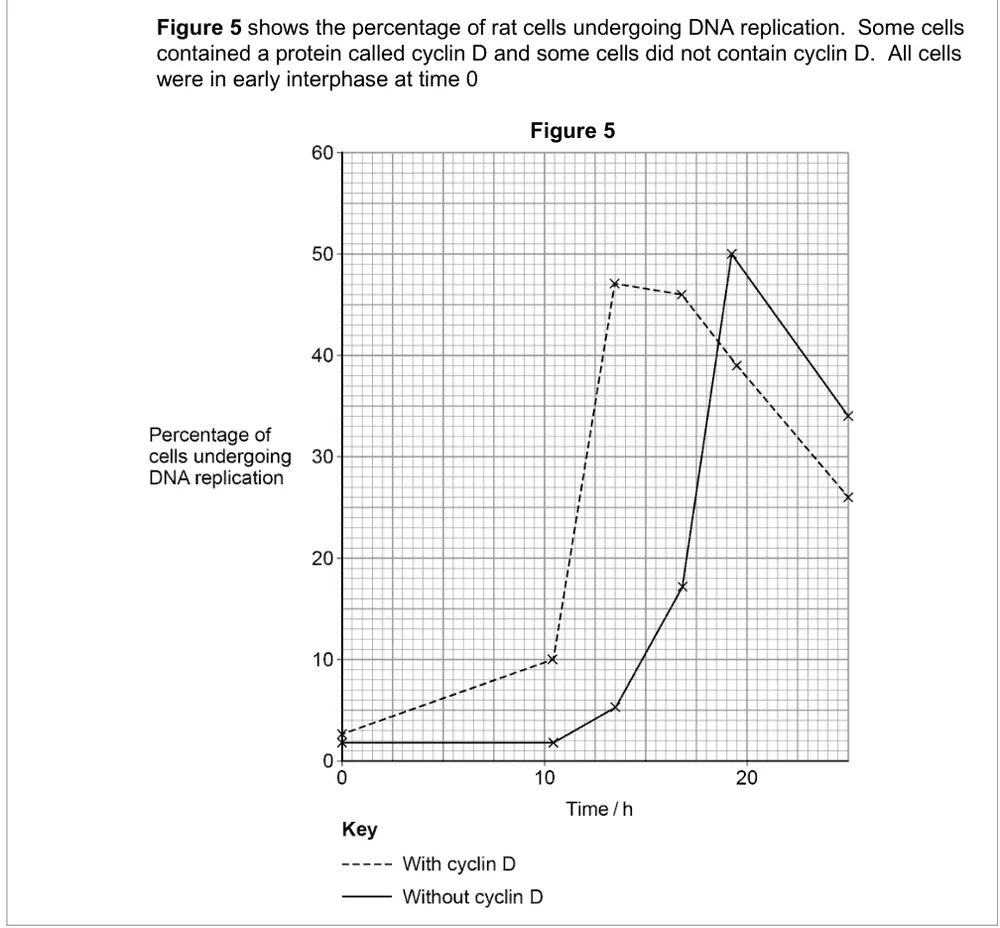
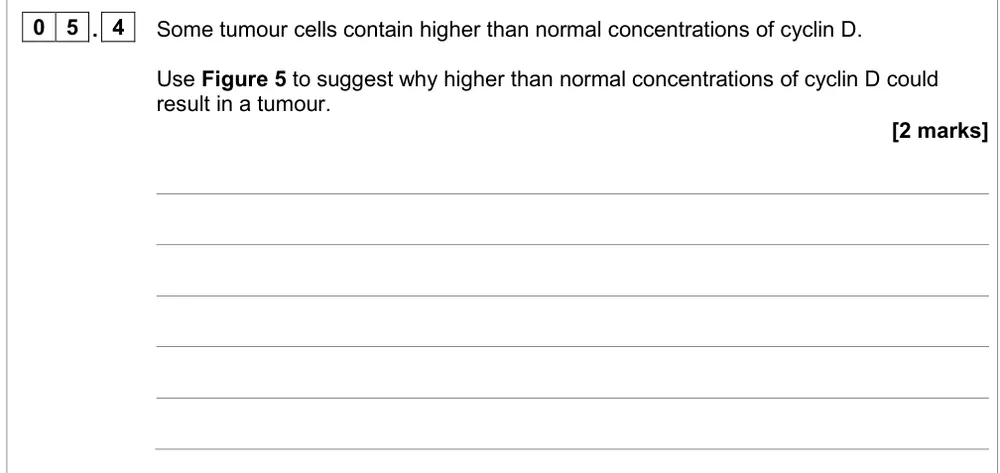
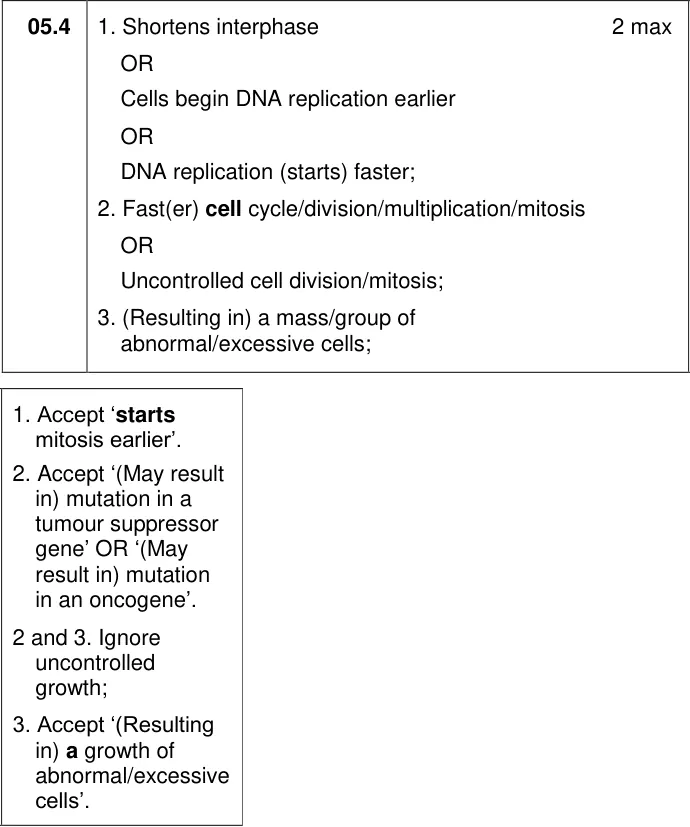
Use a graph to suggest why high cyclin D concentrations could result in a tumour.
Information from earlier in this question:
Show the mark scheme
Tap an image to open it full size.
From the examiners' report: Figure 5 shows DNA replication starting earlier with cyclin D, not more cells replicating. Then link a faster, uncontrolled cell cycle to a mass of cells.
Question 13
AS Paper 1 · June 2019 · Q09.2 · 1 mark
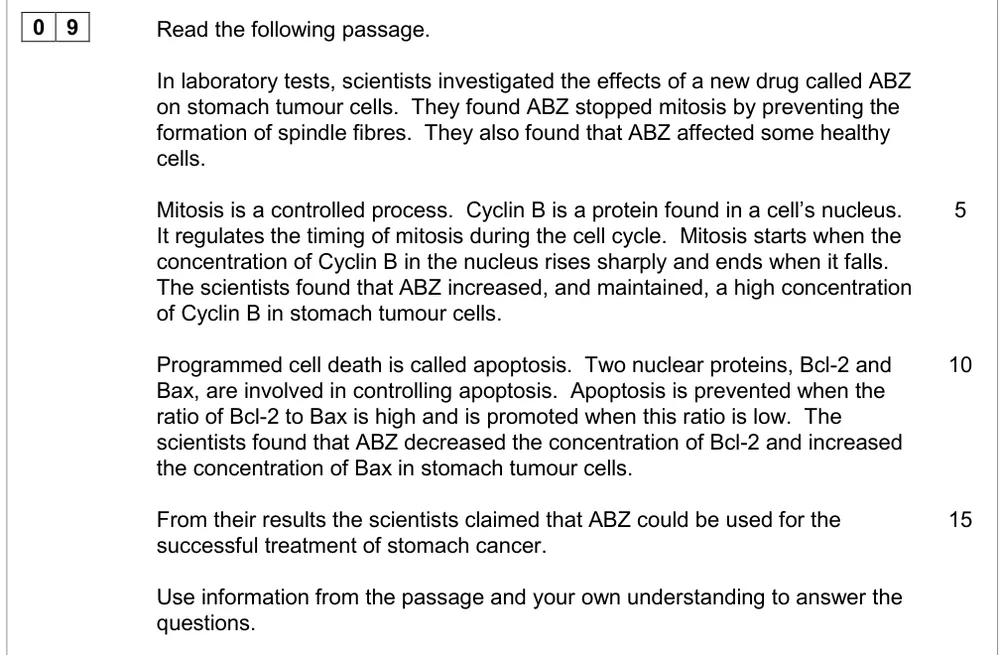
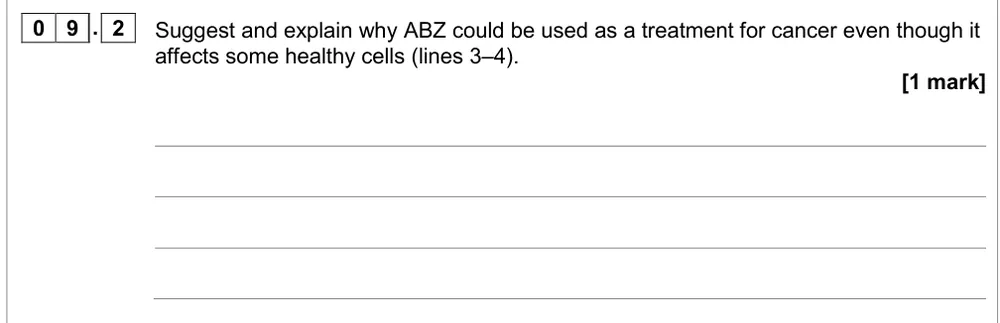
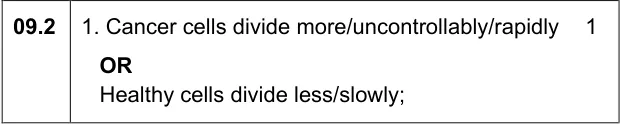
Explain why a drug that stops spindle fibres could treat cancer though it affects healthy cells.
Information from earlier in this question:
Show the mark scheme
Tap an image to open it full size.
From the examiners' report: There's no examiners' report for this paper, so this tip comes from the mark scheme. Cancer treatments target dividing cells. Tumour cells divide far more often than most healthy cells, so they're affected most.
Binary fission and viral replication (3.2.2)
Question 14
A level Paper 3 · June 2025 · Q01.1 · 3 marks · Easy
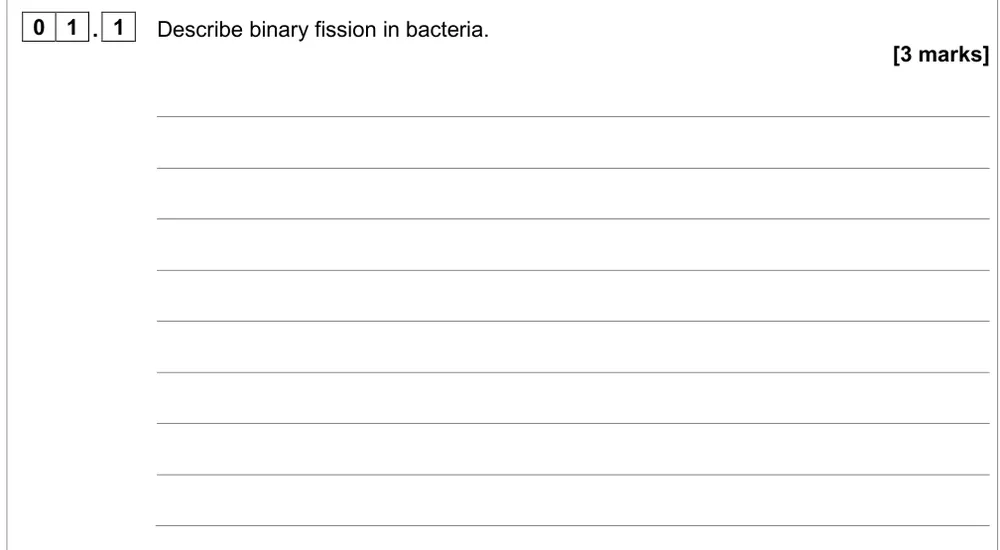
Describe binary fission in bacteria.
Show the mark scheme
Tap an image to open it full size.
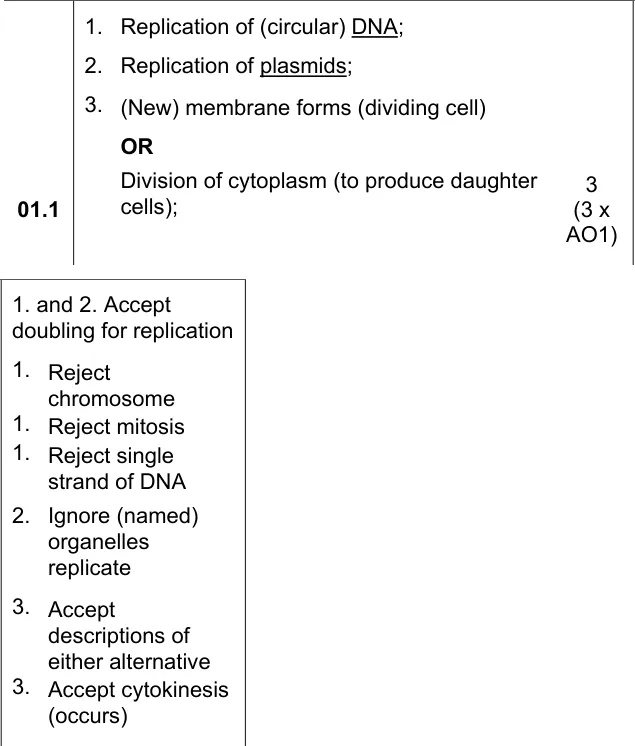
From the examiners' report: About 40% got all three. Give the circular DNA and the plasmids as two separate points, not 'genetic material replicates'.
Question 15
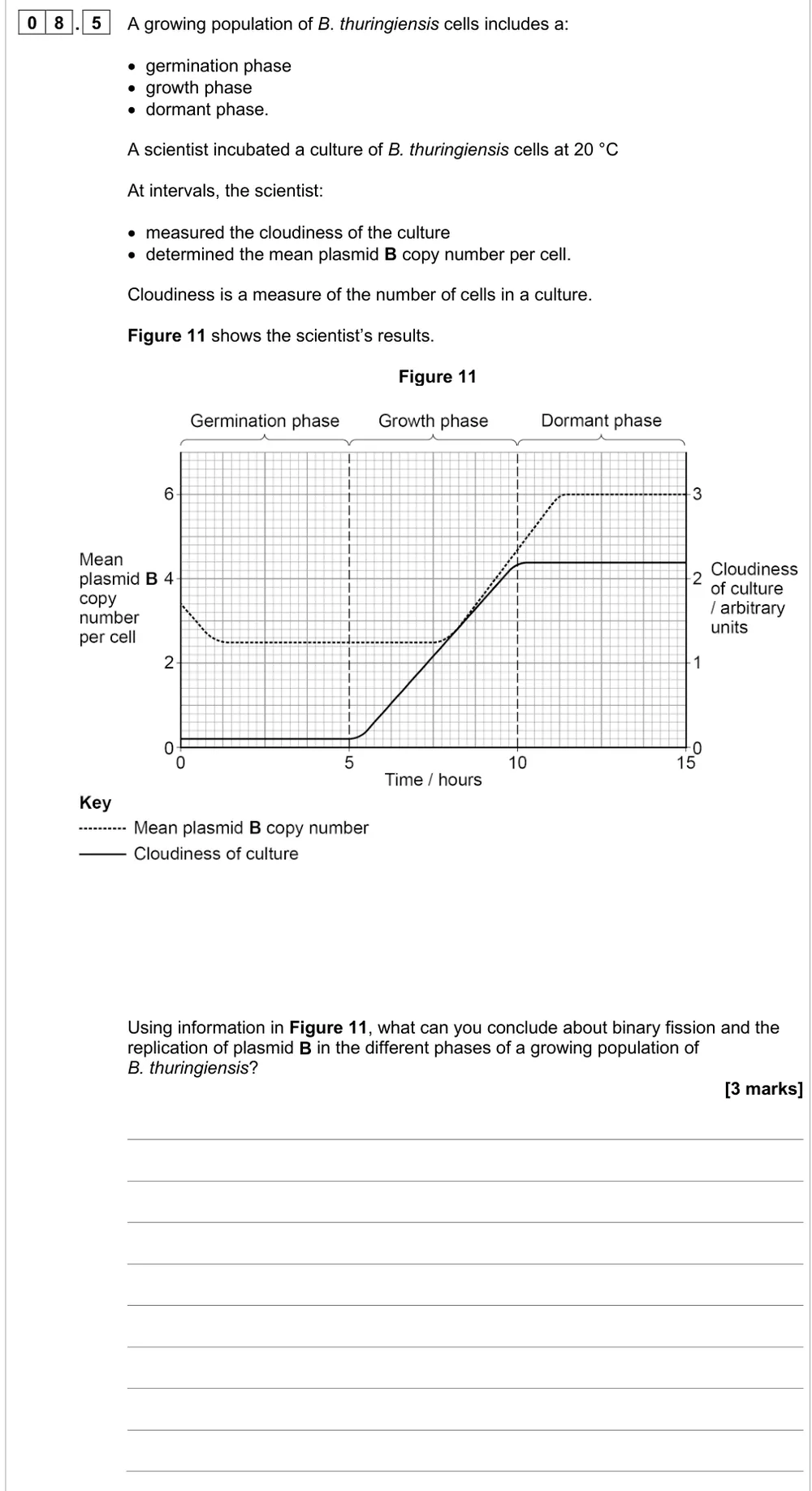
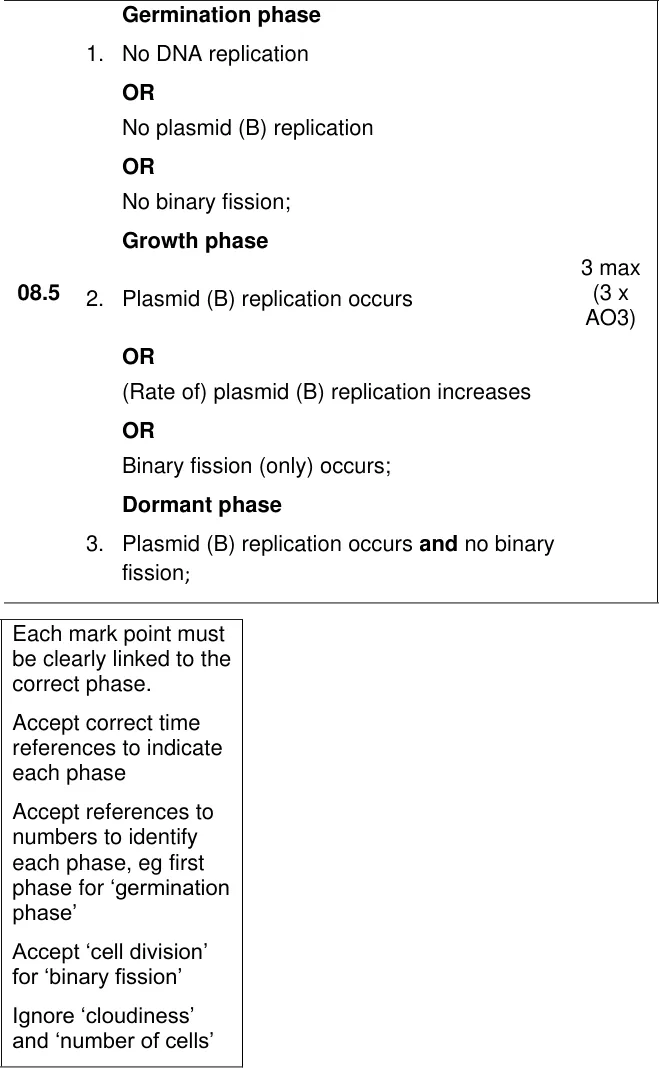
A level Paper 1 · June 2025 · Q08.5 · 3 marks · Medium
Use a graph to conclude when binary fission and plasmid replication happen in a growing population.
Show the mark scheme
Tap an image to open it full size.
From the examiners' report: Under 10% got all three. Don't just describe the lines: turn cloudiness into binary fission and copy number into plasmid replication, phase by phase.
Question 16
A level Paper 1 · June 2022 · Q04.1 · 3 marks · Medium
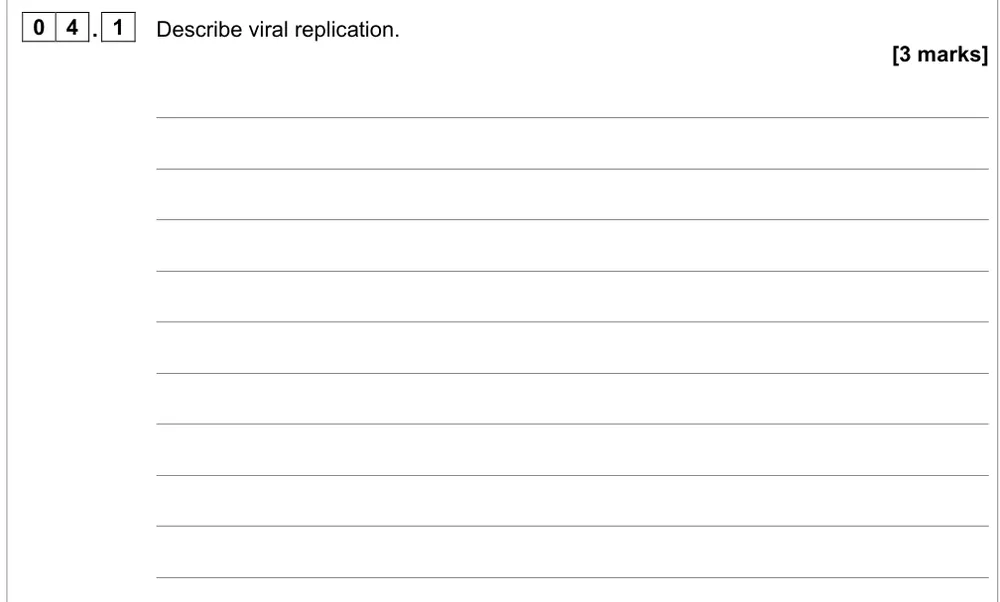
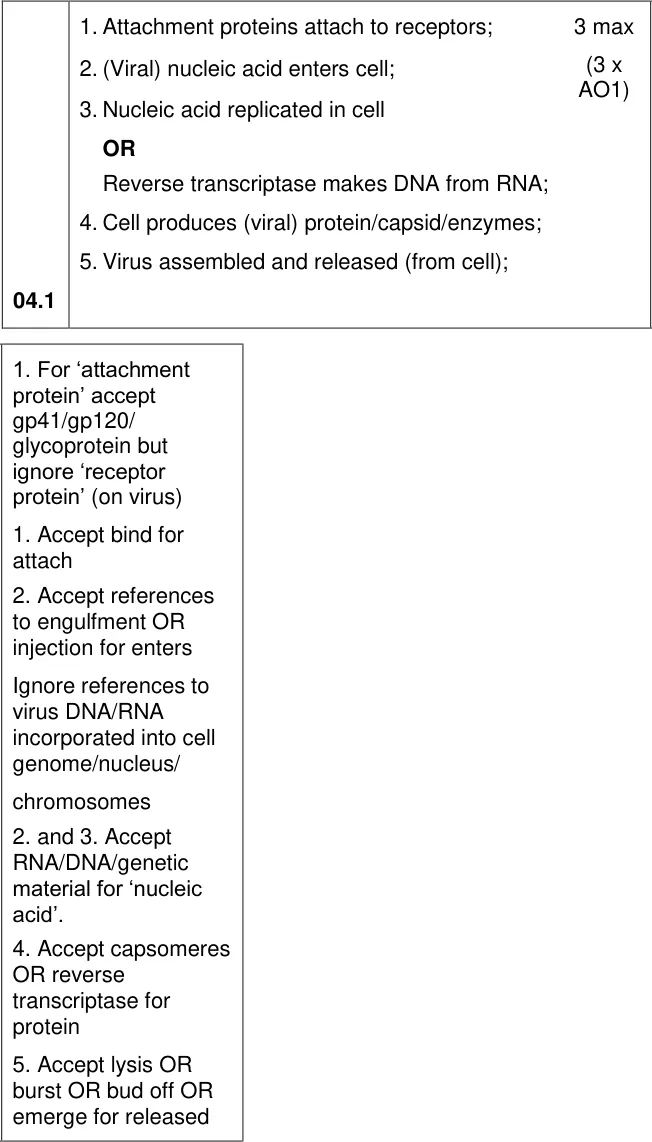
Describe viral replication.
Show the mark scheme
Tap an image to open it full size.
From the examiners' report: About a third scored zero. Viruses don't use binary fission or mitosis. Link attachment proteins to receptors, and include assembly before release.
Question 17
AS Paper 1 · June 2024 · Q03.2 · 1 mark
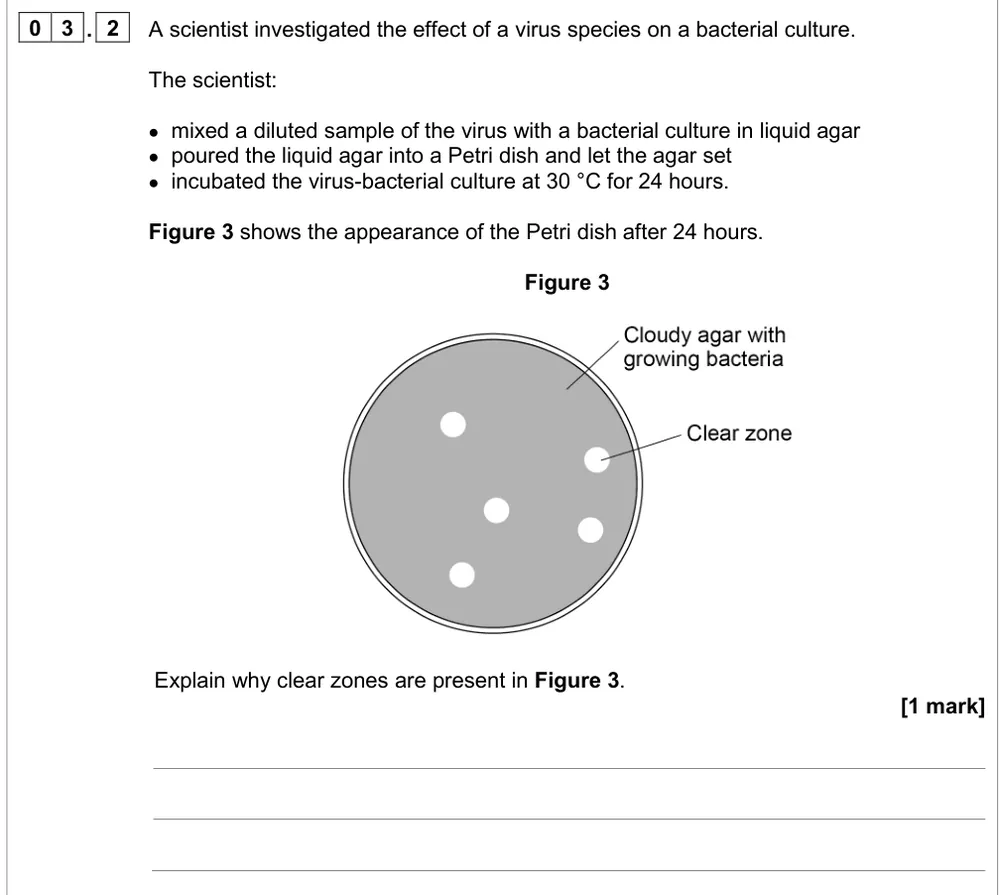
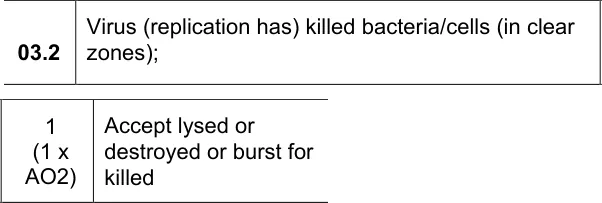
Explain the clear zones on a Petri dish of bacteria mixed with a virus.
Show the mark scheme
Tap an image to open it full size.
From the examiners' report: This new context confused some. Say the virus killed the bacteria: they replicate inside and burst the cells. Antibiotics and antiseptics aren't involved.
Using numbers (3.2.2)
Question 18
AS Paper 1 · June 2018 · Q04.4 · 2 marks · Medium
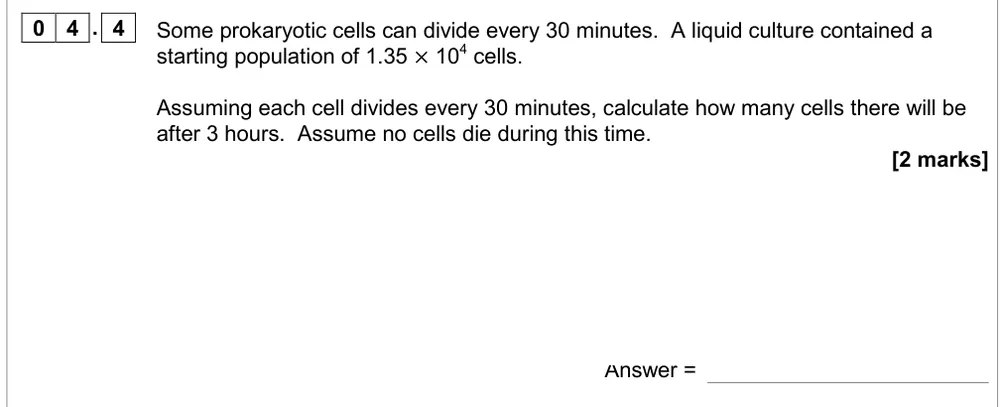
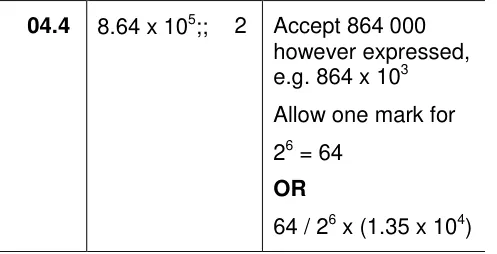
Calculate the number of prokaryotic cells after 3 hours of dividing every 30 minutes.
Show the mark scheme
Tap an image to open it full size.
From the examiners' report: Just under half got both marks. Three hours is six divisions, so multiply by 2⁶ (64), not by 6 or 24.
Where students lose marks (from AQA examiners' reports and mark schemes)
Each point below is followed by wording that gained marks.
Binary fission, not fission or mitosis: 57% named the process by which prokaryotes divide. Those who failed usually wrote just 'fission' or 'mitosis'; 'binary fusion' was rejected.
✔ Gains credit: "Binary fission".
Replicate the circular DNA and the plasmids: Only about 40% got all three marks for describing binary fission: many merged the first two points into 'genetic material replicates'.
✔ Gains credit: "Replication of (circular) DNA; replication of plasmids; division of cytoplasm (to produce daughter cells)."
Centromeres divide in anaphase: Prophase condensing was well known, but spindle attachment less so, and few said the centromere splits in anaphase. Some described meiosis: homologous chromosomes separating and crossing over.
✔ Gains credit: "(Prophase) chromosomes condense; centromeres attach to spindle fibres. (Anaphase) centromeres divide; chromatids pulled to opposite poles."
The membrane pinches in: Many identified cytokinesis or telophase but lost the explanation by saying the cell-surface membrane splits down the middle; few mentioned the chromosomes.
✔ Gains credit: "Division of cytoplasm; pinching of cell-surface membrane / new cell-surface membrane forming; chromosomes are not visible."
A DNA mass of 2 means replicated DNA: Students struggled with a graph of number of cells against DNA mass: many wrote about the DNA mass going up and down, not the number of cells, and few linked a mass of 1 to interphase.
✔ Gains credit: "Mass of 1 = (early) interphase; mass of 2 = each chromosome has two chromatids / mitosis; between 1 and 2 = DNA being replicated."
Uncontrolled division, not just faster: Asked why a virus can cause cancer, over half got the mark, but a common error was that cancer cells divide faster rather than uncontrollably. For 'what is a tumour?' most forgot to say it is a mass of cells.
✔ Gains credit: "Uncontrolled cell cycle/division/mitosis" and "mass of abnormal cells".
Attach to receptors, then assemble: About a third scored nothing on viral replication. Errors included binary fission or mitosis, mRNA being injected, attachment proteins not linked to receptors, and stopping before the virus is assembled.
✔ Gains credit: "Attachment proteins attach to receptors; nucleic acid enters cell and is replicated; cell produces viral proteins; virus assembled and released."
Six divisions means 2⁶: Just under half got both marks for cells dividing every 30 minutes for 3 hours: a common error was multiplying by 6 or 24 instead of 2⁶.
✔ Gains credit: 1.35 × 10⁴ × 2⁶ = 8.64 × 10⁵ cells.
Download the questions
Download the PDF pack (18 questions, mark schemes at the end)
Keep practising
- Required practical 2, mitosis: AQA A Level Biology exam questions
- DNA replication: AQA A Level Biology exam questions by topic
- Prokaryotic cells and viruses: AQA A Level Biology exam questions by topic
- Mastering AQA A Level Biology 3.4.3: genetic diversity via mutation and meiosis
- AQA A Level Biology masterclasses
Questions, mark schemes and examiners' report extracts © AQA.