

Eukaryotic cell structure (AQA 3.2.1.1) is one of the first Year 12 topics, and it turns up on every paper, often as a diagram or electron micrograph of a cell you've never seen. You need the structure and function of the cell-surface membrane, nucleus, mitochondria, chloroplasts, Golgi apparatus and vesicles, lysosomes, ribosomes, rough and smooth endoplasmic reticulum, cell wall and vacuole, how specialised cells are organised into tissues and organs, and how to use organelles to explain why a cell is adapted to its job.
The examiners' reports show where the marks go. Students say mitochondria 'produce energy', describe the nucleus as 'controlling the cell', give the same Golgi function twice, call a starch grain a vacuole or a granum, compare where chloroplasts and mitochondria are found instead of their structures, and stop before saying that vesicles fuse with the cell-surface membrane.
Start with the organelles one by one, then chloroplasts and cell walls, then specialised cells, and finish with the data and calculation questions. Answer each on paper before you open the mark scheme. If you'd like help with this topic, my AQA masterclasses run online on Tuesdays at 5.15pm for Year 12 and on Wednesdays or Thursdays at 6.30pm for Year 13.
What you need from GCSE and Year 12
Each question on this page assumes you're secure on these GCSE and Year 12 ideas. If any of them feels shaky, revise it before you start.
- GCSE: animal and plant cells have a nucleus, cytoplasm, cell membrane, mitochondria and ribosomes; plant cells also have a cellulose cell wall, chloroplasts and a permanent vacuole.
- GCSE: aerobic respiration in mitochondria releases energy as ATP; photosynthesis happens in chloroplasts.
- GCSE: cells differentiate into specialised cells, which form tissues, organs and organ systems.
- Year 12 (AQA 3.1.2): cellulose is a polymer of β-glucose that forms plant cell walls; starch is the plant storage polysaccharide. See the Carbohydrates page.
- Year 12 (AQA 3.1.4.1): enzymes and many hormones are proteins, made from amino acids joined by peptide bonds. See the Proteins page.
Key terms
These words come up in the questions and mark schemes. Examiners expect you to use them exactly.
- Organelle: a structure inside a cell with a particular function, such as a mitochondrion or the Golgi apparatus. Most in eukaryotic cells are membrane-bound.
- Nuclear envelope: the double membrane around the nucleus, with pores that let mRNA out.
- Nucleolus: a region inside the nucleus that makes ribosomal RNA and ribosomes. It doesn't hold all the cell's DNA.
- Cristae: the folds of the inner mitochondrial membrane, which give a large surface area for aerobic respiration.
- Thylakoids and grana: flattened membrane sacs in a chloroplast that contain chlorophyll; a stack of thylakoids is a granum.
- Stroma: the fluid inside a chloroplast around the thylakoids. Not 'stoma'.
- Golgi apparatus: stacks of membranes that modify and package proteins and lipids (for example making glycoproteins) and form Golgi vesicles and lysosomes.
- Lysosome: a membrane-bound organelle that releases hydrolytic enzymes (lysozymes). A lysosome is not a lysozyme.
- Rough endoplasmic reticulum: membranes covered in ribosomes, where proteins are made and transported. Smooth endoplasmic reticulum has no ribosomes and makes lipids.
- Tissue: a group of specialised cells of one type working together.
- Organ: a structure made of more than one type of tissue, working together for a function.
What these questions cover (AQA 3.2.1.1)
The questions test these statements from the AQA AS and A-level Biology specification (7401/7402):
- Structure and function of: cell-surface membrane (the structure of the membrane itself is in section 3.2.3)
- Structure and function of: nucleus (containing chromosomes, consisting of protein-bound, linear DNA, and one or more nucleoli)
- Structure and function of: mitochondria
- Structure and function of: chloroplasts (in plants and algae)
- Structure and function of: Golgi apparatus and Golgi vesicles
- Structure and function of: lysosomes (a membrane-bound organelle that releases hydrolytic enzymes)
- Structure and function of: ribosomes (listed in version 1.6 of the specification; 70S ribosomes in prokaryotes are on the Prokaryotic Cells and Viruses page)
- Structure and function of: rough endoplasmic reticulum and smooth endoplasmic reticulum
- Structure and function of: cell wall (in plants, algae and fungi)
- Structure and function of: cell vacuole (in plants).
- Specialised cells: In complex multicellular organisms, eukaryotic cells become specialised for specific functions. Specialised cells are organised into tissues, tissues into organs and organs into systems.
- Students should be able to apply their knowledge of these features in explaining adaptations of eukaryotic cells.
How to use this page
Write your answer on paper before you open the mark scheme. Allow about 1.3 minutes per mark: the 18 questions are worth 38 marks, so about 49 minutes in total. Then mark your answer strictly against the mark scheme and read the examiners' tip underneath it. If you'd rather print the questions, download the PDF pack.
Organelles and what they do (3.2.1.1)
Question 1
A level Paper 1 · June 2023 · Q03.1 · 1 mark · Easy
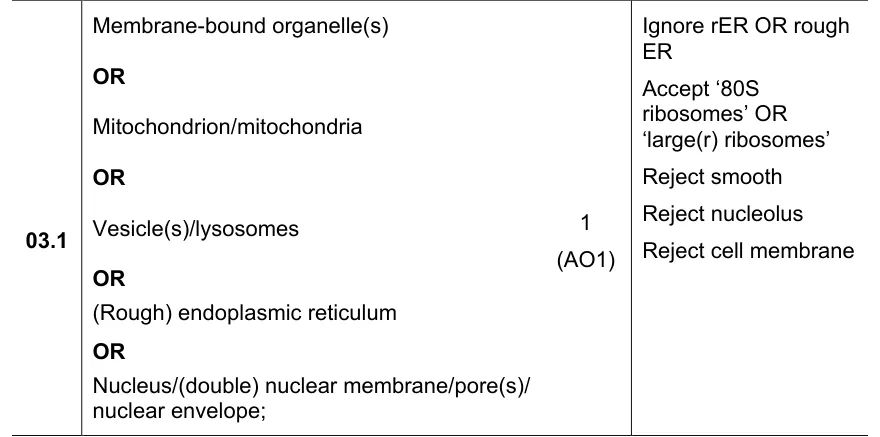
Name one structure in a diagram of Plasmodium vivax that shows it is a eukaryote.
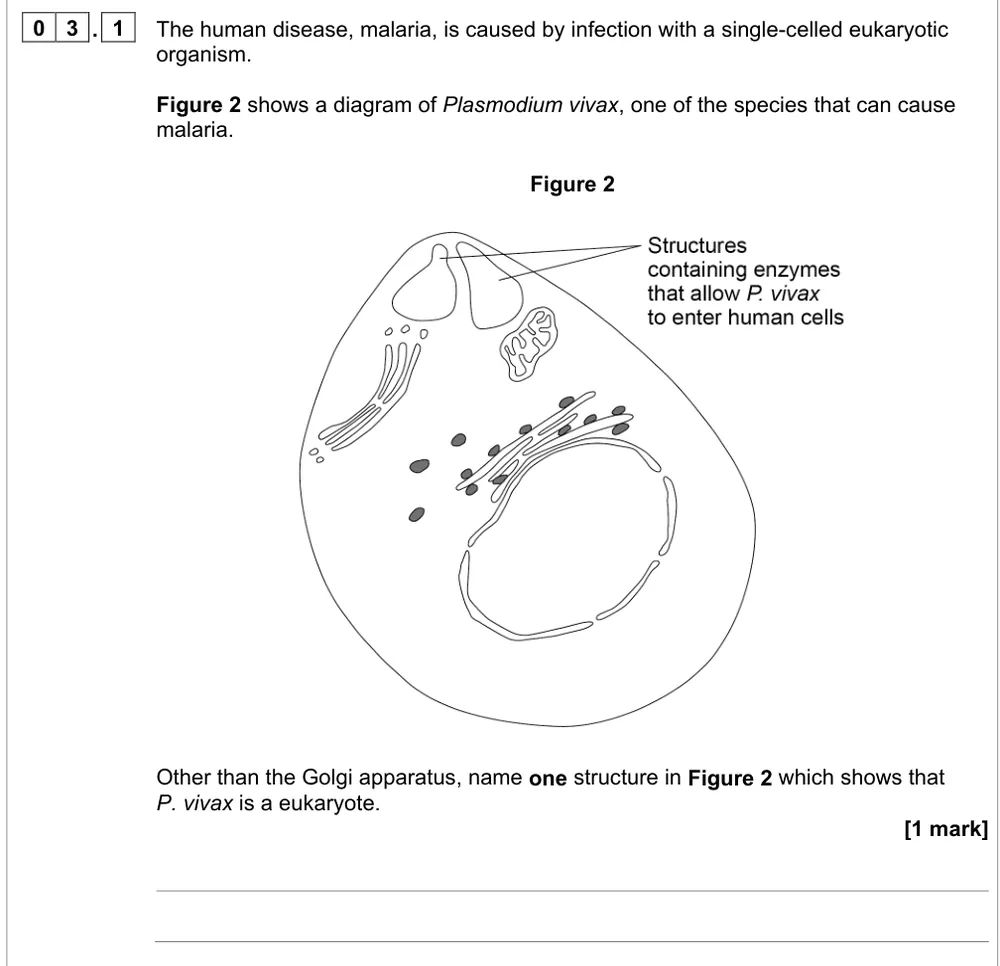
Show the mark scheme
Tap an image to open it full size.
From the examiners' report: 90% got this. Wrong answers came from thinking of plant or bacterial cells: vacuole, cell wall and plasmid didn't score.
Question 2
A level Paper 1 · June 2022 · Q01.1 · 4 marks · Medium
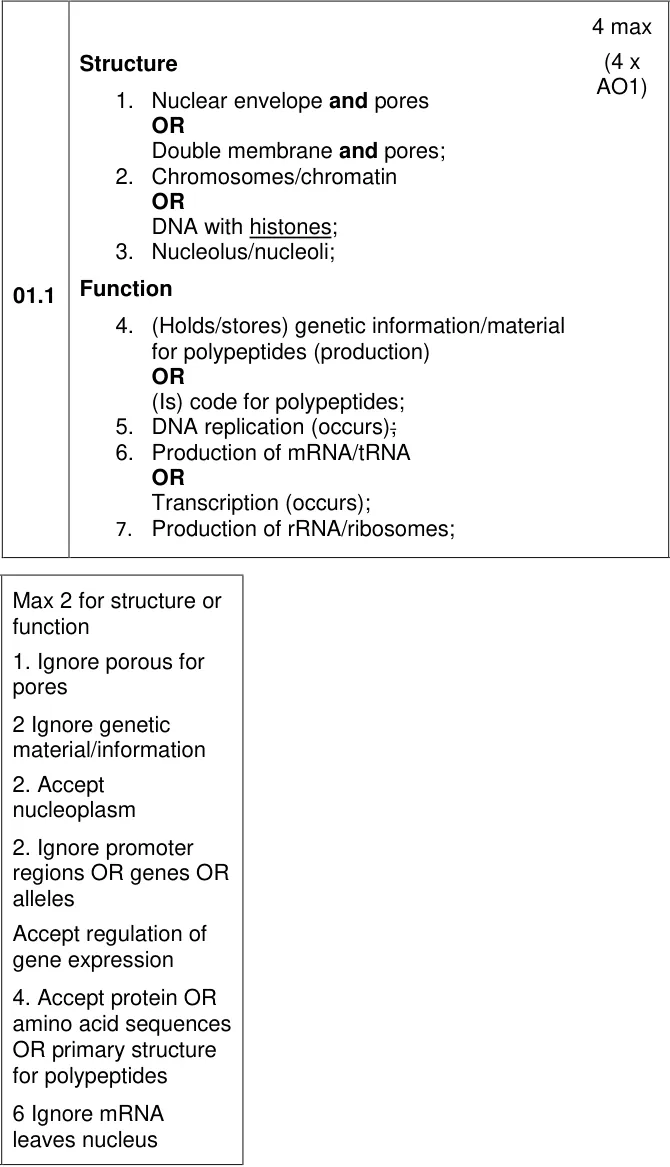
Describe the structure and function of the nucleus.
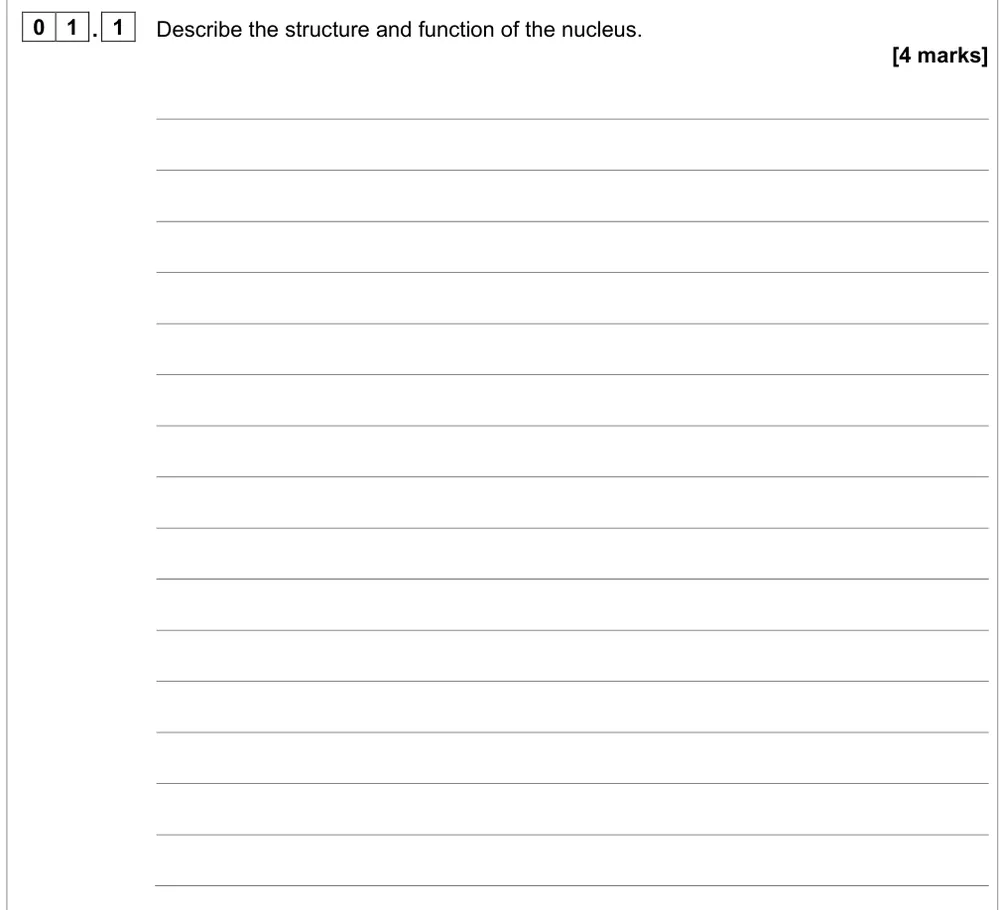
Show the mark scheme
Tap an image to open it full size.
From the examiners' report: Over 90% scored, but 'controls cell activities' is GCSE level. Give two functions as well as two structures, and remember the nucleolus doesn't hold all the DNA.
Question 3
AS Paper 2 · June 2025 · Q02.1 · 2 marks · Easy
Name organelle X and state its function.
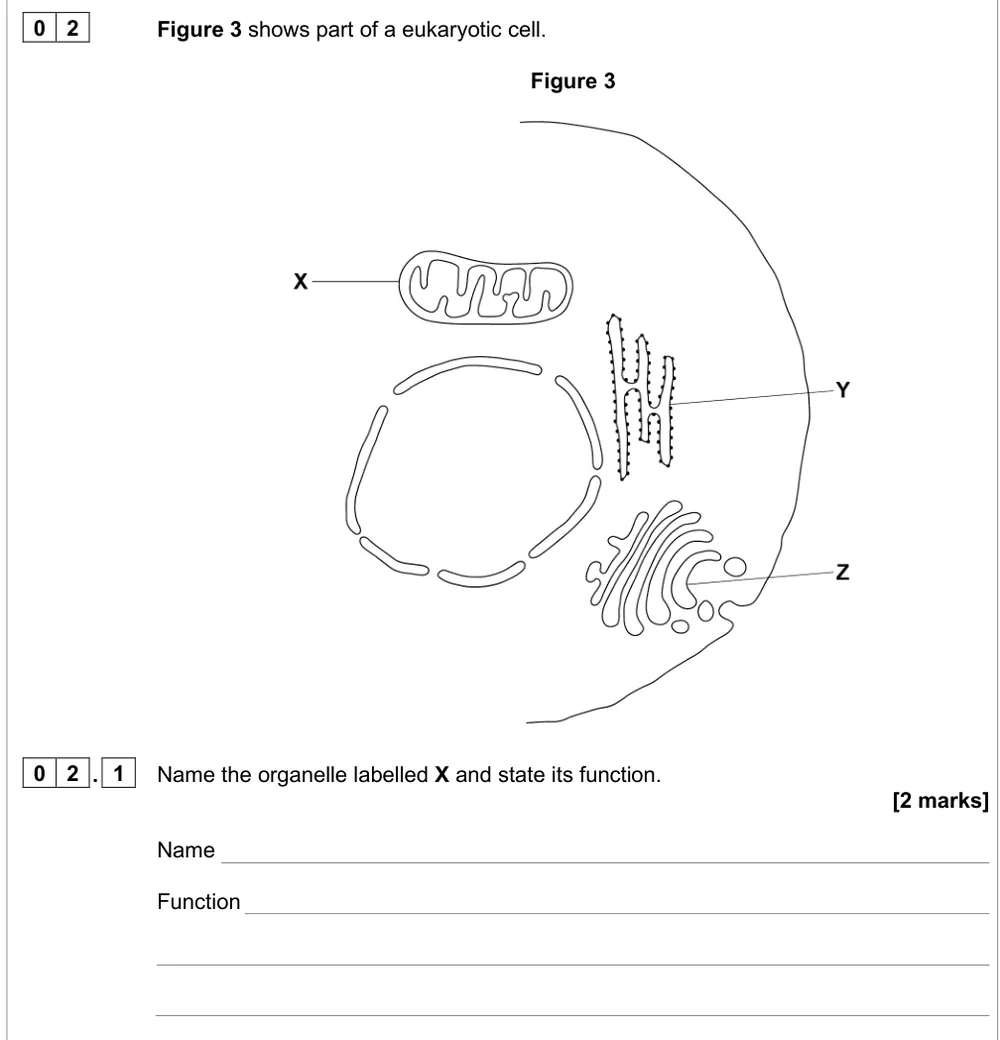
Show the mark scheme

Tap an image to open it full size.
From the examiners' report: Over 90% got at least one mark, but many lost the second for 'creating energy' or 'energy for respiration'. Write aerobic respiration.
Question 4
A level Paper 1 · June 2023 · Q03.2 · 2 marks · Easy
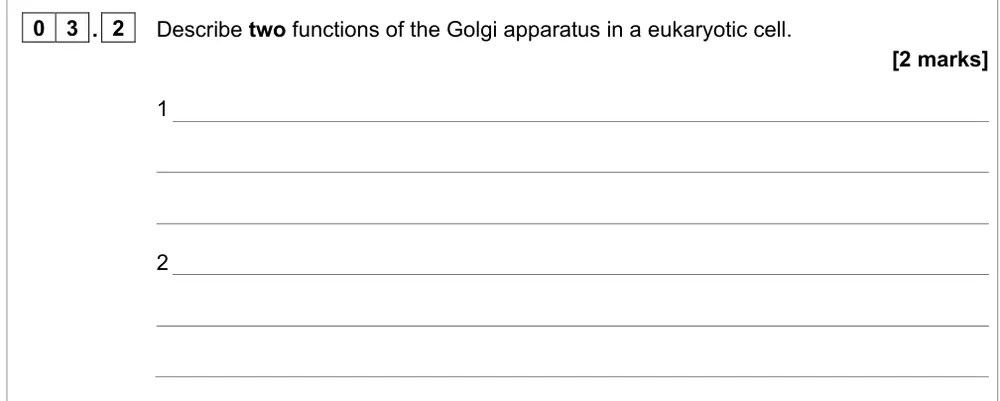
Describe two functions of the Golgi apparatus.
Show the mark scheme
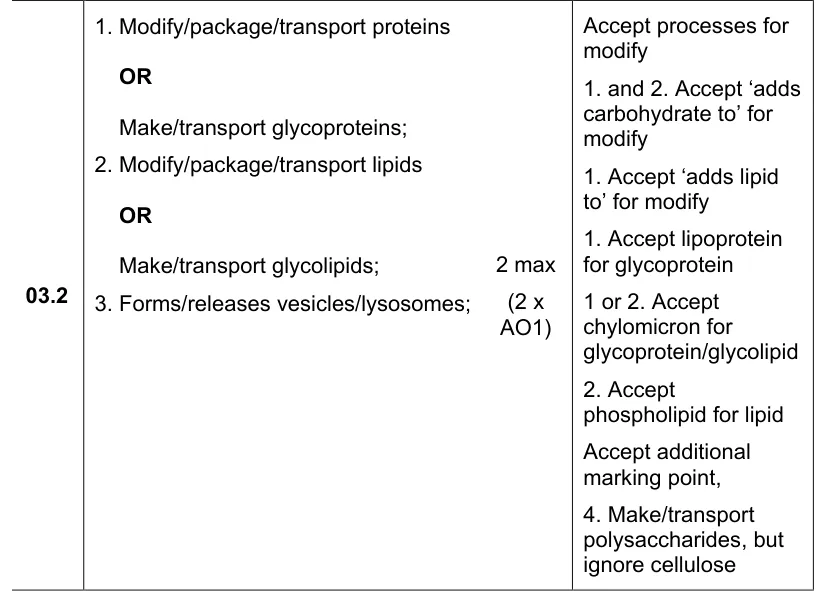
Tap an image to open it full size.
From the examiners' report: 60% got both marks. 'Processing lipids' and 'producing glycolipids' are the same function, so give two different ones, for example proteins and vesicles.
Question 5
A level Paper 3 · June 2023 · Q04.1 · 2 marks · Medium
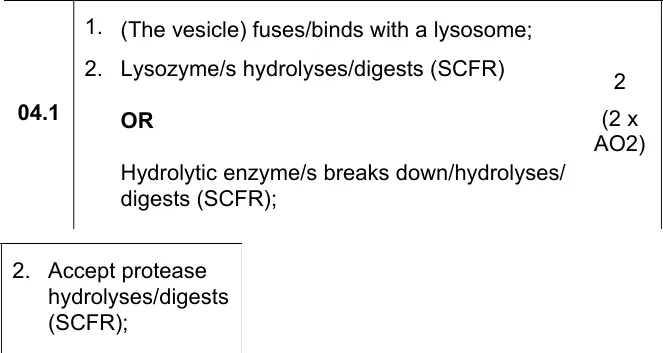
Suggest how a receptor protein enclosed in a vesicle is destroyed by a lysosome.
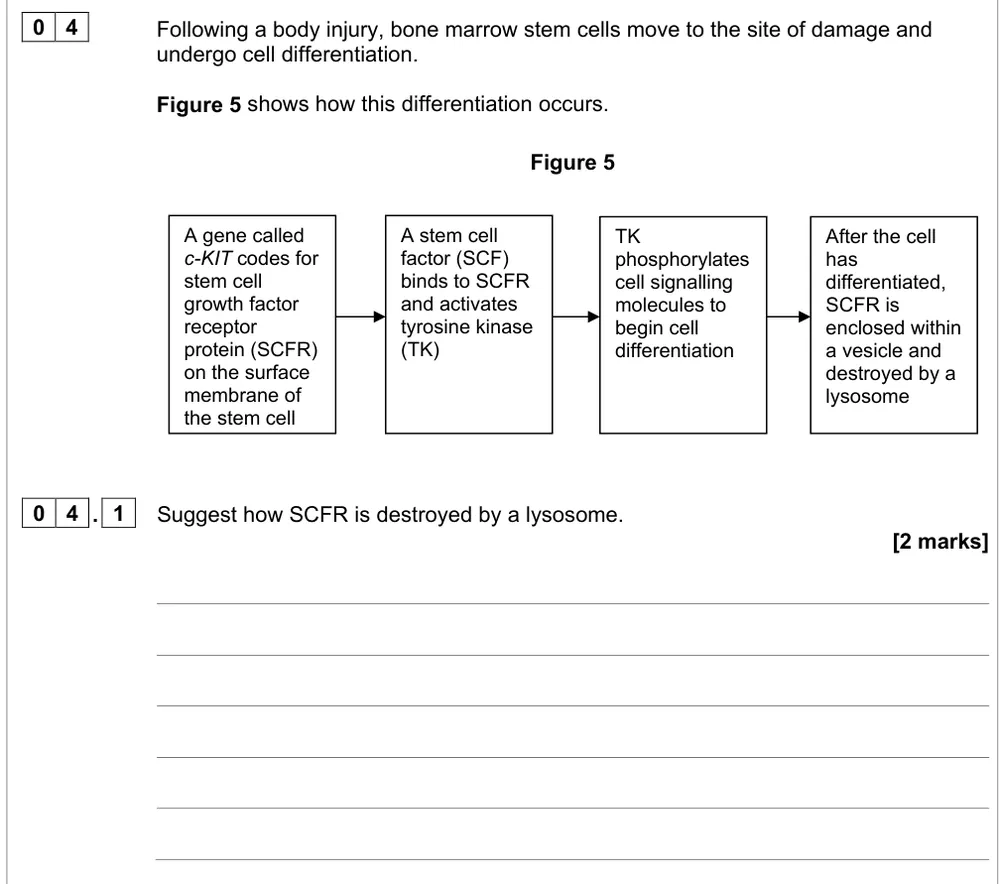
Show the mark scheme
Tap an image to open it full size.
From the examiners' report: About a third scored nothing, often by treating SCFR as a cell to be engulfed. A lysosome isn't a phagocyte, and lysosome and lysozyme aren't the same thing.
Question 6
AS Paper 1 · June 2019 · Q05.4 · 1 mark
Name an organelle found in both a chloroplast and a prokaryotic cell.

Show the mark scheme

Tap an image to open it full size.
From the examiners' report: There's no examiners' report for this paper, so this tip comes from the mark scheme. Chloroplasts have the smaller 70S ribosomes found in prokaryotes; 80S was rejected.
Question 7
AS Paper 1 · June 2016 · Q04.3 · 1 mark
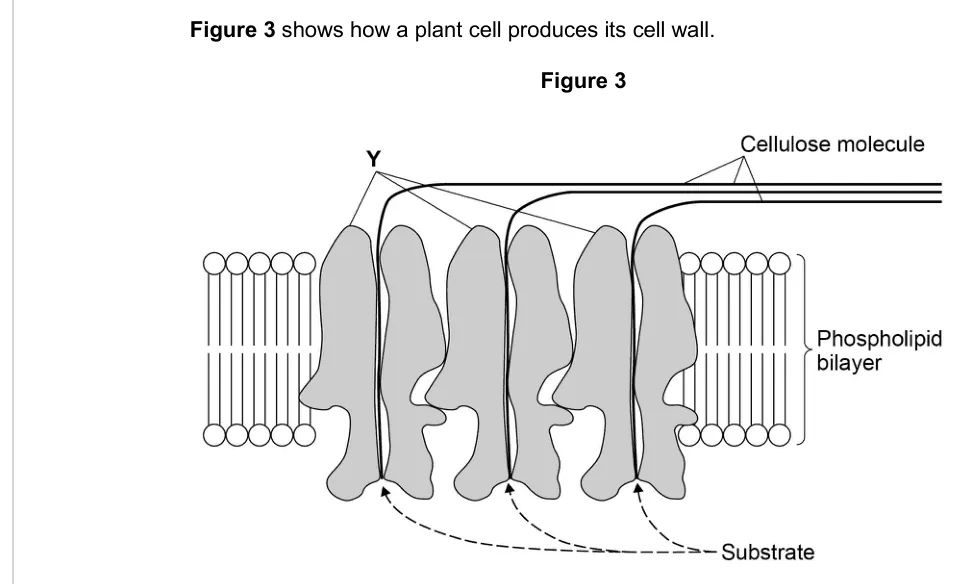
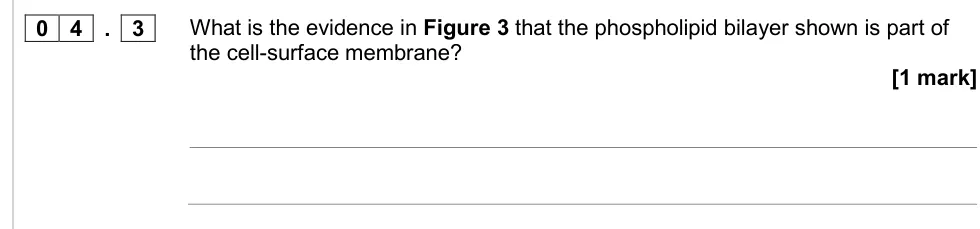
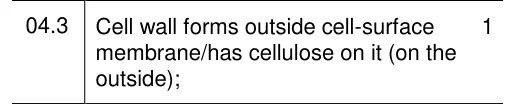
Give the evidence that the phospholipid bilayer shown is the cell-surface membrane.
Information from earlier in this question:
Show the mark scheme
Tap an image to open it full size.
From the examiners' report: There's no examiners' report for this paper, so this tip comes from the mark scheme. Use the figure: cellulose is laid down outside, and only the cell-surface membrane has the cell wall next to it.
Chloroplasts, vacuoles and cell walls (3.2.1.1)
Question 8
AS Paper 2 · June 2023 · Q10.2 · 4 marks
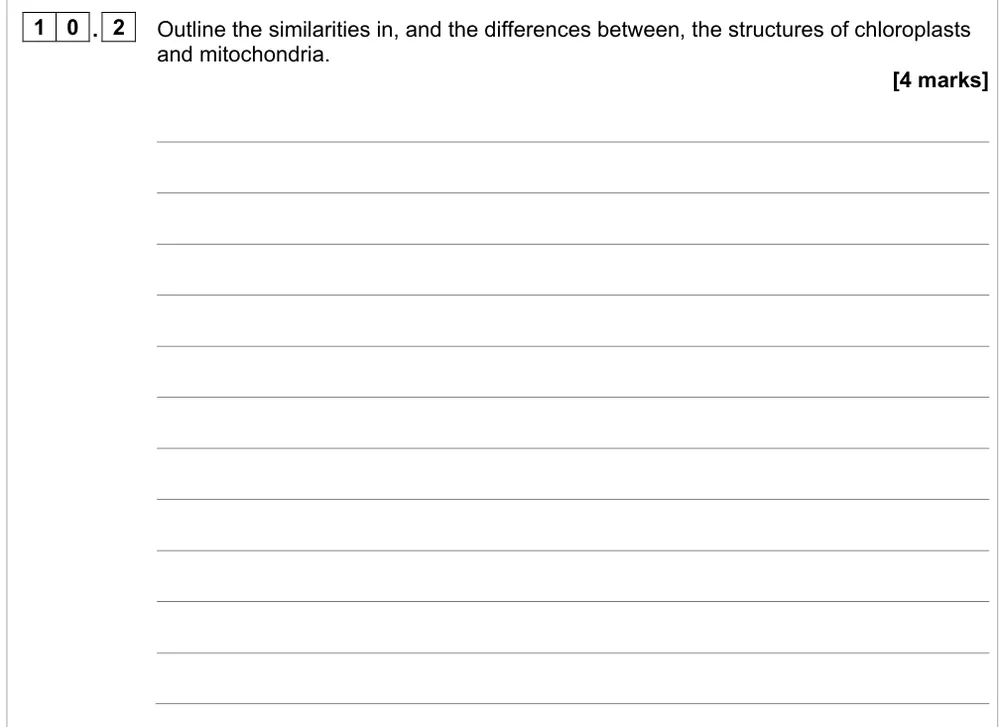
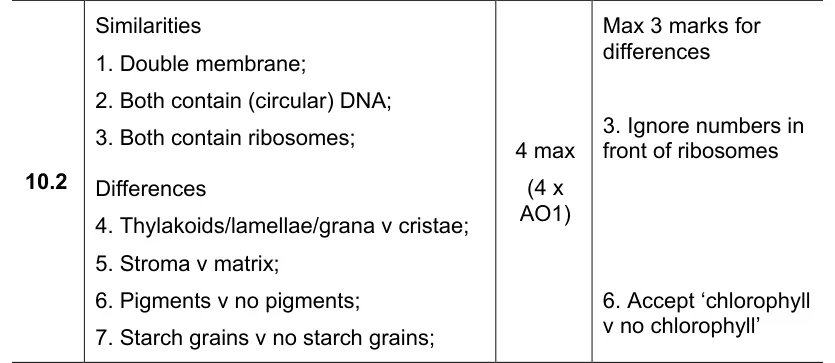
Outline the similarities and differences between the structures of chloroplasts and mitochondria.
Show the mark scheme
Tap an image to open it full size.
From the examiners' report: Location and function got no credit, and many wrongly said mitochondria are larger. Organise your answer into similarities, then differences.
Question 9
A level Paper 1 · June 2025 · Q09.2 · 1 mark · Hard
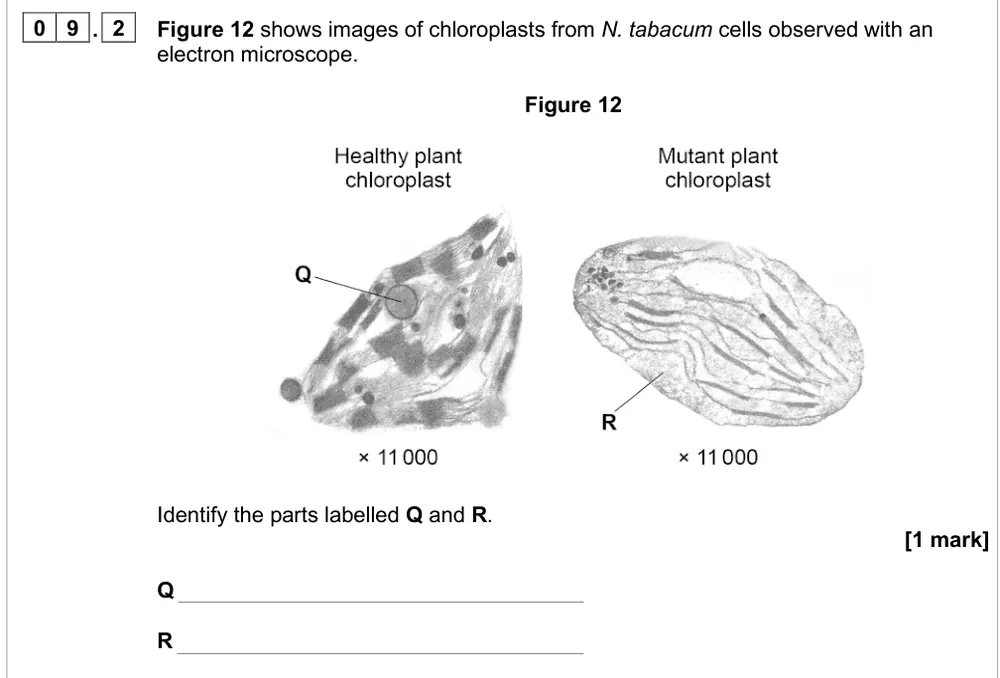
Identify parts Q and R in electron micrographs of chloroplasts.
Show the mark scheme

Tap an image to open it full size.
From the examiners' report: Only about 20% got this. Q is round and separate from the grana, so it isn't a thylakoid, vacuole or nucleus; spell stroma correctly.
Question 10
AS Paper 1 · November 2020 · Q04.3 · 1 mark · Hard
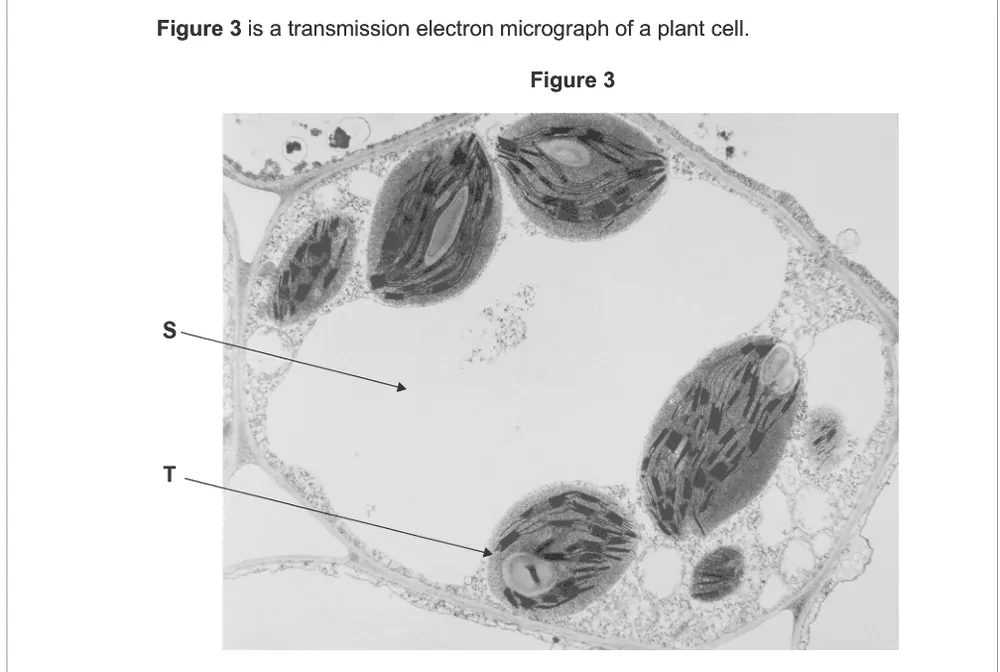
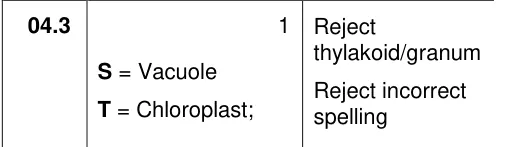
Name organelles S and T in an electron micrograph of a plant cell.
Information from earlier in this question:

Show the mark scheme
Tap an image to open it full size.
From the examiners' report: Many identified the chloroplast but not the vacuole, so lost the mark. A large, pale, empty-looking area in a plant cell is the vacuole.
Question 11
A level Paper 1 · June 2022 · Q01.2 · 1 mark
Name the main polymer in plant and fungal cell walls.

Show the mark scheme

Tap an image to open it full size.
From the examiners' report: About two-thirds got this. Murein (peptidoglycan) is only in bacterial cell walls, not fungal ones.
Specialised cells and adaptations (3.2.1.1)
Question 12
A level Paper 1 · June 2025 · Q09.1 · 1 mark
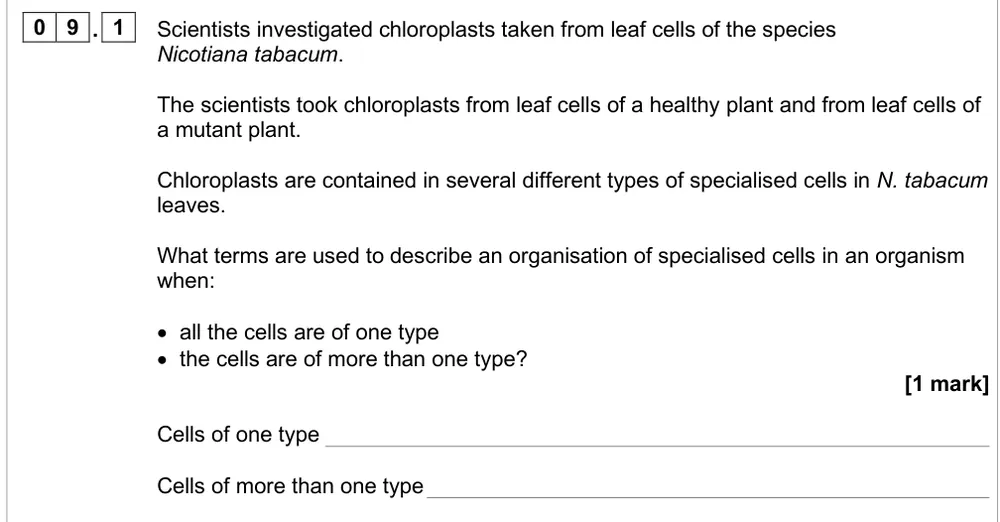
Name the organisation of specialised cells of one type and of more than one type.
Show the mark scheme

Tap an image to open it full size.
From the examiners' report: About half got this. Cells of one type make a tissue; several tissues make an organ. Unicellular, genus and organ system didn't score.
Question 13
A level Paper 1 · June 2024 · Q10.2 · 5 marks
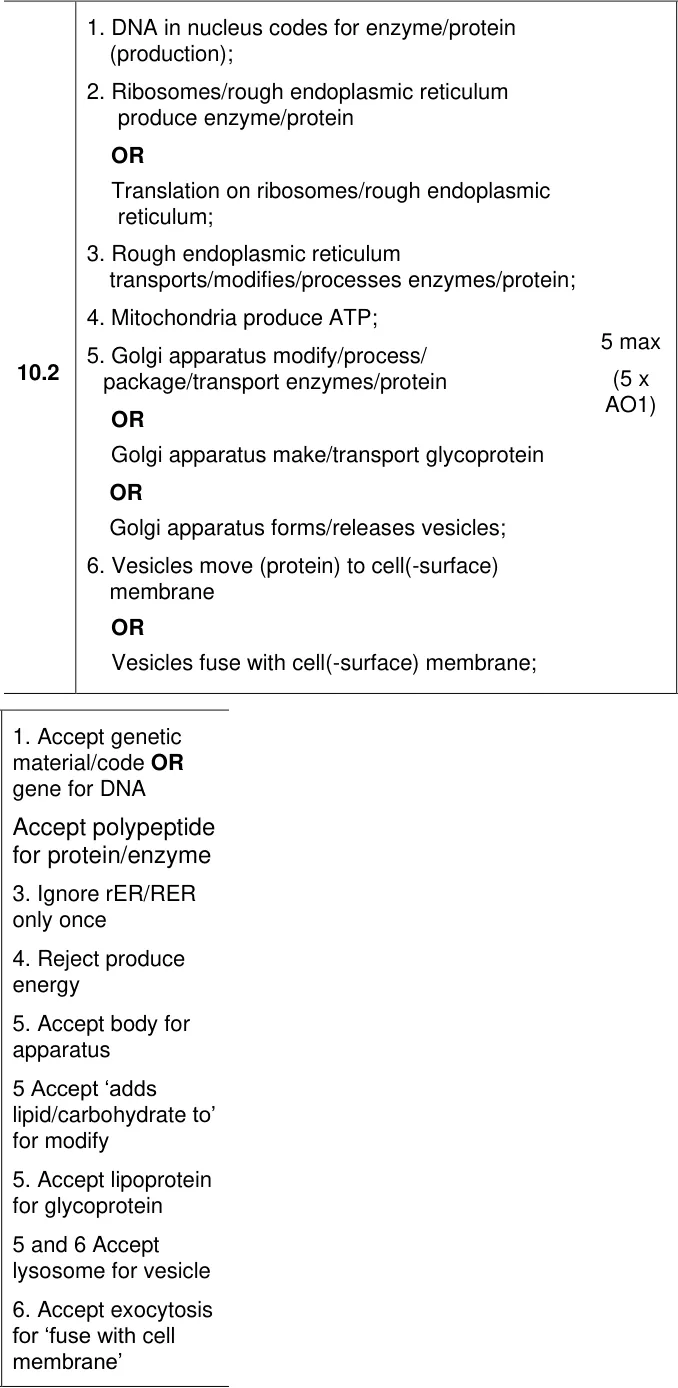
Describe the role of organelles in making and releasing enzymes from animal cells.
Show the mark scheme
Tap an image to open it full size.
From the examiners' report: Many wrote about translation or protein structure instead of organelles. Few mentioned mitochondria or the nucleus, and 'vesicles take them where they are needed' was too vague.
Question 14
AS Paper 2 · June 2025 · Q02.2 · 4 marks · Medium
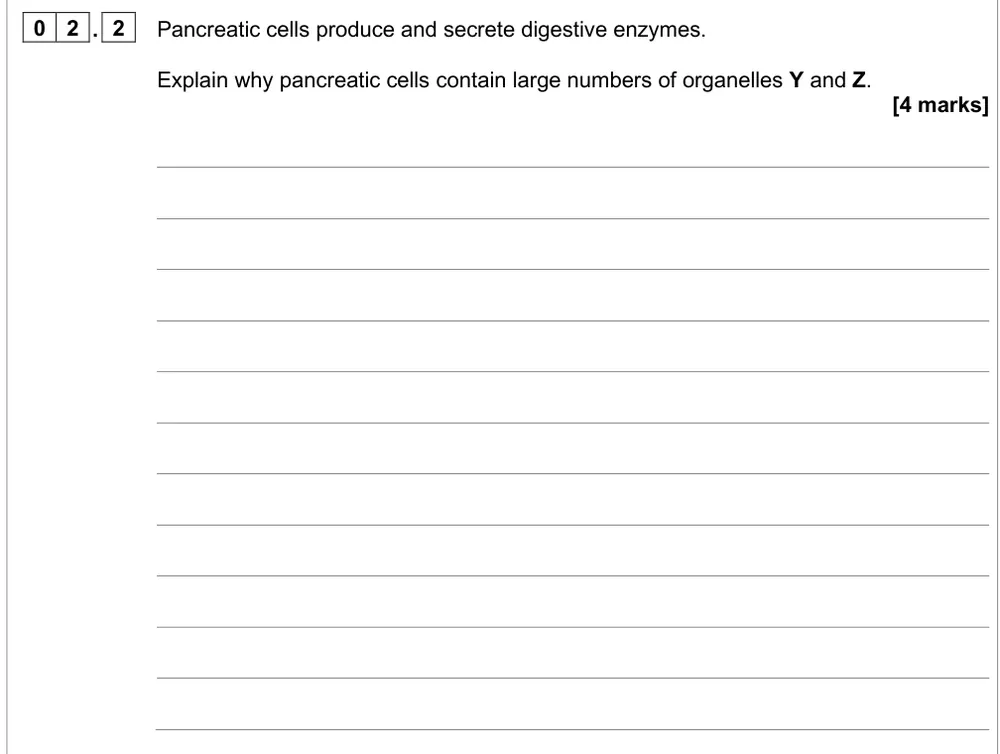
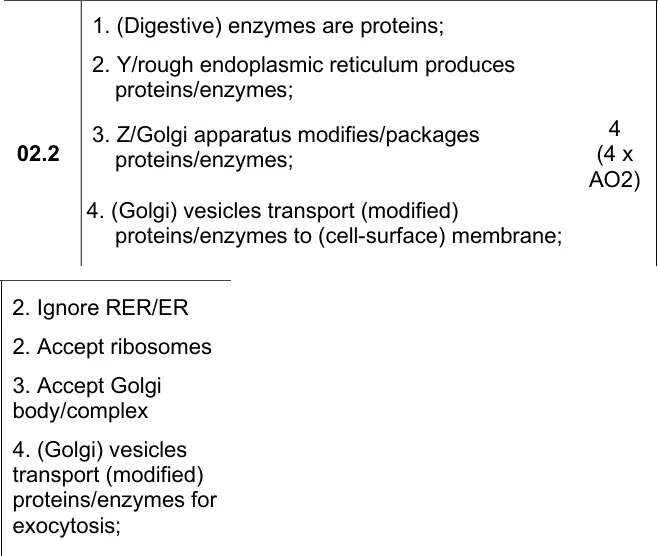
Explain why pancreatic cells contain large numbers of organelles Y and Z.
Information from earlier in this question:
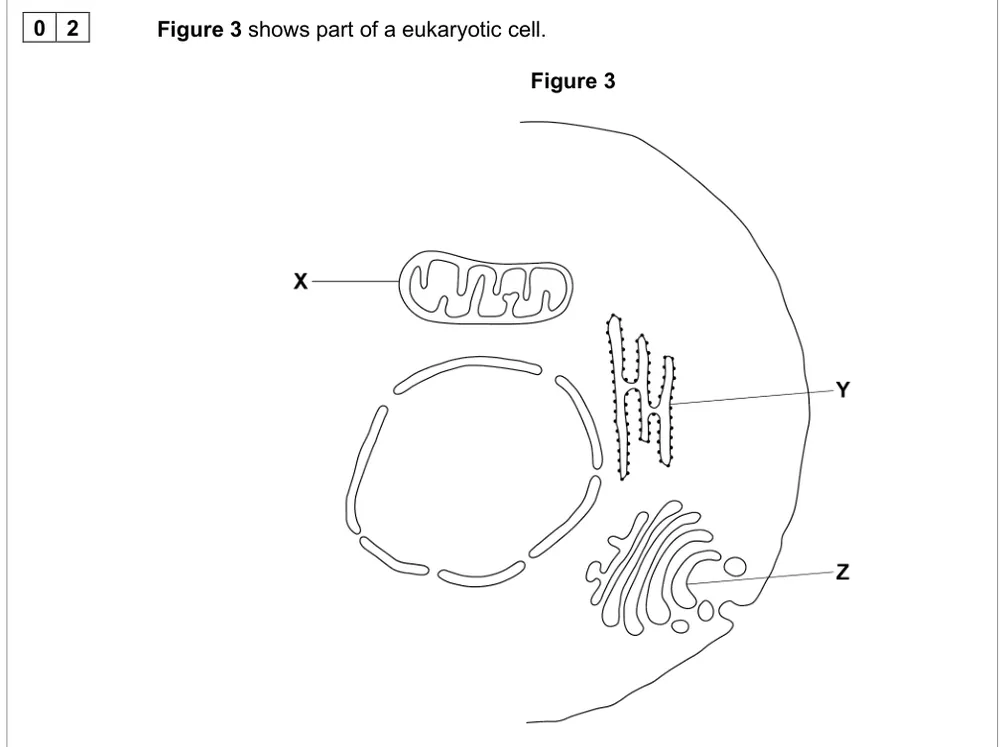
Show the mark scheme
Tap an image to open it full size.
From the examiners' report: About 15% got all four. Say the enzymes are proteins, and finish with vesicles fusing with the cell-surface membrane to secrete them.
Question 15
AS Paper 2 · June 2018 · Q01.2 · 2 marks · Hard
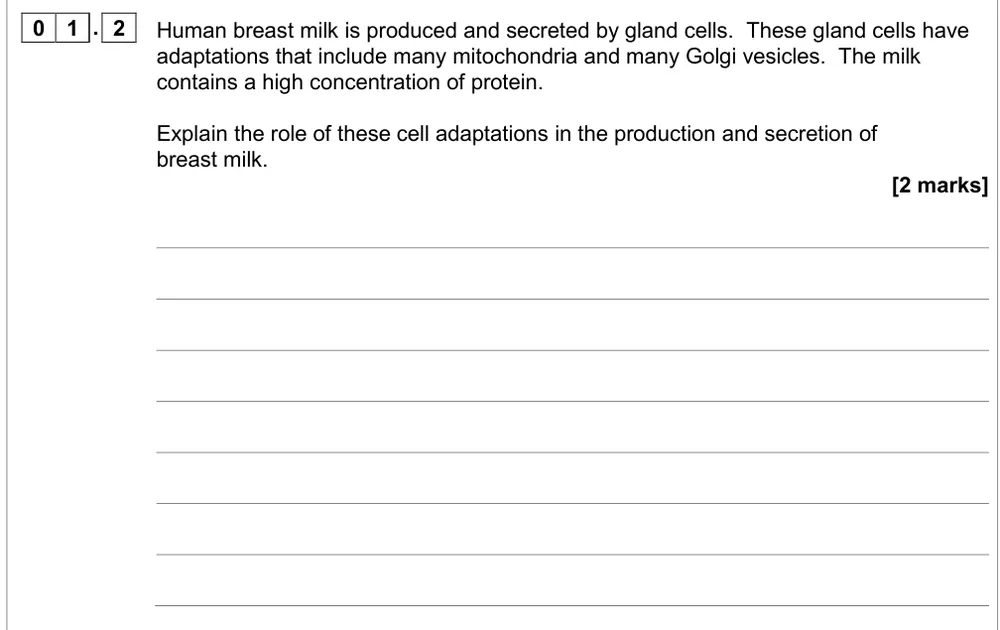
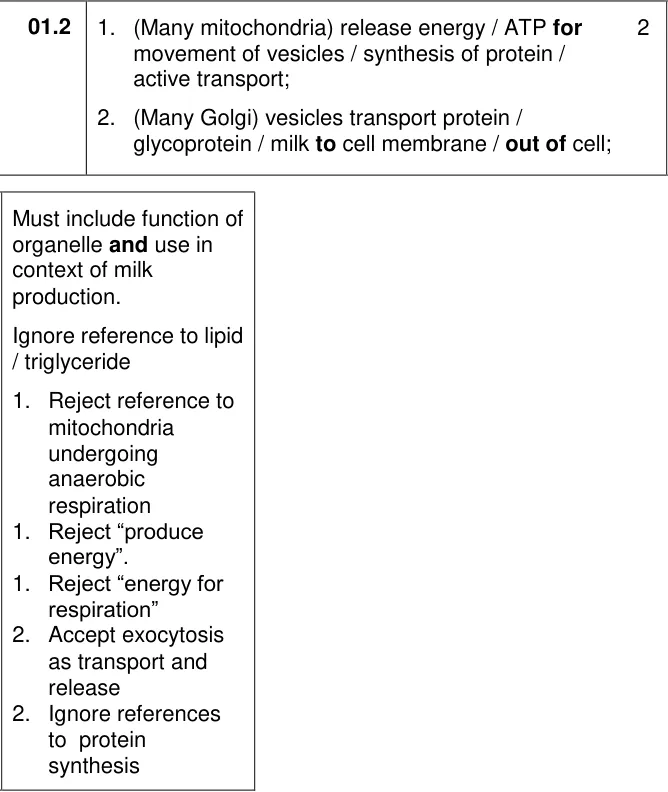
Explain how many mitochondria and Golgi vesicles help gland cells secrete breast milk.
Show the mark scheme
Tap an image to open it full size.
From the examiners' report: Nearly 60% scored nothing. Give each organelle's function in this context: ATP for making protein, not 'energy for milk' or 'for the baby'.
Data and calculations (3.2.1.1)
Question 16
AS Paper 2 · June 2023 · Q01.3 · 3 marks · Medium
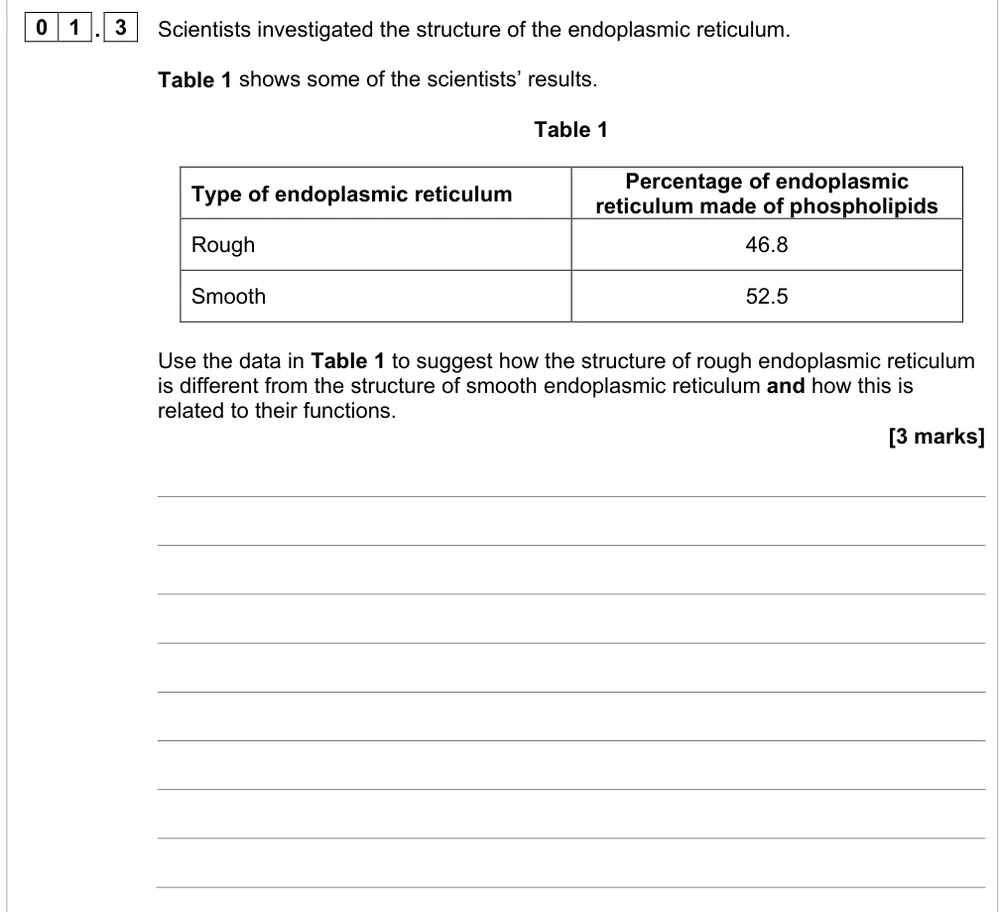
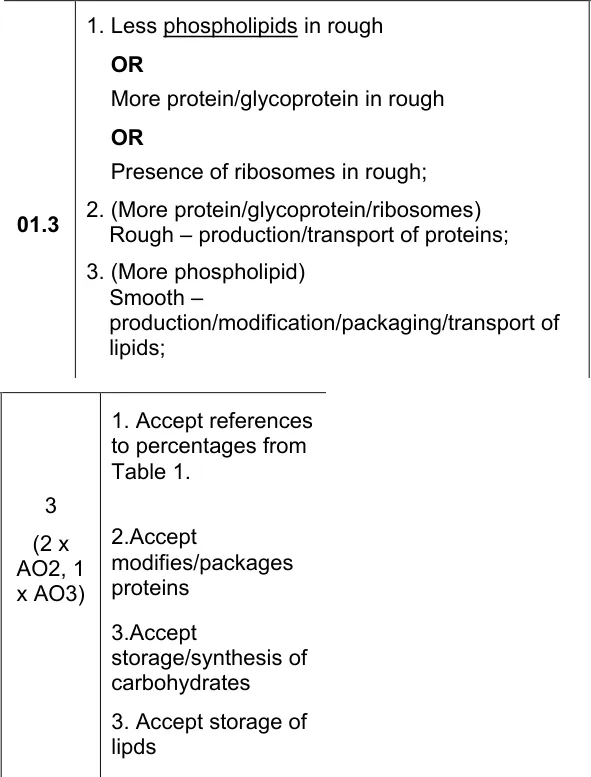
Use phospholipid percentages to compare rough and smooth endoplasmic reticulum and their functions.
Show the mark scheme
Tap an image to open it full size.
From the examiners' report: Over half scored at least 2. The best answers linked the lower phospholipid figure to ribosomes and then gave each type's function.
Question 17
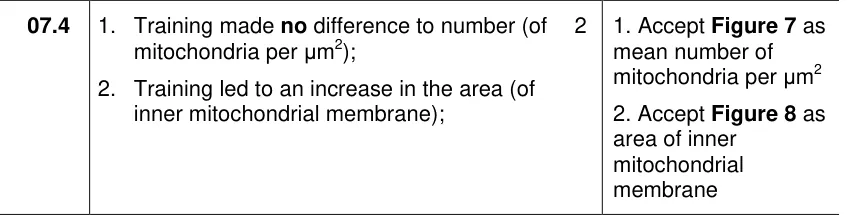
AS Paper 1 · June 2017 · Q07.4 · 2 marks · Medium
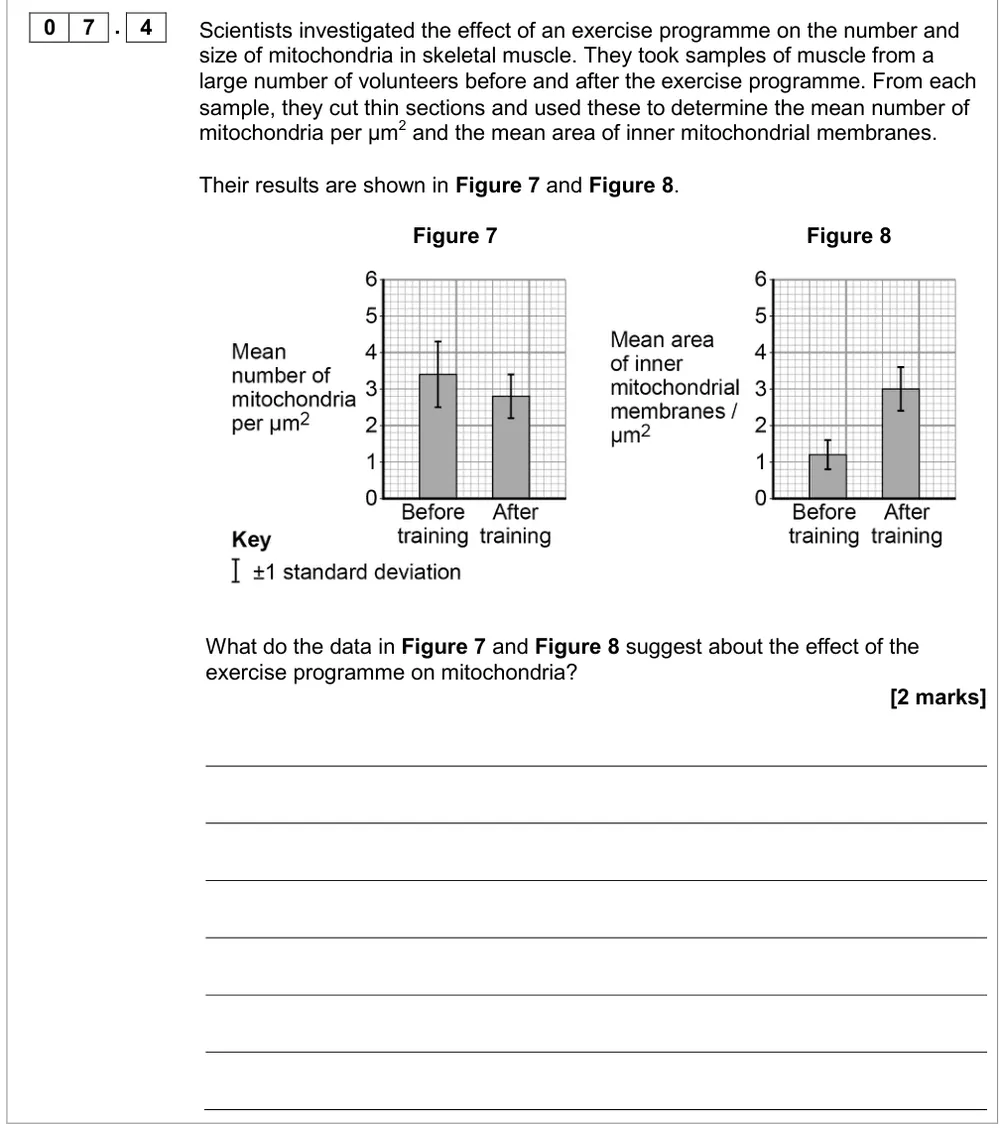
Use bar charts with standard deviations to say how exercise affects mitochondria.
Show the mark scheme
Tap an image to open it full size.
From the examiners' report: Only 16% got both marks. Use the standard deviations: overlapping bars mean no real change in number. Then say which way the membrane area changed.
Question 18
A level Paper 1 · November 2021 · Q05.3 · 1 mark · Hard
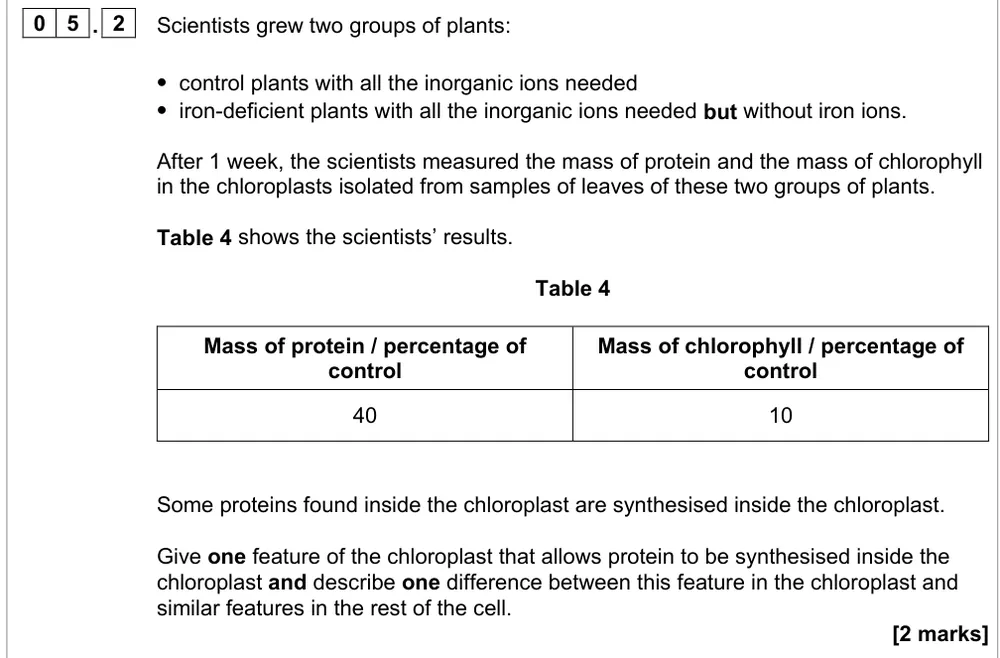
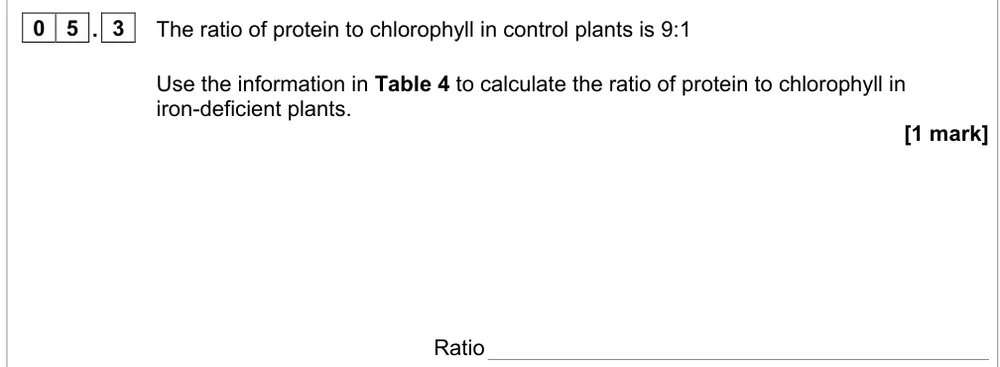
Calculate the protein to chlorophyll ratio in chloroplasts from iron-deficient plants.
Information from earlier in this question:
Show the mark scheme

Tap an image to open it full size.
From the examiners' report: This ratio baffled many: very few got the mark. Protein falls to 0.4 × 9 = 3.6 and chlorophyll to 0.1 × 1 = 0.1, so the ratio is 36:1.
Where students lose marks (from AQA examiners' reports and mark schemes)
Each point below is followed by wording that gained marks.
Aerobic respiration, not 'making energy': Most named the mitochondrion, but many lost the function mark for 'creating energy' or 'energy for respiration'. In the breast-milk question nearly 60% scored nothing, partly for 'mitochondria produce energy'.
✔ Gains credit: "Mitochondrion; site of aerobic respiration" and "(many mitochondria) release ATP for synthesis of protein / movement of vesicles".
The nucleus codes for polypeptides: Structure was well known, but very few gave a function at A-level standard: 'holds genetic material to control cell activities' is GCSE level and scored nothing. Some thought the nucleolus contains all the cell's DNA.
✔ Gains credit: "Holds genetic information that codes for polypeptides; DNA replication; transcription (production of mRNA); production of rRNA/ribosomes."
Two Golgi functions, not one twice: 60% got both marks, but many gave two actions that are really one function: 'processing lipids' and 'producing glycolipids' scored only once. Some thought ribosomes are made in the Golgi.
✔ Gains credit: "Modifies/packages proteins (makes glycoproteins); modifies/packages lipids (makes glycolipids); forms vesicles/lysosomes."
Round grains in a chloroplast are starch: Only about 20% identified both parts: many called the round grain a vacuole, a nucleus or a granum, and some wrote 'stoma' for stroma.
✔ Gains credit: "(Q) starch grain or lipid droplet; (R) stroma."
Compare structures, not locations: Asked about the structures of chloroplasts and mitochondria, many wrote about where they are found, what they do, or plant and animal cells, and some said mitochondria are larger.
✔ Gains credit: "Both have a double membrane, circular DNA and ribosomes; thylakoids/grana v cristae; stroma v matrix; pigments and starch grains only in chloroplasts."
Vesicles fuse with the cell-surface membrane: In the pancreatic-cell question only about 15% got all four marks: very few linked vesicles fusing with the cell-surface membrane to secretion. 'Transported to where they are needed' or 'out of the cell' wasn't enough.
✔ Gains credit: "(Golgi) vesicles transport the modified proteins/enzymes to the cell-surface membrane and fuse with it (exocytosis)."
Chitin in fungi, not murein: About two-thirds got this. A common misconception was that fungal cell walls contain murein (peptidoglycan), which is only in bacteria.
✔ Gains credit: "Cellulose (plants) and chitin (fungi)."
Tissue first, then organ: Only about half got the mark. Wrong answers included unicellular, genus, multicellular, phylum and organ system.
✔ Gains credit: "Tissue and organ" (in that order).
Download the questions
Download the PDF pack (18 questions, mark schemes at the end)
Keep practising
- Prokaryotic cells and viruses: AQA A Level Biology exam questions by topic
- Proteins: AQA A Level Biology exam questions by topic
- Carbohydrates: AQA A Level Biology exam questions by topic
- Required practical 2, mitosis: AQA A Level Biology exam questions
- AQA A Level Biology masterclasses
Questions, mark schemes and examiners' report extracts © AQA.