

This page brings together three short sections of AQA 3.1: monomers and polymers (3.1.1), water (3.1.7) and inorganic ions (3.1.8). Each is small, but the ideas run through the whole course. You need to define monomers and polymers, describe condensation and hydrolysis reactions, explain the properties of water that matter in biology, and recognise the roles of hydrogen, iron, sodium and phosphate ions. They are examined as quick recall, as five-mark extended answers and as calculations set in a new context.
The examiners' reports show where the marks go. Students call monomers 'building blocks', write 'heat capacity' or 'latent heat of vaporisation' without saying high or large (only 32% gave three properties of water correctly), give physics definitions instead of what a property does for an organism, think water is produced in photosynthesis, and say more hydrogen ions raise the pH. The calculations are hard: only 16% simplified the iron ratio to x : 1 and only 12% got the hydrogen ion percentage right.
Start with monomers and polymers, then water, then inorganic ions, and finish with the two calculations. Answer each on paper before you open the mark scheme. If you'd like help with this topic, my AQA masterclasses run online on Tuesdays at 5.15pm for Year 12 and on Wednesdays or Thursdays at 6.30pm for Year 13.
What you need from GCSE
Each question on this page assumes you're secure on these GCSE ideas. If any of them feels shaky, look it up before you start.
- GCSE: large molecules such as starch, proteins and lipids are broken down by enzymes into small, soluble molecules. See the Carbohydrates page for how this works in sugars.
- GCSE: water moves up a plant in the xylem and evaporates from the leaves in transpiration; sweating cools us as the water evaporates.
- GCSE: red blood cells contain haemoglobin, which carries oxygen from the lungs to the tissues.
- GCSE: the pH scale: the lower the pH, the more acidic the solution. Enzymes and other proteins work best at an optimum pH. See the Enzymes page.
Key terms
These words come up in the questions and mark schemes. Examiners expect you to use them exactly.
- Monomer: a smaller unit from which larger molecules are made, such as a monosaccharide, an amino acid or a nucleotide. Not a 'building block'.
- Polymer: a molecule made from a large number of monomers joined together.
- Condensation reaction: joins two molecules with a chemical bond and eliminates a molecule of water.
- Hydrolysis reaction: breaks a chemical bond between two molecules using a molecule of water.
- Metabolite: a substance that takes part in metabolic reactions. Water is used in hydrolysis and photosynthesis and produced in condensation and respiration.
- Solvent: a liquid that substances dissolve in. Metabolic reactions happen in solution in water, and dissolved substances are transported in it.
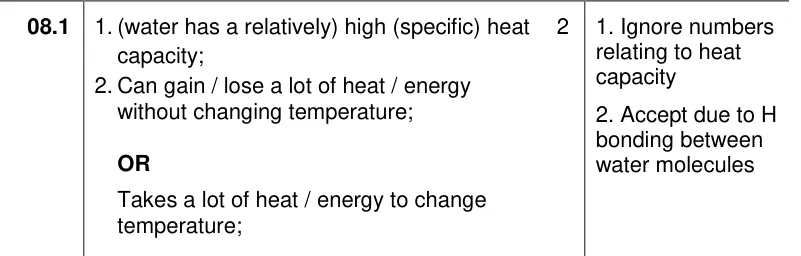
- High heat capacity: water takes a lot of energy to change its temperature, so it buffers changes in temperature.
- Large latent heat of vaporisation: a lot of energy is needed to evaporate water, so evaporation gives a cooling effect with little water lost.
- Cohesion: water molecules stick together by hydrogen bonds between the molecules, supporting columns of water in xylem and producing surface tension.
- Inorganic ion: a charged particle such as H⁺, Fe²⁺, Na⁺ or PO₄³⁻, found in solution in cytoplasm and body fluids.
- Co-transport: sodium ions and glucose or amino acids moving into a cell together through one carrier protein, down the sodium concentration gradient set up by active transport.
What these questions cover (AQA 3.1.1, 3.1.7 and 3.1.8)
The questions test these statements from the AQA AS and A-level Biology specification (7401/7402):
- Biochemical basis of life: The variety of life, both past and present, is extensive, but the biochemical basis of life is similar for all living things. (background to the whole of 3.1; not examined on its own)
- Monomers: Monomers are the smaller units from which larger molecules are made.
- Polymers: Polymers are molecules made from a large number of monomers joined together. (tested in Question 3, on polymers and their monomers)
- Examples of monomers: Monosaccharides, amino acids and nucleotides are examples of monomers.
- Condensation: A condensation reaction joins two molecules together with the formation of a chemical bond and involves the elimination of a molecule of water.
- Hydrolysis: A hydrolysis reaction breaks a chemical bond between two molecules and involves the use of a water molecule.
- Water: Water is a major component of cells. It has several properties that are important in biology. In particular, water:
- Metabolite: is a metabolite in many metabolic reactions, including condensation and hydrolysis reactions
- Solvent: is an important solvent in which metabolic reactions occur (tested in Question 10, on five properties of water)
- Heat capacity: has a relatively high heat capacity, buffering changes in temperature
- Latent heat of vaporisation: has a relatively large latent heat of vaporisation, providing a cooling effect with little loss of water through evaporation
- Cohesion: has strong cohesion between water molecules; this supports columns of water in the tube-like transport cells of plants and produces surface tension where water meets air.
- Inorganic ions: Inorganic ions occur in solution in the cytoplasm and body fluids of organisms, some in high concentrations and others in very low concentrations.
- Specific roles: Each type of ion has a specific role, depending on its properties.
- Students should be able to recognise the role of ions in the following topics: hydrogen ions and pH; iron ions as a component of haemoglobin; sodium ions in the co-transport of glucose and amino acids; and phosphate ions as components of DNA and of ATP.
How to use this page
Write your answer on paper before you open the mark scheme. Allow about 1.3 minutes per mark: the 17 questions are worth 44 marks, so about 57 minutes in total. Then mark your answer strictly against the mark scheme and read the examiners' tip underneath it. If you'd rather print the questions, download the PDF pack.
Monomers, polymers and the reactions that join them (3.1.1)
Question 1
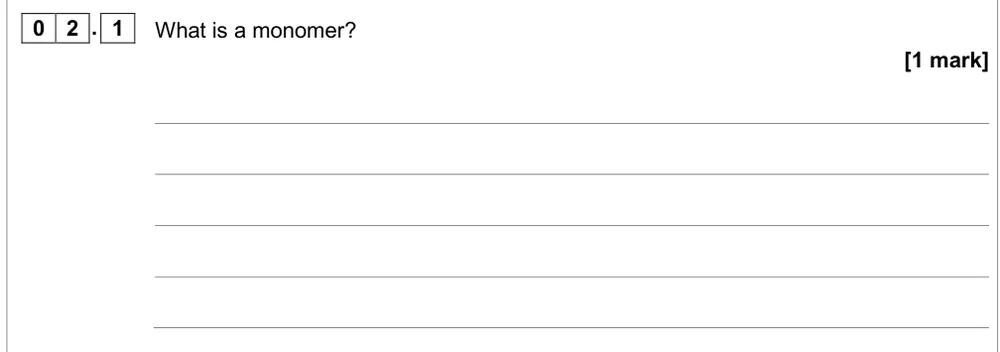
AS Paper 1 · June 2018 · Q02.1 · 1 mark · Medium
Define a monomer.
Show the mark scheme

Tap an image to open it full size.
From the examiners' report: Almost 60% got this. Give both halves of the definition: a smaller unit, and what it makes. 'Building blocks' isn't accepted.
Question 2
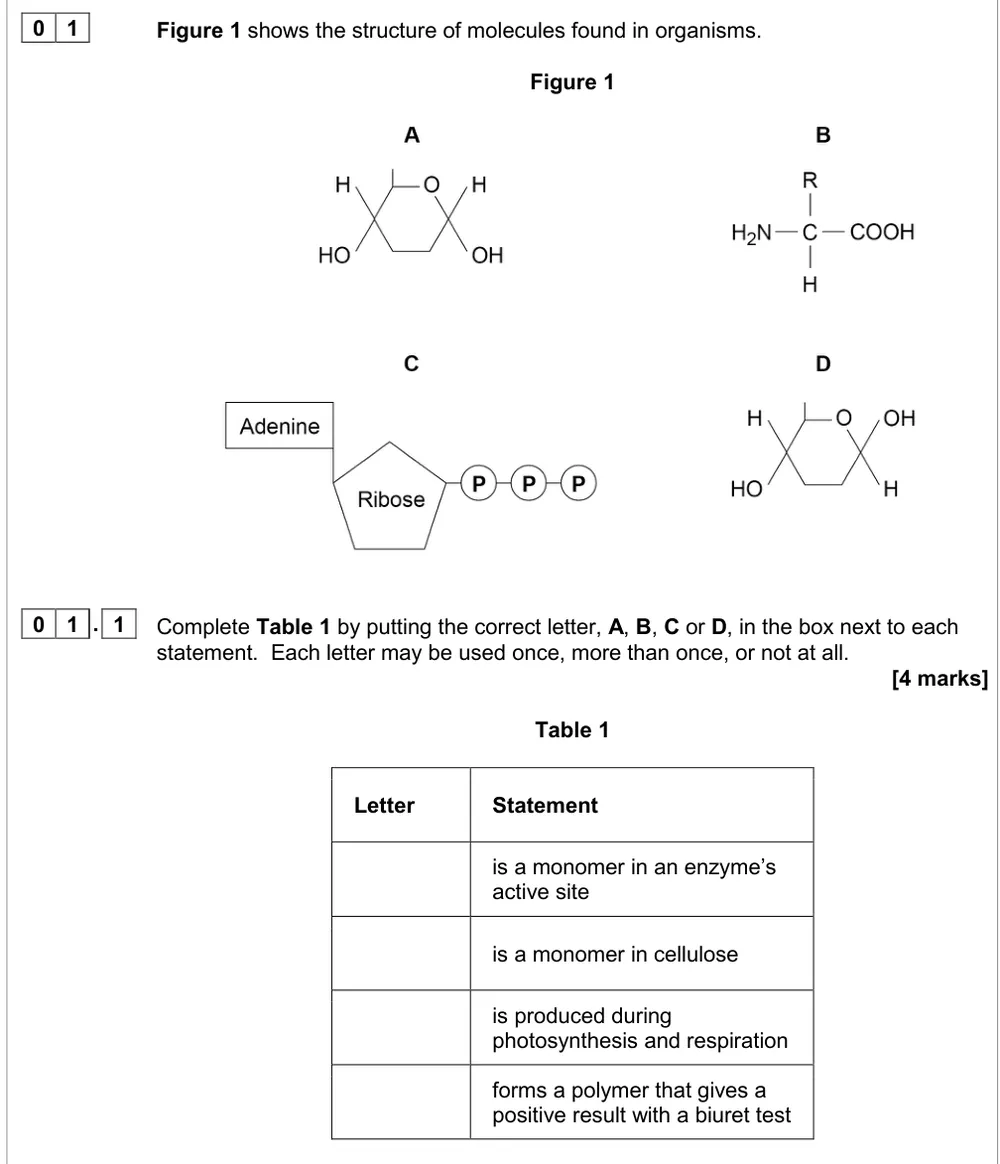
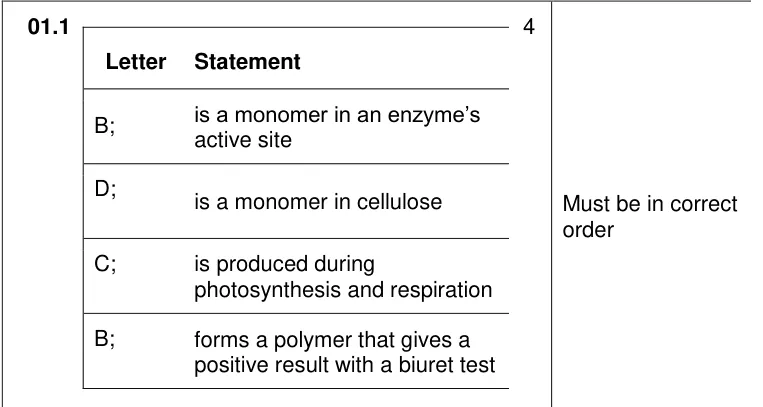
AS Paper 1 · November 2020 · Q01.1 · 4 marks
Match four molecules to statements about monomers and polymers.
Show the mark scheme
Tap an image to open it full size.
From the examiners' report: Each letter can be used once, more than once or not at all, so don't rule out B just because you've used it. Cellulose is made of beta-glucose.
Question 3
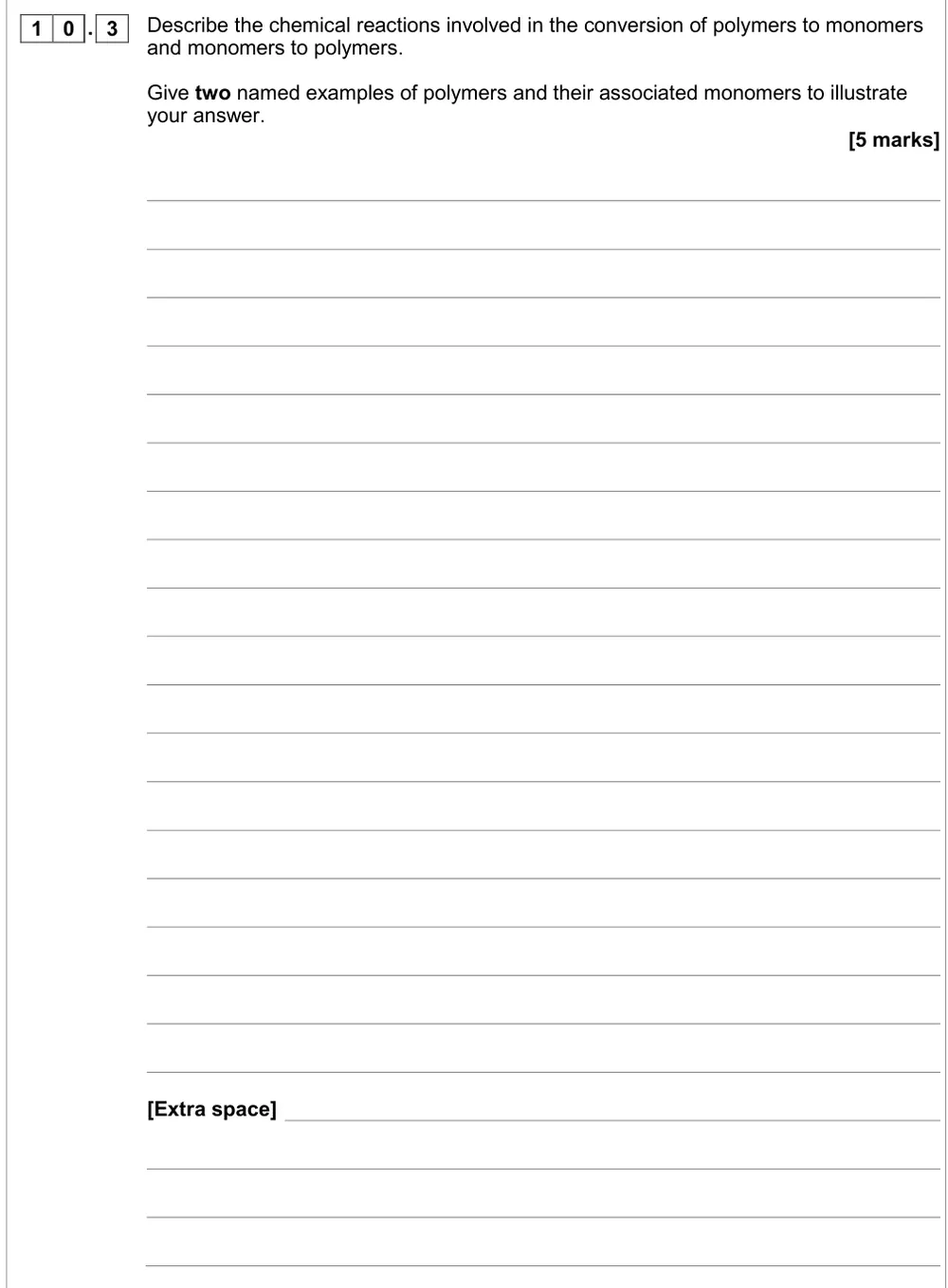
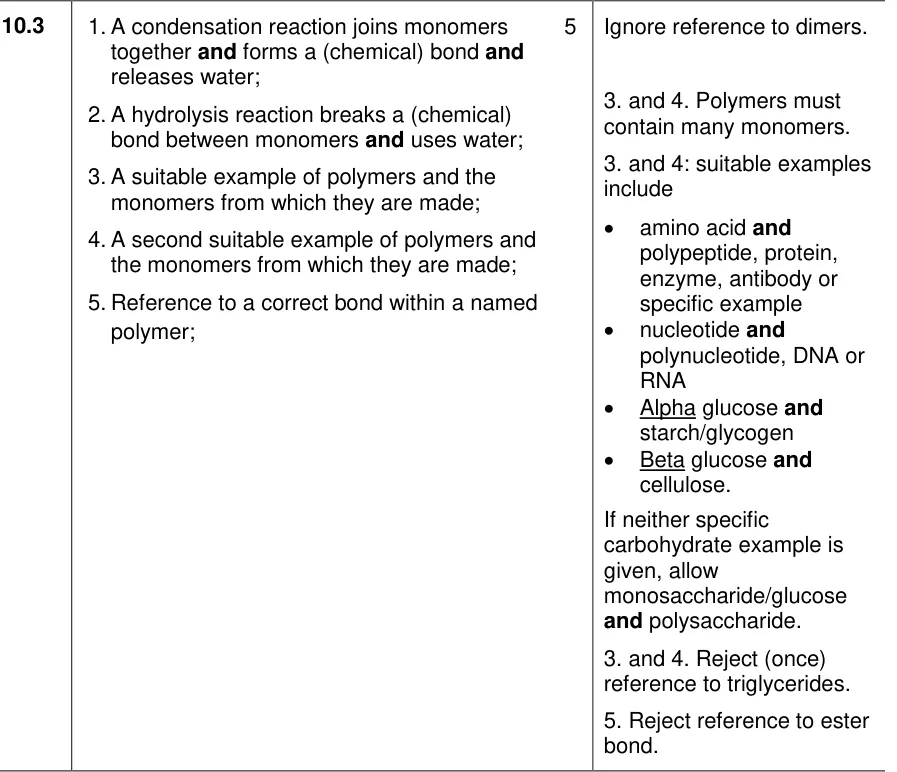
A level Paper 1 · June 2019 · Q10.3 · 5 marks
Describe the reactions that convert polymers to monomers and back, with two named examples.
Show the mark scheme
Tap an image to open it full size.
From the examiners' report: There's no examiners' report for this paper, so this tip comes from the mark scheme. Say water is released in condensation and used in hydrolysis, pick true polymers (not triglycerides) and name the bond, such as glycosidic or peptide.
Question 4
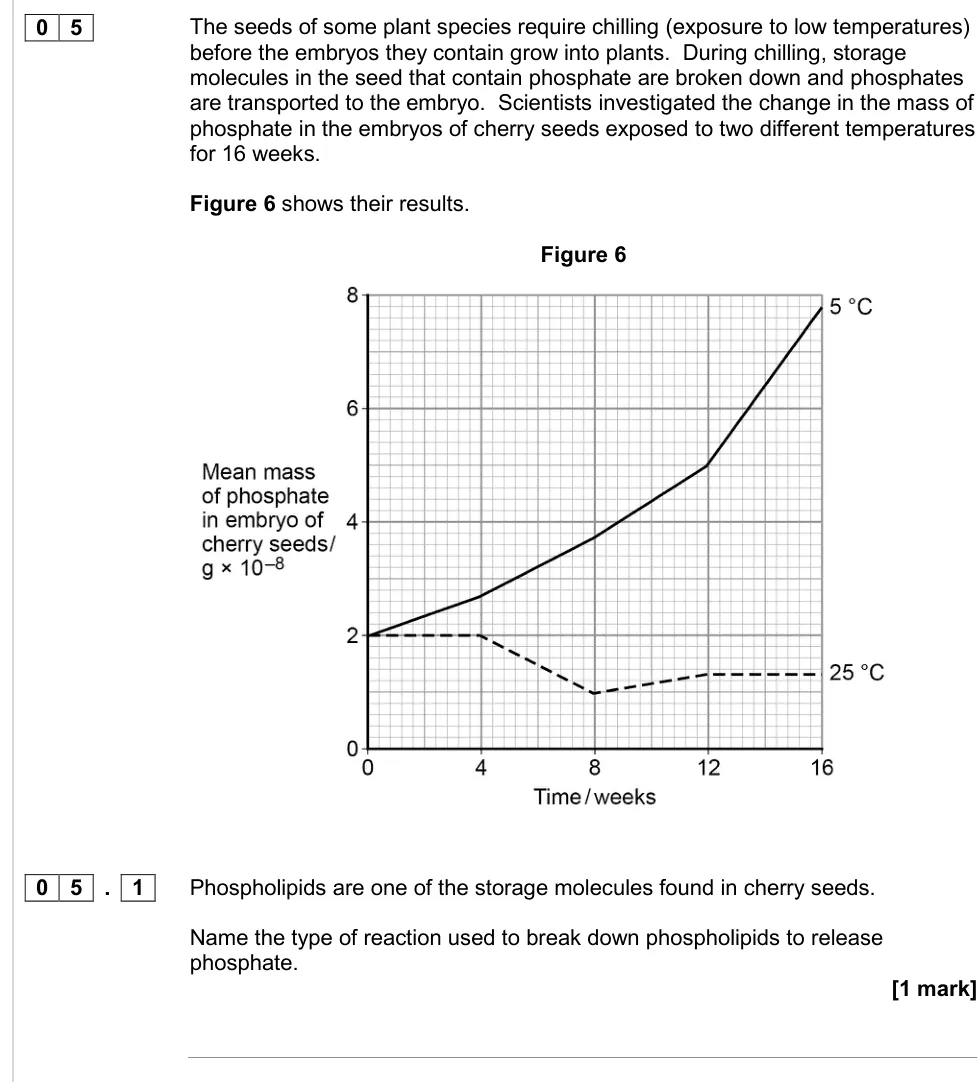
AS Paper 2 · June 2016 · Q05.1 · 1 mark · Easy
Name the type of reaction that breaks down phospholipids to release phosphate.
Show the mark scheme

Tap an image to open it full size.
From the examiners' report: The vast majority got this. Common wrong answers were condensation and phosphorylation.
Question 5
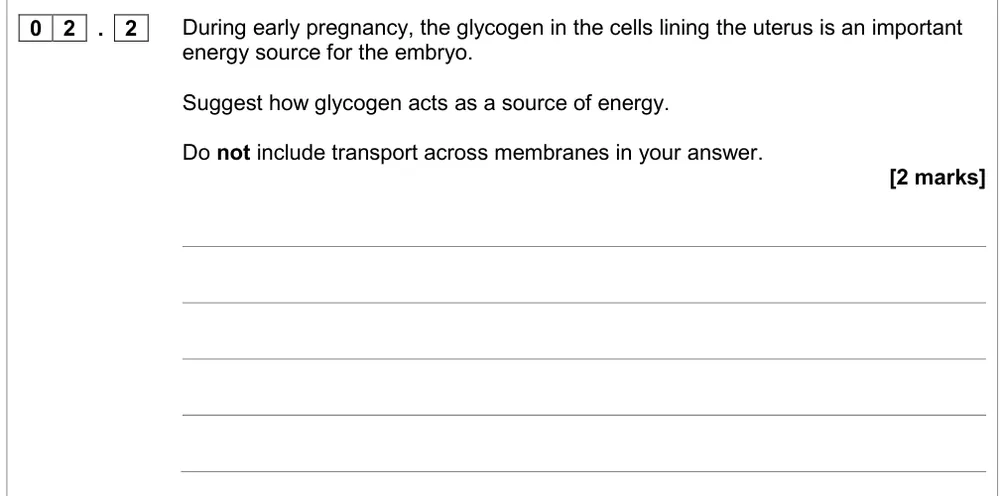
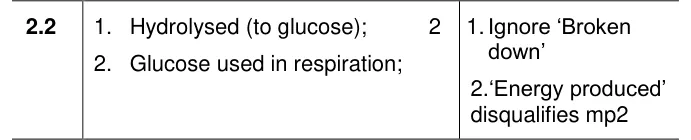
A level Paper 1 · June 2017 · Q02.2 · 2 marks
Suggest how glycogen acts as a source of energy for an embryo.
Information from earlier in this question:

Show the mark scheme
Tap an image to open it full size.
From the examiners' report: There's no examiners' report for this paper, so this tip comes from the mark scheme. Name the reaction: 'hydrolysed', not 'broken down'. Then say the glucose is used in respiration, which releases energy rather than producing it.
Properties of water (3.1.7)
Question 6
AS Paper 1 · June 2017 · Q08.1 · 3 marks · Medium
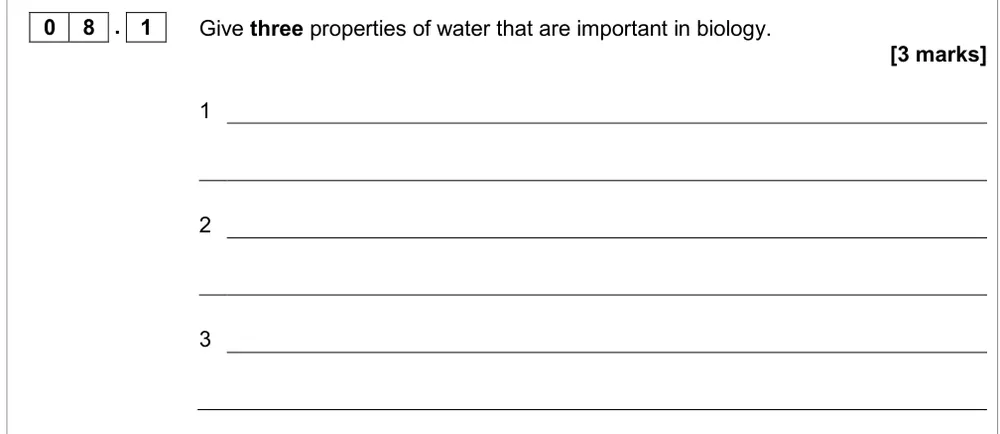
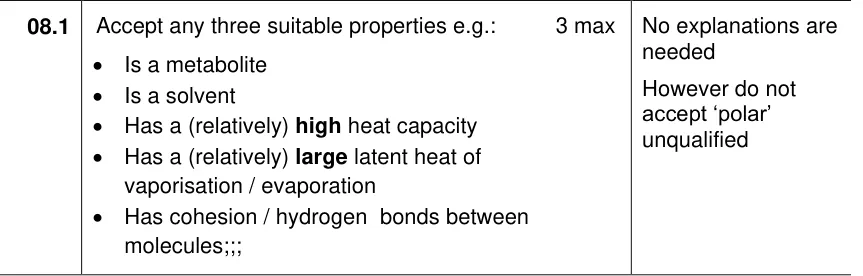
Give three properties of water that are important in biology.
Show the mark scheme
Tap an image to open it full size.
From the examiners' report: Only 32% got all three. Give properties, not reactions such as condensation, and say high heat capacity and large latent heat of vaporisation.
Question 7
AS Paper 2 · June 2016 · Q02.5 · 2 marks · Hard
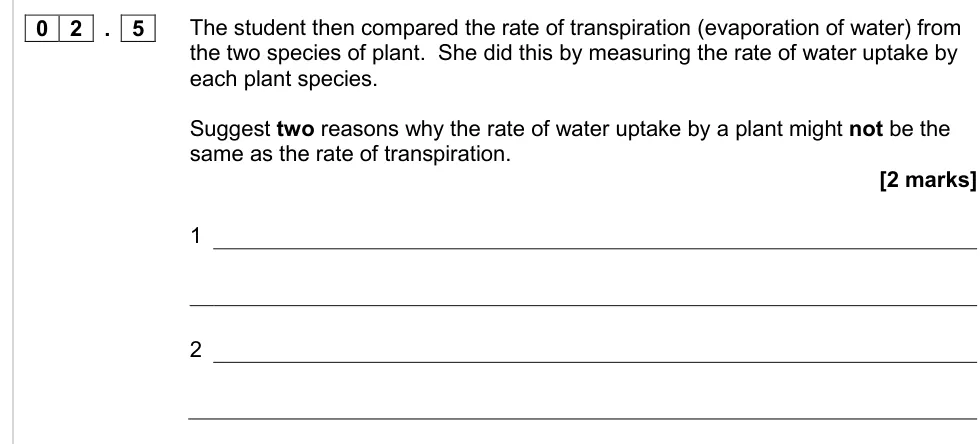
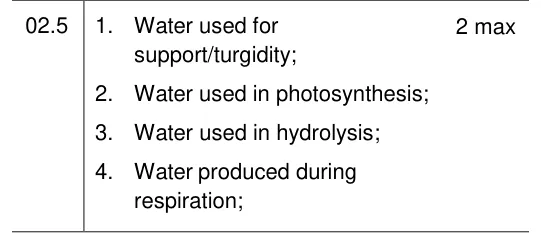
Suggest two reasons why a plant's water uptake might not equal its rate of transpiration.
Show the mark scheme
Tap an image to open it full size.
From the examiners' report: Only a third scored. Water is used in photosynthesis and hydrolysis and produced in respiration; many got these the wrong way round or wrote about potometer leaks.
Question 8
AS Paper 1 · June 2018 · Q08.1 · 2 marks
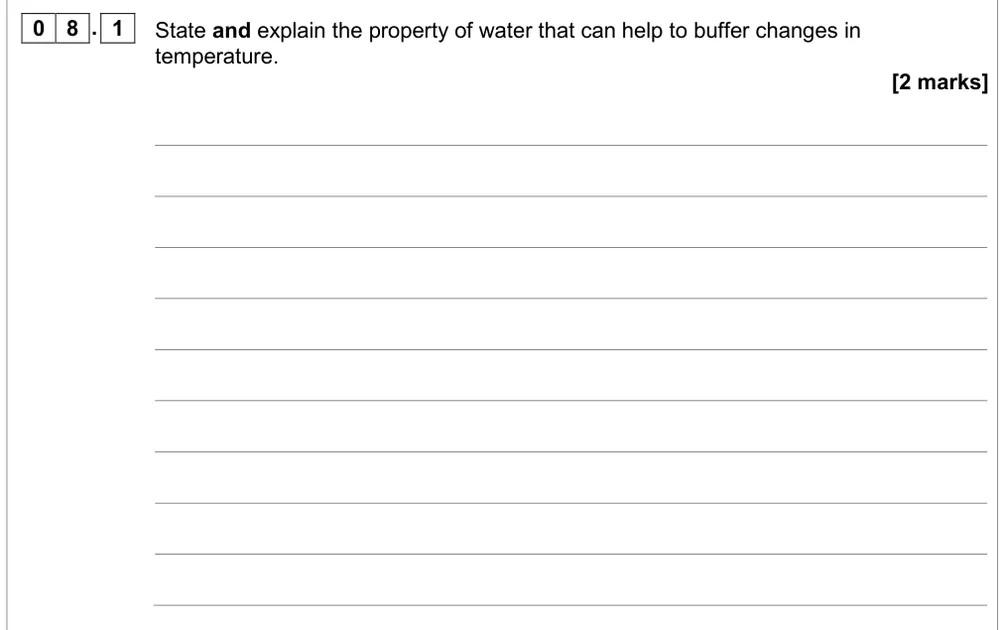
State and explain the property of water that helps to buffer changes in temperature.
Show the mark scheme
Tap an image to open it full size.
From the examiners' report: Don't mix up heat capacity and latent heat of vaporisation, or hedge with 'latent heat capacity'. The hydrogen bonds are between water molecules.
Question 9
AS Paper 2 · June 2024 · Q01.1 · 2 marks
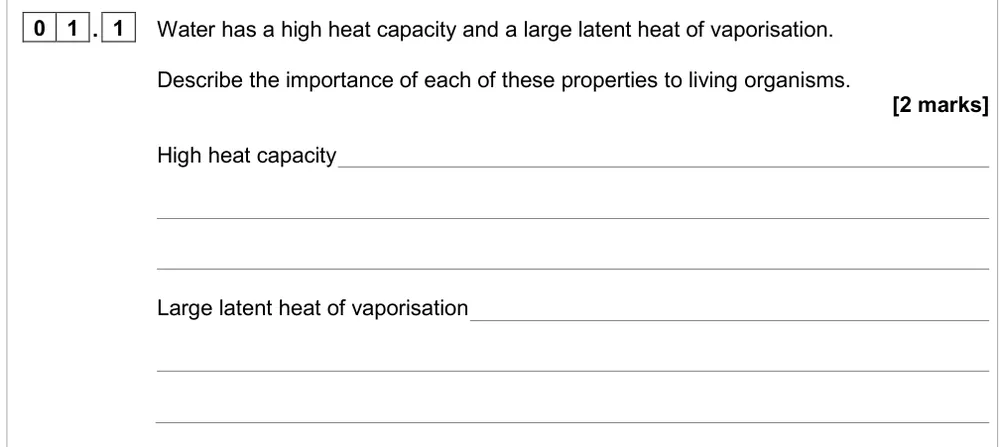
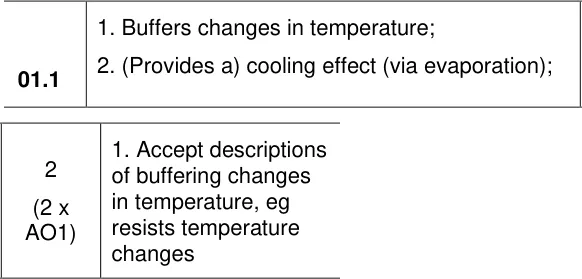
Describe why water's high heat capacity and large latent heat of vaporisation matter to organisms.
Show the mark scheme
Tap an image to open it full size.
From the examiners' report: Almost half got both. Say what each property does for the organism rather than giving the physics definition.
Question 10
AS Paper 2 · November 2021 · Q09.1 · 5 marks
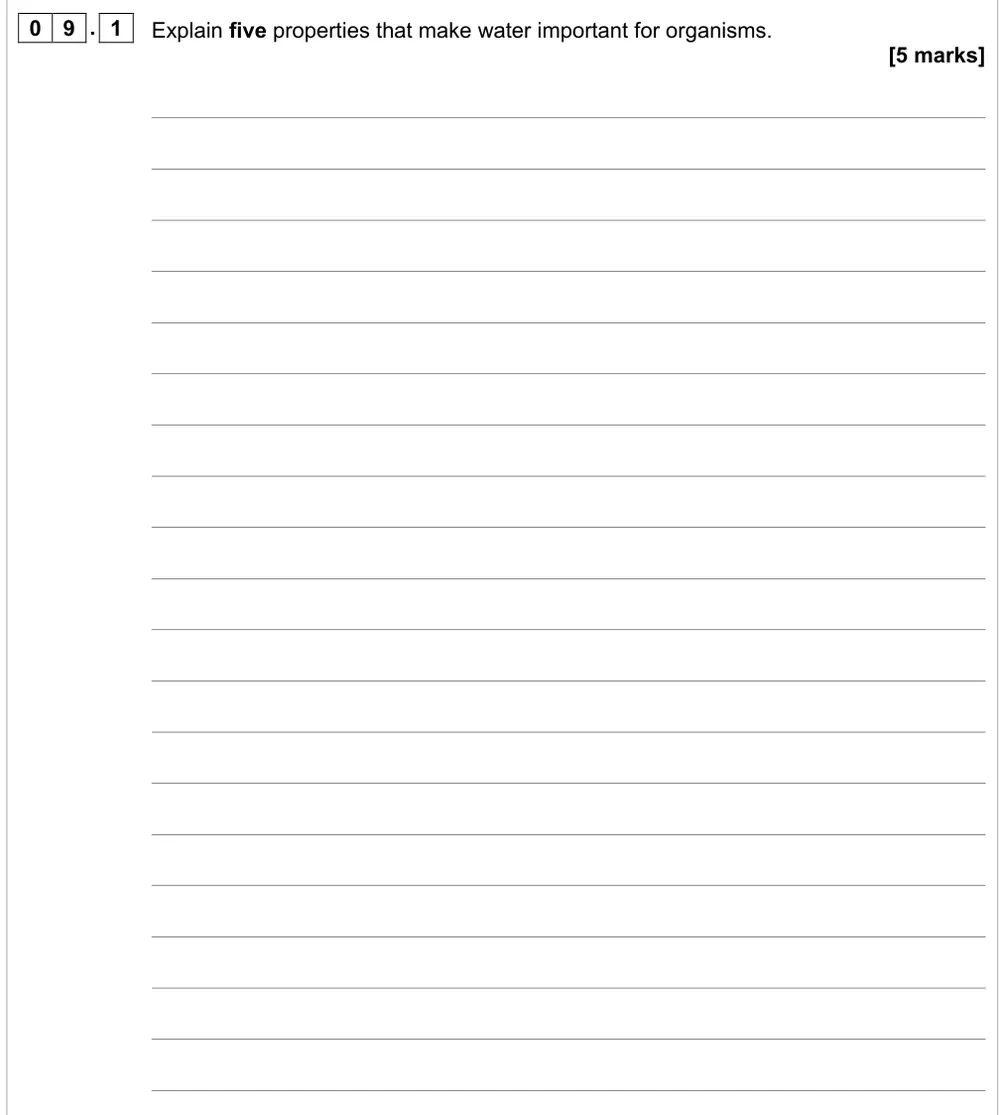
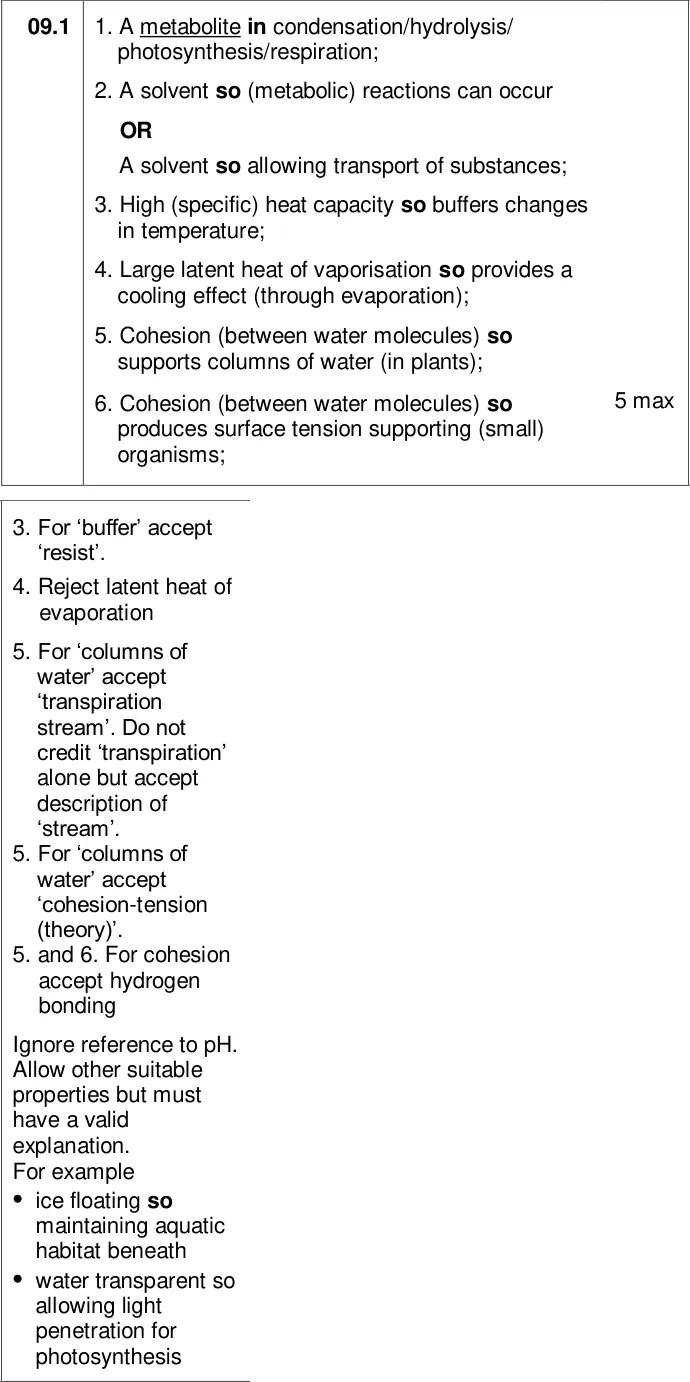
Explain five properties that make water important for organisms.
Show the mark scheme
Tap an image to open it full size.
From the examiners' report: There's no examiners' report for this paper, so this tip comes from the mark scheme. Each property needs its 'so': name the property and then what it does. 'Latent heat of evaporation' was rejected, and 'transpiration' alone doesn't count for water columns.
Inorganic ions (3.1.8)
Question 11
AS Paper 1 · June 2022 · Q06.1 · 2 marks · Medium
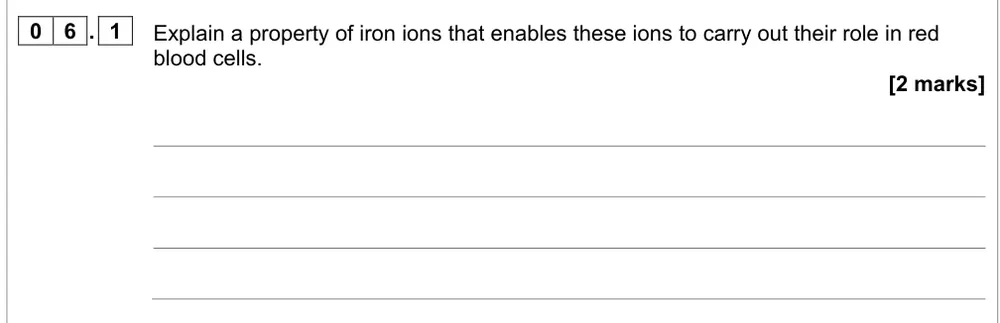
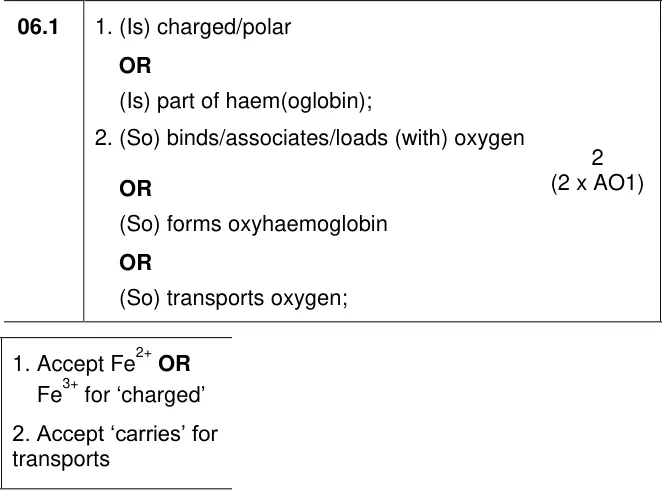
Explain a property of iron ions that lets them do their job in red blood cells.
Show the mark scheme
Tap an image to open it full size.
From the examiners' report: 71% scored at least one mark. Oxygen binds to haemoglobin; it doesn't 'bond' to it.
Question 12
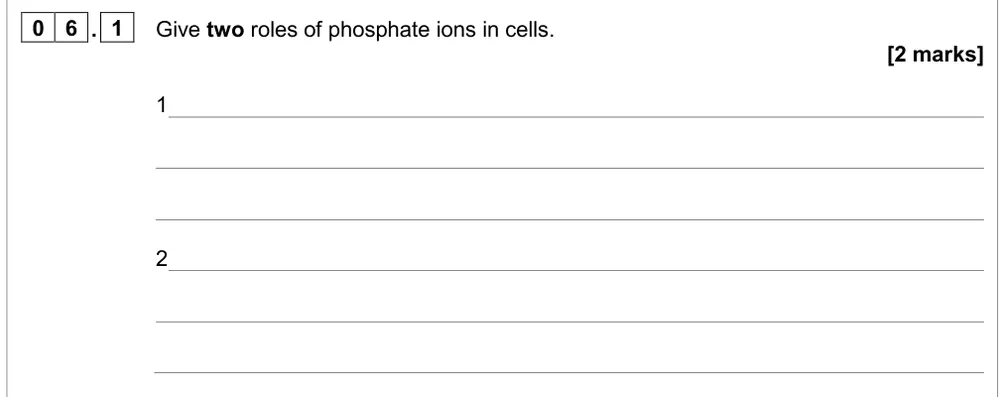
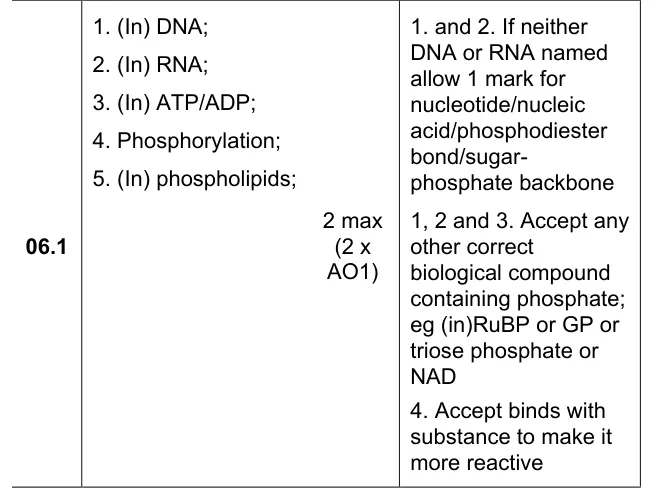
AS Paper 1 · June 2024 · Q06.1 · 2 marks
Give two roles of phosphate ions in cells.
Show the mark scheme
Tap an image to open it full size.
From the examiners' report: All the marking points were seen. Most named DNA and ATP.
Question 13
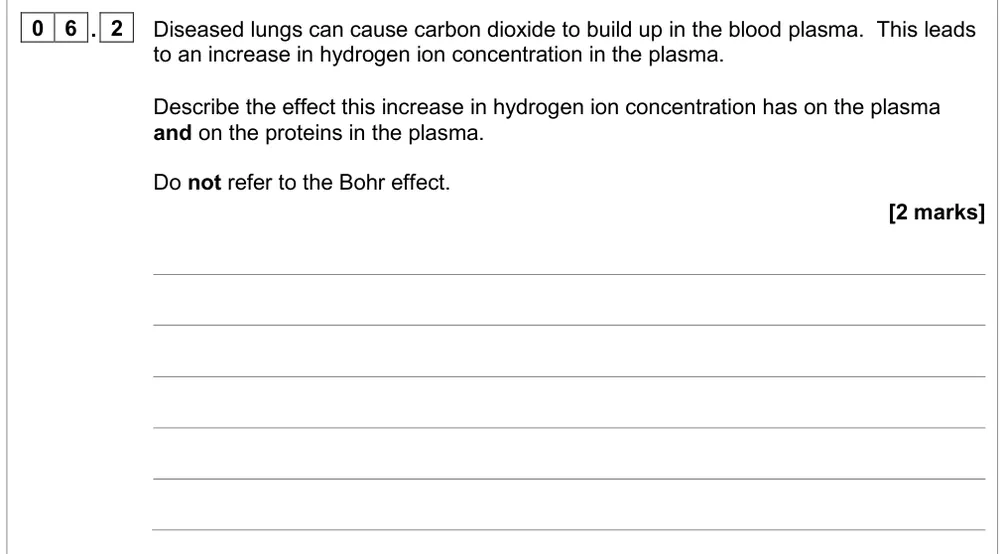
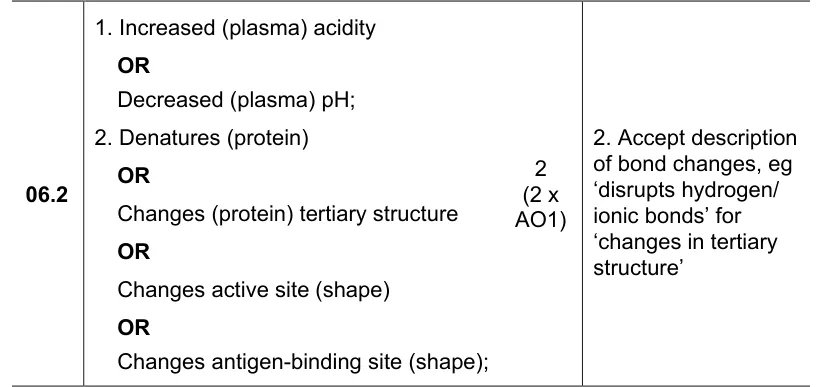
AS Paper 1 · June 2024 · Q06.2 · 2 marks
Describe the effect of more hydrogen ions on the plasma and its proteins.
Show the mark scheme
Tap an image to open it full size.
From the examiners' report: Some said the pH increases: more hydrogen ions means a lower pH. Many then described denaturing or the active site changing shape.
Question 14
AS Paper 1 · June 2024 · Q06.3 · 2 marks
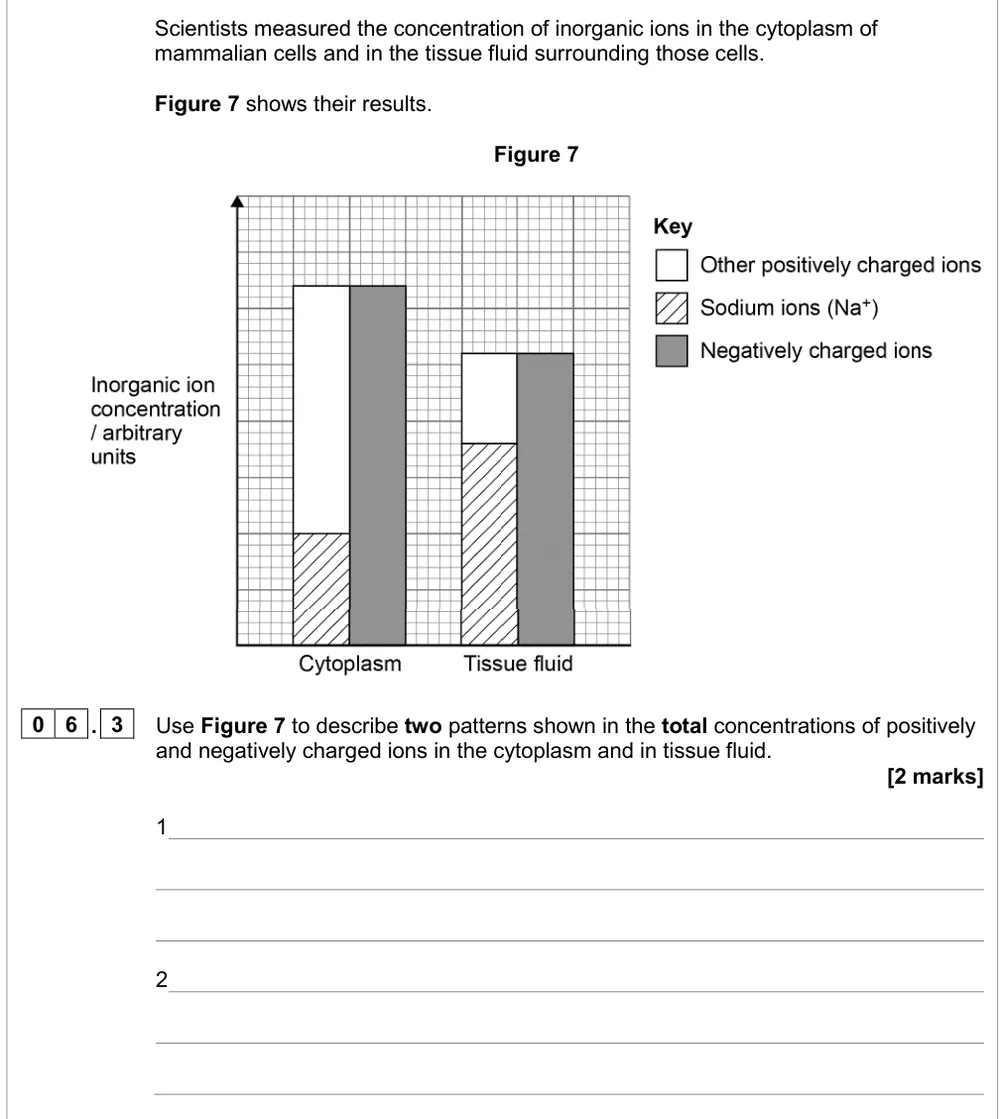
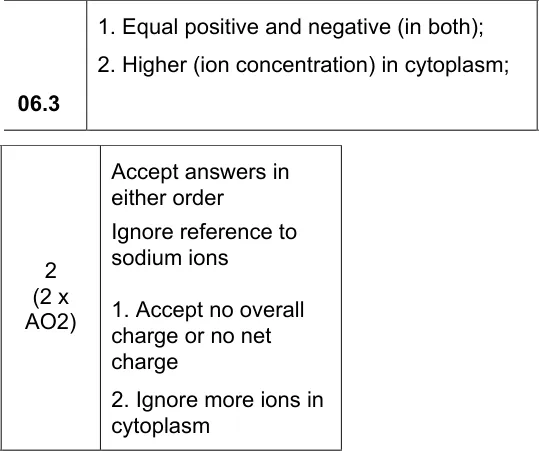
Use a bar chart to describe two patterns in the total ion concentrations in cytoplasm and tissue fluid.
Show the mark scheme
Tap an image to open it full size.
From the examiners' report: 'Total' was in bold, yet many described sodium ions. Use the axis label: 'a higher total inorganic ion concentration in the cytoplasm' scored, 'more ions in the cytoplasm' didn't.
Question 15
AS Paper 2 · June 2019 · Q09.1 · 5 marks
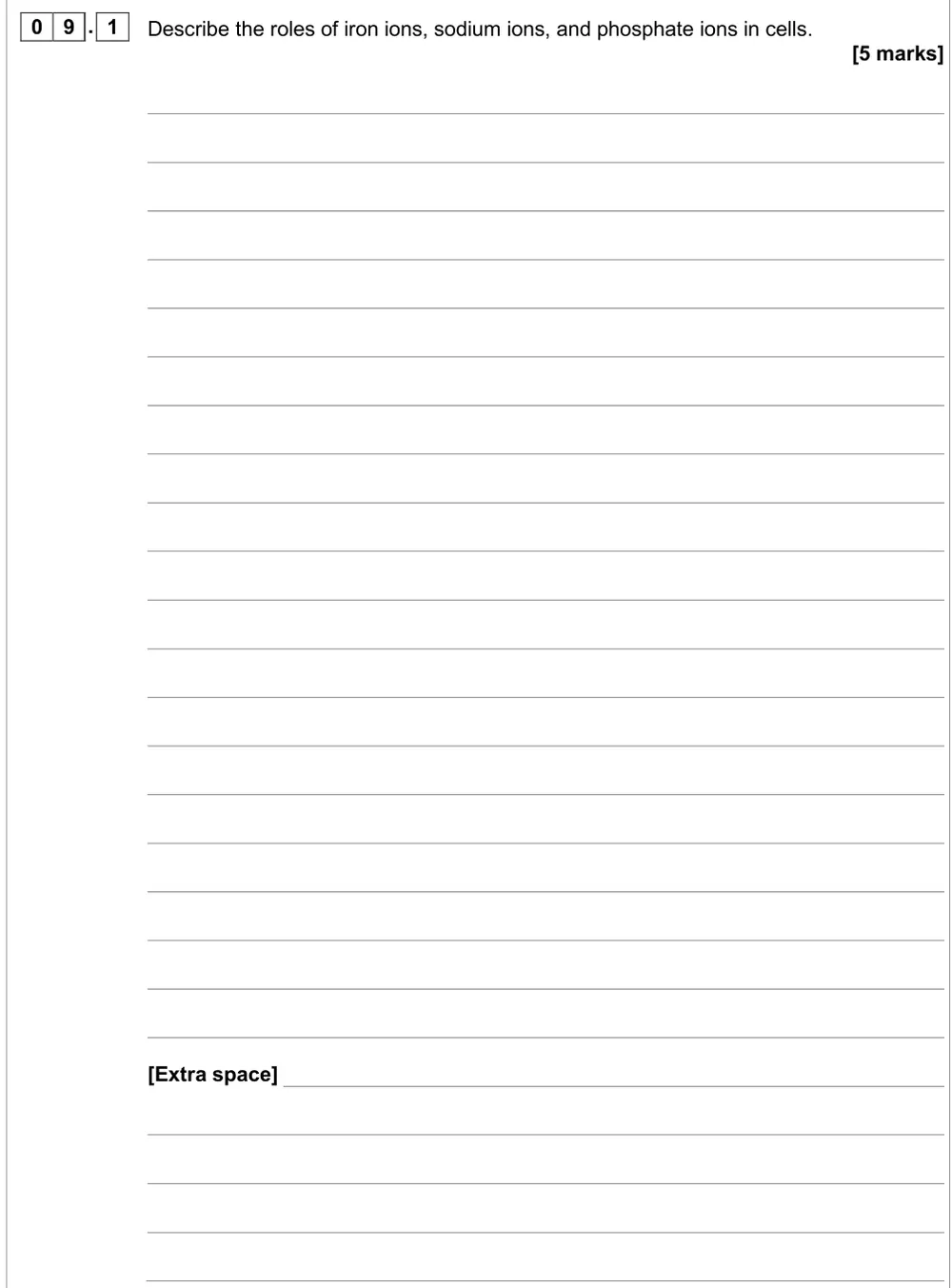
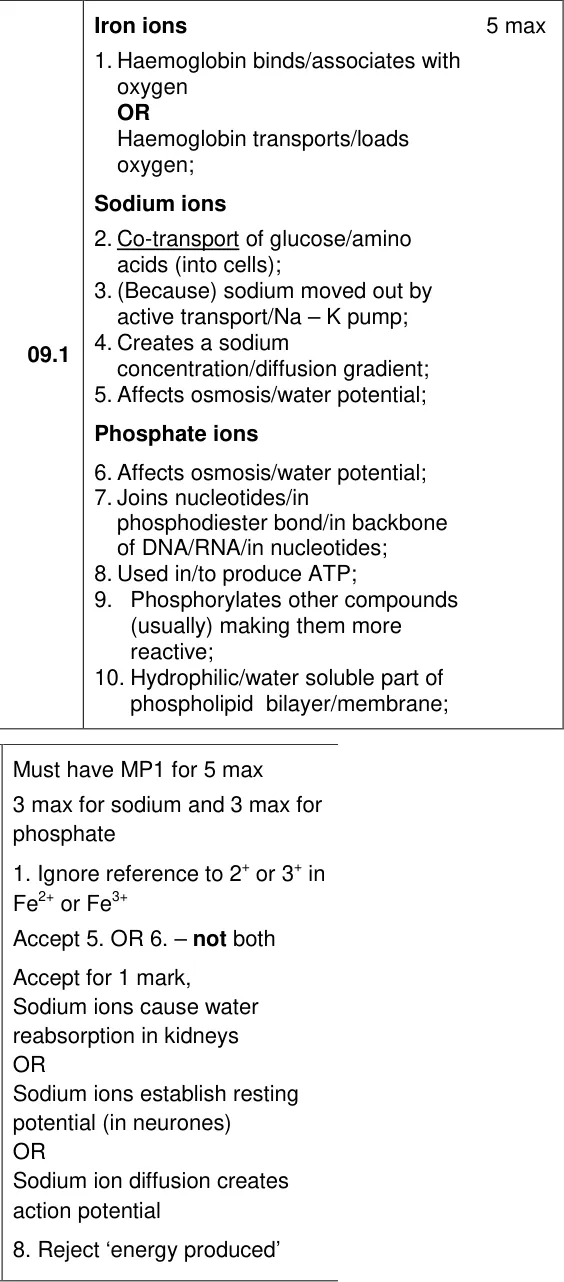
Describe the roles of iron ions, sodium ions and phosphate ions in cells.
Show the mark scheme
Tap an image to open it full size.
From the examiners' report: This discriminated well. Few explained how the sodium gradient is set up by active transport, and saying ATP 'creates' energy cost the phosphate mark.
Calculations with ions (3.1.8)
Question 16
AS Paper 1 · June 2022 · Q06.3 · 2 marks · Hard
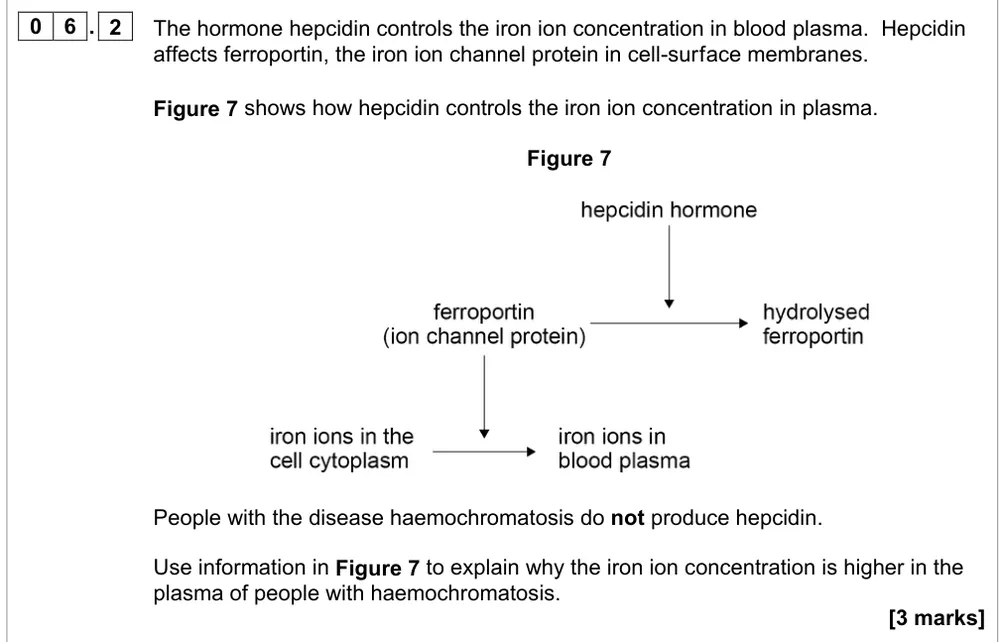
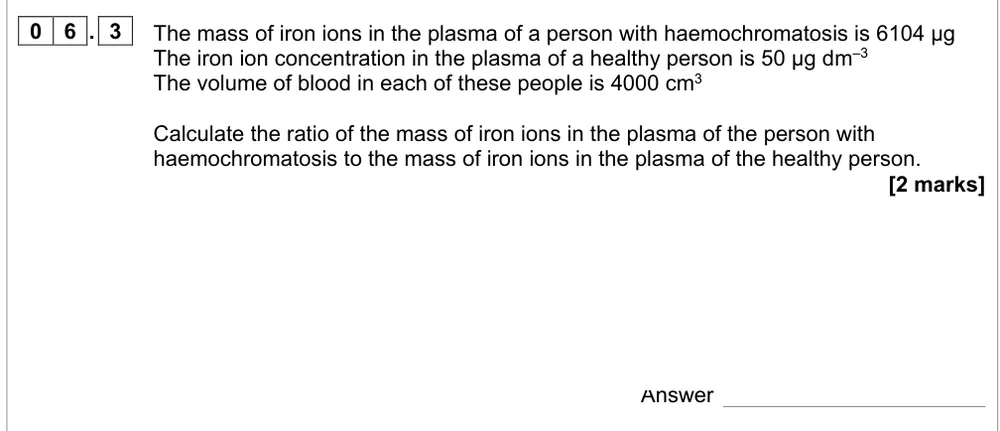
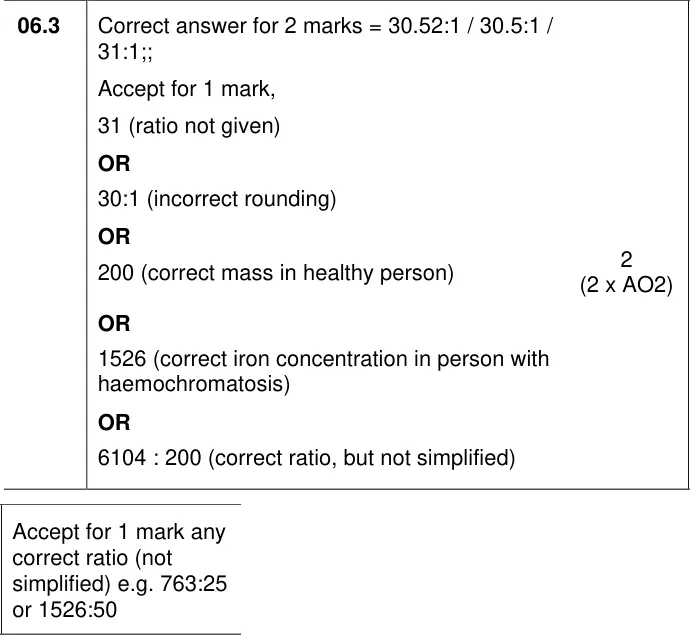
Calculate the ratio of the mass of plasma iron ions in a person with haemochromatosis to that in a healthy person.
Information from earlier in this question:
Show the mark scheme
Tap an image to open it full size.
From the examiners' report: Only 16% got both marks. Convert 4000 cm³ to 4 dm³, then simplify the ratio to x : 1.
Question 17
AS Paper 1 · June 2018 · Q02.4 · 2 marks · Hard
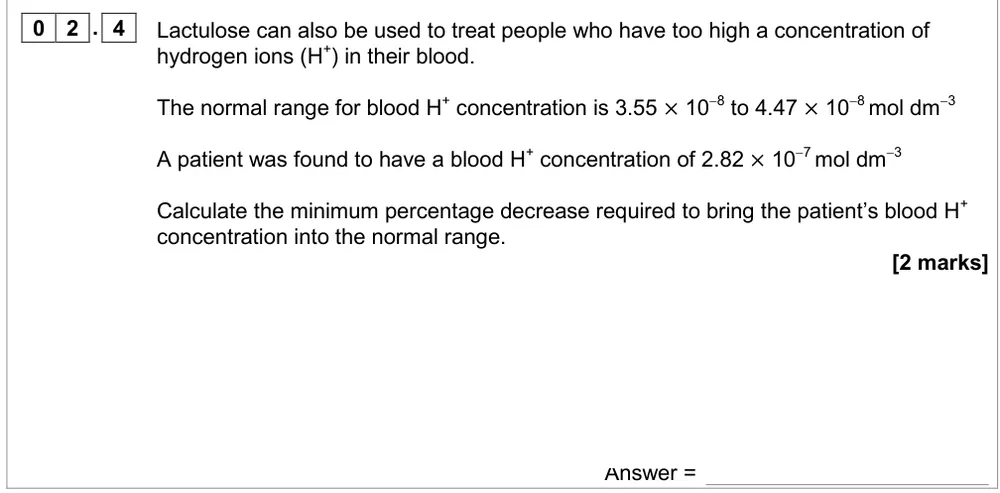
Calculate the minimum percentage decrease needed to bring a patient's blood H⁺ concentration into the normal range.
Show the mark scheme
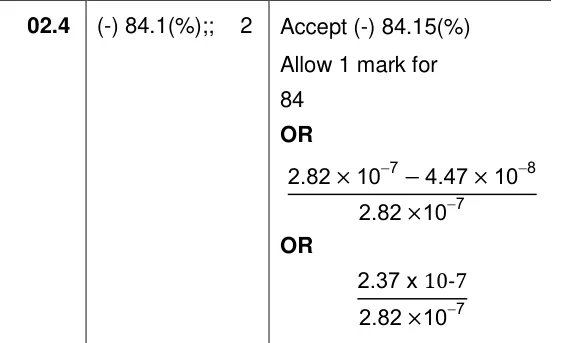
Tap an image to open it full size.
From the examiners' report: Only 12.2% got both and 77.9% scored zero. Keep the standard form, and use the upper end of the normal range for the minimum decrease.
Where students lose marks (from AQA examiners' reports and mark schemes)
Each point below is followed by wording that gained marks.
Units, not building blocks: Asked what a monomer is, about 40% didn't score. Most gave only 'a small unit' without what it makes, or used 'building blocks', 'atoms' or 'elements'.
✔ Gains credit: "A smaller unit/molecule from which larger molecules/polymers are made."
Relatively high, relatively large: Only 32% gave three properties of water. Some wrote 'condensation' or 'hydrolysis' as properties, mixed the terms into 'high latent heat capacity', or wrote 'heat capacity' and 'latent heat of vaporisation' without high or large.
✔ Gains credit: "Has a (relatively) high heat capacity; has a (relatively) large latent heat of vaporisation."
Say what the property does for the organism: Some gave the physics definitions of heat capacity and latent heat without linking them to living organisms, or confused the two terms.
✔ Gains credit: "High heat capacity buffers changes in temperature; large latent heat of vaporisation provides a cooling effect through evaporation."
Photosynthesis uses water; respiration makes it: Only a third scored on why water uptake differs from transpiration. Almost as many said water is produced in photosynthesis as said it is used, and weaker answers said water is used in respiration.
✔ Gains credit: "Water used in photosynthesis; water produced during respiration; water used for support/turgidity."
Oxygen binds to haemoglobin: Examiners asked for care with terminology: oxygen binds to (associates with) the iron in haemoglobin, it doesn't 'bond' to it, and some linked oxygen only to red blood cells.
✔ Gains credit: "Part of haemoglobin, so binds/associates with oxygen (forms oxyhaemoglobin)."
More hydrogen ions, lower pH: It wasn't uncommon for students to say that more hydrogen ions increase the pH.
✔ Gains credit: "Decreased (plasma) pH; denatures proteins/changes their tertiary structure."
Simplify the ratio to x : 1: Only 16% got both marks for the iron ratio. Many stopped at 6104 : 200 or 763 : 25.
✔ Gains credit: "30.5 : 1" (or 31 : 1).
Use the top of the normal range: Only 12.2% got the hydrogen ion percentage and 77.9% scored zero. Many ignored the standard form or worked to the lower limit of the normal range instead of the upper one.
✔ Gains credit: "(2.82 × 10⁻⁷ − 4.47 × 10⁻⁸) ÷ 2.82 × 10⁻⁷ × 100 = 84.1%."
Download the questions
Download the PDF pack (17 questions, mark schemes at the end)
Keep practising
- Carbohydrates: AQA A Level Biology exam questions by topic
- Proteins: AQA A Level Biology exam questions by topic
- ATP: AQA A Level Biology exam questions by topic
- Arithmetic: AQA A Level Biology exam questions by topic
- Calculations and mathematical content in A level Biology, from AQA papers
- AQA A Level Biology masterclasses
Questions, mark schemes and examiners' report extracts © AQA.