

Cell recognition and the immune system (AQA 3.2.4) is one of the biggest Year 12 topics, and it turns up on almost every paper, often in an unfamiliar context such as snake antivenom, a cancer drug or a test for Lyme disease. You need to know how antigens let the immune system recognise pathogens, other people's cells, abnormal cells and toxins; phagocytosis; the cellular response with antigen-presenting cells and helper T cells; the humoral response with B cells, plasma cells, memory cells and antibodies; vaccines, herd immunity and active v passive immunity; HIV and AIDS; and how monoclonal antibodies are used in treatment, diagnosis and the ELISA test.
The examiners' reports show the same slips every year. Students name B and T cells when asked which cells trigger a response, confuse lysosomes with lysozymes, give antibodies an 'active site', say B cells rather than plasma cells release antibodies, claim herd immunity protects against tetanus, and give HIV a cell wall or DNA.
Start with cell recognition and phagocytosis, then T cells, B cells and antibodies, then vaccines and HIV, and finish with monoclonal antibodies, ELISA and an evaluation question. Answer each on paper before you open the mark scheme. If you'd like help with this topic, my AQA masterclasses run online on Tuesdays at 5.15pm for Year 12 and on Wednesdays or Thursdays at 6.30pm for Year 13.
What you need from GCSE and Year 12
Each question on this page assumes you're secure on these GCSE and Year 12 ideas. If any of them feels shaky, revise it before you start.
- GCSE: white blood cells defend the body by phagocytosis, by producing antibodies and by producing antitoxins.
- GCSE: vaccines contain dead or inactive pathogens; they stimulate white blood cells to make antibodies, so a later infection is fought off quickly.
- GCSE: antibiotics kill bacteria but not viruses; HIV attacks the immune system and can lead to AIDS.
- Year 12 (AQA 3.1.4.1): proteins have a specific tertiary and quaternary structure, held by bonds such as disulfide bridges. See the Proteins page.
- Year 12 (AQA 3.2.1.2): the structure of viruses: genetic material, capsid and attachment proteins. See the Prokaryotic Cells and Viruses page.
Key terms
These words come up in the questions and mark schemes. Examiners expect you to use them exactly.
- Antigen: a foreign protein (or other molecule) that stimulates an immune response leading to the production of antibodies.
- Antibody: a protein with two identical antigen-binding sites that are complementary to one specific antigen; made by plasma cells.
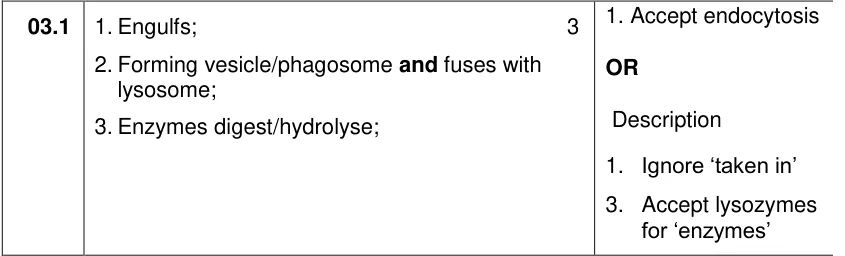
- Phagocytosis: engulfing a pathogen into a phagosome, which fuses with a lysosome so lysozymes hydrolyse the pathogen.
- Antigen-presenting cell: a cell, such as a phagocyte, that displays foreign antigens on its cell-surface membrane.
- Helper T cell (TH cell): a T cell with a receptor complementary to the presented antigen; it stimulates cytotoxic T cells, B cells and phagocytes.
- Clonal selection: the B cell with antibodies complementary to the antigen is stimulated to divide by mitosis, forming a clone.
- Plasma cells and memory cells: cells formed from the B cell clone: plasma cells secrete antibodies; memory cells stay in the blood and give a faster, larger secondary response.
- Agglutination: antibodies binding to antigens on several bacteria, clumping them together so phagocytes can engulf them.
- Active and passive immunity: active: your own plasma cells make antibodies and memory cells form (long-lasting, slow to start); passive: antibodies are given from outside (immediate, short-lived, no memory cells).
- Herd immunity: when so many people are vaccinated that a pathogen can't spread, protecting unvaccinated people too.
- Monoclonal antibody: antibodies with the same tertiary structure, made by a clone of identical plasma cells, used to target drugs, in diagnosis and in ELISA.
What these questions cover (AQA 3.2.4)
The questions test these statements from the AQA AS and A-level Biology specification (7401/7402):
- Cell recognition: Each type of cell has specific molecules on its surface that identify it. These molecules include proteins and enable the immune system to identify: pathogens, cells from other organisms of the same species, abnormal body cells, toxins.
- Antigens: Definition of antigen. The effect of antigen variability on disease and disease prevention.
- Phagocytosis: Phagocytosis of pathogens. The subsequent destruction of ingested pathogens by lysozymes.
- The cellular response: The response of T lymphocytes to a foreign antigen (the cellular response).
- The cellular response: The role of antigen-presenting cells in the cellular response.
- The cellular response: The role of helper T cells (TH cells) in stimulating cytotoxic T cells (TC cells), B cells and phagocytes. The role of other T cells is not required.
- The humoral response: The response of B lymphocytes to a foreign antigen, clonal selection and the release of monoclonal antibodies (the humoral response).
- The humoral response: Definition of antibody.
- The humoral response: Antibody structure.
- The humoral response: The formation of an antigen-antibody complex, leading to the destruction of the antigen, limited to agglutination and phagocytosis of bacterial cells.
- The humoral response: The roles of plasma cells and of memory cells in producing primary and secondary immune responses.
- Vaccines and immunity: The use of vaccines to provide protection for individuals and populations against disease. The concept of herd immunity.
- Vaccines and immunity: The differences between active and passive immunity.
- HIV: Structure of the human immunodeficiency virus (HIV) and its replication in helper T cells.
- HIV: How HIV causes the symptoms of AIDS. Why antibiotics are ineffective against viruses.
- The use of monoclonal antibodies in: targeting medication to specific cell types by attaching a therapeutic drug to an antibody
- The use of monoclonal antibodies in: medical diagnosis. (the specification adds that details of the commercial or scientific production of monoclonal antibodies are not required)
- Ethics: Ethical issues associated with the use of vaccines and monoclonal antibodies.
- ELISA: The use of antibodies in the ELISA test.
- Students should be able to discuss ethical issues associated with the use of vaccines and monoclonal antibodies
- Students should be able to evaluate methodology, evidence and data relating to the use of vaccines and monoclonal antibodies.
How to use this page
Write your answer on paper before you open the mark scheme. Allow about 1.3 minutes per mark: the 18 questions are worth 47 marks, so about 61 minutes in total. Then mark your answer strictly against the mark scheme and read the examiners' tip underneath it. If you'd rather print the questions, download the PDF pack.
Cell recognition and antigens (3.2.4)
Question 1
A level Paper 3 · June 2024 · Q01.1 · 3 marks · Easy
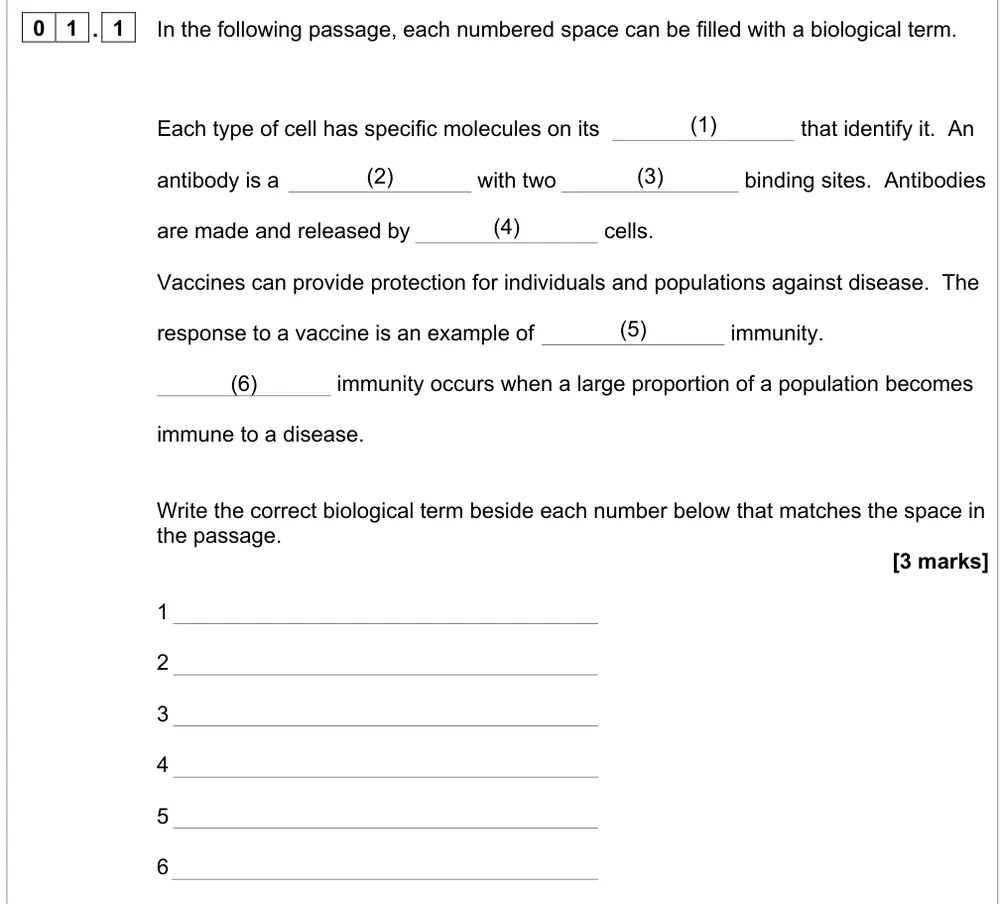
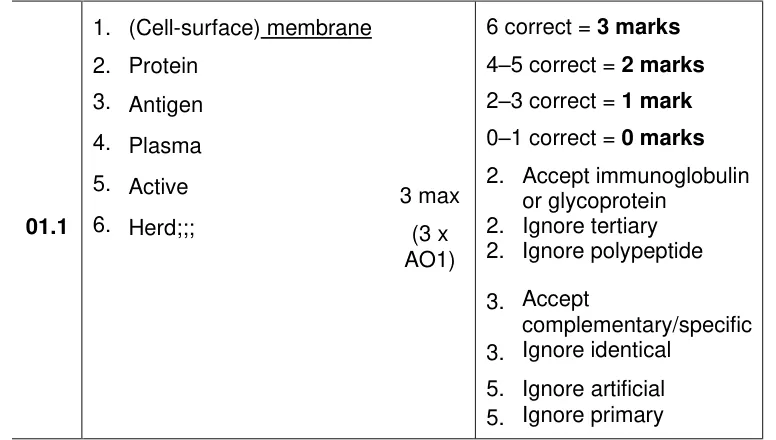
Fill six gaps in a passage about cell surface molecules, antibodies, plasma cells and immunity.
Show the mark scheme
Tap an image to open it full size.
From the examiners' report: A quarter got all three marks. The usual slips were writing just 'surface' instead of cell-surface membrane, 'B cell' instead of plasma cells, and 'passive' for the response to a vaccine.
Question 2
A level Paper 3 · June 2023 · Q06.1 · 2 marks · Hard
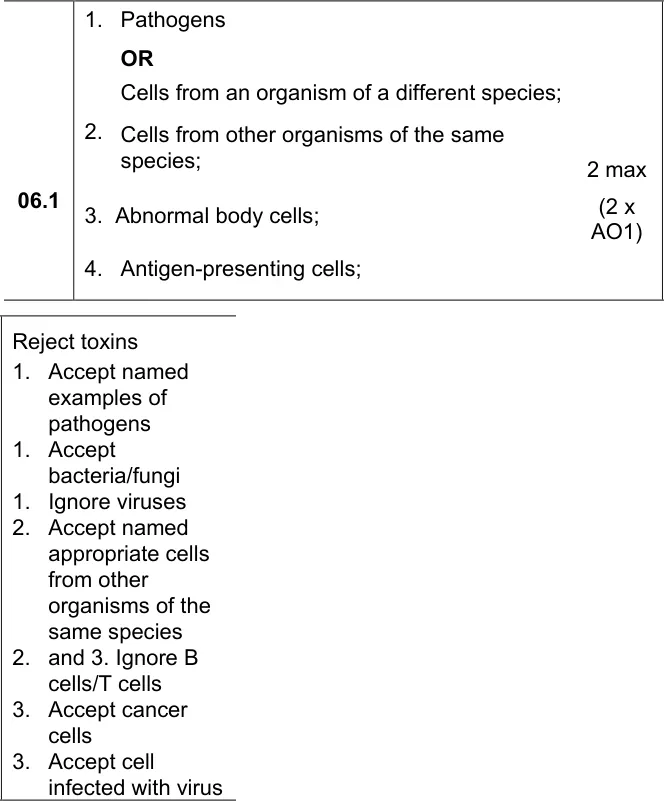
Give two types of cell that can stimulate an immune response.

Show the mark scheme
Tap an image to open it full size.
From the examiners' report: Just over half scored nothing because they named B cells and T cells, the cells that respond. The question wants cells that trigger a response: pathogens, cells from another person (a transplant) and abnormal or cancer cells.
Phagocytosis and the cellular response (3.2.4)
Question 3
AS Paper 1 · November 2020 · Q03.1 · 3 marks
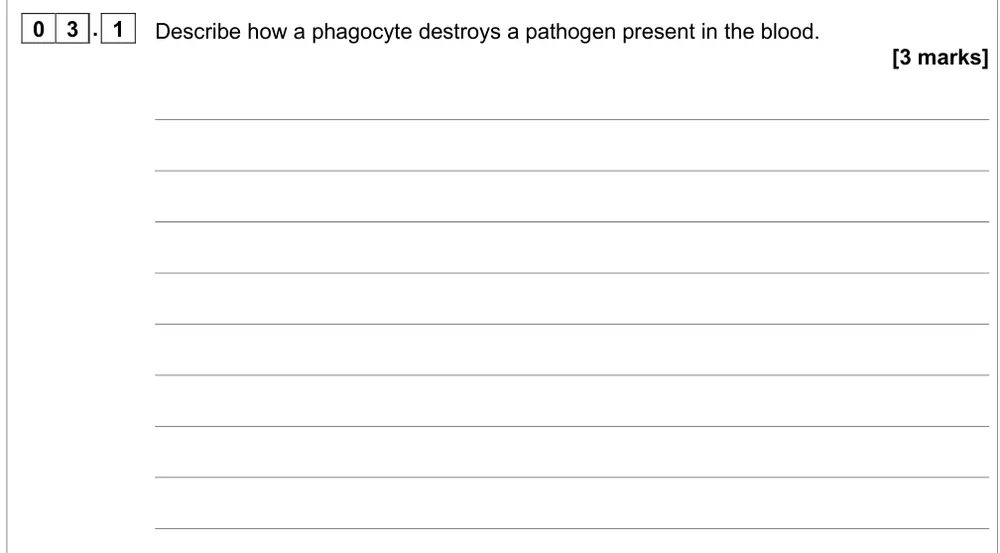
Describe how a phagocyte destroys a pathogen in the blood.
Show the mark scheme
Tap an image to open it full size.
From the examiners' report: Use the right terms in order: the pathogen is engulfed into a phagosome (a vesicle, not a vacuole), a lysosome fuses with it, and lysozymes hydrolyse the pathogen. Don't mix up lysosomes and lysozymes.
Question 4
AS Paper 1 · June 2018 · Q10.1 · 3 marks · Medium
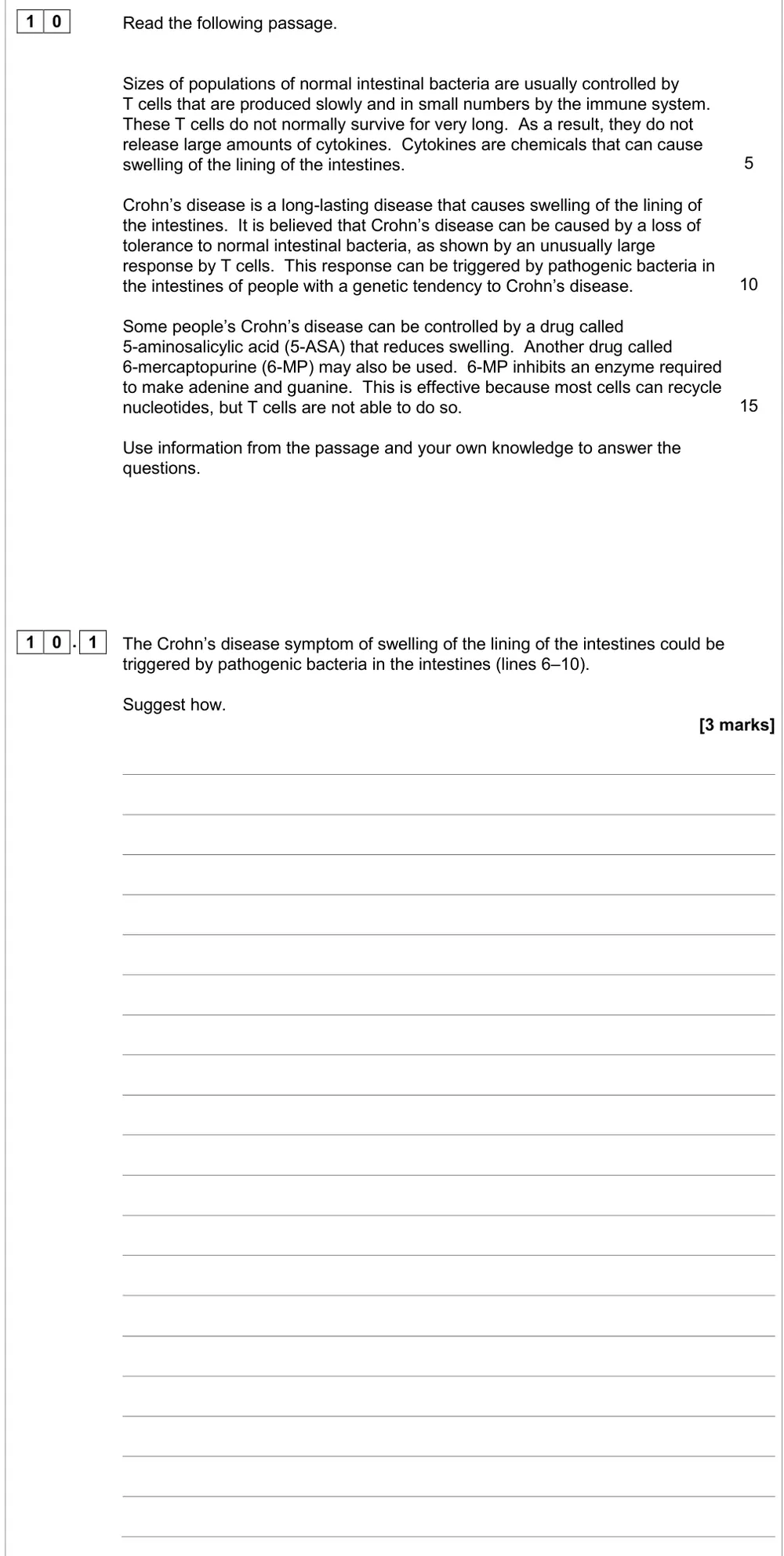
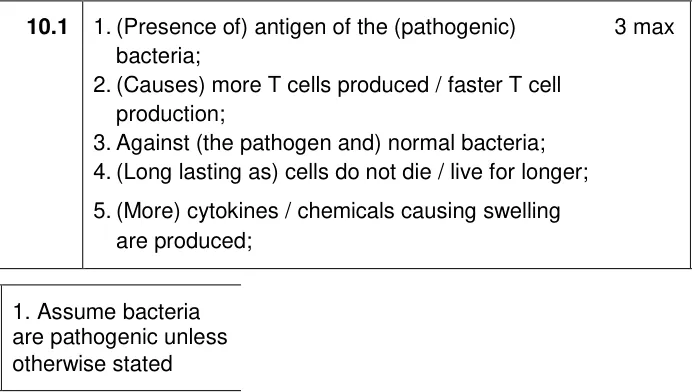
Use a passage on Crohn's disease to suggest how bacteria trigger swelling of the intestine lining.
Show the mark scheme
Tap an image to open it full size.
From the examiners' report: 70.7% scored at least one mark. Start with the antigen on the bacteria, then more T cells, then more cytokines from the passage: it's the cytokines, not a build-up of T cells or water, that cause the swelling.
B cells, antibodies and the humoral response (3.2.4)
Question 5
AS Paper 1 · June 2016 · Q07.1 · 4 marks
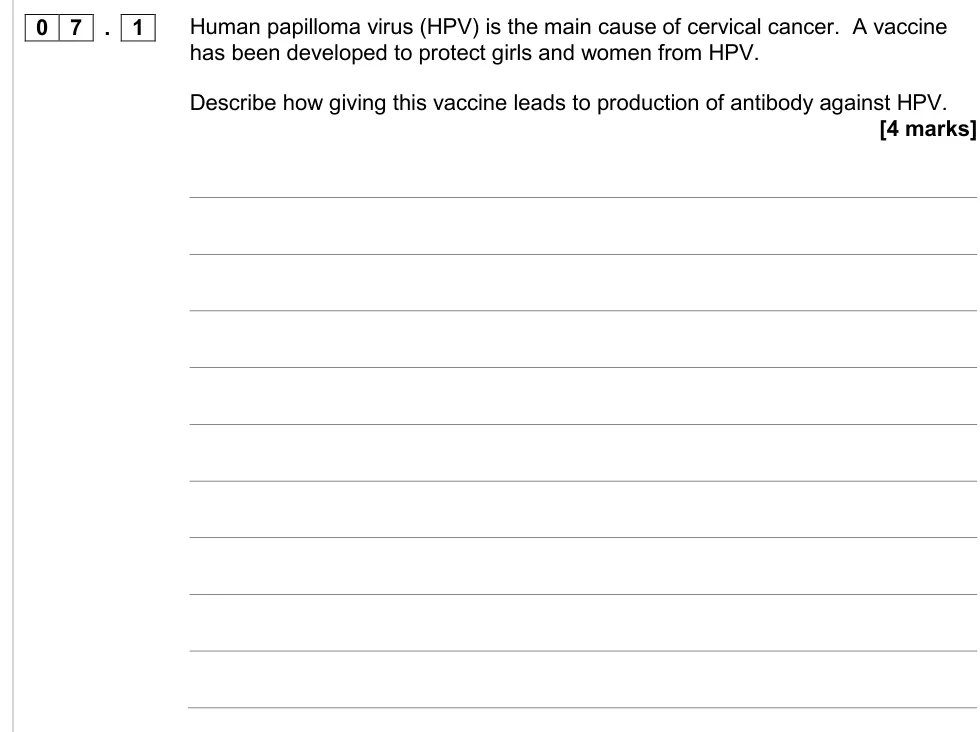
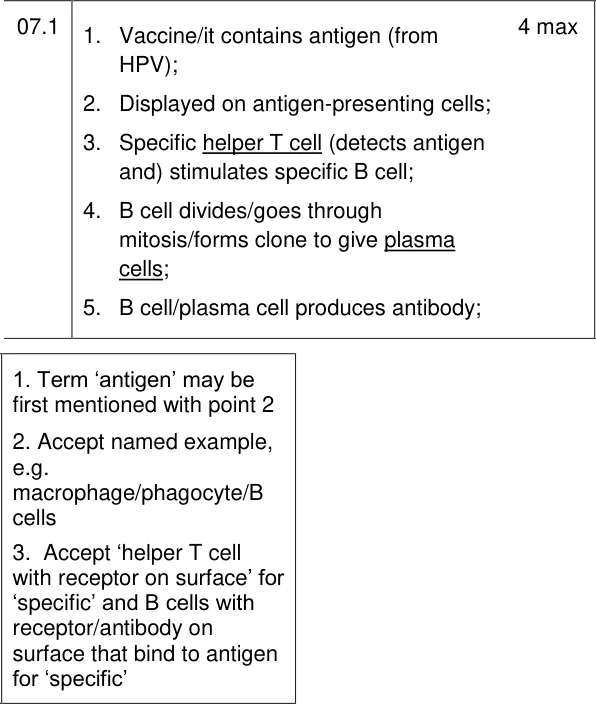
Describe how the HPV vaccine leads to the production of antibody against HPV.
Show the mark scheme
Tap an image to open it full size.
From the examiners' report: There's no examiners' report for this paper, so this tip comes from the mark scheme. Give the full sequence: antigen, antigen-presenting cell, specific helper T cell, specific B cell, mitosis to make plasma cells, antibody.
Question 6
A level Paper 3 · November 2020 · Q03.4 · 3 marks · Medium
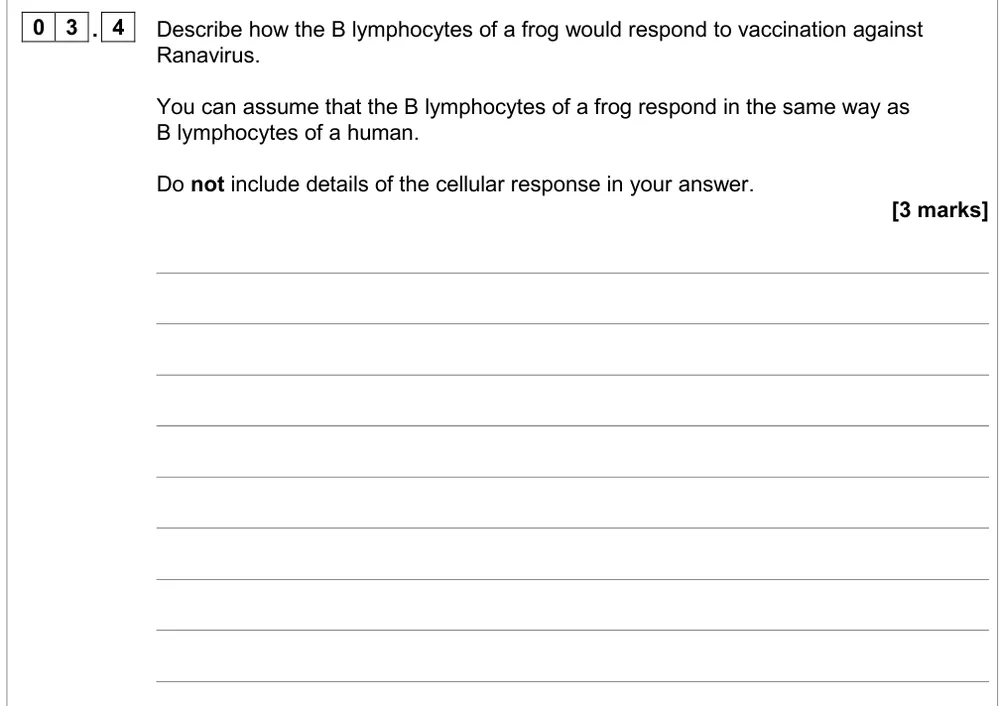
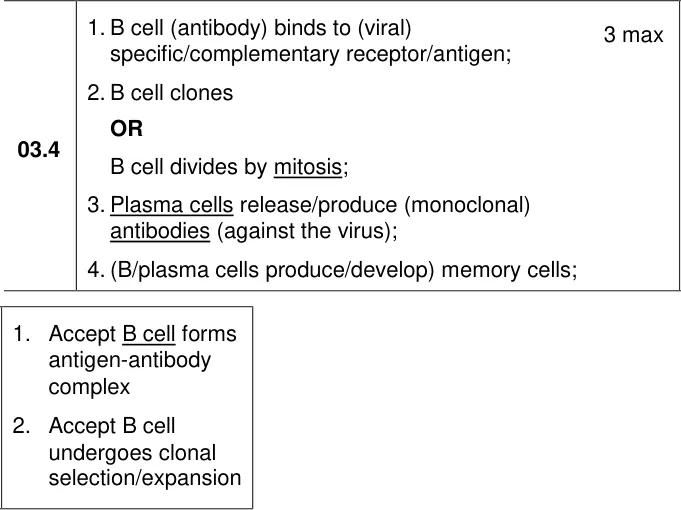
Describe how a frog's B lymphocytes would respond to vaccination against Ranavirus.
Information from earlier in this question:

Show the mark scheme
Tap an image to open it full size.
From the examiners' report: 37% got all three. Name plasma cells (not 'B cells') as the antibody makers, and B cells aren't macrophages. Most answers lost time describing T cells even though the question said not to.
Question 7
AS Paper 1 · June 2024 · Q07.1 · 2 marks
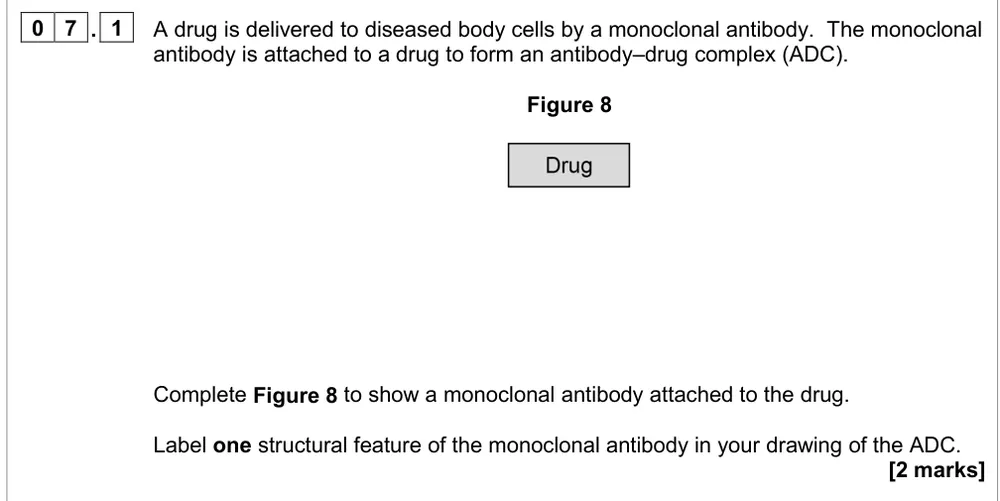
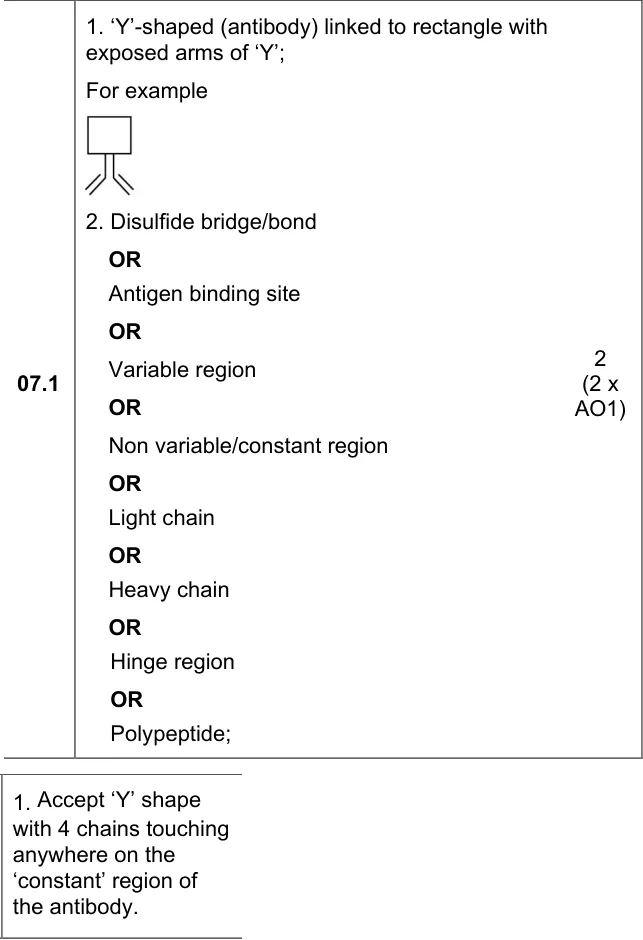
Draw a monoclonal antibody attached to a drug and label one structural feature.
Show the mark scheme
Tap an image to open it full size.
From the examiners' report: A plain Y wasn't enough: draw the two heavy and two light chains. Most attached the drug to an arm (the variable region), which is wrong; it goes on the constant region so the binding sites stay free. There's no active site or receptor to label.
Question 8
AS Paper 2 · June 2019 · Q04.1 · 2 marks
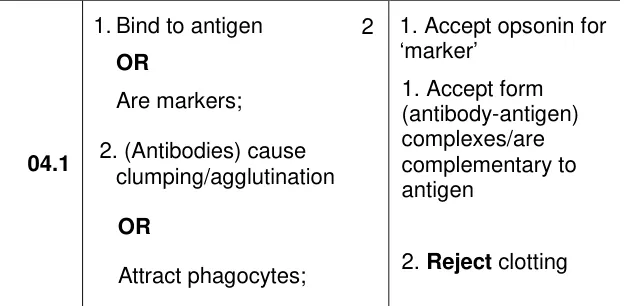
Describe and explain how antibodies stimulate phagocytosis.
Show the mark scheme
Tap an image to open it full size.
From the examiners' report: Antibodies bind to antigens to form antigen-antibody complexes, which clump the bacteria together (agglutination) and attract phagocytes. 'Signal', 'alert' or 'identify' didn't score, and antibodies have binding sites, not active sites.
Vaccines, immunity and antigen variability (3.2.4)
Question 9
A level Paper 1 · June 2018 · Q07.1 · 2 marks
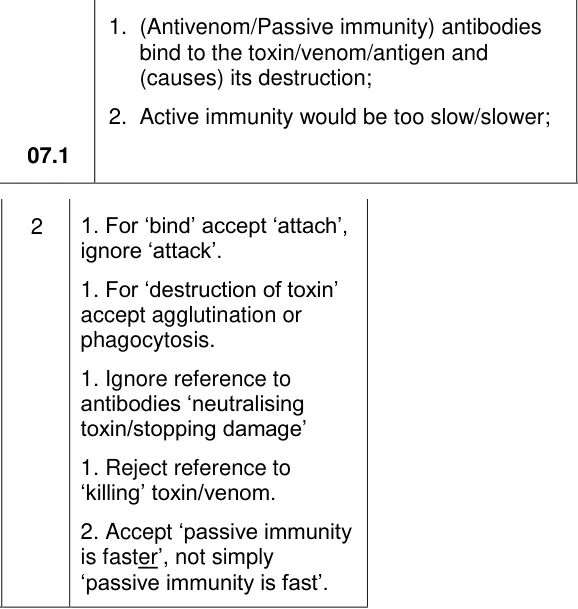
Explain how antivenom works and why passive, not active, immunity is needed.
Show the mark scheme
Tap an image to open it full size.
From the examiners' report: Only 28.1% got both marks. Say the antibodies bind to the toxin and lead to its destruction, then compare: active immunity would be too slow. Antivenom isn't a vaccine and doesn't trigger an immune response.
Question 10
AS Paper 1 · June 2022 · Q09.3 · 2 marks · Hard
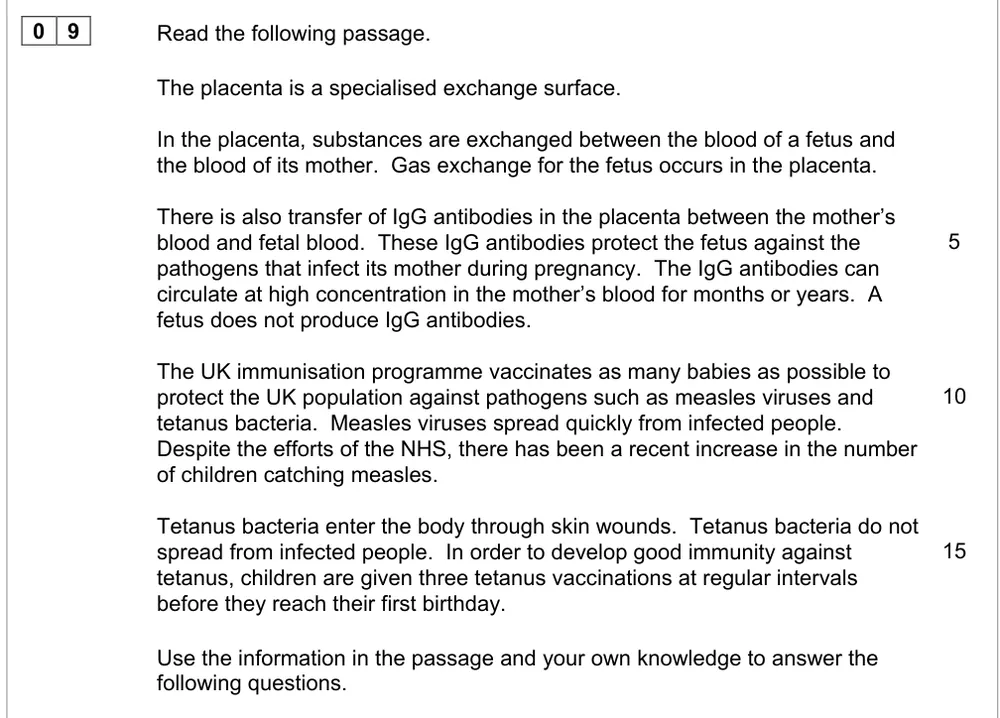
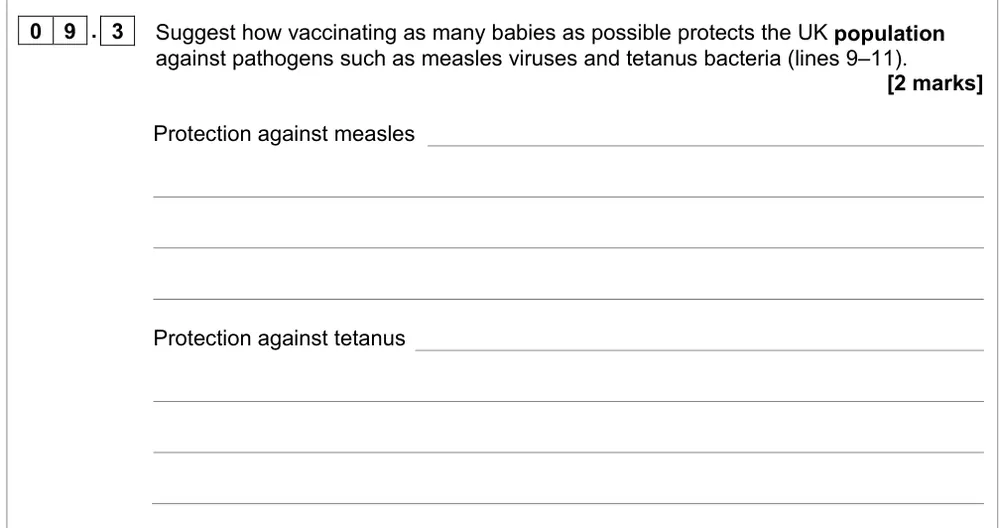
Suggest how vaccinating as many babies as possible protects the population against measles and tetanus.
Information from earlier in this question:
Show the mark scheme
Tap an image to open it full size.
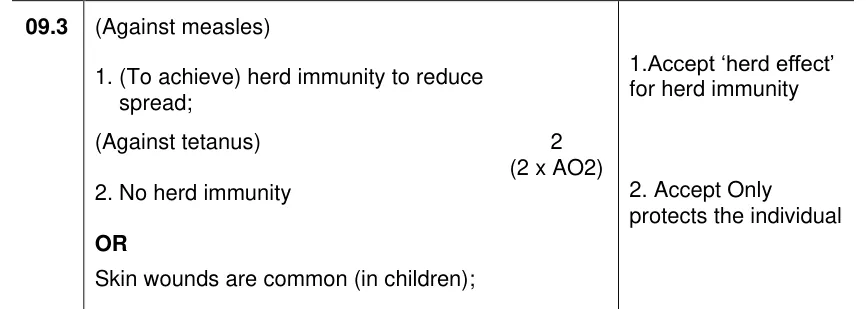
From the examiners' report: Only 42% scored. For measles say herd immunity reduces the spread. Tetanus doesn't spread between people, so there's no herd immunity: each vaccinated child is protected individually.
Question 11
AS Paper 1 · June 2022 · Q09.5 · 2 marks · Medium
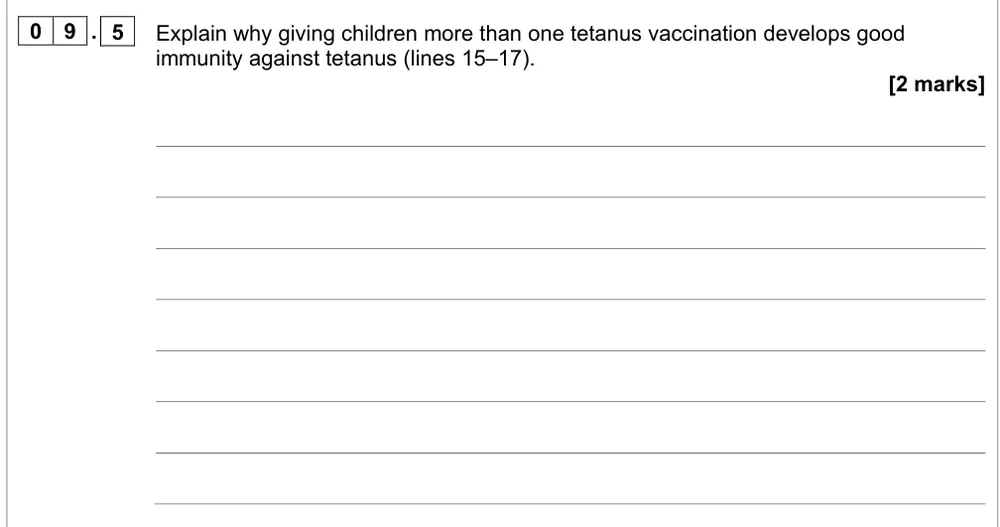
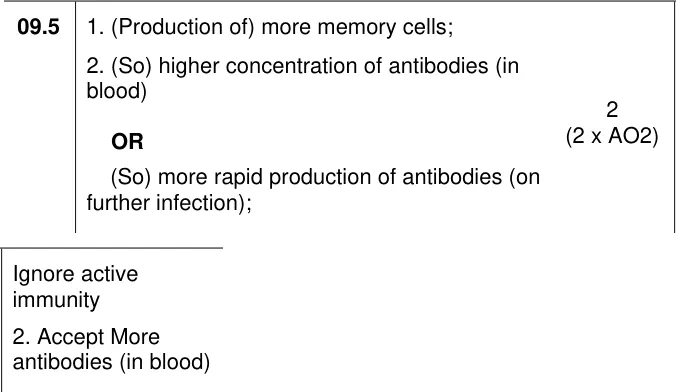
Explain why more than one tetanus vaccination gives good immunity.
Show the mark scheme
Tap an image to open it full size.
From the examiners' report: 'A stronger' or 'faster immune response' isn't enough. Say each dose makes more memory cells, so antibodies are made faster and in higher concentration if tetanus bacteria get in.
Question 12
A level Paper 3 · June 2024 · Q01.2 · 1 mark · Medium
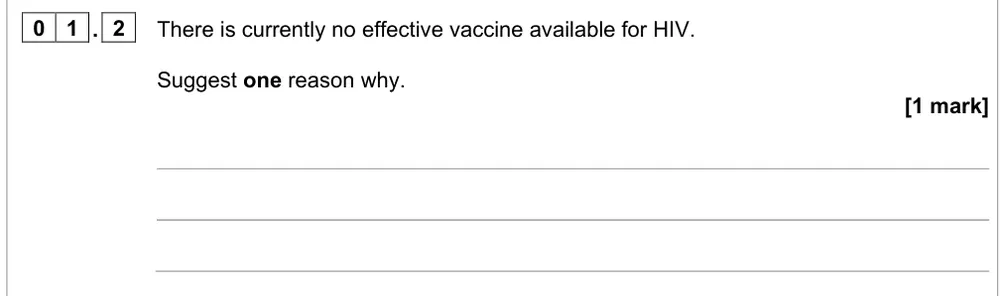
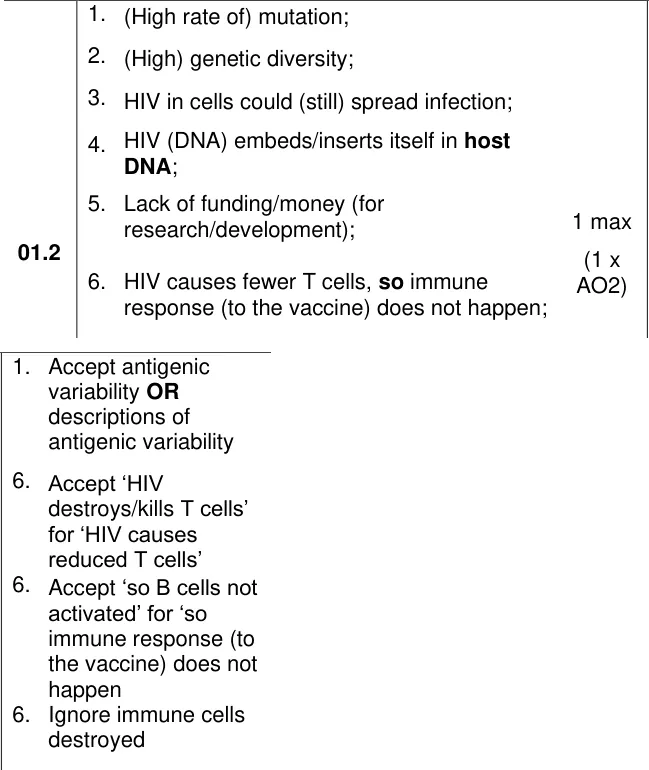
Suggest one reason why there is no effective vaccine for HIV.
Show the mark scheme
Tap an image to open it full size.
From the examiners' report: Just under half scored, mostly for antigenic variability: HIV mutates so often that its antigens change shape. Don't confuse vaccines with antibiotics by saying HIV has no cell wall.
HIV and AIDS (3.2.4)
Question 13
A level Paper 3 · June 2024 · Q01.3 · 2 marks · Easy
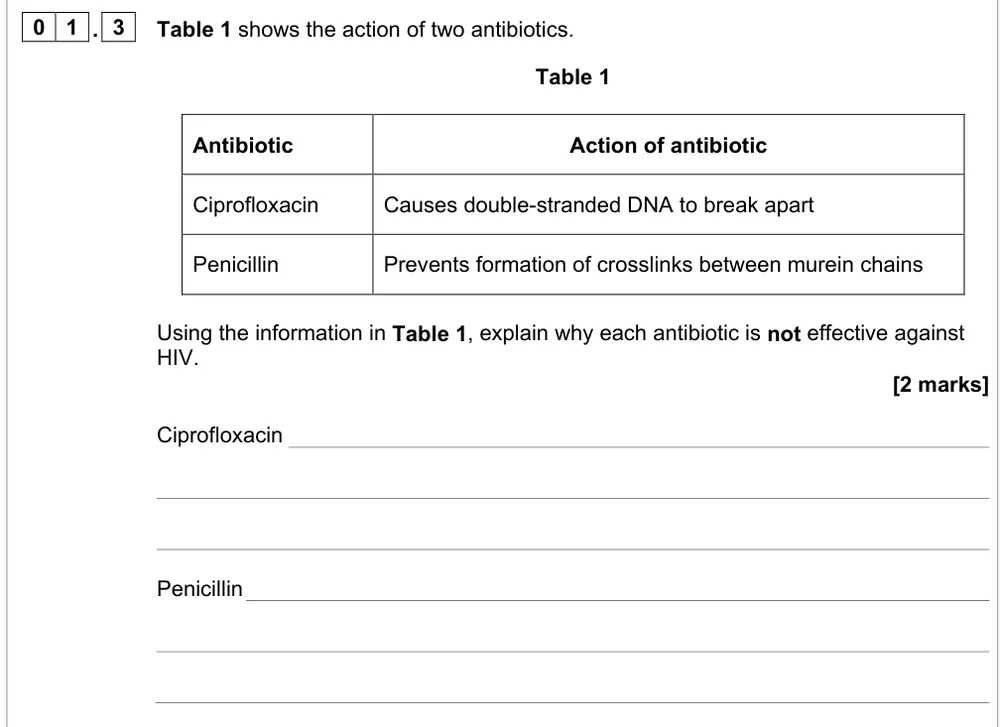
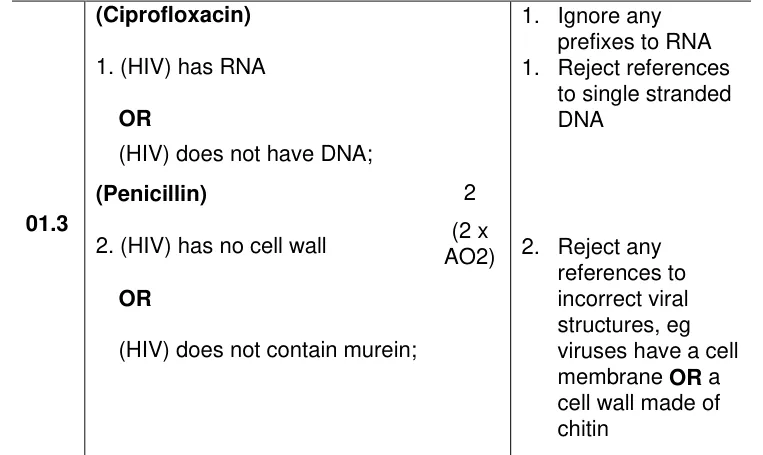
Use a table of antibiotic actions to explain why ciprofloxacin and penicillin don't work against HIV.
Show the mark scheme
Tap an image to open it full size.
From the examiners' report: Just over half got both marks. HIV's genetic material is RNA, not single-stranded DNA, and it has no cell wall of any kind, so don't give it a chitin wall or a cell membrane.
Question 14
A level Paper 3 · November 2021 · Q02.1 · 4 marks · Medium
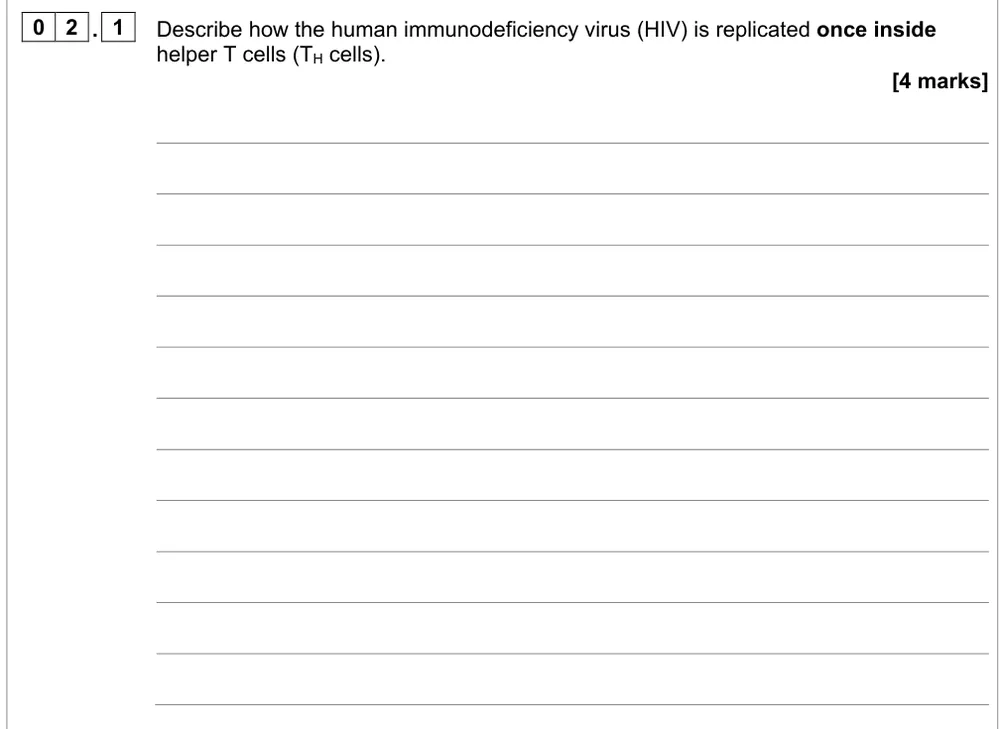
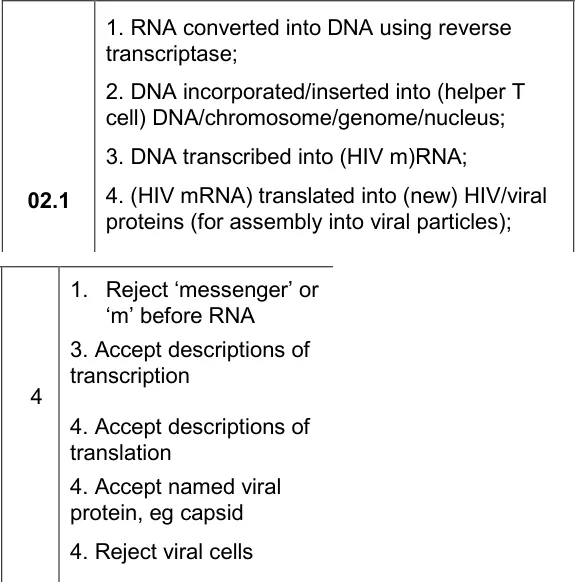
Describe how HIV is replicated once inside a helper T cell.
Show the mark scheme
Tap an image to open it full size.
From the examiners' report: Only 1.89% got full marks. Avoid vague phrases like 'uses the cell's machinery': name reverse transcriptase, insertion into the T cell's DNA, transcription to mRNA and translation into viral proteins.
Question 15
AS Paper 2 · June 2025 · Q08.1 · 3 marks · Medium
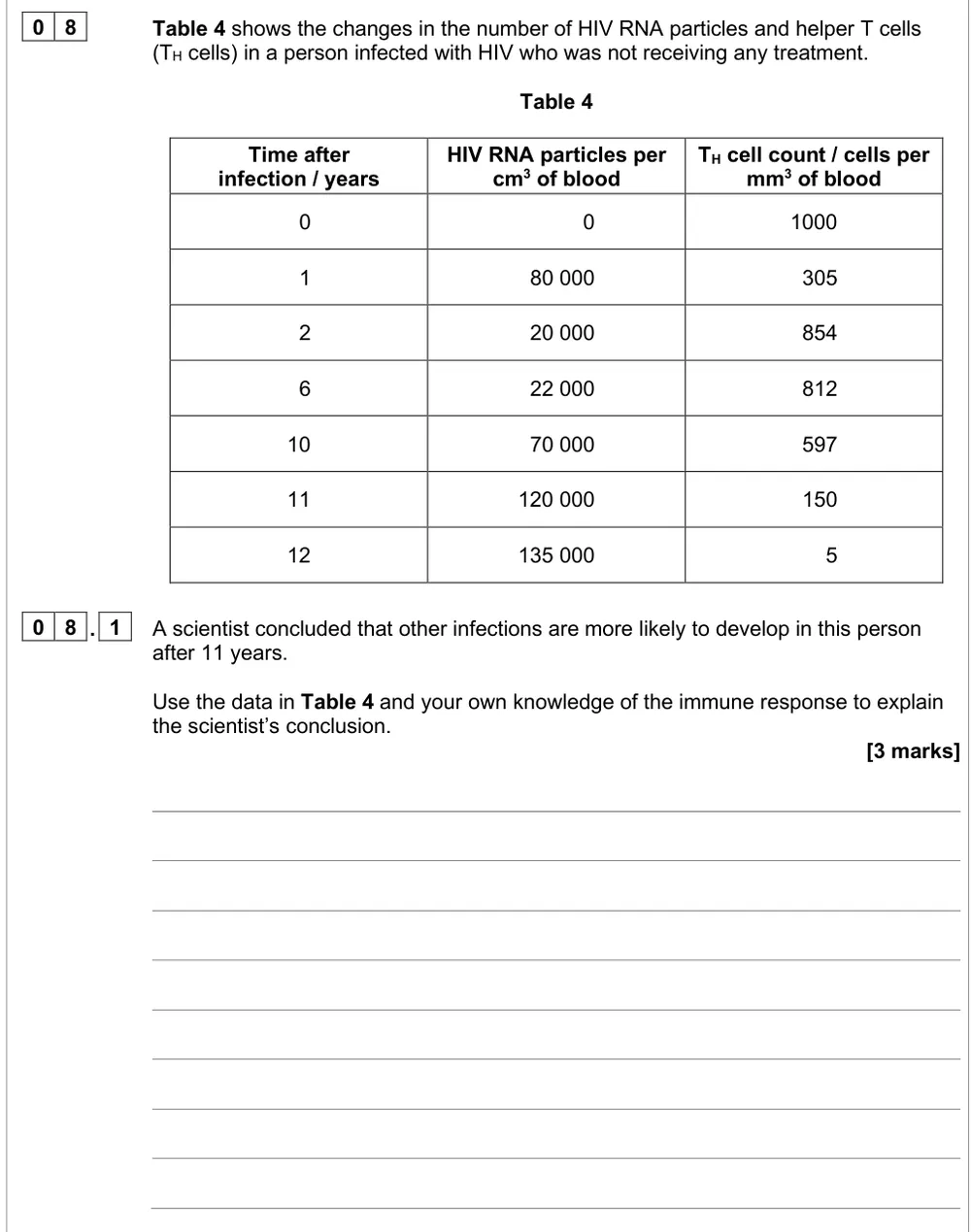
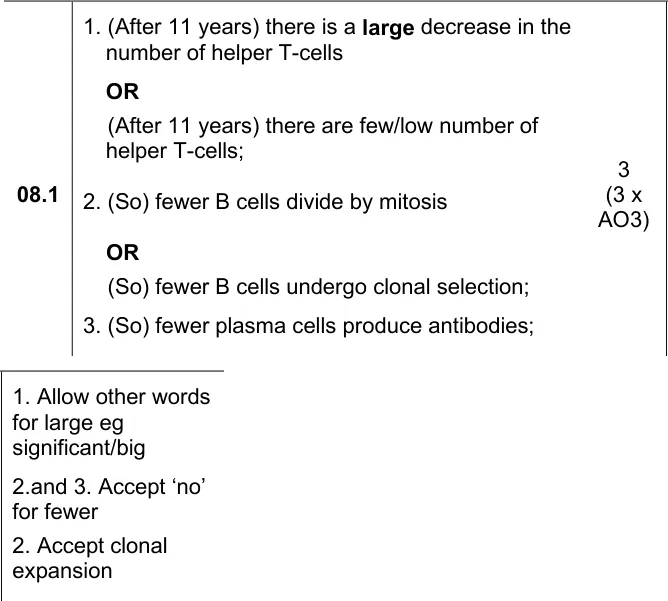
Use HIV and helper T cell counts to explain why other infections are likely after 11 years.
Show the mark scheme
Tap an image to open it full size.
From the examiners' report: Under 5% got all three. Don't just quote 150 or 5: say the helper T cell count has fallen to a very low level, then that fewer B cells divide (clonal selection) and fewer plasma cells make antibodies.
Monoclonal antibodies and ELISA (3.2.4)
Question 16
AS Paper 2 · June 2022 · Q03.3 · 3 marks · Hard
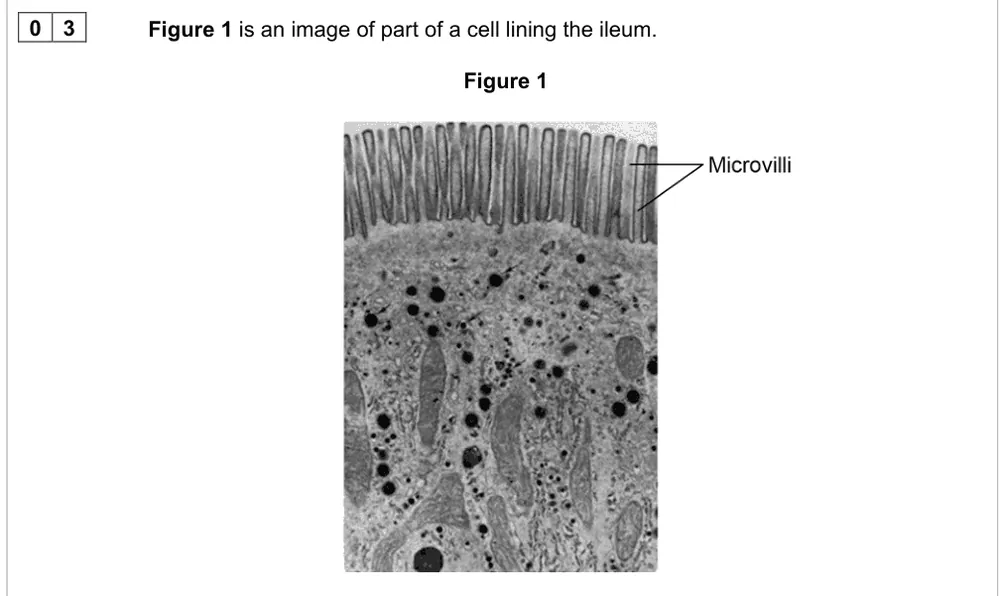
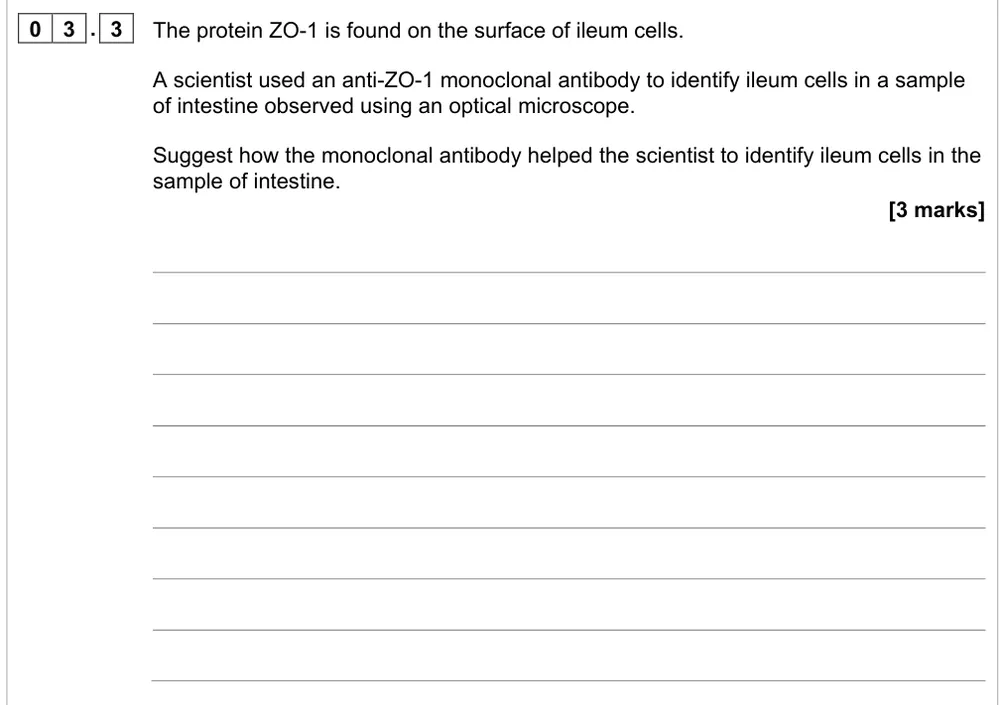
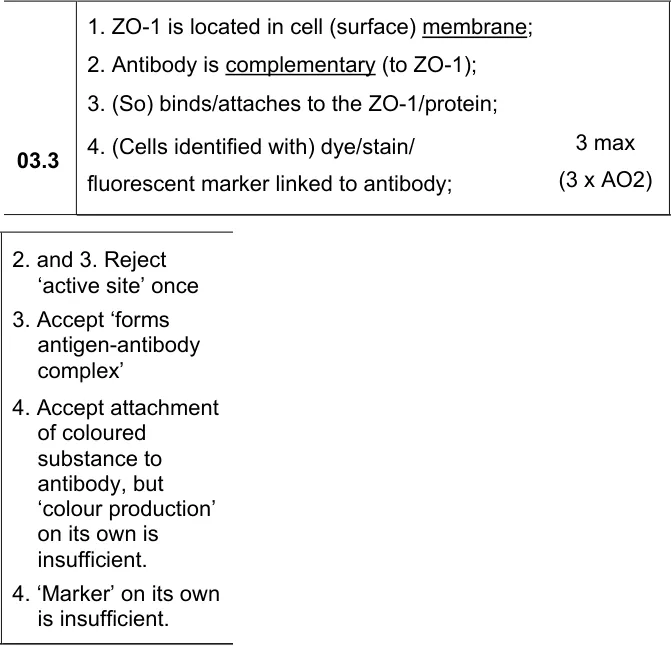
Suggest how an anti-ZO-1 monoclonal antibody helped a scientist identify ileum cells.
Information from earlier in this question:
Show the mark scheme
Tap an image to open it full size.
From the examiners' report: Only 8% got full marks. Say the antibody is complementary to ZO-1 so it binds to it, and that it carries a dye or fluorescent marker you can see. 'Colour' or 'marker' on its own isn't enough, and there's no active site.
Question 17
AS Paper 2 · June 2024 · Q08.1 · 2 marks · Hard
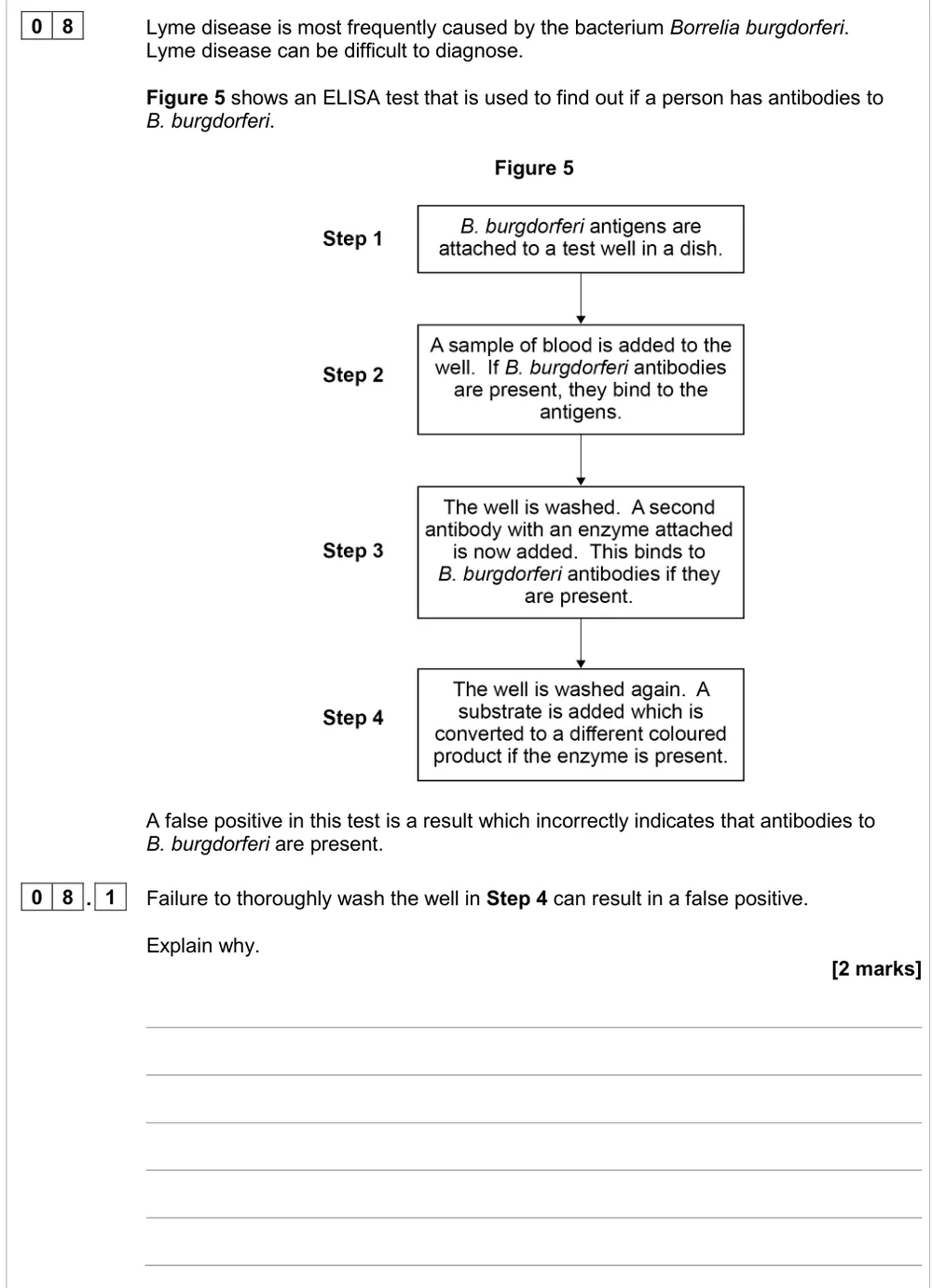
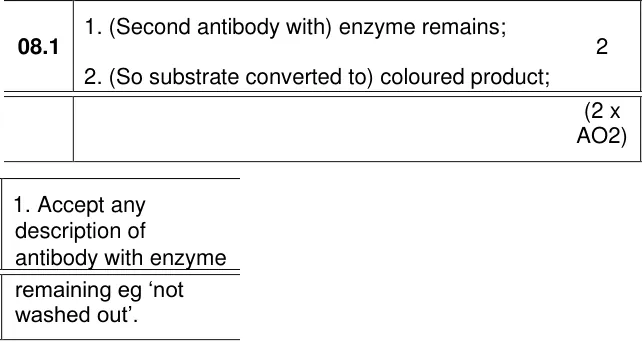
Explain why failing to wash the well in an ELISA test for Lyme disease can give a false positive.
Show the mark scheme
Tap an image to open it full size.
From the examiners' report: Stick to the steps: unbound second antibody with its enzyme is left behind, so it turns the substrate into the coloured product even with no Lyme antibodies present. It's nothing to do with contamination by other bacteria.
Evaluating vaccine use (3.2.4)
Question 18
AS Paper 1 · June 2023 · Q06.4 · 4 marks · Hard
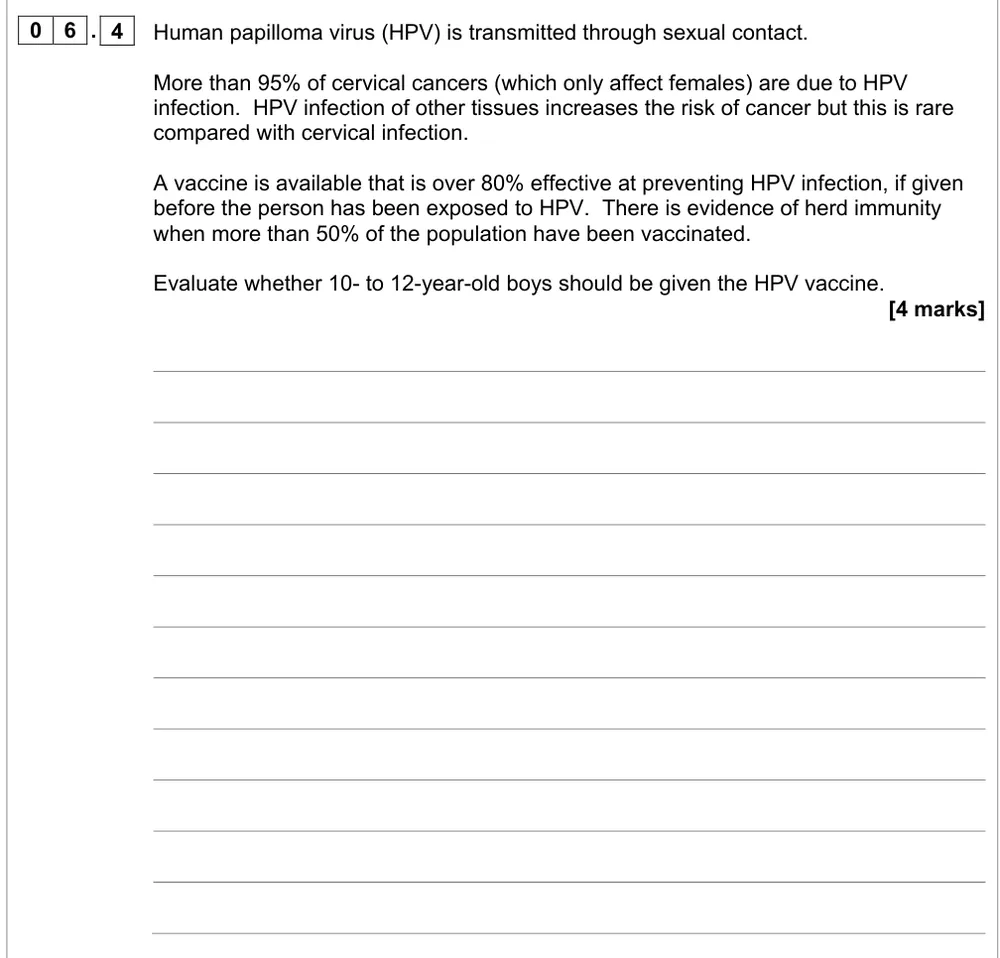
Evaluate whether 10- to 12-year-old boys should be given the HPV vaccine.
Show the mark scheme
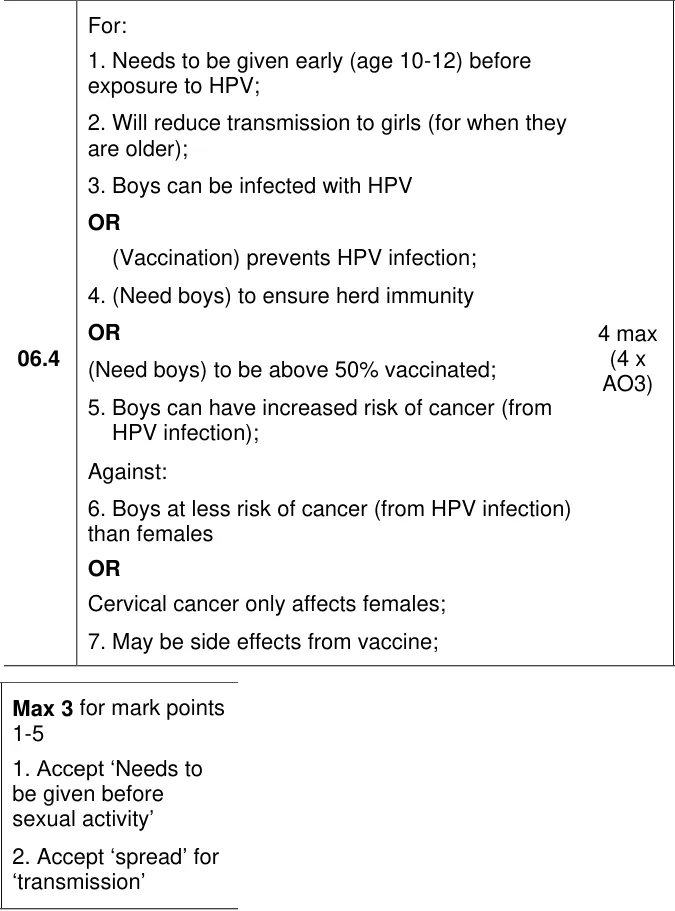
Tap an image to open it full size.
From the examiners' report: Give both sides and use the figures: vaccinating before sexual activity, cutting transmission to girls and reaching the 50% for herd immunity, against a lower cancer risk for boys and possible side effects. 'Not 100% effective' isn't a reason to refuse it.
Where students lose marks (from AQA examiners' reports and mark schemes)
Each point below is followed by wording that gained marks.
Cells that trigger a response, not cells that respond: Just over half scored nothing for two types of cell that stimulate an immune response because they named B cells and T cells. In an earlier paper, many named pathogens when the question excluded them.
✔ Gains credit: "Pathogens; cells from other organisms of the same species; abnormal body cells (cancer cells)" and "(cells from) other organisms/transplants; abnormal/cancer cells; cells infected by virus".
Lysosomes fuse, lysozymes digest: Examiners asked for correct terms in phagocytosis: some wrote of vacuoles rather than vesicles, or confused lysosomes with lysozymes.
✔ Gains credit: "Engulfs; forming a vesicle/phagosome which fuses with a lysosome; enzymes (lysozymes) digest/hydrolyse."
Antibodies have binding sites, not active sites: References to an antibody's 'active site' lost marks across several questions, and 'signal', 'identify' or 'alert' phagocytes gained nothing. Only 8% got full marks for the ZO-1 monoclonal antibody question.
✔ Gains credit: "Bind to antigen/form antigen-antibody complexes; cause clumping/agglutination; attract phagocytes" and "antibody is complementary to ZO-1, so binds to it".
Plasma cells make the antibodies: In the gap-fill passage, 'B cell' was a common wrong answer for the cells that make and release antibodies, and in the Ranavirus question errors included not naming plasma cells.
✔ Gains credit: "Plasma (cells)" and "B cell divides by mitosis; plasma cells release antibodies; memory cells."
Passive immunity is faster, so say it: Only 28.1% explained antivenom fully. Some described binding without destruction, some wrote 'complementary' instead of binding, some said active immunity just 'takes time', and some treated antivenom as a vaccine.
✔ Gains credit: "Antibodies bind to the toxin and cause its destruction; active immunity would be too slow."
No herd immunity against tetanus: Only 42% scored on vaccinating babies. Many claimed herd immunity for tetanus, which doesn't spread between people, or explained how vaccines work in general.
✔ Gains credit: "Measles: herd immunity reduces spread. Tetanus: no herd immunity; it only protects the individual."
More doses, more memory cells: For several tetanus doses, answers about a 'stronger' or 'faster immune response' lacked the detail of memory cells and antibodies.
✔ Gains credit: "More memory cells; so a higher concentration/more rapid production of antibodies."
HIV has RNA and no cell wall: Just over half explained why two antibiotics don't affect HIV. Errors included HIV having single-stranded DNA, a chitin cell wall or a cell membrane. In another paper only a quarter said why antibiotics don't work on viruses; many said viruses 'hide inside cells'.
✔ Gains credit: "(HIV) has RNA, not DNA; (HIV) has no cell wall/does not contain murein."
Download the questions
Download the PDF pack (18 questions, mark schemes at the end)
Keep practising
- Prokaryotic cells and viruses: AQA A Level Biology exam questions by topic
- Proteins: AQA A Level Biology exam questions by topic
- Eukaryotic cell structure: AQA A Level Biology exam questions by topic
- Mastering AQA A Level Biology 3.4.2: DNA and protein synthesis
- AQA A Level Biology masterclasses
Questions, mark schemes and examiners' report extracts © AQA.