

Populations in ecosystems (AQA 3.7.4) is A-level only, so it's Year 13 content. It covers communities, niches and carrying capacity; how abiotic factors, competition and predation change the size of a population; estimating population size with quadrats and mark-release-recapture; succession from pioneer species to climax community; and conservation.
Many of the ideas feel familiar, but the examiners' reports show how precise you need to be. Only about 10% got both marks on the sterile mosquito question, because answers left out competition. Fewer than 7% got full marks for finding mean percentage cover, mostly by not using a large number of randomly placed quadrats. In succession answers students write 'organisms' and 'more habitable' where the mark schemes want species and 'less hostile', and on the coral reef data more than half read the P values the wrong way round.
Work through the groups in order: the key terms first, then population size, sampling, succession and conservation. For the method and evaluation questions, use every piece of information you're given, because the marks go to points tied to the context. If you'd like help with this topic, my AQA masterclasses run online on Tuesdays at 5.15pm for Year 12 and on Wednesdays or Thursdays at 6.30pm for Year 13.
Want help with this topic? It comes up in my weekly AQA masterclasses. See the timetable →
What you need from GCSE and Year 12
Each question on this page assumes you're secure on these GCSE and Year 12 ideas. If any of them feels shaky, revise it before you start.
- GCSE: a community is all the populations of different species in a habitat, and an ecosystem is a community together with its abiotic (non-living) parts.
- GCSE: quadrats and transects are used to sample plants, and random sampling avoids bias.
- Year 12 (AQA 3.4.6): species richness and the index of diversity measure the biodiversity of a community.
- Year 13 (AQA 3.5.4): plants absorb nitrates and phosphates to make proteins, DNA, RNA and ATP.
- Year 13 (AQA 3.7.3): predation, disease and competition cause differential survival and reproduction.
Key terms
These words come up in the questions and mark schemes. Examiners expect you to use them exactly.
- Community: the populations of different species living in the same place at the same time.
- Ecosystem: a community and the non-living components of its environment.
- Niche: the role of a species within its habitat, governed by its adaptation to both abiotic and biotic conditions.
- Carrying capacity: the size of population of a species that an ecosystem can support.
- Abiotic factor: a non-living condition such as light, temperature, oxygen concentration or water flow.
- Interspecific competition: competition between individuals of different species for the same resources.
- Intraspecific competition: competition between individuals of the same species, for example for mates, food or space.
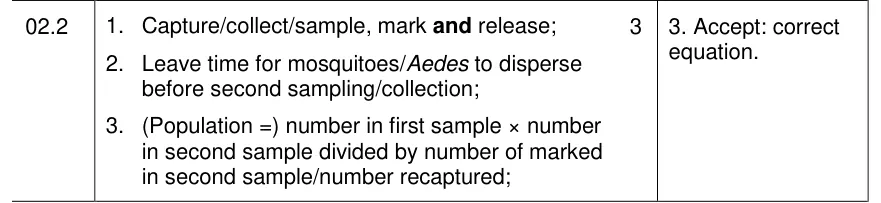
- Mark-release-recapture: capture, mark and release a sample, allow time to disperse, then estimate population = number in first sample × number in second sample ÷ number marked in second sample.
- Pioneer species: the first species to colonise; they change the abiotic environment so it becomes less hostile for other species.
- Climax community: the final, stable community at the end of succession.
What these questions cover (AQA 3.7.4)
The questions test these statements from the AQA AS and A-level Biology specification (7401/7402):
- Communities and ecosystems: Populations of different species form a community. A community and the non-living components of its environment together form an ecosystem. Ecosystems can range in size from the very small to the very large. (the gap-fill question asks for the word community; no question asks you to define an ecosystem)
- Niche: Within a habitat, a species occupies a niche governed by adaptation to both abiotic and biotic conditions. (the gap-fill question asks for the word niche, and the ibex question uses overlap in food and habitat)
- Carrying capacity: An ecosystem supports a certain size of population of a species, called the carrying capacity. This population size can vary as a result of:
- Population size can vary as a result of: the effect of abiotic factors
- Population size can vary as a result of: interactions between organisms: interspecific and intraspecific competition and predation.
- Estimating population size: randomly placed quadrats, or quadrats along a belt transect, for slow-moving or non-motile organisms
- Estimating population size: the mark-release-recapture method for motile organisms. The assumptions made when using the mark-release-recapture method.
- Primary succession: Primary succession, from colonisation by pioneer species to climax community.
- How each stage changes the environment: At each stage in succession, certain species may be recognised which change the environment so that it becomes more suitable for other species with different adaptations. The new species may change the environment in such a way that it becomes less suitable for the previous species.
- Less hostile environments and biodiversity: Changes that organisms produce in their abiotic environment can result in a less hostile environment and change biodiversity.
- Conservation and succession: Conservation of habitats frequently involves management of succession.
- Human needs and conservation: show understanding of the need to manage the conflict between human needs and conservation in order to maintain the sustainability of natural resources
- Evaluating conservation evidence: evaluate evidence and data concerning issues relating to the conservation of species and habitats and consider conflicting evidence (the woodland bird evaluation in the bank can't be used because its figures were removed for copyright; the coral reef and power station evaluations practise the same skill)
- Mark-release-recapture calculations: use given data to calculate the size of a population estimated using the mark-release-recapture method. (the lemur question gives the sample numbers but asks about marking; for the calculation itself, see the required practicals 10 and 12 page)
How to use this page
Write your answer on paper before you open the mark scheme. Allow about 1.3 minutes per mark: the 18 questions are worth 48 marks, so about 62 minutes in total. Then mark your answer strictly against the mark scheme and read the examiners' tip underneath it. If you'd rather print the questions, download the PDF pack.
Communities, niches and carrying capacity (3.7.4)
Question 1
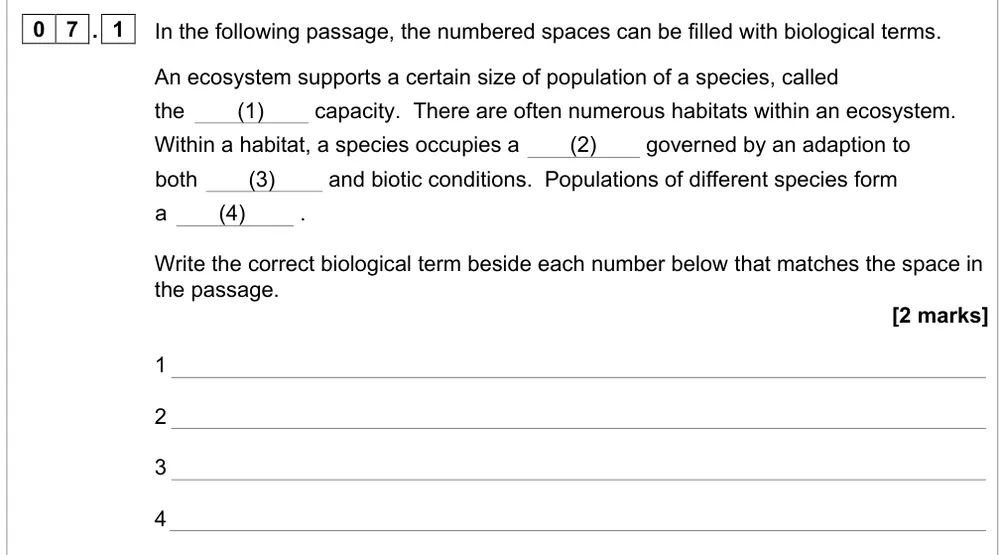
A level Paper 2 · June 2023 · Q07.1 · 2 marks · Easy
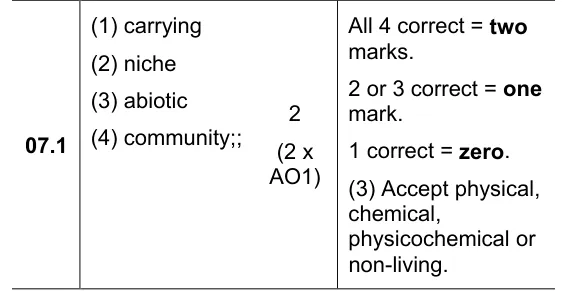
Fill four gaps on carrying capacity, niche, abiotic conditions and community.
Show the mark scheme
Tap an image to open it full size.
From the examiners' report: 40% got both marks. 'Carrying' capacity caused most trouble ('maximum' was common), and 'habitat' or 'population' often replaced niche.
What changes the size of a population (3.7.4)
Question 2
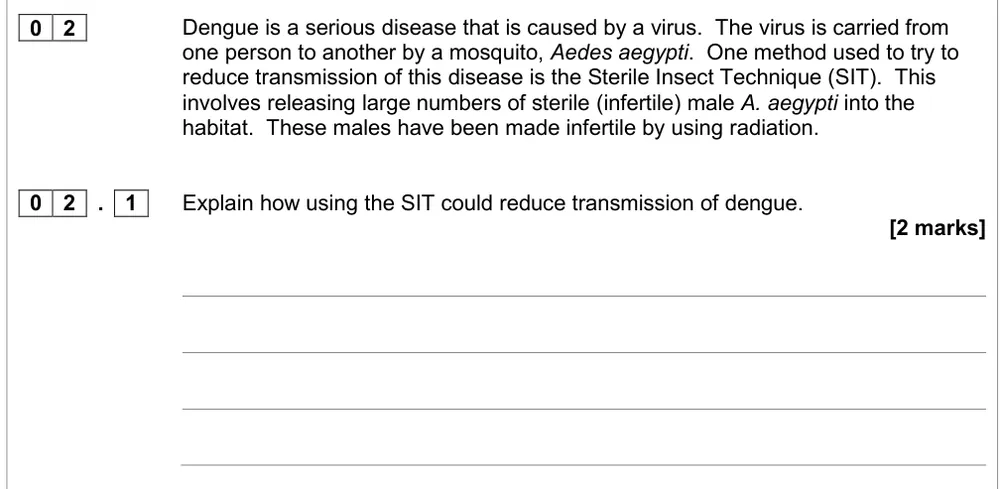
A level Paper 2 · June 2017 · Q02.1 · 2 marks · Hard
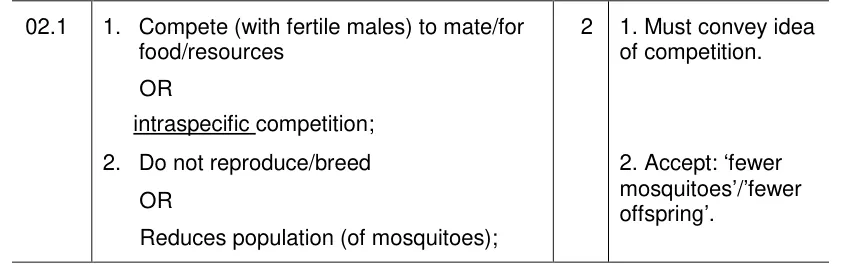
Explain how releasing sterile male mosquitoes could reduce dengue transmission.
Show the mark scheme
Tap an image to open it full size.
From the examiners' report: Only about 10% got both. Name the competition with fertile males for mates as well as the drop in offspring; being infertile doesn't stop a male carrying the virus.
Question 3
A level Paper 2 · June 2017 · Q02.4 · 1 mark · Hard
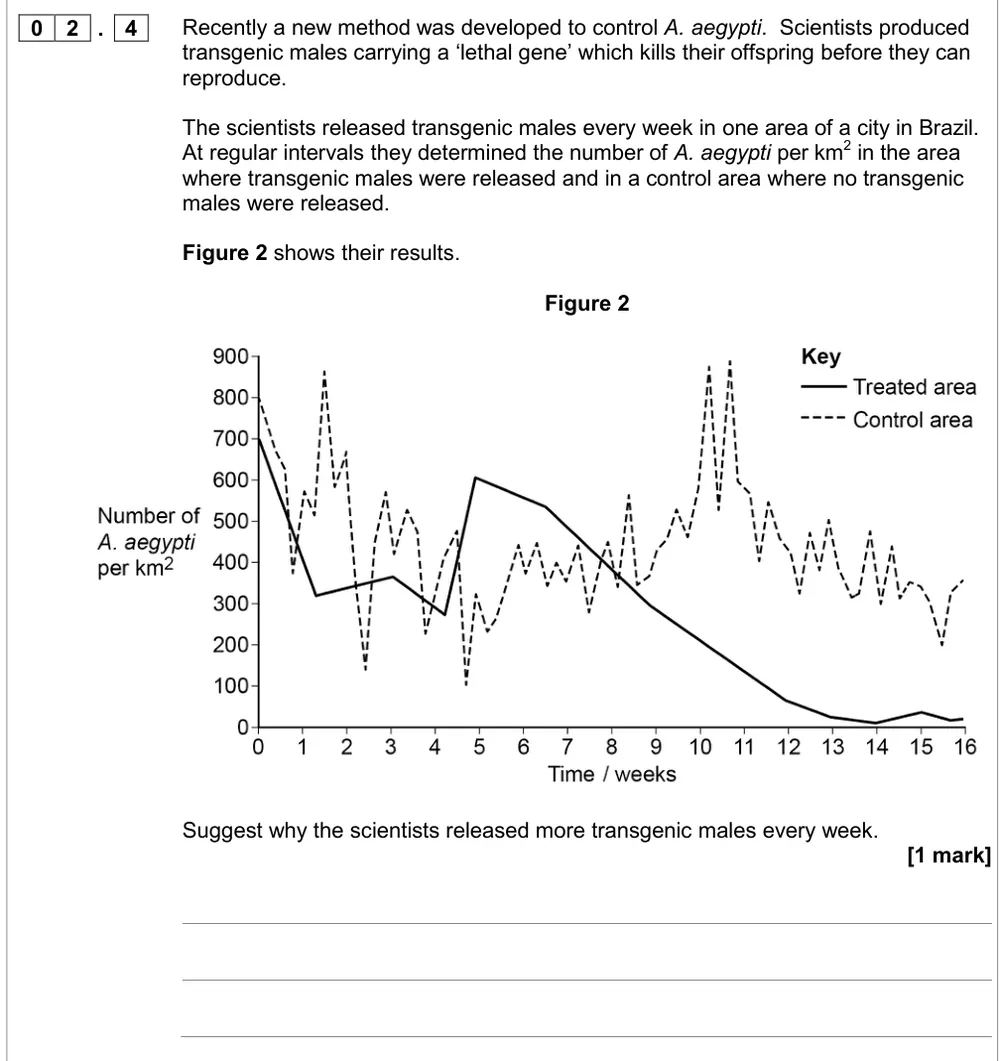
Suggest why transgenic males were released every week.
Show the mark scheme

Tap an image to open it full size.
From the examiners' report: About a third got this. Say why their dying matters: the number of transgenic males competing for females has to be kept up.
Question 4
A level Paper 2 · June 2024 · Q05.2 · 3 marks · Medium
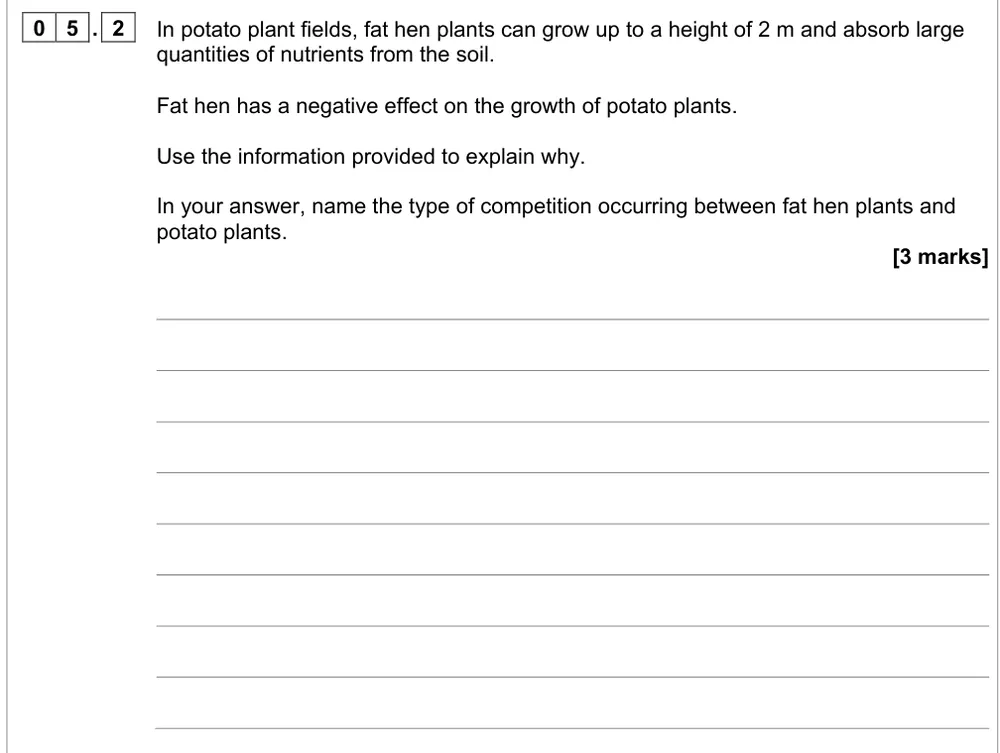
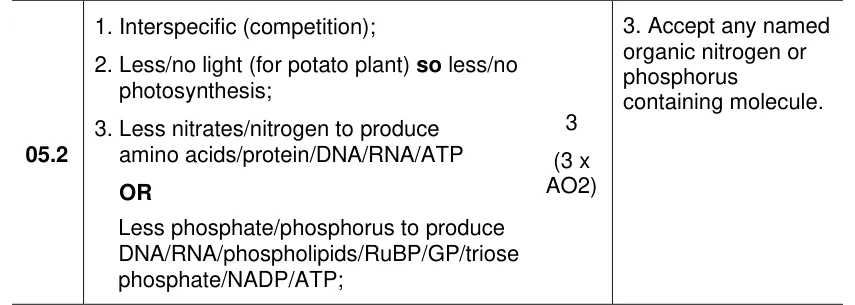
Explain why fat hen reduces potato growth, naming the type of competition.
Show the mark scheme
Tap an image to open it full size.
From the examiners' report: About 10% got all three. Say interspecific, then link each resource to a process: shading means less photosynthesis, and fewer nitrates mean less protein or DNA.
Question 5
AS Paper 1 · June 2019 · Q04.4 · 2 marks
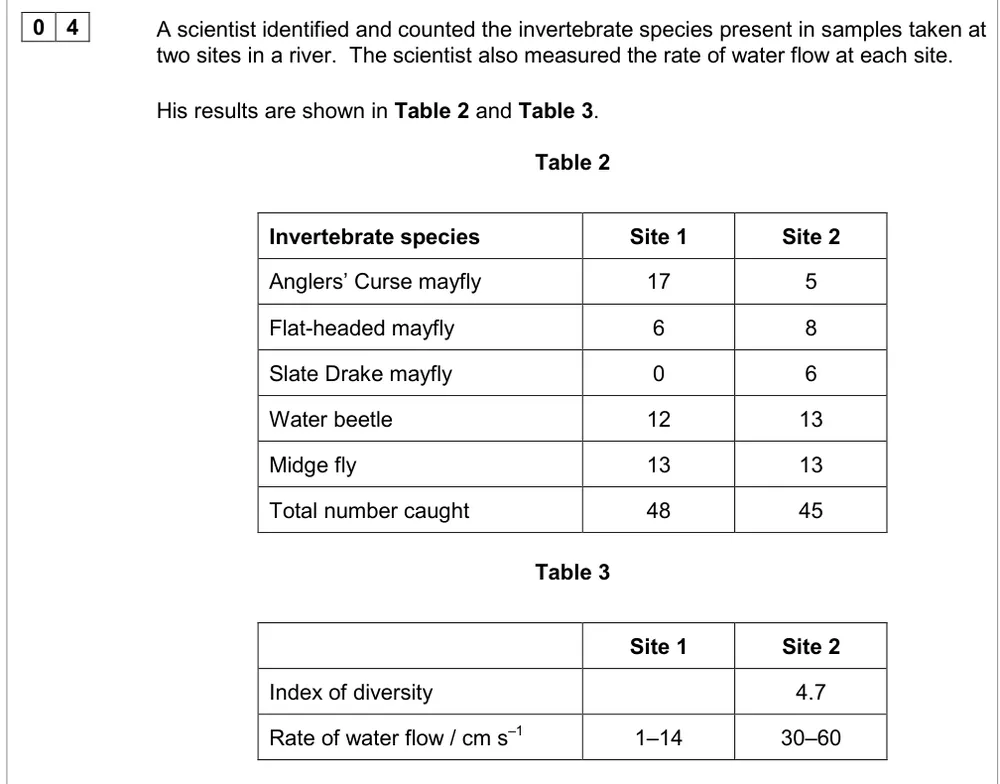
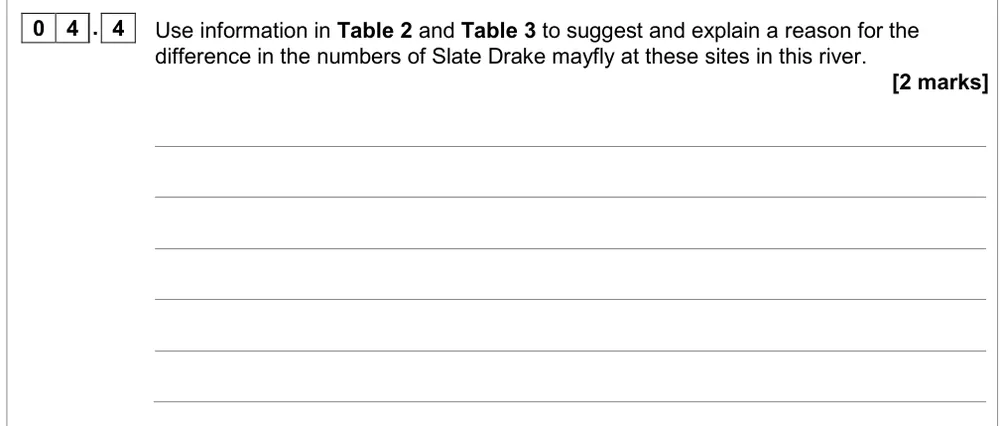
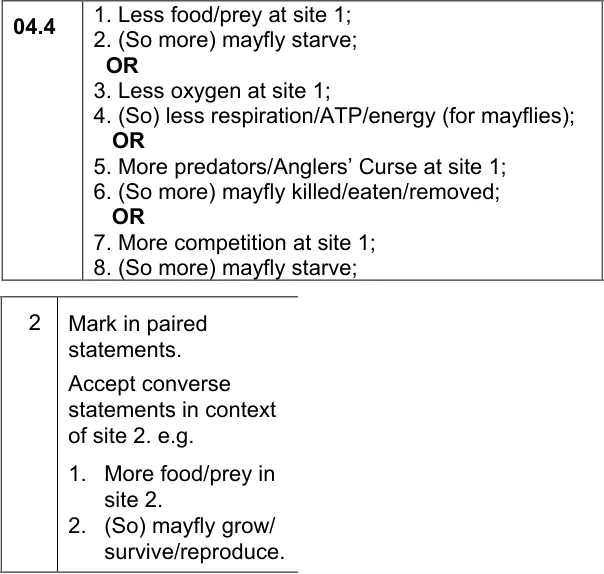
Suggest why there were no Slate Drake mayflies at one river site.
Information from earlier in this question:
Show the mark scheme
Tap an image to open it full size.
From the examiners' report: No examiners' report comment. Marks come in pairs, so give a cause from the tables (slow water, less oxygen, or more Anglers' Curse) and then its effect on the mayflies.
Question 6
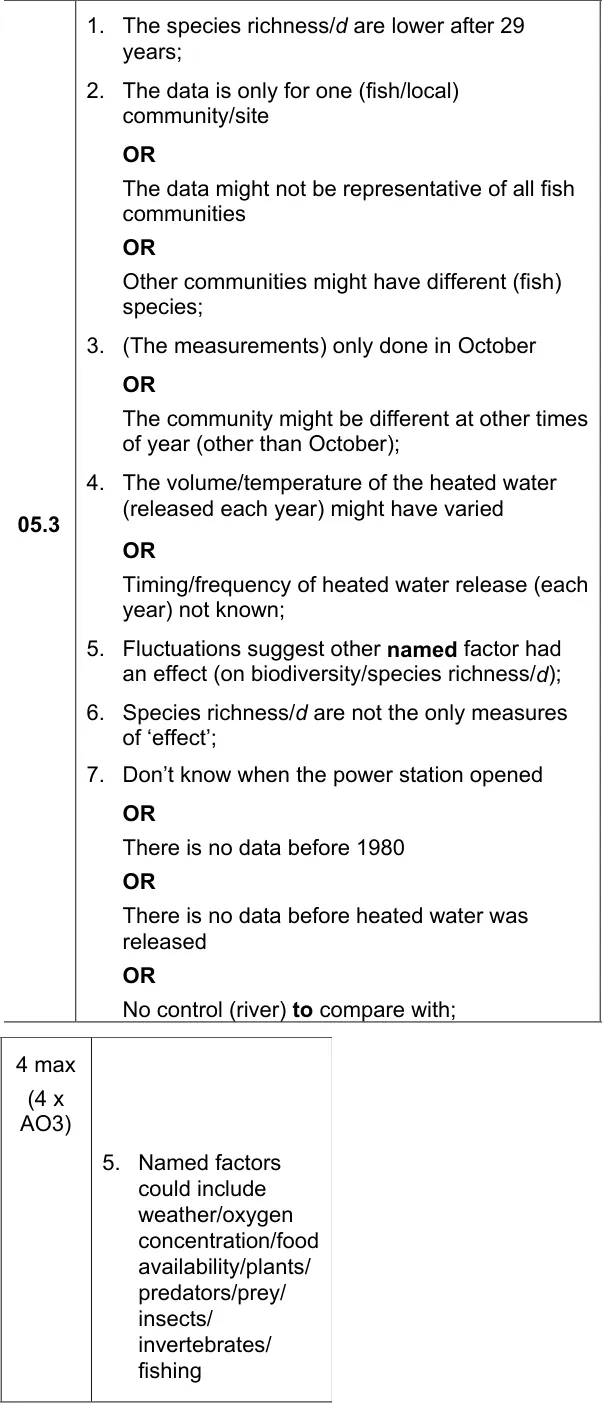
A level Paper 3 · June 2023 · Q05.3 · 4 marks · Medium
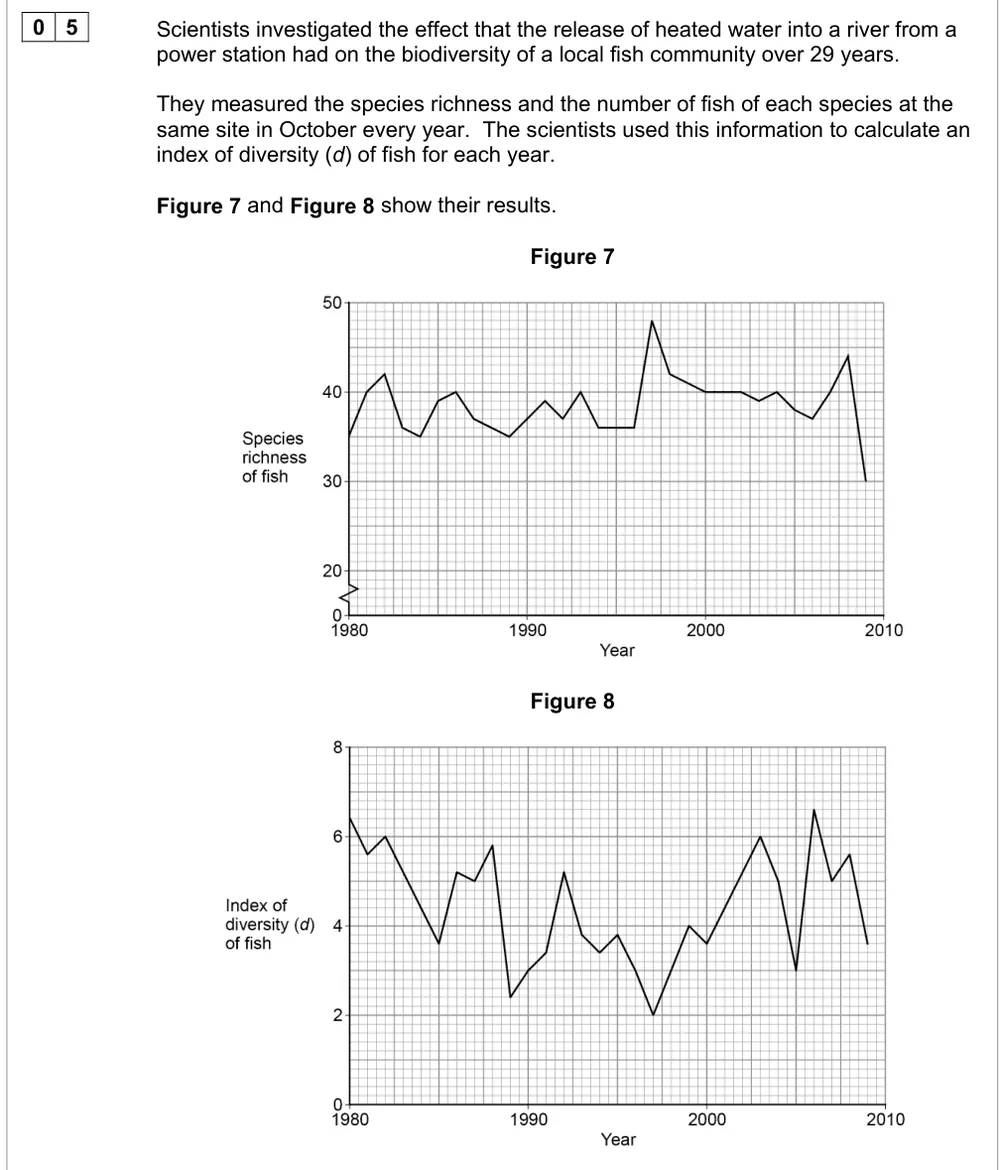
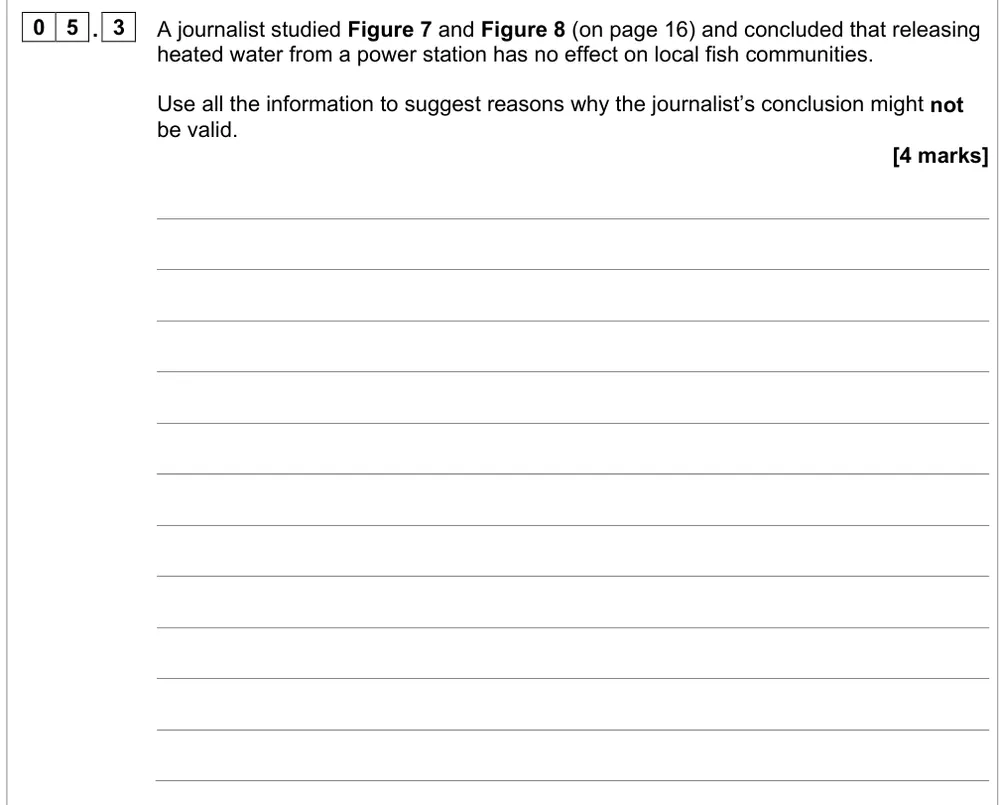
Suggest why heated power station water might affect a fish community after all.
Information from earlier in this question:
Show the mark scheme
Tap an image to open it full size.
From the examiners' report: Only 1% got all four. Rote phrases like 'no sample size', 'no stats test' or '29 years isn't long enough' didn't score; use the figures, the October sampling and the missing data before 1980.
Question 7
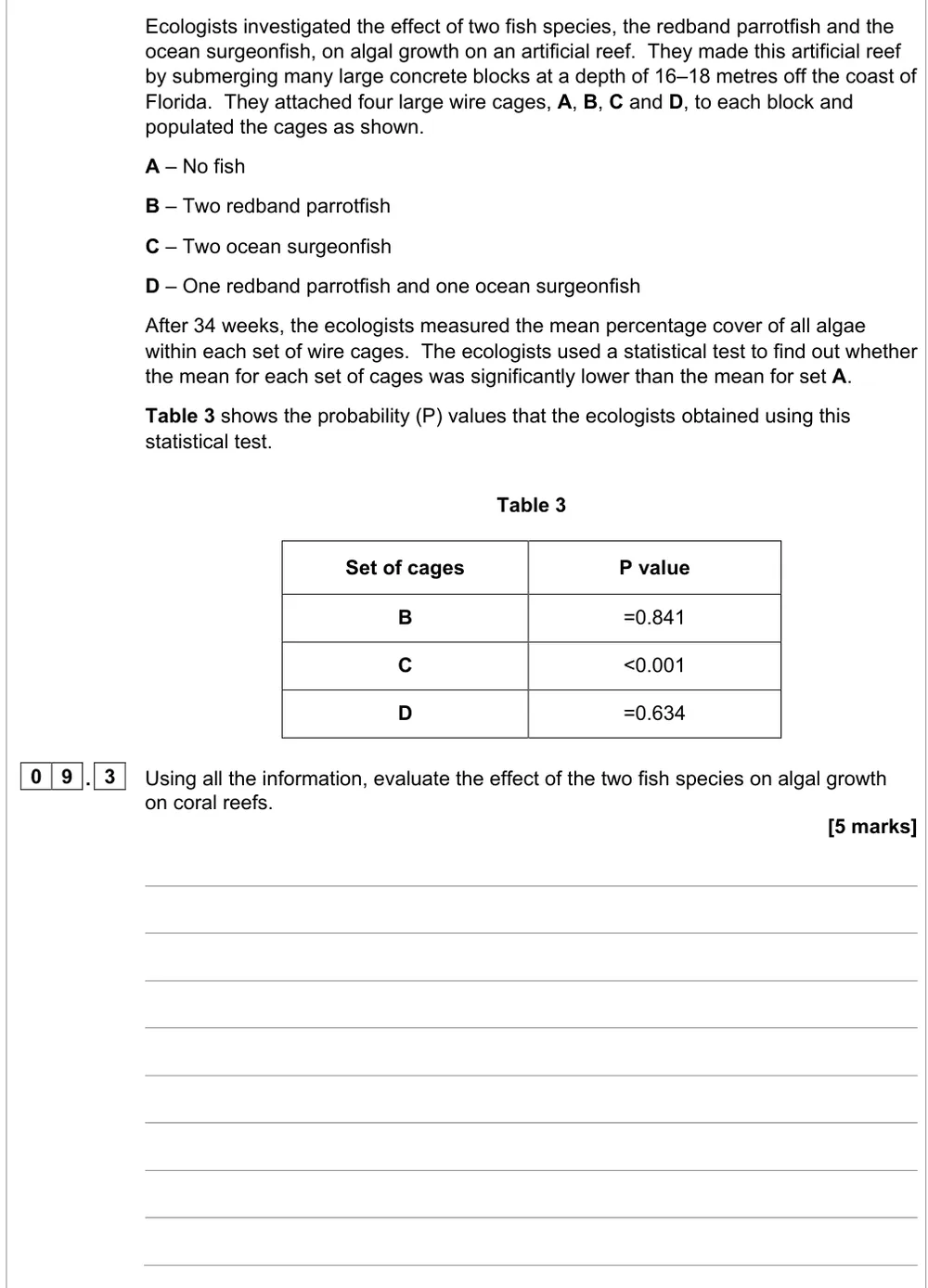
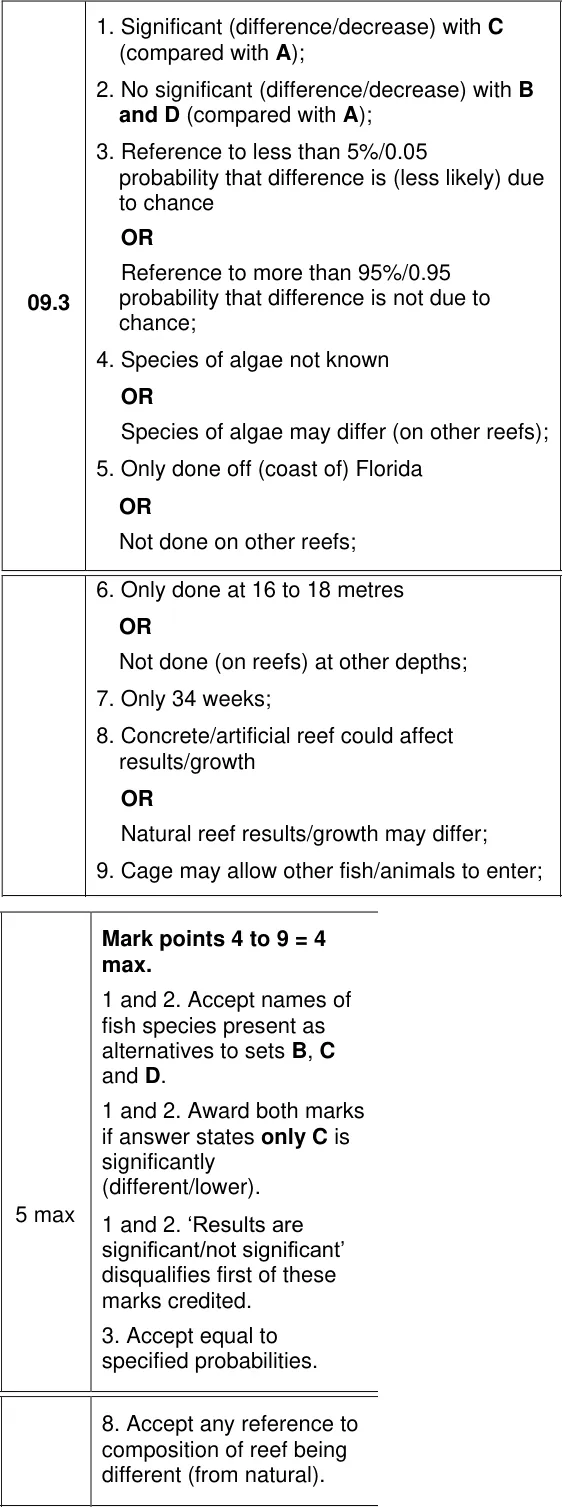
A level Paper 2 · November 2021 · Q09.3 · 5 marks · Hard
Evaluate the effect of two fish species on algal growth on coral reefs.
Information from earlier in this question:

Show the mark scheme
Tap an image to open it full size.
From the examiners' report: Only 1% got five, and more than half read the P values the wrong way round. Only C is below 0.05; then add limitations from the stem: depth, location, time and the artificial reef.
Estimating the size of a population (3.7.4)
Question 8
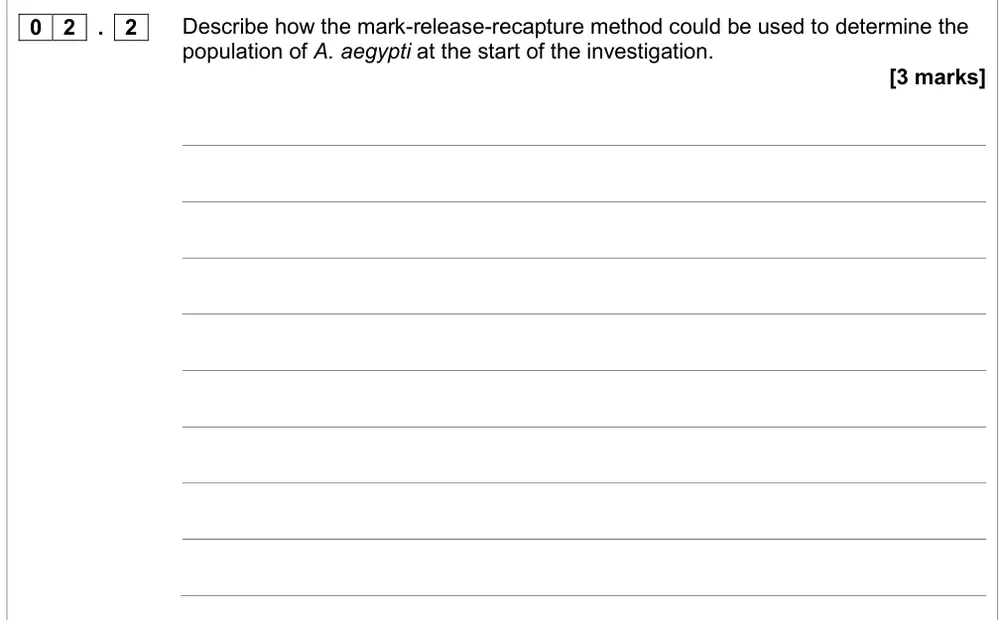
A level Paper 2 · June 2017 · Q02.2 · 3 marks · Medium
Describe how to use mark-release-recapture to estimate the mosquito population.
Information from earlier in this question:

Show the mark scheme
Tap an image to open it full size.
From the examiners' report: Under half of those with two marks got all three. The usual gap was leaving time to disperse before the second sample; don't forget to say you release them.
Question 9
A level Paper 2 · June 2022 · Q05.3 · 1 mark · Easy
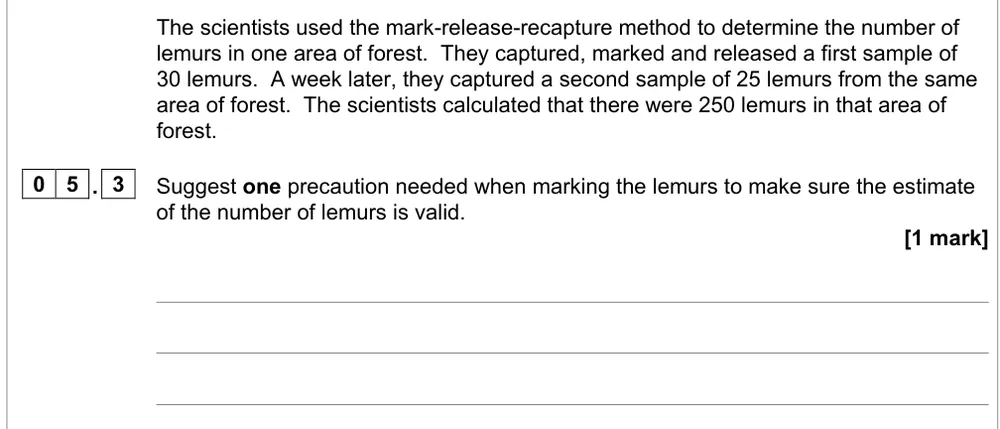
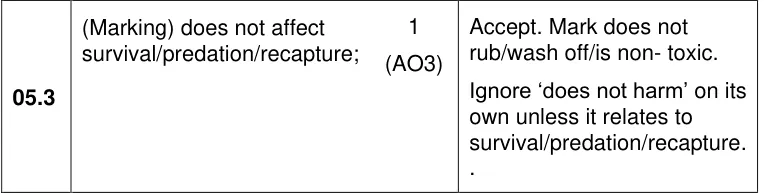
Suggest a precaution when marking lemurs so the estimate is valid.
Show the mark scheme
Tap an image to open it full size.
From the examiners' report: Almost two-thirds got this. Answer about the mark itself: it mustn't make lemurs easier for predators to see or wash off; 'not harmful' alone and dispersal answers didn't score.
Question 10
A level Paper 2 · June 2019 · Q09.1 · 5 marks · Medium
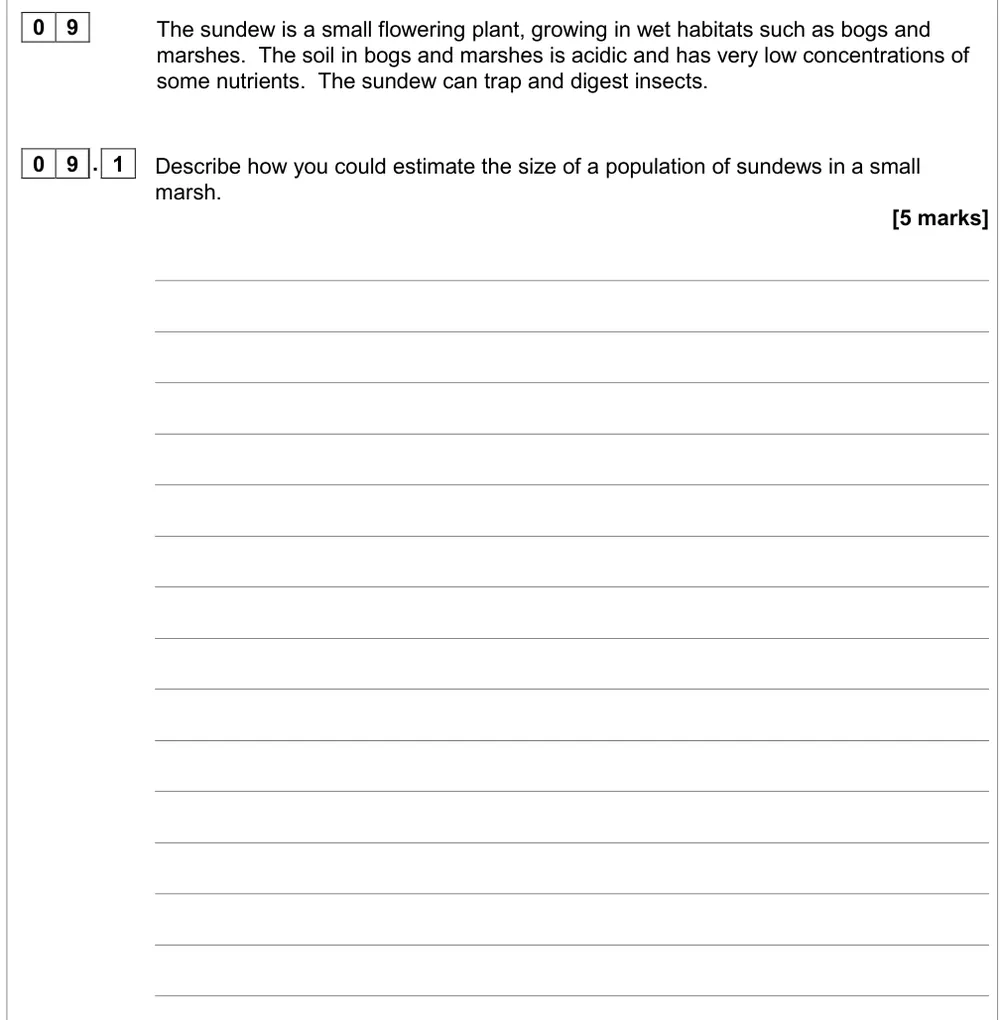
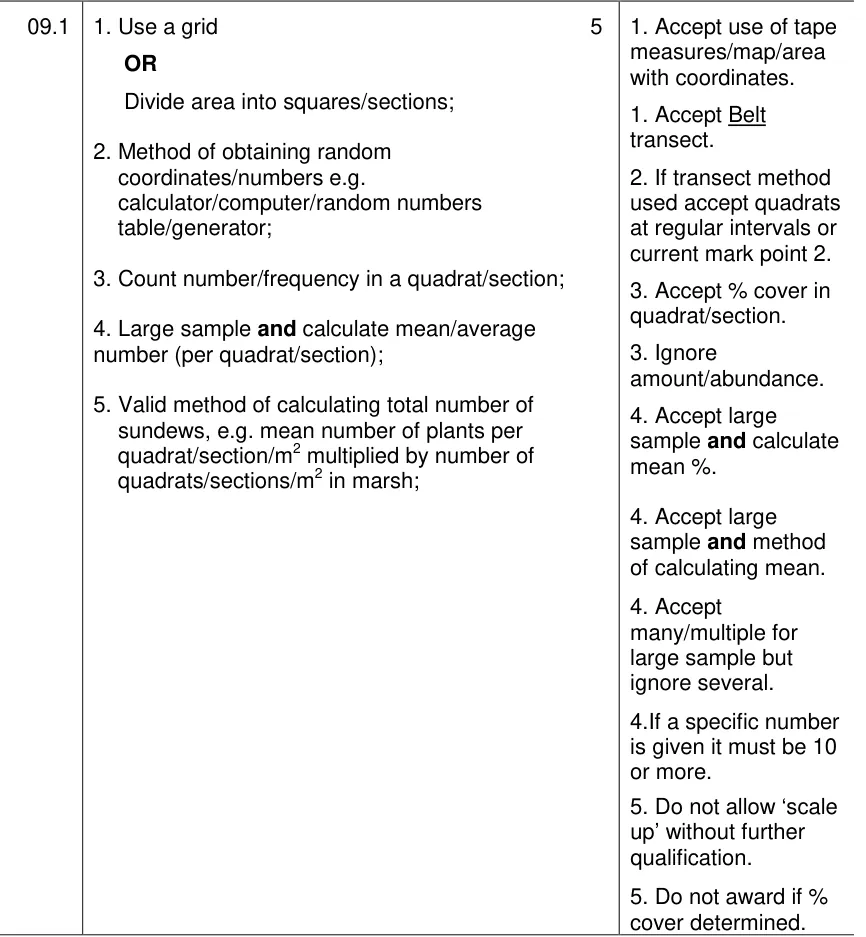
Describe how to estimate the size of a population of sundews in a small marsh.
Show the mark scheme
Tap an image to open it full size.
From the examiners' report: About 10% got all five. Finish with the calculation: multiply the mean per quadrat by the number of quadrats that fit in the marsh; 'scale up' alone didn't score.
Question 11
A level Paper 2 · June 2018 · Q04.1 · 3 marks · Medium
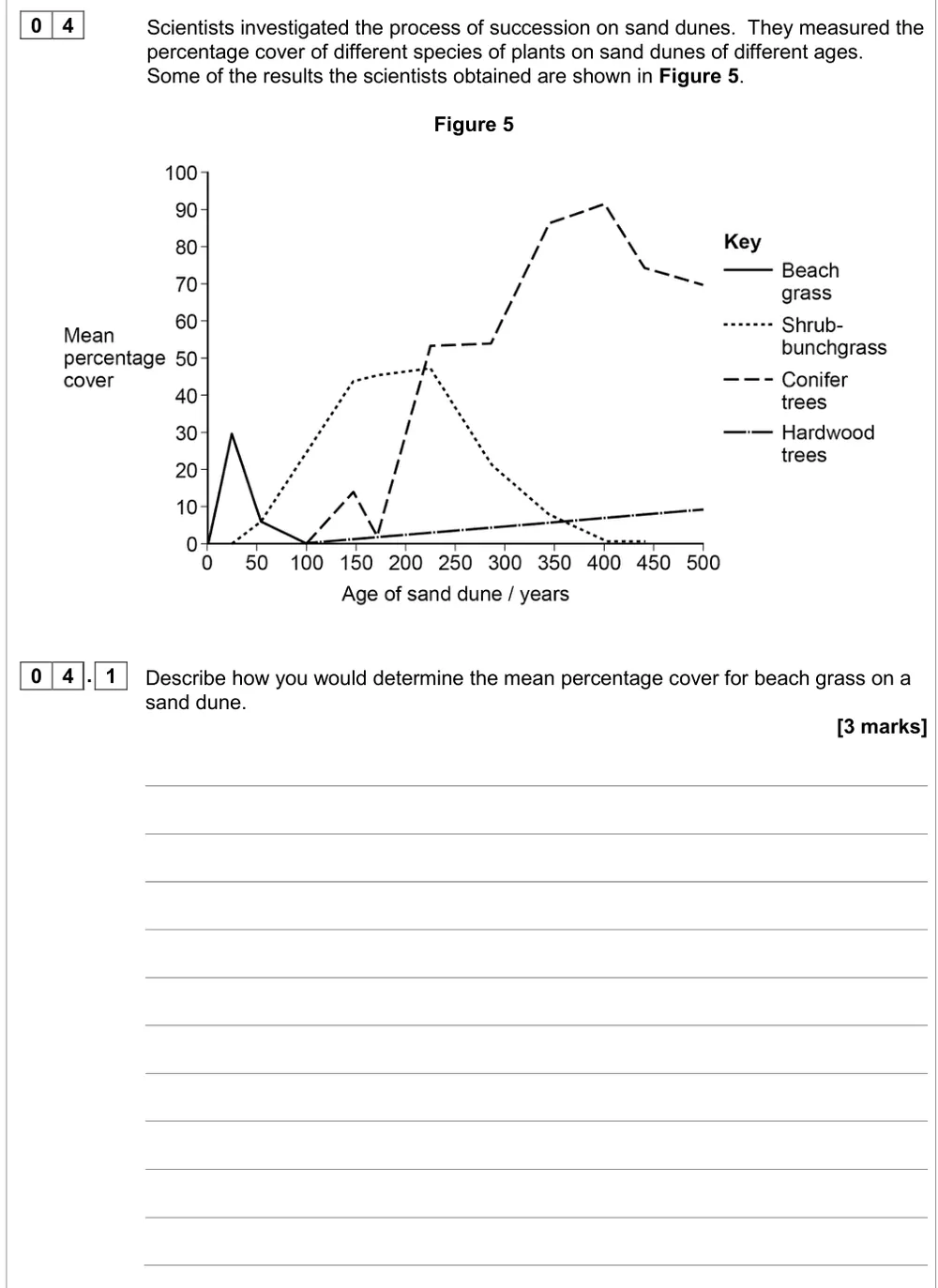
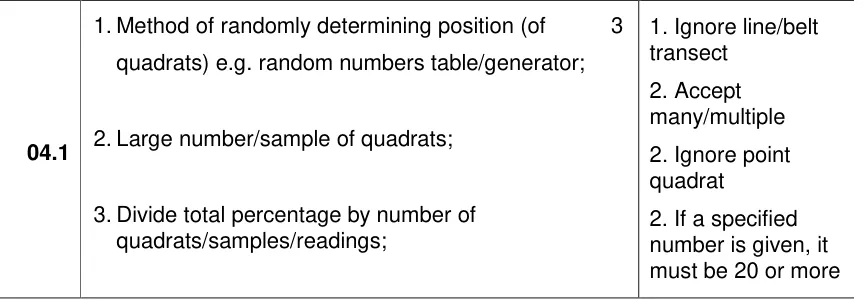
Describe how to find the mean percentage cover of beach grass on a sand dune.
Show the mark scheme
Tap an image to open it full size.
From the examiners' report: Fewer than 7% got all three. Give a method for randomness, say a large number of quadrats, and explain the mean, rather than how to judge cover in one quadrat.
Succession (3.7.4)
Question 12
A level Paper 2 · June 2019 · Q01.1 · 4 marks · Easy
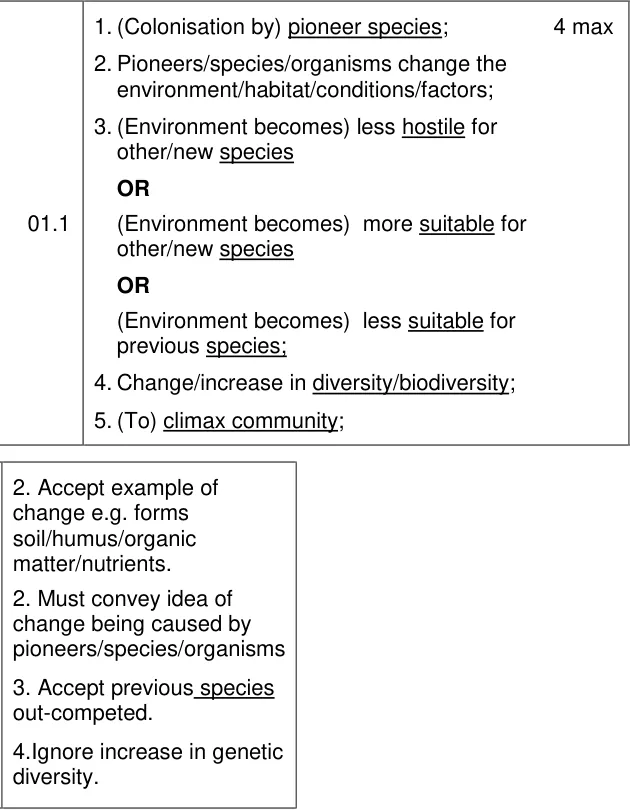
Describe and explain how succession occurs.
Show the mark scheme
Tap an image to open it full size.
From the examiners' report: Almost 44% got all four. Use the terms pioneer species and climax community, say species change the environment, and add the rise in biodiversity, which few mentioned.
Question 13
A level Paper 2 · June 2018 · Q04.2 · 4 marks · Medium
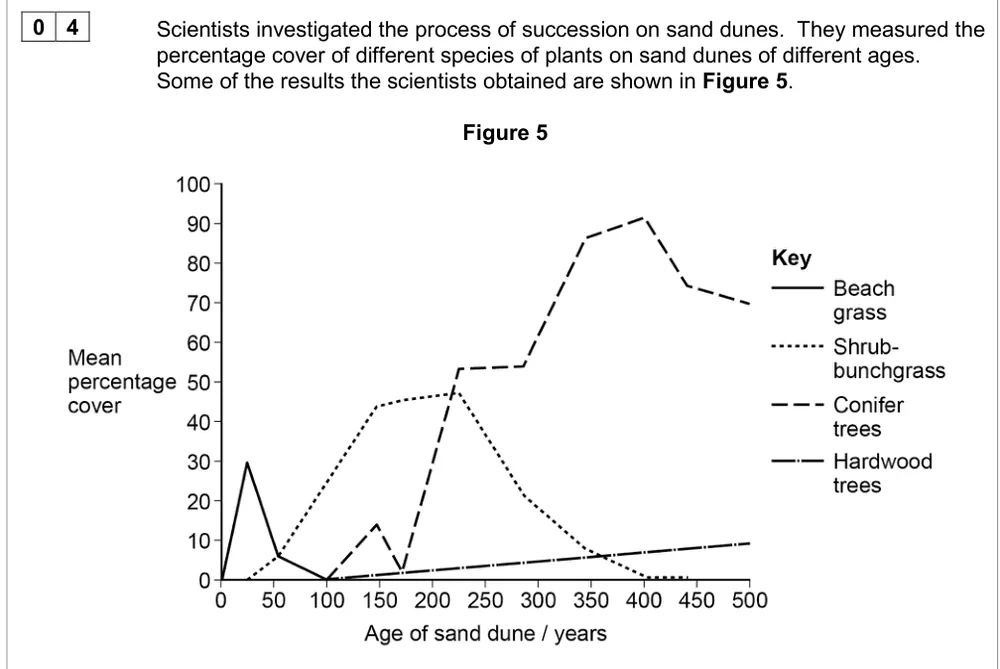
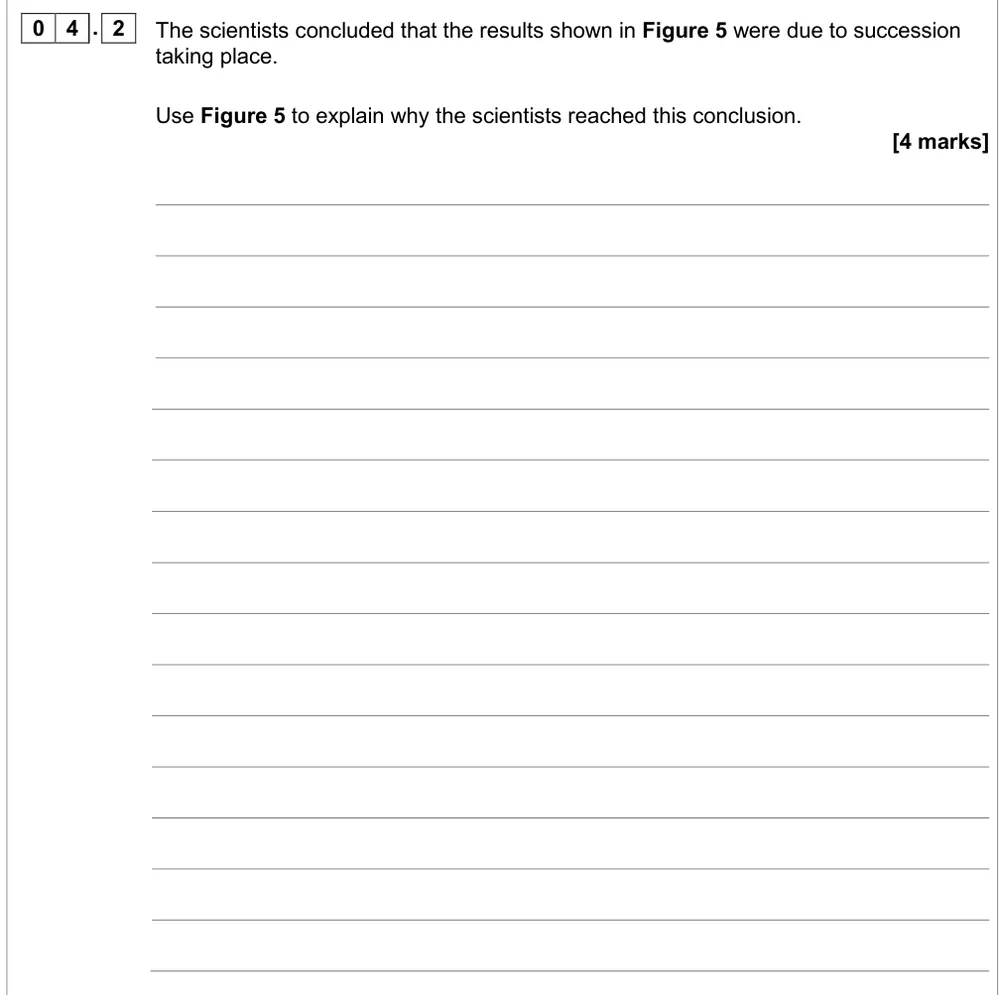
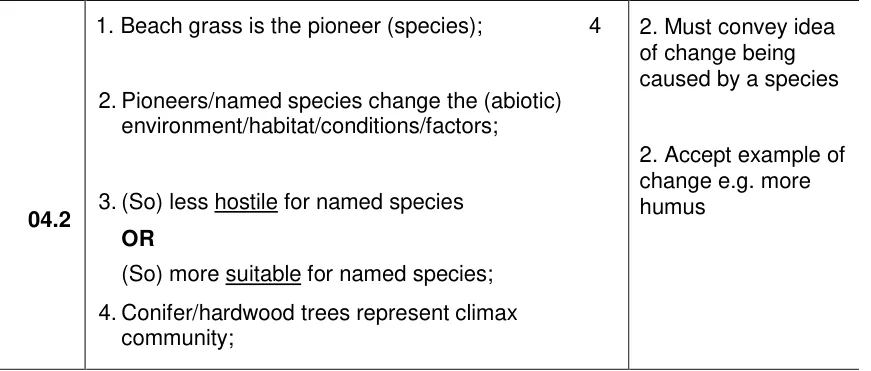
Use the sand dune data to explain why succession is taking place.
Information from earlier in this question:
Show the mark scheme
Tap an image to open it full size.
From the examiners' report: Only 7% got all four and over 20% scored zero by describing succession without the graph. Name beach grass as the pioneer and the trees as the climax community.
Question 14
A level Paper 2 · June 2018 · Q04.3 · 1 mark · Easy
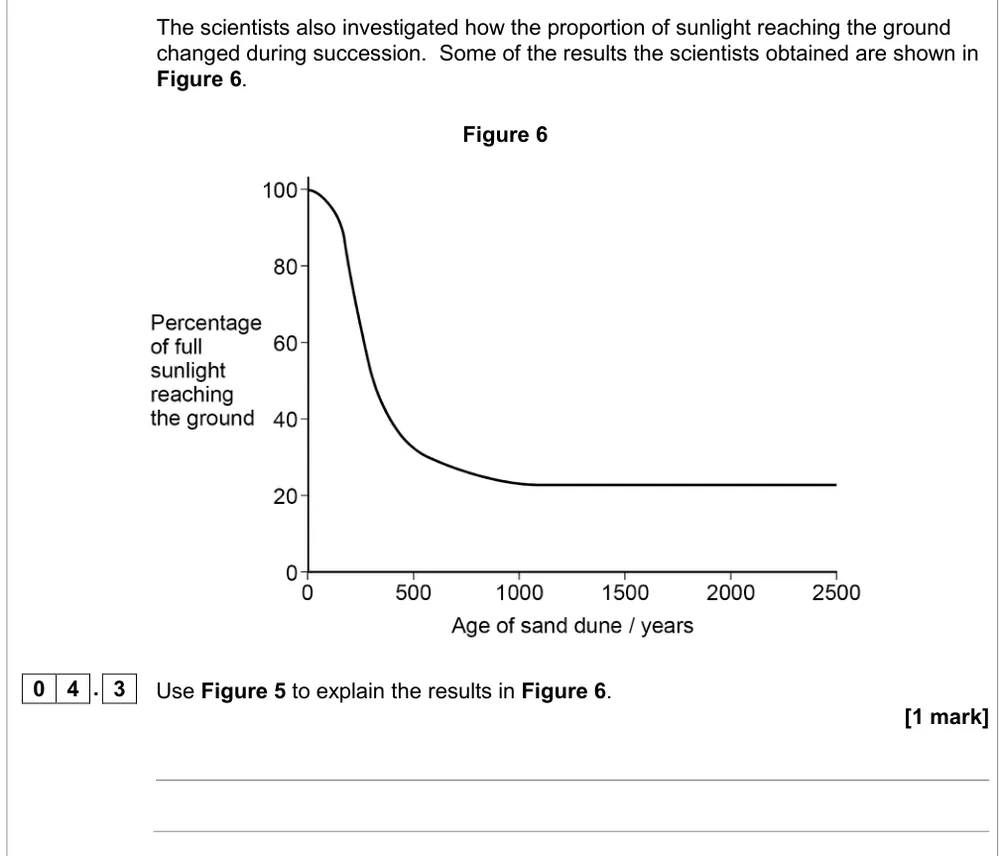
Use the plant data to explain why less sunlight reaches the ground on older dunes.
Show the mark scheme

Tap an image to open it full size.
From the examiners' report: Two-thirds got this. Name the trees from Figure 5; 'plants' or 'larger species' wasn't enough.
Question 15
A level Paper 2 · November 2021 · Q09.2 · 2 marks · Medium
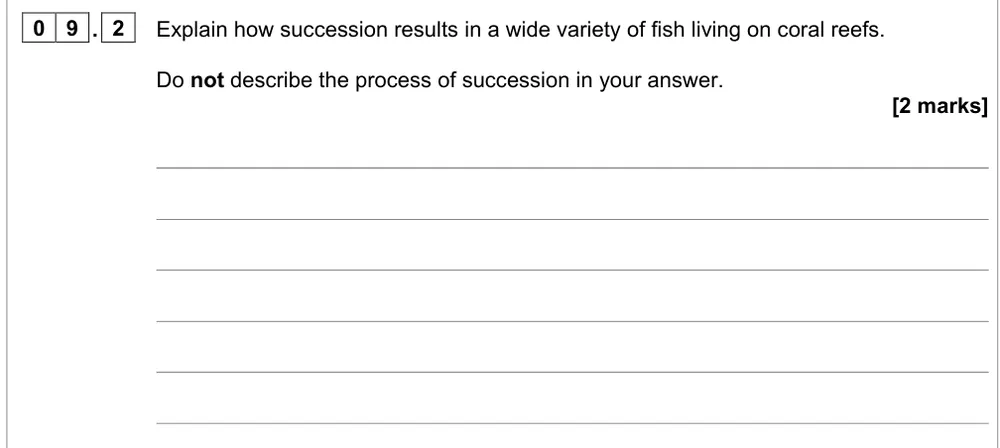
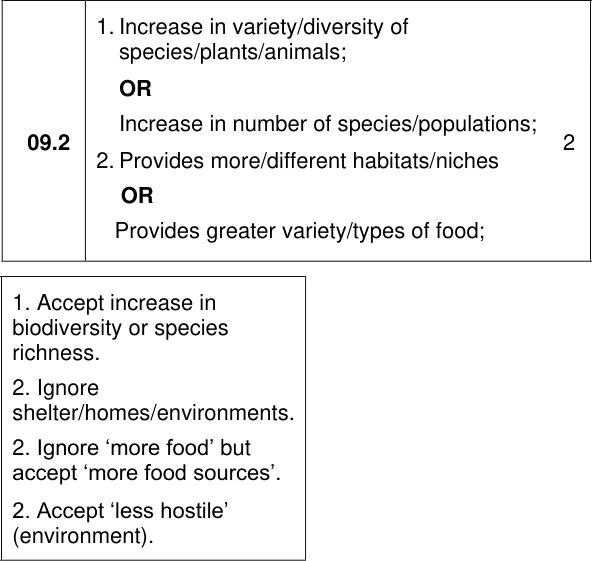
Explain how succession gives a wide variety of fish on coral reefs.
Information from earlier in this question:
Show the mark scheme
Tap an image to open it full size.
From the examiners' report: Almost 21% got both. Say the number of species increases, then that this gives more niches or food sources; 'more plants' or 'more food' isn't precise enough.
Conservation and human needs (3.7.4)
Question 16
A level Paper 2 · June 2025 · Q10.5 · 2 marks · Medium
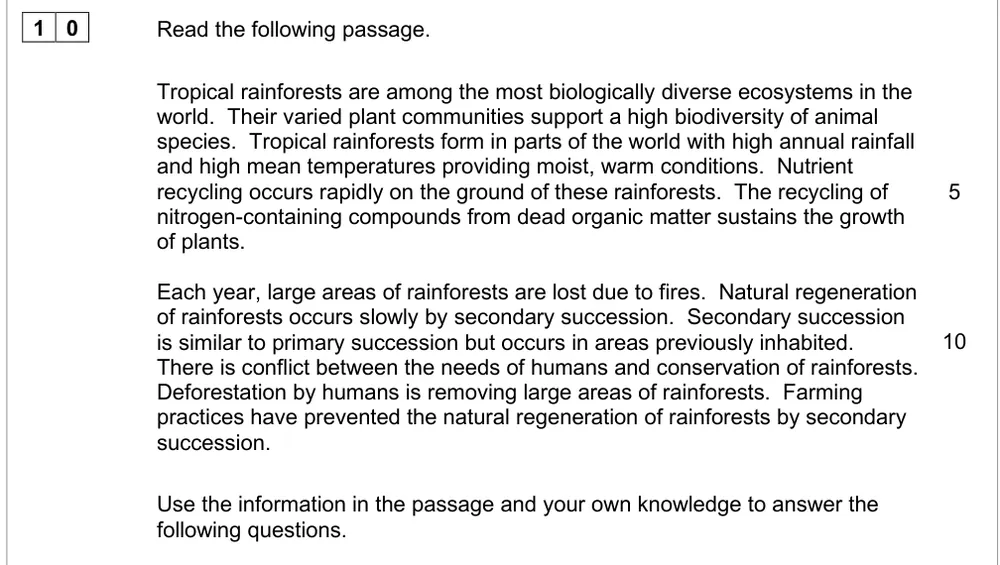
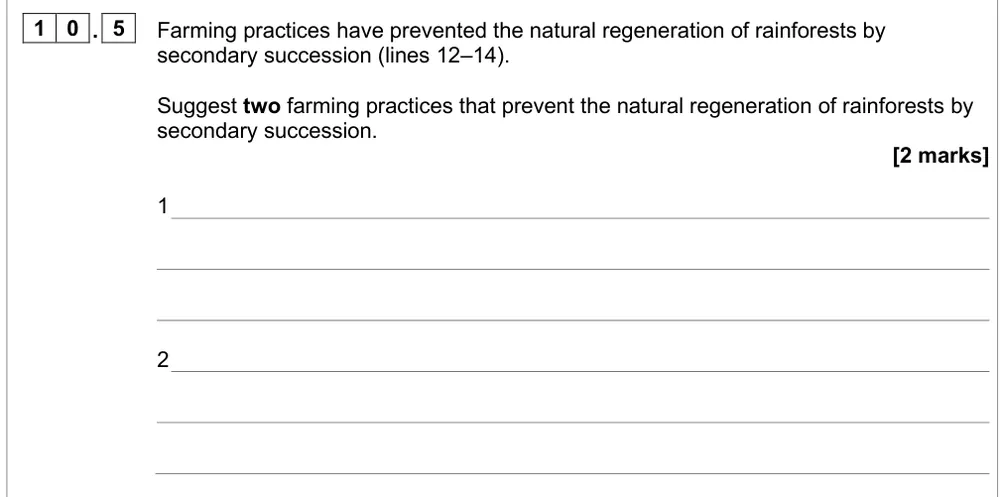
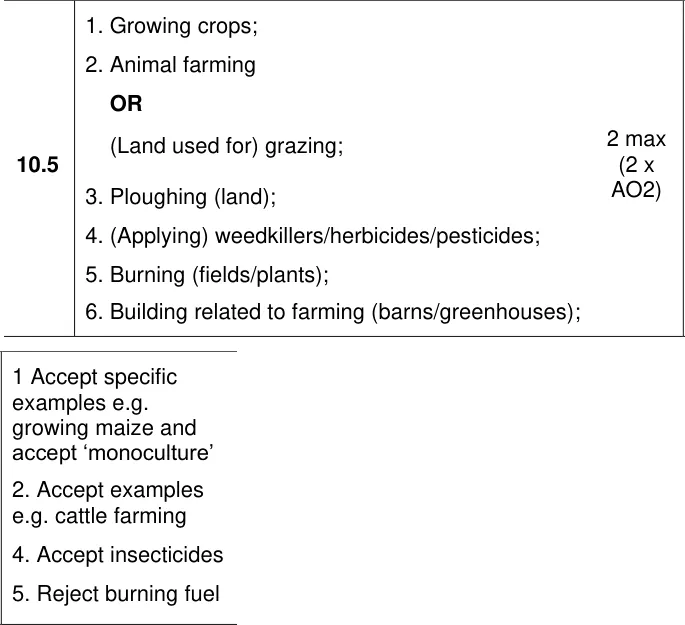
Suggest two farming practices that stop rainforest regenerating by secondary succession.
Information from earlier in this question:
Show the mark scheme
Tap an image to open it full size.
From the examiners' report: About a third got both. Name practices that stop pioneer species establishing, like grazing, ploughing or herbicides; deforestation and fertilisers didn't score.
Question 17
A level Paper 3 · November 2020 · Q02.1 · 1 mark · Easy
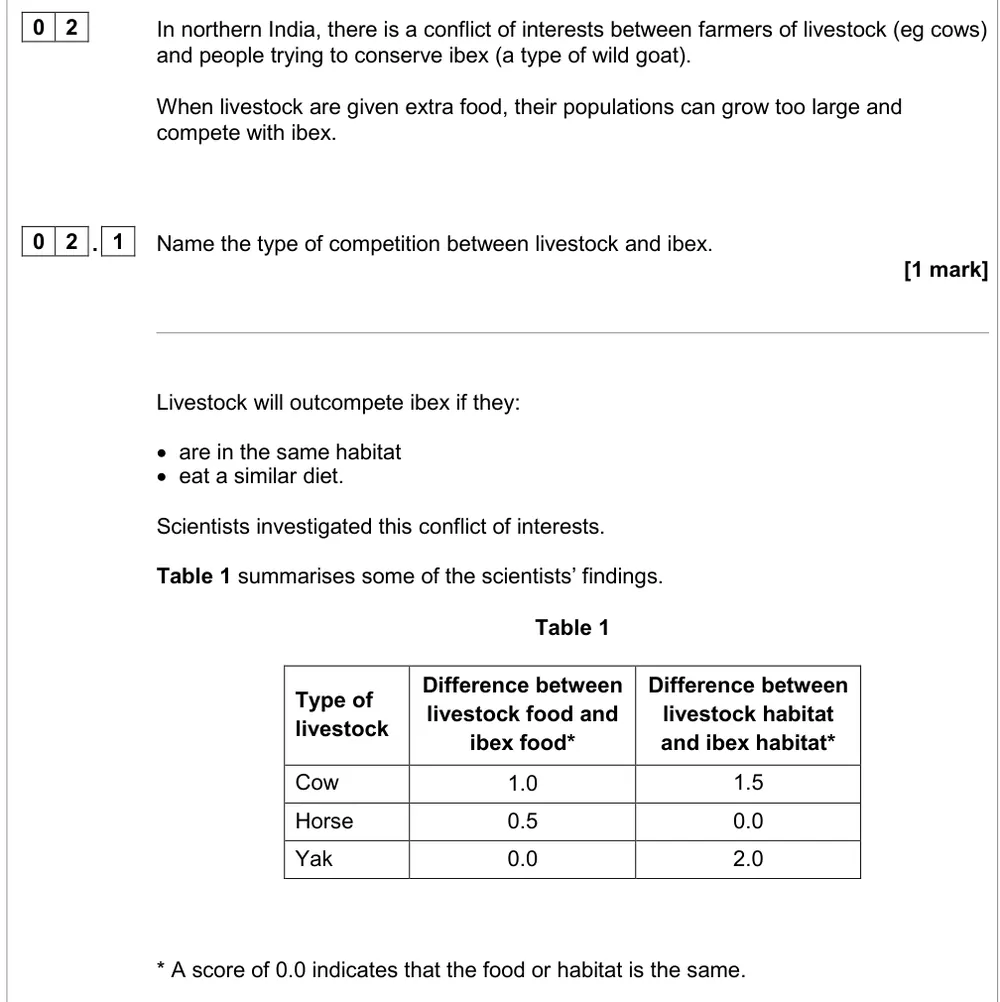
Name the type of competition between livestock and ibex.
Show the mark scheme

Tap an image to open it full size.
From the examiners' report: About 60% got this. Write interspecific in full; 'interspecies' or naming a resource didn't score.
Question 18
A level Paper 3 · November 2020 · Q02.2 · 3 marks · Medium
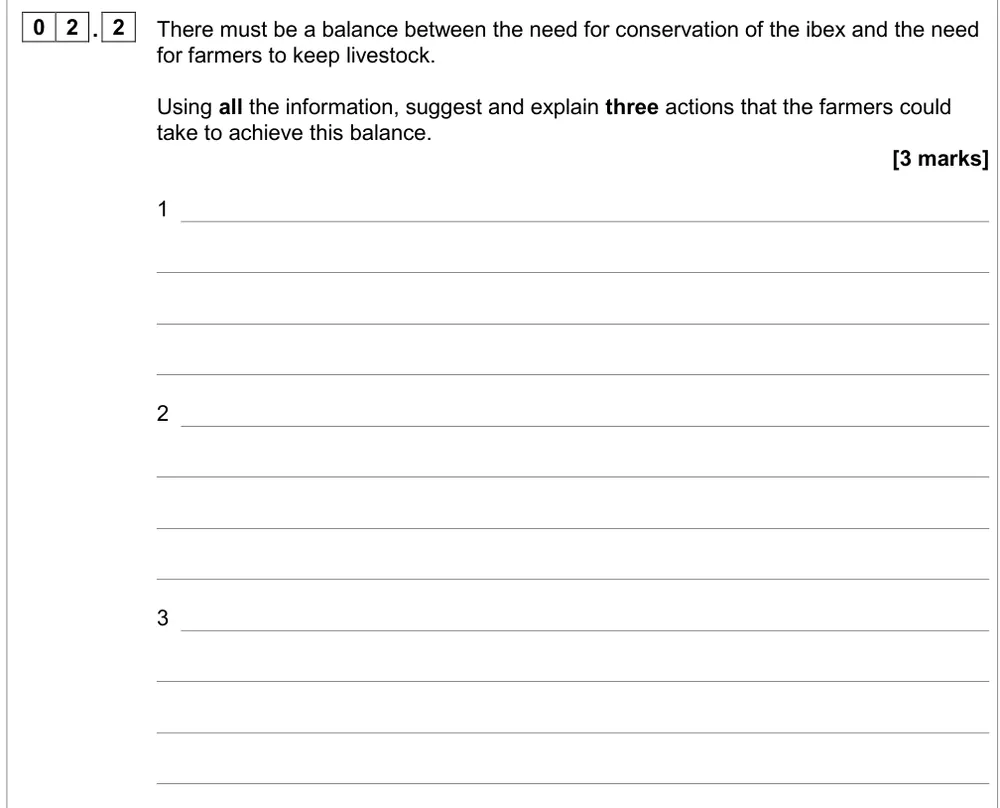
Suggest three actions farmers could take to balance livestock with ibex conservation.
Show the mark scheme
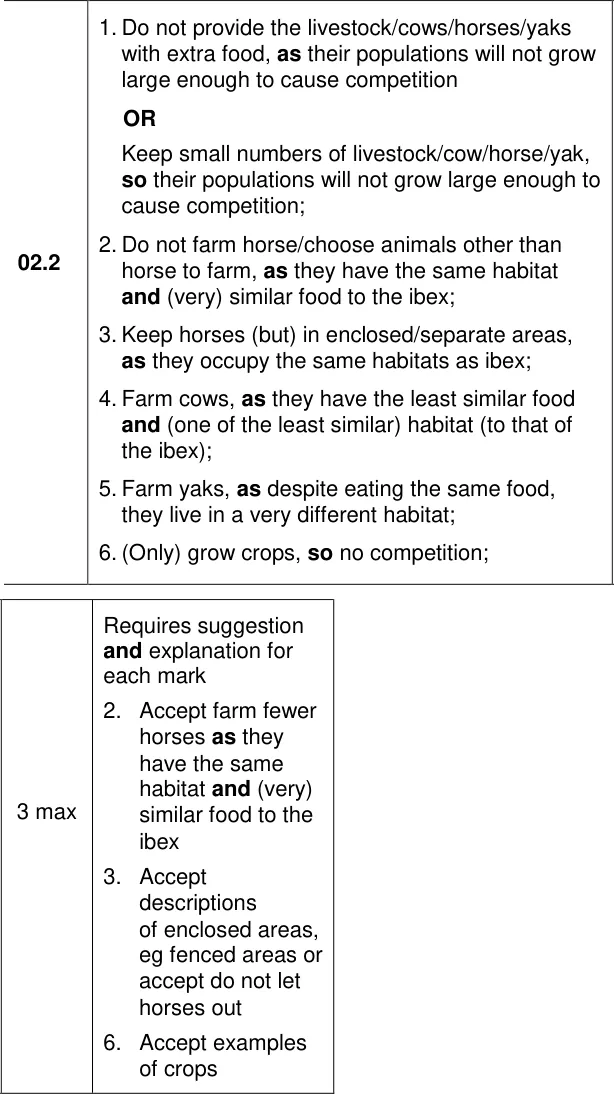
Tap an image to open it full size.
From the examiners' report: Only 4% got all three and over half scored zero. Use Table 1: pick animals whose food or habitat differ from the ibex, and give the reason with each action.
Where students lose marks (from AQA examiners' reports and mark schemes)
Each point below is followed by wording that gained marks.
Sterile males still compete for mates: Only about 10% got both marks on the Sterile Insect Technique. Most knew that fewer offspring are produced but left out competition; some thought sterile males couldn't pass on the virus.
✔ Gains credit: "Compete (with fertile males) to mate/for food/resources OR intraspecific competition"; "Do not reproduce/breed OR Reduces population".
Different species means interspecific: On fat hen and potatoes 'intraspecific' was the most common wrong answer and many didn't name the competition at all; about 60% named it for livestock and ibex, and 'interspecies' didn't score.
✔ Gains credit: "Interspecific (competition)".
Grid, random numbers, many quadrats: Fewer than 7% got all three marks for mean percentage cover. Most didn't say a large number of quadrats, said 'random' with no method, or suggested throwing quadrats.
✔ Gains credit: "Method of randomly determining position (of quadrats) e.g. random numbers table/generator"; "Large number/sample of quadrats".
Mean per quadrat × quadrats in the marsh: On the sundews many answers said 'scale up' from the mean with no detail of how, which wasn't credited.
✔ Gains credit: "Mean number of plants per quadrat/section/m² multiplied by number of quadrats/sections/m² in marsh".
Let them mix back in before recapture: On the mosquitoes the most common omission was leaving time for them to disperse before the second sample; a significant minority also forgot to release them.
✔ Gains credit: "Capture/collect/sample, mark and release"; "Leave time for mosquitoes/Aedes to disperse before second sampling/collection".
Species make it less hostile: On succession students wrote 'organisms' instead of species, and 'more hospitable' or 'more habitable', which the mark schemes ignore. On the sand dunes few named the trees as the climax community.
✔ Gains credit: "Pioneers/species/organisms change the environment"; "(Environment becomes) less hostile for other/new species"; "(To) climax community".
Read which cage set has P < 0.05: On the coral reef cages more than half said B and D were significantly different and C wasn't, the wrong way round, and most ignored the depth, location and 34 weeks.
✔ Gains credit: "Significant (difference/decrease) with C"; "No significant (difference/decrease) with B and D"; "Only 34 weeks".
Use the ibex table for each action: Only 4% got all three marks and over half scored zero, mostly by giving generic ideas instead of using Table 1, or by suggesting farmers change the habitat of the animals.
✔ Gains credit: "Do not farm horse..., as they have the same habitat and (very) similar food to the ibex"; "Farm yaks, as despite eating the same food, they live in a very different habitat".
Download the questions
Download the PDF pack (18 questions, mark schemes at the end)
Keep practising
- Energy and ecosystems: AQA A Level Biology exam questions by topic
- Biodiversity within a community: AQA A Level Biology exam questions by topic
- Required practicals 10 and 12, behaviour and distribution: AQA A Level Biology exam questions by topic
- Evolution and speciation: AQA A Level Biology exam questions by topic
- AQA 3.7.4 populations in ecosystems: self-marking quiz
- AQA A Level Biology masterclasses
Questions, mark schemes and examiners' report extracts © AQA.