

Energy and ecosystems (AQA 3.5.3) is an A-level-only topic built on a handful of definitions and two equations. You need to know how plants make biomass from carbon dioxide, how biomass is measured as dry mass or mass of carbon and its energy estimated by calorimetry, the difference between GPP and NPP (NPP = GPP − R), the net production of consumers (N = I − (F + R)), how productivity is expressed per area per year, and how farming practices increase the efficiency of energy transfer.
The examiners' reports keep finding the same slips. Students don't say that biomass means dry mass or mass of carbon, describe drying without heating to a constant mass, and write that most sugars are used in photosynthesis rather than respiration. On energy transfer they say energy is 'used in' or 'produced by' respiration, don't link heat loss to respiration, and forget that energy is lost between trophic levels. In calculations they take a percentage of the wrong value.
Start with biomass and how it's measured, then GPP and NPP, then consumers and farming, and finish with the calculations. Have a calculator ready and answer each question on paper before you open the mark scheme. If you'd like help with this topic, my AQA masterclasses run online on Tuesdays at 5.15pm for Year 12 and on Wednesdays or Thursdays at 6.30pm for Year 13.
What you need from GCSE and Year 12
Each question on this page assumes you're secure on these GCSE and Year 12 ideas. If any of them feels shaky, revise it before you start.
- GCSE: plants use the glucose they make in photosynthesis for respiration and to make starch, cellulose, lipids and proteins.
- GCSE: food chains, trophic levels and pyramids of biomass; only a small fraction of the biomass at one trophic level reaches the next, because of respiration, egestion and excretion.
- GCSE: to find a percentage of a value, multiply by the percentage and divide by 100; 1 kJ = 1000 J.
- Year 12 (AQA 3.1.2): glucose is the monomer of starch and cellulose, and sugars are respiratory substrates.
- Year 12 (AQA 3.4.6): farming techniques reduce biodiversity, and farming has to be balanced against conservation.
Key terms
These words come up in the questions and mark schemes. Examiners expect you to use them exactly.
- Biomass: the mass of carbon or dry mass of tissue per given area; it is made of the biological molecules plants make from their sugars.
- Dry mass: mass after all the water has gone: heat, weigh, and repeat until the mass is constant.
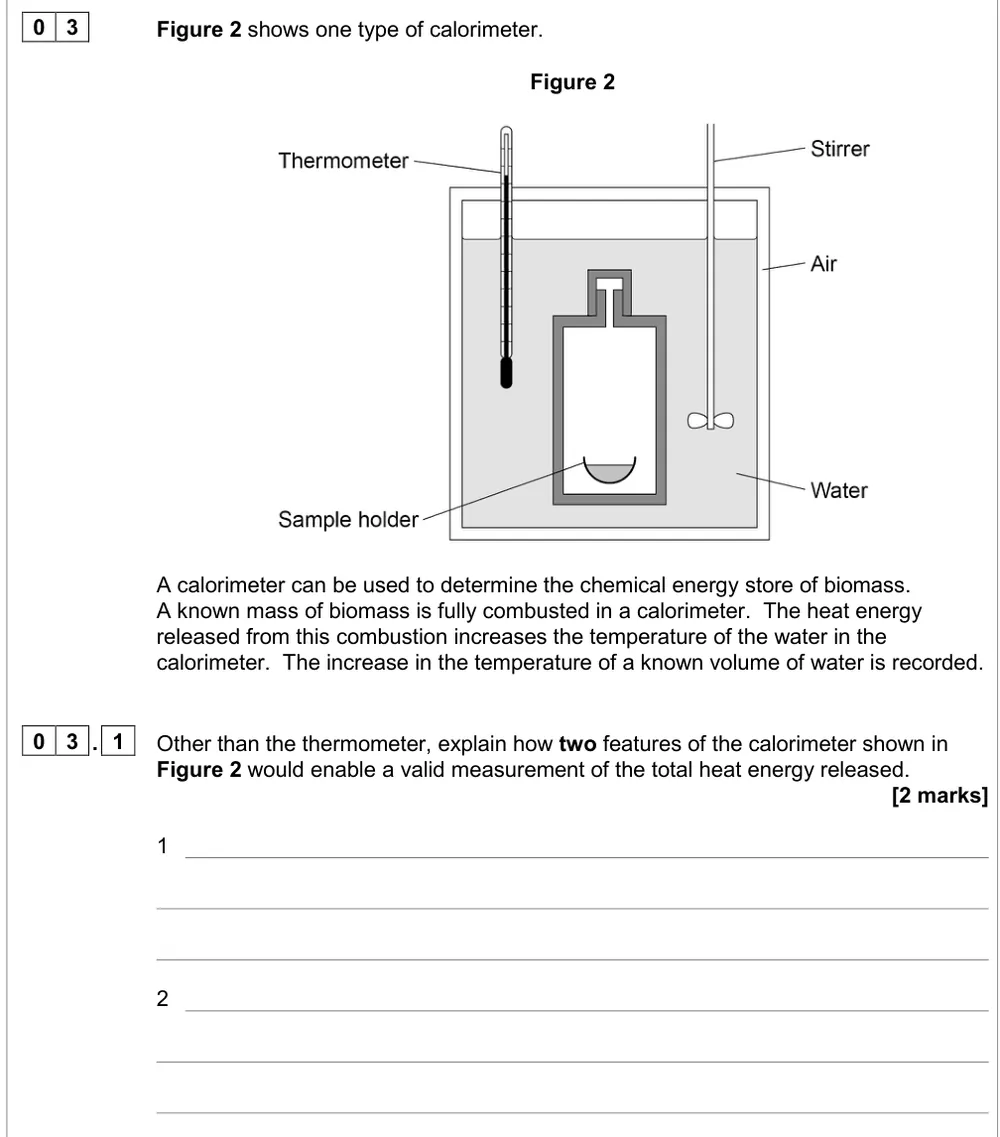
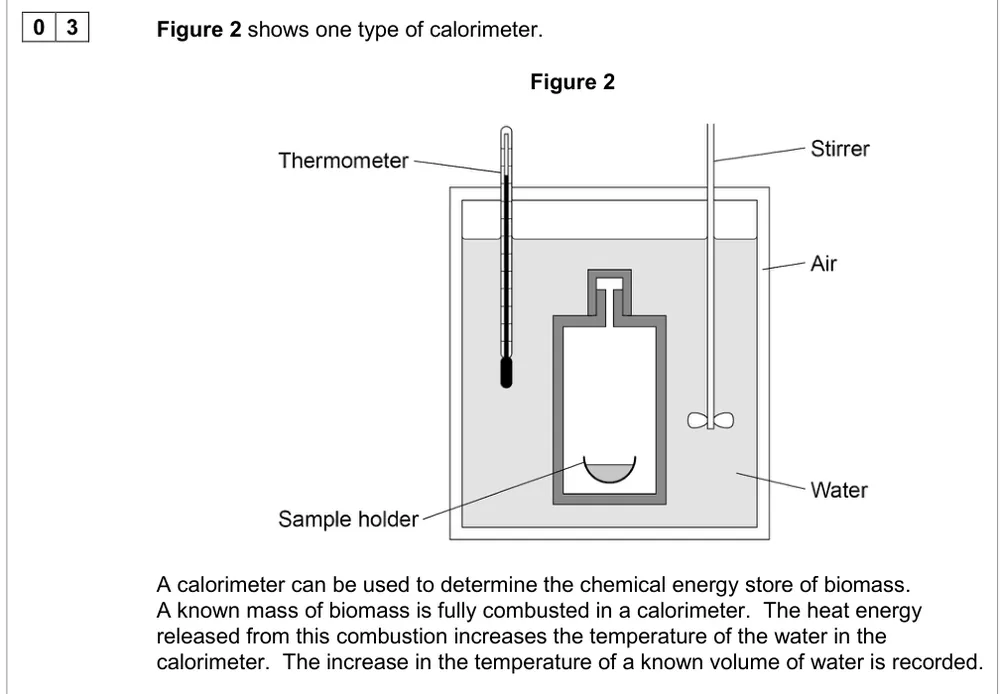
- Calorimetry: fully combusting a known mass of dry biomass and measuring the temperature rise of a known volume of water to estimate its chemical energy store; not colorimetry.
- Gross primary production (GPP): the chemical energy store in plant biomass, in a given area or volume.
- Net primary production (NPP): the chemical energy store in plant biomass after respiratory losses to the environment have been taken into account: NPP = GPP − R.
- Respiratory losses (R): chemical energy released by respiration and lost to the environment as heat; energy is lost, never 'used' or 'produced'.
- Net production of consumers (N): N = I − (F + R): the chemical energy in ingested food minus the energy lost in faeces and urine and in respiration.
- Productivity: the rate of primary or secondary production, measured as biomass in a given area in a given time, for example kJ ha⁻¹ year⁻¹.
- Trophic level: a feeding level in a food chain; energy is lost at each transfer between trophic levels.
- Efficiency of energy transfer: the percentage of energy at one trophic level that ends up in the biomass of the next; farming practices such as reducing respiratory losses raise it.
What these questions cover (AQA 3.5.3)
The questions test these statements from the AQA AS and A-level Biology specification (7401/7402):
- Producers: In any ecosystem, plants synthesise organic compounds from atmospheric, or aquatic, carbon dioxide.
- Biomass: Most of the sugars synthesised by plants are used by the plant as respiratory substrates. The rest are used to make other groups of biological molecules. These biological molecules form the biomass of the plants. (the biomass passage asks what most sugars are used for, and the low-efficiency question needs respiration and heat)
- Measuring biomass: Biomass can be measured in terms of mass of carbon or dry mass of tissue per given area. The chemical energy store in dry biomass can be estimated using calorimetry.
- Gross primary production: Gross primary production (GPP) is the chemical energy store in plant biomass, in a given area or volume.
- Net primary production: Net primary production (NPP) is the chemical energy store in plant biomass after respiratory losses to the environment have been taken into account, ie NPP = GPP − R, where GPP represents gross production and R represents respiratory losses to the environment.
- What NPP is used for: This net primary production is available for plant growth and reproduction. It is also available to other trophic levels in the ecosystem, such as herbivores and decomposers.
- The net production of consumers (N), such as animals, can be calculated as N = I − (F + R), where I represents the chemical energy store in ingested food, F represents the chemical energy lost to the environment in faeces and urine and R represents the respiratory losses to the environment. (the zebra question gives the percentages of energy lost in respiration and in faeces and urine)
- Productivity: Primary and secondary productivity is the rate of primary or secondary production, respectively. It is measured as biomass in a given area in a given time eg kJ ha⁻¹ year⁻¹.
- Students should be able to appreciate the ways in which production is affected by farming practices designed to increase the efficiency of energy transfer by: simplifying food webs to reduce energy losses to non-human food chains (no current-specification question in the bank asks about simplifying food webs)
- Students should be able to appreciate the ways in which production is affected by farming practices designed to increase the efficiency of energy transfer by: reducing respiratory losses within a human food chain.
How to use this page
Write your answer on paper before you open the mark scheme. Allow about 1.3 minutes per mark: the 15 questions are worth 33 marks, so about 43 minutes in total. Then mark your answer strictly against the mark scheme and read the examiners' tip underneath it. If you'd rather print the questions, download the PDF pack.
Biomass and how it's measured (3.5.3)
Question 1
A level Paper 2 · June 2022 · Q01.1 · 2 marks · Medium
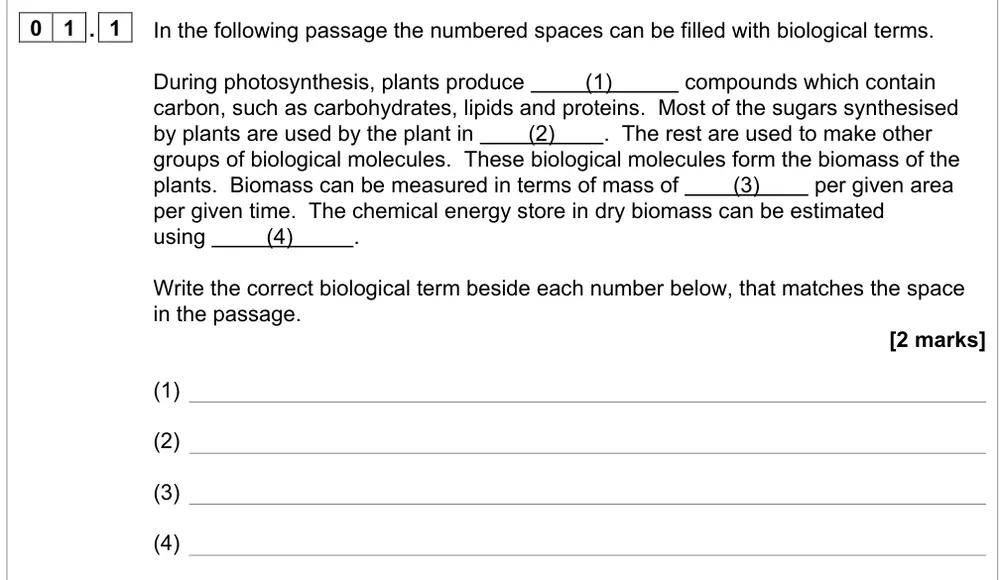
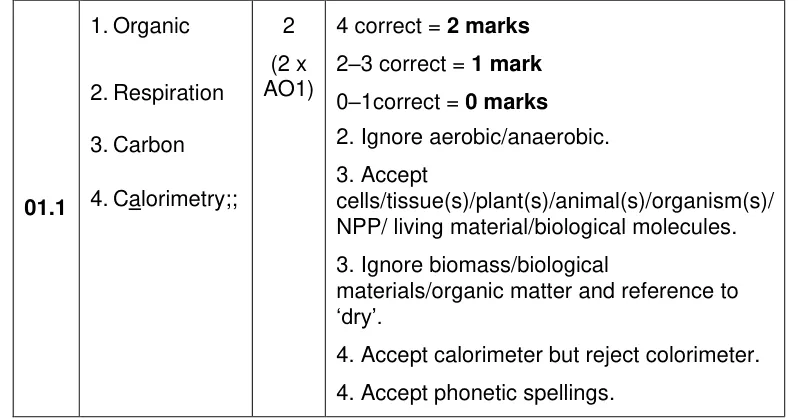
Fill four gaps in a passage about biomass and calorimetry.
Show the mark scheme
Tap an image to open it full size.
From the examiners' report: Only one in four got both marks. Most sugars are used in respiration, not photosynthesis; biomass is measured as mass of carbon (or dry mass); and it's calorimetry, not colorimetry.
Question 2
A level Paper 2 · June 2025 · Q03.1 · 2 marks · Easy
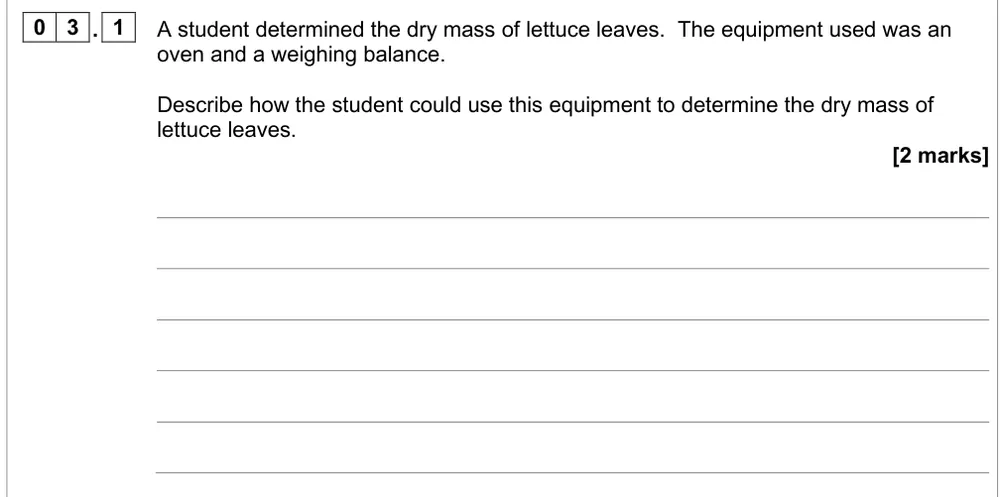
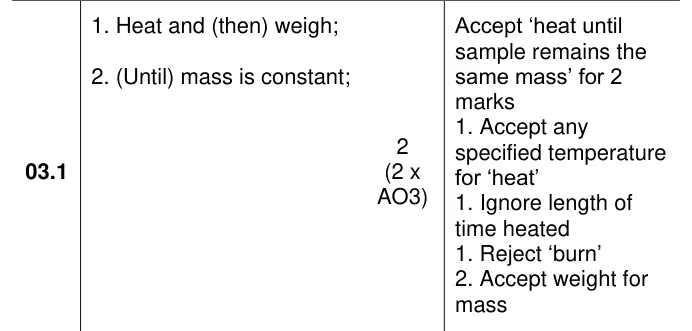
Describe how to use an oven and a balance to find the dry mass of lettuce leaves.
Show the mark scheme
Tap an image to open it full size.
From the examiners' report: About half got both marks. Mention heating, then keep reweighing until the mass is constant. Don't burn the leaves, and don't subtract the final mass from the initial mass.
Question 3
A level Paper 3 · November 2021 · Q04.3 · 2 marks
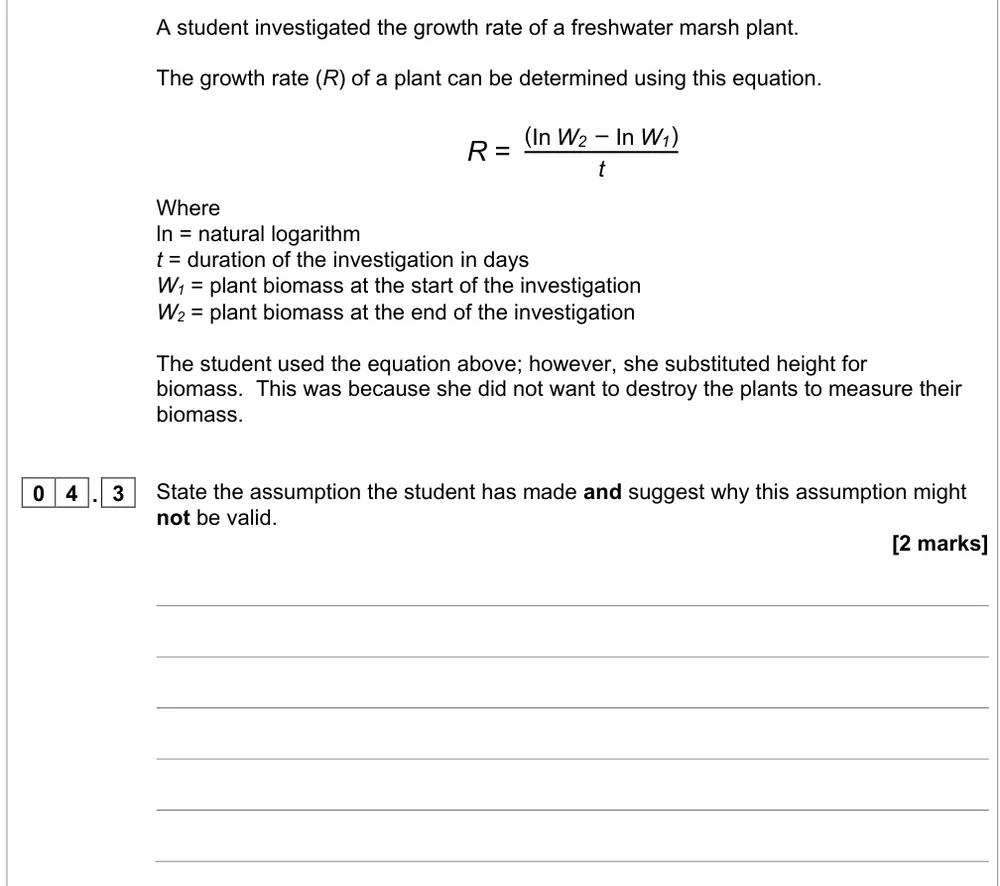
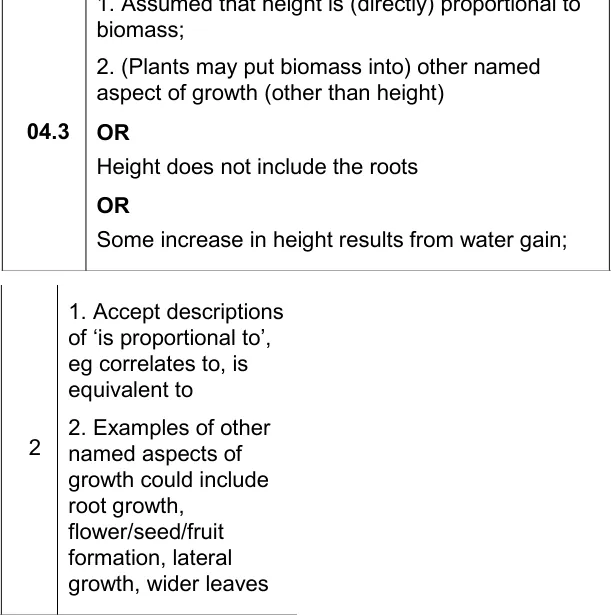
State the assumption made when using plant height instead of biomass, and why it may not be valid.
Information from earlier in this question:

Show the mark scheme
Tap an image to open it full size.
From the examiners' report: Many didn't state an assumption at all. The assumption is that height is proportional to biomass; then give a way biomass can increase without height, such as root growth.
Question 4
A level Paper 2 · November 2020 · Q03.1 · 2 marks · Hard
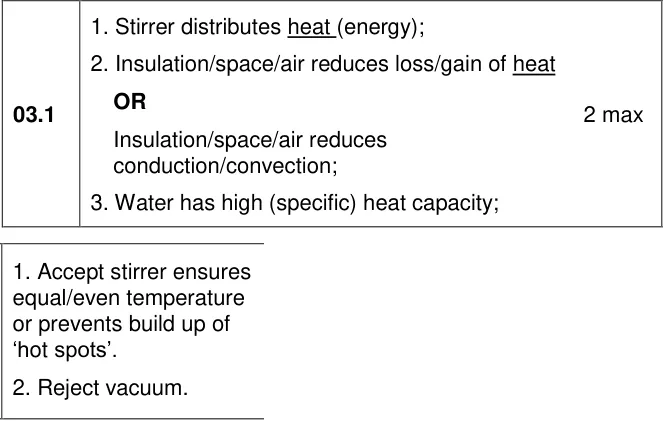
Explain how two features of a calorimeter give a valid measurement of heat energy.
Show the mark scheme
Tap an image to open it full size.
From the examiners' report: Almost 60% scored zero. Name the feature and say what it does to the heat: the stirrer spreads the heat evenly, and the air space reduces heat loss. It's air, not a vacuum.
Gross and net primary production (3.5.3)
Question 5
A level Paper 2 · November 2020 · Q03.3 · 2 marks · Medium
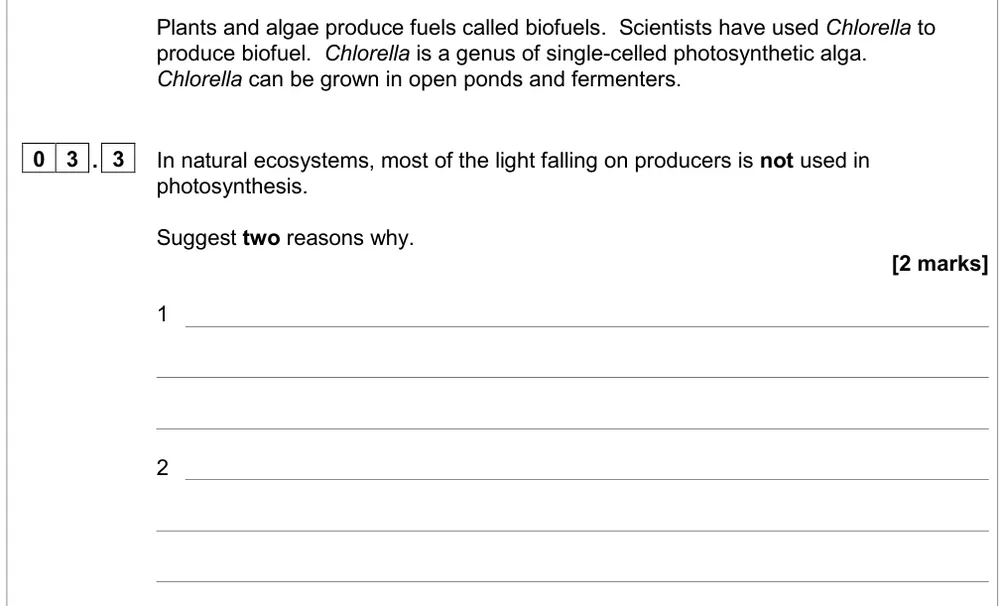
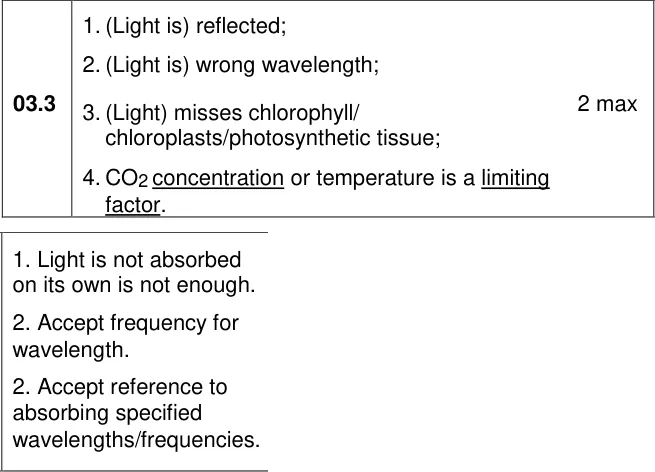
Suggest two reasons why most light falling on producers isn't used in photosynthesis.
Show the mark scheme
Tap an image to open it full size.
From the examiners' report: Almost 40% scored zero. 'Not absorbed' is too vague: say it's reflected, the wrong wavelength, or misses the chloroplasts. If you use carbon dioxide, say its concentration is limiting.
Question 6
A level Paper 2 · June 2025 · Q03.3 · 2 marks
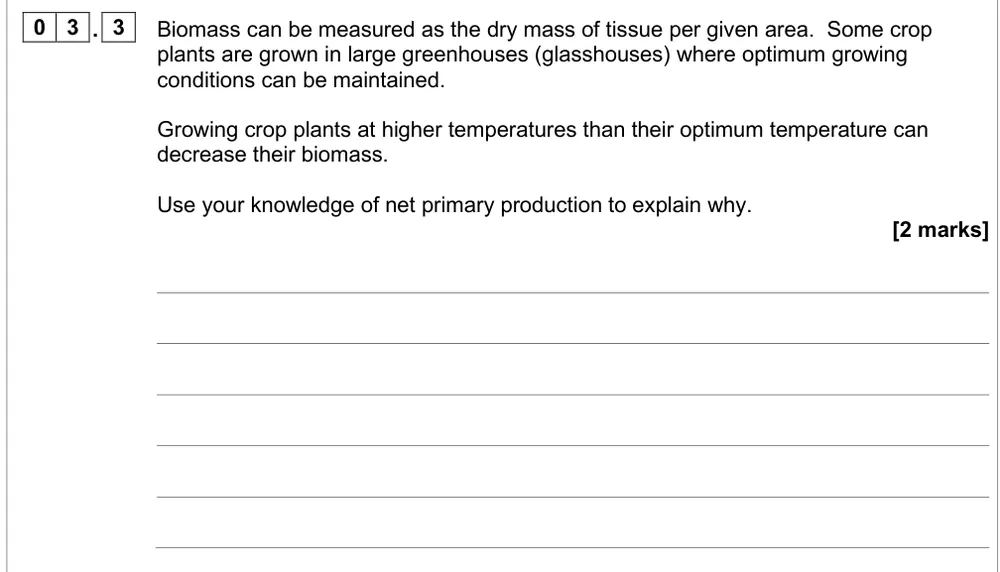
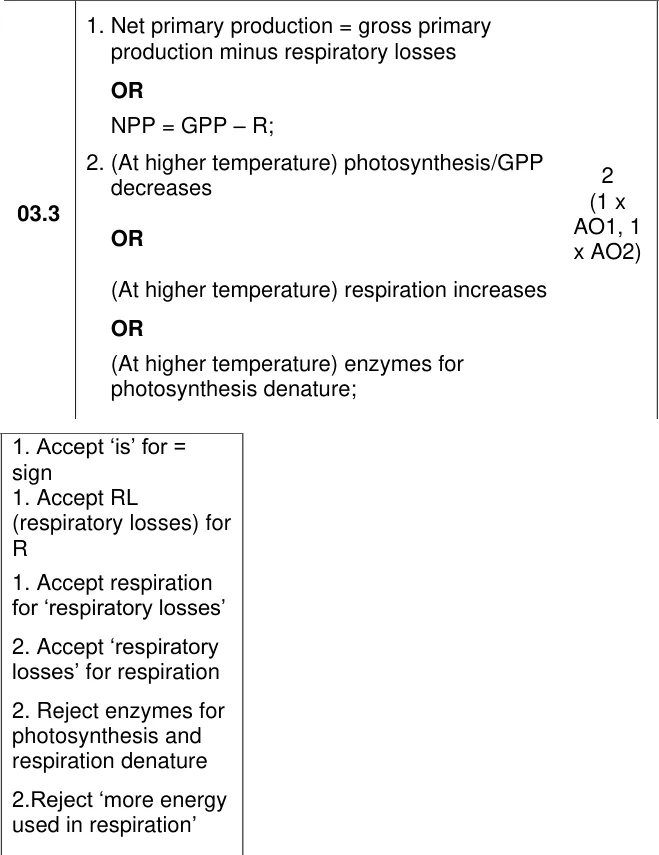
Use NPP to explain why crops grown above their optimum temperature have less biomass.
Show the mark scheme
Tap an image to open it full size.
From the examiners' report: The equation was the easy mark. For the second, say respiration increases or photosynthesis decreases; saying both fall, or just 'enzymes denature', didn't score.
Question 7
A level Paper 2 · June 2018 · Q04.4 · 2 marks · Medium
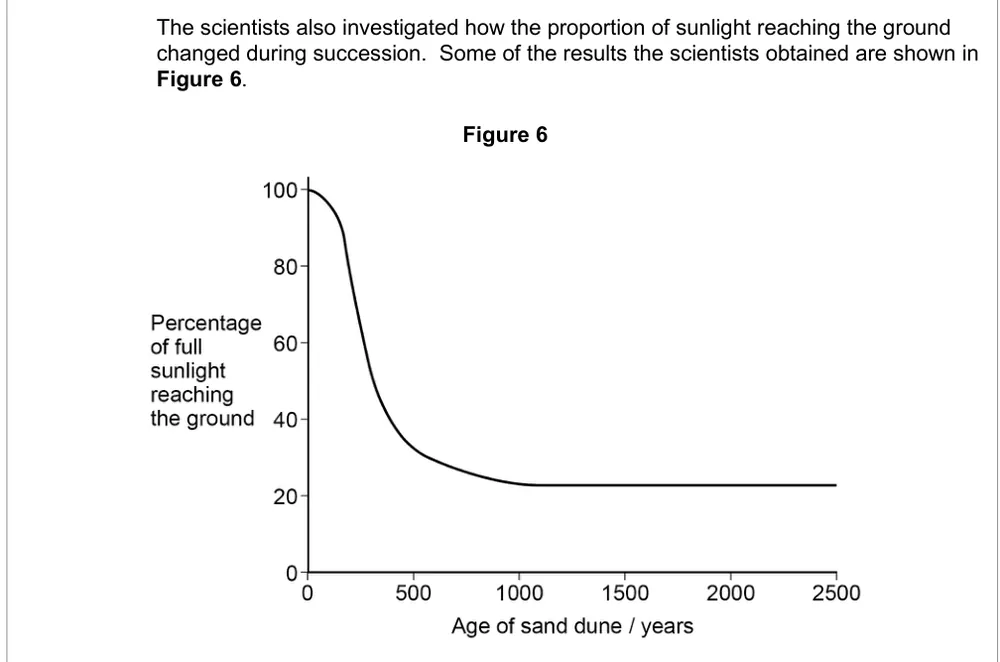
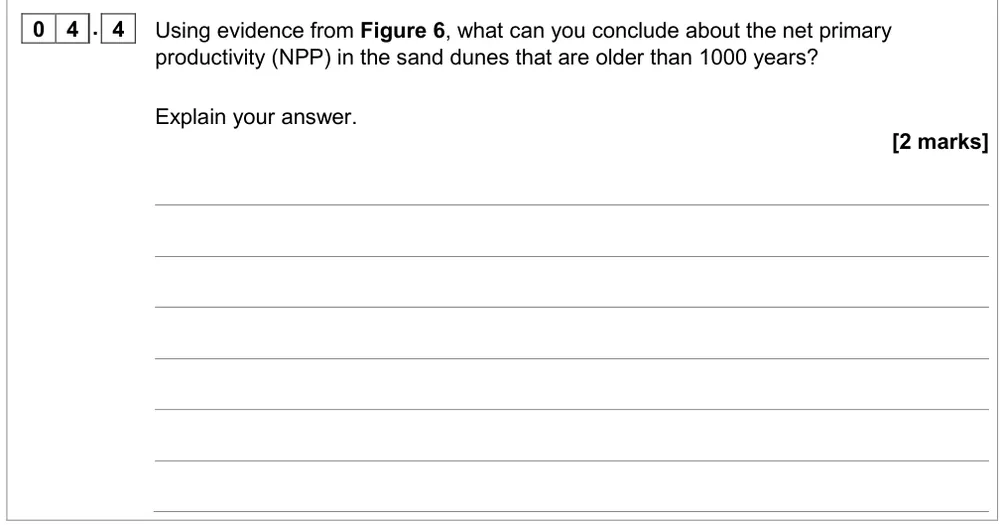
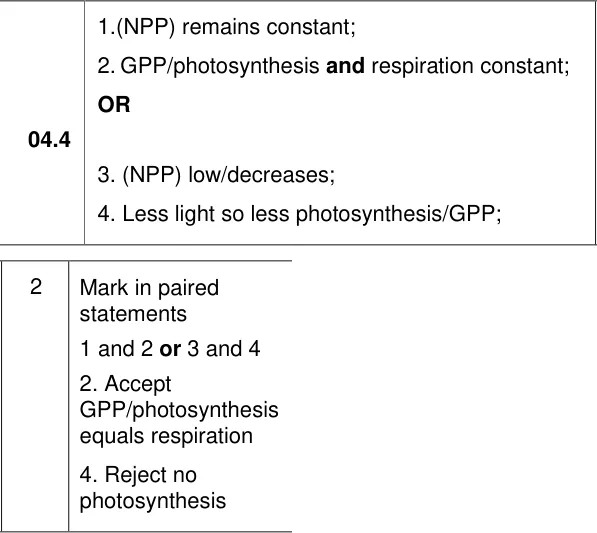
Conclude what happens to NPP on sand dunes older than 1000 years.
Information from earlier in this question:
Show the mark scheme
Tap an image to open it full size.
From the examiners' report: About 72% got the first mark but under a third of them explained it. Back up your conclusion: constant light means GPP and respiration stay constant, or less light means less photosynthesis.
Question 8
A level Paper 3 · November 2021 · Q04.1 · 2 marks
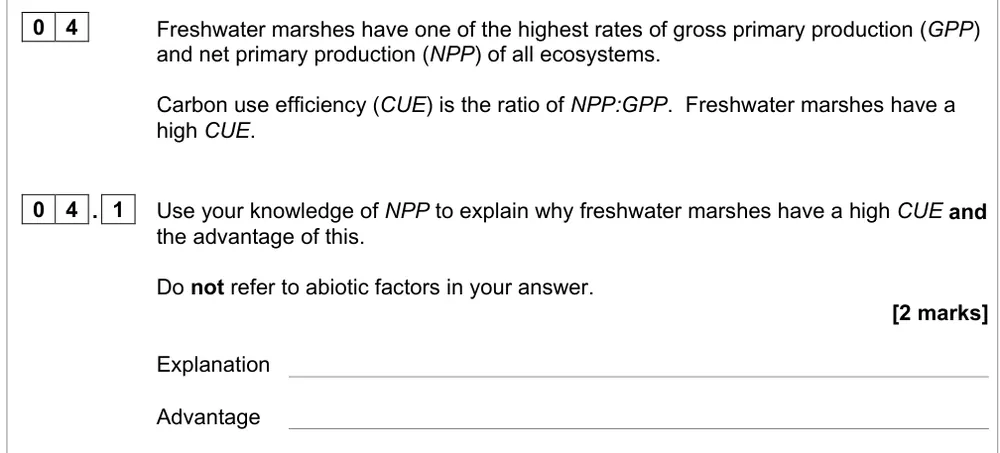
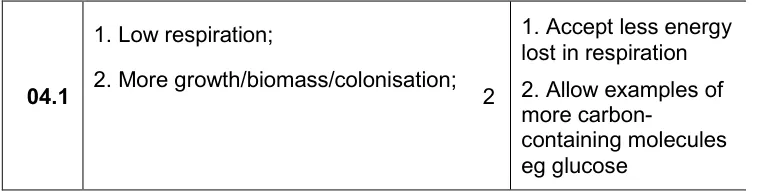
Use NPP to explain why freshwater marshes have a high carbon use efficiency, and its advantage.
Show the mark scheme
Tap an image to open it full size.
From the examiners' report: Many didn't understand how GPP and NPP are related. A high NPP:GPP ratio means little is lost in plant respiration, leaving more for growth; it's about plants, not animals.
Question 9
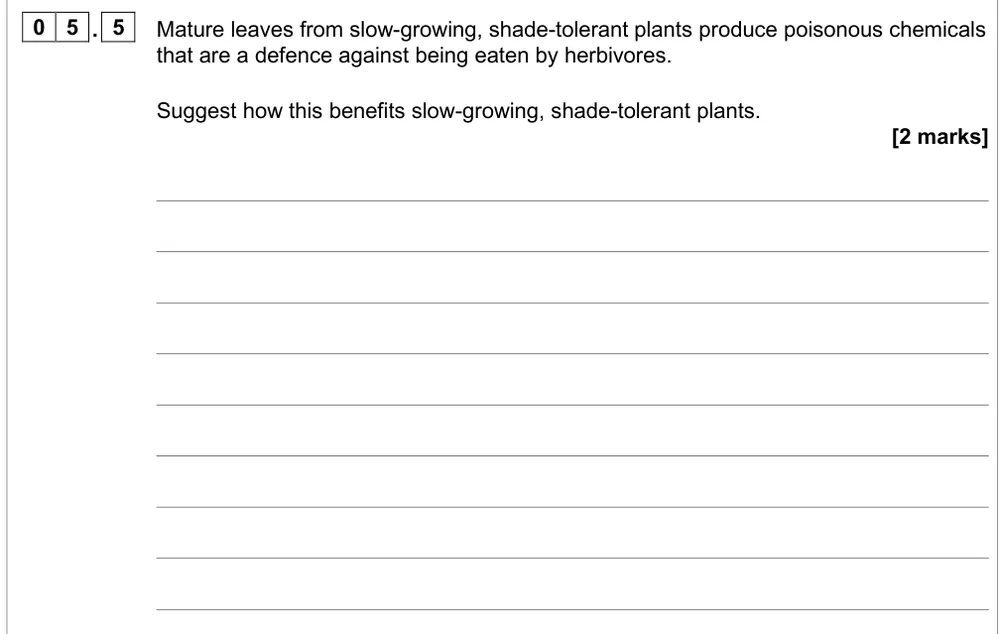
A level Paper 3 · June 2022 · Q05.5 · 2 marks · Hard
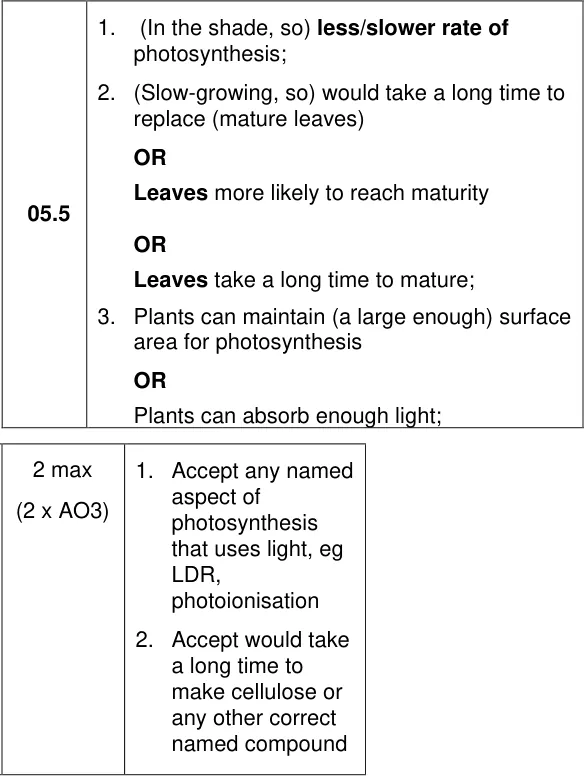
Suggest how poisonous mature leaves benefit slow-growing, shade-tolerant plants.
Show the mark scheme
Tap an image to open it full size.
From the examiners' report: 74.5% scored zero and only 3.5% got both. Don't just say the leaves aren't eaten: use 'shade' (less photosynthesis) and 'slow-growing' (leaves take a long time to replace).
Question 10
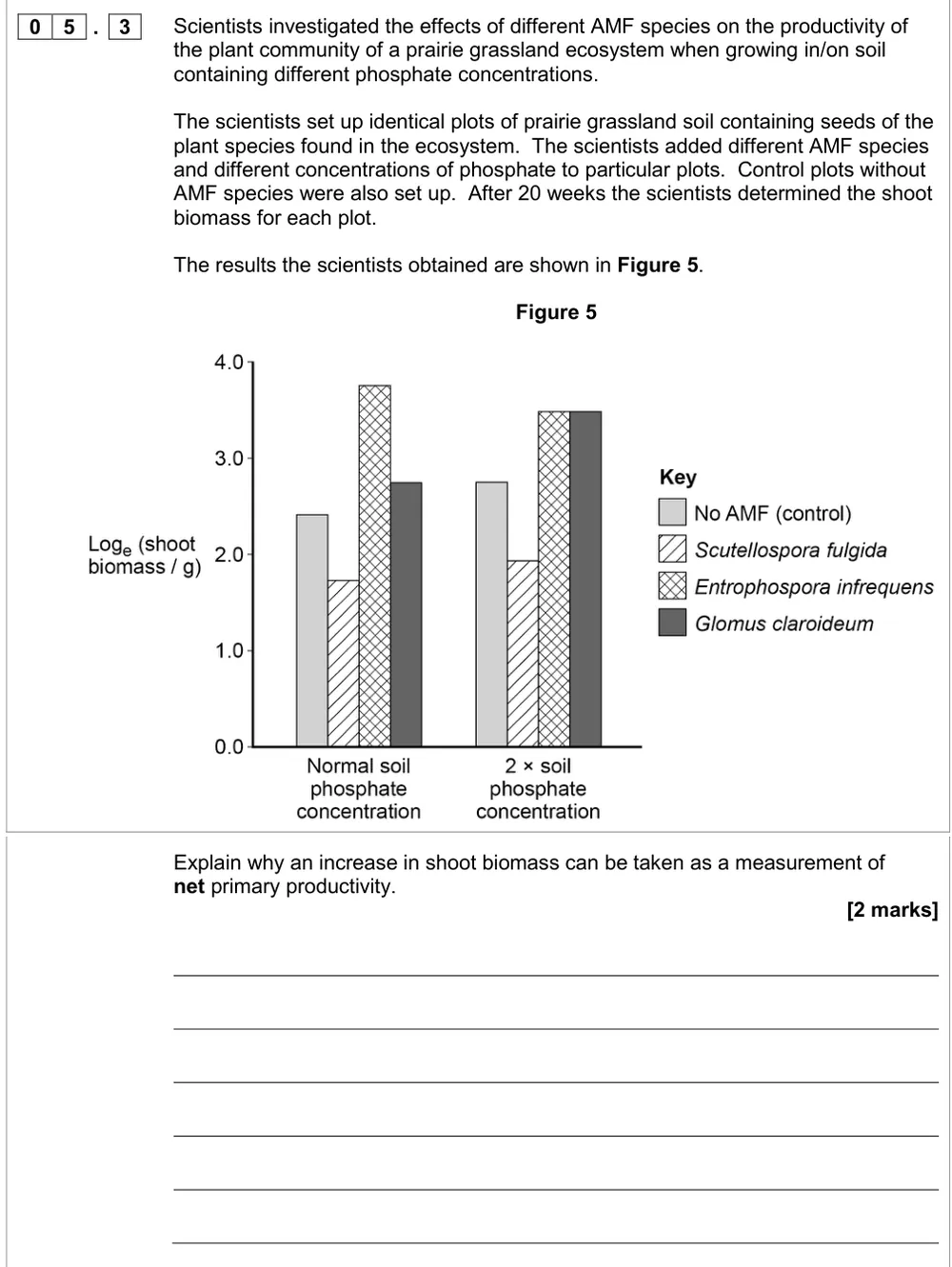
A level Paper 2 · June 2017 · Q05.3 · 2 marks · Hard
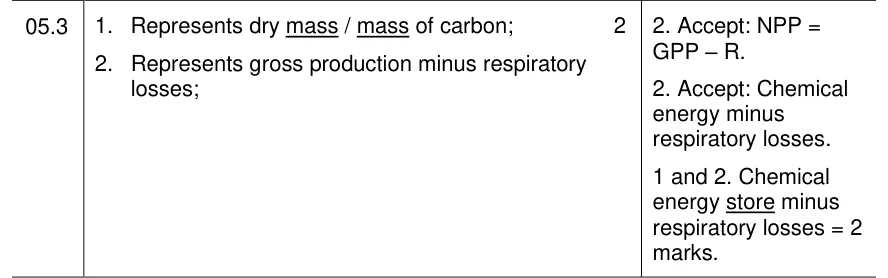
Explain why an increase in shoot biomass can be taken as a measure of net primary productivity.
Show the mark scheme
Tap an image to open it full size.
From the examiners' report: Only slightly more than 5% got both. Say what biomass is (dry mass or mass of carbon) as well as NPP = GPP − R, and leave faeces out of a plant equation.
Question 11
A level Paper 2 · June 2017 · Q05.4 · 4 marks · Medium
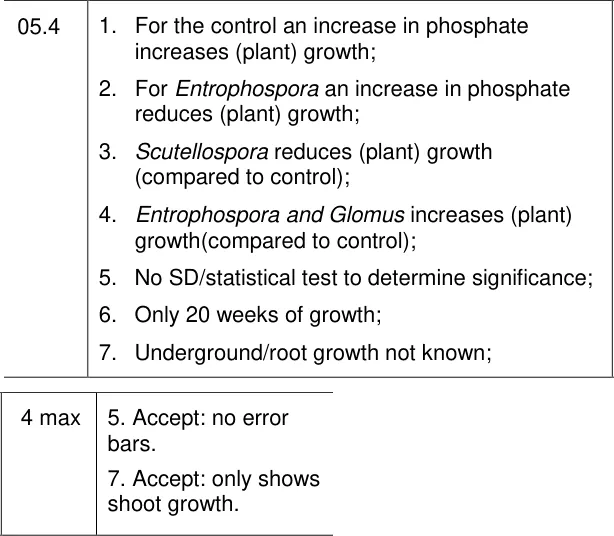
Evaluate the effect of adding AMF species and phosphate on plant productivity.
Show the mark scheme
Tap an image to open it full size.
From the examiners' report: Over 90% got at least one mark. Compare each AMF with the control at both phosphate levels, then add limitations: no statistical test, only 20 weeks, and only shoots measured. Read the key carefully.
Energy transfer to consumers and farming (3.5.3)
Question 12
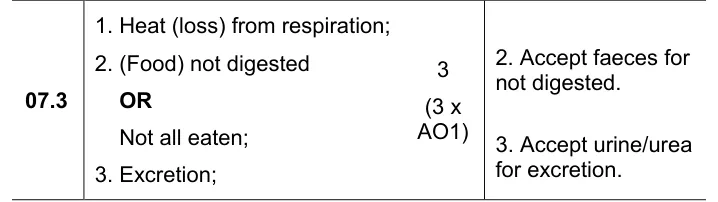
A level Paper 2 · June 2023 · Q07.3 · 3 marks · Medium
Give three reasons for the low efficiency of energy transfer from secondary to tertiary consumers.
Show the mark scheme
Tap an image to open it full size.
From the examiners' report: Only 5% got all three. Heat only scores if you link it to respiration; undigested food and faeces are one point, and faeces aren't excretion. 'Energy lost in waste' is too vague.
Question 13
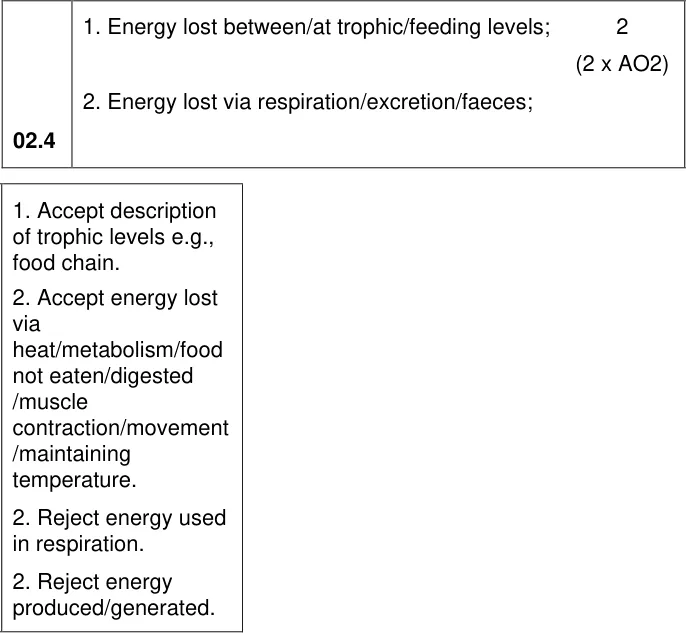
A level Paper 2 · June 2022 · Q02.4 · 2 marks · Medium
Explain why farming cattle for humans to eat is less efficient than farming crops.
Show the mark scheme
Tap an image to open it full size.
From the examiners' report: Only 22% got both. Say energy is lost between trophic levels, then how: as heat from respiration, or in faeces and urine. Energy is lost, never 'used' or 'produced'.
Energy calculations (3.5.3)
Question 14
A level Paper 2 · November 2020 · Q03.2 · 2 marks · Medium
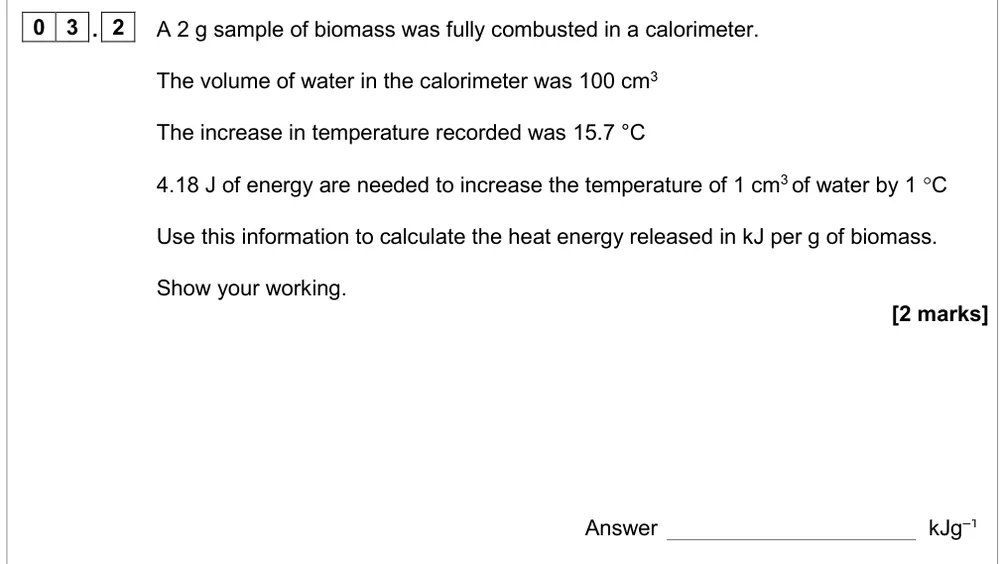
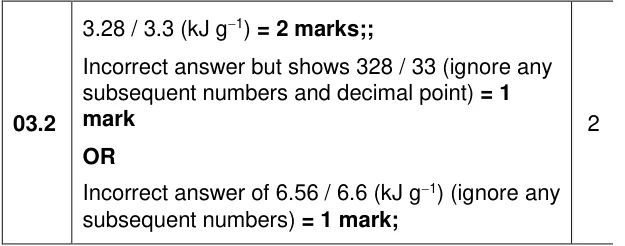
Calculate the heat energy released per gram of biomass in a calorimeter.
Information from earlier in this question:
Show the mark scheme
Tap an image to open it full size.
From the examiners' report: 42% got both marks. Multiply volume × temperature rise × 4.18, divide by the 2 g sample, then divide by 1000 to give kJ; missing either step cost a mark.
Question 15
A level Paper 2 · June 2019 · Q01.3 · 2 marks · Medium
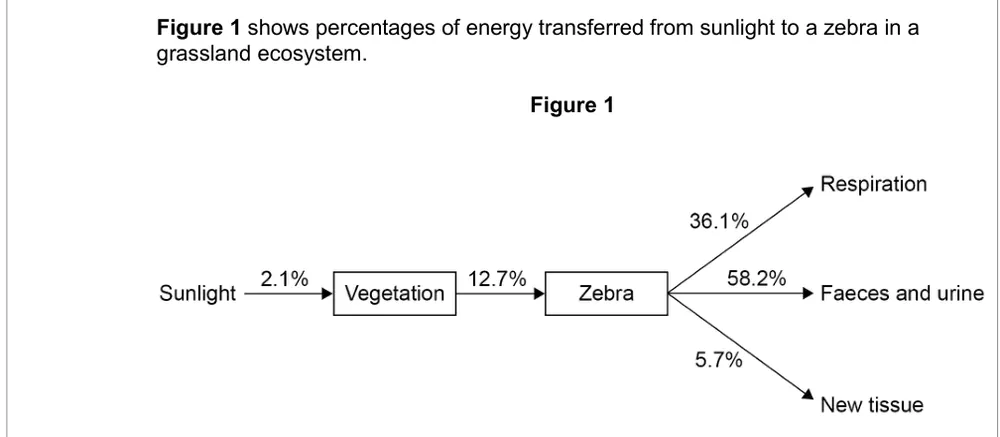
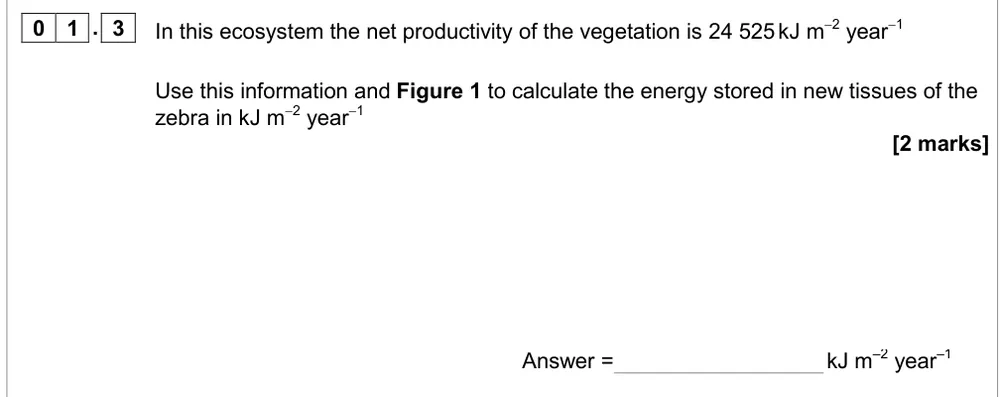
Calculate the energy stored in new tissues of a zebra from the net productivity of vegetation.
Information from earlier in this question:
Show the mark scheme

Tap an image to open it full size.
From the examiners' report: About 40% got both marks. Take 12.7% of 24 525 first, then 5.7% of that. Common errors were using only one percentage, and miscopying 177.54 as 117.54.
Where students lose marks (from AQA examiners' reports and mark schemes)
Each point below is followed by wording that gained marks.
Define biomass as dry mass or mass of carbon: Only slightly more than 5% got both marks for why shoot biomass measures NPP. Most didn't say biomass represents dry mass or mass of carbon; over 40% gave NPP = GPP − R, but weaker answers added faeces to the equation.
✔ Gains credit: "Represents dry mass or mass of carbon; represents gross production minus respiratory losses."
Heat and reweigh until the mass stays the same: On finding the dry mass of lettuce leaves, many didn't appreciate the importance of a constant mass, some left out heating altogether, some burned the leaves, and a common wrong answer subtracted the final mass from the initial mass.
✔ Gains credit: "Heat and (then) weigh; (until) mass is constant" or "heat until the sample remains the same mass".
Plants respire most of their sugars: Only one in four got both marks on the biomass passage. Some wrote 'photosynthesis' instead of 'respiration' for what most sugars are used in, 'carbon' was often the missing term, and a few wrote 'colorimetry' for calorimetry.
✔ Gains credit: "Organic; respiration; carbon; calorimetry."
Say how each calorimeter feature affects the heat: Almost 60% scored zero. Most picked the stirrer and the air space but didn't explain them in terms of heat; some called the air space a vacuum, and water was rarely linked to its high specific heat capacity.
✔ Gains credit: "Stirrer distributes heat; insulation or air reduces loss or gain of heat; water has a high (specific) heat capacity."
Light misses the chloroplasts, not the producers: Almost 40% scored zero on why most light falling on producers isn't used. 'Light not absorbed' was not enough, many said light 'misses the producers', and carbon dioxide only scored with 'concentration'.
✔ Gains credit: "Light is reflected; wrong wavelength; misses chlorophyll or chloroplasts; CO2 concentration or temperature is a limiting factor."
Higher temperature: less photosynthesis or more respiration: On why crops grown above their optimum temperature lose biomass, many said both photosynthesis and respiration would decrease, or simply that 'enzymes would denature'.
✔ Gains credit: "NPP = GPP − R; at higher temperature respiration increases or photosynthesis (GPP) decreases."
Link the heat to respiration: Only 5% got all three reasons for low efficiency from secondary to tertiary consumers. The mark for heat had to be linked to respiration, many called faeces an excretory product, and 'energy is lost in waste' didn't score.
✔ Gains credit: "Heat (loss) from respiration; (food) not digested or not all eaten; excretion (urine or urea)."
Energy is lost at every trophic level: Only 22% got both marks for why farming cattle is less efficient than farming crops. Most didn't say energy is lost between trophic levels, and 'energy used in respiration' or 'energy produced' didn't score.
✔ Gains credit: "Energy lost between trophic levels; energy lost via respiration, excretion or faeces."
Download the questions
Download the PDF pack (15 questions, mark schemes at the end)
Keep practising
- Photosynthesis: AQA A Level Biology exam questions by topic
- Respiration: AQA A Level Biology exam questions by topic
- Nutrient cycles: AQA A Level Biology exam questions by topic
- Arithmetic and numerical skills (MS 0): AQA A Level Biology exam questions by topic
- AQA 3.5.3 energy and ecosystems: self-marking quiz
- AQA A Level Biology masterclasses
Questions, mark schemes and examiners' report extracts © AQA.