

Evolution and speciation (AQA 3.7.3) is A-level only, so it's Year 13 content. It covers why individuals in a population vary, how predation, disease and competition lead to natural selection and changes in allele frequency, the three types of selection, and how reproductive isolation leads to new species by allopatric or sympatric speciation. Genetic drift in small populations is part of it too.
Most of these questions ask for a long explanation in an unfamiliar context, and the examiners' reports show where the marks go. On the Lord Howe Island palms fewer than 2% got all five marks, because so many described allopatric speciation when the question said sympatric. On the snowshoe hares only 11% got all four, as answers said genes instead of alleles, or 'more alleles' instead of a higher allele frequency. Students also put reproductive isolation at the end of the story, or wrote that animals 'mutate to adapt'.
Start with the shorter natural selection questions, then work through the speciation ones, and use the passage or figure in every answer: the marks go to points tied to the context, not to a learned essay. Check your wording against the mark scheme each time. If you'd like help with this topic, my AQA masterclasses run online on Tuesdays at 5.15pm for Year 12 and on Wednesdays or Thursdays at 6.30pm for Year 13.
Want help with this topic? It comes up in my weekly AQA masterclasses. See the timetable →
What you need from GCSE and Year 12
Each question on this page assumes you're secure on these GCSE and Year 12 ideas. If any of them feels shaky, revise it before you start.
- GCSE: in natural selection, individuals best suited to their environment are more likely to survive, breed and pass on their genes.
- GCSE: a species is a group of organisms that can interbreed to produce fertile offspring.
- Year 12 (AQA 3.4.3): mutation, crossing over, independent segregation and random fertilisation all produce genetic variation.
- Year 12 (AQA 3.4.4): directional and stabilising selection change the frequency of alleles that give an advantage.
- Year 13 (AQA 3.7.2): a gene pool is all the alleles in a population, and allele frequency is the proportion of one allele.
Key terms
These words come up in the questions and mark schemes. Examiners expect you to use them exactly.
- Variation in phenotype: differences between individuals caused by genetic factors (mutation, meiosis, random fertilisation) and environmental factors.
- Natural selection: differential survival and reproduction caused by predation, disease and competition for the means of survival.
- Allele frequency: how common one allele is in a gene pool; natural selection increases the frequency of advantageous alleles.
- Evolution: a change in the allele frequencies in a population.
- Disruptive selection: selection for both extremes of a phenotype and against the middle; it can lead to sympatric speciation.
- Reproductive isolation: two populations no longer interbreed, so there is no gene flow and their gene pools stay separate.
- Allopatric speciation: speciation after populations are geographically isolated and face different selection pressures.
- Sympatric speciation: speciation in populations living in the same area, with no geographical isolation, for example after a change in flowering time or mate choice.
- Species: organisms that can interbreed to produce fertile offspring; new species can't do this with the original population.
- Genetic drift: a change in allele frequency by chance rather than by natural selection, important only in small populations.
What these questions cover (AQA 3.7.3)
The questions test these statements from the AQA AS and A-level Biology specification (7401/7402):
- Variation in phenotype: Individuals within a population of a species may show a wide range of variation in phenotype. This is due to genetic and environmental factors. The primary source of genetic variation is mutation. Meiosis and the random fertilisation of gametes during sexual reproduction produce further genetic variation.
- Natural selection: Predation, disease and competition for the means of survival result in differential survival and reproduction, ie natural selection.
- Differential reproductive success: Those organisms with phenotypes providing selective advantages are likely to produce more offspring and pass on their favourable alleles to the next generation. The effect of this differential reproductive success on the allele frequencies within a gene pool.
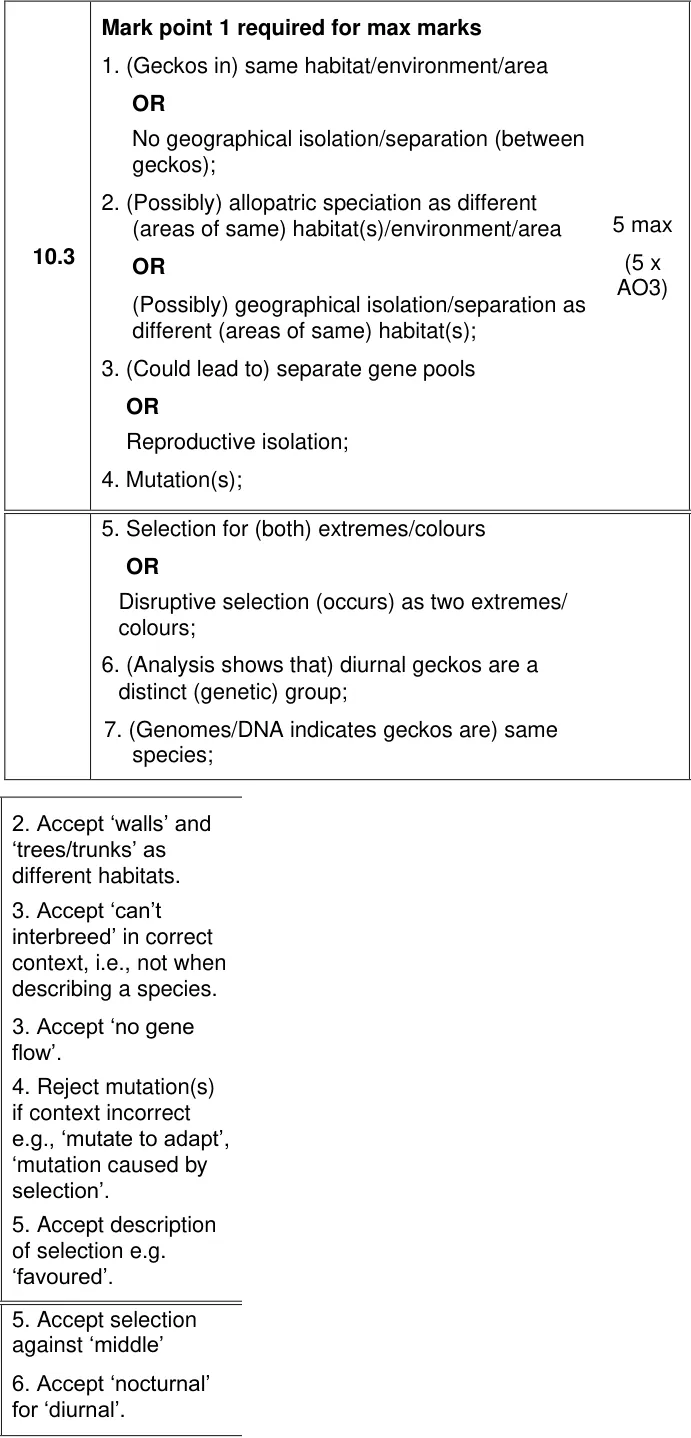
- Types of selection and evolution: The effects of stabilising, directional and disruptive selection. Evolution as a change in the allele frequencies in a population. (no question asks you to describe stabilising or directional selection; the wall gecko evaluation credits disruptive selection as selection for both extremes)
- Reproductive separation and new species: Reproductive separation of two populations can result in the accumulation of difference in their gene pools. New species arise when these genetic differences lead to an inability of members of the populations to interbreed and produce fertile offspring. In this way, new species arise from existing species.
- Allopatric and sympatric speciation; genetic drift: Allopatric and sympatric speciation. The importance of genetic drift in causing changes in allele frequency in small populations.
- Explaining variation: explain why individuals within a population of a species may show a wide range of variation in phenotype (the wall gecko phenotypic diversity question, listed under the first point, asks you to explain this variation)
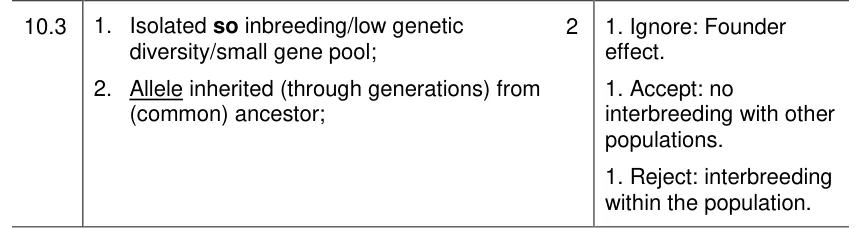
- Genetic drift in small populations: explain why genetic drift is important only in small populations (the Yaramul question rewards isolation and a small gene pool; no question asks directly why drift matters only in small populations)
- Natural selection and isolation: explain how natural selection and isolation may result in change in the allele and phenotype frequency and lead to the formation of a new species
- A great diversity of species: explain how evolutionary change over a long period of time has resulted in a great diversity of species.
How to use this page
Write your answer on paper before you open the mark scheme. Allow about 1.3 minutes per mark: the 15 questions are worth 49 marks, so about 64 minutes in total. Then mark your answer strictly against the mark scheme and read the examiners' tip underneath it. If you'd rather print the questions, download the PDF pack.
Variation and natural selection (3.7.3)
Question 1
A level Paper 2 · June 2024 · Q10.1 · 2 marks · Easy
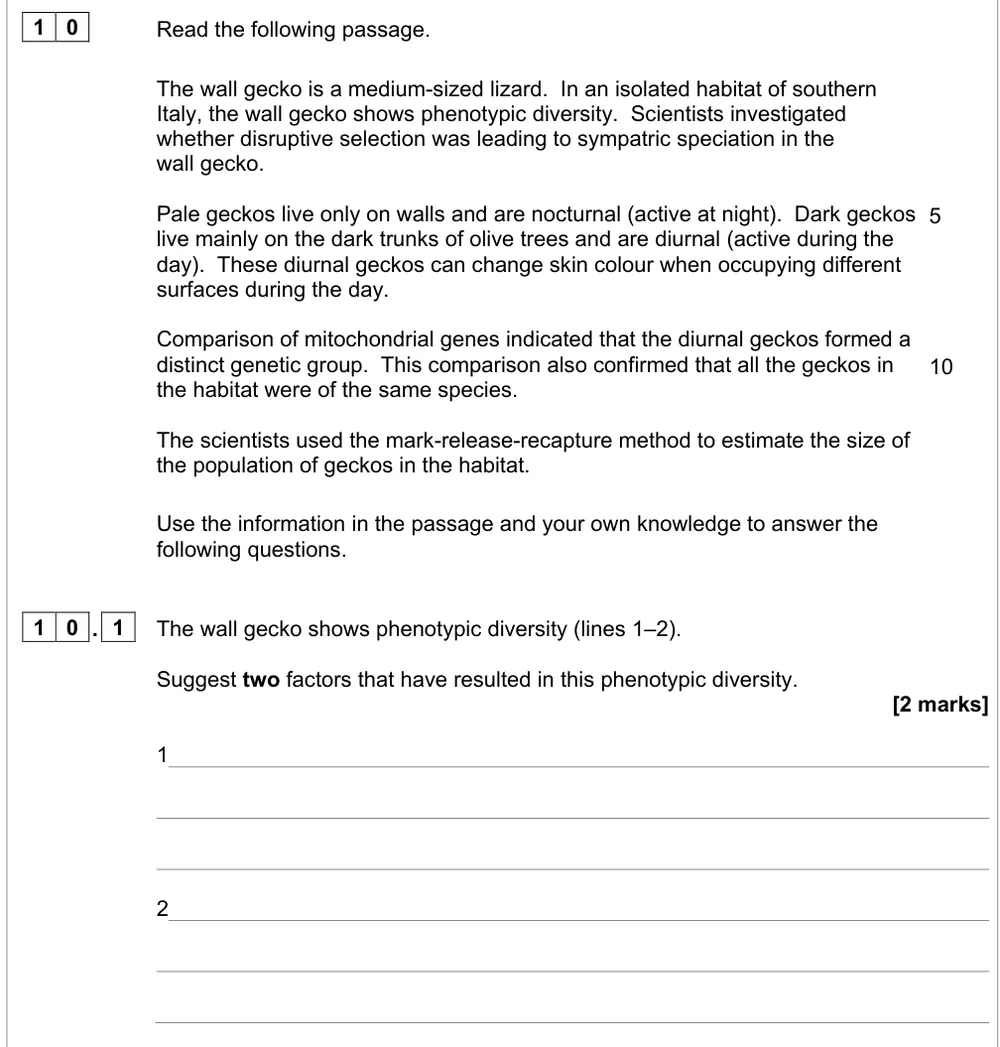
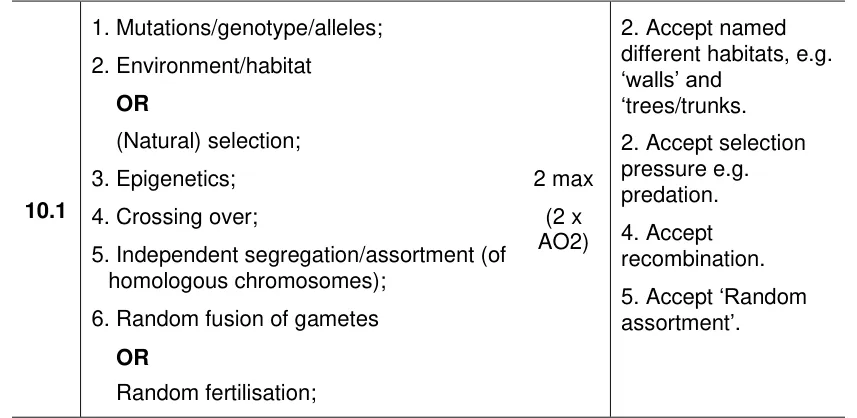
Suggest two factors behind the phenotypic diversity of wall geckos.
Show the mark scheme
Tap an image to open it full size.
From the examiners' report: About 42% got both marks. Give two different sources, such as mutation and the environment; two versions of the same point score once, and geographical isolation or speciation don't count.
Question 2
A level Paper 2 · June 2024 · Q10.2 · 2 marks · Easy
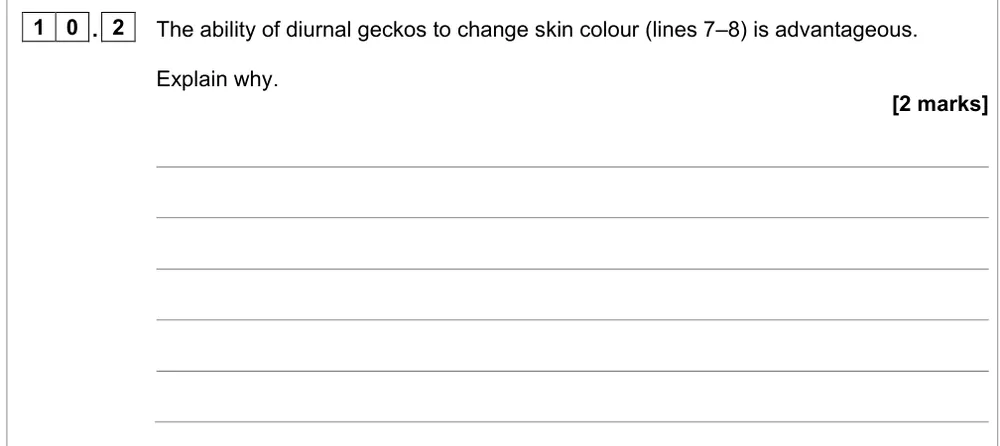
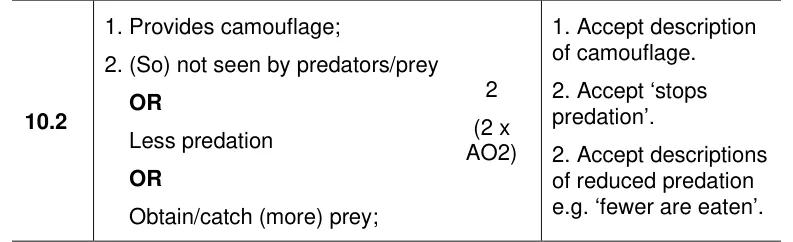
Explain why changing skin colour helps diurnal wall geckos.
Show the mark scheme
Tap an image to open it full size.
From the examiners' report: About 77% got both marks. Say camouflage (or blending in), then link it to predators or prey; 'hiding' on its own wasn't enough.
Question 3
A level Paper 2 · November 2020 · Q10.4 · 2 marks · Easy
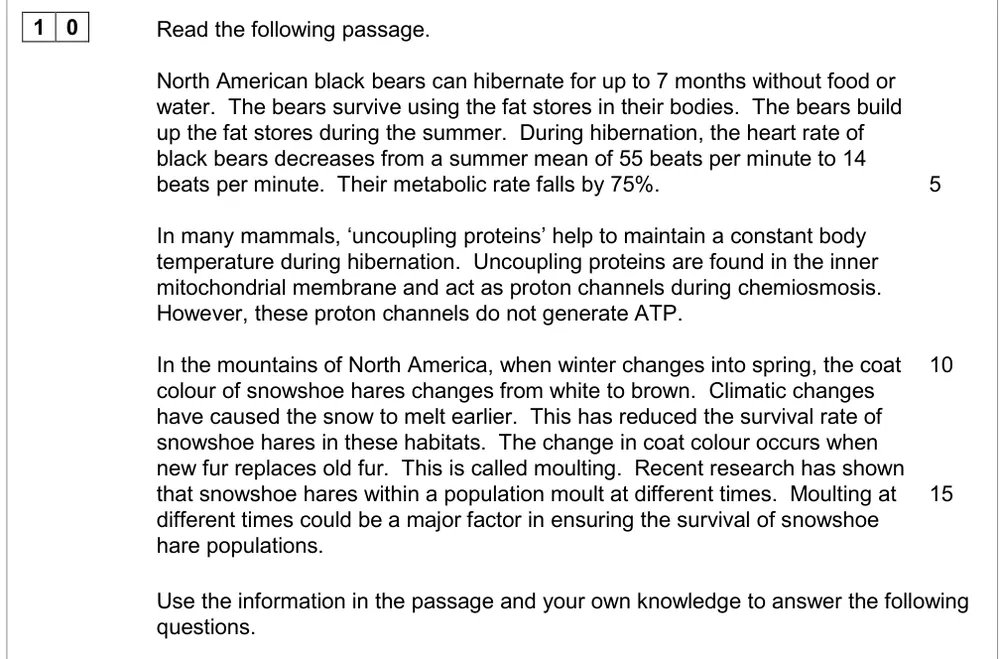
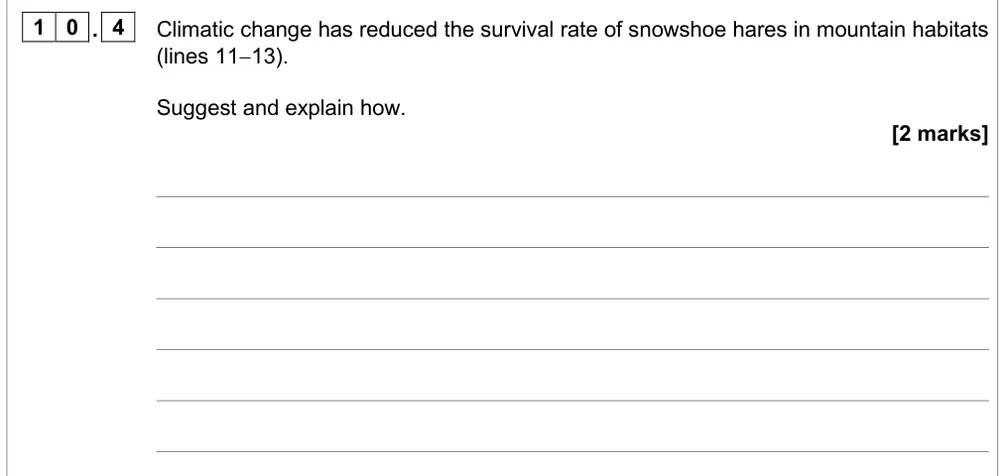
Suggest how climate change has reduced the survival of snowshoe hares.
Information from earlier in this question:
Show the mark scheme
Tap an image to open it full size.
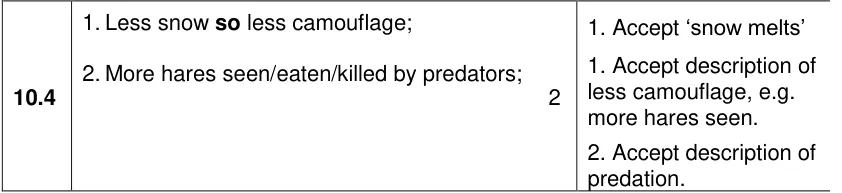
From the examiners' report: 59% got both marks. White hares on brown ground are no longer camouflaged, so predators see and kill more of them. Camouflage from prey and answers about body temperature didn't score.
Question 4
A level Paper 2 · November 2020 · Q10.5 · 4 marks · Hard
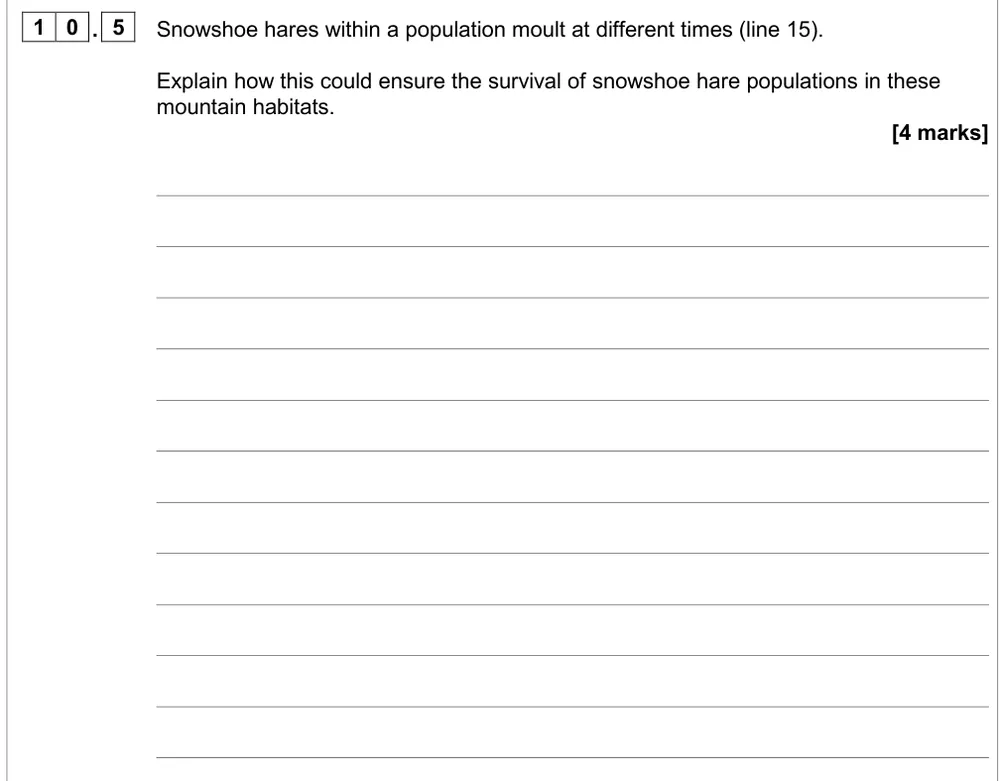
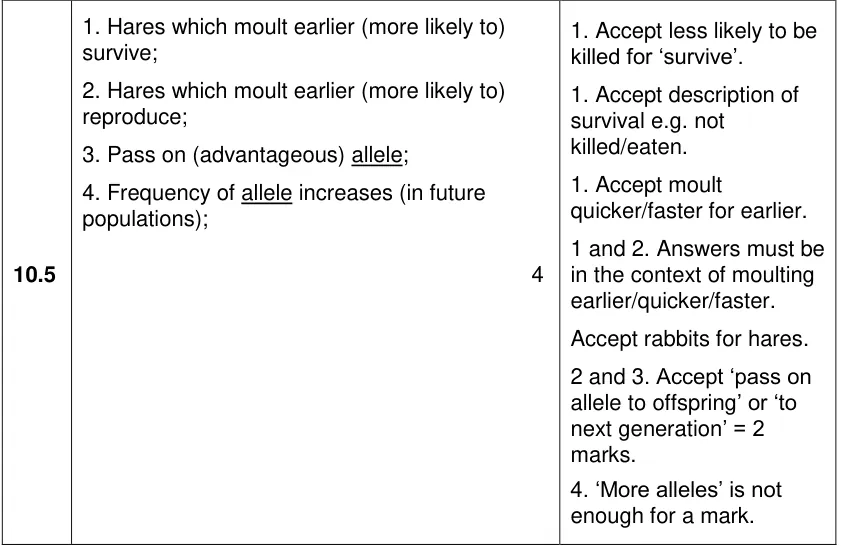
Explain how moulting at different times could keep snowshoe hare populations alive.
Show the mark scheme
Tap an image to open it full size.
From the examiners' report: Only 11% got all four. Keep every point about the hares that moult earlier, and finish with the frequency of the allele increasing, not 'more alleles' or genes.
Question 5
A level Paper 2 · June 2017 · Q10.4 · 2 marks · Medium
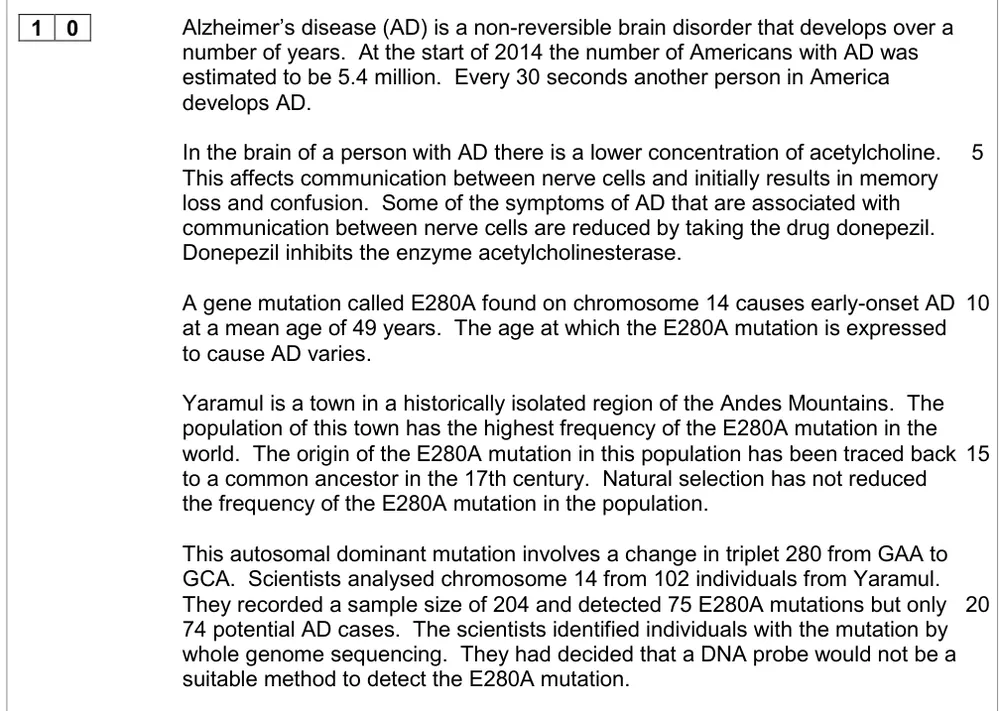
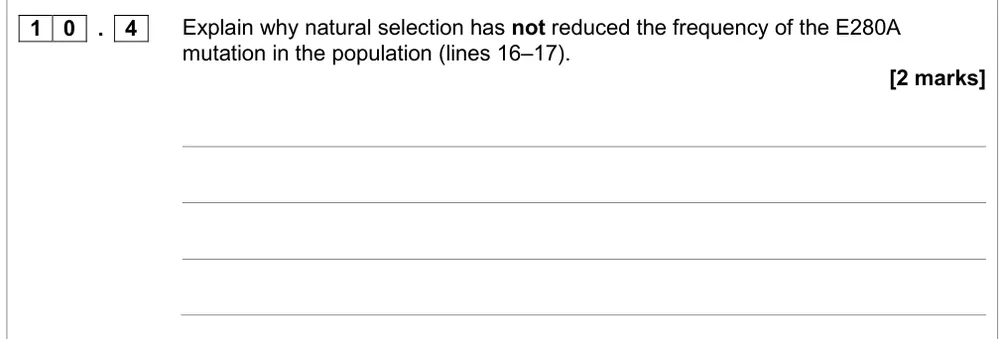
Explain why natural selection hasn't reduced the frequency of the E280A mutation.
Information from earlier in this question:
Show the mark scheme

Tap an image to open it full size.
From the examiners' report: About a third got both and over half scored zero. The symptoms appear after people have had children, so the allele is passed on before selection can act; 'it isn't harmful' scores nothing.
Question 6
A level Paper 3 · November 2020 · Q01.2 · 3 marks · Hard
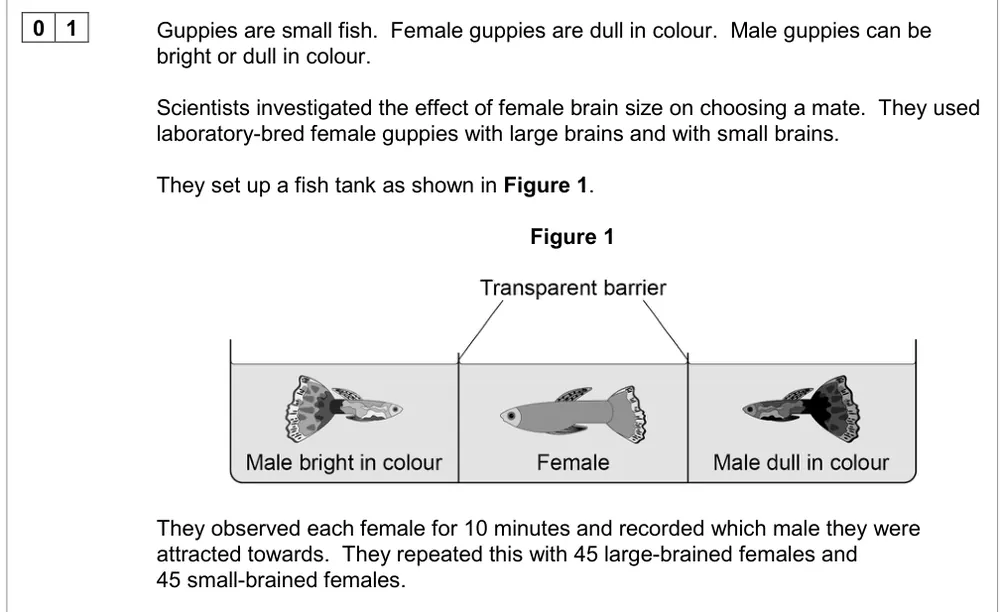
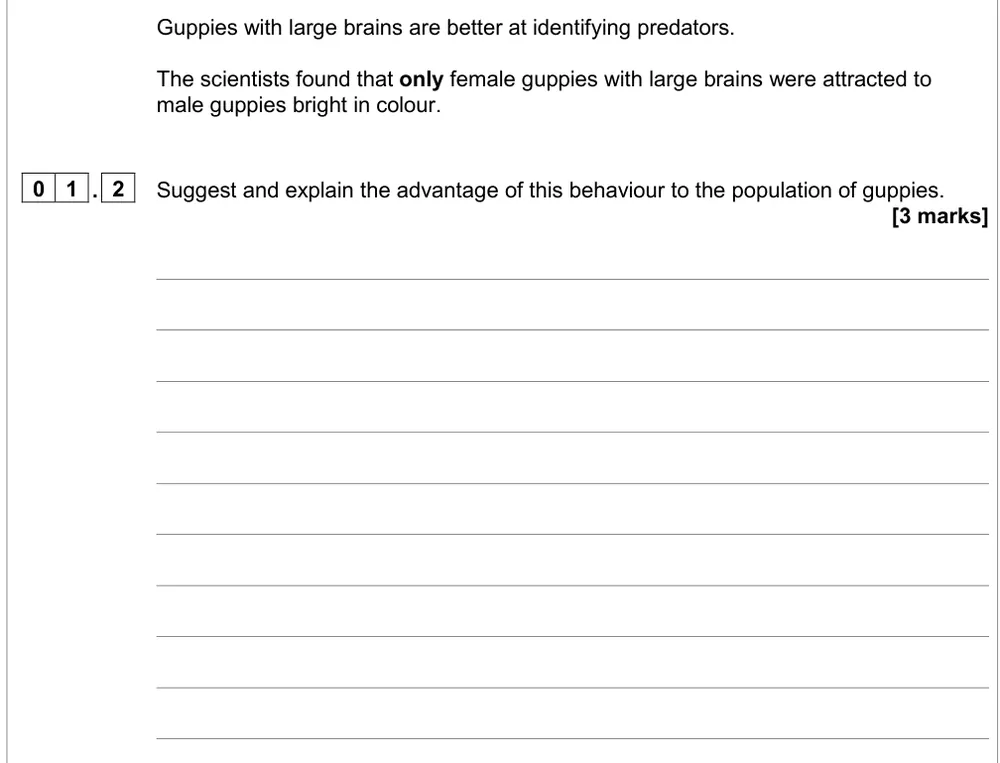
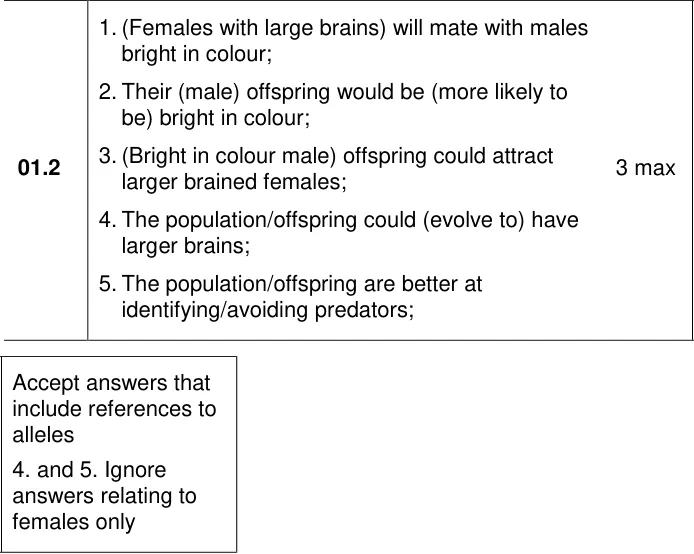
Explain the advantage to guppies of large-brained females choosing brightly coloured males.
Information from earlier in this question:
Show the mark scheme
Tap an image to open it full size.
From the examiners' report: Marks were evenly spread from 0 to 3. Follow the alleles through the offspring to a population better at spotting predators; females 'telling' males about predators didn't score.
Isolation and speciation (3.7.3)
Question 7
A level Paper 3 · November 2020 · Q01.3 · 3 marks
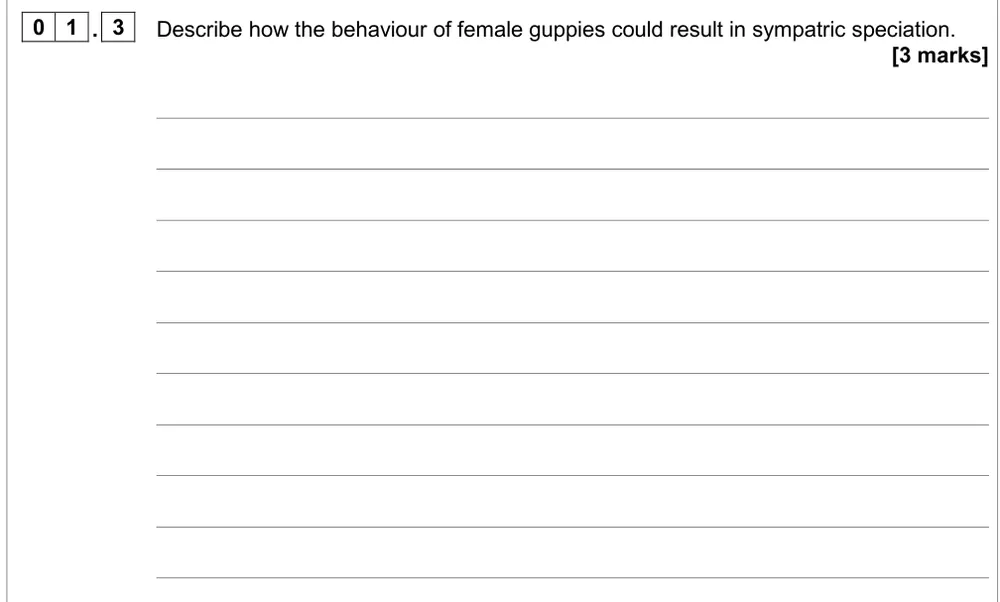
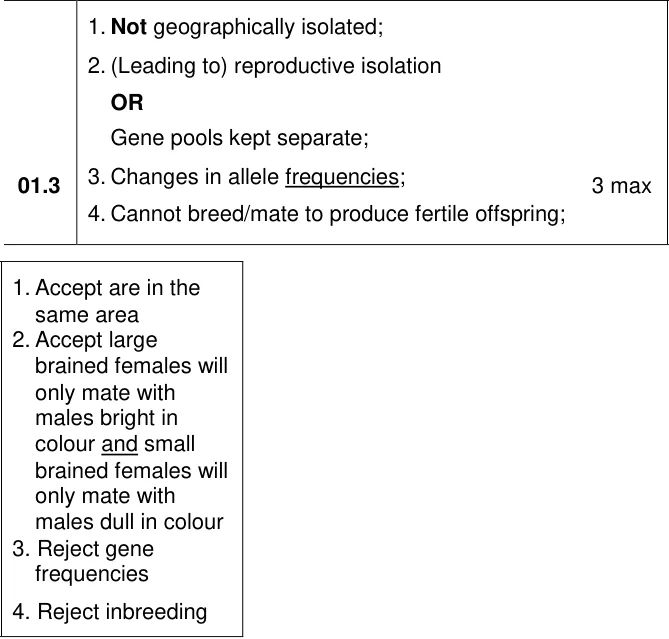
Describe how female guppy behaviour could lead to sympatric speciation.
Show the mark scheme
Tap an image to open it full size.
From the examiners' report: Most students missed the key point that the guppies are not geographically isolated. Say that once, then give one version of reproductive isolation and move on to allele frequencies.
Question 8
A level Paper 2 · June 2017 · Q09.2 · 5 marks · Medium
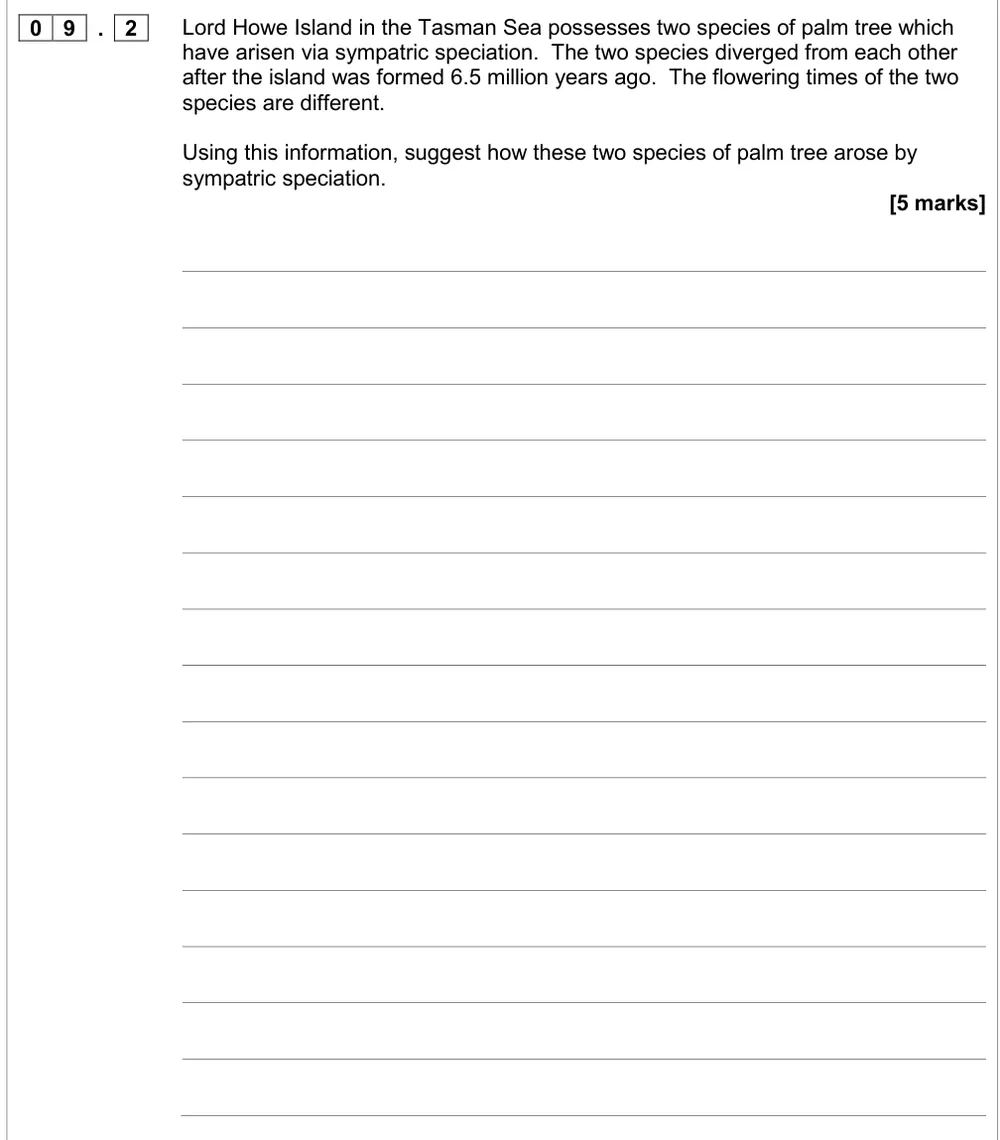
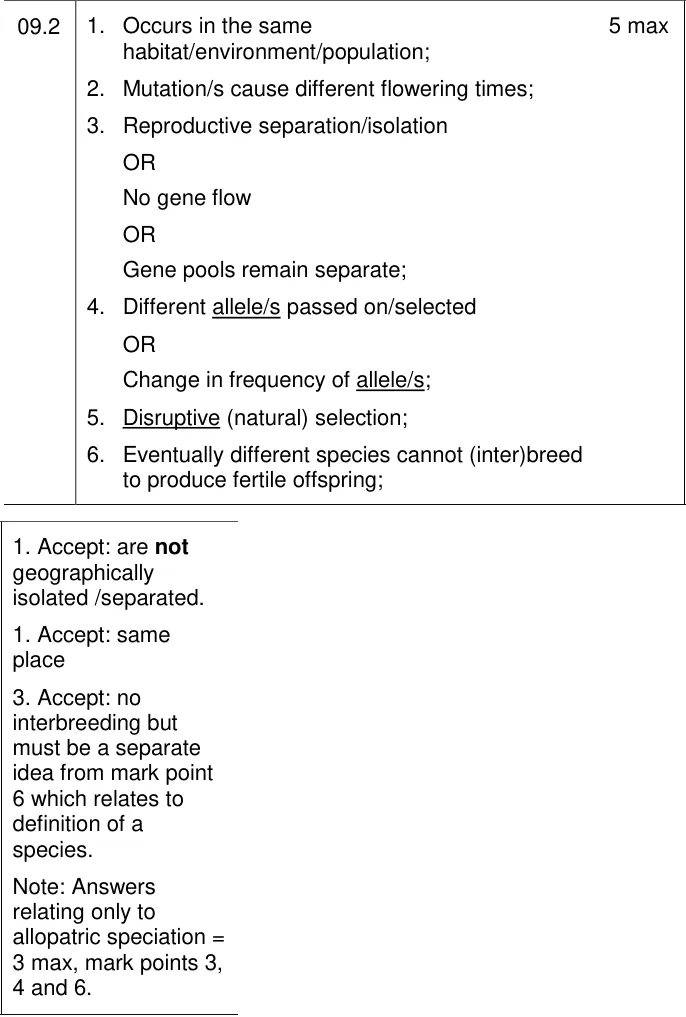
Suggest how two palm species on Lord Howe Island arose by sympatric speciation.
Show the mark scheme
Tap an image to open it full size.
From the examiners' report: Fewer than 2% got all five. Describe sympatric speciation as asked: same place, a mutation changing flowering time, then reproductive isolation and alleles, not genes.
Question 9
A level Paper 2 · November 2021 · Q10.1 · 4 marks · Medium
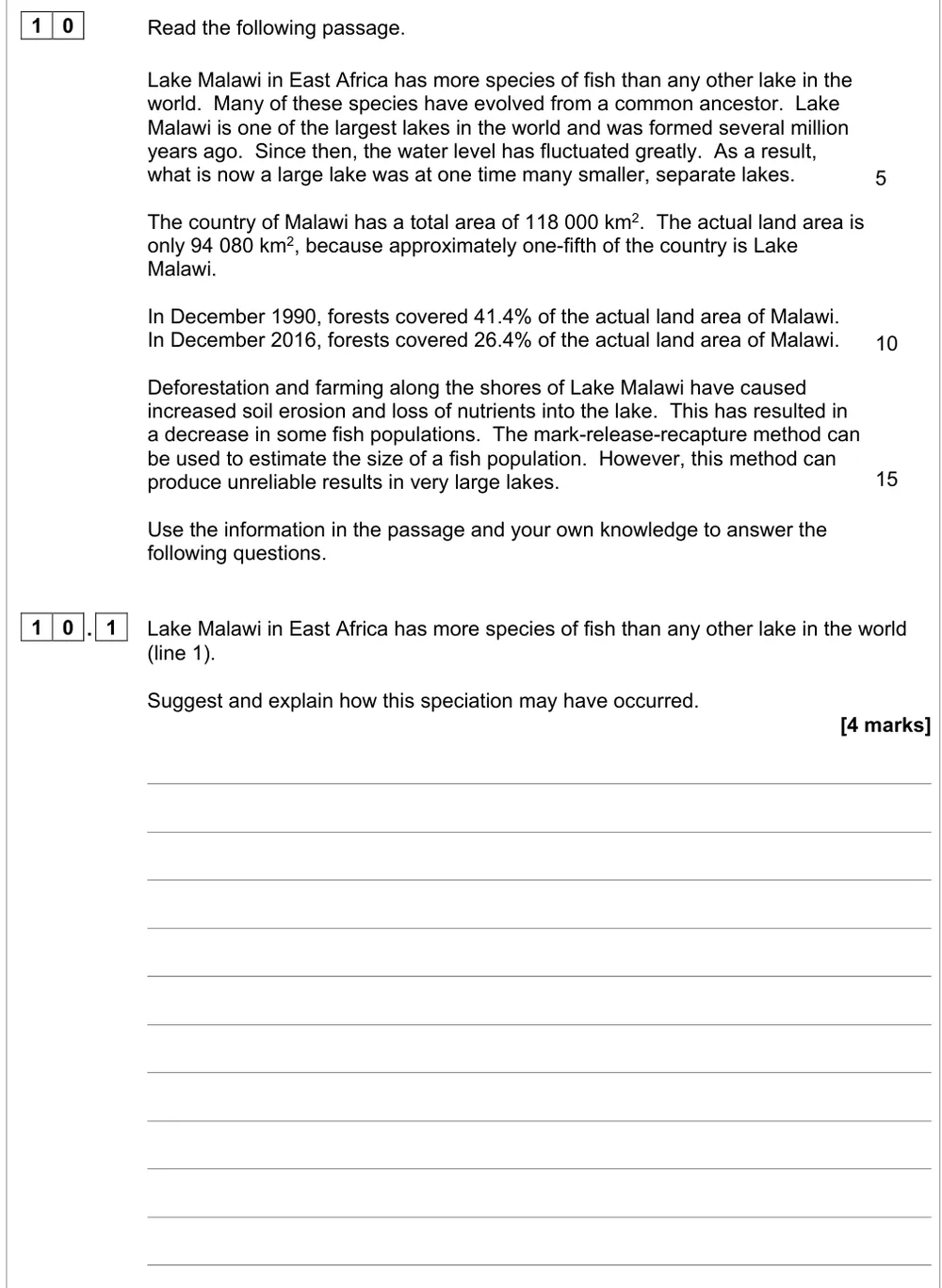
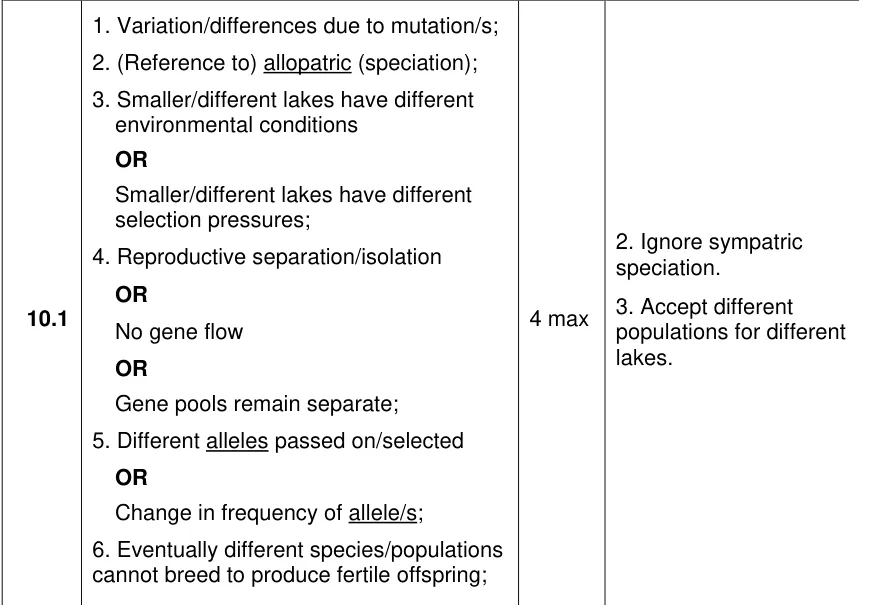
Suggest how the many fish species of Lake Malawi may have arisen.
Show the mark scheme
Tap an image to open it full size.
From the examiners' report: Almost a third scored zero, often by describing succession. Use the passage: separate small lakes give geographical isolation and different selection pressures in each.
Question 10
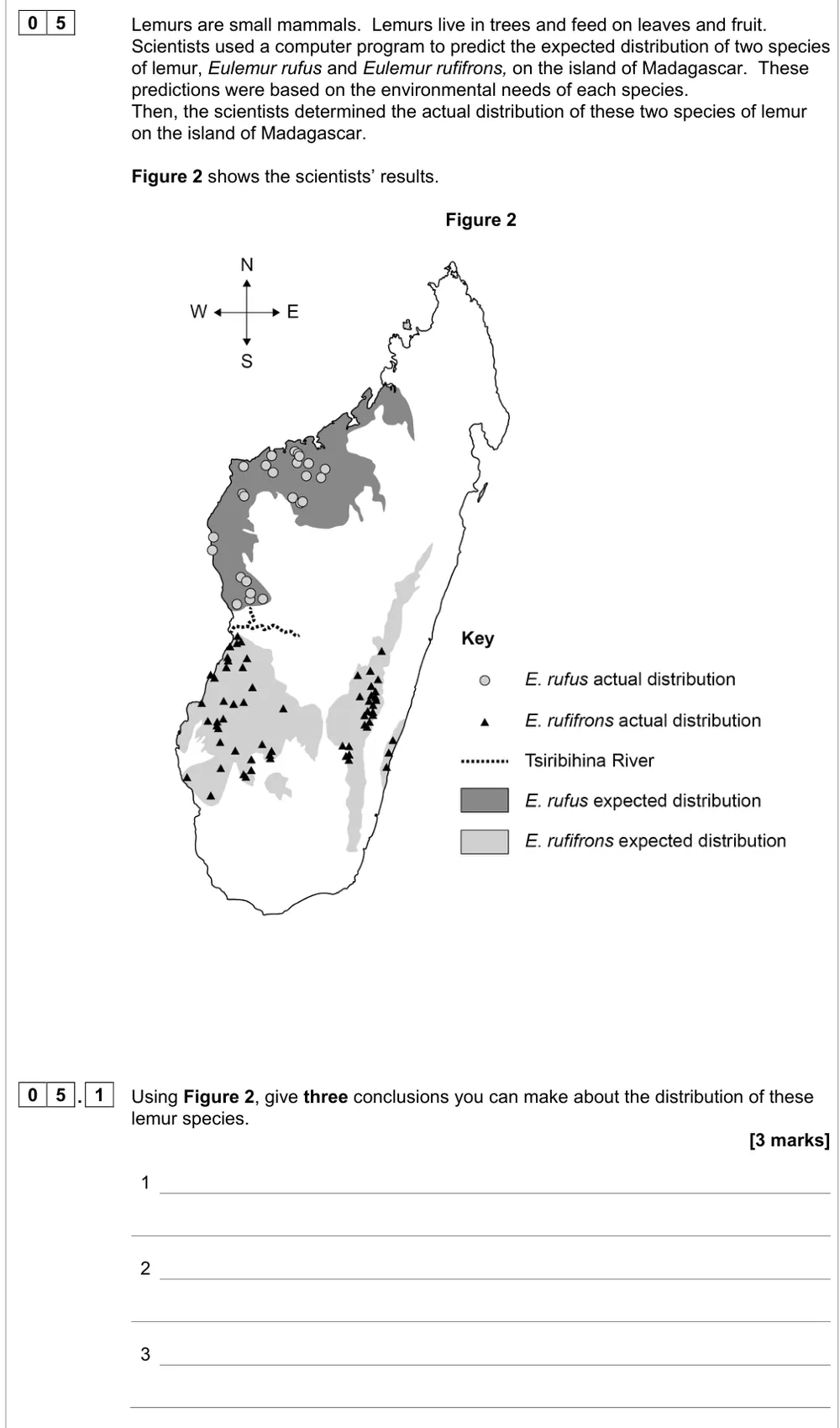
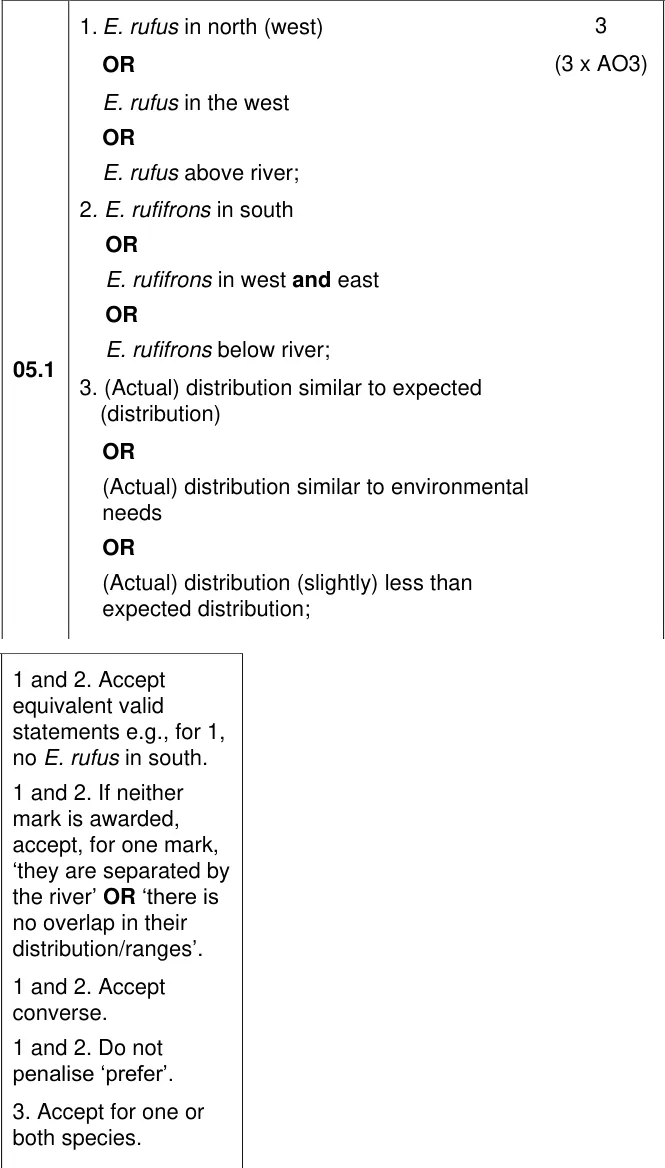
A level Paper 2 · June 2022 · Q05.1 · 3 marks · Medium
Give three conclusions from a map of the distribution of two lemur species.
Show the mark scheme
Tap an image to open it full size.
From the examiners' report: 13% got all three. Name each species and where it is, then compare actual with expected; closeness to the coast scored nothing.
Question 11
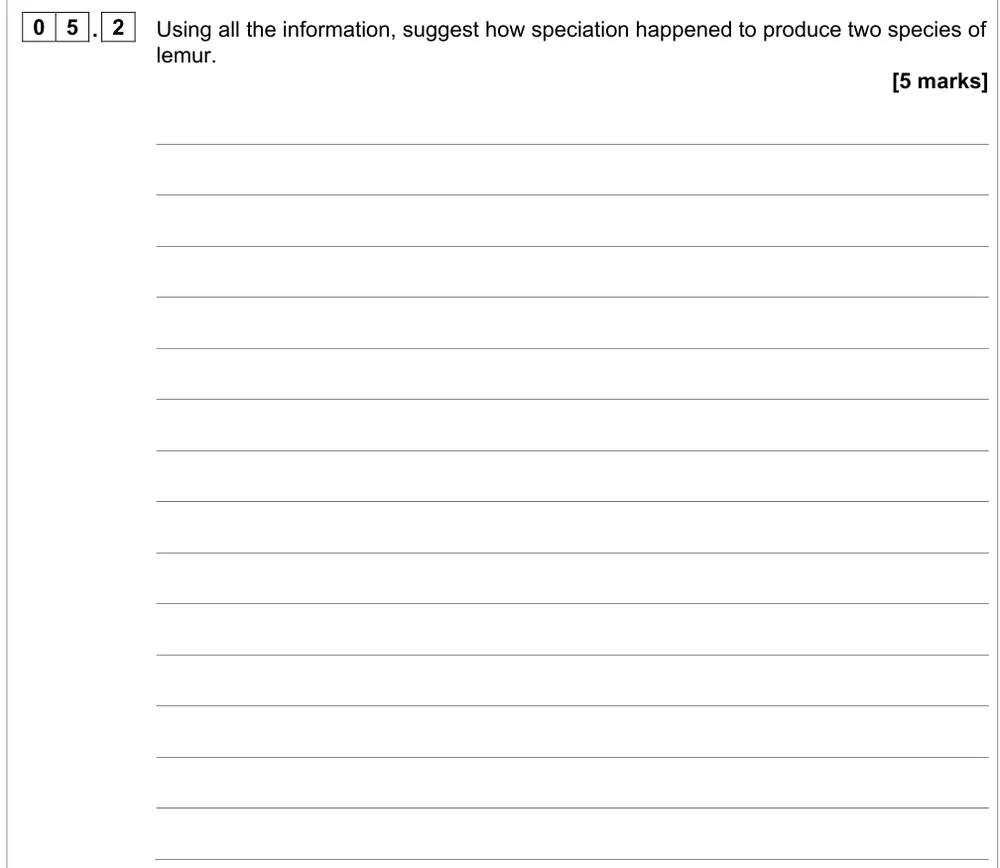
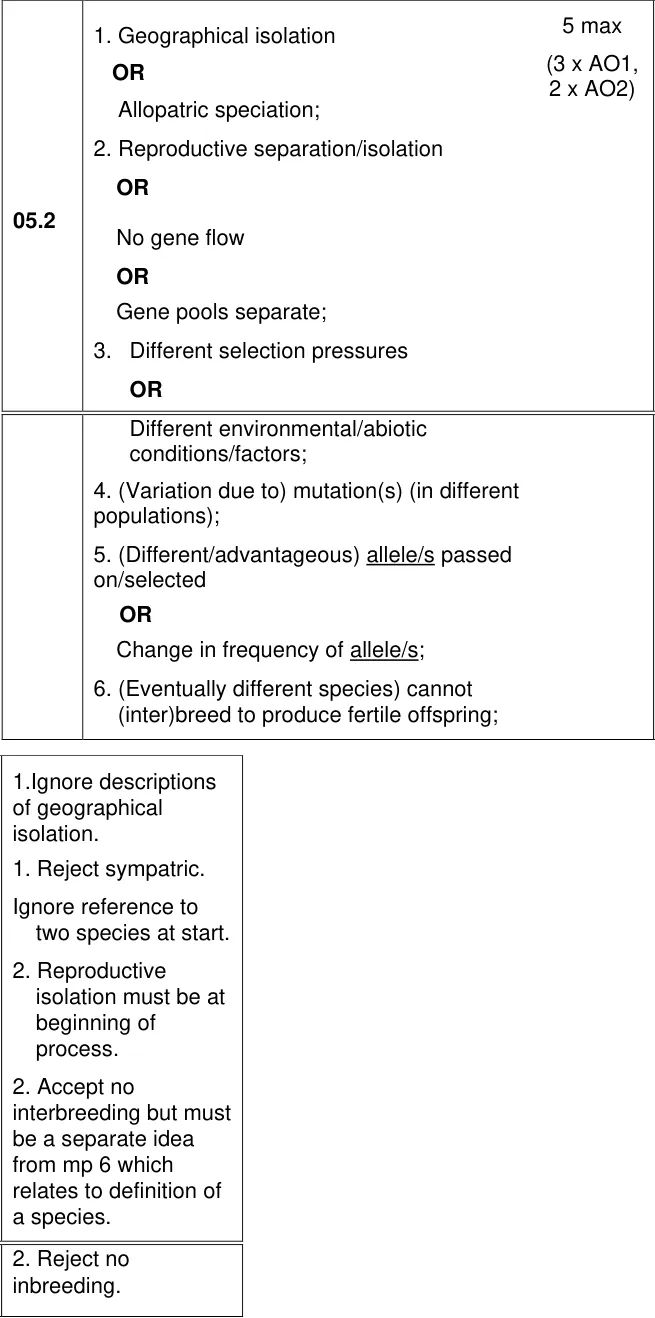
A level Paper 2 · June 2022 · Q05.2 · 5 marks · Medium
Suggest how speciation produced the two lemur species.
Show the mark scheme
Tap an image to open it full size.
From the examiners' report: 52% got at least 3. Put reproductive isolation at the start, say mutations happen randomly rather than 'to adapt', and give both halves of the species test.
Question 12
A level Paper 2 · June 2023 · Q05.3 · 5 marks · Medium
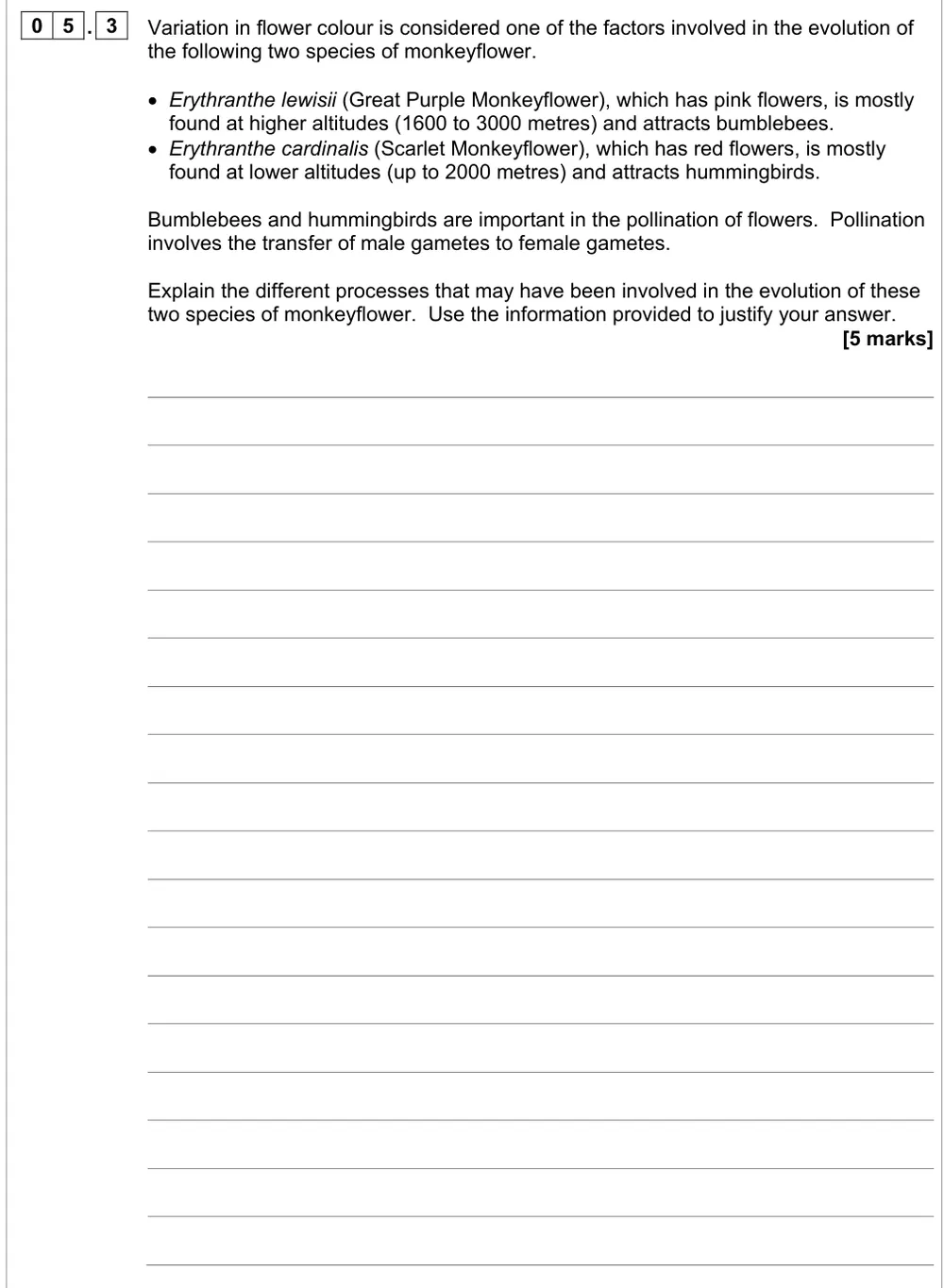
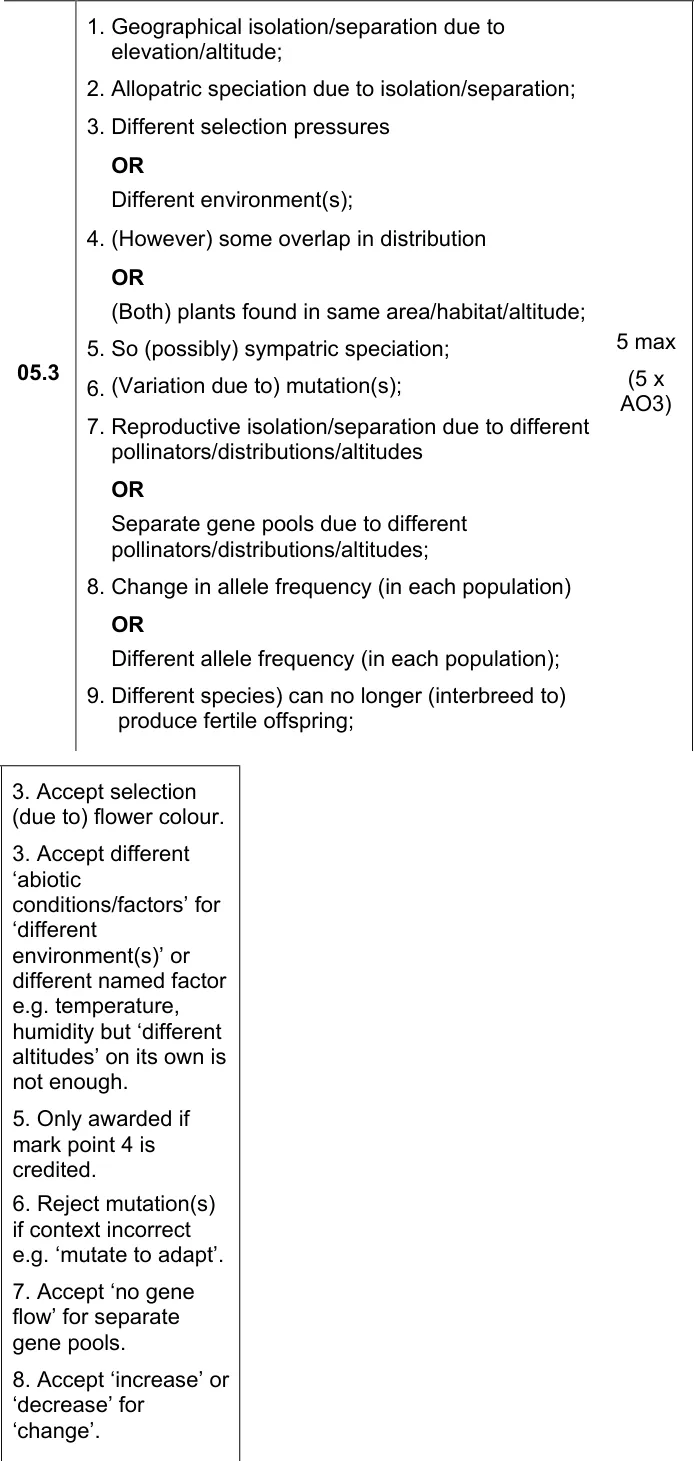
Explain the processes that may have produced two species of monkeyflower.
Show the mark scheme
Tap an image to open it full size.
From the examiners' report: About 21% got full marks. Justify from the data: different altitudes for allopatric, the 1600 to 2000 m overlap for sympatric, and different pollinators for reproductive isolation.
Question 13
A level Paper 2 · June 2024 · Q10.3 · 5 marks · Medium
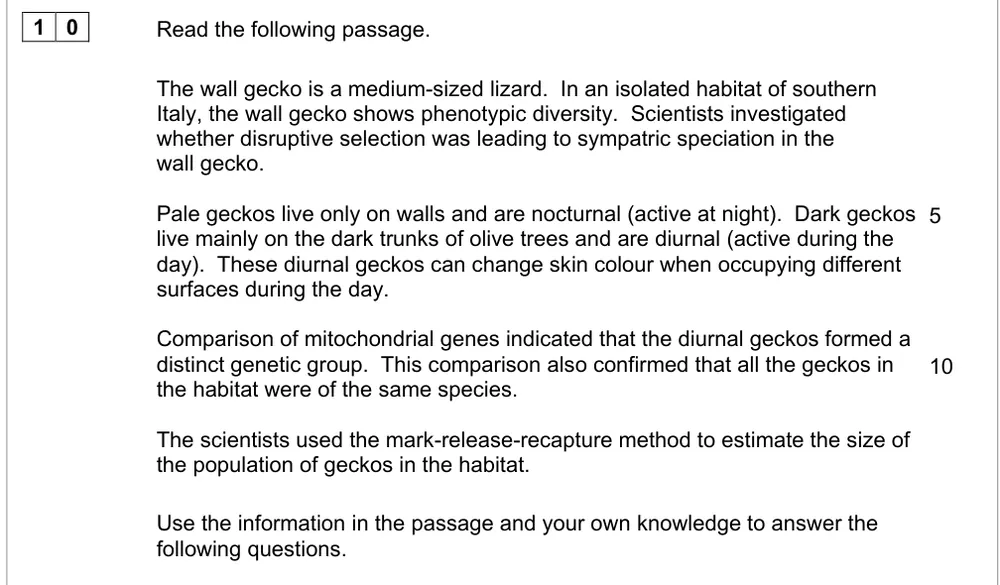
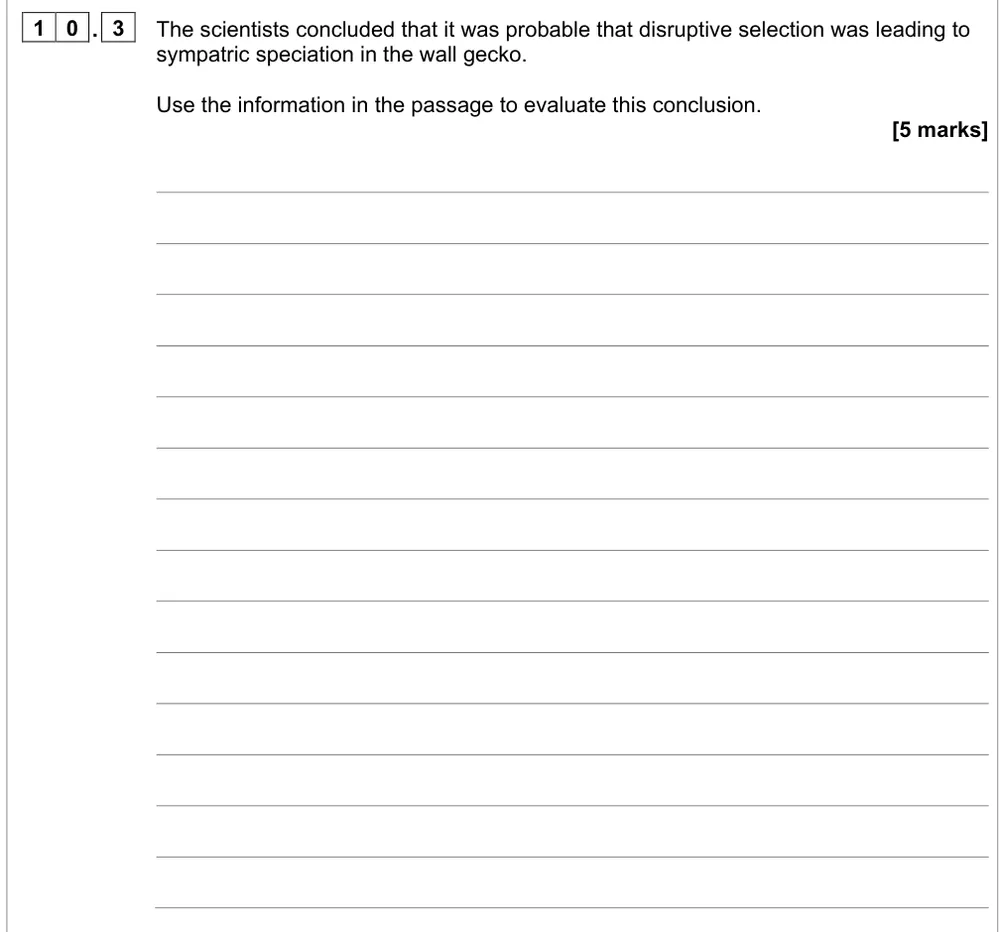
Evaluate the conclusion that disruptive selection is leading to sympatric speciation in wall geckos.
Information from earlier in this question:
Show the mark scheme
Tap an image to open it full size.
From the examiners' report: Only about 3% got five. Use the passage both ways: same habitat and a distinct genetic group support it, but walls versus trees could mean allopatric and they are still one species.
Genetic drift in small populations (3.7.3)
Question 14
A level Paper 2 · June 2017 · Q10.3 · 2 marks · Hard
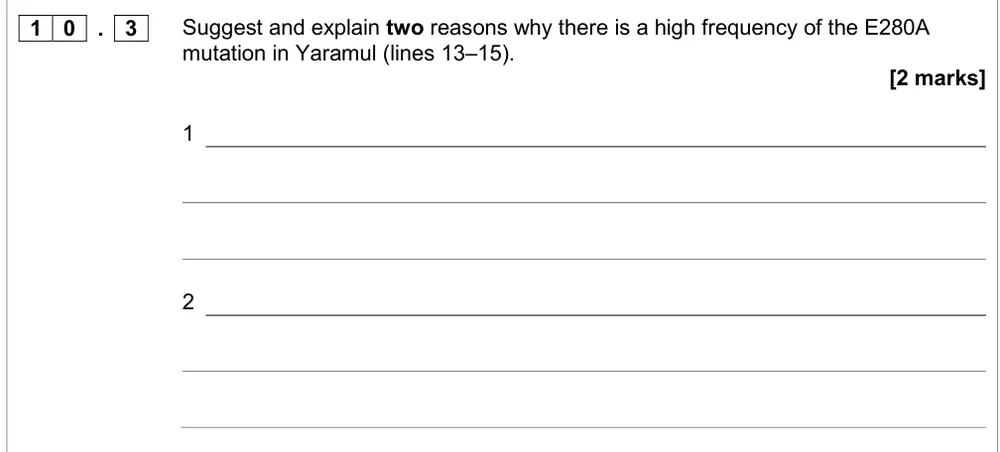
Suggest two reasons for the high frequency of the E280A mutation in Yaramul.
Information from earlier in this question:
Show the mark scheme
Tap an image to open it full size.
From the examiners' report: Fewer than 2% got both and over half scored zero. Explain each reason fully, say allele rather than gene or mutation, and don't mix up inbreeding with interbreeding.
Question 15
A level Paper 3 · June 2024 · Q05.3 · 2 marks · Medium
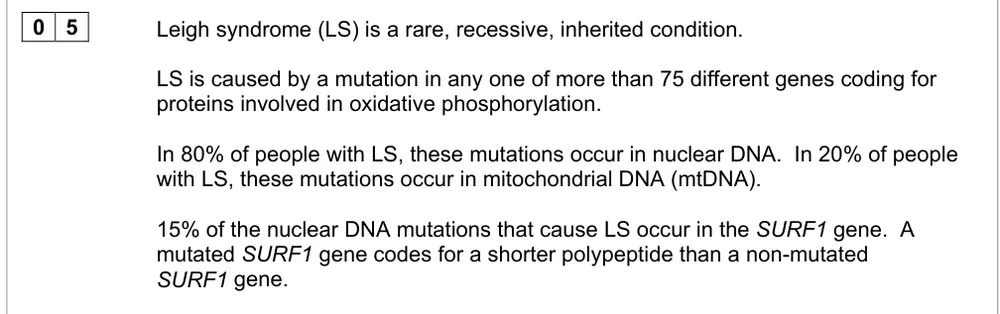
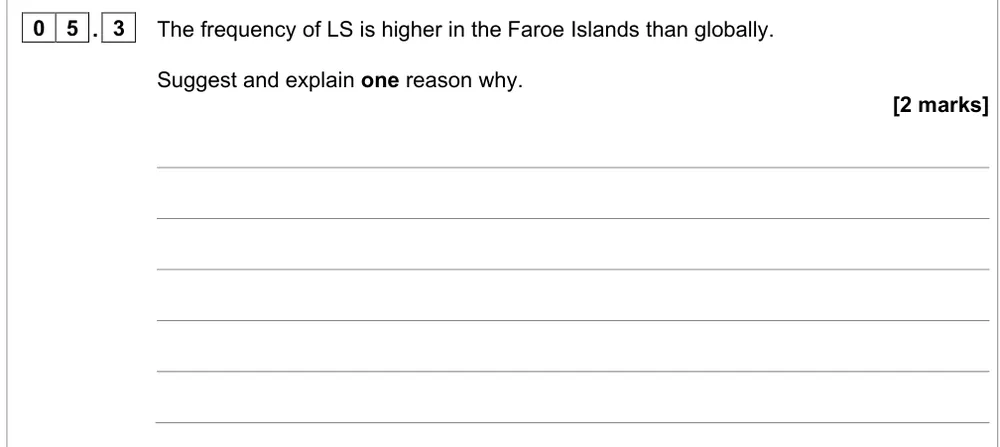
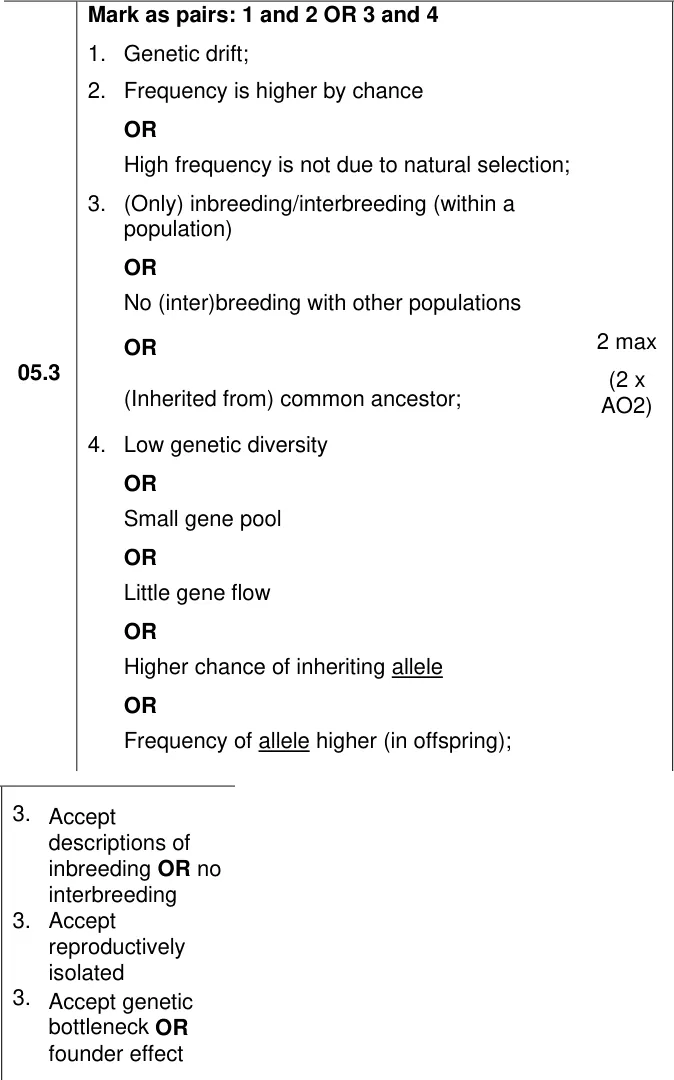
Suggest why Leigh syndrome is more common in the Faroe Islands than globally.
Information from earlier in this question:
Show the mark scheme
Tap an image to open it full size.
From the examiners' report: A quarter got both marks. Give a matched pair: genetic drift means a change by chance, or isolation means a small gene pool, and use 'allele', not 'the mutation'.
Where students lose marks (from AQA examiners' reports and mark schemes)
Each point below is followed by wording that gained marks.
Sympatric means the same place: On the Lord Howe Island palms fewer than 2% got all five marks and almost 25% scored zero, mainly by describing allopatric speciation (capped at 3 marks). On the guppies most students missed the main idea of sympatric speciation.
✔ Gains credit: "Occurs in the same habitat/environment/population"; "Not geographically isolated".
Isolation comes first, not last: On the lemurs some students put reproductive isolation at the end of speciation and lost the mark: the mark scheme says it "must be at beginning of process".
✔ Gains credit: "Reproductive separation/isolation OR No gene flow OR Gene pools separate".
Mutations are random, not a response: The mutation mark was disqualified on the lemurs, monkeyflowers and wall geckos when answers said organisms 'mutate to adapt' or that the conditions caused the mutations.
✔ Gains credit: "(Variation due to) mutation(s) (in different populations)".
Say the allele's frequency rises: Only 11% got all four marks on the snowshoe hares. Weaker answers said genes instead of alleles and 'more alleles' instead of a rise in frequency, and didn't link survival to moulting earlier.
✔ Gains credit: "Hares which moult earlier (more likely to) survive"; "Pass on (advantageous) allele"; "Frequency of allele increases".
Late onset means they've already reproduced: Over 50% scored zero on the E280A mutation, often by saying it isn't harmful or is even beneficial, or by citing better health care.
✔ Gains credit: "AD/symptoms develops late/at 49"; "Have already reproduced".
Finish with two groups that can't interbreed: On Lake Malawi and the lemurs many students ended without the species test, or gave only half of it by leaving out 'fertile offspring'.
✔ Gains credit: "Eventually different species/populations cannot breed to produce fertile offspring".
Drift is change by chance: The Faroe Islands question was set to test genetic drift, but it was rarely seen and rarely understood, and most answers said 'the mutation' where the mark needed 'allele'.
✔ Gains credit: "Genetic drift" with "Frequency is higher by chance OR High frequency is not due to natural selection"; or "Low genetic diversity OR Small gene pool".
Hidden from predators, not from prey: On the snowshoe hares a frequent error was saying hares were camouflaged from their prey, and some students mixed up predator and prey or forgot that the snow melts earlier.
✔ Gains credit: "Less snow so less camouflage"; "More hares seen/eaten/killed by predators".
Download the questions
Download the PDF pack (15 questions, mark schemes at the end)
Keep practising
- Populations in ecosystems: AQA A Level Biology exam questions by topic
- Populations and the Hardy-Weinberg principle: AQA A Level Biology exam questions by topic
- Genetic diversity and adaptation: AQA A Level Biology exam questions by topic
- Species and taxonomy: AQA A Level Biology exam questions by topic
- AQA 3.7.3 evolution and speciation: self-marking quiz
- AQA A Level Biology masterclasses
Questions, mark schemes and examiners' report extracts © AQA.