

Nervous coordination (AQA 3.6.2) is A-level only, so it's Year 13 content. You need the structure of a myelinated motor neurone, how a resting potential is set up and kept, how an action potential is generated and passed along myelinated and non-myelinated axons, and why the refractory period matters. Then comes synaptic transmission: the cholinergic synapse and the neuromuscular junction, unidirectionality, summation, inhibitory synapses and using information to explain how drugs act.
The examiners' reports find the same gaps every year. Students say sodium ion channels open but never say sodium ions enter, have vesicles crossing the synaptic cleft, and put receptors on 'the muscle' instead of the postsynaptic membrane or sarcolemma. On the resting potential they send ions the wrong way or say the pump works by diffusion, and on myelination they call myelin a thermal insulator or have impulses 'jumping'.
Start with the neurone and the resting potential, work through action potentials and synapses, then try the drug and disease questions and the speed calculation. Write your answer on paper before you open each mark scheme. If you'd like help with this topic, my AQA masterclasses run online on Tuesdays at 5.15pm for Year 12 and on Wednesdays or Thursdays at 6.30pm for Year 13.
What you need from GCSE and Year 12
Each question on this page assumes you're secure on these GCSE and Year 12 ideas. If any of them feels shaky, revise it before you start.
- GCSE: neurones carry electrical impulses from receptors to the central nervous system and on to effectors, and a chemical diffuses across the synapse between two neurones.
- GCSE: a reflex arc runs from receptor to sensory neurone, relay neurone, motor neurone and effector.
- Year 12 (AQA 3.2.3): ions cross membranes by facilitated diffusion through channel proteins, and by active transport through carrier proteins using ATP.
- Year 12 (AQA 3.1.4.2): enzymes such as acetylcholinesterase have an active site and can be inhibited; receptors are not enzymes, so neurotransmitters bind to their binding sites.
- Year 12 (AQA 3.1.8): ATP is made in respiration and hydrolysed to release energy for active transport.
Key terms
These words come up in the questions and mark schemes. Examiners expect you to use them exactly.
- Resting potential: the potential difference of about −70 mV across the axon membrane when no impulse is passing: the inside is negative compared with the outside.
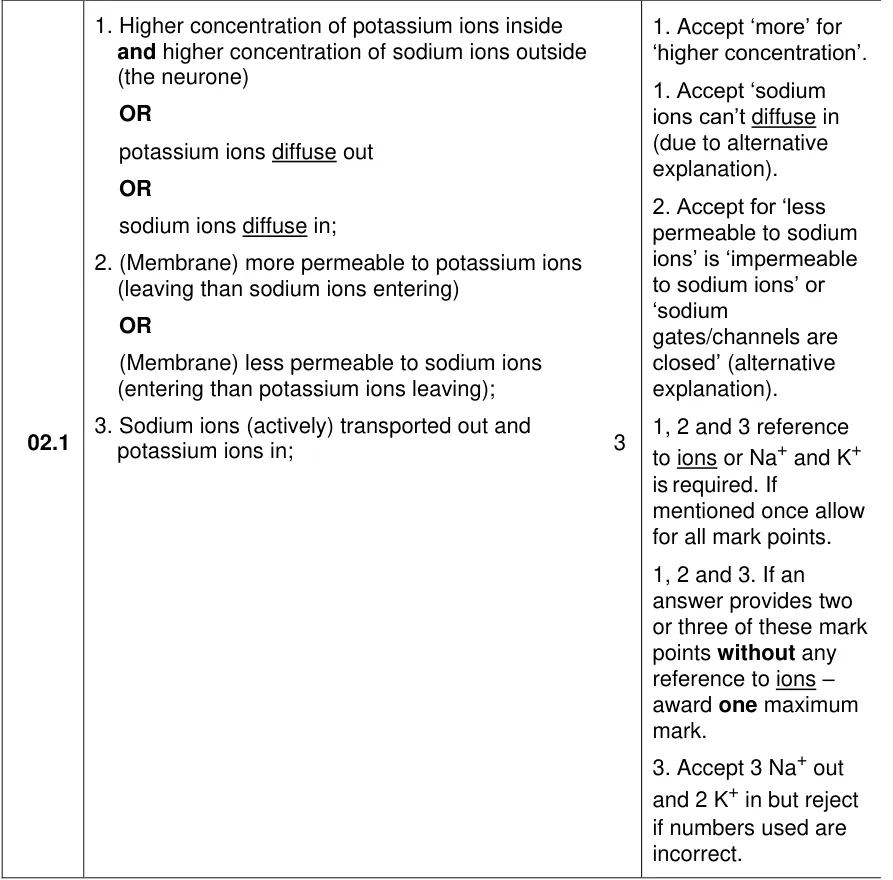
- Sodium-potassium pump: a carrier protein that actively transports three sodium ions out of the axon for every two potassium ions in, using ATP.
- Depolarisation: sodium ion channels open and sodium ions diffuse in, so the inside of the membrane becomes less negative and then positive.
- All-or-nothing principle: an action potential is only produced if the threshold is reached, and every action potential is the same size; a bigger stimulus gives more action potentials, not bigger ones.
- Refractory period: the time after an action potential when a new one can't be produced, so impulses are discrete, travel in one direction and are limited in frequency.
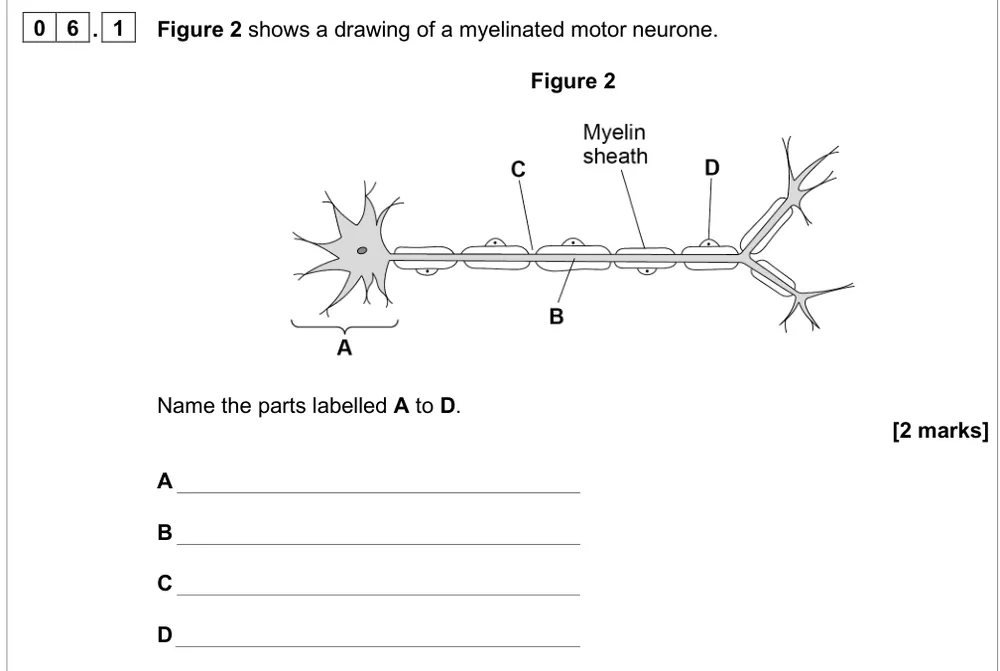
- Saltatory conduction: in a myelinated axon, depolarisation happens only at the nodes of Ranvier, because the myelin sheath (made by Schwann cells) is an electrical insulator.
- Cholinergic synapse: a synapse that uses acetylcholine: calcium ions enter the synaptic knob, vesicles fuse with the presynaptic membrane, and acetylcholine diffuses across the cleft to receptors on the postsynaptic membrane.
- Acetylcholinesterase: the enzyme in the synaptic cleft that hydrolyses acetylcholine, so it stops binding to the receptors.
- Neuromuscular junction: the synapse between a motor neurone and a muscle fibre; its postsynaptic membrane is the sarcolemma.
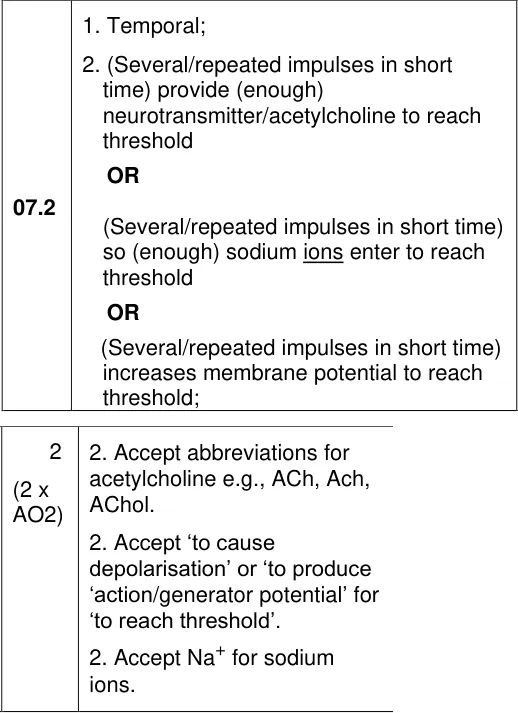
- Temporal and spatial summation: temporal: several impulses in quick succession from one presynaptic neurone; spatial: impulses from several presynaptic neurones; either releases enough neurotransmitter to reach threshold.
- Hyperpolarisation: the inside of the postsynaptic neurone becomes more negative than the resting potential (for example when chloride ions enter), so more sodium ions are needed to reach threshold.
What these questions cover (AQA 3.6.2)
The questions test these statements from the AQA AS and A-level Biology specification (7401/7402):
- Myelinated motor neurone: The structure of a myelinated motor neurone.
- Resting potential: The establishment of a resting potential in terms of differential membrane permeability, electrochemical gradients and the movement of sodium ions and potassium ions.
- Action potentials: Changes in membrane permeability lead to depolarisation and the generation of an action potential. The all-or-nothing principle.
- Passage along axons: The passage of an action potential along non-myelinated and myelinated axons, resulting in nerve impulses.
- Refractory period: The nature and importance of the refractory period in producing discrete impulses and in limiting the frequency of impulse transmission.
- Speed of conductance: Factors affecting the speed of conductance: myelination and saltatory conduction; axon diameter; temperature. (the questions here are on myelination and the reaction-time calculation; no written question on axon diameter or temperature was available for this page, so learn those two factors from your notes)
- Synapse structure: The detailed structure of a synapse and of a neuromuscular junction.
- Cholinergic synapse: The sequence of events involved in transmission across a cholinergic synapse in sufficient detail to explain:
- Unidirectionality: unidirectionality
- Summation: temporal and spatial summation (the question here is on temporal summation; no written question on spatial summation was available, so learn it from your notes (several presynaptic neurones release enough neurotransmitter together to reach threshold))
- Inhibitory synapses: inhibition by inhibitory synapses.
- Neuromuscular junction: A comparison of transmission across a cholinergic synapse and across a neuromuscular junction.
- Drugs: Students should be able to use information provided to predict and explain the effects of specific drugs on a synapse. (you don't need to recall any drug; each question gives you what the drug does)
How to use this page
Write your answer on paper before you open the mark scheme. Allow about 1.3 minutes per mark: the 18 questions are worth 48 marks, so about 62 minutes in total. Then mark your answer strictly against the mark scheme and read the examiners' tip underneath it. If you'd rather print the questions, download the PDF pack.
Neurones and the resting potential (3.6.2.1)
Question 1
A level Paper 2 · June 2025 · Q06.1 · 2 marks · Easy
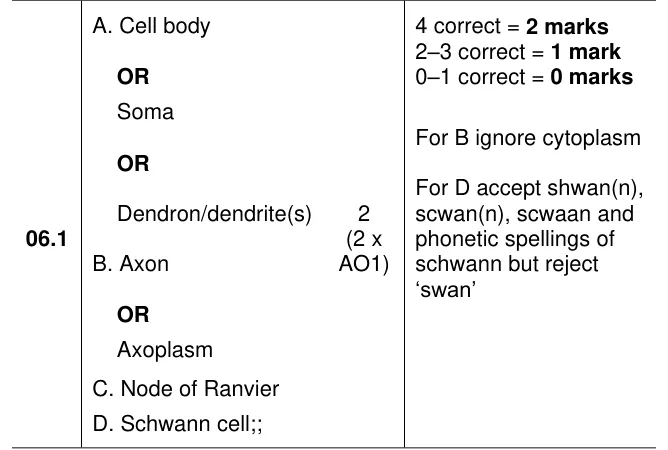
Name four labelled parts of a myelinated motor neurone.
Show the mark scheme
Tap an image to open it full size.
From the examiners' report: About 45% got both marks. Write 'node of Ranvier', not just 'node', and D is a Schwann cell, not the myelin sheath or a nucleus.
Question 2
A level Paper 2 · November 2021 · Q02.1 · 3 marks · Medium
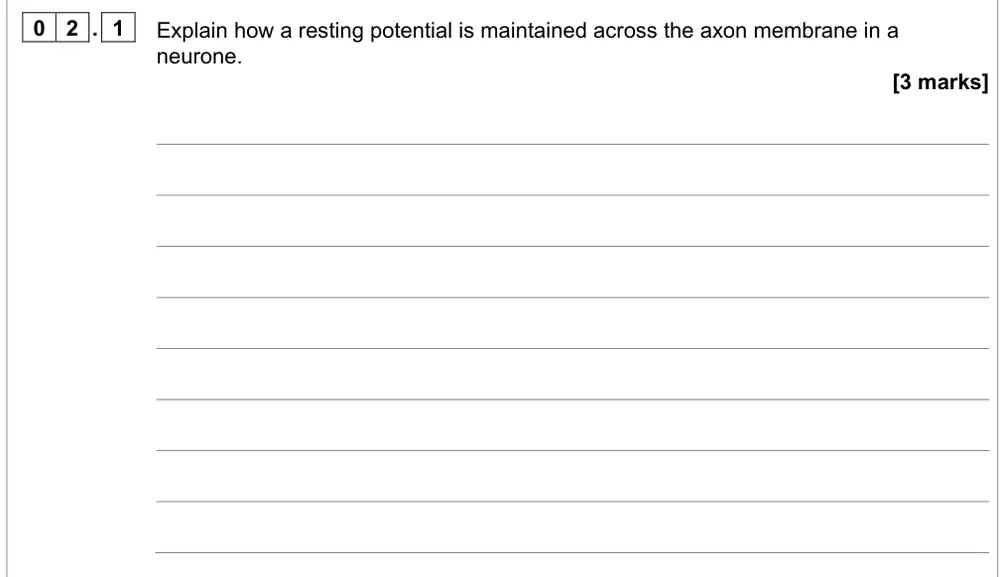
Explain how a resting potential is maintained across an axon membrane.
Show the mark scheme
Tap an image to open it full size.
From the examiners' report: Only 13% got all three. The pump is active transport, three sodium ions out for two potassium ions in, and then say the membrane is more permeable to potassium ions, so they diffuse out.
Question 3
A level Paper 2 · November 2021 · Q02.3 · 3 marks · Hard
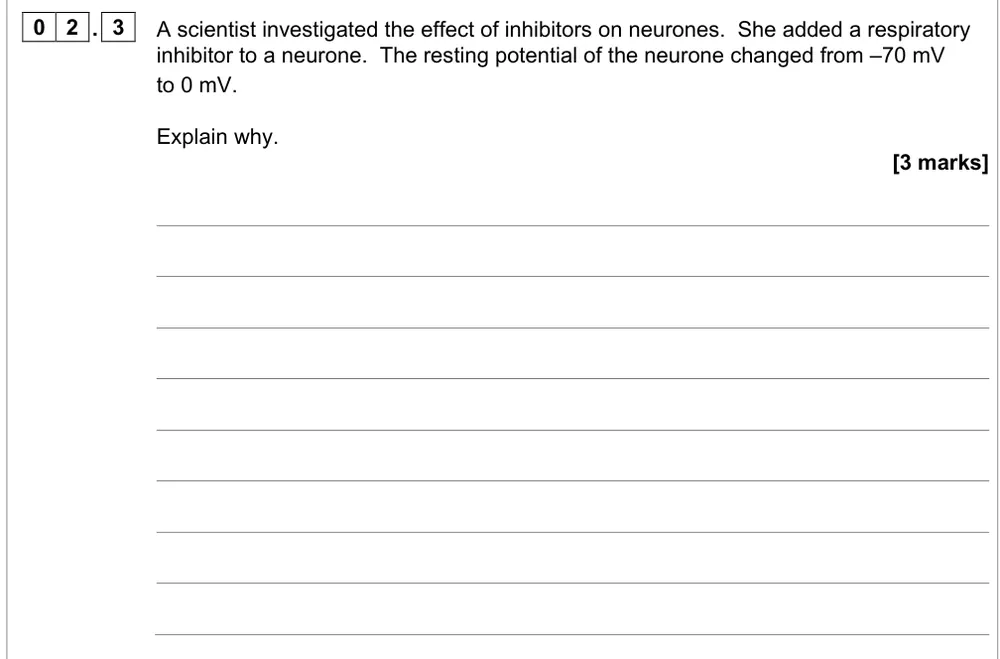
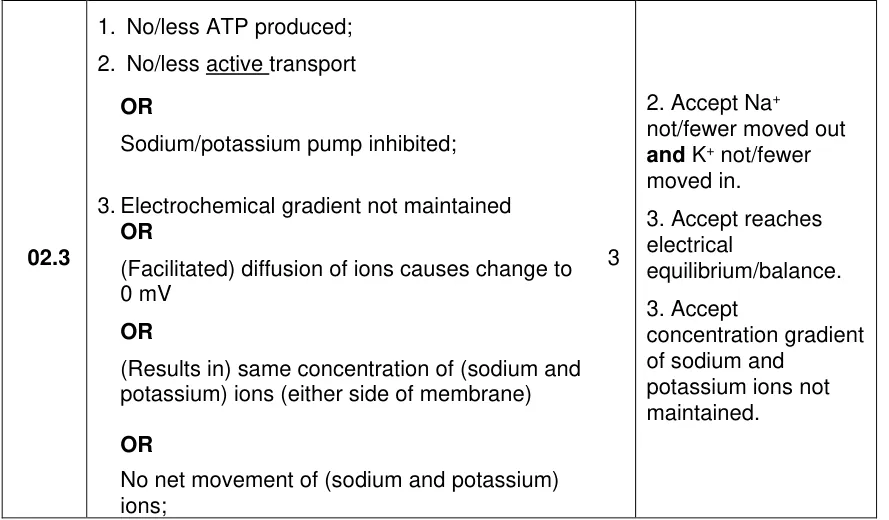
Explain why a respiratory inhibitor makes the resting potential change from −70 mV to 0 mV.
Show the mark scheme
Tap an image to open it full size.
From the examiners' report: Only 8% got all three. Link the inhibitor to less ATP, not 'no energy produced', then to the sodium-potassium pump, and finish with the ions diffusing until there is no net movement.
Action potentials and conduction (3.6.2.1)
Question 4
A level Paper 3 · June 2023 · Q01.2 · 2 marks · Medium
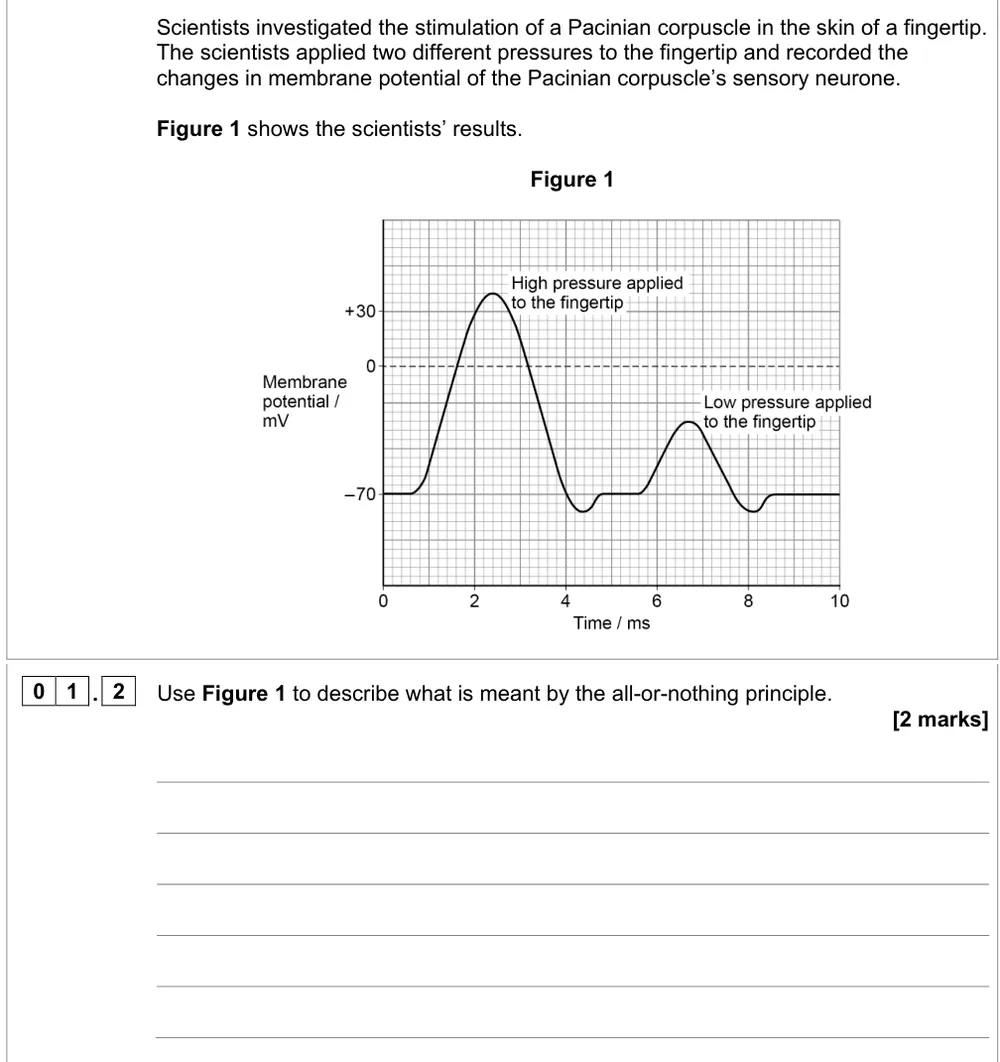
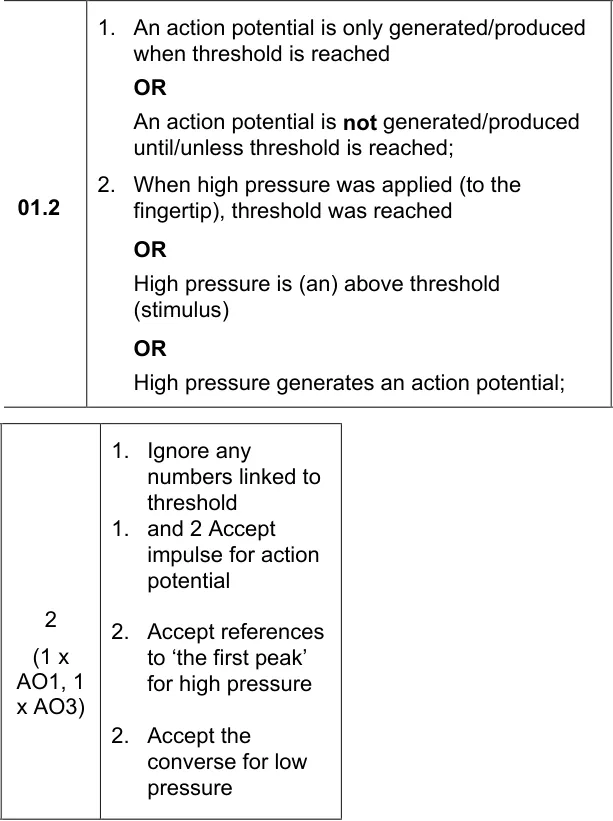
Use a graph of membrane potential to describe the all-or-nothing principle.
Show the mark scheme
Tap an image to open it full size.
From the examiners' report: A quarter got both marks; 41% got one because they described the principle without using Figure 1. Say high pressure reached threshold and low pressure didn't. You don't need a threshold value.
Question 5
A level Paper 3 · June 2023 · Q01.3 · 1 mark · Easy
Name the period when no new generator potential can be produced.

Show the mark scheme

Tap an image to open it full size.
From the examiners' report: 66% got it. Read the times given: 0.6 to 4.0 ms covers the whole action potential, so it isn't hyperpolarisation, a rest period or lag time.
Question 6
A level Paper 2 · November 2021 · Q02.2 · 3 marks · Medium
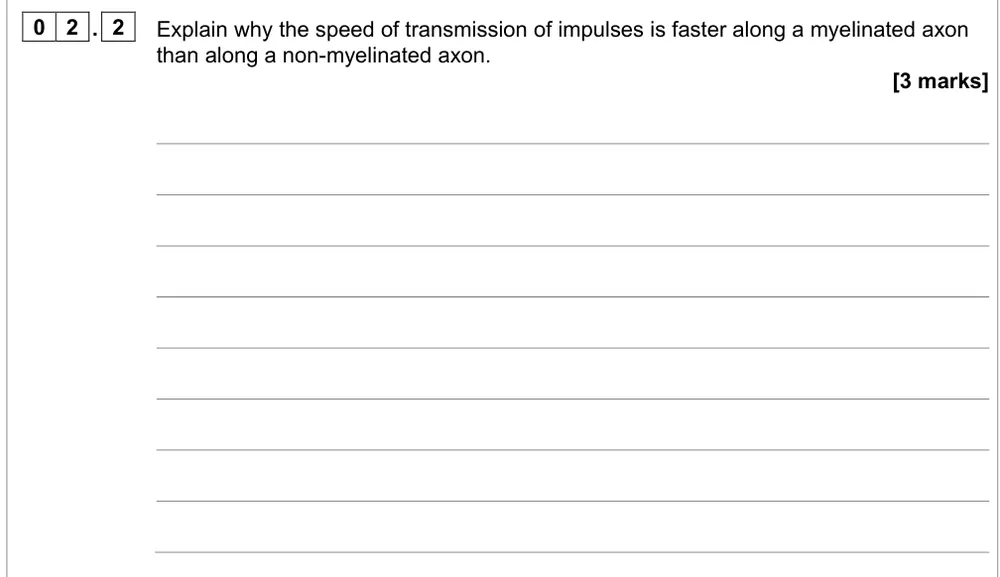
Explain why impulses travel faster along a myelinated axon than a non-myelinated one.
Show the mark scheme
Tap an image to open it full size.
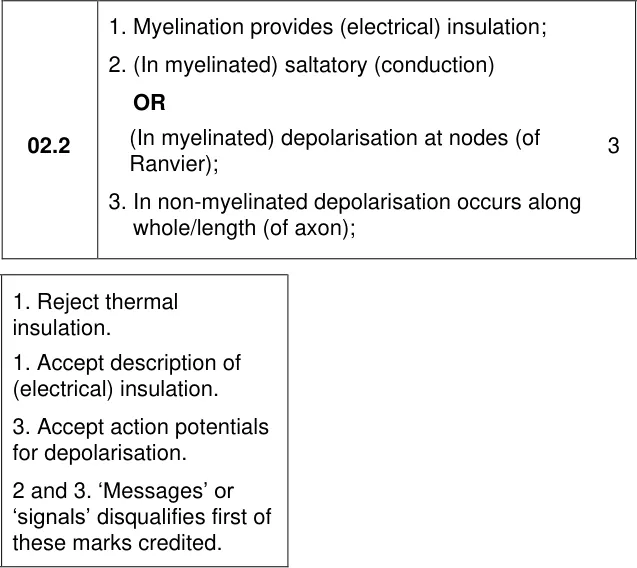
From the examiners' report: Only 8% got all three. Myelin is an electrical insulator, not a thermal one. Use 'depolarisation' at the nodes rather than impulses 'jumping', and compare with depolarisation along the whole non-myelinated axon.
Question 7
A level Paper 2 · June 2019 · Q10.1 · 3 marks · Medium
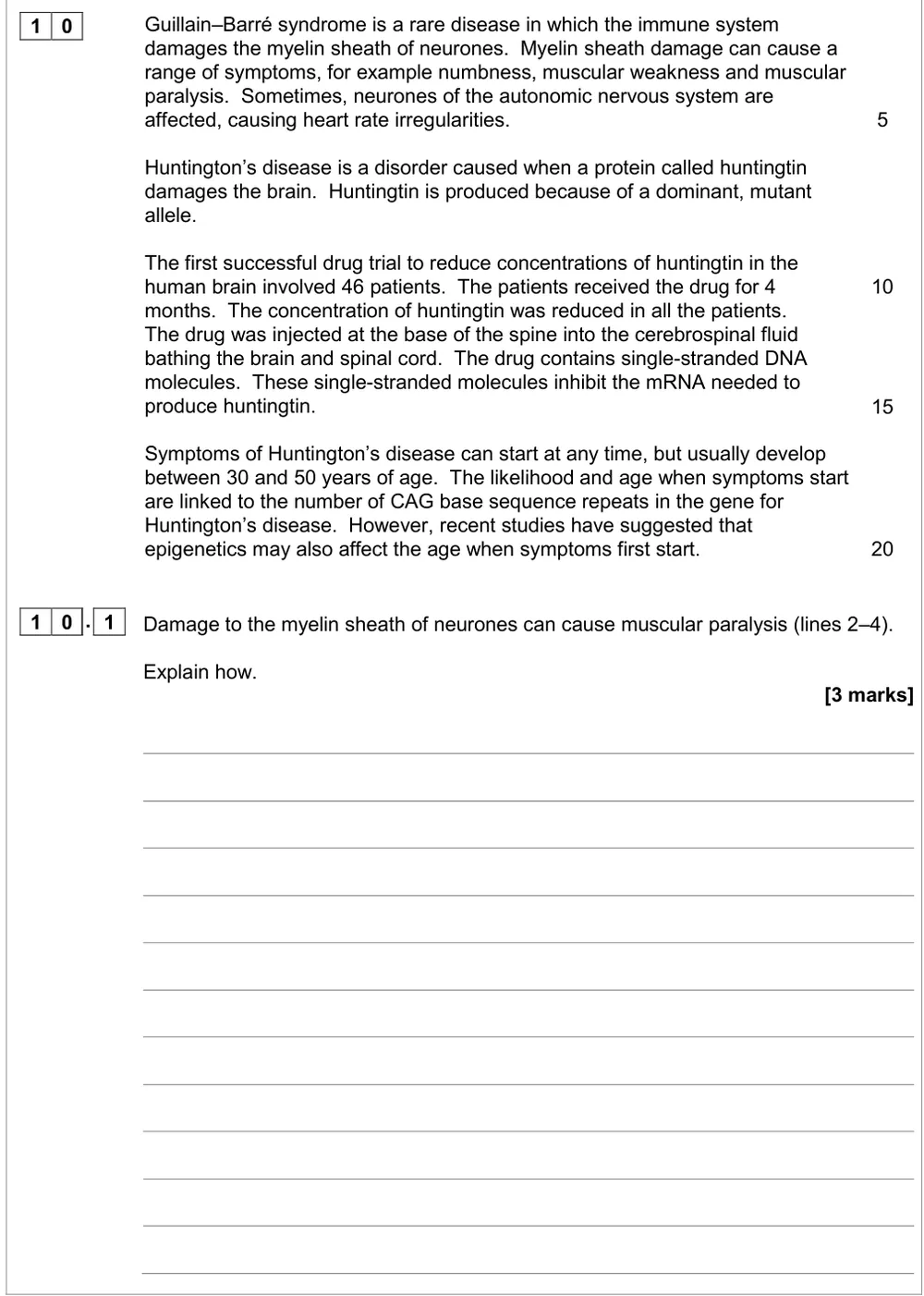
Explain how damage to the myelin sheath can cause muscular paralysis.
Show the mark scheme
Tap an image to open it full size.
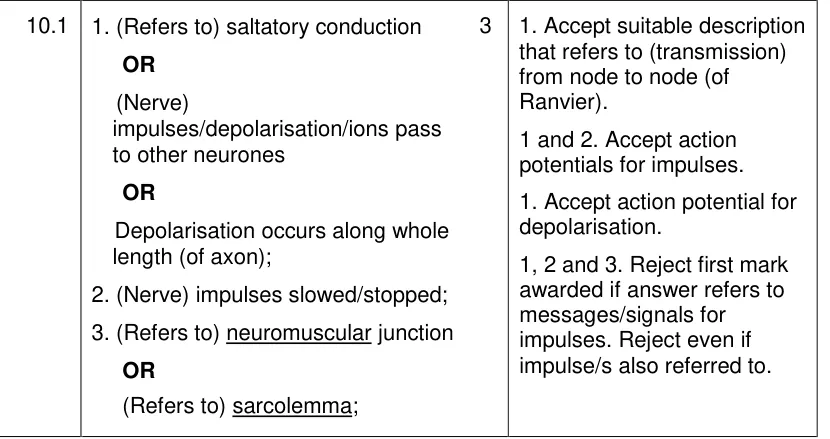
From the examiners' report: 84% got a mark but only 11% got all three. After saltatory conduction and slower impulses, finish at the neuromuscular junction or sarcolemma. Use 'impulses' or 'action potentials', never messages or signals.
Synaptic transmission (3.6.2.2)
Question 8
A level Paper 2 · June 2024 · Q01.1 · 2 marks · Easy
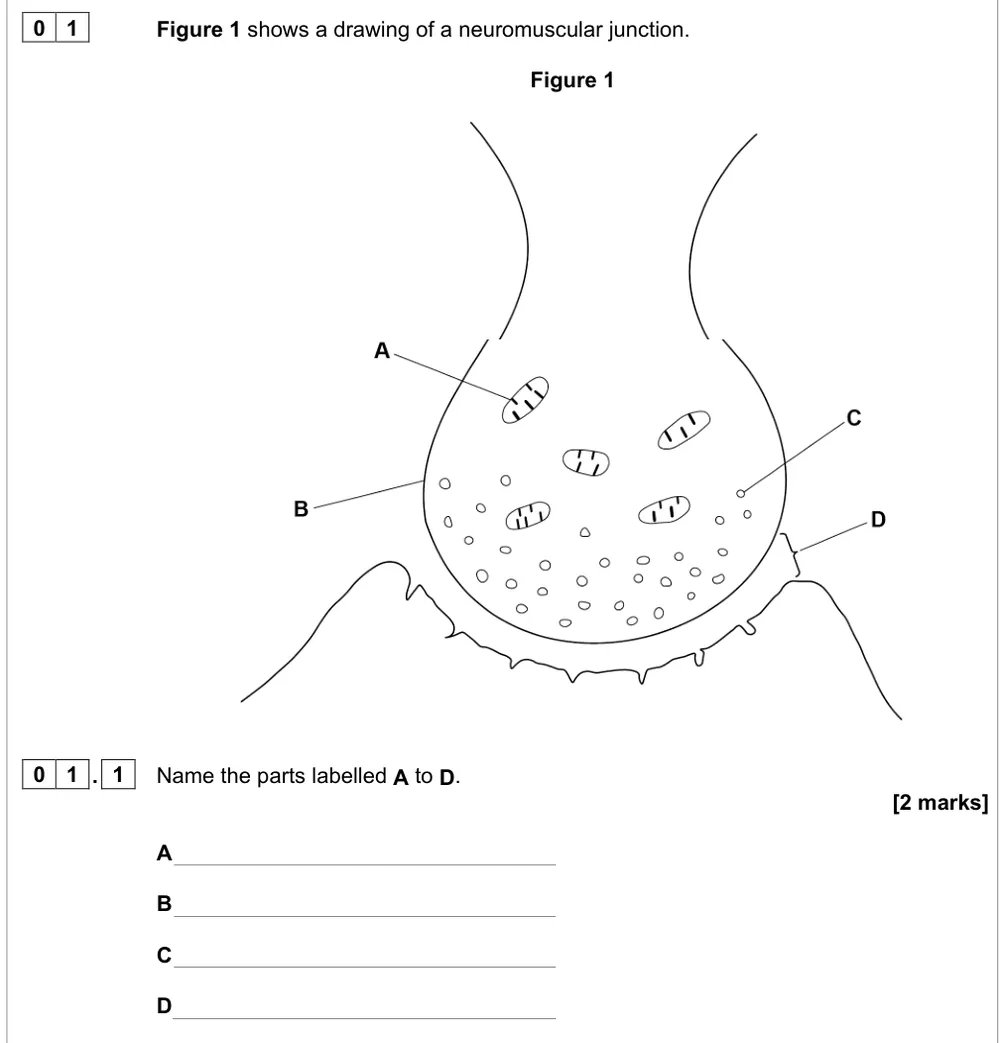
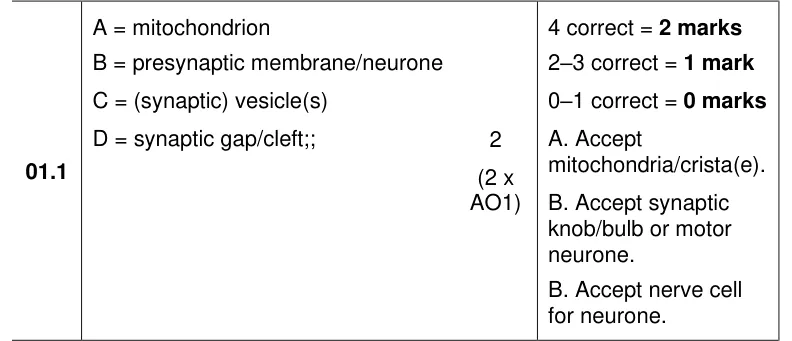
Name four labelled parts of a neuromuscular junction.
Show the mark scheme
Tap an image to open it full size.
From the examiners' report: About 41% got both marks. C is a vesicle, not acetylcholine, calcium ions or a ribosome, and D is the synaptic cleft, not the 'synapse' or 'neuromuscular junction'.
Question 9
A level Paper 2 · November 2020 · Q05 · 5 marks · Medium
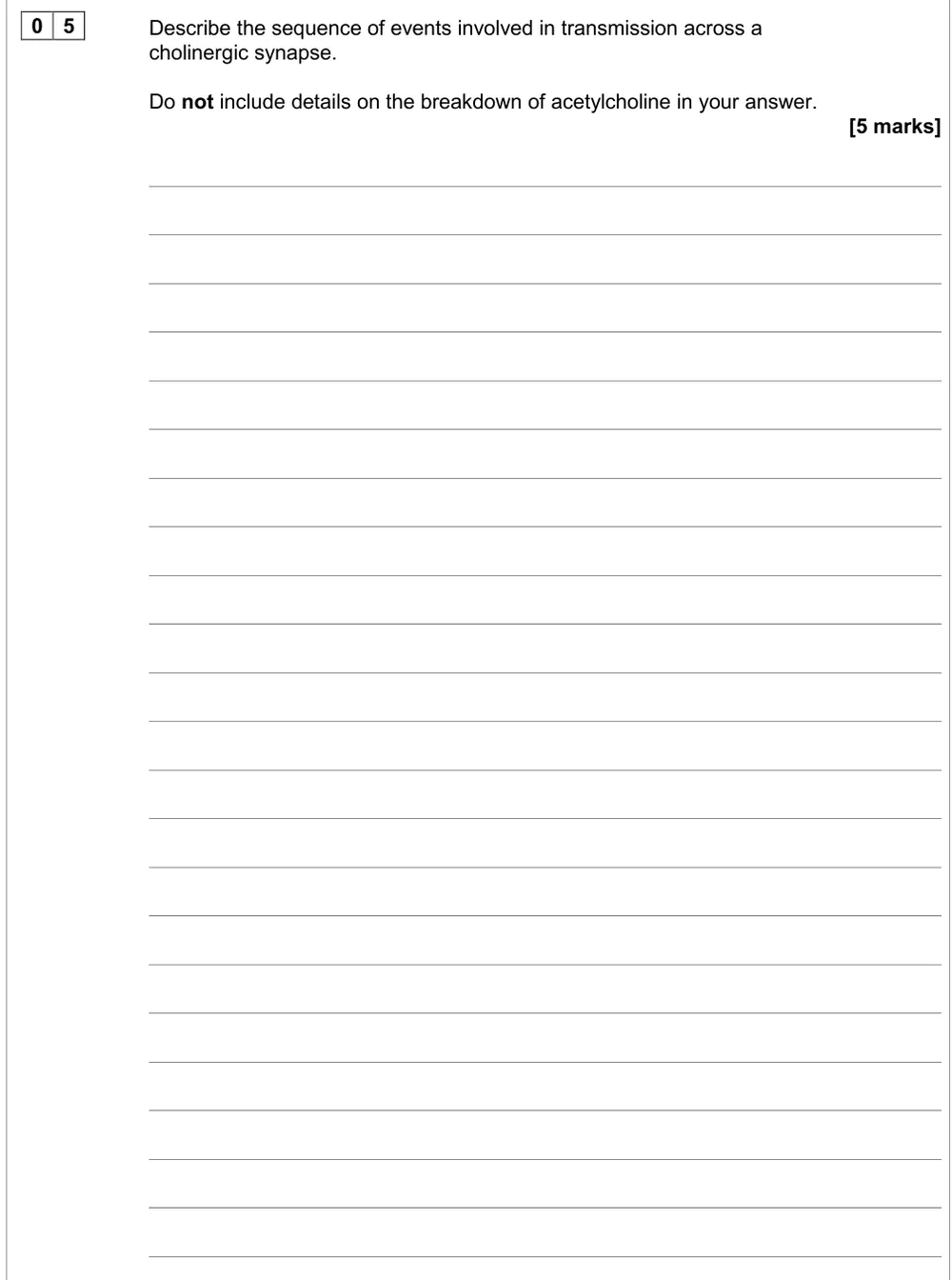
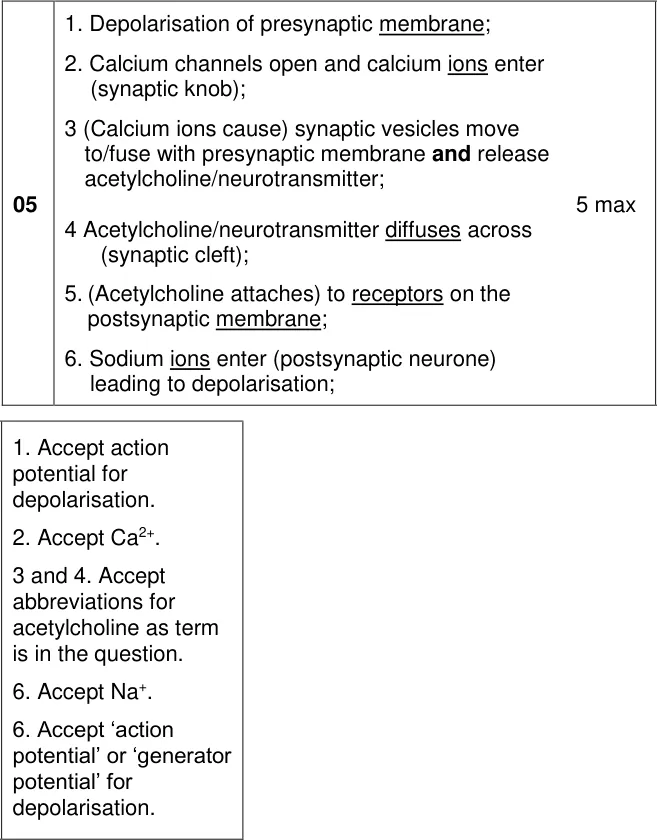
Describe the sequence of events in transmission across a cholinergic synapse.
Show the mark scheme
Tap an image to open it full size.
From the examiners' report: About 17% got all five and 21% scored zero. Calcium ions go in, not out; vesicles fuse and release acetylcholine, they don't cross the cleft; and say receptors, membrane and ions every time.
Question 10
A level Paper 2 · June 2022 · Q07.1 · 2 marks · Medium
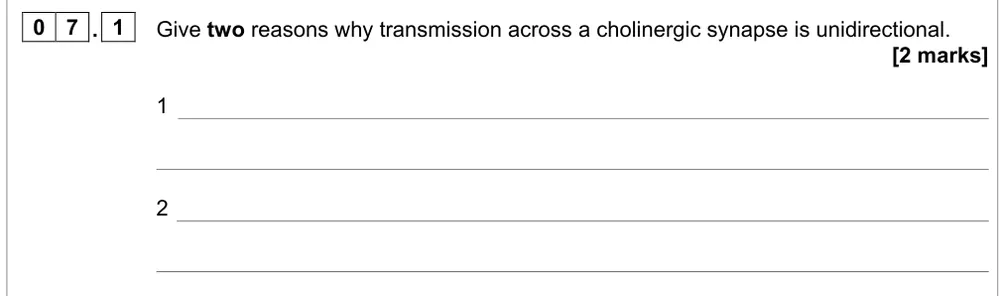
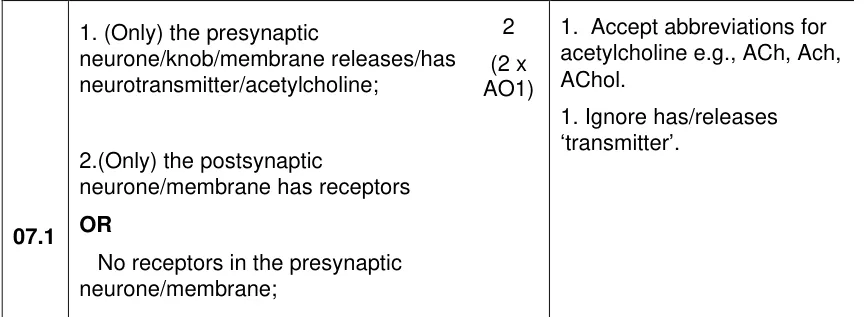
Give two reasons why transmission across a cholinergic synapse is one way.
Show the mark scheme
Tap an image to open it full size.
From the examiners' report: Only 66% got a mark and about 41% got both. Leave out the refractory period and calcium ions: only the presynaptic side releases acetylcholine and only the postsynaptic membrane has receptors.
Question 11
A level Paper 2 · June 2022 · Q07.2 · 2 marks · Medium
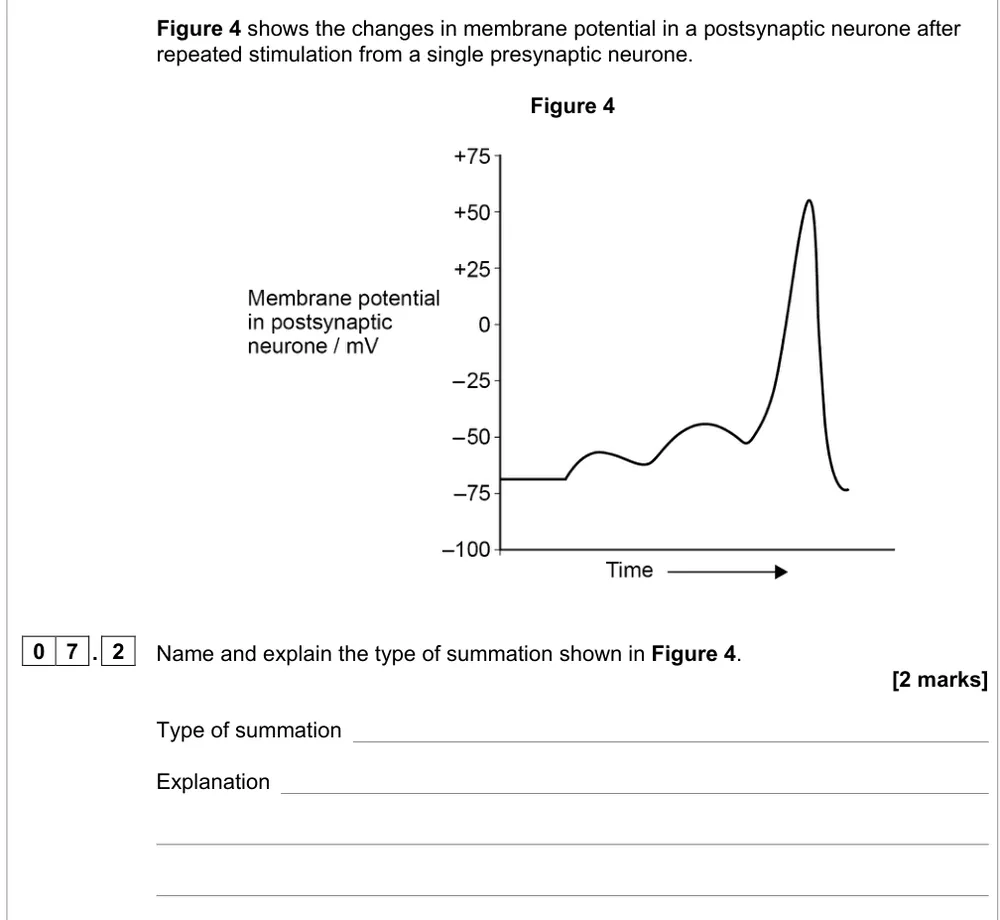
Name and explain the type of summation shown on a graph of postsynaptic membrane potential.
Show the mark scheme
Tap an image to open it full size.
From the examiners' report: Only about 20% got both marks. One presynaptic neurone means temporal, not spatial. Then explain why: enough neurotransmitter, or enough sodium ions entering, to reach threshold.
Question 12
A level Paper 2 · June 2024 · Q01.3 · 2 marks · Hard
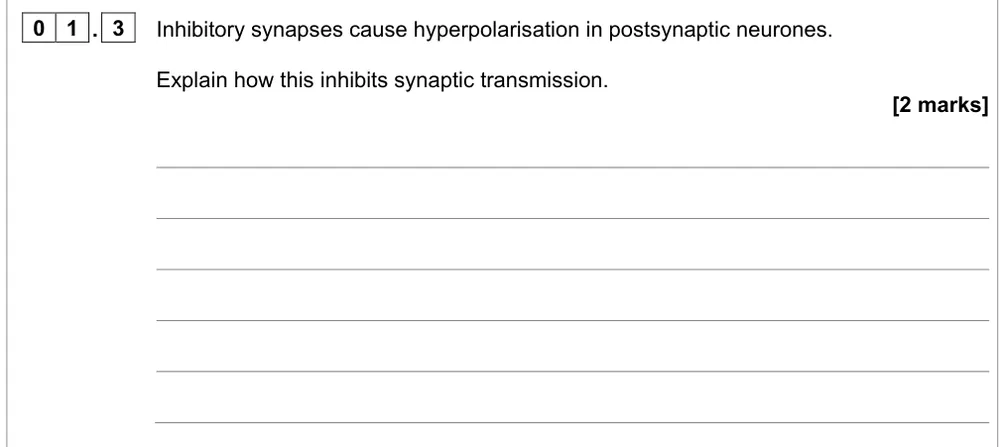
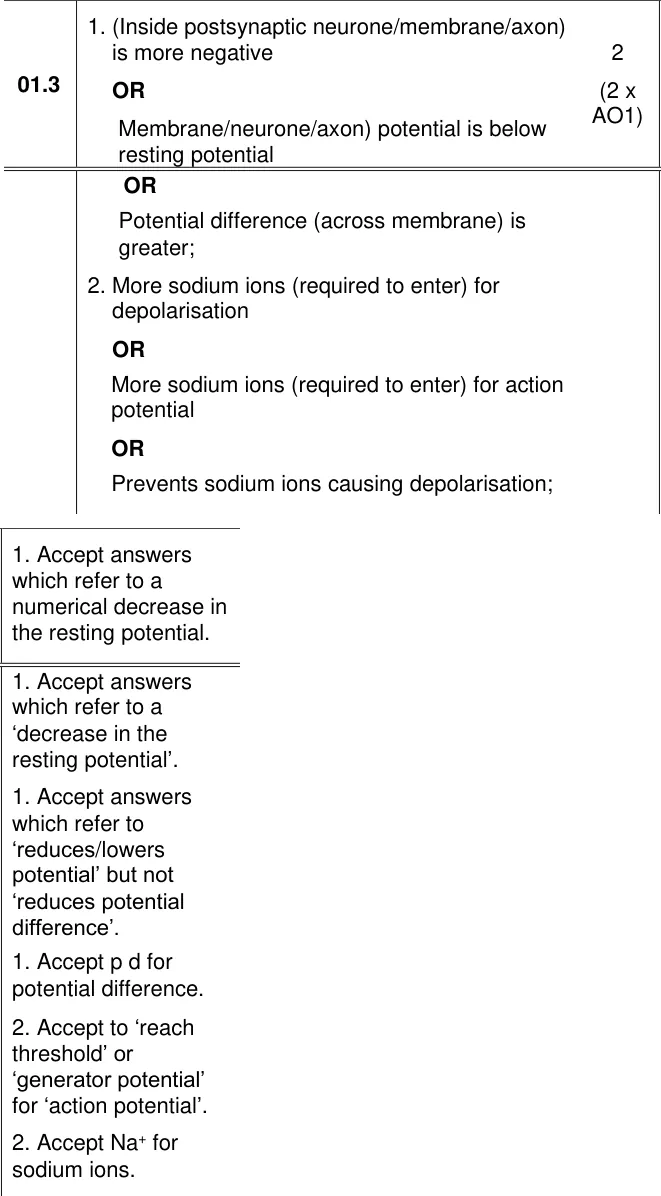
Explain how hyperpolarisation at inhibitory synapses inhibits transmission.
Show the mark scheme
Tap an image to open it full size.
From the examiners' report: About half got a mark but only about 18% got both. After 'more negative inside', say more sodium ions, not 'more sodium', must enter to reach threshold.
Question 13
A level Paper 2 · June 2024 · Q01.2 · 4 marks · Medium
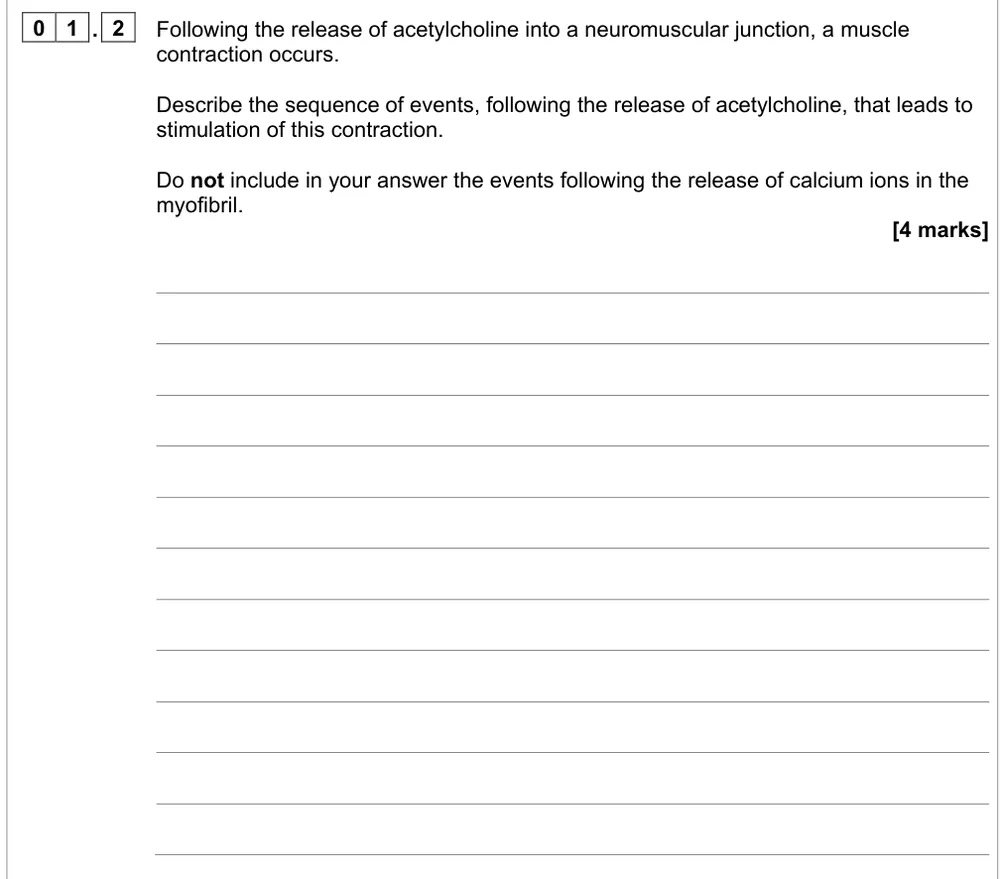
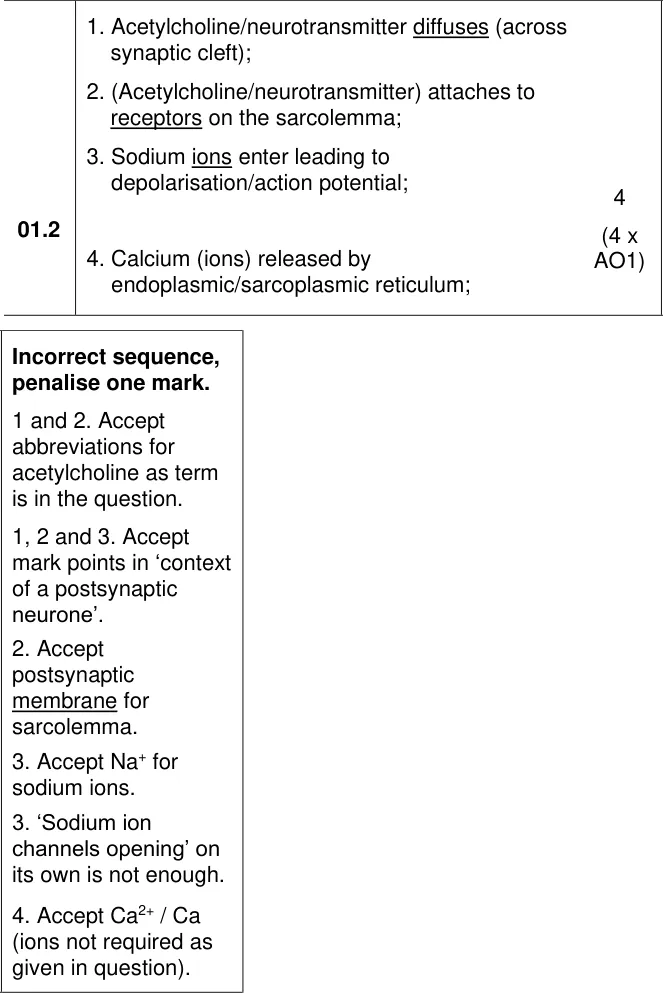
Describe the events after acetylcholine is released at a neuromuscular junction.
Show the mark scheme
Tap an image to open it full size.
From the examiners' report: Only about 7% got all four. Start after the release, put the receptors on the sarcolemma, not 'the muscle', say sodium ions enter, and finish with calcium ions released from the sarcoplasmic reticulum.
Drugs, disease and synapses (3.6.2.2)
Question 14
A level Paper 2 · June 2018 · Q07.2 · 2 marks · Easy
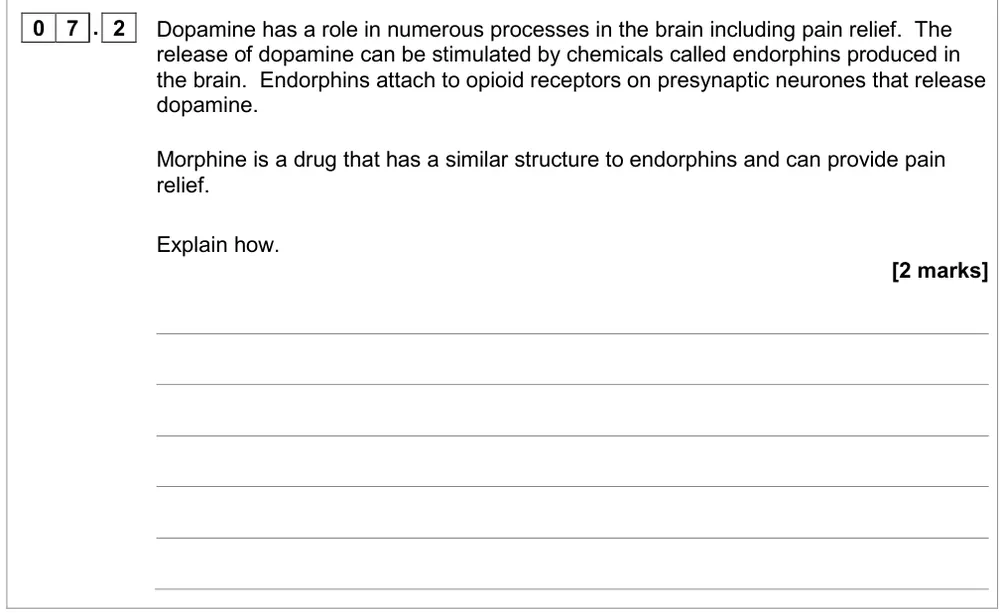
Explain how morphine, which resembles endorphins, gives pain relief.
Show the mark scheme

Tap an image to open it full size.
From the examiners' report: 88% got a mark and 63% got the receptor mark. Say opioid receptors, and don't give the receptor an active site.
Question 15
A level Paper 2 · June 2022 · Q07.3 · 2 marks
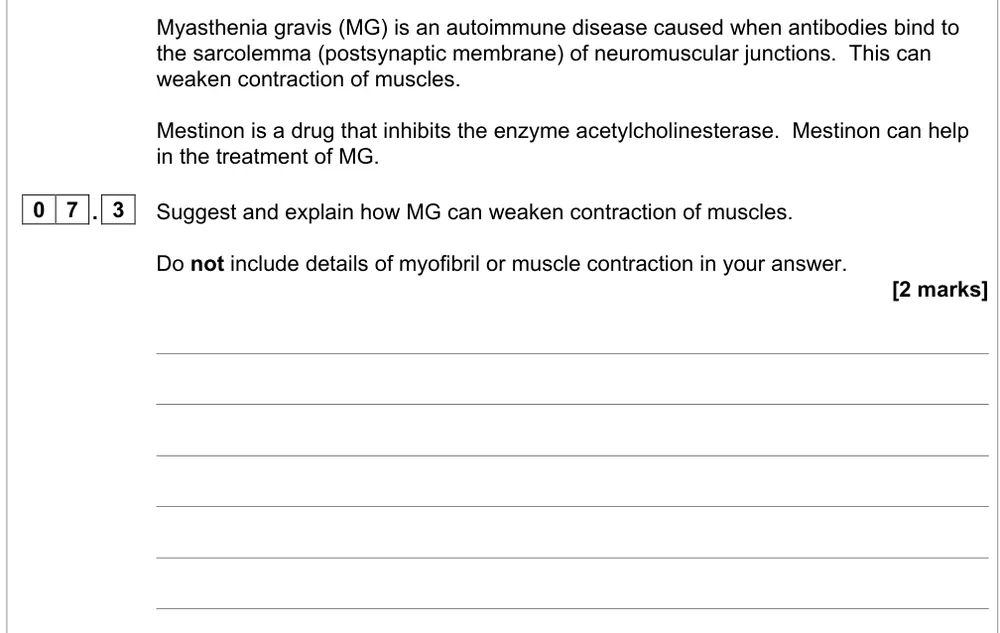
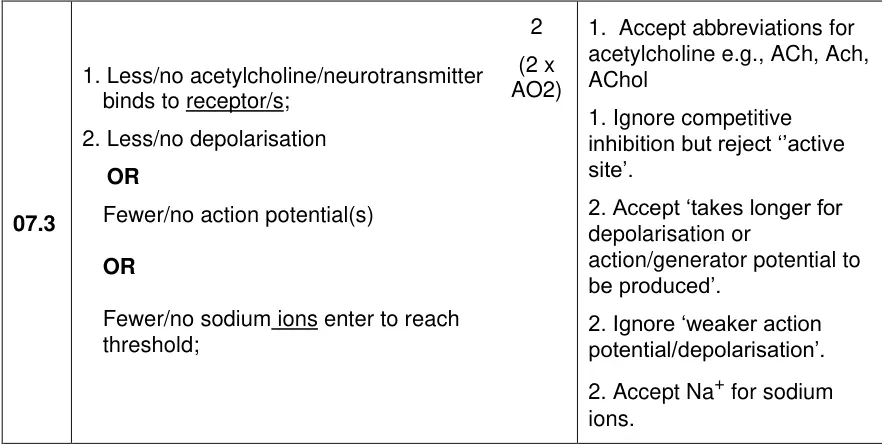
Suggest how antibodies binding to the sarcolemma in myasthenia gravis weaken contraction.
Show the mark scheme
Tap an image to open it full size.
From the examiners' report: Roughly a third each scored two, one and zero. Say acetylcholine can't bind to the receptors, then fewer action potentials, not weaker ones.
Question 16
A level Paper 2 · June 2022 · Q07.4 · 3 marks · Medium
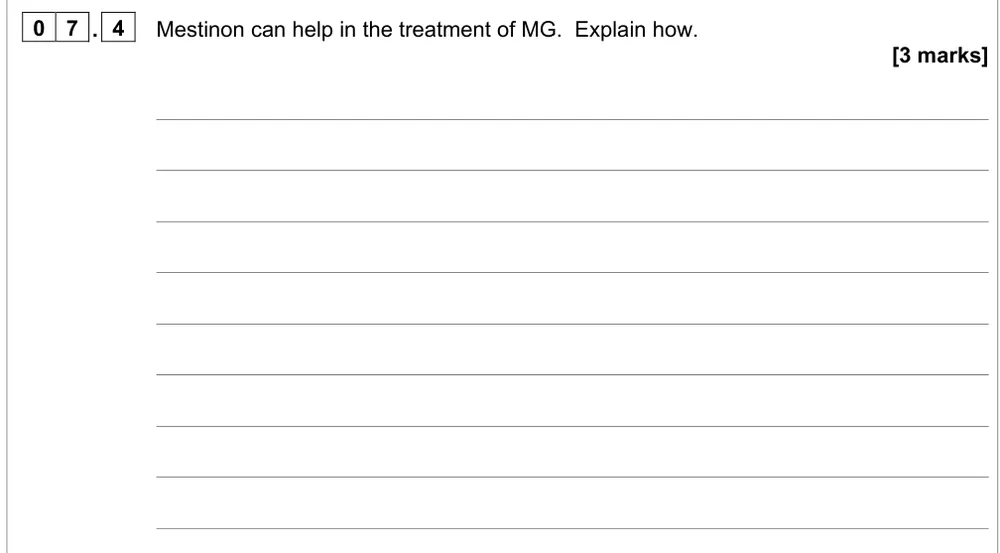
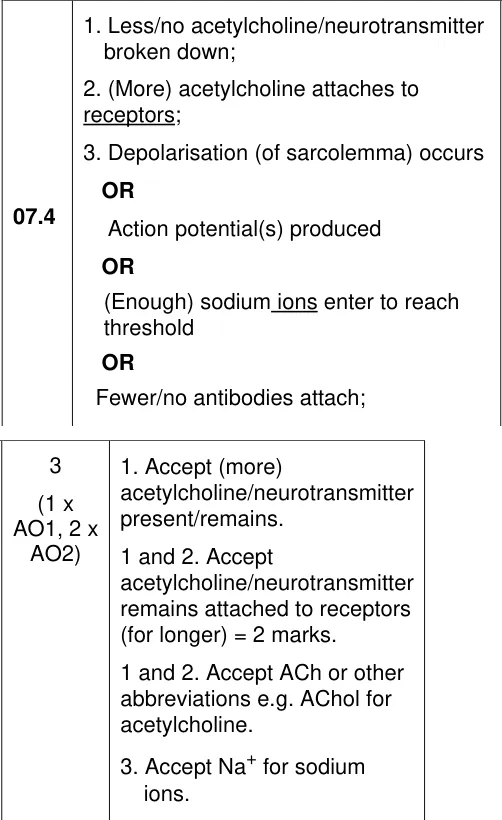
Explain how an acetylcholinesterase inhibitor helps treat myasthenia gravis.
Show the mark scheme
Tap an image to open it full size.
From the examiners' report: About 31% got all three and one in four scored zero. Less acetylcholine broken down means more binds to receptors, so name the receptors, then depolarisation of the sarcolemma.
Question 17
A level Paper 2 · June 2023 · Q02.1 · 5 marks · Medium
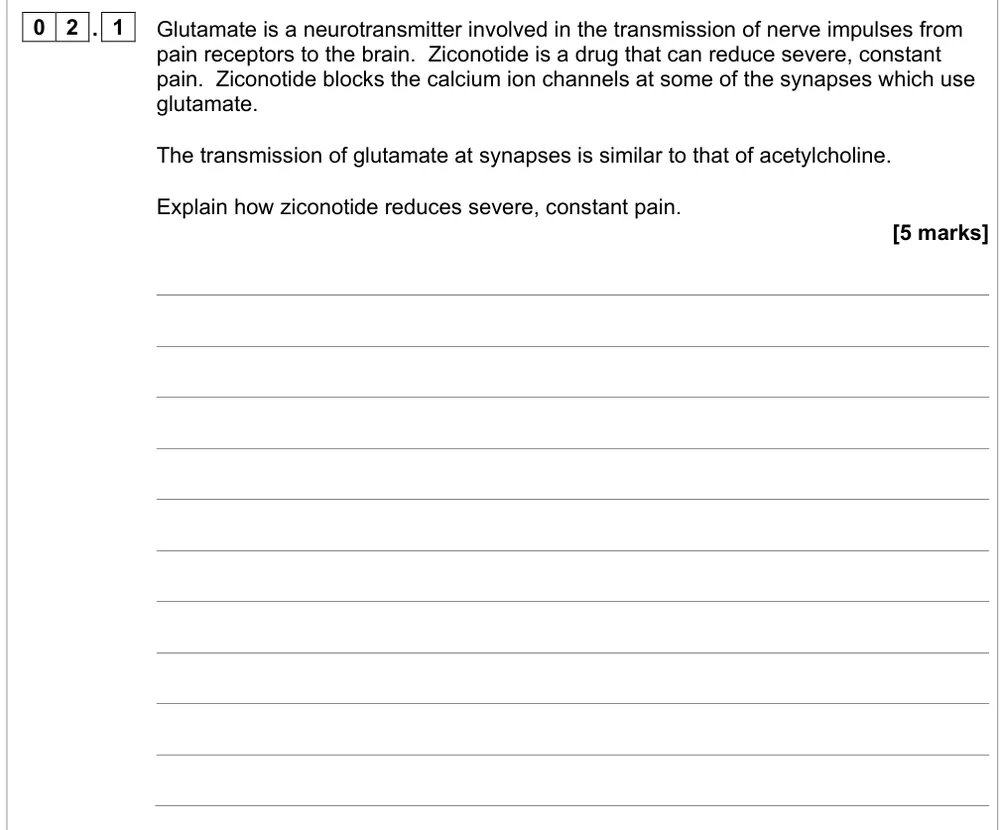
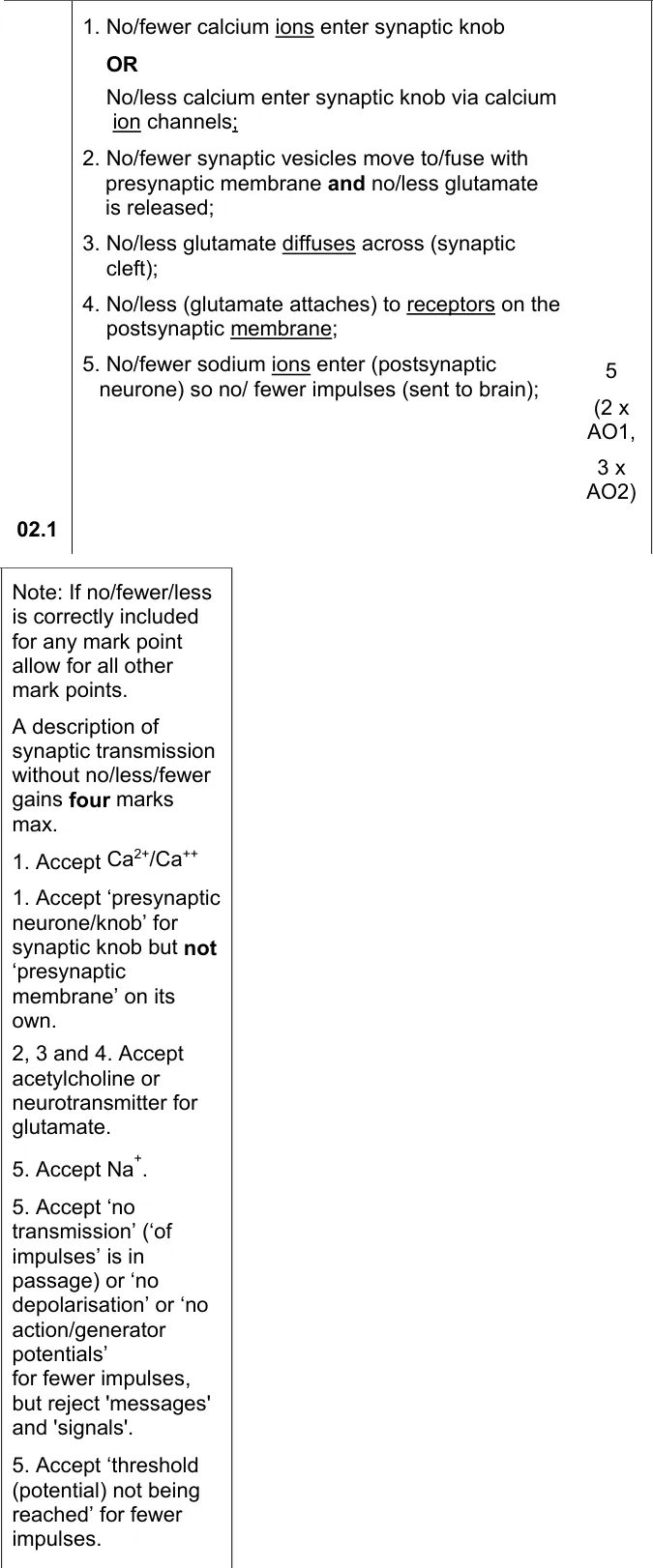
Explain how a drug that blocks calcium ion channels at synapses reduces pain.
Show the mark scheme
Tap an image to open it full size.
From the examiners' report: Only about 7% got all five and 30% scored zero. Calcium ions can't enter the synaptic knob (not the 'synapse'), then follow the whole sequence with 'less' or 'fewer' at every step, through to fewer sodium ions entering.
Investigating nerve impulses (3.6.2.1)
Question 18
A level Paper 3 · June 2022 · Q02.4 · 2 marks · Hard
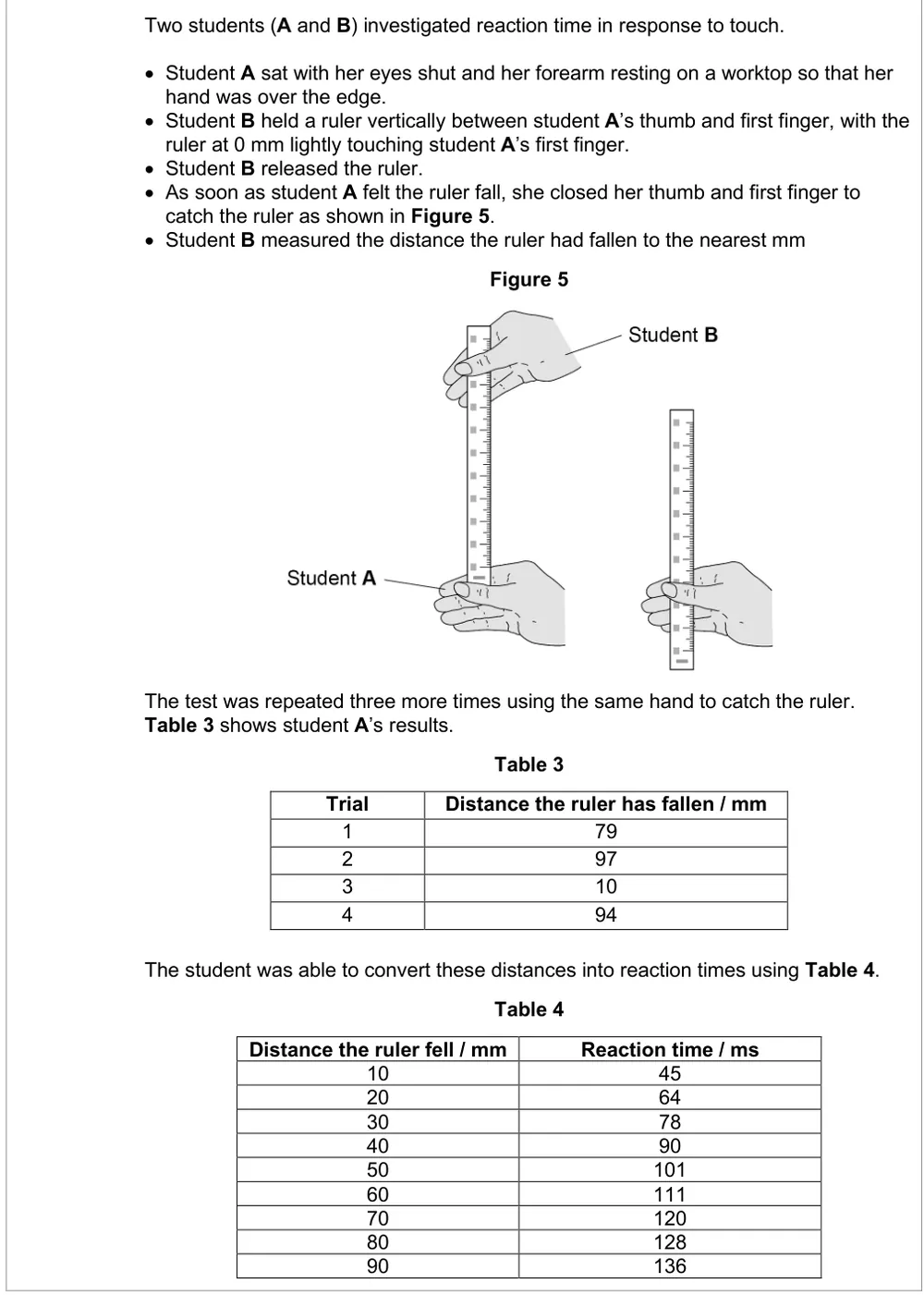
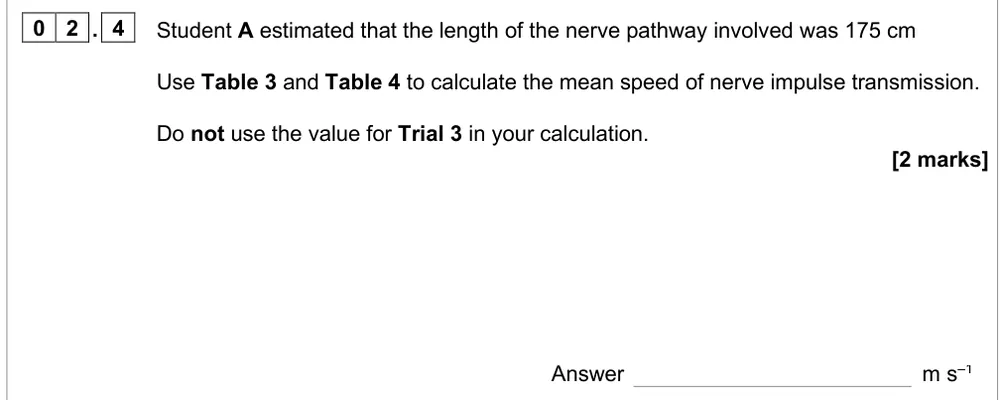
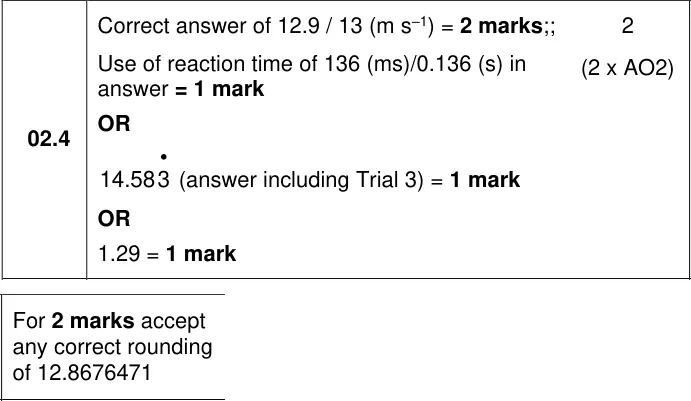
Use reaction-time data to calculate the mean speed of nerve impulse transmission.
Information from earlier in this question:
Show the mark scheme
Tap an image to open it full size.
From the examiners' report: Only 16% got both marks. Speed = distance ÷ time: convert 175 cm to 1.75 m and 136 ms to 0.136 s before you divide.
Where students lose marks (from AQA examiners' reports and mark schemes)
Each point below is followed by wording that gained marks.
Sodium ions must enter, not just channels open: On ziconotide and the neuromuscular junction many students said sodium ion channels open but never said sodium ions enter, and the mark scheme says channels opening on its own is not enough. Only about 7% got full marks on each question.
✔ Gains credit: "Sodium ions enter (the postsynaptic neurone) leading to depolarisation or an action potential."
Calcium ions go into the synaptic knob: On the cholinergic synapse, weaker answers had calcium ions diffusing out of the synaptic knob. On ziconotide, students said calcium ions couldn't enter the 'synapse' or the 'presynaptic membrane', which wasn't credited.
✔ Gains credit: "Calcium channels open and calcium ions enter the synaptic knob."
Vesicles fuse; acetylcholine crosses the cleft: Weaker answers said the vesicles were released and diffused across to the postsynaptic neurone. On the cholinergic synapse 21% scored zero and only about 17% got all five.
✔ Gains credit: "Synaptic vesicles move to or fuse with the presynaptic membrane and release acetylcholine; acetylcholine diffuses across the synaptic cleft."
Put the receptors on the postsynaptic membrane: On the neuromuscular junction a significant number wrote 'muscle' instead of sarcolemma or postsynaptic membrane, and on myasthenia gravis and Mestinon many left out 'receptors' altogether. Calling the receptor's binding site an 'active site' is rejected.
✔ Gains credit: "Acetylcholine attaches to receptors on the sarcolemma (postsynaptic membrane)."
Fewer action potentials, never weaker ones: On myasthenia gravis a significant number said weaker action potentials would be produced, which wasn't credited. On the Pacinian corpuscle graph many ignored Figure 1 and only a quarter used it to explain the all-or-nothing principle.
✔ Gains credit: "Less or no depolarisation, or fewer or no action potentials." "An action potential is only produced when threshold is reached; high pressure reached threshold."
Three sodium ions out, two potassium ions in: Only 13% got all three on the resting potential. Students sent ions the wrong way, wrote 2 sodium ions out for 3 potassium ions in, or said the pump used diffusion rather than active transport.
✔ Gains credit: "Sodium ions actively transported out and potassium ions in; membrane more permeable to potassium ions."
Myelin is an electrical insulator: Only 8% got full marks on myelinated axons. Some said myelin gives thermal insulation, and 'impulses jumping from node to node' wasn't credited without depolarisation.
✔ Gains credit: "Myelination provides electrical insulation; depolarisation at the nodes of Ranvier (saltatory conduction); in non-myelinated axons depolarisation occurs along the whole length."
Hyperpolarised: more sodium ions are needed: Only about 18% got both marks on inhibitory synapses. Students knew the inside becomes more negative but wrote 'more sodium' instead of more sodium ions, or had sodium ions leaving the neurone.
✔ Gains credit: "Inside of the postsynaptic neurone is more negative; more sodium ions are required to enter for depolarisation."
Download the questions
Download the PDF pack (18 questions, mark schemes at the end)
Keep practising
- Receptors and control of heart rate: AQA A Level Biology exam questions by topic
- AQA 3.6.2 nervous coordination: self-marking quiz
- Skeletal muscles: AQA A Level Biology exam questions by topic
- Survival and response: AQA A Level Biology exam questions by topic
- Transport across cell membranes: AQA A Level Biology exam questions by topic
- AQA A Level Biology masterclasses
Questions, mark schemes and examiners' report extracts © AQA.