

Survival and response (AQA 3.6.1.1) is the first section of Year 13 topic 6, and it's A-level only. You need to explain how responding to changes in the environment helps organisms survive, how growth factors such as IAA move from growing regions and control cell elongation in shoots and roots, how this explains phototropism and gravitropism, and how taxes and kineses keep a mobile organism in favourable conditions. The simple three-neurone reflex is in this section too.
The examiners' reports keep finding the same slips. Students say the shoot tip 'contains' IAA instead of producing it, write 'more growth' instead of cell elongation, and describe phototropism when there's no directional light at all. On animal behaviour they call a directional response a kinesis or a tropism, give 'to survive' as the advantage, and describe the data when the question wants a conclusion or an evaluation.
Start with the IAA questions, then taxes and kineses, and finish with the practical and calculation questions. Write your answer on paper before you open each mark scheme. If you'd like help with this topic, my AQA masterclasses run online on Tuesdays at 5.15pm for Year 12 and on Wednesdays or Thursdays at 6.30pm for Year 13.
What you need from GCSE and Year 12
Each question on this page assumes you're secure on these GCSE and Year 12 ideas. If any of them feels shaky, revise it before you start.
- GCSE: plant shoots grow towards light (positive phototropism) and roots grow towards gravity (positive gravitropism), controlled by auxin, which is unequally distributed in the shoot or root.
- GCSE: a reflex arc runs from receptor to sensory neurone, relay neurone, motor neurone and effector, and reflexes are rapid and automatic.
- Year 12 (AQA 3.2.2): plant cells divide by mitosis in growing regions such as shoot and root tips.
- Year 12 (AQA 3.4.4): adaptations that increase an organism's chance of survival and reproduction are favoured by natural selection.
- Year 12 (AQA 3.4.7 and the statistics skills): a null hypothesis says there is no difference, and P less than 0.05 means the probability that the difference is due to chance is less than 5%.
Key terms
These words come up in the questions and mark schemes. Examiners expect you to use them exactly.
- Growth factor: a specific chemical that moves from growing regions to other tissues, where it regulates growth in response to directional stimuli.
- Indoleacetic acid (IAA): a growth factor produced in shoot tips; accept auxin. Say the tip produces it, not that it contains or stores it.
- Cell elongation: IAA increases cell wall plasticity so the cells stretch and get longer; 'more growth' on its own doesn't score.
- Phototropism: a growth response to directional light; IAA moves to the shaded side of a shoot, so cells there elongate more and the shoot bends towards light.
- Gravitropism: a growth response to gravity; IAA collects on the lower side, where it stimulates elongation in shoots but inhibits it in roots.
- Roots and IAA: high IAA concentrations inhibit cell elongation in roots, the opposite of its effect in shoots.
- Taxis: a simple directional response: the organism moves towards (positive) or away from (negative) a stimulus, for example negative phototaxis.
- Kinesis: a simple non-directional response: the organism changes its speed of movement or rate of turning in unfavourable conditions.
- Simple reflex: a rapid, automatic, protective response through three neurones: sensory, relay and motor.
- Choice chamber: a container divided into areas with different conditions, such as light intensity, used to see which conditions an animal moves to.
What these questions cover (AQA 3.6.1.1)
The questions test these statements from the AQA AS and A-level Biology specification (7401/7402):
- Survival and response: Organisms increase their chance of survival by responding to changes in their environment. (the chilling seeds question asks how a response to the seasons helps a plant survive)
- Plant growth factors: In flowering plants, specific growth factors move from growing regions to other tissues, where they regulate growth in response to directional stimuli.
- IAA and tropisms: The effect of different concentrations of indoleacetic acid (IAA) on cell elongation in the roots and shoots of flowering plants as an explanation of gravitropism and phototropism in flowering plants.
- Taxes and kineses: Taxes and kineses as simple responses that can maintain a mobile organism in a favourable environment.
- Simple reflexes: The protective effect of a simple reflex, exemplified by a three-neurone simple reflex. (no written question on the three-neurone reflex was available for this page, so learn the receptor, sensory, relay and motor neurone pathway from your notes)
- Practical work: Required practical 10: Investigation into the effect of an environmental variable on the movement of an animal using either a choice chamber or a maze. (the choice chamber questions here are about taxes; required practical 10 will have its own page)
How to use this page
Write your answer on paper before you open the mark scheme. Allow about 1.3 minutes per mark: the 14 questions are worth 39 marks, so about 51 minutes in total. Then mark your answer strictly against the mark scheme and read the examiners' tip underneath it. If you'd rather print the questions, download the PDF pack.
IAA and plant growth (3.6.1.1)
Question 1
A level Paper 2 · June 2019 · Q03.1 · 2 marks · Easy
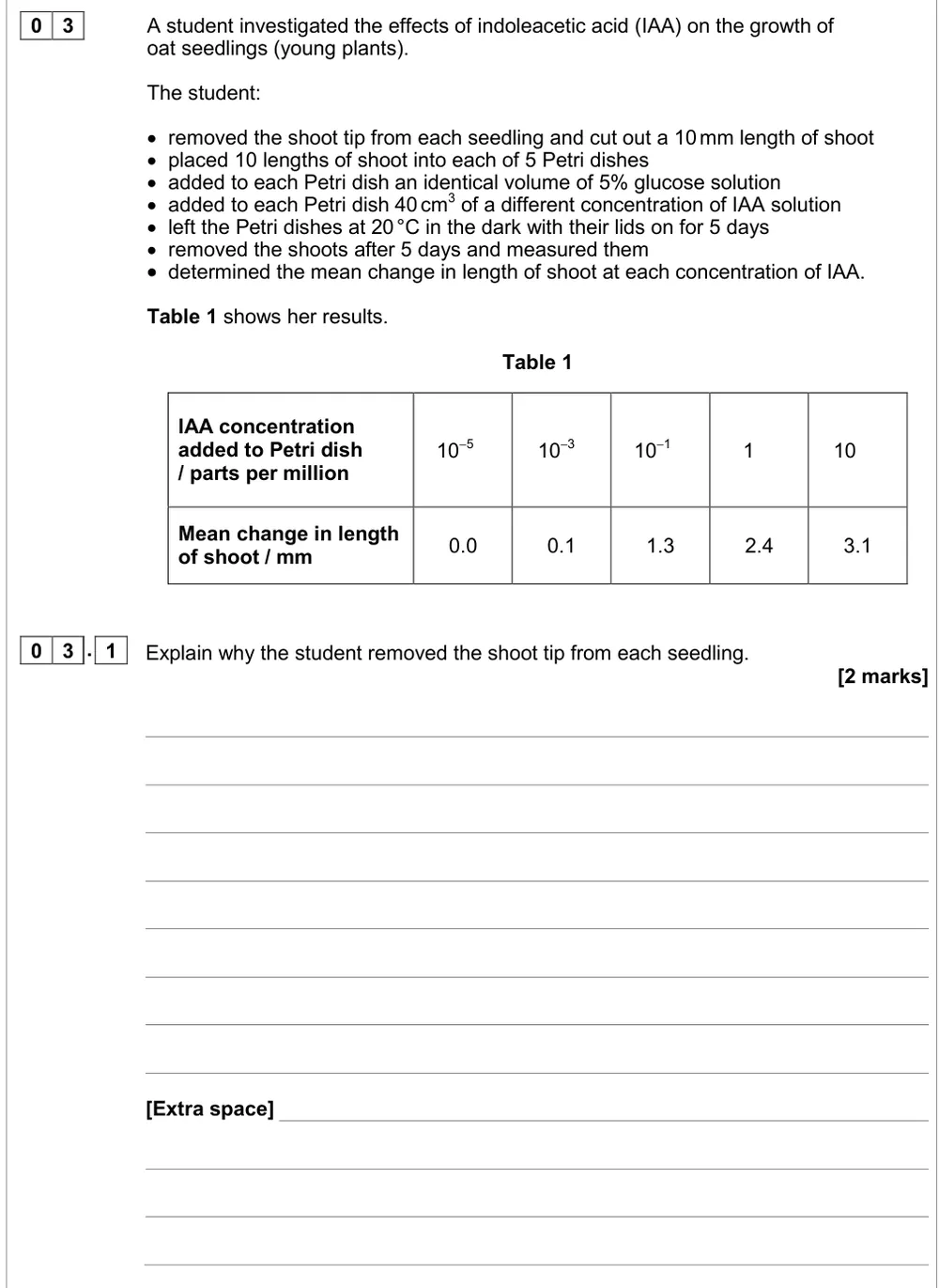
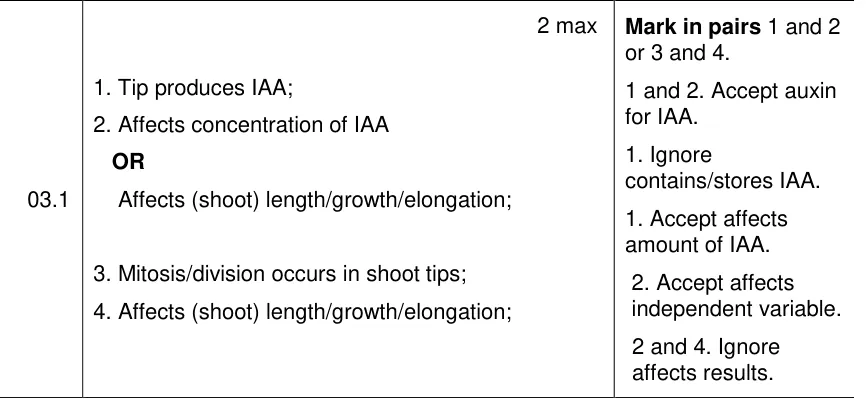
Explain why the shoot tip was removed before testing IAA on oat shoots.
Show the mark scheme
Tap an image to open it full size.
From the examiners' report: Almost 80% got a mark, usually for 'the tip produces IAA'. 'Contains IAA' didn't score. Then say why it matters: it would change the IAA concentration and so the growth.
Question 2
A level Paper 2 · June 2019 · Q03.4 · 3 marks · Medium
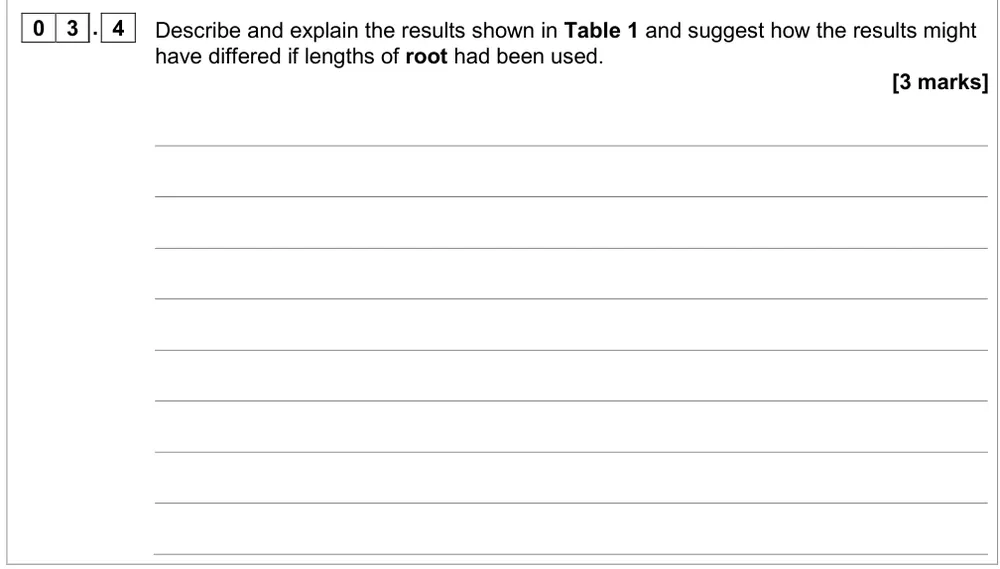
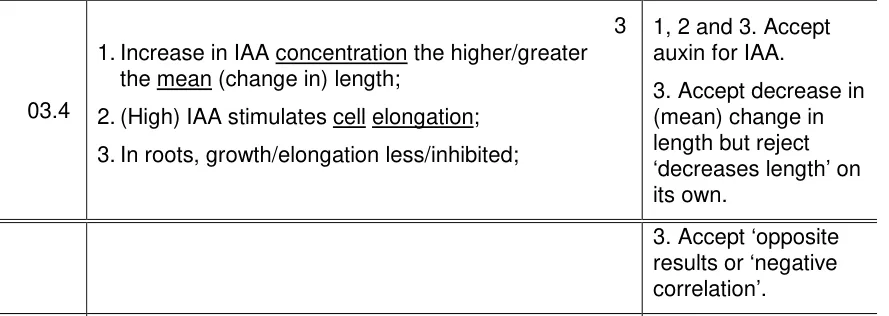
Describe and explain the IAA results for shoots and predict the results for roots.
Show the mark scheme
Tap an image to open it full size.
From the examiners' report: About 20% got all three. Say 'mean change in length' and 'IAA concentration' when you describe, name cell elongation, and say root growth is inhibited rather than that roots get shorter.
Question 3
A level Paper 2 · November 2021 · Q03.1 · 3 marks · Hard
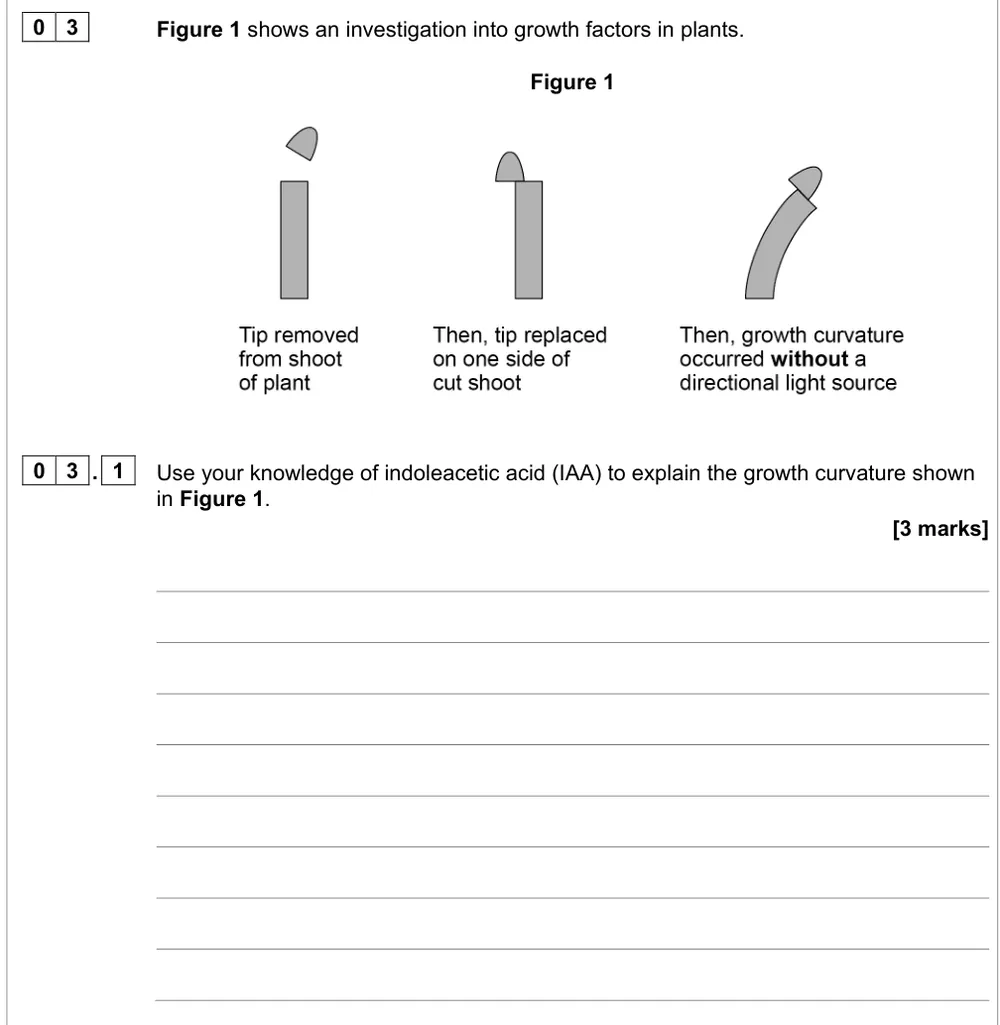
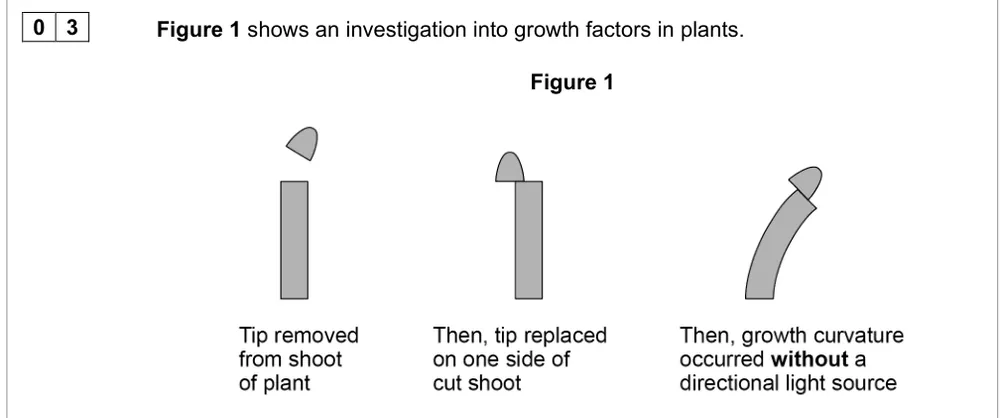
Use IAA to explain why a shoot bends when its tip is replaced on one side.
Show the mark scheme
Tap an image to open it full size.
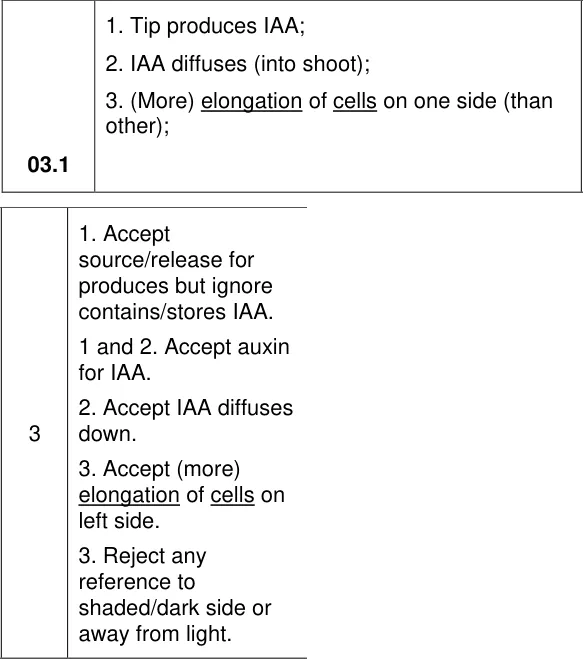
From the examiners' report: Only 7% got all three. There's no directional light, so don't describe phototropism. The tip produces IAA, it diffuses down, and cells elongate more on that side; 'more growth' didn't score.
Question 4
A level Paper 2 · November 2021 · Q03.3 · 2 marks · Hard
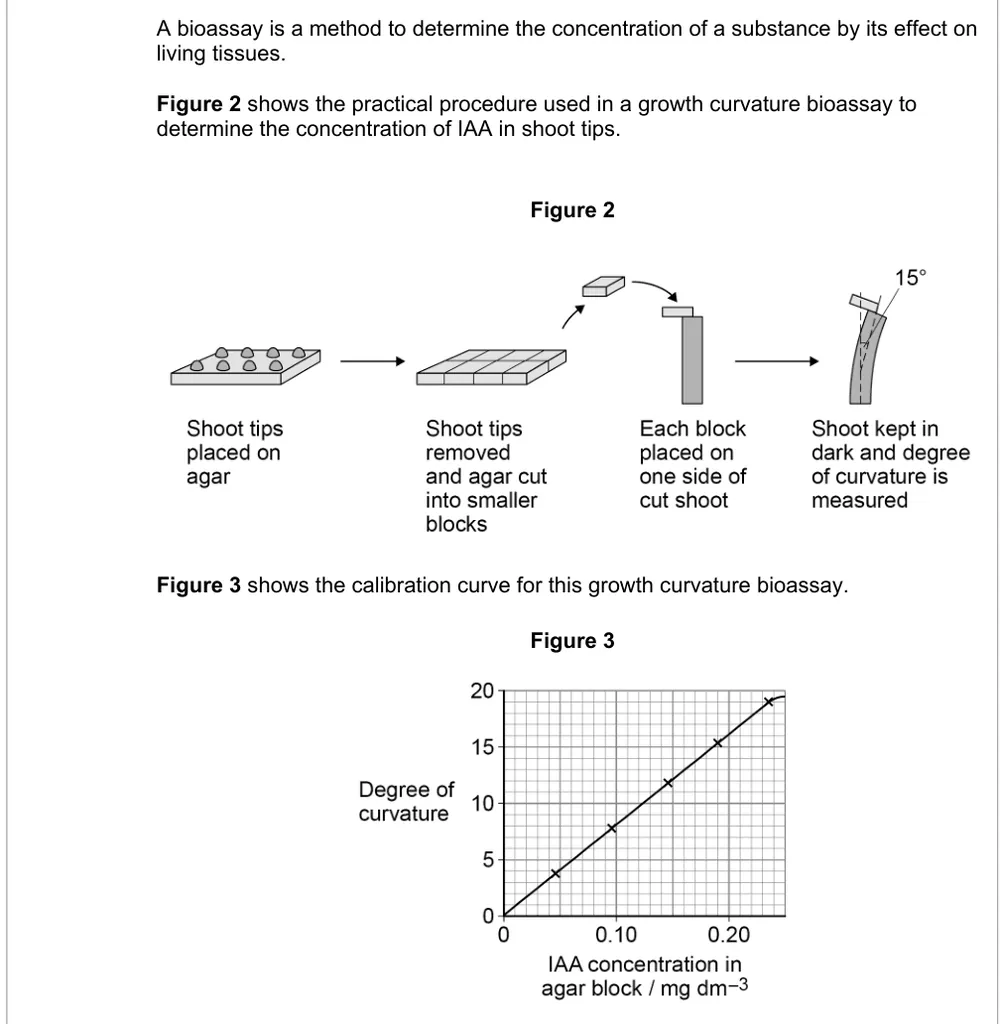
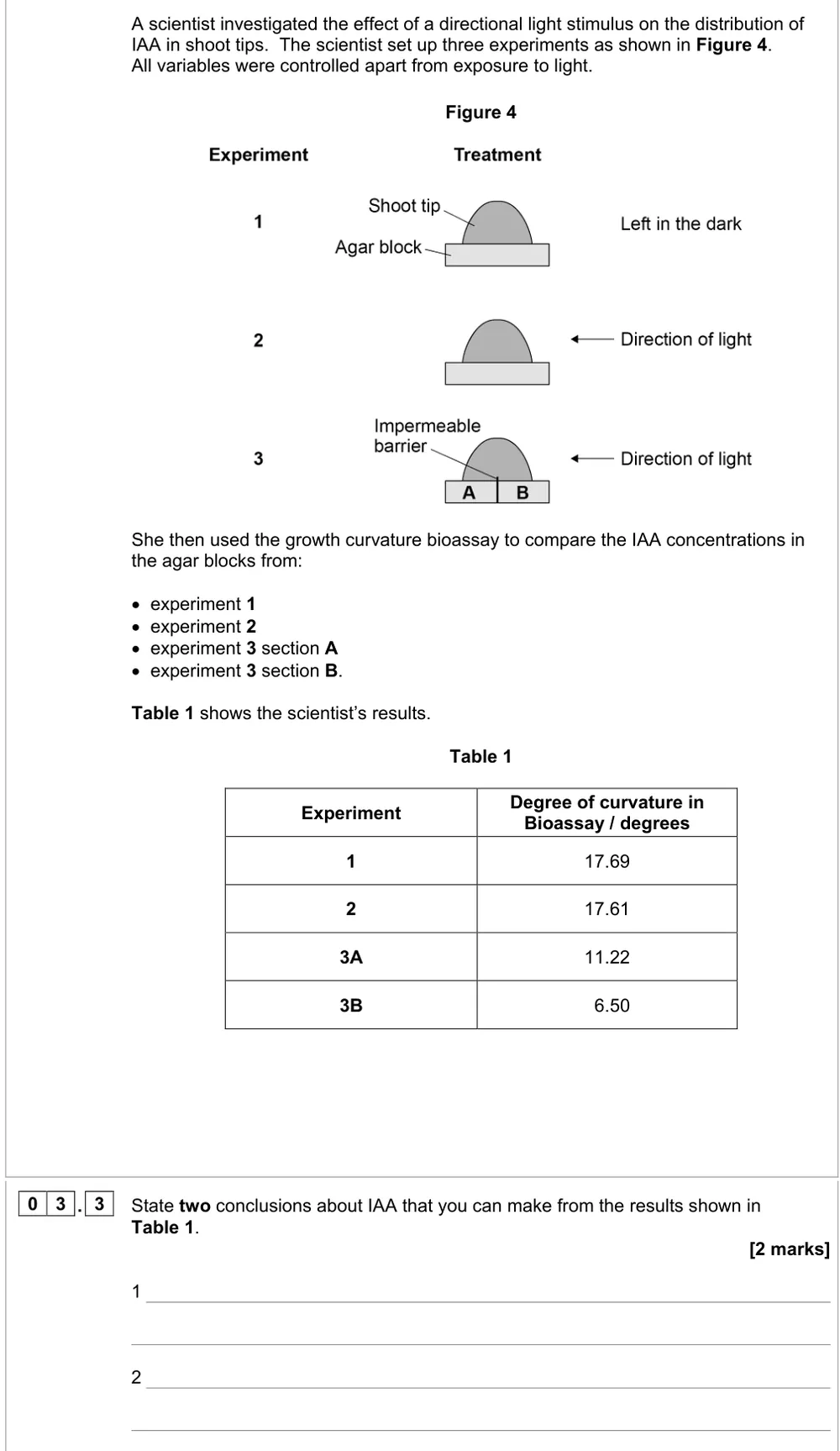
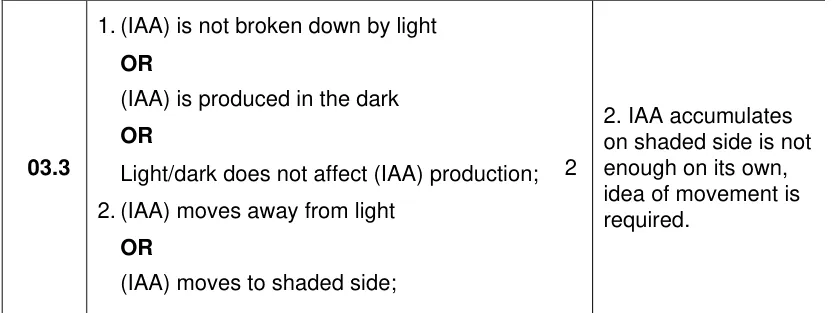
State two conclusions about IAA from a bioassay of shoot tips kept in the dark or light.
Information from earlier in this question:
Show the mark scheme
Tap an image to open it full size.
From the examiners' report: Only 1% got both marks. Don't describe the numbers: compare 1 with 2 to conclude about production, and 3A with 3B to conclude that IAA moves away from light.
Question 5
A level Paper 2 · June 2024 · Q08.1 · 2 marks · Medium
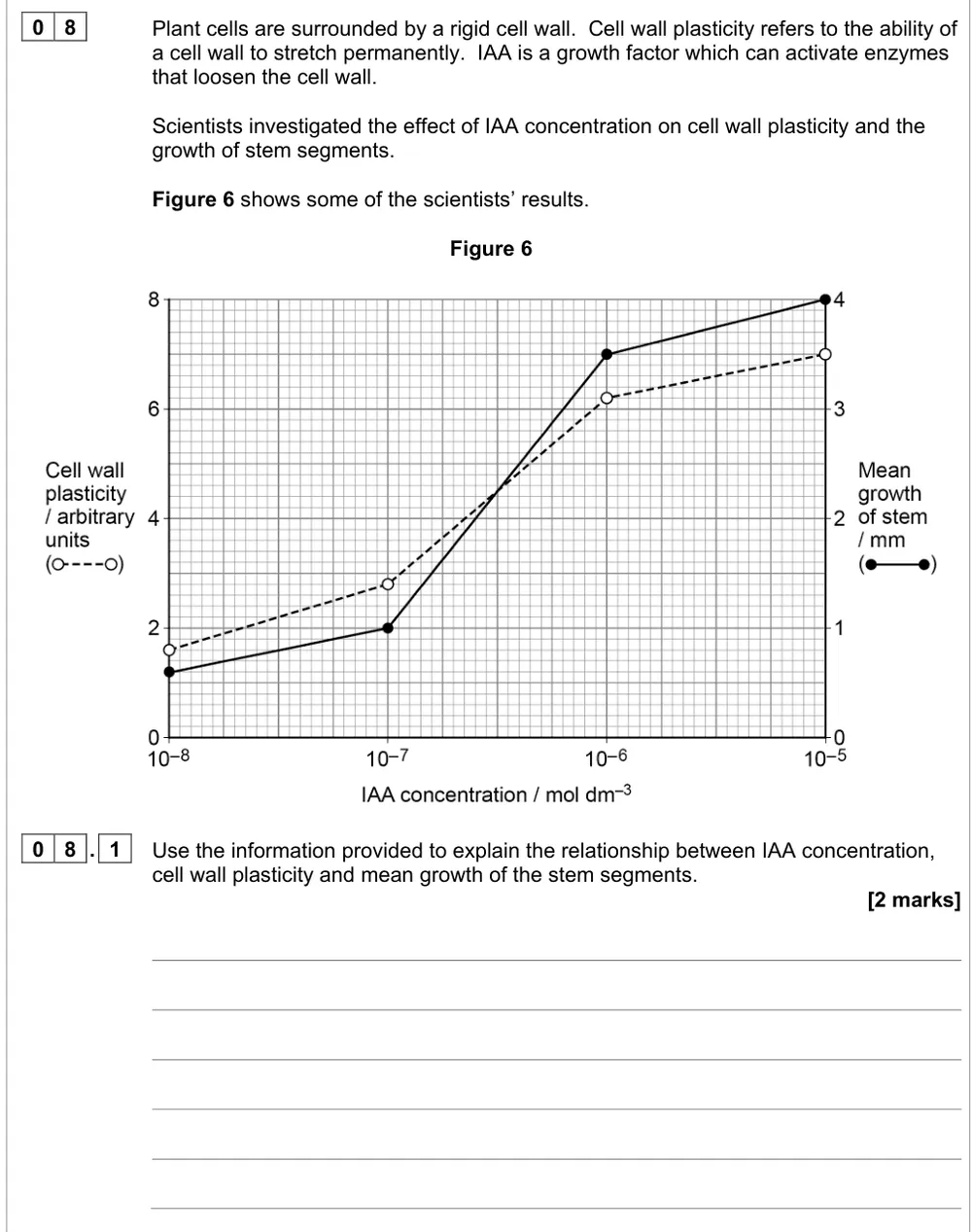
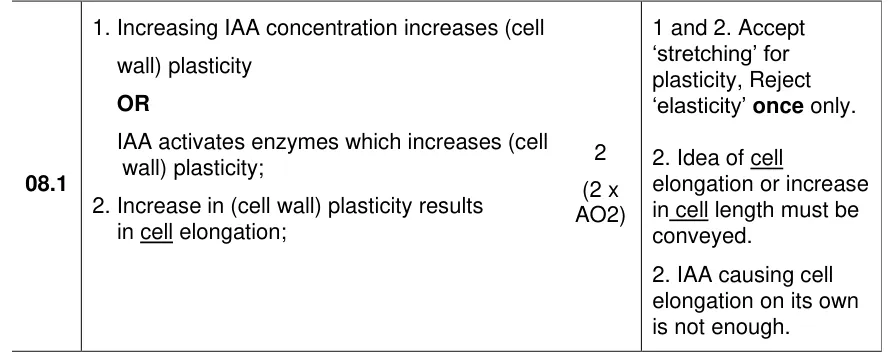
Explain the link between IAA concentration, cell wall plasticity and growth of stem segments.
Show the mark scheme
Tap an image to open it full size.
From the examiners' report: Only about 17% got both. Read the negative indices carefully: 10⁻⁵ is higher than 10⁻⁸. Then link plasticity to cell elongation instead of just saying IAA causes elongation.
Taxes, kineses and survival (3.6.1.1)
Question 6
A level Paper 3 · November 2021 · Q03.1 · 2 marks · Medium
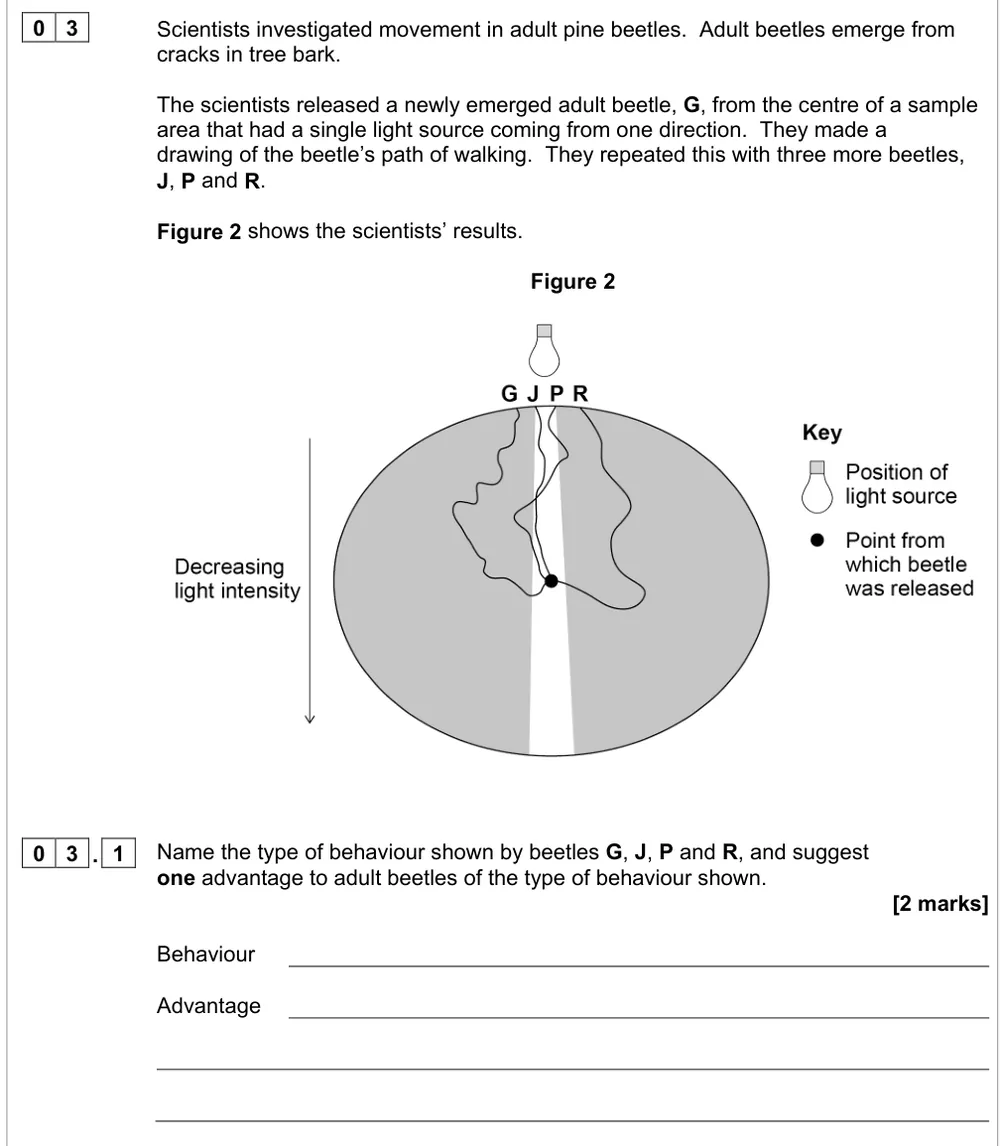
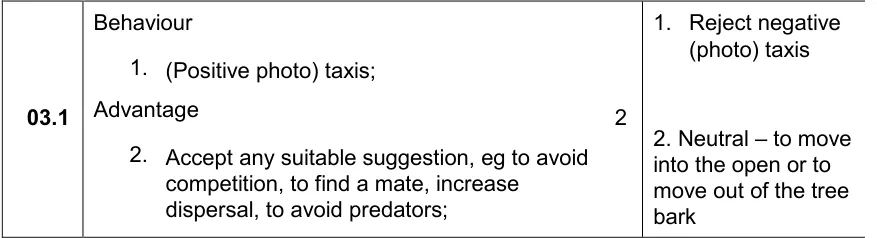
Name the behaviour of beetles walking towards a light and suggest one advantage.
Show the mark scheme
Tap an image to open it full size.
From the examiners' report: Only 18.56% got both. It's a taxis, not a tropism or a kinesis, and the beetles move towards the light. Give a specific advantage; 'to survive' is too vague.
Question 7
A level Paper 3 · November 2021 · Q03.2 · 3 marks · Hard
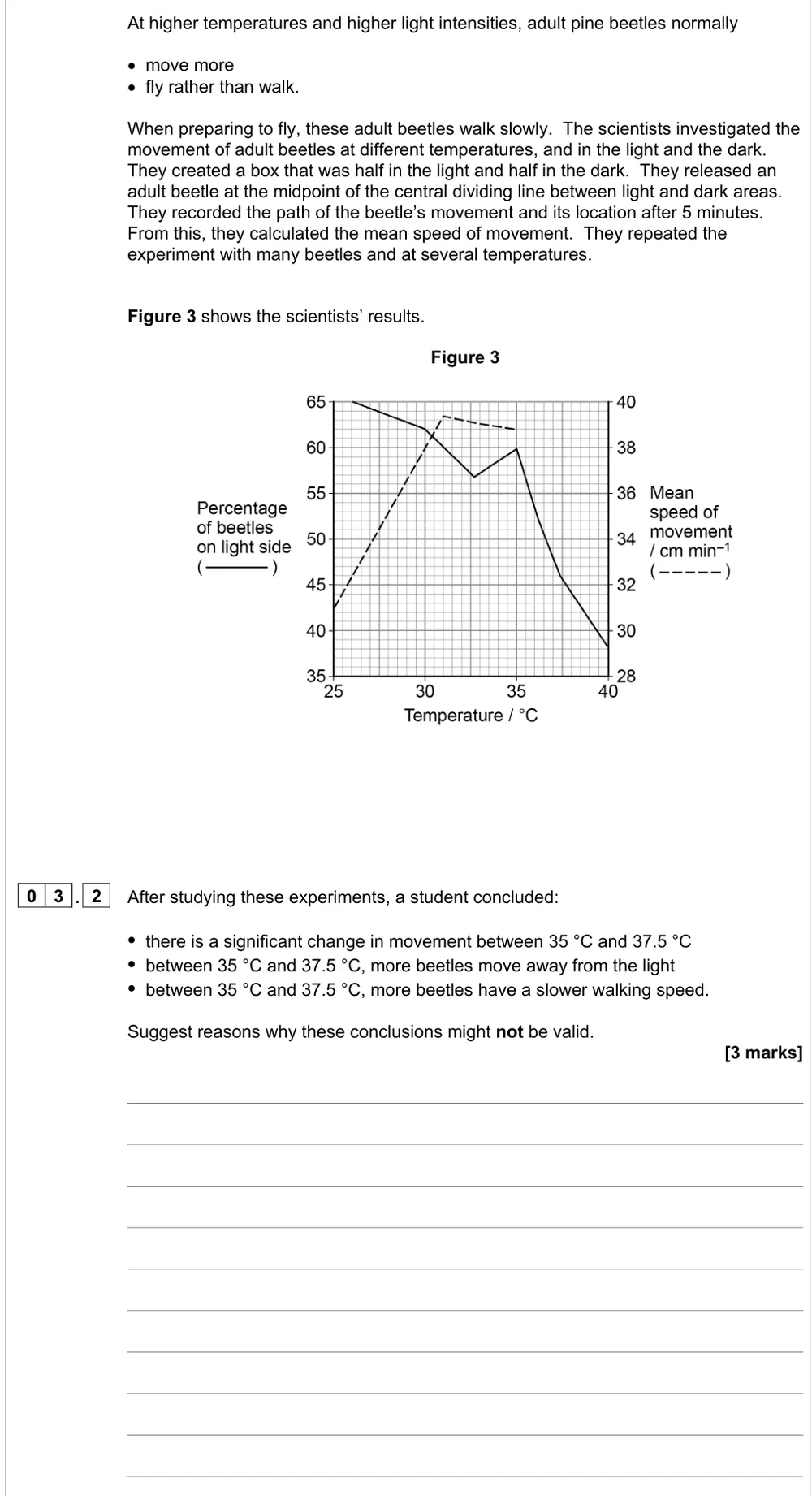
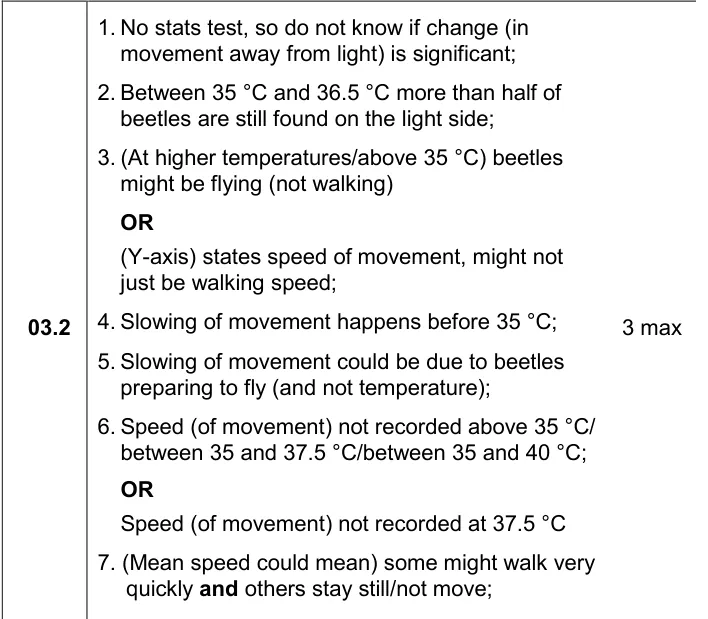
Suggest why conclusions about beetle movement between 35 °C and 37.5 °C may not be valid.
Show the mark scheme
Tap an image to open it full size.
From the examiners' report: Only 4.47% got even 2 marks. Explain why the conclusions are not valid, using the figure. The stem says many beetles were used, so 'small sample size' and 'other factors' don't score.
Question 8
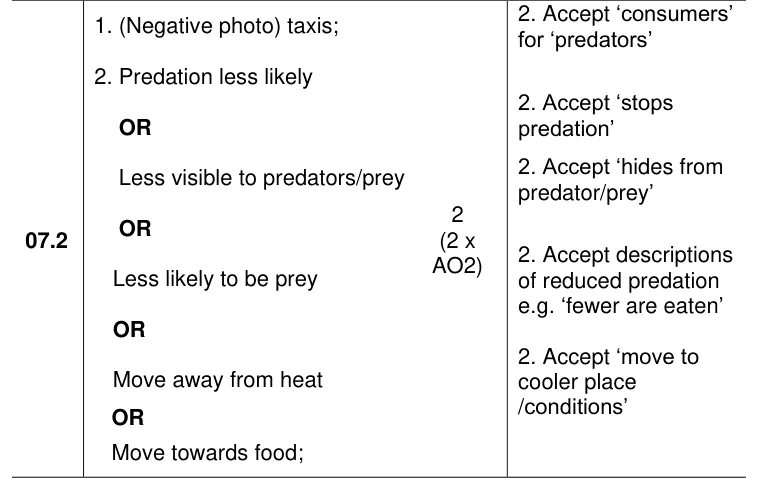
A level Paper 2 · June 2025 · Q07.2 · 2 marks · Medium
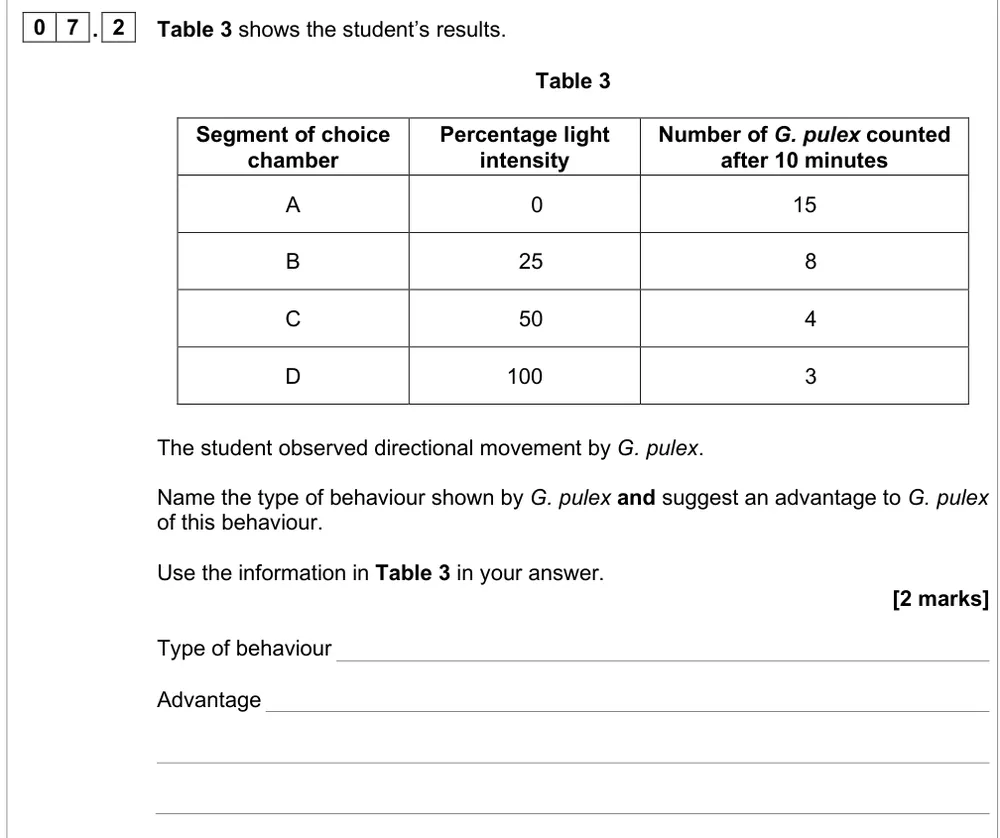
Name the behaviour of freshwater shrimps in a choice chamber and suggest an advantage.
Show the mark scheme
Tap an image to open it full size.
From the examiners' report: About 40% got both. Directional movement is a taxis, not a kinesis or phototropism, and the shrimps move away from light. Link the advantage to predators; 'to survive' is too general.
Question 9
A level Paper 3 · June 2019 · Q05.3 · 3 marks · Medium
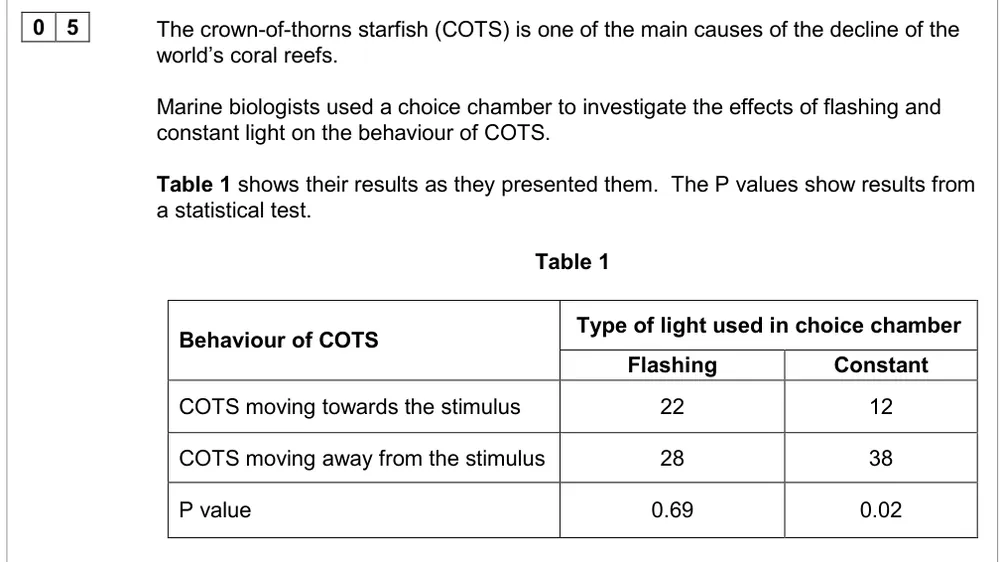
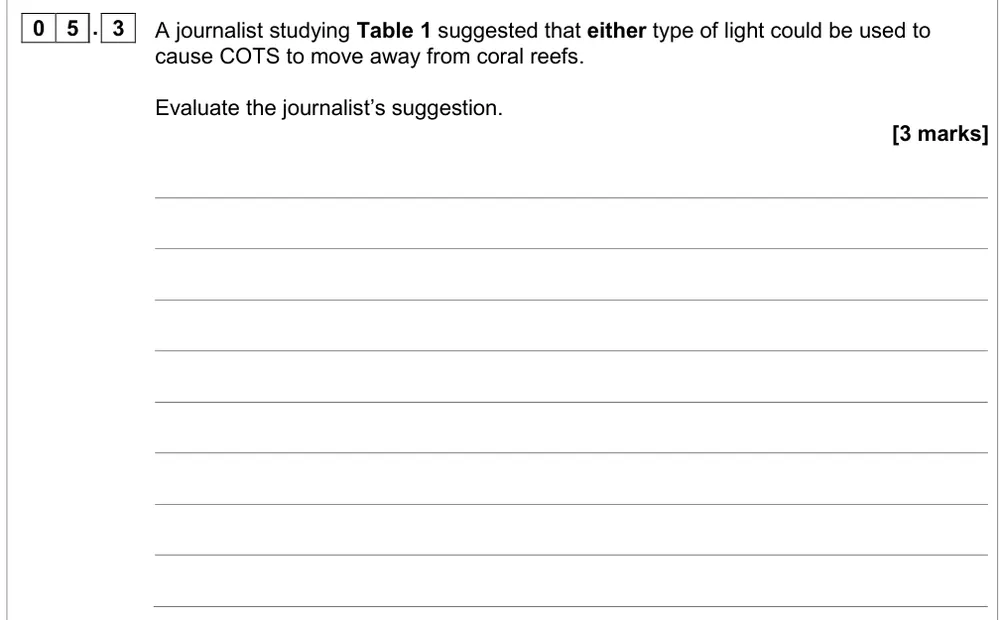
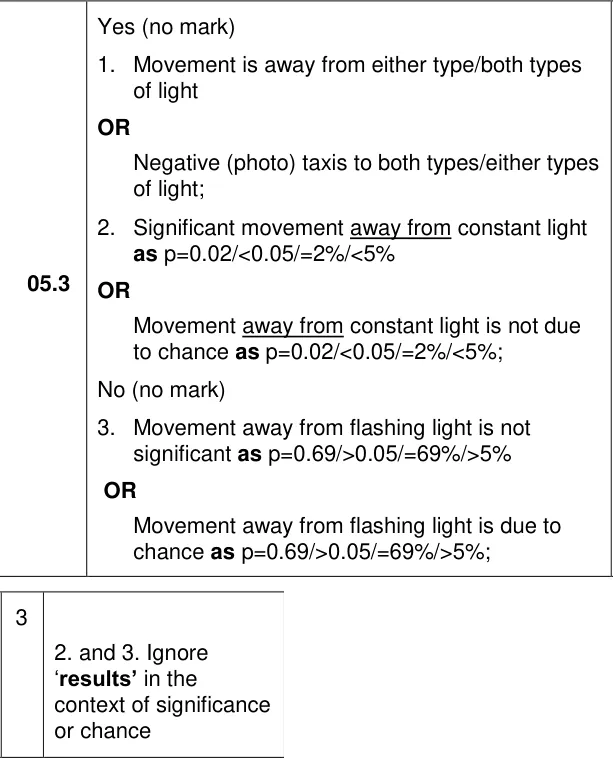
Evaluate whether flashing or constant light could move crown-of-thorns starfish away from reefs.
Information from earlier in this question:
Show the mark scheme
Tap an image to open it full size.
From the examiners' report: Only about 6% got all three. Give both sides: both lights cause movement away, but only constant light gives a significant result. Use P against 0.05, not 'results are significant'.
Question 10
AS Paper 2 · June 2016 · Q05.4 · 3 marks · Hard
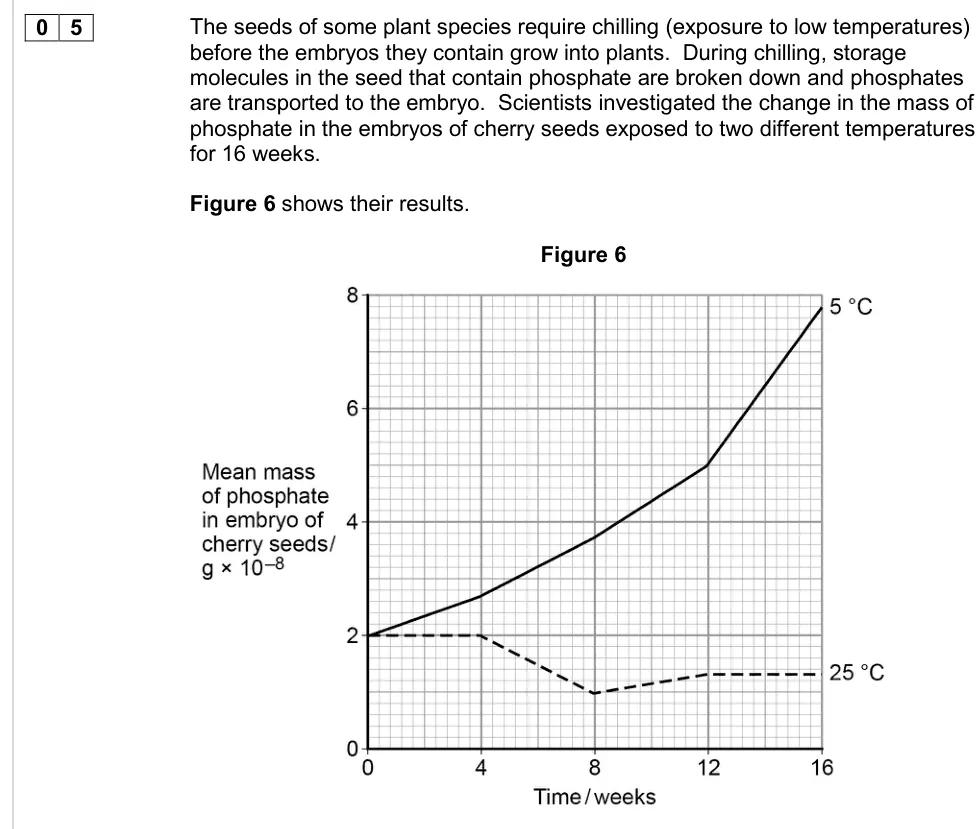
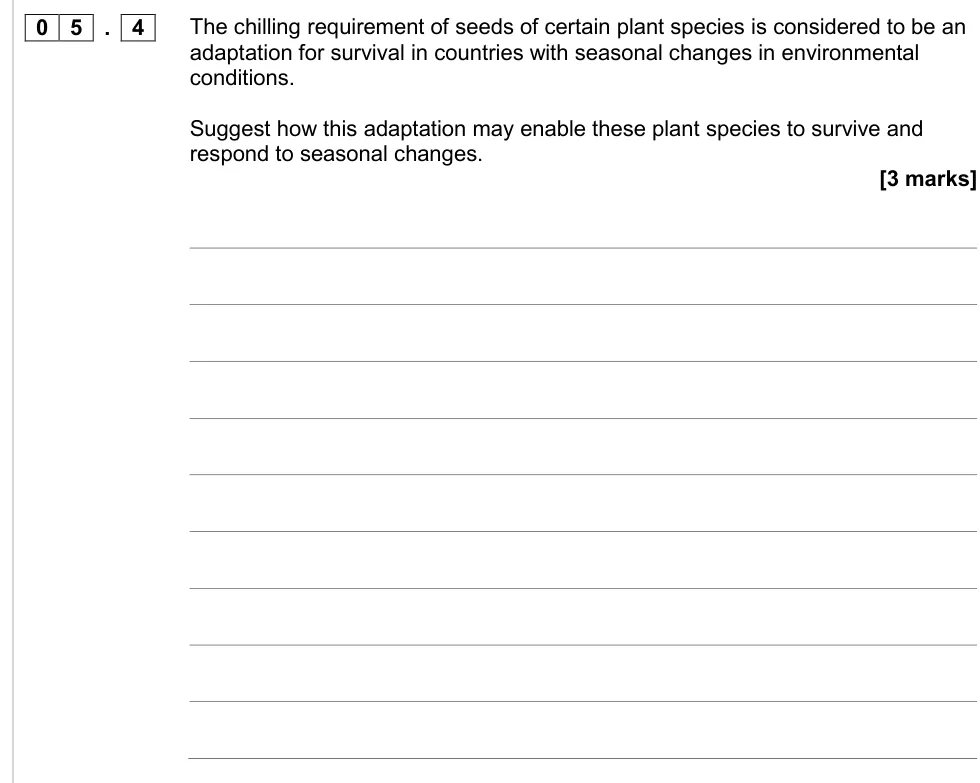
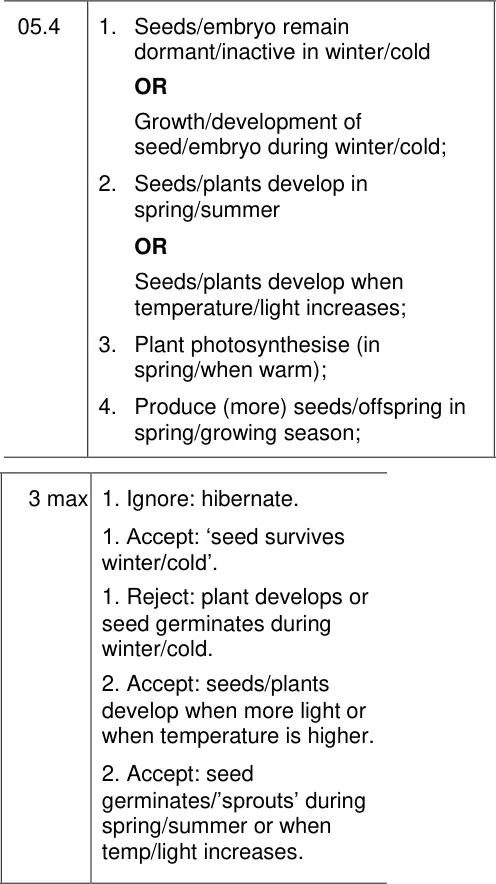
Suggest how a chilling requirement helps seeds survive seasonal changes.
Information from earlier in this question:
Show the mark scheme
Tap an image to open it full size.
From the examiners' report: Almost 60% scored zero. The plants don't grow in winter: the seed stays dormant until it's warmer, then germinates and photosynthesises in spring. Don't turn it into a natural selection answer.
Practical and maths skills (3.6.1.1)
Question 11
A level Paper 2 · November 2021 · Q03.2 · 5 marks · Medium
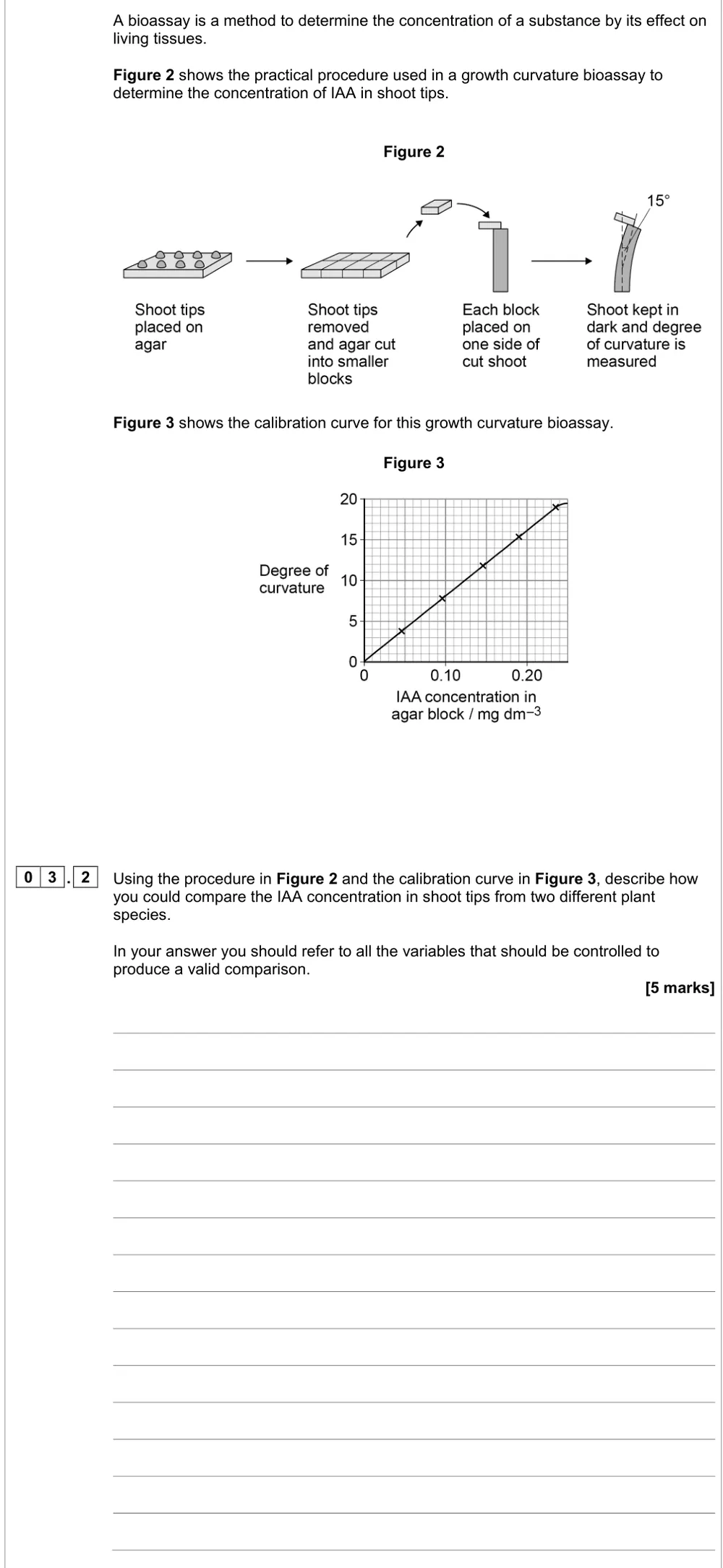
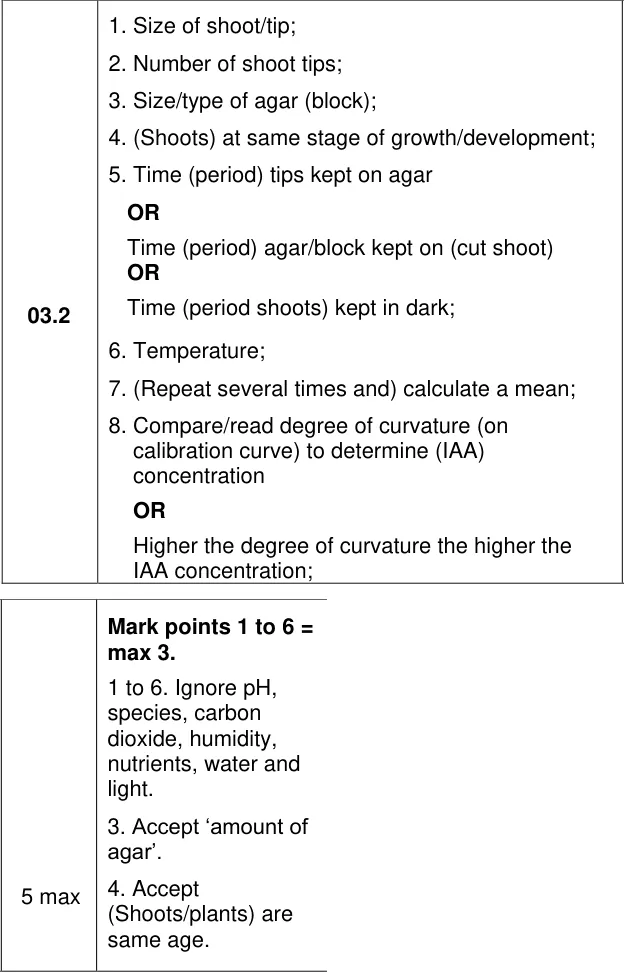
Describe how to use a curvature bioassay to compare IAA in shoot tips from two species.
Information from earlier in this question:
Show the mark scheme
Tap an image to open it full size.
From the examiners' report: Half got at least three marks, but only 3% got all five. After three control variables, add repeats with a mean and how you read the curvature off the calibration curve; don't add known IAA concentrations to the agar.
Question 12
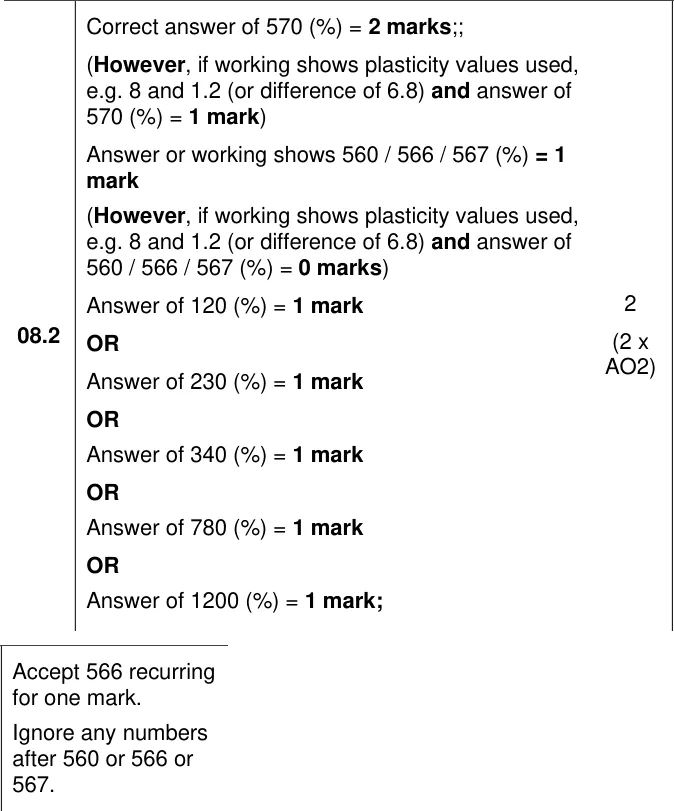
A level Paper 2 · June 2024 · Q08.2 · 2 marks · Hard
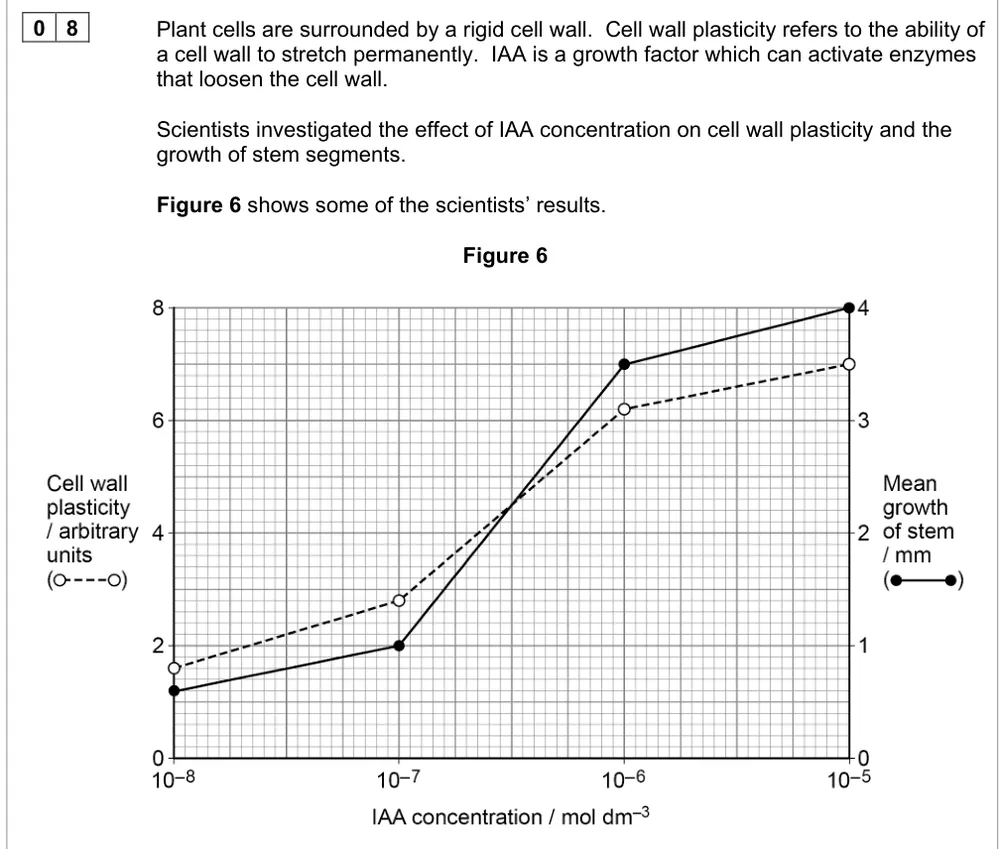
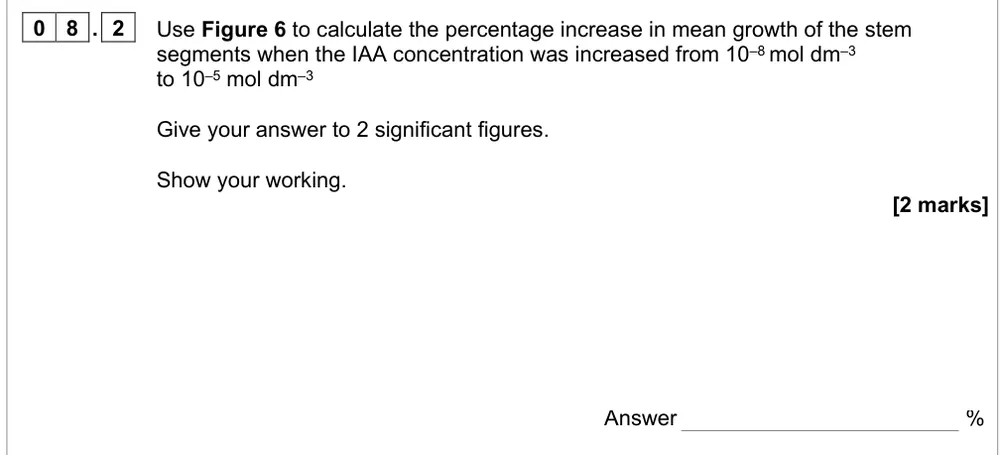
Calculate the percentage increase in stem growth from the IAA graph.
Information from earlier in this question:
Show the mark scheme
Tap an image to open it full size.
From the examiners' report: About 26% got 570%. Use the growth axis on the right, not plasticity, and round to 2 significant figures: 566.7% scores only 1 mark.
Question 13
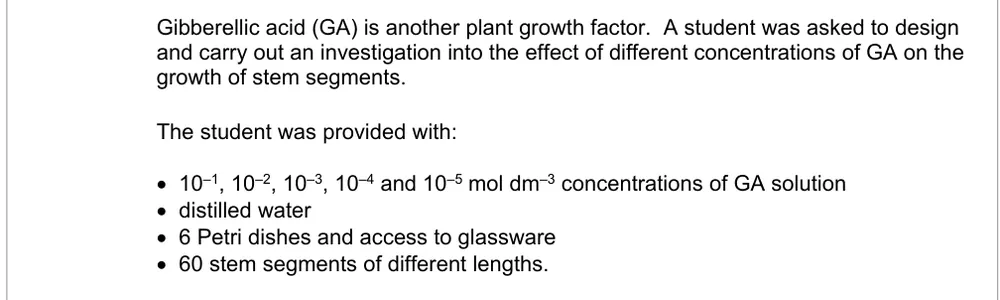
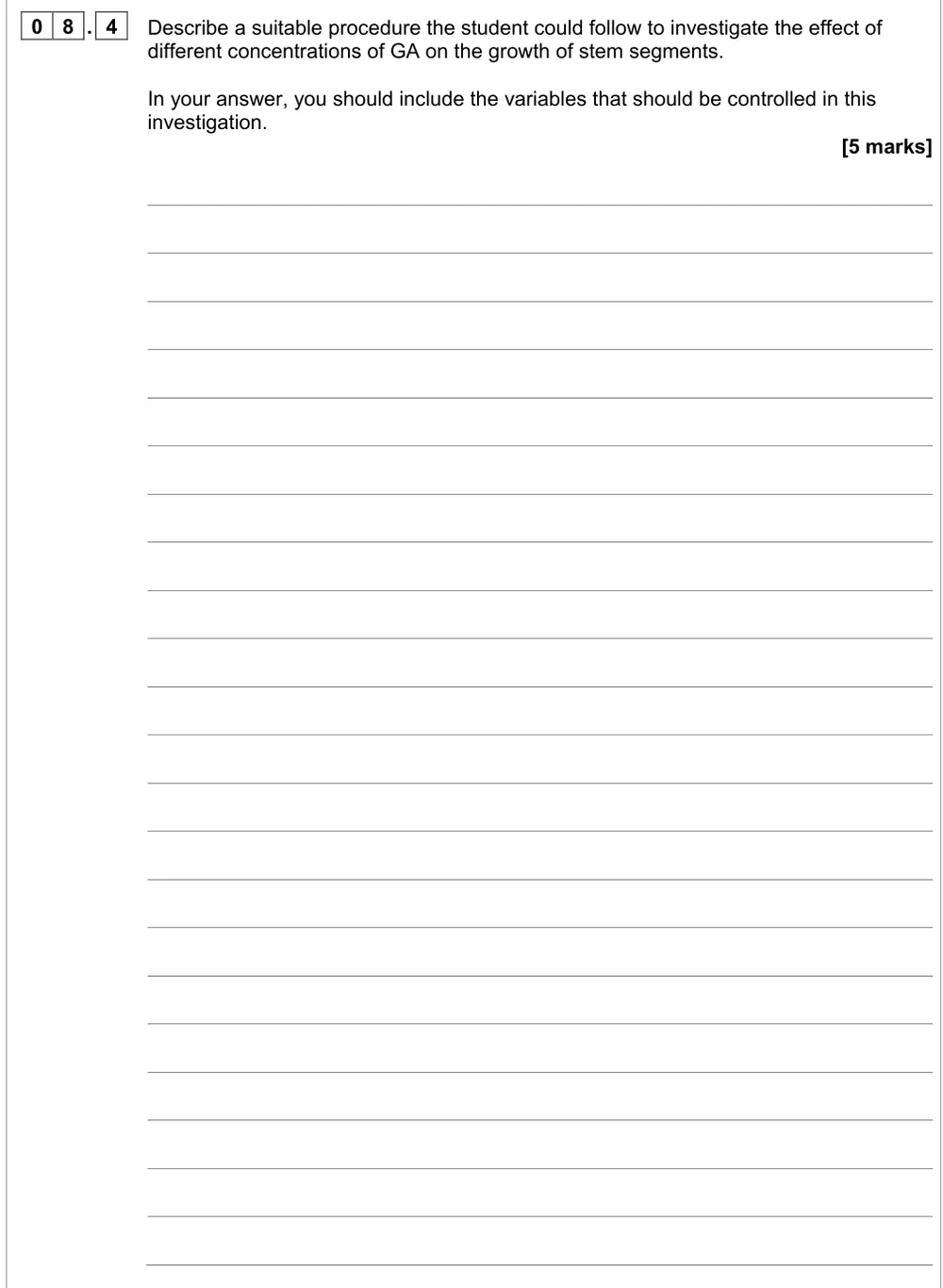
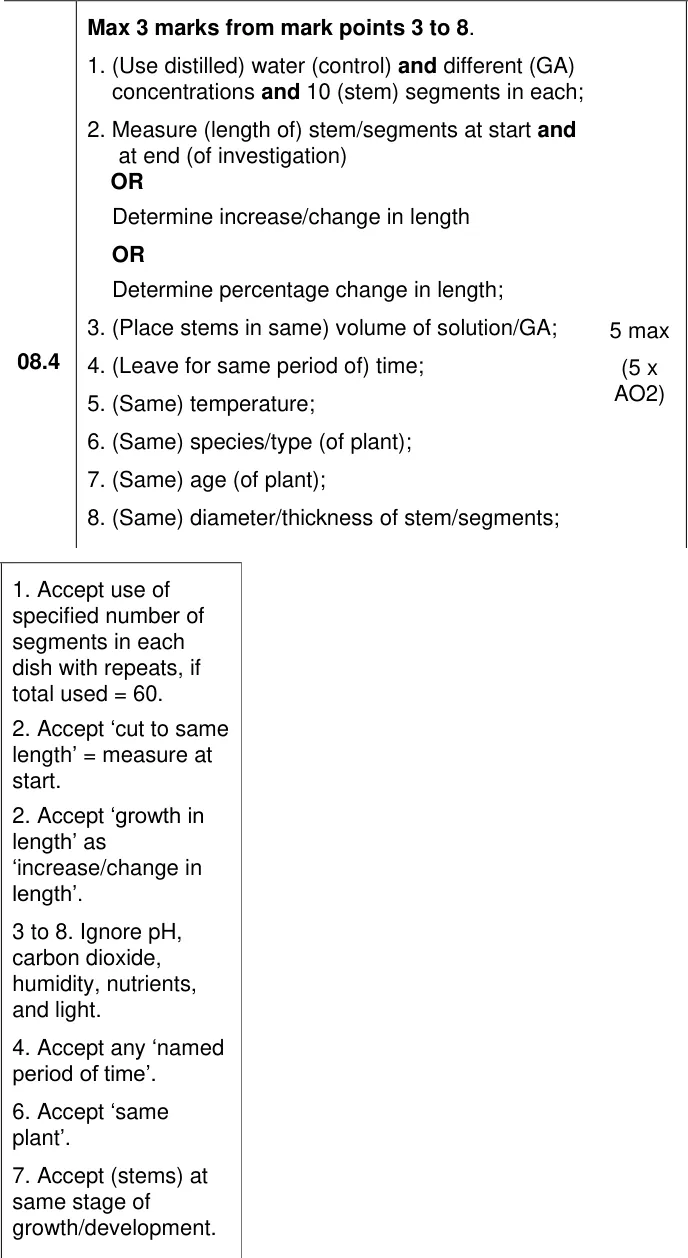
A level Paper 2 · June 2024 · Q08.4 · 5 marks · Medium
Describe a procedure to test the effect of GA concentration on growth of stem segments.
Information from earlier in this question:
Show the mark scheme
Tap an image to open it full size.
From the examiners' report: About 12% got all five. Use all 60 segments with a water control, and measure the length at the start and the end. 'Amount' of GA didn't score, and light, pH and CO2 were ignored.
Question 14
A level Paper 3 · June 2019 · Q05.4 · 2 marks · Medium
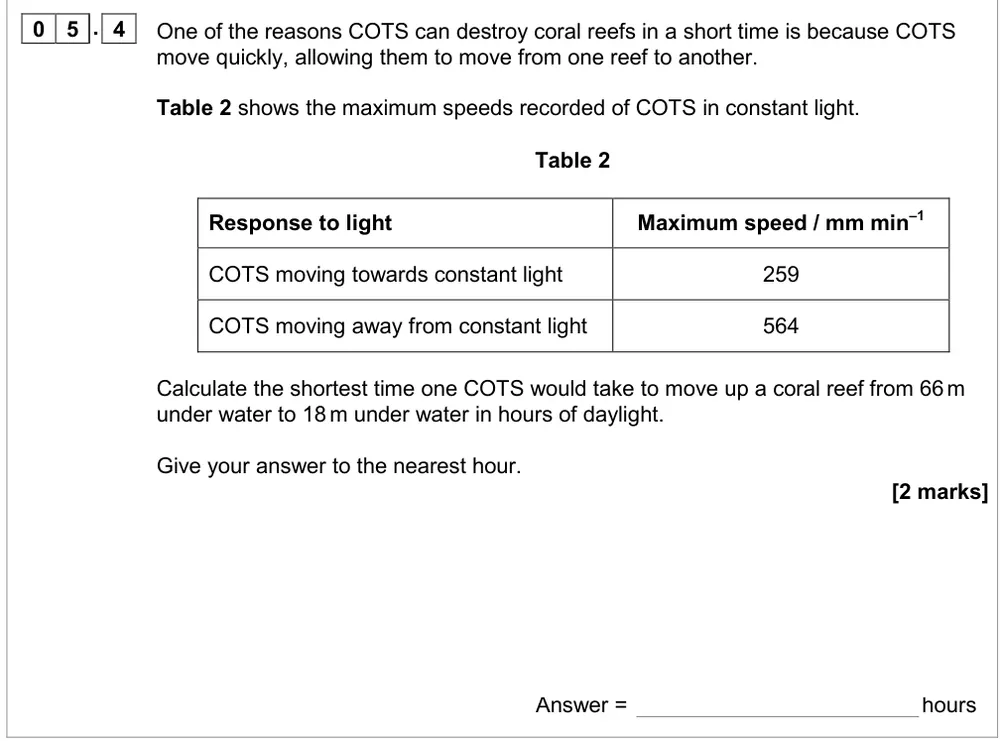
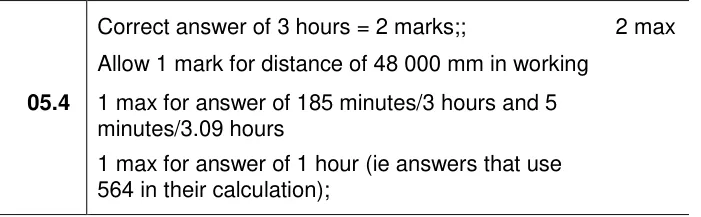
Calculate the time for a starfish to move 48 m up a reef in daylight.
Information from earlier in this question:
Show the mark scheme
Tap an image to open it full size.
From the examiners' report: Just over a third got both. Moving up the reef is towards the light, so use 259 mm min⁻¹. Convert 48 m to 48 000 mm, not 4800, and give the answer to the nearest hour.
Where students lose marks (from AQA examiners' reports and mark schemes)
Each point below is followed by wording that gained marks.
The tip produces IAA; it doesn't just contain it: Almost 80% got a mark for saying the shoot tip produces IAA, but a significant number simply said the tip contained IAA, which wasn't credited. On the growth curvature question the same slip cost marks again.
✔ Gains credit: "Tip produces IAA" and "affects (shoot) length, growth or elongation".
Name cell elongation, not 'more growth': Only the more effective responses referred specifically to cell elongation. On the curvature question, 'more growth' or 'more elongation' wasn't credited, and on cell wall plasticity many said IAA caused elongation without saying how.
✔ Gains credit: "(More) elongation of cells on one side (than the other)"; "increase in cell wall plasticity results in cell elongation".
No directional light, so it isn't phototropism: Figure 1 showed curvature without a directional light source, yet many described phototropism or wrote about the shaded side. IAA diffusing into the shoot was rarely credited, so only 7% got all three marks.
✔ Gains credit: "Tip produces IAA; IAA diffuses (into the shoot); (more) elongation of cells on one side."
In roots, IAA inhibits elongation: Many knew high IAA has a different effect on roots, but 'the length of roots would decrease' wasn't credited. Some only described the roots and never described the shoot results.
✔ Gains credit: "In roots, growth or elongation is less or inhibited"; accept a decrease in (mean) change in length.
Conclude about IAA, don't redescribe the table: Only 1% got both marks for two conclusions about IAA from the bioassay. Most simply described the results in Table 1, or wrote about bending instead of the movement or production of IAA.
✔ Gains credit: "IAA is not broken down by light (or is produced in the dark)"; "IAA moves away from light, to the shaded side".
Directional movement is a taxis: Only 18.56% got both marks for the pine beetles; 'tropism' and 'kinesis' were common wrong answers. On the freshwater shrimps, the most frequent errors were 'kinesis', 'phototropism' and 'positive phototaxis'.
✔ Gains credit: "(Positive photo) taxis" for beetles walking towards light; "(negative photo) taxis" for shrimps moving away from it.
Give an advantage, not 'to survive': Vague answers such as 'to survive' or 'to obtain more favourable conditions' didn't score, and some said the animals moved towards light 'for photosynthesis'.
✔ Gains credit: "Predation less likely" or "less visible to predators"; for beetles "to find a mate, increase dispersal or avoid competition".
Dormant in winter, growing in spring: Almost 60% scored zero on the chilling requirement of seeds. The commonest misconception was that the plants grow during the winter so they are fully grown by spring.
✔ Gains credit: "Seeds remain dormant in winter; seeds or plants develop in spring or summer when temperature or light increases; plants photosynthesise in spring."
Download the questions
Download the PDF pack (14 questions, mark schemes at the end)
Keep practising
- Receptors and control of heart rate: AQA A Level Biology exam questions by topic
- AQA 3.6.1 stimuli and receptors: self-marking quiz
- Handling data (MS 1): AQA A Level Biology exam questions by topic
- Arithmetic and numerical skills (MS 0): AQA A Level Biology exam questions by topic
- AQA A Level Biology masterclasses
Questions, mark schemes and examiners' report extracts © AQA.