

Gas exchange (AQA 3.3.2) comes up on almost every Year 12 paper, and the lung disease data questions turn up at A-level too. You need to know how gas exchange surfaces are adapted in single-celled organisms, insects, fish and the leaves of dicotyledonous plants, how insects and xerophytes balance gas exchange against water loss, the structure of the human gas exchange system and the alveolar epithelium, and how the diaphragm and intercostal muscles change the pressure in the thoracic cavity. You also need to interpret data on lung disease, risk factors and correlations.
The examiners' reports show the same errors year after year. Students describe the mechanism when asked for a pathway, write 'thin membrane' instead of thin epithelial cells, say the diaphragm contracts without saying it flattens, write 'chest' instead of thoracic cavity, say hairs trap water rather than water vapour, and say the results are significant instead of the difference.
Start with single-celled organisms and insects, then fish, leaves, the human gas exchange system and breathing, and finish with lung disease and the risk factor data. Answer each question on paper before you open the mark scheme. If you'd like help with this topic, my AQA masterclasses run online on Tuesdays at 5.15pm for Year 12 and on Wednesdays or Thursdays at 6.30pm for Year 13.
What you need from GCSE and Year 12
Each question on this page assumes you're secure on these GCSE and Year 12 ideas. If any of them feels shaky, revise it before you start.
- GCSE: diffusion is the net movement of particles from a higher to a lower concentration; it is faster with a larger surface area, a steeper concentration gradient and a shorter distance.
- GCSE: air passes down the trachea, bronchi and bronchioles to the alveoli, which are surrounded by capillaries.
- GCSE: a leaf has a waxy cuticle, epidermis, palisade and spongy mesophyll with air spaces, and stomata opened and closed by guard cells.
- Year 12 (AQA 3.3.1): larger organisms have a smaller surface area to volume ratio, so they need specialised exchange surfaces.
- Year 12 (AQA 3.2.3): the cell-surface membrane is partially permeable, and oxygen and carbon dioxide cross it by simple diffusion.
Key terms
These words come up in the questions and mark schemes. Examiners expect you to use them exactly.
- Diffusion pathway: the distance a gas diffuses across an exchange surface; the shorter it is, the faster the rate of diffusion.
- Tracheae and tracheoles: the air-filled tubes of an insect's gas exchange system; tracheoles are highly branched, thin-walled and reach individual cells.
- Spiracles: openings in an insect's body wall where air enters the tracheae; they can close to reduce water loss.
- Gill filaments and lamellae: the structures of a fish gill; many lamellae on each filament give a large surface area for gas exchange.
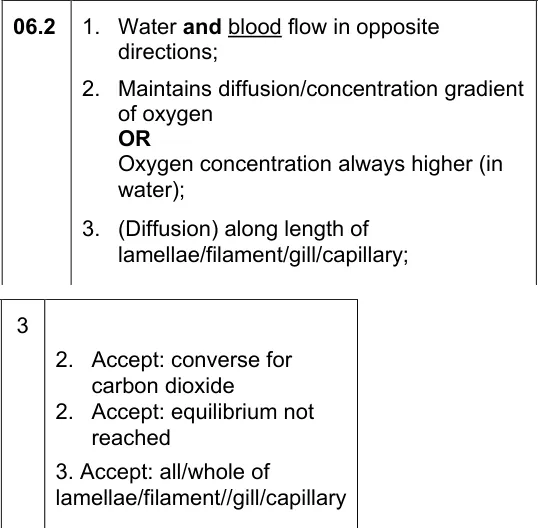
- Counter-current principle: blood and water flow across the lamellae in opposite directions, so a diffusion gradient for oxygen is kept along the whole length of the lamella.
- Stomata: pores in the leaf epidermis, each between two guard cells, that let carbon dioxide diffuse in and water vapour diffuse out.
- Xerophyte: a plant adapted to dry conditions, with features such as sunken stomata, hairs, rolled leaves and a thick waxy cuticle that reduce water loss.
- Alveolar epithelium: the single layer of flattened cells lining an alveolus; with the capillary endothelium it gives a short diffusion pathway.
- Ventilation: breathing in and out, which keeps a steep concentration gradient between the alveoli and the blood.
- Antagonistic muscles: muscles that work in opposite directions; the external intercostals raise the ribcage and the internal intercostals lower it during forced exhalation.
- Correlation: a link between two variables; it doesn't on its own show that one causes the other (a causal relationship).
What these questions cover (AQA 3.3.2)
The questions test these statements from the AQA AS and A-level Biology specification (7401/7402):
- Adaptations of gas exchange surfaces, shown by gas exchange: across the body surface of a single-celled organism
- Adaptations of gas exchange surfaces, shown by gas exchange: in the tracheal system of an insect (tracheae, tracheoles and spiracles) (the insect question also asks how the tracheal system limits water loss)
- Adaptations of gas exchange surfaces, shown by gas exchange: across the gills of fish (gill lamellae and filaments including the counter-current principle)
- Adaptations of gas exchange surfaces, shown by gas exchange: by the leaves of dicotyledonous plants (mesophyll and stomata).
- Compromises: Structural and functional compromises between the opposing needs for efficient gas exchange and the limitation of water loss shown by terrestrial insects and xerophytic plants.
- The human gas exchange system: The gross structure of the human gas exchange system limited to the alveoli, bronchioles, bronchi, trachea and lungs.
- Alveolar epithelium: The essential features of the alveolar epithelium as a surface over which gas exchange takes place.
- Ventilation: Ventilation and the exchange of gases in the lungs. The mechanism of breathing to include the role of the diaphragm and the antagonistic interaction between the external and internal intercostal muscles in bringing about pressure changes in the thoracic cavity.
- Students should be able to interpret information relating to the effects of lung disease on gas exchange and/or ventilation
- Students should be able to interpret data relating to the effects of pollution and smoking on the incidence of lung disease (the particulate matter question links air pollution to damaged alveoli; the COPD question uses smoking data)
- Students should be able to analyse and interpret data associated with specific risk factors and the incidence of lung disease
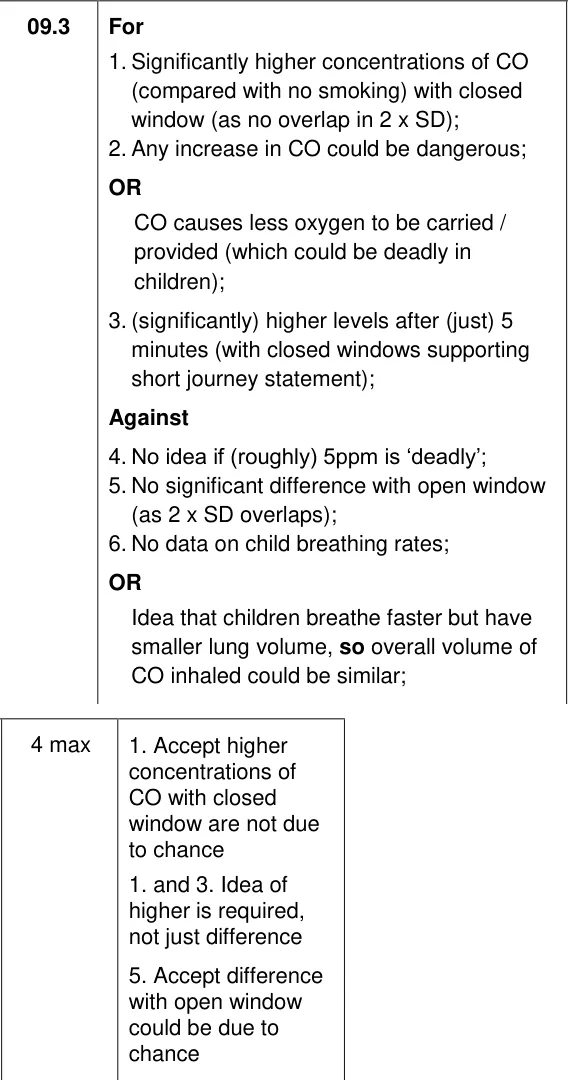
- Students should be able to evaluate the way in which experimental data led to statutory restrictions on the sources of risk factors (the carbon monoxide question asks you to evaluate the evidence behind the 2015 law banning smoking in cars carrying children)
- Students should be able to recognise correlations and causal relationships.
How to use this page
Write your answer on paper before you open the mark scheme. Allow about 1.3 minutes per mark: the 18 questions are worth 52 marks, so about 68 minutes in total. Then mark your answer strictly against the mark scheme and read the examiners' tip underneath it. If you'd rather print the questions, download the PDF pack.
Single-celled organisms and insects (3.3.2)
Question 1
AS Paper 1 · June 2023 · Q05.5 · 3 marks · Medium
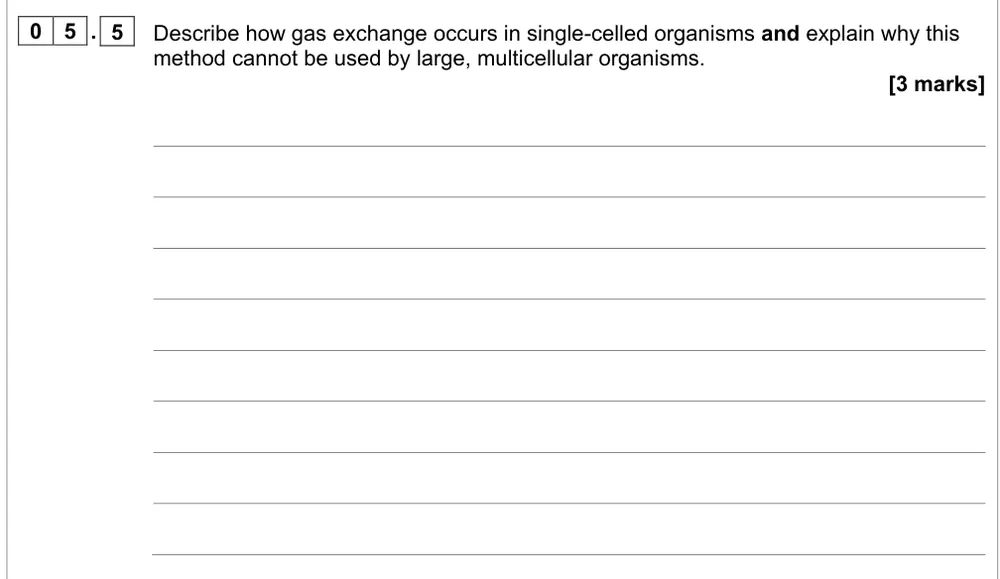
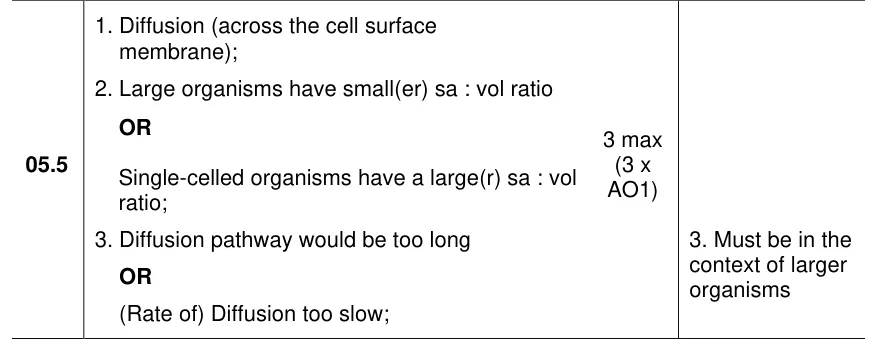
Describe gas exchange in single-celled organisms and explain why large organisms can't use it.
Show the mark scheme
Tap an image to open it full size.
From the examiners' report: About a quarter got full marks. Say diffusion, not active transport, and put the second half in the context of large organisms: a smaller surface area to volume ratio and too long a diffusion pathway. An insect is not single-celled.
Question 2
AS Paper 2 · June 2022 · Q09.1 · 5 marks · Medium
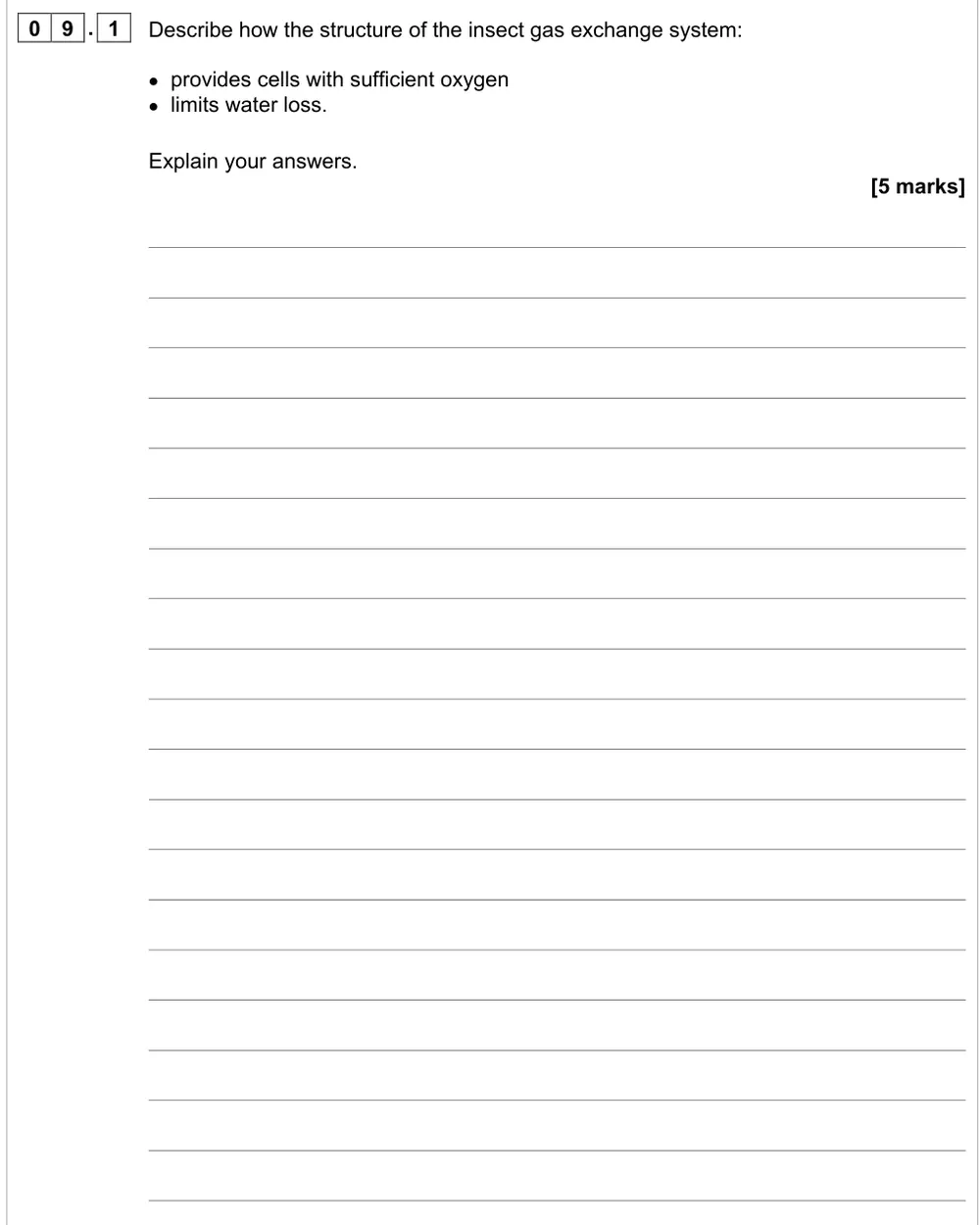
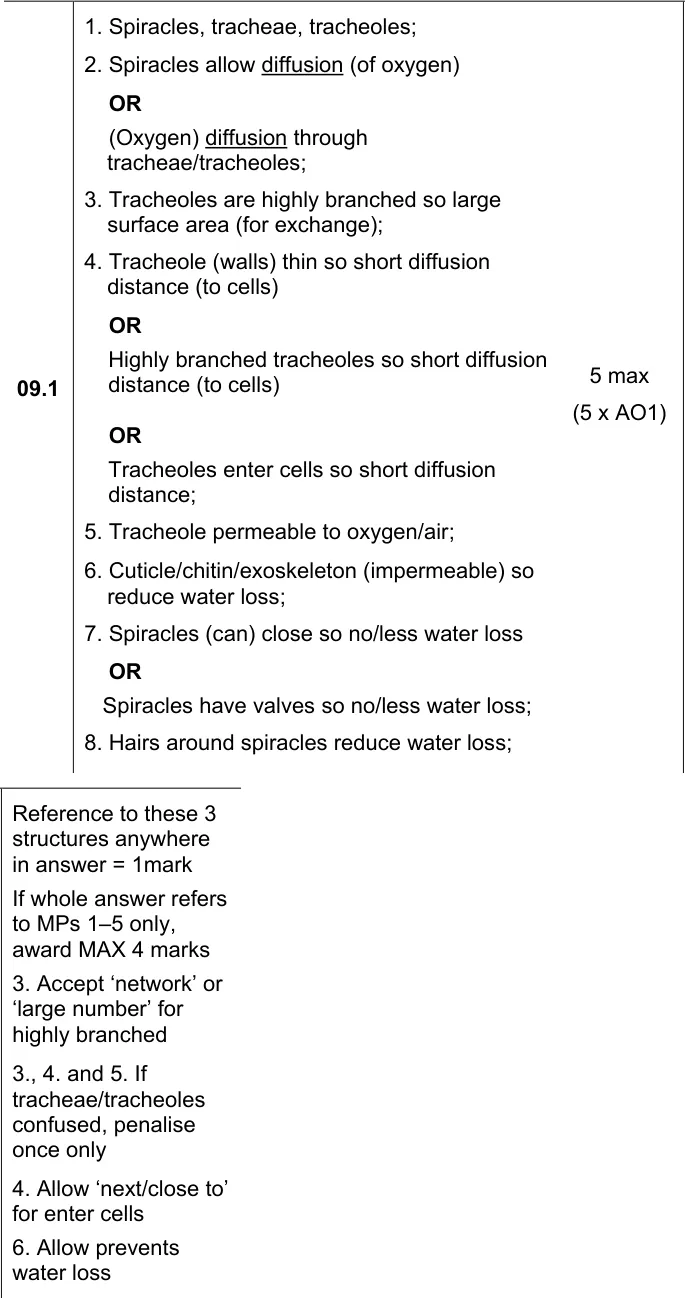
Describe and explain how the insect tracheal system supplies oxygen and limits water loss.
Show the mark scheme
Tap an image to open it full size.
From the examiners' report: Over half got at least 2 marks. Use the word diffusion, and stick to structure: abdominal pumping and fluid in the tracheoles weren't asked for. Don't forget the water loss half: cuticle, spiracles that close, hairs.
Fish gills (3.3.2)
Question 3
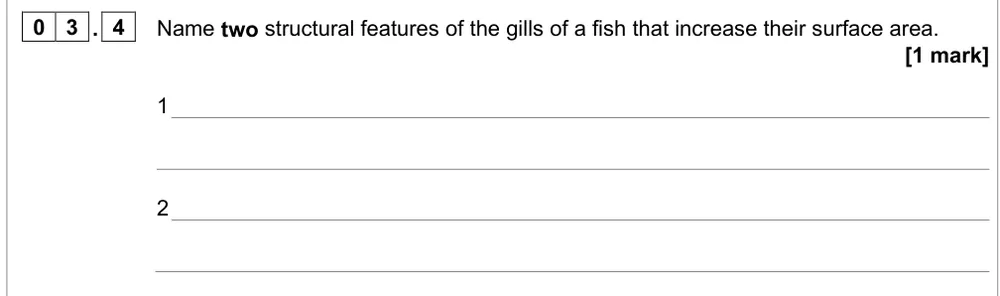
A level Paper 3 · June 2024 · Q03.4 · 1 mark · Easy
Name two structural features of fish gills that increase their surface area.
Show the mark scheme

Tap an image to open it full size.
From the examiners' report: Two-thirds scored. Answer the question asked: surface area means filaments and lamellae, not capillaries or a short diffusion distance.
Question 4
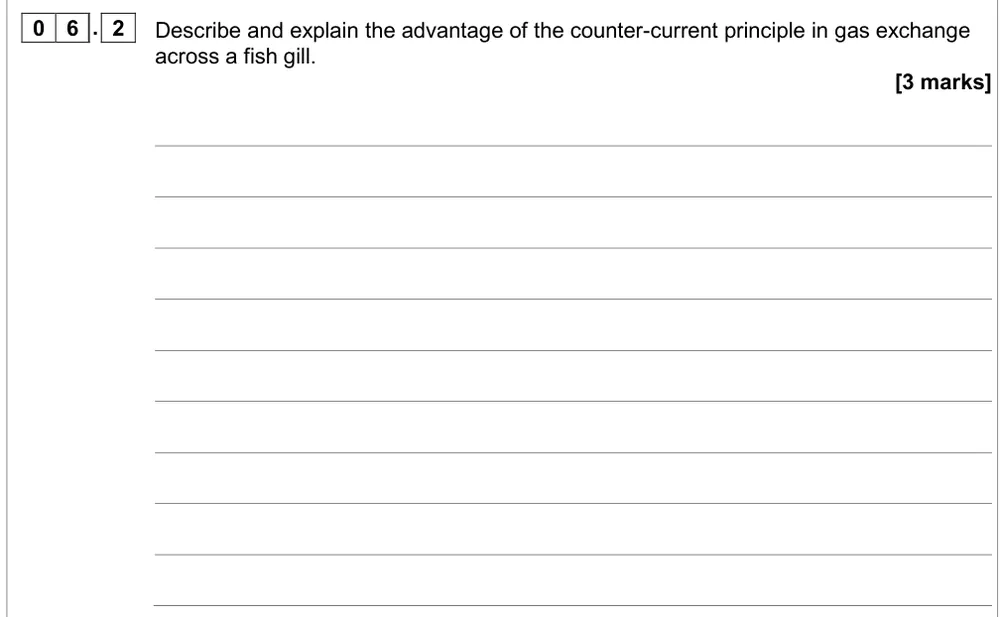
AS Paper 1 · June 2019 · Q06.2 · 3 marks
Describe and explain the advantage of the counter-current principle in fish gills.
Show the mark scheme
Tap an image to open it full size.
From the examiners' report: No examiners' report for this paper; the mark scheme needs all three ideas: opposite directions, a concentration gradient that is maintained, and along the whole length of the lamella.
Question 5
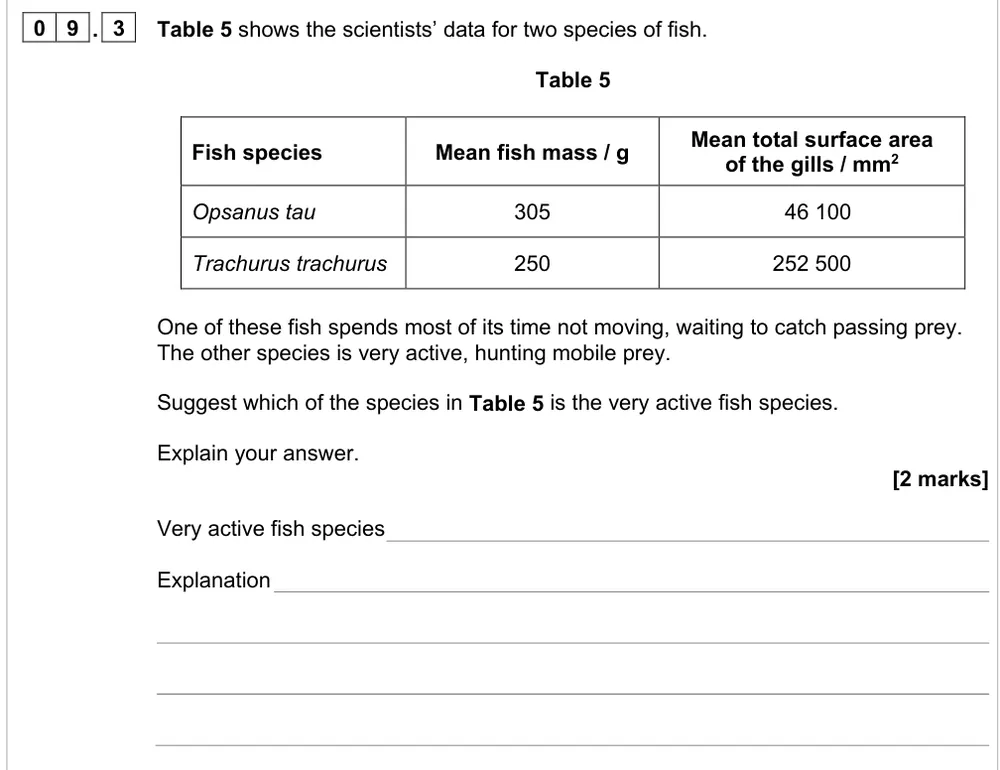
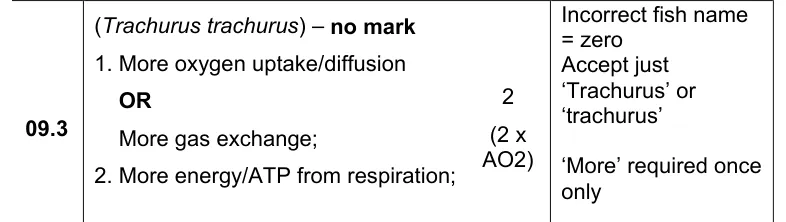
AS Paper 2 · June 2023 · Q09.3 · 2 marks · Easy
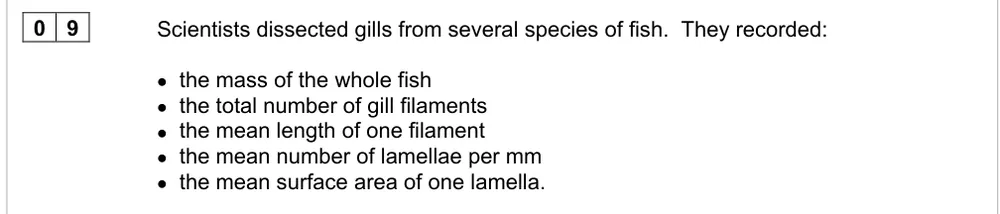
Use gill surface area data to pick out the very active fish species and explain your choice.
Information from earlier in this question:
Show the mark scheme
Tap an image to open it full size.
From the examiners' report: Most got at least 1 mark. Choose Trachurus, then link the larger gill surface area to more oxygen uptake and more ATP from respiration.
Question 6
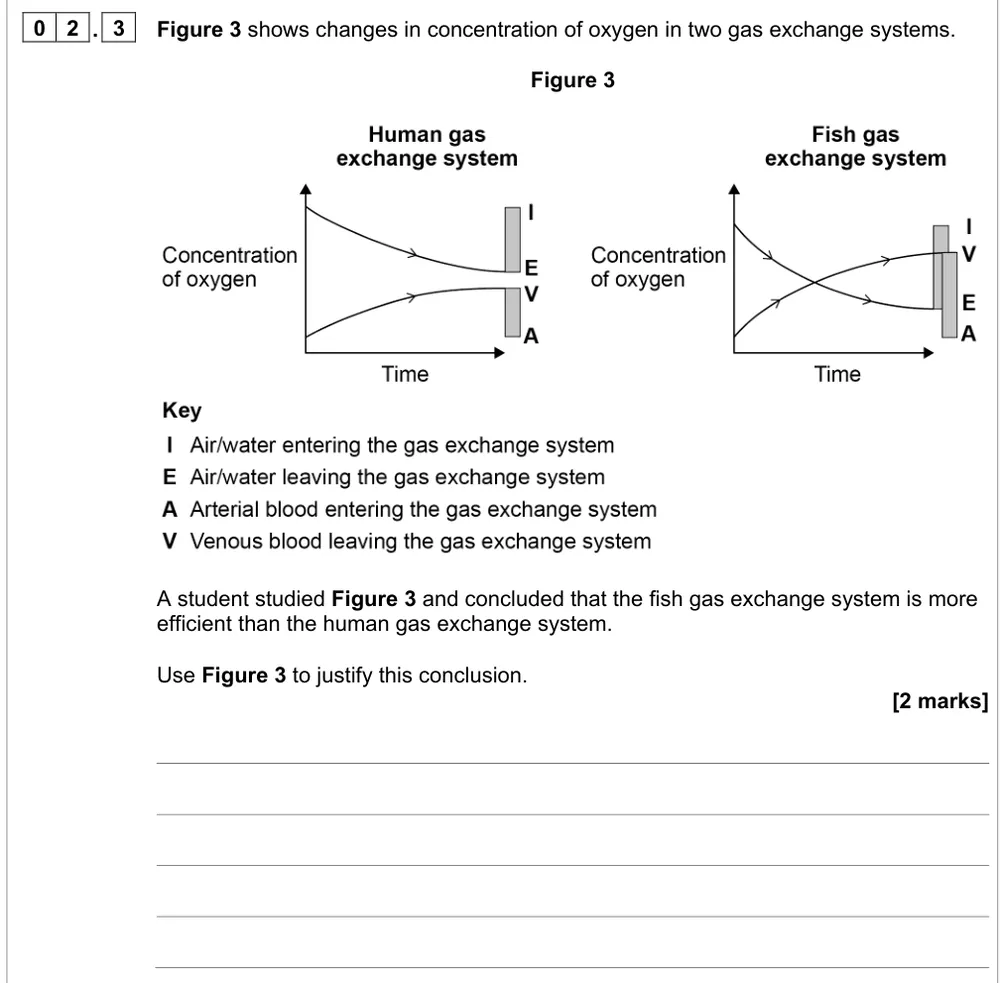
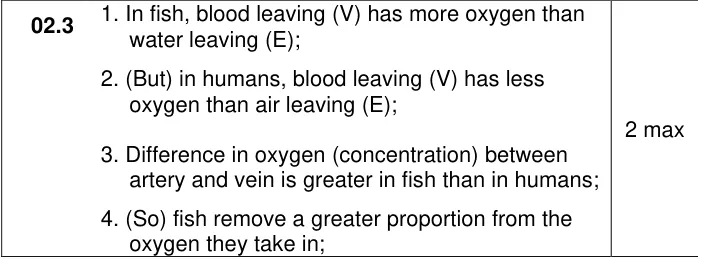
A level Paper 1 · November 2021 · Q02.3 · 2 marks · Hard
Use oxygen concentration graphs to justify the claim that fish gas exchange is more efficient than human.
Show the mark scheme
Tap an image to open it full size.
From the examiners' report: Marks were rarely gained. Read the key carefully, then compare where the blood finishes with where the water or air finishes in each graph.
Leaves and xerophytes (3.3.2)
Question 7
A level Paper 1 · June 2025 · Q10.2 · 4 marks · Medium
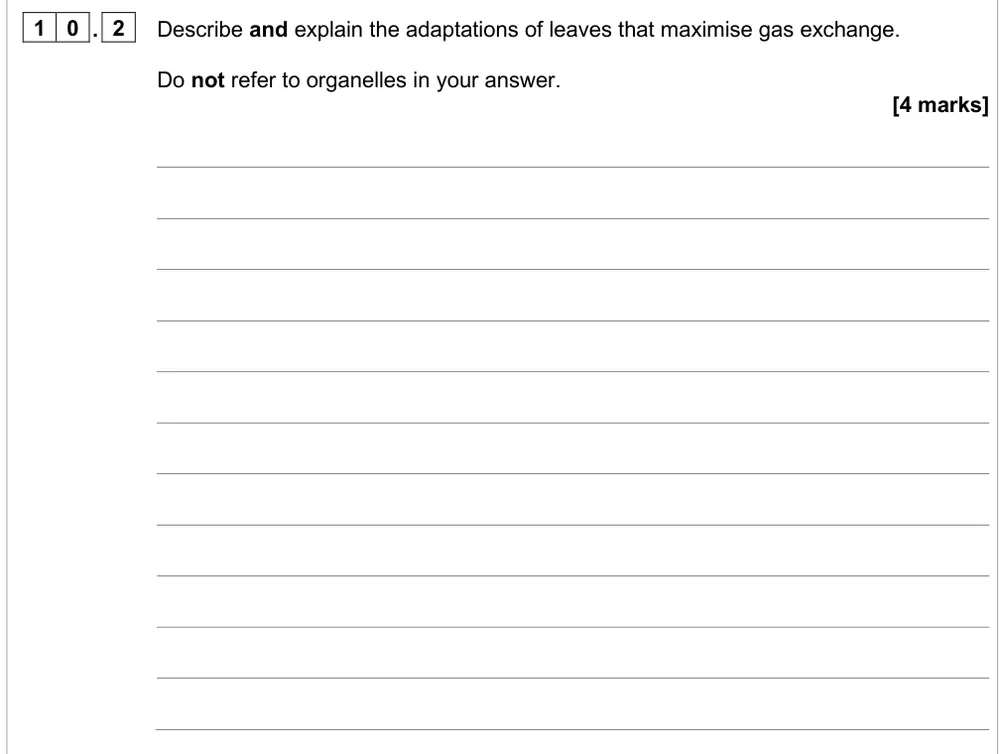
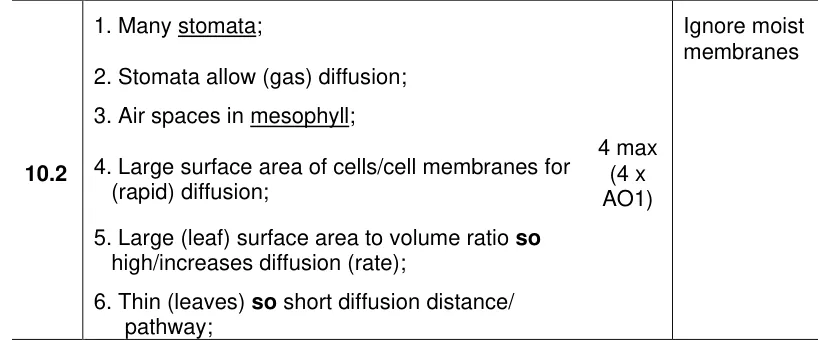
Describe and explain the adaptations of leaves that maximise gas exchange.
Show the mark scheme
Tap an image to open it full size.
From the examiners' report: Only about 5% got all 4. Say 'many' stomata, mean the surface area of the mesophyll cells (not the whole leaf), and finish each point with diffusion, not just 'for gas exchange'. Xerophyte features and the waxy cuticle aren't relevant here.
Question 8
AS Paper 2 · June 2022 · Q07.1 · 3 marks · Medium
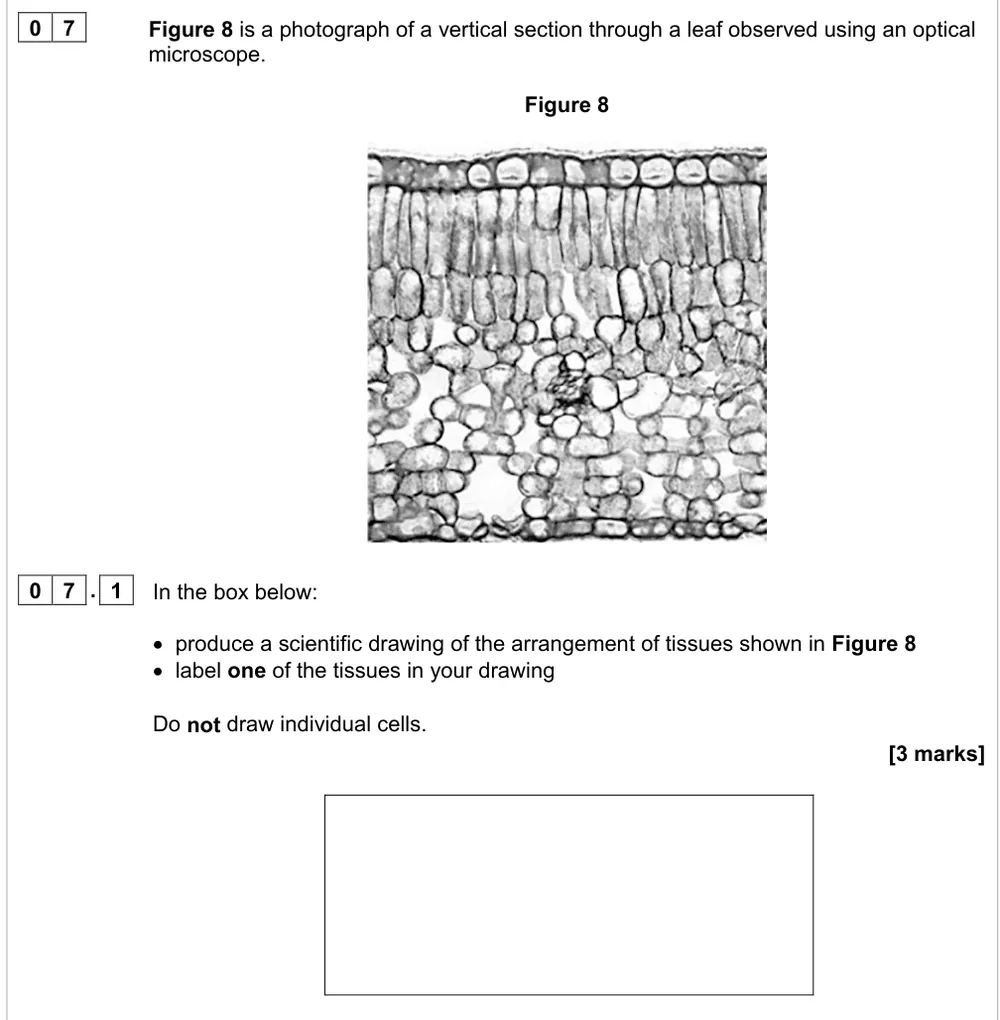
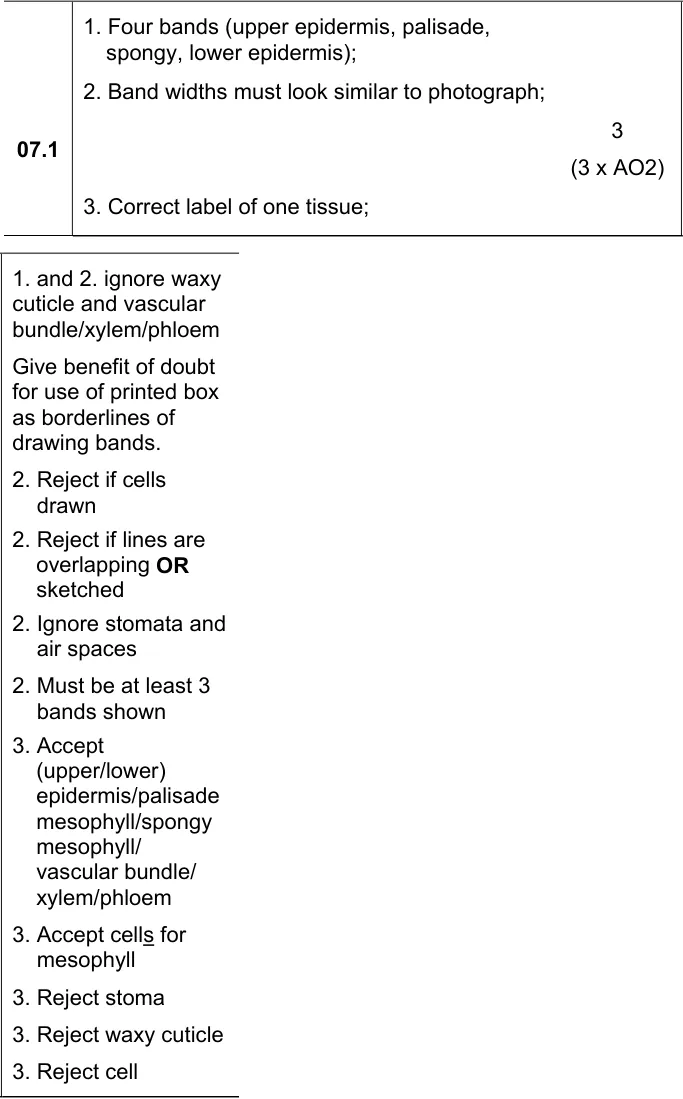
Make a scientific drawing of the tissues in a vertical section through a leaf.
Show the mark scheme
Tap an image to open it full size.
From the examiners' report: Only 7% got 3 marks: most drew individual cells even though the question said not to. Draw a tissue plan with clean single lines, bands in the right proportions, and a label.
Question 9
AS Paper 2 · June 2016 · Q02.4 · 2 marks · Hard
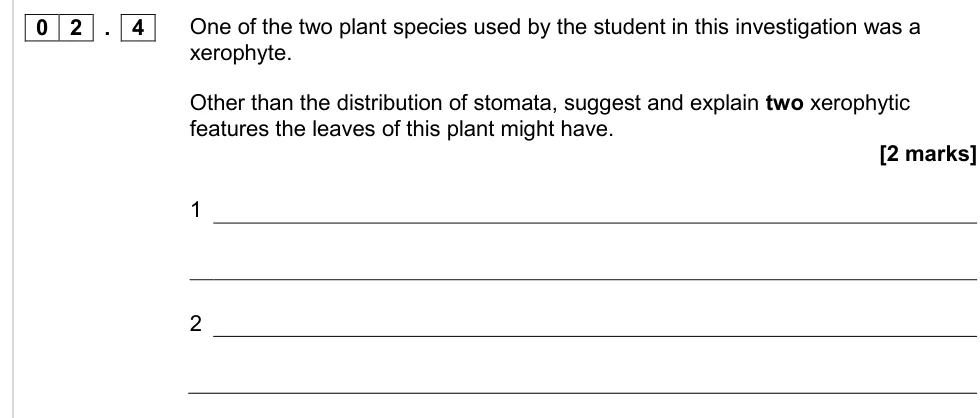
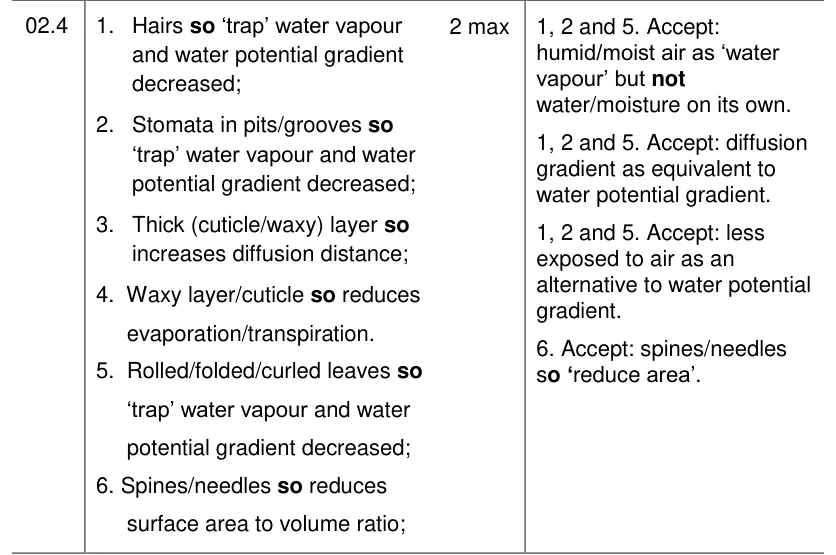
Suggest and explain two xerophytic features the leaves of a plant might have.
Show the mark scheme
Tap an image to open it full size.
From the examiners' report: 75% scored zero. Give leaf features and explain each one: hairs trap water vapour (not water) and reduce the water potential gradient. 'Waxy cuticle reduces water loss' isn't enough, and small leaves don't reduce SA:V.
The human gas exchange system and breathing (3.3.2)
Question 10
A level Paper 1 · June 2024 · Q03.3 · 1 mark · Easy
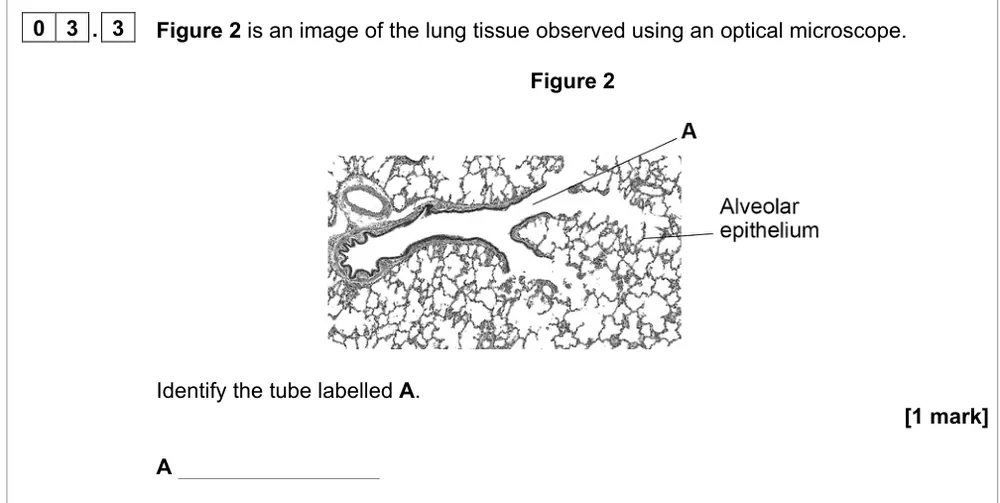
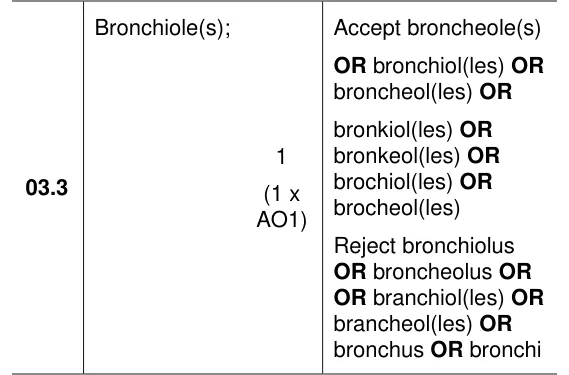
Identify a tube in a light micrograph of lung tissue.
Show the mark scheme
Tap an image to open it full size.
From the examiners' report: About two-thirds got it. A small tube surrounded by alveoli is a bronchiole, not a bronchus, trachea, capillary or alveolus. Learn the spelling.
Question 11
A level Paper 1 · June 2018 · Q10.1 · 6 marks · Medium
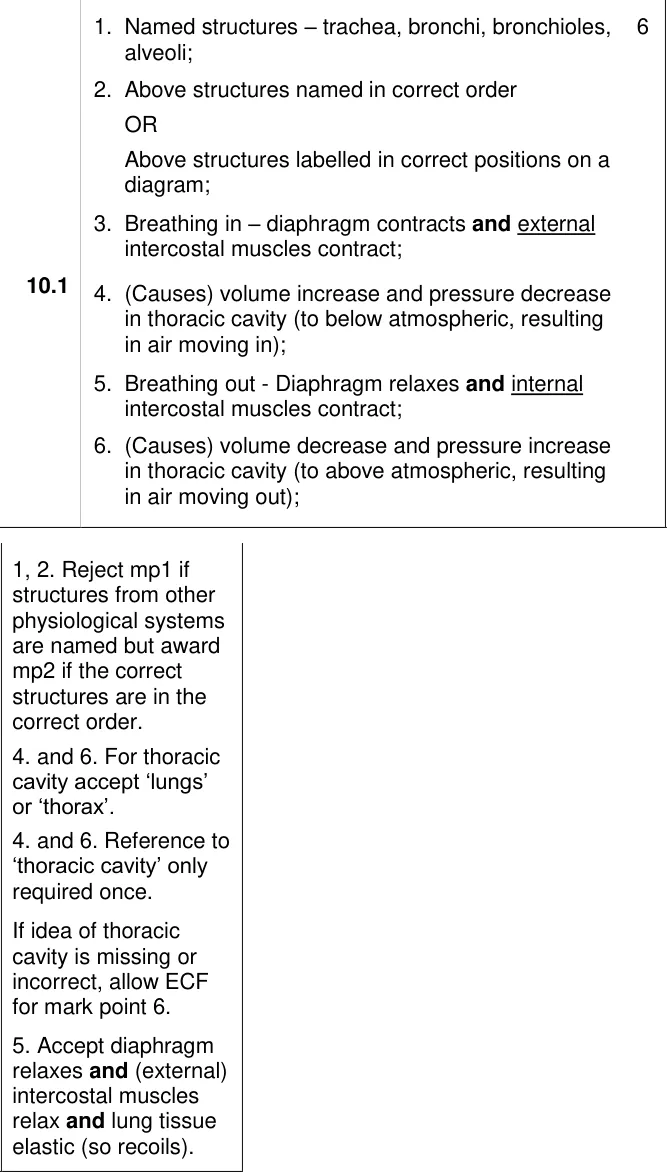
Describe the gross structure of the human gas exchange system and how we breathe in and out.
Show the mark scheme
Tap an image to open it full size.
From the examiners' report: 25.6% got 5 or 6. Many left out the structure altogether; a labelled sketch would do. Tracheoles are insects, not humans. Name the external intercostals for breathing in and the internal ones for forced breathing out.
Question 12
AS Paper 1 · June 2018 · Q09.1 · 2 marks · Hard
Describe the pathway an oxygen molecule takes from an alveolus to the blood.
Show the mark scheme

Tap an image to open it full size.
From the examiners' report: 70.3% scored zero, mostly by explaining how diffusion happens. A pathway means the layers the molecule crosses, in order.
Question 13
AS Paper 1 · June 2024 · Q01.3 · 2 marks
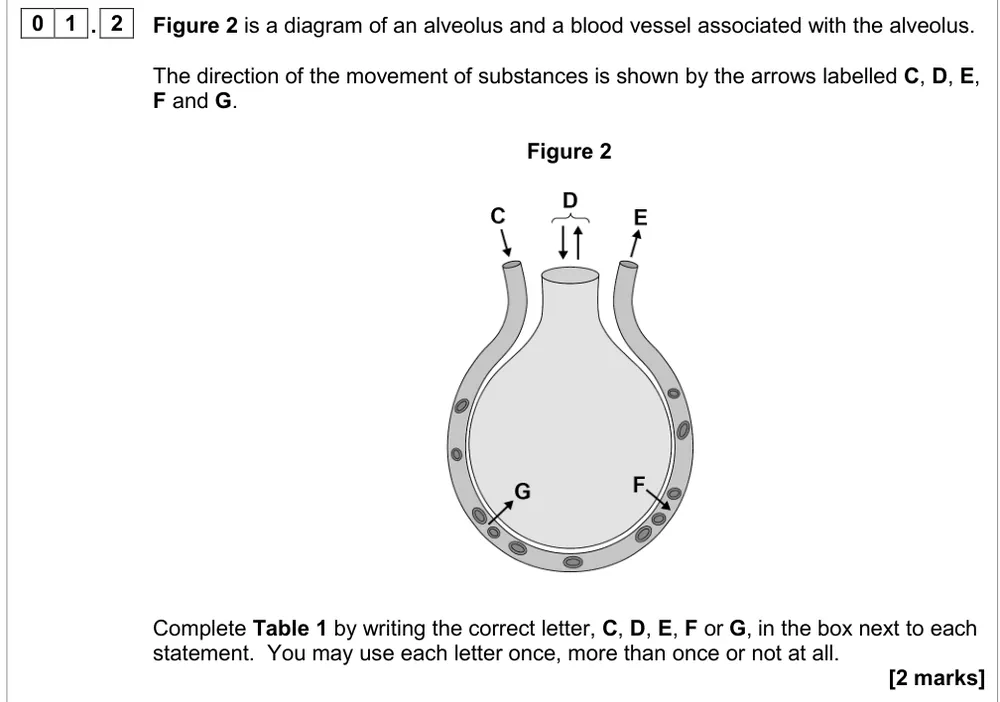
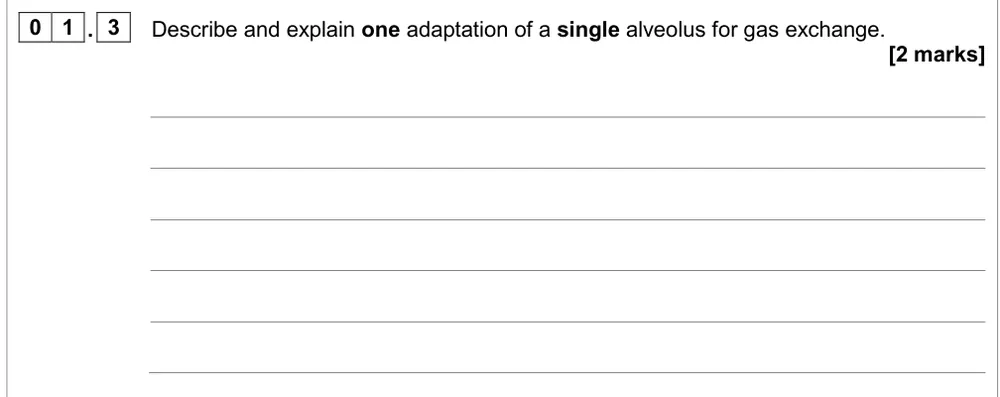
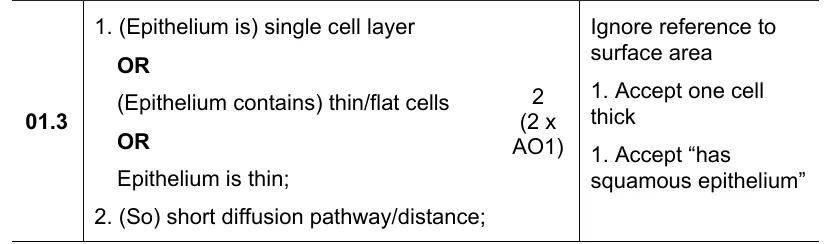
Describe and explain one adaptation of a single alveolus for gas exchange.
Information from earlier in this question:
Show the mark scheme
Tap an image to open it full size.
From the examiners' report: 'Alveoli have thin walls' was a common answer that didn't score: name the epithelium or its cells. The short diffusion pathway mark was easier.
Lung disease (3.3.2)
Question 14
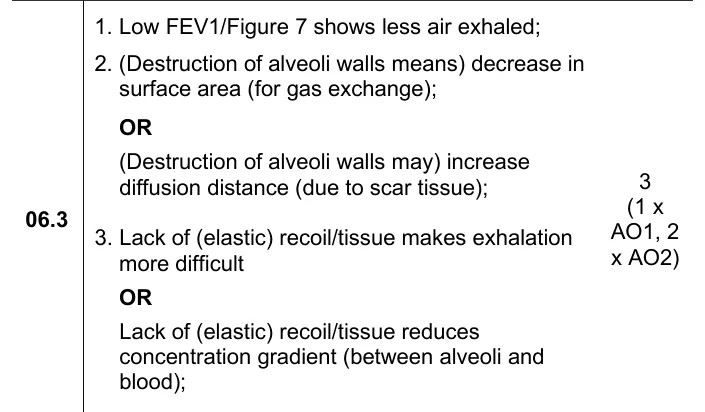
AS Paper 1 · June 2025 · Q06.3 · 3 marks · Medium
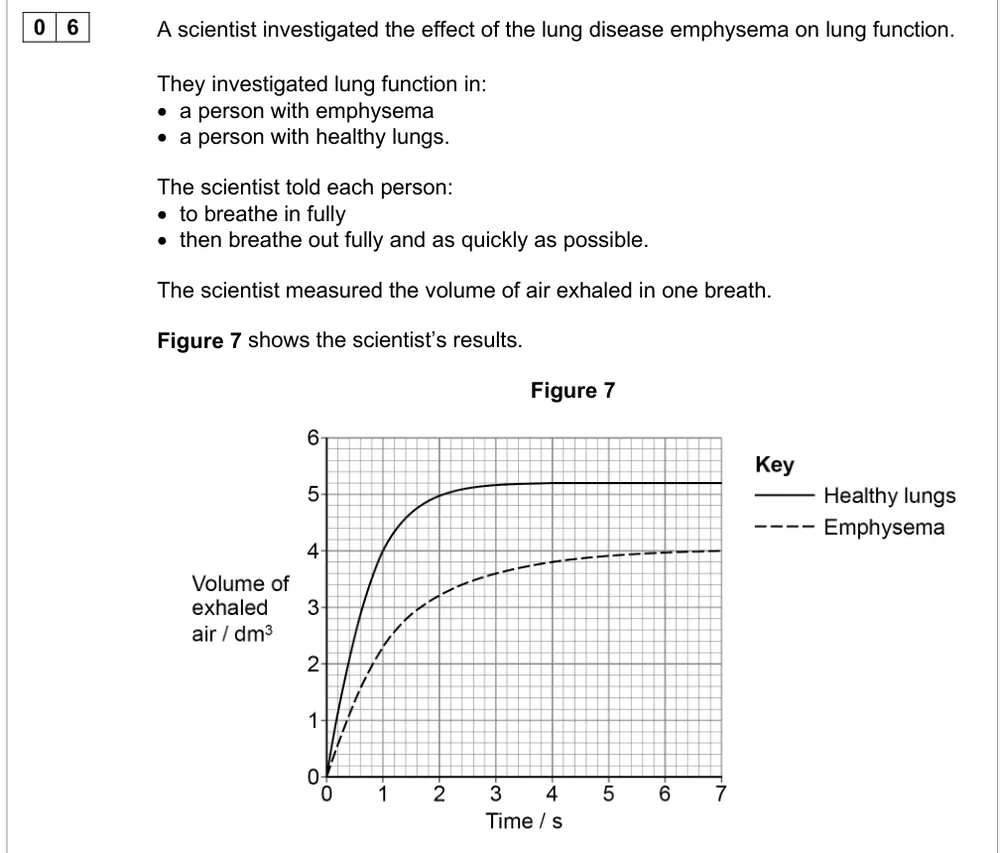
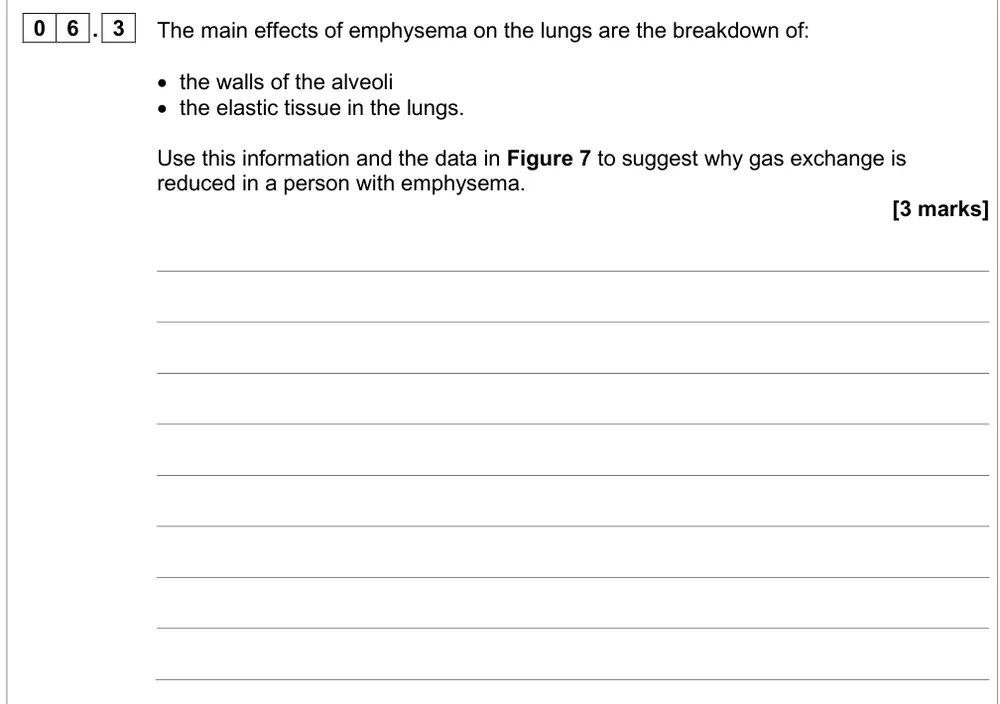
Use a graph of exhaled volume to suggest why gas exchange is reduced in emphysema.
Information from earlier in this question:
Show the mark scheme
Tap an image to open it full size.
From the examiners' report: Under 10% got all 3. Use the graph: less air is breathed out, so the concentration gradient falls. Explain what goes wrong in emphysema, not how a healthy alveolus works.
Question 15
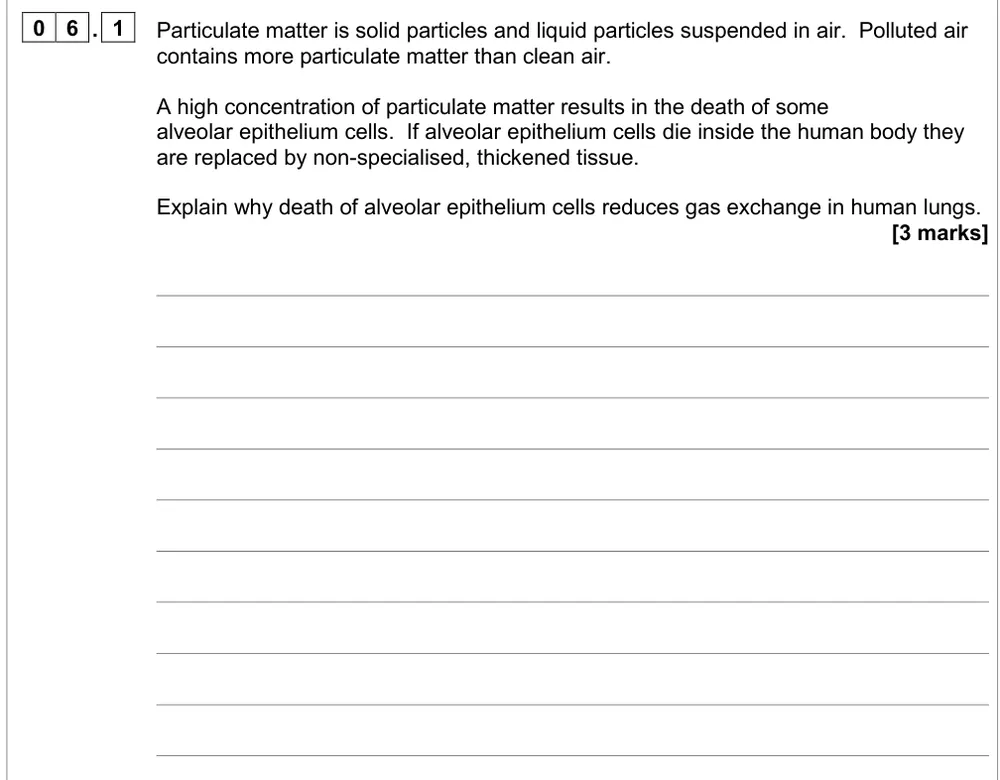
A level Paper 1 · November 2020 · Q06.1 · 3 marks · Hard
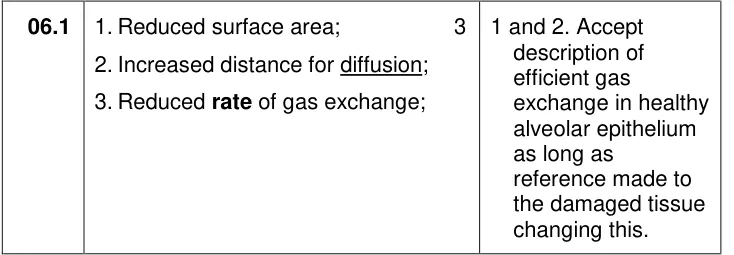
Explain why death of alveolar epithelium cells caused by air pollution reduces gas exchange.
Show the mark scheme
Tap an image to open it full size.
From the examiners' report: Students found it hard to explain a change. Say what the damage does (smaller surface area, longer diffusion distance) and finish with a slower rate of gas exchange.
Risk factors and data (3.3.2)
Question 16
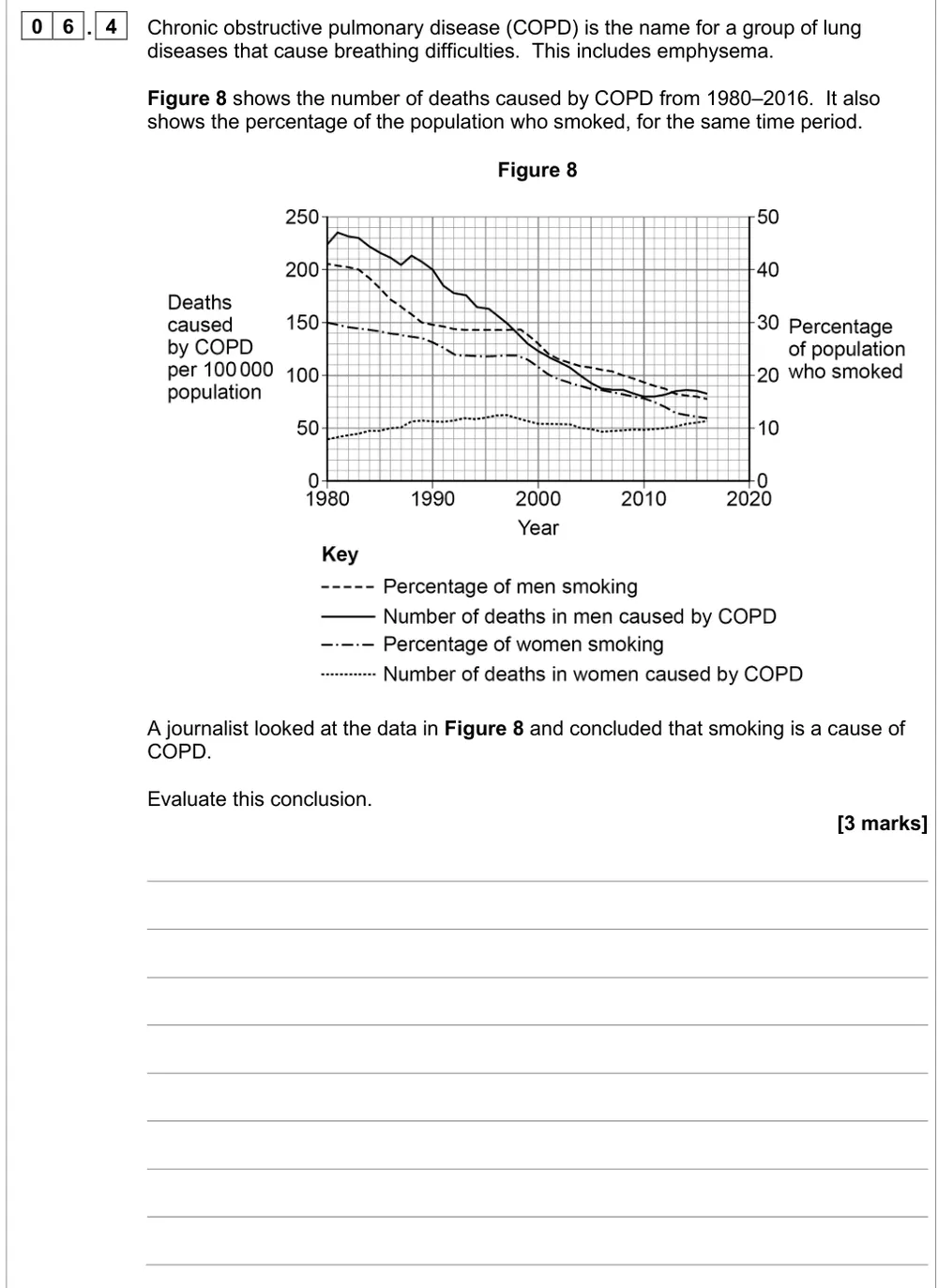
AS Paper 1 · June 2025 · Q06.4 · 3 marks · Medium
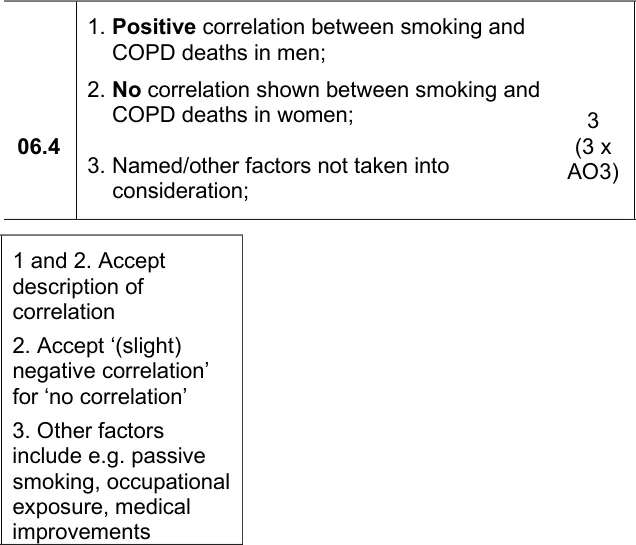
Evaluate a journalist's claim that smoking causes COPD, using graphs of smoking and deaths.
Show the mark scheme
Tap an image to open it full size.
From the examiners' report: About 12% got full marks and a quarter scored nothing. Deal with men and women separately: falling smoking with falling deaths in men is a positive correlation, not a negative one.
Question 17
AS Paper 1 · November 2020 · Q05.4 · 3 marks · Hard
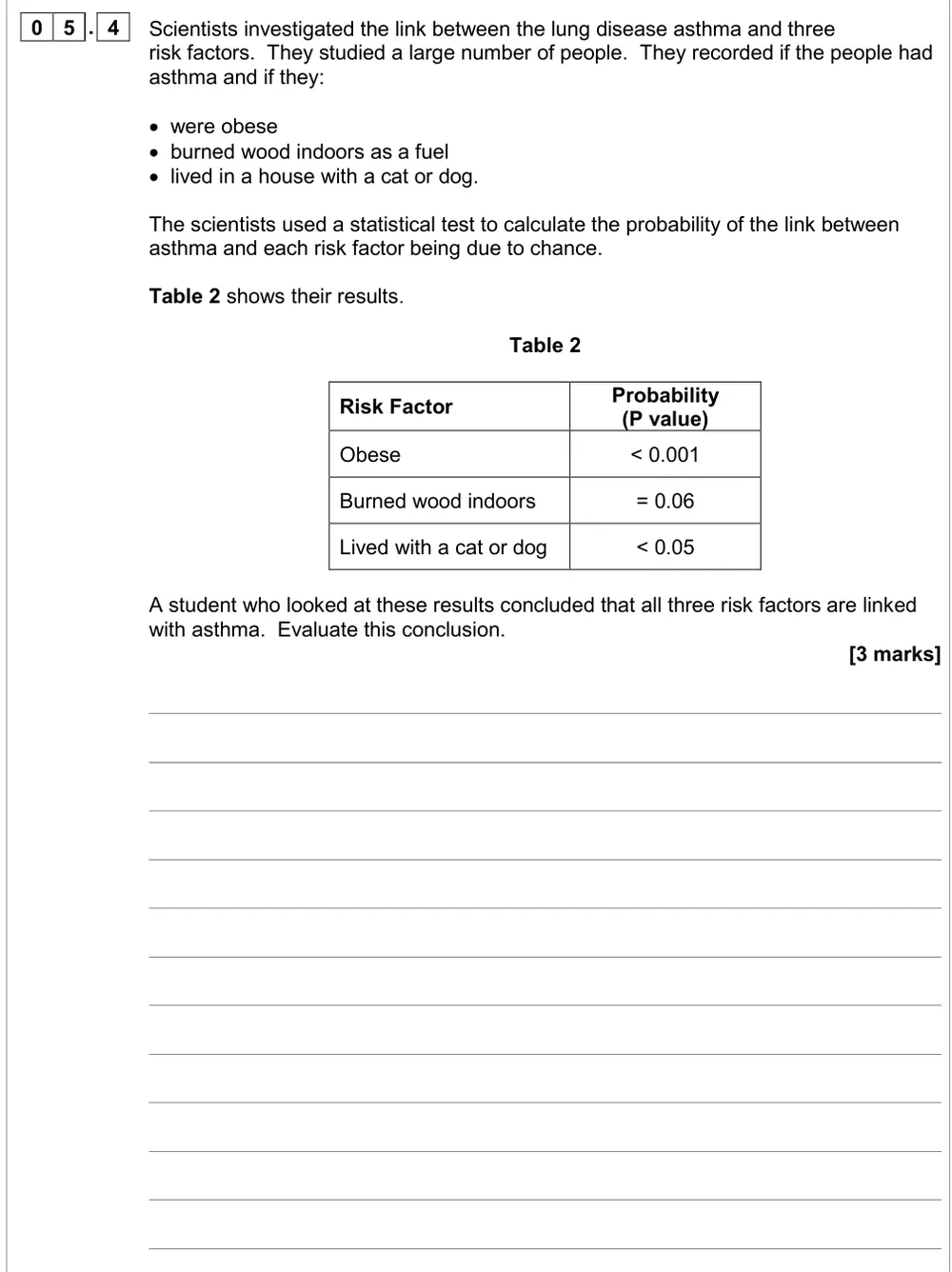
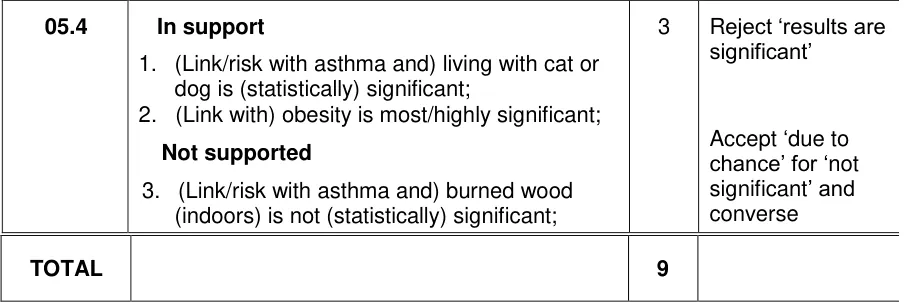
Use P values to evaluate a conclusion that three risk factors are linked with asthma.
Show the mark scheme
Tap an image to open it full size.
From the examiners' report: This scored very poorly. P = 0.06 is above 0.05, so burning wood is not a significant risk factor. Say the link is significant, not 'the results'.
Question 18
AS Paper 1 · June 2018 · Q09.3 · 4 marks · Medium
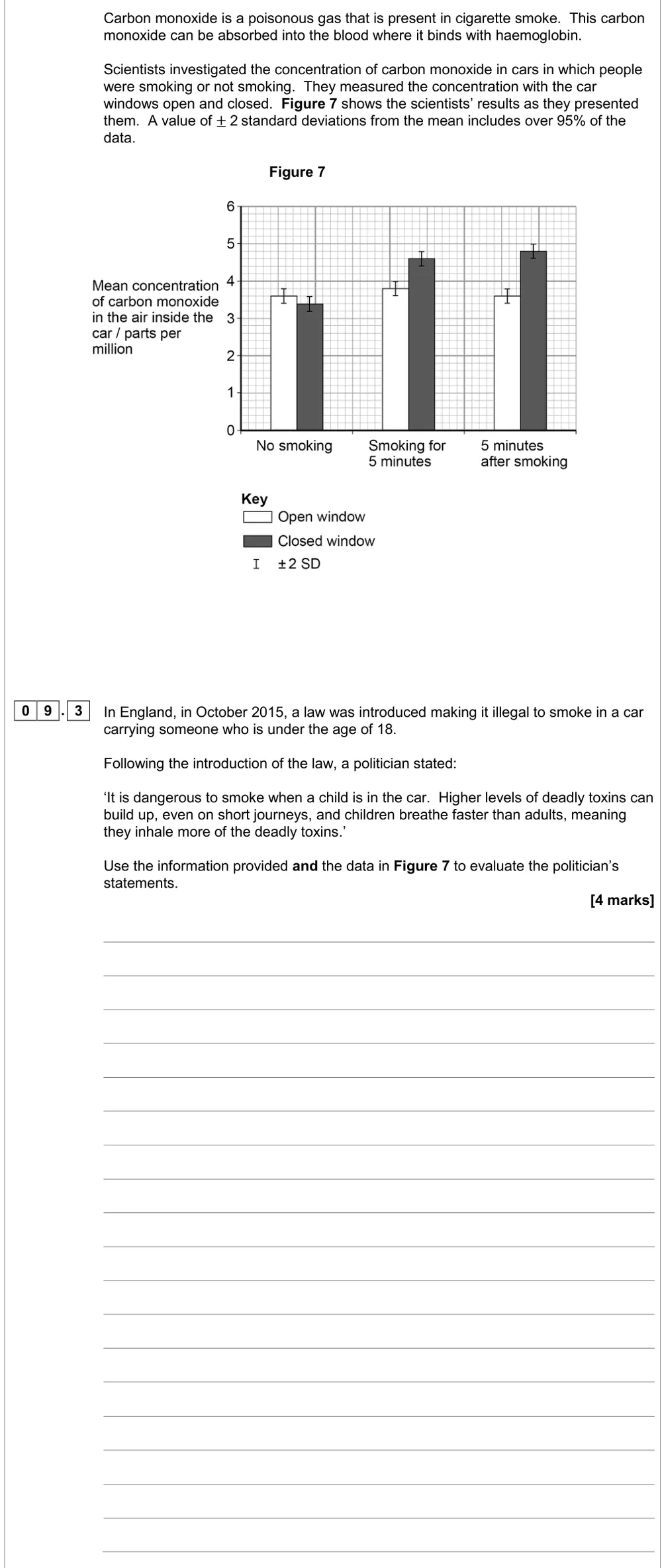
Use carbon monoxide data with standard deviations to evaluate a politician's case for banning smoking in cars.
Show the mark scheme
Tap an image to open it full size.
From the examiners' report: Only 1.2% got all four. Use the SD bars: no overlap means the difference is significant. Avoid rote answers such as 'no repeats' or 'correlation isn't causation'; means and SDs show the work was repeated.
Where students lose marks (from AQA examiners' reports and mark schemes)
Each point below is followed by wording that gained marks.
Pathway, not mechanism: 70.3% scored zero for the pathway of an oxygen molecule from an alveolus to the blood. Many didn't understand what a pathway is and explained diffusion instead.
✔ Gains credit: "Across the alveolar epithelium, then across the endothelium of the capillary" (in that order).
Thin cells, not a 'thin membrane': Only 23.3% got both marks for one feature of an alveolus. 'Thin membrane', 'one-cell-thick membrane' and 'alveoli have thin walls' were rejected: it is the epithelial cells that are thin.
✔ Gains credit: "The alveolar epithelium is one cell thick / has flattened cells, so there is a short diffusion pathway."
Link each muscle to its movement: Only about a third got both marks for the roles of the intercostal muscles and diaphragm. Students said the diaphragm contracts without saying it flattens, said intercostal muscles 'expand', or didn't name the external intercostals.
✔ Gains credit: "External intercostal muscles contract, pulling the ribcage up and out; the diaphragm contracts and flattens."
Thoracic cavity, not 'chest': Examiners saw many answers lose a mark by writing 'chest' or 'chest cavity', or by giving the volume and pressure change without the muscle action that causes it.
✔ Gains credit: "Volume increases and pressure decreases in the thoracic cavity (below atmospheric pressure), so air moves in."
Hairs trap water vapour: 75% scored zero for two xerophytic leaf features. Students wrote that hairs trap 'water', left out the water potential gradient, or said small leaves reduce surface area to volume ratio.
✔ Gains credit: "Hairs trap water vapour, so the water potential gradient is reduced"; "rolled leaves trap water vapour"; "spines / needles reduce surface area".
Slower diffusion, not 'less': On gill damage and dead alveolar cells, answers that said 'less' diffusion or 'less' gas exchange didn't score. At A-level you must talk about the rate.
✔ Gains credit: "Longer diffusion pathway, so a slower rate of diffusion / slower gas exchange."
P above 0.05 is not significant: The asthma risk factor question scored very poorly. Many thought burning wood (P = 0.06) was a significant risk, and wrote that 'the results are significant'.
✔ Gains credit: "The link between burning wood indoors and asthma is not significant; the link with obesity is highly significant (P < 0.001)."
Download the questions
Download the PDF pack (18 questions, mark schemes at the end)
Keep practising
- Eukaryotic cell structure: AQA A Level Biology exam questions by topic
- Graph skills (MS 3): AQA A Level Biology exam questions
- Arithmetic and numerical skills (MS 0): AQA A Level Biology exam questions
- Calculations and mathematical content in A level Biology, from AQA papers
- AQA A Level Biology masterclasses
Questions, mark schemes and examiners' report extracts © AQA.