

DNA, genes and chromosomes (AQA 3.4.1) opens the genetic information section of the Year 12 course, and the ideas come back in protein synthesis, mutation and gene expression questions at A-level. You need to know how DNA is arranged in prokaryotes, in the nucleus of eukaryotic cells and in mitochondria and chloroplasts, what a gene and a locus are, how triplets code for amino acids, what universal, non-overlapping and degenerate mean, and how exons, introns and non-coding repeats fit into nuclear DNA.
The examiners' reports show the same errors year after year. Students say prokaryotic DNA is single-stranded or exists only as plasmids, describe the whole cell instead of the DNA, say an exon codes for a protein rather than a base sequence coding for an amino acid sequence, write that DNA is degenerate or universal, and say codons 'produce' amino acids.
Start with how DNA is packaged in different cells, then genes, loci and the genetic code, then exons and introns, and finish with a short calculation. Answer each question on paper before you open the mark scheme. If you'd like help with this topic, my AQA masterclasses run online on Tuesdays at 5.15pm for Year 12 and on Wednesdays or Thursdays at 6.30pm for Year 13.
What you need from GCSE and Year 12
Each question on this page assumes you're secure on these GCSE and Year 12 ideas. If any of them feels shaky, revise it before you start.
- GCSE: DNA is a polymer of two strands twisted into a double helix, and in animal and plant cells it is found in chromosomes in the nucleus.
- GCSE: a gene is a small section of DNA that codes for a particular sequence of amino acids, to make a specific protein.
- GCSE: bacteria have no nucleus; their genetic material is a single loop of DNA, with extra small rings called plasmids.
- Year 12 (AQA 3.1.5.1): a DNA nucleotide has deoxyribose, a phosphate group and one of the bases adenine, thymine, cytosine or guanine, and the two strands are joined by complementary base pairs.
- Year 12 (AQA 3.1.4.1): the primary structure of a polypeptide is its sequence of amino acids, and it determines the tertiary structure.
Key terms
These words come up in the questions and mark schemes. Examiners expect you to use them exactly.
- Chromosome: a DNA molecule together with its associated proteins (histones) in the nucleus of a eukaryotic cell.
- Histones: the proteins that DNA is associated with in eukaryotic chromosomes; prokaryotic, mitochondrial and chloroplast DNA isn't associated with them.
- Gene: a base sequence of DNA that codes for the amino acid sequence of a polypeptide or for a functional RNA (rRNA or tRNA).
- Locus: the fixed position a gene occupies on a particular DNA molecule (plural loci).
- Triplet: a sequence of three DNA bases that codes for a specific amino acid; the matching three bases on mRNA are a codon.
- Universal: the same triplet or codon codes for the same amino acid in all organisms.
- Non-overlapping: each base is part of only one triplet, so each triplet is read separately.
- Degenerate: more than one triplet or codon codes for the same amino acid.
- Exon: a base sequence within a gene that codes for an amino acid sequence.
- Intron: a non-coding base sequence within a gene that separates the exons.
- Non-coding multiple repeats: base sequences repeated many times between genes in eukaryotic nuclear DNA that don't code for polypeptides.
What these questions cover (AQA 3.4.1)
The questions test these statements from the AQA AS and A-level Biology specification (7401/7402):
- DNA in prokaryotes: In prokaryotic cells, DNA molecules are short, circular and not associated with proteins.
- DNA in eukaryotes: In the nucleus of eukaryotic cells, DNA molecules are very long, linear and associated with proteins, called histones. Together a DNA molecule and its associated proteins form a chromosome.
- DNA in mitochondria and chloroplasts: The mitochondria and chloroplasts of eukaryotic cells also contain DNA which, like the DNA of prokaryotes, is short, circular and not associated with protein.
- A gene is a base sequence of DNA that codes for: the amino acid sequence of a polypeptide
- A gene is a base sequence of DNA that codes for: a functional RNA (including ribosomal RNA and tRNAs). (none of the written questions available tests functional RNA (rRNA and tRNA) on its own)
- Loci: A gene occupies a fixed position, called a locus, on a particular DNA molecule.
- The genetic code: A sequence of three DNA bases, called a triplet, codes for a specific amino acid. The genetic code is universal, non-overlapping and degenerate. (the last question also asks you to count the bases in a gene)
- Non-coding DNA: In eukaryotes, much of the nuclear DNA does not code for polypeptides. There are, for example, non-coding multiple repeats of base sequences between genes. Even within a gene only some sequences, called exons, code for amino acid sequences. Within the gene, these exons are separated by one or more non-coding sequences, called introns.
How to use this page
Write your answer on paper before you open the mark scheme. Allow about 1.3 minutes per mark: the 15 questions are worth 31 marks, so about 40 minutes in total. Then mark your answer strictly against the mark scheme and read the examiners' tip underneath it. If you'd rather print the questions, download the PDF pack.
DNA in prokaryotes, eukaryotes and organelles (3.4.1)
Question 1
AS Paper 2 · November 2020 · Q02.3 · 1 mark · Easy
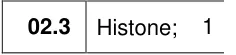
Name the protein associated with DNA in a chromosome.

Show the mark scheme
Tap an image to open it full size.
From the examiners' report: Over 80% got it. The answer is histones; centromere, DNA polymerase and ligase were the common wrong answers.
Question 2
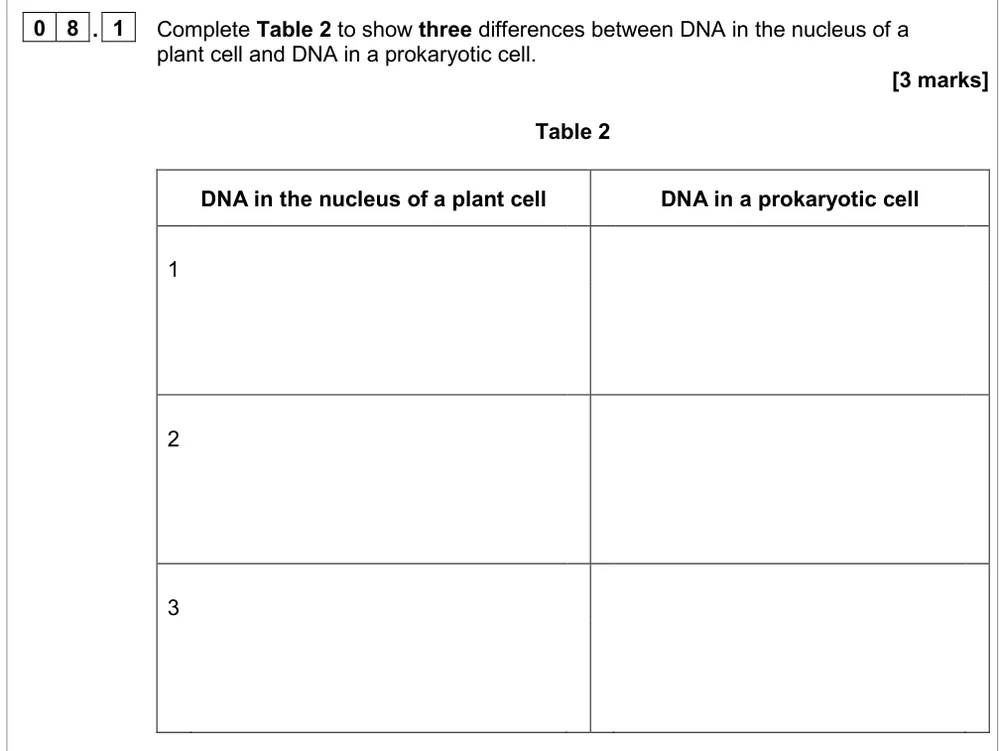
A level Paper 1 · November 2020 · Q08.1 · 3 marks · Medium
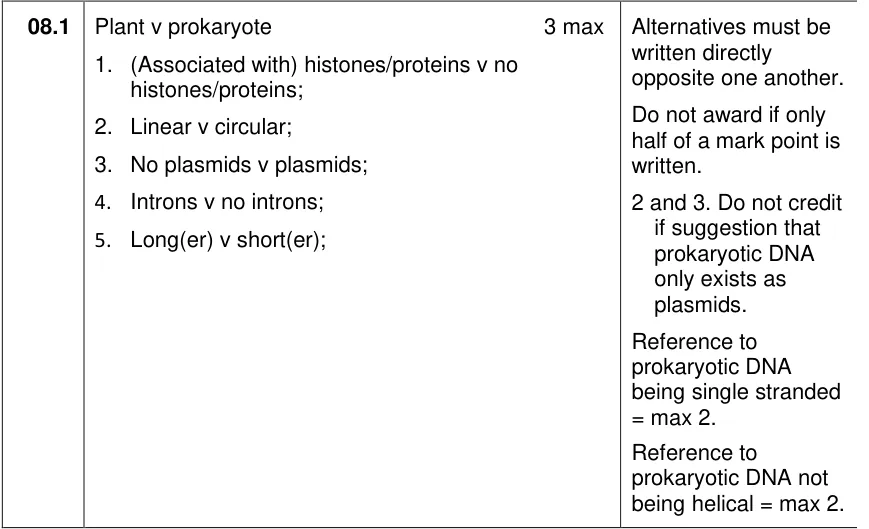
Complete a table of three differences between DNA in a plant cell nucleus and in a prokaryotic cell.
Show the mark scheme
Tap an image to open it full size.
From the examiners' report: Only 26% got all 3. Compare the DNA, not the nucleus or the cell, and write each pair directly opposite. Prokaryotic DNA is double-stranded and helical, and isn't only plasmids.
Question 3
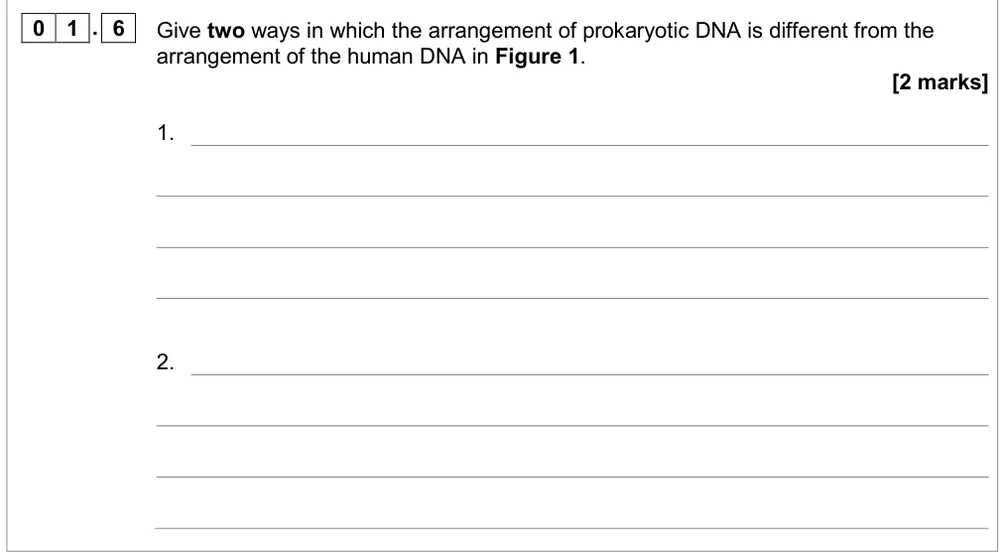
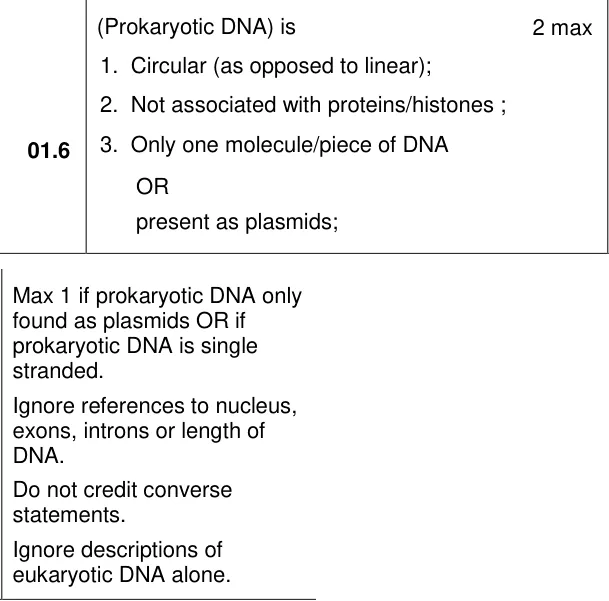
A level Paper 1 · June 2018 · Q01.6 · 2 marks
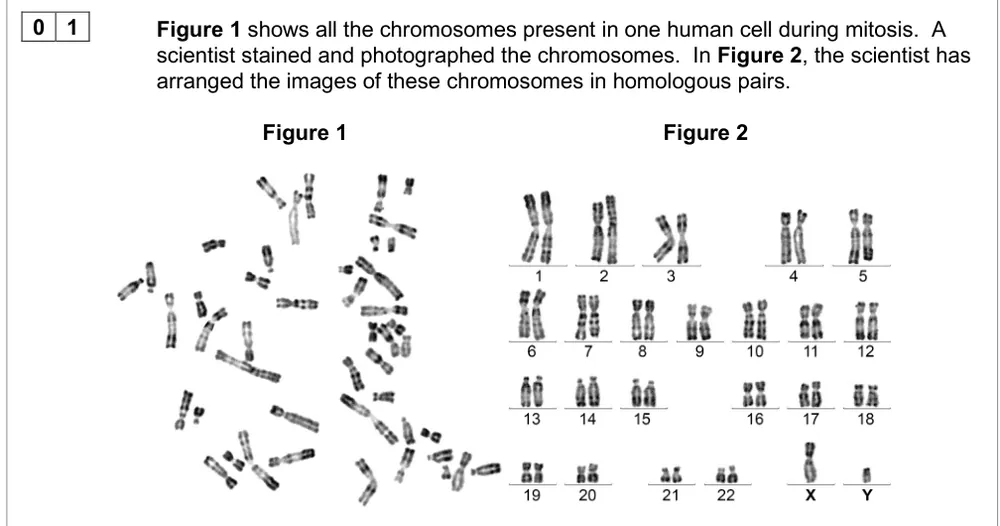
Give two ways the arrangement of prokaryotic DNA differs from human DNA in a photo of chromosomes.
Information from earlier in this question:
Show the mark scheme
Tap an image to open it full size.
From the examiners' report: Most scored at least 1 mark, but many good answers were capped at 1 by saying prokaryotic DNA is single-stranded or that only eukaryotic DNA is a double helix.
Question 4
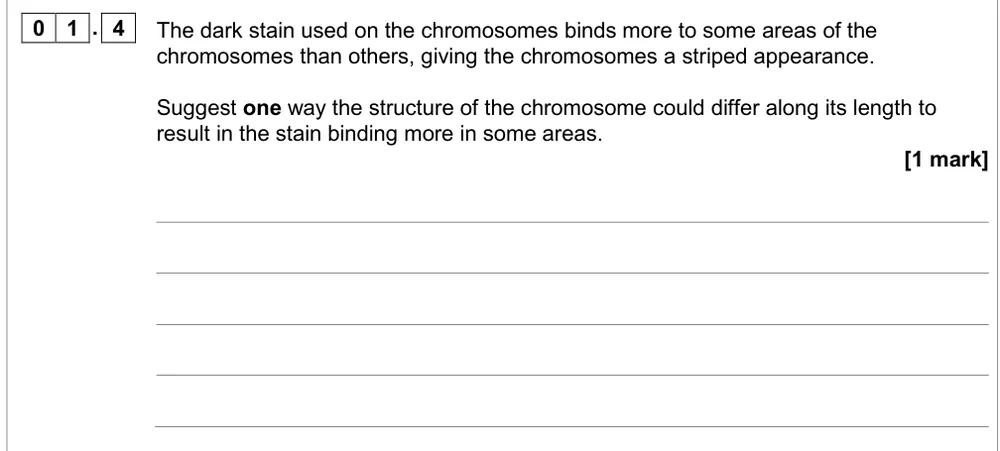
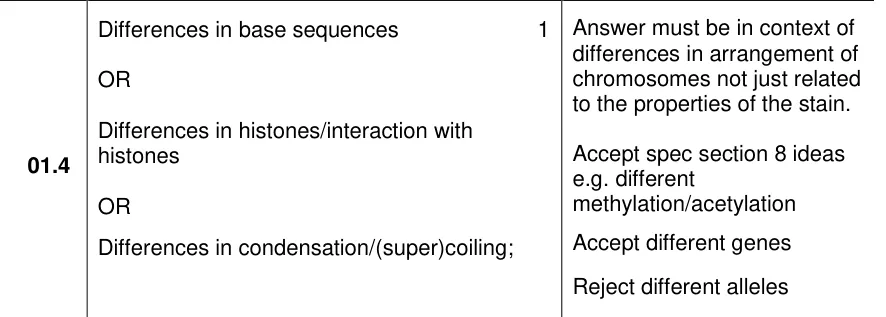
A level Paper 1 · June 2018 · Q01.4 · 1 mark · Medium
Suggest how chromosome structure could vary along its length to give a striped stain.
Show the mark scheme
Tap an image to open it full size.
From the examiners' report: 42.2% scored. 'Histones' or 'bases' on their own don't score: say what differs along the length, such as the base sequence or how tightly the DNA is coiled.
Question 5
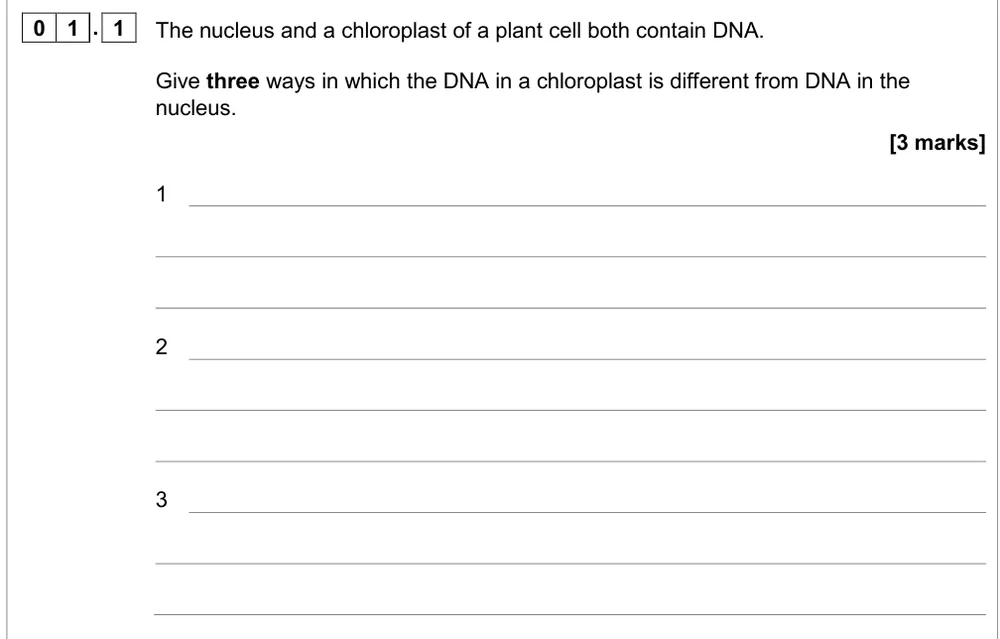
AS Paper 1 · June 2019 · Q01.1 · 3 marks
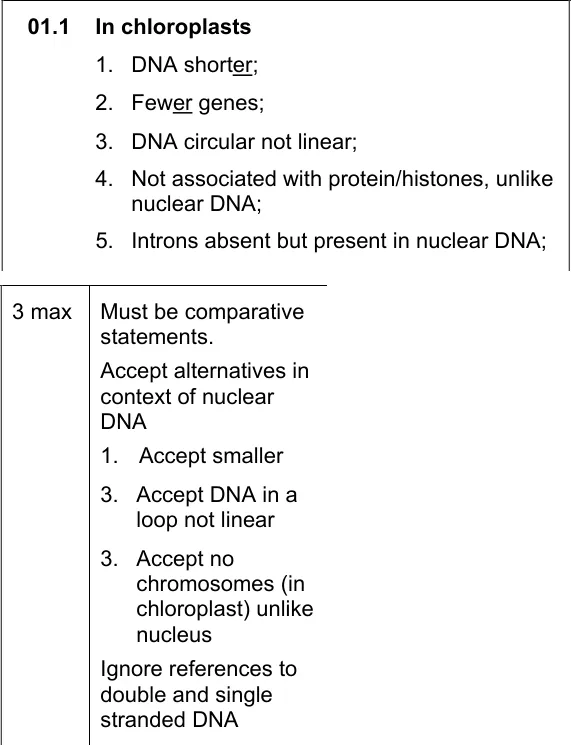
Give three ways DNA in a chloroplast differs from DNA in the nucleus.
Show the mark scheme
Tap an image to open it full size.
From the examiners' report: No examiners' report for this paper. The mark scheme wants comparisons: shorter, circular rather than linear, no histones, no introns. Single- or double-stranded is ignored.
Question 6
A level Paper 1 · November 2021 · Q05.2 · 2 marks · Hard
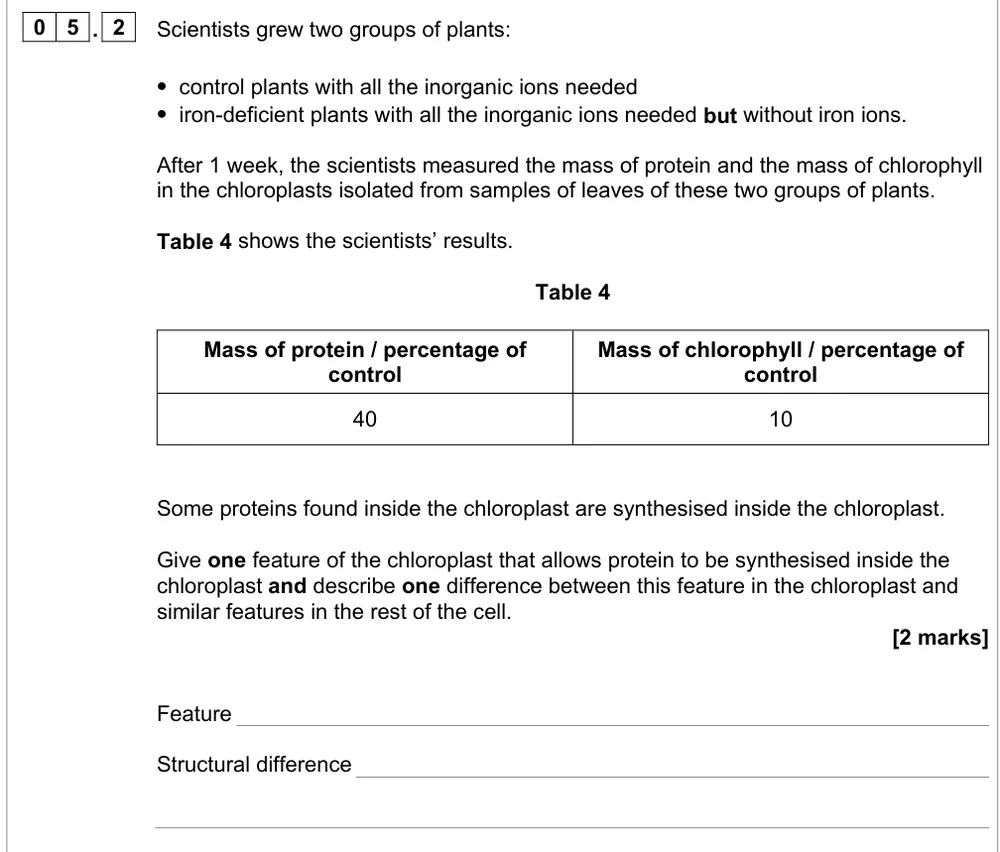
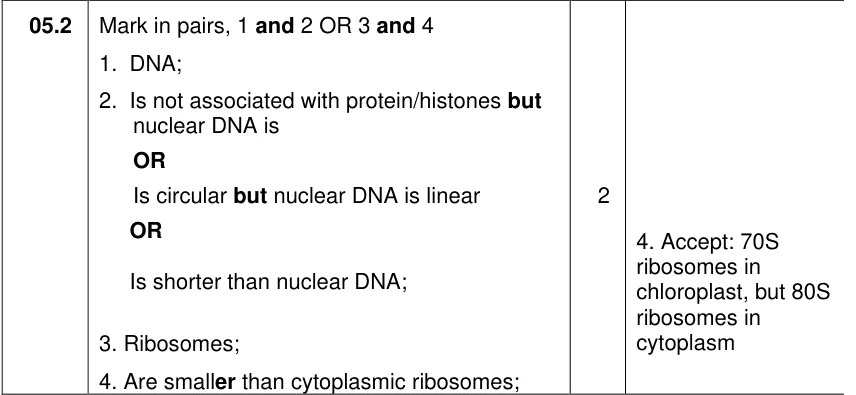
Give a feature that lets a chloroplast make its own proteins and how it differs from the rest of the cell.
Show the mark scheme
Tap an image to open it full size.
From the examiners' report: Very few scored: knowledge of chloroplast structure was patchy. Name DNA or ribosomes, then compare: circular DNA without histones, or smaller 70S ribosomes.
Question 7
A level Paper 3 · June 2018 · Q03.4 · 2 marks · Hard
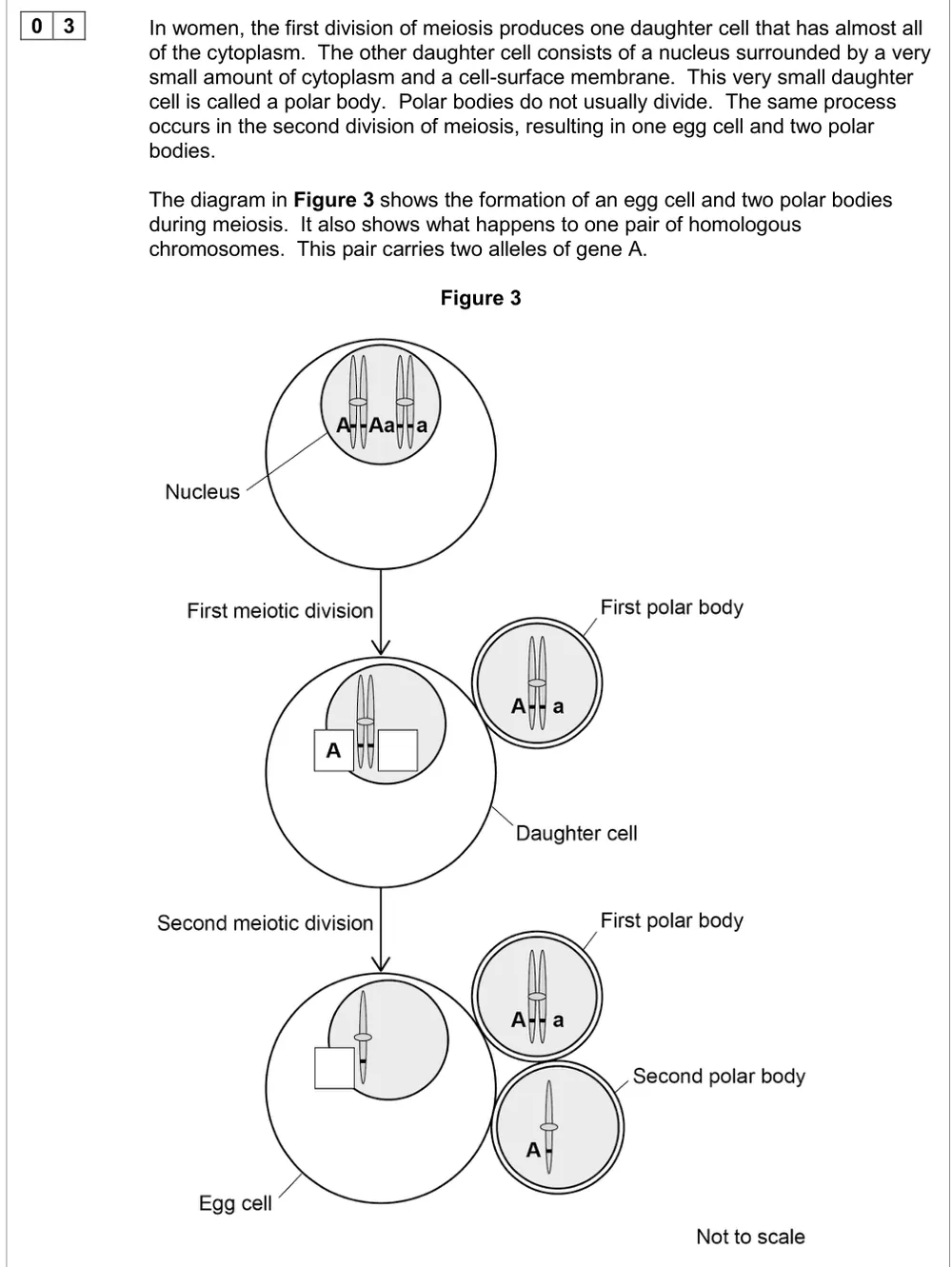
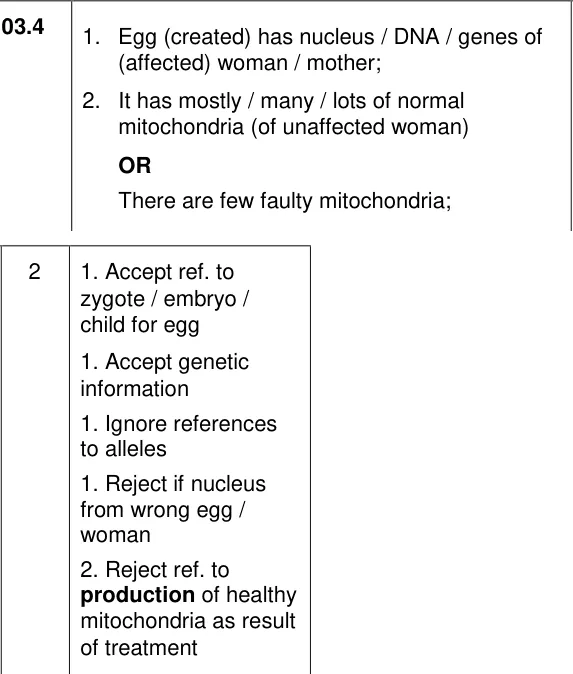
Suggest how a nucleus transfer into a donor egg prevents inheritance of mitochondrial disease.
Information from earlier in this question:
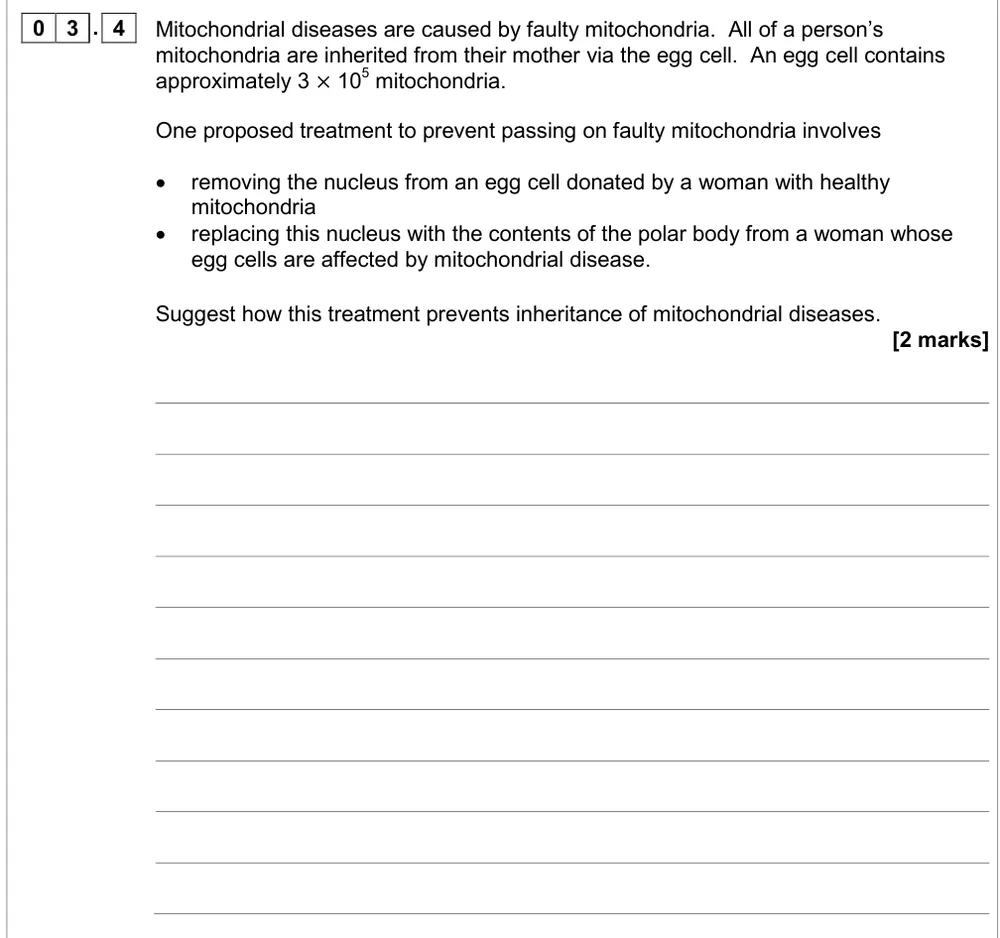
Show the mark scheme
Tap an image to open it full size.
From the examiners' report: Only 3% got both marks. Read the stem: the nucleus comes from the affected woman and the mitochondria mostly from the donor. Mitochondria have their own DNA; they aren't in the nucleus.
Genes and the genetic code (3.4.1)
Question 8
AS Paper 1 · November 2021 · Q04.4 · 3 marks
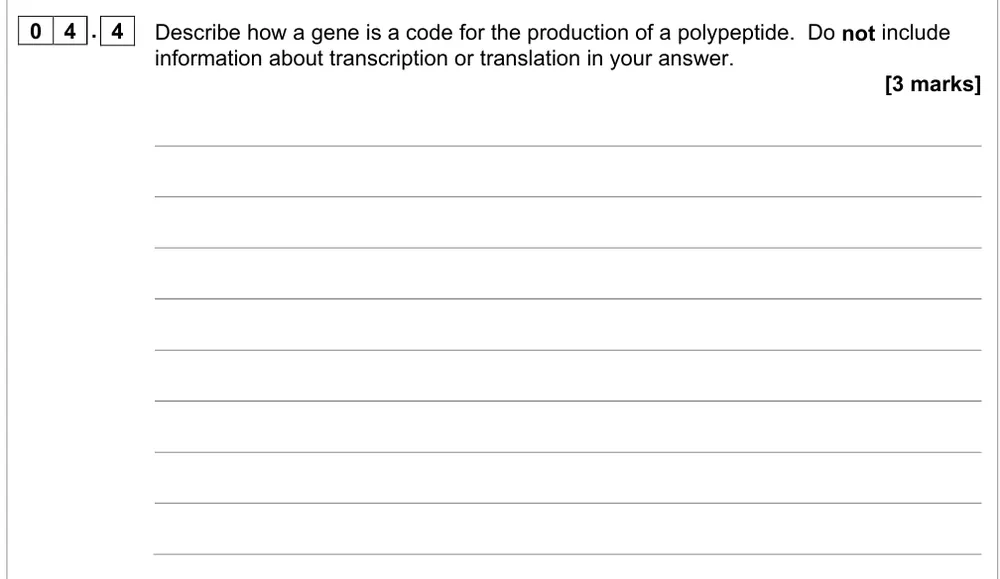
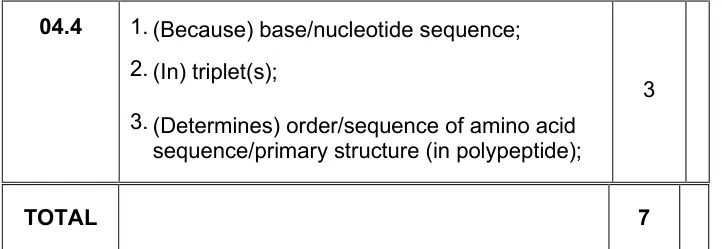
Describe how a gene codes for a polypeptide, without describing transcription or translation.
Show the mark scheme
Tap an image to open it full size.
From the examiners' report: No examiners' report for this paper. The mark scheme wants three linked ideas: base sequence, read in triplets, determines the sequence of amino acids.
Question 9
AS Paper 1 · November 2021 · Q04.3 · 1 mark
Name the fixed position occupied by a gene on a DNA molecule.

Show the mark scheme

Tap an image to open it full size.
From the examiners' report: No examiners' report for this paper. The answer is locus (plural loci). It is a fixed position on a particular DNA molecule, so learn the term and spell it carefully.
Question 10
AS Paper 1 · June 2023 · Q01.2 · 3 marks
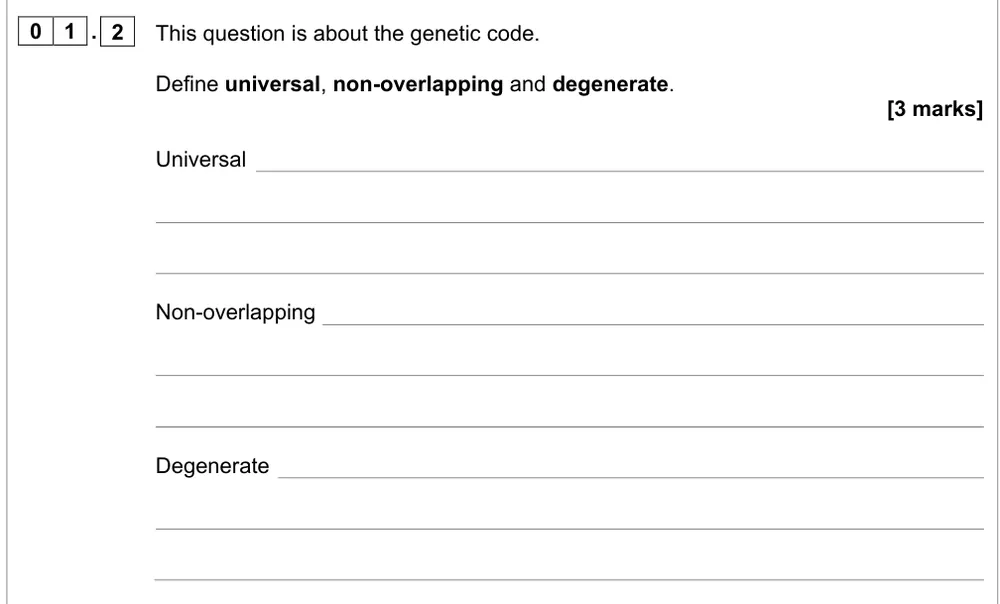
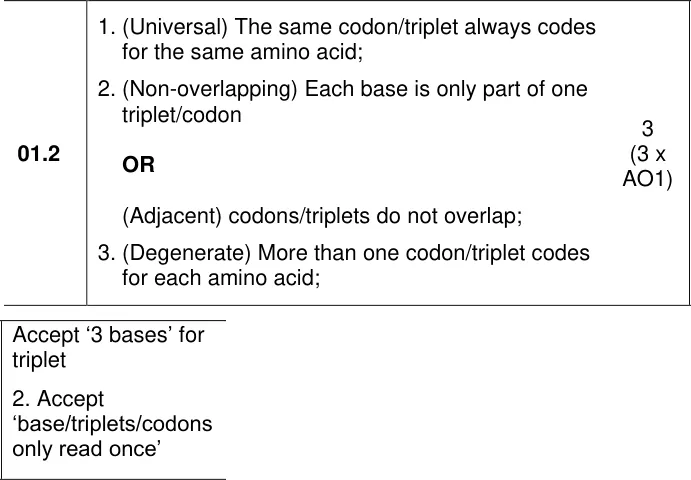
Define universal, non-overlapping and degenerate for the genetic code.
Show the mark scheme
Tap an image to open it full size.
From the examiners' report: Weaker answers wrote about bases rather than codons or triplets. For universal, 'the code is the same in all organisms' isn't enough: say the same codon codes for the same amino acid.
Question 11
A level Paper 1 · June 2018 · Q05.2 · 2 marks · Easy
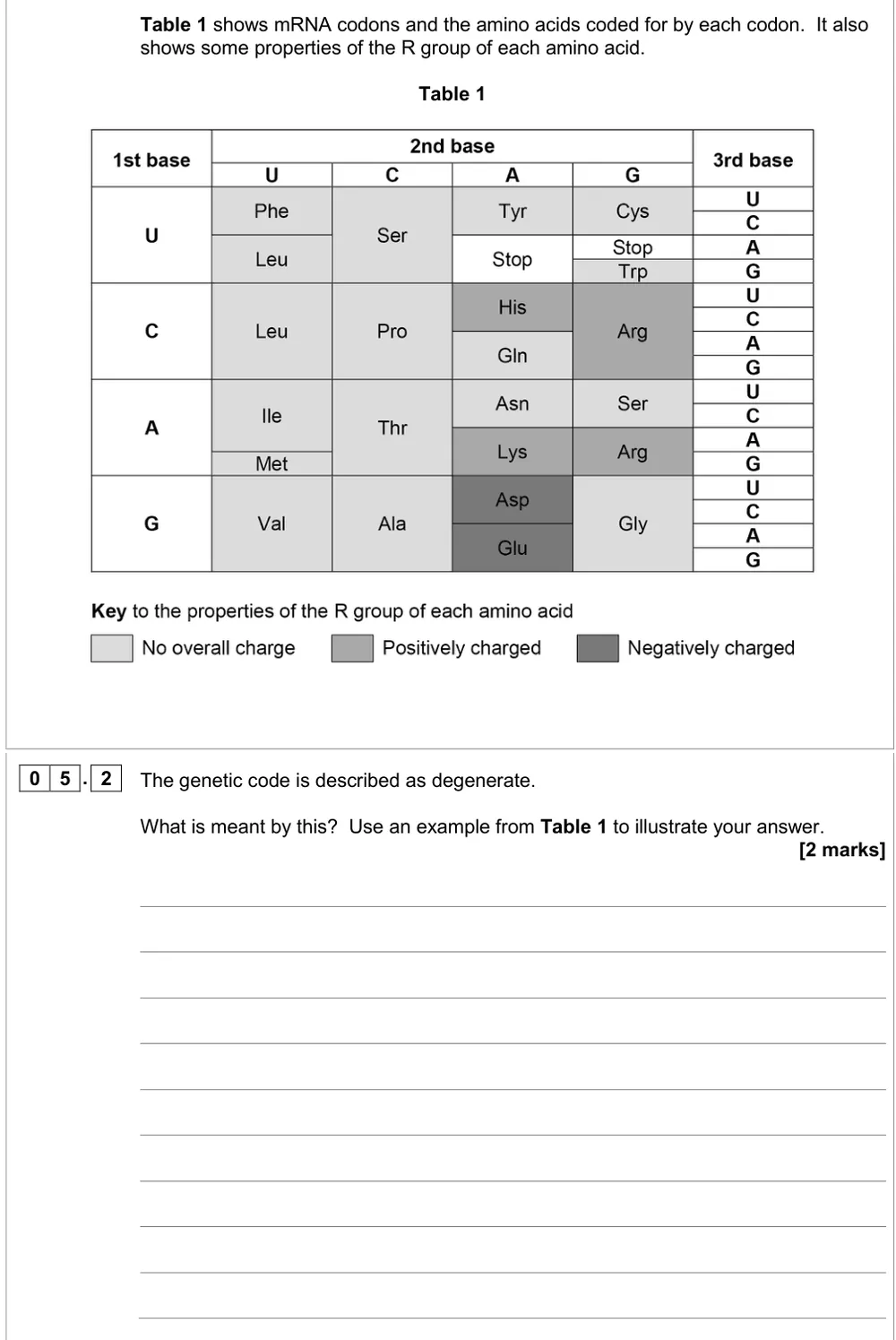
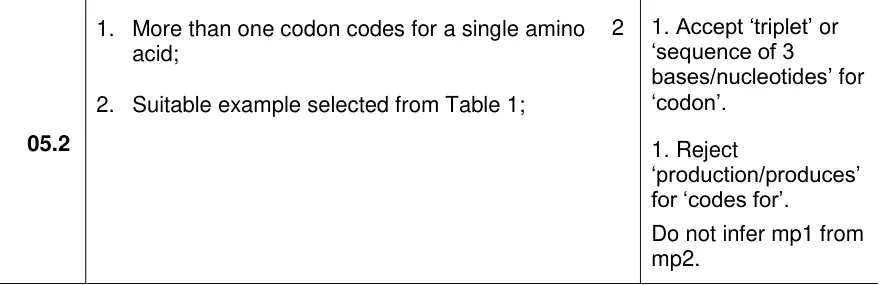
Explain what degenerate means, using an example from a table of mRNA codons.
Show the mark scheme
Tap an image to open it full size.
From the examiners' report: 67.5% got both marks. Write about codons or triplets, not bases, and say they 'code for' an amino acid, not 'produce' it. Then give an example, such as the four codons for proline.
Question 12
A level Paper 3 · June 2022 · Q04.2 · 2 marks · Hard
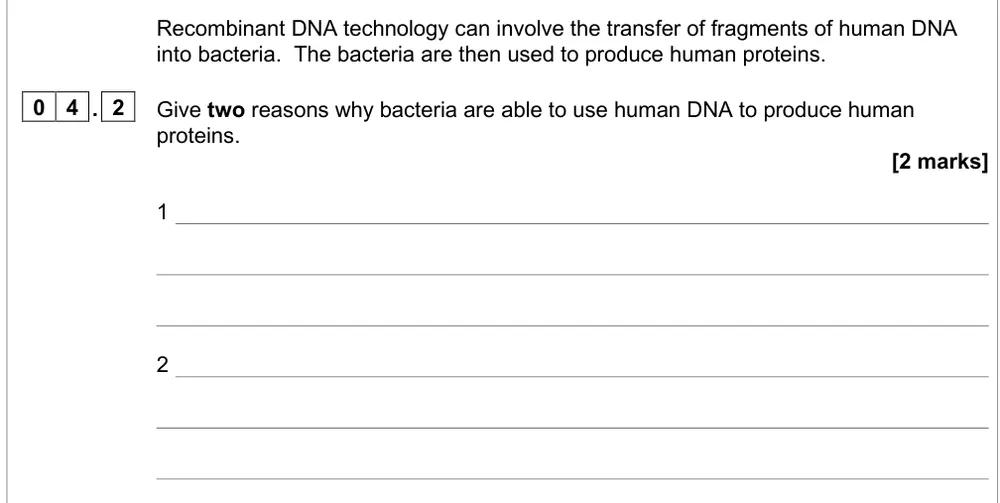
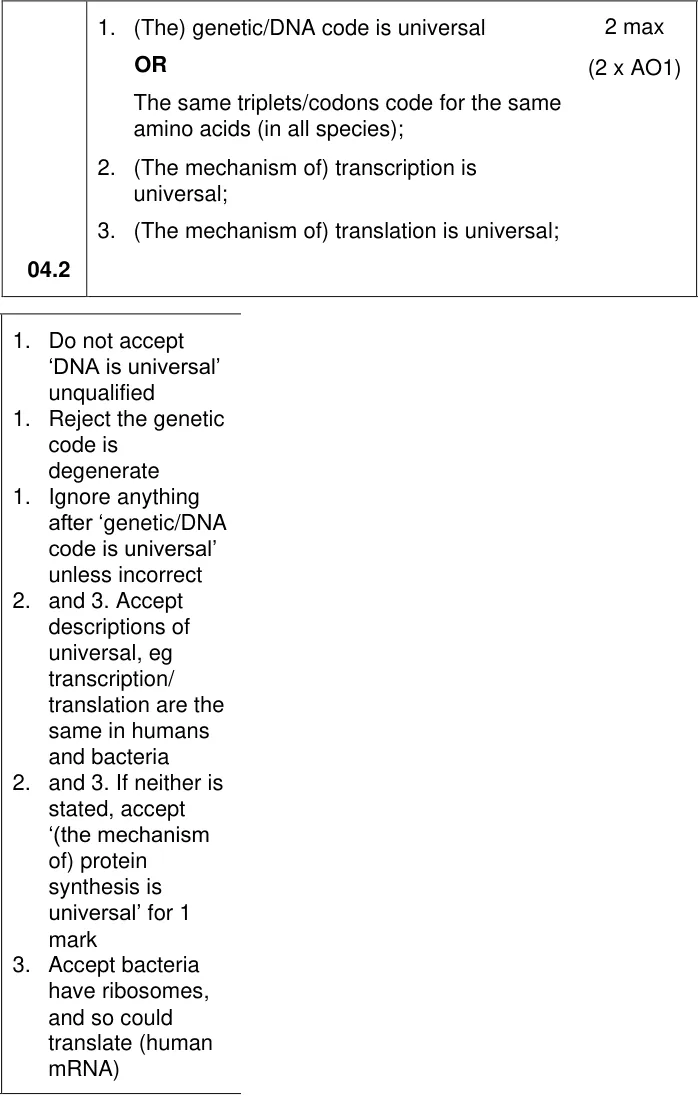
Give two reasons why bacteria can use human DNA to make human proteins.
Show the mark scheme
Tap an image to open it full size.
From the examiners' report: Only 13.5% got both marks and 55% scored zero. Sticky ends and plasmids weren't asked for. Say the genetic code is universal, not 'DNA is universal', and don't link it to degenerate.
Exons, introns and mutations (3.4.1)
Question 13
AS Paper 1 · November 2020 · Q06.2 · 1 mark
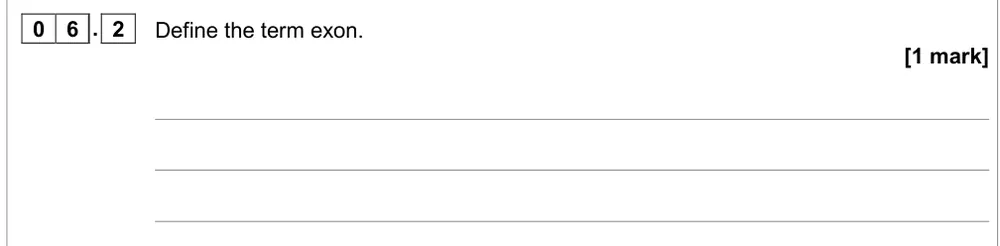
Define the term exon.
Show the mark scheme

Tap an image to open it full size.
From the examiners' report: Many oversimplified this as 'codes for a protein'. Give both halves: a base sequence that codes for an amino acid sequence.
Question 14
AS Paper 1 · June 2024 · Q09.3 · 4 marks · Easy
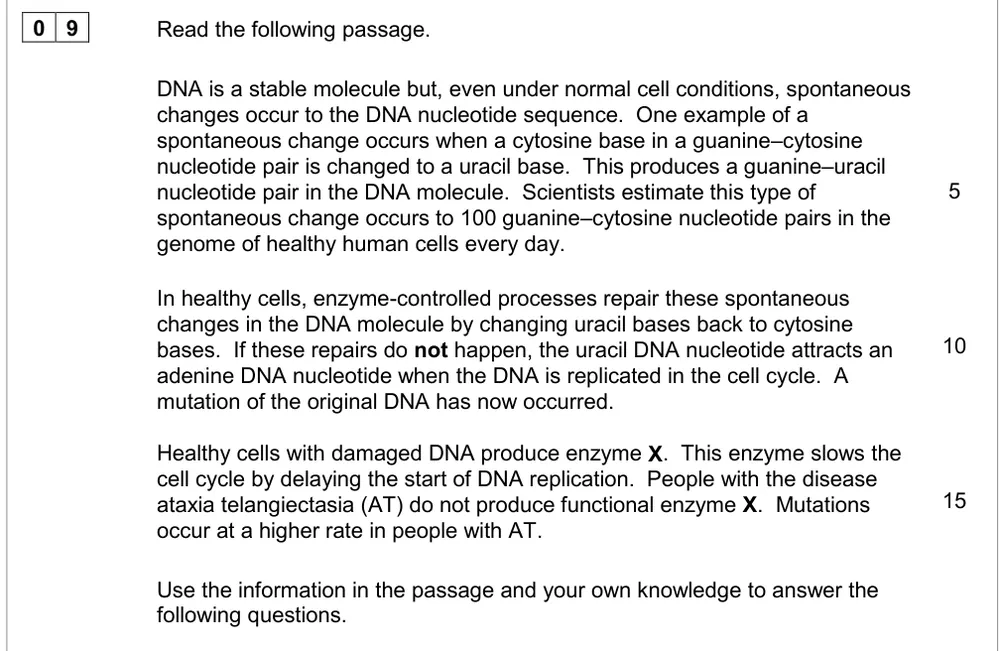
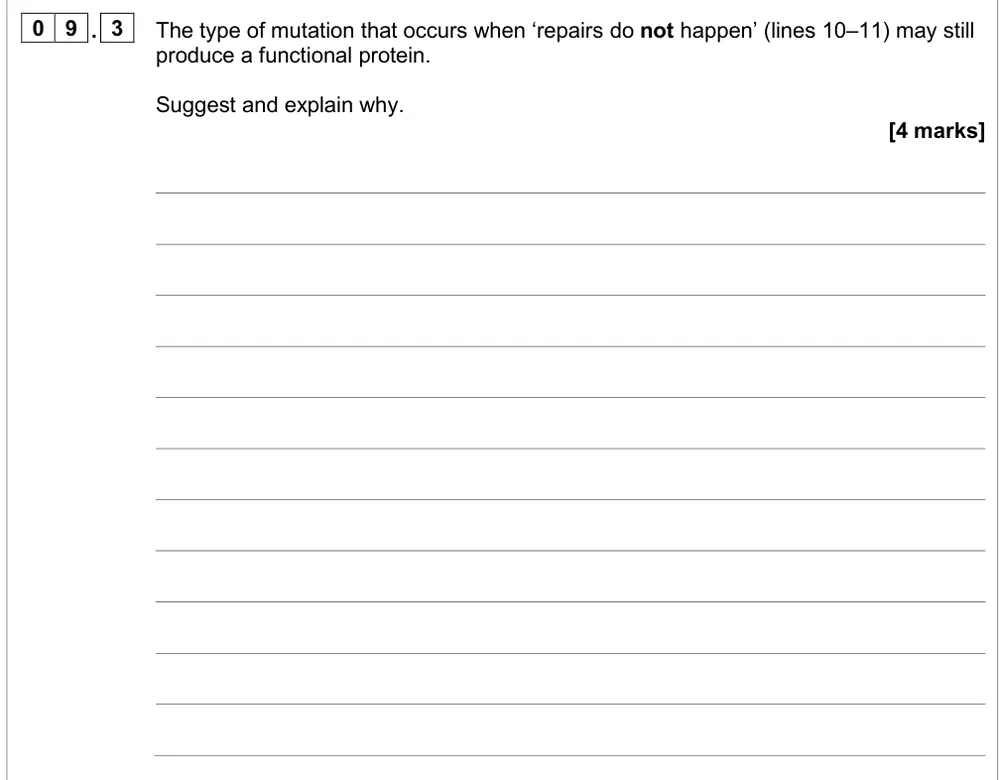
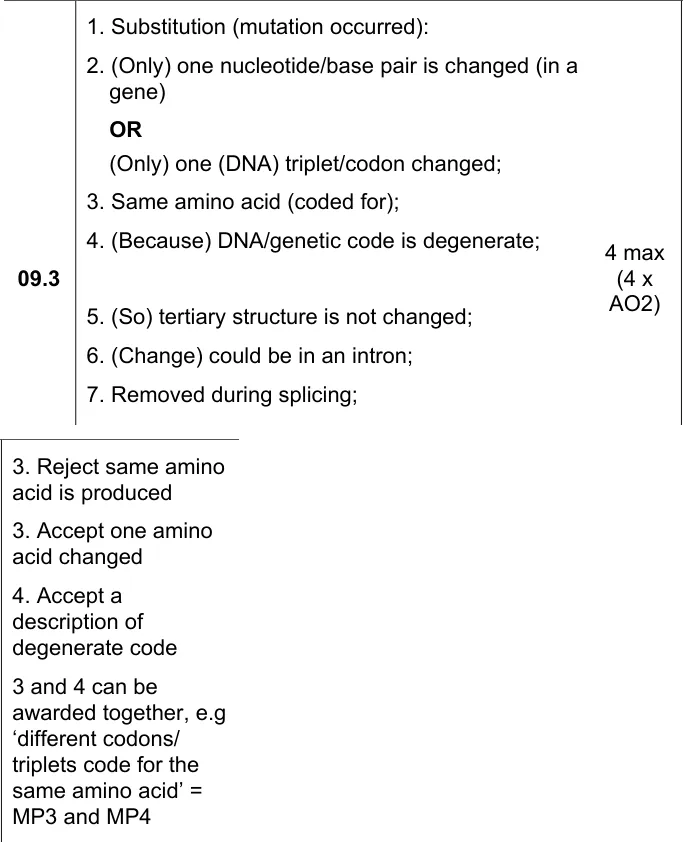
Suggest and explain why a mutation that isn't repaired may still give a functional protein.
Information from earlier in this question:
Show the mark scheme
Tap an image to open it full size.
From the examiners' report: Many got some marks. Say it is a triplet that changes and that the genetic code is degenerate, not 'DNA is degenerate'. A change in an intron is also credited.
Using numbers (3.4.1)
Question 15
A level Paper 1 · June 2018 · Q05.3 · 1 mark · Easy
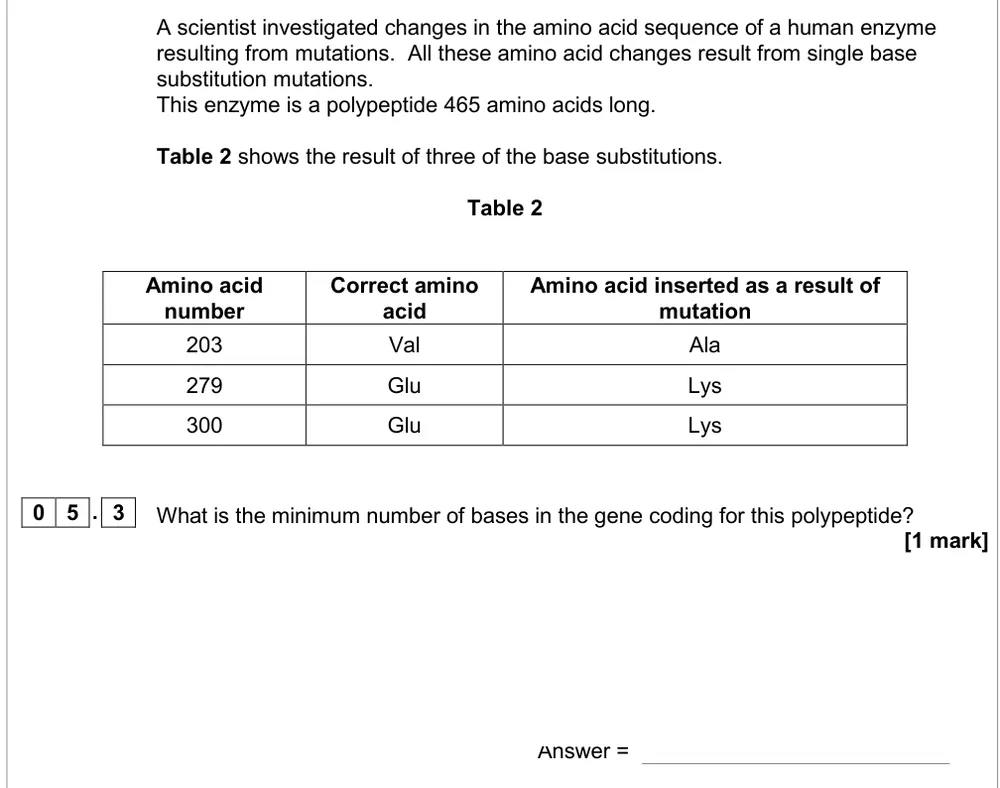
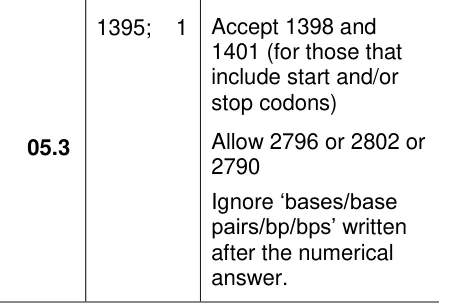
Calculate the minimum number of bases in the gene for a polypeptide 465 amino acids long.
Show the mark scheme
Tap an image to open it full size.
From the examiners' report: 67% got this. Each amino acid needs one triplet, so multiply by three. Adding a stop codon, or doubling for both DNA strands, was also accepted.
Where students lose marks (from AQA examiners' reports and mark schemes)
Each point below is followed by wording that gained marks.
Prokaryotic DNA is still a double helix: Only 26% got all 3 marks for differences between plant nuclear DNA and prokaryotic DNA. Common errors: prokaryotic DNA is single-stranded, isn't a double helix, or exists only as plasmids. Many also described the nucleus or the cell instead of the DNA.
✔ Gains credit: "Plant: associated with histones, linear, has introns; prokaryote: no histones, circular, no introns" (each pair written opposite each other).
Say what changes along the chromosome: Only 42.2% explained the striped staining. Writing 'histones' or 'bases' on its own didn't score: you have to say how they differ along the length.
✔ Gains credit: "Differences in base sequences", "differences in histones" or "differences in condensation (supercoiling)".
Exons are base sequences, not 'code for protein': Many oversimplified the definition of an exon, saying it codes for a protein and leaving out that it is the base sequence that codes for the amino acid sequence.
✔ Gains credit: "Base sequence coding for a polypeptide / sequence of amino acids."
Codons code for amino acids; they don't produce them: 67.5% got both marks for 'degenerate'. Those who didn't wrote about single bases instead of triplets or codons, or said codons 'produce' amino acids.
✔ Gains credit: "More than one codon codes for a single amino acid", with an example from the table.
It's the code that is degenerate, not the DNA: On the substitution question about 15% got all 3 marks. 'DNA is degenerate' wasn't credited, and few used the table to show that every codon starting CG codes for arginine.
✔ Gains credit: "The substitution gives CGU, CGG or CGC, which all code for arginine: the code is degenerate."
Universal means same codon, same amino acid: Some wrote that the genetic code is the same in all organisms rather than that each codon codes for the same amino acid, and weaker answers talked about single bases.
✔ Gains credit: "The same codon / triplet always codes for the same amino acid"; "each base is only part of one triplet".
Leave the sticky ends out: Only 13.5% got both marks for why bacteria can use human DNA, and 55% scored zero. Answers about sticky ends, plasmids and restriction enzymes, 'DNA is universal', or 'universal because it is degenerate' didn't score.
✔ Gains credit: "The genetic code is universal"; "transcription and translation are universal (the same in humans and bacteria)".
Track whose nucleus the new egg contains: Only 3% got both marks on the mitochondrial disease treatment. Many didn't read the stem and said the donor's nucleus would be used, and some thought mitochondria are inside the nucleus.
✔ Gains credit: "The egg has the nucleus of the affected woman, and mostly normal mitochondria from the donor."
Download the questions
Download the PDF pack (15 questions, mark schemes at the end)
Keep practising
- DNA and RNA structure: AQA A Level Biology exam questions by topic
- Prokaryotes and viruses: AQA A Level Biology exam questions by topic
- Mastering AQA A Level Biology 3.4.1: DNA, genes and chromosomes
- Mastering AQA A Level Biology 3.4.2: DNA and protein synthesis
- AQA A Level Biology masterclasses
Questions, mark schemes and examiners' report extracts © AQA.