

Homeostasis and the control of blood glucose (AQA 3.6.4.1 and 3.6.4.2) are A-level only, so they're Year 13 content. You need to explain why core temperature, blood pH and blood glucose are kept within narrow limits, how negative feedback restores the original level, and how to spot positive feedback in an unfamiliar diagram. Then comes the detail: what the liver does in glycogenesis, glycogenolysis and gluconeogenesis, how insulin and glucagon act on their target cells, the second messenger model, and the causes and control of type I and type II diabetes.
The examiners' reports keep finding the same slips. Students say insulin 'opens' channels instead of adding more channel proteins to the membrane, write that glucagon converts glycerol into glucose as if it were an enzyme, and mix up glycogenesis, glycogenolysis and gluconeogenesis with glycolysis. On diabetes they say 'the body' is less sensitive to insulin instead of the receptors, and on the evaluation questions they only use the table.
Start with the homeostasis and feedback questions, then insulin, glucagon and the second messenger model, and finish with the diabetes investigations. Write your answer on paper before you open each mark scheme. If you'd like help with this topic, my AQA masterclasses run online on Tuesdays at 5.15pm for Year 12 and on Wednesdays or Thursdays at 6.30pm for Year 13.
What you need from GCSE and Year 12
Each question on this page assumes you're secure on these GCSE and Year 12 ideas. If any of them feels shaky, revise it before you start.
- GCSE: insulin and glucagon are hormones from the pancreas; insulin lowers blood glucose by causing cells to take up glucose and the liver to store it as glycogen.
- GCSE: type I diabetes is when the pancreas produces too little insulin; type II is when body cells no longer respond to insulin, and obesity is a risk factor.
- Year 12 (AQA 3.2.3): glucose enters cells by facilitated diffusion through channel or carrier proteins, and water moves by osmosis from a higher to a lower water potential.
- Year 12 (AQA 3.1.4.2): enzymes have an active site that is affected by temperature and pH.
- Year 12 (AQA 3.1.2): glycogen is a branched polymer of α-glucose that is stored in liver and muscle cells.
Key terms
These words come up in the questions and mark schemes. Examiners expect you to use them exactly.
- Homeostasis: the maintenance of a stable internal environment within restricted limits by physiological control systems.
- Negative feedback: a change from the norm is detected and causes a response that restores the system to its original level (set point).
- Positive feedback: a change causes more of the same change, so the system moves further from its original level.
- Glycogenesis: the conversion of glucose to glycogen, in the liver and muscles.
- Glycogenolysis: the conversion of glycogen to glucose.
- Gluconeogenesis: the production of glucose from non-carbohydrates such as glycerol and amino acids, in the liver.
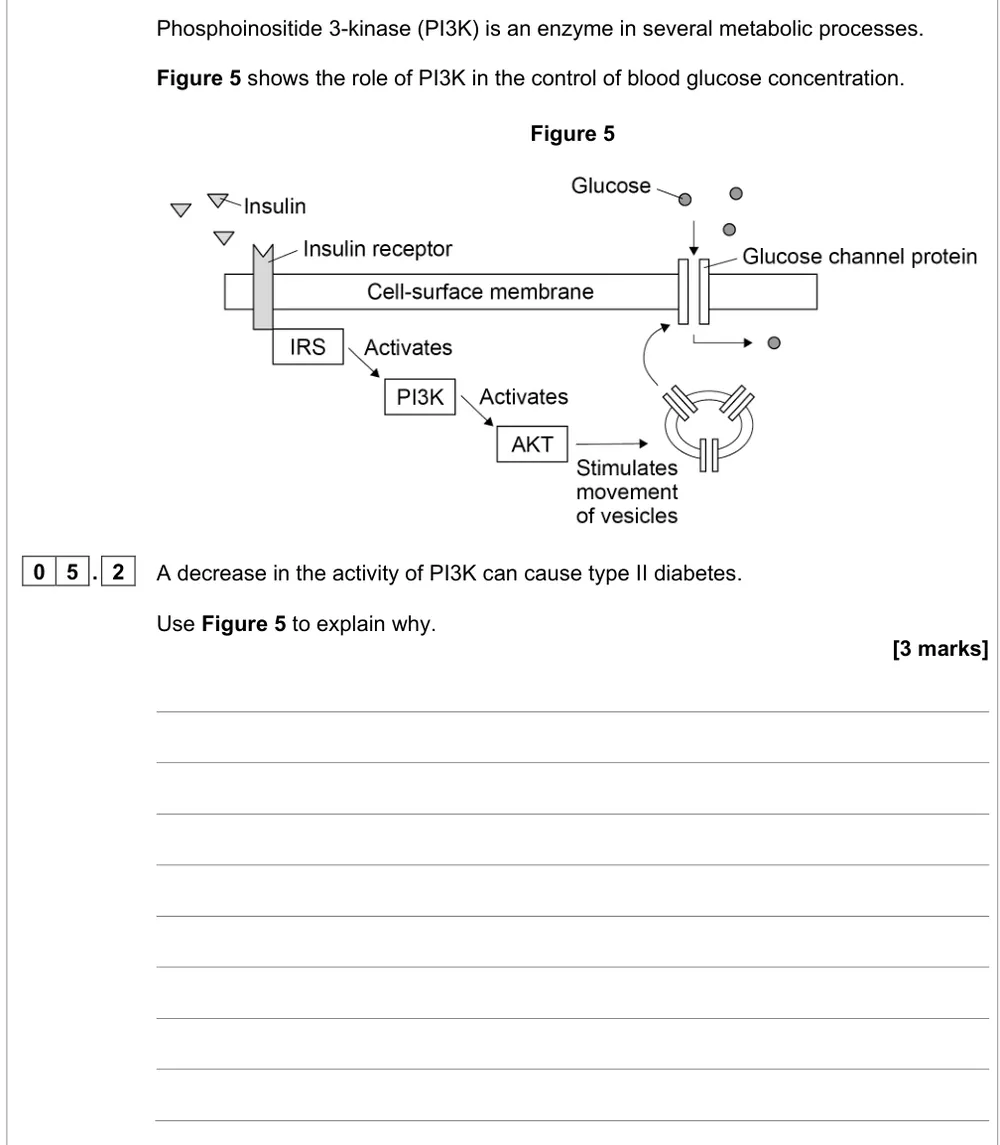
- Insulin: a hormone that attaches to receptors on target cells, increases the number of glucose channel proteins in the cell-surface membrane and activates enzymes that convert glucose to glycogen.
- Glucagon: a hormone that attaches to receptors on liver cells and activates enzymes for glycogenolysis and gluconeogenesis.
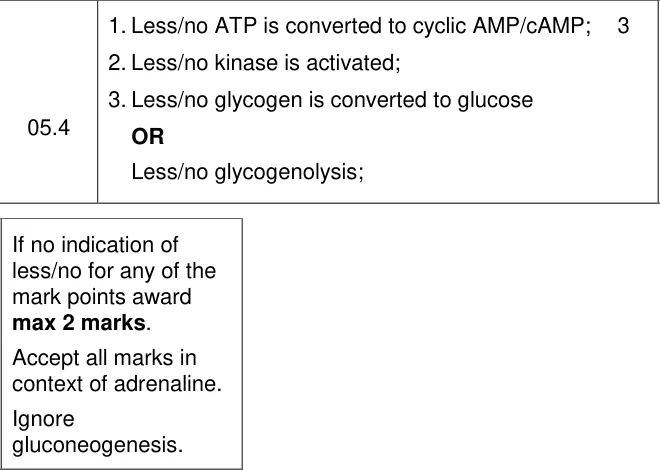
- Second messenger model: adrenaline or glucagon binds to a receptor, activating adenylate cyclase, which converts ATP to cyclic AMP (cAMP); cAMP activates protein kinase, which leads to glycogen being converted to glucose.
- Type I diabetes: the body doesn't produce insulin, usually because the immune system destroys the β cells; controlled by insulin injections.
- Type II diabetes: insulin is still produced but receptors or cells are less sensitive to it; linked to obesity and controlled by diet and exercise.
What these questions cover (AQA 3.6.4.1 and 3.6.4.2)
The questions test these statements from the AQA AS and A-level Biology specification (7401/7402):
- Homeostasis: Homeostasis in mammals involves physiological control systems that maintain the internal environment within restricted limits.
- Core temperature and blood pH: The importance of maintaining a stable core temperature and stable blood pH in relation to enzyme activity.
- Why blood glucose must stay stable: The importance of maintaining a stable blood glucose concentration in terms of availability of respiratory substrate and of the water potential of blood.
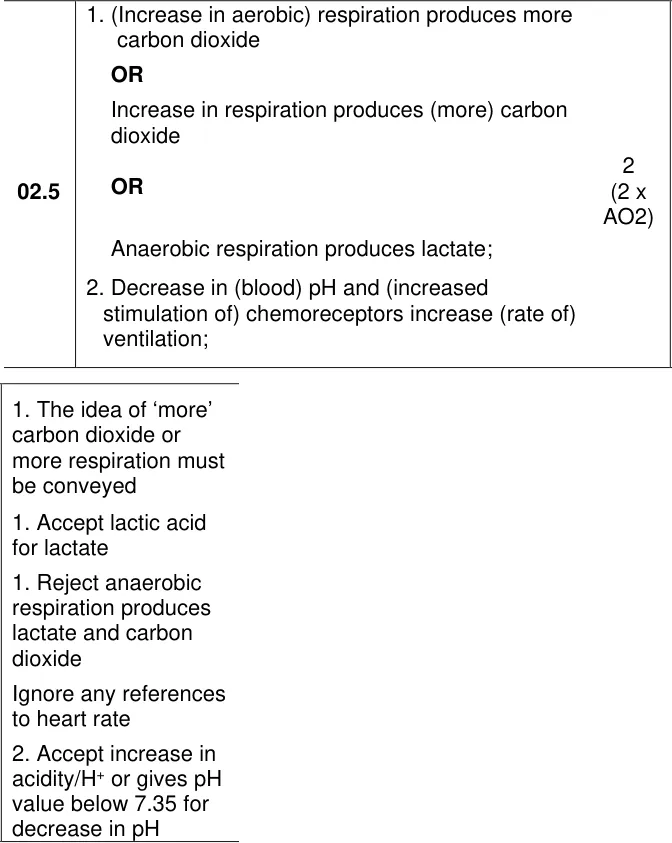
- Negative feedback: Negative feedback restores systems to their original level.
- Separate mechanisms: The possession of separate mechanisms involving negative feedback controls departures in different directions from the original state, giving a greater degree of control. (the blood pH question credits separate mechanisms that control an increase and a decrease)
- Interpreting feedback: Students should be able to interpret information relating to examples of negative and positive feedback.
- Factors affecting blood glucose: The factors that influence blood glucose concentration. (no written question on this point alone was available for this page, so learn how eating, fasting and exercise change blood glucose from your notes)
- The liver: The role of the liver in glycogenesis, glycogenolysis and gluconeogenesis.
- The action of insulin by: controlling the uptake of glucose by regulating the inclusion of channel proteins in the surface membranes of target cells
- Second messenger model: The second messenger model of adrenaline and glucagon action, involving adenylate cyclase, cyclic AMP (cAMP) and protein kinase. (the adenylate cyclase question accepts answers about adrenaline as well as glucagon)
- Diabetes: The causes of types I and II diabetes and their control by insulin and/or manipulation of the diet.
- Health advisers and the food industry: Students should be able to evaluate the positions of health advisers and the food industry in relation to the increased incidence of type II diabetes. (no written question on health advisers or the food industry was available, so the weight-loss evaluation is the closest practice here)
How to use this page
Write your answer on paper before you open the mark scheme. Allow about 1.3 minutes per mark: the 15 questions are worth 36 marks, so about 47 minutes in total. Then mark your answer strictly against the mark scheme and read the examiners' tip underneath it. If you'd rather print the questions, download the PDF pack.
Principles of homeostasis (3.6.4.1)
Question 1
A level Paper 2 · June 2025 · Q02.1 · 1 mark · Easy
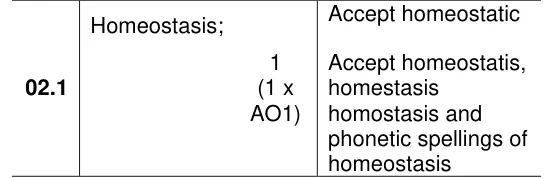
Name the maintenance of a stable internal environment.

Show the mark scheme
Tap an image to open it full size.
From the examiners' report: Almost 95% got this. Learn the definition alongside the word: a stable internal environment kept within restricted limits.
Question 2
A level Paper 2 · June 2025 · Q02.2 · 2 marks · Easy
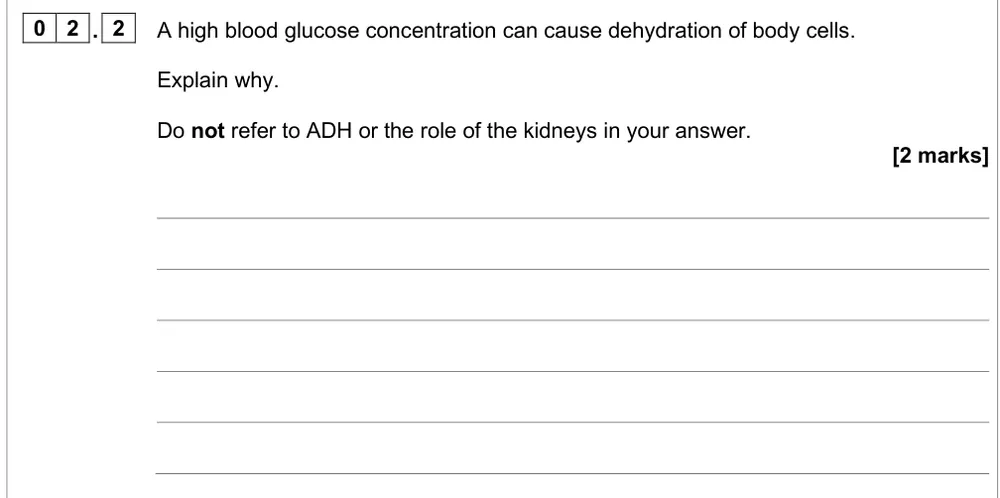
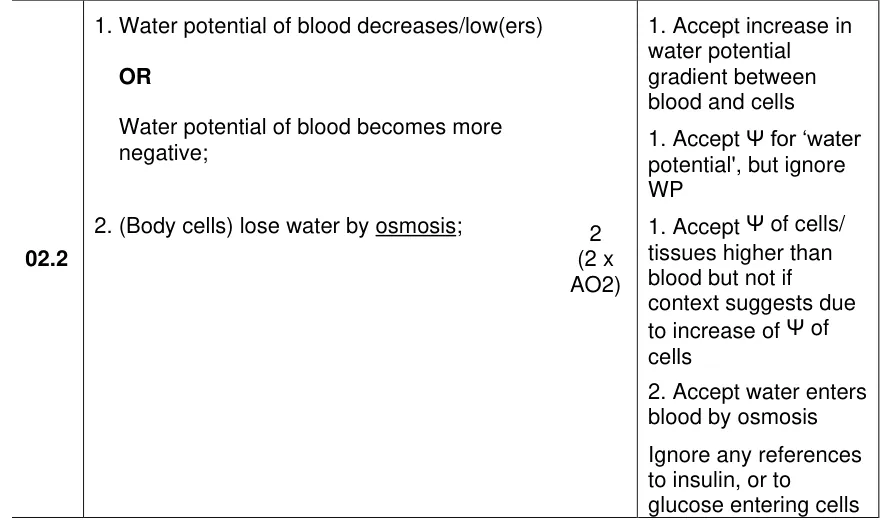
Explain why a high blood glucose concentration dehydrates body cells.
Show the mark scheme
Tap an image to open it full size.
From the examiners' report: About 60% got both. Say the water potential of the blood falls, not just 'a concentration gradient', and say water leaves the cells by osmosis, not diffusion.
Negative and positive feedback (3.6.4.1)
Question 3
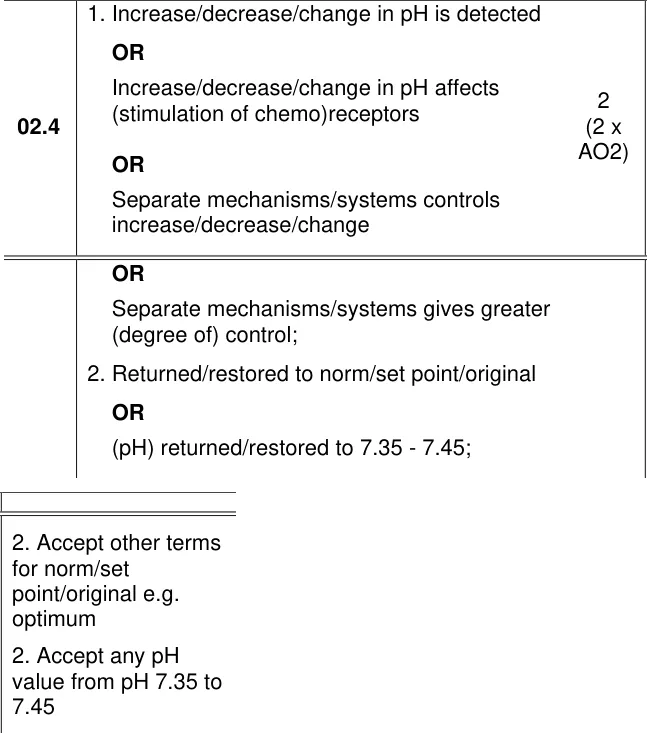
A level Paper 2 · June 2025 · Q02.4 · 2 marks · Easy
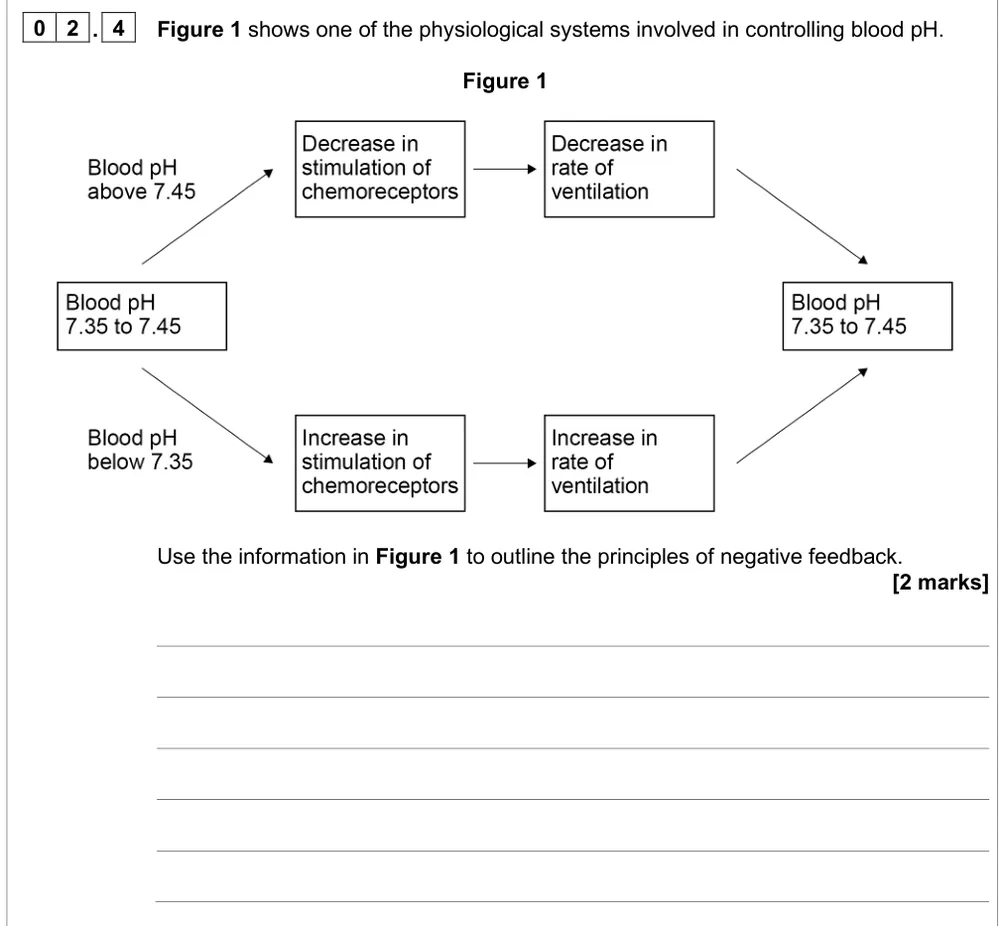
Use a blood pH diagram to outline the principles of negative feedback.
Show the mark scheme
Tap an image to open it full size.
From the examiners' report: Over 50% got both. Most said pH returns to the norm; for the other mark, say how the change is detected (chemoreceptors). You only need to describe one direction.
Question 4
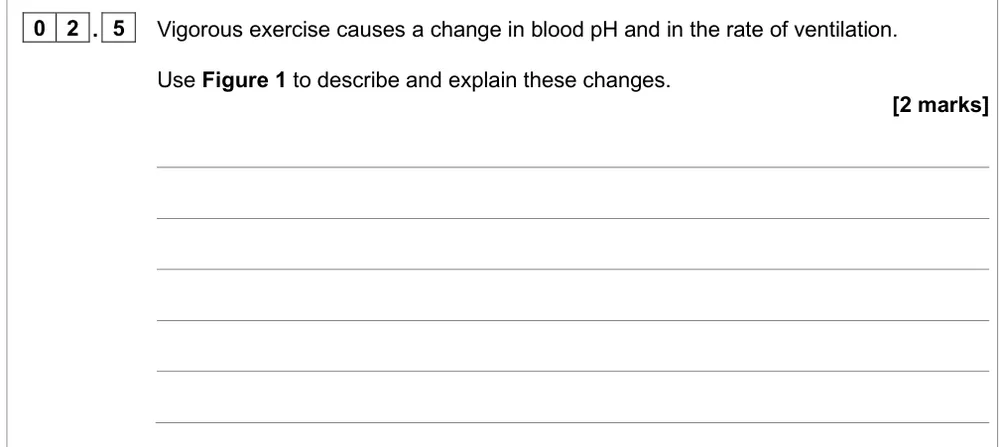
A level Paper 2 · June 2025 · Q02.5 · 2 marks · Medium
Explain how vigorous exercise changes blood pH and the rate of ventilation.
Show the mark scheme
Tap an image to open it full size.
From the examiners' report: About 25% got both. Start from more respiration making more carbon dioxide, so pH falls; then chemoreceptors increase ventilation. Anaerobic respiration in animals makes lactate but no carbon dioxide, and heart rate isn't asked for.
Question 5
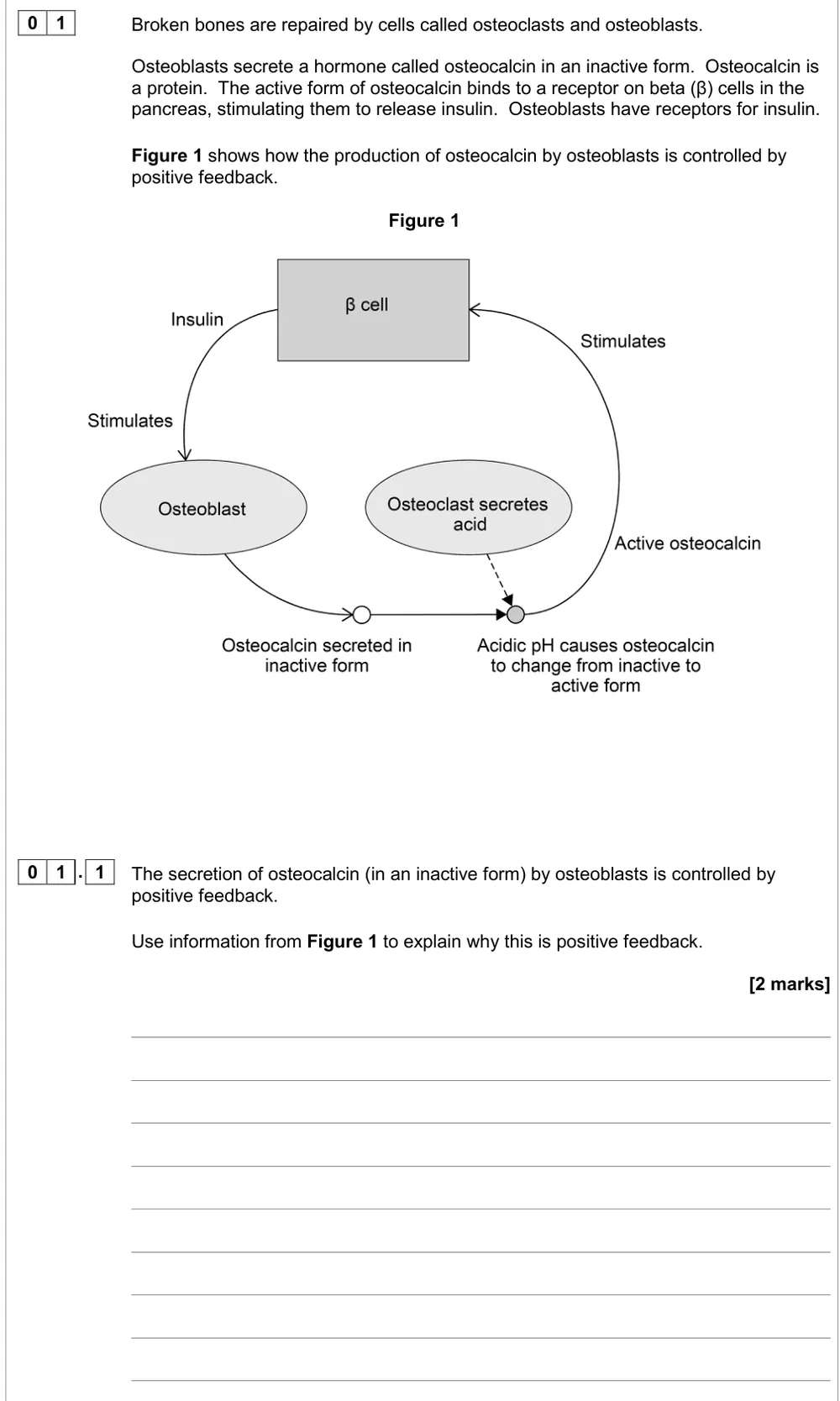
A level Paper 3 · June 2018 · Q01.1 · 2 marks · Hard
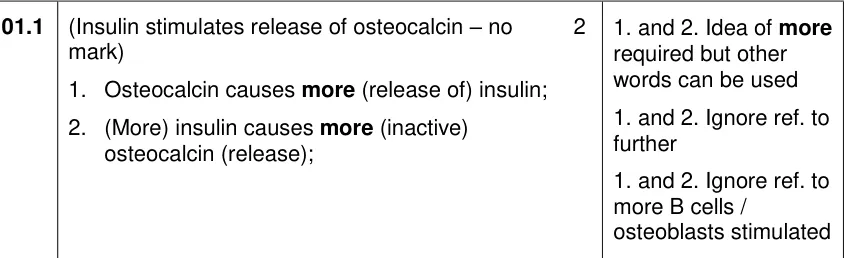
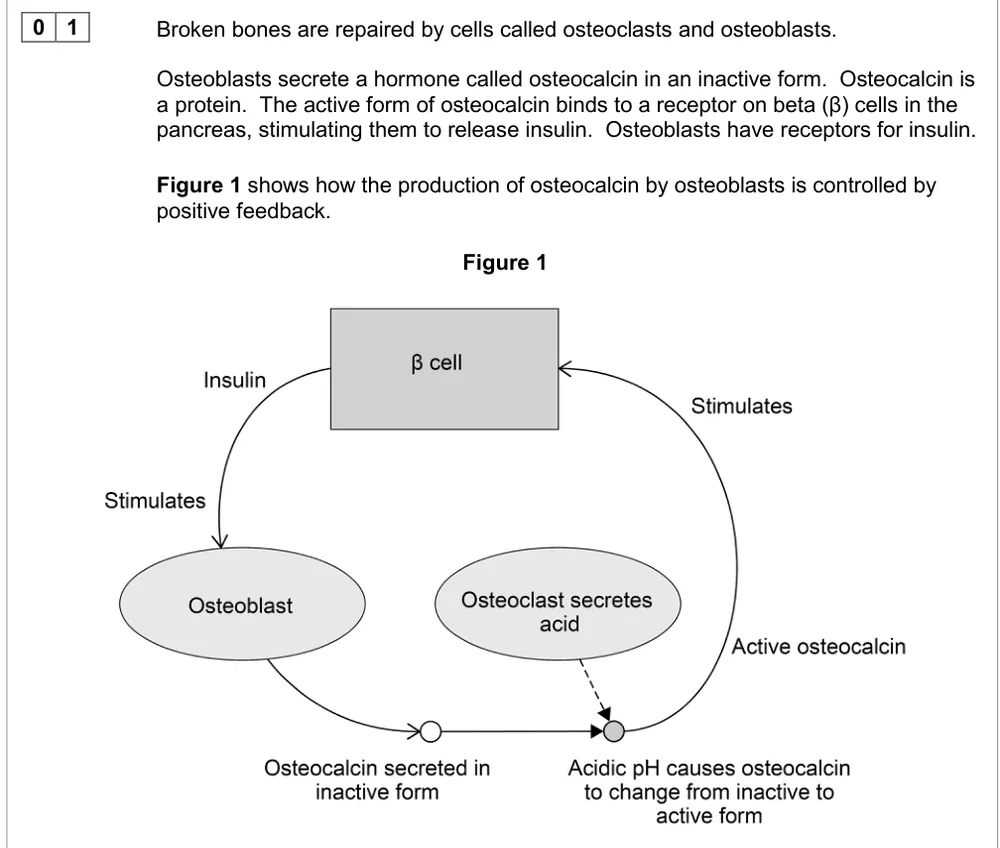
Use a diagram of osteocalcin and insulin to explain why this is positive feedback.
Show the mark scheme
Tap an image to open it full size.
From the examiners' report: Only 13% got both and 55% scored zero. Don't recite a definition: use the diagram and put 'more' into each step, so more osteocalcin gives more insulin, which gives more osteocalcin.
Insulin, glucagon and the liver (3.6.4.2)
Question 6
A level Paper 2 · June 2019 · Q05.1 · 2 marks · Hard
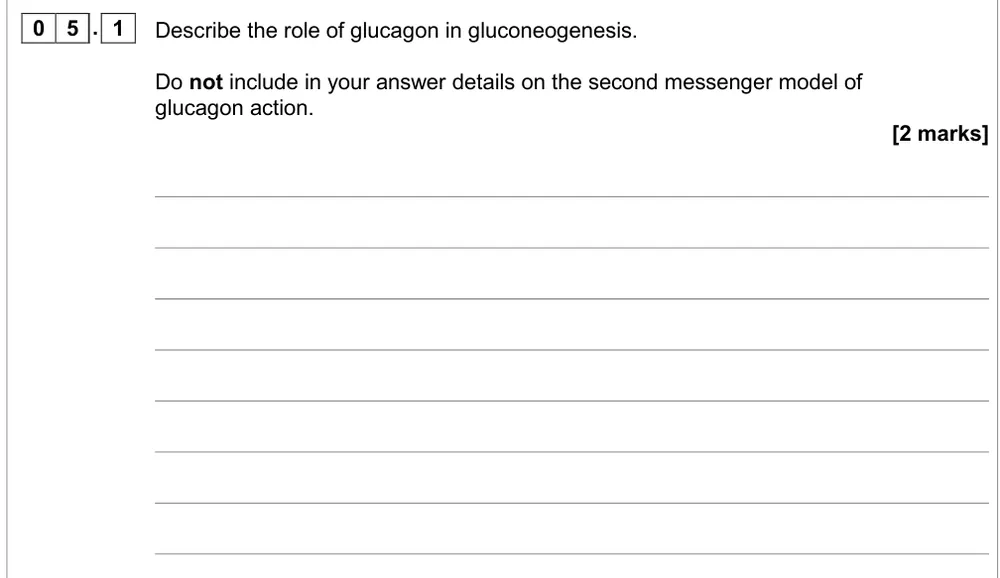
Describe the role of glucagon in gluconeogenesis.
Show the mark scheme
Tap an image to open it full size.
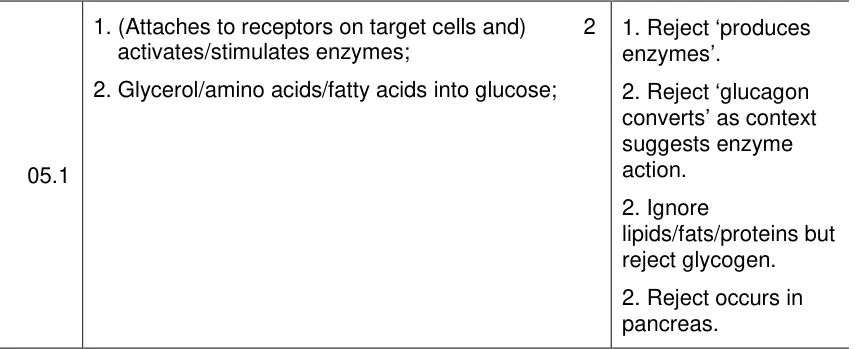
From the examiners' report: Only about 44% scored. Glucagon activates enzymes; it doesn't convert anything itself. Gluconeogenesis makes glucose from glycerol or amino acids, not from glycogen.
Question 7
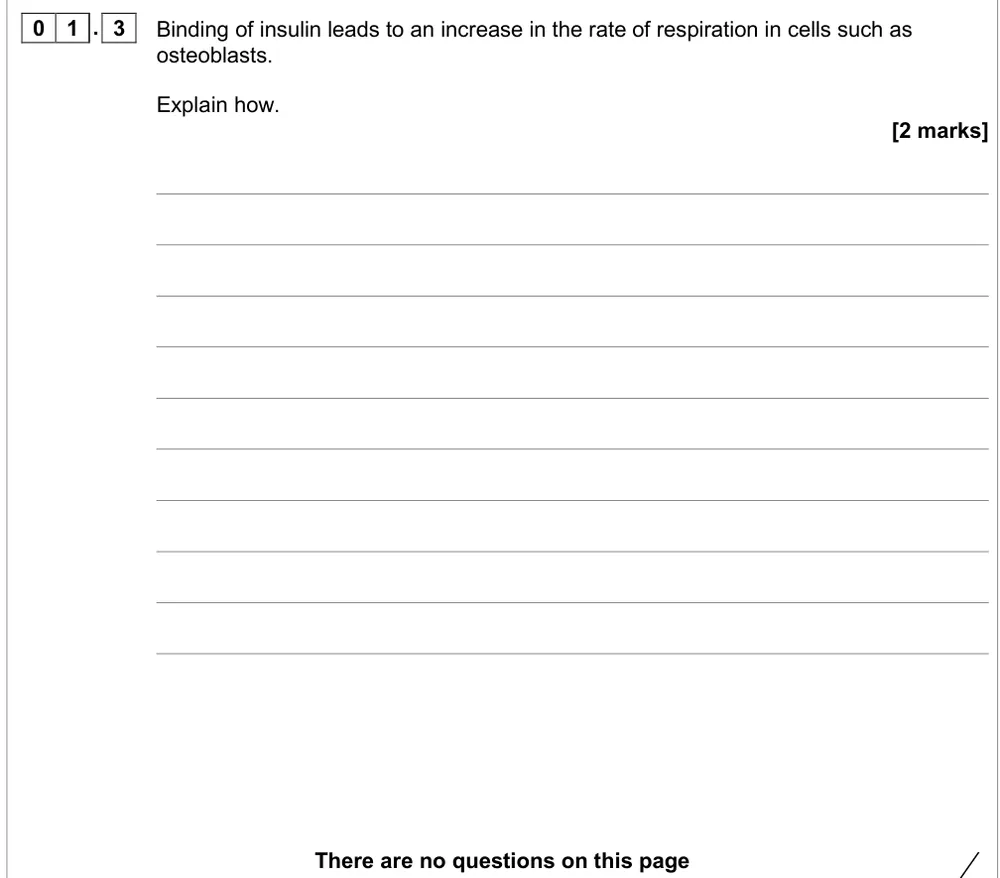
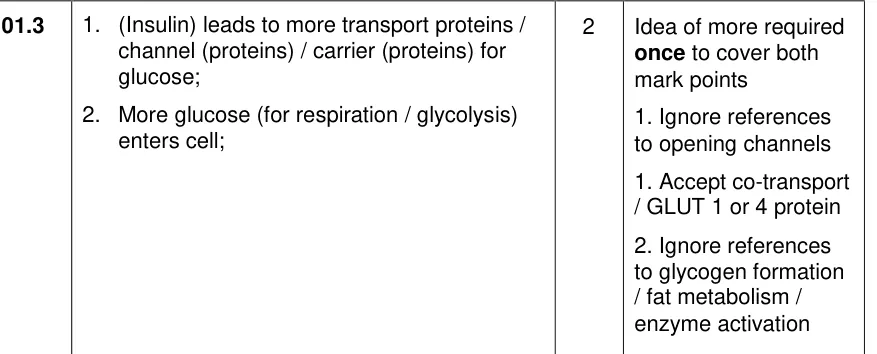
A level Paper 3 · June 2018 · Q01.3 · 2 marks · Hard
Explain how insulin binding increases the rate of respiration in osteoblasts.
Information from earlier in this question:
Show the mark scheme
Tap an image to open it full size.
From the examiners' report: 19% got both. Insulin adds more channel proteins to the membrane rather than opening existing ones, so more glucose enters for respiration. Glycogen formation would leave less glucose, so leave it out.
Question 8
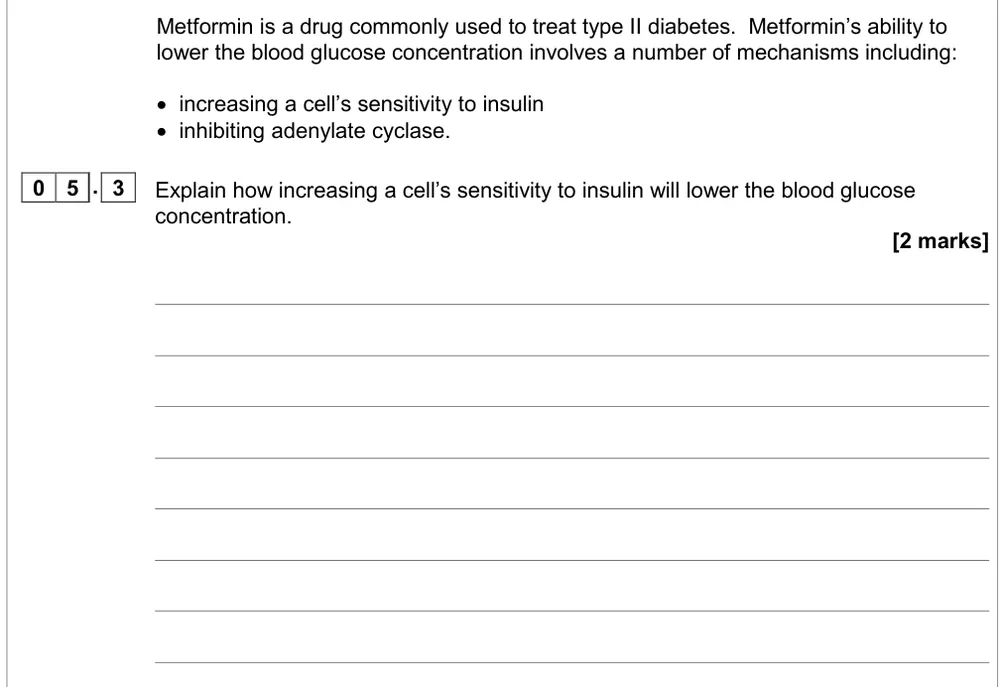
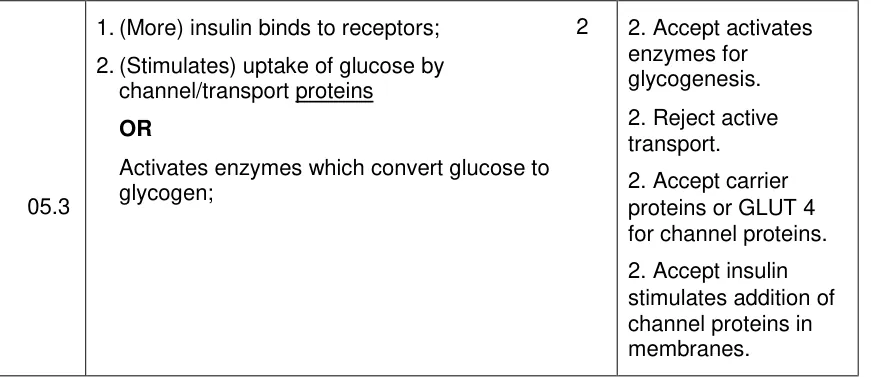
A level Paper 2 · June 2019 · Q05.3 · 2 marks · Hard
Explain how increasing a cell's sensitivity to insulin lowers blood glucose.
Show the mark scheme
Tap an image to open it full size.
From the examiners' report: Only about 16% got both. Insulin binds to receptors, not an active site, then name the channel proteins or the enzymes for glycogenesis. 'Glycolysis' and 'gluconeogenesis' were common wrong words.
Question 9
A level Paper 2 · November 2021 · Q05.2 · 3 marks · Medium
Use a diagram of the insulin pathway to explain why low PI3K activity causes type II diabetes.
Show the mark scheme
Tap an image to open it full size.
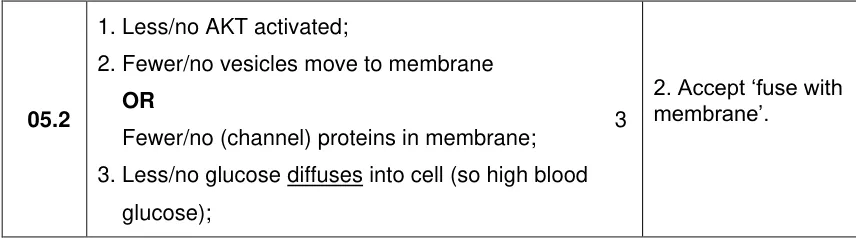
From the examiners' report: 82% got a mark but only 8% got all three. After less AKT, say fewer vesicles reach the cell-surface membrane, then that less glucose diffuses into the cell. The vesicles carry channel proteins, not glucose.
The second messenger model (3.6.4.2)
Question 10
A level Paper 2 · June 2019 · Q05.4 · 3 marks · Medium
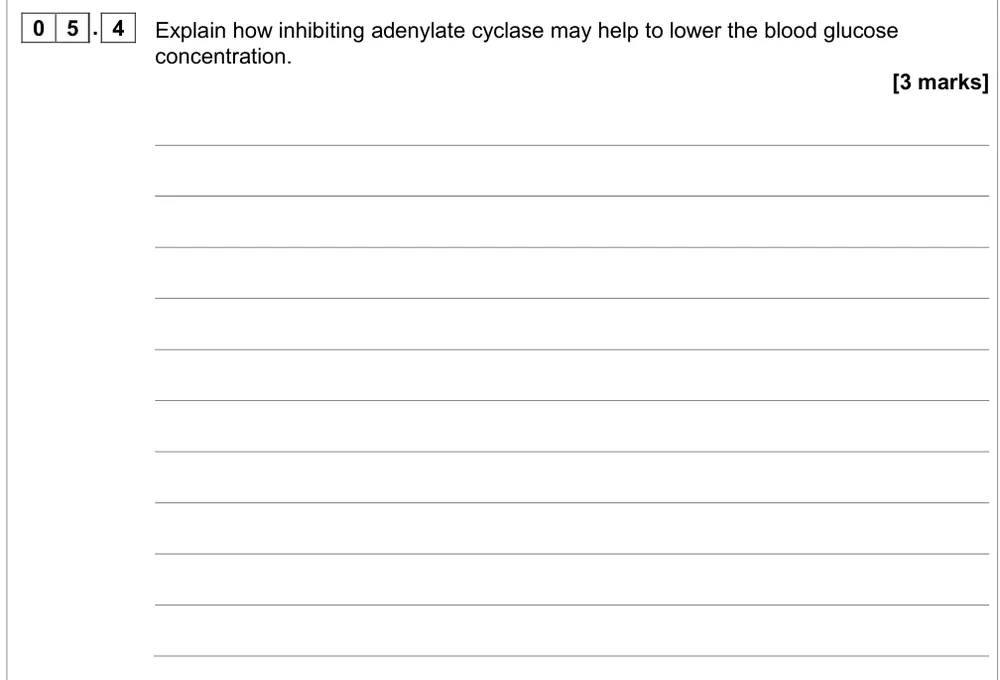
Explain how inhibiting adenylate cyclase could lower blood glucose.
Information from earlier in this question:

Show the mark scheme
Tap an image to open it full size.
From the examiners' report: About 25% got all three. Start at ATP: less ATP is converted to cAMP, so less protein kinase is activated and less glycogen becomes glucose. Write glycogenolysis, not glycolysis.
Types I and II diabetes (3.6.4.2)
Question 11
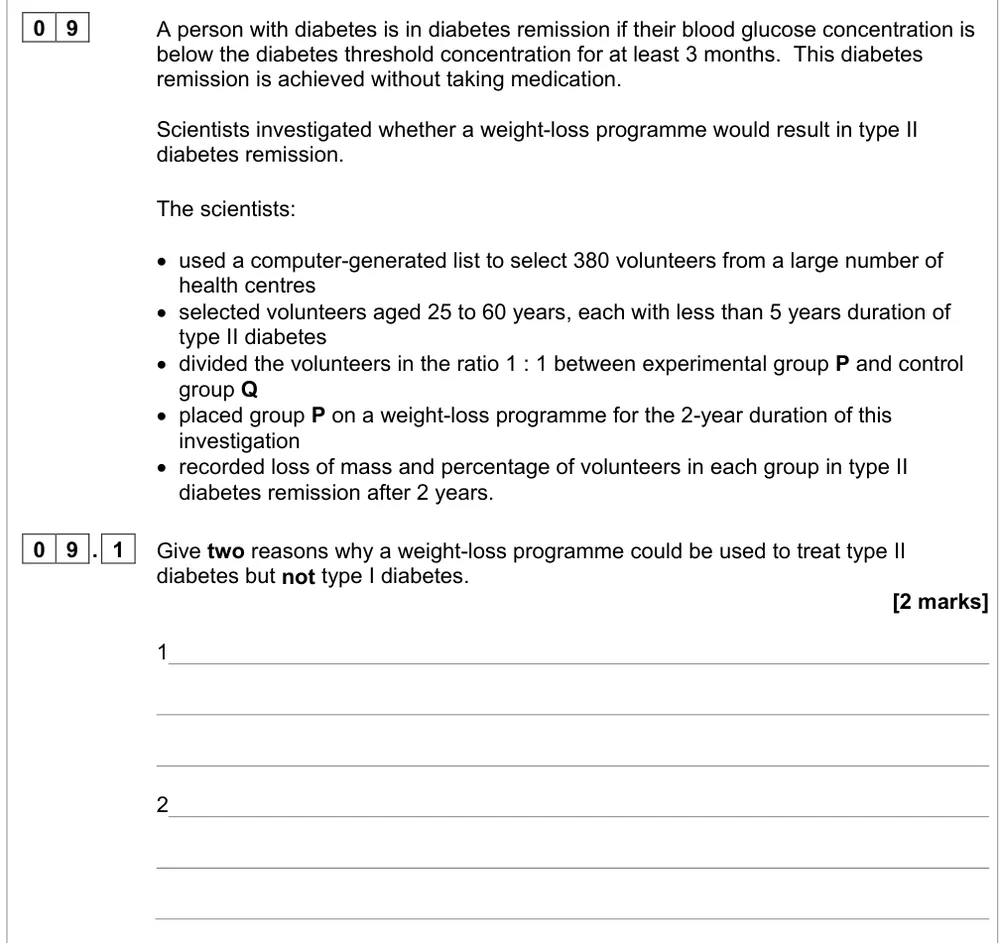
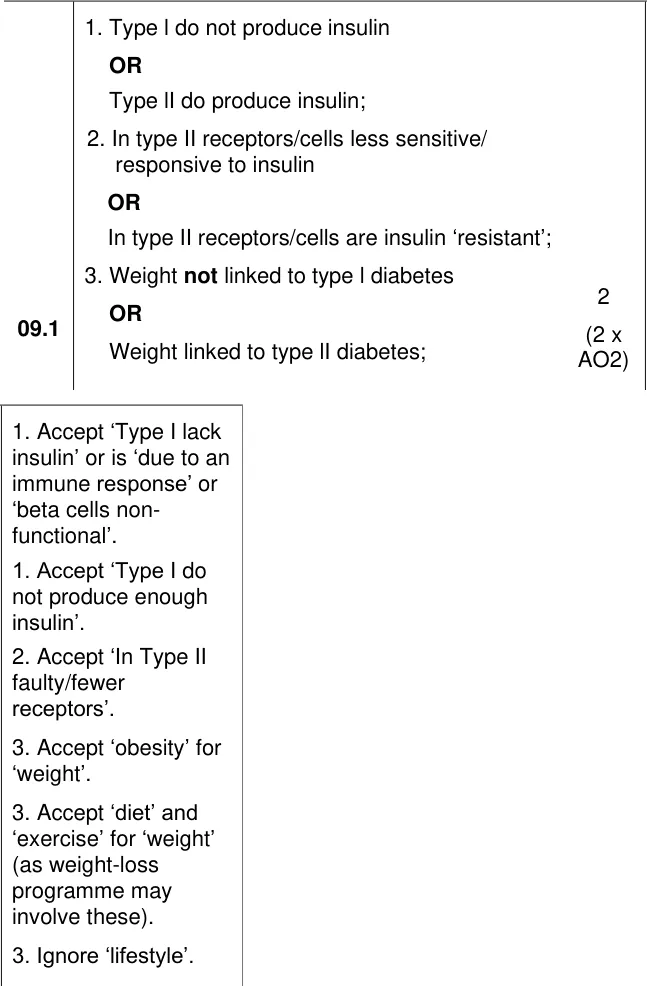
A level Paper 2 · June 2024 · Q09.1 · 2 marks · Easy
Give two reasons why weight loss can treat type II but not type I diabetes.
Show the mark scheme
Tap an image to open it full size.
From the examiners' report: About 50% got both. Say the receptors or cells are less sensitive, not 'the body', and link weight, diet or exercise to type II rather than writing 'lifestyle'.
Question 12
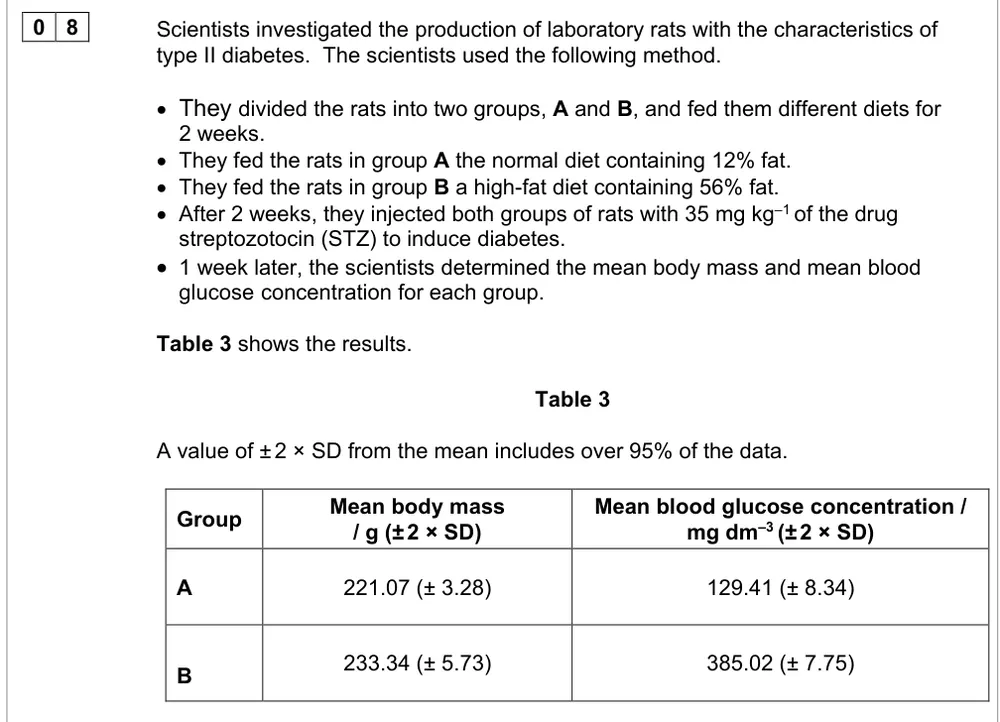
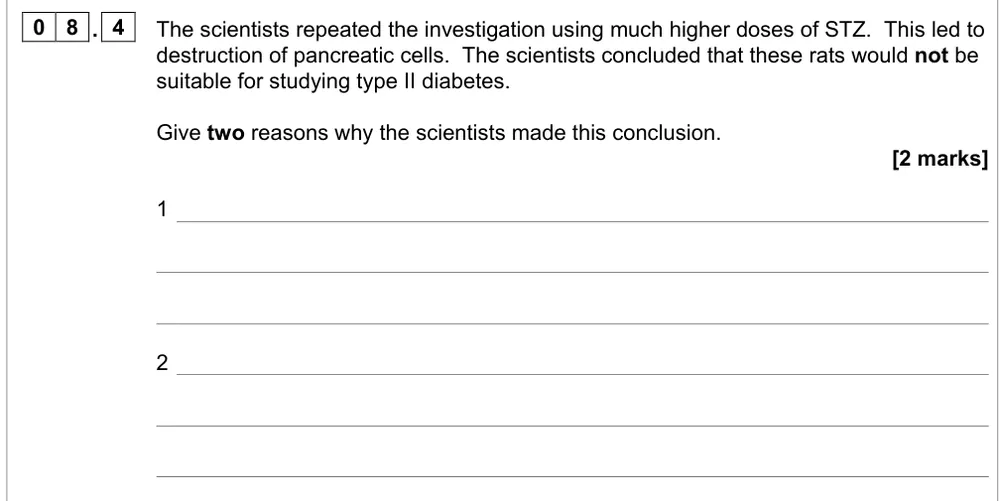
A level Paper 2 · June 2022 · Q08.4 · 2 marks · Medium
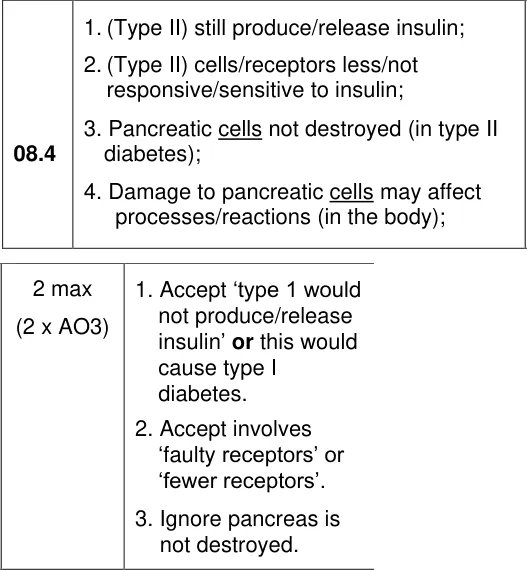
Give two reasons why rats with destroyed pancreatic cells don't model type II diabetes.
Information from earlier in this question:
Show the mark scheme
Tap an image to open it full size.
From the examiners' report: Only 18% got both and 45% scored zero, often with ethics or killing the rats. Use your knowledge of type II: insulin is still made, the receptors are less sensitive, and the pancreatic cells aren't destroyed.
Investigating type II diabetes (3.6.4.2)
Question 13
A level Paper 2 · June 2022 · Q08.3 · 5 marks · Medium
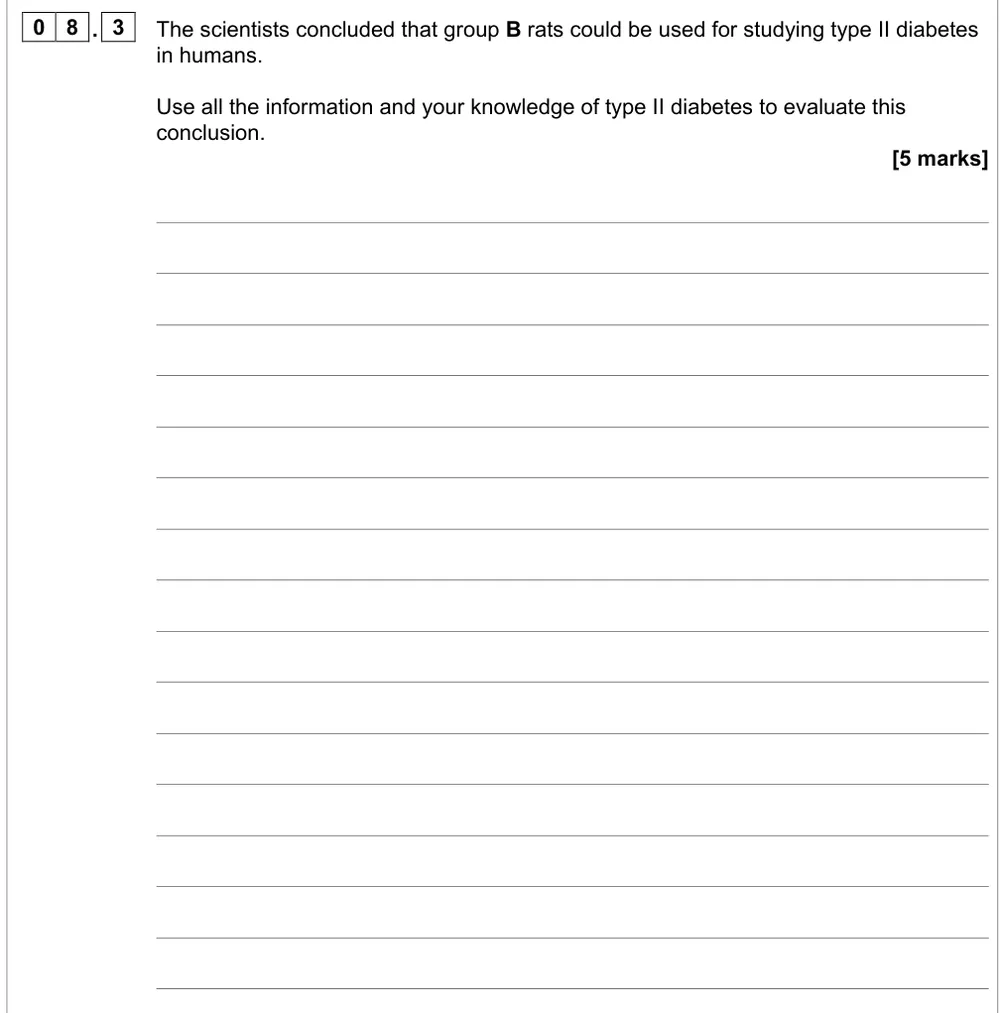
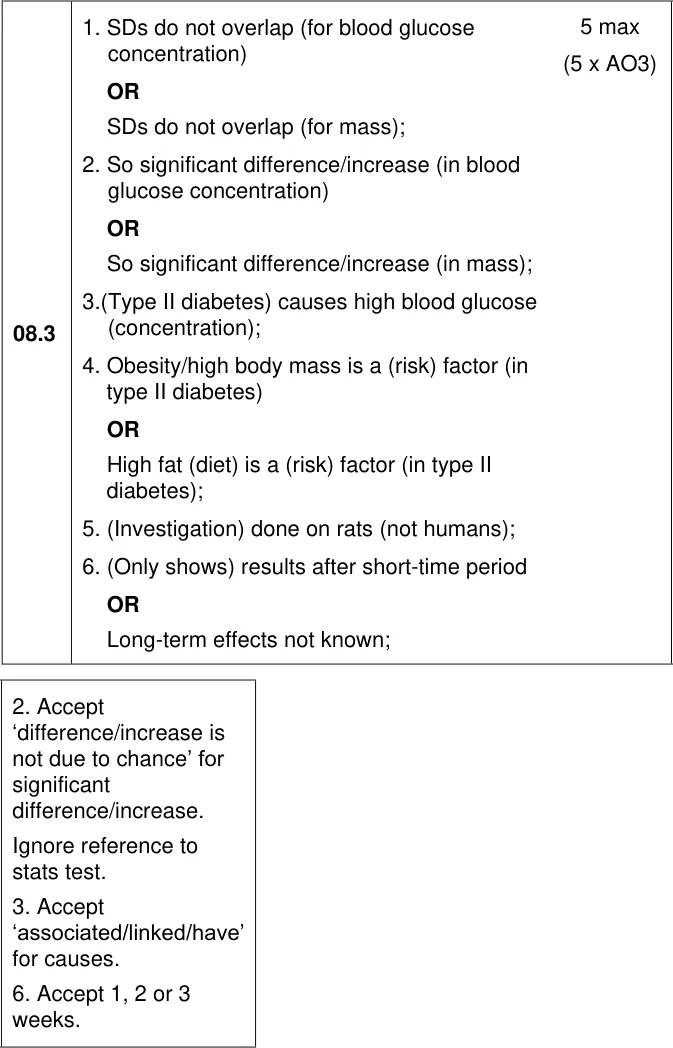
Evaluate whether high-fat-diet rats can be used to study type II diabetes in humans.
Show the mark scheme
Tap an image to open it full size.
From the examiners' report: 10% got all five. Say the SDs don't overlap, so the difference is significant, then link high blood glucose and obesity to type II. Write glucose, not sugar, and mention the short time period.
Question 14
A level Paper 2 · June 2024 · Q09.4 · 4 marks · Medium
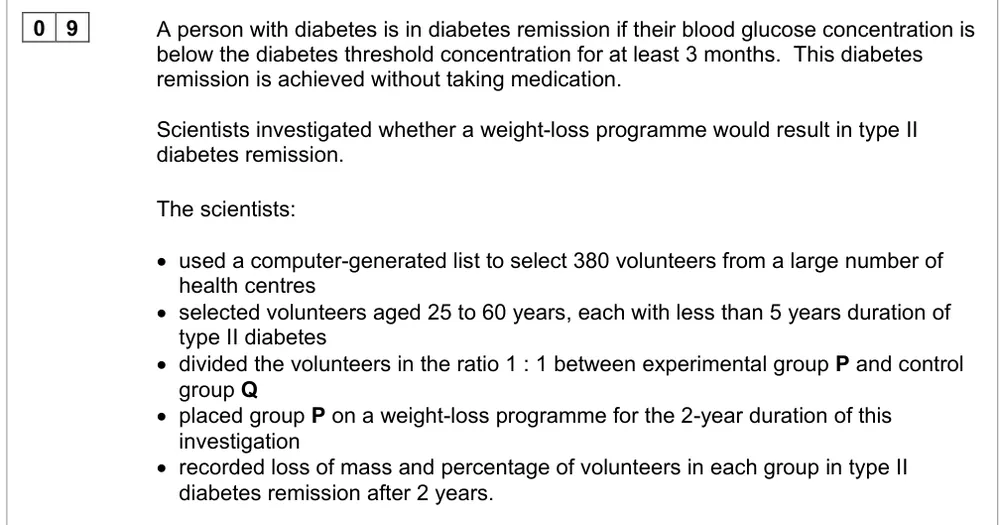
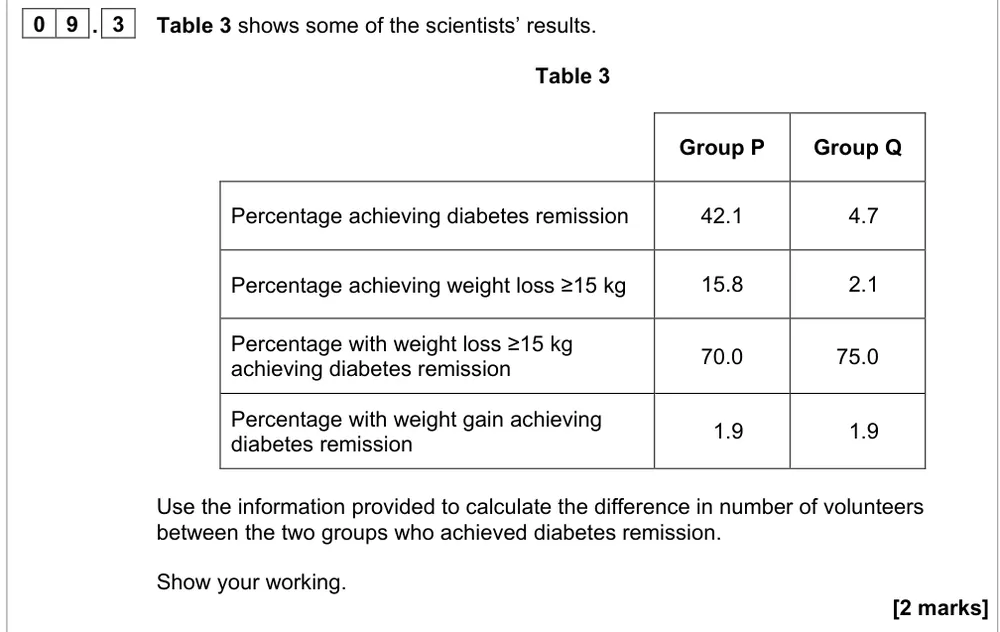
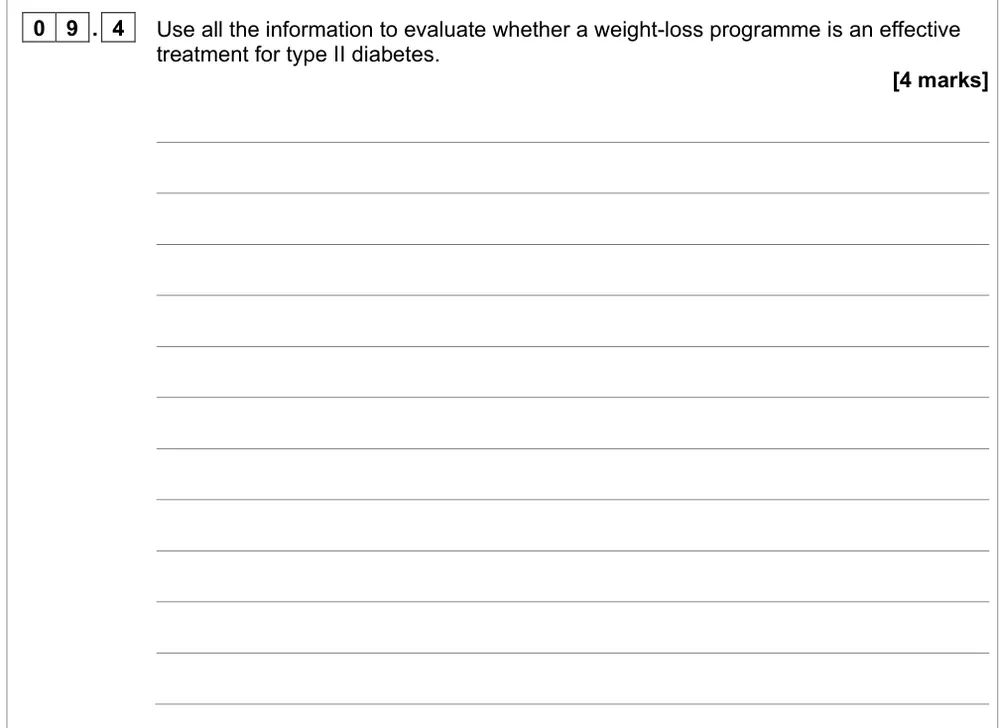
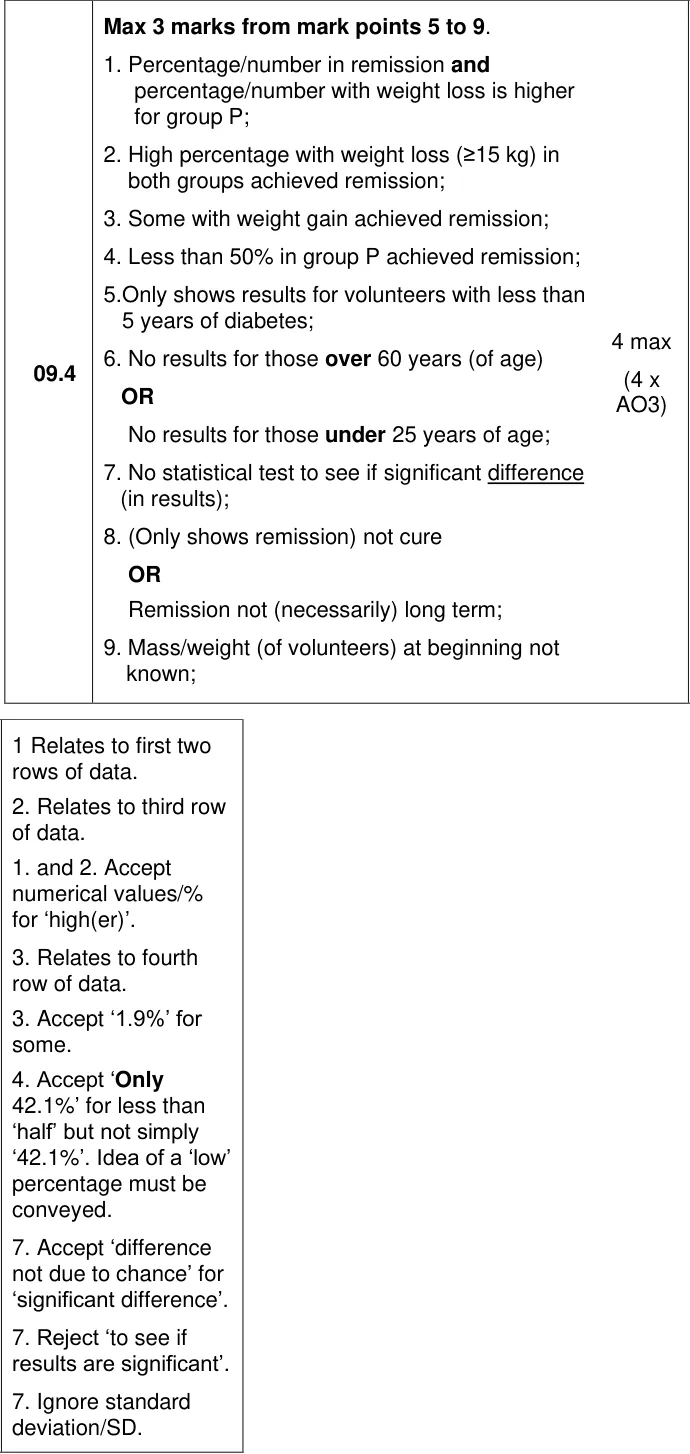
Evaluate whether a weight-loss programme is an effective treatment for type II diabetes.
Information from earlier in this question:
Show the mark scheme
Tap an image to open it full size.
From the examiners' report: About 5% got all four and 25% scored zero, often by only using the table. Compare both rows for groups P and Q, then use the method: age range, under 5 years of diabetes, no statistical test, and remission isn't a cure.
Question 15
A level Paper 2 · June 2024 · Q09.3 · 2 marks · Easy
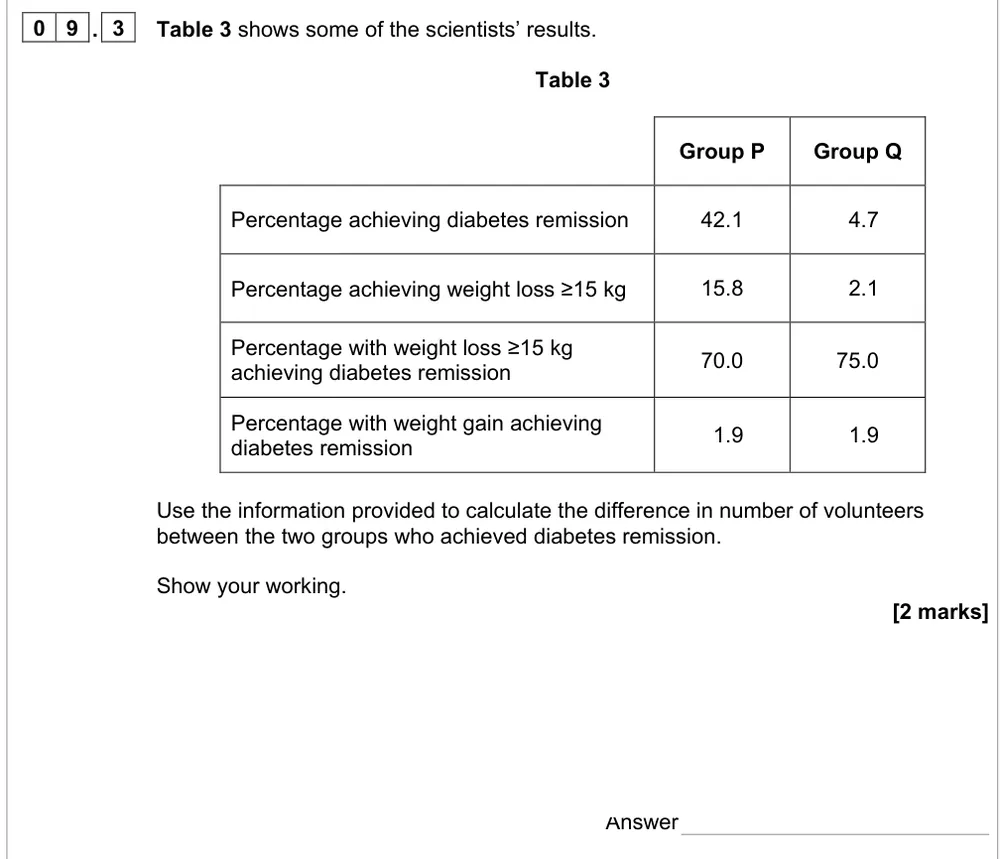
Calculate the difference in the number of volunteers in remission between two groups.
Show the mark scheme
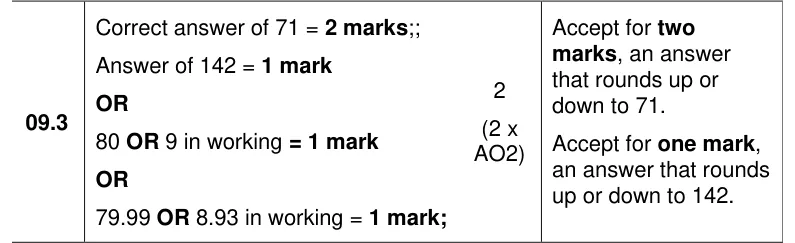
Tap an image to open it full size.
From the examiners' report: About 65% got both. Each group has 190 people, not 380. Work out each number first (80 and 9) and then subtract; subtracting the percentages doesn't score.
Where students lose marks (from AQA examiners' reports and mark schemes)
Each point below is followed by wording that gained marks.
Positive feedback needs 'more' at every step: On the osteocalcin loop only 13% got both marks and 55% scored zero. Many said insulin 'stimulates' osteocalcin, which just repeats the diagram, or wrote 'further' production, which could be at the same rate.
✔ Gains credit: "Osteocalcin causes more release of insulin; more insulin causes more (inactive) osteocalcin release."
Insulin adds channel proteins; it doesn't open them: Only 19% got both marks on insulin and respiration in osteoblasts. Many thought insulin opens existing channels, and nearly 60% scored zero, often by describing glycogen formation, which would leave less glucose for respiration.
✔ Gains credit: "Insulin leads to more channel (carrier) proteins for glucose; more glucose enters the cell for respiration."
Glucagon activates enzymes; it isn't one: Only around 44% scored on glucagon's role in gluconeogenesis. Writing 'glucagon converts' lost the mark, 'glucagon produces enzymes' wasn't credited, and some defined gluconeogenesis as glycogen to glucose.
✔ Gains credit: "Attaches to receptors on target cells and activates enzymes; that convert glycerol or amino acids into glucose."
Glycogenolysis, not glycolysis or 'glucogenesis': On metformin, students wrote 'glycolysis', 'glucogenesis' or 'gluconeogenesis' when they meant glycogenesis, and the same errors appeared for glycogenolysis on the adenylate cyclase question.
✔ Gains credit: "Activates enzymes which convert glucose to glycogen" (glycogenesis); "less glycogen is converted to glucose" (glycogenolysis).
Start the cascade at ATP: About 25% got all three on inhibiting adenylate cyclase. Many said less cyclic AMP is made, but only the best said this is because less ATP is converted to cAMP, and every point needs 'less' or 'no'.
✔ Gains credit: "Less ATP is converted to cyclic AMP; less kinase is activated; less glycogen is converted to glucose."
Name the membrane and send glucose into the cell: On PI3K and type II diabetes only 8% got all three. Most said less AKT is activated, but many didn't say the vesicles or channel proteins reach the cell-surface membrane, and some thought the vesicles contained glucose.
✔ Gains credit: "Fewer vesicles move to the membrane, or fewer channel proteins in the membrane; less glucose diffuses into the cell."
Receptors are less sensitive, not 'the body': About 50% got both marks on why weight loss treats type II but not type I. 'The body is less sensitive to insulin' and 'lifestyle' didn't score, and on the high-dose STZ rats most left receptors out of the same point.
✔ Gains credit: "In type II, receptors or cells are less sensitive or responsive to insulin; weight is linked to type II diabetes."
Say how the change is detected: Over 50% got both marks on the blood pH diagram. Nearly everyone said the pH returns to the norm, but weaker answers didn't say the change in pH is detected by chemoreceptors.
✔ Gains credit: "Change in pH is detected (affects stimulation of chemoreceptors); pH is returned to the norm, 7.35 to 7.45."
Download the questions
Download the PDF pack (15 questions, mark schemes at the end)
Keep practising
- Control of blood water potential: AQA A Level Biology exam questions by topic
- AQA 3.6.4.1–3.6.4.2 blood glucose: self-marking quiz
- Required practicals 3 and 11, calibration curves: AQA A Level Biology exam questions by topic
- Transport across cell membranes: AQA A Level Biology exam questions by topic
- Respiration: AQA A Level Biology exam questions by topic
- AQA A Level Biology masterclasses
Questions, mark schemes and examiners' report extracts © AQA.