

Respiration (AQA 3.5.2) is an A-level-only topic that examiners love to test in unfamiliar settings: hibernating bears, trained mice, a drug that blocks ATP synthase in bacteria. You need glycolysis in the cytoplasm, what happens to pyruvate when respiration is only anaerobic, the link reaction and Krebs cycle in the mitochondrial matrix, oxidative phosphorylation and chemiosmosis, and how the breakdown products of lipids and amino acids enter the Krebs cycle.
The examiners' reports keep finding the same slips. Students say triose phosphate is 'converted' to pyruvate instead of oxidised, forget that making lactate or ethanol regenerates NAD for glycolysis, and mix the Krebs cycle up with the Calvin cycle. When the electron transfer chain is blocked they say oxygen uptake falls because respiration becomes anaerobic, instead of saying oxygen is the final electron acceptor, and many still write that respiration 'produces energy'.
Start with glycolysis and anaerobic respiration, work your way into the mitochondrion, then try the questions set in new contexts and finish with the exercise data. Answer each question on paper before you open the mark scheme. If you'd like help with this topic, my AQA masterclasses run online on Tuesdays at 5.15pm for Year 12 and on Wednesdays or Thursdays at 6.30pm for Year 13.
What you need from GCSE and Year 12
Each question on this page assumes you're secure on these GCSE and Year 12 ideas. If any of them feels shaky, revise it before you start.
- GCSE: aerobic respiration uses glucose and oxygen and releases carbon dioxide and water; anaerobic respiration makes lactic acid in muscles, and ethanol and carbon dioxide in yeast.
- GCSE: oxidation is the loss of electrons or hydrogen, and reduction is the gain of electrons or hydrogen.
- Year 12 (AQA 3.1.6): ATP is hydrolysed to ADP and inorganic phosphate by ATP hydrolase, and made again from ADP and Pi by ATP synthase in a condensation reaction.
- Year 12 (AQA 3.2.1.1): a mitochondrion has a double membrane, an inner membrane folded into cristae, and a matrix; prokaryotic cells have no mitochondria.
- Year 12 (AQA 3.2.3): active transport uses carrier proteins and ATP to move substances against a concentration gradient.
Key terms
These words come up in the questions and mark schemes. Examiners expect you to use them exactly.
- Glycolysis: the first stage of aerobic and anaerobic respiration; it happens in the cytoplasm and splits glucose into two pyruvate.
- Phosphorylation: adding phosphate; in glycolysis glucose is phosphorylated to glucose phosphate using ATP.
- Triose phosphate: the three-carbon sugar phosphate that is oxidised to pyruvate, giving a net gain of ATP and reduced NAD.
- Reduced NAD: the coenzyme that carries hydrogen (protons and electrons) from glycolysis, the link reaction and the Krebs cycle; never NADP in respiration.
- Regenerating NAD: turning pyruvate into lactate or ethanol oxidises reduced NAD, so glycolysis can continue without oxygen.
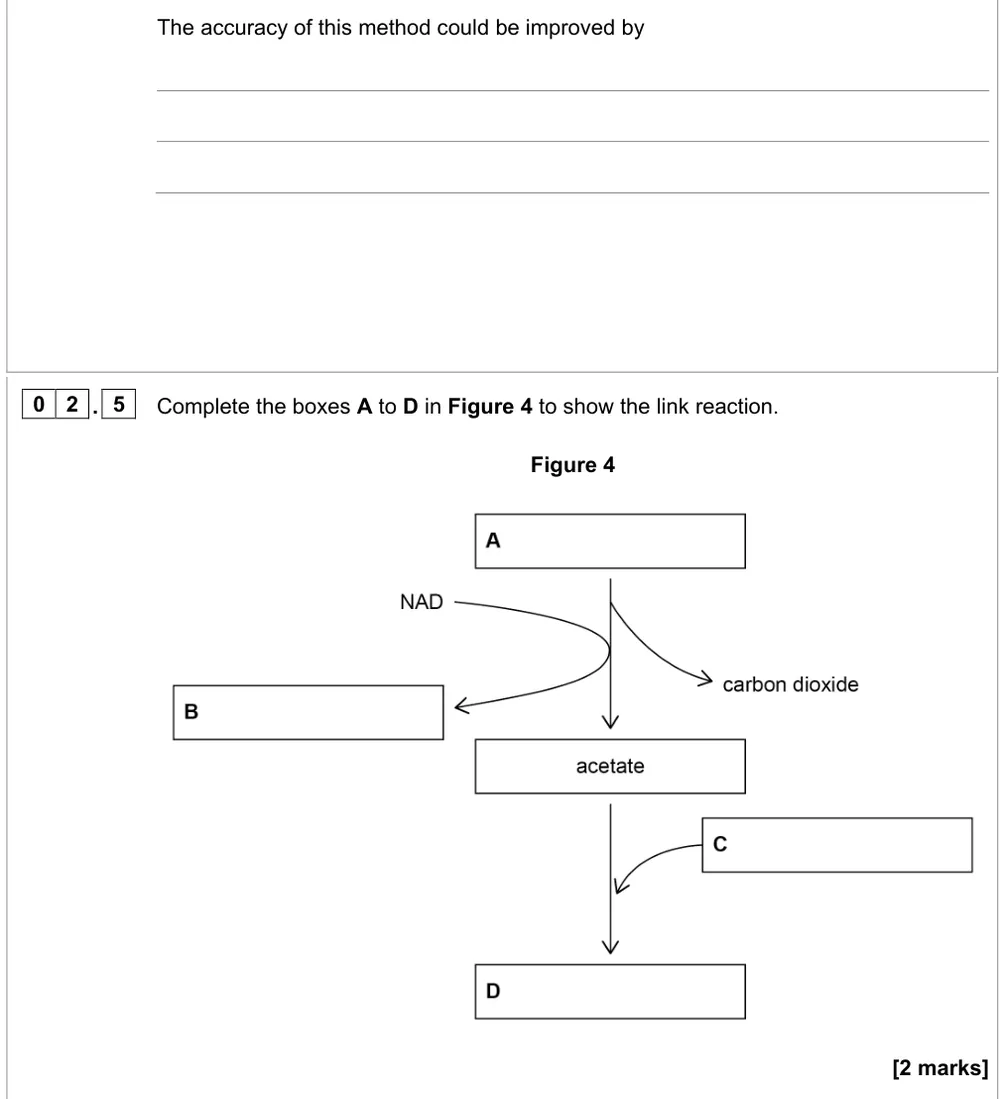
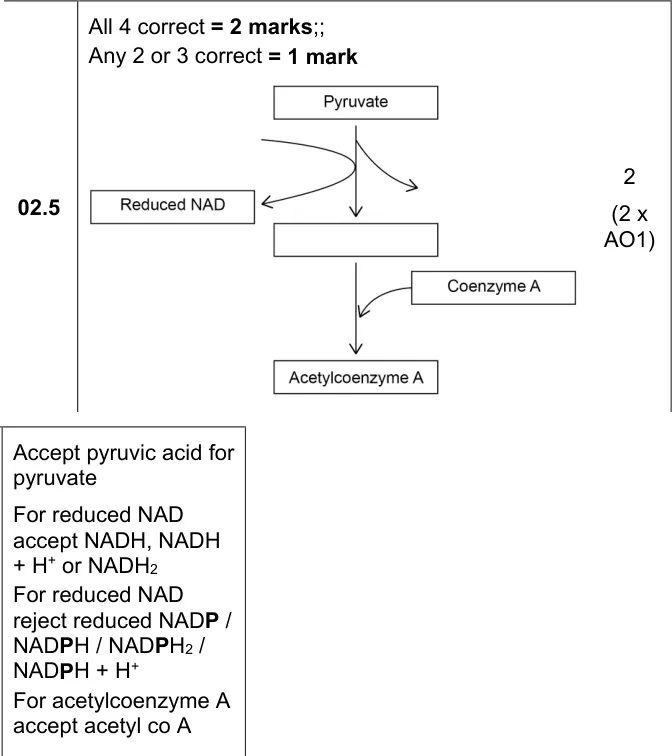
- Link reaction: pyruvate is oxidised to acetate, producing reduced NAD and carbon dioxide, and acetate combines with coenzyme A to make acetylcoenzyme A.
- Krebs cycle: oxidation-reduction reactions in the matrix that make reduced coenzymes and ATP by substrate-level phosphorylation and release carbon dioxide.
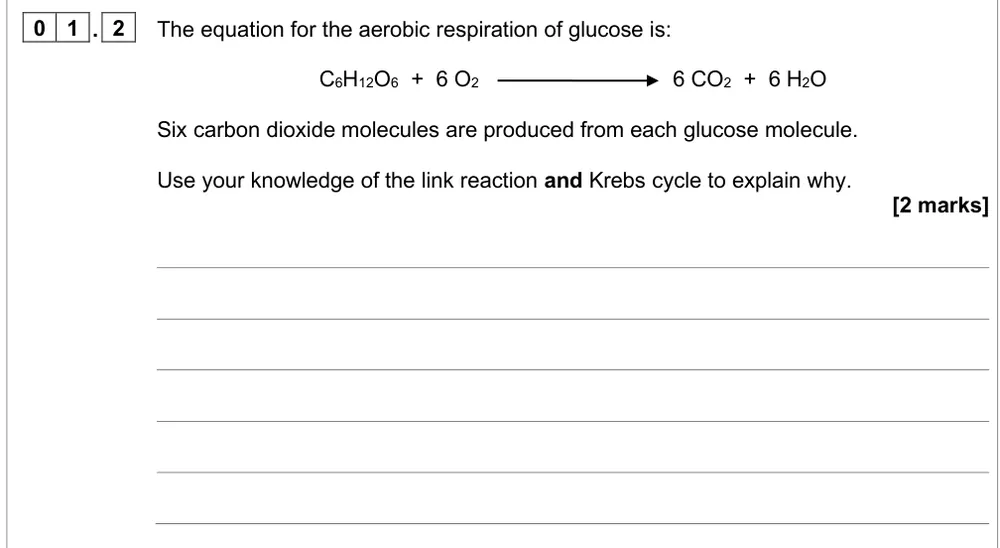
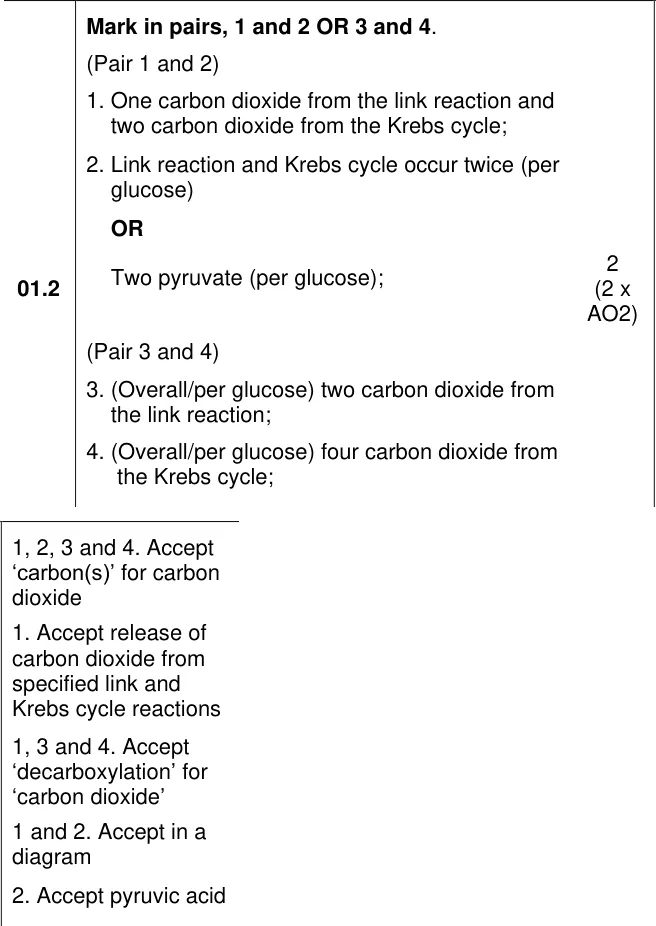
- Decarboxylation: removal of carbon dioxide; once in the link reaction and twice in each turn of the Krebs cycle.
- Oxidative phosphorylation: making ATP from ADP and Pi using energy from electrons passed along the electron transfer chain.
- Chemiosmosis: protons pumped across the inner mitochondrial membrane diffuse back through ATP synthase, which makes ATP.
- Final electron acceptor: oxygen, at the end of the electron transfer chain; it combines with protons and electrons to form water.
What these questions cover (AQA 3.5.2)
The questions test these statements from the AQA AS and A-level Biology specification (7401/7402):
- Respiration and ATP: Respiration produces ATP.
- Glycolysis: Glycolysis is the first stage of anaerobic and aerobic respiration. It occurs in the cytoplasm and is an anaerobic process.
- Glycolysis involves the following stages: phosphorylation of glucose to glucose phosphate, using ATP (the glycolysis passage and the 'describe glycolysis' question both test this)
- Glycolysis involves the following stages: production of triose phosphate (no question asks about this on its own; triose phosphate comes up in the 'describe glycolysis' question)
- Glycolysis involves the following stages: oxidation of triose phosphate to pyruvate with a net gain of ATP and reduced NAD.
- Anaerobic respiration: If respiration is only anaerobic, pyruvate can be converted to ethanol or lactate using reduced NAD. The oxidised NAD produced in this way can be used in further glycolysis.
- Pyruvate in aerobic respiration: If respiration is aerobic, pyruvate from glycolysis enters the mitochondrial matrix by active transport. (no current-specification question in the bank asks about the active transport of pyruvate into the matrix)
- Aerobic respiration in such detail as to show that: pyruvate is oxidised to acetate, producing reduced NAD in the process (the link reaction diagram asks for pyruvate and reduced NAD)
- Aerobic respiration in such detail as to show that: acetate combines with coenzyme A in the link reaction to produce acetylcoenzyme A
- Aerobic respiration in such detail as to show that: acetylcoenzyme A reacts with a four-carbon molecule, releasing coenzyme A and producing a six-carbon molecule that enters the Krebs cycle
- Aerobic respiration in such detail as to show that: in a series of oxidation-reduction reactions, the Krebs cycle generates reduced coenzymes and ATP by substrate-level phosphorylation, and carbon dioxide is lost
- Aerobic respiration in such detail as to show that: synthesis of ATP by oxidative phosphorylation is associated with the transfer of electrons down the electron transfer chain and passage of protons across inner mitochondrial membranes and is catalysed by ATP synthase embedded in these membranes
- Aerobic respiration in such detail as to show that: other respiratory substrates include the breakdown products of lipids and amino acids, which enter the Krebs cycle.
How to use this page
Write your answer on paper before you open the mark scheme. Allow about 1.3 minutes per mark: the 17 questions are worth 44 marks, so about 57 minutes in total. Then mark your answer strictly against the mark scheme and read the examiners' tip underneath it. If you'd rather print the questions, download the PDF pack.
Glycolysis and anaerobic respiration (3.5.2)
Question 1
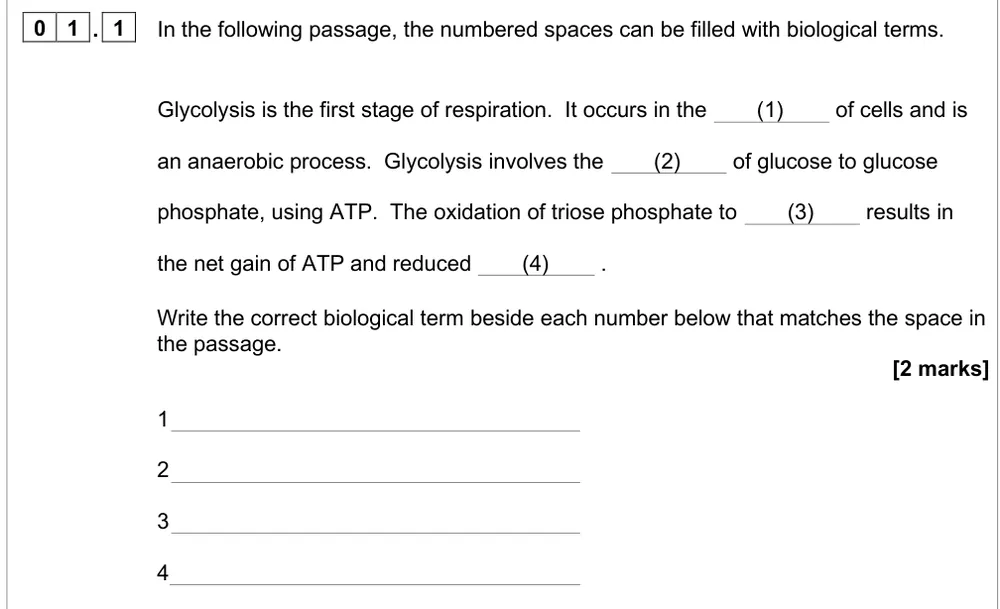
A level Paper 2 · June 2025 · Q01.1 · 2 marks · Easy
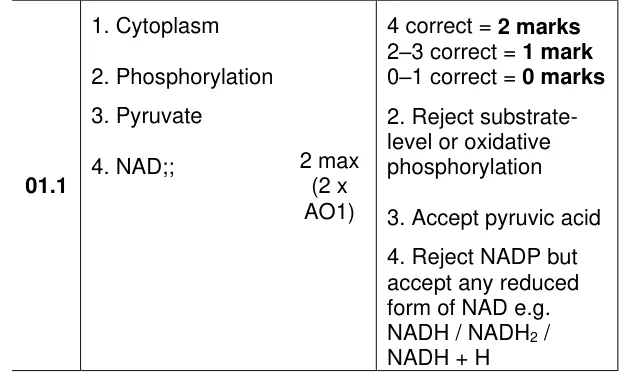
Fill four gaps in a passage about glycolysis.
Show the mark scheme
Tap an image to open it full size.
From the examiners' report: About two-thirds got both marks. The commonest errors were mitochondrion for (1), and NADP for (4); 'converted' isn't a biological term for (2).
Question 2
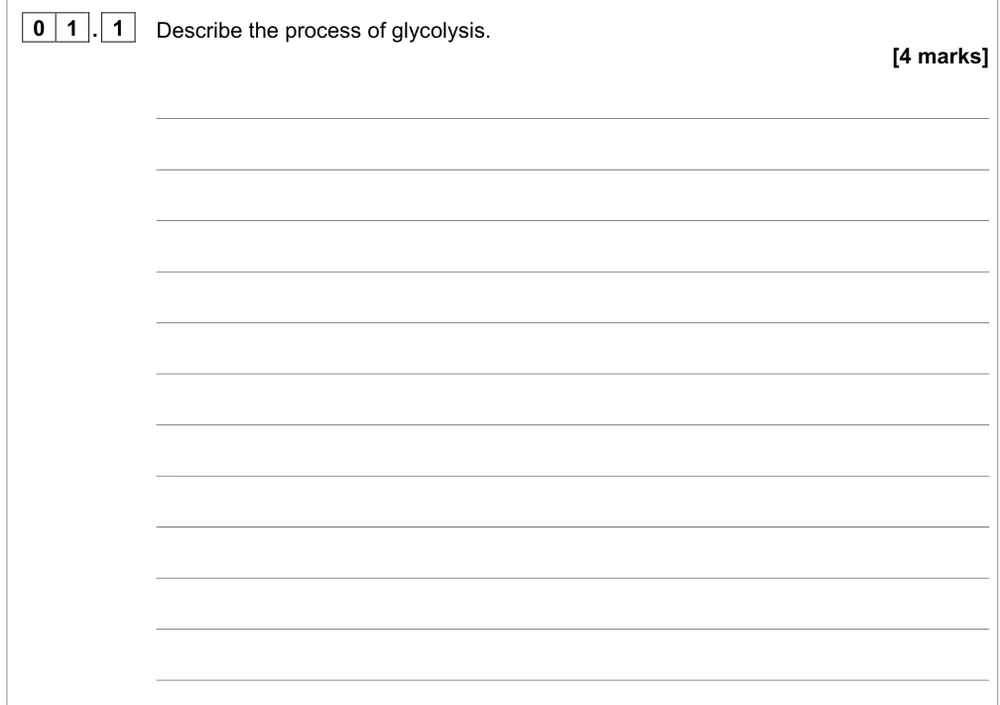
A level Paper 2 · November 2021 · Q01.1 · 4 marks · Medium
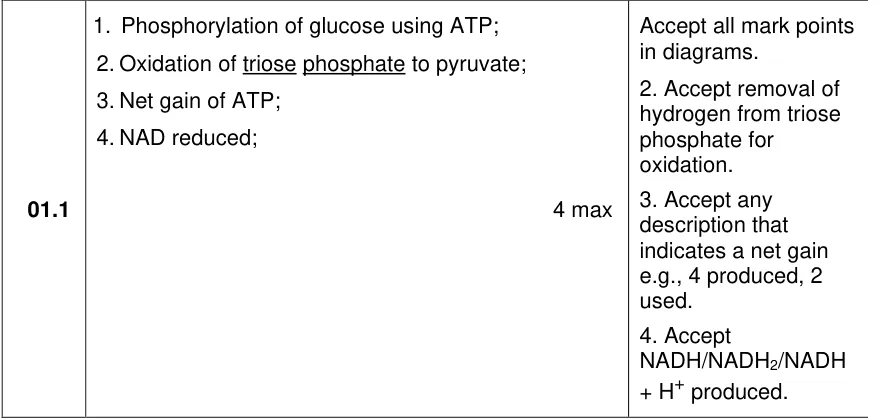
Describe the process of glycolysis.
Show the mark scheme
Tap an image to open it full size.
From the examiners' report: Fewer than 10% got all four. Say triose phosphate is oxidised, not 'converted' or 'broken down', make the net gain of ATP clear, and keep NADP, RuBP and GP out of it.
Question 3
A level Paper 2 · June 2019 · Q04.3 · 2 marks · Medium
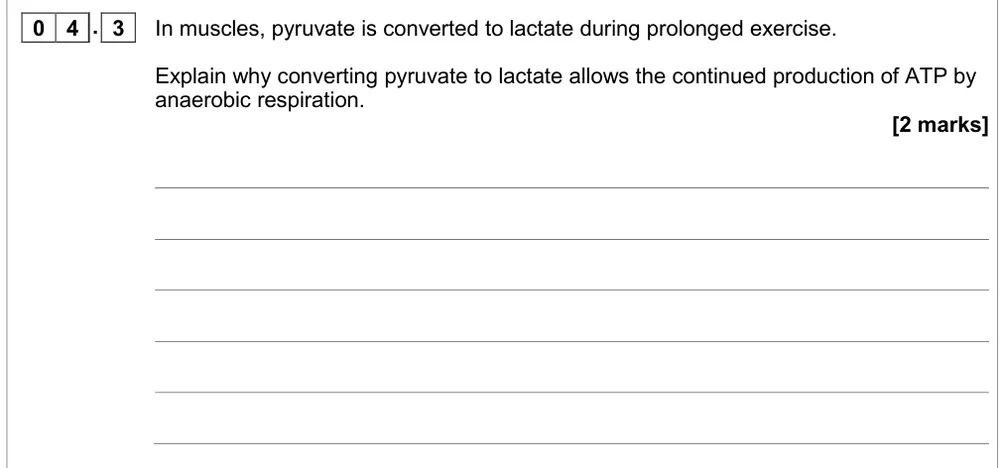
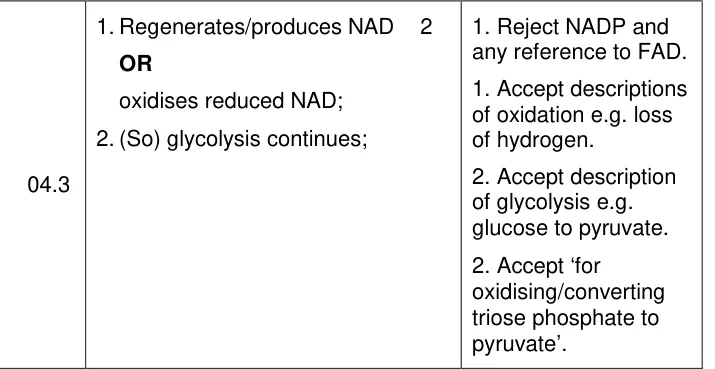
Explain why converting pyruvate to lactate lets anaerobic respiration keep making ATP.
Show the mark scheme
Tap an image to open it full size.
From the examiners' report: Only one in two scored. NAD is regenerated so it can be used again in glycolysis; the electron transport chain, Krebs cycle and link reaction play no part, and making lactate doesn't make ATP itself.
Question 4
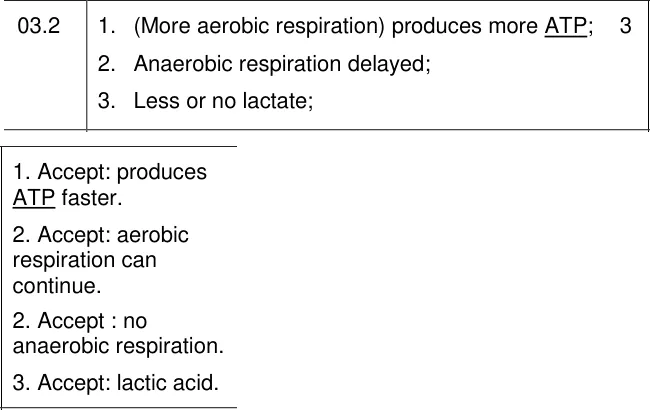
A level Paper 2 · June 2017 · Q03.2 · 3 marks · Medium
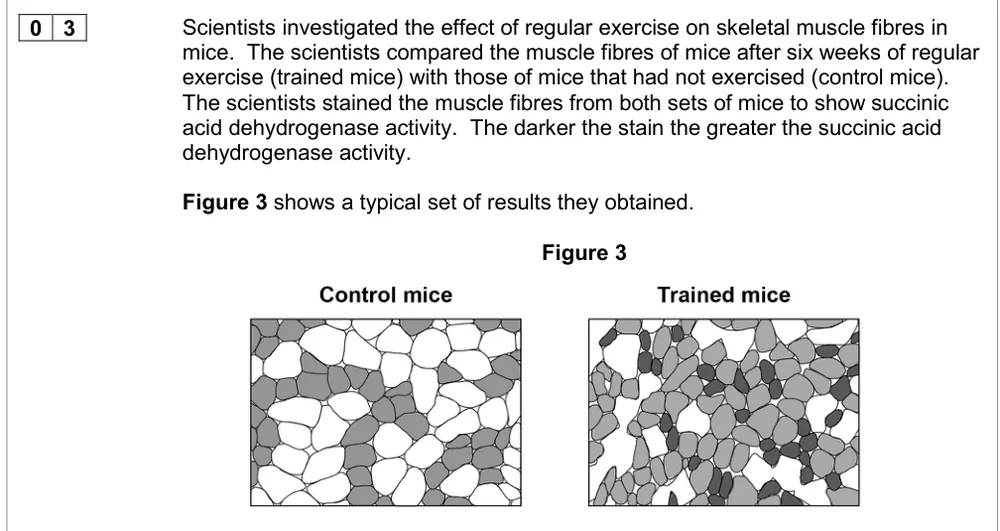
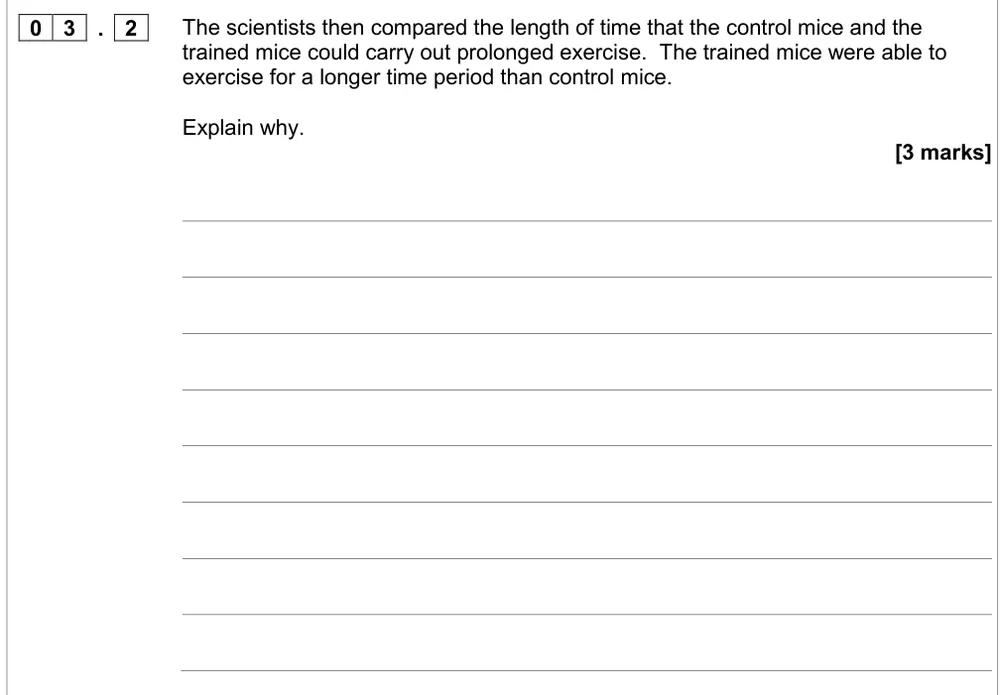
Explain why trained mice could exercise for longer than control mice.
Information from earlier in this question:
Show the mark scheme
Tap an image to open it full size.
From the examiners' report: Fewer than 10% got all three. Write about the trained mice: more aerobic respiration and ATP, anaerobic respiration delayed, less lactate. General effects of training such as more mitochondria didn't score.
Question 5
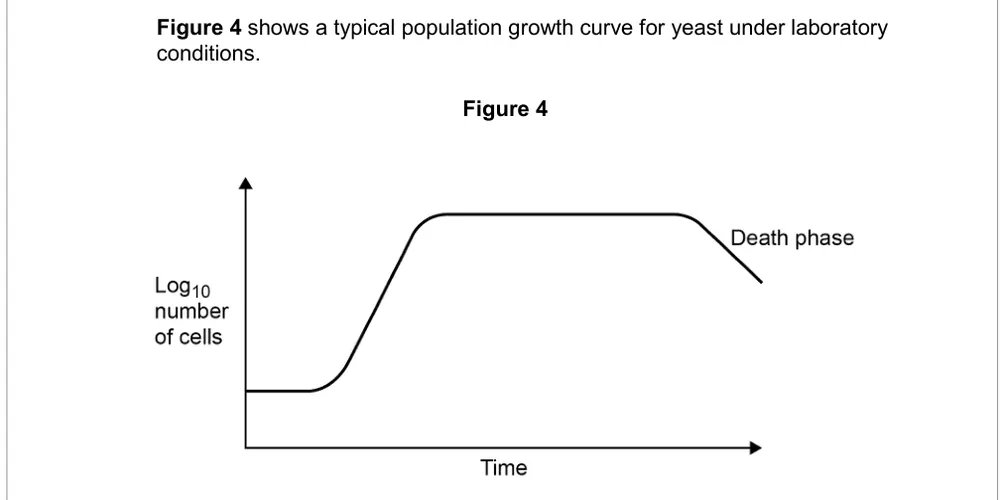
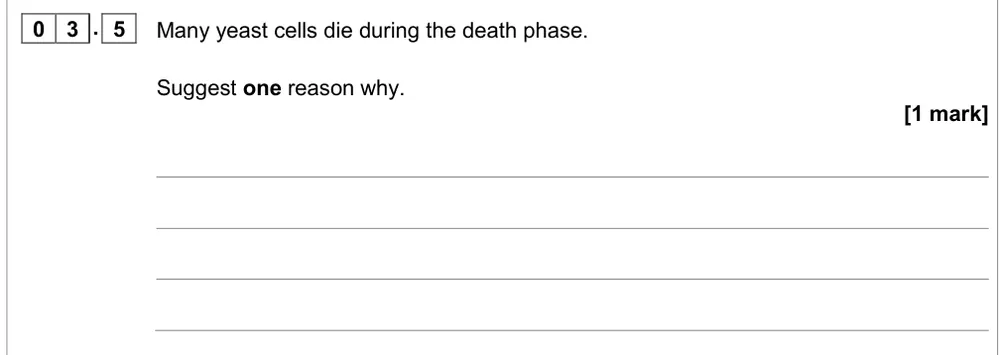
A level Paper 2 · June 2018 · Q03.5 · 1 mark · Medium
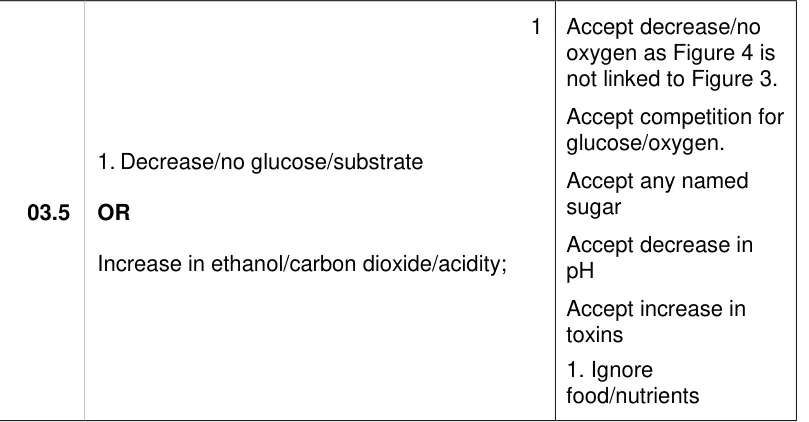
Suggest why many yeast cells die during the death phase.
Information from earlier in this question:
Show the mark scheme
Tap an image to open it full size.
From the examiners' report: Only 53% got it. 'Lack of food' or 'lack of resources' is too vague; name glucose or oxygen, or the ethanol that yeast makes. Yeast doesn't make lactate.
Link reaction and Krebs cycle (3.5.2)
Question 6
A level Paper 3 · June 2023 · Q02.5 · 2 marks · Easy
Complete a diagram of the link reaction.
Show the mark scheme
Tap an image to open it full size.
From the examiners' report: Nearly three-quarters got both marks. Those who failed confused the link reaction with glycolysis and wrote glucose at the top, pyruvate at the bottom and ATP on the right.
Question 7
A level Paper 2 · June 2025 · Q01.2 · 2 marks · Medium
Use the link reaction and Krebs cycle to explain six carbon dioxide molecules per glucose.
Show the mark scheme
Tap an image to open it full size.
From the examiners' report: About half got both marks. Count per pyruvate and then double it, or give the totals per glucose. Don't confuse the Krebs cycle with the Calvin cycle, and it's decarboxylation, not carboxylation.
Question 8
A level Paper 2 · November 2021 · Q01.2 · 2 marks · Hard
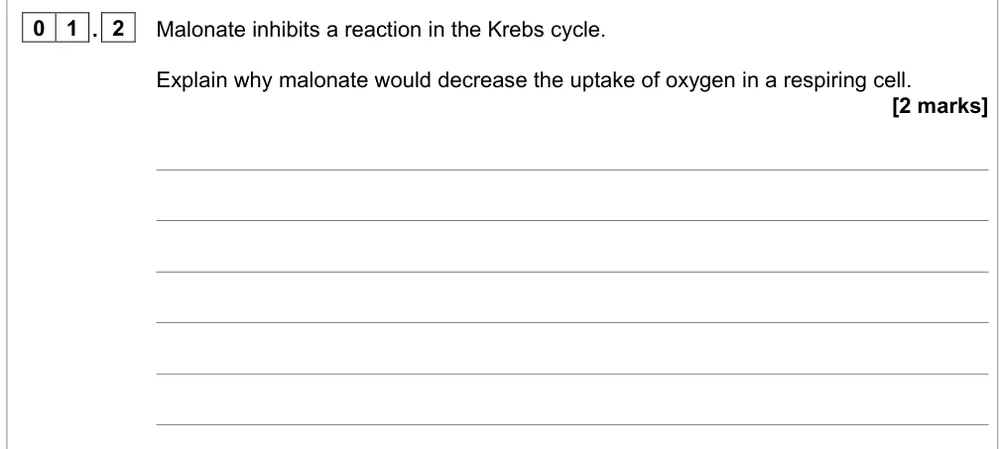
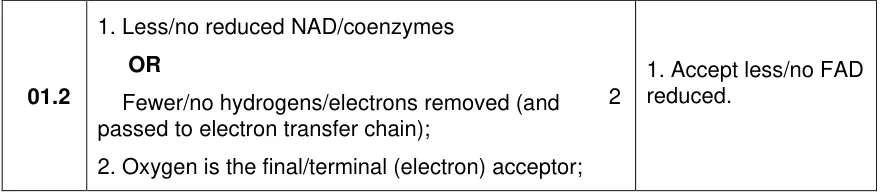
Explain why a Krebs cycle inhibitor decreases oxygen uptake.
Show the mark scheme
Tap an image to open it full size.
From the examiners' report: 46% scored at least one mark, usually for oxygen as the final electron acceptor; only 22% linked malonate to fewer reduced coenzymes. 'Only anaerobic respiration occurs' didn't score.
Oxidative phosphorylation and chemiosmosis (3.5.2)
Question 9
A level Paper 2 · June 2025 · Q01.3 · 3 marks · Easy
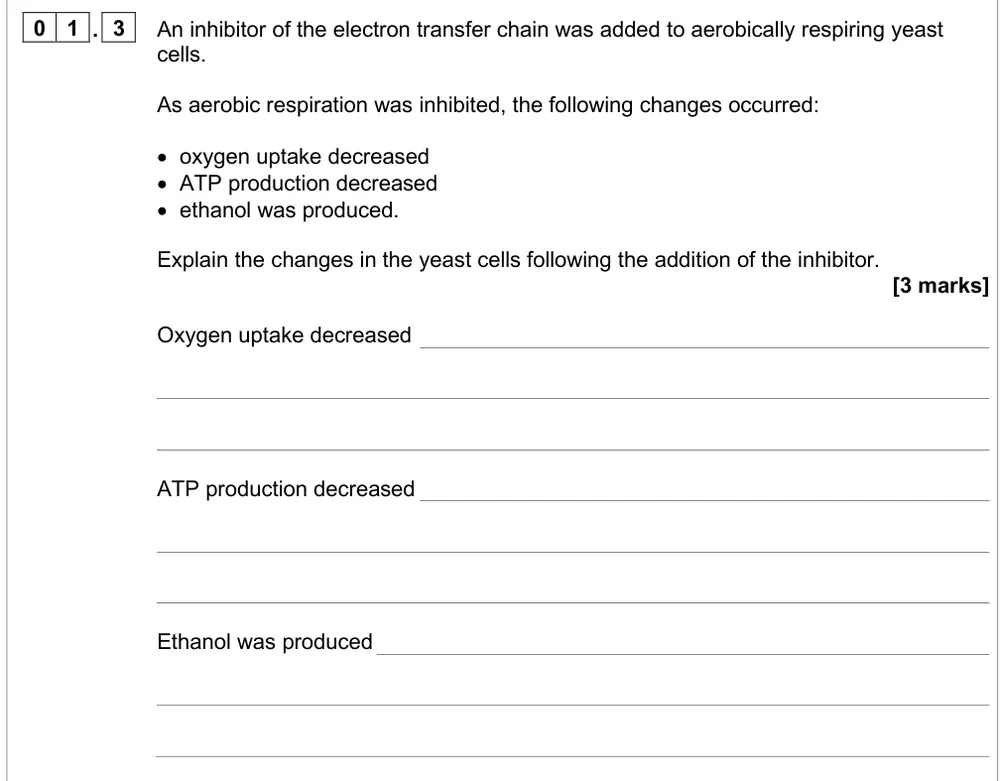
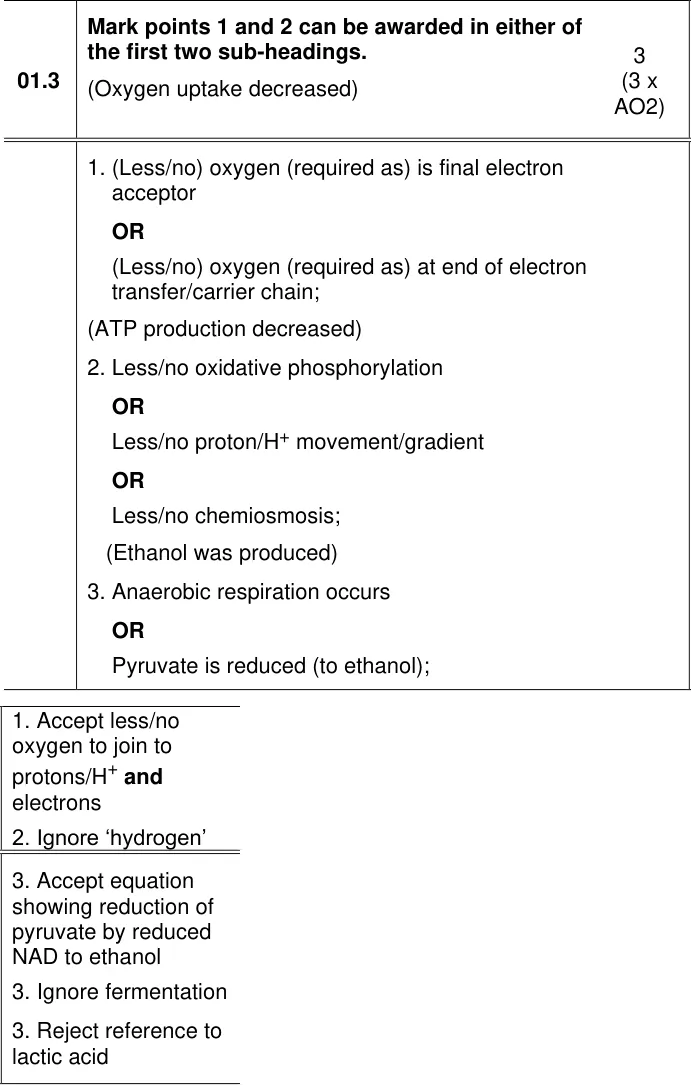
Explain the effects of an electron transfer chain inhibitor on yeast.
Show the mark scheme
Tap an image to open it full size.
From the examiners' report: Over a third got all three. Oxygen uptake falls because oxygen is the final electron acceptor, not because respiration is anaerobic. Pyruvate is reduced to ethanol, and adding lactate cost the mark.
Question 10
A level Paper 2 · November 2020 · Q10.3 · 2 marks · Hard
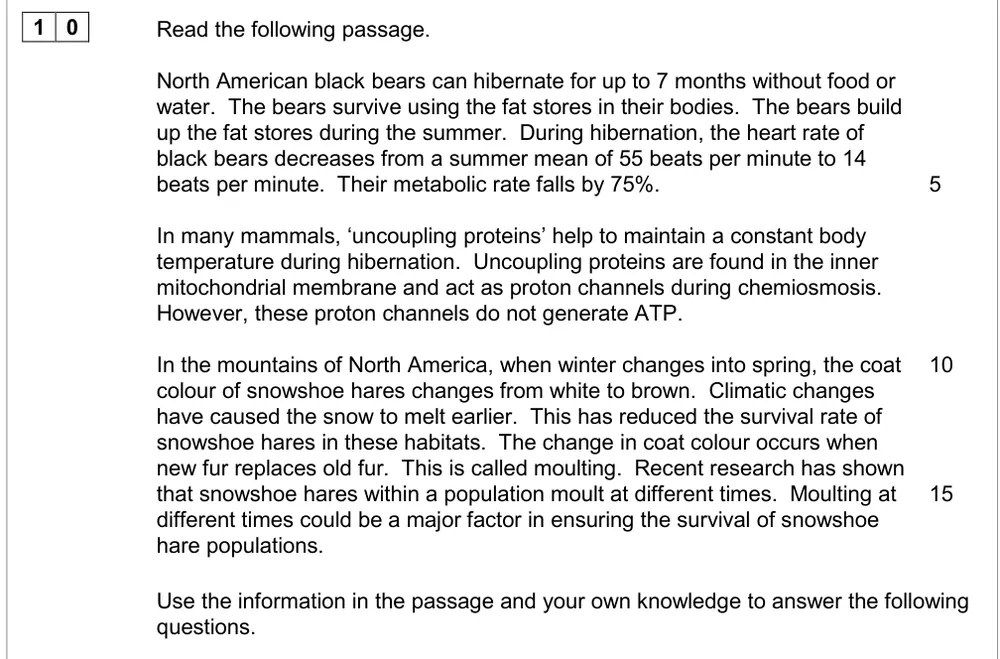
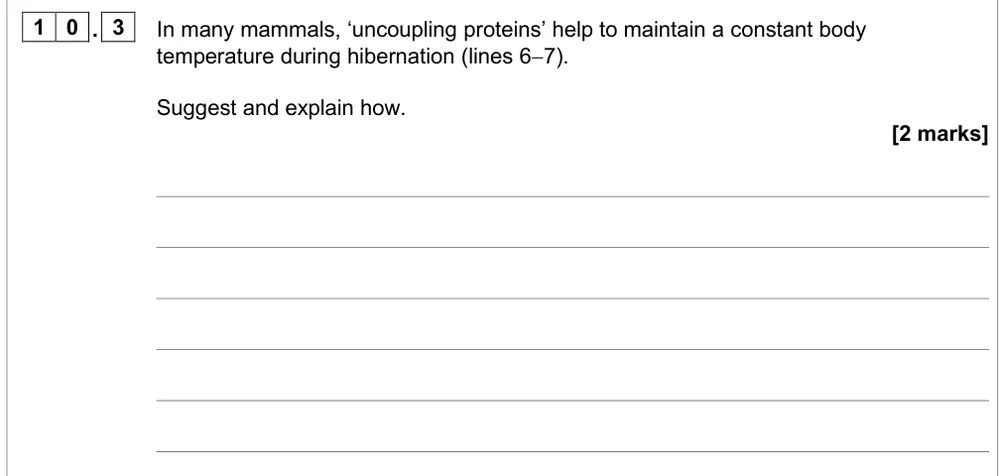
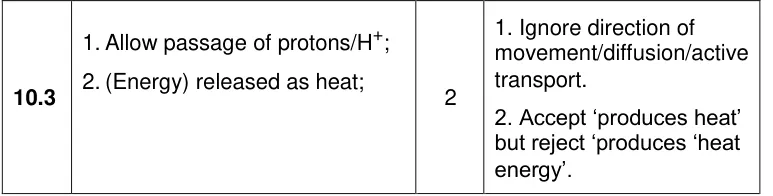
Explain how uncoupling proteins keep body temperature constant in hibernation.
Information from earlier in this question:
Show the mark scheme
Tap an image to open it full size.
From the examiners' report: Only 7% got both marks. Apply chemiosmosis: protons flow back through the uncoupling proteins instead of ATP synthase, so the energy is released as heat. Don't just repeat the passage.
Question 11
A level Paper 3 · June 2025 · Q01.3 · 3 marks
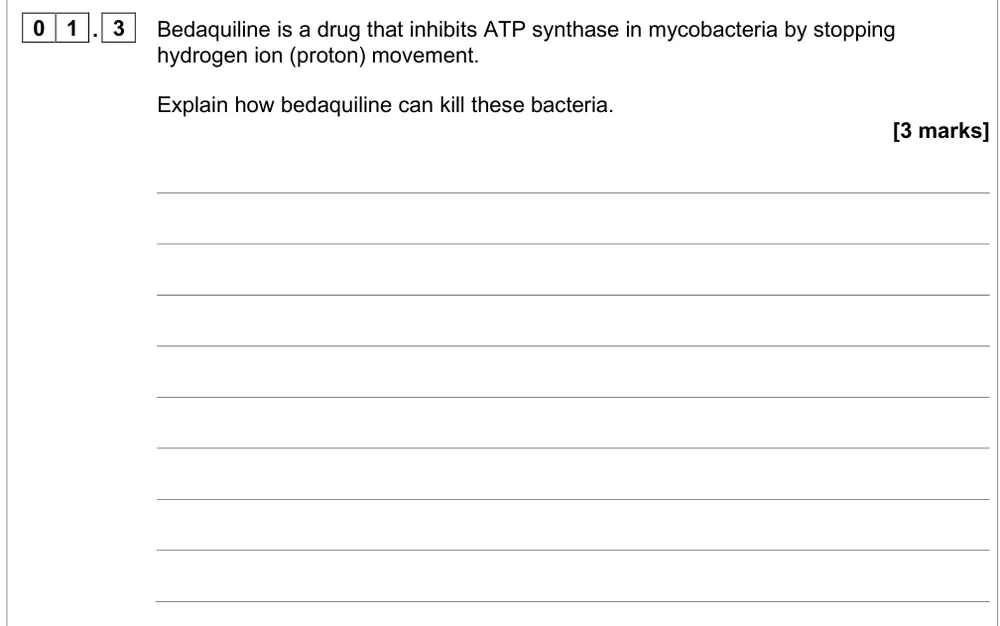
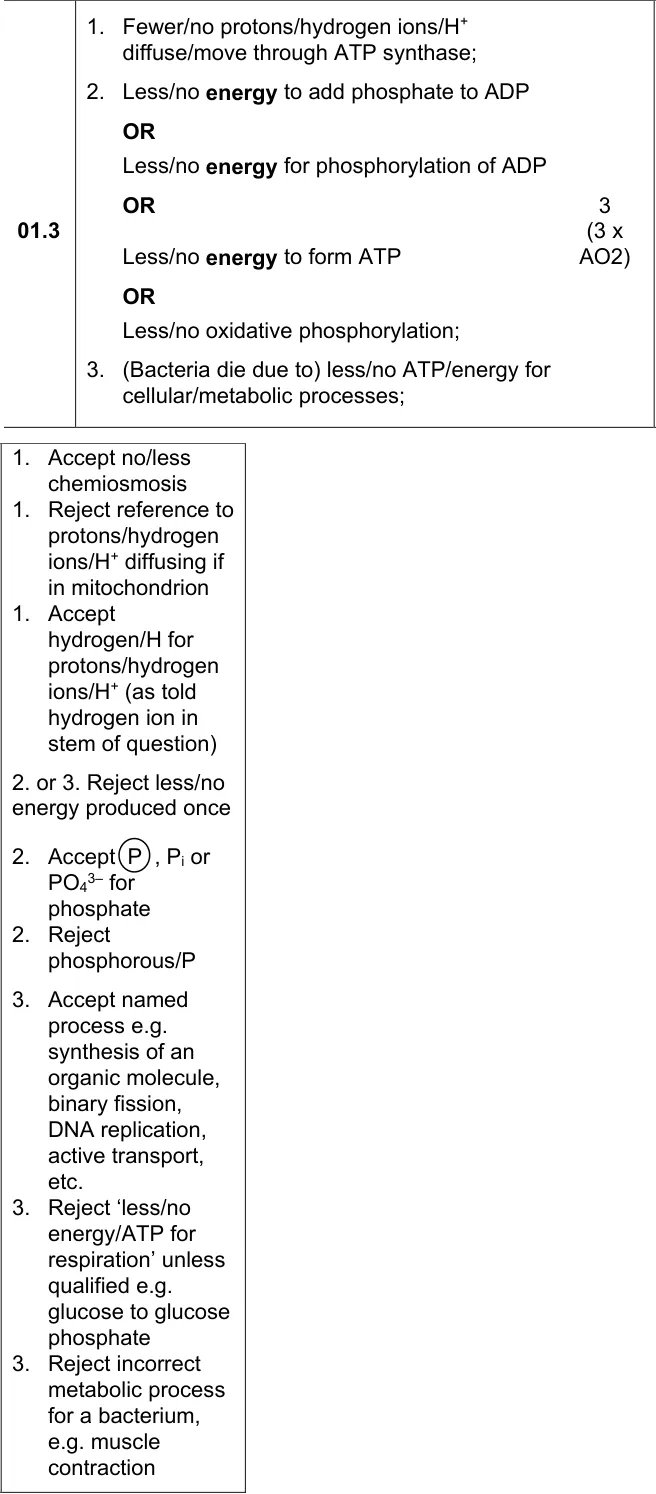
Explain how a drug that stops protons moving through ATP synthase kills bacteria.
Show the mark scheme
Tap an image to open it full size.
From the examiners' report: Bacteria have no mitochondria, so answers set in mitochondria lost the first mark. Say there's less energy to make ATP, then name a process in a bacterium that needs ATP; energy is never 'produced'.
Respiratory substrates and ATP (3.5.2)
Question 12
A level Paper 2 · June 2019 · Q03.2 · 2 marks · Medium
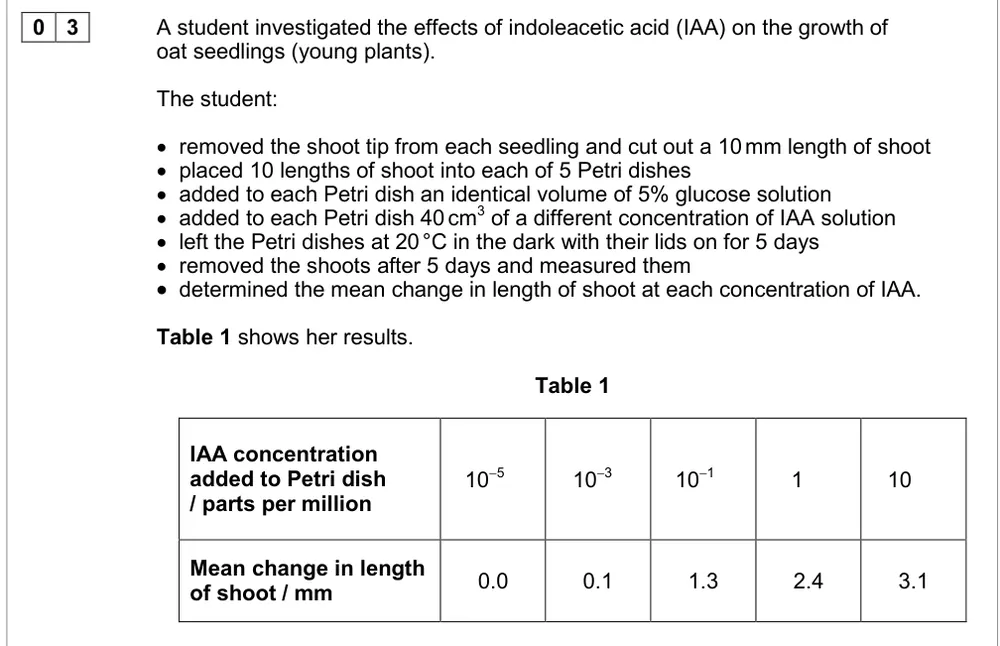
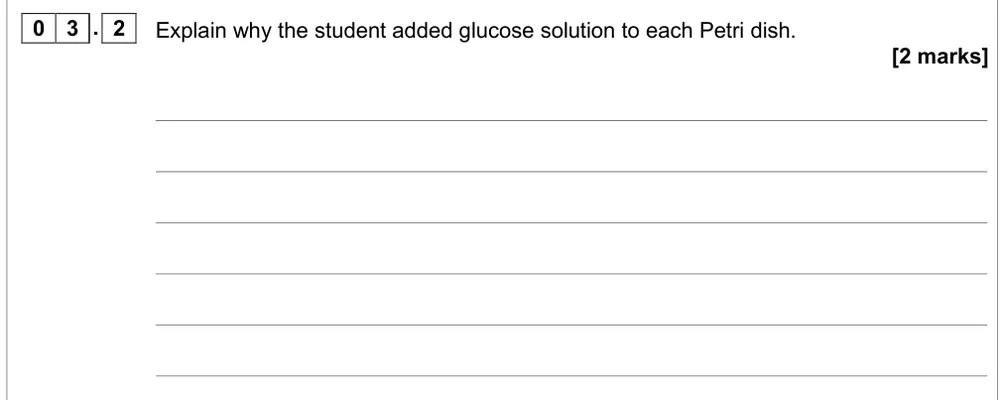
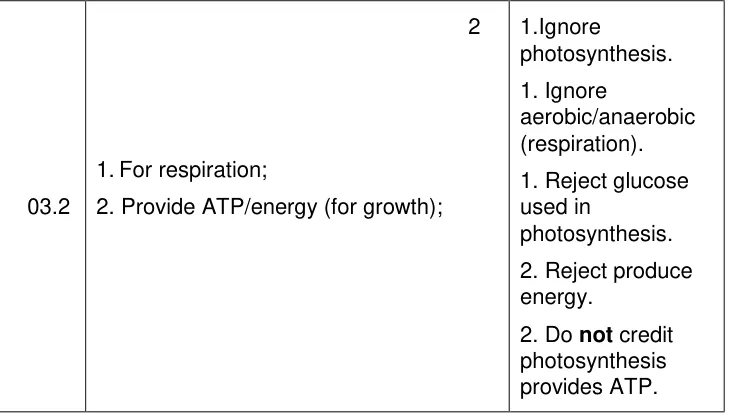
Explain why glucose solution was added to Petri dishes of oat shoots.
Information from earlier in this question:
Show the mark scheme
Tap an image to open it full size.
From the examiners' report: About a third got both marks. The shoots were in the dark, so glucose is for respiration, which provides ATP for growth. Photosynthesis and 'producing energy' didn't score.
Question 13
AS Paper 2 · June 2023 · Q03.4 · 3 marks · Hard
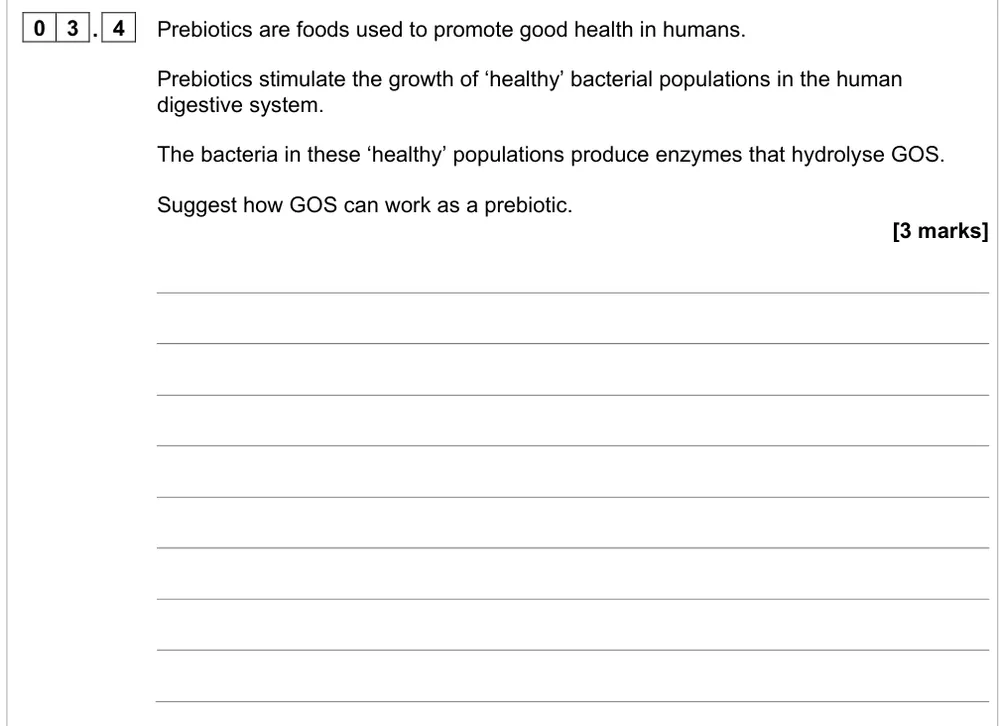
Suggest how galacto-oligosaccharides work as a prebiotic.
Information from earlier in this question:

Show the mark scheme
Tap an image to open it full size.
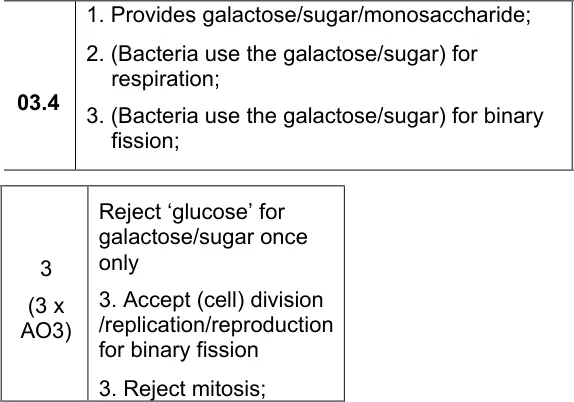
From the examiners' report: Only a third scored at least one mark. Many just repeated the stem. Follow the sugar: hydrolysis gives galactose, which the bacteria use in respiration and for binary fission.
Question 14
A level Paper 2 · June 2017 · Q01.2 · 3 marks · Medium
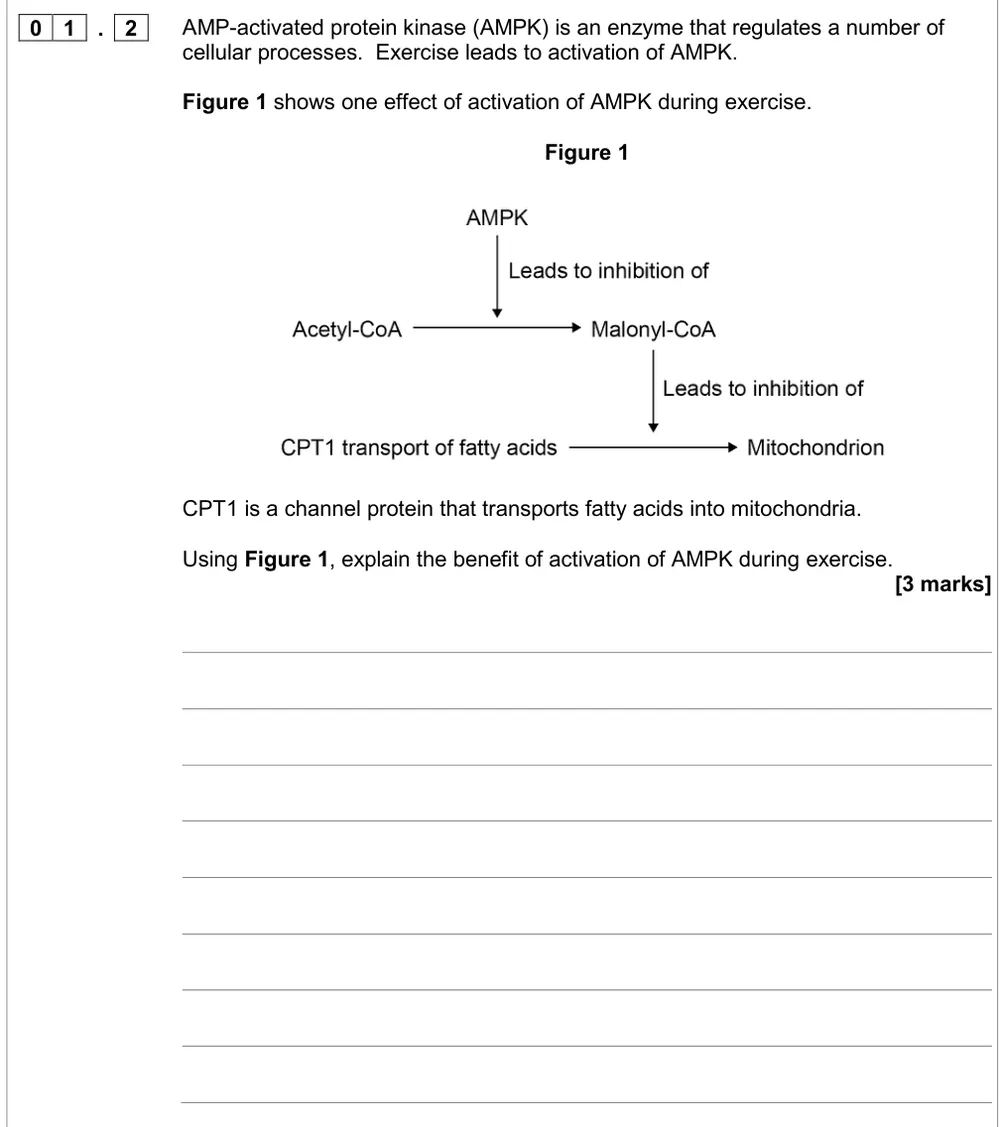
Use a flow chart to explain the benefit of activating AMPK during exercise.
Show the mark scheme
Tap an image to open it full size.
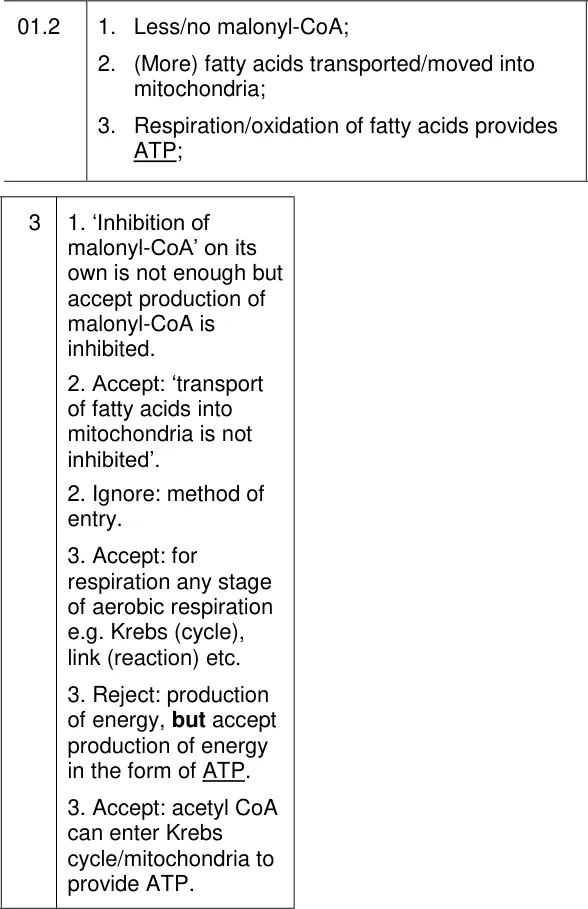
From the examiners' report: Over a third scored zero. Two inhibitions mean more fatty acids get into the mitochondria, not fewer, and the fatty acids themselves are respired to make ATP; glucose isn't the point here.
Question 15
A level Paper 2 · November 2020 · Q10.1 · 3 marks · Medium
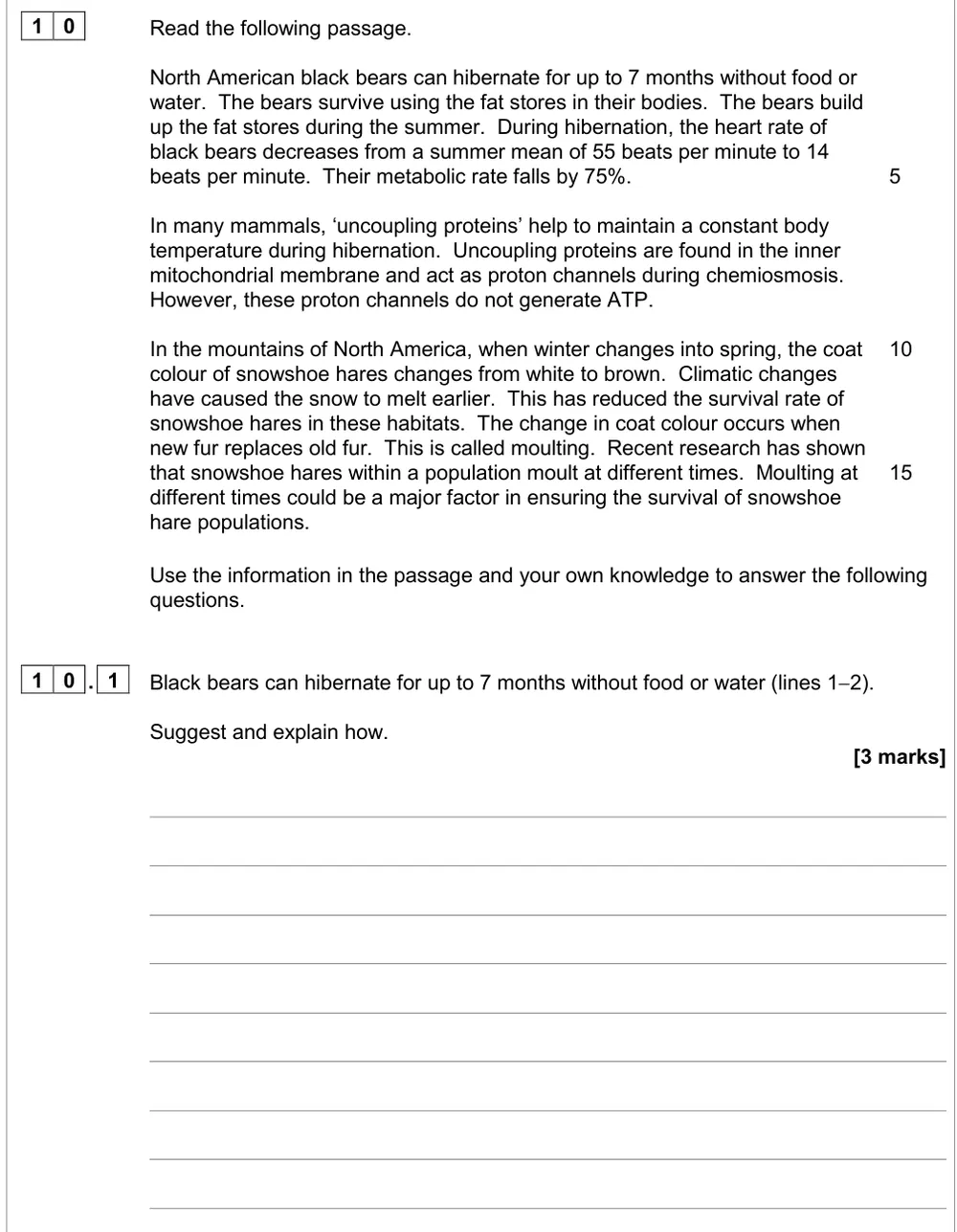
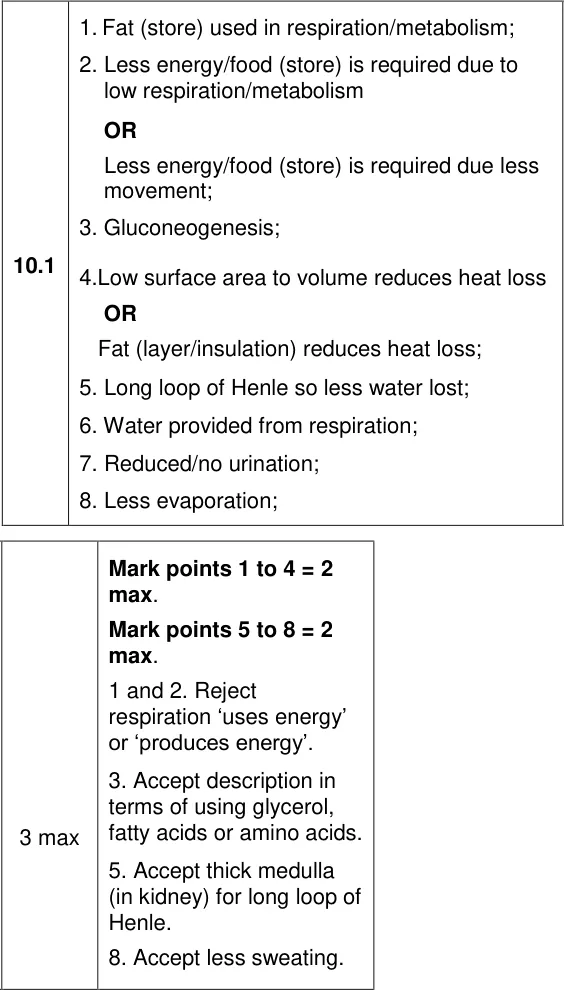
Suggest how black bears survive 7 months of hibernation without food or water.
Show the mark scheme
Tap an image to open it full size.
From the examiners' report: Only 4% got all three. The fat is respired, and a low metabolic rate means less of the store is needed; respiration also makes water. Respiration doesn't 'use' or 'produce' energy.
Respiration and exercise data (3.5.2)
Question 16
A level Paper 3 · November 2020 · Q06.5 · 4 marks · Medium
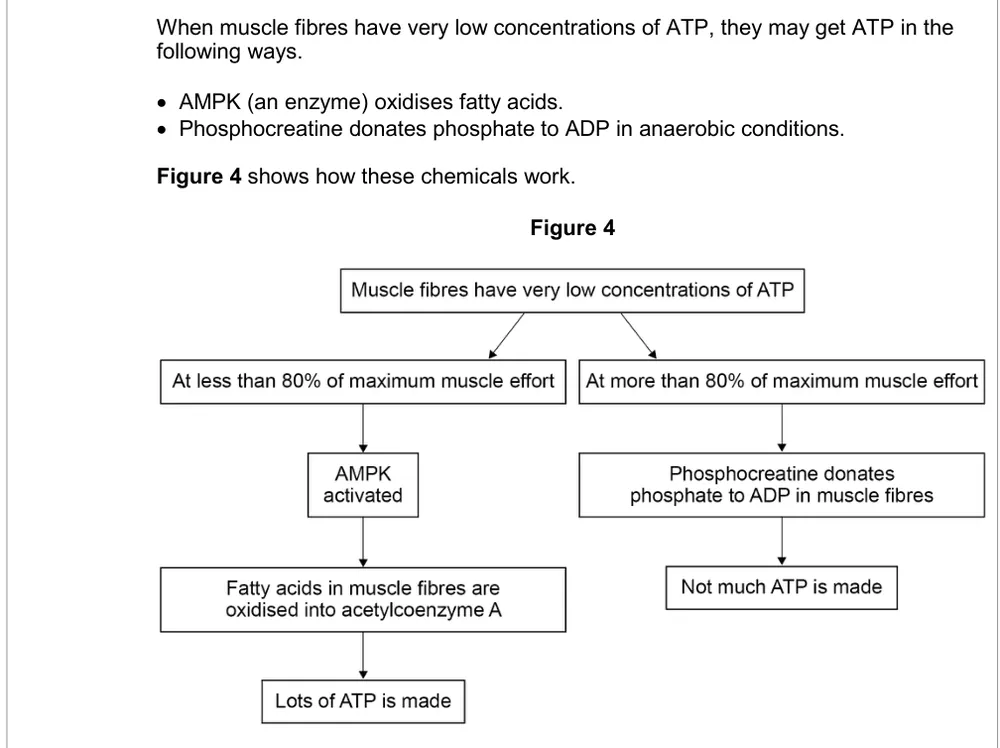
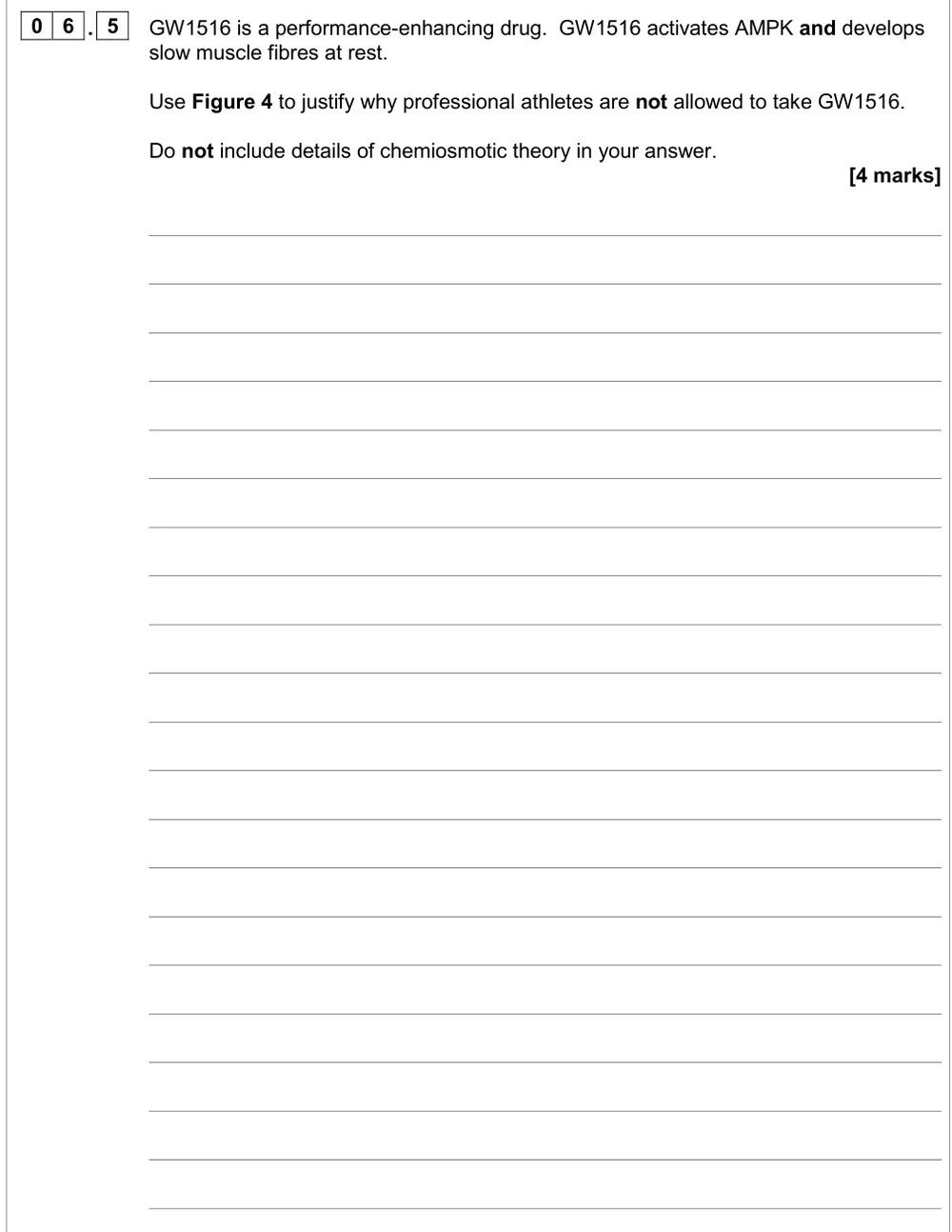
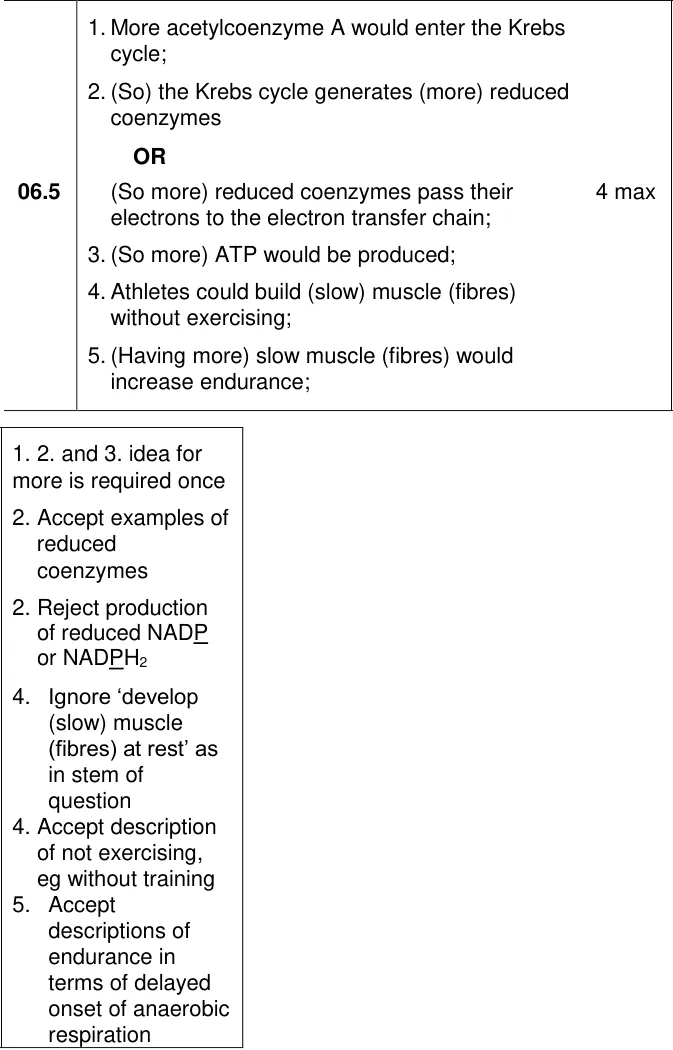
Use a flow chart to justify banning a drug that activates AMPK.
Information from earlier in this question:
Show the mark scheme
Tap an image to open it full size.
From the examiners' report: 82% scored at least one mark. Use Figure 4, not 'it isn't fair': more acetylcoenzyme A into the Krebs cycle means more reduced coenzymes and more ATP. Muscle fibres don't make ATP by contracting.
Question 17
A level Paper 3 · June 2019 · Q04.4 · 3 marks · Easy
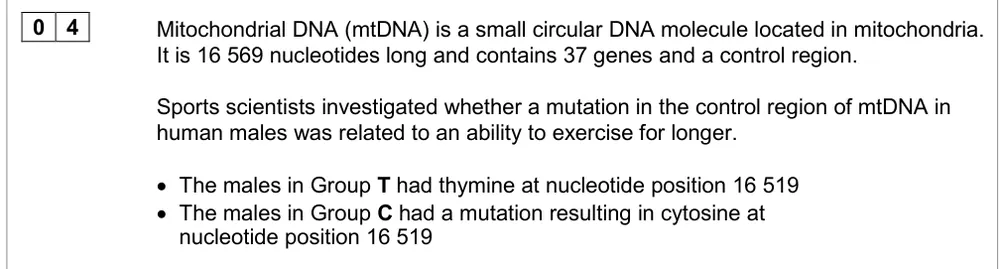
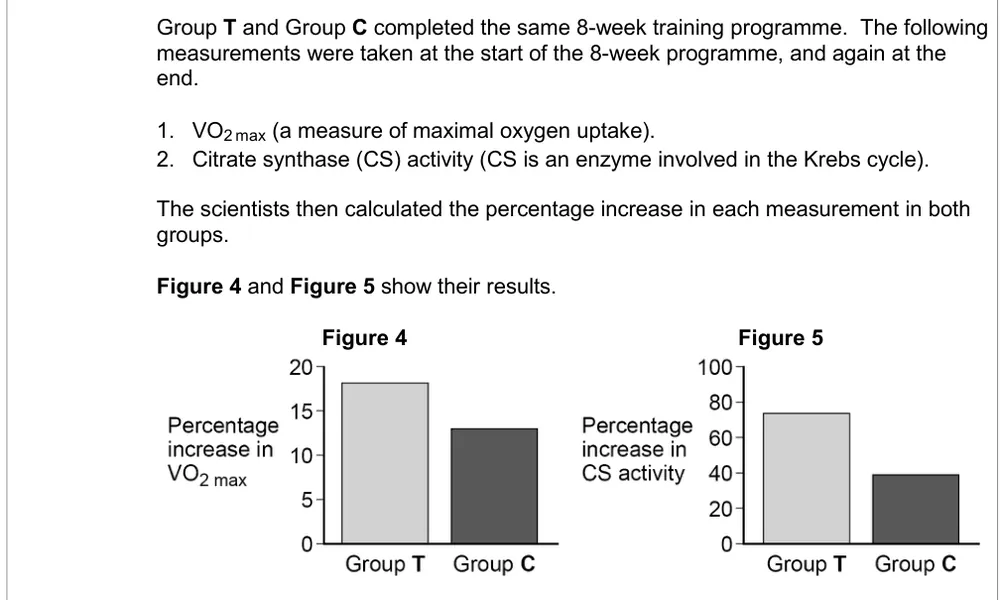
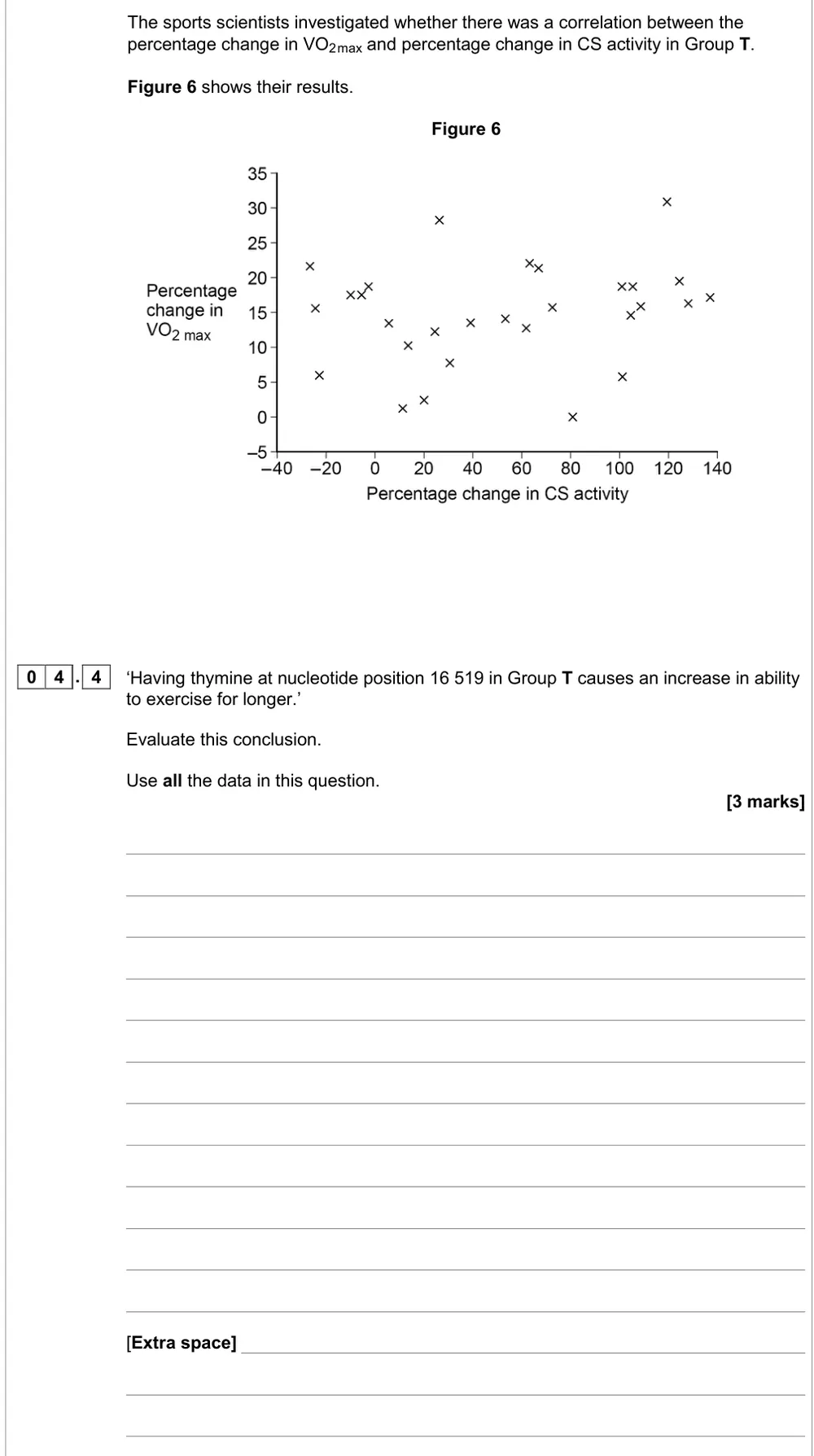
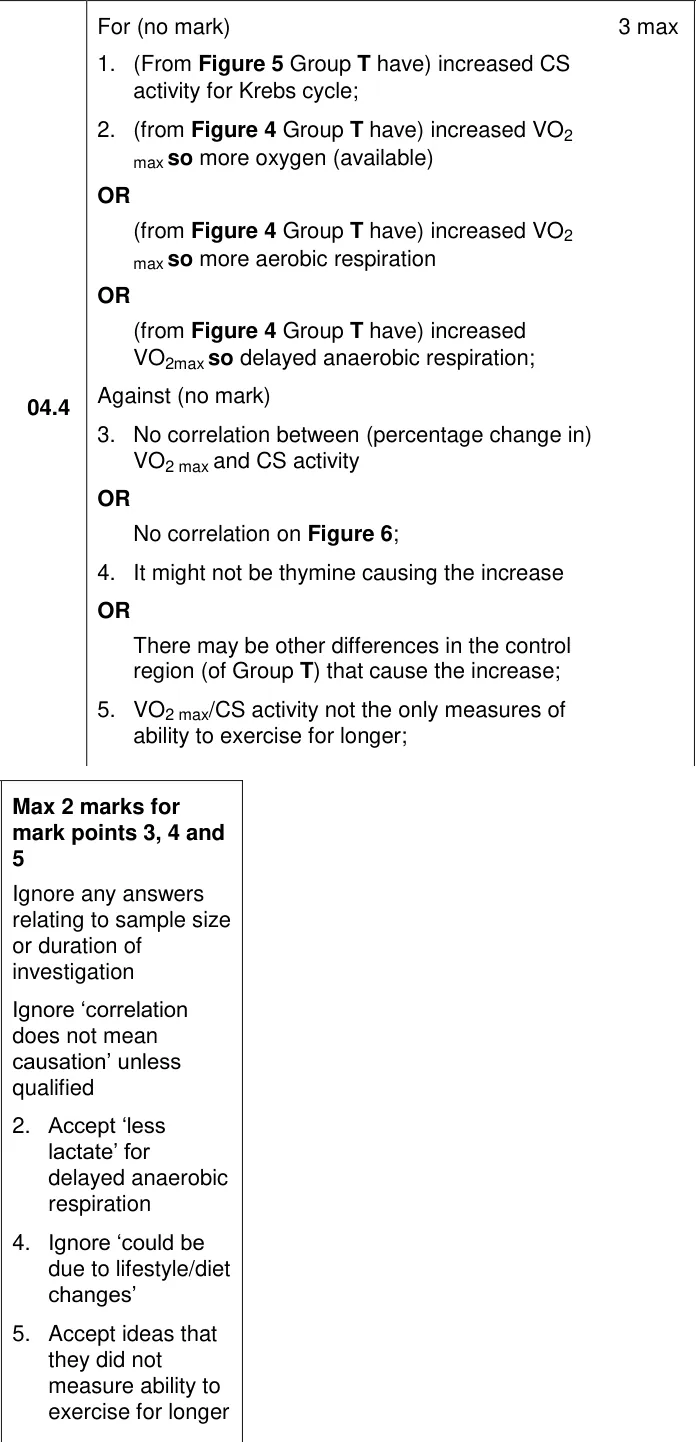
Evaluate a conclusion that a mitochondrial DNA base lets people exercise for longer.
Information from earlier in this question:
Show the mark scheme
Tap an image to open it full size.
From the examiners' report: Most scored some marks, usually for 'no correlation'. Many mentioned higher CS activity or VO2 max without linking it to more Krebs cycle activity or more oxygen for aerobic respiration.
Where students lose marks (from AQA examiners' reports and mark schemes)
Each point below is followed by wording that gained marks.
Oxidise triose phosphate, don't 'convert' it: A third scored zero on 'describe glycolysis' and fewer than 10% got all four marks. Most who mentioned the step wrote 'conversion' or 'breakdown' of triose phosphate to pyruvate, and a net gain of ATP was often unclear.
✔ Gains credit: "Phosphorylation of glucose using ATP; oxidation of triose phosphate to pyruvate; net gain of ATP; NAD reduced."
Lactate is made to regenerate NAD: Only one in two students scored on why making lactate lets anaerobic respiration continue. Wrong answers brought in the electron transport chain, the Krebs cycle or the link reaction, or said converting pyruvate to lactate makes ATP directly; many confused oxidation with reduction.
✔ Gains credit: "Regenerates NAD or oxidises reduced NAD; so glycolysis continues."
Two pyruvate, so double the carbon dioxide: About 50% got both marks for explaining six CO2 per glucose. Weaker answers confused the Krebs cycle with the Calvin cycle, gave photosynthetic products, said six cycles occur, or wrote 'carboxylation' for decarboxylation.
✔ Gains credit: "One carbon dioxide from the link reaction and two from the Krebs cycle; link reaction and Krebs cycle occur twice per glucose."
Oxygen is the final electron acceptor: On malonate and oxygen uptake, only 22% earned the mark for fewer reduced coenzymes. A common uncredited answer was that only anaerobic respiration would occur so less oxygen is needed; the same answer wasn't credited on the 2025 yeast inhibitor question.
✔ Gains credit: "Less reduced NAD or coenzymes; oxygen is the final (electron) acceptor."
Pyruvate is reduced to ethanol: On the yeast inhibitor question a significant minority said pyruvate is oxidised to ethanol, others lost the mark by adding lactate as a product, and 'pyruvate is converted to ethanol' with no mention of anaerobic respiration wasn't credited.
✔ Gains credit: "Anaerobic respiration occurs or pyruvate is reduced (to ethanol)."
Protons pass through, energy leaves as heat: Only 7% got both marks on uncoupling proteins and 10% didn't attempt it. Many repeated the passage or described ATP production by chemiosmosis, and many wrote about the 'production of energy'.
✔ Gains credit: "Allow passage of protons; (energy) released as heat."
Bacteria have ATP synthase but no mitochondria: On bedaquiline, answers about protons diffusing in mitochondria lost the first mark because bacteria have no mitochondria. Many didn't say there would be less energy to make ATP, and some still wrote that energy is produced or is needed 'for respiration'.
✔ Gains credit: "Fewer protons move through ATP synthase; less energy to add phosphate to ADP; less ATP for cellular processes."
More fatty acids reach the mitochondria: Over a third scored zero on the AMPK question. Many said the transport of fatty acids into mitochondria would be reduced, and a common misconception was that glucose would be used instead of fatty acids.
✔ Gains credit: "Less malonyl-CoA; more fatty acids transported into mitochondria; respiration of fatty acids provides ATP."
Download the questions
Download the PDF pack (17 questions, mark schemes at the end)
Keep practising
- ATP: AQA A Level Biology exam questions by topic
- Photosynthesis: AQA A Level Biology exam questions by topic
- Energy and ecosystems: AQA A Level Biology exam questions by topic
- Eukaryotic cell structure: AQA A Level Biology exam questions by topic
- AQA 3.5.2 respiration: self-marking quiz
- AQA A Level Biology masterclasses
Questions, mark schemes and examiners' report extracts © AQA.