

The control of blood water potential (AQA 3.6.4.3) is A-level only, so it's Year 13 content and the last part of homeostasis. You need to explain osmoregulation, the roles of the hypothalamus, posterior pituitary and ADH, and how each part of the nephron does its job: ultrafiltration in the glomerulus, reabsorption of glucose and water in the proximal convoluted tubule, the sodium ion gradient set up by the loop of Henle in the medulla, and water reabsorption from the distal convoluted tubule and collecting ducts.
The examiners' reports keep finding the same slips. Students forget 'posterior' in posterior pituitary, send water into the collecting duct instead of out of it, and leave osmosis out. On ultrafiltration they describe the arterioles but don't say the blood pressure is high, and few mention the basement membrane. They write PCT and DCT, which aren't credited, and on the medulla graph they don't link a thicker medulla to a longer loop of Henle.
Start with ADH and the collecting duct, then ultrafiltration and reabsorption, and finish with the drug and diet investigations. Write your answer on paper before you open each mark scheme. If you'd like help with this topic, my AQA masterclasses run online on Tuesdays at 5.15pm for Year 12 and on Wednesdays or Thursdays at 6.30pm for Year 13.
What you need from GCSE and Year 12
Each question on this page assumes you're secure on these GCSE and Year 12 ideas. If any of them feels shaky, revise it before you start.
- GCSE: the kidneys filter the blood, reabsorb useful substances such as glucose, and remove urea and excess water and ions in urine.
- GCSE: ADH is released by the pituitary gland when the blood is too concentrated and makes the kidney tubules reabsorb more water.
- Year 12 (AQA 3.2.3): water moves by osmosis from a higher (less negative) to a lower water potential, and glucose is reabsorbed by co-transport with sodium ions.
- Year 12 (AQA 3.3.4.2): tissue fluid forms because high hydrostatic pressure at the arteriole end of a capillary forces small molecules out.
Key terms
These words come up in the questions and mark schemes. Examiners expect you to use them exactly.
- Osmoregulation: the control of the water potential of the blood.
- Hypothalamus: the part of the brain containing osmoreceptors that detect changes in blood water potential and make ADH.
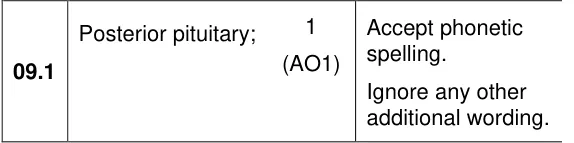
- Posterior pituitary: the gland that releases ADH into the blood; 'pituitary' alone isn't enough.
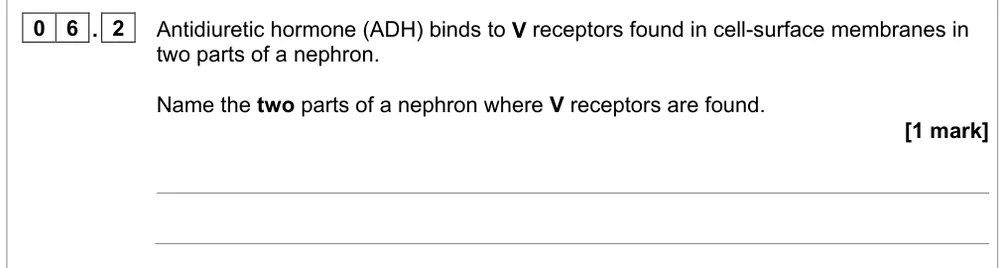
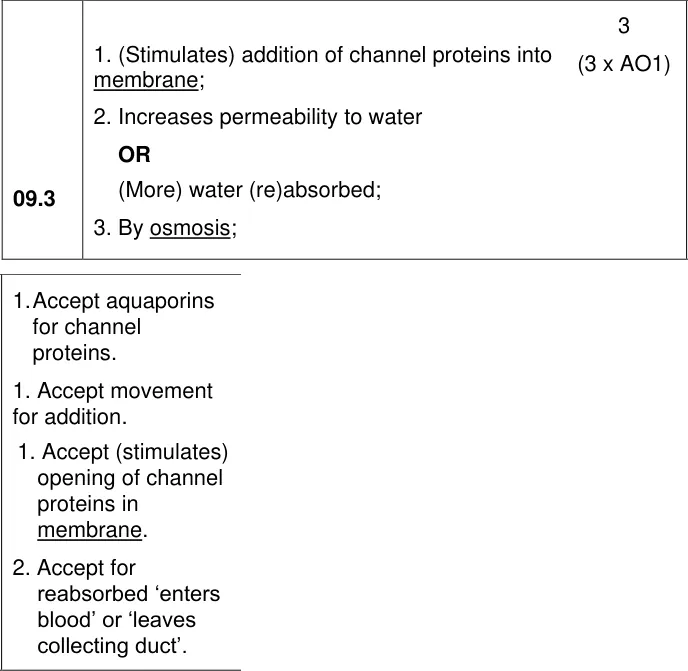
- Antidiuretic hormone (ADH): a hormone that binds to receptors in the distal convoluted tubule and collecting duct and causes channel proteins (aquaporins) to be added to the membrane, increasing permeability to water.
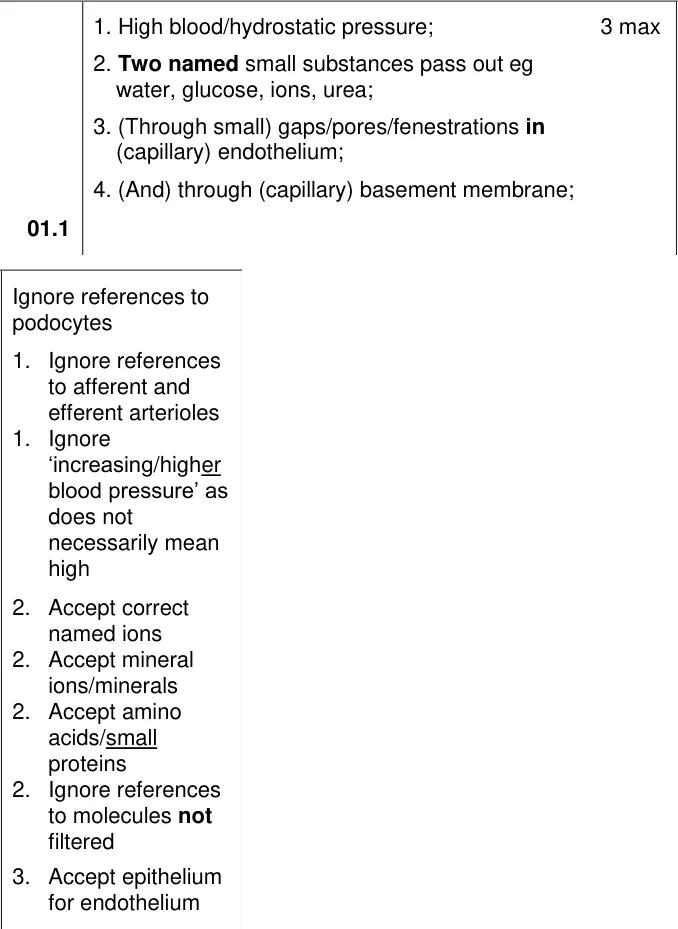
- Ultrafiltration: high blood (hydrostatic) pressure in the glomerulus forces small substances such as water, glucose, ions and urea through gaps in the capillary endothelium and the basement membrane into the Bowman's capsule.
- Basement membrane: the layer between the capillary endothelium and the capsule that stops large molecules such as plasma proteins entering the filtrate.
- Glomerular filtrate: the fluid that enters the nephron from the glomerulus; it contains no plasma proteins or cells.
- Proximal convoluted tubule: where all the glucose and most of the water are reabsorbed; its cells have microvilli, many mitochondria and many carrier proteins for co-transport.
- Loop of Henle: a loop in the medulla that actively transports sodium ions out of the ascending limb, making a sodium ion gradient so water can leave the filtrate by osmosis.
- Collecting duct: the last part of the nephron, running through the medulla, where water is reabsorbed by osmosis under the control of ADH.
What these questions cover (AQA 3.6.4.3)
The questions test these statements from the AQA AS and A-level Biology specification (7401/7402):
- Osmoregulation: Osmoregulation as control of the water potential of the blood.
- Hypothalamus, posterior pituitary and ADH: The roles of the hypothalamus, posterior pituitary and antidiuretic hormone (ADH) in osmoregulation. (no written question asks about osmoreceptors in the hypothalamus, so learn how they detect a fall in blood water potential from your notes)
- The nephron and glomerular filtrate: the formation of glomerular filtrate (the glomerular sclerosis evaluation is included here because it is about protein crossing into the filtrate)
- The proximal convoluted tubule: reabsorption of glucose and water by the proximal convoluted tubule
- The loop of Henle: maintaining a gradient of sodium ions in the medulla by the loop of Henle
- Distal convoluted tubule and collecting ducts: reabsorption of water by the distal convoluted tubule and collecting ducts.
How to use this page
Write your answer on paper before you open the mark scheme. Allow about 1.3 minutes per mark: the 14 questions are worth 35 marks, so about 46 minutes in total. Then mark your answer strictly against the mark scheme and read the examiners' tip underneath it. If you'd rather print the questions, download the PDF pack.
ADH and osmoregulation (3.6.4.3)
Question 1
A level Paper 2 · June 2022 · Q09.1 · 1 mark · Hard
Name the part of the body that releases ADH into the blood.

Show the mark scheme
Tap an image to open it full size.
From the examiners' report: Only 30% got this. 'Pituitary' without 'posterior' didn't score, and the hypothalamus makes ADH but doesn't release it into the blood.
Question 2
A level Paper 2 · June 2022 · Q09.2 · 2 marks · Easy
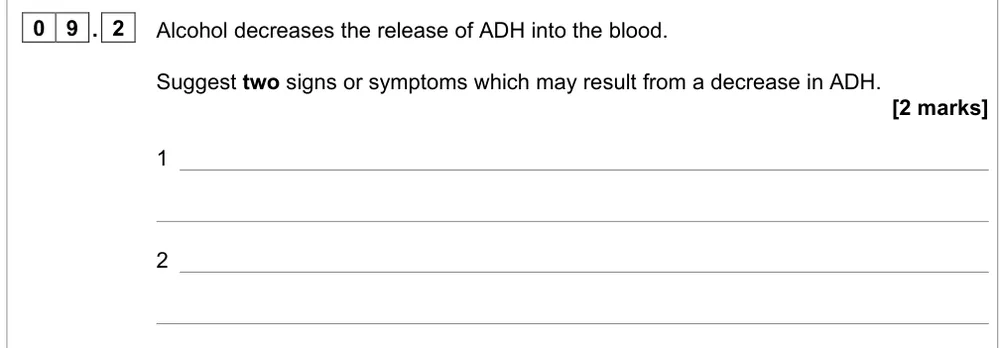
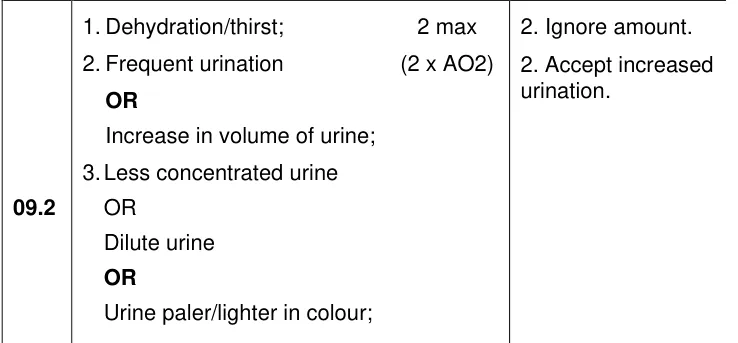
Suggest two signs or symptoms of a decrease in ADH after drinking alcohol.
Show the mark scheme
Tap an image to open it full size.
From the examiners' report: About 47% got both. Less ADH means less water reabsorbed, so think dilute urine and more of it. Don't give the opposite (concentrated urine) or general effects of alcohol such as headaches.
Question 3
A level Paper 2 · June 2023 · Q06.2 · 1 mark · Medium
Name the two parts of a nephron with ADH receptors.
Show the mark scheme

Tap an image to open it full size.
From the examiners' report: About 42% got this and 9% left it blank. Most named the collecting duct; pair it with the distal convoluted tubule written in full, as 'DCT' isn't accepted.
Question 4
A level Paper 2 · June 2022 · Q09.3 · 3 marks · Medium
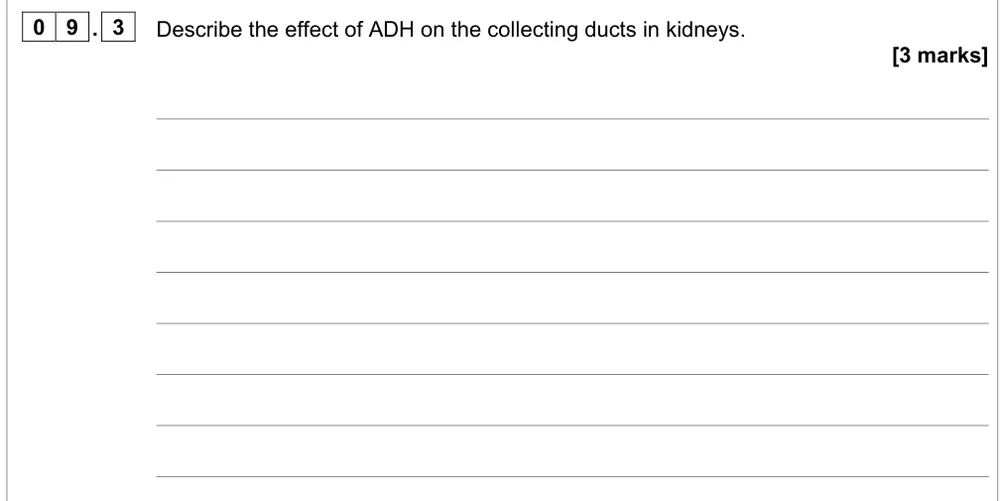
Describe the effect of ADH on the collecting ducts.
Show the mark scheme
Tap an image to open it full size.
From the examiners' report: Only 23% got all three. Put the aquaporins into the membrane, send water out of the collecting duct back into the blood, and say 'by osmosis'.
Ultrafiltration in the glomerulus (3.6.4.3)
Question 5
A level Paper 3 · June 2019 · Q01.1 · 3 marks · Medium
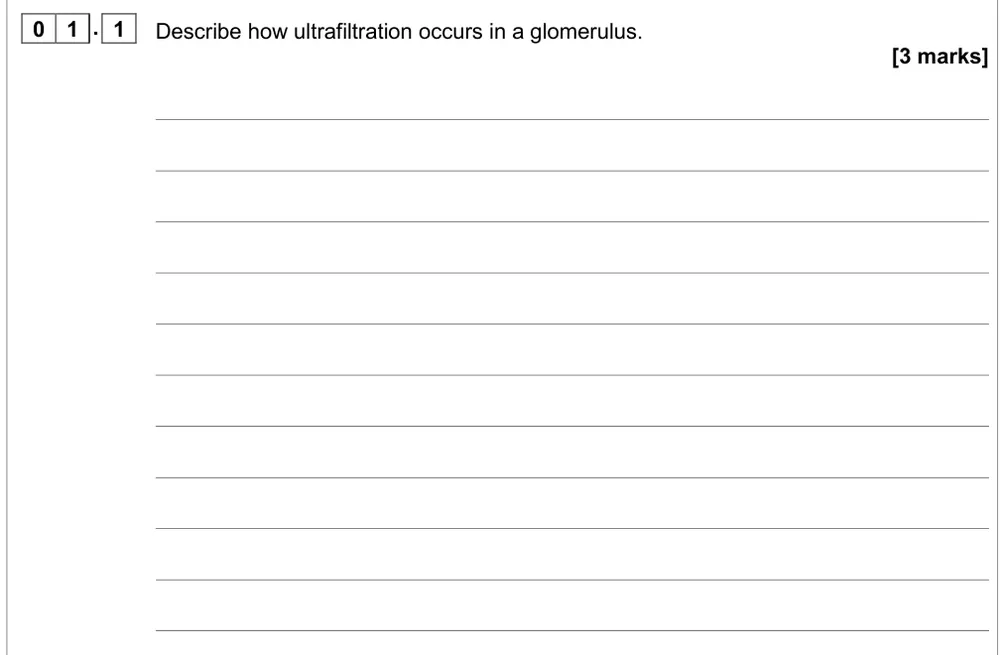
Describe how ultrafiltration occurs in a glomerulus.
Show the mark scheme
Tap an image to open it full size.
From the examiners' report: Only about 10% got all three. Say the blood pressure is high (not just higher), name two small substances, and take them through gaps in the endothelium and the basement membrane. Leave the arterioles out.
Question 6
A level Paper 3 · June 2025 · Q02.2 · 2 marks · Medium
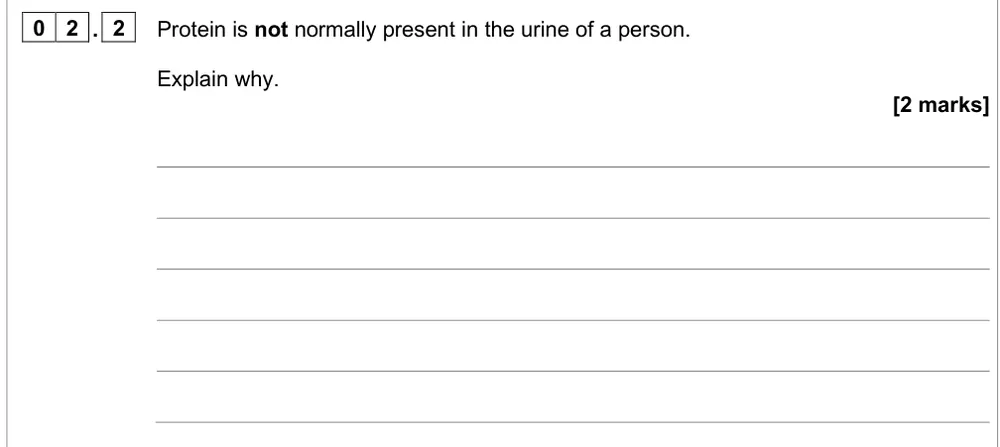
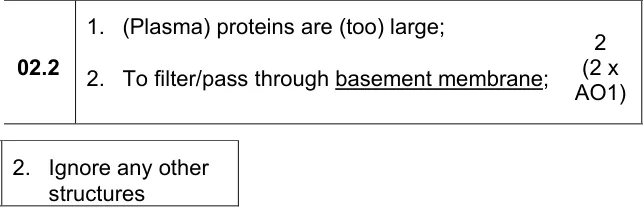
Explain why protein is not normally found in urine.
Show the mark scheme
Tap an image to open it full size.
From the examiners' report: About 35% got both. Name the basement membrane; 'membrane', capillary or endothelium alone didn't get the second mark. There are proteins in the blood, so don't say they've all been digested.
Question 7
A level Paper 2 · November 2020 · Q08.1 · 2 marks · Hard
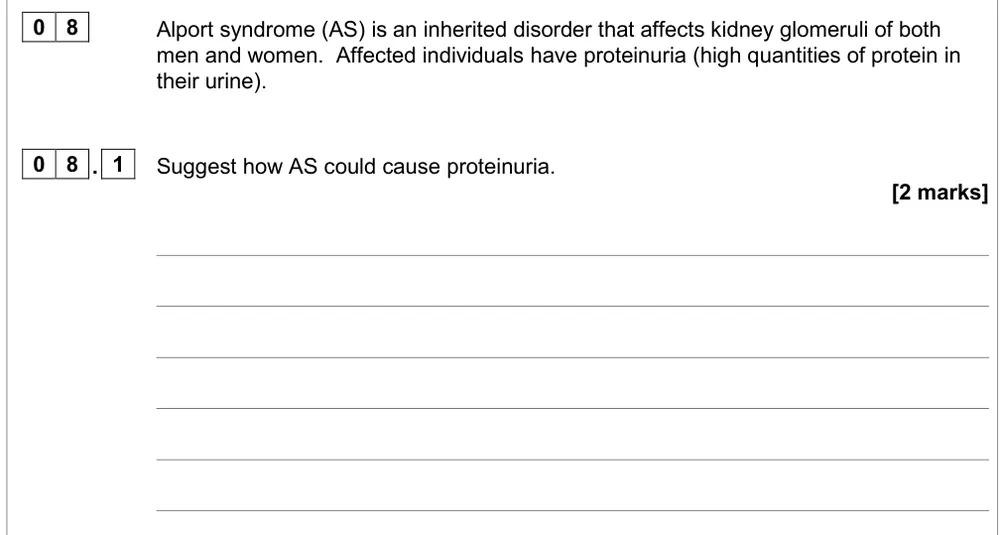
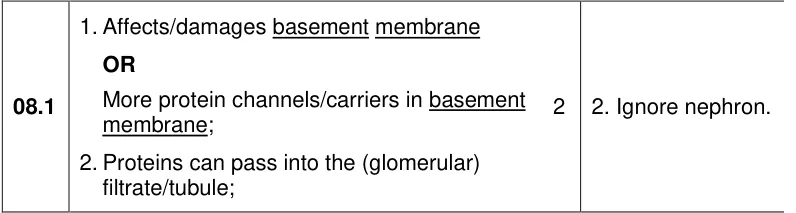
Suggest how Alport syndrome, which affects glomeruli, could cause protein in the urine.
Show the mark scheme
Tap an image to open it full size.
From the examiners' report: Only 8% got both. The problem is at the glomerulus: a damaged basement membrane lets proteins into the filtrate. Proteins aren't normally reabsorbed later in the nephron, because they never get in.
Reabsorption in the proximal convoluted tubule (3.6.4.3)
Question 8
A level Paper 2 · June 2023 · Q06.1 · 3 marks · Hard
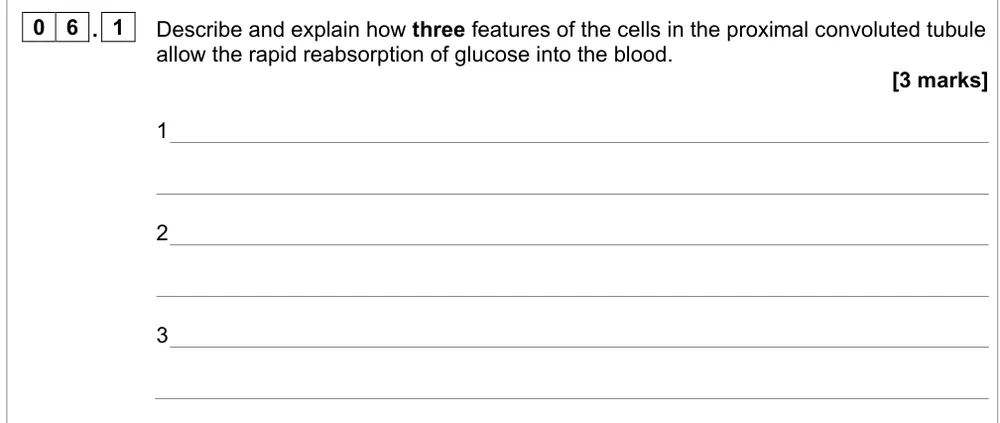
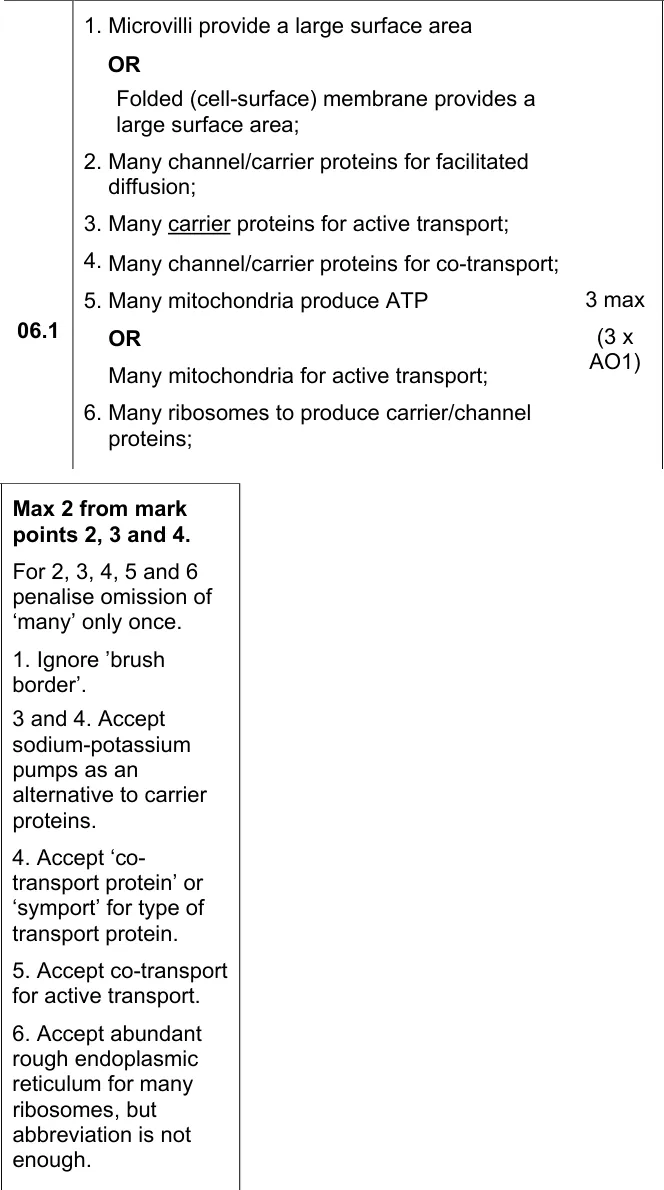
Describe and explain three features of proximal convoluted tubule cells for rapid glucose reabsorption.
Show the mark scheme
Tap an image to open it full size.
From the examiners' report: Only 11% got all three. Pair each feature with what it does, and say 'many' carrier proteins and 'many' mitochondria. Describe the cells, not the tubule, and don't confuse microvilli with villi.
Question 9
A level Paper 2 · November 2021 · Q05.3 · 3 marks · Hard
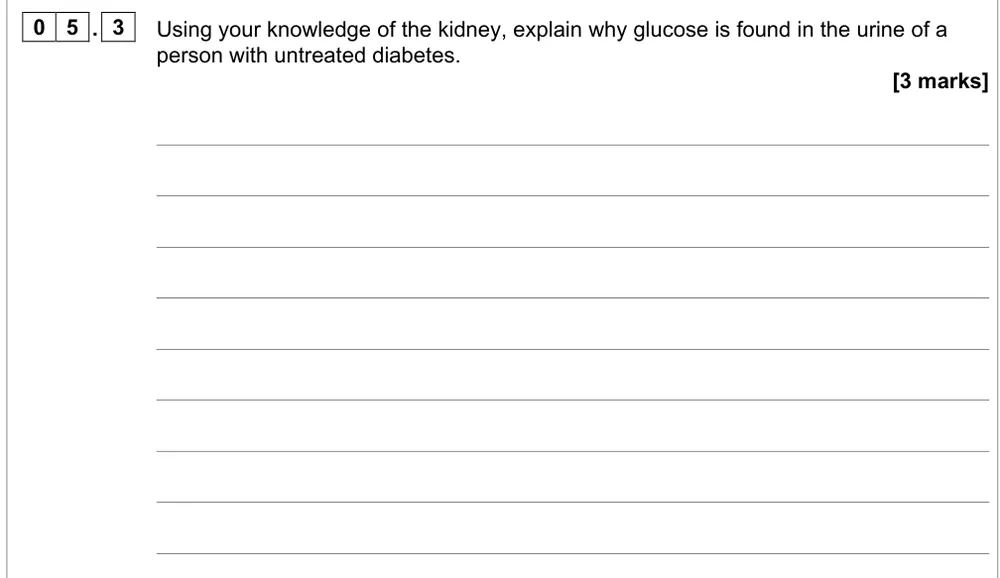
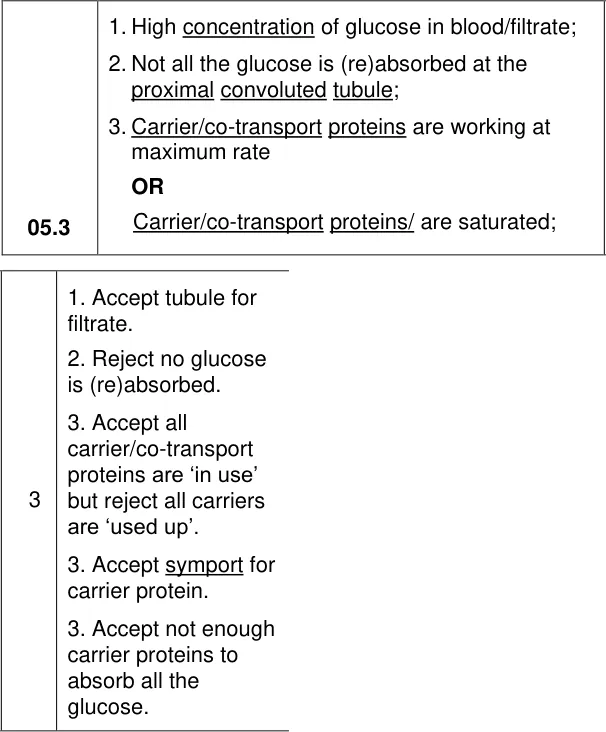
Explain why glucose is found in the urine of a person with untreated diabetes.
Show the mark scheme
Tap an image to open it full size.
From the examiners' report: Fewer than 3% got all three. Write 'high concentration', not 'high level', name the proximal convoluted tubule in full, and say not all (not no) glucose is reabsorbed because the carriers are saturated.
The loop of Henle and water reabsorption (3.6.4.3)
Question 10
A level Paper 3 · June 2019 · Q01.4 · 3 marks · Hard
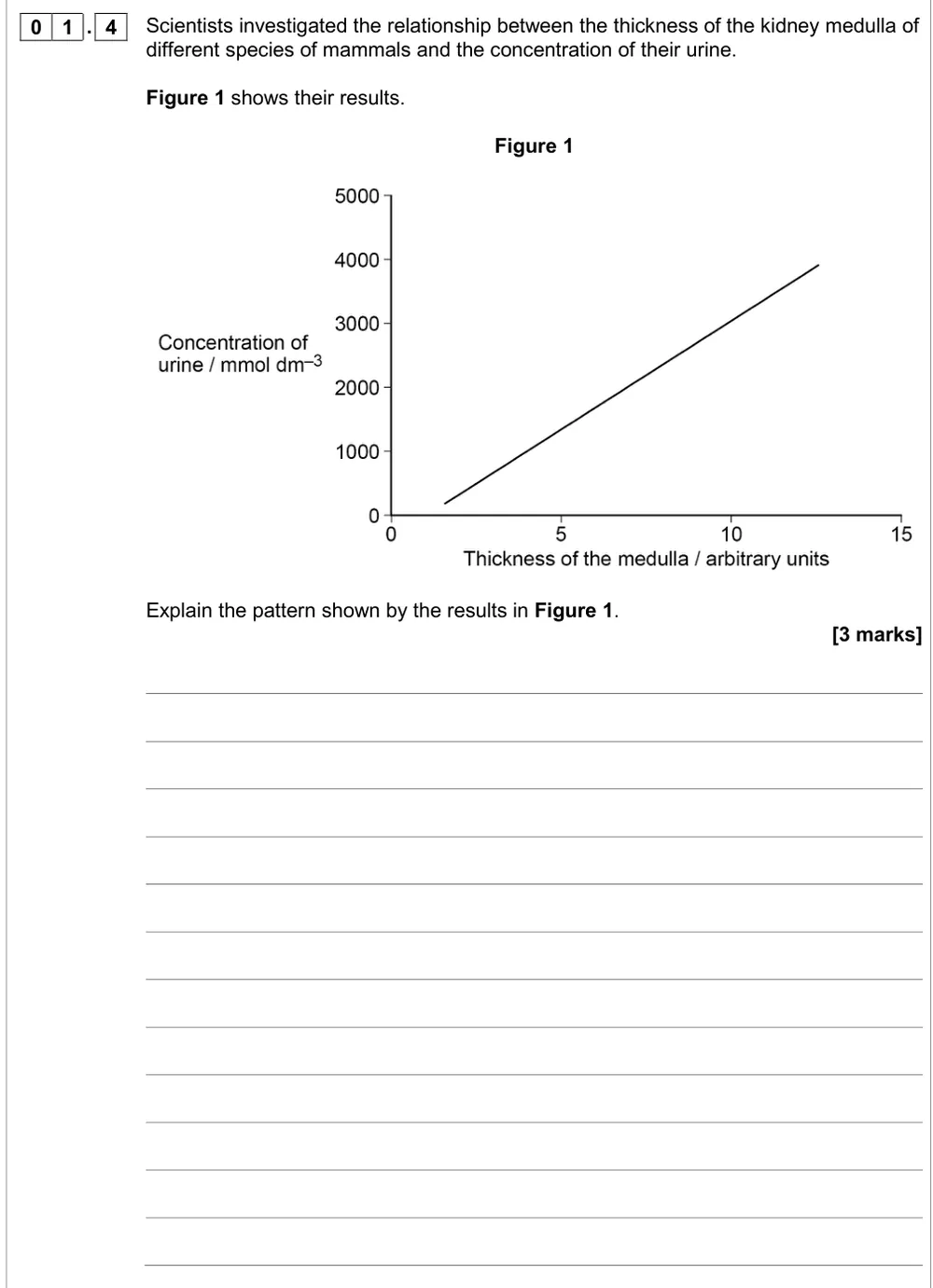
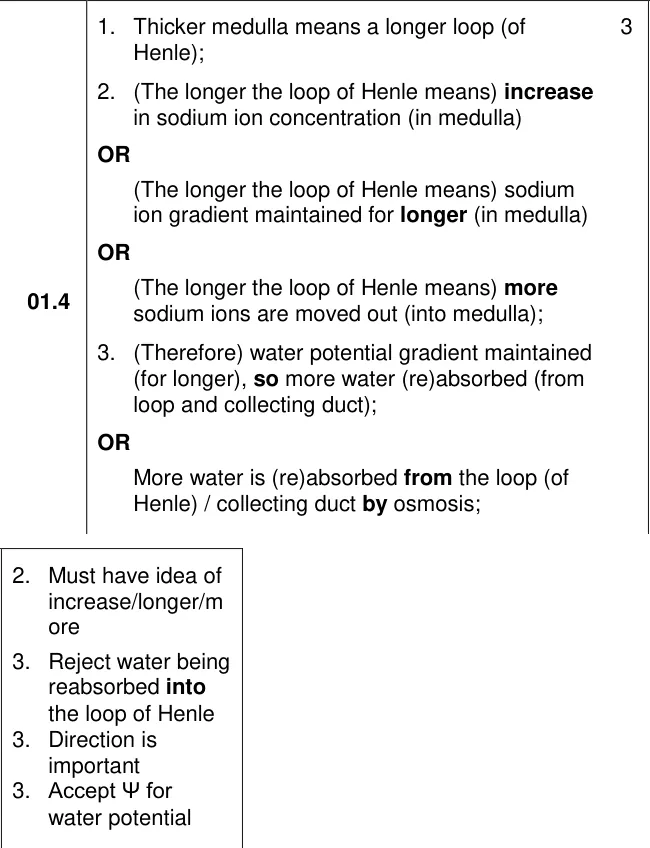
Explain why mammals with a thicker kidney medulla produce more concentrated urine.
Show the mark scheme
Tap an image to open it full size.
From the examiners' report: Only about 2% got all three. The loop of Henle is in the medulla, so link thickness to loop length, then to more sodium ions in the medulla, then to more water leaving the collecting duct by osmosis.
Investigating kidney function (3.6.4.3)
Question 11
A level Paper 2 · June 2018 · Q05.1 · 2 marks · Hard
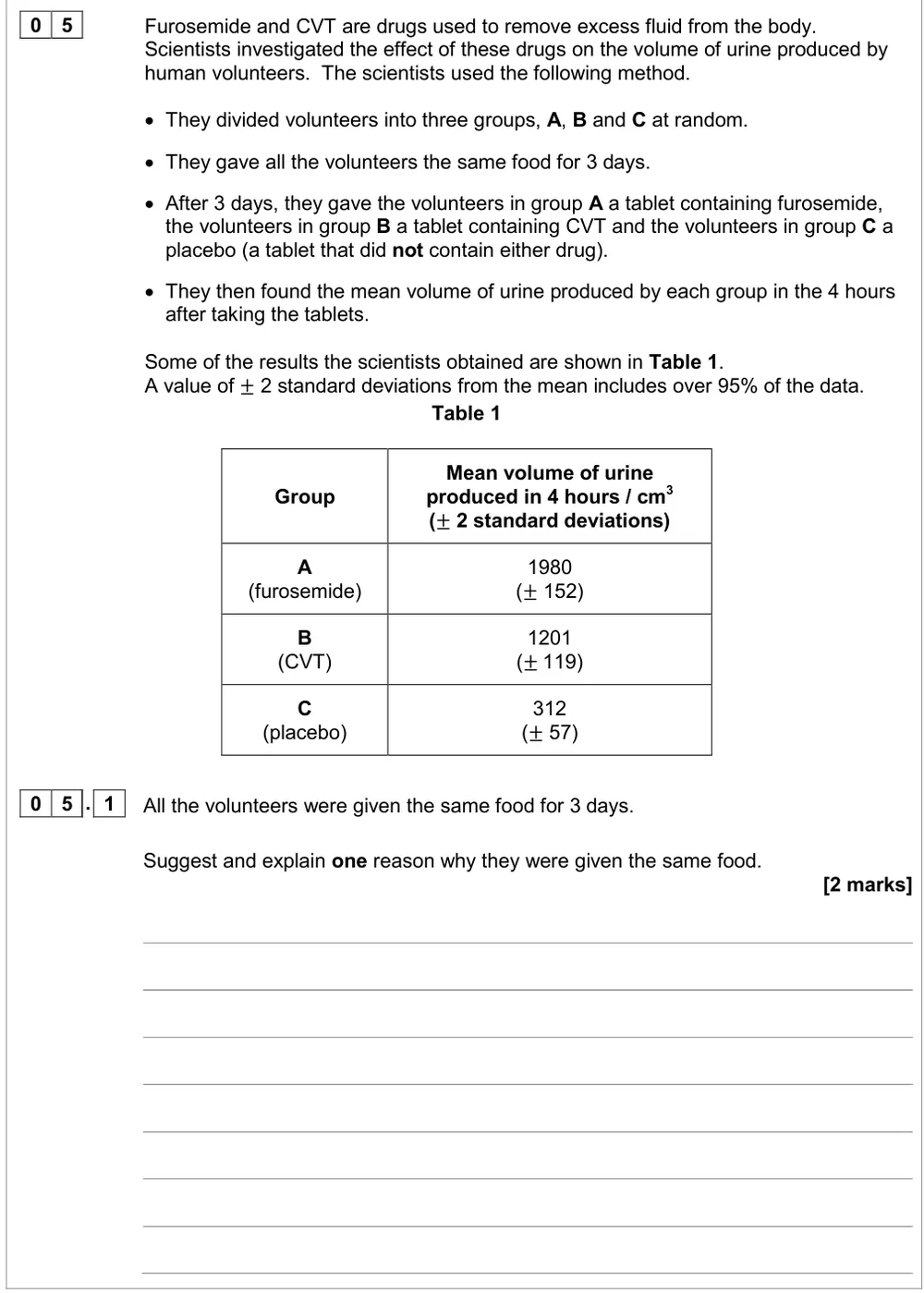
Suggest why volunteers in a diuretic drug trial were all given the same food.
Show the mark scheme

Tap an image to open it full size.
From the examiners' report: About 50% scored zero and only 7% got both. 'Fair test' or 'controlling variables' isn't enough: say the water, salt or glucose in food changes the water potential of the blood, which changes the volume of urine.
Question 12
A level Paper 2 · June 2018 · Q05.4 · 3 marks · Medium
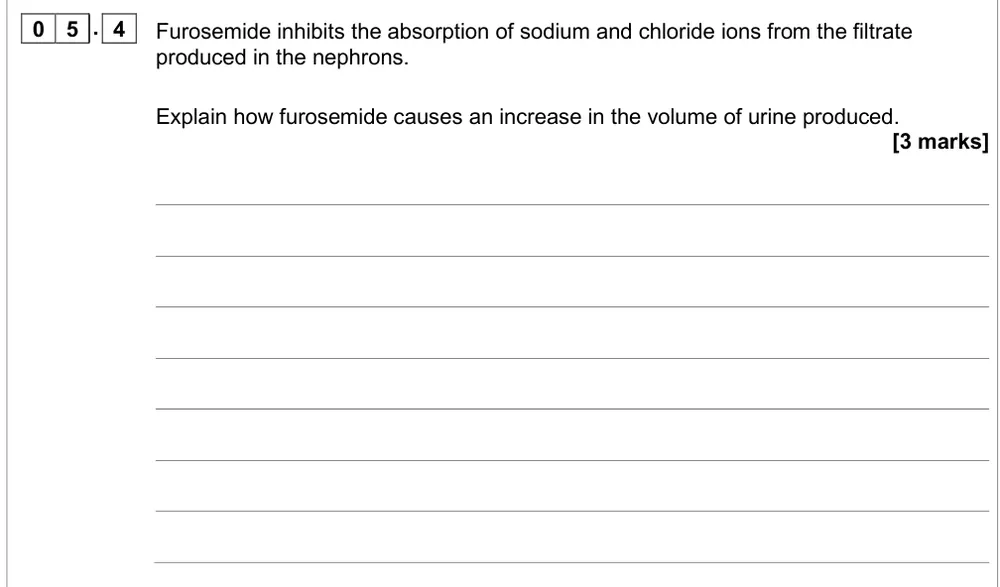
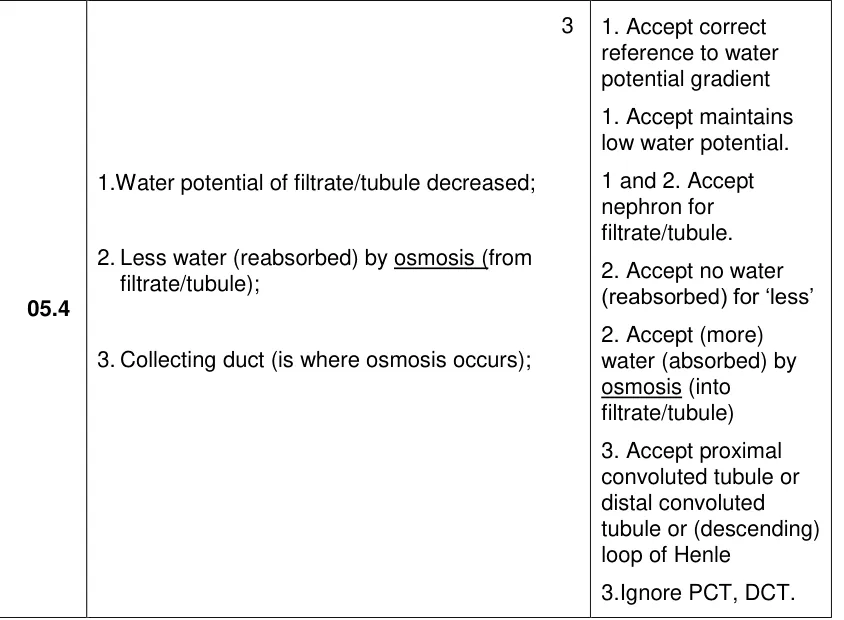
Explain how a drug that stops sodium and chloride ion reabsorption increases urine volume.
Show the mark scheme
Tap an image to open it full size.
From the examiners' report: About 27% scored zero. The ions stay in the filtrate, so its water potential is lower and less water leaves by osmosis. Say 'water', not 'fluid', and name where it happens, such as the collecting duct.
Question 13
A level Paper 2 · June 2018 · Q05.2 · 2 marks · Easy
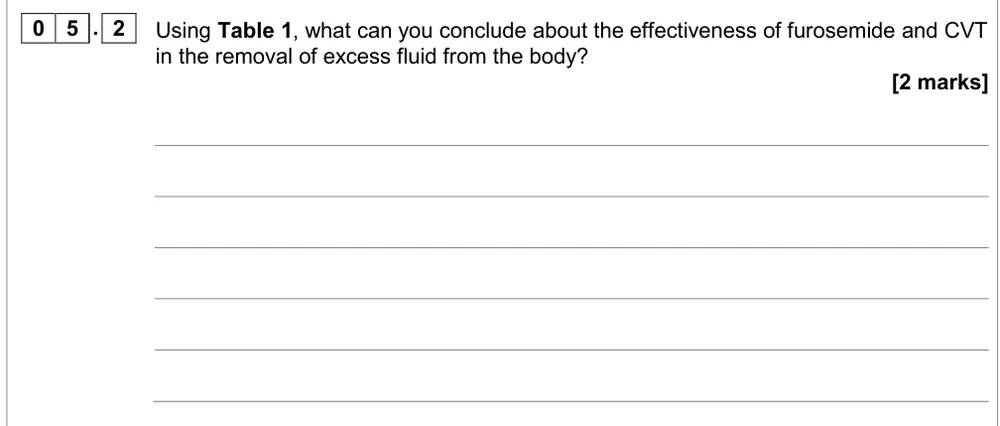
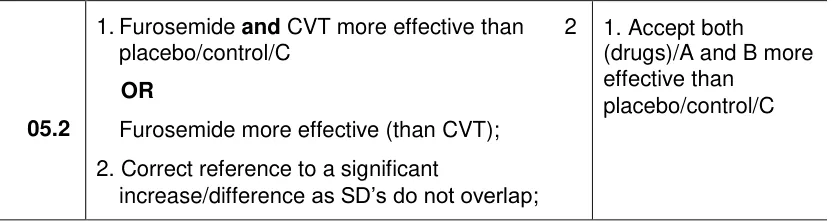
Use means and standard deviations to compare two diuretic drugs.
Show the mark scheme
Tap an image to open it full size.
From the examiners' report: 94% got a mark but only about 35% got the second. Say the SDs don't overlap, so the difference is significant; comparing the size of the SDs or talking about ranges didn't score.
Question 14
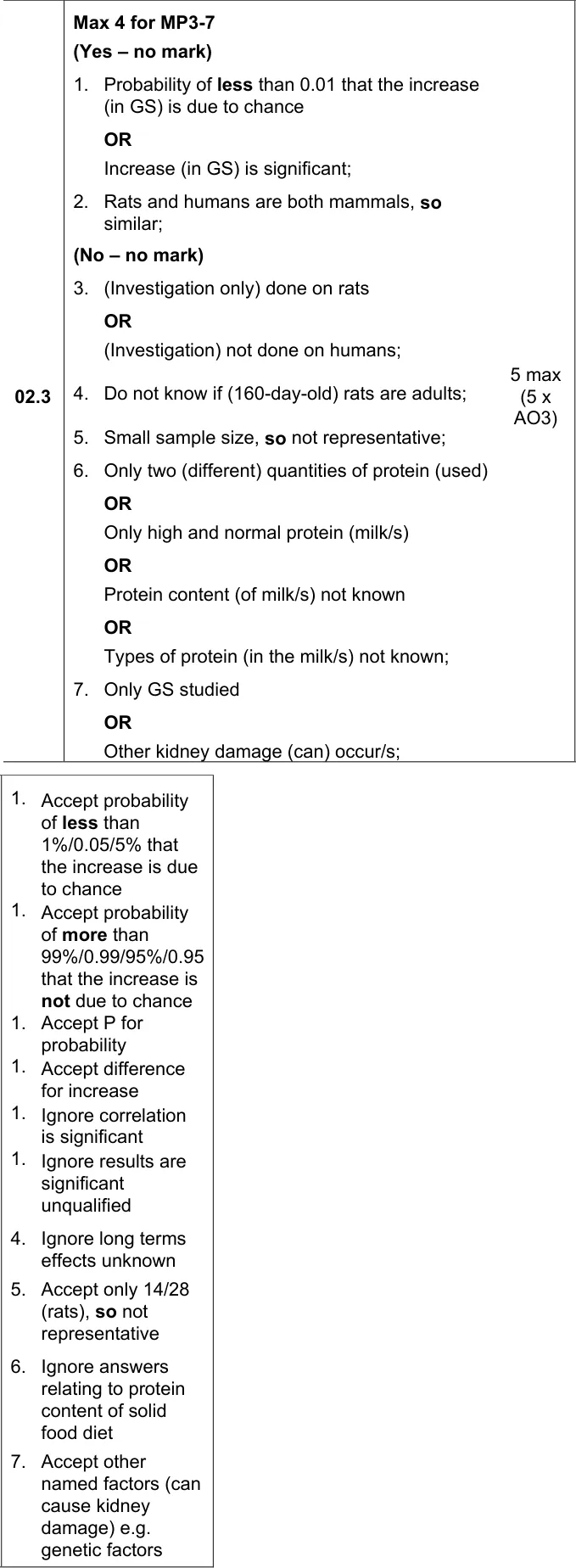
A level Paper 3 · June 2025 · Q02.3 · 5 marks · Medium
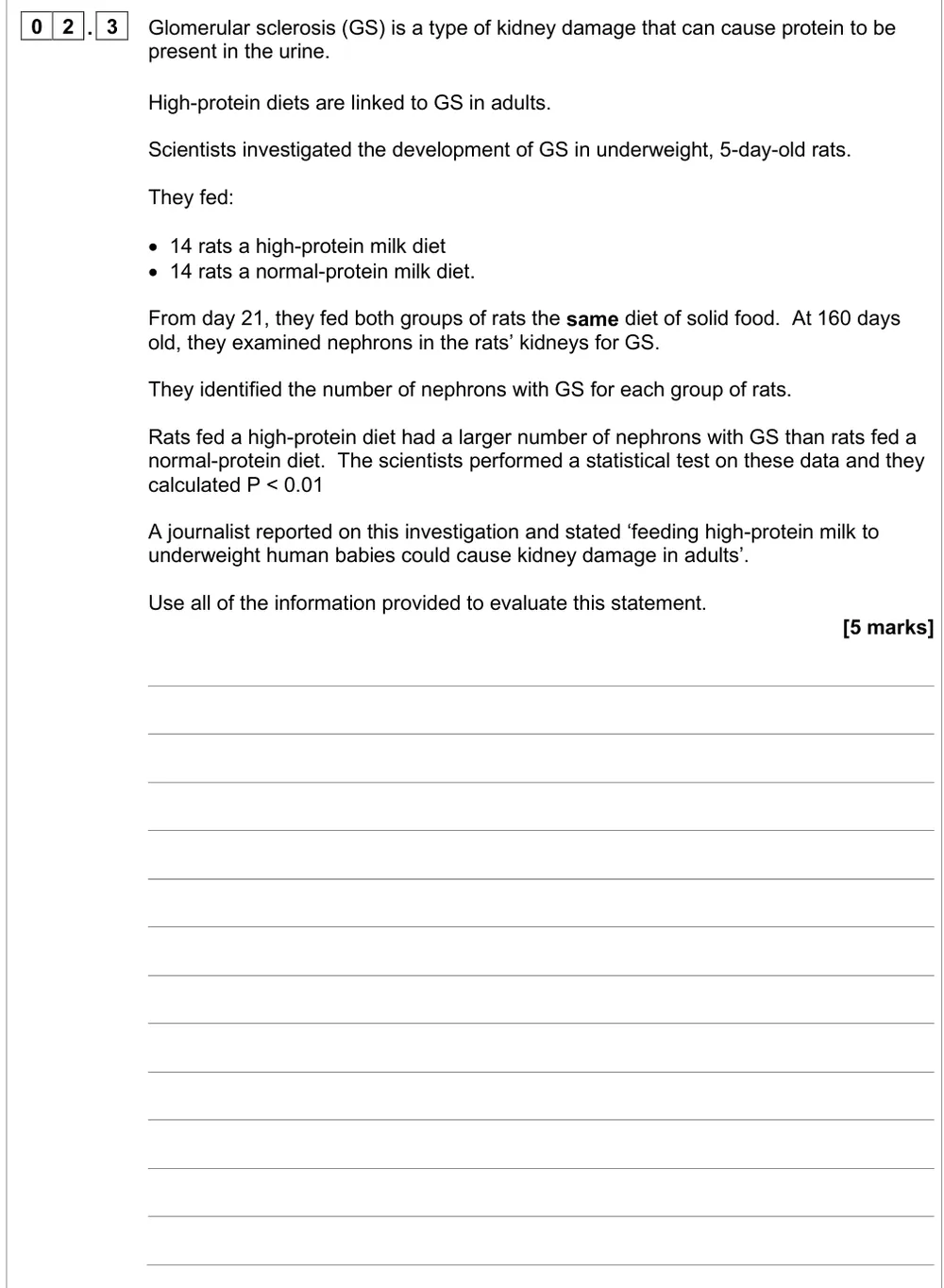
Evaluate a claim that high-protein milk for babies could cause kidney damage in adults.
Show the mark scheme
Tap an image to open it full size.
From the examiners' report: Fewer than 1% got all five. Interpret P < 0.01 as less than a 1% probability the difference is due to chance, and add 'so not representative' to the small sample. Use the details given, such as 160-day-old rats.
Where students lose marks (from AQA examiners' reports and mark schemes)
Each point below is followed by wording that gained marks.
Posterior pituitary, not the hypothalamus: Only 30% named the part of the body that releases ADH into the blood. The two most common errors were leaving out 'posterior' or naming the hypothalamus, which makes ADH but doesn't release it.
✔ Gains credit: "Posterior pituitary."
Water leaves the collecting duct, by osmosis: Only 23% got all three on the effect of ADH. A significant number sent water into the collecting duct, many named aquaporins without saying they go into the membrane, and many left out osmosis.
✔ Gains credit: "Addition of channel proteins (aquaporins) into the membrane; increases permeability to water; water reabsorbed by osmosis."
High blood pressure, then gaps and the basement membrane: Only about 10% got all three on ultrafiltration and nearly a third scored zero. Many described the afferent and efferent arterioles, which aren't part of the glomerulus, said pressure 'increases' instead of being high, or wrote 'small molecules' without naming two.
✔ Gains credit: "High blood or hydrostatic pressure; water and glucose pass out; through gaps in the capillary endothelium; and through the basement membrane."
Protein in urine got into the filtrate: Only 8% got both marks on Alport syndrome. The common misconception was that protein in the urine means proteins weren't reabsorbed; students who mentioned the basement membrane nearly always got both marks.
✔ Gains credit: "Damages the basement membrane; proteins can pass into the glomerular filtrate."
Glucose in urine means saturated carriers: Fewer than 3% got all three on glucose in the urine in diabetes. Students wrote 'high level' instead of high concentration, 'PCT' instead of proximal convoluted tubule, or 'no glucose is reabsorbed' instead of not all of it.
✔ Gains credit: "High concentration of glucose in the filtrate; not all the glucose is reabsorbed at the proximal convoluted tubule; carrier (co-transport) proteins are saturated."
Many mitochondria, many carriers, and say what each does: Only 11% got all three on features of proximal convoluted tubule cells. Naming transport proteins without their role, or leaving out 'many', lost marks, and some described villi or 'one cell thick' instead of features of the cells.
✔ Gains credit: "Microvilli provide a large surface area; many carrier proteins for co-transport; many mitochondria produce ATP for active transport."
A thicker medulla means a longer loop of Henle: Only about 2% got all three on medulla thickness and urine concentration. Many talked about a longer diffusion pathway, said 'ions' instead of sodium ions, or had water moving into the loop instead of out of it.
✔ Gains credit: "Thicker medulla means a longer loop of Henle; increase in sodium ion concentration in the medulla; more water reabsorbed from the loop and collecting duct by osmosis."
Food changes blood water potential, not just the 'fair test': About 50% scored zero and only 7% got both marks on why the volunteers ate the same food. 'To make it a fair test' didn't score; the best answers said food affects the water potential of the blood, and 'amount of urine' lost the second mark.
✔ Gains credit: "Affects the water potential of the blood; affects the volume of urine produced."
Download the questions
Download the PDF pack (14 questions, mark schemes at the end)
Keep practising
- Homeostasis and blood glucose: AQA A Level Biology exam questions by topic
- AQA 3.6.4.3 kidney: self-marking quiz
- Transport across cell membranes: AQA A Level Biology exam questions by topic
- Blood vessels and tissue fluid: AQA A Level Biology exam questions by topic
- AQA A Level Biology masterclasses
Questions, mark schemes and examiners' report extracts © AQA.